Home Blog Page 6918

Yields on government debt end mixed

YIELDS ON government securities (GS) ended mixed last week following a sell-off in US Treasuries as traders priced in more aggressive interest rate hikes by the Federal Reserve.

GS yields, which move opposite to prices, went up by a week-on-week average of 5.01 basis points (bps), the PHP Bloomberg Valuation Service Reference Rates published on the Philippine Dealing System’s website as of Jan. 21 showed.

Tenors at the short end of the curve fell at the end of trading on Friday. Yields on the 91-, 182- and 364-day Treasury bills dropped by 6.55 bps, 2.67 bps, and 3.36 bps to 0.8783%, 1.0979% and 1.4473%, respectively.

Meanwhile, the belly of the curve increased as the rates of the two-, three-, four-, five-, and seven-year Treasury bonds (T-bonds) jumped by 9.17 bps (to 2.4090%), 9.29 bps (3.0586%), 8.66 bps (3.6520%), 7.03 bps (4.1220%), and 3.56 bps (4.6504%), respectively.

The long end of the curve also climbed. The 10-, 20-, and 25-year debt saw their yields rise by 13.3 bps (to 4.9573%), 8.15 bps (5.0894%), and 8.56 bps (5.0808%), respectively.

“Yields were mixed in the previous week with belly and longer securities drifting higher amid US Treasuries’ sell-off streak,” First Metro Asset Management, Inc. (FAMI) said in an e-mail.

“Markets priced in faster US Federal Reserve (US Fed) hikes in line with persistently high inflation sending US 10-year to its highest yield since January 2020.”

FAMI added that proceeds from the fixed-rate Treasury note 10-54 that matured recently helped temper the sell-off in local bonds amid rising US yields.

Meanwhile, a bond trader attributed last week’s yield movement to growing views of more aggressive rate hikes from the Fed this year as well as inflationary concerns after international crude prices returned to their November peak levels.

“The upward movement was mostly observed in the belly of the curve and long-term yields as these drivers are highly seen to exert pressures on domestic inflation,” the trader said in an e-mail interview.

“Short-term yields, however, dropped after BSP (Bangko Sentral ng Pilipinas) Governor [Benjamin E.] Diokno remained fairly dovish in his latest policy signals,” the trader added.

Yields on US Treasuries rose last week as traders adjusted to the possibility that the Fed will hike rates more aggressively to temper rising inflation, Reuters reported.

Benchmark 10-year US note yields reached 1.902% in overnight trading on Wednesday, highest in two years or since January 2020.

The Fed is scheduled to meet on Jan. 25-26, which could provide additional clues for an interest rate hike as early as March.

Meanwhile, the BSP chief signaled that a rate hike in the first half of the year may not be possible as the central bank wants to wait for a firmer economic recovery and for unemployment to fall.

For this week, the bond trader said local yields might move with an upward bias as the Fed is expected to make more hawkish statements after its policy meeting this week.

“However, the increase in GS yields might be limited due to some caution ahead of the Philippine GDP (gross domestic product) report and lingering concerns over the local COVID-19 situation. Market participants remained fixated on the potential policy cues from the US Federal Reserve while closely monitoring the local COVID-19 situation,” the bond trader added.

For FAMI, the liquidity from the maturing five-year papers will keep support for the front end and belly of the curve.

“Meanwhile, longer bonds will continue to be subjected to developments in global bonds space until we have stronger catalysts in the local front.”

The Philippine Statistics Authority is scheduled to report fourth-quarter and full-year 2021 GDP data on Jan. 27. — Lourdes O. Pilar


Fresh produce risks getting more scarce with US jabs

REUTERS

FOOD SHORTAGES already seen at grocery stores across the US risk getting worse as the country begins mandating vaccinations from truck drivers coming from Mexico and Canada.

The mandate starting Jan. 22 requires truckers and other essential workers who aren’t US citizens crossing into the country to be vaccinated. Canada made a similar move beginning Jan. 15, and it has caused chaos for the country’s fruit and vegetable markets. Now the produce industry is sounding the alarm that the US could experience similar headaches because of the large amount of food imported from Mexico during the winter months. In 2020, Mexico accounted for 77% of US fresh vegetable import volume. This comes at a time when the food supply chain is already seeing massive disruption.

“This will only bring more pressure in terms of bottlenecks and availability of truck drivers that are eligible to drive into the US,” said David Magana, a Rabobank senior analyst.

The mandate will also affect temporary workers who cross the border to work on farm jobs like harvesting vegetables and picking fruit. Some of these workers come from Mexico daily to jobs in places like Arizona and California for the production of leafy greens at this time of year, Magana said.

The US has already been struggling to put food on shelves as shipping snarls, a lack of labor and other logistical headwinds have pushed inflation up around the world. Global food inflation saw a near-record high at the end of last year as harvest setbacks and high freight rates roiled markets, though food prices have eased some. Any issues caused by this new vaccine mandate could impact availability of fresh food.

“It’s just going to continue to impact the ability to get fruit to the market, because Mexico fills an important hole in the fresh produce market,” said Curt Covington, senior director of institution credit at AgAmerica Lending, which loans money to farmers.

The Delaware-based International Fresh Produce Association (IFPA) said in an e-mailed statement that organization leadership is concerned about how the supply chain will be impacted by the mandate.

“Given the volumes of fresh fruits and vegetables that flow across North American borders, IFPA Chief Public Policy Officer Robert Guenther has already shared the association’s concerns to DHS Assistant Secretary Eva A. Millona on the impact this is going to have on the entire food supply chain, not just produce, which is already experiencing extreme challenges,” IFPA said on its website. — Bloomberg

Sotto, 36ers versus Hawks today

KAI SOTTO — ADELAIDE 36ERS

IN-FORM Kai Sotto wants no let-up in a bid to contribute anew when the Adelaide 36ers shoot for a quick rebound against the Illawarra Hawks in the Australia National Basketball League (NBL) today.

Adelaide goes on the road against Illawarra at 4:30 p.m. (Manila time) at the Win Entertainment Center with high hopes on the 7-foot-3 Filipino ace following his best game in the NBL so far.

It will be the 36ers’ third straight game in a week after being sidelined for a month marked by postponement of their five straight games due to coronavirus disease 2019 (COVID-19) protocols.

Their long layoff helped Sotto fully recover from a knee soreness injury, finally showing a glimpse of his potential with a six-point, eight-rebound outing in only 16 minutes of play against Melbourne United.

Adelaide actually absorbed a 97-78 loss, but found a renewed hope in Sotto marching midway through the season with a 3-4 card.

Illawarra, at home, however, will not be an easy nut to crack for Sotto and company with an expected extra fuel coming off a 94-78 loss to Perth.

The Hawks sport a 4-3 card at fourth place so far with Adelaide lurking at seventh spot. — John Bryan Ulanday

Q4 and full-year 2021 GDP growth estimates

THE PHILIPPINES’ gross domestic product (GDP) growth is expected to have moderated in the fourth quarter of 2021, even as the more relaxed quarantine restrictions spurred economic activity. Read the full story.

Q4 and full-year 2021 GDP growth estimates

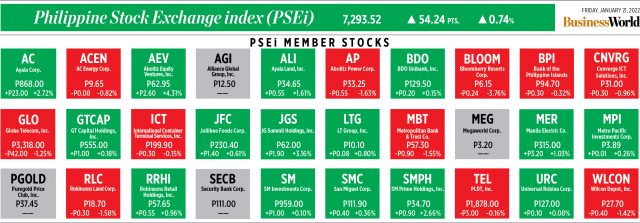
How PSEi member stocks performed — January 21, 2022

Here’s a quick glance at how PSEi stocks fared on Friday, January 21, 2022.


Growth in 2021 agriculture output ruled out due to typhoon damage

By Luisa Maria Jacinta C. Jocson

AGRICULTURE OUTPUT in 2021 is expected to contract due to damage incurred late in the year from Typhoon Odette (international name: Rai), an analyst and industry representatives said.

“With Typhoon Odette, all hopes were dashed (for) the fourth quarter of 2021,” Pampanga State Agricultural University Professor Roy S. Kempis said in a Viber interview.

He estimates that farm output contracted 3-4% in the fourth quarter.

“My estimate for 2021 overall is minus 3.5% to minus 2.5%, the exact opposite projection the Department of Agriculture (DA) made early in the month of January 2021,” Mr. Kempis said.

The DA set an agricultural output growth target for 2021 of 2%, downgrading its original 2.5% target.

In the third quarter, agricultural output declined 2.6% at constant 2018 prices due to weak crop, livestock, and fisheries production. In the fourth quarter of 2020, output contracted by 3.8%.

“The P13.3 billion worth of losses in agriculture due to Typhoon Odette, compared to the P1.36 billion in losses due to Typhoon Jolina in the third quarter is (significantly) bigger.  If third quarter performance was minus 2.6%, a higher contraction is projected for the fourth quarter,” Mr. Kempis said.

Crop damage caused by Odette hit P13.3 billion, affecting 533,709 farmers and fisherfolk across 462,766 hectares of agricultural land, with the volume of lost production at 273,062 metric tons (MT), according to the DA.

Federation of Free Farmers National Manager Raul Q. Montemayor said that hitting the growth target for the year will be difficult, estimating that fourth quarter output must rise by at least 14% in order to hit the DA’s target.

“This kind of growth has never happened. Most probably, agricultural output had a negative growth rate in 2021 even without taking into account the effects of the typhoons,” Mr. Montemayor said in a Viber message.

“To hit 0% annual growth in 2021 versus 2020, fourth quarter gross value added (GVA) must be P525.4 billion, which is 7% over the fourth quarter GVA in 2020.  To hit the DA’s target of 2% annual growth, GVA in the fourth quarter must be P561.2 billion, which is 14% over the fourth quarter GVA in 2020,” he said.

“(It is) practically impossible to get even 7% growth in the fourth quarter to end up with just 0% growth for 2021,” he added. “But since fourth quarter GVA in 2020 was historically very low, it is possible that fourth quarter output in 2021 will be slightly better.  But even if that happens, the fourth quarter output will still be lower than in 2018.”

Aside from typhoon losses, the estimated contraction could be due to the government continuing to allow imports in order to augment local supply.

“Everything will be starting from a low base, so normally there would be some growth. However, DA import policies will be a continuing albatross on the affected sectors thereby derailing or stifling any meaningful, especially inclusive growth,” United Broiler Raisers Association President Elias Jose M. Inciong said in a Viber message.

“The damage wrought by Typhoon Odette will aggravate the negative impact of such policies. Of course, these are all on top of the ravages of COVID-19,” he added.

The Philippine Statistics Authority is scheduled to release its fourth quarter and full-year estimate for agriculture output on Jan. 26.

ERC assures power will be sufficient during election

ANDREY METELEV-UNSPLASH

THE ENERGY Regulatory Commission (ERC) said it expects no power interruptions during the campaign, election, and canvassing period, with contracts for reserve power currently awaiting approval.

“We have been holding consultations with electricity stakeholders, primarily with the DoE (Department of Energy) and NGCP (National Grid Corp. of the Philippines), to ensure that such (a) scenario will not happen,” ERC Commissioner Floresinda B. Digal said in a Viber message to BusinessWorld.

Ms. Digal has said that NGCP has entered into firm contracts for power reserves, which are pending approval by the ERC. “We are communicating with the generators to ensure that they run their plants in accordance with existing standards to ensure efficient supply.”

She noted that the ERC is monitoring NGCP’s compliance with the DoE Circulars on ancillary services, the regulator’s term for the reserves that may be tapped should baseload supply run low.

Legislators urged the ERC to ensure continuous power during the election period, after the NGCP forecast possible red alerts on the Luzon grid between April and June.

The election is on May 9. Red alerts are raised when demand is projected to exceed supply, triggering power rationing.

Senator Ana Theresia N. Hontiveros-Baraquel urged the ERC to ensure adequate and reliable supply of electricity during and after the election to head off any doubts about the integrity of the poll result.

“We need to ensure that there will be continuous power supply in the country during the elections,” she said in a statement. “There should be strict coordination and teamwork between the DoE, the ERC, and other sectors in the power industry to resolve this perennial problem.”

House Deputy Minority Leader and Bayan Muna Rep. Carlos Isagani T. Zarate noted the NGCP’s projection as “worrisome” as red alerts might come “smack in the middle of the election period.”

He noted the yellow alerts on Jan. 10 and 11 on the Luzon grid due to forced plant shutdowns. Yellow alerts are raised when supply thins below a specified safety margin.

“Energy Secretary Alfonso (G.) Cusi claimed (the DoE has) devised plans to prevent brownouts during the elections, but apparently this is not what is happening in reality,” he said in an earlier statement, noting as well the continuing inability to supply the typhoon zones in the Visayas and Mindanao.

Ms. Hontiveros noted that in previous Senate hearings, industry representatives and the DoE had floated solutions like firm NGCP ancillary services contracts and the minimization of unplanned maintenance shutdowns on the part of the generation companies.

Ms. Digal said that consultations with key stakeholders are constantly taking place. “We already have existing mechanisms, we just have to monitor compliance of stakeholders,” she added. — Alyssa Nicole O. Tan

Debt service bill triples in Nov. to P81.24 billion

BW FILE PHOTO

THE National Government made debt service payments in November amounting to P81.24 billion, or triple the year-earlier total, after amortization payments surged, according to preliminary data from the Bureau of the Treasury.

Amortization payments accounted for 61.6% of the total debt service bill, after they increased by more than seven times to P50 billion in November.

Principal payments to foreign creditors that month amounted to P6.95 billion, while those to domestic lenders totaled P43.07 billion.

Meanwhile, interest payments were up 55.83% at P31.22 billion in November.

Interest paid on domestic debt totaled P27.55 billion, up 72.8% year on year.

These payments consisted of P18.24 billion for fixed-rate treasury bonds, P7.94 billion for retail Treasury bonds, and P1.36 billion for Treasury bills.

Interest paid on external debt, in contrast, dropped 10.17% year on year to P3.68 billion.

The government borrows from foreign and local sources to plug its budget deficit as it spends more than it makes to support programs that will stimulate economic growth.

In the 11 months to November, the debt service bill rose 27.6% from a year earlier to P1.13 trillion.

Amortization payments in the period grew by 37% to P732 billion.

On the other hand, interest payments as of November rose 13.24% to P402 billion.

The National Government’s gross borrowings hit P2.78 trillion at the end of November as it continued to raise funds for its pandemic response.

In November, the Treasury borrowed P26.7 billion. — Jenina P. Ibañez

Legislators hopeful of House approval for water dep’t measure 

By Jaspearl Emerald G. Tan

LEGISLATORS expressed hope that the House of Representatives will approve a bill seeking to create a water management department, after the bill hurdled committee-level evaluation.

Trade Union Congress of the Philippines Rep. Raymond Democrito C. Mendoza said House Bill (HB) 9948 or the proposed National Water Act, which is signed will create a Department of Water Resources, is now in a form that has passed scrutiny from four House committees. He said he hopes it will be approved at the next plenary session.

Mr. Mendoza, who co-authored the bill, said the measure has gone through the Government Reorganization, Public Works and Highways, Ways and Means, and Appropriations committees.

“With Committee Report No. 1115, approved by the various Committees, I believe we have achieved the best version of the many bills filed in 2019,” he told BusinessWorld in an e-mail.

“I hope that the efforts will not be in vain and that approval at the plenary is inevitable.”

Magsasaka Party-list Rep. Argel Joseph T. Cabatbat, also a co-author, said in an e-mail, “We are optimistic that the House will line this up as one of the priority bills to be passed before Congress ends.”

He noted that HB 9948 was a combination of 35 separate bills and that it had “garnered massive support from one hundred forty-four House members.”

Another co-author, Parañaque Rep. Joy Myra S. Tambunting, said the measure aims to establish an Integrated Water Resource Management system to govern policymaking and planning at the national level.

Ms. Tambunting added that the bill will address water shortages by encouraging “focused research and development in water treatment, sanitation and distribution.”

The bill’s other objective is to support agriculture.

Mr. Cabatbat said one of the problems in agriculture is lack of irrigation and insufficient water allocations for rural areas.

“Once we establish a lead agency that will secure the water supply, including in agricultural areas, we expect that it can gradually address the mismanagement of water resources for irrigation that will eventually help improve the yield of our crops,” he said.

The Magsasaka representative added that the measure directs the Department of Water Resources to work with the Department of Agriculture to ensure the development of agriculture and reduce long-term pollution in both surface and groundwater.

Under the bill, the two departments are tasked with ensuring the efficient use of water, recycling or reuse, and proper wastewater treatment. It also proposes that the National Irrigation Agency be absorbed by the water department to centralize the decision-making for supplying water to agriculture.

The bill also aims to encourage the participation of the private sector by allowing the Department of Water Resources to enter into contracts and partnerships with domestic and foreign entities that invest in water projects.

“…This Department is allowed to enter into joint venture agreements, public-private partnerships or memorandums of agreement which means the creation of business design and solutions resulting in jobs,” Ms. Tambunting said.

HB 9948 is currently in the sponsorship period. A committee report on the National Water Act was filed on Aug. 9, 2021. The House of Representatives will resume its plenary sessions on Monday.

PHL files instrument of accession to Istanbul Convention

BW FILE PHOTO

THE PHILIPPINES has deposited its Instrument of Accession to the Istanbul Convention, which will help exporters access foreign markets, the Department of Foreign Affairs said on Sunday.

Philippine Ambassador to Belgium, Luxembourg, and the European Union Eduardo José A. de Vega filed the accession documents to the Istanbul Convention, formally known as the Convention on Temporary Admission, and also known as the ATA Convention, to World Customs Organization (WCO) Secretary General Kunio Mikuriya at the headquarters of the WCO in Brussels.

The convention eases the movement of goods for re-export into a customs territory of a convention signatory, by granting total or partial relief from import duties and taxes, provided that they remain for a specified period and have not undergone processing.

The goods are covered by a single document known as the ATA carnet, secured by an international guarantee system.

The Philippine Chamber of Commerce and Industry President George T. Barcelon told BusinessWorld in a Viber message that it is working with the Bureau of Customs to be accredited on the ATA carnet protocols. “We will actively participate when our papers are in order.”

“This would allow us to expand further hosting of industry, sectoral exposition, etc.,” he said. “Companies will have flexibility in documentation of imports and exports.”

The convention is expected to be beneficial for micro, small and medium enterprises, which aim to export or join international trade shows, fairs, and exhibitions.

The convention, signed by President Rodrigo R. Duterte in July 2020, will take effect on April 17.

Asked about the convention’s expected benefits, Trade Secretary Ramon M. Lopez said: “Yes. We have always supported that as it can help develop more trade activities moving forward. We also supported it when it was deliberated in the Senate. RCEP (the Regional Comprehensive Economic Partnership) has also a provision on the temporary admission of goods that is consistent with the convention.

The Philippines is set to become the 73rd contracting party to the convention. — Alyssa Nicole O. Tan

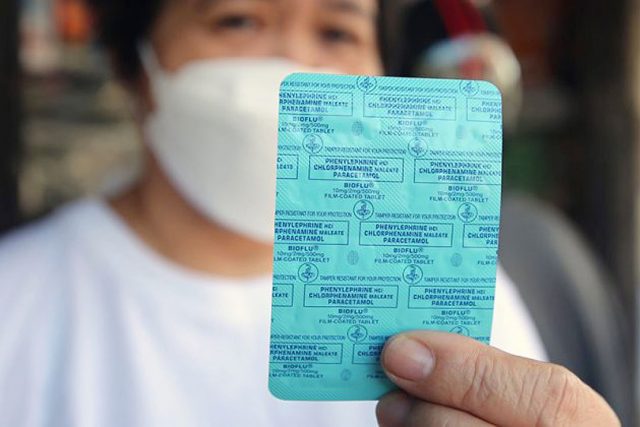
Paracetamol supply stabilizes in Metro Manila 

INTERAKSYON

THE SUPPLY of paracetamol in Metro Manila has stabilized following reports of drug store shortages earlier this month, the Department of Trade and Industry (DTI) said.

Trade Secretary Ramon M. Lopez said in a mobile phone message that supply is currently adequate following a run on the over-the-counter drug to rising coronavirus disease 2019 (COVID-19) cases and other flu-like illnesses.

“Purchase limits on paracetamol helped in normalizing the supply and demand situation. Manufacturers were able to catch up in replenishing (retail stocks) as demand wasn’t artificially bloated,” Mr. Lopez said.

In early January, some drugstores in Metro Manila reported they were out of stock of paracetamol and other treatments for flu and fever following the rise in COVID-19 cases.

The DTI and Department of Health issued a joint memorandum circular (JMC) on Jan. 10 that imposed a purchase limit on paracetamol and other medicines.

A purchase cap was also recently implemented by the DTI in Cebu City, where COVID-19 has also surged.

Under the JMC, the limit for paracetamol 500 milligram (mg) tablet purchases is 20 units per individual and 60 per household. Paracetamol 120 mg/5 milliliter (ml), 60 ml in suspension form was capped at five units per individual and 10 per household; and paracetamol 250 mg/5 ml, and 60 ml in suspension form five per individual and 10 per household. — Revin Mikhael D. Ochave 

ADVERTISEMENT
ADVERTISEMENT