Home Blog Page 6907

Bigger spend needed for net-zero world than assumed — McKinsey

REUTERS

THE EXTRA amount the world must spend each year to create a “net-zero” emissions economy is equivalent to half all profits currently generated by companies globally, consultancy group McKinsey estimated in a report on the energy transition.

It said its calculation was much higher than most other estimates by economists but stressed such investments could be lucrative and the long-term costs of not doing enough to tackle climate change would be greater.

“We find that the transition would be universal, significant, and front-loaded, with uneven effects on sectors, geographies, and communities, even as it creates growth opportunities,” it concluded.

Although time is running out, reaching net-zero carbon emissions by 2050 would give the world a chance of capping temperature rises at 1.5 degrees Celsius above pre-industrial levels — avoiding the worst fall-out from climate change.

The report’s main finding was that this would require spending on physical assets for energy and land-use systems of about $275 trillion, or $9.2 trillion per year on average — an annual increase of $3.5 trillion on current spending.

“The increase is approximately equivalent, in 2020, to half of global corporate profits, one-quarter of total tax revenue and 7 percent of household spending,” it calculated.

The amount of cumulative spending would be equivalent to about 7.5% of world output from 2021-2050, far higher than the 2-3% of global output which climate economists polled by Reuters in 2021 estimated was needed each year.

McKinsey put the difference down to the fact that it was including a broad view of spending by households, businesses, agriculture and forestry as well as some continued spend on high-emissions assets like fossil fuel–based vehicles.

“While these spending requirements are large and financing has yet to be established, many investments have favorable return profiles and should not be seen as merely costs,” it added. Gernot Wagner, a climate economist at New York University not involved with the report, welcomed its attempt to come up with a comprehensive view of the investments needed.

“Climate policy means massive investment, and a massive rejigging of market forces from the current high-carbon and low-efficiency path onto a low-carbon and high-efficiency one,” said Wagner.

“We just spent trillions of dollars because of COVID relief. So, would it be feasible? Yes. Would it involve massive changes? Of course, that too. Where is the money coming from? Ratepayers, taxpayers or shareholders?”

The McKinsey report noted large uncertainties relating to how such a transition would play out and that some populations and sectors would be more exposed than others to disruption, notably poorer countries and those reliant on fossil fuels.

It added: “The economic and social costs of a delayed or abrupt transition would raise the risk of asset-stranding, worker dislocations, and a backlash that delays the transition.” — Reuters

Red packets from global banks become Hong Kong collectors’ items

UNSPLASH

AS MILLIONS of Hong Kongers prepare to hand out packets stuffed with cash to mark the lunar new year, the hottest envelopes are coming from an unlikely source: global investment banks.

The red packets, often embossed with gold or signs from the Chinese zodiac, are in huge demand on a vibrant secondary market even though banks give them away for free. This year’s design from UBS Group AG is commanding the highest price, selling for more than HK$10 ($1.30) per envelope on Facebook Marketplace and Carousell Pte. That’s more than 50% above second-ranked Credit Suisse Group AG and almost triple the price being paid for those from local rival HSBC Holdings Plc.

Red envelopes containing cash are an annual tradition across much of Asia as a way to bring good luck for the upcoming year of the tiger. Known as laisee in Cantonese and hongbao in Mandarin, they are handed out to everyone from colleagues and customers to friends and family. Designs can take months to evolve with banks often including classic emblems like flowers and goldfish. The ritual is taken so seriously that the final layout usually requires approval from the top executive ranks.

Zodiac symbols, such as the tiger used by Credit Suisse, are even more attractive for collectors because they only come around once every 12 years. Hong Kong companies are estimated to spend as much as HK$300 million ($38.5 million) annually on red packet printing.

While the era of electronic payments has seen the rise of so-called e-laisee, giving out delicately designed paper envelopes remains part of a decades-long practice to pay respect to local customs. Close to 7,000 packet listings were created in the first half of January, double the pace of the year earlier, said Kevin Huang, managing director of Carousell Hong Kong in an email response. The most popular bank searches were for UBS, HSBC and DBS Group Holdings Ltd.

Most buyers online are purchasing them as keepsakes. Saby Cheng, a buyer and seller on Carousell, said she has been collecting banks’ packets for at least four years. While she expected the branded items’ price to rise over the time, she kept most of them and would only resell the surplus.

Spokespeople for UBS, Credit Suisse, Goldman Sachs Group Inc., Deutsche Bank AG, DBS and Morgan Stanley declined to comment while representatives of HSBC and BNP Paribas SA didn’t respond to requests for comment. — Bloomberg

S.Korea’s GDP growth climbs to 11-year high, but recovery uneven

A MAN walks along a nearly empty street in Seoul, South Korea, July 12, 2022. — REUTERS

SEOUL — South Korea’s economy expanded at the fastest pace in 11 years in 2021 helped by a jump in exports and construction activity, tempering declines in capital investment and a slow recovery in the coronavirus-hit service sectors.

Record exports drove the rebound but swathes of the economy have fallen behind. Jobs are still vanishing across manufacturing and service sectors, a reminder that liberal President Moon Jae-in’s promises to boost employment have not materialized.

Hours after Bank of Korea (BOK) data showed the economy expanded 4.0% last year, hundreds of small business owners plan to gather near the National Assembly in Seoul to shave their heads in protest against social distancing rules that have hammered retail and service sector sales.

Sentiment remains pessimistic as South Koreans head to the polls for the 2022 Presidential election slated for March 9.

The main candidates from the ruling and opposition parties have seized on the discontent, making an equitable society a centerpiece of their policy visions.

The BOK expects gross domestic product (GDP) to grow 3.0% this year as Asia’s fourth-largest economy benefits from strength in semiconductor exports and increased public spending, though record domestic coronavirus disease 2019 (COVID-19) cases this week are a threat to consumption.

“Global demand for our chips is resilient and strong exports will keep (South Korea’s) growth momentum solid,” said Hwang Sang-pil, head of BOK’s Economics Statistics department.

“People are getting used to social distancing curbs. Activity was slower in December but the hit is smaller than before.”

The economy expanded a seasonally adjusted 1.1% in the October-December period from three months earlier, beating the 0.9% expansion tipped in a Reuters poll and up from a 0.3% rise in the third quarter.

From a year earlier, the economy expanded 4.1% in the fourth quarter, also beating a median forecast of 3.7% in the poll.

The BOK on Jan. 14 raised its benchmark interest rate to pre-pandemic levels and signaled it may tighten further as growth and inflationary pressures remain strong.

South Korea’s economy has had a sharp albeit uneven bounce from the coronavirus slump in 2020, when it contracted 0.9%, with exports expanding at their fastest annual pace in 11 years last year while the consumption recovery has been patchy due to social distancing curbs.

A recent Reuters poll of 20 economists forecast the economy will grow 2.9% this year, below the 3.0% projected by the BOK.

Tuesday’s data showed exports were the main driver of growth in the fourth quarter, jumping 4.3% on-quarter.

Growth was also helped by private consumption and construction investment, which expanded 1.7% and 2.9%, respectively.

The service sector grew 1.3% in the fourth quarter, stronger than the third quarter but slower than the second.

Capital investment declined 0.6% on-quarter, following a 2.4% drop in the preceding three months. — Reuters

Titlist Japan advances to quarters with win over Vietnam

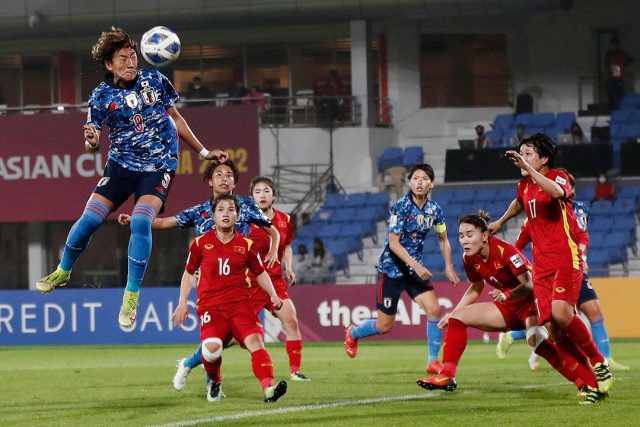
JAPAN’S Yuika Sugasawa heads at goal. — REUTERS

Australia beats the Philippines, 4-0

DEFENDING champion Japan beat Vietnam 3-0 at the Women’s Asian Cup in Pune on Monday to book their place in the quarterfinals alongside Australia and South Korea.

Yui Narumiya scored twice, with her goals coming either side of an effort from former Asian Women’s Player of the Year Saki Kumagai.

Victory means Japan goes into their final game in Group C against South Korea on Thursday guaranteed a top-two finish.

Futoshi Ikeda’s side had to wait until the 38th minute to take the lead when Narumiya netted from close range, while Kumagai claimed a rare international goal from similar range five minutes into the second half.

Narumiya beat Vietnam goalkeeper Tran Thi Kim Thanh to her left in the 58th minute to put the seal on a comfortable win for the 2014 and 2018 winners.

The result ensures South Korea also advance after their 2-0 win over Myanmar earlier in the day.

The Koreans struggled to break down their defensively disciplined opponents but finally opened their account five minutes into the second half when Lee Geum-min netted following Cho So-hyun’s cushioned header.

Chelsea midfielder Ji So-yun was instrumental in the second goal six minutes from time when her header back across the target brushed against defender Tun Khin Mo Mo before crossing the line via the inside of the post.

The Australians confirmed their place in the next round when a decisive second-half showing saw Tony Gustavsson’s side defeat Philippines 4-0 in Mumbai.

After a goalless first half, Sam Kerr opened the scoring with a 51st-minute header before Dominique Randle’s own goal two minutes later put the Matildas in control of the Group B encounter.

Emily van Egmond and Mary Fowler were also on target as the Australians defeated a Philippines side directed by former Matildas coach Alen Stajčić.

The win, coupled with their 18-0 thrashing of Indonesia on the opening day, means the Australians are guaranteed a place in the last eight ahead.

Thailand kept alive their hopes of a quarterfinal place with a comfortable 4-0 win over Indonesia.

Kanyanat Chetthabutr scored a hat trick before Dee Makris scored her side’s fourth as the Thais moved level on three points with the Philippines, with Australia on top of the group.

The top two finishers in each of the three groups will advance to the knockout rounds along with the two third-place finishers with the best records.

The competition is doubling up as Asia’s qualifier for next year’s Women’s World Cup, with the continent awarded five guaranteed spots at the finals in Australia and New Zealand.

Australia qualifies for the World Cup as co-host while two other Asian nations will feature in an intercontinental playoff round. — Reuters

Overtime rules come under fire after Chiefs win playoff thriller

THE National Football League’s (NFL) overtime rules have again come under fire after the Buffalo Bills’ high-powered offense never got a chance to touch the ball in the extra period of their crushing playoff loss to the Kansas City Chiefs.

The game on Sunday was an instant classic between two of the most gifted NFL quarterbacks and included three lead changes in the final two minutes of regulation before Patrick Mahomes’ Chiefs prevailed 42-36 over Josh Allen’s Bills.

Unlike most other sports that give challengers from both sides an equal shot at winning in overtime (OT), the NFL uses a coin toss to determine which team gets the ball first.

Under the current overtime format, a team can win on the opening possession only if they score a touchdown. Otherwise, each team gets at least one possession.

After Allen made the wrong call on the coin toss, the Chiefs received the ball and Mahomes needed just eight plays to drive his team 75 yards down the field for the winning touchdown.

“If you are still arguing, in a game like that, it’s not in best interest of EVERYONE that both Mahomes and Allen get the ball in OT I don’t know what to tell you,” former NFL tight end Greg Olsen wrote on Twitter.

“In a game where neither team could stop the other at the end, a literal coin flip determined the ending.”

If a team gets a field goal on the opening possession of overtime, their opponent gets a possession and can win the game with a touchdown or tie it with a field goal. If both teams get field goals, the next team to score wins.

The NFL’s overtime format, which critics argue gives too much value to something as random as a coin toss, has come under scrutiny before, including on the game’s biggest stage.

Five years ago, the New England Patriots beat the Atlanta Falcons when they scored on the opening drive of the only Super Bowl to go to overtime.

In 2019, the Chiefs could only sit and watch as the Patriots advanced to the Super Bowl with a game-winning 75-yard touchdown drive to begin overtime.

That offseason the Chiefs proposed a change to the overtime rules with hopes of giving each team’s offense an opportunity to touch the football. — Reuters

Second half show against Philippines takes Australia into quarters

AUSTRALIA advanced to the quarterfinals of the Women’s Asian Cup on Monday after a decisive second-half showing saw Tony Gustavsson’s side defeat Philippines 4-0 in Mumbai.

After a goalless first half, Sam Kerr opened the scoring with a 51st-minute header before Dominique Randle’s own goal two minutes later put the Matildas in control of the Group B encounter.

Emily van Egmond and Mary Fowler were also on target as the Australians defeated a Philippines side directed by former Matildas coach Alen Stajčić.

The win, coupled with their 18-0 thrashing of Indonesia on the opening day, means the Australians are guaranteed a place in the last eight ahead of their final group game against Thailand on Thursday.

“The first half, they made it difficult for us to break them down, and in the second half we came out and capitalized quite early, which gave us good momentum for the last 45 minutes,” said Van Egmond.

“But credit to the Philippines, they came out and they were disciplined and made it tough for us. But we’re proud of our group of girls, to follow the game plan and get it done.”

South Korea moved a step closer to booking their place in the next round despite laboring to a 2-0 win over Myanmar.

Coach Colin Bell was forced to introduce Chelsea midfielder Ji So-yun from the bench 11 minutes from the end of the first half to invigorate his side as they struggled to break down their defensively disciplined opponents.

The Koreans finally opened their account five minutes into the second half when Cho So-hyun’s cushioned header across the six-yard box was controlled by Lee Geum-min before she scored.

Ji was instrumental in the second strike six minutes from time when her header back across goal brushed against defender Tun Khin Mo Mo before crossing the line via the inside of the post.

South Korea will confirm their place in the next round if Japan defeats Vietnam in the late game in Group C in Pune.

The top two finishers in each of the three groups will advance to the knockout rounds along with the two third-place finishers with the best records.

The competition is doubling up as Asia’s qualifier for next year’s Women’s World Cup, with the continent awarded five guaranteed spots at the finals in Australia and New Zealand.

Australia qualifies for the World Cup as co-host while two other Asian nations will feature in an intercontinental playoff round. — Reuters

At least six killed in Cameroon stadium stampede, says state broadcaster

YAOUNDE — At least six fans died in a stampede at the Yaounde Olembe Stadium in Cameroon on Monday before the host nation’s round of 16 game in the African Cup of Nations against Comoros, the Central African nation’s national broadcaster reported.

It said dozens of others were injured.

Images shared on social media, which Reuters could not immediately authenticate, showed screaming fans being crushed at an entrance gate.

Continental soccer government body CAF said in a statement that it was aware of an incident at the Stadium.

“CAF is currently investigating the situation and trying to get more details on what transpired. We are in constant communication with Cameroon government and the Local Organizing Committee,” it said.

Following a low turnout in the first round games at brand new stadiums built for the continent’s premier men’s soccer tournament, Cameroon authorities have thrown open stadium gates, organized mass transport and given out free tickets to lure fans.

Cameroon beat 10-man Comoros Islands 2-1 in the game to advance to the quarterfinals. — Reuters

Bulls build 28-point edge, hold off Thunder

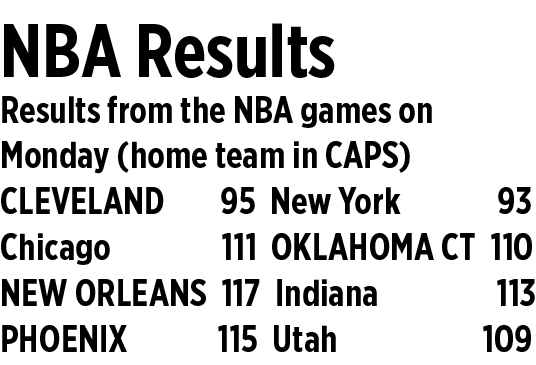
NIKOLA Vučević scored 26 points and grabbed 15 rebounds to lead the Chicago Bulls to a 111-110 road win over the Oklahoma City Thunder on Monday.

Chicago rookie Ayo Dosunmu made his first nine shots en route to a season-high 24 points. He added five rebounds and eight assists.

After leading by 28 midway through the third quarter, the Bulls had to hold on at the end to win for just the second time in eight games. Chicago snapped a five-game road losing streak.

Short-handed even with the returns of Zach LaVine and Javonte Green and playing on the second night of a road back-to-back, the Bulls sputtered late, getting outscored 32-19 in the fourth quarter.

The Thunder pulled within one with 14.8 seconds left on Josh Giddey’s layup off a feed from Shai Gilgeous-Alexander.

Gilgeous-Alexander (31 points, 10 assists) missed a potential game-tying 3-pointer with 2.3 seconds left. Green hit a free throw with one second remaining to put the game away, though Mike Muscala’s 3-pointer at the buzzer narrowed the final margin.

The Thunder have lost six consecutive games and 13 of their past 15.

A night earlier, Chicago’s starting backcourt of Dosunmu and Cody White did not record any assists in a 114-95 loss to the Orlando Magic.

With LaVine back in the lineup for the first time since Jan. 14, having recovered from a knee injury, the ball moved much more freely.

LaVine finished with 23 points, seven assists and seven rebounds for the Bulls, who had 31 total assists.

Green returned to the lineup after missing 12 games with a groin ailment. He contributed just five points, but the Bulls improved to 9-0 in the past nine games he has played.

Dosunmu got off to a hot start, sinking all five shots he took to score 12 in the first quarter.

Chicago took the lead for good less than seven minutes into the game, with the advantage ballooning to 84-56 midway through the third quarter after the Bulls started the second half on a 26-8 run.

The Bulls started the second half 9 of 12 from the floor, hitting five 3-pointers during the stretch.

Luguentz Dort scored 16 points for the Thunder, who got 14 from Muscala and 12 from Jeremiah Robinson-Earl. — Reuters

Not retiring

Countless times, Tom Brady has been asked how long he plans to keep playing. And, more often than not, he has been quick to say he believes he can continue to suit up at least until he’s 45 years old. The other day, however, he did not have the predisposition to make a clear declaration about his future. He told the assembled media in the aftermath of the Buccaneers’ loss to the Rams that “I’m not thinking about anything past five minutes from now.”

Not that Brady can be blamed for refusing to commit to a future that, just last month, appeared certain. In line with his previous timetable, he remains under contract with the Buccaneers for another year. Still, he deserves to take stock of his situation and plan accordingly, and not just because he’s already widely acknowledged as the “greatest of all time.” Even as his competitive nature has him leaning towards a return, he will want to do so only if he has a solid supporting cast.

Which, in a nutshell, is where the problem lies. With 24 players slated to hit unrestricted free agency, the Buccaneers may not have the wherewithal, financial or otherwise, to run it back the way they did last year. Meanwhile, Brady wants to, in his words, “take it day by day and kind of see where we are at.” Bottom line, he’s not going to lace up his cleats if he’s not going to be within sniffing distance of the hardware. As he argued, “every team is qualified when you get to the final eight, then the final four, then the final two.”

Only time will tell if Brady stays in the active roster or hangs up his jersey for good. The smart bet has him angling for an exit while at the top — and he may well have done so had the Buccaneers succeeded in defending the championship. That they failed to meet their ultimate objective feeds into his inability — or, to be more accurate, refusal — to accept defeat on any level. “It sucks to lose in the end,” he contended. Is he inclined to change the narrative? Fans will know soon enough.


Anthony L. Cuaycong has been writing Courtside since BusinessWorld introduced a Sports section in 1994. He is a consultant on strategic planning, operations and Human Resources management, corporate communications, and business development.

Peso climbs on stock market’s gains, oil prices

THE PESO strengthened versus the greenback on Tuesday, supported by upbeat investor sentiment following stock market gains and the decline in global oil prices.

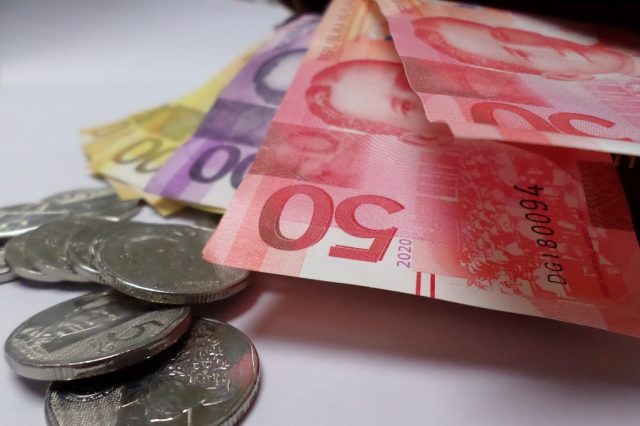
The local unit closed at P51.26 per dollar on Tuesday, gaining three centavos from its P51.29 finish on Monday, based on data from the Bankers Association of the Philippines.

The peso opened Tuesday’s session weaker at P51.35 versus the dollar. Its worst showing was at P51.40, while its intraday best was at P51.20 against the greenback.

Dollars exchanged increased to $1.041 billion on Tuesday from $827.5 million on Monday.

The peso appreciated following gains in the local stock market, Rizal Commercial Banking Corp. Chief Economist Michael L. Ricafort said in a Viber message.

The Philippine Stock Exchange index rose by 35.57 points or 0.49% to close at 7,288.21 on Tuesday. The broader all shares index also increased by 16.97 points or 0.44% to 3,864.48.

The local benchmark climbed even as Asian shares and US futures fell sharply on Tuesday, with investors nervous about the potential for military conflict in Ukraine and ahead of a key Federal Reserve meeting that could offer hints about the timing and pace of rate hikes, Reuters reported.

Benchmarks slid, with most extending losses in afternoon trade. MSCI’s broadest index of Asia-Pacific shares outside Japan shed 1.43% to its lowest in a month. The Nikkei closed down 1.66%, having earlier touched its lowest level since December 2020.

Meanwhile, a trader said the peso appreciated on the back of the decline in global oil prices.

Reuters reported that oil prices were down by about 2% on Monday, on concerns over quicker-than-expected rate hikes by the US Federal Reserve.

However, Brent crude futures have risen by 61 cents or 0.7% to $86.88 per barrel by 0722 GMT of Tuesday, while the US West Texas Intermediate futures climbed 44 cents or 0.5% to $83.75 a barrel. This, amid escalating tension in Eastern Europe and the Middle East over worries on possibly supply disruptions.

For Wednesday, Mr. Ricafort gave a forecast range of P51.15 to P51.35, while the trader expects the local unit to move within P51.10 to P51.35 per dollar. — LWTN with Reuters

PHL shares rise on hopes of eased mobility curbs

BW FILE PHOTO

SHARES bounced back on Tuesday amid hopes of eased quarantine restrictions following the continued decline in coronavirus disease 2019 (COVID-19) cases in Metro Manila.

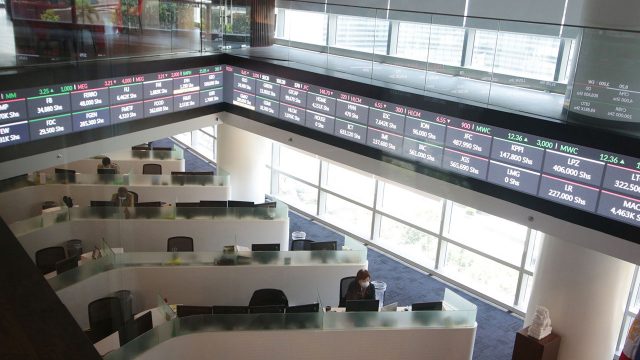
The benchmark Philippine Stock Exchange index (PSEi) inched up 35.57 points or 0.49% to close at 7,288.21 on Tuesday, while the broader all shares index advanced 16.97 points or 0.44% to 3,864.48.

Regina Capital Development Corp. Head of Sales Luis A. Limlingan said in a Viber message that investors are hoping for an easing in mobility restrictions in Metro Manila.

“With the National Capital Region’s (NCR) risk classification being downgraded and COVID-19 reproduction number down to 0.91 as confirmed by OCTA Research group, the investor sentiment improved, inspiring them to go on bargain hunting with the market closing in positive territory,” Diversified Securities, Inc. Equity Trader Aniceto K. Pangan said in a text message.

The Philippines and Metro Manila’s COVID-19 risk classification has been downgraded to high risk from critical risk, the Health department said on Tuesday.

In a televised meeting between President Rodrigo R. Duterte and his Cabinet members on Monday night, Health chief Francisco T. Duque III said the infection growth rate across the country between Jan. 11 to Jan. 24 declined to 176% from 3,361%.

Meanwhile, in Metro Manila, the growth rate fell to 65% from 7,225%.

Mr. Duque said the capital region is ready for a more relaxed Alert Level 2 by next month amid decreasing COVID-19 cases and high vaccination rates.

“The lowering of risk classifications has overpowered local investors’ concerns on the upcoming US Federal Reserve monetary policy meeting,” Timson Securities, Inc. Trader Darren Blaine T. Pangan said in a Viber message.

The Fed, which had announced plans to begin paring back unprecedented stimulus, is set to update its policy trajectory at the close of its two-day meeting. Concerns that the central bank could tighten too quickly added to investor nerves, Reuters reported.

Most sectoral indices advanced on Tuesday except for mining and oil, which dropped 101.81 points or 0.97% to 10,300.44; and financials, which slipped 0.32 points or 0.02% to end at 1,637.49.

On the other hand, industrials gained 106.28 points or 1.02% to 10,488.05; services climbed 14.29 points or 0.72% to 1,976.23; property added 20.07 points or 0.63% to 3,197.87; and holding firms increased 22.43 points or 0.31% to 7,163.76.

Value turnover rose to P6.28 billion with 1.26 billion shares switching hands on Tuesday from the P6.05 billion with 1.96 billion issues traded the previous day.

Decliners beat advancers, 96 against 82, while 52 names closed unchanged.

Diversified Securities’ Mr. Pangan put the PSEi’s support at 7,200 and resistance at 7,400. — MCL with Reuters

By automating finance, CFOs can embrace more strategic role — IBM study

UNSPLASH

Fewer than 10% of finance-related activities are dedicated to analysis and action that support decision-making, according to a study on the role of the chief financial officer (CFO) by technology firm IBM. Instead, many activities are low-value and transactional.

Published on Jan. 20, the IBM 2021 Global CFO study surveyed 2,000 C-suite finance leaders in 28 industries and 43 locations worldwide.

“Freeing up the time to work on strategic challenges is an issue for finance organizations,” said Natalie Pia H. Azarcon, managing partner at IBM Consulting, IBM Philippines, “especially if finance doesn’t have the right tools and systems needed to automate traditional work, such as making payments, closing books, and the like.”

Only 46% of CFO respondents in the Asia Pacific, including the Philippines, say finance is effective at execution.

“Half of the finance department’s time continues to be spent on transactional activities, which have remained relatively consistent across IBM’s 18 years of research,” said Ms. Azarcon.

Artificial intelligence (AI), she told BusinessWorld, can be leveraged to automate and eliminate low-value and transactional activities, thereby freeing up the time to drive deeper business insights and better business outcomes. 

The IBM study found that 63% of Asia Pacific CFOs say AI technology has been implemented in their planning processes, with 51% also reporting AI’s implementation in financial forecasting, management/performance reporting (52%), and profitability/margin analysis (50%).

“Today, in the modern tech-fueled economy, the CFO is uniquely situated to influence the organization’s digital transformation: setting the financial baseline, building the business case, helping to determine the value of each initiative, collaborating across the C-suite to gain buy-in, and tracking benefit realization,” said Ms. Azarcon. — Patricia B. Mirasol

ADVERTISEMENT
ADVERTISEMENT