Home Blog Page 6904

Office fit-out trends to watch in 2022

KATE.SADE/UNSPLASH

MANY COMPANIES’ return-to-office plans may have been delayed due to the emergence of the infectious Omicron variant of the coronavirus disease 2019 (COVID-19).

However, Cushman & Wakefield said companies still need to prepare for the eventual return of employees to the office and adopt more flexible working practices as the pandemic continues.

In its Asia Pacific Office Fit-out Cost Guide, the commercial real estate services firm noted that employee desire to work flexibly is lower in Asia-Pacific markets than in the United States and Europe.

“While fit-out typologies are changing globally, providing more collaborative spaces, the shift in Asia Pacific is likely to be more muted. With a greater proportion of employees spending more time in the office, there is more demand for space for focused work in the region,” Cushman & Wakefield said.

Companies are looking to build an ideal hybrid office, which would meet the demands of the flexible workforce.

Cushman & Wakefield also noted employees want greater workplace flexibility, while employers are looking to maintain corporate culture.

“High quality buildings that provide the highest quality health and wellbeing credentials are mandatory, as is the need for occupiers to provide employees with seamlessly integrated technology solutions for both onsite and offsite working. The application of thoughtful design and fit-out standards is crucial in order to reflect the role and purpose of the office which is all about experience, engagement, collaboration, culture and wellbeing,” it said.

Occupiers and investors are now putting greater emphasis on environment, social and governance (ESG) in their real estate footprint.

“Occupiers are increasingly seeking green and wellness certifications for their projects… Project managers play a pivotal role here by exposing clients to the latest workplace design strategies and assisting the integration of ESG principles into their workplace,” Cushman & Wakefield said.

According to the report, Japanese cities Tokyo, Osaka and Nagoya have the highest average fit-out cost in the Asia-Pacific region at $166, $161 and $151 per square meter (sq.m.).

Auckland in New Zealand came in fourth with $139 per sq.m., while Hong Kong came in fifth with $138 per sq.m.

In Manila, the average fit-out cost is $87 per sq.m., slightly more expensive than Bangkok ($85 per sq.m.) and Kuala Lumpur ($83 per sq.m.). Hanoi and Ho Chi Minh City offer much-lower fit-out costs at $63 and $61 per sq.m., respectively.

Jakarta in Indonesia offers the lowest average fit-out cost at $56 per sq.m.

From fairytale to gothic ghost story: how 40 years of biopics showed Princess Diana on screen

Kristen Stewart in Spencer (2021) — IMDB.COMA

SINCE the earliest Princess Diana biopics appeared soon after the royal wedding in 1981, there have been repeated attempts to bring to the screen the story of Diana’s journey from blue-blooded ingenue through to tragic princess trapped within — and then expelled from — the royal system.

A long string of actresses, with replicas of the outfits she wore and a blond wig (sometimes precariously) in place, have walked through episodic storylines, charting the “greatest hits” of what is known of Diana’s royal life.

Biopics about the princess tend to be shaped according to the dominant mythic narratives in circulation in any given phase of Diana’s life. The first biopics were stories of fairytales and romance. From the 1990s, the marriage of Charles and Diana took on the shape of soap opera and melodrama.

Now, with the Crown (2016–) and Spencer (2021), Diana has become a doomed gothic heroine. She is a woman suffocated by a royal system that cannot, will not, acknowledge her special place in the royal pantheon.

The first Dianas appeared on American television networks within months of the July 1981 wedding of Charles and Diana.

Both Charles and Diana: A Royal Love Story (starring Caroline Bliss) and The Royal Romance of Charles and Diana (starring Catherine Oxenberg) invested wholesale in a fairytale lens.

They told of the young and virginal beauty who had captured the attention of the dashing prince, whisked off to a life of happily ever after.

The Diana biopics fell quiet for the first years of the marriage (fairytales don’t tend to interest themselves in pregnancies and apparent marital harmony), and then reemerged after the publication of Andrew Morton’s exposé, Diana: Her True Story (1992).

Morton’s biography was written from taped interviews with the princess and inspired the next generation of Diana biopics, ones that I call the “post-Morton” biopics, which borrow from Diana’s own scripting of her life.

A series of actors were enlisted to play Diana in these made-for-television productions.

Ms. Oxenberg turns up again in Charles and Diana: Unhappily Ever After (1992). In Diana: Her True Story (1993), Serena Scott-Thomas (who, incidentally, turns up in the 2011 television biopic William and Kate as Catherine Middleton’s mother Carole) does her best with a terrible script and series of wigs.

Others gave it their best shot. We had Julie Cox in Princess in Love (1996), Amy Seacombe in Diana: A Tribute to the People’s Princess (1998), Genevieve O’Reilly in Diana: Last Days of a Princess (2007) and, briefly, Michelle Duncan in Charles and Camilla: Whatever Love Means (2005).

But even large budget films (such as 2013’s cinema-release Diana, directed by Oliver Hirschbiegel and starring Naomi Watts) had critics and audiences letting out a collective yawn.

In film after film we were offered yet another uninspired, soap opera-style representation of the princess’s life.

Critics’ voices were quelled somewhat with the appearance of Emma Corrin’s Diana in season four of The Crown.

With Netflix’s high budget and quality production values, many — including myself — felt Peter Morgan’s deliberate combination of accuracy and imaginative interpretation of Diana’s royal life offered something approximating a closer rendition of the “real” princess than we’d been presented with before.

And then we come to the most recent portrayal of Diana on screen, Pablo Larraín’s Spencer (2021), starring Kristen Stewart as Diana. What, royal biopic watchers wondered, could it possibly do to top The Crown’s Diana?

Spencer’s statement in the film’s opening offers a clue: it promises to be a “fable from a true tragedy.”

This is a film where genre imperatives and creative imaginings are placed at the forefront of its representation of the princess.

Taking its cue from the gothic themes and tropes Diana can be heard invoking on the Morton tapes, Spencer’s heroine is trapped in a frozen Sandringham setting, gasping for air to the point where her voice rarely lifts above a soft, almost suffocated, whisper.

She tears at the pearls encircling her throat. She rips open the curtains sewn shut by staff. She self-harms with wire cutters. She runs like an animal hunted down manor house corridors and across frosty Norfolk fields.

She is haunted by the ghost of Anne Boleyn, another royal wife rejected by her husband, prompting one reviewer to ask: “is Spencer the ultimate horror movie?”

Larraín and Stewart’s Diana has her precursor in the spectral, gothic Diana who appears in the 2017 future-history television film King Charles III, based on Mike Bartlett’s 2014 play. The anguished howl of this Diana (played by Katie Brayben) echoes throughout the palace in the same way Spencer’s Diana is framed as the royal who will haunt the Windsors for decades to come.

The lamentable Diana: The Musical (2021) on Netflix (a filmed version of the Broadway production starring Jeanna de Waal) — with its cliched storyline, two-dimensional characterization, awkward costuming and early 1980s Andrew Lloyd Webber-style aesthetic — offers some evidence that, even in 2021, the creators of Diana stories haven’t altogether abandoned their investment in the Diana of 1981.

But with Spencer, we have a Diana shaped by both the princess’s own version of her story, and the screen Dianas that came before her. Spencer suggests new directions and potential for the telling of royal lives.


Giselle Bastin is an Associate Professor of English, Flinders University.

FEU, partners plan Brunei private nursing school 

BW FILE PHOTO

FAR EASTERN University (FEU) is looking to enter a joint venture to create and manage a private nursing school in Brunei Darussalam.

In a disclosure to the exchange on Monday, the listed educational institution said it is joining Brunei’s Ministry of Health and private firm Jerudong Park Medical Centre Sendirian Berhad “to cooperate in a proposed joint venture for the establishment, management, and operation” of the private nursing school.

“The parties entered into a memorandum of agreement to that effect. No definitive agreements were signed yet pending further discussions on details on how to achieve the goals of the project,” FEU said.

“We will make the necessary disclosures regarding the Project as soon as further definite information becomes available,” it added.

The company currently operates FEU in Manila and is the majority shareholder of East Asia Computer Center, Inc., FEU Alabang, Far Eastern College Silang, Inc., FEU High School, Inc., and Roosevelt College, Inc.

It also has a 51% ownership in Edustria, Inc., a new senior high school in Batangas, which is 49% owned by the Technological Institute of the Philippines, Inc.

FEU shares were last traded on Jan. 20 for P551 apiece. — Keren Concepcion G. Valmonte

China property sector could see ‘significant’ policy easing

REUTERS

NEW YORK — China’s real estate sector will likely see “significant easing” in the policies that govern it, BNP Paribas Asset Management (BNPPAM) said, months after starting to build a long position in that sector’s debt.

“We are of the view that we are at a major inflection point in terms of policy and we are likely to see some significant easing,” said Jean Charles Sambor, head of emerging market fixed income at BNPPAM in London.

“We are involved in the sector and we are positive in the sector. We have built this position over the last couple of months.”

Sambor could only discuss the overall sector, not company-specific investments.

Chinese real estate sector assets came under a lot of pressure last year after stricter financing rules for property development set in 2020 met with a mountain of debt, effectively engineering a contraction. The outsized importance of China’s real estate in the global economy sent shivers down many portfolio manager backs.

The CSI China Mainland Real Estate Index fell as much as 28% last year before closing down 15%, with stocks in China Evergrande, one of the biggest developers in the midst of a restructuring, down 89% in 2021.

Evergrande carries about $300 billion in liabilities including some $20 billion in international bonds. The foreign bonds, which traded above 90 cents in some cases last year, are now at default levels at under 20 cents on the dollar.

“The property market had been under pressure because (the government) wanted to deleverage and to some extent they achieved that,” Sambor said. “Now China wants to make sure that the rest of the sector is not at risk.”

Some international investors expect state-owned enterprises (SOEs) to help smooth debt restructurings, but others worry that it could open the door for Beijing to use the limited returns to pay its local debts first.

Sambor said a sector restructuring cannot be led by the state because private sector involvement in the property market is very large.

“SOEs are a significant part of the market but are not dominating it so it is difficult for them to engineer an SOE-lead restructuring. You need to have strong participation from the private sector,” he said.

Sambor said BNPPAM’s view on the real estate sector is part of a wider bet on fixed income returns within emerging markets.

“We think it’s going to be the year of the great normalization in Asia high yield, with a focus on China,” Sambor said. “Asian high yield, and China more specifically, will be a key driver of EM fixed income performance in 2022.” — Reuters

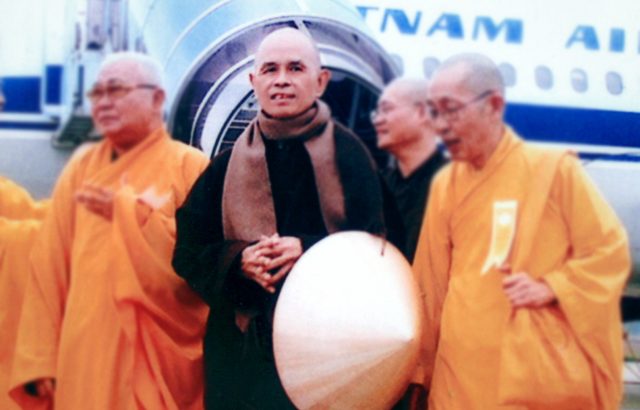
Thich Nhat Hanh, poetic peace activist and master of mindfulness, 95

THICH NHAT HANH — EN.WIKIPEDIA.ORG

THICH NHAT HANH, the Zen Buddhist monk, poet, and peace activist who in the 1960s came to prominence as an opponent of the Vietnam War, died on Saturday aged 95 surrounded by his followers in the temple where his spiritual journey began.

“The International Plum Village Community of Engaged Buddhism announces that our beloved teacher Thich Nhat Hanh passed away peacefully at Tu Hieu Temple in Hue, Vietnam, at 00:00hrs on 22nd January, 2022, at the age of 95,” said his official Twitter account.

His week-long funeral will be held at the temple in a quiet and peaceful manner, according to his followers.

“Thich Nhat Hanh will be remembered as arguably one of the most influential and prominent religious leaders in the world,” Chargé d’Affaires Marie C. Damour of the US Mission to Vietnam said in a statement.

“Through his teachings and literary work, his legacy will remain for generations to come,” she said, adding that his teachings, in particular on bringing mindfulness into daily life, have enriched the lives of innumerable Americans.

In a body of works and public appearances spanning decades, Thich Nhat Hanh spoke in gentle yet powerful tones of the need to “walk as if you are kissing the earth with your feet.”

He suffered a stroke in 2014 which left him unable to speak and returned to Vietnam to live out his final days in the central city of Hue, the ancient capital and his place of birth, after spending much of his adult life in exile.

As a pioneer of Buddhism in the West, he formed the Plum Village monastery in France and spoke regularly on the practice of mindfulness — identifying and distancing oneself from certain thoughts without judgement — to the corporate world and his international followers.

“You learn how to suffer. If you know how to suffer, you suffer much, much less. And then you know how to make good use of suffering to create joy and happiness,” he said in a 2013 lecture.

“The art of happiness and the art of suffering always go together.”

Born Nguyen Xuan Bao in 1926, Thich Nhat Hanh was ordained as a monk as modern Vietnam’s founding revolutionary Ho Chi Minh led efforts to liberate the Southeast Asian country from its French colonial rulers.

Thich Nhat Hanh, who spoke seven languages, lectured at Princeton and Columbia universities in the United States in the early 1960s. He returned to Vietnam in 1963 to join a growing Buddhist opposition to the US-Vietnam War, demonstrated by self-immolation protests by several monks.

“I saw communists and anti-communists killing and destroying each other because each side believed they had a monopoly on the truth,” he wrote in 1975.

“My voice was drowned out by the bombs, mortars and shouting.”

“Venerable Thich Nhat Hanh lived a truly meaningful life. I have no doubt the best way we can pay tribute to him is to continue his work to promote peace in the world,” the Dalai Lama, the spiritual leader of Tibetan Buddhism, said on Twitter.

‘LIKE A PINE TREE’
Towards the height of the Vietnam War in the 1960s he met civil rights leader Martin Luther King, whom he persuaded to speak out against the conflict.

Mr. King called Thich Nhat Hanh “an apostle of peace and non-violence” and nominated him for the Nobel Peace Prize. “I do not personally know of anyone more worthy of the Nobel Peace Prize than this gentle Buddhist monk from Vietnam,” Mr. King wrote in his nomination letter.

While in the United States to meet King a year earlier, the South Vietnamese government banned Thich Nhat Hanh from returning home.

Fellow monk Haenim Sunim, who once acted as Thich Nhat Hanh’s translator during a trip to South Korea, said the Zen master was calm, attentive and loving.

“He was like a large pine tree, allowing many people to rest under his branches with his wonderful teaching of mindfulness and compassion,” Haemin Sunim told Reuters. “He was one of the most amazing people I have ever met.”

Thich Nhat Hanh’s works and promotion of the idea of mindfulness and meditation have enjoyed a renewed popularity as the world reels from the effects of a coronavirus pandemic that has killed over a million people and upended daily life.

“Hope is important, because it can make the present moment less difficult to bear,” Thich Nhat Hanh wrote. “If we believe that tomorrow will be better, we can bear a hardship today.

“If you can refrain from hoping, you can bring yourself entirely into the present moment and discover the joy that is already here.” — Reuters

Quasi-banks book 10.3% NPL ratio at end-Sept.

BAD DEBT held by quasi-banks stood at P14.501 billion for a nonperforming loan ratio (NPL) of 10.3% as of September 2021, data from the Bangko Sentral ng Pilipinas (BSP) showed.

Quasi-banks’ bad loans rose by 6.9% year on year from the P13.562 billion seen as of September 2020. Their NPL ratio inched up from the 10.2% a year earlier, but was a tad lower than the 10.4% seen as of end-June.

Meanwhile, the industry’s gross loan portfolio rose by 5.6% year on year to P140.801 billion as of September from P133.335 billion a year ago.

Nonperforming assets (NPAs) of quasi-banks, which include real and other properties acquired, increased by 9.5% year on year to P16.044 billion from P14.654 billion.

The industry’s restructured loans hit P2.138 billion, surging 79.5% from the P1.191 billion last year.

Quasi-banks boosted their loan loss reserves by 36.9% year on year to P5.414 billion from P3.955 billion. These buffers made up 3.8% of their total loan portfolio, increasing from the 3% seen as of end-September 2020.

This brought their NPL coverage ratio to 37.3%, improving from the 29.2% seen a year earlier.

Meanwhile, allowance on NPAs also climbed 36.2% year on year to P5.607 billion from P4.118 billion.

With this, their NPA coverage rose to 35% from 28.1% from a year earlier.

BSP-supervised financial institutions with quasi-banking functions include financing companies and investment houses.

Last week, the Department of Finance said five asset management companies have been set up to will help financial institutions unload their nonperforming assets to clean their balance sheets. This is in line with the Financial Institutions Strategic Transfer (FIST) Law, which took effect in February 2021.

Quasi-banks may also sell their nonperforming assets to FIST corporations that are registered with the Securities and Exchange Commission. — L.W.T. Noble

Axelum sees robust global demand for its products

AXELIM Resources Corp. expects stronger growth for its coconut products this year as it forecasts robust global demand based on the country’s export performance for most of last year.

“We are seeing increasing requirements for coconuts owing to stronger preferences for nutritiously-laden food labels by a thriving health-conscious population. Last year, Axelum catered to a larger customer base and managed to outpace industry growth to accelerate global market leadership,” Axelum President and Chief Operating Officer Henry J. Raperoga said in a media release on Monday.

The manufacturer and exporter of coconut products cited a surge in coconut sales abroad to boost Philippine exports last year.

From January to November 2021, it said coconut exports were up 54% to $1.74 billion from $1.13 billion. It added that the top commodities were coconut oil and desiccated coconut with a growth of 54% and 49%, respectively.

“Based on third-party estimates, the global coconut products market is projected to reach $31.1 billion by 2026, with a compound annual growth rate (CAGR) of 14% from 2018. Aside from traditional categories, market drivers include the fast-rising coconut water and coconut milk powder segments,” the company said.

“Coconut water is a popular and healthier alternative to sugary and caffeinated drinks while coconut milk powder is an extensively-used universal food ingredient particularly for much-sought all-natural diets,” it added.

For 2022, Axelum said it would expand its nut processing and storage capabilities to improve the yield of its core products. It is also scheduling planned rollouts of multiple food products to the American market by the second half of the year.

From January to September last year, the company’s net income rose 51.1% to P578.7 million from P383.1 million in 2020.

In the third quarter alone, its net income increased 44.5% to P260.3 million from P180.2 million in the same quarter in 2020.

At the stock exchange on Monday, Axelum shares were unchanged at P2.88 each. — Luisa Maria Jacinta C. Jocson

Airbnb says ‘live anywhere’ trend here to stay

REUTERS

MANY COMPANIES expect to continue implementing remote and hybrid work schemes in the near future, which Airbnb says would allow more people to live anywhere they want.

“This Live Anywhere trend is like a decentralization of living, and it’s changing the identity of travel,” the home rental company said in a statement.

Airbnb said it has seen an increase in long-term stays in the third quarter of 2021.

“In Q3 2021, over 85% of long-term stay nights booked in the Philippines were for stays in urban destinations. Metro Manila, Metro Cebu and Baguio emerged as the top most searched destinations for long-term stays,” it said.

Airbnb also expects more people giving up their leases to become “digital nomads.”

“The share of Airbnb long-term stay bookers who used their stays to lead a nomadic lifestyle grew from 9% (in 2020) to 12% (in 2021). In the Philippines, 45% of Filipinos polled want to rent out their homes and travel,” it said.

More cities and countries will tweak their visa and tax rules to attract these remote workers, Airbnb said.

What makes us human

By Michelle Anne P. Soliman, Reporter

Album Review
The Gods We Can Touch
Aurora
Decca Records

THE PURSUIT for perfection, the constant doubt of one’s inner beauty, and worthiness to be loved are some of the introspections that Norwegian singer-songwriter Aurora Aksnes sings about in her new album.

In the two years since the release of her last album in 2019, Ms. Aksnes has had stint on Disney’s Frozen 2 as the voice of the North Wind, and joined Idina Menzel and nine other singers in a live performance of “Into the Unknown” at the 92nd Academy Awards in 2020. In 2021, her 2015 single “Runaway” re-entered the music charts after going viral on TikTok.

On Jan. 21, Ms. Aksnes released her third studio album, The Gods We Can Touch.

In the album, Ms. Aksnes references Greek gods and goddess as perfect creatures and shows the listener that with their flaws, even gods are relatively human.

“They were more human, more relatable, almost touchable. Most importantly, they had flaws,” Ms. Aksnes wrote in the album’s storyline on Spotify. “This album is a celebration of all the things we should never be ashamed of; they are what make us human.”

While maintaining her signature ethereal and electropop sound, Ms. Aksnes experiments with other musical styles in specific tracks.

Unlike her previous albums — Infections of a Different Kind (Step 1) from 2018 and A Different Kind of Human (Step 2) from 2019 — which have songs with sexual and political themes and social issues, The Gods We Can Touch is more introspective, with songs about self-love, self-worth, appreciating your uniqueness, and accepting your flaws.

The 15-track album begins with “The Forbidden Fruits of Eden” with Ms. Aksnes’ signature high-pitched and icy harmonies. The 40-second intro track starts the album with a lightweight mood, as if you are listening to the musical score in a fantasy film’s opening scene.

The mood abruptly shifts to mysterious with the guitar plucking introduction to “Everything Matters” (featuring French singer Pomme). In this track, Ms. Aksnes sings of how simple things are great miracles.

In “Giving in to the Love,” he album’s third single takes inspiration from Prometheus, the god of fire, who sculpted humans. It is in this track where she sings of self-appreciation: “If I’ll be somebody, I’ll never let my skin decide it for me. I never had the world, so why change for it?” The song has a certain 1990s grunge rock sound.

It is followed by the dance tune “Cure for Me,” which carries a similar theme from the previous song with the repeated chorus line: “I don’t need a cure for me,” followed by an infectious circus theme sample.

The album’s first single and slow dance ballad, “Exist for Love,” is a break from the album’s first upbeat tracks. Serving as an ode to the goddess of love Aphrodite in the music video, Ms. Aksnes sings: “I can’t imagine how it is to be forbidden from loving, ‘cause when you walked into my life, I could feel my life begin.”

The second half of the album offers diverse musical styles — something different from the 25-year-old singer’s previous records.

“A Temporary High” (this writer’s personal favorite) takes the listener back to the 1980s pop sound with the track’s heavy use of synthesizers and danceable melody.

It is followed by “Artemis,” inspired by the story of the goddess of wild animals, vegetation, chastity, and childbirth. This one has a jazzy musical arrangement with violin and cello instrumentals.

The final three tracks — the hard-hitting folk-rock piece “Blood in the Wine,” the easy-listening “This Could be a Dream,” and the folk sounds and harmonies in “A Little Place Called the Moon” — succeed each other like a film soundtrack, narrating a story’s climax to its happy ending. The music can inspire the listener to imagine the landscapes and townsfolk in a fictional world.

Ms. Aksnes’ exploration of other musical styles is a bold move that only adds to her versatility. She also maintains the lyrical meaningful songwriting she is known for. And the album illustrates the importance of listening to songs in the order that the artist intends them to be heard — here they narrate a story from creation to self-discovery. Ms. Aksnes proves that being eccentric can be fun too.

To listen to The Gods We Can Touch and for more information, visit https://www.aurora-music.com/.

Himlayang Pilipino Plans placed under conservatorship

THE Insurance Commission has placed Himlayang Pilipino Plans, Inc. under conservatorship due to capital and trust fund deficiencies.

Insurance Commissioner Dennis B. Funa had previously issued a cease-and-desist order against the company due to its “inability or willingness to comply” with instructions to pay P112.3 million in capital deficiency and P184.88 million in trust fund deficiencies, the commission said in a press release Monday.

Capital deficiency means the firm’s liabilities exceeded the minimum buffers required under Republic Act (RA) No. 9829 or the Pre-Need Code of the Philippines.

The Pre-Need Code of the Philippines authorizes the IC to place a company under conservatorship if the company is in a state of continuing liability or unwilling to comply with the code’s requirements or the commission’s orders.

Mr. Funa said the pre-need company was given enough time to comply with instructions before the cease-and-desist order was issued.

“Notably, the company requested for various regulatory reliefs after it was apprised of the results of the verification of its 2020 annual statement,” the commission said.

This included requests for authority to venture into high-yielding investment portfolios, suspension of the directive to fund deficiencies, and withdrawal of the excess of trust funds for both education and pension plans.

“However, the requests were denied due to various legal considerations, which eventually led to the issuance of the cease-and-desist order and later, the conservatorship order,” the ICs said.

The commission in an email said the appointed conservator for Himlayang Pilipino Plans will come up with a rehabilitation plan to restore the company’s financial viability.

“Bearing in mind that the pre-need business is imbued with public interest, it is this commission’s mandate to safeguard of the rights and interests of the public while, at the same time, ensure the financial resilience of the business,” Mr. Funa said.

“We aim to restore the company to financial viability with the ultimate objective of protecting the interest of its planholders.”

Himlayang Pilipino did not immediately respond to a request for comment.

Latest data from the IC showed Himlayang Pilipino Plans had assets of P632.5 million as of Sept. 30, 2021. Trust fund investments stood at P310.03 million while its trust fund deficiency was at P144.75 million. Total liabilities were at P680.2 million while its paid-up capital was at P150 million. It booked a net loss of P6.44 million in the period. — JPI

NLEX Corp. to upgrade contactless systems; motorists served up 28%

NLEX Corp. on Monday said it is working to expand and upgrade its contactless systems to further improve customer service after serving 119 million motorists in 2021, up 27.96% from 93 million in 2020.

The enhancements planned for 2022 “include the installation of RFID early detection feature, installation and software upgrade of RFID card readers or contactless terminals, upgrade of system servers, and replacement of toll lane equipment — all aimed at improving the service to customers,” the company said in an e-mailed statement.

“About 29 more toll lanes will be equipped with enhanced scanners for faster RFID detection and additional 50 toll lanes will have new contactless terminals where customers can tap their Easytrip card to process their RFID transactions,” it added.

When completed, a total of 217 toll lanes will be equipped with RFID early detection features and 258 toll lanes with contactless terminals.

“We are innovating and adapting accordingly to improve our operations so we can provide customers with a quick and seamless experience both in our expressways and digital channels,” NLEX Corp. President and General Manager J. Luigi L. Bautista said.

The company said that traffic control gates as well as lane status and toll fare indicators on 187 toll lanes will also be replaced to improve efficiency.

It intends to launch this year an interactive chatbot system on its website and Facebook Messenger to “help customers get instant answers to their basic inquiries.”

As for its expansion plans, the company previously said that it targets to start this year the construction of a two-kilometer expressway section between the existing Mindanao Avenue toll plaza and Quirino Highway in Novaliches, Quezon City.

Upgrade work on the northbound portion of the Candaba Viaduct, a five-kilometer bridge between Pulilan, Bulacan and Apalit, Pampanga, will be started next month.

NLEX Corp. is part of Metro Pacific Tollways Corp., the tollway unit of Metro Pacific Investments Corp. (MPIC).

MPIC is one of three key Philippine units of Hong Kong-based First Pacific Co. Ltd., the others being Philex Mining Corp. and PLDT, Inc. Hastings Holdings, Inc., a unit of PLDT Beneficial Trust Fund subsidiary MediaQuest Holdings, Inc., has a majority stake in BusinessWorld through the Philippine Star Group, which it controls. — Arjay L. Balinbin

Obiena declines PSC mediation

Legal battle between Obiena and PATAFA looms

By Joey Villar

A LOOMING legal battle between Olympian pole-vaulter Ernest John “EJ” Obiena and the Philippine Athletics Track and Field Association (PATAFA) emerge after the former on Monday formally declined the mediation proposed by the Philippine Sports Commission (PSC).

“It is with great regret that I am forced to officially withdraw from the PSC offer of mediation due to the bad faith of Mr. Juico and PATAFA,” said Mr. Obiena in a statement referring to PATAFA President Philip Ella Juico.

The World No. 6 and Asian record-holder accused the PATAFA of allegedly peddling lies that Sergey Bubka and Ukrainian coach Vitaly Petrov voluntarily executed their respective affidavits and that the former concealed Mr. Petrov’s bank details so the money will be coursed through him.

Mr. Obiena also lashed at PATAFA for attacking his mother, former PATAFA auditor Jeanette Obiena.

“Where is the dignity and respect in that? I do not believe I can enter into any mediation with people who are seemingly focused on destroying me,” said Mr. Obiena. “For me, hurling multiple false accusations, hiding information and lying are not the framework for good faith and mediation.

“They used friends, relatives and fellow athletes as pawns of their aggression,” he added.

It will be the second time Mr. Obiena declined to join the mediation.

And the decision may have worsened the already gloomy situation as PATAFA’s two-week moratorium delaying the implementation of the recommendations of its fact-finding panel, which included Mr. Obiena’s expulsion from the national team and a filing of an estafa case against him, to give way for the mediation has expired.

PATAFA has accused Mr. Obiena of allegedly falsifying liquidations concerning payments to Mr. Petrov, which the Southeast Asian Games gold medalist has repeatedly denied.

At press time, there is no word yet from PATAFA on its next move.

The PSC, for its part, has started its own probe and tasked a team headed by its executive director Atty. Guillermo Iroy to look deeper into the matter.

“Last week, PSC accounting with the supervision of CoA (Commission on Audit) started investigation with PSC board approval,” said PSC chairman William Ramirez.

“The executive director is entrusted by the board to take charge of this investigation and will make appropriate advisory to the two parties.”

ADVERTISEMENT
ADVERTISEMENT