Home Blog Page 6877

ALI inches lower amid property-for-share deal

AYALA LAND, Inc. (ALI) dipped last week as investors took positions after its property-for-share swap deal with Ayala Corp. and Mermac, Inc.

Data from the Philippine Stock Exchange (PSE) showed a total of 31.66 million ALI shares worth P1.09 billion were traded from Jan. 24 to 28 making it the seventh most actively traded issues based on value turnover during the week.

The property giant finished at P34.20 apiece on Friday, inching down by 1.3% week on week. Year to date, the stock’s price fell by 1.4%.

“Evident in ALI’s price performance the past week is how investors were quick to take positions in ALI when news of the transaction between Ayala Corp. (AC), Mermac, Inc., and the company came out. This cements the market consensus that ALI is currently undervalued,” Regina Capital Development Corp. Equity Analyst Anna Corenne M. Agravio said in an e-mail interview.

“While price performance was slightly mixed this week, this is more of a reflection of general market sentiment as a whole rather than something fundamental and specific to ALI,” Ms. Agravio added.

Last Jan. 21, ALI approved a property-for-share swap deal worth P17.40 billion with AC and its biggest shareholder Mermac.

Under this transaction, AC and Mermac will transfer five real estate assets to ALI in exchange for 311.58 million primary common shares valued at P55.80 apiece.

“Given a significant price difference, the P55.80 might be treated as price target for long-term investors and good opportunity to accumulate while price is undervalued,” I.B. Gimenez Securities, Inc. Research Head Joylin F. Telagen said in a separate e-mail interview.

ALI’s consolidated revenues increased by 8.8% year on year to P23.66 billion in the third quarter. This brought its nine-month top line to P70.88 billion, rising by 13.5%.

During the July-September period, its attributable net income went up by 37.8% to P2.55 billion. ALI’s nine-month attributable bottom line rose by 34.9% to P8.59 billion.

Ms. Agravio sees ALI’s net income growing by double-digits for the final three months of 2021 as well as for the full-year 2022 amid “sustained uptick” in its property development revenues.

“On conservative note, I think P3-billion [net income] is fair estimate for the [fourth quarter],” Ms. Telagen said.

She expects a double-digit growth for ALI’s bottom line this year or at least P13.8 billion despite “a lot of risk and challenges and global growth downgraded.”

“But given its fundamental good liquid stock, it’s one of the property stocks to buy and hold,” Ms. Telagen said. “Aside from that, property index historically performs better after the crisis.”

For Ms. Agravio, ALI is undervalued at this point. Levels between P34.00 to P35.00 are arguably good entry points based both on fundamentals and technical, she said.

“Fundamentals-wise, ALI is trading at a significant discount versus our fair value; technical-wise, it is trading at a lower range versus all its major moving average, therefore it is considered a bargain.”

Ms. Agravio placed ALI’s support levels at P34.00, while its resistance levels at P35.50 to P36.00.

For Ms. Telagen: “Support is at P31.00, breakdown to P29.00. While resistance at P38.00, breakout to P42.00. Trade cautiously.” — Abigail Marie P. Yraola
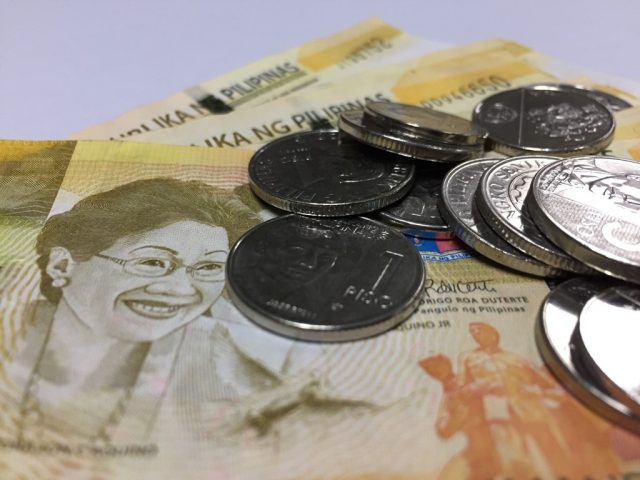
Peso may weaken against the dollar ahead of inflation, US jobs reports

BW FILE PHOTO

THE PESO may depreciate versus the greenback this week ahead of the release of January US jobs data, which is seen to support the planned monetary policy tightening of the US Federal Reserve starting March.

The local unit finished at P51.23 per dollar on Friday, gaining 11 centavos from its P51.34 close on Thursday, based on data from the Bankers Association of the Philippines.

Week on week, it appreciated by three centavos from its P51.37 close on Jan. 21.

The peso strengthened after the government announced it will relax travel restrictions on arriving Filipinos and some foreigners, Rizal Commercial Banking Corp. Chief Economist Michael L. Ricafort said in a Viber message.

Cabinet Secretary Karlo Alexei B. Nograles said at a Friday briefing on Friday that fully vaccinated international passengers will no longer be required for a facility quarantine upon arrival starting February. They will instead need to present a negative PCR test, taken within 48 hours before departure from the country of origin.

Travelers are currently categorized under color-coded scheme depending on the perceived infection risk of their country of origin.

Stronger-than-expected economic growth in the fourth quarter of 2021 also boosted the peso last week, UnionBank of the Philippines, Inc. Chief Economist Ruben Carlo O. Asuncion said in an e-mail.

Gross domestic product (GDP) rose by 7.7% in the three months to December, faster than the 6.9% in the third quarter, the Philippine Statistics Authority (PSA) reported on Thursday.

This brought 2021’s full-year expansion to 5.6%, turning around from the 9.6% contraction in 2020, which was due to the country having one of the world’s strictest lockdowns.

Last year’s GDP growth was also faster than the 5.3% median estimate of 18 economists in a BusinessWorld poll and surpassed the downgraded 5-5.5% target by economic managers.

For this week, Mr. Asuncion said the dollar could strengthen ahead of the release of US labor data. The January US nonfarm payrolls will be released on Friday, Feb. 4.

Reuters reported earlier that Fed Chairman Jerome H. Powell said they are determined to ensure high inflation did not become entrenched. He said Fed actions “should not have negative effects on the employment market.”

After their policy review last week, Mr. Powell said the US central bank may start increasing interest rates in March to tame runaway inflation.

Meanwhile, Mr. Ricafort said the market will also take cues from the release of Philippine inflation data.

The PSA will release the January consumer price index report on Feb. 4, Friday.

The Bangko Sentral ng Pilipinas (BSP) is expected to release its inflation forecast for the month this Monday.

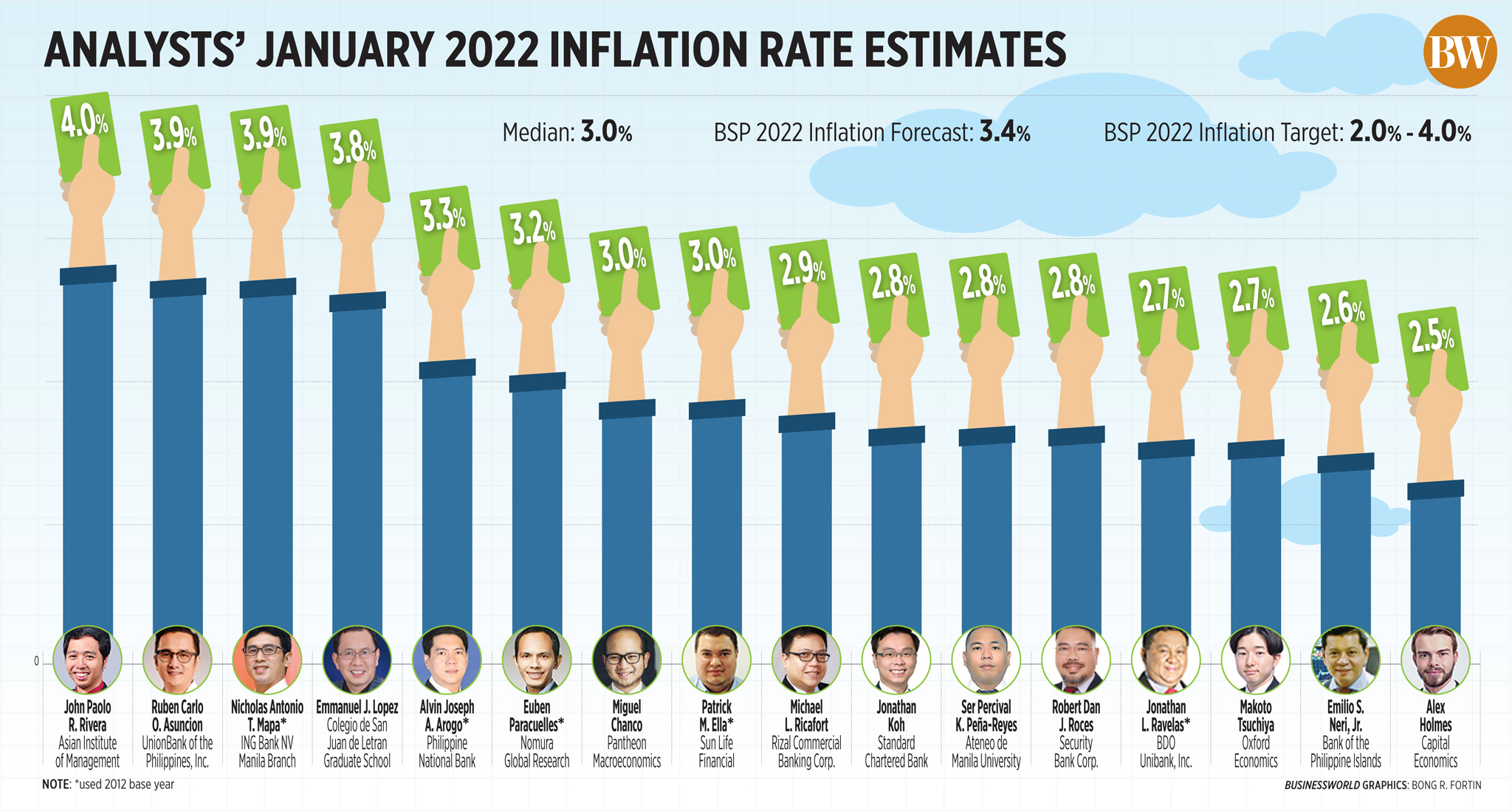
A BusinessWorld poll of 16 analysts last week yielded a median estimate of 3% for January inflation.

If realized, this will be the second consecutive month that inflation was within the BSP’s 2-4% target. It will also be slower than the 3.6% logged in December 2021.

Analysts said inflation likely slowed due to base effect and lower demand as infections spiked, even amid upward price pressures due to higher oil prices and the impact of Typhoon Odette to food supply.

For this week, Mr. Ricafort expects the local unit to move within P51 to P51.40 versus the dollar, while Mr. Asuncion gave a forecast range of P51 to P51.50. — L.W.T. Noble with Reuters

China kicks off reform of state food giants Cofco, Sinograin

REUTERS

CHINA has kicked off a long-anticipated overhaul of its massive state-owned agriculture companies to help secure food supply for the world’s most populous nation.

Food giant Cofco Corp. and national stockpiler China Grain Reserves Group, also known as Sinograin, will set up two joint ventures. The first is a grain storage business to be controlled by Sinograin, and the second for oilseed crushing and processing will be managed by Cofco. 

The move will play to the strengths of the respective firms and contribute to China’s broader goal of improving food security, according to a government statement late on Thursday.

The revamp has been considered since at least 2019 and is part of President Xi Jinping’s drive to streamline industrial capacity among state-owned companies. It will take Cofco closer to its ambition of rivaling the storied ‘ABCD’ group of international commodity traders who dominate flows of agricultural products — Archer-Daniels-Midland Co., Bunge Ltd., Cargill, Inc. and Louis Dreyfus Co.

TRANSFER ASSETS
The government could transfer Sinograin’s trading assets and oilseed crushing capacity to Cofco, Bloomberg reported in 2019. For Sinograin, the restructuring will allow it to fulfill its role of “managing the granary of a big country,” said the State-owned Assets Supervision and Administration Commission.

The move will improve the efficiency of resource allocation and the ability of enterprises to withstand risks, the commission, which oversees China’s state-run companies, said in the statement. This will support a stable grains and oilseeds supply chain, and help maintain national food security, it added.

Food security remains at the forefront of China’s political agenda after floods, epidemics and trade tensions raised pressure on the government to safeguard food supply for its 1.4 billion people. The nation’s imports of corn, soybeans, wheat and meat have soared to record levels in recent years, driving global prices higher and stoking worries over food inflation.

“Those factors are likely highlighting the importance for China to have a strong coordinated presence in the international and domestic market,” said Darin Friedrichs, co-founder and market research director of Sitonia Consulting, a China-based agricultural information service provider. 

Transferring Sinograin’s crushing capacity would reinforce Cofco’s position as China’s top crusher of soybeans as it competes with Wilmar International Ltd.’s units in the world’s biggest oilseed importing nation.

Cofco currently owns 30 processing plants across China, with annual processing capacity of over 20 million tons and refining capacity of more than 6.7 million tons. It has nine listed units in Hong Kong and seven on mainland Chinese stock exchanges, according to its website. 

Sinograin imports grains, soybeans and edible oils for state reserves, but it also has commercial oilseeds crushing and refining capacity that makes it one of the five biggest processors in China, according to its website. — Bloomberg

Honda PHL reiterates focus on customer service

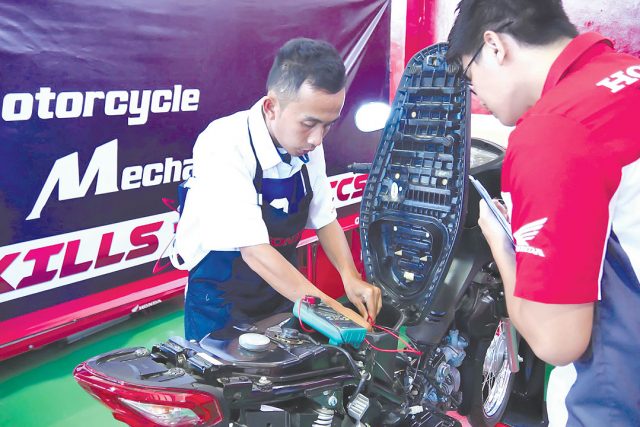
Honda Philippines reiterates focus on ‘top-notch’ customer service. — PHOTO FROM HONDA PHILIPPINES, INC.

HONDA PHILIPPINES, INC. (HPI) said in a release that “a motorcycle is only a two-wheeled vehicle, but its complexity makes it a machine that requires periodic service and maintenance throughout its lifetime.” Thus, the company promises to provide “top-notch and (uncompromising) after-sales service and support to ensure worry-free ownership every step of the way.”

In fact, HPI Assistant Vice-President for Customer Service Operations Hitoshi Ito credits the brand’s market leadership to making clients feel cared for. “We know that customers buy motorcycles because this helps make their daily lives better. In the same way, Honda’s customer service will always be here to help our customers’ daily lives better, easier, and more comfortable as well,” he explained.

Aside from exclusive dealers being equipped with tools, equipment, and publications, all HPI mechanics are guaranteed to be well-trained and accredited. They also receive regular training both in the areas of technical and customer service, which is an important protocol all dealers need to follow. HPI said that empowering its frontliners to provide an exceptional after-sales experience is “the key to adding value, joy, and safety to the lives of the customers.”

Founder Soichiro Honda said that human relationships are based on trust. “It is our job to fix their motorcycles but, more than that, the true goal is to repair the customer’s heart, to make the customers happy,” he affirmed. Thus, Honda’s Mechanic Skill Olympics annual competition is a testament to this vision, as it’s not only the most-awaited activity of all their dealers and mechanics, it’s also a showcase of their individual technical expertise. As a reward, the winners get to represent the country in an international competition, participated by other Honda distributors from Asia and Oceania.

“We believe that Honda’s role in the community is not just to produce great products but also ensure that high-quality services are accessible to its customers through its after-sales program. This is the reason why Honda has always been at the forefront of the motorcycle business in the Philippines and why we have kept the loyalty of our customers over the years,” added Customer Service Manager Cyrus Pagaran.

Another Customer Service Manager, Noli Minor, Jr., continued, “We always ensure that a purchase is supported by strong after-sales through our dealers. We want our customers to always come back to our dealers because they are delighted with the services. It’s the responsibility of Honda to make our dealers always be ready about it.”

The company recently launched its Serbisyong Panalo Promo, that will run until April 30. Every purchase of Honda genuine part, apparel, or service worth P300 earns a raffle ticket for a chance to win any of the following: Honda helmet (15 winners in NCR, Luzon, Visayas, and Mindanao), smartphones, and a brand-new Honda PCX160 (one winner each for NCR, Luzon, Visayas, and Mindanao).

Style (01/31/22)

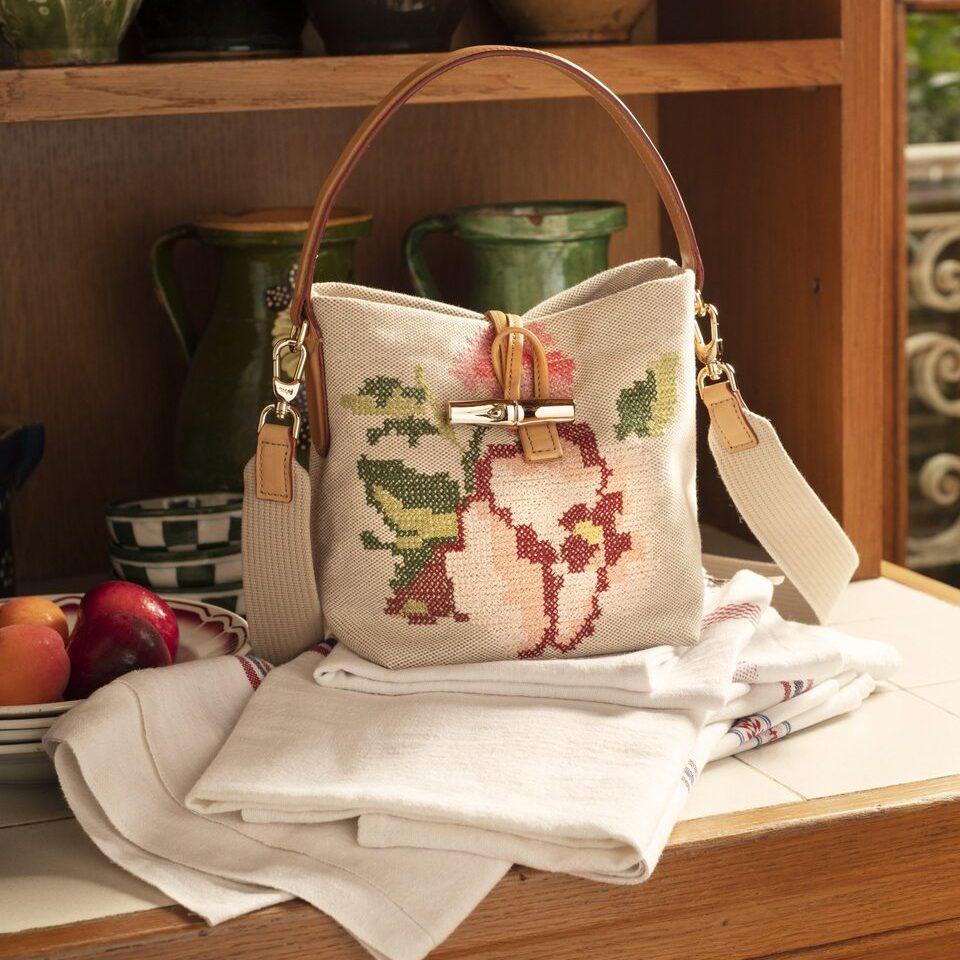
Longchamp Roseau Essential Fleurs Bucket bag Pink

Longchamp releases new Roseau bags

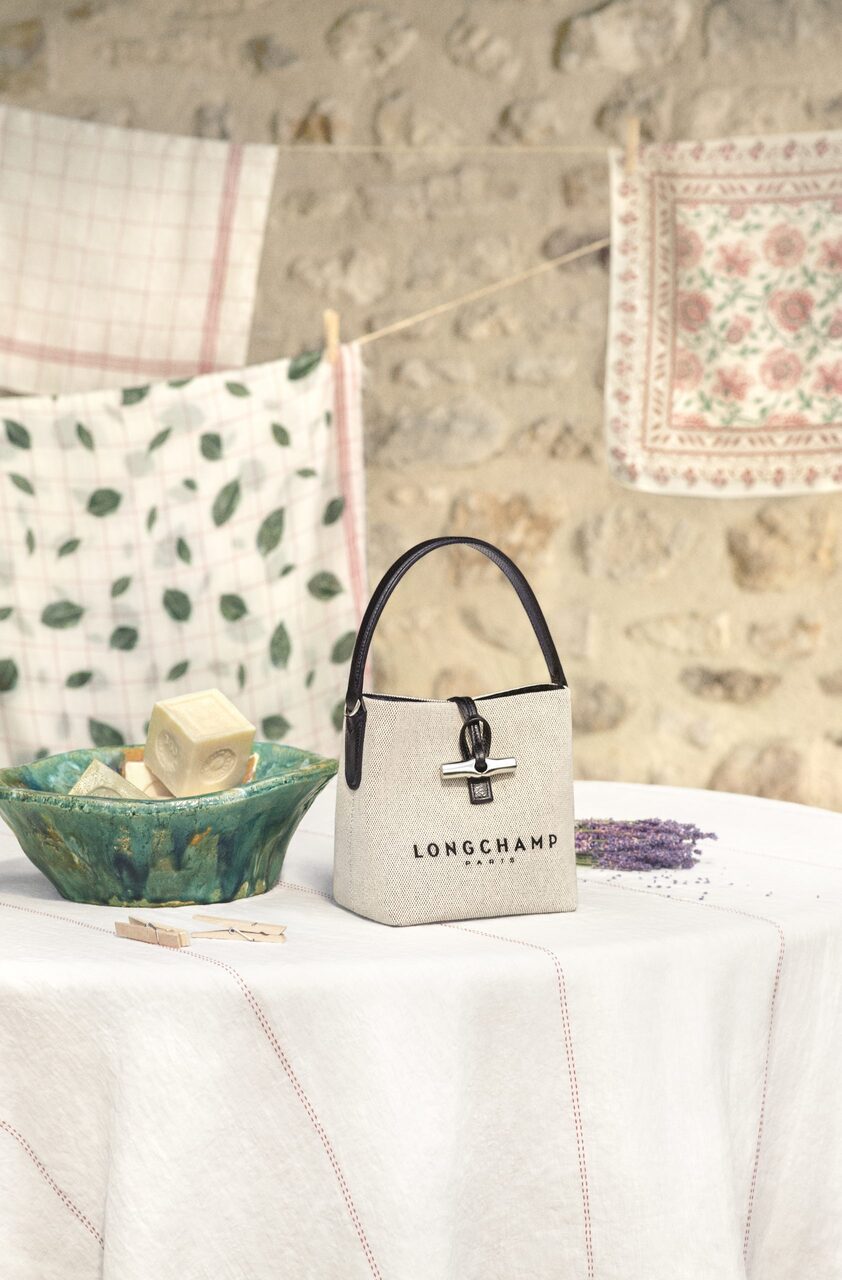
ALONGSIDE the Le Pliage, the Roseau bag is a Longchamp icon. Launched nearly three decades ago as an open tote secured with a bamboo toggle — the roseau of the name — the bag is regularly reinterpreted so that, as well as being an enduring emblem of elegance and authenticity, it remains at the cutting edge of fashion. That is again the case for Spring/Summer 2022, when the latest iteration of the Roseau — a simple yet stylish bucket bag. Crafted from cowhide leather, the small yet spacious Roseau bucket is made to be dangled lightly from one hand by its rounded handle or — thanks to its longer, removable strap — slung over the shoulder or across the body. A palette of timeless shades, including tan and black, enhances the authentic feel of this design. In addition to the leather Roseau bucket, an array of variations are directly inspired by Longchamp’s Spring/Summer 2022 ready-to-wear collection — witness a model in cotton canvas embroidered with soft floral motifs like a Provençal tapestry, or another version in blue and white striped cotton, which evokes the spirit of the Mediterranean. Both have a natural leather handle and trim, and a canvas shoulder strap. Two further variations play on Longchamp signatures: the first, in ecru cotton canvas with black grained cowhide trim, is printed with the name of the House on one side and the racehorse logo on the other; the second comes in black and taupe LGP jacquard canvas with black Russian leather trim. The one feature all these buckets share? The iconic toggle, now in shiny silver or pale gold-tone metal. Longchamp is exclusively available at Rustan’s Makati, Rustan’s Shangri-La, Rustan’s Cebu, Greenbelt 5 and Rustans.com.

Rustan’s offers personalization services for one-of-a-kind gifts

FOR VALENTINE’S, Rustan’s launches “Make It Personal,” a campaign focused on offering personalization services to make a gift meaningful. Personalized gifts stand out because of the extra level of thought that goes into them. Rustan’s offers multiple services to personalize and create custom gifts in-store, such as hi-speed laser engraving, guest calligraphers, embroidery, handwritten messages and greeting cards. Expect complimentary engraving and other gifts with purchase when shopping for fashion, home, and luxury gifts from Hermés, Montblanc, Adolfo Dominguez, Pedro del Hierro, Christofle, and more. Get complimentary engraving on glass or metal pieces for a minimum single-receipt purchase of P10,000. This service will be available on Feb. 4 at Rustan’s Alabang, Feb. 5 at Rustan’s Makati, and Feb. 6 at Rustan’s Shangri-la from 1 to 5 p.m. Looking for the perfect pen for your loved one? Choose from Cross, Parker, or Sheaffer and have a message engraved for every purchase. A Victorinox Swiss tool with their name makes an excellent gift for the handyman in your life. On Feb. 5 to 6 and Feb. 12 to 13, customers who will shop at Rustan’s Makati can embroider one piece of clothing from Criselda Lontok, Lady Rustan, Lotus, Luna, Eileen Fisher, Ricardo Preto, Adolfo Dominguez, Karen Kane, Daze, and Pedro del Hierro. Opting for a bag or accessory? Transform items from Momoe, Guasch, Echo Designs, Traveler, Lesportsac and Coccinelle into pieces with personal value by having them embroidered with their recipient’s initials. Add a nice touch to Montblanc leather goods and writing instruments with complimentary debossing and engraving from Feb. 1 to 15. Purchase fine jewelry pieces from Marco Bicego, Damiani, and Roberto Coin, and get a free personalized pouch to match the gift. Fragrance has always been a traditional gift every Valentine’s Day. From Feb. 11 to 14, purchase a full-sized Hermés perfume and make it unique and memorable with a hand engraved calligraphy love note. Rustan’s also offers an array of unique, one-of-a-kind gifts suggestions. Check out the Rustan’s Valentine’s themed e-catalog or avail of the Personal Shopper on Call service for more personalized gift suggestions. Use the expert assistance of a Personal Shopper or dial our Personal Shopper On-Call hotline 0917-111-1952 from 10 a.m. to 7 p.m. Contact your preferred Rustan’s store to request for the personal shopper service, and a Sales Associate will be assigned to assist you with your inquiries, order confirmation and payment transactions. Fulfilled orders can be collected via curbside pick-up or items can be delivered for free, for a minimum purchase requirement of P5,000.

Rimowa reveals new colors of Tanzania

RIMOWA has created a cross-product capsule collection that sees its Essential suitcase range and a Personal Polycarbonate Cross-Body Bag reimagined in two distinctive colors that pay tribute to Tanzania’s dramatic landscapes. Tanzania is famed for its natural beauty, which stretches from the plains of the Serengeti to the snow-topped peak of Mount Kilimanjaro. A popular destination for animal lovers, the East African country is home to many of the continent’s most famous wildlife — including millions of flamingos, who arrive at the vivid waters of its northern lakes to feed and breed. Inspired by this breathtaking spectacle, Rimowa created two new complementary tones: Flamingo, a boldly saturated reddish tone, and Azure, a peaceful, easy-to-wear shade of blue. Renowned as the world’s first polycarbonate suitcase, the Rimowa Essential range has been color-matched in Flamingo and Azure — from its glossy shell to the badge and wheel housing. Such innovation is on display throughout the case’s design, with a stage-free telescopic handle and Multiwheel system to ensure a seamless travel experience. Alongside the new Essential range, the Rimowa Personal, a cross-body bag crafted from the same grooved polycarbonate as the suitcase, is now available in Azure. The Essential Cabin in Flamingo or Azure, the Essential Check-In L in Flamingo or Azure, and the Essential Trunk Plus in Flamingo or Azure are now available at Rimowa stores worldwide. In March, the Personal Polycarbonate Cross-Body Bag in Azure will become available.

New ‘Bring It To Me’ feature on the adidas app

WITH safety protocols now more important than ever, adidas has launched a digital personal shopper service through the new Bring It To Me feature on the adidas app, allowing customers to digitally request shoes to try in-store. Customers of the adidas Brand Center in Glorietta, Makati, can now try out this in-store service for a safer and more convenient shopping experience. Using in-store geolocation tagging, the new feature allows shoppers to scan products, check stocks, and request their desired size all with their phones to help limit interactions. The Bring it To Me feature lets customers shop for their preferred shoes in three clicks. Customers should go to the, enable “store experience” under the settings tab, then click on “Scan a shoe” and scan the pair using the phone’s camera, select the desired size, tap “Bring It To Me” to confirm the request, then wait for a store associate to bring it. Once the shoe size has been confirmed, the request goes directly to a store associate to fetch the pair from the stockroom. But if the desired pair is unavailable, the app also immediately informs the customer and suggests other similar pairs with the same style. One can download the adidas app on the Apple App Store or Google Play Store.

Shares seen to rebound as cases continue to drop

BW FILE PHOTO

STOCKS are seen to rebound this as the coronavirus disease 2019 (COVID-19) in the capital continues to improve and as companies release their financial reports.

The benchmark Philippine Stock Exchange index (PSEi) went down 21.55 points or 0.29% to end at 7,251.97 on Friday, while the broader all shares index slipped 5.41 points or 0.14% to close at 3,856.08.

Week on week, the index retreated 41.55 points from its 7,293.52 close on Jan. 22.

Rizal Commercial Banking Corp. Chief Economist Michael L. Ricafort said in an e-mail sent over the weekend that even though the PSEi traded lower, it still ended among one-month high despite the decline in other stock markets due to the hawkish signals from the US Federal Reserve.

Analysts said for this week, investors will take their cue from the continuous decline in COVID-19 infections in the National Capital Region (NCR), the release of inflation data and companies’ financial reports, as well as the effect of the Fed’s stance on local monetary policy.

Diversified Securities, Inc. Equity Trader Aniceto K. Pangan said the downgrade in NCR’s COVID-19 infection risk level to moderate from high is seen to boost market sentiment this week.

The Health department on Friday said Metro Manila is now just at moderate risk for COVID-19 following a 67% decline in new cases.

Health Undersecretary and spokesperson Maria Rosario Clarissa S. Vergeire said in a press briefing that NCR logged an average of 4,398 new COVID-19 cases last week, down from the 13,298 recorded the week earlier.

“Company earnings will start coming out this February, then investors will be waiting for the PSEi index rebalancing announcement,” Regina Capital Development Corp. Head of Sales Luis A. Limlingan said in a Viber message.

Mr. Limlingan added that the January inflation report to be released on Friday is also among this week’s trading drivers.

Online brokerage 2TradeAsia.com added that the Fed’s stance will continue to affect sentiment.

“The anxiety may linger until the second quarter this year when elections activity is projected to drive the CPI (consumer price index) artificially higher,” 2TradeAsia.com said in a market note sent over the weekend.

The Fed on Wednesday indicated it is likely to raise rates in March, as widely expected, and reaffirmed plans to end its pandemic-era bond purchases that month before launching a significant reduction in its asset holdings, Reuters reported.

Bangko Sentral ng Pilipinas Governor Benjamin E. Diokno earlier said they are unlikely to increase rates in the first half of this year as it waits for the economic recovery to become entrenched and unemployment to fall. The central bank has kept borrowing costs at record lows since 2020.

The Monetary Board will hold its first meeting on Feb. 17.

2TradeAsia.com and Mr. Pangan both put the PSEi’s support at 7,200 and resistance at 7,400. — M.C. Lucenio with Reuters

Analysts’ January 2022 inflation rate estimates

INFLATION is expected to have decelerated in January, as a favorable base effect offset the rise in oil prices and the impact of Typhoon Odette on food supply. Read the full story.

Analysts’ January 2022 inflation rate estimates

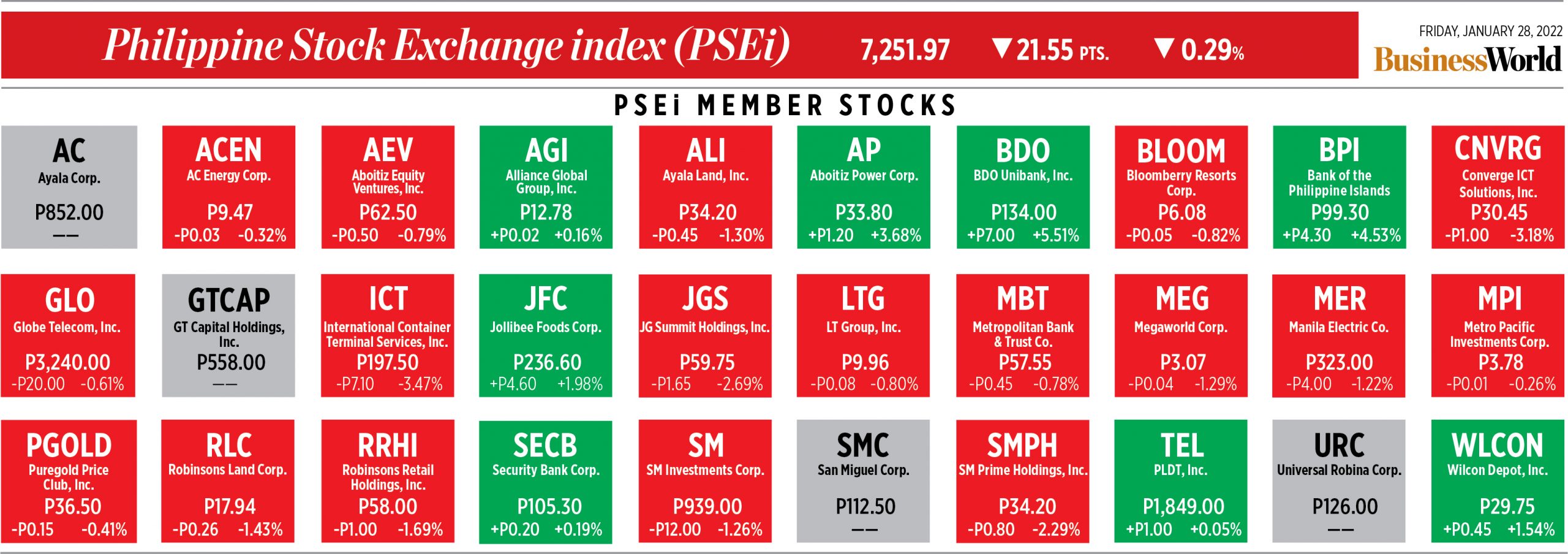
How PSEi member stocks performed — January 28, 2022

Here’s a quick glance at how PSEi stocks fared on Friday, January 28, 2022.


Return of mining investment seen delayed after gov’t bans

BW FILE PHOTO

By Luisa Maria Jacinta C. Jocson

THE Chamber of Mines of the Philippines (CoMP) said the recovery of investment in mining may be delayed because of the various moratoriums and shutdowns ordered on the industry over the past nine years.

“Because of the policy issues that the Philippine mining industry has faced, our country’s reputation as an investment destination took a big hit, and it will take time for investors to regain their confidence in the Philippines,” CoMP Vice-President for Communications Rocky G. Dimaculangan said in an e-mail interview.

On Dec. 23, the government lifted the four-year ban on open-pit mining, rescinding an order issued by the late Environment Secretary Regina L. Lopez, an anti-mining advocate.

In April, President Rodrigo R. Duterte lifted the nine-year moratorium on granting new mining permits.

“Foreign investment in mining allows the government access to capital and technology that are meant to benefit the nation and its people over the long term. Some exploration and mining projects require huge capital requirements, which the government does not have, and Filipino investors may not be willing or able to provide,” Mr. Dimaculangan said.

“It also takes time for a mining project to reach operational status. Apart from having to prove its financial capability to operate a large-scale mine, and we’re talking about hundreds of millions to billions of dollars here, a project has to undertake such steps as an environmental impact assessment, and to secure a social license to operate, which in our experience is the more challenging one to get. That’s why the government’s recent mining policy pronouncements are indeed most welcome developments,” he added.

Three copper-gold projects are in the pipeline for Mindanao: Silangan, Tampakan and King King, which are expected to bring in close to $5 billion in total capital investment over several years, according to CoMP.

Mining’s gross domestic product contribution is expected to increase from 0.6% to 1.5% a year, while enhancing National Government revenue by P12 billion, LGU revenue by P1.5 billion, exports by $2 billion, and social expenditures by close to P800 million a year.

“You can imagine what yearly expenditures of almost P800 million per year can do to the development of those far-flung yet highly mineralized areas that don’t see much development at all. Also, royalties to indigenous tribes of a little over P600 million a year. It is no wonder that the indigenous people in such areas have been clamoring for the start of development of these projects,” he said.

“We hope the next administration will continue policies that will help stabilize business and investment policies. Our country has a lot of catching up to do in terms of investment attractiveness compared to other mining jurisdictions all over the world,” he added.

After the ban on open-pit mining was lifted, various environmental groups criticized declared their opposition, citing the impact on the environment, changes to the landform, and the risk of acid leaks and deteriorating water quality.

With regard to sustainability, the chamber said sufficient laws in place to assure that mining does not unduly damage the environment.

“We believe that the regulatory environment governing mining is adequate. The Philippines already has among the strictest mining laws, rules and regulations in the world that impose on exploration and mining companies many social, economic, and environmental limitations and conditions. Where we can explore and mine is already well-defined. We need to secure a social license before we can explore and mine. We have to contend with voluminous environmental requirements and reports from inception to termination — and beyond — of our mining projects,” Mr. Dimaculangan said.

“In the last nine years, our government has done a thorough review of the regulatory framework of the mining industry and has put in place additional rules and regulations to enhance the industry’s productivity while increasing the protection for the environment and the benefits to host communities,” he added.

Mr. Dimaculangan said the chamber adopted the Climate Change Protocol in 2017, one of the eight protocols of the Towards Sustainable Mining (TSM) initiative.

“TSM is a set of tools and indicators to drive environmental and social performance and ensure that key mining risks are managed responsibly at members’ facilities. The program was established in 2004 by the Mining Association of Canada and its main objective is to enable mining companies to meet society’s needs for minerals and metal products in the most socially, economically, and environmentally responsible way,” he said.

The CoMP said it undertook a thorough “Filipinization” process for TSM from 2018 to 2020 to ensure the program is responsive to Philippine conditions.

Apart from Canada and the Philippines, TSM is currently being implemented in Argentina, Australia, Botswana, Brazil, Colombia, Finland, Norway, and Spain.

The Department of Environment and Natural Resources also issued a memorandum authorizing large-scale mining companies to realign their mandated social development funds, equivalent to 1.5% of operating costs, to support affected communities quarantined due to the pandemic.

“Consequently, large-scale mining companies spent over P380 million on PPEs, disinfectant, and medical supplies, as well as food assistance and supplies for social amelioration measures.  This benefitted 297,491 frontliners and 1,099,090 households and families living in host communities and beyond,” Mr. Dimaculangan said.

Subway excavation expected to start in Q2

By Arjay L. Balinbin, Senior Reporter

THE Transportation department said tunnel works for the Philippines’ first underground railway system will start by the second quarter, with the positioning of the tunnel boring machines from Japan set to start in April.

“TBM (tunnel boring machine) lowering and assembly for excavation will begin in April,” Transportation Undersecretary Timothy John R. Batan told BusinessWorld last week when asked for an update.

The new timetable represents one quarter’s slippage in subway progress. The department said in December that excavation would begin in the first quarter of 2022, with lowering and assembly taking “two to three months starting in December.”

On Jan. 8, Transportation Arthur P. Tugade announced that the Metro Manila Subway Project’s (MMSP) overall progress rate as of November 2021 was 25.09%.

“Now, the MMSP is already NEDA (National Economic and Development Authority) Board-approved, already funded by the Japanese, and its partial operability civil works, trains, and electromechanical systems already contracted,” he said in a statement.

“Actual construction works by the design-build contractor for the partial operability section began in 2019 with site clearing works at MMSP’s Valenzuela Depot,” he added.

Two out of 25 tunnel boring machines from Japan that will be used for the project arrived in Manila in February 2021.

The project was first proposed and planned in 1973 as part of the Urban Transportation Study in the Manila Metropolitan Area, the department said.

“For more than 40 years and six administrations, all we had were talk, proposals, plans, studies, drawings, and Powerpoint presentations,” the department noted.

The government broke ground on the first three stations in February 2019 after the Transportation department signed a P51-billion deal with the Shimizu joint venture, which consists of Shimizu Corp., Fujita Corp., Takenaka Civil Engineering Co. Ltd., and EEI Corp.  

The Philippines and Japan signed in March 2018 the first tranche of the P355.6-billion loan for the project.

The subway will have 17 stations: East Valenzuela, Quirino Highway, Tandang Sora, North Avenue, Quezon Avenue, East Avenue, Anonas, Katipunan, Ortigas, Shaw, Kalayaan Avenue, Bonifacio Global City, Lawton, Senate, FTI, NAIA Terminal 3, and Bicutan.

It will run across North and South zones of the Capital Region, according to the Transportation department.

“Once operational, the MMSP will reduce travel time between Quezon City and NAIA (Ninoy Aquino International Airport) from one hour and 10 minutes to just 35 minutes,” it added.

While the public will have to wait until 2025 for full operations of the 17-station subway, the government is planning to launch partial operations, covering the first three stations this year.

Pandemic setbacks could prompt PHL review of ASEAN integration goals

ICTSI

THE PHILIPPINES could call for revisions in a region-wide economic integration plan after the pandemic affected its growth trajectory, the Philippine Institute for Development Studies (PIDS) said in a report.

In a research paper, How Does the Philippines Fare in Meeting the ASEAN Economic Community Vision 2025?, PIDS said that the Philippines so far is in the middle of the pack in performance against indicators set in the blueprint in 2015.

But the coronavirus disease 2019 (COVID-19) pandemic could call for a reevaluation of these goals, researchers Francis Mark A. Quimba, Maureen Ane D. Rosellon, and Jean Clarisse T. Carlos said.

“Parts of the economy and society that were affected might not deliver the expected outcomes. The ASEAN member-states could have also tweaked their respective development plans because of the pandemic like what the Philippines has done,” they said.

The ASEAN Economic Community (AEC) blueprint set in 2015 aimed for integrated economies, a competitive and innovative region, enhanced connectivity, a resilient and people-oriented region, and a global ASEAN.

Under AEC indicators, the Philippines performed well in categories like intra-ASEAN imports, private partnerships in infrastructure investment, and tariff rates on imports. But it ranked among the lowest in intra-ASEAN exports, research and development expenditure, intra-ASEAN tourist arrivals, and number of small businesses.

“While the country is generally moving toward achieving AEC goals, its performance certainly can be further improved,” the report found.

“Within ASEAN, its ranking is somewhere in the middle, placing for most of the indicators around fourth to sixth. As the Philippines is bound to become an upper-middle-income country, it cannot settle (for) the current standing and should do more work to step up the progress being made.”

The report recommended that the government assess indicators that need improvement to address bottlenecks.

The volume of trade could still improve by improving industry efficiency, while the information and communications technology sector will need more attention.

“Various aspects of the economy have become digital, and the COVID-19 pandemic highlighted the importance of internet connectivity and digitalization. The Philippines has a relatively high cost, low speed and weak internet connection,” PIDS said.

The Philippines, the report said, could tap ASEAN as a source of foreign direct investment in technology, which could help it integrate better with the region.

The Philippines could also reevaluate its plans in response to the impact of the pandemic.

The Philippine economy expanded by 5.6% in 2021, reversing the 9.6% contraction in 2020, when drastic lockdowns slowed down business and consumer activity. But last year’s growth is still lower than the pre-pandemic 6.1% expansion in 2019.

“While the National Economic and Development Authority is actively assessing the Philippine Development Plan indicators, there is a need for the entire government (including the local government units) to update plans and incorporate the AEC targets,” PIDS said. — Jenina P. Ibañez

SEC urges caution on digital investment

REUTERS

THE securities regulator has warned the public to exercise caution in making digital and cryptocurrency investments, noting the presence in the Philippines of investment scams specializing in the assets.

At a webinar organized by the Philippine Stock Exchange on Sunday, Vicente Graciano P. Felizmenio, Jr., director of the Markets and Securities Regulation Department at the Securities and Exchange Commission (SEC) said that the regulator “is not against DLT (distributed ledger technology), it’s not against blockchain, and definitely we even encourage the use of it in the market, and we favor innovation.”

However, he warned that some entities are taking advantage of the rise of cryptocurrency, noting recent SEC advisories against scams by unlicensed parties that purport to invest client funds in digital assets.

The entities the SEC flags via its advisories defraud investors by claiming they invest in cryptocurrency.

Bangko Sentral ng Pilipinas (BSP) Circular No. 1108 or the Guidelines for Virtual Asset Providers provide that those entities that engage with virtual assets are required to secure a license from the BSP.

BSP Technology Risk and Innovation Supervision Department Director Melchor T. Plabasan said central banks are “veering away from calling these cryptocurrencies currency or money.”

“There’s really a technical and legal definition for currency or money,” Mr. Plabasan said. “It should be backed by the central bank or by a monetary authority; it should be stable.”

Cryptocurrencies in the Philippines are classified as digital or virtual assets.

Mr. Plabasan said according to current regulations on virtual asset service providers, “We really conduct thorough evaluation, on-site and off-site supervision; we do… technical review before these products and services are offered to the public and when you secure your license as a virtual asset service provider, then you are now required to comply with the BSP’s regulations,” which include rules on Anti-Money Laundering, consumer protection, and cybersecurity.

The BSP maintains a registry of licensed virtual asset providers to ensure that investors can get regulatory support.

“If you want to experience how it is to trade in retail for crypto, train in bonds.ph,” Union Bank of the Philippines Senior Executive Vice-President and Chief Technology and Operations Officer Henry Rhoel R. Aguda said.

He said bonds.ph is “a normal retail bond,” with bond investment for as little as P5,000. He said the platform uses blockchain.

“The bonds are not yet tokenized, (but) the mechanism and technology to buy and sell Philippine retail bonds is already in blockchain,” Mr. Aguda said. “That’s gone through regulatory approval, that’s in the partnership with the Bureau of the Treasury, and who knows in the future, that same experience of buying and selling retail bonds can be applied safely and securely on cryptocurrencies.” — Keren Concepcion G. Valmonte

ADVERTISEMENT
ADVERTISEMENT