Home Blog Page 6833

Philippine presidential bets kick off 2022 campaign
PHILIPPINE presidential candidates started their three-month campaign on Tuesday with grand rallies and parades aimed at wooing millions of voters more concerned about personalities than policies. 

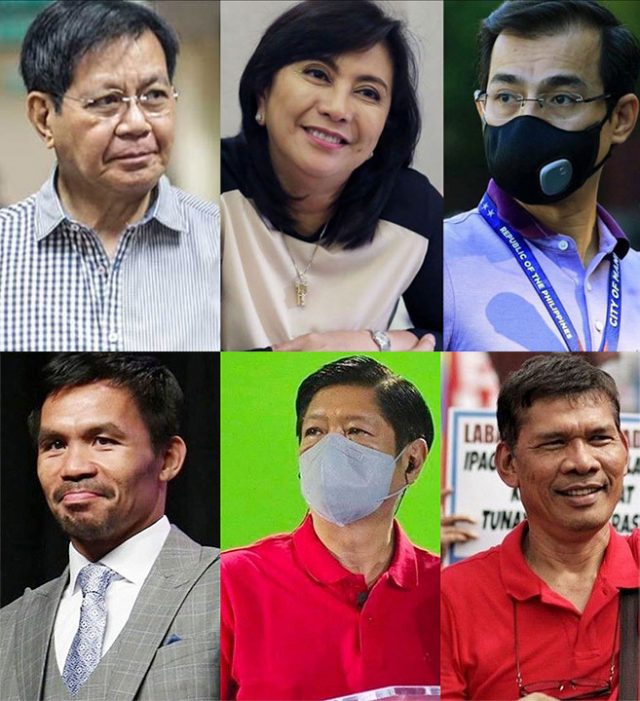
Six candidates vying to succeed President Rodrigo R. Duterte have until May 7 to present their platforms and convince Filipinos to vote for them two days later. Nine are running for vice-president. 

The late dictator’s son Ferdinand “Bongbong” R. Marcos, Jr. is leading opinion polls on a race dominated by powerful clans and influenced by religious blocs. 

Mr. Marcos launched his campaign at the world’s largest indoor arena in Bulacan province owned by the religious group Iglesia Ni Cristo (INC). The group is known to vote as a bloc and had historically backed the Marcoses. 

Political analysts have said more than a million INC voters might be enough to swing the votes. 

“It is just a venue,” Marcos lawyer Victor D. Rodriguez told reporters when asked if the religious group had endorsed his client and running mate and presidential daughter Sara Duterte-Carpio. 

The candidate’s rally was hosted by actress Celestine “Toni” Gonzaga, whom civic groups had criticized for allegedly downplaying the atrocities committed during the martial law regime of his father, the late dictator Ferdinand E. Marcos. 

At the program, Mr. Marcos reiterated his call for unity, which has been heavily criticized by victims of his father’s martial rule. 

Also running for president are incumbent Vice-President Maria Lenor “Leni” G. Robredo, former matinee idol and Manila Mayor Francisco “Isko” M. Domagoso, boxing champion and Senator Emmanuel “Manny” D. Pacquiao, Senator Panfilo M. Lacson who is a former police chief and labor leader Leodegario “Ka Leody” de Guzman 

Ms. Robredo, a former lawyer for the poor, started her pink-colored campaign in Lupi town in Camarines Sur province. A distant second in opinion polls, she has vowed to “defeat the old and rotten brand of politics.” 

She was thrust into the political limelight after the death of her husband and local government champion Jesse M. Robredo. She ran for a House of Representatives seat in 2013 and won. 

Mr. Duterte, who is barred by law from running for reelection, on Monday night said almost all of the candidates had sought his endorsement, but he was not supporting any of them at the moment. “At this time, I am saying that I’m not supporting anybody,” he told a televised Cabinet meeting. 

He had chosen loyal aide Senator Christopher Lawrence T. Go to replace him, but he pulled out of the race. 

Mr. Duterte, who is stepping down in less than five months, said he had been longing for retirement. “I have started packing. I have had some of my belongings shipped.” 

SIGNATURE TUNE
Meanwhile Mr. Domagoso started the first day of the national campaign with a mass in Tondo, Manila where he grew up. 

He was seen dancing to the tune of “Dying Inside to Hold You” as speakers blasted his signature tune, while his motorcade passed through a street in the district of Tondo, where he collected garbage as a boy. 

Mr. Domagoso said he had a good chance of winning just like Mr. Duterte, who was mayor of Davao City before he became president in 2016. 

He said people’s lives have not improved under the late dictator and his successor, democracy icon Corazon C. Aquino. “If you’re tired of these two, I’m just here.” 

Mr. Pacquiao started his uphill climb to the presidency with a caravan in his hometown of General Santos City. Starting at the village of Bawing to the Oval Plaza Stand where he was to have his proclamation rally. 

At his rally, the boxing champ said government corruption is the root cause of poverty. “The fight of Manny Pacquiao is not a fight for myself no my family. Rather, it is a fight for every Filipino.” 

Mr. Lacson started his campaign in his hometown of Imus in Cavite province. He vowed a “disciplined” campaign, leading by example and avoiding mudslinging. 

“The people may not be our masters, but definitely we are your servants,” he said at his proclamation rally. “If I become the president, I will not embarrass you. I will not fail you.” 

Meanwhile, Mr. de Guzman held his proclamation rally at the Bantayog ng mga Bayani (Heroes’ Monument) in Quezon City later in the day. 

At his proclamation rally, he said it is time for workers and the poort to lead the country. “The problems of the rich are different from the ordinary Filipino which is why those in power do not take our country’s problems seriously,” he said in Filipino. 

He also reiterated his plan to impose a wealth tax on the richest Filipinos. “This should be the government of the people, not the government of billionaires.” 

Senatorial candidates also kicked off their campaign, including six lawmakers who are seeking reelection. 

Senator Leila M. de Lima, one of Mr. Duterte’s staunchest critics, said her “unjust detention” would not prevent her campaigning. She would use surrogates, video messages and dispatches to woo voters. 

Senator Richard J. Gordon, on his final term, vowed to fight corruption and incompetence in government. “Our crusade against corrupt and abusive members of the government will not end here because we will continue to hold those who steal and sin against the people accountable.” 

Senator Ana Theresia “Risa” N. Hontiveros-Baraquel held a caravan in Camarines Sur, focusing on jobs, health and economic revival. 

The three are part of Ms. Robredo’s senatorial slate. 

Senator Joel J. Villanueva, who is running as an independent for a second term, pledged to continue his agenda of job creation. 

Also running for reelection are Juan Miguel F. Zubiri and Sherwin T. Gatchalian. 

Antique Rep. Lorna Regina “Loren” B. Legarda, who had been a senator for three terms, vowed to prioritize the poor “as we tread on the path towards sustainable and green pandemic recovery.” 

Former Duterte spokesman Herminio L. Roque, Jr., who is part of Mr. Marcos’s senatorial lineup, vowed to improve healthcare and reform the justice system. — Kyle Aristophere T. Atienza, Alyssa Nicole O. Tan, Jaspearl Emerald G. Tan and John Victor D. Ordoñez


DoH reports 3,574 more COVID cases, 83 more deaths

PHILIPPINE STAR/ MICHAEL VARCAS

THE DEPARTMENT of Health (DoH) posted 3,574 coronavirus infections on Tuesday, bringing the total to 3.62 million.

The death toll hit 54,621 after 83 more patients died, while recoveries rose by 14,644 to 3.46 million, it said in a bulletin.

It said 16.3% of 23,754 samples on Feb. 5 tested positive for coronavirus disease 2019 (COVID-19), still above the 5% threshold set by the World Health Organization (WHO).

Of 105,550 active cases, 4,059 did not show symptoms, 96,722 were mild, 3,007 were moderate, 1,446 were severe and 316 were critical.

The DoH said 87% of the latest cases occurred from Jan. 26 to Feb. 8. The top regions with new cases in the past two weeks were Metro Manila with 528, Western Visayas with 357 and Central Visayas with 308 infections. It added that 64% of new deaths occurred in February.

The agency said 328 duplicates had been removed from the tally, 276 of which were recoveries, while 35 recoveries were relisted as deaths. Six laboratories failed to submit data on Feb. 5.

DoH said 41% of intensive care unit beds in the country had been used, while the rate for Metro Manila was 35%.

The country’s average daily cases fell by 52% last week from a week earlier, Health Undersecretary Maria Rosario S. Vergeire told an online news briefing.

Zamboanga Peninsula, the Davao region, Soccsksargen and Northern Mindanao were at high risk from the virus, she added.

The government is scrambling to vaccinate more people as it reopens the national economy.

The Philippines had fully vaccinated 60.15 million people as of Feb. 7, while 60.74 million have received their first dose, data from the Health department showed. About 8.24 million booster shots have been injected.

The government is also aiming to inject booster shots to 72.16 million adults and 12.47 million minors aged 12 to 17.

On Feb. 7, The government started vaccinating children aged five to 11. The government aims to inoculate 15.56 million kids under the age bracket.

Ms. Vergeire said more than 9.2 million children aged 12-17 have been vaccinated with no deaths reported. Among the more than 9,000 kids vaccinated on Monday, only one child reported a mild reaction, she added.

Meanwhile, the government would keep the virus alert system, presidential spokesman Karlo Alexei B. Nograles told a televised news briefing.

The five-tier alert level system will be institutionalized in the fifth phase of the National Economic Development Authority’s national action plan “to serve as our warning system for possible increase in cases or outbreaks,” he said.

“Alert Level 1 is our new normal, which focuses on enhancing risk management, although it appears to be less restrictive,” he added.

Agencies are working on a national roadmap so the country could move toward living with COVID-19, Mr. Nograles said.

“We feel that it is now time to start discussing and planning out a roadmap so we can already start living with COVID-19, and we will start doing that this month,” Vivencio B. Dizon, deputy enforcer of the country’s pandemic plan, told a televised Cabinet meeting on Monday night.

Meanwhile, DoH has lowered the price cap on COVID-19 antigen test kits to P350 from P500, based on a Jan. 28 circular released on Tuesday. — Kyle Aristophere T. Atienza

Vote buying incidents may now be reported through Comelec’s social media accounts

VOTE BUYING, the act of giving money or other forms of valuable goods in exchange for guaranteed support on election day, may now be reported through social media platforms, the Commission on Elections (Comelec) said on Tuesday as the official campaign period started for national candidates. 

Comelec Spokesman James B. Jimenez, however, stressed that the public’s responsibility does not stop at merely reporting the vote buying incident — and/or selling, which means acceptance of the bribe.

“If you see vote-buying, you should document the vote-buying activity, file a  formal complaint, and pursue the case to the end,” Mr. Jimenez said in a tweet on Tuesday.

He also said that simply posting pictures of campaign materials with stapled money does not count as a formal complaint.

Formal reports of election violations may be coursed through Comelec’s social media accounts using the #SumbongKo tag, Mr. Jimenez said in a press briefing on Tuesday.

Giving out food assistance or anything of value is also prohibited, Comelec Director Elaiza S. Sabile-David said in a radio interview over DZBB on Tuesday.

E-WALLET
Mr. Jimenez also said that Comelec is planning to address the possible use of electronic-wallet services for vote-buying. 

“We haven’t made any concrete agreements with these e-wallet services, but we’re trying to get something down,” he said.

He added that it is difficult to prove someone’s use of an e-wallet service for criminal purposes like vote buying.

Vote buying or selling is illegal under the Omnibus Election Code. Those found guilty face penalties of imprisonment for one to six years, disqualification from public office, and forfeiture of one’s right to vote. 

A political party found guilty faces a fine of at least P10,000. 

Mr. Jimenez also reminded candidates and supporters that  

campaign materials have to comply with Comelec rules such as using designated public areas for posters and a maximum size of two-by-three feet. 

Meanwhile, the poll body has printed 17.5 million ballots as of Monday for the May 9 polls, data from Comelec showed.

This total includes about 60,000 local absentee ballots, 79,080 overseas manual ballots, 2.6 million ballots for the Bangsamoro Autonomous Region in Muslim Mindanao, and 1.6 million overseas automated elections system ballots. 

Comelec is set to print 67.4 million ballots, including 65.7 million for voters nationwide and 1.7 million for overseas voters, according to Comelec Deputy Executive Director Helen C. Aguila Flores. — John Victor D. Ordoñez 

Business adviser urges gov’t to shift to ‘recovery mode’ with Alert Level 1 by March

PHILIPPINE STAR/ MICHAEL VARCAS

PRESIDENTIAL Adviser for Entrepreneurship Jose Ma. A. Concepcion III called on the government to place the country under pandemic Alert Level 1, the least restrictive under a five-level system, by March to sustain economic recovery.

Mr. Concepcion said in a statement on Tuesday that Alert Level 1 should be implemented starting next month as the country is seen to record lower coronavirus cases, citing an estimate by the OCTA Research Group that daily infections will drop to 1,000 to 2,000 by end-February. 

“We need to de-escalate our countrymen from crisis mode to recovery mode,” Mr. Concepcion said. 

“This is important if Filipinos (have) to come out and help rebuild our country by engaging in economic activity like going to shops, dining out, traveling or going back to work.”

Mr. Concepcion said a shift to Alert Level 1 will have a big effect on the country’s economic recovery, adding that areas with high vaccination rate can implement a no alert level status while maintaining minimum health protocols such as wearing of face mask. 

“I think that as long as there are no variants of concern, and we have already achieved a high vaccination rate and hospital utilization rate is low, we can already start to consider lifting alert levels,” he said. 

Mr. Concepcion also suggested that the government should firm up the timing for administering booster shots, noting that immunity will eventually wane and thousands of vaccines are approaching expiry date.

During an interview in ABS-CBN News Channel on Tuesday, Mr. Concepcion also recommended that the alert level system should eventually be set aside and just reimplemented if there is another virus outbreak.

“Six months or eight months or a year from now, we don’t know if there’ll be another virus, maybe more contagious. But the alert level system is still there. So, we can bring it back once we see the threat,” he said. “My only suggestion is maybe we can trim it down instead of Alert Level 1 to 5, maybe we can trim it down to Alert Level 1 to 3.” — Revin Mikhael D. Ochave

Duterte orders gov’t agencies to prepare for use of national ID in delivery of services

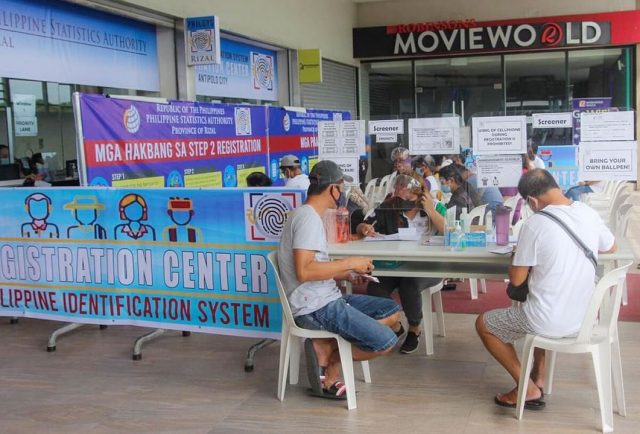
PRESIDENT Rodrigo R. Duterte has issued a memorandum circular directing agencies to prepare for the use of the Philippine Identification System (PhilSys) and its integration into government processes. 

Memorandum Circular No. 95, signed on Feb. 7., mandates all government agencies — including government-controlled corporations, local government units, and government financial institutions — to incorporate and integrate in their respective databases and services the Philsys Number (PSN) and Philippine Identification (PhilID) of registered individuals as well as the other components of PhilSys. 

“The covered agencies shall prioritize PhilSys integration to enable the use of PhilSys-enabled services, involving, among others, online authentication processes and proper controls for the PhilID, including features such as real-time authentication and validation, as established by the Philippine Statistics Authority (PSA), within two years from the launching of the said services in their respective agencies,” the memo states. 

The circular orders covered agencies to identify processes that can utilize the Philsys as well as determine the appropriate types and quantity of biometric authentication devices that need to be procured. 

Agencies are also mandated to develop their respective two-year work plans indicating the activities to be covered by the integration initiative; and coordinate with and enter into formal agreements with the PSA to ensure effective implementation of the PhilSys integration. 

Mr. Duterte signed the law that created PhylSis in 2018. 

A total of 50,014,382 Filipinos completed the second step of PhilSys registration as of Dec. 11, 2021, according to PSA. 

Step 1 involves submission of data; step 2 covers data validation; and the last step is the issuance of the PhilSys Number and ID. — Kyle Aristophere T. Atienza 

Solon says farmers can have direct link to retailers through digital platforms like dating apps

BLOOMBERG

A LAWMAKER said farmers can cut out middlemen and sell directly to retailers through digital platforms like dating apps, citing a model project in Butuan City called AgriBOOST. 

“These apps would sort of be like dating apps but being matched are the farmers, livestock raisers and fisherfolk on one side, while on the other side are vendors for public markets, supermarkets and cooperatives,” said Rep. Lawrence H. Fortun who represents the 1st district of Agusan del Norte which covers Butuan.

The city, located in southern Philippines, was one of the 15 winners of Bloomberg Philanthropies’ 2021 Global Mayors Challenge for the AbriBOOST project. 

Mr. Fortun called on telecommunication companies and financial institutions to step in to hasten the development of similar initiatives across the country. 

He said telecom service providers can tap their e-commerce platforms to make “mobile apps for farmers, livestock growers, and fishermen to achieve sustainable and profitable economies”.

In the financial sector, he said the Banko Sentral ng Pilipinas, Securities and Exchange Commission and the Department of Agriculture can jointly draft guidelines for the establishment of regional and national commodities trading boards. 

“The regional bourses must be auditable by the country’s many reputable audit firms and should address current and immediate local supply and demand, as well as future needs of the market within 12 months, especially the lean months or up to three cycles of harvests,” he said. — Jaspearl Emerald G. Tan

Cebu woos return of direct flights with top 3 tourist markets Japan, Korea, China

THE CEBU provincial government met with the consuls of Japan, Korea and China on Monday to push for the resumption of direct flights soon as the Philippines reopens its borders to fully-vaccinated foreign tourists starting Feb. 10. 

Gov. Gwendolyn F. Garcia also said that the local government intends to disregard the national government’s policy of recognizing only the vaccination certificates of countries with a reciprocal arrangement with the Philippines. 

“The governor will issue a memorandum that will lay down Cebu’s own protocols for vaccinated foreign tourists, particularly taking away this reciprocal arrangement requirement, as stated by IATF in its new ruling,” the Cebu provincial government said in a statement. 

Ms. Garcia stressed that the primary goal of all efforts to safely reopen Cebu’s borders is to help the tourism industry get back on its feet.

Hotel, Resort, and Restaurant Association of Cebu President Alfred Reyes said the industry is counting on the return of foreign tourists to drive occupancy rate as the government has already withdrawn the facility-based quarantine requirement for returning Filipinos. 

The Mactan-Cebu International Airport, located in central Philippines, is the second busiest gateway in the country. — MSJ

QC partners with fintech firm for SME financial literacy program

THE QUEZON City government has partnered with credit firm First Circle for a financial literacy program directed at the city’s over 75,000 small and medium enterprises (SMEs). 

“This is something very different and has not been done in our city… Through this partnership, we can provide two-pronged support to our entrepreneurs — financial assistance as well as financial literacy,” Mayor Maria Josefina “Joy” G. Belmonte said during the partnership agreement signing on Feb. 7. 

“We know that our SMEs need more help to survive in the competitive world of business in the midst of the pandemic,” she said.

The program will provide free quarterly webinars on money management and loans, and other topics intended to help business owners recover and grow their enterprises. 

“We’ve got a long road ahead of us but we’re very excited for everything to come,” First Circle Chief Executive officer Patrick Lynch said.

The Quezon City government previously rolled out other assistance projects for SMEs, such as a subsidy scheme to help cover wages and capital funding for unique startups.

Jay Powell may be the most important climate decision-maker

WIKIPEDIA

THE most important decision-maker for the future of the climate isn’t Saudi Crown Prince Mohammed Bin Salman, Chinese President Xi Jinping, US Senator Joe Manchin, or Tesla, Inc. Chief Executive Officer Elon Musk — it’s Federal Reserve Chair Jerome H. Powell.

You might not think that interest rates were as crucial as carbon pricing, the price of oil, the cost of polysilicon for solar panels, or whether you can buy an electric SUV for less than a gasoline-powered equivalent.

In fact, they’re a central consideration, because of a key difference between the way fossil fuel and zero-carbon power is paid for.

As the name implies, fossil energy depends on fuel. Expenditure on buying hydrocarbons year-in and year-out to power conventional engines and turbines makes up a significant share of overall expenditure. A new Ford Motor Co. F-150 pickup will cost $34,000 to buy, but drive it around for 10 years and you’ll have spent $25,000 just filling up the tank. A gas-fired power station that makes a profit selling electricity at $45 a megawatt-hour is spending almost half that amount on the methane it burns.

The fuel that renewables need, however — wind, sunlight, and water — comes free of charge. (Nuclear, whose modest fuel costs are dwarfed by the expense of building a new plant, is in a similar situation.) As a result, the expense of building zero-carbon power is front-loaded and paid off over the lifetime of the project, whereas conventional power incurs a larger share of costs later, at the same time as it’s bringing in revenues. That makes finance critical. Just as fossil energy is fueled by hydrocarbons, renewables are fueled by credit — and when the cost of credit rises, renewables’ economic advantages diminish.

Just how much is open to debate. One 2019 study of German renewable projects estimated that if 10-year government bond rates were to climb to 4.3% by 2023, the costs of solar would rise by 11% and those of wind, 25%. That would be enough to reverse the situation seen in recent years where new unsubsidized renewables have been able to undercut existing black coal and gas generators on cost, they wrote.

That, to be sure, would be an extreme scenario. German government debt is still trading at a negative yield and Goldman Sachs Group, Inc., one of the most hawkish Fed-watchers at present, doesn’t foresee the US Federal Funds Rate climbing above 2.75% in forecasts stretching out to the end of 2025.

Higher interest rates, meanwhile, are both a cause and an effect of higher energy prices, so it’s reasonable to assume that if the cost of renewables rises because of central bank policies, fossil fuel pricing would increase as much. An 11% bump in solar looks pretty modest next to the fourfold increase in European gas benchmarks over the past year, and even that would only slow, rather than arrest, the advance of renewables thanks to their ever-declining equipment costs.

At the same time, it’s important to consider whether shifting so much expenditure to the near term could have its own macroeconomic effects. Current spending on energy and land-use assets amounts to about $5.7 trillion a year, according to a McKinsey & Co. report last month. A shift to net zero would increase that spending over the coming three decades by a cumulative $26.5 trillion, the authors estimated.

That’s a modest outlay when set against the $19.5 trillion in borrowing incurred over 12 months in response to the COVID-19 pandemic. Still, about two-thirds of the increase in spending will have to occur over the next 15 years, according to McKinsey.

One explanation for the current era of low rates is that a generation has been deferring its spending to pay for longer retirements. This ballooning savings pool, chasing returns from a slower-growing pile of assets, has pushed down the cost of borrowing across the board.

The investment needed for a successful energy transition might change that. McKinsey’s estimate for spending on carbon-exposed assets equates to about one dollar in 15 in the global economy. Drag those costs forward and the long-term effect may be deflationary — but in the near term, that pool of savings may finally find the assets it’s been seeking, sending interest rates to a structurally higher level than we’ve seen for many years.

The twin fuels of the modern economy are energy and credit. Energy price volatility has always been a driver of macroeconomic policy, all the way back to the days in the mid-20th century when a sharp increase in the oil price was seen as an inevitable precursor to recession. In the past, though, that uncertainty has been driven only by supply-demand mismatches within the oil market. In the future, it may come from structural changes in the way our entire planet generates and uses energy.

Central banks wrestling with whether to use their economic clout to reduce the cost of capital for green investments should take note. Pushing too hard on interest rate rises could undo all the good they’re trying to do elsewhere.

BLOOMBERG OPINION

A tipping point for Philippine competitiveness

UPKLYAK-FREEPIK

For three generations, the Commonwealth Act No. 146 or the Public Service Act (PSA) of 1936 was immutable. In the same period, the Philippine economy had also been caught in a mindset of protectionism and nationalism. With the advent of globalization in the mid-1990s, the general Filipino attitude remained the same, notwithstanding the liberalization of its economy, trade, and investments in varying degrees.

It was only lately that the Philippine legislature has pivoted to a policy more responsive to the hyperlinked global arena with the ratification of the proposed amendments to the PSA. It intends to make the law more attractive and competitive for foreign investments that will boost the quality and services of the country’s lagging infrastructure.

The Public Service Act of 2021 delineated the scope of public utilities, which must be at least 60% Filipino-owned; and of public services, which allows 100% foreign ownership. While public utilities include transmission and distribution of electricity, water pipelines and sewerage, seaports, petroleum pipelines, and public utility vehicles (PUVs), public services include telecommunications and airlines.

With the said ratification, a handful of vital sectors will remain in Filipino hands. Philippine competitiveness is expected to improve, with new capital that will bring in new technologies that will expand and upgrade public services and stimulate a vibrant economic system amidst the challenges of the COVID-19 pandemic crisis. The increased presence of foreign companies should be seen as an opportunity to adopt and integrate the best innovations and world-class standards that will ultimately benefit all Filipino consumers.

Once signed into law, vital sectors — such as seaports and PUVs that are essential of trade and logistics — must still adhere to the 60% Filipino-40% foreign ownership limits. These utilities, after all, are critical to the movement of goods and people throughout the country. So allowing foreign control of these could have drastic economic and social implications.

At the same time, the amendments will still allow the national economy to be injected with much-needed foreign direct investments that will, in turn, have a positive impact on labor productivity and boost labor markets. Human capital will likewise be augmented as the labor force will have to undergo continuous re-education and upskilling to thrive in a fast-evolving digital economy.

There will be more jobs for workers, additional livelihood for affiliate industries, particularly the micro, small, and medium enterprises (MSMEs), and more income for Filipino families. The improvement in the human and finance capital in the telecommunications and airline industries will also result in the efficient delivery of responsive public services.

Aside from the perceived potential benefits of this economic opening, the PSA of 2021 is not without the necessary regulatory safeguards in relation to the possible risks of foreign control or intervention and infringements in national security.

For instance, Section 15 stipulates that the foreign investments in covered transactions are subject to review to prevent foreign control of a business or entity considered critical infrastructure, thereby ascertaining the effects on national security. Covered transactions, for this matter, pertain to “any investment activity such as a merger, acquisition, or takeover that is proposed or pending after the effectivity of this law.”

In terms of data privacy and cybersecurity compliance of foreign investors, Section 16 provides that “an entity Controlled by or Acting on Behalf of the Foreign Government, or Foreign State-owned Enterprise shall be prohibited from owning capital in any public service classified as critical infrastructure.” Additionally, the said entity “shall not make any data or information disclosure, nor extend assistance, support or cooperation to any foreign government, instrumentalities or agents.”

This safeguard is especially important when DITO Telecommunity comes to mind. Already 40% owned by the Chinese Communist Party-backed China Telecom, Section 16 of the PSA ensures DITO, the country’s third telco, does not become wholly-owned and controlled by a foreign government. This would only have created further national security concerns and privacy and data challenges.

Another commendable feature of the PSA of 2021 refers to the presence of a reciprocity clause. Section 17 states that “Foreign nationals shall not be allowed to own more than 40 per centum of capital in public services engaged in the operation and management of critical infrastructure unless the country of such foreign national accords reciprocity to Philippine nationals as may be provided by foreign law, treaty or international agreement.” This clause clearly puts all stakeholders on an equal footing.

Further, it is set to be dynamic legislation that is subject to performance audits, to be guided by regular studies and baseline surveys, and be subject as well to Congressional oversight and periodic review.

Forward-looking is what best describes the mentality and attitude of Bicameral Conference co-chairs Senator Grace Poe and Representative Sharon Garin in laboring for the passage of this bill. When the ratified bill becomes law, this will set up the Philippine economy to a more aggressive and progressively dynamic economic trajectory. The PSA of 2021 is the tipping point for Filipino competitiveness in this highly globalized and interconnected era where government, corporations, and civil societies cannot operate in silos anymore. Instead, these social forces should work with one another for the sustainable and inclusive development of all sectors of society


Victor Andres “Dindo” C. Manhit is the president of the Stratbase ADR Institute.

The case of Carpio

PCH.VECTOR-FREEPIK

Among the six kinds of employment (including probationary), it is probably in project employment where divergence in views, and even in decisions of the Supreme Court, is more than apparent. In an effort to summarize and clarify the various decisions on project employment, the Supreme Court, in Ruben Carpio vs. Modair Manila Co. Ltd., Inc. (G.R. No. 239622, June 21, 2021), “(synthesized) the jurisprudence and, to obviate further confusion regarding the nature of employment for workers in the construction industry, the Court (articulated) the following principles for the guidance of workers, employers, labor tribunals, the bench, bar, and public:” (Note: for brevity, citations were omitted; note further that while Carpio involves the construction industry, the doctrine therein may also be applied to other industries).

First, a worker is presumed a regular employee, unless the employer establishes that (1.) the employee was hired under a contract specifying that the employment will last only for a specific undertaking, the termination of which is determined at the time of engagement; (2.) there was indeed a project undertaken; and, (3.) the parties bargained on equal terms, with no vices of consent.

Second, if considered a regular employee at the outset, security of tenure already attached, and the subsequent execution of project employment contracts cannot undermine such security, but will simply be considered a continuation in the regular engagement of such employee.

Third, even if initially engaged as a project employee, such nature of employment may ripen into regular status if (1.) there is continuous rehiring of project employees even after cessation of a project; and, (2.) the tasks performed by the alleged “project employee” are vital, necessary, and indispensable to the usual business or trade of the employer. Conversely, project-based employment will not ripen into regularity if the worker was truly engaged as a project-based employee, and between each successive project, the employer made no manifestations of any intent to treat the worker as a continuing resource for the main business.

Fourth, regularized construction workers (in a work pool) are subject to the “no work, no pay” principle, such that the employer is not obliged to pay them a salary when “on leave.” In case of an oversupply of regularized workers, then the employer can exercise management prerogative to decide whom to engage for the limited projects and whom to consider as still “on leave.” The employer must use fair and reasonable standards in deciding, e.g., experience, skills-match, and availability.

Fifth and finally, the submission of termination reports to the Department of Labor and Employment may be considered only as an indicator of project employment; non-submission does not automatically grant regular status.

However, even with the synthesis made in Carpio, there may still be questions as to when a repeated hiring and re-hiring may or may not ripen into regular employment. The Court said that the employees should not be treated as “ongoing resources to be deployed for each and every project it might perform.” But this begs the question of whether the hiring and rehiring of employees for successive projects (even if not for “each and every project”) for several years is a badge of regular employment.

With all due respect, the Court may have failed to consider one strand of jurisprudence involving a situation where there is an identifiable project, with a determined duration, and several employees are hired to work on the project or on the several phases and/or components thereof. Absent any bad faith on the part of the employer, it is my opinion that the project employees remain as such even if they are continuously hired and re-hired within the project period to work on different phases or components of the same project.

Finally, with respect to the fourth principle, the “regularized project employees” are not exactly the same as the regular employees referred to in Article 295 of the Labor Code. The idea of a work pool of “regularized project employees,” as held in one case, is not to impose on the employer the mandatory duty to re-hire the employee after the completion of the project for which he was engaged. Rather, the employees are part of a pool from which the employer should tap, for engagement in projects that it has or may have, depending on the supply of manpower and the qualifications and skills of the employees. On the other hand, the regular employees of a company perform their tasks for the entire year regardless of the presence or absence of projects. Furthermore, the concept of leave enunciated in Carpio refers to the period that the employee is not engaged for a particular project, which is not the same as the concept of leave for the regular employees under Article 295.

This article is for informational and educational purposes only. It is not offered and does not constitute legal advice or legal opinion.


Neptali B. Salvanera is a partner of the Labor and Employment Department (LED) of the Angara Abello Concepcion Regala & Cruz Law Offices or ACCRALAW.

(632) 8830-8000

nbsalvanera@accralaw.com

The digital rupee needs more thought, less haste

STARLINE-FREEPIK

INDIA has surprised the payments world by announcing that its central bank will issue a digital currency as early as the coming financial year, a crucial decision that most other major economies are refusing to make in a hurry. According to Finance Minister Nirmala Sitharaman, an electronic representation of India’s legal tender will give a big boost to its digital economy. How valid is that claim, and how risky is a hasty transition to a central bank digital currency, or CBDC?

A digital rupee will be like banknotes, but minus the ATMs. Users will be able to transfer purchasing power from their deposit accounts into their smartphone wallets in the form of online tokens, which will be a direct liability of the Reserve Bank of India — just like cash.

Retail access to the central bank’s IOUs may not be a big deal in countries with well-capitalized financial systems. But this is a major benefit in India. As researcher Bhargavi Zaveri observes in the blog IndiaCorpLaw, depositors at 21 Indian lenders have been restricted from withdrawing their funds due to bank distress in the last few years. “A CBDC, which is a liability of the RBI, will mitigate the risk of losses that Indian depositors face when dealing with commercial banks,” she says.

Consumers may find the digital rupee to be a safer alternative to bank deposits, which underpin 76 trillion rupees ($1 trillion) in annual real-time payments via apps such as Walmart, Inc.’s PhonePe, Alphabet, Inc.’s Google Pay, and the homegrown Paytm.

But therein lies the risk as well. If electronic cash becomes popular, and the RBI places no limit on the amount that can be stored in mobile wallets, weaker banks may struggle to retain sticky, low-cost deposits. And even as they lose that cushion, lenders may be reluctant to shed their loan assets and sacrifice profits. Their less-liquid balance sheets could leave them vulnerable to bank runs.

All economies are mindful of this threat to financial stability. Yet, advanced nations also worry about the dwindling use of banknotes, especially after the pandemic. As more purchases go online, the basis of trust in demand deposits — that they convert to cash at face value — might get reduced to a theoretical construct. A digital currency as a public utility could keep the notion of convertibility grounded in daily reality.

In India, though, there’s no such urgency because cash is far from dying. Banknotes account for about 15% of money supply, compared with 1% in Sweden. Yet, the Riksbank is in no hurry to embrace CBDCs. After five years of weighing different architectures and running pilots, the Swedish monetary authority is still to take a final decision on whether to issue an e-krona.

The US Federal Reserve is seeking the public’s views on whether to provide an official tender to compete against private stablecoins riding on the dollar as the world’s most popular unit of account. The digital euro is in a 24-month investigation phase. If all goes well, the European Central Bank may offer it by 2025. Japan may delay a call to 2026. After judging the risks and rewards, Singapore has taken a pass on CBDCs for now.

India’s rushed deadline seems to be at least partly a response to the growing popularity of cryptocurrencies, though it’s hard to see how an unremunerated means of payment can wean the public off the get-rich-quick lure of a speculative asset class.

The other reason for hurry may be a desire to head off China, which is showcasing the digital yuan at the Beijing Winter Olympics. By early November some 140 million individuals had signed up for the e-CNY. But even in the People’s Republic, there is no national rollout date, and Alipay and WeChat Pay retain their stranglehold on electronic payments. Besides, Beijing’s intention to promote a rival to the dollar in cross-border trade and finance — which is presumably what worries New Delhi — will only become clear after the digital yuan makes its appearance in Hong Kong, perhaps via the wealth connect plan for the so-called Greater Bay Area.

Any role for a digital rupee in India’s fast-growing online economy is fuzzy. Unlike perfectly anonymous cash, most CBDCs will be designed so central banks will have the power to trace spending to check money-laundering. However, transactions conducted with them may not be visible to payment apps. The fintech industry may lose access to some of the data that it is currently mining with artificial intelligence to make cheap loans available to those who do not possess collateral or business and tax registrations, such as mom-and-pop stores.

There will also be gains, though they won’t be immediate. Once international corridors are in place for exchanging one CBDC into another, there won’t be any need for an expensive network of correspondent banks to settle cross-border payments. For Indians working abroad, sending money home will become simpler and cheaper, leading to substantial savings for the world’s No. 1 recipient of foreign remittances. However, some of those benefits are possible even without a digital rupee, via a global network of bank-based online payment systems. One such proposal is Bank for International Settlements’ Nexus project.

A digital rupee may well be a boon. For one thing, it may not be a bad idea for the monetary authority to use technology to put bank managements on notice: They need to stop taking depositors for granted. Still, that lesson is probably best administered after lenders have put the pandemic-related stress on their balance sheets behind them.

Besides, the RBI needs to do its homework. The technology, blockchain or otherwise, will need to balance the often-conflicting goals of speed, scalability, auditability, security, and privacy, something the Fed is attempting to do as part of its Project Hamilton initiative. Given India’s still-vast digital divide, a protocol for offline use has to be worked out. Rushing the implementation of what should ideally be a multiyear project may be fraught with unnecessary risks.

BLOOMBERG OPINION

ADVERTISEMENT
ADVERTISEMENT