Home Blog Page 6807

Peace adviser calls on Bangsamoro leaders to scale up role in resolving clan wars after 9 dead in Maguindanao attack

PEACE.GOV.PH

THE PRESIDENT’S peace adviser called on leaders of the Muslim-majority Bangsamoro region to step up their role in addressing clan wars following an attack last week in Maguindanao where nine people were killed. 

“We condemn in the strongest possible terms this senseless attack which took away nine lives. Armed violence has once again reared its ugly head and is causing fear, animosity and instability among our people,” Secretary Carlito G. Galvez Jr. said in a statement on Monday. 

Authorities said the assault arose from a rido, or hostilities between kinship groups that prompt retaliatory violence.

“We are aware that such incidents are personal in nature. But we also believe that the MILF leadership has the moral obligation to help find ways so that the parties involved in these feuds can reach a peaceful settlement,” he said, referring to the former rebel group Moro Islamic Liberation Front, which is currently at the helm of the Bangsamoro region under transition. 

Mr. Galvez also said such feuds are rooted in “a deeper problem” — such as land disputes and economic conflicts, among other issues — that need to be addressed by local leaders, the community and government forces.

“We must be able to look beyond the personal reasons behind these armed attacks and decisively address the roots of the problem. This culture of violence has to stop or else more innocent lives will be lost,” he said. 

Meanwhile, Mr. Galvez also denounced the killing of two children in Northern Samar on Saturday when members of the communist armed group New People’s Army (NPA) open fired at members of the Army who were passing through the community. 

The victims were two boys aged 12 and 13 who were gathering coconuts when the shooting incident occurred. 

Mr. Galvez said the NPA is a “spent force” whose remaining members are using violence to coerce people for support.

“The (NPA) must realize that its time has come to an end. Even the group’s supporters have turned away from it after realizing that they are just being used to promote twisted political agendas,” he said. — MSJ

Rams Kupp named Super Bowl MVP after two touchdown game

LOS ANGELES RAMS’ Cooper Kupp celebrates after winning Super Bowl LVI. — REUTERS

INGLEWOOD, CA — Cooper Kupp capped one of the National Football League’s (NFL) greatest individual seasons in style as the Los Angeles Rams wide receiver was named the Most Valuable Player (MVP) of the Super Bowl on Sunday after catching a late, game-winning touchdown.

With his team trailing late in the game, Kupp came to the rescue in a 79-yard drive during which he converted a fourth down and caught four passes, including his second touchdown of the game with 85 seconds left in a 23-20 win.

Kupp finished the game with eight catches for 92 yards and two touchdowns, the first which came early in the second quarter and gave the hometown Rams a 10-point lead.

“Just the perfect team, the perfect setup. I’m just so thankful for everyone that’s been around me,” Kupp, who is only the eighth wide receiver to be named Super Bowl MVP, told reporters. “It still really hasn’t hit me.”

Kupp, who was drafted 69th overall by Los Angeles in 2017, entered the playoffs fresh off one of his most dominant regular seasons, as he became the first player since 2005 to lead the NFL in receptions, receiving yards and receiving touchdowns.

The 28-year-old Kupp was just as efficient in the playoffs and found a way to come through in the Super Bowl even though an injury to Rams receiver Odell Beckham, Jr. in the first half allowed the Bengals’ secondary to double-team him.

One the Rams’ final drive, with the Bengals doing everything in their power to contain Kupp, he managed to make four catches for 39 yards and drew several penalties that helped set up the one-yard touchdown pass from Matthew Stafford.

When presented with the MVP award on the field, Kupp deflected the praise and credited his performance to those around him. — Reuters

GAB green lights Mobile Legends Season 9 to go offline

THE Mobile Legends: Bang Bang Professional League – Philippines (MPL-PH) Season 9 gets the green light from Games and Amusements Board (GAB) to go offline from the third week of the regular season up to the playoffs. GAB initially confirmed the approval to have the games onsite from Week 5 onward.

During the period, strict health and safety protocols will be implemented such as having swab tests and limiting the number of personnel entering in the venue. There will also be a roving safety officer to ensure everyone follows the rules. Safety and sanitation kits will be shared with all attendees and potential cases will be isolated.

The venue will be limited to players, casters, and staff for safety purposes. There will also be no audience during the games, but fans can stream the matches at the comfort of their homes through MPL-PH’s official social media platforms — Facebook, TikTok, and YouTube.

Scottie Scheffler wins playoff at Phoenix Open for first PGA Tour win

SCOTTIE Scheffler rolled in a 26-foot birdie putt on the third playoff hole at the Waste Management Phoenix Open in Scottsdale, AZ, and won his first title on the Professional Golfers’ Association (PGA) Tour after Patrick Cantlay missed his chance to extend.

Scheffler landed his tee shot on that hole in a bunker right of the fairway, but he rescued himself with a second shot that found the green and set up a straight, uphill putt.

The 25-year-old Texan was ranked 15th in the Official World Golf Ranking this week and played for the victorious American team at last fall’s Ryder Cup, beating Spanish star Jon Rahm in singles. But a PGA Tour win was missing from his resume until Sunday, when he drew the plaudits of an enthusiastic TPC Scottsdale crowd.

“Such a great place,” Scheffler said on the CBS broadcast, his wife by his side. “Such a fun week and I’m very pleased.”

Scheffler and Cantlay each shot 5-under-par 67s in their final round and finished at 16-under 268. Scheffler charged up the leaderboard with four birdies in his final six holes.

Both players missed birdie putts at the par-4 18th hole to get to 17 under, so they replayed No. 18 three times before a winner was decided.

“Patrick is obviously a phenomenal player, and I knew one of us was going to have to make a birdie,” Scheffler said. “Par wasn’t going to do it. This is a really hard tee ball for me. It’s hard for me to get it in play, so I knew if I had an opportunity I really had to take advantage of it.”

Three others fell one shot shy of the playoff. Sahith Theegala, the 54-hole leader in search of his first Tour victory, carded a final-round 70 and went 15 under for the week for a share of third. His tee shot at the short par-4 17th hole bounced left of the green into the water, leading to a costly bogey.

“I thought I hit a great shot on 17,” Theegala said. “It was cutting. As long as it’s another yard right, I think that’s perfect. Kick straight and it’s good. Kicked left into the water there.”

“But definitely proud of the way I played this week,” the PGA Tour rookie added.

Xander Schauffele (68) and Brooks Koepka (69) also tied for third at 15 under. Koepka posted a colorful back nine, with bogeys at Nos. 10 and 16 and birdies at Nos. 11, 13, 15 and 17.

Billy Horschel’s 66 moved him to 14 under for the tournament, tying Sweden’s Alex Noren (68) for sixth. Justin Thomas (66) and Japan’s Hideki Matsuyama (69) tied for eighth at 13 under, and Rahm was part of a tie for 10th at 12 under.

For the second straight day, the fans at the famed par-3 16th hole were treated to a hole-in-one. Mexico’s Carlos Ortiz striped a 9-iron and watched it hop and roll straight into the cup one day after Sam Ryder carded an ace there.

On both occasions, the rowdy group in the enclosed stadium-style seating celebrated by tossing adult beverages onto the hole below.

“I don’t even know what to say. It was unbelievable,” Ortiz said. “I didn’t know how to react. A lot of people cheering for you, and then you start trying to watch out for your head because I got actually nailed pretty hard on the back with a beer can on the back, and then after that I was just trying to just avoid all the cans I could.”

Ortiz shot a 67 and finished 7 under for the week, tied for 33rd. — Reuters

Aliassime crushes Tsitsipas to win maiden ATP title in Rotterdam

ROTTERDAM — Three years after making his Association of Tennis Professionals (ATP) main draw debut in Rotterdam, Felix Auger-Aliassime’s career came full circle when he lifted his maiden tour title with a 6-4, 6-2 victory over Greek top seed Stefanos Tsitsipas in the final on Sunday.

A title win has been a long time coming for the 21-year-old Canadian who has fallen at the final hurdle eight times before. Having beaten Andrey Rublev in the semifinal in three sets, he needed only 78 minutes to defeat Tsitsipas.

“It has not been the smoothest road since my first final three years ago,” Auger-Aliassime said.

“It is an amazing day for me to get my first title and especially here. I played my first ATP main draw here a couple of years ago, so it is right I won my first title here.

“I have a lot of good memories playing here in front of you, so thank you for making it a special week for me that I will remember for the rest of my life. It is the happiest day of my career and hopefully it is the first of many to come.”

It was second time lucky for Auger-Aliassime in Rotterdam having lost the 2020 final to Gael Monfils. Auger-Aliassime fell in the quarterfinals of the Australian Open but started the season helping Canada win the ATP Cup in Sydney. — Reuters

SEC’s powers to impose administrative sanctions, and to cite in contempt

JCOMP-FREEPIK

The constitutional due process clause — “No person shall be deprived of life, liberty, or property without due process of law” — has application to both natural and juridical persons, and has been held to apply not only to criminal proceedings, but to administrative proceedings as well.

Based on the foregoing considerations, it is our position that there are fatal defects in language of Sections 157 and 158 of the Revised Corporation Code (RCC) that empower the Security and Exchange Commission (SEC) to cite in contempt offending persons and to impose administrative sanctions, respectively, for violations of the Revised Corporation Code, or the rules and regulations issued thereunder.

SEC’S POWER TO CITE IN CONTEMPT
Under Section 157 of the RCC, any person who, without justifiable cause, fails or refuses to comply with any “lawful order, decision or subpoena” issued by the SEC shall, after due notice and hearing, be held in contempt and fined in an amount not exceeding P30,000; and when the refusal amounts to clear and open defiance of the SEC’s order, it may impose a daily fine of P1,000 until the order, decision, or subpoena is complied with.

The authority of SEC to cite in contempt “any person” under Section 157 properly refers to a “lawful order or decision”; in other words, there is no authority to cite a recalcitrant person in contempt against an “unlawful order or decision” of the SEC. What amounts to a “lawful order or decision” is based on whether such an order or decision was issued pursuant to the adjudicatory or quasi-judicial powers of the SEC under the RCC, which must mean that it is issued by way of enforcing the provisions of the RCC or any of its implementing rules or regulations (IRR) issued by the SEC in the exercise of its quasi-legislative power under Section 179(o) of the RCC.

It is our position that when an order or decision is issued by the SEC in the exercise of its purely regulatory functions, it must be issued in accordance with the enforcement power expressly granted by the RCC to SEC, or which have been adopted by the SEC as part of the IRR to the provisions of the Code. Any order or decision that is not grounded in a directive provided for under the RCC, or in the IRR, would be an unlawful order or decision in violation of the due process clause that provides that a person may only be punished on committing an act that has been declared punishable under the law. Therefore, an order or decision issued by the SEC that is not based on enabling provisions of the RCC, or pursuant to the IRR issued by the SEC would be unlawful and may be considered justified failure or refusal to comply with such order or decision.

It is likewise our position that when an order or decision is issued by the SEC in the exercise of its adjudicative or quasi-judicial powers, it means that such an order or decision was rendered pursuant to a notice and hearing having been held against a person who is accused of having violated provisions of the RCC, or its IRR. If that be the case, the order or decision is covered under Section 158 on administrative sanctions, and the unjustified failure or refusal to comply with such a lawful order or decision should not be covered by the exercise of contempt powers under Section 157 (which requires another process of notice and hearing), but is properly resolved by the exercise by the SEC of its power to enforce its decisions provided under Section 179: “(l) Issue writs of execution and attachment to enforce payment of fees, administrative fines, and other dues collectible under this Code.”

This means that the power of SEC to cite in contempt for unjustified failure or refusal to comply with its order or decision would apply only to orders issued in the exercise of its purely regulatory power; and that unless the RCC provides otherwise, the SEC has no authority to use its contempt power in relation to offenses for which the Code provides a specific criminal penalty.

To illustrate, the last paragraph of Section 17 of the RCC goes out of its way to provide expressly that “If the corporation fails to comply with the [SEC’s] order [on the unauthorized use of corporate name], the [SEC] may hold the corporation and its responsible directors or officers in contempt and/or hold them administrative, civilly and/or criminally liable under this Code.”

Another instance is Section 161 of the Code that provides for criminal penalties for violation of the various sections covering duties to maintain corporate records and allow inspection and/or reproduction of corporate records — it last paragraph provides expressly that “The penalties imposed under this section shall be without prejudice to the [SEC’s] exercise of its contempt powers under Section 157 hereof.”

SEC’S POWER TO IMPOSE ADMINISTRATIVE SANCTIONS
Under Section 158 of the Revised Corporation Code, if the SEC finds, after due notice and hearing, “that any provision of [the Revised Corporation Code], rules or regulations, or any of the Commission’s order has been violated,” it may impose any or all of the following sanctions, taking into consideration the extent of participation, nature, effects, frequency and seriousness of the violation, thus:

(a) Imposition of a fine ranging from P5,000 to P2 million, and not more than P1,000 for each day of continuing violation but in no case to exceed P2 million;

(b) Issuance of a permanent cease and desist order;

(c) Suspension or revocation of the certificate of incorporation of the offending corporation; and,

(d) Dissolution of the corporation and forfeiture of its assets…

Since the SEC is not granted omnipotent powers — it is not a god whose every order becomes infallible — it is legally doubtful if it may lawfully impose administrative sanction when “any of its orders has been violated,” as separate and distinct offense from violations of “any provision of this Code, rules or regulations.” In other words, there cannot be an administrative offense for “violation of any order of the SEC” that is apart from violation of the provisions of the RCC, or any rules or regulations issued by the SEC to implement the RCC. To rule otherwise would be a violation of the due process clause for it would subject an offender liable for an administrative offense that has not yet been classified as an offense by the proper issuance of the rules and regulations.

In addition, we believe that the unjustified failure or refusal “to comply with any lawful order … issued by the Commission” under Section 157, has the same coverage as “any of the Commission’s orders has been violated” under Section 158, since not complying with or acting contrary to a SEC order amounts to the same thing as failure or refusal to comply. If the order is issued pursuant to a final decision of the SEC in the exercise of its quasi-judicial powers (i.e., finding a violation of the RCC, or its IRR), the proper remedy for the SEC is to exercise its power under Section 179(l) to issue the appropriate writ of execution to enforce its final decision.

Further, if violation or non-compliance with any order issued outside of an adjudication of an offense or violation of the RCC, or its IRR, may be covered separately as an administrative offense, it would amount to subjecting the offending party twice to the imposition of administrative fines provided separately under Section 157 (maximum of P30,000) and Section 158 (maximum of P2 million) for defying the very same order issued by the SEC.

We also take the position that even in the area where an administrative sanction is sought to be imposed by the SEC for violation of “any provision of this Code, rules or regulations” under Section 158, the same must be classified by the RCC or the IRR to be subject to administrative sanction; otherwise, the imposition of administrative sanctions would be in violation of the rudiments of due process that require that a person cannot be penalized or sanctioned for an act which has not previously been declared to be an offense subject to administrative penalties.

DEFINING THE ADMINISTRATIVE OFFENSE OF ‘VIOLATION OF ANY PROVISION OF THIS CODE’
If the RCC itself does not provide that a certain act is subject to administrative sanction of the SEC, can the all-encompassing clause under Section 158, i.e., “any provision of this Code … has been violated,” be invoked to subject the same to administrative sanctions? The answer would clearly be in the negative, since Section 158 provides only a conclusion “has been violated,” but does not define what would constitute the violation of each and such provision of the Code. The rudiments of due process require that a potential offender must be properly informed of what particular acts constitute an offense for which he stands to lose either his life, liberty, or property as a sanction for committing such an offense.

When the RCC itself does not say that a violation of a particular provision is subject to administrative sanction, the only manner by which the same may become “administratively sanctionable” under Section 158, and comply with the rudiments of due process, is for the SEC to reiterate and perhaps clarify the provisions in an IRR, and therein declare that the violation of the terms of the rule or regulation would be subject to administrative sanction provided under Section 158 of the RCC.

This is precisely what the SEC sought to accomplish when it issued in February 2020, SEC Memorandum Circular No. 3-2020 providing for the following rules on Notice of Regular Meetings of the Stockholders/Members, which merely reiterated the same requirement under Section 49 of the RCC. The most important consideration for SEC’s issuance of the memorandum circular was to subject violation of the provisions thereof to its power to impose administrative sanctions, by providing therein: “If, after due notice and hearing, the Commission finds that any provision of this Memorandum Circular has been violated, the Commission may impose any or all of the sanctions provided under Section 158 of the RCC.”

This article reflects the personal opinion of the author and does not reflect the official stand of the Management Association of the Philippines or MAP.


Atty. Cesar L. Villanueva is co-chair for Governance in the MAP Committee on ESG, chair of the Institute of Corporate Directors (ICD), the first chair of the Governance Commission for GOCCs, a former dean of the Ateneo Law School, and a founding partner of Villanueva Gabionza & Dy Law Offices.

map@map.org.ph

cvillanueva@vgslaw.com

Rejection of Gordon report on Pharmally anomaly can be politically tragic

FREEPIK

On Feb. 2, Senator Sherwin Gatchalian, chairman of the Senate Committee on Energy, delivered a speech on the Senate floor calling on the Office of the Ombudsman and the Civil Service Commission to promptly file administrative and criminal cases against Department of Energy (DoE) Secretary Alfonso Cusi, for approving the sale of the 45% participating interest of Chevron Malampaya LLC Philippines to UC Malampaya, an indirect subsidiary of Udenna Corporation.

He alleged that Cusi and his subordinates are liable for gross neglect of duty and grave misconduct in evaluating and approving the transaction. Pursuant to the Revised Administrative Code of 1987, those found guilty will face dismissal from public service. He further claimed that Cusi, as the final approving authority, is also criminally liable under a provision of the RA 3019, or the Anti-Graft and Corrupt Practices Act, for knowingly granting the privilege of a participating interest in Service Contract 38 to UC Malampaya — an entity that is clearly not qualified to own it.

In the plenary session on that day, the Senate adopted Gatchalian’s resolution “Expressing the sense of the Senate to file the appropriate criminal and administrative charges before the Office of the Ombudsman and the Civil Service Commission against Secretary Alfonso Cusi and other DoE officials for approving and recommending approval of the Chevron Philippines-UC Malampaya transaction contrary to law and regulation.”

Senate Majority Leader Mig Zubiri, Senators Bong Revilla, Bato dela Rosa, and Francis Tolentino abstained from signing the resolution.

On Feb. 4, Gatchalian personally filed the resolution, which, according to him, bears the signature of 18 senators, with the Office of the Ombudsman.

At about the same time, circulating among the same members of the Senate was the 113-page report of Senator Richard Gordon, chairman of the Senate Committee on Accountability of Public Officers, better known as the Blue-Ribbon Committee, on the investigation into the government’s use of pandemic funds and its transactions with Pharmally. The report recommends the filing of plunder, graft, and other criminal charges against Health Secretary Francisco Duque, other former government officials, Chinese businessman Michael Yang, and Pharmally executives.

The report also says that at some point after his term of office, charges must be considered against President Rodrigo Duterte because he “betrayed the public trust” when he appointed Yang as his economic adviser and allowed him to help Pharmally, a newly created undercapitalized firm, bag a P10-billion contract with the government. The report further says Duterte betrayed public trust when he sought to discredit not just the Senate but also the Commission on Audit whose state auditors first reported on the anomalies in the Pharmally deals.

In contrast to the speed with which the senators endorsed Gatchalian’s resolution on the Malampaya case to the Office of the Ombudsman is the sluggishness with which the same senators are handling Gordon’s report. Only seven senators other than Gordon have signed the report. They are Senate Minority Leader Frank Drilon, Senators Ping Lacson, Manny Pacquiao, Koko Pimentel, Kiko Pangilinan, Risa Hontiveros, and Leila de Lima.

The report requires the signatures of at least 11 of the 20 members of the endorsing committee to be accepted as an official committee report before it can be submitted for plenary deliberation. So, the signatures of three more senators are needed for the report to be referred to the plenary. Senate sources indicated that other senators want to read the entire report first before signing it.

The difference between the speedy treatment of the Gatchalian resolution and the sluggish handling of the Gordon report lies in the inclusion of President Duterte among those to be charged in the Gordon narrative. Senators Bong Go, Bato dela Rosa, and Francis Tolentino are not expected to sign the report as they owe their membership in the Senate to the President.

Senators Gatchalian, Migz Zubiri, and Joel Villanueva are running for re-election. Signing the Gordon report could alienate the Duterte diehards among the voters, an eventuality they certainly want to avoid. Imee Marcos’ brother Bongbong is running for president. Cynthia Villar’s son Mark and Pia Cayetano’s brother Alan Peter are also running for the Senate. President Duterte endorsed the senatorial bids of Imee, Cynthia, and Pia in the 2019 elections. Their signing the Gordon report could draw the ire of the President, who would likely exhort his rabid followers not to vote for Bongbong, Mark, and Alan Peter.

Senators Sonny Angara, Bong Revilla, and Lito Lapid were also endorsed by President Duterte in their run for the Senate in 2019. They owe him a debt of gratitude. Their signing the report would be a betrayal of their patron.

Considering that all the 18 hearings of the committee were televised, exposing to the electorate the apparent anomalous transactions of Pharmally and the obvious attempts of the President to disrupt the investigation and to shield certain officials from being interrogated, a senator not signing the report could be taken by civil society to mean he or she would dismiss the Blue Ribbon Committee’s report of massive graft and corruption in order not to alienate the President and his rabid followers.

However, the senators’ servility to President Duterte could backfire on them. The electorate might repudiate Gatchalian, Zubiri, Villanueva, Mark Villar, Alan Peter Cayetano, and Bongbong on Election Day.

This brings to mind the Craven Eleven. During the impeachment trial of President Joseph Estrada in 2001, his allies in the Senate tried to block the opening of an envelope believed to contain evidence that Estrada received bribes in the tens of millions.

Those who voted “No” to the opening of the envelope were Senators Blas Ople, Juan Ponce Enrile, Nikki Coseteng, Gregorio Honasan, Robert Jaworski, Tess Oreta, John Osmeña, Ramon Revilla, Miriam Santiago, Tito Sotto, and Francisco Tatad. The press branded them the Craven Eleven. The 16 senators who have not signed the Gordon report might go down in history as the Servile Sixteen.

Tatad, Honasan, Jaworski, Osmeña, and Santiago all lost in their bids for re-election. Coseteng, having reached her term limit as senator, ran for representative of her congressional district, but lost ignominiously. Oreta deemed it wise not to run for office again. She instead fielded her daughter as a candidate for representative of the Oreta political bailiwick. She lost. Ople and Revilla decided to retire from politics.

Tatad, Jaworski, Osmeña, Coseteng, Oreta, Ople, and Revilla only voted against opening an envelope believed to contain evidence incriminating President Estrada. That one simple act ended their political careers. Those who vote “No” to the Gordon report might meet the same fate as those who voted “No” to the opening of an envelope in the Estrada impeachment trial.


Oscar P. Lagman, Jr. is a retired corporate executive, business consultant, and management professor. He has been a politicized citizen since his college days in the late 1950s.

Harm reduction — beer, Diet Coke and vapes

I wrote a recent paper for the Albert del Rosario Institute (Stratbase-ADRi), “Assessment of the Philippines’ Sin Tax laws: Have they delivered the expected revenues?”

The quick answer is “Yes.” The primary purpose of the sin tax hike is to raise more money for the government, secondarily to reduce consumption of so-called “sin products” like tobacco, alcohol, and sugar-sweetened beverages (SSB). And there is a big question mark if the second objective was really attained.

RISING SIN TAX REVENUES
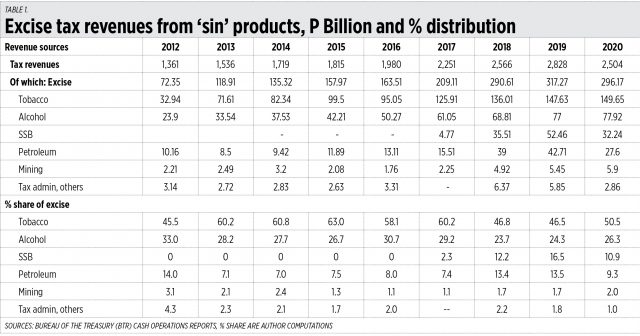
Tobacco tax revenues doubled from P33 billion in 2012 to P72 billion in 2013, tripled by 2015, quadrupled by 2017, and nearly quintupled by 2019 and 2020. The same trend of persistent increase follows in alcohol tax revenues, but not as fast as tobacco revenues. The P24 billion level in 2012 became double by 2016 and triple by 2019. From one of the tables (Table 15) of the paper, I showed these numbers (Table 1).

As a percentage of total excise tax revenues including collections from petroleum and mining products, tobacco taxes share increased from 45.5% in 2012 to 60% in 2017 while alcohol share decreased from 33% to 29% over the same period. By 2020, tobacco taxes comprised 50% of total excise tax collections, alcohol and SSB comprised 26% and 11%, respectively. The three products brought in a total of P260 billion to the government, big money for the government.

So, high tax rates lead to low smoking and drinking incidence? Likely the answer is “No.” Because the government and NGOs only look at reduced volume of legal tobacco and alcohol but not illegal tobacco and alcohol. I made my own estimates using four scenarios and assumptions. The estimated increase in smoking prevalence ranges from 1.2% to 6.8% of population. Meaning that from 21.4% of population in 2019, actual smoking prevalence can be 22.6% to 28.2% of population. Higher tax rates lead to higher smuggling, cheaper illegal tobacco, and led to more smoking, not less.

VAPE BILL AND HARM REDUCTION
Now come two bills from Congress —HB 9007 and SB 2239, the Vaporized Nicotine and Non-Nicotine Products Regulation Act, or simply the vaporized nicotine products (VNP) or vape bill. Its main goal is to encourage smokers to shift from using unhealthier cigarettes to alternative less harmful products like VNP, if they cannot stop smoking.

The bill has many prohibitions — minors below 18 years old cannot have access to these products; no online selling; celebrities cannot endorse these products; they are banned in schools, hospitals, and government offices; distribution is banned within 100 meters from any perimeter of a school or playground; no corporate sponsorships to industry associations or trade events, and so on.

Senate President Pro Tempore Ralph G. Recto, the Chairperson of the Senate contingent to the Bicameral Conference Committee on disagreeing provisions of both bills, made good arguments in his sponsorship speech of Senate Committee Report No. 265 on SB No. 2239 last in May 2021. He said, “VNPs are not safe and not risk-free. Similar to cigarettes, they pose health risks. The absence of combustion does not make it nicotine-free. What VNPs do is that they lessen the emission of other harmful chemical compounds, which are released when tobacco is set on fire.

“For many who have been trying, VNPs have been a good alternative to kick the (smoking) habit. VNPs, as borne by many studies, can scale down consumption… While this paradigm is still contested, it is gaining adherents from the science community as a feasible approach in tobacco control. I will not argue that these products are safe or as pristine as clean mountain air, because there is no debate there.”

VAPE TAXATION
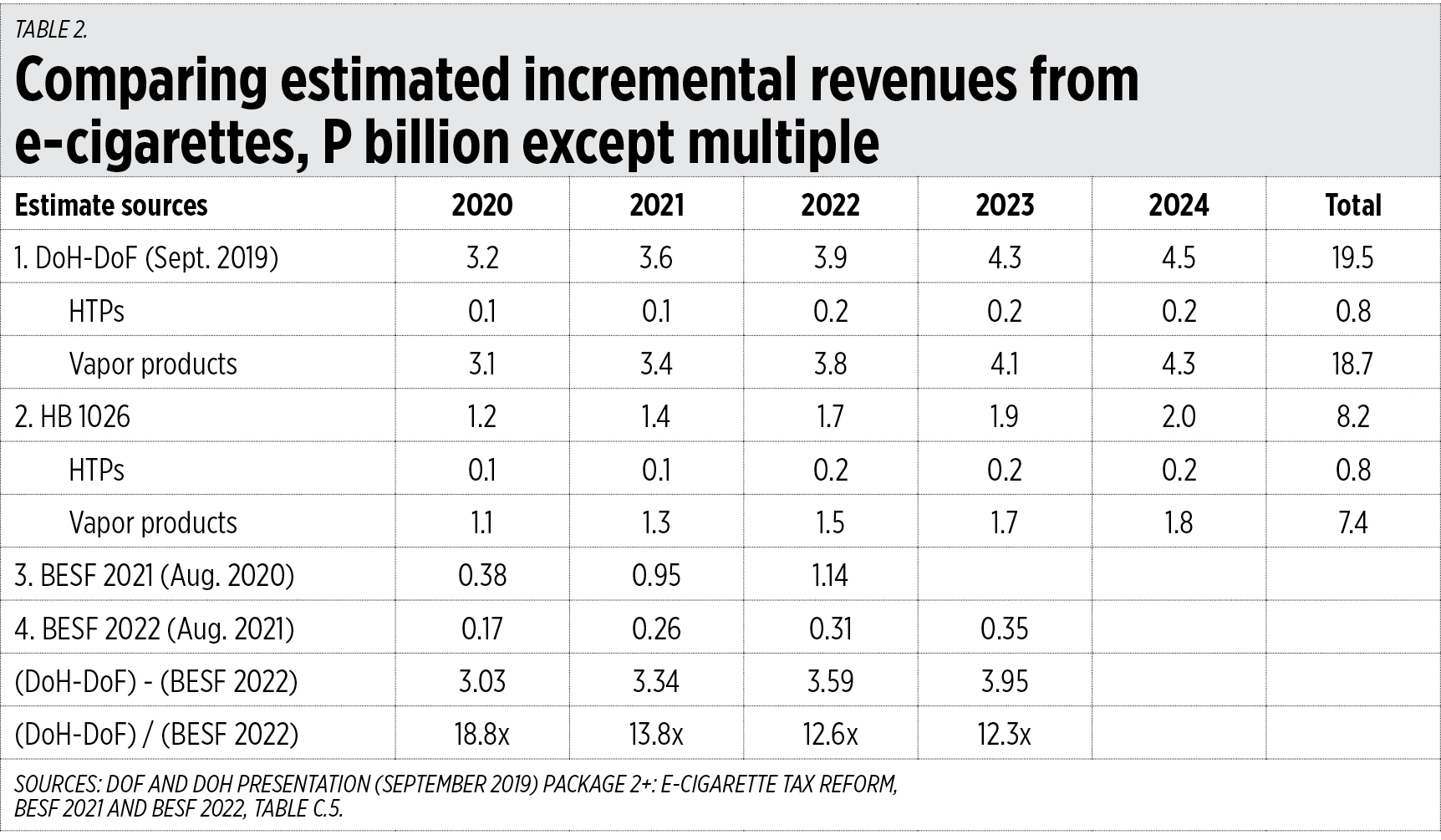
Before the vape bill regulating the products, there was a vape tax under RA 11467 (2020). In 2019 during the discussions on potential tax revenues from e-cigarettes and VNPs, the Departments of Health and Finance (DoH and DoF) made bloated and exaggerated projections that incremental revenues would be P3.2 to P4.3 billion a year. Compare this with lower estimates from House Bill (HB) 1026 and the Department of Budget and Management’s Budget of Expenditures and Sources of Financing (BESF). The computed difference from DoH-DoF projection vs. BESF 2022 ranged from P3 to P4 billion a year and the exaggeration is 12x to 19x a year (Table 2).

The DoH-DoF can argue that because of the COVID-19 pandemic and lockdowns, their bloated estimates did not materialize. That is not a plausible explanation because consumption of tobacco products has hardly been affected by the pandemic. For instance, tobacco tax revenues rose from P147.6 billion in 2019 to P149.6 billion in 2020 and P172.3 billion in 2021.

The DoH-DoF just deliberately bloated their estimates with unrealistic assumptions to rush the law, and people quickly shifted to HTPs and salt nicotine, and/or shifted to smuggled products.

CONCLUDING NOTES
Harm reduction is done for many other products. Beer (5-7% alcohol content) and wine (15-17% alcohol content) are considered as harm reduction substitutes for brandy (25-28%) or whisky and vodka (40-45%). Unregulated lambanog (distilled coconut liquor) can have alcohol content of up to 50%. Diet Coke or Coke Zero are considered harm reduction substitutes when it comes to sugar content over the original Coca Cola with 39 grams sugar per 12 oz can. New chocolates with zero sugar or little sugar are harm reduction substitutes for the traditional high sugar chocolates.

Yet these harm-reduction products are not demonized. Probably because anti-vape people are consuming these and there is no funding to attack these products. So, there is double-talk when people attack harm reduction substitutes for tobacco products but not harm reduction in alcohol, soda, chocolate, ice cream and other products.

Instead of double talk, the vape bill should pass. It is an anomaly actually that there is a need for legislation for this. A slippery slope, this may lead to legislation to further regulate use and distribution of those products aside from raising their taxes.

Government concern for public health is also inconsistent. It is less concerned with risky sports like rock climbing and downhill cycling that can cause considerable bodily injury in case of accidents. Or financially addicting activities like online and casino gambling, cockfighting, and many other activities.

Either government should regulate and tax all of these products and activities heavily — which will further increase government corruption — or it should relax regulations and taxation to have consistency in public policy.


Bienvenido S. Oplas, Jr. is the president of Minimal Government Thinkers.

minimalgovernment@gmail.com

We know politicians lie — but do we care?

Claims Prime Minister Scott Morrison is a liar have been piling up.

From French President Emmanuel Macron, to former Prime Minister Malcolm Turnbull and most recently, Deputy Prime Minister Barnaby Joyce, there have been high profile accusations Morrison has not been truthful. Some media outlets have even started a dossier of Morrison’s “lies and falsehoods.”

(Asked last November if he had ever told a lie in public, Morrison said, “I don’t believe so.”)

We are cognitive psychologists who study misinformation. What impact do politicians’ lies have on voters? What happens when their lies are exposed?

It is important to note that people lie all the time. Some studies show the average person lies about twice a day.

This is not without its advantages. In fact, people who are brutally honest can find themselves in socially awkward situations (“You look terrible in those pants, love”).

Most lies are harmless and serve mainly to avoid uncomfortable moments, help people make a good impression, or make others feel good (“Of course I remember you!”).

But lies of course can also be more sinister. For example, I can mislead you in order to make you do what I want you to do. (“Can you deal with the paperwork? I have so much going on…”)

These lies can have negative consequences — the person lied to may feel duped or the liar may be caught out. However, some studies claim lies of this sort have helped humans develop the ability to work together.

Lies can be used to get others to form false beliefs and garner their support. It is well known that false information can influence people’s thinking even after they come to realize the information is false.

This makes it particularly concerning when people in leadership positions lie. Former United States President Donald Trump famously made more than 30,000 false or misleading claims during the four years of his presidency. This is an average of more than 20 a day.

But isn’t that just what we’ve come to expect of politicians?

They rank as one of Australia’s least trusted professions. They spin the truth to make themselves seem more capable and successful than they are and appeal to whoever they are talking to at the time. They make promises they know they won’t be able to keep. Much like us, really (“We’ll catch up soon, for sure!”).

So, the big question is: do voters care? The answer is not straightforward.

Our research has shown identifying a lie reduces people’s belief in it, even if the lie comes from a politician they support. However, this does not necessarily translate into a reduction in voter support or a change in voting intentions.

In one study, we exposed American participants to lies (and true statements) Trump made in the lead up to the 2016 presidential election, followed by fact-checks of these statements.

Although fact-checks led to reduced belief in inaccurate claims, this did not translate to reduced voting intentions in Trump supporters.

A follow-up study used lies from both Trump and Democrat candidate Bernie Sanders. It found when Trump and Sanders supporters were shown many more lies than accurate statements, they began to feel more negatively towards the politician they support — but only slightly.

However, in a parallel study conducted in Australia in 2018, a different picture emerged.

When participants were shown the fact-checks, they significantly reduced their support for the politician in question (in this case Turnbull or Labor’s Bill Shorten) — regardless of their own partisan position. In other words, when voters thought Australian politicians were mostly telling lies, their feelings and voting intentions changed.

A similar pattern emerged in our forthcoming UK-based study. While this study has not yet been peer-reviewed, we found participants reduced their feelings and voting intentions for politicians following fact-checks, particularly for politicians they support (likely due to low baseline support for opposition politicians).

So, it turns out voters do penalize Australian politicians for lying, particularly if they make a habit of it. We think that is a good thing, for several reasons.

First, the things leaders lie about often matter to many people. Our prime minister, for example, has been accused of deviating from the truth on issues including the vaccine rollout, our response to climate change, and the use of public funds.

Second, politicians have power and are supposed to represent us. Ideally, their decisions should be based on facts and evidence in pursuit of the common good. If politicians develop a laissez-faire relationship with the truth, it means they are abusing their position, not accountable, and failing as role models (“If the leader can lie – and get away with it — so can I, right?”).

At a broader level, a functional democracy depends on common appreciation of basic facts. Yes, we can debate how to respond to climate change, but genuine debate is only possible if we first accept the evidence that the climate is changing. If truth is seen as unattainable, anything goes. And if politicians ultimately do and say whatever they want, why bother engaging with politics at all?

As we have also seen recently, in times of crisis, mutual trust between government and the public produces greater compliance and better outcomes for everyone. Lies poison this trust.

From this perspective, then, we should not accept lying politicians, and the media is well advised to hold our elected representatives to account. And if our Australian study is anything to go by, how our politicians deal with truth may end up affecting voters at the ballot box in May.


Ullrich Ecker is a professor of Cognitive Psychology and Australian Research Council future fellow, The University of Western Australia. Toby Prike is a postdoctoral research associate, The University of Western Australia. Mr. Ecker receives funding from the Australian Research Council. Mr. Prike does not work for, consult, own shares in or receive funding from any company or organization that would benefit from this article, and has disclosed no relevant affiliations beyond their academic appointment.

In relief for retailers, Vietnam won’t close factories amid COVID surge

AN EMPLOYEE WORKS at a shoe factory for export in Hanoi, Vietnam, Dec. 29, 2021. — REUTERS

HANOI — Vietnamese factories making everything from shoes to smartphones are expected to continue production despite record coronavirus disease 2019 (COVID-19) infections, reversing a policy of sweeping lockdowns last year that hobbled global supply chains for Western retailers.

One of the world’s biggest garment makers, Vietnam reported more than 26,000 new infections on Sunday, or about double the peak last year, when factories supplying brands such as Nike, Zara, Apple and Samsung were shut for months.

But unlike nine months ago, when the Delta variant was spreading through a mostly unvaccinated population, now millions of factory workers have been fully vaccinated and the Omicron variant is proving less severe, the government said.

“The risk of widespread lockdowns is very low this year as Vietnam has successfully carried out its COVID-19 vaccination campaign,” Dang Duc Anh, director of the National Institute of Hygiene and Epidemiology, told Reuters.

Vietnam has been relaxing curbs in recent months, with schools re-opening last week and the government saying on Sunday it would lift restrictions on arriving international passenger flights.

More than 76% of the population has received at least two vaccine doses, up from 3.3% early in September last year, the health ministry says.

The American Chamber of Commerce in Hanoi, which represents US businesses and last year urged the government to ease its curbs, is anticipating a better 2022, said Adam Sitkoff, its executive director.

“I do not expect to see additional countrywide lockdowns as serious cases in most parts of the country are at a manageable level and the authorities have learned that economy-crippling restrictions are not sustainable,” Mr. Sitkoff told Reuters.

The government is targeting economic growth of 6% to 6.5% this year, up from 2.5% in 2021.

Smooth factory operations in Vietnam, the second biggest exporter of clothes and footwear to the United States after China, will also help free up supply chain bottlenecks that are pushing up inflation around the world.

“If Vietnam can maintain a strong production capability and factory output, this will really support the global supply chain, in particular for sectors like agriculture, textiles and electronics consumers,” said Duc Minh Nguyen, a partner at accounting firm EY.

SHIFTING SUPPLY CHAINS
Over the last decade Vietnam has emerged as one of the most attractive alternative production hubs for companies looking to reduce their exposure to China.

That trend is expected to continue, if Vietnam can emerge relatively unscathed from the current Omicron wave and Beijing keeps up its tough lockdowns to suppress infection.

“Vietnam will be a key beneficiary of shifting supply chains, particularly in regards to low value-add manufacturing relocating out of China and electronics,” said Raphael Mok, head of Asia country risk for Fitch Solutions.

Vietnam won praise early in the pandemic for curbing infections with its tight controls, but a flare-up last summer caused by the Delta variant kept millions of workers at home amid lockdowns in Ho Chi Minh City and neighboring industrial provinces.

In September, at the height of the lockdowns, businesses began considering moving production elsewhere.

Lululemon, a Canadian clothing retailer, shifted production out of Vietnam in September. Nike, which sources half its footwear from the southeast Asian nation, cut its 2022 sales forecast due to factory closures there.

Now, 90% to 95% of garment and textile workers have returned to work after the Lunar New Year holiday, said Truong Van Cam, deputy chairman and general secretary of the Vietnam Textile and Apparel Association.

Vietnam’s factory workers, who earn on average $330 per month, are hoping to make up for earnings lost last year.

“Things are pretty smooth now … there are many orders that need delivering so we can work overtime to earn more,” said Nguyen Van Hoang, 28, who works at a leather factory in Ho Chi Minh City.

“I don’t think factory lockdowns will become a thing in the future.”

Ninh Thi Ty, chairwoman of Ho Guom Group, which makes garments for firms such as CK, Mango, Zara and H&M, said she expected the government would soon designate COVID-19 an endemic illness.

“More lockdowns would hurt businesses like ours, as we wouldn’t be able to deliver products to customers,” said Ms. Ty, whose garment factories employ 6,000 workers in Vietnam. — Reuters

Europe’s travel rebound gains pace as it dumps curbs

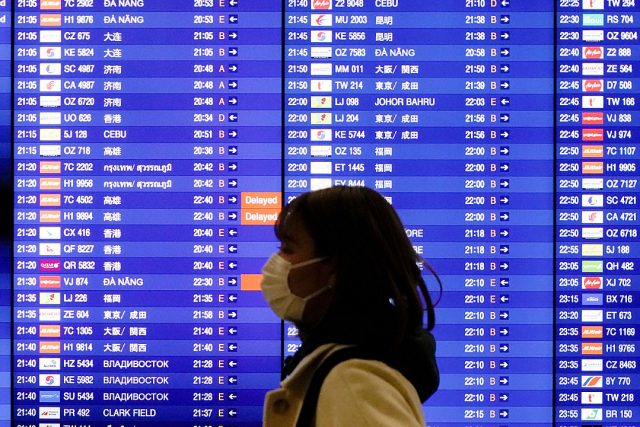
A WOMAN wearing a face mask walks past an electronic board showing flight schedules at Incheon International Airport in Incheon, South Korea, Jan. 3, 2020. — REUTERS/KIM HONG-JI

A GLOBAL travel divide is deepening as some countries ditch coronavirus disease 2019 (COVID-19) restrictions including quarantines, isolation and even mandatory testing for good, while others cling to years-old curbs.

Lingering barriers to travel in Asia in particular are isolating the region and its tourism-reliant economies, just as the recovery in Europe and the US accelerates. In the UK, authorities are dumping unpopular pre-flight tests and now only require proof of vaccination as they strive to normalize international air traffic.

The marquee transit hubs of Hong Kong and Singapore are being shunned as travelers seek to avoid weeks in hotel isolation on arrival or a raft of testing swabs. Airlines, which before the pandemic operated about 30,000 flights a month to the two Asian gateways, have slashed that number to just 4,514 in February, according to aviation data company Cirium.

There’s little prospect of immediate change. Hong Kong — which quarantines overseas arrivals for as long as 14 days, and effectively bars flights from an array of countries deemed to be high risk — is sticking to a goal of eliminating the virus even as cases in the community surge. Last week, authorities there tightened restrictions even further, extending gathering limits to private premises for the first time.

And while Singapore has struck more than two dozen agreements with other countries to set up vaccinated air-travel lanes, it still requires overseas visitors to undergo almost a week of daily coronavirus tests during their stay. Anyone attending the city’s scaled-back biennial air show this week, an event forecast to attract more than 13,000 in-person delegates and 600 companies, must also test negative each day as a condition of entry.

These impediments to flying extend the financial pressure on airlines primarily plying routes in Asia, from Cathay Pacific Airways Ltd. and Singapore Airlines Ltd. to budget carriers Cebu Air, Inc. in the Philippines and Malaysia-based AirAsia. While China holds the key to a broad recovery — its vast market could trigger a global travel resurgence all on its own — the country is expected to keep its borders sealed for most of this year at least.

The uneven air-travel rebound is likely to continue for the rest of 2022 as countries in Europe and North and South America continue to reopen and Asian restrictions put off travelers, according to Rob Morris, Cirium’s global consultancy chief. “The two-speed recovery is very evident,” he said. “A significant level of intra-Asia traffic touches China and with borders there likely to remain closed to international arrivals through late 2022, the recovery in Asia will inevitably be slower than other regions.”

CHOKING THE FLOW
Within Europe, flying will surpass 75% of pre-pandemic levels next month, according to Cirium data from airline schedules. Inside the US, the figure will be 86%.

Asia’s COVID curbs are choking the flow of visitors to the countries that need them most. Australia’s Jetstar recently delayed a resumption of flights to Bali from Melbourne and Sydney, citing the island’s five-day quarantine requirement for vaccinated arrivals. “We look forward to flying into Bali when quarantine restrictions ease further,” said Jetstar, which is owned by Qantas Airways Ltd.

Thailand this month resumed quarantine-free tourism for vaccinated travelers. But the program’s requirements for multiple tests, registration, and a certain baseline of insurance cover have drawn criticism. Thailand expects less than 10 million foreign visitors this year, down from 40 million before the virus.

“The testing requirements are a disincentive,” said Hannah Pearson, founding partner of Kuala Lumpur-based tourism consultancy Pear Anderson. “The fact that Singapore and Thailand, the two leaders of reopening in the region, are still taking this intense approach to testing, may encourage other countries to behave similarly.”

The cost of daily swabbing for a family visiting Singapore is prohibitive enough, said Pearson. The mandatory test on arrival is S$125 ($93). On top of that, visitors run the risk of returning a positive result, then paying to quarantine in a hotel and wasting their trip, she said. The city-state is conducting a study to assess the efficiency of antigen rapid testing kits for passengers arriving at Changi Airport, which would be quicker and cheaper, the Business Times reported.

NO TESTS
At some point, Southeast Asia’s tourist hubs will need to demand less of overseas visitors, Pearson said. That might mean downgrading to a rapid antigen test on arrival, or waiving tests completely for those who already recorded a negative result before they took off, she said.

China and Hong Kong, meanwhile, are showing no sign of giving up their battle to contain the virus, even as other parts of the world treat it as endemic. Chinese authorities this month locked down 3.6 million residents of the southwestern city of Baise after identifying fewer than 100 cases.

The central role that China and Hong Kong play in Asia’s aviation market means their COVID-Zero approach weighs on neighboring nations. The number of scheduled flights into all of Asia from outside the region this month is little more than half the total before the pandemic, Cirium data show.

Some countries in the Asia-Pacific region are dropping barriers. Australia last week said vaccinated tourists will be allowed to enter from Feb. 21, while New Zealand will finally begin reopening to the world at the end of this month, although arrivals will still initially need to isolate for 10 days.

The reluctance of travelers to tolerate quarantine after they land is clear: It typically deters at least 90% of potential passengers, Auckland International Airport Ltd. said this month, citing the experience of airlines in other markets.

The speed at which passengers return to the air once restrictions and mandatory tests are removed also indicates how much these rules hinder travel.

British Airways and Virgin Atlantic Airways Ltd., for example, reported a surge of interest in long-haul flights in January. That was just days after a requirement that vaccinated arrivals take a Covid test before boarding a flight into England was dropped. On Feb. 11, the UK also stopped requiring vaccinated travelers to take a Covid test after arriving in England.

The UK government is now depending on vaccines as it takes steps to live with the virus, recognizing inoculation certificates from over 180 countries and territories.

The Omicron variant is already “spreading widely in the community,” the government said as it made the change. Testing incoming vaccinated travelers, UK Transport Secretary Grant Shapps said, had “outlived its usefulness.”

Buoyed by that decision, the aviation industry is lobbying the US government to scrap pre-departure tests for incoming vaccinated passengers there as well.

In a Feb. 2 letter to the White House, travel industry groups led by Airlines for America argued Covid was already widespread in the US, and pre-flight tests “are unlikely to change that fact.” The letter cited the UK as a precedent, as well as the European Union’s January recommendation that member states remove intra-Europe Covid travel restrictions.

Destinations in Asia are likely to continue to struggle to lure travelers for short breaks, said Volodymyr Bilotkach, associate professor in air-transport management at the Singapore Institute of Technology.

“Why come to Singapore for four to five days and pay for all the extra tests facing the risk of being stuck in your hotel room, when you can go to New York without having to worry about all this stuff?” he said. — Bloomberg

India bans 54 Chinese apps on security concerns

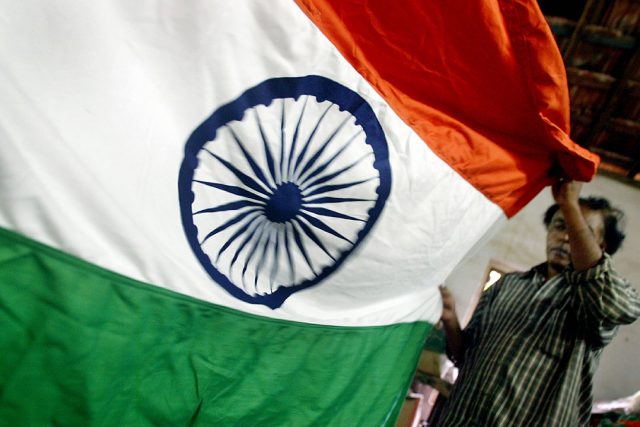
A WORKER folds an Indian flag at a workshop in India, Aug. 11, 2005. — REUTERS

INDIA has banned 54 Chinese apps in a new order citing security concerns, according to a local newspaper report, in the latest instance of tensions between the two neighbors locked in a protracted border dispute impacting business dealings.

The South Asian nation’s ministry of electronics and IT has banned apps including those belonging to large China tech firms such as Tencent, Alibaba and NetEase, that are re-branded versions of apps already banned by India in 2020, the Economic Times reported Monday.

A spokesman for the Home Affairs ministry did not immediately comment on the matter.

The latest move comes as a long-running dispute between the two nuclear-armed nations remains unresolved, after boiling over in a bloody 2020 skirmish that left soldiers from both sides dead, and drew tougher laws in India for investments from China, including the original app ban.

India and China share an unmarked 3,488 km (2,170 miles) long border along the Himalayas, where thousands of troops, tanks and artillery guns from both countries have been massed since then. Tensions between the two countries remain, with India’s army chief citing the risk of Chinese aggression as recently as last month. — Bloomberg

ADVERTISEMENT
ADVERTISEMENT