Please be advised that the Annual Meeting of the Stockholders of ROXAS HOLDINGS, INC. for the year 2022 will be conducted by remote communication on Wednesday, 16th day of March 2022 at 10:00 a.m. (URL: https://asm2022.rhi.com.ph/).
Stockholders who are interested to participate in the proceedings may visit the above website, RHI’s website at https://www.roxasholdings.com.ph/ or check the Company’s disclosures via PSE Edge, for the requirements to register.
Spotlight is BusinessWorld’s sponsored section that allows advertisers to amplify their brand and connect with BusinessWorld’s audience by enabling them to publish their stories directly on the BusinessWorld Web site. For more information, send an email to online@bworldonline.com.
People cross Taft Avenue in Manila, Feb. 16. The government is preparing for the shift to a “new normal” as the country is now under a “low-risk” classification for coronavirus disease 2019 (COVID-19). — PHILIPPINE STAR/ MICHAEL VARCAS
THE PHILIPPINE ECONOMY is expected to grow above 7% in the next few years, but is still grappling with pandemic scars as seen in the lost output gap in the gross domestic product (GDP), S&P Global Ratings said on Wednesday.
“As of the latest GDP reading, at the end of the fourth quarter 2021, we still estimate that the Philippine GDP level is 14% below where it would have been without the pandemic,” Vincent Conti, S&P senior economist, said at an online webinar.
The Philippine economy rose by 5.6% in 2021, a reversal of the record 9.6% contraction in 2020.
For 2022, S&P expects Philippine GDP to expand by 7.4% which is within the 7-9% target by economic managers.
“We do expect growth, the rate of GDP growth to recover quite strongly over the next few years, staying above 7%. And we do also expect unemployment to ease down gradually from the peak that we saw during the pandemic,” Mr. Conti said.
Still, Mr. Conti noted how the Philippine economy continues to reflect economic scarring or some signs of long-term impact due to the crisis.
“However, we do also recognize that some of this scarring might be permanent in the sense that the level of GDP might never catch up to the half that it was taking without the pandemic. But that is not to say that the important parts of of the economic assessment cannot recover,” he said.
Mr. Conti last year warned that by 2025, the Philippine GDP will likely be 12% below where it would have been without the pandemic.
At the same time, Moody’s Analytics raised its growth forecast for the Philippines to 6.2% this year, after seeing the strong rebound in the fourth quarter as restrictions were loosened and business activity picked up.
“The 6.2% growth largely reflects the strong fourth quarter of 2021, which puts the 2022 forecast for GDP at a higher level,” Moody’s Analytics Chief APAC Economist Steve Cochrane said in an e-mail.
The projection is higher than the 5.6% GDP growth projection given in January.
Moody’s Analytics had cut its projection last month after it took into account the slowdown in economic activity due to the Omicron-driven surge in coronavirus disease 2019 (COVID-19) cases.
Philippine GDP grew by 7.7% in the fourth quarter of 2021, a reversal of the 8.3% contraction in the same quarter in 2020. This was also higher than the revised 6.9% GDP expansion seen in the third quarter of 2021.
Moody’s Analytics’ 2023 growth projection was cut to 5.4% from the 5.7% given in January. “On a quarter-to-quarter basis, the 2023 projections are little changed, but the annual figure is shifted a bit as it is coming off of the revised 2022 forecast,” Mr. Cochrane said.
BANKS ON TRACK FOR RECOVERY Meanwhile, the Philippine banking industry is on track for recovery, as loan quality improves alongside the economic rebound, S&P said. However, the debt watcher said risks remain due to its significant exposure to the property sector and the emerging variants of COVID-19.
In its Philippine banking industry country risk assessment (BICRA), the economic risk trend was upgraded to “stable,” S&P Global Ratings Associate Director Nikita Anand said. This was changed from “negative” which was given in the third quarter of 2020.
“The reason for a stable trend is because we believe that Philippine banks are on a recovery path supported by improving macroeconomic conditions, our concerns on asset quality have reduced significantly,” Ms. Anand said at a webinar on Wednesday.
The country’s BICRA standing is at 5, on a scale of 1-10 with 1 being the best. In the region, Singapore and Hong Kong were assessed as having the strongest banking sector landing a grade of 2. Malaysia ranked higher than the Philippines with a grade of 4, while Thailand and Indonesia were assessed with a score of 6.
Ms. Anand said the expected launch of more digital banks this year could trigger other banks to raise their deposit rates. New digital banks typically offer about 5-6% rates to attract funds. Only the Overseas Filipino Bank and the Tonik Digital Bank, Inc. (Philippines) have started operations.
The other four lenders that were granted licenses by the central bank are Union Digital Bank, UNO Bank, Maya Bank, and GOtyme.
“So if there is a possibility for deposit price competition, there’s a huge market out there to capture. The Philippines is a very under-penetrated market in that sense, especially when it comes to retail loans or small-ticket loans,” Ms. Anand said.
RISKS FROM PROPERTY Philippine banks may face risks arising from their exposure to commercial properties, Ms. Anand said.
“There is uncertainty on the long-term prospects of this sector with the increasing preference for working from home and increasing preference for shopping from home and e-commerce,” she said.
Potential policy rate hikes could improve margins, although Ms. Anand said the BSP is not expected to start increasing interest rates in the near term.
Philippine banks will also likely improve profitability this year with the reopening of the economy.
“We are expecting higher credit growth and growth in fee income as business activity picks up as well as the lower credit costs to improve sector profitability,” she said.
The World Bank on Tuesday warned of the risk of rising loan defaults when relief measures are scaled back.
At a briefing on Wednesday, Bangko Sentral ng Pilipinas Governor Benjamin E. Diokno downplayed such risks in the case of the Philippines.
“I think the World Bank is referring to emerging economies in general. I think the Philippines does not belong to that group. I think we have prepared our banks and MSMEs (micro, small, and medium enterprises), we have helped them during this crisis. So I don’t see them under threat at the moment,” Mr. Diokno said.
Support measures introduced during the pandemic, included loan moratoria and relaxed accounting standards for recognizing distressed loans, have already lapsed. Ms. Anand noted that very few lenders have applied for the accounting relief measures and were mostly rural and cooperative banks.
In 2021, central bank data showed the local banking industry’s combined net income reached P223.66 billion, up 44% from the P155.22 billion seen in 2020.
The bad loan ratio declined to an 11-month low of 3.99% as of end-December, reflecting improving asset quality. It reached a 13-year high of 4.51% in July and August 2021. — Luz Wendy T. Noble and Jenina P. Ibañez
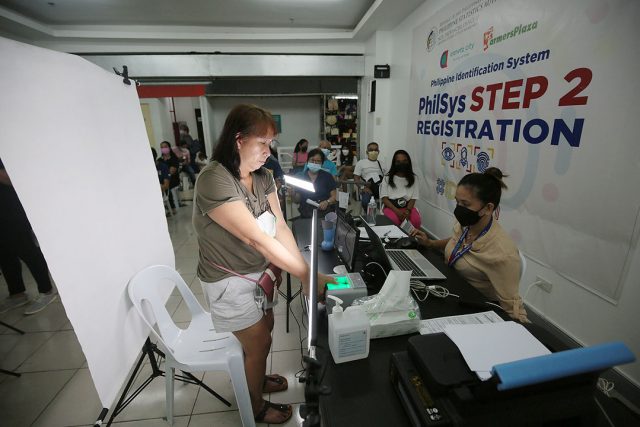
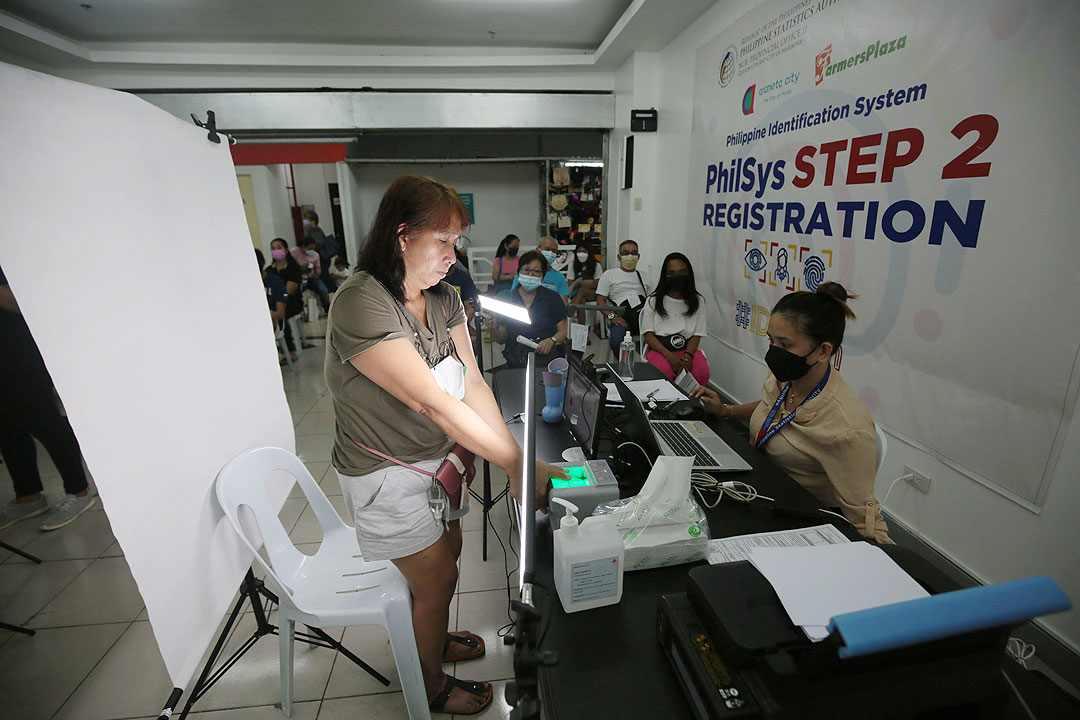
A WOMAN registers for the national ID at a mall in Quezon City, Nov. 18, 2021. — PHILIPPINE STAR/ MICHAEL VARCAS
PHILIPPINE PRESIDENT Rodrigo R. Duterte has ordered government agencies and private institutions to start accepting the national ID or the Philippine Identification System (PhilSys) number as sufficient proof of identification in a bid to improve the delivery of public services and promote ease of doing business.
The national ID will serve as the state’s central identification platform for all citizens and resident aliens of the country, Mr. Duterte said in Executive Order No. 162 signed on Monday.
The PhilSys ID (PhilID) and PhilSys Number (PSN) shall be considered as sufficient proof of identity and age in all public and private transactions, he added.
“Unless otherwise provided by law, the presentation of the PhilID, PSN or PSN Derivative, as authenticated, shall be sufficient proof of identification and of all other personal details stated therein, without need for presentation of other identification documents,” the order stated.
The national ID may be presented instead of a birth certificate in applications for marriage license, student driver permit, or conductor’s license, the Professional Regulation Commission, and those relative to voter’s registration, the order stated.
It may also be used when enrolling at public and private schools or registering for the Philippine Educational Placement Test, it added.
The EO tasks the Philippine Statistics Authority (PSA) to ensure that “cardholders or holders of PSNs will not be prejudiced if authentication cannot be performed through no fault on the part of said persons.”
“Neither does this Order foreclose the recognition and acceptance of other government-issued identification documents in government and private transactions,” it said.
The order directs covered agencies to amend their Citizen’s Charters to integrate the components of PhilSys and accommodate its features.
Covered agencies must inform the public of these amendments, while private entities are enjoined to do likewise regarding similar changes in their identification requirements.
About 55 million Filipinos have already registered for the national ID system, but only six million cards have so far been released, the PSA said last week. — Kyle Aristophere T. Atienza
A Japan Yen note is seen in this illustration photo taken on June 1, 2017. — REUTERS/THOMAS WHITE/ILLUSTRATION
THE JAPANESE government discussed extending an additional ¥30 billion in loans (about P13.3 billion) for the Philippines’ pandemic response in an economic and infrastructure meeting held on Wednesday, the Department of Finance (DoF) said.
“During the meeting, the two sides discussed proposed additional financing support of 30 billion yen from Japan under the 2nd COVID-19 Crisis Response Support Loan (CCRESL 2) to help cover the funding for the Philippines’ ongoing national vaccination program,” the DoF said in a statement after the 12th meeting of the high-level joint committee on infrastructure development and economic cooperation on Wednesday.
The Japanese government in 2020 released a ¥50-billion loan to the Philippines for its pandemic response, under the initial COVID-19 (coronavirus disease 2019) Crisis Response Emergency Support Loan. Japan-backed projects also included support for medical equipment procurement and cold chain storage system development in the Philippines.
After the meeting, Finance Secretary Carlos G. Dominguez III expressed confidence about continuing aid from Japan.
“I am confident that the commitment of Japan to partner with the Philippines in developing our economy is for the long term, as it has been in the past,” Mr. Dominguez told reporters in a Viber message.
The two countries also discussed Japan’s public and private financing to the Philippines since 2017, which has reached ¥1.38 trillion (about P612 billion), exceeding the commitment made five years earlier.
“I wish to report that Japan’s public and private financial contribution to the Philippines’ nation-building in the five years since January 2017 amounts to ¥1.38 trillion, well over the ¥1-trillion mark set forth,” Special Advisor to Japan’s Prime Minister Mori Masafumi said during the meeting.
Mr. Mori said that Prime Minister Fumio Kishida continues to support Philippine infrastructure development, maritime law enforcement, and COVID-19 responses.
“I’d like to emphasize that the government of Japan’s commitment to the bilateral cooperation project remains unchanged under the Kishida Cabinet,” he added.
The two countries also discussed the Japan-supported big-ticket projects under the government infrastructure program, including the Metro Manila Subway Project, North-South Commuter Railway Project, rehabilitation of the Metro Rail Transit Line 3 (MRT-3), Dalton Pass East Alignment Alternative Road Project, Central Mindanao Highway Project (Cagayan de Oro-Malaybalay Section), and the Parañaque Spillway.
The first high-level committee meeting was held in 2017, after Japan Prime Minister Shinzo Abe committed to provide ¥1 trillion in financing support to the Philippines over five years, mostly funding big-ticket infrastructure projects.
The government has raised $25.8 billion in financing and grants from multilateral lenders, development partners, and foreign currency denominated global bonds for its COVID-19 response since the start of lockdowns in 2020 up to Jan. 14 this year. — J.P.Ibañez
CHINA is seen as the most influential economic power in Southeast Asia, according to the new poll, although there’s caution over Beijing’s territorial positions over the South China Sea.
A survey of 1,677 Southeast Asians by the ISEAS-Yusof Ishak Institute showed 76.7% regard China as the most influential economic power in the region, followed by the US at a very distant 9.8%. Washington trailing in second place comes after the administration of US President Joseph R. Biden finally unveiled its strategy to engage with Asia last week.
Half of those with a positive view of China, however, say that perception could be negatively impacted if Beijing continues to expand its influence in their country. China’s “strong-arm tactics” in the South China Sea are a top concern among those surveyed with 46.2% saying it could taint their perceptions of China. It was the top concern for all the claimant nations: 56.9% in Malaysia, 71.2% in the Philippines and 55.3% in Vietnam.
The survey on Wednesday comes as the foreign ministers from the Association of Southeast Asian Nations meet in Cambodia amid concerns over whether the region is able to get together on pressing issues ranging from disputes over the South China Sea to civil strife in Myanmar.
Of the 58.1% of survey respondents who show distrust toward China, nearly half of them fear Beijing could use economic and military power to threaten their country’s sovereignty. More than three out of four believe China should respect national sovereignty “and not constrain” the foreign policy choices of Southeast Asian countries.
A study by the Sydney-based Lowy Institute in December showed China’s influence in Asia receding for a second year of the pandemic as the country turned more inward, while the US expanded its power in the region through better diplomacy.
China’s membership in the Comprehensive and Progressive Agreement for Trans-Pacific Partnership, meanwhile, is perceived to create both opportunities and challenges for the region, according to the ISEAS study. If China were able to join, 31% felt it would reduce economic tensions in the region and help to resolve the US-China trade war, while just under 30% disagree.
Nearly 60% of respondents welcome the strengthening of the Quad, a regional partnership made up of the US, India, Japan and Australia, while 36.4% feel that the US’ security partnership with the UK and Australia known as Aukus will help balance China’s growing military power. — Bloomberg
THE Australia Philippines Business Council (APBC) said it welcomes the change in the Philippines’ policy direction for mining, including the lifting of a freeze on new mining licenses.
“These developments are expected to usher in significant benefits to the economy including manufacturing resurgence, and step up investor confidence,” the council said in a statement.
In December, the Philippines lifted a four-year ban on open-pit mining.
In April, it also lifted the moratorium on granting new mining permits.
“Mining is one industry that truly highlights the complementarity between Australia and the Philippines. The Philippines has vast untapped natural resources; Australia is a global expert in minerals development and production underpinned by responsible mining practices sought by the Philippine government and community. The potential for rewarding opportunities has always been there,” APBC President Rene Cabrera said.
“The country’s mineral resource assets are valued at approximately $1.32 trillion Australian dollars (and) are largely untapped. Thirty percent of its total land area has mineral potential but less than 3% is covered by mining tenements,” APBC said.
It said that the policy changes come with “stringent, clear-cut rules and regulations to ensure that they are equitably beneficial to the state and to the private sector with emphasis on environment sustainability and community safety.”
“Australian companies are well-placed to capitalize on these developments. The areas of opportunity include mineral exploration, mining equipment supply, engineering services, specialist software and industry education and training,” Jose P. Leviste, special advisor to the APBC and former chairman of OceanaGold Philippines, said. — Luisa Maria Jacinta C. Jocson
WHILE the Tinapayan Festival bakery has been around since 1982 (think of everything else that had happened in the 40 years since), the virus that had taken the world hostage in 2020 changed the game for its founder and General Manager Lucito Chavez.
“There were a lot of businesses, especially bakeries, that struggled to still exist and operate. We were forced to cut down our operations by 60%. Earlier than other establishments, we were the first to close our branches in the malls to secure our personnel from COVID-19 (coronavirus disease 2019) infection. We suspended our delivery operations due to lack of manpower as our employees wanted to go home to their provinces and be with their families. Even our suppliers, wholesalers, and resellers had a hard time reaching us due to the lockdown and community quarantine measures during the strict lockdowns,” he said in an e-mail to BusinessWorld.
Before the pandemic the bakery had three branches — the main one in Sampaloc, Manila, one in Fisher Mall in Quezon City and another in Market! Market! in Taguig. The mall branches closed in 2020.
“We never knew that this pandemic was coming and that it would hit our economy this hard. Pre-pandemic, we already had plans set up for the company and we had to postpone most, if not all, in consideration of this pandemic,” he added.
Rolling into the third year of the pandemic, the bakery has plans. It is expanding again, reestablishing its roots in Batangas. “This expansion is an adventure. It is high time for us to explore the bakery business by going home to our roots in Cuenca, Batangas — which is known as the Home of the Bakers,” said Mr. Chavez who hails from that town.
They are hoping to resume delivery operations in the next few weeks.
CHALLENGING THE INDUSTRY Tinapayan Festival’s product lines include breads that pioneered the use of agricultural products such as squash, potato, cassava, carrot, ube (purple yam), and sweet potato. According to a statement, their aim is to “place the Filipino baking industry at par with international brands.”
“The challenge in the Philippine baking industry is the call for continued research and development of products. We have to have the right mindset and inspiration to create products that are at par with the global market,” Mr. Chavez told BusinessWorld. “In achieving my goals for Tinapayan, I did not stop innovating my products until I was able to realize that the creation of our products is a testament of one of our values: excellence.
“A proper mindset must be inculcated to our fellow bakers in the industry. Dapat isaisip ng ating mga kasamahan sa industriya ang pagnenegosyo sa pagtitinapay habang isinasapuso ang pagtitinapay sa pagnenegosyo. (Our industry partners need to internalize business in baking; and baking in business.) We grow in both directions, in baking at the same time in doing business.”
SURVIVING THE PANDEMIC What kept the bakery going during the pandemic? The fact that food is essential, basically. That, plus the need to help its employees. This was accomplished with help from the government and friends.
“We are in the food industry and food is essential. Ang tinapay sa pang-araw-araw at maging ang mga cakes and pastries sa mga celebrations ay laging bahagi ng hapag ng bawat pamilyang Pilipino. (Bread is for every day, and even cakes and pastries are always part of celebrations for Filipino families).
“We did not stop baking to give opportunities to our employees, despite our skeletal workforce, to retain their livelihood and to serve the community with baked products in the middle of the strict community quarantine,” said Mr. Chavez.
Government efforts and the private sector’s needs aided in their continued production.
“Another highlight is the Kadiwa Rolling Store, a project by the city government of Manila, in partnership with the Department of Agriculture, to bring fresh produced products closer to the residents amid the community quarantine,” said Mr. Chavez. “We are also very thankful to the Philippine Association of Flour Millers, Inc. who contributed to our donations to frontliners in the early years of this pandemic,” he said.
“It was not important to us if we lost sales by closing our branches and suspending delivery operations while focusing only on our main branch,” said Mr. Chavez. “Our main priority is to take good care of our employees and assure them of a little livelihood as we ensure the community of continued supply of bread products.”
“Madaming nawalan ng trabaho dahil maraming nagsarang negosyo, walang mabilhan ng pagkain at gamot ang mga tao; ito ang ayaw namin maramdaman ng aming mga empleyado. May pagkain, may tirahan, may vitamins, may gamot at doktor, walang dapat ikatakot o ipangamba. (A lot of people lost their jobs because of businesses that have closed, and people then couldn’t buy food or medicine; this is what we don’t want our employees to feel. They have food, they have shelter, they have vitamins, doctors, and medicine; there is nothing to fear or worry about).”
Despite the challenges, Mr. Chavez finds some hope. “We see the pandemic as a rebirth. It is a great opportunity to restructure and to grow. It is a good time to teach and nurture people. Now that we are at what may be the lowest and most struggling point, our only option is to move forward and rise.”
Tinapayan Festival is located at 1650 Dapitan St. corner Don Quijote, Sampaloc, Manila. To place advanced orders, call 8732-2188, send an e-mail at sales@tinapayan@gmail.com. Tinapayan Festival products are also available via GrabFood and FoodPanda. —Joseph L. Garcia
CITICORE Energy REIT Corp. (CREIT) deferred its listing at the Philippine Stock Exchange (PSE) due to “voluminous transactions arising from the huge number of retail and individual investors.”
In a statement on Wednesday, the company said the strong investor demand for the P6.4-billion initial public offering (IPO) of the country’s first energy-focused real estate investment trust (REIT) slowed its processing time.
CREIT’s market debut was initially scheduled Feb. 17. It has yet to confirm a new listing date as of press time.
“We are grateful to the overwhelming reception of investors, owing also to the extensive market education conducted, which further increased appreciation for REITs as a new asset class,” CREIT President and Chief Executive Officer Oliver Y. Tan said.
The company said all shares allotted for its institutional, trading participants, and local small investors (LSIs) tranches were oversubscribed.
“In as much as the underwriters wanted to accommodate all interested investors, the strong orders for CREIT’s IPO from local and international institutions and more than 5,000 retail investors simply outnumbered the total shares offered to the public,” Unicapital, Inc. First Vice-President for Corporate Finance Pamela Louise Q. Victoriano said.
“The underwriters nonetheless exerted efforts to distribute the shares as widely as possible to a broad investor base to hopefully result to better liquidity and more active trading,” she added.
CREIT said the local small investors tranche of the offer was oversubscribed by 124.09%. The company received a demand of 270.745 million shares for 218.182 million shares allocated for the LSI tranche.
“For the LSI investors who were not able to participate in the country’s first energy REIT or received partial allocations, rest assured that refunds for those who placed and paid for their orders but were not allocated are being promptly processed by the Underwriters and the Receiving Agent,” Mr. Tan said.
CREIT sold 2.509 billion shares for P2.55 apiece. Based on projected earnings, the company is expected to have a dividend yield of 7% in 2022 and 7.4% in 2023.
The company said it is looking to implement a dividend payout of at least 95% of its distributable income for the preceding year.
METRO Pacific Investments Corp. (MPIC) announced on Wednesday that its subsidiary, Metro Pacific Tollways Corp. (MPTC), is constructing a $53-million (around P2.7 billion) toll road in Indonesia.
PT Bintaro Serpong Damai, one of the indirect subsidiaries of MPTC in Indonesia, held the groundbreaking for the project on Feb. 7, MPIC said in a disclosure to the stock exchange.
MPTC owns a majority interest in PT Bintaro Serpong Damai, a toll road business entity.
The toll road project is approximately 3.2 kilometers long and provides direct access to the Makassar Port in South Sulawesi, a province in the southern peninsula of Sulawesi, Indonesia.
MPIC said the toll road project is expected to “encourage economic growth, aid in the distribution, logistics and the facilitation of export and import routes, as well as ease the congestion of traffic for the delivery of goods and logistics transportation with its direct access to the Makassar Port.”
The project, which is a national strategic project of the government of Indonesia and is being implemented by the Ministry of Public Works and Public Housing of Indonesia through the PT Bintaro Serpong Damai, will be implemented in three stages, according to the company.
It is targeted to be completed in early 2023.
In the Philippines, MPTC expects to open the Cebu-Cordova Link Expressway (CCLEX) project to motorists within the first quarter of the year.
Aside from CCLEX, MPTC holds the concession rights for Cavite–Laguna Expressway (CALAX), Manila–Cavite Expressway (CAVITEX), Circumferential Road 5 (C-5) Link Expressway, North Luzon Expressway (NLEX), NLEX Connector Road, Subic-Clark-Tarlac Expressway (SCTEX), and Cebu-Cordova Link Expressway.
It also expects to complete this year the NLEX Connector Phase 1, CALAX Cavite Segment, NLEX Segment 8.2 Section 1A, NLEX Connector Phase 2, and CAVITEX C5 Link projects.
SHARE BUYBACK Meanwhile, MPIC also announced on Wednesday that its board of directors had approved the implementation of a share buyback program of up to P5 billion commencing on Feb. 17.
“The purpose for the share buyback program is to enhance and improve shareholder value and to manifest confidence in the company’s value and prospects through the repurchase of its common shares,” MPIC said in a separate disclosure.
The company also noted that its buyback transactions will be triggered in cases where its “stock is deemed to be substantially undervalued, when there is high volatility in share prices, or in any other instance where a buyback would serve to enhance or improve shareholder value.”
MPIC is one of three key Philippine units of First Pacific, the others being Philex Mining Corp. and PLDT, Inc.
Hastings Holdings, Inc., a unit of PLDT Beneficial Trust Fund subsidiary MediaQuest Holdings, Inc., has a majority stake in BusinessWorld through the Philippine Star Group, which it controls.
MPIC shares closed 2.50% higher at P3.96 apiece on Wednesday. — Arjay L. Balinbin
LATEST Offerings from Yellow Tail: Pure Bright Pinot Grigio and Whiskey Barrel Aged Cabernet Sauvignon.
YELLOW Tail or [yellow tail] wine — Australia’s famous original kangaroo label with a bracket on its brand name — continues to be the trend setter in the wine world. Aside from being Australia’s most exported wine brand for close to two decades now, Yellow Tail also retained its No. 1 position as World’s Most Powerful Wine Brand (Wine Intelligence Global Wine Brand Power Index 2021) for the fourth year in a row since 2018. Just last year, Yellow Tail celebrated its 20th year anniversary, and the brand shows no signs of slowing down.
In the Philippines, Yellow Tail has withstood the early challenges of the COVID-19 pandemic and even months of liquor bans to continue improving its market share in the local wine industry.
INTRODUCING TRENDY WINES Yellow Tail has been in the Philippines since 2005, with the first four varietal wines being Shiraz, Cabernet Sauvignon, Merlot and Chardonnay. Over time, the portfolio has steadily increased, and now includes a sparkling wine range called Bubbles and a more premium Reserve range. In the last quarter of 2013, Yellow Tail Pink Moscato was launched in the Philippines. This was the first pink version of the Moscato ever sold in the country, and it was a huge success. As of end of 2021, the Yellow Tail Pink Moscato is one of the best-selling wines in the country and this version of Moscato has been emulated by many other wine brands, from Australia to Chile to the US, that can be seen flooding the shelves of wine shops.
Yellow Tail very recently launched two new wine ranges: the Pure Bright, a low-calorie range, and the slightly more premium Whiskey Barrel range.
PURE BRIGHT RANGE Yellow Tail launched the Pure Bright range in Australia to capitalize on the growing “Low and No Alcohol” wine segment in their market. The concept is still to make the same high quality wine Yellow Tail is known for, but with a reduction in both alcohol and calories. For this to happen, specific winemaking techniques needed to be employed.
Pure Bright winemaker David Joeky explained this delicate technique. “Our vines are selected and pruned to maximize the leaf protection from our summer sun, protecting the grapes and slowing their development while maintaining fruit flavor and intensity. Grapes for Pure Bright are therefore picked earlier, with lower natural sugar content converting to lower alcohol in the wine. Night harvest keeps the grapes in a condition that maximizes the aroma and flavor. The grapes are then run through a cooler fermentation process using specialized yeast to maximize the flavor profile at lower alcohol levels. In addition, the fermentable sugars are kept very low and proprietary yeast selections accentuate the flavors in each varietal.”
The Pure Bright range has only 8%-9.5% alcohol and 80-85 calories in its white wines, and 10.8% alcohol and 100 calories for its lone red wine, the Pure Bright Pinot Noir. This is 25% less alcohol content and roughly 40% lower in calories versus regular wines.
Pure Bright is also vegan-friendly and gluten-free.
The best part of this new range too is that the price is exactly in parity with the regular Yellow Tail core varietal wines.
The first varietal of the Yellow Tail Pure Bright range in the Philippines is the Pino Grigio. The popular varietal is known for its young, fresh, “white-pepper spice” and crisp finish, especially that coming from Italy’s Veneto wine region of Alto Adige and Friuli-Venezia Giulia. It is also known as Pinot Gris in Alsace, France — another region that makes very nice grey Pinot. Grigio in Italian and gris in French both mean “grey,” referring to the color of this grape. From my personal drinking experience, other regions with nice Pinot Grigio are Baden in Germany, and the ones from Marlborough in New Zealand.
Yellow Tail Pure Bright Pinot Grigio has a suggested retail price of P495/bottle.
In the US, actress Sarah Michelle Gellar, best known in the lead in the late 1990s hit TV series Buffy the Vampire Slayer, is the brand ambassador of the Yellow Tail Pure Bright range.
With the successful Pure Bright roll out in the US and Australia, this trend should be coming to us too here in Asia soon.
WHISKEY BARREL RANGE The practice of aging wine in oak barrels dates back thousands of years. Over time, barrel aging has become a norm in the winemaking process. Winemakers discovered that barrel aging improved the quality of wine, created a softer and smoother palate and also imparted additional flavors.
In the late 20th and during this 21st century, the most popular thing for winemakers is to use are brand new oak barrels, normally in typical barrel size for 225 liters. The logic behind using brand new oak is because first contact with the wood gives the wine all the nuances and flavors of the barrel. Second use gives less flavor, and then eventually the barrel just ends up being flavorless and neutral, and just a vessel like a stainless-steel tank.
Old barrels are then either disposed of or recoopered (shaved and re-toasted in most cases) after being used for four to five years. That is why it should not surprise anyone if new oak is a huge selling feature when wineries are trying to sell their premium wines. New oak, mostly American and French in origin, of course also costs more than second-hand or recoopered oaks.
Recently, we have been seeing more and more wineries use whiskey barrels to age their wines. The reason given by winemakers is that whiskey barrel aging imparts smoky notes, with hints of vanilla. So, the idea is that whiskey barrel aging gives the wine bigger and bolder flavors. Whiskey barrel aging also tempers tannins, making for an easier drinking experience. Tannins are mouth-drying compounds found in grape skins, seeds, and stems, and need to be tempered as a result. Wines like Cabernet Sauvignon are naturally high in tannins, which is one reason they stand up well to and can benefit from whiskey barrel aging. It is a bit too early to tell whether this whiskey barrel aging is just a fad or will become more mainstream. Yellow Tail has, however, joined this movement with their release of the Yellow Tail Whiskey Barrel Aged range.
The first wine released from this range is the Yellow Tail Whiskey Barrel Aged Cabernet Sauvignon, with the barrels coming from an Australian whiskey company that used a blend of French and American oak. Next to be released from this range is the Whiskey Barrel Aged Red Blend.
The Yellow Tail Whiskey Barrel Aged Cabernet Sauvignon is now available in the Philippines with a suggested retail price of P595/bottle — this is best value if compared to other brands that also have their version of the whiskey barrel wine.
Those interested in buying or distributing these two new Yellow Tail wines in the country can contact Golden Wines, Inc., the exclusive importer, at 8638-5025 or e-mailinfo@goldenwines.com. Or you can also ask your favorite liquor stores to order these wines from the importer.
The author is the only Filipino member of the UK-based Circle of Wine Writers. For comments, inquiries, wine event coverage, wine consultancy and other wine related concerns, e-mail the author at wineprotege@gmail.com, or check his wine training website at https://thewinetrainingcamp.wordpress.com/services/.
THE Securities and Exchange Commission (SEC) on Wednesday said it “has considered favorably” the public offerings of Bank of Commerce and San Miguel Corp. (SMC).
“In its Feb. 15 meeting, the Commission En Banc resolved to render effective the registration statements of Bank of Commerce and SMC covering 1,403,013,920 common shares and up to P60 billion in fixed-rate bonds under shelf registration, respectively, subject to their compliance with certain remaining requirements,” the SEC said in a statement.
BANK OF COMMERCE IPO SMC subsidiary Bank of Commerce is planning a P3.5-billion initial public offering (IPO), while SMC will be offering up to P30-billion fixed-rate bonds in an initial tranche of the shelf-registered bonds.
Bank of Commerce will be selling to the public over 280.6 million common shares for P12.50 at most. The SEC said the company might net P3.34 billion from the offer.
According to the latest timetable submitted to the SEC, Bank of Commerce plans to conduct its IPO from March 7 to 16, while its listing at the main board of the Philippine Stock Exchange is slated for March 23.
Proceeds from Bank of Commerce’s IPO will be used to fund its lending activities, acquisition of investment securities, and to finance capital expenditure requirements, which involve upgrading its ATM fleet and its core banking system.
As of Sept. 30, 2021, Bank of Commerce had 140 branches and 257 ATMs.
The company tapped BDO Capital & Investment Corp., China Bank Capital Corp., Philippine Commercial Capital, Inc. (PCCI), and PNB Capital Investment Corp. as joint issue managers, joint lead underwriters, and joint bookrunners for the offer.
SMC BOND OFFERING SMC can issue the P60-billion fixed-rate bonds in one or more tranches within three years. The initial tranche is worth 30 billion, comprised of P25-billion five-year Series J bonds due 2027 and an overallotment option of up to P5-billion seven-year Series K bonds due 2029.
According to the latest timetable submitted to the SEC, the first tranche bonds will be offered at face value and will be listed at the Philippine Dealing & Exchange Corp. on March 1.
Should the overallotment option be exercised, SMC may net up to P29.63 billion from the offer. Proceeds will be used to refinance short-term loans of the company as well as for general corporate purposes.
SMC engaged BDO Capital and China Bank Capital to be the offer’s joint issue managers and will be joined by BPI Capital Corp., PCCI, PNB Capital, RCBC Capital Corp., and SB Capital Investment Corp. as joint lead underwriters and bookrunners of the transaction. — Keren Concepcion G. Valmonte
THE NAME of Elle & Vire immediately conjures up an image of France. The dairy products brand, after all, is named after two French rivers —the Elle and the Vire.
The brand was founded in 1945 as a dairy cooperative. By 1975, it had become the first French dairy exporter in the world. During a press conference last week, the country manager of Savencia Fromage & Dairy’s (Elle et Vire’s parent company) in the Philippines, Errol Medina, said that 65% of chefs with Michelin stars use Elle & Vire’s Professionel Excellence Cream.
With a strong hold on the culinary arts, the brand has also established La Maison de l’Excellence, a professional kitchen and innovation center in Paris which offers exclusive training programs. Around the world, the brand’s Professionel line has appointed 17 Chef Ambassadors. The brand itself has a presence in 120 countries, including the Philippines (since 1997). The country will even have its own Chef Ambassador, Josh Boutwood, who spoke at Madrid Fusion Manila and founded The Test Kitchen.
According to Jennifer Zapata, National Food Service Head for Savencia, Mr. Boutwood’s responsibilities would include conducting pastry and culinary demonstrations, promoting the brand through social media, translating content from La Maison de l’Excellence to the local scale, and conducting product testing before their local launch.
Speaking of his ambassadorship, Mr. Boutwood, who is now sporting a mustache, said during the press conference, “I’m over the moon.”
“I couldn’t say no. It was such a wonderful opportunity,” he said. He has been using Elle & Vire Professionel for years, he pointed out. “I’ve never had a bad day with them.”
Mr. Boutwood, while aware of the products available in the Philippines that use carabao milk, said, “Because we don’t have any cultural heritage to any dairy products, we’re able to use Elle & Vire products as an innovative addition to our recipes and creations.”
One of the things he’s playing with is adobo (meat stewed in a soy and vinegar sauce). Since every adobo recipe is different, he noted, citing adobo sa gata (adobo made with coconut milk), “There are no rules that we can’t add French dairy to an adobo.” —J.L. Garcia