Home Blog Page 672

Dining In/Out (11/20/25)
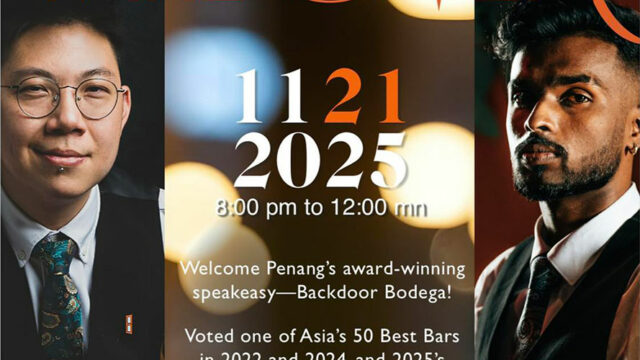

Penang takes over Pen’s Bar

BACKDOOR BODEGA in Penang, one of Asia’s 50 Best Bars in 2022 and 2024, is lending two of their stars, Yun Shen Koh and Thaneshkumar Sivakumar for a takeover at The Peninsula Manila’s The Bar on Nov. 21. Expect drinks from Remy Martin and Cointreau flowing from 8 p.m. to midnight. For inquiries, call 8887-2888 loc. 6694 or e-mail diningpmn@peninsula.com.


DTF marks 10 years with dimsum basket

DIN TAI FUNG’s Xiaolongbao Day returns with a special XLB Basket to celebrate 10 years in the Philippines. For a limited time only, Din Tai Fung Philippines will celebrate DTF Xiaolongbao Day, bringing diners a special XLB Birthday Basket featuring five mainstay flavors and five XLB Day comeback flavors from Nov. 19 to Dec. 3. Guests can order The Birthday Basket for P985 at all Din Tai Fung shops for dine-in only. This limited time offer features five mainstay Xiaolongbao flavors: Pork, Pork Xiaolongbao with Nomad Caviar, Chili Crab and Shrimp Xiaolongbao, Pork and Truffle Xiaolongbao, Foie Gras and Chicken Xiaolongbao. The others, from the Flavors of Asia XLBs, inspired by regional cuisines and released in previous XLB Days celebrations, include Prawn Tom Yum, Pork Kurobuta Ramen, Scallop and Prawn Laksa, Wagyu Pho, and Wagyu Mala Xiaolongbao. Each shop will only serve 100 baskets a day.


Starbucks planner out now

STARBUCKS Philippines is celebrating 23 years of a holiday tradition with the return of its Starbucks Traditions Collection — which, yes, includes the planner. Customers can already begin collecting stickers through the Starbucks PH App or QR Promo Card to redeem pieces from the 2026 collection. This year’s theme, “Invite Joy,” is an invitation back to the familiar comfort of a coffeehouse. Customers can collect one e-sticker for every purchase of a Tall, Grande, or Venti handcrafted beverage through the Starbucks PH App or QR Promo Card. After collecting 18 stickers, they can redeem their choice of 2026 Starbucks Traditions Planner: the 2026 Siren Planner with Carrier in charcoal and onyx; or the daily planner and its matching leather carrier which includes a sleek pen. Other gifts include the cold cup, tumbler, or mug. Stickers can now be collected in all Starbucks stores nationwide. To have a closer look at the 2026 Starbucks Traditions and new holiday offers, visit www.starbuckstraditions.ph.


Joel’s Place unveils a holiday hamper collection

JOEL’S PLACE has unveiled a holiday hamper collection that includes a variety of versions for different recipients. For those who love to host and cook, the selection ranges from La Dolce Passata (P999) to The Big Paella Celebration (P3,499) to the Gusto Hamper (P5,999). For friends and family who prefer to enjoy rather than prepare, there are ready-to-eat offerings like the Signature Snack Box (P2,599) and the premium Curated Cravings Hamper (P9,999). For wellness buffs there are options like the Coconut Collective (P899) and the Merry Harvest (P2,999). Beyond these ready-made hampers, customers can create their own, filling bayongs, red baskets, or picnic hampers with their favorite gourmet finds. Assembling a holiday feast is also an option with ready-to-serve meals. These include the Smoked Salmon Board, the Best of Season Platter, Salmon Wellington in Golden Pastry, the Roast Beef Belly Feast, the Crispy Crunchy Lechon Belly, Roast Duck Breast with Pancakes and Hoisin, and the Festive Flame-Grilled Feast. For dessert, there’s the Biscoff Icebox Dream Cake or the Sticky Toffee Cake. The celebration continues with the Holiday Bakehouse line, featuring the Christmas Tree Croissant, Ribbon Pain Suisse, and gourmet cookie jars filled with Dark Fig & Nut Choco and Food for the Gods Biscotti. Details on the Christmas collection, pricing, and customization options can be found at joelsplace.com.


Taco Bell spices it up

TACO BELL is serving up the new Cheesy Lava sauce in featured items like the Cheesy Lava Crunchy Taco Supreme (starts at P159), made with seasoned beef, shredded lettuce, cheddar cheese, diced tomato, and Cheesy Lava sauce inside a crispy taco shell. There’s also the Cheesy Lava Grilled Stuft Burrito (starts at P219), made with seasoned beef, Mexican rice, a two-cheese blend, and the signature Cheesy Lava sauce, wrapped in a flour tortilla. For sharing, try the Cheesy Lava BBQ Nachos Supreme (starts at P199), made with seasoned nacho chips topped with beef, cheese sauce, sour cream, diced tomato, and a layer of Cheesy Lava sauce. There are also the Cheesy Lava Beef Quesadilla (P199) and the Cheesy Lava Loaded Fries (starts at P299). Diners can add an extra serving of the fiery Cheesy Lava sauce for P39. The Cheesy Lava Crunchy Taco Supreme, Grilled Stuft Burrito, and Beef Quesadilla can come as a combo with a side of Nacho Sprinkle and a 12oz soda for an additional P70. Shareable items like the Cheesy Lava Nachos Supreme and Loaded Fries can also be paired with a 12oz soda for P30 more. Available at Taco Bell store for dine-in and take-out orders. They can also be ordered for delivery via Grabfood, foodpanda, and Pickaroo (prices may vary).


Idle school funds

PHILIPPINE STAR/MIGUEL DE GUZMAN

We have long known that public education needs both special attention and money. As early as 1968, Congress created the Special Education Fund (SEF) through Republic Act No. 5447, setting aside money to pay for classrooms, textbooks, equipment, teacher salary adjustments, and scholarships.

Under RA 5447, the SEF was funded by earmarking portions of real property and cigarette taxes to the Department of Education (DepEd). The law conveyed that education mattered enough to deserve an additional tax base and its own fund, not just whatever was appropriated in the general budget.

That principle was carried over into the 1991 Local Government Code, which devolved public services, including education, to local government units (LGUs). Control over the SEF was transferred to local school boards from DepEd, with funding drawn from an additional 1% real property tax collected by LGUs.

Yet after 57 years of the SEF, there is still no convincing evidence that the fund, in its current design, has systematically lifted the public school system out of its chronic problems. Classroom and teacher shortages persist, and inequalities between schools in rich and poor LGUs endure.

Studies point to a familiar pattern: some cities and municipalities manage the fund well and see local gains, while others underspend, misalign priorities, or simply park SEF balances in bank accounts while learners struggle in overcrowded, under-equipped classrooms, and from lack of teachers.

Reports indicate that from 2018 to 2022, the SEF accumulated an unspent balance of P15 billion sitting idle in LGU bank accounts, earning interest. Clearly, money is not the problem, governance is. The way we govern and spend education funds has not been enough to improve outcomes at scale.

The Department of Finance’s (DoF) call for SEF reforms is therefore timely and necessary. But Congress should also take a long, hard look at what has transpired since 1968 and make an informed decision on how best to redesign the SEF and make it the true helping fund that it was meant to be.

With former senator and congressman Sonny Angara now heading the Department of Education, he is in a position to propose practical, politically feasible reforms. Of all people, he understands how Congress works, and how the budget process can be misused to benefit the unscrupulous.

There is more to this issue than money. There are local cases where the SEF was well-spent, producing positive outcomes. But across the country, the fund remains underutilized and inefficiently managed. A full overhaul may be necessary to confront the systemic weaknesses in our education governance.

Available analyses show a mismatch between what schools need (classrooms, teachers, or learning materials, etc.) and how LGUs spend SEF money, often prioritizing infrastructure and sports facilities. In many cases, funds simply sit in banks earning interest, while students share textbooks or study under trees.

This suggests that underutilization stems not from lack of revenue, but from poor planning, weak coordination with the DepEd, and inadequate administrative capacity at the local level. Governance failures, rather than corruption or revenue shortfalls, appear to limit educational outcomes.

To be fair, the SEF has financed classrooms, teaching materials, and even teacher supplements for over five decades. While some studies indicate good results where the fund was planned and spent well, I have yet to see any national study proving that the SEF, as currently designed, has systematically improved the performance of the public school system in the last 50 years.

Imagine how much money is raised nationwide every year through the additional 1% real property tax earmarked for education, on top of the basic RPT. These proceeds flow to local school boards to support school operations, minor infrastructure, learning materials, sports development, and other programs.

I am certain that both DepEd and DoF are exploring ways to standardize planning and require LGUs to align SEF spending with DepEd priorities and local development plans. The DoF is also monitoring SEF collections and utilization by LGUs. My concern lies in any pending proposal to double the SEF rate and expand its scope of spending at the same time.

There is a proposal to raise the SEF from 1% to 2% of real property tax, and to allow its use for a wider range of activities such as Special Education (SPED), Open High School, madrasah, flexible learning, feeding and health programs, mental health, and child-protection services, among others. These are all worthy causes, but the expansion may be a case of too much, too fast, especially when the present SEF is not efficiently utilized.

Before we double the SEF tax, the DepEd, DoF, and LGUs must first prove they can spend the current 1% properly. The P15-billion unspent balance from 2018-2022 already proves otherwise. Capacity and governance issues must be fixed before asking taxpayers for more money.

If property taxes rise and SEF collections double, but the funds still sit idle or go to token projects with little impact, the reform could be politically suicidal for LGUs. More so now that citizens are more aware of how public money can be misused, as seen in recent flood control projects scandal.

A higher SEF rate could also widen the gap between schools in rich cities like Quezon City or Makati and poor municipalities in the provinces, unless a redistribution or equalization mechanism is put in place. The DepEd should be empowered to use national funds to augment the SEF of poorer LGUs, particularly for school construction and teacher hiring.

A bigger SEF, if inefficiently used, can also turn local school boards into battlegrounds for local politics, with mayors and school officials fighting over control of the fund. This invites abuse, politicization, and corruption in procurement. And even if used honestly, what guarantee is there that a bigger SEF will lead to better educational outcomes?

Almost six decades of SEF experience already exposed the system’s weaknesses. These must first be corrected before raising additional money. Reforms must proceed sequentially, not in parallel. Safeguards, performance benchmarks, and accountability measures should come first. Tax hikes can follow.

Otherwise, we risk repeating the same mistakes that have kept our public school system chronically underfunded, underperforming, and underdelivering on the promise of quality education for all. We might just be raising more money to mismanage and squander.


Marvin Tort is a former managing editor of BusinessWorld, and a former chairman of the Philippine Press Council

matort@yahoo.com

DigiPlus plans South Africa launch by early 2027

STOCK PHOTO | Image by Tim Johnson from Unsplash

LISTED digital entertainment provider and online gaming company DigiPlus Interactive Corp. expects to introduce its operations in South Africa by early 2027.

“We probably will adopt a similar approach to Brazil. First, we get the license, and then we will build a local team there. We also have to conduct market research to better understand what the product offering would be,” DigiPlus President Tsui Kin Ming told reporters on Wednesday.

DigiPlus is in the process of securing its license for South Africa and is optimistic about obtaining it within the next eight months, Mr. Tsui said, adding that the company will leverage its presence in Brazil for its planned operations in the South African market.

In September, DigiPlus launched its GamePlus platform in Brazil, giving users access to more than 150 free-to-play and real-money games.

“So, I would say sometime in early 2027, we will also do a soft launch in South Africa,” he said.

The company has filed applications for three gaming licenses with South Africa’s Western Cape Gambling and Racing Board (WCGRB): a national manufacturer license, a bookmaker license, and a bookmaker premises license.

WCGRB is considered the preferred jurisdiction for international operators like DigiPlus, the company said, citing seamless and transparent regulatory processes and digital readiness.

South Africa’s online gambling sector is currently valued at more than $1.6 billion, the company added.

Further, DigiPlus is assessing and monitoring other developing countries with licensing opportunities, Mr. Tsui said, noting that it will evaluate territories and opportunities for further expansion.

“We only go for licensed markets as we’re a listed company. We look for developing countries that have more opportunities. We’re not going into mature markets like the UK or the US because the cost of entry is much higher and it’s very competitive, so we are carefully selecting new opportunities,” he said.

DigiPlus reported a 51.41% decline in its third-quarter net income to P1.71 billion, citing stricter regulations that prompted e-wallet providers to remove in-app access to licensed online gaming platforms. 

For the January-to-September period, the company’s net income rose 15.59% to P10.11 billion from P8.75 billion a year earlier, driven by steady gains in its retail games segment and contributions from new product launches and operational improvements.

Revenues for the nine-month period increased 29.61% to P66.83 billion from P51.56 billion in 2024. Gross revenues for the third quarter inched up 0.26% to P19.05 billion from P19 billion a year earlier, supported by continued product development, improved user experience, and stronger corporate governance.

At the stock exchange on Wednesday, shares in the company closed P2, or 8% higher, at P27 apiece. — Ashley Erika O. Jose

Central bank TDF yields drop on rate cut hopes

BW FILE PHOTO

By Katherine K. Chan

YIELDS on the Bangko Sentral ng Pilipinas’ (BSP) term deposits fell on Wednesday as investors sought to lock in returns amid market expectations that the Monetary Board could ease borrowing costs at its Dec. 11 meeting.

Total tenders for the seven-day term deposit facility (TDF) reached P162.089 billion, more than double the P80 billion offered and exceeding last week’s P158.208 billion in bids.

The BSP accepted the full offering. Banks bid for rates from 4.6% to 4.7515%, narrower than 4.6%-4.765%  last week, pushing the average down 1.24 basis points (bps) to 4.7435%.

“The BSP seven-day average auction yield was again slightly lower, by -0.0124 to 4.7435%, now interestingly and unusually lower than the BSP one-day policy rate at 4.75%, after local monetary authorities signaled a possible (25-bp) rate cut at the next rate-setting meeting,” Michael L. Ricafort, chief economist at Rizal Commercial Banking Corp., said in a Viber message.

The decline in term deposit yields underscores a broader shift in monetary conditions, with investors pricing in easier financing costs that could stimulate credit, spending and investment amid slower economic growth this year.

With inflation remaining relatively benign, markets are increasingly betting on further easing, which could help support the domestic economy amid external risks and subdued government spending.

The BSP did not offer the 14-day tenor for a third consecutive week, while the 28-day term deposit has not been auctioned since October 2020 to prioritize weekly securities with the same maturity.

The TDF and BSP bills are tools to absorb excess liquidity and help guide market rates toward the policy benchmark.

BSP Governor Eli M. Remolona, Jr. on Tuesday said the Monetary Board might deliver a 25-bp cut before yearend, while Executive Secretary Ralph G. Recto, a former Finance chief, noted that a December reduction is likely but ruled out off-cycle easing.

The central bank has cut policy rates by 175 bps since the start of its easing cycle in August 2024, bringing the benchmark to 4.75%, a more than three-year low.

Mr. Ricafort said recent volatility in local equities also contributed to lower yields.

The Philippine Stock Exchange index fell to 5,584.35 on Friday, its weakest close in over five years, down 2.49% from the previous session and comparable to lows last seen on May 28, 2020.

Eli Lilly weight-loss drug appears to suppress binge-eating signal, small study finds

LILLY.COM

RESEARCHERS monitoring the brain activity of a patient with a severe binge-eating problem reported that Eli Lilly’s GLP-1 weight-loss drug appeared to temporarily suppress food-craving signals in the “reward center” of the brain.

These are the first direct measurements of brain activity in a person receiving tirzepatide, sold as Mounjaro for diabetes and Zepbound for weight loss, shedding light on the treatment’s impact on so-called food noise.

The report, published on Monday in Nature Medicine, describes the effect of tirzepatide on a single individual, and the findings cannot be generalized to others, the researchers cautioned. But it may suggest a role for future versions of Mounjaro or other GLP-1 drugs in treating certain eating disorders, they said.

“Hopefully this report inspires some rigorous investigation of that possibility,” said study leader Dr. Casey Halpern of the Perelman School of Medicine at the University of Pennsylvania.

The study followed four patients participating in the first human trial of deep-brain stimulation for treating loss-of-control eating disorders such as binge-eating and bulimia.

The plan was to monitor activity in the brain’s reward center, or nucleus accumbens, and use a surgically implanted device to send electrical impulses to block signals that “ramp up” before binge-eating episodes, Mr. Halpern said.

One patient’s doctor had prescribed tirzepatide before the electrodes were implanted to treat her type 2 diabetes and obesity. During the first few months of electrode monitoring, she reported no food preoccupation and her nucleus accumbens food-craving signals were silent.

Study participants not taking tirzepatide showed the typical elevated activity in the nucleus accumbens and frequent episodes of food preoccupation.

The striking quiet in her nucleus accumbens signaling and food preoccupation suggests that tirzepatide was responsible for the temporary quieting of food noise in this patient, the researchers said.

“Activity in her nucleus accumbens was so quiet that it almost made us think our system wasn’t working,” Mr. Halpern said.

DRUG IMPACT FADES OVER TIME
Five months later, the researchers saw signs that tirzepatide’s effects on this patient’s behavioral disorder were temporary, and “food noise” was breaking through.

They detected nucleus accumbens activity consistent with binge-eating, and the patient reported episodes of severe food preoccupation.

The reason tirzepatide’s effect on out-of-control eating was only temporary in this case is likely because the drug was designed and optimized for diabetes and weight loss, not for binge-eating disorders, Mr. Halpern surmised.

Current popular weight-loss drugs mimic hormones found in the small intestine and pancreas and are not designed to impact the brain’s reward mechanisms.

To have a lasting effect on severe food preoccupation, GLP-1 drugs would need to be redesigned to impact the nucleus accumbens and optimized for mental health, Mr. Halpern said. — Reuters

DXC sets up center to boost firms’ AI-readiness

DXC.COM

US INFORMATION TECHNOLOGY (IT) service provider DXC Technology is looking to help position the Philippines as a global IT hub with its recently opened client experience center, through which it plans to help both local and foreign clients in their artificial intelligence (AI) and cloud-adoption journeys.

“We don’t just want the Philippines to be known as a delivery location, but we want to be known as a location that is able to help our clients innovate,” DXC Philippines Site Leader Malou Ocampo-Quiambao told BusinessWorld during a tour of the center in Taguig City on Nov. 6.

“In this age, everything needs to be AI-first and AI-enabled. So, that’s how we also want to shift so that it provides more value not just for local clients but for global clients as well.”

DXC opened its first client experience center in Taguig City on Nov. 3.

The center, located on the 12th floor of the Intellectual Property Center within McKinley Hill Cyberpark, is expected to support DXC’s clients across America, Europe and Asia.

The company is optimistic about further boosting its presence in the Philippine market as more firms adopt AI, cybersecurity and cloud-migration journeys, said DXC Philippines Country General Manager Maria Angelica Yap.

In the Philippines, DXC supports clients in industries like manufacturing, utilities, consumer and retail, public sector, banking and automotive.

“We actually support quite a number of banking customers from the global center, delivered out of the global center for a global company. So, we want to kind of replicate that as well in the Philippine market,” Ms. Yap said.

Ms. Yap said the 250-seat client experience center near Bonifacio Global City is accessible to offices within the area. It is also near the Ninoy Aquino International Airport, she said, making it convenient for out-of-town and foreign clients.

The client experience center is envisioned to become a co-creation hub to help global and local clients run their mission-critical applications and modernize their cloud, data, AI and cybersecurity systems.

Ms. Quiambao said DXC’s client experience center has spaces that can be reconfigured for training, town hall meetings and workshops.

“Where you have those types of spaces, it really encourages or triggers ideas from people when they do those types of brainstorming,” she said.

DXC’s client experience center will also help upskill its 7,000 employees to become AI-ready.

“[An AI-enabled workforce] is not just a nice-to-have. It’s now a must-have,” Ms. Quiambao said.

“The experience center gives them the ability to be able to work with other people, see how they’re doing and learn from them,” she added.

The center also gives DXC a space to collaborate with universities and professional organizations to ensure that the country’s workforce aligns with industry demand.

It would also allow the company to better assist Filipino clients in keeping up with the fast-moving tech landscape, address skill gaps and comply with data sovereignty laws, Ms. Yap added.

“It’s really meant for clients and DXC to work together, think about what the requirements are, what frameworks can we do, and what roadmaps can we embark on to get them to that journey,” she said.

The IT-BPM industry is expected to increase its staffing to 1.9 million this year, generating $40 billion in export revenue, according to the Information Technology and Business Process Association of the Philippines. — Beatriz Marie D. Cruz

First kiss was 20 million years ago by early primates, scientists say

STOCK PHOTO | Image by Rawpixel.Com from Freepik

AMSTERDAM — Kissing did not begin with star-crossed human lovers but with the primate ancestors of great apes around 20 million years ago, according to a study published on Wednesday.

Researchers from Oxford University and the Florida Institute of Technology wanted to examine when kissing began, given that from an evolutionary standpoint it has no obvious survival benefit, and could spread disease.

Yet humans, chimpanzees, bonobos, orangutans, and gorillas all kiss, which strongly suggests the habit was inherited from a shared ancestor. Scientists in the study combined observations of primate behavior with data on evolutionary relationships, to rewind the clock and try and date the first kiss.

“Using these two key pieces of information, we employed a modelling approach that allowed us to simulate different evolutionary scenarios,” said lead author Dr. Matilda Brindle of Oxford’s Department of Biology. Running the model millions of times put that first smooch at 21.5-16.9 million years ago.

The findings were published in the journal Evolution and Human Behavior.

The scientists’ unromantic definition of kissing was “non-aggressive, mouth-to-mouth contact that did not involve food transfer.” This included sexual kissing as well as platonic kisses such as those between family members or in friendly greetings. How kissing emerged remains a subject of debate, as does why it persisted.

“Some people suggest sexual kissing is a useful way of assessing mate quality or suitability,” Ms. Brindle said. Alternatively, kissing could be a type of foreplay, increasing sexual arousal and boosting the chance of fertilization.

Platonic pecks are thought to be used to navigate complex social relationships or increase bonding, she said.

The study argued Neanderthals and humans also likely locked lips, given evidence that they interbred and shared an oral microbe — a sign they swapped saliva — long after the two species diverged 450,000-750,000 years ago. — Reuters

China’s trade model is built on keeping others poor

STOCK PHOTO | Image by DC Studio from Freepik

By Mihir Sharma

THE WORLD has, for the most part, welcomed the trade truce between the US and China. Exporters, in particular, are hoping for a period of quiet that will allow them to adjust to a new world with higher tariffs and more restrictions.

Yet for workers and companies across the developing world, the possibility of a return to a status quo ante isn’t an entirely comforting notion, either. A new normal that preserves China’s dominance of global trade hurts them far more than it does the US or other Western nations.

A new index from Bloomberg Economics that examines the export potential of various major economies explains why. China is still at the top of the table, and there’s a big gap between it and the closest competitor, India. Most emerging markets, according to the index, only marginally outperform developed economies.

This is not how it’s supposed to go. As labor costs in China converge with higher-productivity markets, it should look like a less attractive source of goods. Trade-driven sectors should start moving out of the country — or, in the index’s terms, other developing economies should demonstrate greater or at least comparable export potential.

Instead, China’s lead in other factors — from energy costs and logistics efficiency to straightforward technical know-how — is so great that it still has no peers.

It’s impossible to overstate how unusual this is in world history. Various countries and regions have had their moment dominating world trade — Britain, the US, Japan — before stepping aside and letting others grow. As they became richer, they moved to different slots in the supply chain, allowing lower-value goods to be made in places with reduced costs.

China, instead, continues to dominate every rung of the supply chain, from low- to high-margin manufacturing. According to calculations by the economists Arvind Subramanian and Shoumitro Chatterjee, three-quarters of the country’s enormous trade surplus with the world continues to come from goods that are manufactured using relatively basic skills, and it still has over half the global market share in such sectors.

Other estimates, with a more restrictive definition of low-skills production, come out a little smaller: Harvard’s Gordon Hanson assessed in 2020 that China’s share of labor-intensive manufacturing was about one-third.

Either way, this is an anomaly. This market share doesn’t fit with the other things we know about that economy — that its working-age population is declining, and average wages are now several times those of its struggling competitors.

There could be several reasons for the emergence of this inconsistency. A persistently undervalued currency could account for it, as could hidden subsidies for inputs like energy.

But part of the reason is that Beijing has deliberately intervened in the natural process of global development. Because the corollary of one country’s economy growing and a second, poorer peer overtaking it in terms of export potential is that the savers, investors, and corporations of the first country start moving capital and technology to the second.

This is how manufacturing spread across the developed world and the Asian tigers. In the heyday of British economic hegemony, London’s bankers financed half of the world’s foreign investment. A large proportion of American railroad bonds were denominated in sterling. By the time the US dominated trade a century later, it in turn was the origin of almost half of outward investment globally. And during its boom years in the 1980s, Japan’s share of world investment overtook America’s.

This is what happens when companies in trade-surplus nations are allowed to freely plan for the future and find the best returns on their capital. That isn’t how Beijing allows its economy to work, however. What it earns from trade is directed instead at creating excess capacity at home, or toward long-gestation projects meant to further embed China at the center of global manufacturing.

This means that Chinese companies get a low return on their savings, and its savers and pensioners are poorer than they should be. But it also means that workers throughout the rest of the developing world are cut off from their potential. They need Chinese companies to use their technological skills and hoarded capital to build factories that would train and employ them.

But China’s leaders aren’t allowing that to happen. They want to stay at the top of that export potential table, and don’t care if, as a consequence, the developing world is deprived of its destiny. If Beijing has its way, nobody else will ever get rich.

BLOOMBERG OPINION

Lepanto Q3 profit surges to P407M on higher metal prices

LEPANTOMINING.COM

LEPANTO Consolidated Mining Co. reported a more than fivefold increase in attributable net income for the third quarter (Q3), driven by higher metal prices.

For the three months ended Sept. 30, the company’s attributable net income reached P407.14 million, up 465.26% from P72.03 million a year earlier, it said in a regulatory filing on Tuesday.

Consolidated net income rose to P407.78 million from P71.97 million in Q3 2024.

Revenue from the sale of metals surged 53.83% to P1.12 billion from P730.84 million, supported by a 38.65% increase in average gold prices to $3,453.67 per ounce and a 31.27% rise in average silver prices to $39.97 per ounce.

Revenue from services also increased 15.34% to P2.51 million from P2.18 million.

For the January-to-September period, attributable net income reached P1.18 billion, up 795.09% from P131.77 million in 2024.

Lepanto said it is focusing on gold and silver dore production in its Victoria and Teresa deposits as exploration drilling continues.

The company added that it has a capital expenditure budget of P700 million for 2025, which covers machinery and equipment purchases, mine development, tailings dam maintenance, and exploration activities.

“Prices of gold and silver are expected to remain robust, which could offset inflationary pressures on materials and equipment costs,” the company added.

Lepanto, which operates mines in Mankayan, Benguet, has business interests in the exploration and extraction of gold, silver, copper, lead, zinc, and various ores, metals, minerals, oil, gas, and coal, as well as their related by-products.

On Wednesday, Lepanto “A” shares on the stock exchange rose 1.2%, or 0.2 centavo, to close at P0.168 apiece, while Lepanto “B” shares fell 0.56%, or 0.1 centavo, to close at P0.176 each. — Vonn Andrei E. Villamiel

Manulife launches tech-focused UITF

BW FILE PHOTO

MANULIFE Investment Management and Trust Corp. has launched a unit investment trust fund (UITF) designed to tap into the global semiconductor sector, a key driver of artificial intelligence, automation and next-generation technologies.

“The Manulife Global Semiconductor Opportunities Equity Feeder Fund empowers Filipino investors to participate in one of the most transformative technology trends shaping the global economy,” Manulife Investment Philippines President and Chief Executive Officer Aira Gaspar said in a statement on Wednesday.

The fund invests in a collective investing scheme, or target fund that allocates at least 70% of its net assets to equities and equity-related securities of leading semiconductor companies worldwide.

It adopts an active management strategy to navigate market cycles, focusing on both mega-cap companies and smaller, under-researched companies with differentiated technologies.

“Semiconductors serve as the foundation of modern innovation and power AI (artificial intelligence), automation and digital connectivity,” Ms. Gaspar said. “This UITF provides access to leading companies driving progress across the semiconductor and AI value chain.”

The fund is aimed at long-term capital appreciation, offering investors diversified exposure to high-growth tech firms.

Manulife cited McKinsey & Co. data projecting the semiconductor market to surpass $1 trillion by 2030, highlighting the sector’s growth potential.

The fund can be accessed for as little as $100 or P1,000, with accounts opened online via Manulife iFUNDS, the company’s digital platform for managing UITF investments.

Manulife Investment, a wholly owned unit of The Manufacturers Life Insurance Co. (Phils.) Inc., obtained a standalone trust corporation license from the Bangko Sentral ng Pilipinas in 2017.

As of 2024, the trust firm reported assets of P1.88 billion, liabilities of P215.88 million and total equity of P971.77 million. Net income surged 55.3% to P372.16 million from the previous year.

Its parent company, Manulife Philippines, posted P15.83 billion in premium income and a net income of P2.78 billion last year, underscoring the group’s growing presence in insurance and investment management in the country. — Aaron Michael C. Sy

Evolving threats need smarter defenses: Combating AI-enabled social engineering

REUTERS/KACPER PEMPEL/FILE PHOTO

By Bambi Escalante

ARTIFICIAL INTELLIGENCE (AI) is transforming the way organizations operate, driving speed, innovation, and efficiency across industries. But the same technology is also being weaponized by cybercriminals, enabling them to launch faster, stealthier, and more convincing attacks than ever before.

In the Philippines, the consequences are already being felt. According to a recent IDC survey commissioned by Fortinet, nearly 78% of organizations reported encountering AI-powered cyber threats in the past year. Among the most concerning are AI-enhanced social engineering attacks, which exploit trust and human behavior to trick victims into revealing information, transferring funds, or approving fraudulent requests.

WHEN OLD TRICKS GET AN AI UPGRADE
Social engineering is not new. Phishing e-mails, fraudulent calls, and impersonation schemes have long been used to deceive individuals. What is new is how AI supercharges these tactics.

Attackers can now automate reconnaissance, scanning social media posts, company websites, and leaked credentials to build detailed profiles of their targets. With this data, AI can craft personalized phishing messages that are grammatically correct, contextually relevant, and nearly indistinguishable from legitimate communications. Even security-savvy employees may find it difficult to spot the difference.

The rise of deepfakes adds another dimension. Cloned voices and AI-generated videos are being used to impersonate executives, colleagues, or customer service agents. These synthetic media assets are convincing enough to pressure victims into taking urgent action, whether it’s wiring funds, sharing login credentials, or approving sensitive transactions.

What makes these threats so alarming is their scale. With AI-driven automation, cybercriminals can launch hundreds or thousands of highly targeted attacks simultaneously, increasing both their reach and effectiveness. The result is a more persistent threat landscape that traditional defenses alone cannot keep up with.

A PREPAREDNESS GAP IN THE PHILIPPINES
The IDC survey highlights a worrying confidence gap. Only 9% of organizations in the Philippines said they feel very confident in defending against AI-powered threats. A further 27% admitted these attacks are outpacing their detection capabilities, while almost one in five confessed to having no ability to track AI threats at all.

This preparedness gap leaves businesses exposed to significant risks. The most common consequences of cyberattacks in the Philippines include loss of customer trust (62%), regulatory penalties (56%), and data theft (54%). Nearly half of organizations experienced direct financial losses, with one in four reporting costs exceeding $500,000. For a growing digital economy, these numbers underscore the urgent need for smarter defenses.

USING AI TO FIGHT AI
If adversaries are leveraging AI, defenders must too. AI can dramatically improve the speed and accuracy of threat detection and response, enabling security teams to sift through vast amounts of data, spot anomalies, and neutralize threats before they escalate.

E-mail security is a strong example. AI can analyze the tone, structure, and context of messages to detect subtle signs of phishing or impersonation that traditional filters may miss. Over time, these systems learn normal communication patterns, making it easier to spot anomalies. Combined with automated responses, this helps reduce the workload on security teams and accelerates containment.

But technology cannot operate in silos. To be effective, AI-powered tools must be part of an integrated cybersecurity platform that unifies defenses across networks, endpoints, cloud environments, and operational technology. A platform-led approach ensures consistent visibility, coordinated responses, and reduced complexity, all of which are critical in a landscape where lean security teams are already stretched thin.

EMPOWERING PEOPLE AS THE FIRST LINE OF DEFENSE
While technology is critical, people remain a decisive factor in defending against social engineering. Every employee, from the boardroom to the front line, plays a role in cybersecurity. When equipped with the right knowledge and tools, they can serve as an effective first line of defense.

Security awareness training is therefore essential. Employees must understand the risks, recognize common attack techniques, and know how to respond to suspicious activity. This is especially important in the Philippines, where cybercriminals often exploit urgency and trust in personal interactions.

Fortinet’s Security Awareness and Training service, delivered through the Fortinet Training Institute, is one example of how organizations can foster a cyber-aware workforce. Delivered as a SaaS solution, it provides timely, relevant training on evolving threats such as phishing and impersonation, and allows organizations to customize modules and track user progress. By cultivating a culture of vigilance, companies can significantly reduce their exposure to AI-enhanced social engineering.

BUILDING RESILIENCE IN THE AGE OF AI
AI is reshaping the cyber battlefield, turning familiar tactics into sophisticated, scalable campaigns. The Philippines cannot afford to fall behind. Addressing these threats requires a balanced approach,  harnessing AI-powered defenses while empowering people through awareness and training.

Cybersecurity is no longer just about preventing breaches; it is about resilience. By combining smarter technologies, integrated platforms, and a culture of vigilance, organizations in the Philippines can build the resilience needed to withstand and adapt to the next wave of AI-powered threats.


Bambi Escalante is the country manager, Fortinet Philippines.

AI revives French playwright Molière with a new play

PORTRAIT OF MOLIÈRE by Pierre Mignard (c. 1658) — COMMONS.WIKIMEDIA.ORG/

PARIS — What might have been Molière’s next play if the 17th century French playwright had not died after collapsing on stage while performing The Imaginary Invalid? It’s a question French scholars, artists, and an artificial intelligence (AI) firm teamed up to answer.

The result is L’Astrologue ou les Faux Presages (The Astrologer or the False Omens), a comedy that will debut next year in the Palace of Versailles, where Louis XIV, Molière’s patron, held court centuries ago.

“What we thought was, let’s try to recreate a bit of Molière’s creative process using the current state of AI,” said Hugo Caselles-Dupre, a researcher in using AI for artistic creation, who was involved in the project.

A FRENCH ICON
Molière holds iconic status in France, to the extent that French is sometimes referred to as “the language of Molière.” His plays, characterized by satirical wit and social commentary, are widely taught in French high schools and performed in theaters in the French-speaking world.

Despite the patronage of Louis XIV, Molière lived in hardship for many years and died of exhaustion at the age of 51, leaving his devotees to wonder who would have been his next target.

According to the Molière Ex Machina project backed by French artificial intelligence firm Mistral AI, he might have taken aim at astrologers.

“We looked for what kind of play (Molière) might have written. One of the subjects he addressed, but subtly woven into several of his other works, is astrology,” Mickael Bouffard, an art historian and director of the play, said.

The plot centers on Geronte, a gullible bourgeois who falls prey to a fraudulent astrologer scheming to marry off Geronte’s daughter to a deceitful wigmaker, despite her love for another.

The AI model was not left to run loose. The production was tweaked by scholars and researchers who corrected historical inaccuracies and other details.

But the model offered scholars a deeper understanding of Molière’s craft, more than 350 years after his death.

“I have learned things about Molière that I had missed because they’re so scattered throughout his work,” Mr. Bouffard said. — Reuters