Home Blog Page 6526

Local shares drop on profit taking, rate hike fears

COURTESY OF PHILIPPINE STOCK EXCHANGE, INC.

PHILIPPINE SHARES dropped on Thursday along with other Asian markets due to profit taking amid fears of an aggressive rate hike from the US Federal Reserve and other central banks.

The benchmark Philippine Stock Exchange index (PSEi) went down by 80.93 points or 1.13% to close at 7,061.49 on Thursday, while the broader all shares fell by 24.59 points or 0.65% to 3,752.54. 

“[Most] US stock markets corrected slightly lower overnight after softer US existing home sales data… and the recent hawkish signals from some Fed and ECB (European Central Bank) officials that suggest more aggressive rate hikes/monetary tightening that could lead to higher interest rates/borrowing costs and could slow down the economic recovery in an effort to curb/rein in on elevated inflation,” Rizal Commercial Banking Corp. Chief Economist Michael L. Ricafort said in a Viber message.

New York Fed President John Williams said on Thursday that the Fed should reasonably consider raising interest rates by a half percentage point at its next meeting in May, which was seen as a further sign that even more cautious policy makers are on board with bigger rate hikes, Reuters reported. This was after the ECB said it plans to cut bond purchases — known as quantitative easing — this quarter, then end them at some point in the third quarter.

“Philippine shares succumbed to profit taking following other Asian markets, while the US traded rather mixed as investors digested a fresh batch of 1Q22 earnings results,” Regina Capital Development Corp. Head of Research Luis A. Limlingan said.

Fears of a sharp economic slowdown in China and higher oil prices weighed on most Asian stocks on Thursday, but a dip in US treasury yields offered some relief for broader markets worried by the prospect of aggressive rate hikes.

Chinese and Hong Kong shares hit month lows and the yuan fell to its lowest in six months as Shanghai authorities said tough coronavirus disease 2019 (COVID-19) restrictions would remain in place.

The declines pulled MSCI’s broadest index of Asia-Pacific shares outside Japan 0.66% lower.

Back home, only two sectoral indices closed in the green on Thursday. Mining and oil went up by 251.37 points or 2.01% to 12,741.04 and financials climbed by 16.62 points or 0.99% to 1,696.10.

Meanwhile, property dropped by 72.02 points or 2.16% to 3,261.29; services went down by 29.76 points or 1.49% to 1,960.75; industrials fell by 110.07 points or 1.13% to 9,608.09; and holding firms lost 70.51 points or 1.06% to end at 6,581.27.

The MidCap index retreated by 7.83 points or 0.66% to 1,185.85, while the Dividend Yield index improved by 6.88 points or 0.419% to close at 1,688.03.

Value turnover increased to P6.04 billion with 895.46 million shares changing hands from the P4.82 billion or 799.64 million issues seen the previous day.

Decliners outnumbered advancers, 91 versus 83, while 61 names closed unchanged.

Foreigners turned sellers anew with net sales of P206.05 million versus the P585.78 million in net purchases seen the previous trading day. — R.C.S. Agustin with Reuters
Peso up on profit taking amid hawkish Fed, softer US home sales data

BW FILE PHOTO

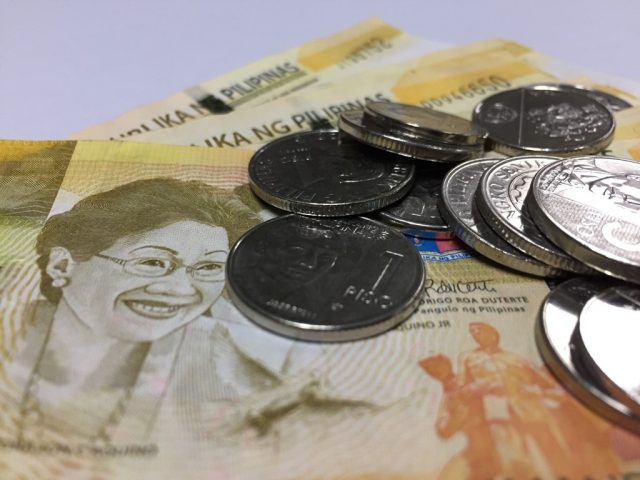
THE PESO strengthened versus the greenback on Thursday amid profit-taking following hawkish signals from Federal Reserve officials and softer US economic data.

The local unit closed at P52.365 per dollar on Thursday, appreciating by 12.5 centavos from its P52.49 finish on Wednesday, based on Bankers Association of the Philippines data.

The peso opened Thursday’s session at P52.40 versus the dollar. Its weakest showing was at P52.45, while its intraday best was at P52.35 against the greenback.

A trader in a Viber message said the peso closed stronger due to profit-taking following hawkish signals from Fed officials.

San Francisco Federal Reserve President Mary Daly on Wednesday said she supports a broad consensus to raise the interest rates to about 2.5% by the end of 2022, Reuters reported.

“Once accommodation is removed, we need to evaluate the effects — observe how financial conditions adjust, how much inflation recedes, and what more remains to be done to ensure a sustained expansion,” Ms. Daly said.

The Fed in March hiked rates by 25 basis points to begin its tightening cycle.

The peso also appreciated after the release of softer US home sales data, which partially led to a healthy downward correction of the dollar, Rizal Commercial Banking Corp. Chief Economist Michael L. Ricafort said in a Viber message.

Data reported by the National Association of Realtors on Wednesday showed US existing home sales dropped 2.7% to a seasonally adjusted annual rate of 5.77 million units in March. This is the lowest level since June 2020.

Home resales, which make up the bulk of the sales, were down 4.5% annually in March.

For Friday, both Mr. Ricafort and the trader gave a forecast range of P52.25 to P52.45 per dollar. — LWTN with Reuters

Presidential frontrunners visit vote-rich Visayas

ONENEWS.PH

By Kyle Aristophere T. Atienza, Reporter

THE PHILIPPINES’ top three presidential frontrunners visited the Visayas island this week, as they tried to woo more voters less than three weeks before the elections.

Vice-President Maria Leonor “Leni” G. Robredo on Thursday held campaign rallies in three big cities in vote-rich Cebu province, whose governor had pledged a landslide victory for the son and namesake of the late dictator Ferdinand E. Marcos.

“I won’t lose focus on my real goals,” she told reporters in Filipino in Cebu’s Bogo City when asked to comment on rival presidential bet Manila Mayor Francisco “Isko” M. Domagoso’s call for her to quit the race, according to a transcript sent by her office.

Mr. Domagoso, a former matinee idol, on Wednesday night campaigned in Tagbilaran City, where he drew about 40,000 supporters, according to his office.

The provinces of Cebu, Negros Occidental and Iloilo in the Visayas have a total of 6.8 million voters, according to Commission on Elections data.

“Moreno urged the people anew, especially the youth, not to be blindsided by the fight for power among the two warring elitist political factions who have lorded over the country for several decades only to leave the ordinary mortals on the losing end,” it said in a statement that used Mr. Domagoso’s screen name.

The mayor has presented himself as an alternative candidate to political clans that have dominated Philippine politics. Ms. Robredo is a member of the Liberal Party, the party of the late President Benigno S.C. Aquino III, whose mother Corazon replaced Ferdinand Marcos after he was toppled by a popular street uprising in 1986.

The dictator’s son, Ferdinand “Bongbong” R. Marcos, Jr., visited Cebu City, whose governor Gwendolyn F. Garcia estimated more than a million votes more for him compared with his closest rival in the May 9 election.

Mr. Domagoso and other presidential poll laggards on Sunday urged Ms. Robredo to withdraw from the race after some sectors asked them to back her instead in a presidential race that is shaping up to become a two-way contest.

Marcos, Jr. is leading in presidential opinion polls, where Ms. Robredo is a distant second though her ratings have risen.

Presidential candidates are expected to intensify their campaigns on various fronts, whether through large rallies or from house to house, said Maria Ela L. Atienza, a political science professor from the University of the Philippines (UP).

“Last-minute endorsements can pull their candidacies, but I think this will only affect undecided or soft voters,” she said in a Viber message. “Hard voters are already decided, and it would take something drastic for them to change their choice.”

She said Ms. Robredo is expected to keep her composure amid personal attacks. “As always, her message is to focus on the campaign.” 

Ms. Atienza said Mr. Domagoso might use the remaining days to get media attention and increase his exposure. “Whether this works or not is something that will unfold later.”

“All campaigns will try to gain momentum until the end of the campaign period,” said Jan Robert Go, an assistant political science professor from UP.

He said candidates who run negative campaigns like Mr. Domagoso “may intensify their attacks against other candidates but it could backfire like what is happening now.”

“Others may intensify the strategies that are working, like advertisements, rallies, house-to-house campaigns,” he said in a Messenger chat. “There could be more shifts in alliances and endorsements for certain candidates.”

Mr. Go said Ms. Robredo’s campaign would likely gain more momentum after being attacked by her rivals. “She remains unbothered despite attacks from Domagoso.”

The last government-organized presidential debate on Sunday could still affect their campaigns.

“The Marcos-Duterte camp can’t afford to have a lull in their campaigns and their continued silence on issues against them and their absence from debates may cost them some more votes,” he said.

Ms. Atienza said Mr. Domagoso might reiterate his tirades against the opposition. “It would be interesting to see how other candidates who denied asking the vice-president to withdraw will react to these possible dynamics.”

Former BSP official says Robredo gov’t to attract investors

PHILSTAR

VICE-PRESIDENT Maria Leonor “Leni” G. Robredo “will make every peso count” in her administration’s pandemic recovery program if she becomes president, according to a former Philippine central bank official.

Her anti-corruption drive and proven leadership during the global health crisis could also boost business confidence and attract investors, ex-Bangko Sentral ng Pilipinas (BSP) Deputy Governor Diwa C. Guinigundo said in a statement on Thursday.

Ms. Robredo’s office outperformed other agencies with higher budgets, making her a good model for the country’s market-driven economy, he added.

“She was able to maximize the Office of the Vice President’s allocation to fund an operation truly national in scope,” Mr. Guinigundo said.

“The next president must be able to judiciously utilize scarce resources. Robredo is the only one with executive experience to make every peso count.”

The Commission on Audit has given the Office of the Vice President the highest audit rating for three straight years.

Mr. Guinigundo said the country is entering an era “when a coronavirus-hit economy will not be able to contribute revenues that can substantially finance a national budget that addresses the needs of the people.”

“She will attract investors who will be lured that an economist is at the helm,” he said. “They will see her as both fair to labor, capital and consumers.”

Mr.  Guinigundo said Ms. Robredo is a “stark contrast” to her main rival, Ferdinand ‘Bongbong’ R. Marcos, Jr., who failed to file his income tax returns in the 1980s.

Critics have asked him and his family to settle the unpaid tax of their father’s estate that has ballooned to more than P200 billion due to interests and other penalties.

Nomura Global Research earlier said a government led by Ms. Robredo would be more “market-friendly.”

“Marcos Jr., in our view, will likely be regarded as less market-friendly than [Ms. Robredo], particularly when it comes to experience at the national level and in articulating a strategy for the country to recover from the pandemic,” it said in a report last year.

Ms. Robredo, who lawyered for the poor before becoming a congresswoman, has vowed to promote transparency and accountability in government and pursue pandemic recovery through health-based measures that respect human rights.

Her main rival, Mr. Marcos, who is leading in presidential opinion polls, has promised to continue a number of President Rodrigo R. Duterte’s policies, including his infrastructure plan.

“A Marcos victory will likely be viewed negatively owing to perceptions against him, in part because his candidacy is facing some petitions for disqualification on grounds of making false statements and a previous conviction of failing to file income tax returns,” Nomura said.

A recent poll conducted by Bloomberg showed that Filipino investors were lukewarm to the prospects of a Marcos presidency, with Ms. Robredo emerging as their top pick to oversee an economic rebound.

The late President Benigno S.C. Aquino III, who started economic policies that led to investment-grade credit ratings for the Philippines and economic growth exceeding 6% from 2012 to 2014, endorsed Ms. Robredo’s vice presidential run in 2016.

The country’s economic output grew from an annual average of 4.5% before Mr. Aquino’s term to 6.2% during his six-year reign, according to economists. — Kyle Aristophere T. Atienza

FedEx Clark capacity seen expanding five times

REUTERS

TRADE SECRETARY Ramon M. Lopez said FedEx Corp.’s Clark capacity is expected to expand around five times amid plans to use Clark as a transshipment base.

In a statement issued out of Washington, DC, the Department of Trade and Industry (DTI) said transshipment status will mean FedEx will conduct hub-and-spoke operations at Clark. Hub and spoke means packages arriving in Clark will be reloaded to other aircraft that will proceed to their specific regional destinations.

FedEx discussed its plans with DTI officials, Presidential Adviser on Flagship Programs and Projects Vivencio B. Dizon. Representing the company at the April 18 meeting was Vice-President Ralph Carter.

Mr. Dizon was in attendance to address FedEx concerns about the processing of documentation that will enable speedy transfers at the hub.

Mr. Carter said FedEx is looking to initiate Phase 2 of its project in Clark as soon as possible. FedEx’s Phase 1 facility is 7,000 square meters.

He also cited the need for clear and flexible rules to ensure that transit goods that come into the Philippines are not stopped and inspected.

In February 2022, FedEx executives met virtually with Board of Investments (BoI) Managing Head and Trade Undersecretary Ceferino S. Rodolfo to discuss FedEx’s expansion plans and to seek assistance in getting the Bureau of Customs to agree to rules governing transshipments.

Animal feed, cooking oil tax differential suspected of encouraging palm oil smuggling

REUTERS

THE ZERO-TARIFF status of palm oil used in animal feed is believed to be a factor in encouraging smuggling by importers, who instead use the commodity for making cooking oil, the Department of Agriculture (DA) said.

“We have been investigating the alleged smuggling of palm oil as animal feed (which is instead) processed as cooking oil for human consumption… Palm oil as animal feed is imposed zero tariff and is not classified as a product to be imposed a 12% e-VAT,” the DA said in a statement.

During a hearing of the House Committee on Ways and Means on Tuesday, Albay Representative Jose Ma. Clemente S. Salceda estimated foregone revenue as a result of palm oil smuggling at about P45 billion. The mechanism for tariff evasion is the misdeclaration of palm oil for use in animal feeds, a trade which he said is worth P300 billion.

“As the DA has no police power to apprehend and prosecute suspected smugglers, it sought the assistance of the Anti-Red Tape Authority (ARTA) which conducted an investigation in January 2022,” the DA added.

The DA said there were discrepancies in the volume certified by the Bureau of Animal Industry (BAI), which processes import permits, and the Bureau of Customs (BoC), which tracks the volume of landed shipments.

“BAI’s data on volume certified are much higher than those in the accounts of the BoC,” the DA said.

In 2020, the BoC tallied imports of 55.49 million kilograms, while the BAI’s count was 40.63 million kgs.

The DA said the steps it has taken to address possible smuggling include the monitoring of sanitary and phytosanitary import clearances (SPSICs). — Luisa Maria Jacinta C. Jocson

Varying ecozone fees imposed on POGOs flagged by fiscal body

CAGAYAN SPECIAL ECONOMIC ZONE AND FREEPORT (CEZA)

THE Fiscal Incentives Review Board (FIRB) said investment promotion agencies (IPAs) need to harmonize the fees for locators from the Philippine Offshore Gaming Operator (POGO) industry, after finding wide disparities in the charges collected by various economic zones.

Finance Secretary and Fiscal Incentives Review Board (FIRB) Chairman Carlos G. Dominguez III ordered the FIRB Secretariat to rationalize fee structures across the industry, the Department of Finance (DoF) said in a statement.

“Clearly, there is no uniformity in the fees charged by the IPAs to their registered POGO companies when in fact, they all fall under the same type of project,” according to Assistant Secretary and FIRB Secretariat Head Juvy C. Danofrata.

According to IPA reports to the FIRB Secretariat, the Cagayan Economic Zone Authority (CEZA) charges POGOs a $200,000 application and processing fee and $500,000 for a master license for interactive gaming and land-based casino operations.

 Other IPAs charge application, processing, and renewal fees for e-casino and sports betting of between $10,000 and $25,000.

 For POGO service providers including those offering business process outsourcing (BPO) and information technology (IT) support services, the application, processing, and renewal fees range between $10,000 and $50,000.

According to Secretariat data, CEZA has 32 registered POGO licensees and service providers. Three service providers are registered with the Authority of the Freeport Area of Bataan (AFAB), five with Clark Development Corp. (CDC), and one with the Subic Bay Metropolitan Authority (SBMA).

 Ms. Danofrata  added, “The FIRB Secretariat has been instructed by Secretary and Board chairman Dominguez to look into the inconsistent charges set by the IPAs, which most likely does not only apply to the POGOs registered under them, with the end view of streamlining the collection and use of such fees charged investors or locators.”

Ms. Danofrata cited Section 297 (A) of the National Internal Revenue Code (NIRC) of 1997, as amended by the Corporate Recovery and Tax Incentives for Enterprises (CREATE) Act, which grants the authority to the FIRB to exercise policy-making and oversight functions on the administration and grant of tax incentives. Its authority in this case derives from the IPA fees forming part of the incentives regime.

CREATE allows the FIRB can review and rationalize fees imposed by IPAs on their registered locators, she added. — Tobias Jared Tomas

NGCP budgets P160-B capex for grid upgrades

BW FILE PHOTO

THE National Grid Corp. of the Philippines (NGCP) said it set a capital expenditure budget of P160 billion for 2021-2025, in capital expenditure for transmission projects and facility improvements.

It said in a statement that the investment plan was filed with the Energy Regulatory Commission (ERC) as part of its submissions for the 5th Regulatory Period (2021 to 2025).

Of the total, P111.4 billion will go to transmission projects, with the remainder paying for information technology infrastructure development, substation and transmission line enhancements, and system operations expansions.

The NGCP plans to develop three major 500/230 kilovolt (kV) drawdown substations in Taguig City; Marilao, Bulacan; and Silang, Cavite to support expected load growth in Metro Manila.

Other 230/115kV substations will be buit in Antipolo City, Navotas City, and Pasay City, along with two new transmission corridors — the Taguig-Silang 500kV and Taguig-Taytay 230kV lines.

Transmission projects within and around Metro Manila include the Pasay 230kV Substation, Manila 230kV Substation, Marilao Extra High Voltage Substation, New Antipolo 230kV Substation, Taguig Extra High Voltage Substation, Taguig-Taytay 230kV Transmission Line, and Taguig-Silang 500kV Transmission Line.

“NGCP continues to invest in undertakings for the improvement of the power transmission grid. We are also working on applying smart grid technologies to ensure reliable, efficient, and safe operations and create a world-class transmission network,” it said. — Ram Christian S. Agustin

Few farm items seen affected by RCEP trade liberalization

REUTERS

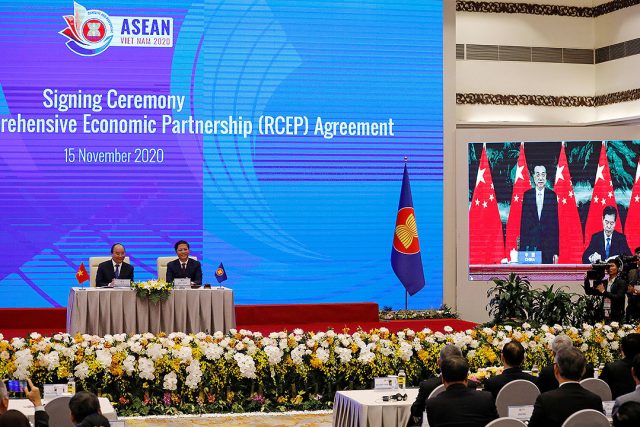
THE liberalization of trade resulting from participation in the Regional Comprehensive Economic Partnership (RCEP) is expected to affect only a limited number of agricultural commodities, the Department of Trade and Industry (DTI) said.

Trade Assistant Secretary Allan B. Gepty said in a statement on Thursday that the market opening RCEP calls for the additional liberalization of 33 tariff lines to four trade partners, with most other commodities already subject to other free trade agreements (FTAs).

“In RCEP, basically, the Philippines has only offered 33 agricultural tariff lines for further liberalization or improvement specifically for Australia, New Zealand, China, and South Korea… This is only equivalent to 1.9% of the total agricultural tariff lines. Out of these 33 agricultural tariff lines. Seventeen tariff lines are raw materials, 8 tariff lines are inputs, and only 8 tariff lines are final goods,” Mr. Gepty said.

The commodities opened up to more import competition include an offer to Australia and New Zealand of reduced tariffs for fish fillet products dried, salted or in brine but not smoked. The tariff on such products will fall to 0% after 15 years from the 5% stipulated in the ASEAN-Australia-New Zealand Free Trade Area (AANZFTA). Frozen mackerel tariffs will fall to 3% from 4% under AANZFTA. Celery tariffs will fall to 15% under RCEP from 16% in AANZFTA. Sausage tariffs will fall to 23% from 32%.

“We really ask the agricultural sector to look at RCEP as a platform of more and bigger opportunities ranging from improved market access in the RCEP region, cheaper access to raw materials, wider cumulation area, trade facilitative measures, and even investments in smart agriculture and research and development,” he added.

Mr. Gepty said trade remedies are available in the form of an RCEP transitional safeguard, on top of the mechanisms available via the World Trade Organization (WTO).

“There may be cases wherein commitments made in the RCEP Agreement need to be adjusted or addressed due to exceptional circumstances that affect our economy and industries, as well as our farmers. For this reason, the RCEP agreement provides various mechanisms that serve as safety nets to address these circumstances. These are on top of the available remedies under the WTO agreements,” Mr. Gepty said.  

RCEP, which started taking effect on Jan. 1, involves Australia, China, Japan, South Korea, New Zealand and the 10 members of the ASEAN.

The Philippines has yet to enter RCEP as the Senate was unable to ratify the agreement before adjourning on Feb. 3. President Rodrigo R. Duterte signed the trade agreement on Sept. 2. — Revin Mikhael D. Ochave  

New shopping habits seen roiling FMCG industry

PHOTO BY BERNARD HERMANT

THE fast-moving consumer goods (FMCG) industry needs to consider how the pandemic has transformed shopping habits, according to data and consulting firm Kantar.

Kantar Philippines Worldpanel Expert Solutions Director Ledz Lim said in a virtual briefing on Thursday that FMCG companies need to adapt to the new consumer emphasis on value for money, e-commerce and sustainability. Return to school goods are also a focus area because of the lifting of restrictions on face-to-faces classes, while the industry must also adapt their channel strategy to the way mobility restrictions trained consumers for two years to patronize sellers within their immediate vicinity.

“With the return to neighborhood stalls (sari-sari stores), brands that can get themselves into the limited shelf space will be the ones who stand to gain the most,” Kantar Shopper and Consumer Insight Director Laurice Padlan-Obana said.

Kantar also noted that e-commerce will continue to grow, particularly as an avenue for selling personal care products.

“With only 8% of Filipino homes shopping online, there is a huge opportunity for brands to leverage this platform. However, the e-Commerce category will truly take off when shoppers turn to online channels to purchase their food and beverage needs,” Ms. Obana said.

According to Kantar, consumers will continue to switch to brands that offer greater value.

“With more than half of the 156 categories monitored by Kantar raising their prices by more than 5% in the last two years, shoppers will continue to switch to brands that offer them greater value. This search for such products that offer their money’s worth, especially among the lower socioeconomic classes, will continue and brands that are able to address this need can join the ranks of other growing and fast rising value brands,” Kantar said.

Kantar said the return to face-to-face classes will also boost FMCG categories that saw little action during the virtual classes era.

“This (categories) include those that will keep children safe and fresh (sanitizers, baby powder and colognes), while also ensuring that they have nutritious lunchboxes and are properly hydrated while in school. Moreover, households may see an increase in demand for laundry detergents with more instances of children changing outfits,” Kantar said.

“82% of shoppers said they are personally affected by environmental problems, while 68% admitted to not buying certain products which they feel greatly impact the environment and society. Moreover, Filipino shoppers believe that various stakeholders, including FMCG companies, (should play a) bigger role in taking action and pursuing a more sustainable path,” Ms. Lim said.  

Lourdes Deocareza-Lozano, Kantar Philippines Worldpanel Division new business director, said  shopping frequency is expected to rise in the coming months following the easing of mobility restrictions.

According to Ms. Deocareza-Lozano, overall FMCG spending during the last two years dropped 11%. The D income class posted the sharpest decline in spending of 12%, followed by the E category with 11%, C2 9%, and ABC1 2%. — Revin Mikhael D. Ochave

Gov’t, private sector urged to implement immediate energy conservation measures

THE problem of thinning power reserves must be addressed by both the government and private sector with the immediate adoption of energy conservation measures to ensure a problem-free election on May 9, the Management Association of the Philippines (MAP) said Thursday. 

In a statement responding to forecasts of thin power reserves over the next 30 days, MAP called for the adoption of energy efficiency practices at the household, office, or business level, while urging government agencies to implement conservation measures for air-conditioner use. It also recommended the use of compact fluorescent lamps (CFLs) for lighting, and coconut methyl ester-blended diesel fuel for vehicle operations.

It urged energy stakeholders, specifically distribution utilities, electric cooperatives, the National Grid Corp. of the Philippines (NGCP), and the Energy Regulatory Commission (ERC), to roll out measures like the Interruptible Load Program (ILP), especially in areas with increased power demand.

The ILP allows major users with their own generation facilities to opt out of using grid power to help the system service elevated demand.

In March, the Manila Electric Co. (Meralco) urged more eligible companies to sign up for its ILP.

Meralco currently has 122 companies registered for its ILP, with a total committed de-loading capacity of approximately 560 megawatts (MW).

MAP urged the NGCP to contract more reserve power and accelerate the connection of power plants not yet linked to the grid. It also asked the ERC to suspend the Secondary Price Cap (SPC) at the Wholesale Electricity Spot Market (WESM).

“The government should treat the protection and sustainability of the country’s energy infrastructure as a national security concern and thus increase the (focus) on longer-term development,” it said, citing the need for an energy transition plan configured for climate equity and energy security.  — Ram Christian S. Agustin

Online platform targets more collaboration among innovators

THE NATIONAL Innovation Council (NIC) said its new online platform hopes to improve collaboration among innovators and investors by encouraging more networking within the innovation ecosystem.

Carlos Bernardo O. Abad Santos, National Economic and Development Authority (NEDA) assistant secretary, said during the virtual celebration of the National Innovation Day on Thursday that the online platform, called Filipinnovators that the system “will allow innovators and investors to expand their network, upgrade their knowledge and skills, learn from field experts, and collaborate for more innovative solutions. It serves as a knowledge recognition and co-creation portal and it also aims to be a venue for innovation policies and trends.”

Mr. Abad Santos said the online platform has a landing page on the NIC website, a profile creation page for innovators, a forum for exchange of ideas, and a section on training available to participants.

The NIC is a policy advisory body comprising 25 members from the public and private sectors. It is chaired by the President of the Philippines while the NEDA Secretary serves as the vice-chair.

In February, NEDA announced that the NIC is drafting the National Innovation Agenda and Strategy Document which include a 10-year plan and outline strategies for achieving innovation goals. — Revin Mikhael D. Ochave

ADVERTISEMENT
ADVERTISEMENT