Home Blog Page 6471

Duterte stops e-sabong operations


REUTERS
Roosters are seen during a cockfight bout in Manila, Jan. 24, 2009. — REUTERS

By Kyle Aristophere T. Atienza, Reporter

PRESIDENT Rodrigo R. Duterte said on Monday he will order the termination of online cockfighting operations in the Philippines, after earlier flaunting the hundreds of millions of pesos in government revenues generated from these games.

At the Cabinet meeting televised on Tuesday morning, Mr. Duterte said his order was based on the recommendation of Interior Secretary Eduardo M. Año, who was tasked to do a survey on the social costs of online cockfighting, also known as “e-sabong.”

“The recommendation of Secretary Año is to do away with e-sabong and he cited the validation report coming from all sources,” he said. “So it’s his recommendation and I agree with it, it’s good, so e-sabong will end.”

Mr. Duterte’s sudden decision to stop online cockfighting operations might force operators and their workers to go underground, according to policy analysts.

Stopping e-sabong operations abruptly without providing a clear strategic roadmap for affected sectors would likely force small-time operators and their workers to operate illegally, said John Paolo R. Rivera, an economist at the Asian Institute of Management.

“Just like the other gambling operations suspended, this latest decision might temporarily fail to totally disenfranchise operations,” he said in a Viber message.

“Other operators may continue operating underground…The unintended consequences of this sudden decision would kick in.”

Jefferson A. Arapoc, an economist at the University of the Philippines (UP) Los Baños, said underground e-sabong operations are expected to flourish as the government has shown it is unable to regulate online activities such as scams and sex trafficking.

“The Duterte administration’s order to stop e-sabong operations would depend on the government’s capability to implement it,” he said. “His decision could have done more damage than good — imagine the government losing revenues while e-sabong continues to thrive in the underground economy.”

Mr. Duterte previously refused to suspend e-sabong because of the revenues it generates for the government, which saw its budget deficit widen during the pandemic.

The Philippine Amusement and Gaming Corp. (PAGCOR) earlier estimated revenues from online cockfighting averaged P400 million monthly last year and P640 million a month since January 2022.

Mr. Duterte acknowledged that the government’s previous stand was only based on e-sabong’s economic benefits. 

“It’s working against our values,” he said of the game. “The impact on families and on people, it turns out players are not sleeping for 24 hours.”

E-sabong gained popularity during the pandemic, as Filipino gamblers only needed to place bets using their mobile phones. However, the disappearance of at least 30 people allegedly linked to online cockfighting sparked a Senate investigation and prompted calls for its suspension.

Sought for comment, PAGCOR Chair Andrea D. Domingo said via text message that the regulator has to implement the President’s decision.

“We are duty bound to follow whatever is the decision of the President on e-sabong, which I am sure is always guided for the people in general,” PAGCOR President and Chief Operating Officer Alfredo C. Lim said via Viber.

Mr. Duterte gave Mr. Año until Tuesday (May 3) to finalize the order to terminate e-sabong operations. As of 5 p.m. yesterday, Malacañang had yet to release the order.

“Providing no certainty as to the exact date of the closure is unhelpful,” said Michael Henry Ll. Yusingco, a fellow at the Ateneo de Manila University Policy Center. “This date should have been settled before the announcement was even made.”

Mr. Yusingco said Mr. Duterte’s decision might push Congress to evaluate the domestic gaming industry and make it more responsive to emerging security and social threats.

“The broader context, the responsibility of re-examining the gaming industry falls on Congress,” he said in a Messenger chat. 

“Establishing a legal framework that is responsive to the times is the job of our legislators… So the future of this revenue-generating activity, and similar activities as well, is in the hands of our lawmakers.”

Congress has been urged to pass a law regulating online cockfighting. PAGCOR previously issued licenses to several e-sabong operators.

Mr. Yusingco said lawmakers should ensure “public safety and the general welfare are protected in the gaming industry now that we are on the path of digitalization.”

“E-sabong is only one activity, it should be examined among many others in a holistic way, including all forms of gambling,” said Edna Estifania A. Co, a professor and former dean of the UP National College of Public Administration and Governance.

“The government should rationalize its decisions by weighing the positive and negative aspects in terms of management. Financial gains, regulatory framework, and social impacts,” she added.

Senators welcomed Mr. Dutere’s latest decision.

“The suspension of e-sabong operations in the country, while delayed, will pave the way for families to recover from their financial losses,” Senate President Vicente C. Sotto III said.

Senator Ronald M. dela Rosa, who previously pushed the President to suspend e-sabong, said there is no time for Congress to act on a bill that would transfer the authority to issue permits for e-sabong operators from PAGCOR to Congress.

“(This) would mean demise of the e-sabong industry unless the next administration would decide to resurrect it,” he said.

Senator Francis N. Pangilinan, meanwhile, said the debates on e-sabong should be left to the next Congress to give lawmakers more time to assess the popular online game. — with inputs from Tobias Jared Tomas


Next president needs to build on Duterte’s reforms — economist

PHILIPPINE STAR/KRIZ JOHN ROZALES
A person holds a ballot as he participates in the local absentee voting, April 27. — PHILIPPINE STAR/ KRIZ JOHN ROZALES

THE COUNTRY’S next president will need to build on the economic reforms started by the Duterte administration in order to sustain recovery from the pandemic, according to think tank GlobalSource Partners.

In a May 2 note titled “Is it game over?,” GlobalSource Partners Philippine country analyst Romeo L. Bernardo said former Senator Ferdinand “Bongbong” R. Marcos, Jr. continued to enjoy a wide lead in the latest Pulse Asia survey. The same survey showed Vice-President Maria Leonor “Leni” G. Robredo was a distant second despite large crowds at her recent campaign rallies.

“For the economy to return to sustaining the 6-7% pre-pandemic growth rates, the next administration needs to build on the economic reforms of the Duterte government to attract private capital, whether in infrastructure or elsewhere,” he said.

“Mr. Marcos, if he does win next week’s vote, will need to quickly assure markets that he has a well-thought-out, cohesive plan. And just as important, an economic team that can competently implement it.”

The Philippine economy grew by 5.7% in 2021, a turnaround from the record 9.6% contraction in 2020. The government is targeting 7-9% gross domestic product (GDP) growth this year.

While there appears to be no wild swings in price and flows in the financial markets that indicate apprehension about a Marcos win, Mr. Bernardo said “it is not clear that this has not already been fully priced in as a Marcos 2.0 has been looming for months now.”

Mr. Bernardo identified some risks from a possible Marcos win at the May 9 polls, such as the former senator’s lack of a clear economic plan for the country.

“To date, Mr. Marcos has yet to present a coherent economic program. His refusal to participate in debates, notwithstanding one-on-one challengers from other contenders, has left observers guessing whether it is safe to bet policy continuity under the new administration,” he said, adding some do not expect any drastic changes under a Marcos presidency.

If he wins a “high majority” in the elections, Mr. Bernardo said Mr. Marcos may be encouraged to pursue “fiscally unsound measures” such as price stabilization measures for rice and oil.

Mr. Marcos Jr. earlier promised to bring down the prices of rice by P20-30 per kilogram should he win.

Another risk is Mr. Marcos’s plan to continue the Duterte administration’s aggressive infrastructure program.

“While the Duterte administration inherited substantial fiscal space from its predecessor, Mr. Marcos will not have that luxury, especially after considering continuing social supports needed for post-COVID recovery and managing the impact of high global commodity prices,” Mr. Bernardo said.

“As it is, players in the public infrastructure sector have told us that ongoing construction projects have little budget cover and the risk of contractors not getting paid on time is worrisome.”

The Philippines ended 2021 with P11.73 trillion in outstanding debt, pushing the GDP ratio to a 16-year high of 60.5%. This was higher than the 60% threshold considered manageable by multilateral lenders for developing economies.

The country also borrowed P1.3 trillion and received grants worth P2.7 billion to fund its pandemic response, including coronavirus vaccines.

Outstanding debt stood at a record P12.09 trillion at the end of February. — Tobias Jared Tomas

Bulk prices surge to over 10-year high

PHILIPPINE STAR/ RUSSELL A. PALMA
A man carries a sack of rice to a rice store in Divisoria, Manila, March 31. — PHILIPPINE STAR/ RUSSELL A. PALMA

By Bernadette Therese M. Gadon, Researcher

NATIONWIDE BULK PRICES of general goods rose to their highest level in more than a decade in February due to higher fuel costs caused by the Russia-Ukraine war, latest preliminary data from the Philippine Statistics Authority (PSA) showed.

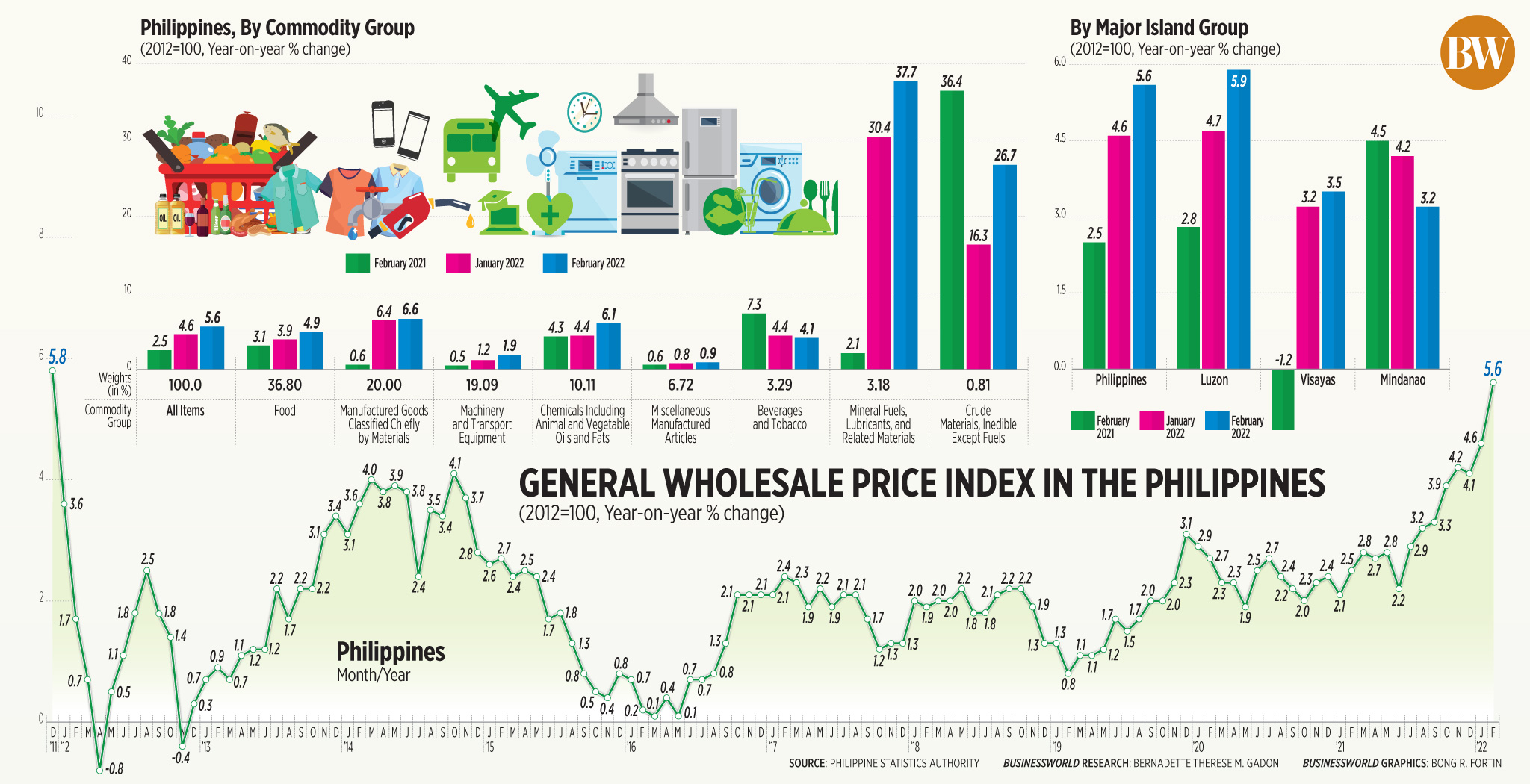
The country’s general wholesale price index (GWPI) jumped 5.6% in February, from 4.6% in January and 2.5% in February 2021.

This was the highest index reading in more than 10 years or since the 5.8% growth recorded in December 2011.

General Wholesale Price Index in the Philippines

Year to date, the national GWPI averaged 5.1%, faster than the 2.3% in the same period in 2021.

The GWPI is used to monitor the wholesale trade sector and serves as a basis for price adjustments in business contracts and projects.

University of Asia and the Pacific Senior Economist Cid L. Terosa said the surge in bulk prices in February was mainly due to the spike in global oil prices after Russia invaded Ukraine.

“Higher global fuel and commodity prices due to the Russia-Ukraine conflict pushed prices higher. In addition, prices of housing, electricity, and water added upward pressure on prices in February,” he said in an e-mail interview.

Global crude oil prices soared above the $100-per-barrel mark after Russia began its invasion of Ukraine on Feb. 24. Concerns over global supply contributed to the volatility in oil prices since Russia is the world’s second-largest producer of crude oil.

Nearly all eight commodity groups monitored by the agency posted growth on an annual basis in February. Only beverages and tobacco saw slower growth at 4.1% from 7.3% in February 2021, and eased from 4.4% in January.

The heavily weighted food index, which contributed 36.8% in the theoretical wholesale basket of goods, went up by 4.9% year on year in February from 3.9% the previous month.

Manufactured goods classified chiefly by materials likewise increased by 6.6% in February from 6.4% the previous month. This group accounted for a fifth of the wholesale market basket under 2012 prices.

Mineral fuels, lubricants, and related materials surged by 37.7% in February, higher than 30.4% the previous month and 2.1% in February last year. This commodity group accounted for 3.2% of the market basket.

Crude materials, inedible except fuels, which made up 0.8% of the wholesale basket, also jumped by 26.7% from 16.3% in January.

By island group, Luzon outpaced the national level’s GWPI with 5.9% in February. This was faster than the 4.7% print in January, and the 2.8% in February 2021.

Luzon had the quickest growth in over a decade or since the 6.6% print in December 2011.

The GWPI in the Visayas also inched up to 3.5% from January’s 3.2%. It was a turnaround from the 1.2% contraction recorded in February last year. This matched the print logged in October 2011 and was also the quickest pace in more than 10 years or since the 4.2% growth in September 2011.

Meanwhile, Mindanao’s GWPI reading in February slowed to a 13-month low of 3.2% from 4.2% in January and 4.5% a year ago. This was Mindanao’s lowest GWPI reading since the 2.8% growth in January last year.

For the year, Mr. Terosa expects bulk prices to continue to climb based on the continued rise in commodity prices here and abroad.

“The GWPI will continue to climb in March and even in April, the confluence of global (persistence of the Russia-Ukraine war and the continued rise of global food and commodity prices) and domestic events (domestic transmission of increases in global food and commodity prices as well as brisk election-related activities) will keep prices above levels achieved last year and last February 2022,” Mr. Terosa said.

YouTube, TikTok replace consultation: Students self-diagnose their mental health

UNSPLASH

By Brontë H. Lacsamana, Reporter

FILIPINO university students are “overwhelmed with responsibilities” and have little to no time for self-care and a social life, leading many to self-diagnose their mental health instead of seeking professional help, according to study by the University of Santo Tomas (UST).

Conducted from 2021 to 2022, the study funded by the Department of Science and Technology surveyed over 200 students with anxiety and depression from six universities in Manila, Palawan, Benguet, Leyte, South Cotabato, and Albay.

Of the UST respondents, 20% performed self-diagnosis. Of those from Mindanao State University – Iligan Institute of Technology (MSU-IIT), 71.4% self-diagnosed.

“There are some ways they get to the point of, ‘maybe there’s something wrong with me,’” said Maria Carinnes P. Alejandria, project leader and UST associate professor, at an April 28 virtual summit that presented the results of the study.

These methods include taking a psychology class on mental health, conversing and consulting with peers, reading online articles and watching YouTube videos on their problems, and observing their own behavioral and emotional changes.

Jean S. Taypa, assistant professor at MSU-IIT, shared that one participant became aware of her condition through mental health professionals disseminating information on short-form video platform TikTok.

“Although they are self-diagnosed, the participants themselves notice the symptoms. … Despite the awareness of mental health services, students chose not to access help,” she said. Reasons cited for not doing so include long processes, the expensive cost of services, a lack of family support, and social stigma.

The study also found that the top external factors affecting the youth’s mental health are disasters (such as the coronavirus pandemic), family, peers, history of trauma and abuse, and academic pressure.

According to Ms. Alejandria, the delivery of mental health services can be improved by funding at the national and institutional level for mental health programs, and hiring of more psych personnel.

UNFILLED GAPS
The clamor for emergency sessions and consultations was so high when the pandemic started that clinics and services in the country were flooded by these requests, according to speakers at the summit.

“Now, we’re still plagued by the same problems: Where do we get support? How can we afford it? Are we getting the right kind that we need?” said Jun Angelo M. Sunglao, a psychologist from the London School of Hygiene and Tropical Medicine.

“There are still unfilled gaps,” he added, citing that the National Center for Mental Health struggled with nearly double the distress calls in 2020 than they did in 2019.

Filipino workers are also overwhelmed by multiple mental health challenges, with a 2021 study by mental health firm MindNation showing that 53% of Filipino workers suffered mentally during the global health crisis.

The survey pointed out top external factors affecting the workforce that were similar to that of the students — the coronavirus pandemic, family matters, personal problems, and pressure (but this time from work and financial matters).

Stigma against even having these mental health challenges was also found to play a part in workers’ low focus, motivation, productivity, and self-confidence.

MENTAL HEALTH MAP
Philippine-based health and wellness clinic LifeScience Center launched in February a genetic test called the Genomind Mental Health Map.

Leslie K. Lim-Carlos, a psychotherapist at LifeScience Center, said that Filipinos can use genetics to proactively understand “what we have no control over, while the rest is modifiable and changeable based on actions and habits.”

The service, which costs P23,600, starts off with an appointment for a registered medical technologist to collect one’s cheek swab. After this, the specimen is sent to the Genomind laboratory in Pennsylvania, USA, where the test originated.

Analysis takes two to three weeks and yields results for seven core genetic health capabilities — stress and anxiety, mood, focus and memory, sleep, eating behavior, habits and substance abuse, and social behavior. The client can access the report online to view these.

For instance, those who test as predisposed to heightened stress and/or decreased working memory can get insights on brain derived neurotrophic factor (BDNF), a protein that helps produce neurons and their healthy connections to the brain’s fear center.

Based on this result, the website then recommends eating more food with omega-3 fatty acids to boost BDNF and box breathing exercises to calm the system. It also links to a self-reported questionnaire by Mental Health America that screens for generalized anxiety disorder — for people to track symptoms over time.

On top of receiving a health map, those who want their results and recommendations explained to them can book a 30-minute consultation with an expert.

“Factors like genetics, environment, lifestyle, are all cumulative in one’s mental health journey,” said Dr. Harris Nguyen, a Genomind pharmaceutical expert in a video call with BusinessWorld.

Like the free mental health assessment offered by Break Your Stigma, the LifeScience test is open to those already diagnosed with mental health conditions and those who don’t have any history but want to understand themselves better.

What sets it apart is the deep dive into how various factors come together plus personalized, evidence-based recommendations that a consultation then interprets.

PRACTICAL TIPS
Meanwhile, the Benilde Well-Being Center (BWC) of the De La Salle-College of Saint Benilde, with Northeast Ohio Medical University psychiatry professor Dr. Dimitrios Tsatiris, released in March five questions that can help anxious minds identify “unease-provoking” thought patterns and seek calm:

1. Why am I anxious? This is for identifying the cause or source of one’s worries. Enumerating all doubts and prioritizing them can establish a sense of control.

2. What are the odds that my fear will become a reality? By estimating the probability of one’s worries turning real, these sources of anxiety become less impending.

3. What can I do to lower the chances? The anxious can further ease their minds and take charge by considering reasonable steps to lower these worries becoming real.

4. Even if the worst-case scenario were to occur, can I handle it? In unavoidable situations, people can recall and reflect on times that they overcame worst-case scenarios before, as guidance for present and future challenges.

5. What is the cost of anxiety? Rather than fixate on what can go wrong, thinking of one’s personal growth can help with reaching full potential as a result of the situation.

Bird flu puts organic chickens into lockdown from Pennsylvania to France

US DEPARTMENT OF AGRICULTURE/CC BY 2.0/WIKIMEDIA COMMONS

CHICAGO/PARIS — Organic and free-range chickens have been thrown into lockdown.

Egg-laying hens that normally have access to the outdoors can no longer roam as freely or feel the sun on their beaks as some US and European farmers temporarily keep flocks inside during lethal outbreaks of bird flu, according to egg producers and industry representatives.

The switch comes as a surprise to shoppers already shelling out more money for eggs due to cullings of infected flocks. Consumers pay extra for specialty eggs, thinking they come from hens that can venture out of barns.

US watchdogs say retailers and egg companies must do a better job informing customers that hens are kept inside, as shoppers track their spending amid record global food inflation. Keeping birds inside is safest for now, according to government officials, because a single case of bird flu results in entire flocks being culled. The virus can also infect humans, though experts say the risk is low.

In France, where the government has temporarily required farmers to keep chickens indoors since November, some retailers are defying obligations to post clear information for consumers about the mandate, according to checks of grocery stores by Reuters.

“I didn’t know that they had to stay inside,” said Josephine Barit, 34, a shopper at a small Paris store that had no indications hens may have been confined.

“So it’s not really ‘free range’ anymore?” she said. “I suppose there is no other choice because of bird flu, but they could say so.”

Allowing chickens time outside is thought to be more humane, giving consumers some peace of mind about buying animal farm products.

Veterinarians say poultry with outdoor access are particularly vulnerable to becoming infected with bird flu, officially known as highly pathogenic avian influenza (HPAI), because migratory birds spread the disease. Poultry can fall ill from contact with infected wild birds, their feathers or feces.

The US Department of Agriculture recommends farmers keep poultry indoors “as long as the HPAI outbreak is ongoing,” but has not required confinement.

DISSATISFIED CUSTOMERS
The US outbreak is the second-worst in history, with more than 35 million birds wiped out this year. France has culled nearly 16 million birds in its worst outbreak ever, while infections have also hit nations including Britain, Italy, and Spain.

European requirements to confine chickens have left some consumers dissatisfied even when retailers post signs notifying customers of the change.

“At the end of the day you still pay the price of ‘free range’ or organic eggs when the fowls have actually never seen the sky,” said Marc Dossem, 52, a shopper who spoke in a large supermarket in Paris.

EU and British marketing standards allow for free-range laying hens to be kept inside for up to 16 weeks before companies must issue advisories to customers.

Britain temporarily required eggs from “free-range” hens kept indoors to be labeled “barn eggs,” but has allowed farmers to let hens outside again starting in May.

In Spain, hens must be kept indoors in special risk and surveillance areas of the country, said Mar Fernández, Spanish head of the Interprofessional Organization of Eggs and Egg Products. They have not yet been indoors for more than 16 weeks, she said.

“There are countries that no longer have eggs from free-range hens available for months,” Ms. Fernández said.

US authorities do not require organic egg producers to update labels when unexpected events like bird flu change production practices, the agriculture department said. Eggs labeled “organic” as well as “free range” must come from hens with access to the outdoors in the United States.

MISSING THE SUNSHINE
Among the suppliers now prohibiting outdoor access is Pete and Gerry’s, which says it is the leading US producer of organic, free-range and pasture-raised eggs. The business sells eggs in stores owned by Kroger Co. and Amazon.com, Inc.’s Whole Foods Market.

“We will be constantly evaluating the exposure risk and will have them back outside in the sunshine as soon as possible,” Pete and Gerry’s said.

Vital Farms, Inc., another US producer of pasture-raised eggs, said it confined hens after outbreaks in Europe. Both producers have information online about the switch, but their “free-range” and “pasture raised” labels remain the same.

Whole Foods, Kroger and Target Corp. did not respond to questions about whether they would post notices for shoppers.

“Consumers should get what they pay for and they’re not getting the product as advertised,” said Danielle Melgar, a food advocate for the US Public Interest Research Group.

Some European producers are resisting orders to confine poultry, despite the risks.

“Laying hens can be quite aggressive so we let them out a little bit every day or they will kill each other,” said Emilie Ravalli, who runs an organic farm in Corcoue-sur-Logne in western France.

But barns can be comfortable, and chickens do not always go outside each day even when they are able to, said Gregory Martin, a poultry scientist at Pennsylvania State University.

“Confinement gives us safety,” Mr. Martin said. “Only live birds produce eggs, so it’s to our advantage to keep our birds safe.” — Reuters

Get boosted against COVID, doctors say

A woman gets a booster shot at an elementary school in Marikina City, Nov. 25, 2021. — PHILIPPINE STAR/ MICHAEL VARCAS

WHILE the government began rolling out the second booster against coronavirus disease 2019 (COVID-19) this April, only about a fifth of fully vaccinated Filipinos have had their first booster, prompting doctors to remind the public that a third dose is needed to maintain protection.

A booster dose, regardless of the brand, restores protection against serious COVID-19 outcomes, according to a review of 79 real-world studies on VIEW-hub, an interactive platform for data visualization on vaccine use and impact by the Johns Hopkins Bloomberg School of Public Health and IVAC (International Vaccine Access Center).

Conducted by 18 Southeast Asian infectious disease experts, the review posted April 25 included outcomes for both mRNA vaccines and the AstraZeneca vaccine.

“We live in an Omicron world, and two doses is not optimal protection against [the coronavirus variant],” said Dr. Bruce Mungall, Asia area medical director of vaccines and infectious diseases at AstraZeneca, during an April 27 event organized by the multinational pharmaceutical company and the Philippine College of Physicians (PCP).

“A booster dose is important for protection against Omicron,” he added.

As of May 1, only 19.8% of fully vaccinated Filipinos (or 13,487,275 of 67,911,471) have had their first booster.

RESTORED PROTECTION
Data from the UK shows that vaccine-induced protection against symptomatic COVID-19 infection wanes over time, Dr. Mungall said.

“For [the] Delta [variant], there is a sustained effectiveness over time — but effectiveness against Omicron drops 30% after six months of the second dose,” he added.

The same UK data shows that when individuals are given either an AstraZeneca or Pfizer primary series plus an mRNA booster, there is an immediate restoration of protection (in the 80%–90% effectiveness range) against hospitalization.

Dr. Mungall said another study had similar results: “If AstraZeneca is given as a booster, the effectiveness against overall infection goes up about 60%.”

Data from the review will help take the Philippines into the endemic phase of COVID-19, according to Dr. Ma. Encarnita C. Blanco-Limpin, PCP president.

“Anyone vaccinated with either the viral vector or mRNA vaccines can be assured that they will be highly protected from death or hospitalization due to the virus,” she said.

“The most important part of this expert review is that we can’t rely on measuring antibodies as a measure of [a vaccine’s] effectiveness against complications,” added Dr. Rontgene M. Solante, a vaccine expert with the Department of Health and one of the authors of the Southeast Asia review.

Antibodies for the virus that causes COVID-19 are expected to wane over time.   

“Even with waning antibodies, the [vaccine’s] protection is still there against severe COVID-19 and severe hospitalizations,” Dr. Solante said. “That’s why we discourage people from taking antibody tests. What’s more important is that you are protected against severe forms of complications.” — Patricia B. Mirasol

MREIT earnings up 18% on new acquisitions

MREIT.COM.PH

MREIT, Inc., the real estate investment trust company of Megaworld Corp., announced on Tuesday that its distributable income in the first three months of the year increased by 18% to P639 million quarter on quarter, driven by recent acquisitions.

“Our solid performance in the first quarter of 2022 affirms our efforts to sustain MREIT’s growth via a combination of organic and inorganic means. The combination of rent escalation, steady occupancy, and implementation of our acquisition plans puts us on track to deliver on our targeted returns for our shareholders in 2022,” MREIT President and Chief Executive Kevin L. Tan said in a statement.

Meanwhile, the company’s net income registered at P687.2 million with revenues at P901.6 million. It did not give comparative numbers.

Last December, MREIT completed the acquisition of four properties worth P9.1 billion, expanding its portfolio’s gross leasable area (GLA) by 25% to 280,000 square meters (sq.m.) from 224,000 sq.m. during its initial public offering in September last year.

As of end-March 2022, the company’s portfolio value stood at P59.3 billion, with an occupancy rate averaging at 96%.

MREIT also announced its plan to acquire additional four prime properties worth P5.3 billion.

“The acquisition will be undertaken via a property-for-share swap and is subject to the approval of the Securities and Exchange Commission,” the company said.

Once completed, the acquisition will expand its portfolio GLA by 16% to 325,000 sq.m.

“We hope to complete the acquisition within the month of May. We look forward to the completion of this deal as it will further cement MREIT’s presence in the Fort Bonifacio area, which continues to command one of the highest rental rates in the Philippines today,” Mr. Tan said.

Last week, the real investment trust declared dividends amounting to P0.243 per share to its shareholders based on its income for the first quarter of 2022.

The company aims to declare dividends amounting to P1.00 per share for 2022, or 6% higher than originally contemplated in the company’s REIT plan.

“This target does not yet consider the upside impact of the acquisitions that MREIT is contemplating this year,” it added.

The company’s principal investment strategy is to invest in income-generating real estate.

“To meet the investment criteria, a potential new property should be located in a prime location in either Metro Manila or key provinces in the Philippines; be primarily (but not exclusively) focused on Grade A office and retail properties; and have stable occupancy, tenancy, and income operations,” it said.

At the stock exchange on Monday, MREIT shares were unchanged at P17.50 apiece. — Luisa Maria Jacinta C. Jocson

Sounds made visible

PHOTO BY ANDREA D’ALTOE

The Philippine Pavilion at the Venice Biennale combines the modern with the traditional

VISUAL artist Gerardo Tan visited a weaving house in Miag-ao, Iloilo in 2016. While there, he was captivated by the sounds of the pedal looms as the weavers were working. To him, the activity sounded like music. This experience made him wonder how it would be like if the looms’ sounds were read. So over the next six years, he worked on the project that has now become the Philippine Pavilion’s installation for the 59th International Art Exhibition at the Venice Biennale.

Established in 1895, the Venice Art Biennale is the oldest and arguably most prestigious international art exhibition. It is held every two years in the Castelo District of Venice in Italy.

The Philippines first participated in the Venice art fair in 1964 with an exhibition of paintings and sculptures by National Artists for Visual Arts José Joya and Napoleón Abueva.

It took another 50 years before the Philippines returned to Venice.

This year’s Philippine Pavilion at the Arsenale features the collaborative project titled Andi taku e sana, Amung taku di sana (All of us present, This is our gathering) by Mr. Tan, ethnomusicologist Felicidad A. Prudente, and Ifugao weaver Sammy N. Buhle. It is curated by Yael Buencamino Borromeo and Arvin Flores.

The exhibition is a convergence of traditional and contemporary art forms: textile weaving, painting, video and sound installation.

“…The exhibit aims to represent the translation of cultural data into visual communication, collectively promoting Philippine traditions and ensuring its endurance through universal exchange,” co-curators Buencamino Borromeo and Flores wrote in their curatorial statement.

CHANTS MEET VIDEO
Andi taku e sana, Amung taku di sana are the opening lines of a sogna, a chant performed extemporaneously in gatherings of the Madukayan people (a Kalinga ethnolinguistic community of the Philippines located in the northern Cordillera region). The chant is performed prior to a peaceful dialogue among the members of the community.

Performed by chanter Jose Pangsiw, the sogna was transcribed by Ms. Prudente and subsequently used by Mr. Tan for the work, Speaking in Tongues — a two-channel video installation featuring the translation of a traditional chant into a performative painting using squid ink as a medium.

The exhibit’s main installation, Renderings, shows the transmission of the sounds made by traditional weaving practices remediated in video and textile.

SOUNDS MAKE FABRIC
For the textiles in Renderings, Mr. Tan reached out to Ms. Prudente of the UP College of Music to assist with the notations of audio recordings taken in different weaving houses around the Philippines. For these to be translated into woven fabric, Mr. Tan and Ms. Prudente went to Ifugao and sought out Mr. Buhle upon the advice of Dr. Analyn Salvador-Amores, director of Museo Kordilyera in UP Baguio. Ms. Prudente’s notation provided a visual representation which was sketched by Mr. Tan, before Ifugao weaver Mr. Buhle, transformed these into woven fabric.

The resulting textiles do not use traditional weaving patterns, but are “woven sound transcriptions,” exhibition co-curator Ms. Buencamino Borromeo said in her speech at the Philippine Pavilion launch on April 21 which was streamed on Facebook.

Ms. Borromeo added that transcribing the rhythms of the looms into notations “required disciple and extensive experience in music transcription to accurately capture the timing of the looms’ movements.”

“The exhibition encourages one to be open to collaborative work because when you create new knowledge, you are able to produce something unique,” Ms. Prudente said.

Mr. Buhle, who comes from a family of traditional weavers said that he “needed to transform my way of technique” for the project.

“They collaborate with me on the patterns that I need to weave. They give me the final print of the layout,” Mr. Buhle said. “I will ask them to video the weaving process that I do until the fabric is finished.”

“A lot of my work has this self-referential aspect to them. It feeds back on itself. There’s a loop that’s being created. As a viewer, when you approach the work, you present it with different realities at the same time. There’s a dialogue between materials and processes,” Mr. Tan said.

VIRTUAL TOUR
The Philippine Pavilion in Venice is open for public viewing until Nov. 27. The Philippine Pavilion is also accessible to a global public through its digital programs and virtual tours.

The Philippine’s participation at the Venice Biennale is a collaborative effort of the National Commission for Culture and the Arts, the Department of Foreign Affairs, and the Office of Deputy Speaker and Congresswoman Loren Legarda.

The artists and curators are hopeful that an exhibit of the installations can be put up in the Philippines after the Venice Biennale.

For more details, visit philartsvenicebiennale.org, or Facebook and Instagram via @philartsvenice.  — Michelle Anne P. Soliman

COVID worsens asthma in children

THE following is a summary of some recent studies on coronavirus disease 2019 (COVID-19). They include research that warrants further study to corroborate the findings and that has yet to be certified by peer review.

ASTHMA IN CHILDREN
Asthma in children may worsen after an infection with the coronavirus, doctors warn.

They studied nearly 62,000 US children with asthma who had PCR tests for the virus in the first year of the pandemic, including more than 7,700 who tested positive. Infected children had significantly more asthma visits, hospitalizations, emergency inhaler use, and steroid treatments during the six months after their illness compared to children who tested negative and to their own prior history, researchers reported in the Journal of Allergy and Clinical Immunology: In Practice. Children who tested negative for the virus “had improved asthma control for the next six months, meaning fewer emergency department visits and hospitalizations for asthma, and less asthma treatment,” said Dr. Christine Chou of Children’s Health of Orange County, in California.

Results of earlier studies showing improvement in asthma control in the early part of the pandemic were likely due to public health measures like staying home and masking, which curbed exposure to asthma triggers, she said. Despite the overall impression that children with asthma did well during the first year of the pandemic, Chou added, the new study shows “longer lasting harm of COVID on children’s asthma control.”

BOOSTER AFTER INFECTION
Among people who were previously infected with the coronavirus, a third dose of an mRNA vaccine from Pfizer/BioNTech or Moderna may not boost their protection against the Omicron variant of the virus, according to new data.

Researchers studied nearly 130,000 people tested for COVID in Connecticut from November 2021 through January 2022, including 10,676 with Omicron infections. Roughly 6% to 8% had been infected with previous versions of the coronavirus, according to a report posted on medRxiv ahead of peer review.

Two doses of an mRNA vaccine did help protect against Omicron among people with prior infections, but “we did not detect an additional benefit of receiving a third booster dose among this population,” said Margaret Lind of Yale University.

A separate study from Canada, also posted on medRxiv ahead of peer review, similarly found that more than two vaccine doses “may be of marginal incremental value” for protecting previously-infected individuals against Omicron.

The message, Ms. Lind said, “should be that (1) people should get two doses of mRNA vaccine regardless of if they have had a prior infection or not, that (2) people without prior infections should get a booster dose and that (3) people with prior infections should consider a booster dose, especially if they are in a high risk group for life threatening complications, but recognize that it may not provide significant additional protection against infection above two doses.” — Reuters

Manila Mining plans P519-million stock rights offer  

MANILA Mining Corp. said it is eyeing a stock rights offering amounting to P519.2 million to fund its exploration program, administrative costs, and settle trade payables and accruals.

It plans to offer 51,917,357,740 common shares of the company, with a par value of P0.01 per share, consisting of 31,159,217,274 class A shares and 20,758,140,466 class B shares.

“The net proceeds from the offer, after costs and fees of about P11.75 million, will be used by the company to fund its exploration program, administration costs, and settle trade payables and accruals,” it said in its prospectus.

The offer period will run from May 16 to 20, with a listing date of June 20.

The company tapped Penta Capital & Investment Corp. as the underwriter.

“The offer shares shall be considered issued upon approval of Manila Mining’s application for increase of authorized capital stock with the Securities and Exchange Commission,” the company added.

According to its prospectus, the company is currently not in operation.

“It stopped its mining and milling operations on July 25, 2001 due to the expiration of the Temporary Authority to construct and operate Tailings Pond issued by the Environmental Management Bureau. Thereafter, activities have been limited to exploration and to securing the company’s assets,” it read.

Manila Mining was incorporated in 1949 to primarily engage in the mining and exploration of metals.

The firm had two mining lease contracts with the government located in Surigao del Norte and currently has three other mineral production sharing agreement applications covering locations in Surigao del Norte and Agusan del Norte.

It is an affiliate of Lepanto Consolidated Mining Co. and has one subsidiary, the Kalaya-an Copper-Gold Resources, Inc., which it owns 95% with Philex Mining Corp. owning the rest.

At the stock exchange on Monday, Manila Mining shares ended lower by 3% at P0.0097 apiece. — Luisa Maria Jacinta C. Jocson

Lenders oppose BSP’s proposed credit quota for innovation dev’t

BW FILE PHOTO
THE CENTRAL BANK wants to require lenders to allocate credit for the development of new technologies and innovations for various services. — BW FILE PHOTO

THE CENTRAL BANK’S proposal to impose a lending quota for the development of new technologies and innovations for various services will affect smaller lenders negatively as these do not match their market, according to the Rural Bankers Association of the Philippines (RBAP).

RBAP President Albert T. Concha, Jr. said they have filed a joint petition for declaratory relief with the Bankers Association of the Philippines and the Chamber of Thrift Banks regarding the proposed credit allocation.

“We highly contest this mandatory credit allocation for innovation and technology as there is hardly any, possibly none at all, borrower who would qualify for this category in the areas where RBs (rural banks) operate in,” Mr. Concha said in a Viber message.

“We find this [proposal] oppressive as stiff penalties will be imposed on RBs when in fact non-compliance is already beyond the rural banks’ control,” Mr. Concha said.

“While we recognize the need to support technology and innovation in our country, it should not be done at the expense of rural banks,” he added.

The Bangko Sentral ng Pilipinas (BSP) in March released a draft circular proposing that banks must allocate 4% of their loanable funds for innovation development credit.

Eligible loans that can be included as direct compliance under the proposal are those granted to qualified borrowers after Aug. 6, 2019. These borrowings should have been used to develop new technologies and innovations for products, processes, organization, and marketing.

Credit that can be counted as alternative compliance for innovative development will include loans to micro-, small-, and medium-sized enterprises that have businesses related to e-commerce and supply chain financing.

Banks’ investments in bonds for innovation and those related to food security, blue economy, education, health, clean and renewable energy, climate change, infrastructure, human capital development, digital economy and transportation will also count as alternative compliance.

Lastly, investments in equities of startups may also be counted as compliance, subject to limits set by the central bank.

The proposal showed the BSP is also looking to make innovative development lending serve as an alternative mode of compliance to the mandatory credit allocation for agriculture and agrarian reform.

Based on the proposal, banks will face penalties equivalent to 0.5% of the minimum compliance requirement if they fail to meet the credit quota.

The industry-wide net profit of rural banks reached P4.241 billion in 2021, rising by 64% from the P2.593 billion in 2020, based on BSP data.

Their cumulative assets increased by 10.6% to P287.03 billion from P259.521 billion a year earlier. — L.W.T. Noble

Russia’s Bolshoi drops shows by two directors who spoke out against war

A SCENE from the cancelled production of Nureyev. — PHOTO FROM BOLSHOIRUSSIA.COM

LONDON — Russia’s Bolshoi Theater has upset opera and ballet fans by abruptly cancelling a series of shows this week by directors who have spoken out against the war in Ukraine.

The theater gave no reason for dropping Timofey Kuliabin’s production of the opera Don Pasquale and Kirill Serebrennikov’s ballet Nureyev.

Mr. Kuliabin has used his Instagram account to express solidarity with Ukraine and ridicule Russia’s description of its actions there. In one post, he showed a mocked-up version of the cover of Leo Tolstoy’s War and Peace, replacing the first word of the title with “Special Operation” —  the term used by the Kremlin to describe the invasion.

Mr. Serebrennikov told France 24 in an interview last month that “it’s quite obvious that Russia started the war,” and that it was breaking his heart.

“It’s war, it’s killing people, it’s the worst thing (that) ever might happen with civilization, with mankind… It’s a humanitarian catastrophe, it’s rivers of blood,” he said.

Both directors are currently outside Russia.

The replacement of the two shows with The Barber of Seville and Spartacus, two longstanding staples of the Bolshoi’s repertoire, drew hundreds of mostly critical online comments from ticketholders. Many demanded in vain to know the reason.

“What disrespect to the spectators and artists!” one woman, Valeria, wrote on the Bolshoi’s Telegram channel.

There was particular outrage at the cancellation of Serebrennikov’s Nureyev, a controversial production that premiered at the Bolshoi in 2017. The story of dancer Rudolf Nureyev, who defected to the West in 1961, included a tender scene with his gay lover that tested the Kremlin’s tolerance for what it calls “homosexual propaganda.” —  Reuters

ADVERTISEMENT
ADVERTISEMENT