Home Blog Page 6397

Richer environment, support needed to grow Philippines’ next unicorns

By Adrian Paul B. Conoza, Special Features Assistant Editor

Given an innovative environment and more sources of support, the Philippine startup community has the potential to grow the next unicorns, or startups with a valuation of over $1 billion. This was stressed in the second part of the BusinessWorld Insights series on Philippine startups held recently.

Rene “Butch” Meily, president of IdeaSpace Foundation, Inc. and QBO Innovation Hub, expressed his optimism that the local startup space can soon have its next unicorns, albeit they are hard to find.

“If even a few of these companies turn into unicorns, it’s going to lift all boats. We’re all going to benefit. And that’s the great thing about the startup ecosystem: Somebody’s success is a success for everybody,” Mr. Meily said. “The more successes we have, the more investors will come in, [and more] young people will want to start their own companies, and the more companies are going to go public. It’s a virtuous cycle.”

Ideaspace Foundation runs founder-focused programs for early-stage tech startup founders solving emerging market issues. The foundation also has an Opportunity Fund which enables them to invest in early-stage startups.

The QBO Innovation Hub, meanwhile, provides support to startups across various sizes and development stage through programs like networking events, feedback & mentorship sessions, and an incubation program.

Mr. Meily also noted that the digitization of micro, small, and medium enterprises, which compose about 98% of the Philippine economy to date, can be an opportunity for startups to turn into unicorns.

“There are human resource platforms that are promising, but there are also startups which are helping businesses export products. There’s a number of these ideas and companies that are out there that have a lot of potential for growth,” Mr. Meily noted, adding that there are as well a number of businesses that look into digitizing sari-sari stores.

For Anna Irmina B. Navarrete, co-founder and president of Kickstart Ventures, Inc. (KVI), the pressure to become a unicorn must be removed among Philippine startups. “What we want to focus on is creating companies that are sustainable, that are scalable, that are massively successful,” she said.

Ms. Navarrete stressed that the Philippines can be a leader in the startup industry, as much as it has become in the business process outsourcing industry and in terms of companies that have expanded globally from a Philippine base.

“The Philippines has succeeded at creating and supporting industries and companies that solve real problems, created jobs, and served employees, customers, shareholders, and communities. I think we (startups) can do the same thing,” she said.

KVI launched in 2012 its first fund which focused on helping consumers and businesses adopt digital. Then, in 2015, it unveiled a bigger fund to make investments in telco, media, and associated technologies. More recently, in 2020, it introduced the Active Fund, which looks into technologies that support the future of data, work, home, and life.

While becoming a unicorn apparently takes much time and effort, progressing into a camel, or a startup that can survive a crisis without a sky-high valuation, can be the initial step for startups to take.

“Camels might be more practical, they’re easier to build, they are more resilient. Unicorns have this need to grow so fast, almost at all cost; while camels are more focused on profitability,” Mr. Meily said. “I think what you’re going to need in order to survive and be a successful company [is] to do well first, and that means making money… Unless you do that, you might not survive the ‘deserts’.”

Yet, for both camels and unicorns to thrive, cultivating an inclusive and innovative environment is seen to be necessary.

“Whether we talk about camels or unicorns, still we really need to focus on building the foundations and ensuring that we have a robust startup and innovation ecosystem,” Dr. Rafelita M. Aldaba, Undersecretary of the Department of Trade and Industry (DTI), said during the online forum.

She shared in detail the policies and initiatives that DTI has set in place together with other government agencies to further enhance the Philippine startup ecosystem.

The policy reforms include the Ease of Doing Business Act, Philippine Innovation Act, Innovative Startup Act, and the One Person Corporation, which is included in the Revised Corporation Code.

Moreover, Ms. Aldaba shared about the Startup Venture Fund, a P500-million fund being implemented by DTI and the National Development Company that aims to help startups develop their products, scale up, and expand.

The Undersecretary also mentioned DTI’s Regional Inclusive Innovation Centers (RIICs), which she said are intended to “connect our startups with large small and medium enterprises along with government, co-working spaces, accelerators, incubators, research and development labs, universities, and funders.”

To date, there are eight RIICs, with the first four established in Legazpi, Cebu, Cagayan De Oro, and Davao.

“With continuous government support and whole-of-nation thrust towards creating an innovative society, I also truly believe we’ll be able to have an environment where camels and unicorns can thrive and develop,” Ms. Aldaba said. “We also remain committed to fostering the development of the country’s startup ecosystem through the implementation of the Innovative Startup Act and the Philippine Innovation Act.”

Ms. Navarrete of KVI added that the Philippines already has in place many of the essential market characteristics for unicorns to thrive.

“We’ve got a young demographic, high mobile and broadband penetration, and an openness to try new things. Especially when you think about the last two years, we now have a new Filipino consumer who is much more digital, much more willing to test new things,” she explained.

KVI’s president also pointed out that freely sharing information is a key for startups to be successful that they can progress into unicorns. “When you look at big success stories globally, these have come because information, data, and science are respected,” she said. “Conversely, when you think of… startups [that] have had spectacular failures, [they have] come from disinformation, fraud, and abuses.”

Another aspect within the environment that should be improved further, for Mr. Meily, is entrepreneurship among Filipinos.

“There’s always been this tendency to play it safe… and we hear this time and again, ‘Okay ka na diyan, huwag ka nang umalis’ (‘Stay there, don’t go elsewhere’). I think we need to cultivate a new type of culture where it’s okay to take a chance, to fail, and to start again,” he said. “If we can get that entrepreneurial mindset that you don’t have to go abroad or work in a big company to be successful, you can start your own company and create wealth for yourself, your employees, and the country.”


Key findings, recommendations from Ecosystem Mapping Report for the country presented

Thirty-three key stakeholders converged on May 18 at Dusit Thani Manila and online to validate the ARISE Plus Philippines’ Ecosystem Mapping Report and to discuss the key recommendations and findings for strengthening Philippine entrepreneurship. ⁠— www.facebook.com/ARISEPlusPh

By Chelsey Keith P. Ignacio, Special Features Writer

Highlights from the International Trade Centre (ITC) Ecosystem Mapping Report for the Philippines were presented at the workshop on “Strengthening Philippine Entrepreneurship: Findings and Key Recommendations from the Ecosystem Mapping” held last May 18.

The Ecosystem Mapping Report provided a ‘bird’s-eye-view’ of the business supporting organizations operating in the country. It included insights into service overlapping and gaps in the offerings and recommendations formulated based on the findings for the institutions in the network.

The report, which has also been conducted in other countries, followed the ITC’s methodology. Its three pillars include service mapping and gaps analysis, network analysis, and user experience analysis.

ITC National Expert and Startup Village Founder Carlo Calimon went over the report’s first pillar. “There are many [ecosystem] players, whether it’s incubators, accelerators, investor groups, associations, and the like. And at the end of the day, their objective remains the same: to support the development of entrepreneurs in the country,” he shared.

He also explained the eight gaps identified regarding the service offerings, among which concern government support and leadership for the ecosystem, limited access to funding (especially for the idea to the startup stage), and lack of focus on areas outside Metro Manila.

One of the identified overlaps is duplication of programs, with majority of the support focused on the idea to the early- stage entrepreneurs. Another overlap is high competition as organizations compete for limited resources like funding and the startups themselves because of comparable service offerings.

“In the Philippines, what we’ve seen compared to other ecosystems that ITC has mapped is there’s an abundance of actors in the ecosystem,” Claire Sterngold, Ye! community manager at ITC, noted. “However… while you have a lot of actors in the ecosystem, we’re still exhibiting more of a hub and spoke model where we have a number of actors with a high degree centrality, where they have high numbers of connections coming into them. But then, the bridging capacity, the betweenness centrality, between factors that are connected to the key node is not quite there. And that’s where the network analysis can provide guidance and insights into how these networks can be strengthened.”

Key insights presented from the report’s network analysis are that connections are concentrated in Manila; the potential growth through differentiating connections; setting up a country guide that could provide information to entrepreneurs; and expanding the support beyond the technology sector.

Furthermore, despite various support available, one of the six key findings from the report’s user experience analysis is that entrepreneurs do not know where to go for support. “So it’s not about a lack of presence or support programs; it’s about a lack of awareness of said programs,” said Chino Atilano, an ITC national expert and TimeFree Innovation founder.

Credibility is another challenge for young entrepreneurs. “It hinders them from doing business with different corporations, potential customers and potential partners, just because of their age and most especially if they’re also female,” Mr. Atilano shared.

Nine recommendations are presented in the report to help strengthen the country’s support ecosystem for startups, especially for the youth and women-led.

The Ecosystem Mapping Report will be published on the website of the Department of Trade and Industry (DTI) by the end of the month.

“The report is a welcome addition to our continuing effort to better understand the Philippine entrepreneurship ecosystem and work together to further foster innovation and collaboration between and among government agencies at both the national and local levels, the stakeholders from industry, startups, MSMEs, youth and women entrepreneurs, academe, and other sectors,” DTI Undersecretary Dr. Rafaelita M. Aldaba said.

Aside from the introduction of the mapping report, the workshop also included a panel discussion and breakout discussions. It is organized together with the DTI under the ARISE Plus Philippines, a European Union-funded project that seeks to cultivate inclusive economic growth in the country through improved international trade performance and competitiveness as well as economic integration.

Edutech platform Bitskwela helps Filipinos understand bitcoin, cryptocurrency better

Photo from www.bitskwela.com

By Bjorn Biel M. Beltran, Special Features Writer

Cryptocurrencies, once only acknowledged and traded in the more obscure recesses of the Internet, have been steadily gaining more attention among investors over the past few years. It would be difficult not to, as last November, bitcoin, the most popular cryptocurrency, hit an all-time high of more than $68,000, pushing the value of the crypto market to $3 trillion.

Bitcoin now hovers around $30,000, plunging the market’s value to around half of what it was. The market’s volatility has led to a number of investors losing vast amounts of money due to improper risk management and lack of understanding about cryptocurrency in general.

“Personally, I know some people who lost a lot of money due to improper understanding and risk management investing in this space,” Jiro Reyes, chief executive officer of crypto edutech platform Bitskwela, told BusinessWorld in an interview.

Citing research done by the Organization for Economic Cooperation and Development (OECD), Mr. Reyes pointed out that 74% of Filipinos are aware of cryptocurrencies today, but 83% of them do not understand it well.

“This is absurd given that the Philippines is actually number 15 in global cryptocurrency adoption, reaching 76 billion in transaction volume from June 2020 to July 2021,” he said.

In addition, the Philippines ranked first out of 20 countries in terms of ownership of NFTs or non-fungible tokens that are traded digitally. About a third of Filipino Internet users claim to own these tokens, according to a December online survey by Australian information service provider Finder.

“That is a good thing, right? But if you pair it with the lack of education and crypto-literacy in the Philippines, you come up with a population that is investing into an asset class they do not understand, leading to billions and billions of pesos being lost in crypto-related scams locally,” Mr. Reyes said.

“That’s what we’re here to solve at Bitskwela, in all languages for all Filipinos.”

Bitskwela (bitskwela.com) is a Filipino-led edutech platform that strives to make bitcoin and cryptocurrency education accessible to all Filipinos of any ethnicity. The platform currently offers 13 modules and a five-minute crash course on cryptocurrencies in English, Tagalog, Cebuano, and Ilocano, translated by professional translators who are native speakers of their respective languages.

Bitskwela is also planning on expanding their content to cover other major Filipino languages such as Ilonggo, Bicolano, Waray, Pampango, and Pangasinense, as well as offer alternative learning resources such as blogs, podcasts, newsletters, quizzes, webinars, and face-to-face events for a more holistic learning environment.

“Cryptocurrency is just a tool. I have lots of friends who tackled cryptocurrencies, they failed at it, now they hate it. What I’ve noticed overall is rooted in the lack of education and the lack of understanding,” Mr. Reyes said.

“We’re helping people in general tackle the space better. Sadly, the common mindset people have when tackling cryptocurrency is ‘Okay, I’ll throw money into this cryptocurrency, or this NFT, or this game, and I’ll be rich overnight’.”

He hopes that by teaching cryptocurrency, Filipinos can also indirectly gain a better understanding of financial literacy and risk management to help them make informed decisions regarding their money, especially as the crypto industry continues to grow and develop at a rapid pace.

“We see the fast pace of the crypto industry as an opportunity rather than a risk. With the exponential growth of the industry comes lots of things that Bitskwela can simplify into digestible forms for the common Filipino,” he said.

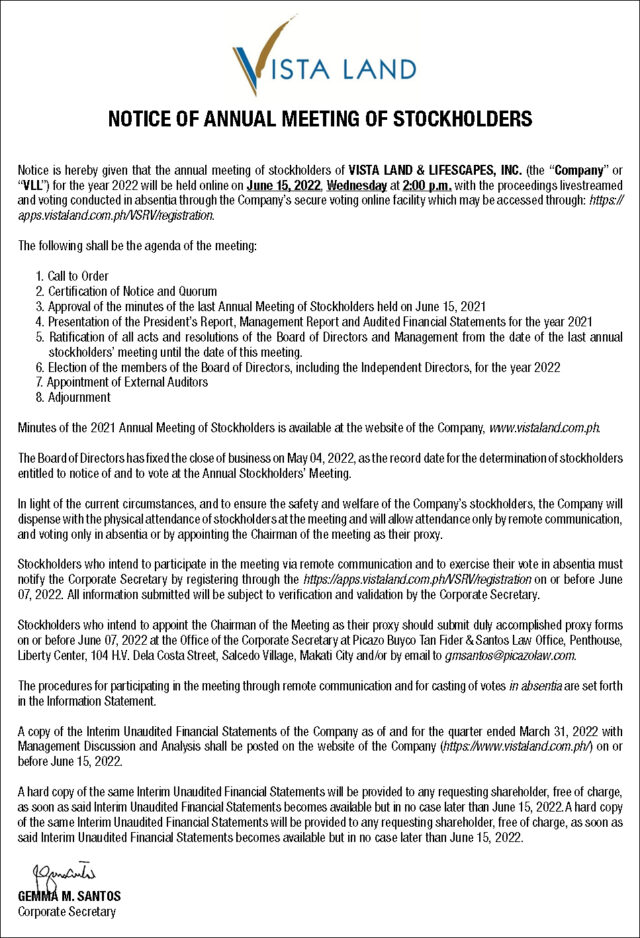
Vista Land & Lifescapes, Inc. to conduct annual meeting of stockholders on June 15


Spotlight is BusinessWorld’s sponsored section that allows advertisers to amplify their brand and connect with BusinessWorld’s audience by enabling them to publish their stories directly on the BusinessWorld Web site. For more information, send an email to online@bworldonline.com.

Join us on Viber to get more updates from BusinessWorld: https://bit.ly/3hv6bLA.

BIR falls short of Q1 collection goal

Bureau of Internal Revenue (BIR) staff check the income tax returns submitted by individuals and business owners at the BIR Office in Intramuros, Manila, April 18, 2022. — PHILIPPINE STAR/ RUSSELL A. PALMA

THE BUREAU of Internal Revenue (BIR) missed its collection target by 8.9% in the first quarter, as businesses made use of tax credits for raw materials under the Tax Reform for Acceleration and Inclusion (TRAIN) law, the Department of Finance (DoF) said on Sunday.

According to a DoF statement, the BIR collected P485.4 billion in the first three months of 2022, below the Development Budget Coordination Committee’s (DBCC) P532.6-billion target.

However, the tally was 7.2% higher than the P452.9 billion collected by the BIR in the first quarter of 2021.

“(The) shortfall was due to businesses deciding to fully utilize their input value-added tax (VAT) credits on purchases available to them under Section 35 of the TRAIN law,” BIR Deputy Commissioner Arnel SD. Guballa was quoted as saying.

Before Jan. 1 this year, the Tax Code required that input VAT from purchased capital goods with an aggregate acquisition cost of P1 million and above should be spread out over a 60-month period.

Since outright crediting of input VAT on capital goods is now allowed, the BIR was P17.4 billion short of the VAT collection target and P9.4 billion short of the income tax collection goal, Mr. Guballa said.

By region, the National Capital Region (NCR) accounted for the bulk of the first-quarter collections with P399.779 billion. The NCR collection includes the P285.99 billion collected by the BIR’s Large Taxpayers’ Service in the three-month period.

Among cities, Makati had the biggest collection with P26.09 billion, followed by Quezon City with P19.72 billion, Taguig with P18 billion and Manila with P11.56 billion.

Region IV-A (Calabarzon) collected P19.1 billion in revenues, followed by Region VII (Central Visayas) with P15.21 billion, and Region III (Central Luzon) with P12.88 billion.

Meanwhile, revenue from non-BIR operations for the first three months of the year amounted to P18.1 billion.

This brought the BIR’s total revenue for the quarter to P503.5 billion, jumping by 7% from P470.5 billion in the same period in 2021. However, the total revenues fell 8.8% short of the DBCC’s target of P551.78 billion for the January to March period.

The government borrowed heavily to finance its pandemic response, as revenues dropped during the lockdown and economic slowdown.

The BIR, the government’s largest collecting body, is tasked to collect P2.43 trillion this year.

On Saturday, the DoF said it ordered the BIR to suspend the creation of special audit task forces to prevent duplication of functions of BIR offices, and reduce confusion among taxpayers.

The BIR also ordered a halt to all field audit and other field operations under the task forces authorized to conduct examinations and verifications of taxpayers’ books of account, records and other transactions.

The agency had created special audit task forces on real estate developers and direct selling/multi-level marketing, as well as task forces for Philippine Offshore Gaming Operators and electronic sabong (e-sabong) to check their tax compliance. — T. J. Tomas

Freight fees expected to climb further

BW FILE PHOTO

By Arjay L. Balinbin, Senior Reporter

SHIPPING COMPANIES in the Philippines are likely to raise freight fees even more to cushion the impact of rising fuel costs on their operations, analysts said.

“There is a limit to cutting cost. The lines will have no choice but to pass on the cost to the cargo owners,” Philippine Liner Shipping Association (PLSA) President Mark Matthew F. Parco told BusinessWorld in a phone message on May 19.

Asked if freight fees are projected to increase further, he responded, “Yes, not only fuel but everything else is rising such as forex, parts, wages, etc.”

“Certainly, there will be another round. Maybe similar quantum,” he added, noting that shipping lines “face the same problems.”

Freight fees have already gone up by an average of 25% this year, reflecting the impact of the spike in oil prices.

As of May 17, year-to-date adjustments are at a net increase of P21.60/liter for gasoline, P31.40/liter for diesel and P27.65/liter for kerosene.

Rizal Commercial Banking Corp. Chief Economist Michael L. Ricafort said higher costs are widely expected to be passed on to passengers and cargo customers.

“(The) ability to pass on higher costs would be a function of competition or even potential demand destruction or lower demand due to higher shipping prices/fees that lead to lower demand,” he said in an e-mailed reply to questions.

Cost-cutting measures would be the firms’ “second layer of defense,” Mr. Ricafort said, adding that they may need to adopt better technologies to increase operational efficiency and prevent operating losses.

“Higher costs, largely due to higher oil/energy/fuel prices, which comprise a large chunk of the cost structure of shipping companies would lead to either higher prices (but could be mitigated/limited by competition) and/or cost-cutting measures to make up for the narrower profit margins,” he said.

The International Monetary Fund has said the rise in global shipping costs would likely cause quicker inflation in import-dependent economies until the end of the year.

The Philippines is a net oil importing country. Inflation quickened to a three-year high of 4.9% in April, the highest in more than three years as food and energy prices soared,

“Main culprit remains to be coronavirus and the war in Ukraine. Insofar as COVID is concerned, it’s still biting. We saw China go into lockdown mode on elevated cases, and this shuttered major trading ports leading to supply chain difficulties. And then of course, there’s revenge spending going on as well in other economies so that leads to supply and demand imbalances,” Security Bank Corp. Chief Economist Robert Dan J. Roces said in an e-mailed reply to questions.

Mr. Roces said the ongoing war in Ukraine and sanctions against Russia have continued to drive up prices of oil and other major commodities. “What we are seeing right now are more upsides in inflation risk,” he added.

PLSA’s Mr. Parco said the group will submit its policy recommendations to the new Transportation Secretary, including how to address “high increases” in tariff.

For his part, Mr. Ricafort said further reopening of the economy would help boost passenger travel and cargo businesses

“Measures to further reopen the economy towards greater normalcy amid the further easing of restrictions with the adoption of the lowest Alert Level 1 in more areas around the country that supports further recovery of passenger travel and cargo business would definitely help generate more sales/topline figures for shipping companies, in terms of higher passenger and cargo revenues/sales, with some upward adjustments in shipping fares/fees, to help make up for the increase in operating costs largely due to higher oil/fuel prices,” he said.

The impact of rising fuel costs can be seen in the first quarter financial results of some listed firms involved in the shipping business.

Lorenzo Shipping Corp. swung to an attributable net loss of P30.83 million in the first quarter, compared with a net profit of P42.72 million in the same period a year earlier.

“There was an increase in direct cost amounting to P796 million from last year of P711 million mainly due to soaring fuel prices,” the company said in its first-quarter report. Lorenzo Shipping’s revenues increased by 1.88% to P795.17 million “due to determined efforts to recover increasing costs through surcharges and freight adjustment.”

Meanwhile, Chelsea Logistics and Infrastructure Holdings Corp. saw its attributable net loss widen to P415.64 million in the first three months from a loss of P218.07 million in the same period in 2021. Revenues went up by 13.04% to P1.30 billion in the January to March period.

“Fuel prices continued to increase with the Ukraine conflict and this pushed the group’s bunkering cost to P486 million, a 43% increase year on year. Consequently, cost of sales and services escalated to P1.22 billion,” it said.

But the increase was “tapered off by the decline in depreciation and amortization cost by 25% or P94 million to P287 million in 2022 due to the disposal of certain vessels in prior year and extended drydocking of some vessels until this period,” it added.

2GO Group, Inc. narrowed its attributable net loss to P34.9 million in the first quarter from a loss of P291.12 million previously. Total revenues were flat at P3.99 billion.

“Our company focused on profitable services and customers, while driving efficiencies in our operations and stringently controlling costs,” it said. “The group uses derivative instruments to manage exposures to fuel price risks arising from the group’s operations and its sources of financing.”

2GO said its cost of services, pertaining to fuel, oil and lubricants, increased by 60.19% to P538.27 million in the first quarter.

Brent crude rose by 0.46% to $112.55 per barrel as of May 21, while US crude was up 0.35% to $110.28 a barrel.

BusinessWorld Virtual Economic Forum to tackle ‘new normal’ revolution

THE CORONAVIRUS pandemic pushed individuals and organizations to reevaluate their lives, work, priorities and values. These changes are now becoming “revolutions” that can unlock new opportunities for businesses, government, institutions and the workforce.

BusinessWorld, the Philippines’ most trusted business newspaper and multimedia content provider, will gather leaders and experts to discuss these “new normal” revolutions in this year’s BusinessWorld Virtual Economic Forum on May 25 and 26.

With the theme “Revolutions 2022: Navigating the Changed World,” the economic forum will highlight the changes shaping the world after the pandemic. It will be hosted by One News Anchor Regina Lay.

The two-day forum will feature a keynote from a thought leader on the “new normal” economy, as well as discussions moderated by BusinessWorld editors and journalists that will take a closer look into the transformations brought about by the pandemic, lessons learned and most effective ways to thrive in this new landscape.  

DAY 1
On May 25, Albert Park, chief economist at Asian Development Bank, will deliver a keynote speech on the global economic outlook for this year.

The chief executive officer (CEO) panel discussion, “Rethinking the Role of Corporate Leaders in an Era of Change,” will feature Martha M. Sazon, president and CEO, Mynt – Globe Fintech Innovations, Inc.; and Alfredo E. Pascual, president of the Management Association of the Philippines. It will be moderated by BusinessWorld Editor-in-Chief Wilfredo G. Reyes.

Kalpana Seethepalli, director of ESG for Asia-Pacific at Deutsche Bank, will make a presentation on “Sustainability Revolution: Investing in Green Economy.” 

The panel discussion on “Accelerating the Journey to a Net-Zero Future” follows, with Torbjørn Kirkeby-Garstad, general manager for Southeast Asia of renewable power producer Scatec; Raymond Rufino, CEO of top green buildings developer NEO; and Yoly Crisanto, chief sustainability & corporate communications officer of Globe Telecom. It will be moderated by One News Anchor Jester Delos Santos.

Angelo Tan, country lead for climate business at IFC Philippines, will join a fireside chat on “Making Green Infrastructure More Accessible” with BusinessWorld Managing Editor Cathy Rose A. Garcia.

“Industry Revolution: Reinventions & Opportunities in Traditional Businesses” will be presented by Jon Canto, acting managing partner at McKinsey & Company Philippines.

There will be a panel discussion on “Shifts in Sectoral and Business Game Plan” with John Dy, chief operating officer of JLL Phillipines; Clifford Academia, vice-president of Aboitiz InfraCapital Economic Estates; and Edna T. Belleza, general manager of GoRobinsons (under Robinsons Retail Holdings, Inc.). It will be moderated by BusinessWorld columnist Andrew J. Masigan.

Ipsos Philippines Country Manager Vicky Abad will have a fireside chat with BusinessWorld Multimedia Editor Sam L. Marcelo on “Delivering a Seamless Phygital Customer Experience”; while an Ask the Expert session with Carlo Delantar, founding partner at venture capital firm Core Capital and head of circular economy at Gobi Partners, on “Pivoting to a Circular Economy,” will be moderated by BusinessWorld contributor Santiago Jose J. Arnaiz.

DAY 2
On May 26, the forum starts with a panel discussion on “Technology Adoption & Collaboration: Prospects in the Digital Economy” with Diosdado “Dado” Banatao, chairman of PhilDev Foundation; Shailesh Baidwan, president of Voyager Innovations; and Ron Estrella, country manager of Medgate Philippines. It will be moderated by BusinessWorld columnist Danie Laurel.

“Internet Revolution: Web 3.0, 5G and a Hyperconnected World” will be presented by Todd Schweitzer, co-founder and CEO of Asia-Pacific open finance tech solutions provider Brankas.

This will be followed by a panel discussion on “Ensuring Safety and Security in the Virtual Spaces,” with Zaza Nicart, managing director of Cisco Philippines; Archieval Tolentino, president of the Information Security Officers Group (ISOG); and Arivuvel Ramu, group chief technology officer at Philippines’ first neobank Tonik. It will be moderated by Arjay L. Balinbin, BusinessWorld senior reporter,

John Rubio, country director of Meta Philippines, will have a fireside chat on the metaverse’s impact on businesses and brands.

“Human Revolution: Man Meets Machine in Industry 5.0” will be presented by Anthony Oundjian, managing director and senior partner of Boston Consulting Group.

A panel discussion on “Re-engineering HR Strategies for Post-COVID Workplace Realities” will feature Ma. Rhodora Campos, senior regional leader of Infosys BPM Philippines and Malaysia; Carol Dominguez, president and CEO of John Clements Consultants, Inc.; Oscar Medina, chief people officer of Coca-Cola Beverages Philippines, Inc.; and Jeffrey John Dela Cerna, vice-president of human resources at TELUS International Philippines,

Sprout Solutions Chief People and Customer Officer Arlene De Castro will have a fireside chat with BusinessWorld Special Features and Content Editor Josielyn Luna-Manuel on the topic “Behind and Beyond The Great Resignation.”

Completing this two-day forum is an Ask the Expert session with Gwendolyn Lim, partner at Bain & Company in Singapore. She will discuss the topic “Connecting and Catering to the Needs of the Changed Consumers.”

To learn more about and register for this most-awaited event in the business community, head on to www.bworldonline.com/BWVEFRevolutions2022.

BusinessWorld Virtual Economic Forum 2022 is presented by BusinessWorld Publishing Corp. with gold sponsors Ayala Corp., Federal Land, Inc., Globe Telecom, Inc., LT Group, Inc., and San Miguel Corp.; silver sponsors Aboitiz InfraCapital, Inc., Asus Philippines Corp., BDO Unibank, Inc., FWD Philippines, GT Capital Holdings, Inc., Okada, PLDT Enterprise, Pilipinas Shell Petroleum Corp., Quezon City Government, SM Investments Corp., Toyota Motor Philippines Corp., and Wilcon Depot, Inc.; bronze sponsors First Gen Corp., Philippine Amusement and Gaming Corp., Maynilad Water Services, Inc., SN Aboitiz Power, SyCip Gorres Velayo & Co., Robinsons Retail Holdings, Inc., Southstar Drug; and Vista Land & Lifescapes, Inc.; partner organizations Asia Society – Philippines, Bank Marketing Association of the Philippines, European Chamber of Commerce of the Philippines, Financial Executives Institute of the Philippines, French Chamber of Commerce and Industry in the Philippines, Makati Business Club, Management Association of the Philippines, Philippine Chamber of Commerce and Industry, Philippine Franchise Association, and Philippine Retailers Association; media partner The Philippine STAR; and official TV partner OneNews.

For further inquiries, please contact Jay Sarmiento through e-mail at marcom@bworldonline.com.

Regulator warns public on entities posing as SEC

THE Securities and Exchange Commission (SEC) has warned the public against entities that associate themselves with the corporate regulator.

In an advisory, the SEC reported that entities on Facebook called SEC Registration Assistance and SEC Registration Assistance Support have been operating as if they are part of the regulator.

The entities have been collecting fees from the public in exchange for services that are given for free by the commission. They have also been using the official SEC logo in their social media posts, according to the SEC’s investigation.

“Please be informed that the SEC is not, in any way, connected or affiliated with SEC Registration Assistance,  SEC Registration Assistance Support, or other entities offering similar services,” the commission said.

The SEC said that the public is advised that the processing for company registration is available online through the SEC Electronic Simplified Processing of Application for Registration of Company (eSPARC).

The commission said that it has not recognized or authorized the use of the official SEC logo by the said entities.

“Any unauthorized use or appropriation for business or personal exploitation thereof by individuals or entities without written permission, endorsement or approval by the commission shall be severely dealt with by law and may incur criminal liability or otherwise sanctioned or penalized accordingly,” the regulator said.

The commission discouraged the public from transacting in activities or services being offered by the entities.

“The public is hereby advised to exercise caution in dealing with any individual or group of persons who use the official SEC logo in its social media accounts. The public is further advised to transact or communicate concerns about SEC matters only through the contact details provided at the official SEC website,” it added. — Luisa Maria Jacinta C. Jocson

Pereira grabs PGA Championship lead as Tiger Woods withdraws

MITO PEREIRA of Chile hits out of a bunker on the 16th hole during the third round of the PGA Championship golf tournament on May 21, at Southern Hills Country Club in Tulsa, Oklahoma. — REUTERS

TULSA, Oklahoma — Unheralded Mito Pereira became the first Chilean to lead a major, surging three shots clear at the top of the Professional Golfers’ Association (PGA) Championship third round leaderboard on Saturday, while Tiger Woods withdrew after sinking to the bottom of the table.

Playing in just his second major, Pereira has refused to surrender to pressure carding a one-under 69 to get to nine-under 201 and a three-shot advantage on Britain’s Matt Fitzpatrick and American Will Zalatoris going into Sunday’s final round at Southern Hills Country Club.

Woods has played nearly 100 majors and won 15, but the PGA Championship in Southern Hills was just the second in his comeback from a car crash 15 months ago that nearly resulted in the amputation of his right leg.

The toll that effort was taken reached a head on Saturday as a hobbled Woods grimaced his way to a nine-over 79, his third worst score ever at a major.

The dejected 46-year-old trudged off the 18th green with the PGA of America confirming five hours later he had withdrawn.

“Tiger Woods has informed us that he is withdrawing from the 2022 PGA Championship,” PGA of America President Jim Richerson said in a statement. “We admire Tiger’s valiant effort to compete here at Southern Hills and wish him the best as he continues to recover from his injuries.”

With Woods long gone, Pereira started his work one back but found himself alone at the top after two holes when overnight leader Zalatoris bogeyed the first and he picked up a birdie at the second.

The 27-year-old would extend his lead to four before a mid-round wobble that saw him absorb four bogeys over a five-hole stretch around the turn.

But with his lead chopped to one, Pereira responded with back-to-back birdies at 13 and 14 before closing out his round in style, rolling in 27-footer at the last.

“It’s by far the biggest tournament I played, the biggest round of golf and tomorrow is going to be even bigger,” said Pereira, who missed the cut in his only other major the 2019 US Open. I just try to keep it simple, try to do the same things that I’ve been doing, try to not even look at the people that’s around me.”

When the day began, Fitzpatrick was heading in the wrong direction with bogeys on his opening two holes but would have just one the rest of the way while notching six birdies, including a pair to end his round for a 67.

Second round leader Zalatoris never managed to heat up on a cold day in Oklahoma, taking four bogeys on his outward nine on was to a three-over 73.

Cameron Young also had a 67 to lurk four off the lead.

Pereira, Fitzpatrick, Zalatoris and Young are all in pursuit of their first PGA Tour win.

After dealing with heat and gusting winds through the opening two rounds, golfers faced dramatically different conditions on Saturday as rain and cold settled in over Tulsa.

With temperatures hovering around 90°F (32°C), players sweated out a wind-whipped second round, but on Saturday with temperatures in the 50s (10-15°C) mitts, sweaters and umbrellas were the order of the day.

First round leader Rory McIlroy’s hopes of ending an eight-year major drought faded as the Northern Irishman was dragged down the leaderboard with a four-over 74, falling nine back of the leader.

McIlroy, a two-time winner of the PGA Championship, was far from the only big name to labor in the miserable conditions.

US Open champion and world number two Jon Rahm slumped to a 76 while British Open winner and world number three Collin Morikawa signed for a 74. — Reuters

Rising from the marshes

AYALA Tower One and Exchange Plaza

Coffee table book details the history of the Makati Business District

WHILE Ayala Avenue may just be a road to some, it serves as the main artery of the Makati Central Business District (CBD). This street, lined by some of the country’s most expensive real estate, is the headquarters of many of the companies that determine the country’s day-to-day movement; this financial district dictates how money is made and moved around the country.

It was the country’s first private master planned community, developed by the Zobel de Ayalas in their then-1,600-hectare Hacienda de San Pedro de Makati, bought for P52,000 in 1851. It was then known for its marshland.

This little fact is one of the many one can find in Fifty Years and Forward, a coffee table book from the Makati Central Estate Association, Inc. (MACEA). The 300-page book features essays by the author and project director Lisa Guerrero Nakpil on how Makati became one of the country’s premier addresses, new images of the city by photographers Wig Tysmans, Patrick Diokno, and Paul Quiambao that capture the energy of the district, and never-before-seen pictures of the Makati CBD master plan and its development throughout the years.

The book was launched via a tour through the Central Business District earlier this month, visiting the stretch of Ayala Ave., and surrounding neighborhoods of Salcedo and Legaspi Villages. The tour was conducted by TV host David Celdran (interestingly, the cousin of late tour guide and cultural advocate Carlos Celdran, who made walking tours in this style fashionable). The tour began with Tower One and Exchange Plaza, once the home of the Philippine stock exchange. The lobby, of stone and wood, contains masterpieces by National Artists, namely, the Ang Kiukok piece The Fishermen, and a commissioned work by Arturo Luz, an abstraction of the developers’ last name: Zobel de Ayala.

Mr. Celdran made a special point that these works are seen both by the executives and ordinary office workers passing through the same lobby. “I think one of the most important principles of MACEA, and of course, Ayala Land, is to make art accessible to the public.”

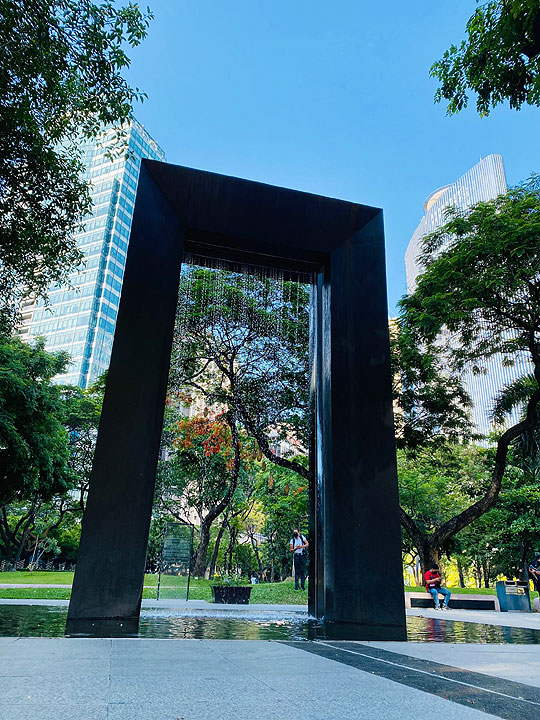
A walk to the nearby Ayala Triangle Gardens (which, along with Tower One and Exchange Plaza, was once the Ugarte Football Field) revealed the McMicking Memorial, a fountain made of weathered steel, dedicated to Col. Joseph McMicking and his wife, Mercedes Zobel-McMicking. Col. McMicking together with members of his wife’s family Enrique Zobel, Alfonso Zobel de Ayala, and Jaime Zobel de Ayala were the four visionaries who are credited for their significant contributions to the development of Makati’s financial district. In the book’s prologue, Ayala Land, Inc. Chairman and Ayala Corp. President and CEO Fernando Zobel de Ayala said of his uncle, “Col. Joseph R. McMicking was a true visionary, and I remember him often trying to imagine projects with a 10- to 20-year horizon.”

Mr. Celdran, gesturing to the fountain, said, “They already saw, beyond the horizon, what they wanted this entire place to be.”

While Nielsen Tower, once an air control tower for the Nielsen Field airport, still stands in the same spot it was built on in 1937, the airport itself was destroyed in 1941 during World War II, reopening in 1947 before permanently closing in 1948. The facilities passed on to Ayala y Compania, and the backbones of what was to become the business center were the airfield’s runways, which became Ayala Avenue and Paseo de Roxas.

The masterplan for the business center was first drawn up in 1947, in the country’s first gasps of recovery after the war. Ayala Avenue was developed as the artery of the business district in 1956, while the Makati Building became the first office building on Ayala Ave.

PARKS, ART, AND RALLIES
A luxury bus ferried media guests around the Central Business District, with Mr. Celdran pointing out familiar spots like Greenbelt and Glorietta. The bus made a stop at the Washington SyCip park in Legaspi Village, boasting its own Japanese garden, a spot of quiet in the busy neighborhood. A short drive to its sister, Salcedo Village, had us taking in the artwork at the Jaime C. Velasquez Park, where Art in the Park is usually held.

The tour ended with a final drive down Ayala Ave., with Mr. Celdran pointing out its more political history. “Ayala Ave., being the financial district — obviously, this is where businessmen, employees, and professionals would march,” said Mr. Celdran.

Ayala Ave. began its radical streak after the assassination of opposition leader and former senator Benigno “Ninoy” Aquino in 1983. Rallies would be held in Ugarte Field and protest marches would go down Ayala Ave., and almost every lunchtime, the be-suited workers of the buildings lining the street would open their office windows and rain yellow confetti down onto the avenue.

“People wanted to express their sympathy, or their protest,” said Mr. Celdran. At that time, according to him, people used to protest in Mendiola, which was a dangerous choice due to its proximity to Malacañang Palace. “Ayala was like a more moderate, a safer alternative to Mendiola,” he said.

Ayala Center would also be where one of the bloodiest coup attempts against Ninoy Aquino’s wife, former President Corazon Aquino, happened.

THE COUNTRY’S LEADING CITY
Christine C. Roa, Head of Marketing and Communications for Ayala Land Estates, Inc. said in a speech, “Beyond the objective of promoting the MACEA coffee table book, this tour is a celebration of Makati, the city we have all grown to love. Many have described Makati as the country’s leading city — a Filipino legacy. After all, contemporary urban living in the Philippines started in Makati, being the first master-planned development in the country. Several developers have followed suit but what sets Makati apart is, it is the only privately developed estate that has a rich heritage spanning almost a century. It has evolved to keep up with the changing times, and yet the sense of nostalgia that makes it a city with a soul, remains constant.”

In an interview with BusinessWorld, she said, “I think what differentiates Makati is the heritage we have here. Even if we are a city rich in heritage and history, we continue to evolve with the times. It’s a combination of what transcends time… and modernization.”

In a way, it makes one think about the possibilities for the country when we think about the rise of the Makati Central Business District from a former marshland.

Discussing how the rise of Ayala Ave. and its environs can reflect the same around the country, Ms. Roa said. “I think it’s a matter of being able to harness the skills and talents, and what we have… and putting them to really productive use.” — JLG

Max’s Group: Price hikes last option in mitigating headwinds

CASUAL dining restaurant group Max’s Group, Inc. is betting on its “creative” strategy to manage the impact of some “serious headwinds” on its operations, but price increases will be the last thing to go, the company’s president said.

“There are definitely serious headwinds that we are looking at… Headwinds come in the form of very sharp raw materials price hikes. They come in the form of fuel as everyone knows, and, of course, the mandatory wage increase,” Max’s Group President Ariel P. Fermin said during a briefing on May 20.

“What we are very clear on is that there is no one part of the value chain that can completely neutralize the headwinds. The commissary cannot absorb them in full, the stores cannot absorb them in full, and definitely the consumers cannot absorb them in full. So, what we’ve done was that we’ve been quite creative in mitigating those headwinds through operational excellence from our end,” he added.

He said the group has likewise harmonized its ingredients across its brands, a program that started prior to the public health crisis. “It’s now coming in full force.”

At the store level, the company is “revisiting” its bundles. “[We] identify based on analytics what sells most, what has the most margins and, obviously, design our product assortment in such a way that makes the consumers buy the profitable mix.”

“So, the last thing to go, at least from our end, would be consumer price increases, because we do want to be mindful of the transaction count that we are enjoying at this moment, which is, of course, critical to restaurant operations,” Mr. Fermin added.

At the same time, he said the company has done some forms of hedging. “We’ve identified some materials that are critically important for the brands that we are selling. Of course, we want to make sure that there is business continuity, and, you know, we get those materials in prices that are favorable to [us].”

Max’s Group saw its attributable net income for the first quarter fall 87.7% to P41.47 million from P335.98 million in the same period last year.

The company’s total revenues climbed 17.9% to P2.17 billion from P1.84 billion in the same period a year ago.

“Local sales were still tempered as a result of the strict lockdown in January due to the Omicron surge, while international business continues to flourish, surpassing even pre-COVID levels,” it said in an e-mailed statement.

“March demonstrated significant growth in sales with a 14% month-on-month increase as restrictions on dine-in were loosened further,” it said, adding that core brands Max’s Restaurant, Pancake House, Yellow Cab Pizza Co., and Krispy Kreme “all realized upsides with the relaxed restrictions and are expected to further realize gains as dine-in continues to surge amidst heightened mobility.”

Max’s Group shares closed 5.45% higher at P5.80 apiece on Friday. — Arjay L. Balinbin

Pat Aquino resigns as National U Lady Bulldogs head coach

GILAS Women’s head coach Pat Aquino

By John Bryan Ulanday

PAT Aquino has stepped down from his post as head coach of the National University (NU) Lady Bulldogs in the University Athletic Association of the Philippines (UAAP) women’s basketball tournament, ending an era of dominance and excellence highlighted by six straight titles and the longest streak in UAAP history.

Mr. Aquino said he came to the tough decision to focus on his role as also the head coach and program director of the Gilas Pilipinas women’s coach that has just captured the gold medal in the Hanoi Southeast Asian Games.

“I am officially stepping down as head coach of the NU Women’s Basketball team. After six straight years of being a champion, I know that we’re able to sustain a winning culture,” Mr. Aquino said in a statement.

“I thank NU and the management, Mr. Herbert Sy and our major supporter Dioceldo Sy for believing in me since day one,” he added, promising to still help in any capacity.

Mr. Aquino will be leaving an unparalleled legacy in NU, which he authored to a six-peat UAAP championship in 2019 before the pandemic.

Included in that dynasty is an astounding 96-game winning streak since 2014, the longest win spree in any sport of the league’s rich history.

Without Mr. Aquino from here on though, NU is still determined to extend its reign with Aris Dimaunahan taking over the program as per his confirmation to The STAR.

For Mr. Aquino, a bigger responsibility awaits him with a busy schedule ahead for the Gilas women’s U16, U17, 3×3 and 5-on-5 tournaments.

Mr. Aquino will also be more active in his deputy role with the Blackwater squad in the PBA.

ADVERTISEMENT
ADVERTISEMENT