Home Blog Page 6361

The wins of pandemic change: Managing the transitions

CALEB LUMINGKIT-UNSPLASH

After a bruising two-year pandemic, the world is eager to start living again, albeit in a changed environment. We are in the midst of transition from epidemic to endemic, in the lengthy process of crossing over to a more stable recovery path and regaining the balance we seem to have lost in the crisis.

That is not to say that the pandemic was all bad because there are WINS. Changes that we thought we could gradually implement have been accelerated — the digital shift, putting health care as a critical component of global development, intensified buy-in for addressing climate change, the rise of corporate activism, the importance of trust in securing a stable market, and the government finding ways to uplift the poor.

And if there are wins, there are big winners. We see big pharma increase their sales as demand skyrocketed, the rise of the fulfillment centers, the growing acceptance for artificial intelligence and robotics, the hybrid workforce and workplaces, and the micro and small enterprises that entered the market through buyers in search of alternatives.

There were also swings and misses. Many companies closed or are barely surviving, and there are job losses that can put social protection for those affected on the line. We have a health system that is still groaning from the weight of the pandemic responsibility, and COVID-19 remains a large unknown that can rear its spikes anytime. We are also on the look-out for other emerging health concerns.

LIVING IN THE WORLD OF IN-BETWEENS
Today, we are at a crossroad — forging pathways that can redefine what was to what can be and what will be. Our country is about to have a leadership change that is expected to result in political realignments and policies which will impact the recovery process. History is hindsight, and time will tell if the effects of these movements will benefit the country.

This is the backdrop against which we will pick up the threads and weave a new fabric for the future. We were slowed down by the pandemic, but it is time to move forward. Our directions will be enriched by the lessons that were taught to us by our collective experience. We need all this wisdom to initiate, manage, and complete the transition process for our organizations. The road ahead will not be easy because though this pandemic period affords a chance for a do-over, it is also not possible to wipe the slate completely clean. We have to build upon the wins that were posted, even as we examine what lessons are taught by those that did not come up to expectations or failed.

There are developments that crept so silently and stealthily that we are even unaware we have come to accept these as normal much in the same way that we are now learning to live with COVID-19.

Managing the transition process requires patience and discipline. It is akin to a home renovation project, going through our plans from room to room and examining what will still be useful and still serviceable, what may need only cosmetic renovations or enhancements, and those that might have to be done away with to give way to new spaces we should create based on present and future needs.

Transition is not about making changes for the sake of change; it requires foresight and planning. It is getting the people and the processes ready to face even the most uncertain future and remain stable. It is building a solid foundation towards a resilient structure that can enable growth and development, but which is also capable of withstanding the test of time and the worst of conditions. It is NOT all or nothing actions; more often, they will be a series of small wins versus one big success. They will be systematic improvements of bits and pieces until the whole becomes fully functional.

Transitions bridge the present and that future where we want to be. Having a transition plan can establish a roadmap we can follow that will lead to that future. Our experiences these past two years underscore the importance of building into the organizational DNA out-of-the-box thinking and innovation. The future we are preparing for will depend on how well we can question and disrupt our own familiar structures that served us for a long time, and initiate the steps to build capacities and capabilities that are imperatives of the times. Retooling, upskilling, and reskilling the present and future workforce mean putting a premium on human resources as a means for dynamic and continuing development.

Leadership matters but leaders are not infallible. The way forward will be difficult for many, and no one is expected to know all the answers. We must learn to solicit opinions and ideas and really listen. Create a CHALLENGE NETWORK made up of those who are mavericks in the organization; those who are always questioning; those who see the problems; the skeptics, even pessimists if you will. We need them more than those who say “yes” all the time because they will challenge status quo, keep us in healthy discomfort and give us the impetus to push the envelope. They will keep us grounded and on our toes. Think twice before firing the messengers of bad news. They are our early warning devices.

The challenge for leaders is how to remain relevant. The importance of learning from past practices and experiences while keeping an eye to a future signaled by the trends that continue to evolve cannot be over-emphasized. Therefore, value planning, no matter how fluid the times are. Even if plans change, or are scrapped altogether depending on conditions, they will provide bases for our strategies and actions.

More importantly, people must know their leaders care, are able to empathize with their situations, and are investing in their development.

WORKING OUR WAY FORWARD
Over the coming decades, society will continue to be confronted with serious global trends, among them climate change, geopolitical shifts, peace and security, resource scarcity, ecosystem depletion, and a growing social divide. Regardless of who or where we are, we will be called upon to help develop solutions that generate shared value for communities and societies.

Governance will need to embrace new ways, learn to collaborate, forge alliances, build synergies, and work with sectoral interests. We will need to engage in a fundamental rewiring of our relationships if we want to remain relevant to our stakeholders. In the end, the progress we will enjoy can only be limited by our perspectives and openness to ideas. Expand these, embrace diversity and inclusion, and it is possible to win them all.

Please mark your calendars for the Sept. 13 (Tuesday) Management Association of the Philippines (MAP) International CEO Hybrid Conference on the theme: “THE WINS OF CHANGE: Thriving in a World of In-Betweens” from 8:30 a.m. to 4:30 p.m. For inquiries/reservations, please e-mail <map@map.org.ph>.


Alma Rita R. Jimenez is Vice-Chair of the MAP Health Committee, Chair of the MAP CEO Conference Committee, President and CEO of Health Solutions Corporation, and former Undersecretary of the Department of Tourism.
ESG, electricity prices, and BBM’s economic team

During the BusinessWorld Virtual Economic Forum (BWVEF2022) last week (May 25-26), net-zero, decarbonization, and more renewable energy (RE) were discussed on Day 1. These concepts and aspirations are related to the new fad in finance — the environmental and social governance (ESG) scheme where more investments in RE and under-investments in fossil fuels are promoted.

ESG AND ITS IMPACT ON AGRICULTURE COMMODITIES
Among the ESG-related points made by some speakers at the BWVEF2022 were: 1.) Offshore wind power as part of climate solution, made by Torbjørn Kirkeby-Garstad of Scatec, 2.) more incentives for green buildings and net-zero, made by Raymond Rufino of NEO, and, 3.) small businesses have to be enabled to pursue net zero, made by Maria Yolanda Crisanto of Globe Telecom.

See also some recent articles on ESG in BusinessWorld:

1. “Accounting considerations for the oil and gas sector as renewable energy adoption drives ESG reporting” by Arthur M. Maddalora (April 10)

2. “ESG investing” by Marvin Tort (May 4)

3. “ESG’s emerging influence in PHL business” by Adrian Paul B. Conoza (May 23)

Fossil fuels (oil-gas-coal) give us energy for our cars, trucks, and tractors; reliable and dispatchable electricity for our homes, buildings, and factories. So, if there is underinvestment in fossil fuels, there will be less supply of these commodities in the future. Petroleum produces plenty of chemicals that are used in our everyday lives. These include nylon and polyester fabrics in our clothing. Handbags, sunglasses, phone cases, jewelry in our accessories. Cooking tools, appliances, cleaning products in our households. Fertilizers and insecticides in our agriculture. And many more.

Food inflation has become more visible in recent years. Crops need urea, ammonia, and other fertilizers to grow faster and produce more yield per hectare. Livestock need corn and other crops for feed. These commodities also need energy for harvest, transport, and storage — and energy prices have been rising fast since 2021.

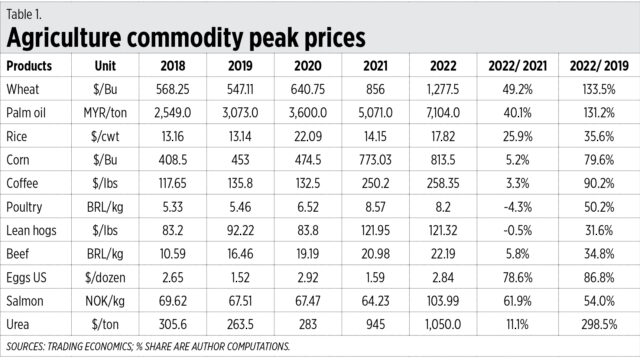
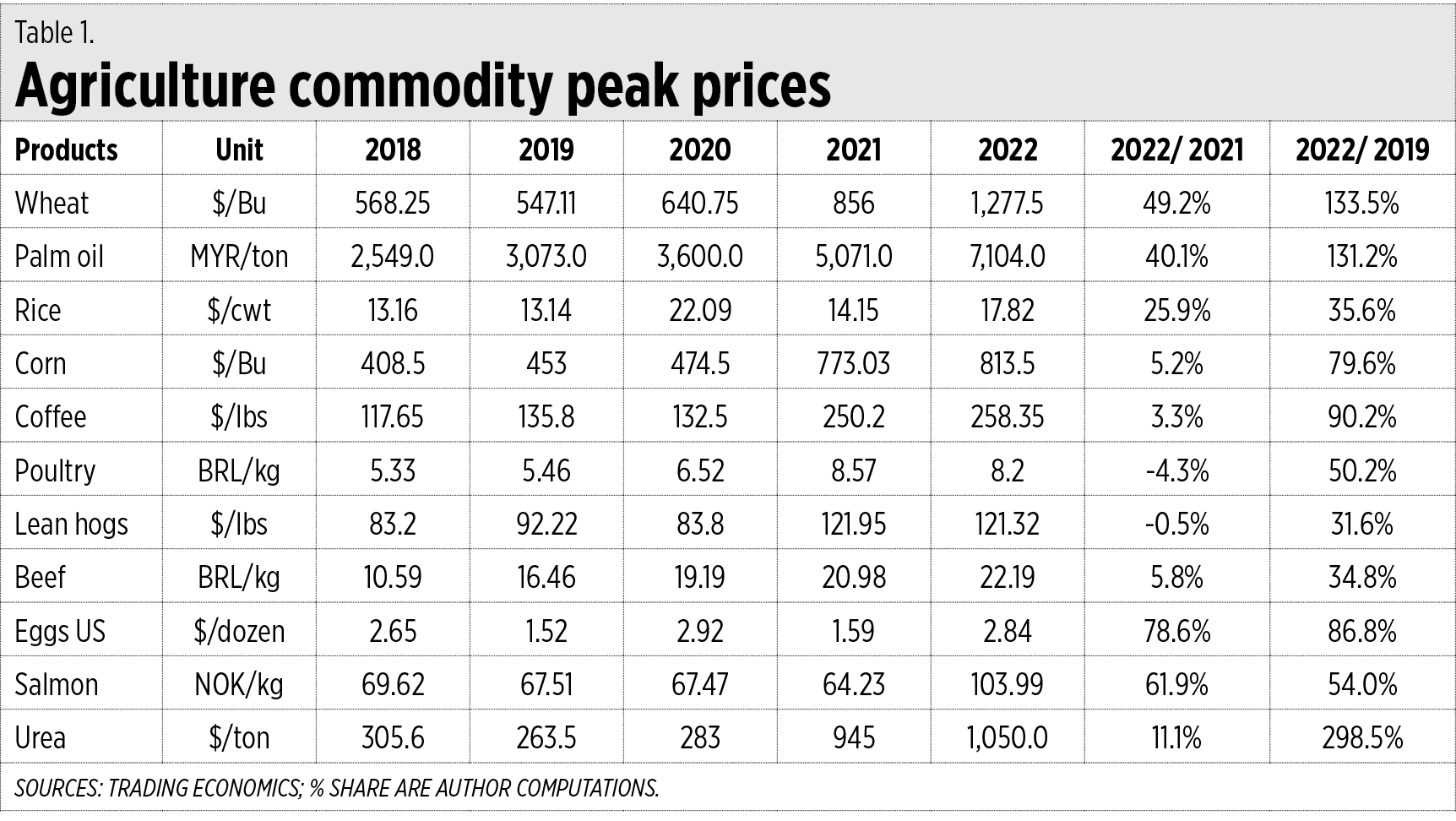
I checked the peak prices of agricultural commodities and the price curve is getting steeper upwards. Wheat, palm oil (also canola), coffee, and US eggs showed a steep rise this year compared to last year and pre-pandemic 2019. Urea — used for fertilizers, feed supplement, and starting material for plastic manufacturing — experienced an almost 300% price increase compared to 2019. Salmon and other seafood experienced high prices this year mainly because of high demand while the supply of Russian seafood is curtailed by the economic sanctions (Table 1).

The price of urea ammonium nitrate (UAN) last Friday was €645/ton and it was 187.3% higher than a year ago. That is a huge increase in just one year.

So ESG schemes have a direct threat to global food production. Companies, banks, multilaterals, and government agencies should rethink their advocacy for ESG.

PHILIPPINES ELECTRICITY PRICES
At a media briefing today by the Independent Electricity Market Operator of the Philippines (IEMOP), their numbers showed that economic recovery is indeed happening — peak demand in the Luzon-Visayas grids was 14,380 MW in May 2022 vs 13,660 MW in May 2021, 11,567 MW in May 2020, and 13,316 MW in May 2019.

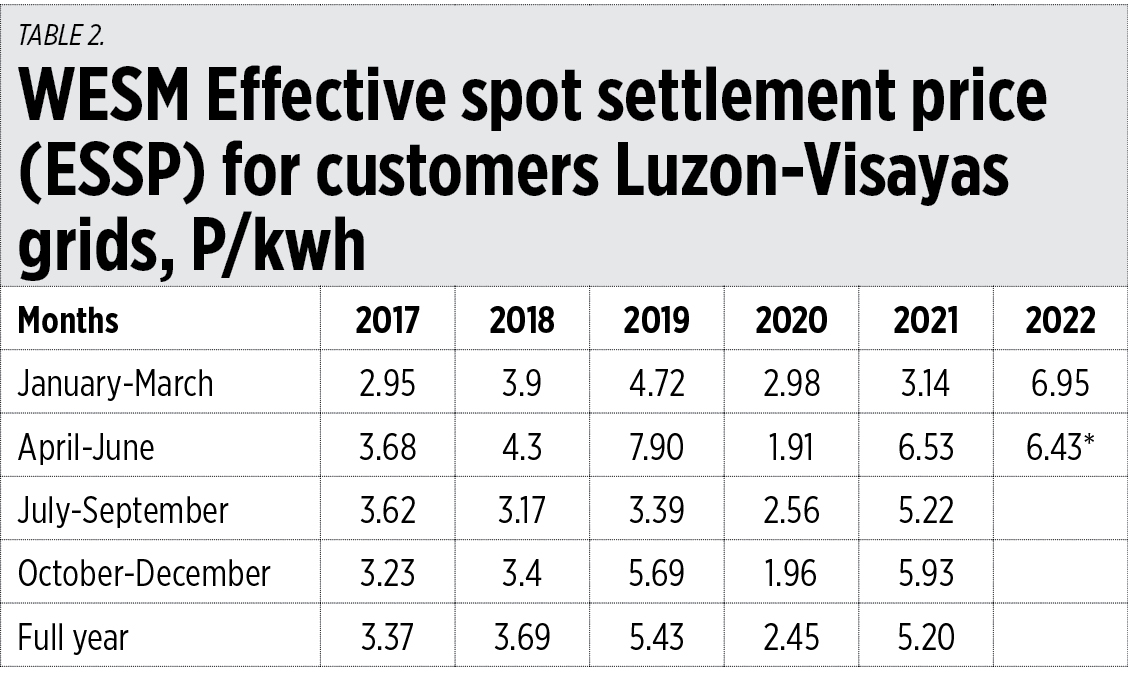
The “blackout during May 2022 elections” forecast by some climate alarmist groups pushing for more RE and ditching fossil fuel did not happen. On election day, May 9, power supply was at normal levels while demand was down and prices were low at P2-3/kwh.

The share in total generation for February, March, April, and May were as follows: Coal 54.4%, 57.6%, 57.6%, and 60.9% respectively. Solar was flat at 1.9%-2%; with wind, 1.9%, 1.2%, 1.2%, 0.4%. So, the combined share of the beloved solar-wind in May was only 2.3% while demonized coal was at 61%. Weather-dependent energy sources should never be the “hope” to achieve economic prosperity.

THE BBM ECONOMIC TEAM
The recently announced economic team of President-elect Ferdinand “Bongbong” Marcos, Jr. (BBM) is generally good.

Incoming Finance Secretary Benjamin Diokno — former Department of Budget and Management (DBM) Secretary under the Estrada administration, and outgoing Bangko Sentral ng Pilipinas (BSP) Governor under the Duterte administration — has long experience in fiscal and monetary policy work. He was my teacher in Public Finance twice at the University of the Philippines School of Economics (UPSE), undergrad in the 1980s and PDE/graduate in the ’90s.

Incoming National Economic and Development Authority (NEDA) Secretary Arsenio Balisacan — the former NEDA Secretary under the PNoy administration, Philippine Competition Commission Commissioner under the Duterte administration — has long experience in socio-economic research and policy. He was also my teacher in Development Economics at the UPSE PDE program in the 1990s, the same semester as Sir Ben.

Incoming Trade Secretary Alfredo Pascual — former UP President, current Management Association of the Philippines (MAP) President — has long experience in corporate, academic, and multilateral agency work. He is not from UPSE, he graduated BS Chemistry then an MBA from UP.

Incoming BSP Governor Felipe Medalla — former NEDA Secretary under Estrada, and current BSP Monetary Board member since 2011 — has long experience in fiscal/taxation and monetary policy work. He was also a former Dean of UPSE but he was not my teacher.

There is no appointment yet for DBM Secretary but I hope he/she will not be a fan of heavy subsidies and more borrowing, and will prefer fiscal discipline and responsibility.

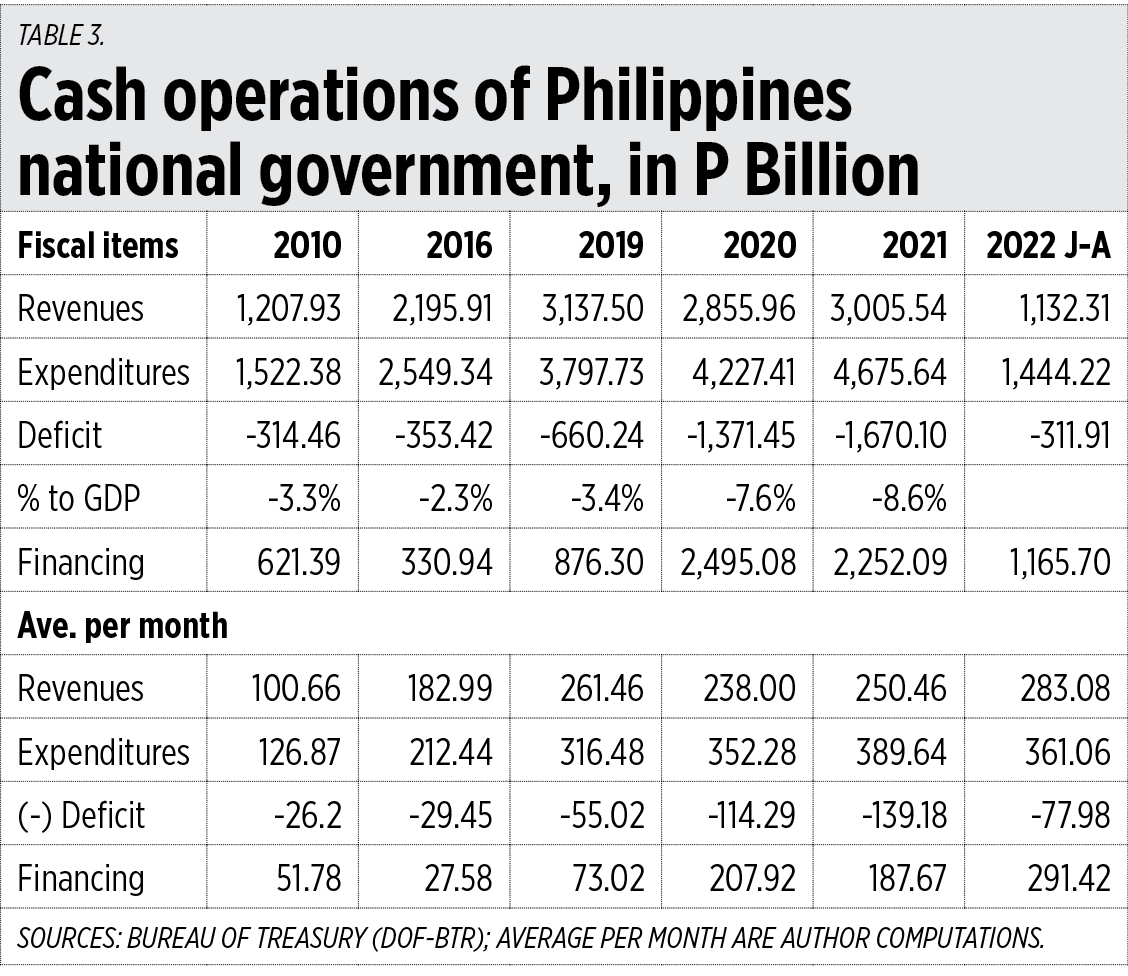
The economic team will face a very important problem — the huge increase in public debt and how to pay it back. From P6.60 trillion (actual + guaranteed) in 2016, this went up to P8.22 trillion in 2019, P10.25 trillion in 2020, P12.15 trillion in 2021, and P13.09 trillion as of March 2022. An increase of P6.5 trillion in just five years and one quarter.

This happened because of the strict COVID-19 lockdowns of 2020-2021, when revenues significantly declined while expenditures continued to increase. While millions of people lost their businesses and jobs in the private sector, government personnel remained intact and their salaries, allowances and bonuses continued from national down to barangay levels.

I computed the monthly average borrowings: it jumped from P73 billion in 2019 to P208 billion in 2020, P188 billion in 2021, and P291 billion in January-April (J-A) this year (Table 3).

The good news is that Sir Ben is not inclined to raise taxes but rather focuses on better tax administration, collecting more revenues via a digital easier payment system. This will reduce corruption via person-to-person interaction between Bureau of Internal Revenue/Bureau of Customs personnel and taxpayers.

BBM and the economic team are not yet in the mood to do large-scale privatization or long-term leasing of government assets and corporations, but I hope they will consider this. Among the “low-hanging fruits” that are easier to privatize are the Philippine Amusement and Gaming Corporation, and the long-term leasing of the lands of state universities and colleges, and military and police camps. Revenues from privatization and long-term leases should be used exclusively to retire public debt, not earmarked for whatever agency or program.

Entrepreneurs and workers in the private sector have suffered enough under the lockdowns of 2020-2021. They should not suffer further with higher taxes in 2023 and beyond.


Bienvenido S. Oplas, Jr. is the president of Minimal Government Thinkers.

minimalgovernment@gmail.com

China’s population is about to shrink for the first time since the great famine struck 60 years ago. Here’s what it means for the world

JAVIER QUIROGA-UNSPLASH

The world’s biggest nation is about to shrink.

China accounts for more than one sixth of the world’s population.

Yet after four extraordinary decades in which China’s population swelled from 660 million to 1.4 billion, its population is on track to turn down this year, for the first time since the great famine of 1959-1961.

According to the latest figures from China’s National Bureau of Statistics, China’s population grew from 1.41212 billion to just 1.41260 billion in 2021 — a record low increase of just 480,000, a mere fraction of the annual growth of eight million or so common a decade ago.

While a reluctance to have children in the face of strict anti-COVID measures might have contributed to the slowdown in births, it has been coming for years.

China’s total fertility rate (births per woman) was 2.6 in the late 1980s — well above the 2.1 needed to replace deaths. It has been between 1.6 and 1.7 since 1994, and slipped to 1.3 in 2020 and just 1.15 in 2021.

By way of comparison, in Australia and the United States the total fertility rate is 1.6 births per woman. In ageing Japan it is 1.3.

This has happened despite China abandoning its one-child policy in 2016 and introducing a three-child policy, backed by tax and other incentives, last year.

Theories differ about why Chinese women remain reluctant to have children in the face of state incentives. One involves having become used to small families, another involves the rising cost of living, another involves increasing marriage age, which delay births and dampens the desire to have children.

In addition, China has fewer women of child-bearing age than might be expected. Limited to having only one child since 1980, many couples opted for a boy, lifting the sex at birth ratio from 106 boys for every 100 girls (the ratio in most of the rest of the world) to 120, and in some provinces to 130.

China’s total population grew by a post-famine low of just 0.34 in 1,000 last year.

Projections prepared by a team at the Shanghai Academy of Social Sciences have it falling this year — for the first time post-famine — by 0.49 in a thousand.

The turning point has come a decade sooner than expected.

As recently as 2019 the China Academy of Social Sciences expected the population to peak in 2029, at 1.44 billion.

The 2019 United Nations Population Prospects report expected the peak later still, in 2031-32, at 1.46 billion.

The Shanghai Academy of Social Sciences team predicts an annual average decline of 1.1% after 2021, pushing China’s population down to 587 million in 2100, less than half of what it is today.

The reasonable assumptions behind that prediction are that China’s total fertility rate slips from 1.15 to 1.1 between now and 2030, and remains there until 2100.

The rapid decline will have a profound impact on China’s economy.

China’s working-age population peaked in 2014 and is projected to shrink to less than one third of that peak by 2100.

China’s elderly population (aged 65 and above) is expected to continue to climb for most of that time, passing China’s working-age population near 2080.

This means that while there are currently 100 working-age people available to support every 20 elderly people, by 2010, 100 working-age Chinese will have to support as many as 120 elderly Chinese.

The annual average decline of 1.73% in China’s working-age population sets the scene for much lower economic growth, unless productivity advances rapidly.

Higher labor costs, driven by the rapidly shrinking labor force, are set to push low-margin, labor-intensive manufacturing out of China to labor-abundant countries such as Vietnam, Bangladesh, and India.

Already manufacturing labor costs in China are twice as high as in Vietnam.

At the same time, China will be required to direct more of its productive resources to provision of health, medical and aged-care services to meet the demands of an increasingly elderly population.

Modelling by the Center of Policy Studies at Victoria University suggests that without changes to China’s pension system, its pension payments will grow five-fold from 4% of gross domestic product (GDP) in 2020 to 20% of GDP in 2100.

For resource exporting nations such as Australia, these changes are likely to require a reorientation of exports towards manufacturers outside China.

For importers of goods including the United States, the source of goods is set to gradually shift towards new and emerging centers of manufacturing.

Despite forecasts that this will be “the Chinese century,” these population projections suggest influence might move elsewhere — including to neighboring India, whose population is expected to overtake China within this coming decade.


Xiujian Peng is a Senior Research Fellow at Victoria University.

Evicted villagers pay a high price for India’s hydropower push

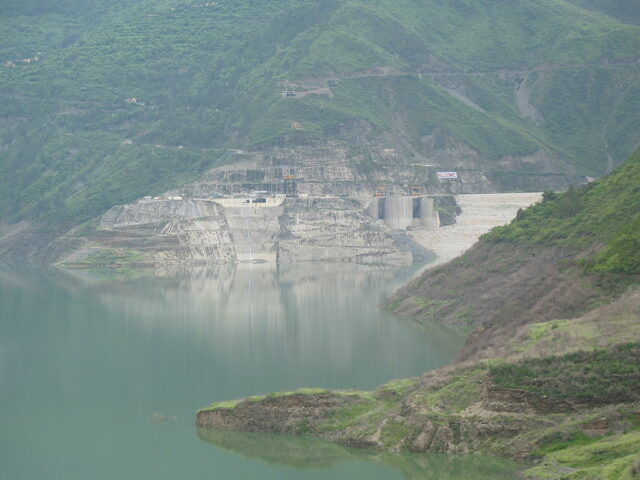
The Tehri Dam in India. — WIKIMEDIA COMMONS

HAAT VILLAGE, India — Narmada Devi pointed to an expanse of rubble and dirt, at the spot where her home in the north Indian state of Uttarakhand stood until last year. 

The flattened remains of her house and those of her neighbors in Haat village lay scattered around, buried in construction waste from a nearby hydroelectric power plant. 

Between the village and the plant, an important Hindu temple stands surrounded by debris. 

“This is where the remains of my house lie, under the muck,” Ms. Devi told the Thomson Reuters Foundation. “What kind of development is this, when you rob poor people of their homes to supply electricity to others?” 

Ms. Devi’s family is among the more than 240 households in the village who lost their homes during the construction of the 444-megawatt (MW) hydropower project on the Alaknanda river. 

The World Bank-financed power plant is one of dozens of hydroelectric projects either being built or already operating across India’s Himalayan states, in a bid to cut down the country’s carbon emissions. 

The government has said hydropower, along with solar and wind, is vital to meeting India’s pledge to get half of its energy from non-fossil fuel sources by 2030. 

As countries look for ways to curb global warming, backers of hydropower note that it provides massive amounts of clean electricity and can be ramped up quickly when more weather-dependent solar and wind projects fail to meet demand. 

But green groups and communities affected by hydroelectric projects say the high environmental and social costs are hard to justify. 

Ms. Devi, 63, said that when officials from government-owned power company Tehri Hydro Development Corporation (THDC) came last year asking to buy locals’ land, anyone who refused was “bundled into a truck” and taken to a police station for several hours while their homes were demolished. 

Those who had earlier agreed to sell up were given “nominal” compensation of 1 million Indian rupees ($12,887) each, said homemaker Ms. Devi, who now lives with her family in a nearby village. 

Sandeep Gupta, assistant general manager of the THDC project, said Haat residents had all agreed to voluntarily resettle themselves and were fairly compensated, adding that the project was being monitored by government agencies for any environmental damage. 

“No adverse impact has been reported by the agencies to date,” Mr. Gupta said. 

UNTAPPED POTENTIAL
In a June 2021 report, the International Energy Agency called hydropower “the forgotten giant of clean electricity” and urged countries to include it in their energy mix to have a chance of reaching net-zero emissions

India currently has 46 gigawatts of installed hydropower capacity — only a third of what it could potentially generate, according to government figures. 

To boost capacity, the government in 2019 officially declared hydroelectric projects of over 25 MW a renewable energy source, and made it obligatory for power companies to use hydro for a share of their supply. 

Before then, only smaller hydropower plants had been classed as renewable. 

Arun Kumar, a professor of hydropower and renewable energy at the Indian Institute of Technology-Roorkee, said that expanding India’s hydropower sector was about more than generating electricity. 

Hydroelectric dams can also provide a reliable water supply for homes, businesses and farmers, said Mr. Kumar, who sits on the board of the London-based International Hydropower Association. 

In addition, big projects can attract tourists and bring jobs, electricity, roads and railways to nearby communities, improving “the quality of life in backward areas,” Mr. Kumar said. 

But building more hydropower plants makes little economic sense when India can get cheaper clean energy from solar and wind projects, said Himanshu Thakkar, coordinator of the South Asia Network on Dams, Rivers and People, an advocacy group. 

He said installing 1 MW of hydroelectric capacity in India costs more than 100 million rupees, about double the amount for the same solar or wind-based capacity. 

Corruption and lax regulation, he added, are the only reasons India’s authorities are so focused on hydropower. 

“There is huge scope for padding up the costs in the absence of credible regulatory oversight,” Mr. Thakkar said. 

RISING DISASTER RISK
As for hydropower’s reputation as a green energy source, some environmentalists say the sector does more harm than good. 

Hydro projects can clear forests, divert rivers, slow or stop groundwater recharge and shift huge amounts of earth, all of which make nearby communities more vulnerable to the effects of increasingly destructive extreme weather, they say. 

S.P. Sati, who teaches environmental science at the College of Forestry-Ranichauri in Uttarakhand, pointed to devastating floods in the state in 2013 that killed about 6,000 people, according to state government estimates. 

A committee appointed by India’s Supreme Court concluded that hydroelectric projects had exacerbated the flood damage, as the rushing water carried mountains of excavated boulders, silt and sand downstream, burying low-lying communities. 

The committee also noted in a report that digging and use of explosives while building the plants “can trigger landslides or slope failure. 

“If you don’t care about the sensitivity, fragility, and carrying capacity of the terrain, (hydropower) is bound to trigger big disasters,” Mr. Sati said. 

Haat village head Rajendra Prasad Hatwal said residents would keep on holding protests and lobbying the local government until the hydropower plant developers stopped using their home as a dumping site and properly compensated displaced families. 

He also questioned why India is leaning so heavily into hydropower, when countries like the United States, Brazil, and China have suffered huge disruptions in hydropower generation due to climate change-driven droughts in the past few years. 

Another concern is the clearing of thousands of trees for the power plant, he said, when “we hear so much about saving forests to fight climate change.” 

“It is so confusing and frustrating,” he added. ($1 = 77.5956 Indian rupees) — Thomson Reuters Foundation

Britain prepares to celebrate Queen Elizabeth’s Platinum Jubilee

JOE GIDDENS/ POOL VIA REUTERS

LONDON — Britain will mark Queen Elizabeth’s record-breaking 70 years on the throne this week with four days of celebrations, ranging from military parades and a church service to street parties and a pop concert outside Buckingham Palace. 

Queen Elizabeth, 96, marked seven decades on the throne in February, and two public holidays have been set aside to create a four-day weekend for nationwide events commemorating her reign from June 2–5. 

It is not clear how many of these the monarch herself will attend, having been forced to miss a number of official engagements in recent months because of what Buckingham Palace calls “episodic mobility issues.” Royal officials say her attendance will be decided on the day. 

Paying tribute to “Elizabeth the Great” in parliament last week, Prime Minister Boris Johnson said her service and dedication to duty was without parallel. 

“I hope that in the coming days we can … show with every bonfire, with every concert and street party and aerobatic display, a love and a devotion to reciprocate the love and devotion and leadership she has shown to the whole country over seven decades,” he said. 

The four days of events begin on Thursday with the traditional “Trooping the Colour” military parade in central London, which will be followed by a flypast of modern and historic aircraft. 

The queen is also due to make an appearance on the balcony of Buckingham Palace to greet the crowds, although the two most controversial members of the royal family — her son Prince Andrew and grandson Prince Harry — will be absent. 

In February, Andrew settled a US lawsuit in which he was accused of sexually abusing Virginia Giuffre. He had previously stepped down from public duties because of his connections to the late convicted US sex offender Jeffrey Epstein. 

Harry, younger son of heir Prince Charles, also gave up royal duties to move with his American wife Meghan to Los Angeles, from where they have delivered barbs and accusations of racism against the royal household. 

However, both are likely to attend other engagements over the long weekend. Another notable absentee will be her late husband Prince Philip, who died aged 99 last April after 73 years by her side. 

SERVICE, HORSE RACE AND PARTIES
Friday will see a thanksgiving service at London’s St Paul’s Cathedral, while on Saturday the queen is due to attend the Derby horse race with other family members. Later there will be a concert outside Buckingham Palace, featuring the likes of rock group Queen, pop band Duran Duran, and US singer Diana Ross. 

Celebrations will conclude on Sunday, with street parties and a pageant through the British capital. 

Elizabeth became the queen of Britain and more than a dozen other realms including Canada, Australia and New Zealand on the death of her father King George VI on Feb. 6, 1952, while she was in Kenya on an international tour. 

At the time, Josef Stalin, Mao Zedong, and Harry Truman were leading the Soviet Union, China and the United States, while Winston Churchill was British prime minister. 

In September 2015, she overtook her great-great-grandmother Queen Victoria to become the longest-reigning monarch in nearly 1,000 years of a line that traces its origin back to Norman King William I and his 1066 conquest of England. 

During her seven decades on the throne, the queen has been a symbol of stability for the country during huge social, economic and political change, including the end of the British Empire. 

“Not only has your majesty been a constant presence in the lives of most of your subjects, but you are also the third longest serving monarch in world history,” the Speaker of parliament’s House of Commons said in a statement. 

Polls show she remains very popular and well-respected, although they suggest growing indifference to the monarchy among younger people. 

A YouGov survey for the Republic campaign group last Thursday also found that more than half of those surveyed were not interested in the jubilee. 

“Rather than being a national celebration, the jubilee is a minority interest,” said Graham Smith from Republic. “The lack of interest across the country and all age groups under 65 shows the monarchy’s future is in serious doubt.” — Reuters

From baristas to inspectors: Singapore’s robot workforce plugs labor gaps

Spot robot by Boston Dynamics. — BOSTON DYNAMICS

SINGAPORE — After struggling to find staff during the pandemic, businesses in Singapore have increasingly turned to deploying robots to help carry out a range of tasks, from surveying construction sites to scanning library bookshelves. 

The city-state relies on foreign workers, but their number fell by 235,700 between December 2019 and September 2021, according to the manpower ministry, which notes how coronavirus disease 2019 (COVID-19) curbs have sped up “the pace of technology adoption and automation” by companies. 

At a Singapore construction site, a four-legged robot called “Spot,” built by US company Boston Dynamics, scans sections of mud and gravel to check on work progress, with data fed back to construction company Gammon’s control room. 

Gammon’s general manager, Michael O’Connell, said using Spot required only one human employee instead of the two previously needed to do the job manually. 

“Replacing the need for manpower on-site with autonomous solutions is gaining real traction,” said Mr. O’Connell, who believes industry labor shortages made worse by the pandemic are here to stay. 

Meanwhile, Singapore’s National Library has introduced two shelf-reading robots that can scan labels on 100,000 books, or about 30% of its collection, per day. 

“Staff need not read the call numbers one by one on the shelf, and this reduces the routine and labor-intensive aspects,” said Lee Yee Fuang, assistant director at the National Library Board. 

Singapore has 605 robots installed per 10,000 employees in the manufacturing industry, the second-highest number globally, after South Korea’s 932, according to a 2021 report by the International Federation of Robotics. 

Robots are also being used for customer-facing tasks, with more than 30 metro stations set to have robots making coffee for commuters. 

Keith Tan, chief executive of Crown Digital, which created the barista robot, said it was helping solve the “biggest pain-point” in food and beverage — finding staff — while also creating well-paid positions to help automate the sector. 

However, some people trying the service still yearned for human interaction. 

“We always want to have some kind of human touch,” said commuter Ashish Kumar, while sipping on a robot-brewed drink. — Reuters

Monkeypox presents moderate risk to global public health, WHO says

Image via Jernej Furman/Flickr/CC BY 2.0

The World Health Organization (WHO) said on Sunday that monkeypox constitutes a “moderate risk” to overall public health at global level after cases were reported in countries where the disease is not typically found. 

“The public health risk could become high if this virus exploits the opportunity to establish itself as a human pathogen and spreads to groups at higher risk of severe disease such as young children and immunosuppressed persons,” WHO said. 

As of May 26, a total of 257 confirmed cases and 120 suspected cases have been reported from 23 member states that are not endemic for the virus, the health agency said in a statement. There have been no reported fatalities so far. 

WHO also said that the sudden appearance of monkeypox at once in several non-endemic countries suggests undetected transmission for some time and recent amplifying events. 

The agency added that it expects more cases to be reported as surveillance in endemic and non-endemic countries expands. 

Monkeypox is an infectious disease that is usually mild, and is endemic in parts of west and central Africa. It is spread by close contact, so it can be relatively easily contained through measures such as self-isolation and hygiene. 

Most of the cases reported so far have been detected in the UK, Spain and Portugal. 

“The vast majority of reported cases so far have no established travel links to an endemic area and have presented through primary care or sexual health services,” the UN agency said. — Reuters

Zero-COVID, big money: China’s anti-virus spending boosts medical, tech, construction

BLOOMBERG

BEIJING — China’s “zero-COVID” (coronavirus disease) policy of constantly monitoring, testing, and isolating its citizens to prevent the spread of the coronavirus has battered much of the country’s economy, but it has created bubbles of growth in the medical, technology, and construction sectors.

The Chinese government, alone among major countries in vowing to eradicate the coronavirus within its borders, is on track to spend more than $52 billion (350 billion yuan) this year on testing, new medical facilities, monitoring equipment and other anti-COVID measures, which will benefit as many as 3,000 companies, according to analysts. 

“In China, the companies that provide testing services and other related industries are making big money because of the government’s focus on a containment-based approach in fighting COVID,” said Yanzhong Huang, a global health specialist at the Council on Foreign Relations (CFR), a US think tank. 

China aims to have COVID testing facilities within 15-minutes’ walk of everyone in its big cities and continues to impose mass testing at the slightest sign of an outbreak. Hong Kong-based Pacific Securities estimates this has created a market worth more than $15 billion a year for test makers and providers. 

The government is footing the bill for the vast majority of this, either by buying test kits or paying companies to do tests. Although prices of tests have dropped since the outbreak of the coronavirus in early 2020 — to as little as 50 cents per test — this continuing demand has helped a number of companies. 

First-quarter profit more than doubled for Hangzhou-based Dian Diagnostics Group Co. Ltd., one of China’s biggest medical test makers. Its revenue jumped more than 60% to $690 million, just less than half of which was for its COVID testing services, almost entirely paid for by the government. 

Rival Adicon Holdings Ltd., which received about $300 million of mostly government money for its COVID tests over 2020 and 2021, according to the company’s financial statements, has applied for an initial public offering on the Hong Kong stock exchange. 

Shanghai Runda Medical Technology Co. Ltd. said it was processing up to 400,000 COVID tests per day in April, during the almost two-month-long lockdown of Shanghai, generating more than $30 million a month, according to an article by the state-run Securities Times. 

China defends its “zero-COVID” policy as crucial to saving lives and preventing its healthcare system from being overrun. It shows little sign of pulling back even as the economic toll mounts. 

The latest indicators show the country’s economy has weakened sharply since March, as employment, consumer spending, exports and home sales have been hit by stringent lockdown measures that clogged highways and ports, stranded workers, and shut factories. 

Many private-sector economists expect the economy to shrink in the April to June quarter from a year earlier, compared with the first quarter’s 4.8% growth. The blue-chip CSI 300 Index is down 19% this year. 

Investors are uncertain how long the boom will last for companies like Dian, Adicon, and Shanghai Runda, whose fortunes are closely tied to government spending. Analysts, on average, expect Dian’s revenue to dip slightly next year, while they see Shanghai Runda’s continuing to grow. Stocks of both are down from the start of this year. 

“The development of the epidemic is uncertain due to the large number of mutated strains of the new coronavirus and the complexity of infectiousness,” said a recent research note by Shenzhen-based Essence Securities. “If the spread of the epidemic is well controlled and the epidemic prevention policy is adjusted, it may have a negative impact on the market demand for COVID nucleic acid testing.” 

Mr. Huang at the CFR said that China’s massive program of lockdowns, tracing and isolating could prevent a worst-case scenario but was not a permanent solution. “Epidemiologically and economically, it is unsustainable,” he said. 

Dian Diagnostics, Adicon, and Shanghai Runda did not respond to requests for comment. Health authorities in Beijing and Shanghai did not respond to requests for comment. 

MASS SURVEILLANCE, QUICK BUILDINGS 

Dozens of surveillance and thermal imaging camera manufacturers, such as Wuhan Guide Infrared Co. Ltd. and Hangzhou Hikvision Digital Technology Co. Ltd., have benefited from the Chinese government’s demand for gadgets that can help it keep track of the COVID status of its 1.4 billion citizens. 

Wuhan Guide, one of the world’s leading manufacturers of thermal imaging equipment, doubled its revenue in 2020 as it worked overtime to supply fever-detecting cameras across China and overseas. Growth flattened out last year, but analysts expect it to pick up again this year and next. The company did not respond to a request for comment. 

Disease has been the mother of invention. Since March, Chinese companies and research institutes have filed at least 50 COVID-related patents, according to a Reuters review of international and domestic databases. The inventions are mostly related to adapting existing surveillance cameras and platforms in order to track close contacts and identify potential positive cases. 

The urgent need for hundreds of new hospitals, to take the strain off China’s already-stretched medical infrastructure, has created a boom for some construction companies. 

Beijing-based China Railway Group Ltd., a conglomerate spanning construction, manufacturing and real estate, has built makeshift hospitals all over China this year, and has been particularly active in areas hit hard by COVID such as Shanghai and the northeastern city of Changchun. Its profit has grown steadily over the past two years, at least partly helped by COVID-related projects, and analysts expect that to continue over the next few years. Its stock hit a three-year high in May. China Railway Group did not respond to a request for comment. 

One analyst has estimated that about 300 makeshift hospitals were built around China during a 35-day span between March and April, as infections surged, at a cost of more than $4 billion. 

One third of those were built in and around Shanghai. There is no sign of waning demand from the government. On May 15, China’s National Health Commission head Ma Xiaowei called for the construction of what he called “permanent makeshift hospitals” in leading Chinese Communist Party publication Qiushi, suggesting that there will be a long-term need for such buildings. 

A Reuters review of tenders for such projects suggest the government will spend about $15 billion this year on new hospitals. — Reuters


Shanghai eases return to work, moves to support economy

REUTERS

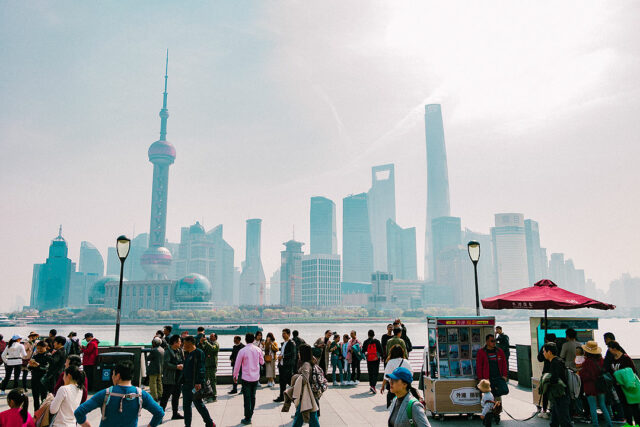
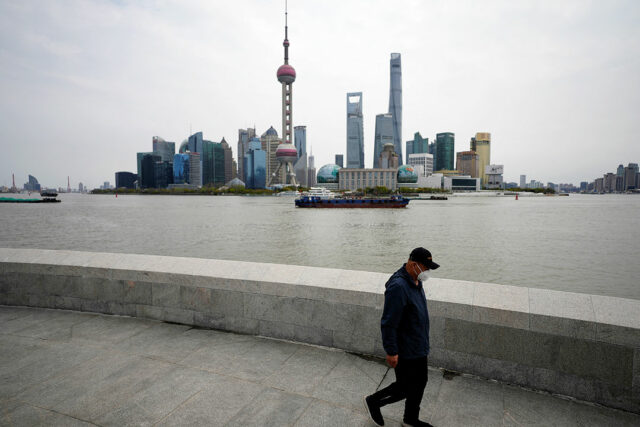
SHANGHAI — Shanghai authorities will cancel many conditions for businesses to resume work from Wednesday, a city official said on Sunday, easing a city-wide lockdown that began some two months ago, and will also introduce policies to support its battered economy.

China’s commercial hub of Shanghai reported a broad decline in its economy last month as coronavirus disease 2019 (COVID-19) outbreaks prompted stringent restrictions and lockdowns, impacting manufacturing to retail sales and its property sector.

Now, the city government will revise guidelines for epidemic prevention and control of returning to work, cancel “unreasonable restrictions” on the resumption of work and production for enterprises and do away with its “white-list” system, Vice Mayor Wu Qing told a news briefing, referring to how it had previously prioritized some companies in resuming work and had published lists of names.

Businesses will also from June 1 no longer need to apply to resume work, he said, without detailing what other restrictions were being removed.

City officials also announced an action plan — consisting of 50 policy measures — to boost the economy, aimed at helping enterprises and promoting consumption. They include accelerating the issuance and use of local government bonds, asking banks to renew loans for small and medium sized enterprises and establishing a green channel for approving real estate projects.

The city will also reduce some passenger car purchase taxes to spur auto consumption, and increase the quota of license plates for passenger cars by 40,000 this year. Shanghai had issued 135,000 such license plates in 2021.

A 10,000 yuan subsidy will also be granted to people looking to switch to an electric vehicle.

Additionally, authorities will seek to help companies impacted by the lockdown by allowing them to delay insurance payments and rent, as well as offering subsidies on their utility bills. E-commerce platforms and large retail businesses will be supported with voucher handouts, particularly for the cultural, tourism and fitness industries.

All these measures, combined with others that were rolled-out at the end of March, are estimated to reduce over 300 billion yuan of financial burden as a result of the pandemic for market players for the full year, said Hua Yuan, deputy secretary general of Shanghai’s municipal government.

“In short, we will do our best to help all kinds of enterprises … and work together to restore and revitalize Shanghai’s economy,” said Mr. Wu.

“Although the pandemic had a great impact on Shanghai’s economy and society … The long-term positive trend of Shanghai’s economy has not changed.” — Reuters

[B-SIDE Podcast] Seeing sound: The Philippine Pavilion at the 59th Venice Art Biennale

Follow us on Spotify BusinessWorld B-Side

This year’s Philippine Pavilion at the 59th Venice Art Biennale features a collaborative project titled Andi taku e sana, Amung taku di sana (All of us present, This is our gathering) by visual artist Gerardo Tan, ethnomusicologist Felicidad A. Prudente, and Ifugao weaver Sammy N. Buhle.

In this B-Side episode, Philippine Pavilion curators Yael Buencamino Borromeo and Arvin Flores explain to BusinessWorld reporter Michelle Anne P. Soliman the process of translating sound into painting and textile design; and the value of participating in the Biennale, a cultural institution established in 1895.

“It’s really important for us to participate in exhibitions like this, because they provide artists and curators with a platform to engage with the international community. And it does provide people with a glimpse of what’s going on in contemporary art,” Ms. Borromeo said.  

TAKEAWAYS  

The Venice Art Biennale is still the place to see and be seen.

“The trite description of the Venice Biennale is that it’s the Olympics of the art world,” said Ms. Borromeo. “Everybody who’s interested in art is probably there in the first three days. These are people that might not normally come to the Philippines to see the art that we have … so this is one way in which we can give them a glimpse of what artists in the Philippines are doing.”  

Traditional art can be made contemporary.

The Philippine Pavilion was “a very tricky project,” according to Mr. Flores because it deals with traditional forms of weaving, a craft that has a long history in the country. 

“People expect a certain type of pattern,” he said. Andi taku e sana, Amung taku di sana upends these expectations through the collaboration of the three artists. 

“Creation is also chaotic. It’s like opening an abyss and looking at the void,” he said.

Added Ms. Borromeo: “I think that it was very brave and open on Sammy’s part that he agreed to be a part of this project precisely because it’s not something that he’s normally used to. But he took on the challenge of working on something that he hadn’t encountered before.”

Art is an arena for asking questions.

“[Art] is not a beauty pageant. Art is always supposed to shape the world. Maybe that’s a very romantic and almost traditional thing to say, but in these uncertain times, perhaps we need to slow down, question things,” said Mr. Flores. “That’s where we’re also at as a nation — not to be in a rush but to think things out, be patient, and know ourselves.”

The Venice Biennale, added Ms. Borromeo, “takes countries that are in the so-called peripheries of the international art world and places them on the same stage as everybody else, giving everyone the opportunity to see what different countries have to offer.”


Recorded remotely in April 2022. Produced by Earl R. Lagundino and Sam L. Marcelo.

Follow us on Spotify BusinessWorld B-Side


Experience the seasons of Japan in BGC with The Seasons Residences

The Seasons Residences in Bonifacio Global City. Artist’s Perspective.

Japan is a world leader in state-of-the-art technology and design that lean toward functionality and elegant simplicity. This distinct ingenuity and artistry are just a few of the many reasons real estate developer Federal Land, Inc. has partnered with leading Japanese firms to deliver a slice of Japanese living in the Philippines.

Soon, more Filipinos can relish the Japanese way of life as real estate developer Federal Land, Inc., together with renowned Japanese firms Nomura Real Estate Development and Isetan Mitsukoshi Holdings, launches Aki Tower, the third tower of The Seasons Residences. Inspired by Japan’s season of autumn, discerning homeowners can expect meticulously designed facilities and living spaces to channel one’s creativity.

Jogging Path at the amenity floor. Artist’s Perspective.

Set to rise in Federal Land’s master-planned community Grand Central Park in Bonifacio Global City, The Seasons Residences is a mixed-use development featuring upscale residences, curated amenities, and the first MITSUKOSHI in the country. It marries Filipino hospitality and sense of community with the Japanese tradition of excellence and innovation.

The Guest House of The Seasons Residences. Artist’s Perspective.

Japanese design efficiency 

The Seasons Residences features Japanese innovations that elevate the standards of comfort, convenience, and functionality for its discerning homeowners.

Uniquely Japanese storage solutions, like kitchen floor storage, shoe cabinet, and bedroom closets, are installed to maximize space and keep everything organized. Every unit will have a sunken slab for a below-floor drainage system in the bathroom and kitchen to allow easier pipe maintenance and water leakage protection.

Two-Bedroom Unit. Artist’s Perspective.

At The Seasons Residences, innovative Japanese technology is optimized to ensure safety and security. All four towers are equipped with the sophisticated Viscoelastic Coupling Dampers technology that can withstand strong winds and earthquakes, common to the Philippines and Japan. The development also has eco-friendly solutions like energy-efficient lights and Japanese-branded shower toilets.

Meanwhile, the amenity floor is influenced by the seasons of Japan, with various elements inspired by spring, summer, autumn, and winter.

A modern gym and landscaped gardens evoke the fresh beginnings of spring, while the swimming pool and karaoke room call to mind the fun of summer. A music room, reading lounge, and business center are provided to accommodate the creativity Autumn inspires. Lastly, The Seasons Residences offers a spa reminiscent of Japanese winters.

Wellness Center Lobby. Artist’s Perspective.

The First MITSUKOSHI in the Philippines

The podium of The Seasons Residences will have the first MITSUKOSHI in the country, offering the ultimate Japanese shopping experience.

The four-story mall brings to the country premium commercial spaces that showcase Japanese design elements in a casual but elegant setting. It will feature a well-curated selection of shops and highlight the Japanese way of polite service known as Omotenashi. At the basement level will be its signature depachika, a haven of top-shelf Japanese food and related products.

Business Center. Artist’s Perspective.

A master-planned community

Located in the city’s most prestigious address, The Seasons Residences rises within Grand Central Park, a master-planned community developed by Federal Land in Bonifacio Global City (BGC). Inspired by the dynamic New York, Grand Central Park offers a cornucopia of chic stores, themed restaurants, nightlife flashpoints, and special events.

It is close to the new BGC-Ortigas Center Road Link, as well as upcoming infrastructure developments such as the SkyTrain, BGC-NAIA Bus Rapid Transit System, and Metro Manila Subway System – offering convenient mobility options to residents.

There are several reasons why people admire Japan. Whatever your reason, you will find it soon at The Seasons Residences.

Own a piece of Japan at the heart of BGC. To know more about the Aki Tower, visit The Seasons Residences’ website, email invest@federalland.ph, or call (632) 8359 6756 to book a private showing.


Spotlight is BusinessWorld’s sponsored section that allows advertisers to amplify their brand and connect with BusinessWorld’s audience by enabling them to publish their stories directly on the BusinessWorld Web site. For more information, send an email to online@bworldonline.com.

Join us on Viber to get more updates from BusinessWorld: https://bit.ly/3hv6bLA.

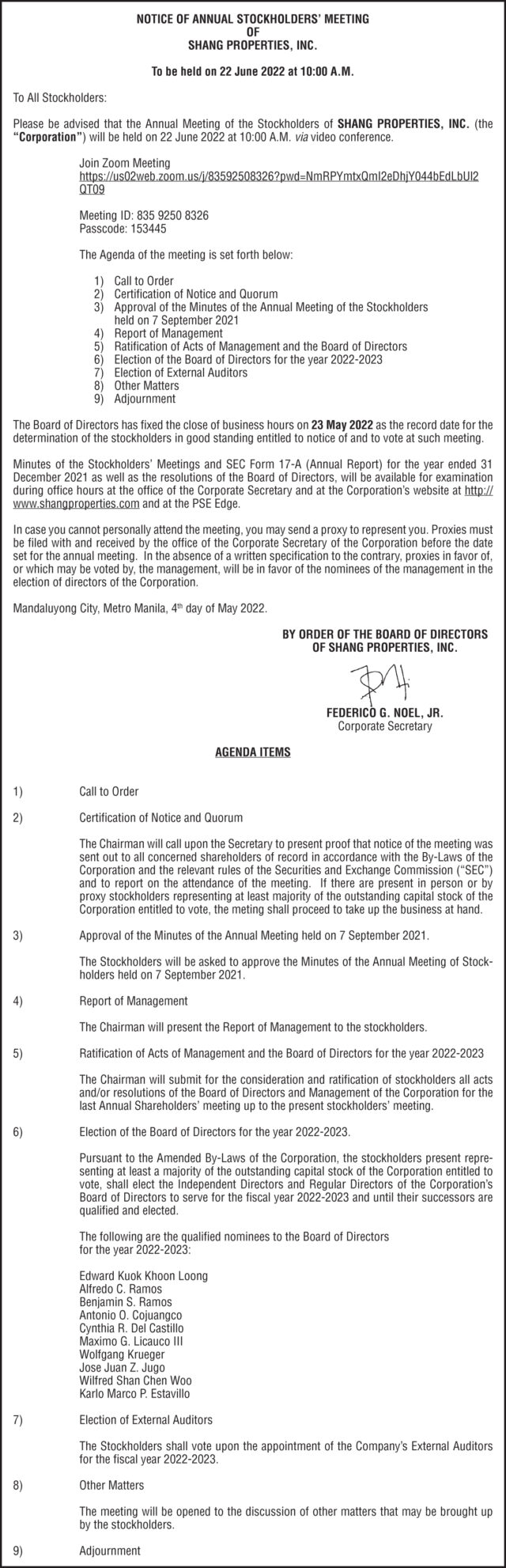
Shang Properties, Inc. announces annual stockholders’ meeting on June 22


Spotlight is BusinessWorld’s sponsored section that allows advertisers to amplify their brand and connect with BusinessWorld’s audience by enabling them to publish their stories directly on the BusinessWorld Web site. For more information, send an email to online@bworldonline.com.

Join us on Viber to get more updates from BusinessWorld: https://bit.ly/3hv6bLA.

ADVERTISEMENT
ADVERTISEMENT