Home Blog Page 6336

Arthaland Corp. announces annual stockholders’ meeting on June 24

NOTICE OF ANNUAL STOCKHOLDERS’ MEETING

NOTICE is hereby given that the 2022 annual stockholders’ meeting of ARTHALAND CORPORATION will be held on 24 June 2022, Friday, 9:00 A.M. and will be convened by the Presiding Officer in Taguig City through remote communication. Attendees must register at https://us02web.zoom.us/webinar/register/WN_Y5YQixvvR5araoU3Dz1uIQ in order to participate during the meeting.

The Agenda for the meeting is as follows:

  1. Call to Order
  2. Secretary’s Proof of Due Notice of the Meeting and Determination of Quorum
  3. Approval of Minutes of the Annual Stockholders’ Meeting held on 25 June 2021
  4. Notation of Management Report
  5. Ratification of Acts of the Board of Directors and Management During the Previous Year
  6. Proposed Amendment of Article SEVENTH of Articles of Incorporation – Decrease of Authorized Capital Stock
  7. Election of Directors (including Independent Directors)
  8. Appointment of External Auditor for 2022
  9. Other Matters
  10. Adjournment

Only stockholders of record on 02 June 2022 will be entitled to further notice of and to vote at this meeting. Electronic copies of the Information Statement which will include the manner of conducting the meeting and the process on how one can join the same, as well as vote in absentia, among other relevant documents, will be made available in www.arthaland.com and the Electronic Disclosure Generation Technology of the Philippine Stock Exchange (PSE EDGE).

WE ARE NOT SOLICITING YOUR PROXY. However, if you cannot personally attend the meeting or participate through remote communication but would still like to be represented thereat and be considered for quorum purposes, you may inform the Office of the Corporate Secretary at the address indicated below or through investor.relations@arthaland.com not later than 17 June 2022 (Friday). You will thereafter be advised the following business day of any further action on your part, which may include accomplishing a proxy.


RIVA KHRISTINE V. MAALA (Sgd.)
Corporate Secretary


Spotlight is BusinessWorld’s sponsored section that allows advertisers to amplify their brand and connect with BusinessWorld’s audience by enabling them to publish their stories directly on the BusinessWorld Web site. For more information, send an email to online@bworldonline.com.

Join us on Viber to get more updates from BusinessWorld: https://bit.ly/3hv6bLA.

Ginga partners with Agrea Philippines

#UpliftingTheLives of the Farmers through partnership and collaboration to organizations with the same goal and mission.

Responsive Business (GRB) as per the European Union’s mandate and it will provide information, events, and resources for farmers, especially the women to succeed in agriculture. This partnership aims to uplift the lives of Filipino farmers by giving them equal opportunities such as livelihood and training, so they will be able to understand their significant roles in agriculture and economic development.

The partnership officially came to life when they had the contract signing in Chef Jessie in Rockwell Club, Makati last May 16, 2022. The event was graced by Ms. Lota Lazarte-Manalo, CEO and President of Ginga, Ms. Cherrie Atilano, CEO and Founder of AGREA Philippines, Ms. Charisse Malazarte, Operations Manager of Ginga and the rest of the agricultural business support team.

“Today, we closed a good partnership that believes in our cause and wants to co-brand with us to help more farmers, supports environmental sustainability, product traceability, and gender-equality in the food and agriculture sector”, Ms. Atilano shared.

Ginga Agrifood was established in 2005 founded on a mission that aspires to manufacture and sell high-quality, all-natural products that use locally-grown ingredients and support Philippine-Made products, as well as the farmers. Their vision is geared towards producing high-quality, all-natural products and expanding their market as wide as what they stand for all while uplifting the lives of the Filipino farmers through providing livelihood in their farm situated at Lobo, Batangas.

“Thank you, Cherrie Atilano and AGREA for this incredible partnership! We will continue to promote women empowerment, strive to improve the lives of our farmers, and give opportunities for livelihood in order to achieve our goal – food security,” -Ms. Manalo shared during the event.

On the other hand, AGREA is currently working with farmers through agribusiness management, teaching farmers how to be entrepreneurs, guiding them in the cropping production process, as well as providing the farmer’s initial capital to increase their capacity to earn, so they can provide for themselves and their families. AGREA team is also educating farmers with the right variety of ginger and turmeric based on the demand of the clients like a market-oriented approach.

Through this partnership, we hope to gather a lot of inspiring stories from our thriving women farmers and support them by providing training, capacity-building, and learning opportunities.

Together, let us help uplift the lives of the farmers and work hand in hand towards achieving food security, gender equality, women and economic empowerment!


Spotlight is BusinessWorld’s sponsored section that allows advertisers to amplify their brand and connect with BusinessWorld’s audience by enabling them to publish their stories directly on the BusinessWorld Web site. For more information, send an email to online@bworldonline.com.

Join us on Viber to get more updates from BusinessWorld: https://bit.ly/3hv6bLA.

ABS-CBN Corporation announces schedule of annual stockholders’ meeting

NOTICE

To the stockholders of ABS-CBN Corporation:

Please take notice that the annual stockholders meeting on July 28, 2022, Thursday, at 8:00 a.m. by remote communications.  The record date of stockholders entitled to attend and vote at the said meeting shall be June 9, 2022.


Spotlight is BusinessWorld’s sponsored section that allows advertisers to amplify their brand and connect with BusinessWorld’s audience by enabling them to publish their stories directly on the BusinessWorld Web site. For more information, send an email to online@bworldonline.com.

Join us on Viber to get more updates from BusinessWorld: https://bit.ly/3hv6bLA.

NG debt rises to record P12.76 trillion

BW FILE PHOTO

THE NATIONAL Government’s (NG) outstanding debt rose to a record-high P12.76 trillion at the end of April, as it continued to ramp up borrowings to support economic recovery from the pandemic.

Preliminary data from the Bureau of the Treasury (BTr) showed outstanding debt inched up by 0.7% from end-March’s P12.68 trillion “due to the net issuance of government securities to both local and external lenders and the depreciation of the local currency against the US dollar.”

Year on year, the debt stock jumped by 16.1% from P10.99 trillion.

National Government outstanding debtThe BTr said the debt pile has risen by 8.8% since the year started, after the government borrowed P1 trillion more.

Of the outstanding debt, the bulk or 70% was obtained domestically, while the rest was from foreign creditors.

Domestic debt stood at P8.94 trillion at end-April, 0.8% up from end-March due to P66.3 billion in net availment of domestic financing. This was 14.4% higher than P7.8 trillion a year earlier, and 9.4% higher than the end-December 2021 level of P8.17 trillion.

Most of the domestic debt stock still came from government securities with P8.64 trillion in April, up 18.8% year on year and 0.8% month on month.

Meanwhile, outstanding external debt jumped by 20.4% year on year to P3.83 trillion at end-April. It inched up 0.4% month on month, and increased by 7.6% from the end-December 2021 level.

“For the period, the increment to external debt was due to the net availment of external loans amounting to P28.56 billion and the effect of peso depreciation against the US dollar amounting to P31.5 billion. This was tempered by adjustments in third currencies amounting to P43.86 billion,” the Treasury said.

The National Government’s guaranteed debt rose by 0.6% month on month to P413.43 billion at end-April due to the net availment of both domestic and external guarantees.

Rizal Commercial Banking Corp. Chief Economist Michael L. Ricafort said the record debt reflected government borrowings made before the elections to fund infrastructure projects, support fuel subsidies and other pandemic response programs.

“In view of the streak of record highs in the government’s outstanding debt in recent months, the intensified tax collections from existing tax laws may not be enough and would inevitably require new tax/fiscal reform measures to curb additional borrowings/debt by the government, especially for the incoming administration,” he added.

Institute for Leadership, Empowerment and Democracy (iLEAD) Executive Director Zy-za Nadine Suzara said the higher debt might be due to the outgoing administration’s infrastructure push.

“It’s hard to say if the ongoing external issues affected the country’s debt, especially since most of the new debt acquired from March to April 2022 were domestic,” she said in a Viber message. “At most, the increased oil prices and overall uncertainty played a role in driving up the need for cash… It’s more plausible that the government is really just cash-strapped to fund the rest of the year’s programs.”

Ms. Suzara said debt is expected to further increase since the government can’t generate enough revenues.

“To plug the budget deficit, the total financing requirement from both domestic and external sources is projected to reach P2.2 trillion. So far, the Treasury’s cash operations report shows that as of end April 2022, it already amounts to around P1.2 trillion,” she said. “If the next administration will not tweak the current fiscal program, then we can expect around P1 trillion more in addition to the current outstanding debt until the end of the fiscal year.”

Bank of the Philippine Islands Lead Economist Emilio S. Neri said debt would be a major challenge for the incoming Marcos administration.

“The new set of economic managers are highly competent and if they can sway our politicians to swallow bitter pills to help us carry out a sound fiscal consolidation plan, we may be able to reverse the deteriorating debt metrics,” he said in a Viber message.

President-elect Ferdinand “Bongbong” R. Marcos, Jr. has tapped Bangko Sentral ng Pilipinas (BSP) Governor Benjamin E. Diokno to head the Finance department.

Mr. Diokno has said he is not in favor of raising taxes even with the record debt pile.

“To me, grow the economy, focus on tax administration first, improve the collection,” he earlier told ABS-CBN News Channel. — Bernadette Therese M. Gadon

PHL likely to miss out on RCEP opportunities as ratification deferred

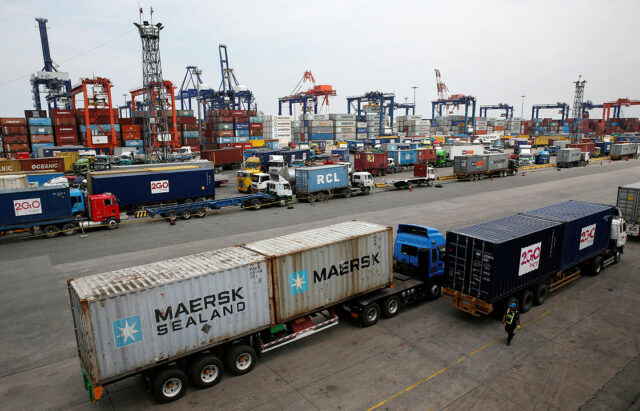
Trucks are seen in a container port in Manila, Philippines May 25, 2016. — REUTERS

By Revin Mikhael D. Ochave, Reporter

THE PHILIPPINES is likely to lose investment opportunities to other Southeast Asian countries if it continues to delay the ratification of the Regional Comprehensive Economic Partnership (RCEP), Trade Secretary Ramon M. Lopez said on Thursday.

“Any delay in ratification means that we run the risk of losing some export markets and the good opportunities in new investments as they shift to participating countries who are already part of the RCEP system,” he said in a Viber message to reporters.

“There may be lost opportunities in investments, and jobs for our people, investments such as in agribusiness, manufacturing for exports, and services.”

The Trade chief made the statement after the Senate on Wednesday failed to give its concurrence to the RCEP before it adjourned sine die despite repeated appeals from economic managers and business groups.

Senate Foreign Relations Committee Chairman Senator Aquilino Martin L. Pimentel III said it would be up to President-elect Ferdinand R. Marcos, Jr. to endorse the mega-trade deal to the Senate when the 19th Congress opens next month.

“The 19th Congress (will) wait for (Office of the President) to endorse the said treaty again to the Senate,” he said in a mobile message to BusinessWorld.

Mr. Pimentel said there was no vote on the RCEP since only 17 senators were present during plenary on Wednesday. The trade deal needed 16 affirmative votes to be ratified by the Senate.

“Two senators are abroad, one quarantined, two went out. In short, many members were not on the floor. We didn’t want to deprive them the chance to participate and or vote on the measure,” he said.

The RCEP, which entered into force on Jan. 1, is a trade agreement involving Australia, China, Japan, South Korea, New Zealand and the 10 members of the Association of Southeast Asian Nations (ASEAN). 

The Philippines is one of three countries that have not ratified the RCEP, along with ASEAN members Indonesia and Myanmar.

Mr. Marcos previously said he wanted to review the trade agreement to protect the local agriculture sector.

While it was “unfortunate” the Senate failed to act on the RCEP, Mr. Lopez remained optimistic that incoming senators will ratify the trade deal.

“RCEP has the support of the incoming economic team and we understand that it will be in their priority agenda… I can only hope for the early ratification in the next Congress. We leave this for the next administration and next Congress,” he said.

Rizal Commercial Banking Corp. Chief Economist Michael L. Ricafort said in a Viber message the delay in the RCEP’s ratification could slow economic recovery, in terms of lower foreign direct investments and exports.

“Since RCEP is the world’s largest free trade agreement (FTA), the country’s membership in RCEP would be a consideration for foreign investors in able to access other RCEP member countries’ export markets at zero or reduced tariffs,” he said.

Makati Business Club Executive Director Francisco “Coco” Alcuaz, Jr. said in a Viber message the incoming Marcos administration should push for the country’s participation in the RCEP to boost trade and investments and create more jobs.

“This is one policy President-elect Marcos should consider leveraging his election win to get and send an open for business signal to the region. The sooner we ratify RCEP, the faster we can compete more fully for trade, investment and jobs. All businesses in all countries are racing to recover. No one is waiting for us,” he said.

European Chamber of Commerce of the Philippines (ECCP) President Lars Wittig said in a Viber message the group continues to support RCEP.

“RCEP membership will yield significant economic benefits for the Philippines and will help accelerate recovery from the mounting debt as well as the adverse economic impacts inflicted by the ongoing COVID pandemic. As such, we urge the incoming legislators to approve the RCEP agreement upon its return to session later this year,” he said.

Meanwhile, Federation of Free Farmers (FFF) National Manager Raul Q. Montemayor said in a statement the Marcos administration should consult with agriculture stakeholders on how they can prepare for the RCEP and take advantage of export opportunities.

“Our sector’s opposition to RCEP is largely due to the mishandling of the issue by the Department of Agriculture (DA)… The DA never acknowledged RCEP’s threats to the sector, despite data showing that our farmers were unprepared and our trade deficits were increasing by billions of dollars every year,” he said.   

“Our farmers and fishers do not wish to remain poor and unproductive and merely rely on government protection to survive,” he said. “They want to increase their yields and lower their production costs so that they can be profitable and competitive, even under trade agreements like RCEP. But they expect the government to be firmly behind them and not just stand idly by, or worse, work against them.”  with inputs from Alyssa Nicole O. Tan

Customs exceeds May collection target by 21%

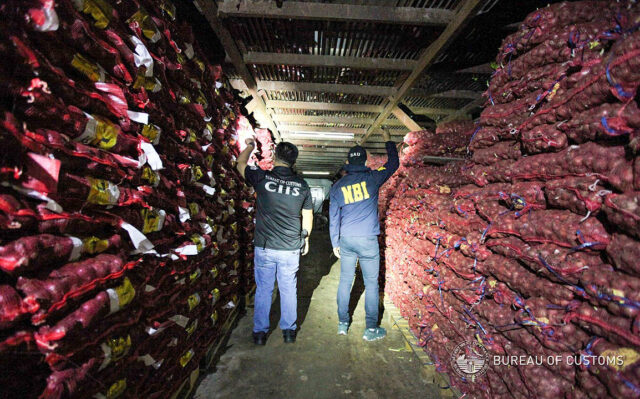
Bureau of Customs (BOC) and the National Bureau of Investigation-Special Action Unit (NBI-SAU) inspected a warehouse in Valenzuela City, March 11, 2022. — COURTESY OF BUREAU OF CUSTOMS

THE BUREAU of Customs (BoC) on Thursday said it exceeded its May collection target by a fifth due to improved valuation and collection efforts as the economy continues to rebound.

In a statement, the bureau said it collected P68.245 billion in May, surpassing the P56.478-billion target by 21%.

May marked the fifth month in a row that Customs has exceeded its monthly collection goals.

Last month’s Customs collection was 38% higher than the same month in 2021.

Citing a preliminary report from the BoC-Finance Service, the bureau said 15 of the 17 collection districts surpassed their monthly target.

These were the ports of San Fernando, Manila, Batangas, Legazpi, Iloilo, Cebu, Tacloban, Cagayan de Oro, Zamboanga, Davao, Subic, Clark, Aparri and Limay, as well as the Manila International Container Port (MICP).

For the first five months, the BoC collected P322.472 billion, nearly half or 47.5% of the P679.226 billion full-year target.

“Among the factors that contributed to the positive performance of the BoC since January this year include the improved valuation, intensified collection efforts, measures preventing revenue leakage and the recovering economy of the country,” the bureau said.

The BoC said it continued to implement border security measures against “undervaluation, misdeclaration and other forms of technical smuggling and collect lawful revenues.”

In 2021, Customs collected P645.77 billion, 4.7% higher than its full-year target of P616.75 billion. This was also 20% higher than P537.69 billion in revenues generated amid the pandemic in 2020. — K.B. Ta-asan

Supply snarls promise Southeast Asia bigger slice of trade pie

Yantian Harbor, Yantian District, Shenzhen, China — CHENGWEI HU-UNSPLASH

TRADE DISRUPTIONS from China’s lockdowns and the war in Ukraine are seen doing for Southeast Asia what the US’ spat with Beijing couldn’t meaningfully do — redistribute supply chains.

“Much of the discussion around dependency on China has been linked to the US-China rivalry,” according to a report by Hinrich Foundation. But the latest “disruptions have broadened the number of countries currently assessing the risks to their supplies.”

This time around, Japan and European Union (EU) members are looking to secure supply linkages without increasing cost, wrote Stewart Paterson, the report’s author and research fellow at the Asia-based foundation set up by US entrepreneur Merle Hinrich to promote sustainable global trade.

The EU and Japan each account for about 12% of total direct investment flows into Southeast Asia for the past five years, compared with China’s 8% share, according to the report. With a per capita gross domestic product (GDP) of $4,500, the 10-member bloc of the Association of Southeast Asian Nations (ASEAN) is also a “far less costly source of labor than China,” Mr. Paterson wrote.

Another reason that sets apart the US-led efforts earlier to reduce dependence on China from what’s happening now is the relation between the state and the companies, he said. Unlike in the US where multinational corporations are “notoriously independent” from government-set agendas, the linkages run much deeper in the EU and Japan.

“The passing of Japan’s new Economic Security Law and the EU’s Global Gateway policy are the most recent manifestations of close government-corporate cooperation in industrial policy,” Mr. Paterson said.

Here are some more key points from the report:

ASEAN’s export performance between 2016 and 2020 has more or less matched that of China. The bloc’s exports grew by 21% to $1.39 trillion during the period, while China’s grew by 23% to $2.59 trillion.

The ASEAN bloc has been enmeshed in the global trading system and has trade-to-GDP ratios well above the global average.

Currently, much of the growth in ASEAN trade has been with China itself. The bloc’s exports to China grew by 51% between in the four years to 2020, while exports to the rest of the world grew by 16%. — Bloomberg

Razon firm ‘poised’ to control Malampaya project

RAZON-LED Prime Infrastructure Holdings, Inc. (Prime Infra) said on Thursday that it “is poised to acquire a controlling stake” in the Malampaya gas-to-power project, a move that is likely to be decided on by the incoming administration.

In a media release, Prime Infra said that the acquisition “has kicked off” and is subject to the consent of the Department of Energy (DoE) and state-led Philippine National Oil Co. Exploration Corp. (PNOC EC).

Prime Infra Chairman Enrique K. Razon, Jr. said the project “will allow us to contribute more to the country’s transition from expensive and volatile coal and imported fuel prices to affordable cleaner and domestic energy resources like natural gas.”

Prime Infra referred to the seller as Dennis A. Uy, chairman of Udenna Corp., whose business unit acquired the 45% stake in the deepwater project held by Chevron Malampaya LLC. The deal, forged in October 2019, was approved by the DoE in March 2021.

Another Udenna unit has a pending deal to acquire the 45% stake of Shell Philippines Exploration B.V. (SPEx) in an agreement forged in May 2021. The acquisition awaits the approval of the DoE, which in turn is waiting for the consent of PNOC EC.

PNOC EC holds the remaining 10% of the Malampaya project located northwest of Palawan island, West Philippine Sea. It previously withheld its consent to the SPEx sale, as disclosed by its top official in a Senate hearing held late last year.

In the media release, Prime Infra quoted Mr. Uy as saying: “We look forward to this opportunity to partner with Prime Infrastructure and PNOC EC, as we explore more ways to fulfill our common vision to make Malampaya sustain its capability to meet the urgent energy security need of the Philippines.”

Udenna has yet to respond to a request for confirmation of the deal.

A source at SPEx said in a text message that the sale transaction with Udenna’s Malampaya Energy XP Pte. Ltd. “remains active.” SPEx is the operator of the Malampaya gas project under Service Contract 38, which expires in 2024.

A source at Prime Infra who asked not to be named said in a phone interview that “realistically” the deal is not likely to be approved by officials of the current administration.

“Definitely, we don’t see it completing within the month,” the source said, referring to the end of the Duterte administration by June 30, 2022.

The source added that a “term sheet” after negotiations among parties will determine the exact share to be acquired by Mr. Razon’s group and from which entity.

But the source confirmed that Mr. Razon was not in talks with PNOC EC for the latter’s stake. “We don’t know if they are selling that.”

Prime Infra sees its entry into the natural gas industry as aligned “with its purpose to create better lives and resilient economies through critical infrastructure coupled by its aspiration to help its customers transition to cleaner energy resources to fuel the economic growth of the Philippines.”

“Malampaya’s service contract is set to expire in 2024 making it critical for Prime Infra’s entry to be able to continue operating the project while applying for an extension so it can invest in its expansion, which will sustain the economic and social benefits that Malampaya is providing for the country. The transition of the operations of Malampaya is critically urgent,” it said.

Prime Infra also said that along with Udenna as the “new operators” of the project after SPEx, they would need to plan for Malampaya’s expansion “to ensure the continuity of the production as long as the reserves support it.”

Senator Sherwin T. Gatchalian, who headed Senate hearings last year on the Malampaya share sale, described the offshore gas field as a “critical energy asset,” powering more than 4.5 million homes and businesses in Metro Manila and nearby areas.

“Malampaya has also provided significant income to the government, totaling P290.76 billion from January 2002 until June 30, 2021,” he previously said. — Victor V. Saulon

Depp scores near-total victory in US defamation case against ex-wife Heard

ACTOR Johnny Depp embraces his attorney Benjamin Chew after closing arguments during his defamation case against ex-wife Amber Heard, in the courtroom at the Fairfax County Circuit Courthouse in Fairfax, Virginia, US, May 27. — STEVE HELBER/POOL VIA REUTERS

ACTOR Johnny Depp won more than $10 million in damages on Wednesday, achieving a near-total victory in a defamation suit against ex-wife Amber Heard to cap a six-week trial featuring graphic testimony about the stars’ soured relationship.

A seven-person jury in Virginia also ruled for Ms. Heard on one counterclaim against Mr. Depp. The Pirates of the Caribbean film star depicted the decision as a vindication, and his former wife said it was “a disappointment.”

Jurors awarded Mr. Depp $15 million in damages from Ms. Heard, which the judge reduced to $10.35 million to comply with state limits on punitive damages. The panel ordered Mr. Depp to pay Ms. Heard $2 million in damages.

Mr. Depp, 58, had sued Ms. Heard for $50 million and argued that she defamed him when she called herself “a public figure representing domestic abuse” in a newspaper opinion piece.

Ms. Heard countersued for $100 million, saying Mr. Depp smeared her when his lawyer called her accusations a “hoax.”

Mr. Depp denied hitting Ms. Heard, 36, or any woman and said she was the one who turned violent in their relationship. He told jurors the allegations from Ms. Heard, best known for her role in Aquaman, had cost him “everything.” A new Pirates movie was put on hold and Mr. Depp was replaced in the Fantastic Beasts film franchise, a Harry Potter spinoff.

“The jury gave me my life back. I am truly humbled,” Mr. Depp, who watched the verdict from Britain, said in a statement.

“The best is yet to come and a new chapter has finally begun,” he added, ending with the Latin phrase “Veritas numquam perit. Truth never perishes.”

Ms. Heard, seated in the courtroom between two of her lawyers, looked down as the verdicts were read.

“The disappointment I feel today is beyond words,” she said in a statement. “I’m heartbroken that the mountain of evidence still was not enough to stand up to the disproportionate power, influence and sway of my ex-husband.”

“I’m even more disappointed with what this verdict means for other women,” she added. “It is a setback.”

Mr. Depp faced a different outcome in Britain less than two years ago, when he sued the Sun tabloid for calling him a “wife beater.” A London High Court judge ruled that he had repeatedly assaulted Heard.

JURY HEARS ABOUT COUPLE’S CLASHES
The two met in 2011 while filming The Rum Diary and wed in February 2015. Their divorce was finalized about two years later.

At the center of the legal case was a December 2018 opinion piece by Ms. Heard in the Washington Post. The article did not mention Mr. Depp by name but his lawyer told jurors it was clear that Ms. Heard was referring to him.

The jury agreed with all of Mr. Depp’s defamation claims, which cited a passage in the article and headline that read: “I spoke up against sexual violence — and faced our culture’s wrath. That has to change.”

Jurors rejected two of Ms. Heard’s three counterclaims. They concluded she was defamed when an attorney for Mr. Depp told a media outlet that Ms. Heard staged property damage to show to police after an alleged fight.

“Amber and her friends spilled a little wine and roughed the place up, got their stories straight under the direction of a lawyer and publicist,” the statement said in part.

During six weeks of testimony, Ms. Heard’s attorneys argued that she had told the truth and that her comments were covered as free speech under the US Constitution’s First Amendment.

Jurors listened to recordings of the couple’s fights and saw graphic photos of Mr. Depp’s bloody finger. He said the top of the finger was severed when Heard threw a vodka bottle at him in 2015.

Ms. Heard denied injuring Mr. Depp’s finger and said Mr. Depp sexually assaulted her that night with a liquor bottle. She said she struck him only to defend herself or her sister.

Testimony was livestreamed widely on social media, drawing large audiences to hear details about the couple’s troubled relationship.

Mr. Depp’s lawyers filed the US case in Fairfax County, Virginia, because the Washington Post is printed there. The newspaper was not a defendant. — Reuters

edotco Group building around 500 towers in PHL this year

By Arjay L. Balinbin, Senior Reporter

ISOC edotco Towers, Inc., one of two tower companies acquiring some of the PLDT group’s telecom towers, aims to build nearly 500 towers in Luzon this year, as part of its goal to help the government in achieving 66,000 new tower builds by 2026, a company official said.

“I intend to build close to 500 this year. We’ve started already,” ISOC edotco Towers Acting Country Managing Director Suraj Narayanan told BusinessWorld on Thursday.

“The 500 towers are concentrated in Calabarzon (Cavite, Laguna, Batangas, Rizal, and Quezon) and South Luzon, and with the recent acquisition in Visayas and Mindanao, we will reach those areas also,” he added.

The PLDT group announced in April that its subsidiaries, Smart Communications, Inc. and Digitel Mobile Philippines, Inc., had signed sale and purchase deals in connection with the sale of 5,907 telecom towers and related passive telecom infrastructure for P77 billion to the subsidiaries of international telecommunications infrastructure services companies edotco Group and EdgePoint.

The 5,907 towers — almost half of PLDT’s total tower portfolio — are spread across the Philippines, with 2,973 being acquired by ISOC edotco Towers, a subsidiary of edotco Group, and 2,934 towers by Comworks Infratech Corp., a subsidiary of EdgePoint.

On Wednesday, PLDT, Inc. announced the first closing on its sale and leaseback towers agreement involving 3,012 telecom towers, or more than half of the towers being monetized by the group. It received corresponding cash consideration of approximately P39.2 billion.

ISOC edotco Towers’ Mr. Narayanan said that with its acquisition of PLDT’s telecom towers, it expects to manage close to 3,500 towers in the country by the end of the year.

In 2019, the tower company said it would build 70 common towers in the province of Cavite.

Adlan Tajudin, edotco Group’s chief executive officer, said that when the pandemic struck the Philippines in 2020, processing of tower permits was halted due to the closure of offices.

“Essentially, the rollout slowed down tremendously during these two years. I think in 2022, permits are coming out again,” he added.

With the common tower policy in place, tower companies in the Philippines now only need to secure a maximum of nine permits, down from 27 to 28 permits previously, according to Mr. Narayanan.

“It only takes between three to four months to get the permits from 10 to 12 months previously,” he added.

Mr. Tajudin said of the Philippine market: “The Philippines is a very strategic market for us, and part of our plan is actually portfolio rebalancing, moving from frontier to emerging markets.”

“So, our presence in the Philippines is very important, one for portfolio mix and second for growth in the Philippines, where we see that there’s going to be a phenomenal growth on tower infrastructure,” he added.

Aside from the Philippines, the edotco Group also manages telecom towers in Malaysia, Bangladesh, Cambodia, Sri Lanka, Myanmar, Pakistan and Laos.

With the recent tower acquisition in the country, Mr. Tajudin said the Philippines “will contribute between, initially, 15% to our total revenue, and that should grow over a period of time given the growth potential that we see in the Philippines.”

“Our biggest is still our home market, Malaysia,” he noted.

The Department of Information and Communications Technology has been pushing for telcos to share infrastructure since 2017, saying every tower in the country serves more than 7,000 subscribers, as opposed to the ideal of having 1,000 subscribers per tower, and the usual 2,000 subscribers per tower in countries with faster internet.

TBA Studios gets rights to Cannes winner Triangle of Sadness

DOLLY DE LEON plays Abigail, in the film Triangle of Sadness.

TBA Studios has acquired the exclusive Philippine theatrical rights to this year’s Cannes Film Festival Palme d’Or winner Triangle of Sadness. A theatrical release date in the Philippines has yet to be announced.

Directed by Swedish filmmaker Ruben Östlund, Triangle of Sadness follows fashion model couple as they embark on a luxury cruise adventure. All appears fine at first, until the cruise ends catastrophically and they wind up stranded on a desert island with a group of billionaires and a cleaning lady. In the fight for survival, old hierarchies are turned upside down since the cleaning lady is the only one who knows how to fish.

The movie received an eight-minute standing ovation during its premiere at the Cannes Film Festival. Film critic Robbie Collin gave it five stars and called it “a bold and brilliant film.” ING’s Ryan Lesto wrote, “Triangle of Sadness is a comedic tour de force from a director who really understands how to wage a tremendously funny class war. Mr. Östlund’s cringe-inducing humor pairs well with some genuine laugh-out-loud moments to create an all-around hilarious social satire.”

Critics also praised the performances of the ensemble cast, most notably Filipino actress Dolly de Leon’s breakout performance as Abigail, the yacht’s cleaning lady. Variety’s Clayton Davis describes her performance as “Oscar-worthy,” suggesting that Ms. De Leon’s defining supporting performance deserves recognition from the Academy Awards in the US.

A veteran actress in theater and television, Ms. De Leon describes herself as a “bit player” and is known for playing a variety of roles in local dramas.

The movie also stars Harris Dickinson, Charlbi Dean, Woody Harrelson, Henrik Dorsin, Zlatko Buric, Iris Berben, Sunnyi Melles, Vicky Berlin, and Oliver Ford Davies.

Triangle of Sadness is produced by Plattform Produktion and Coproduction Office.

Seaoil, Zamboanga economic zone to build bulk depot

SEAOIL Philippines, Inc. is investing P740 million into the construction of a bulk terminal in an economic zone in Zamboanga City, the independent oil firm said on Thursday.

In a media release, Seaoil Chief Operating Officer Stephen L. Yu said that the partnership with Zamboanga Economic Zone and Freeport Authority (ZFA) is more than just a business decision for the company.

“By opening a terminal here in Zamboanga City, we can make our quality products more accessible to retail customers and commercial industries in the area,” said Mr. Yu, who is also the company’s president for commercial business.

The depot, which is designed for 18 million liters of storage capacity, can receive direct importations. It is seen to widen Seaoil’s capability in Mindanao to directly import petroleum products.

Seaoil quoted ZFA Chairman Raul M. Regondola as saying, “We welcome this partnership with open arms as this is an excellent opportunity to pump more economic activity into the city. We also look forward to the jobs this terminal will bring to our locals.”

The investment marks Seaoil’s foray into an economic zone, with the project breaking ground on May 25, 2022. The partnership with ZFA firms up a 50-year agreement with the ecozone to create development projects and activities for terminal and jetty operations.

The depot’s leased area covers 2.12 hectares, with an option for expansion. The terminal and jetty development is set to be completed next year. Operations are projected to begin in the fourth quarter of 2023.

“The construction and operation of the facility will also provide more jobs and create more economic activities in the local community,” Mr. Yu said.

The project is expected to generate more than 300 jobs during construction and operations, 90% of which will come from the local communities of Zamboanga City.

Mr. Yu said that as Seaoil expands its retail footprint in southern Mindanao, more consumers from Zamboanga, Jolo, Sulu, and Tawi-tawi can experience the company’s innovations such as its mobile app.

The fuel-saving app, PriceLOCQ, protects users from price hikes by enabling them to buy and store Seaoil fuels for later use while prices are lower. It currently has more than 200,000 active users.

Last year, it launched LubeServ, its own branded service center. It provides automotive repairs and lubricant services using Seaoil products. It has its home service version called LubeServ on Wheels for customers who wish to have repairs and mechanics done at their preferred location.

Seaoil has more than 650 branches nationwide, and targets to hit 1,000 branches in 2023. — VVS

ADVERTISEMENT
ADVERTISEMENT