Home Blog Page 6277

Deciding between a loyal old-timer and a top-performing newcomer

I’m a vice-president who is torn between promoting an average-performing old-timer (OT) and a newcomer with star qualities (SQ) to a vacant managerial post. The human resource (HR) department does not have a clear policy on promotion but recommended OT. I rejected this advice out of my belief that meritocracy should prevail over seniority. How do we resolve this matter?  — Yellow Submarine.

The most objective and practical way is to send both OT and SQ through an evaluation process by a third party, using tools like psychological assessments, job simulation games, ability and aptitude tests. It may cost your organization some money but the result can be worth if you want to assess likely on-the-job performance.

As a department head, you must understand the dynamics of each and every relationship in your organization. It could be that the HR department is influenced by friendship with OT. We can’t say for sure. That’s one reason why you need to be very careful with your choice.

Of course, loyalty as displayed by OT is an important ingredient in any work relationship, except that any hiring decision must balance the need for loyalty with the overall requirements of the job. It is possible to interpret OT’s long service as reflecting an inability to get a job elsewhere.

If this is the case, then a consistent performer like SQ, who could serve as a role model, might be more welcome. On the other hand, OT and the rest of your department may have been so accustomed to a relaxed work environment that SQ might be treated like a pariah if he rocks the boat by demanding more performance.

If you aren’t aware of these things, maybe you don’t have your ear to the ground.

MERIT TAKES PRECEDENCE
You need to make a firm and objective decision that keeps future issues from arising. Now might be the right time to create or review a management policy with the help of the HR department. Put it in black and white that merit takes precedence over seniority. Seniority should come in only to settle ties between equally-qualified candidates.

Here are some ideas that you can use to create a healthy working environment:

One, job vacancies must be announced to all workers. Go public. Explain the requirements of the job, the required qualifications and the timeline for submitting applications. This does not mean ignoring those who do not indicate their interest. If this happens, talk to people who are next in line and find out what their career plans are.

Two, promotion policy must align with succession planning. You can’t have one without the other. If there’s a vacancy, the succession plan (aka replacement plan) is the first document you should consult. Unlike the promotion policy, a succession plan must be kept confidential to avoid adversely affecting the morale of people not on the list.

Last, employee career management and career planning. This is the job of all line managers and department heads who must practice proactive communication with their direct reports. This requires a regular engagement dialogue to help discern the employees’ career interests and assist them through a multi-pronged training and coaching program.

MANAGING MOTIVATION
People management is the heart and soul of every organization. In order for your business to succeed, it’s important to manage people effectively, by motivating them not just with big money and handsome perks. You should also do so with zero-cash motivational approaches that let them use their talent to full potential.

While the employment contract carries with it specific expectations from both employees and management, there are many unwritten rules, like treating everyone with due respect and trust.

Everyone deserves a happy, healthy, secure and safe working environment. The employees themselves must be the ones making the environment sustainable. Anything less than this would represent a clear failure in motivating people. It may lead to the promotion of deadwood over candidates who consistently perform like stars.


Consult with Rey Elbo via Facebook, LinkedIn or Twitter or send your workplace questions to elbonomics@gmail.com or via https://reyelbo.consulting

Cryptocurrency — a risk asset

JUST a few days ago, the total cryptocurrency market capitalization fell below $1 trillion for the first time since February 2021, according to data from CoinMarketCap.com. This happened against the backdrop of a bull run of Bitcoin in 2021, which ended 70% up at the end of the year. During the lockdown-stricken year of 2020, Bitcoin gained more than 300%!

But in 2022, crypto investors are embracing “a general flight to safety across the board in most asset classes,” said Alex Reffett, co-founder of wealth management firm East Paces Group, as reported in Forbes. “Collectively, investors have shown more interest in value-based investments and less in speculative stocks and alternative ‘store of value’ investments.”

One major source of the negative Bitcoin sentiment is the meltdown of Celsius, a decentralized finance (DeFi) platform and one of the largest crypto lenders. The company gathers crypto deposits from retail customers and loans them out to other investors and financial institutions, much like what a conventional bank does. Investors earn yield from the revenue Celsius generates from crypto borrowers.

In recent days, we have seen the consequence to consumers when unregulated crypto firms play in the highly regulated financial markets. Within the last few days, Celsius experienced an old-fashioned run on the bank and halted customer withdrawals last Sunday. For a variety of reasons, customers lost confidence in the Crypto firm.

One reason is the Federal Reserve’s raising of interest rates twice this year and is planning to raise them again soon. The demand for cryptocurrencies and Bitcoin apparently dwindles when the Fed raises interest rates, just like its impact on tech stocks.

The sustained jacking up of interest rates to fight the historic surge in inflation is uncharted territory for cryptocurrency. In fact, Interactive Brokers’ Chief Strategist Steve Sosnick said, “We have no historical precedent for how Bitcoin and other cryptos might act if we enter a sustained period when central banks actively drain liquidity; Those tend to be tough times for investors, and riskier assets tend to underperform safer ones,” as quoted in Forbes.

These highlight the fact that Bitcoin and cryptocurrencies are risk assets — investments that experience a substantial amount of volatility when subjected through the usual market forces. Other risk assets are stocks, commodities, currencies, and high-yield bonds, which frequently experience difficulties in prices under almost any market conditions.

That’s why Microsoft co-founder Bill Gates described cryptocurrencies and non-fungible tokens (NFTs) as something that’s “100% based on greater fool theory.” He was “referring to the idea that overvalued assets will go up in price when there are enough investors willing to pay more for them” as reported by CNBC. “I’m used to asset classes… like a farm where they have output, or like a company where they make products,” Gates said in a CNBC report.

Gates’ pronouncements resonate well with astute investors. In 2017, I have written and spoken advisories about cryptocurrencies and Bitcoin. I likened investing in Bitcoin to gambling — deciding to put one’s money into something with low to moderate knowledge of the investment and extremely substantial risk.

Warren Buffett said that gamblers are “encouraged when they see some successes around.” But it “has terrible odds attached.” Gamblers lose more when they erroneously assume that the more they lose now, the better the chances of winning in the future; hence they make more bets. This is what has been happening with Bitcoin and other cryptocurrencies over the last years. Only a few make money relative to those ignorant masses that blindly speculate on the risky asset.

Is it wise to invest in Bitcoin? The answer is no. It’s never an investment in the first place. Just like rare baseball cards, Bitcoin is being driven to absurd prices by speculators, misinformed investors, and even gamblers who think they could sell them to someone else for more money in the future.


Reynaldo C. Lugtu, Jr. is CEO of Hungry Workhorse, a digital and culture transformation consulting firm. He is the country representative of the Institute of Change and Transformation Professionals Asia (ICTPA) and fellow at the US-based Institute for Digital Transformation. He teaches strategic management in the MBA Program of De La Salle University. The author may be e-mailed at rey.lugtu@hungryworkhorse.com

Tax court declines to review telco firm’s VAT refund claim

THE Court of Tax Appeals (CTA) affirmed its division ruling denying the appeal of Lantro Philippines, Inc. to review and refund its excess value-added tax (VAT) worth P11.9 million for the four quarters of 2014.

In a 15-page decision on June 9 and made public on June 14, the CTA full court agreed with the First Division as it ruled that the company did not file its petition within the 30-day period prescribed by law.

“Petitioner’s (Lantro) claim was filed out of time, and the court in division did not err in dismissing the petitioner for review for lack of jurisdiction,” according to a copy of the ruling penned by CTA Associate Justice Erlinda P. Uy.

The tribunal said it need not address the issues presented since the late filing justified an instant dismissal of the petition.

Lantro had filed its petition for review on Aug. 23, 2016, which was beyond the 30-day period to appeal a tax decision.

Under the country’s revenue code, if the commissioner of internal revenue rejects or fails to act on a claim for refund, the taxpayer is given a 30-day period from the receipt of an adverse decision or ruling to file a petition for review with the tax court.

The CTA en banc said that taxpayer-claimants should act “judiciously and with circumspection” in complying with the prescribed periods to file a judicial claim, which affects the court’s jurisdiction on the claim for refund. It added that an administrative claim for refund must be filed within two years after the end of a taxable quarter when the sales were made.

The company argued it had refiled its refund claim on Feb. 26, 2016, after it initially filed its claim on Jan. 7 of the same year.

“Surely, the petitioner cannot expect the court to assume that it re-filed its administrative claim absent any clear and definite proof that it abandoned its initial administrative claim,” the court said.

The petitioner is a telecommunications company based in Pasig City that provides its clients with installation, maintenance, and support services. — John Victor D. Ordonez

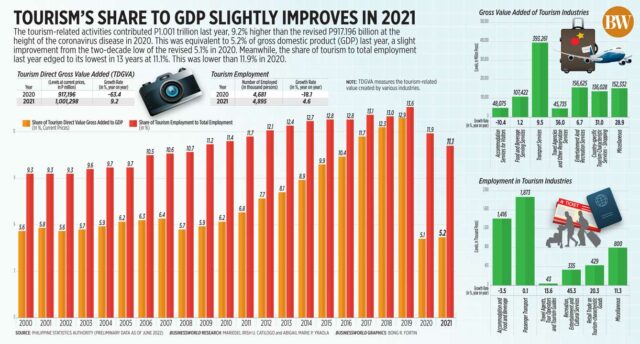
Tourism’s share to GDP slightly improves in 2021

THE SHARE of the tourism industry to the Philippines’ economic output inched up in 2021, as domestic travel restrictions eased alongside the increase in coronavirus disease 2019 (COVID-19) vaccination rates. Read the full story.

Tourism’s share to GDP slightly improves in 2021

How PSEi member stocks performed — June 16, 2022

Here’s a quick glance at how PSEi stocks fared on Thursday, June 16, 2022.


PHL shares up on bargain hunting after Fed hike

REUTERS

SHARES climbed on Thursday on bargain hunting and as Wall Street cheered the US Federal Reserve’s decision to hike interest rates by 75 basis points (bps), bigger than increases made at previous meetings, to fight rising inflation.

The benchmark Philippine Stock Exchange index (PSEi) rose by 73.59 points or 1.16% to close at 6,393.01 on Thursday, while the broader all shares index ended higher by 25.54 points or 0.74% to 3,435.24.

“Philippine shares rebounded following the Federal Open Market Committee’s rate hike announcement. The Fed announced a 75-bp rate hike to conclude its two-day policy-setting meeting, which had been widely anticipated by the market, but it was Fed Chair Jerome Powell’s willingness to do another hike of that size to tamp down inflation back to its 2% objective that surprised markets,” Regina Capital Development Corp. Head of Sales Luis A. Limlingan said in a Viber message.

“The local market bounced back this Thursday as investors hunted for bargains from the preceding day’s losses… The positive spillovers from Wall Street’s overnight performance also helped in the rebound. This is as Federal Reserve Chairman Jerome Powell said that it is still possible for the US economy to avoid a recession amid their monetary tightening,” Philstocks Financial, Inc. Senior Research Analyst Japhet Louis O. Tantiangco said in a Viber message.

The Fed on Wednesday approved its largest interest rate increase in more than a quarter of a century to stem a surge in inflation, Reuters reported.

Officials also envision steady rate increases through the rest of this year, perhaps including additional 75-bp hikes.

Wall Street rallied on Wednesday after the Fed’s announcement. The Dow Jones Industrial Average rose 303.70 points or 1% to 30,668.53; the S&P 500 gained 54.51 points or 1.46% to 3,789.99; and the Nasdaq Composite added 270.81 points or 2.50% to end at 11,099.16.

Back home, Regina Capital’s Mr. Limlingan said the April remittances report also helped buoy the market. Cash remittances sent home by overseas Filipino workers surged by 3.9% in April. The growth was the fastest since the 5.1% print seen in November last year.

The majority of sectoral indices ended in the green, except for services, which declined by 35.05 points or 2.04% to 11,681.98.

Meanwhile, property rose by 69.51 points or 2.36% to 3,005.79; holding firms gained by 99.93 points or 1.72% to 5,900.30; financials went up by 25.31 points or 1.63% to 1,573.04; industrials climbed by 79.67 points or 0.90% to 8,932.97; and mining and oil added 93.63 points or 0.80% to end at 11,681.98.

Decliners narrowly beat advancers, 107 versus 103, while 48 names ended unchanged.

Value turnover decreased to P5.60 billion on Thursday with 647.17 million shares changing hands from P11.03 billion with 3.65 billion issues seen the previous trading day.

Net foreign selling dropped to P295.08 million from P1.22 billion on Wednesday. — Luisa Maria Jacinta C. Jocson with Reuters

Peso weakens further after Fed hikes rates by 75 bps

BW FILE PHOTO

THE PESO weakened further against the dollar on Thursday after the US Federal Reserve delivered its biggest rate hike since 1994.

The local unit closed at P53.47 versus the greenback, down by 3.5 centavos from its P53.435 finish on Wednesday, data from the Bankers Association of the Philippines showed.

The peso opened Thursday’s session at P53.30 against the dollar. Its intraday best was at P53.29, while its worst showing for the day was at P53.495 versus the greenback.

Dollars exchanged went down to $1.141 billion on Thursday from $1.164 billion on Wednesday.

The local unit declined after the Fed hiked its benchmark interest rates by 75 basis points (bp), Rizal Commercial Banking Corp. Chief Economist Michael L. Ricafort said in a Viber message. The bigger hike came after US inflation hit a 40-year high in May.

The Fed on Wednesday said officials also expect to raise rates steadily this year, with more 75-bp hikes still on the table.

The US central bank has hiked borrowing costs by a total of 150 bps since starting its tightening cycle in March.

For today, a trader said the peso may drop further on expectations of a dovish statement from the Bank of Japan (BoJ). The BoJ is widely expected to keep its ultra-low interest rate targets unchanged at its two-day review that ends on Friday.

Mr. Ricafort gave a forecast range of P53.35 to P53.50, while the trader expects the peso to move from P53.30 to P53.50 per dollar. — KBT

LRT-MRT-Subway Common Station expected to be complete this month

DEPARTMENT OF TRANSPORTATION

THE Transportation department said on Thursday that the Unified Grand Central Station, or Common Station, in North EDSA, Quezon City, is set to be completed this month, before President Rodrigo R. Duterte leaves office.

The construction of the project, which will interconnect Light Rail Transit Line 1 (LRT-1), Manila Metro Rail Transit System Line 3 (MRT-3), Metro Rail Transit Line 7 (MRT-7), and Metro Manila Subway, is currently being “accelerated,” the department said in a statement.

“After eight years of delay, the Common Station is expected to be completed this June with the remainder of the project now in full swing,” it added.

The project features an intermodal integrated system, allowing departing passengers of the Common Station to catch buses, jeepneys, and taxis.

Once completed and opened, the Common Station, which features a 13,700-square meter concourse area, is expected accommodate up to 500,000 passengers daily, the department said.

In January 2017, the government and private companies involved in the project signed a memorandum of agreement after years of deadlock on the matter of the project’s location.

The agreement was signed by Transportation Secretary Arthur P. Tugade; Public Works Secretary Mark A. Villar; Metro Pacific Investments Corp. Chairman Manuel V. Pangilinan; SM Prime Holdings, Inc. Director Hans T. Sy; Ayala Corp. Chief Executive Officer Jaime Zobel de Ayala; and San Miguel Corp. President and Chief Executive Officer Ramon S. Ang.

Under the agreement, the project was built at a compromise site near the original 2009 site in front of SM Annex (North EDSA) and the 2014 location near Ayala-owned TriNoma Mall.

“Within the remaining 15 days of the Duterte administration, more projects across the archipelago will be completed and initiatives to be implemented to achieve unprecedented heights of connectivity and mobility to make the Filipino life more convenient and comfortable,” the Transportation department said. — Arjay L. Balinbin

Angara says PHL debt of P12.7 trillion still ‘reasonable’

PHILSTAR FILE PHOTO

THE PHILIPPINES’ debt of P12.7 trillion is still “reasonable,” a ranking Senator said, in the context of increased global borrowing during the pandemic.

The government was “responsible” in its borrowing, according to Senator Juan Edgardo M. Angara, who chairs the Senate Finance Committee, speaking in an interview with One News on Thursday. He said the administration did a “fair job” as it did not overstep the country’s bounds by borrowing “too much.”

“I think we’re still on the side of reasonable, a little bit over our predicted 60% (of gross domestic product)… but in times of pandemic, the boundaries move as well,” he added, noting that borrowing was inevitable considering the need to provide subsidies and implement stimulus programs.

The debt-to-GDP ratio was 63.5% as of the end of the first quarter, exceeding the 60% threshold considered by multilateral lenders to be manageable for developing economies.

The pre-pandemic level was 39.6% of GDP at the end of 2019.

Finance Secretary Carlos G. Dominguez III has said that the Philippines may need at least 10 years before its debt-to-GDP ratio returns to about 40%.

The senator said that with the right mix of policy and economic incentives for the private sector, recovery is assured and revenue increased.

As the budget grows every year, Mr. Angara said the challenge is to make revenue grow proportionally.

However, Mr. Angara said increasing taxes may not be the solution as the people are still suffering from the after-effects of the pandemic. “You want to grow your economy in this period. You want it to recover,” he said, “and increased taxation might be sending the wrong message during this time.”

Instead, he recommended making adjustments to government spending, noting that Congress will focus on funding essentials during the deliberations for the 2023 General Appropriations Act.

“I think that one way of looking at it is attacking the spending side, but you have to be more judicious I suppose in your expenditure so that those debts can be paid (to bring) public debt (to manageable levels),” Mr. Angara said. The Philippines should spend “on things which really benefit the people and which will pay dividends over the long term, so things like education, health, infrastructure. Those are the things which should not be compromised.”

“What matters more is how you spend that debt and whether it’s sustainable,” he added.

Economic managers target GDP growth of 7-8% this year.

Mr. Dominguez has said the Philippines needs to grow an average of 6% annually in the next six years to effectively reduce debt. — Alyssa Nicole O. Tan

Power consumers pay only 12% VAT overall, ‘no double taxation’ — DoF

BW FILE PHOTO

THE Department of Finance (DoF) said on Thursday that power consumers pay 12% value-added tax (VAT) only once, following remarks by the head of the Energy Regulatory Commission (ERC) that VAT should only be collected from power distributors.

“There is no double taxation in the electric power industry. Because the EPIRA (the Electric Power Industry Reform Act) Law has unbundled the pricing at each stage of the electricity production, the VAT is imposed separately in each stage of production,” Finance Secretary Carlos G. Dominguez III said in a statement. “But at the end of the day, if you look at the total bill, the entire electricity service is charged 12% VAT on the side of the consumer.”

ERC Chairperson and Chief Executive Officer Agnes VST Devanadera said last month that VAT should only be imposed on distribution utilities, instead of on power generation, transmission, and distribution.

Ms. Devanadera also proposed to remove the 12% VAT imposed on the generation charge.

Mr. Dominguez said that for double taxation to occur, the tax must be imposed twice for the same goods, for the same purpose, by the same taxing authority, and within the same jurisdiction.

Under EPIRA, the pricing of electricity has been unbundled, Mr. Dominguez said.

“With this unbundled pricing mechanism, VAT is imposed on every level of the value chain and not integrated vertically like other sectors,” Mr. Dominguez said. This means that “the VAT paid on the distribution charge only accounts for the value-added in distributing the electricity, and does not include the generation and transmission of power.”

He added that a VAT exemption on electricity is not the solution for reducing power bills.

“If the intention is to unburden consumers, the next administration needs to review the existing policies on power generation pricing,” Mr. Dominguez said, adding that removing the 12% VAT would not translate to a 12% reduction in prices.

He said that VAT-exempt businesses do not charge output VAT, and are unable to recover the VAT they pay on their inputs.

“Thus, this input VAT becomes an additional cost for them, and to recover this, it is passed on to the consumers.”

The DoF said that electricity costs in the Philippines are higher compared to its neighbors in the Association of Southeast Asian Nations (ASEAN), due to the higher cost of power generation.

Manila Electric Co. said last week that power rates will rise in June, with households consuming 200 kilowatt-hours (kWh) getting billed expecting to pay about P80 more. 

It said prices are climbing due to the higher usage of liquid fuel and coal prices that have risen by an average of 23%.

“We cannot afford to give another VAT exemption as this leads to distortionary and less equitable tax systems,” Mr. Dominguez said. “VAT exemption creates discrimination among similar businesses. Thus, it should remain broad-based and allow for few exemptions.”

The DoF also reiterated its opposition to the suspension of excise taxes, maintaining its view that the best way to respond to rising fuel prices is to continue with targeted subsidies to vulnerable sectors.

Ms. Devanadera said last month that the suspension of excise taxes on coal and petroleum would translate into a reduction of overall electricity costs.

The DoF said that suspending the excise tax on petroleum would mean reducing government revenue by P105.9 billion, equivalent to 0.5% of GDP. It added that this would result in higher debt and deficit levels, resulting in a potential rise in interest rates at a time when the economy is still recovering from the pandemic and the war in Ukraine.

“The suspension of excise taxes on petroleum is also extremely regressive and primarily benefits higher-income households,” the DoF said. “We will just be subsidizing the top 10% of Filipino households who consume about 50% of total fuel consumption in 2022. This means that the larger financial benefits of the suspension will not go to the poor, but to higher income households.” — Tobias Jared Tomas

BoI approves registration of P118.5-million chicken project

DA.GOV.PH

THE Board of Investments (BoI) said it approved the registration of a P118.5-million broiler chicken farm in South Cotabato.

In a statement on Thursday, the BoI said it approved the application of RCB Poultry Farm. The project has an annual capacity of 3.36 million kilograms of broiler chicken.

“The operation of the farm is seen as a significant project to ward off the threat of supply disruption should Region 12 (Soccsksargen) and its nearby regions were to be affected by the avian flu… as the localized source of chicken or chicken meat entails less biosecurity risk,” the BoI said.

The BoI said that the project will use modern methods to grow poultry at reduced cost in feed, water, and energy.

It added that the project was endorsed by the Department of Agriculture (DA).

Trade Secretary Ramon M. Lopez called the project “innovative.”

According to the BoI, the operator will enter into a contract growing agreement with a large food corporation, reducing the need to import chicken at a time of massive disruption in the global supply of food.

It added that the approved project will raise Soccsksargen’s chicken production by up to 2.71%.

 “Chicken meat is… the second most-consumed meat-type after pork, based on the Supply Utilization Accounts of the Philippine Statistics Authority on Livestock and Poultry,” the BoI said.

“While there is no expected shortage of chicken meat this year, according to the DA, local production needs to reach at least 1.34 million metric tons to achieve at least 90% self-sufficiency,” it added. — Revin Mikhael D. Ochave

Maynilad customers to receive rebates on March-June water bills

BW FILE PHOTO

MAYNILAD Water Services, Inc. customers in selected areas of Metro Manila will receive minor corrections in their water bills in the form of rebates, after Maynilad implemented tax rates that diverged from the approved rates.

These include customers in the Business Areas of Muntinlupa-Las Piñas, Malabon-Valenzuela, and Quezon City, according to the Metropolitan Waterworks and Sewerage System Regulatory Office (MWSS RO).

In March, the MWSS RO recommended the approval of a petition of Maynilad to collect taxes from customers after the grant of a legislative franchise to Maynilad. 

The tax collections include a 2% national franchise tax and local franchise taxes (LFT) charged by local government units, which are reflected in the statements of account of Maynilad customers. 

“Upon monitoring and evaluation of the rates being implemented by Maynilad in its Service Areas, it has come to the attention of the MWSS RO that Maynilad has been charging customers in the aforementioned Business Areas the actual LFT rates of the relevant local government units instead of the rates approved,” the regulatory office said.

The MWSS RO said that it recognizes that Maynilad implemented these rates in “good faith” as the rates that it previously used were outdated. 

“Nevertheless, the concessionaire implemented such rates without prior recommendation by the MWSS RO and subsequent approval of the MWSS Board of Trustees, which are part of the procedural requirements as provided under relevant laws,” the MWSS said.

The regulator said it directed Maynilad to return the collections to bring all charges in line with approved levels. The rebates will be reflected in billing for March to June. — Luisa Maria Jacinta C. Jocson

ADVERTISEMENT
ADVERTISEMENT