Home Blog Page 6238

PHL bond market expands faster in Q1


BW FILE PHOTO
THE COUNTRY’S bond market continued to expand in the first quarter, an Asian Development Bank report showed. — BW FILE PHOTO

THE PHILIPPINE bond market grew faster in the first quarter on higher government borrowings due to a retail bond offering and central bank issuances, the Asian Development Bank (ADB) said.

The June 2022 issue of ADB’s Asia Bond Monitor report released on Monday showed the peso bond market grew by 6.5% quarter on quarter to P10.43 billion from January to March, faster than the 0.3% growth seen in the three months ended December 2021.

This was the fastest growth seen in the emerging East Asia subregion, followed by China at 3.3% and Indonesia and Singapore, which both recorded a 3.1% expansion.

Year on year, the Philippine bond market grew by 14.3%.

Broken down, the bond market was made up of 85.5% government securities and 14.5% in corporate issuances.

Outstanding government issuances totaled P8.91 trillion as of the first quarter of 2022, growing by 6.5% quarter on quarter and 18.1% year on year.

Broken down, Treasury bills (T-bills) declined by 17.5% to P656.6 billion as of March from the previous quarter and by 37.4% from the previous year.

Meanwhile, outstanding Treasury bonds (T-bonds) grew by 7.4% quarter on quarter and 27.3% year on year to P7.8 trillion at end-March.

The ADB said the Treasury’s awards were mostly below program in the first quarter due to rising rates, but this was offset by the issuance of retail treasury bonds and debt exchanges worth P457.8 billion.

“The unsuccessful auctions implied that investors were cautious about building major positions in the bond market on the back of elevated inflation and expectations of a rate hike by the BSP (Bangko Sentral ng Pilipinas),” it said.

Outstanding bills issued by the central bank totaled P410 billion, growing by 57.7% from the previous quarter and by 37.8% from the previous year.

“The central bank increased its volume offer versus the previous quarter and all auctions were successful except for one where sales were below the offer amount. Nonetheless, strong demand for the securities reflected sustained high liquidity in the market,” the ADB said.

Meanwhile, outstanding corporate bonds increased by 6.6% quarter on quarter to P1.52 billion but declined by 4.1% from a year ago.

“Corporate bond issuance was strong in Q1 2022 as the economy reopened amid declining coronavirus disease 2019 (COVID-19) cases… Firms issued bonds to fund their operations amid growing demand and, to an extent, to secure lower interest rates as the BSP and other central banks were expected to aggressively unwind their accommodative monetary policy stances to combat inflation,” the ADB said.

“The largest share of corporate bonds outstanding belonged to the banking sector with 40.9% at the end of March… The property sector, which ranked second, had a share of 23.5%, down slightly from 23.8% a year earlier. Holding firms overtook the utilities sector for third place at the end of March, with shares of 16.7% and 14.3%, respectively,” it added.

The local currency bond market in emerging East Asia expanded 3.1% quarter on quarter and 13.8% year on year to $23.5 trillion as of March.

The multilateral lender said bond yields in the country and the emerging East Asia region have been rising on inflation risks and with global central banks beginning to tighten.

“Financial conditions in emerging East Asia weakened between 28 February and 9 June amid ongoing monetary tightening and headwinds facing the global and regional economies that are being driven by continued inflation, rising commodity prices, a slowdown in economic growth in the People’s Republic of China due to COVID-19 containment measures, supply chain disruptions, and the Russian invasion of Ukraine,” it said.

“Weakened financial conditions in emerging East Asia were evidenced by currency depreciations, a retreat in equity markets, portfolio outflows, and widened risk premiums in most regional markets,” the ADB added.

It said risks to the financial and economic conditions in the region remain tilted to the downside as the possibility of more aggressive tightening by central banks due to fast inflation remains. — T.J. Tomas


BTr moves to link small investors to bond market

DIGITALIZATION initiatives that will connect small investors to the local bond market are underway, the Bureau of the Treasury (BTr) reported during a Capital Market Development Council (CMDC) meeting.

The initiatives include the integration of Pesonet and Instapay payment platforms into the Bonds.ph mobile application, with the aim of allowing small-time traders and investors to have an easier time buying and selling on the local bond market and through other applications.

National Treasurer Rosalia V. de Leon said that the BTr was also working on bond financing options for local government units in order to make them more fiscally sustainable. This is in light of the increased funds they will receive from national tax collections as a result of the Mandanas ruling, which entered into effect this year.

The CMDC meeting was held on June 6, and was also attended by Finance Secretary Carlos G. Dominguez III, who co-chairs the CMDC. The meeting was the last under the current administration.

The move comes after the successful digital bond issuance of Union Bank of the Philippines on June 2, which saw the P1-billion program oversubscribed by 11 times, raising P11 billion from about 900 investors.

Philippine Dealing & Exchange Corp. Chief Executive Officer Ma. Theresa B. Ravalo said that the digital process for the bond issuance was “seamless” for underwriters, issuers, and bondholders.

She added that the process involved in the issuance was compatible with existing market infrastructure, while still being compliant with existing securities laws and regulations.

This issuance makes the Philippine Dealing System Holdings Corp. the first national market infrastructure in Asia to launch a distributed ledger or blockchain-based digital registry and depository. — Tobias Jared Tomas

London’s prime shopping street suffers from a case of long COVID

A VIEW of Regent Street in London, England, August 2018. — PHOTO BY CATHY ROSE A. GARCIA/BUSINESSWORLD

REGENT Street, London’s premier shopping thoroughfare, is struggling to shake off the lingering effects of COVID-19.

Store vacancy levels, at a record 12%, are almost twice what they were at the end of 2019, while asking rents for the best space on the street have fallen by more than 30% during the pandemic, according to Savills Plc.

Shoppers who stroll along the curving avenue, passing through Oxford Circus and Piccadilly in London’s West End, may notice the absence of familiar brands. J Crew, Brooks Brothers, Desigual and Zara Home all closed stores during the two years of on-again off-again lockdowns that battered brick-and-mortar retailers and accelerated a shift to online shopping.

“We aren’t out of the woods by any means,” said Simon Harding-Roots, managing director for London at The Crown Estate, which counts Regent Street among its £7.7 billion ($9.5 billion) of holdings in the capital.

“There’s work to be done to get vacancies back to pre-pandemic levels,” he said in an interview. “We’re well aware we’ve got some tough times ahead.”

The Crown Estate —  which traces its roots to the Norman conquest in 1066 —  owns a range of assets, from shops, offices and rural lands to the seabed around England. Now an independent company established by an Act of Parliament, its proceeds go to the UK treasury, which in turn sets aside a portion of the profits to fund the monarchy. It owns most of Regent Street along with Norway’s Sovereign Wealth Fund, which has a 25% stake.

‘STUBBORNLY DOWN’
The number of visitors to the West End collapsed during the pandemic as shoppers stayed away. Now people are returning, but with many still working part of the week at home, real wages falling and tourism not yet recovered, the shopping district hasn’t bounced all the way back.

“Footfall is stubbornly down,” said Harding-Roots. “We’ve got to entice people back into London.”

Britain’s biggest rail strike in a generation —  and the prospect of more labor unrest this summer —  aren’t helpful. Nor is the exponential growth of e-commerce companies, like China’s Shein. Even Primark, which has steadfastly resisted moving online, said on Monday it will start a trial selling children’s products through its website for in-store collection.

Purveyors of luxury goods have been hit as the government’s decision to abolish tax-free shopping in the UK sends the well-heeled to boutiques in cities like Paris, Madrid and Milan. Those hubs are gaining £5 million a week from high-earning British spenders who can make cheaper purchases on the continent, said Helen Brocklebank, chief executive officer at Walpole, which represents the UK luxury industry.

“Has Regent Street lost its iconic status? No not at all,” Ms. Brocklebank said. “But is there a fight for wallet share post pandemic? Yes absolutely.”

It’s not just Regent Street where the shine seems to have come off. Vacancies have been rising on neighboring Oxford Street too, and rents have also fallen. More broadly, the problems affecting London’s prime shopping district are similar to those facing high streets across the UK. Chief among them: surging inflation, a shift to internet shopping and staffing shortages.

Retail leaders need to consider where best to invest money and many will think the digital world is a safer bet, said Peter Williams, the chairman of Mister Spex SE and former chair of Boohoo Group Plc. “Many will ask ‘do I really need to invest in a store on Regent Street, when the West End is not looking as good as it once did? Probably not.”’

MIXING IT UP
That said, churn is hardly new in Britain’s dynamic retail industry. As some brands have left the area, others —  like Uniqlo —  have moved in. The Japanese clothing seller opened a new Regent Street store in April.

The Crown Estate is reviewing its retail properties to mix flagship stores with smaller shops and pop-ups. Its ownership of Regent Street as a whole gives it the flexibility to break up large retail spaces and vary the type of tenants, said Harding-Roots.

“It’s been around 300 years, it’ll be around another 300 years,” he said. “Global success stories want to be on Regent Street, still.”

Gymshark, the workout-wear brand, plans to open its first permanent store there. Skincare brand Aesop, apparel maker Armani Exchange and fashion label Marc Jacobs also have new shops in the offing.

Footfall has grown to 88% of pre-pandemic levels, higher than the West End’s average of 81%, according to the New West End company, which represents businesses in the area. The opening of the new Elizabeth Line at Bond Street station in the autumn may bring in more visitors.

Gymshark likens Regent Street to New York’s Fifth Avenue or the Champs-Elysees in Paris. It has a history of attracting the most exciting new brands, said Mitch Healey, who heads physical retailing and events at the company. Gymshark customers want to “hang out” and touch and feel products in real life, he said.

The sportswear brand had a pop-up store in Covent Garden in 2020 and the “data we gleaned from those 11 days of trading showed we were onto a good thing,” he said.

But for Superdry Plc, Regent Street has lost its appeal. The fashion brand closed its store last year in favor of a newly fitted-out flagship across three floors on Oxford Street.

While the tech gadgets of Apple, Inc. and colorful toys of Hamleys of London Ltd. pull in customers at the upper end of Regent Street, there isn’t an anchor store at the bottom end to keep shoppers interested, Julian Dunkerton, CEO and co-founder of Superdry, said by phone. Department store Selfridges & Co. provides that attraction on Oxford Street, he said.

“You’ve got a real determined shopper on Oxford Street and you’ve got a sort of lost tourist at the bottom end of Regent Street,” he said. “You need a really strong flagship that is going to give people a reason to go.” — Bloomberg

Fajardo sees the potential of Arana in the big league

COUNT June Mar Fajardo as one of the believers in rookie Justin Arana’s potential as the next big thing in the PBA.

Mr. Fajardo said Mr. Arana, the 6-foot-6 freshman from new league franchise Converge, has what it takes to reach that stature so long as he continues to learn the ropes under the watch of FiberXers assistant Danny Ildefonso.

“Magaling ‘yung bata. Suwerte siya at nandoon si kuya Danny. Maga-guide siya ni kuya Danny doon,” said Mr. Fajardo after finally testing the mettle Mr. Arana in San Miguel’s 111-92 win against Converge.

Mr. Fajardo stamped his class with 18 points, 16 rebounds and four blocks. Mr. Arana, the fourth overall pick, had four points, six boards and two blocks in limited play following an ankle injury.

Like Mr. Arana now, Mr. Fajardo was once a protégé of Mr. Ildefonso when they’re still teammates in San Miguel.

Then already on the twilight of his legendary career, the two-time MVP Mr. Ildefonso took the 2012 No. 1 overall pick in Mr. Fajardo under his wings that paved the way for the unleashing of his full potential.

Now already known as “The Kraken,” Mr. Fajardo went on to win six straight MVP awards with eight Best Player of the Conference plums to etch history as already the league’s most accomplished big man.

Though still early, Mr. Fajardo said the NCAA Defensive Player of the Year from Arellano could be on the right track to reaching that greatness as well with Mr. Ildefonso once again as his guru.

“Sobrang bright ng future niya. As long as magiging coachable siya at makikinig siya kay kuya Danny. Hindi siya pababayaan ni kuya Danny,” Mr. Fajardo beamed, hoping for the fast recovery of Mr. Arana.” — John Bryan Ulanday

Entertainment News (06/28/22)

Spotify launches new K-Pop site

SPOTIFY has launched a site dedicated to all things K-Pop: K-Pop ON! Track. The site will be a home base for all of Spotify’s K-Pop news, as well as exclusive artist interviews, happenings within the industry, up-and-coming trends, and more. K-Pop ON! Track is filled with varied K-Pop content. From breaking down K-Pop terminology to step-by-step guides on creating a Spotify Blend playlist with BTS, from a series dedicated to who “We Stan” (kicking off with NCT127) to sit-downs with Spotify’s K-pop music experts, the site celebrates the talent behind the tracks and the fans at the forefront of K-Pop. The launch of K-Pop ON! Track comes as Spotify continues to see momentum of K-Pop streams around the globe. The newly named K-Pop flagship playlist K-Pop ON! has racked up billions of streams for the genre since it first launched in 2014. K-Pop ON! has more than 3.9 million followers as of May 2022, with the USA, Indonesia, and the Philippines topping the ranks for countries that stream the playlist most.

Seasoned traveler shares travel tips

KACH Umandap, a Filipina who has already toured 173 countries using her Philippine passport, is all set to share travel and immigration tips in the new FYE Channel show Travel with Kach. A visa consultant and blogger behind Two Monkeys Travel, Ms. Umandap will talk about her journey around the world while sharing information on how to easily get visas to both top destinations and off-the-beaten countries. Travel with Kach airs on FYE Channel on Kumu every Friday at 9 p.m.

Lego adds to Botanical Collection

THE LEGO Group has two new additions to its Botanical Collection: a Lego Orchid and a Lego Succulents selection. The new Orchid set features six large flowers and two newly opened flowers which can be customized to create an arrangement for any space. The set also comes with a blue fluted vase and bark mix made from Lego elements. The Succulents set has nine individual succulents in their own containers. The separate plants and cacti can be built and connected together, depending on the owner’s preference. The new Lego Botanical Orchid and Succulents sets are now available in all leading toy stores including the Lazada LEGO Flagship Store and Shopee Mall, and the Lego Certified stores in BGC, Alabang Town Center, TriNoma, The 30th, and UP Town Center. Suggested retail price for the sets is ₱3,499.75. To know more about the LEGO Botanical Building Sets, check out www.bankeebrick.ph.

New Minions movie out on June 29

TAKING the franchise into new territory, Minions: The Rise of Gru tracks how the Minions met their ultimate boss during his younger self as an aspiring villain back in the 1970s. Being cautious as a young villain aspirant trying to get in the infamous supervillain group called the Vicious 6, Gru is at first resistant towards the Minions but is eventually won over by their hard work and irresistible charm. Minions: The Rise of Gru features the voices of Steve Carell, Taraji P. Henson, Lucy Lawless, Dolph Lundgren, Danny Trejo, Jean-Claude Van Damme, Michelle Yeoh, Russell Brand and Oscar-winner Julie Andrews as Gru’s mom. Minions: The Rise of Gru is the fifth film in what has become the biggest animated global franchise, earning more than $3.7 billion worldwide. A Universal Pictures and Illumination animated feature film, Minions: The Rise of Gru opens in cinemas nationwide on June 29.

Final episode of Pokémon animated web series out

THE POKÉMON Company, makers of the Pokemon Legends: Arceus animated web series, based on the namesake Nintendo Switch monster-catching game, recently released the final episode, “Two Hues,” on YouTube. This original series includes three episodes in total and takes place in the Hisui region. For more information, check out the official Pokémon YouTube Channel: https://www.youtube.com/playlist?list=PLQo7jlHehrYMRkuXBZ-iKjLAMzNmdKhOk.

Netsky and Rita Ora team up for new single

RITA Ora joins forces with award-winning producer and DJ Netsky on summer anthem “Barricades,” released via Helix Records. The track was produced by the recording and producing duo Stargate. “Barricades” combines Netsky’s trademark energetic production style and knack for a soaring pop chorus with Ora’s distinctive uplifting vocals. The track’s music video was filmed in Los Angeles by director Joe Mischo.

Marcial named as new head of BPI’s wealth unit

THE WEALTH MANAGEMENT arm of listed Bank of the Philippine Islands (BPI) has appointed a new president and chief executive officer (CEO), it said in a statement on Monday.

BPI Asset Management and Trust Corp. (BPI AMTC) is now headed by Maria Theresa D. Marcial, with her appointment taking effect on June 15. She is taking over the post of previous BPI AMTC President and CEO Shiela Marie U. Tan who headed the BPI unit since 2018.

“It is an honor to take charge of a company with an unrelenting commitment to provide the investing public with the best options and services that will help them build wealth and reach their goals. Looking ahead, we will continue to pursue excellence in fund management and steer towards the direction of shared success,” Ms. Marcial was quoted as saying in a BPI statement.

Ms. Marcial has more than 25 years of experience in the financial services industry, specifically in the fields of strategic planning and finance, corporate banking, debt and equity capital markets, and investment management and trust.

She was previously chief finance officer, chief sustainability officer, and head of Strategy and Finance at BPI, where she was responsible for strategic planning, accounting, financial control, capital management, balance sheet analytics, corporate legal affairs and litigation, and investor relations, BPI said.

She also held leadership roles at the Fund Managers Association of the Philippines, Trust Officers Association of the Philippines, Capital Markets Development Committee of the Financial Executives Institute of the Philippines, Market Governance Board of Philippine Dealing and Exchange Corp., and the National Advisory Council of World Wide Fund for Nature (WWF) Philippines.

Ms. Marcial obtained her master’s degree in Economics in 1995 from the University of the Philippines (UP) Diliman after taking up BS Economics and graduating cum laude from UP Los Baños in 1990.

She completed the Advanced Management Program at Harvard Business School in 2010.

Ms. Marcial was recently recognized by Asian Investor magazine as one of the Top 25 Most Influential Women in Asset Management in Asia. She was also awarded as a Most Outstanding Alumnus of UP Los Baños.

BPI AMTC had over P890 billion in assets under management as of March with an 18% market share in the Philippines.

Its parent BPI recorded a higher net income in the first three months of the year on improved net interest earnings. The bank’s net profit jumped by 59.6% to P8 billion in the first quarter from a year earlier.

This translated to a return on equity of 11%, while return on assets was at 1.36%.

The Ayala-led lender’s shares went down by P2.50 or 2.84% to close at P85.50 apiece on Monday. — K.B. Ta-asan

DTI, Jollibee partner to promote locally made products

THE DEPARTMENT of Trade and Industry (DTI) and Jollibee Foods Corp. partnered on June 24 for a campaign that seeks to promote locally manufactured goods.

In a statement on Monday, the DTI said Jollibee is the latest partner for the #FlexPHridays national advocacy campaign, which is an offshoot of the Buy Local, Go Lokal campaign.

The Buy Local, Go Lokal campaign was launched in 2020 as part of efforts to stimulate the demand for locally manufactured goods, services, and locally grown fresh produce and inspire optimism among small businesses amid the coronavirus disease 2019 (COVID-19) pandemic. The #FlexPHridays campaign is a spinoff of the Buy Local, Go Lokal campaign to expand its reach and entice more advocates.

“The DTI’s Go Lokal national advocacy campaign — through #FlexPHridays — has been integral to the Department’s whole-of-society initiative to promote and support local businesses amid the pandemic’s impact on the country’s economy,” Trade Secretary Ramon M. Lopez said.

“Capitalizing on the online behavior of consumers, DTI’s #FlexPHridays advocacy campaign invites all Filipino consumers to flex or showcase products they’ve purchased from local businesses. The campaign aims to make this a Friday habit to encourage everyone to purchase locally-made products and express pride in the quality of Filipino products,” he added.

Under the partnership, Jollibee will create digital content and promote the #FlexPHridays campaign across its social media channels, and feature selected DTI-endorsed micro, small, and medium enterprises (MSMEs). Different products and services including clothing, accessories, and furniture will be promoted every week.

“The campaign leverages the emergent ‘flex’ culture in social media where people take pride in sharing photos of items they own or have recently purchased on their accounts or in different online communities. The overarching goal is to support local industries such as hospitality, arts and crafts, design, fashion, film, video, photography, music, performing arts, publishing, TV/radio, and other manufacturing and services sectors,” the DTI said.

“This national campaign aims to further promote local products and services and inspire a sense of pride among Filipino consumers. It is a user-generated campaign that allows individuals with social media accounts to be part of the campaign where they create and share content in the form of pictures, videos, testimonials, tweets, and blog posts, among others,” it added. — Revin Mikhael D. Ochave 

Philippines second in budget transparency in Southeast Asia

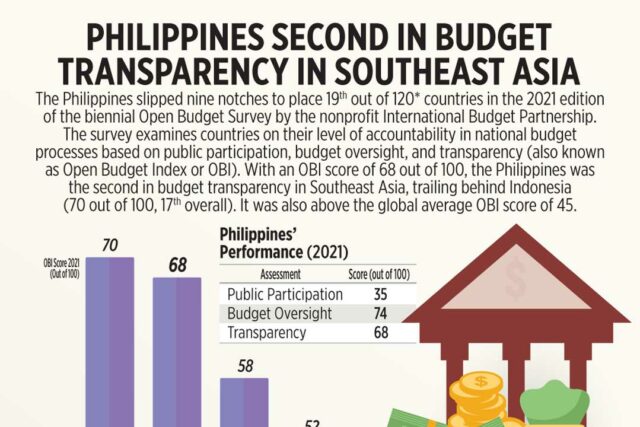
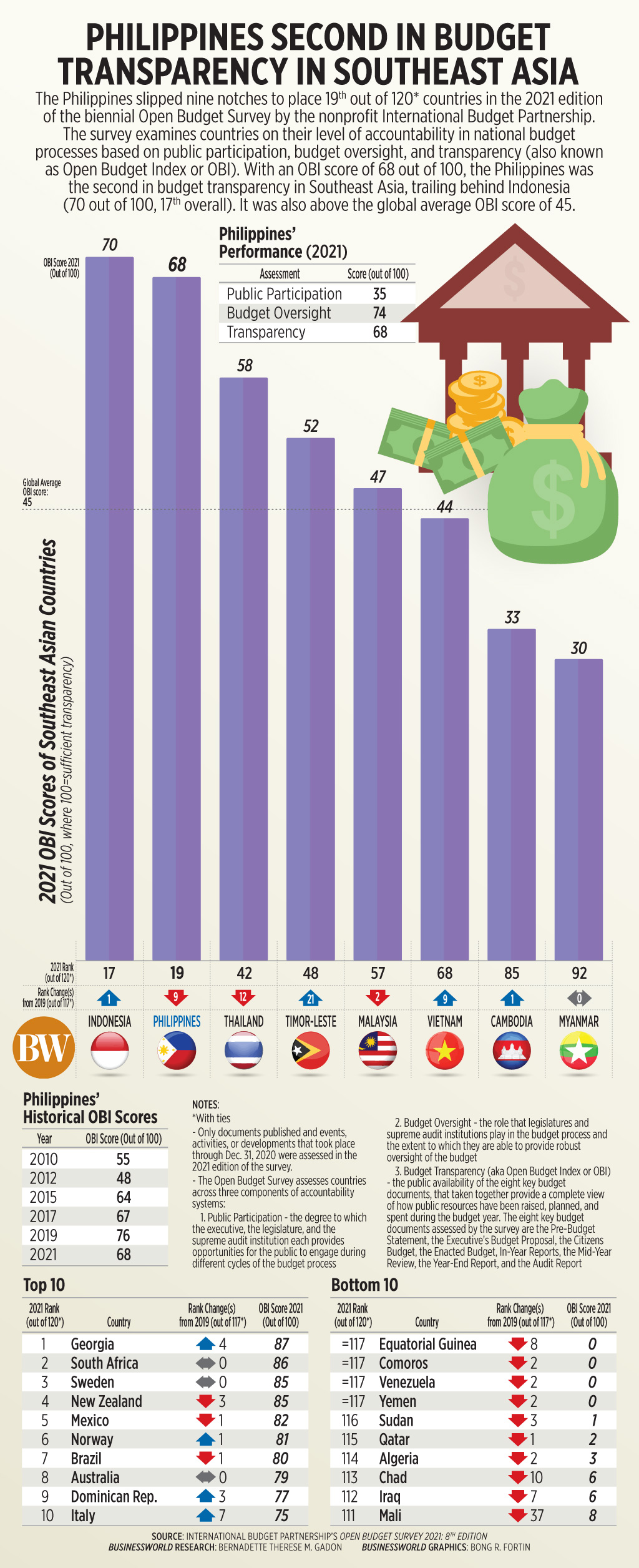
The Philippines slipped nine notches to place 19th out of 120* countries in the 2021 edition of the biennial Open Budget Survey by the nonprofit International Budget Partnership. The survey examines countries on their level of accountability in national budget processes based on public participation, budget oversight, and transparency (also known as Open Budget Index or OBI). With an OBI score of 68 out of 100, the Philippines was the second in budget transparency in Southeast Asia, trailing behind Indonesia (70 out of 100, 17th overall). It was also above the global average OBI score of 45.

Philippines second in budget transparency in Southeast Asia

8990 Holdings unveils amenities of Urban Deca Homes Ortigas

URBAN Deco Homes Ortigas is located along Ortigas Avenue Extension in Barangay Rosario, Pasig City. — COMPANY HANDOUT

By Brontë H. Lacsamana, Reporter

MASS housing developer 8990 Holdings, Inc. inaugurated on Friday the amenity area of its largest condominium project to date, Urban Deca Homes Ortigas, in Pasig City.

Located along Ortigas Avenue Extension in Barangay Rosario, Urban Deco Homes Ortigas boasts of 1.3 hectares of green lawns and trees, a lagoon and two basketball courts.

The developer is currently building the clubhouse, while a playground and a wellness area are being planned.

8990 Holdings President and Chief Executive Officer Anthony Vincent S. Sotto said their residential developments can help close the country’s growing housing backlog, estimated to reach around 12 million units by 2030.

“Our 1.3-hectare open space is but another way for us to help create an area where our homeowners can build community awareness. But it is highly accentuated because it is our largest open space that is located in the middle of an urban area,” he told reporters at the sidelines of the event.

Three of Urban Deca Homes Ortigas’ 22 planned towers are now occupied by unit owners.

Two- and three-bedroom units come at an average price of P2.86 million. Homebuyers can reserve a unit for P15,000, and pay P23,570 per month for three months to cover the initial 3% down payment.

With accreditation from the Bank of the Philippine Islands and Security Bank and a partnership with the Home Development Mutual Fund (Pag-ibig Fund), 8990 Holdings offers several loan options for homebuyers.

These loan options will best suit young professionals and newly married couples looking to own their first home, Mr. Sotto added.

He said 8990 Holdings is looking into environmentally sound energy sources for their properties.

Urban Deca Homes Ortigas’ amenities area, for instance, includes sewage treatment plants for wastewater management.

“We wanted to really make sure that we’re able to reuse water that’s coming from our homeowners for gardening,” he said.

How PSEi member stocks performed — June 27, 2022

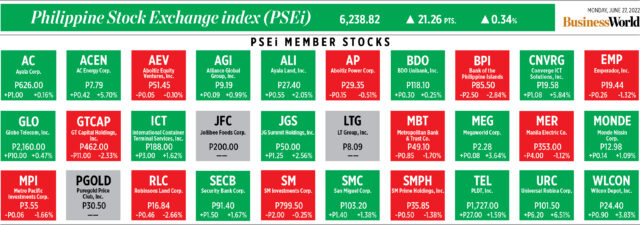
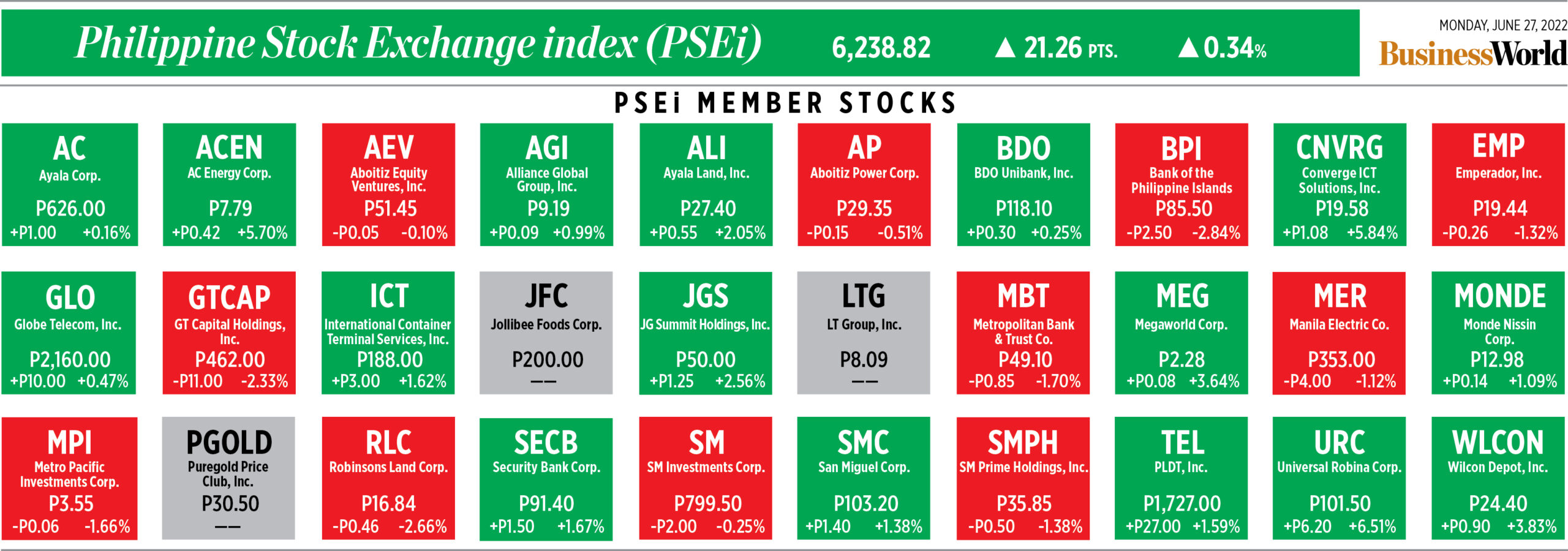
Here’s a quick glance at how PSEi stocks fared on Monday, June 27, 2022.


Stocks up on bargain hunting, Wall Street’s rise

BW FILE PHOTO

SHARES ended higher on Monday on bargain hunting after the market’s decline last week and improved sentiment on the back of the positive performance of Wall Street over the weekend.

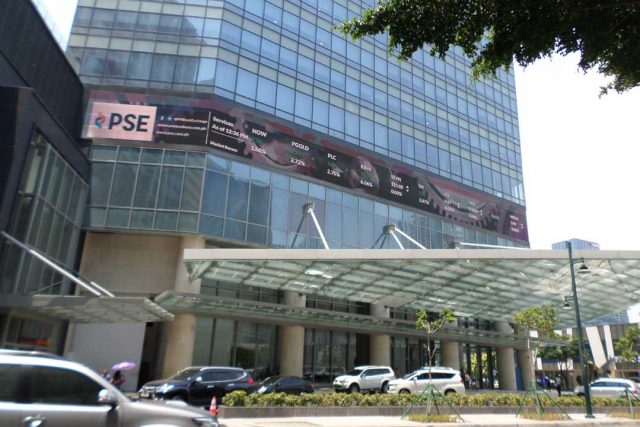
The benchmark Philippine Stock Exchange index (PSEi) rose by 21.26 points or 0.34% to end at 6,238.82 on Monday, while the broader all shares index improved 14.84 points or 0.44% to close at 3,352.47.

“The local market rose this Monday…as investors continued with their bargain hunting. The market also took cues from Wall Street’s positive performance last Friday,” Philstocks Financial, Inc. Senior Research Analyst Japhet Louis O. Tantiangco said in a Viber message.

“Trading remained tepid, however, as many remained on the sidelines due to the lingering risks, including the further depreciation of the peso, inflationary risks stemming from the rising local fuel prices, and recession risks in the US,” Mr. Tantiangco said.

He said Universal Robina Corp. was the top index gainer, jumping 6.51% to P101.50 each, while Bank of the Philippine Islands was the main laggard as it lost 2.84% to end at P85.50 apiece.

Value turnover on Monday was at P5.24 billion with 682.61 million shares switching hands, higher than the P4.53 billion and 604.01 million issues seen on Friday.

Wall Street rebounded on Friday as oil prices eased, tempering fears of a recession in the US due to aggressive Federal Reserve tightening amid higher inflation.

The Dow Jones Industrial Average improved 823.32 points or 2.68% to end at 31,500.68; the S&P 500 climbed 116.01 points or 3.06% to finish at 3,911.74; and the Nasdaq Composite rose 375.43 points or 3.34% to close at 11,607.62.   

On the other hand, Regina Capital Development Corp. Head of Sales Luis A. Limlingan said in a Viber message that the local bourse closed higher ahead of key data and as investors await the inauguration of President-elect Ferdinand R. Marcos, Jr.

“Philippine shares started the week in the green as investors brace for the end of the semester with the latest bank lending data and S&P Global Philippines purchasing managers’ index on July 1. On Thursday, the 17th President of the Philippines will have his inauguration at the National Museum of Fine Arts,” Mr. Limlingan said. 

Sectoral indices were mixed at the close of trading on Monday. Services rose 31.69 points or 1.95% to 1,655.85; industrials went up 107.85 points or 1.22% to 8,893.08; and holding firms added 10.49 points or 0.17% to end at 5,863.55.

In contrast, mining and oil declined 144.96 points or 1.33% to 10,717.65; financials fell 13.23 points or 0.88% to 1,487.47; and property retreated 1.12 points or 0.03% to end the session at 2,868.47.

Advancers beat decliners, 98 versus 84, while 54 names closed unchanged.

Net foreign selling totaled P389.88 million on Monday, slightly lower than the P335.46 million in net outflows recorded on Friday. — Revin Mikhael D. Ochave

Peso up on profit taking after drop

BW FILE PHOTO

THE PESO strengthened versus the dollar on Monday, even after hitting the P55 level intraday, on profit taking after last week’s decline and gains at the local stock market.

The local unit closed at P54.78 on Monday, rising by 20.5 centavos from its P54.985 finish on Friday, Bankers Association of the Philippines data showed.

The peso opened Monday’s session weaker than its Friday close at P54.93 versus the dollar. Its lowest showing for the day was at P55.15 against the greenback, its weakest level in over 16 years, or since the peso closed at P55.26 on Oct. 25, 2005. Meanwhile, the peso’s intraday best was its close of P54.78.

Dollars exchanged declined to $1.17 billion on Monday from $1.40 billion on Friday.

“The peso exchange rate strengthened today…, considered a healthy correction…after the peso reached as low as P55.15 earlier in the day as global oil prices recently lingered among one-month lows and the 10-year US Treasury yield lingered among two-week lows,” Rizal Commercial Banking Corp. Chief Economist Michael L. Ricafort said in a Viber message on Monday.

“The peso also stronger after the recent relief rally in the local and US/global stock markets after the US University of Michigan gauge of long-term (5-10 years) consumer expectations revised to 3.1% (from a preliminary 3.3%) but still the highest in more than 11 years or since March 2011,” Mr. Ricafort said.

He added that most currencies in the region ended stronger against the dollar on Monday.

“The peso strengthened amid a potentially weaker US durable goods report,” a trader added in an e-mail.

Philippine shares ended higher on Monday on bargain hunting after the market’s decline last week and improved sentiment on the back of the positive performance of Wall Street over the weekend.

The benchmark Philippine Stock Exchange index rose by 21.26 points or 0.34% to end at 6,238.82 on Monday, while the broader all shares index improved 14.84 points or 0.44% to close at 3,352.47.

Wall Street rebounded on Friday as oil prices eased, tempering fears of a recession in the US due to aggressive Federal Reserve tightening amid higher inflation.

The Dow Jones Industrial Average improved 823.32 points or 2.68% to end at 31,500.68; the S&P 500 climbed 116.01 points or 3.06% to finish at 3,911.74; and the Nasdaq Composite rose 375.43 points or 3.34% to close at 11,607.62.

As of Monday’s close, the peso has declined by P3.78 or 7.41% versus the dollar from its Dec. 31, 2021 finish of P51. For this month so far, the peso has lost P2.41 or 4.6% in value from its May 31 close of P52.37 a dollar.

“Since the start of 2022, the peso’s depreciation of 7.4% is now the worst in ASEAN vs. 6.5% for the Thai baht, 5.7% for the Malaysian ringgit, 5.2% for the Chinese yuan, 3.8% for the Indonesian rupiah,” Mr. Ricafort said.

For Tuesday, the trader said the peso may continue to rebound on profit taking. The trader expects the local unit to move within P54.65 to P54.85 per dollar, while Mr. Ricafort gave a forecast range of P54.60 to P54.90. — K.B. Ta-asan

ADVERTISEMENT
ADVERTISEMENT