Home Blog Page 6204

Drug war will be as ‘intensive’ — new DILG chief

PHILIPPINE STAR/ MICHAEL VARCAS

By John Victor D. Ordoñez, Reporter

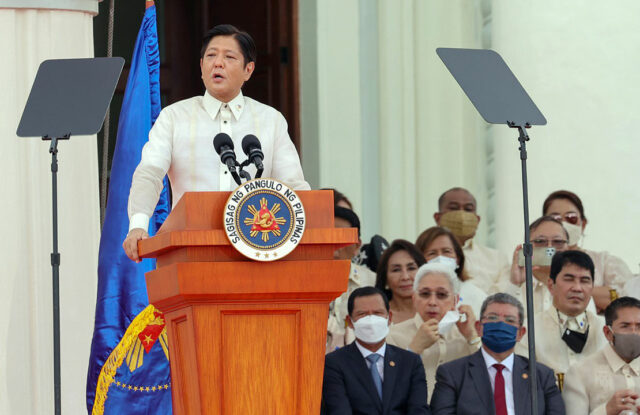
THE NEW Philippine government under President Ferdinand “Bongbong” R. Marcos, Jr. will carry on with the controversial drug war of the previous administration, according to the new Interior secretary.

“The war against drugs will be as intensive as before and will be the basis of my oath as a public official in accordance with the constitution,” Department of the Interior and Local Government (DILG) Secretary Benjamin “Benhur” C. Abalos, Jr. said in a press briefing on Monday.

Mr. Abalos, who also held an appointive position under President Rodrigo R. Duterte, said that he would uphold the rule of law in continuing the war on drugs.

“We will involve other concerned government agencies, and most importantly, the communities, to make sure that we have a comprehensive campaign against illegal drugs,” he said.

Mr. Abalos noted that most investigations of drug-related killings are deterred due to lack of witnesses. He said police drug operations should have at least three witnesses present from the media, the Department of Justice (DoJ), and the barangay where the operations take place.

In May, the DoJ dropped 29 cases from its list of extralegal killings and torture cases for lack of evidence and cited complainants who decided not to pursue their charges.

The National Police Commission, which is under the DILG’s supervision, has the authority to investigate and dismiss erring police officers.

Mr. Abalos, who served as chairman of the Metropolitan Manila Development Authority under Mr. Duterte, was previously elected as mayor and congressman of Mandaluyong City.

He noted that his experience as mayor would help the DILG’s supervision of law enforcement agencies that carry out anti-illegal drug operations.

Government prosecutors have filed charges in court against police officers in four cases and plan to probe 250 more of what could have been wrongful deaths in Mr. Duterte’s drug war, former DoJ Secretary Menardo I. Guevarra told the United Nations Human Rights Council in February.

Former Interior Undersecretary Epimaco V. Densing told the ABS-CBN News Channel in May that more or less 95% of the deaths in Mr. Duterte’s drug war did not involve police foul play and were “within the bounds of the law.”

“It was not perfect, but the violations are not considered massive in the human rights perspective,” he said.

A group of human rights lawyers, meanwhile, has urged Mr. Marcos to rejoin the International Criminal Court (ICC) and to work closely with the tribunal should it continue its probe of the previous administration’s war on drugs.

In a statement on Monday, Manananggol Laban sa Extra-Judicial Killings (Manlaban sa EJK) said the resumption of the ICC’s probe would achieve a “high level of accountability” as it would confront those who committed atrocities during anti-illegal drug operations.

“If Marcos really intends to continue the war on drugs within the framework of the law and with respect for human rights, he should cooperate more closely with the ICC investigation, and eventually, rejoin the assembly of states parties,” the group said.

ICC Prosecutor Karim Ahmed Khan had requested the court’s pre-trial chamber to reopen the probe months after it was halted upon the Philippine government’s request.

Manlaban sa EJK said the potential probe of drug-related killings must include a review of policies developed by senior government and law enforcement officials, not just policemen during the operations

At least 6,117 suspected drug personalities had been killed in police operations as of April 2021, according to data from the Philippine government.

An inter-agency committee formed 15 teams last year that probed extralegal killings and human rights violations involving the government’s anti-illegal drug operations.

Justice Secretary Jesus Crispin C. Remulla earlier said that he would look into the government’s initial review of the anti-illegal drug campaign.

LOCAL GOVERNMENTS
In the same briefing, Mr. Abalos said he would ensure the “equitable” implementation of the Mandanas ruling, which expands the share of local government units (LGUs) in national taxes beginning this year.

The law is named after Batangas Governor Hermilando I. Mandanas who challenged the government’s previous position that local governments were entitled to a smaller share of national government income.

“What is important is the word equitable, it means what is equitable for the LGUs and what is equitable for the national government,” Mr. Abalos said.

“We will work closely with the Department of Budget and Management and the National Economic and Development Authority on implementing the law.”

As DILG head, Mr. Abalos also plans to prioritize digitalizing government procedures, reducing crime within LGUs, and regularly inspecting jails for drug paraphernalia.

Cabinet candidates under ‘final evaluation stage’

PHILIPPINE STAR/KRIZ JOHN ROSALES

THE SELECTION process for vacant seats in President Ferdinand R. Marcos, Jr.’s Cabinet is now in the final stage, according to his press chief, but no target date has been set for completing the team.

Mr. Marcos did not hold his first Cabinet meeting on his inauguration day on June 30 as conventionally done by recent past Philippine presidents.

“I understand that this is going through the final evaluation stage so I don’t think it will take too long,” Press Secretary Trixie Cruz-Angeles told a news conference on Monday.

Ms. Cruz-Angeles said there is no “deadline” for the selection process because it is being carefully done.

“There’s no deadline,” she said. “What we’re saying is that we’re evaluating the candidates very well.”

Mr. Marcos has yet to fill some key Cabinet posts, including chiefs of the departments of Health, Energy, Environment and Natural Resources, Science and Technology, and Human Settlements and Urban Development.

“That they are unable to name the heads of these important agencies reveals the absence of these programs during the campaign,” said Leonardo A. Lanzona, who teaches economics at the Ateneo De Manila University.

“It seems obvious that the Marcos campaign did not have a clear program that can help address issues that face ordinary citizens, particularly health and housing,” he said in a Messenger chat.

“The Marcos campaign was really running on empty programs. This does not contribute to the confidence of the business community, worse it shows a disregard to the plight of the common tao (folk).”

Arjan P. Aguirre, a political science professor at Ateneo, said discussions between and among allies with their own proposed names for those posts might still be ongoing. 

It’s also possible “that Mr. Marcos already has the names of his new Cabinet members, but other allies are not happy with it,” he said in a Messenger chat. “If this is the case, then the delay should really make us suspicious of the independence of the presidency with his political allies.”

Meanwhile, Mr. Marcos on Monday held a closed-door meeting with members of the Department of Agriculture, which he is currently leading as its secretary.

When asked by reporters whether the new Philippine leader would consider any government austerity measure or new revenue-generating policy to help address the country’s debts, Ms. Cruz-Angeles said: “It’s the economic team who is making these — drawing up these plans and the policy proposals in accordance with the directive of the President.”

“We’ll wait for the economic team to make the announcement,” she said.

Ms. Cruz-Angeles also said Mr. Marcos has no scheduled state visits yet.

“The President has not announced any state visits,” she said. “As of now, he is busy building up the Cabinet.”

At the weekend, the Philippine’s envoy to the US said American President Joseph R. Biden has invited Mr. Marcos to visit Washington. However, no schedule has been set yet. — Kyle Aristophere T. Atienza

COVID cases in the past week reach more than 7,000

PHILIPPINE STAR/ WALTER BOLLOZOS

THE PHILIPPINES recorded more than 7,000 new coronavirus infections in the past week, according to health authorities.

A total of 7,398 new coronavirus disease 2019 (COVID-19) infections were recorded from June 27 to July 3, 60% higher than the cases on June 20-26, the Department of Health said in a bulletin on Monday.

Of the latest total cases, 19 or 0.26%  were critical, it said. It added that 74 new deaths were “verified” during the past week and that “zero deaths occurred on June 20 to July 3.”

The agency said 381 or 15.3% of 2,487 intensive care unit (ICU) beds were in use as of July 3, while 4,342 or 19.9% of 21,791 non-ICU beds were occupied.

It added that 497 severe and critical coronavirus patients or 8.4% of total admissions were staying in hospitals.

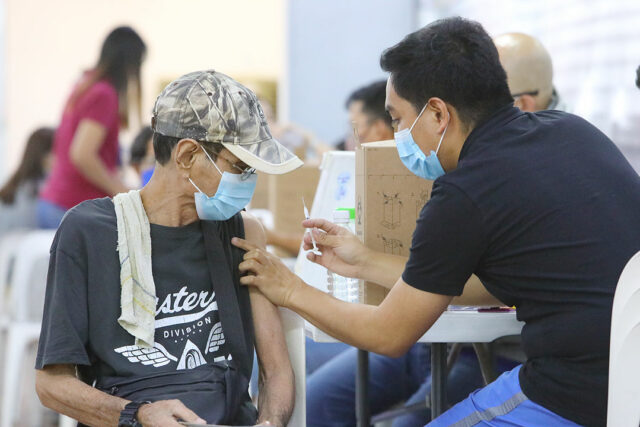
The Health department said 70.78 million people have been fully vaccinated against the coronavirus as of July 3, while 15.15 million people have received booster shots.

MEDICAL TEAM
Meanwhile, a bill that seeks to create a Medical Reserve Corps whose members will be deployed in case of health emergencies like the COVID-19 pandemic has been refiled in the House of Representatives.

The measure passed the lower chamber in the previous Congress but remained pending at the Senate committee.

House Bill No. 2, filed on Friday, “aims to enhance the capacity of our country to produce and call on the needed manpower and expand its human health resources in times of disasters and public health emergencies of both national and local scale through the mobilization of a medical reserve force specifically trained to supplement the existing human health resources to ease the burden in our healthcare system.”

Leyte Rep. Martin G. Romualdez, the presumptive House speaker, said in a statement on Monday: “The COVID-19 pandemic has exposed the inability of the country’s health care system to cope with the surge of patients needing medical care due to lack of medically-trained personnel.”

At present, the country has a shortage of 290,000 health workers, aggravated by an annual migration of 13,000 health care professionals, he said.

According to the World Health Organization, there were only six medical doctors per 10,000 Filipinos in 2017, lower than its recommended 10 physicians per 10,000 population.

Under the proposal, the Medical Reserve Corps will be under the Health Emergency Management Bureau of the Health department.

They may be mobilized to help monitor suspected cases and conduct contact-tracing during disease outbreaks, help implement quarantine measures, and provide logistics and manpower for large-scale disaster and health emergency operations.

Mobilization centers will be established in every province once the bill is passed into law. — Kyle Aristophere T. Atienza and Alyssa Nicole O. Tan

VP Sara taps Briones as DepEd consultant

DEPED

VICE President and Education Secretary Sara Z. Duterte-Carpio has tapped her predecessor, Leonor Magtolis-Briones, to be her consultant. 

Ms. Magtolis-Briones committedto stay with the Department of Education (DepEd) as a consultant for the Office of the Secretary, Ms. Duterte-Carpio said in a speech on Monday during the formal turnover event for the agencys leadership streamed live on Facebook. 

Ms. Duterte-Carpio praised her predecessor at the event, saying she led the agency in adopting bold but necessary measures to provide Filipino children with accessible, quality educationand ensuring that learning is unhampered. 

Ms. Magtolis-Briones also considered the economic welfare of Filipino teachers and the non-teaching personnel working under the organization, the vice president said. 

Ms. Duterte-Carpio said Ms. Magtolis-Briones never cowered in the face of disapprovals and pressures” — some of which stemmed from the agencys poor response measures and delivery of services. 

When some sectors called for an academic freeze, the response was academic ease,Ms. Duterte-Carpio said. It was a brilliant, appropriate and timely response, made with will and resolve and foresight that our childrens learning is shielded from the adverse impacts of the pandemic.

“Secretary Liling is a force, and I am humbled and honored to follow the footsteps of a much admired academic, public servant, social activist and change-maker,she added.

The new Education chief also held a virtual meeting on Monday with members of private school associations. 

She acknowledged the pandemics impact on private academic institutions and vowed government assistance measures, citing their role in the countrys education sector. 

Some private schools are facing closure. And a number have in fact already shut down,she said. As a community, there is an urgent need to build back, and build back stronger and better. The migration of students from private to public schools has put enormous strain on our public schools. 

Ms. Duterte-Carpio said DepEd needs the help of private schools in addressing the education crisis. 

Our task here is clear it is to protect our children and ensure that quality education is made accessible for them whether they are enrolled in private or public schools, whether they are in the cities or the countryside.Kyle Aristophere T. Atienza 

Labor chief tackles contractualization, national minimum wage

LABOR Secretary Bienvenido E. Laguesma on Monday said he has started evaluating issues relating to contractualization and the worker sectors call for a national minimum wage.  

“We will once again review department issuances that pertain to the work arrangement of ending a worker’s contractual service even if it can be still continued,” Mr. Laguesma said in Filipino during an interview with CNN Philippines.  

“This is the slightly pressing issue I see as to why there is a negative interpretation of the contractual arrangement.” 

In 2019, former President Rodrigo R. Duterte vetoed the Security of Tenure and End of Endo Act that aimed to address the contentious contractual arrangement. 

Mr. Laguesma noted he met with labor groups weeks before assuming his post and intend to consult with the management sector this week. 

He said he plans to reopen dialogues between labor groups and employers to discuss contractual arrangements.  

The new Labor chief also said he is open to assessing proposals to implement a national minimum wage, starting at a rate of P750 per day, in coordination with different sectors.  

Minimum wage rates are currently set on a regional basis.  

Before his second stint as labor chief, Mr. Laguesma had said that a national minimum wage may not be possible because small companies are still struggling to recover from the pandemic.  

Mr. Laguesma previously served as Labor secretary under former President Joseph E. Estrada. John Victor D. Ordoñez 

Jannik Sinner stays strong to down Alcaraz in fourth round thriller

JANNIK Sinner of Italy in the fourth round of tennis tournament in London. — REUTERS

LONDON — Italian Jannik Sinner enjoyed a night to remember on his Centre Court debut as he toppled fifth seed Carlos Alcaraz with a barnstorming 6-1, 6-4, 6-7(8), 6-3 win in a battle of the young-guns to reach the Wimbledon quarterfinals for the first time.

On a day when Wimbledon’s most famous stage celebrated its centenary, the two youngest players left in the men’s draw gave a glimpse of the future with some breathtaking shotmaking that earned them a standing ovation from 15,000 hollering fans.

However, during the first two sets, there was little indication of the spellbinding drama that would end up unfolding on Centre Court.

The highly-rated Alcaraz, who has won a Tour-leading four titles this year, was sucked into a Sinner whirlwind as he lost seven games in a row from 1-1 in the first set.

The 19-year-old Spaniard recovered from that setback to deny Sinner two match points in the third-set tie-break before three more went begging with Alcaraz serving at 5-2 down in the fourth.

But Sinner withstood the barrage of belting winners to finally book his place in the last eight at his sixth attempt when Alcaraz rolled a forehand into the net.

“Carlos is a very tough opponent and a very nice person so it’s always a huge pleasure to play him with such a great crowd and on a special day with 100 years of Centre Court — it’s just amazing,” said Sinner, who will next face either six-time champion Novak Djokovic or Dutch wild card Tim van Rijthoven.

“It’s tough when you have match points and you still have to play — I tried my best, it’s part of the game, part of tennis.

“I’m very happy how I reacted in the beginning of the fourth because I was struggling, but I’m very happy to be in the next round and hopefully, I can play some good tennis there.” — Reuters

J.T. Poston holds on for wire-to-wire victory at John Deere

J.T. POSTON holds his John Deere Classic trophy after winning the John Deere Classic golf tournament. — REUTERS

J.T. POSTON’S 2-under-par 69 in Sunday’s final round was enough to secure a three-shot win at the John Deere Classic in Silvis, Ill.

Poston led wire to wire at TPC Deere Run after opening the week with a 9-under 62. He finished at 21-under 263, three better than Christiaan Bezuidenhout of South Africa and Emiliano Grillo of Argentina.

Poston not only won his second career PGA Tour title and the accompanying $1.278-million prize, but also qualified for this month’s Open Championship at St. Andrews in Scotland. Both Bezuidenhout and Grillo also qualified for the Open with their top-three finishes.

“I can’t wait. I’ve always wanted to play in an Open Championship, and this will be my first one,” Poston said. “So for it to be at St. Andrews and the 150th is pretty special, and pretty hard to draw it up any better than that.”

Poston slept on a three-shot lead and got off to a hot start with three straight birdies, including a long putt from the fringe at the par-3 third. He left the door cracked open, though, when he posted consecutive bogeys at the par-4 fifth and sixth holes.

He held firm at 20 under by saving 10 straight pars before adding a birdie at the par-5 17th. It marked just the third wire-to-wire win at the John Deere.

Grillo got as low as 19 under before bogeying the 12th and 14th holes to drop further back. He matched Poston’s 69.

Bezuidenhout birdied three of his final five holes to finish off a bogey-free 66 and grab the other qualifying position.

“Definitely, a confidence booster,” Bezuidenhout said of the T2, his best career finish. “I’ve put in a lot of hardwork over the last week, especially my golf swing and just overall my game, my fitness. My trainer is here as well. We’ve been doing a lot of good things over the last few months, so it’s nice to see the results coming through and the hardwork is paying off.”

Christopher Gotterup (bogey-free 66) and Scott Stallings (70) tied for fourth at 17 under. Gotterup, a rookie making his fourth start as a professional, birdied each of his final three holes.

“Yeah, just more validation that I do belong out here,” Gotterup said. “And honestly, I didn’t have my greatest stuff this week. Hit it amazing, but just putted pretty poorly until coming down the stretch. So, yeah, you pick up things along the way.” — Reuters

Kyrie Irving for Russell Westbrook talks in progress

THE Brooklyn Nets and Los Angeles Lakers are discussing swapping star guards Kyrie Irving and Russell Westbrook, Yahoo! Sports reported.

According to Saturday’s report, the teams “are actively engaged in discussions.”

Both Westbrook and Irving exercised their one-year, multimillion-dollar options last week, tying them for another season to teams where they just don’t seem to fit.

Westbrook, 33, has a $47-million option for 2022-2023. Irving, 30, will play under a $36.5-million deal.

According to Yahoo!, the teams haven’t been able to reach agreement on the other pieces of the trade package, including draft picks. The Nets reportedly want the Lakers also to take 30-year-old guard Joe Harris and the two years and $38.6 million left on his contract.

The Lakers instead want shooting guard Seth Curry, 31, who has one year left on his contract at $8.5 million, per Yahoo!.

Brooklyn also is engaged in initial trade talks with numerous NBA teams about superstar Kevin Durant, who last week requested a trade.

Despite star-studded rosters, both teams fell short of their championship aspirations last season. The Lakers failed to make the playoffs, and the Nets were swept by the Boston Celtics in the first round of the Eastern Conference playoffs. — Reuters

The lords of Philippine basketball are troubled

MARKUS SPISKE-UNSPLASH

Philippine Basketball Association (PBA) Commissioner Wilfrido “Willie” O. Marcial will soon meet with Shinji Semada, chairman of Japan’s B.League, and Kim Hee-ok, commissioner of the Korean Basketball League (KBL) to discuss, among other things, the recruitment of Filipino basketball players by the two foreign basketball associations.

Among the players who are playing or who have played in the B.League are Thirdy Ravena (San-En NeoPhoenix), Keifer Ravena (Shiga Lakestars), Ray Parks (Nagoya Diamond Dolphins), Kobe Paras (Niigata Albirex BB), Dwight Ramos (Levanga Hokkaido, Toyoma Grouses), and Juan Gomez de Liano (Earthfriends Tokyo Z, now with the ASEAN Basketball League’s Surabaya Vikings Warriors).

Javi Gomez de Liano played for Ibaraki Robots last season but he has come home and is now playing for Terrafirma Dyip of the PBA. Justine Baltazar will play for Hiroshima Dragonflies after the conclusion of the Philippine National Basketball League (NBL) season (he is with Pampanga Delta).

Three other local players will soon play in the KBL. They are SJ Belangel (Daegu KOGAS Pegasus), RJ Abarrientos (Ulsan Hyundai Mobis Phoebus), and Justin Gutang (Changwon LG Sakers).

The B.League is Japan’s professional men’s basketball league. It was formed in September 2016, as a result of a merger between the National Basketball League that was operated by the FIBA-affiliated Japan Basketball Association and the independently operated bj league.

The league consists of two divisions: B1, which has 24 teams; B2, which has 14. Each club in the first and second divisions are allowed up to three registered foreign players.

KBL, established in 1997, is South Korea’s professional men’s basketball league. The league consists of 10 teams. Each team can have up to two foreign players on the condition that only one of them can be taller than 200 centimeters (6 ft. 6 in.).

Those in the know say Japan’s B.League Division I teams paid Filipino imports around $7,000 to $15,000 (P350,000 to P750,000) a month depending on the player.

Twenty-five-year-old Thirdy Ravena is reported to be getting $400,000 to $550,000 (P20 million to P27.5 million). In addition they are given bonuses for won games and incentives for playoffs, which can amount to one or two months’ worth of salary.

The PBA has a cap of P420,000, and that is for the superstars in the league. In the PBA, the players pay their agents’ commission. In the B.League, the teams pay the agents’ commission.

On top of paying them handsome salaries, B.League teams house their imports in luxurious facilities. They also provide them with a car and a driver. The imports can dine in a restaurant affiliated with their team for free.

The lure of playing in Japan, and now in South Korea as well, has become a serious concern for officials of the Samahang Basketbol ng Pilipinas (SBP), the federation of all FIBA-affiliated associations in the country.

The SBP officials fear that foreign leagues will draw players away from Gilas Pilipinas, the country’s national basketball team that participates in international tournaments. Keifer Ravena, Ramos, Belangel, and Abarrientos are mainstays of Gilas Pilipinas.

The ruling body of the PBA, the Board of Governors, is also troubled. Keifer Ravena and Parks were still under contract with PBA teams (Ravena with NLEX and Parks with TNT) when they left to play for Japan. There are talks that Matthew Wright of Phoenix is just waiting for his contract with Phoenix Fuel Masters to expire. Then off to Japan he goes. Abu Tratter made known his availability to B.League teams while he was negotiating with the new PBA team Converge FiberXers. He is staying as he has signed the contract with Converge.

Many contemporaries of Thirdy Ravena probably decided to play in the PBA to experience playing for a professional league coach and to hone their skills by learning from their superstar teammates and playing against the best in the land before they play in another country.

Arvin Tolentino of Ginebra must be overjoyed in having Tim Cone as coach and power forward Christian Standhardinger as teammate and mentor. Same with point guard Kib Montalbo of TNT who has Chot Reyes as coach and Jason Castro, once reputed to be the best point guard in Asia, as his teammate and mentor.

Other young players like CJ Perez, Robert Bolick, Javee Mocon, Bong Quinto, Rey Suerte, Matt and Mike Nieto, and Santi Santillian must be the subject of Japanese and Korean scouts.

Having gained much experience playing with and against the best in the land and having attained the status of starters and therefore established themselves as real pros, they will draw offers much more than the players with only collegiate tournament experience like the Filipino players now in Japan, maybe as much as what Thirdy got.

They are not likely to refuse the offers. That is why they worked their butt off honing their basketball skills from their high school days to their college years — to attract offers from the PBA teams. Now, bigger money and better perks can be obtained somewhere. That has caused the lords of Philippine basketball to consider action that would minimize the threat of losing the country’s top cagers to foreign leagues.

Not even the PBA teams with big budgets can match the offers of B.League teams, otherwise Keifer Ravena would be playing for NLEX and Parks for TNT in the on-going Philippine Cup conference. But if TNT and maybe San Miguel would match the B.League offers, salaries of PBA players would skyrocket.

If the Metro Pacific or San Miguel teams protect the targets of B.League recruiters by matching the offers of the latter, then the other stars among the teammates of the targets would ask for a significant upward adjustment in their salaries.

If no adjustment is made to the satisfaction of the players, then the team manager and head coach might suddenly find themselves swamped with reports of injuries such as a broken finger, a strained hamstring, back spasms, even symptoms of coronavirus disease 2019 (COVID-19) infection from disappointed players. Or sometimes, a team’s top scorer might suddenly lose his touch.

I have been told such stories by team insiders (team managers and high-ranking executives of companies that own PBA teams). A former team manager of San Miguel was my former classmate and roommate in the US. A former team manager of Purefoods was my classmate from grade school to college. I used to sit in the section in Araneta Coliseum reserved for the president and other senior executives of Toyota Philippines, courtesy of the secretary of the president. Other team officials are relatives.

If salaries skyrocket, low-budget teams will fold up. My guess is that as many as four, perhaps even five, would withdraw from the league, threatening the viability of the PBA itself.

One course of action the SBP and the PBA can take is to pass a rule that bans teams from hiring local players, whether from the collegiate ranks or from any of the SBP-affiliated professional leagues, who have played for B.League and KBL teams.

The ban would be for a definite period, like three or five years. It would be imposed from the time the overseas player returns to the country. The ban would be similar to the ban imposed on Keifer Ravena by the FIBA.

The intention of the ban is to make a local player think twice about playing in Japan or South Korea. As the B.League and KBL contracts are on a per-season basis, a Filipino player is not assured of a job after the season ends. And with the SBP and PBA ban, he would not find one in any basketball-related capacity (player, trainer, etc.) in the country for several years.


Oscar P. Lagman, Jr. is a retired corporate executive, business consultant, and management professor. He has been a politicized citizen since his college days in the late 1950s.

May Congress delimit through legislation the constitutional coverage of ‘public utilities’

TINGEY INJURY LAW-FIRM-UNSPLASH

In its Article XII on National Economy and Patrimony, the 1987 Constitution provides in no uncertain terms that “No franchise, certificate, or any other form of authorization for the operation of a public utility shall be granted except to citizens of the Philippines or to corporations or associations organized under the laws of the Philippines at least sixty per centum of whose capital is owned by such citizens nor shall such franchise, certificate, or authorization be exclusive in character or for a longer period than fifty years.” (Sec. 11, Art. XII, 1987 Constitution).

In essence, the constitutional provision on public utilities allows foreign equity ownership to be at a maximum of 40% of the capital stock of a domestic corporation or association engaged in public utility; it prohibits entirely all foreign individuals from engaging in activities, undertaking, business enterprises, or industries that are classified as “public utilities.”

Fr. Joaquin G. Bernas, S.J., observed that “[t]his Filipinization provision is one of the products of the spirit of nationalism which gripped the Constitutional Convention of 1935. It provides for the Filipinization of public utilities by requiring that any form of authorization for the operation of public utilities should be granted only to ‘citizens of the Philippines or to corporations or associations organized under the laws of the Philippines at least sixty per centum of the capital of which is owned by such citizens.’ The provision is a recognition of the sensitive and vital position of public utilities both in the national economy and for national security.”

Our Supreme Court (SC) in Gamboa v. Teves, G.R. No. 176579, 28 June 2011, 652 SCRA 690 (2011), held that the issue of the extent of foreign equity participation in public utilities under “Sec. 11, Art. XII of the Constitution has far-reaching implications to the national economy. In fact, a resolution of this issue will determine whether Filipinos are masters, or second-class citizens, in their own country. What is at stake here is whether Filipinos or foreigners will have effective control of the national economy. Indeed, if ever there is a legal issue that has far-reaching implications to the entire nation, and to future generations of Filipinos, it is the threshold legal issue presented in this case.”

May Congress through a legislative enactment, i.e., RA No. 11659, de-limit or de-classify the coverage of the term “public utilities” to exclude activities, undertakings, business enterprises, or industries which have been pronounced by the SC as within the coverage of Sec. 11, Art. XII of the 1987 Constitution? This is the core question that is addressed in this article.

SC’s POWER

The long-standing principle in Philippine Constitutional Law is that the constitution is what the SC says it is.

Fr. Bernas wrote that “Constitutional law, as understood both in American and Philippine law, is not just the text of the constitution itself. It is ‘a body of rules resulting from the interpretation by a high court of cases in which the validity, in relation to the constitutional instrument, of some act of governmental power … has been challenged. This function, conveniently labeled ‘Judicial Review,’ involves the power and duty on the part of the [Supreme] Court of pronouncing void any such act which does not square with its own reading of the constitutional instrument …’”

The corollary principle in constitutional construction is that unless the constitution itself provides that certain items are within the power of Legislature to define by law, the Constitution is what the SC holds it to be — the SC is the final arbiter of the meaning and coverage of constitutional provisions.

When one dissects the text of Sec. 11, Art. XII of the 1987 Constitution, it gives no leeway for Congress to determine the coverage of enterprises that would fall within the coverage of “public utilities.”

This may mean that the final determination of whether an activity, undertaking, business enterprise or industry falls within the constitutional coverage of “public utilities” depends on how the SC has defined the meaning and coverage of the term in justiciable controversies brought within its jurisdiction as a constitutional court.

How has the SC interpreted the meaning and coverage of the term “public utilities” under what is now Sec. 11, Art. XII of the 1987 Constitution?

In addressing the question, it must be kept in mind that the statutory regulation of public utilities in general which formally began under Act No. 2307 on Dec. 19, 1913 — which created the Board of Public Utility Commission, later changed to Public Service Commission under Act No. 3316 — pre-dated the constitutional nationalization of public utilities, when it first appeared under Sec. 8, Art. XIV of the 1935 Constitution.

Consequently, when the Public Service Act was promulgated as Commonwealth Act No. 1169 on Nov. 7, 1936, to provide for a more comprehensive code on the regulation of public utilities, it was construed to be also the statutory implementation of Sec. 8, Art. XIV of the 1935 Constitution.

In other words, our SC had already evolved a doctrinal meaning and coverage of the term “public utilities” before the advent of the constitutional nationalization of public utilities under Sec. 8, Art. XIV of the 1935 Constitution.

In United States v. Tan Piaco, 40 Phil. 853, 856 (1920), the earliest decision rendered under Act No. 2307 to determine if the accused had operated vehicles as common carriers without authority from the Public Utility Commission as to render them criminally liable under said Act, the SC relied upon the statutory definition of public utilities under Sec. 14 of Act No. 2307, which in part read that “… The term ‘public utility’ is hereby defined to include every individual, copartnership, association, corporation or joint stock company, …. that now or hereafter may own, operate, manage, or control any common carrier, railroad, street railway, … engaged in the transportation of passengers, cargo, …. for public use.”

The SC in Tan Piaco used the enumeration under Sec. 14 of Act No. 2307 to determine what constitutes “public utility” and in addition required the showing of “public use” in ruling that “Under the provisions of said section, two things are necessary: (a) The individual, copartnership … must be a public utility; and (b) the business in which such individual copartnership … is engaged must be for public use. So long as the individual or copartnership … is engaged in a purely private enterprise, without attempting to render service to all who may apply, he can in no sense be considered a public utility for public use.”

In effect, Tan Piaco provided that under statutory law on public utilities as being subject to the jurisdiction of public utility commission, there are two essential elements: first, the activity, undertaking, business enterprise or industry must be fixed by law as a public utility; and second, such activity, undertaking, business enterprise or industry is for public use.

The Court held that “If the use is merely optional with the owner, or the public benefit is merely accidental, it is not a public use, authorizing the exercise of the jurisdiction of the public utility commission. The true criterion by which to judge the character of the use is whether the public may enjoy it by right or only by permission.”

In Iloilo Ice and Cold Storage Company v. Public Utility Board, 44 Phil. 551, 555-556 (1923), where the issue was whether an ice and cold storage business that catered only to limited clientele and refused its services to others, could be classified as a “public utility” within the supervision of the Public Utility Board, the SC noted that the “original public utility law, Act No. 2307, in its sec. 14, in speaking of the jurisdiction of the Board of Public Utility Commissioners, and in defining the term ‘public utility,’ failed to include ice, refrigeration, and cold storage plants … [which] deficiency was, however, remedied by Act No. 2694, enacted in 1917, which amended sec. 14 of Act No. 2307…”

The Court then concluded that because of such amendment “the term ‘public utility,’ in this jurisdiction, [covers] corporation, or joint stock company that now or hereafter may own, operate, manage, or control, within the Philippine Islands, any ice, refrigeration, cold storage system, plant, or equipment, for public use.”

The Court then held that the respondent could not be subject to the jurisdiction of the Public Utility Board because the second essential element of “public use” was not present.

In his concurring opinion in Iloilo Ice and Cold Storage Company, Justice Ostrand referred to a distinction between a “common law” (i.e., judge-made law or doctrine) from statutory provision of what constitutes a public utility, thus: “I concur in the result on the ground that an ice plant is not a public utility by common law, but is only made so by statute; that in the present case the [ice] plant existed in approximately its present form and as, in a then legal sense, a private enterprise, before the statute making such plants public utilities was enacted …”

The implication of the Tan Piaco and Iloilo Ice and Cold Storage Company rulings was that the classification of activities, undertakings, business enterprises, or industries as “public utilities” to be under the supervision and control of public utility boards would essentially be an exercise of legislative prerogative, since regulatory agencies can only exercise such powers and functions within the parameters of the laws creating them.

As one scholar has observed: “The legislature is vested with police power so that it may pass laws that would effect a well-ordered society and promote the general welfare. And in the area of business concerns and enterprises engaged in public utilities, which usually affect the lives of many, the legislature has created franchising and regulatory bodies to limit, oversee and rationalize their operations. …”

In other words, prior to the constitutional nationalization provisions on public utilities, the SC had determined the coverage of the term “public utilities” based on how the Legislature, in the exercise of its police power over the regulation of business affected with public interests, has determined them to be covered thereby.

We now address the next issue: When the constitutional writers incorporated Sec. 8, Art. XIV into the 1935 Constitution limiting the operation of public utilities to Filipinos and to domestic corporations with at least 60% Filipino equity, did they intend the term “public utilities” to have the same coverage under Sec. 14 of Act No. 2307, as vetted by the SC?

This article reflects the personal opinion of the author and does not reflect the official stand of the Management Association of the Philippines or MAP.


Atty. Cesar L. Villanueva is co-chair for Governance of the MAP ESG Committee, the chair of the Institute of Corporate Directors, the first chair of the Governance Commission for GOCCs, a former dean of the Ateneo Law School, and a founding partner of Villanueva Gabionza & Dy Law Offices.

map@map.org.ph

cvillanueva@vgslaw.com

http://map.org.ph

The Bulacan Ecozone veto and Ben Diokno books

A number of important policies and events caught my attention last week. I will discuss three of them.

PRESIDENTIAL VETO OF BULACAN ECOZONE BILL
One big news on day 1 of President Ferdinand “Bongbong” R. Marcos, Jr., is his letter to the Senate dated July 1 expressing his veto of House Bill 7575, “An Act Establishing the Bulacan Airport City Special Economic Zone and Freeport” (Bulacan Ecozone).

Among the reasons given are that Bulacan Ecozone “poses substantial fiscal risks and conflict with other agencies’ mandates and authorities… Ecozone Authority has rule-making powers on environmental protection not found in other Ecozones, … [and] close proximity to Clark Special Ecozone.”

I initially saw the logic of those reasons. I also saw the 12-page Memorandum of former Finance Secretary Carlos Dominguez to former President Rodrigo R. Duterte why he should veto that bill. To see the bigger picture, I read the 12-page bill (third reading, May 30, 2022, version).

Being an advocate of free trade, more business competition and less government intervention, I actually like that bill. Here are three reasons why:

One, it will increase competition among Ecozones and Freeports. In particular, the Bulacan Ecozone will compete with nearby Clark, Subic, Bataan, and other Ecozones. In the 1990s, the Americans left Clark and Subic with their sprawling infrastructure, including runways and the Subic seaport. And 31 years after, Clark and Subic have improved but they are not as developed as one would expect from real freeports (like those in Hong Kong, Singapore, and Dubai).

Two, it will limit the long interventionist arms of national bureaucracies that affected Clark and Subic from becoming real freeport (these include the Bureau of Customs, Department of Environment and Natural Resources, and the Department of National Defense). Bulacan Ecozone will operate as a separate customs territory and will have internal security and military forces for national defense.

Three, it promotes provincial economic competition and the principle of subsidiarity (which states that if a local authority can perform a function, it should not be taken by a higher or national authority). These are consistent with the federalism philosophy, which Mr. Marcos should adhere to since he ran as the candidate of the Partido Federal ng Pilipinas party.

But the previous leaderships of the Department of Finance, the National Economic and Development Authority, and other agencies did not like more ecozone competition, did not like curtailment of their bureaucratic interventions so they recommended a veto by the previous Duterte administration.

Now that the new Marcos administration has issued the bill’s veto, it has to be refiled in the new Congress. But beyond this, Congress should also amend the charters of existing ecozones so that they will have similar liberal, free trade and subsidiarity policies as the proposed Bulacan Ecozone to equalize powers and responsibilities, privileges and accountability, and empower them toward greater ecozone and freeport competition in the country.

More incentives, more private enterprises, more job generation, broader tax base as national taxation laws like RA 11534 (CREATE law of 2021) will still apply. We need more business competition and innovation.

THE BEN DIOKNO BOOKS
Also last week I was able to get copies of the four books (published in 2020) of new Finance Secretary Benjamin Diokno.

Composed of his past columns in BusinessWorld and Manila Speak from 2012 to 2016, the four books are: (1) Holdap: The truth about pork, (2) State of The Nation: A Retrospective Look into the Macroeconomic Issues of the Philippines, (3) Governance: Analyzing the Economic Performance of the Estrada, Arroyo & Aquino Administrations, and (4) Through the Looking Glass: A Look into the Public Economic Issues in the Philippines.

In one article, “A broad-based, comprehensive tax reform is the only way forward” (BusinessWorld, Sept. 16, 2015), Mr. Diokno argued that “the core elements of a broad-based, comprehensive tax reform program are: lower income and corporate income tax rates, broader corporate tax base by rationalizing fiscal incentives, higher value-added tax rates, and higher real property tax.”

I agree with lower personal income tax (PIT) and corporate income tax (CIT) rates and a broader tax base. But I do not agree with the higher VAT rate. We should instead have a lower VAT rate and fewer or zero VAT exemptions — except raw agriculture and fishery products — to broaden the tax base. And real property tax rate should be lower on lands that have optimal use and generate more jobs and more business transactions per square meter of land.

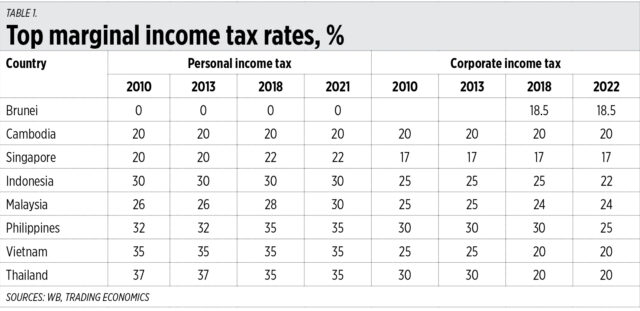
Mr. Diokno showed the comparative income tax rates in the ASEAN from 2010 to 2013. I use his numbers below and expand it to 2022 data. The good news is that in the Philippines, PIT rates for middle income people have declined under RA 10963 (TRAIN law of 2017) and CIT under RA 11534 has declined. The bad news is that the top marginal rate of PIT has increased for the upper income people to 35% from 32% under RA 10963 (Table 1).

When people are industrious, efficient, and ambitious, and when they save and invest for the future, their income and wealth naturally increase. They should not be penalized with higher PIT for their industriousness.

Mr. Diokno wrote many articles highly critical of the overall budget and infrastructure spending under the administration of President Benigno S.C. Aquino III.

In one of his papers, “From a slow to fast-moving machinery” (Manila Speak, April 24, 2014), he showed a table on infrastructure/GDP ratio from 2011 to 2013. I use his numbers and expand it to 2021 data (Table 2). It is true that infrastructure spending under the Duterte administration has indeed expanded substantially compared to previous administrations.

I do not agree with a number of points raised by Mr. Diokno in his four books but they are worth reading by researchers, writers and observers of economic policies. Having hindsight of the recent past will help formulate sound policies for the present and the future.

LAND TRANSPORTATION MESS
Last week, I passed by the Edsa-Ayala bus loading area: it was a horrible sight in the afternoon. The passenger queue was very long and hundreds, maybe thousands, of people had to endure the heat, dust and smoke.

When buses arrive, passengers fill them up quickly and stand shoulder-to-shoulder with little to no social distancing.

There are not enough buses. Not enough aircon vans. Not enough transport network vehicle service (TNVS) cars. Not enough motorcycle taxis (MCT).

The recent leaderships of Department of Transportation (DoTr) and Land Transportation Franchising and Regulatory Board (LTFRB) have implemented a pair of bad policies: (1) putting a cap on the number of those who can operate buses, aircon vans, TNVS and MCT, and (2) keeping the low fares of public transportation despite spiraling prices of gasoline, diesel, engine oil, and vehicle parts.

Transportation Secretary Jaime Bautista comes from a private airline company. He knows the importance of having flexibility in the number of units per destination and flexibility in adjusting fares depending on seasonal demand by passengers. He will be a good manager to modernize land, sea, and air transportation in the country.

Passengers need a respite from long queuing just to get a ride to and from work. Driving their cars may not be an option due to the high price of gasoline and the high cost of parking. Driving motorcycles or riding bicycles is not for everyone.

Removing the cap on the number of land transport companies, removing the cap on fares, and transport and fare liberalization are pro-passengers.

The most expensive transportation is one that is not available, not one where fares rise to reflect rising cost of fuel and operational cost. Hopefully, Mr. Bautista and new LTFRB leadership will have more mature views on transportation modernization.


Bienvenido S. Oplas, Jr. is the president of Minimal Government Thinkers.

minimalgovernment@gmail.com

Reflections of domestic tourists

RAWPIXEL

White sand, blue skies, and waves … and people housed in rectangular boxes in a meeting. The beach became the default background in Zoom meetings and the closest we had to the real thing as we immersed ourselves online, trying to live our lives in the new normal.

We have been very cautious, going out only when needed because our son is not yet eligible for the coronavirus disease 2019 (COVID-19) vaccine. And just like other parents, we always prioritize his safety. However, having been confined at home for the past two years has taken a toll on our mental health.

Searching for information on how to manage our struggle, we came across an article on children’s mental health by Dr. Cecily Maller and Dr. Mardie Townsend of Deakin University, who wrote, “Research on the health and wellbeing benefits of contact with animals and plants indicates the natural environment may have significant positive psychological and physiological effects on human health and wellbeing. In terms of children, studies have demonstrated that children function better cognitively and emotionally in ‘green’ environments and have more creative play.”

We noticed that our son was becoming dependent on gadgets. And so, when the government loosened restrictions, we decided to take a short trip to Laiya, San Juan, Batangas.

To avoid crowds, we traveled on a weekday. Even with the hotel rates significantly higher than they were before the pandemic, we were willing to spend more because we believed that we deserved this.

Before the pandemic, we would have weighed the pros and cons of a destination, and searched for the best rates. This time, we were willing to splurge on a hotel that takes extra steps to reduce its guests’ chances of contracting the virus.

Call it revenge spending: a phenomenon that explains how consumers hurry to spend more than they usually would on products and services because they believe they were denied the chance to spend due to an unfavorable event.

As reported in the May 2022 Bangko Sentral ng Pilipinas Economic Newsletter, “travel services declined by 81.7 percent to US$1.8 billion in 2020, and by another 66.5 percent in 2021 to only US$600 million.” People are raring to spend, and hotels are welcoming them warmly.

While our son was happily building sandcastles and sipping his mango shake, we were savoring the sight, sound, and smell of a non-virtual beach. While relaxing in a cabana, we noticed sellers walking back and forth along the shorefront of the different hotels.

If hotels were hit badly by the pandemic, vendors of souvenirs, sorbetes (dirty ice cream), local delicacies such as puto and suman (rice cakes), and whatnots were hit worse. Understandably, hotel security personnel would reprimand vendors when they approached hotel guests.

But if local governments were to accredit micro-entrepreneurs from the nearby communities, then they could create win-win solutions.

Hotels usually have similar offerings such as good food and great amenities. What could set them apart is offering sorbetes for an afternoon delight, or getting a vendor to create customized souvenirs for their guests. I, for one, would be more than willing to shell out a little more, knowing that I would be helping members of the community.

In the past years, we pivoted to connect digitally. Although our online setups have been useful, they pale in comparison to the real (non-virtual) world. Connecting with nature by visiting a beach can help our and our children’s mental health. But helping the most affected, vulnerable members of the industry along the way can lift their lives and improve their mental health, too.


Jenelyn Culian-Legaspi is an associate medical affairs manager at Johnson and Johnson Philippines, Inc. handling Consumer and OTC. Jose Luis Legaspi is an assistant professorial lecturer at the Department of Marketing and Advertising of De La Salle University. Both proud DLSU MBA graduates, they have been married for seven years, and are parents to a wonderful baby boy.

jose.luis.legaspi@dlsu.edu.ph

ADVERTISEMENT
ADVERTISEMENT