Home Blog Page 6112

RLC Residences is heading to Ironman 70.3 in Cebu this August

WITNESS RLC Residences raise the bar yet again as it joins this year’s most awaited global triathlon event in Cebu as part of the run leg.

“We are thrilled to be part of this year’s event, as this is a testament to how RLC Residences has come full circle in the game of elevating the lives of people who they build condominiums for,” RLC Residences Head of Marketing and Chief Integration Officer,  Karen Cesario shares.

Not many know, but RLC Residences has been part of the first Ironman held in Cebu in 2012, through its project AmiSa Private Residences. AmiSa Private Residences, a destination home located in Mactan, Cebu has since then been part of this three-part race, welcoming triathletes as they take on the course’s run phase along the breathtaking views of the Punta Engano coastline.   

The Amisa Private Residences has been part of the run course of the IRONMAN 70.3 since it moved to Cebu in 2012.

This year, RLC Residences has taken a more active part in Ironman 70.3 as it lines up a number of activities for participants and spectators alike. Visitors of Ironman’s 4-day expo are in for a treat, with exclusive RLC Residences merchandise up for grabs designed to beat the heat and much ideal for sports fans & enthusiasts.

“Participants of this year’s Ironman 70.3 coming from various parts of the globe, will surely find the run interesting”. We hope to continue to be able to showcase this wonderful home and the many possibilities it presents to investors,” Cesario shares. Moreso now as Tower D comes with all the upgrades in the living spaces and amenities.

And to cap off RLC Residences’ participation in this year’s Ironman is the creation of its Triathlon team composed of athletic enthusiasts from Robinsons Land Corporation’s various business units. Headlined by RLC Residences’ Brand Management Head, Dan Carlo Torres, the team hopes to inspire the RLC Residences community to pursue an active and healthy lifestyle.

Celtic Durant?

At face value, the idea that the Celtics, runners-up in the immediate past season of the National Basketball Association, would entertain the thought of breaking up their core group sounds absurd. Why would they risk disrupting chemistry — a critical but often elusive factor for even the most talented assemblies of stars — simply because of the possibility that the grass is greener on the other side? Have they forgotten about the saying “plus valet in minibus avis unica quam dupla silvis”? The annals of pro hoops are littered with examples of flameouts arising from those who ignore how much a bird in the hand is worth versus the two in the bush.

That said, the temptation of welcoming future Hall of Famer Kevin Durant into the fold seems too much to overcome. Not that the Celtics are wrong to entertain the thought; after all, the 12-time All-Star is a generational talent worth the assets — outside of reigning Eastern Conference Most Valuable Player awardee Jayson Tatum, of course — they will probably have to give up in exchange. He’s that good, period, and far be it for the green and white to immediately balk at the prospect of spreading the welcome mat for him. And it’s not as if he hasn’t already shown he can fit in with talents of proven contenders; two titles with the Warriors prove the malleability of his otherworldly skills.

To be sure, talks with the Nets are, at best, at the infancy stages, and not just because Durant’s current employers have seen fit to exact what they deem to be the right pound of flesh as payment. The asking price for him remains astronomical, although it’s one that the Celtics can actually cover should they so desire. What’s under consideration isn’t whether they’re capable of acceding to the demands; it’s whether they should. And they haven’t even assessed yet if his sensitive skin fits New England sensibilities; fans are intensely loyal, but they can likewise be savage in their criticism of the warts of supposed stalwarts.

Bottom line, the Celtics will not pull the trigger on any deal they feel compromises their view of the horizon. Durant’s an old 33, with major surgeries to his name, and they’ll be giving up prominent figures of their youth movement for him. Head of hoops operations Brad Stevens has his work cut out for him. Should he go for it? Or should he keep building on what he already has? The answers figure to shape the Celtics’ future for some time to come.


Anthony L. Cuaycong has been writing Courtside since BusinessWorld introduced a Sports section in 1994. He is a consultant on strategic planning, operations and Human Resources management, corporate communications, and business development.

Glaciers vanishing at record rate in Alps following heatwaves

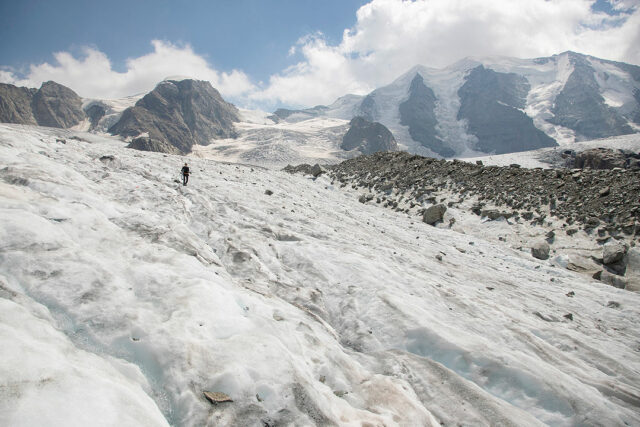
A WOMAN walks on the ice to a measuring point on the Pers Glacier near the Alpine resort of Pontresina, Switzerland, July 21, 2022. — REUTERS

MORTERATSCH GLACIER, Switzerland — From the way 45-year-old Swiss glaciologist Andreas Linsbauer bounds over icy crevasses, you would never guess he was carrying 10 kg of steel equipment needed to chart the decline of Switzerland’s glaciers.

Normally, he heads down this path on the massive Morteratsch Glacier in late September, the end of the summer melt season in the Alps. But exceptionally high ice loss this year has brought him to this 15-square-kilometer amphitheater of ice two months early for emergency maintenance work.

The measuring poles he uses to track changes in the depth of the pack are at risk of dislodging entirely as the ice melts away and he needs to drill new holes.

The Alps’ glaciers are on track for their highest mass losses in at least 60 years of record keeping, data shared exclusively with Reuters shows. By looking at the difference in how much snow fell in winter, and how much ice melts in the summer, scientists can measure how much a glacier has shrunk in any given year.

Since last winter, which brought relatively little snowfall, the Alps have sweltered through two big early summer heatwaves — including one in July marked by temperatures near 30 Celsius (86 Fahrenheit) in the Swiss mountain village of Zermatt.

During this heatwave, the elevation at which water froze was measured at a record high of 5,184 meters — at an altitude higher than Mont Blanc’s — compared with the normal summer level of between 3,000-3,500 meters.

“It’s really obvious that this is an extreme season,” Mr. Linsbauer said, shouting over the roar of rushing meltwater as he checked the height of a pole jutting out of the ice.

Most of the world’s mountain glaciers — remnants of the last ice age — are retreating due to climate change. But those in the European Alps are especially vulnerable because they are smaller with relatively little ice cover. Meanwhile, temperatures in the Alps are warming at around 0.3C per decade — around twice as fast as the global average.

If greenhouse gas emissions continue to rise, the Alps glaciers are expected to lose more than 80% of their current mass by 2100. Many will disappear regardless of whatever emissions action is taken now, thanks to global warming baked in by past emissions, according to a 2019 report by the UN Intergovernmental Panel on Climate Change.

Already, Morteratsch is much changed from the glacier depicted on the region’s tourist maps. The long tongue that once reached deep into the valley below has shrunk back by nearly 3 kilometers (2 miles), while the depth of the snow and ice pack has thinned by up to 200 meters (656 feet). A parallel glacier Pers flowed into it until 2017 but has now receded so much that an expanding strip of grit lies between them.

The dire situation this year raises concern that the Alps’ glaciers might vanish sooner than expected. With more years like 2022, that could happen, said Matthias Huss, who leads Glacier Monitoring Switzerland (GLAMOS).

“We are seeing model results expected a few decades in the future are happening now,” Mr. Huss said. “I did not expect to see such an extreme year so early in the century.”

NO SNOW, HIGH HEAT
Reuters spoke with glaciologists in Austria, France, and Italy who confirmed that glaciers there were on track for record losses. In Austria, “the glaciers are snow-free up to the summits,” said Andrea Fischer, a glaciologist at the Austrian Academy of Sciences.

Seasonal snowfall, apart from replenishing ice lost during summer, protects glaciers from further melt by providing a white cover that reflects sunlight back out to the atmosphere better than darker ice — sullied by dust or pollution — can do.

But at the Grand Etret glacier in northwest Italy, only 1.3 meters of snow had accumulated during this past winter — 2 meters less than the annual average for the 20 years up to 2020.

This year’s Alpine ice losses, registered even before the biggest melt month of August, surprised scientists to some extent, as many of the glaciers had already lost their lower-lying snouts. Because they had retreated up the mountain, where temperatures are cooler, scientists thought they should have been better protected.

“You can easily imagine the final results after summer will be … extensive loss of glacier coverage in the Italian Alps,” said Marco Giardino, vice president of the Italian Glaciological Committee.

Data shared exclusively with Reuters shows that Morteratsch is now shedding about 5 centimeters (2 inches) a day and is already in a worse state than it would normally be at the end of an average summer, according to data from GLAMOS and the Universite libre de Bruxelles.

The nearby Silvretta Glacier has lost about 1 meter (3.3 feet) more than at the same point in 1947 — the worst year in its database stretching back to 1915.

HIMALAYAN THAW
Himalayan glaciers are also on track for a record ice loss year, scientists told Reuters. When the summer monsoon season arrived in the Kashmir region, for example, many glaciers had already been shrunk drastically, with their snowlines starting high up the mountain, after a March-May heatwave marked by temperatures above 48C (118F) in northern India.

An early June expedition in India’s Himachal Pradesh found that the Chhota Shigri Glacier had lost much of its snow cover. “The highest temperature in over a century in March through May clearly had its impacts,” said glaciologist Mohd Farooq Azam at the Indian Institute of Technology Indore.

Vanishing glaciers are already endangering lives and livelihoods. Earlier this month, a glacier collapse on the Marmolada in Italy killed 11 people.

Days later, a collapsing glacier in the Tian Shan mountains of eastern Kyrgyzstan triggered a massive avalanche, sending ice and rocks hurdling toward passing tourists.

Above the Swiss village of Saas Fee, a path leading to a mountain hut once passed through a summer snowfield on top of the Chessjen Glacier.

“It’s too dangerous now,” due to the risk of falling rocks, once held together by hard-frozen ice, said hutkeeper Dario Andenmatten while gazing out over a barren landscape dotted with glacial lakes. Nearby, the rumble of stones tumbling from the mountain could be heard.

Swiss residents worry that the glacier losses will hurt their economy. Some area ski resorts of the Alps, which rely on these glaciers, now cover them with white sheets to reflect sunlight and reduce melting.

Swiss glaciers feature in many of the country’s fairy tales, and the Aletsch Glacier is considered a UNESCO World Heritage Site. Losing the glaciers “means losing our national heritage, our identity,” said hiker Bernardin Chavaillaz. “It’s sad.” — Reuters

South Korea’s economy unexpectedly speeds up

REUTERS

SEOUL    South Korean economic growth unexpectedly picked up in the second quarter as strong consumption on eased COVID-19 restrictions offset poor exports, supporting the case for further central bank interest rate hikes.

The Bank of Korea (BoK) estimated on Tuesday gross domestic product for the April-June period rose 0.7% quarter-on-quarter, faster than the 0.6% growth in the first quarter and above a 0.4% rise tipped in a Reuters survey.

Economists said the upbeat data allowed the central bank, which this month delivered an unprecedented 50 basis-point rate hike, to continue tightening policy in coming months.

“The economy will inevitably slow due to prolonged inflation and cooling exports, but today’s solid readings are a good boost for the central bank seeing inflation as the prime risk for now,” said Chun Kyu-yeon, economist at Hana Financial Investment.

The BoK has raised the policy interest rate by a combined 1.75 percentage points to 2.25% from record-low 0.5% since August last year, with economists predicting rates to be at 2.75% by the end of this year. The bank holds its next policy meeting on Aug. 25.

The strong consumption comes despite the BoK’s aggressive series of interest rate hikes since August last year.

The economy also received a boost from increased government spending after the parliament approved a 62-trillion won ($47.33 billion) supplementary budget weeks after President Yoon Suk-yeol took office in early May.

However, exports and corporate spending on production facilities slumped amid a slowing Chinese economy and the fallout from a war in Ukraine as well as a global wave of monetary policy tightening to fight inflation.

Exports shrank 3.1% in the April-June period from the preceding quarter, the largest decline in two years. Capital investment dropped for a fourth consecutive quarter by 1.0% following a 3.9% contraction in the January-March period.

Asia’s fourth-largest economy grew 2.9% in the second quarter year-on-year, faster than analyst expectations for 2.5% growth but slower than 3.0% growth in the first quarter. — Reuters

Japanese Emperor Emeritus diagnosed with heart failure

REUTERS

TOKYO — Japan’s Emperor Emeritus Akihito, father of the current emperor, received a diagnosis of heart failure last month but his condition has improved under treatment, an official at the Imperial Household Agency (IHA) said on Tuesday.

Akihito, 88, stepped down in 2019 in the first abdication of a Japanese emperor for two centuries, saying he was not sure he was still up to the demands of the job.

Heart failure is a condition in which the heart muscle does not pump blood as well as it should and can be treated. It differs from a heart attack where blood flows to the heart are suddenly blocked.

Akihito was diagnosed with heart failure due to a faulty heart valve at the end of June and has been undergoing treatment with medication and through restricting activity and fluid intake since then, an IHA official said.

“Currently he is living life as usual,” the official added.

Akihito, the son of Emperor Hirohito, spent much of his reign working to heal the wounds of a war waged across Asia in his father’s name, as well as bringing the monarchy closer to ordinary citizens.

He marked the 70th anniversary of World War II’s end in 2015 with an expression of “deep remorse”, a departure from previous remarks, that was seen by some as an effort to cement a legacy of pacifism under threat from conservative Japanese nationalists.

“Looking back at the past, together with deep remorse over the war, I pray that this tragedy of war will not be repeated and together with the people, express my deep condolences for those who fell in battle and in the ravages of war,” he said on Aug. 15, 2015, the 70th anniversary of the war’s end.

A scientist by avocation, Akihito was the first heir in the Japanese imperial family to marry a commoner, Empress Emerita Michiko, whom he met on a tennis court. — Reuters

Myanmar’s neighbors dismayed over ‘highly reprehensible’ executions

ASEAN.ORG

MYANMAR’S Southeast Asian neighbors issued a stinging rebuke on Tuesday of the ruling military’s execution of four political activists, calling it “highly reprehensible” and destructive to regional efforts to de-escalate the crisis.

The 10-member Association of Southeast Asian Nations (ASEAN), which includes Myanmar, said it was “extremely troubled and deeply saddened by the executions,” as well as by their timing, just a week ahead of the bloc’s next meeting.

“While the complexity of the crisis is well recognized and the extreme bellicose mood can be felt from all corners of Myanmar, ASEAN as a whole has called for utmost restraint,” Cambodia, this year’s ASEAN chair, said in an unusually strong statement.

“The implementation of the death sentences just a week before the 55th ASEAN ministerial meeting is highly reprehensible,” it said, adding it showed the junta’s “gross lack of will” to support ASEAN’s U.N.-backed peace plan.

The military, which seized power in a coup last year, announced in state media on Monday that it had executed the activists for aiding “terror acts” by a civilian resistance movement, Myanmar’s first executions in decades.

The news triggered international outrage, with the United States, Britain, Australia, the European Union and senior United Nations officials accusing the junta of cruelty.

It was not clear when the executions took place, or which method was used. Family members on Monday said they were not informed of their loved ones’ executions beforehand, nor allowed to retrieve their bodies.

The executed men were among more than 100 people whom activists say have been sentenced to death in secretive trials by military-run courts since the coup.

Authorities tightened security at the jail in the biggest city Yangon where the four men had been held, a human rights group said on Tuesday, following the global outcry and a demonstration by inmates over the execution.

A source from a prisoner’s support group told Reuters that a protest had taken place in the jail. News portal Myanmar Now said some inmates had been assaulted by prison authorities and about 15 of them were separated from the general population.

Lin Thant, a representative of Myanmar’s shadow National Unity Government, said its sources had confirmed there was also unrest in a jail in the city of Mandalay, where gunshots had been fired.

Spokespersons for Yangon’s Insein prison and the corrections department did not answer calls from Reuters.

The junta has yet to respond to the international criticism, but has previously accused the United Nations and western powers of meddling in its affairs. Its spokesperson was due to hold a regular news briefing later on Tuesday.

U.N. Special Rapporteur on human rights in Myanmar, Tom Andrews, said he was concerned about more executions. He said at least 140 people had been sentenced to death in Myanmar.

“And so there is every indication that the military junta intends to continue to carry out executions of those on death row, as it continues to bomb villages and detain innocent people throughout the country,” he said in an interview on Monday. — Reuters

Huawei offers green solutions to banking sector

PIXABAY

Huawei expects Philippine regulators to step up green finance efforts by setting industry guidelines on power consumption and encouraging green investments.

“Huawei sees tremendous opportunities in the Philippines — not only [in the] building of green infrastructures, but also in green bonds and the green economy system,” said Luan Mingming, country head of Huawei Philippines’ Enterprise Business Group, in a July 26 e-mail. 

While green finance is not a new topic, the actual implementations and best practices vary, Mr. Mingming added. 

At Huawei’s Intelligent Finance Summit 2022, Jason Cao, chief executive officer of Huawei Global Digital Finance, pointed out that digital banking consumes “a lot of resources, a lot of data.” 

“Banks are large consumers of computing power,” he said at the July 20 roundtable discussion.

Technology providers, he added, can help banks resolve carbon emissions by focusing on alternatives to issues affecting power supply, power consumption, and power management. Photovoltaic energy (or solar panels), for instance, can be offered as a clean source of power supply. Banks can also invest in equipment with recycling systems for the efficient heat dispersal. 

Huawei offers smart management modules that detect peak periods of usage. This feature allows banks to shut down some modules during off-peak hours to save power. 

Accessing services on the Internet entails the use of servers in data centers, all of which need electricity to run. Phys.org, a web-based science news service, estimates that the electricity consumption for these centers may grow to between 15%–30% of the total electricity consumption of some countries by 2030. Most electricity is generated by fossil fuels, which contributes to climate change. 

Huawei is targeting two types of customers, according to Mr. Cao: traditional banks that are going digital because customer behaviors are changing; and banks in areas without prevalent services such as Africa and the Asia Pacific. 

“We are pushing for inclusive finance,” he said. 

Huawei counts BDO Unibank, Inc., and Union Bank of the Philippines (UnionBank) among its local clients. — Patricia B. Mirasol

Addressing Filipinos’ concerns

PRESIDENT Ferdinand R. Marcos, Jr. delivered his first State of the Nation Address during the joint session of the 19th Congress at the House of Representatives, Batasan complex, Quezon City, July 25. — PHILIPPINE STAR/KRIZ JOHN ROZALES

The inaugural speech of President Ferdinand Marcos, Jr. was a preamble to his first State of the Nation Address (SONA). The SONA provided a broader explanation and discussion of the concerns, issues, and sectors that need to be prioritized as tackled in the inaugural speech.

Among other important things, the economic agenda of the Marcos Jr. government envisions that the country would achieve middle-income status by 2024 and economic growth of 6.5% to 8% from 2023-2028.

Meanwhile, the headline goal or target for average inflation is 2%-4% between 2024 and 2028. The targets also include improving foreign exchange to between P51-P55 per $1 in 2023-2028, increasing the exports of goods by 6% from 2023-2028, and imports by 8% in the same period.

With the stated economic targets for the next six years, the administration still needs to expound on how these will be achieved.

As part of the economic agenda, it is also noteworthy to state that the importance of making the country an investment destination is rightfully placed. It is also good to know that our government has plans for a medium-term fiscal strategy for the purpose of spending sustainability.

As the concurrent Department of Agriculture secretary, President Marcos Jr. devoted ample time to discussing agricultural development and agrarian reform improvements. Here, the President proffered a paradigm shift in terms of transforming agriculture into a major contributor to the economy.

To make this happen and lessen the burden on the sector, he assured the sector’s stakeholders of financial assistance. He also announced a moratorium on land amortization payments, the provision of loans for farm inputs and implements, a balance in importation, and much-needed collaboration between government agencies.

Other issues that the SONA fittingly addressed were health and social assistance. The president stated that there will be no more lockdowns amid the COVID-19 pandemic as the country needs to balance health and the national economy. This will be complemented by the continuation of the vaccine rollout; Filipinos were encouraged to get their booster shots.

With regard to social protection, the president announced the continuation of the 4Ps program and the cleansing of the list of beneficiaries. These will be to provide better help for the poor, marginalized, and vulnerable population.

Further, Marcos’ emphasis on the role of the private sector and public-private partnerships (PPPs) in terms of investments and innovation was unequivocal and promising, as the ability and credibility of private enterprises spans infrastructure, agriculture, education, and digitalization.

President Marcos Jr. also gave a spot-on analysis on the need for digitalization and modern technology for Philippine society. Particularly, he highlighted the importance of digitalization in improving governance and streamlining the delivery of public goods and services.

One of the most remarkable points in this first SONA pertains to foreign policy. Reiterating his pro-Filipino stance, the president stated that he will not give a square inch of Philippine territory to foreigners and that the “national interest is our primordial guide” in promoting foreign relations.

The second most surprising point is the declaration of the legislative priorities of the presidency. Numbering up to 19 priorities, it means that preparations have been made and that the president has a lot in mind in terms of the country’s political, social, and economic direction.

Very noteworthy in these priorities is the National Government Rightsizing Program (NGRP) proposed by the Department of Budget and Management (DBM). It is “a reform initiative that primarily aims to achieve simplicity, economy, and efficiency in the bureaucracy.”

The NGRP will be able to reduce costs, implement reforms, and improve the delivery of public services by “(i) streamlining the operations of the different agencies and rightsizing their structure and manpower; (ii) undertaking organizational actions that will fortify areas/sectors that need to be strengthened and re-channel resources to the same; and (iii) eliminate functions, programs and projects (F/P/Ps) which are already redundant or no longer necessary,” the DBM briefer stated.

However, these plans of action still need to be explained and so these could address Filipinos’ most urgent concerns particularly within the year.

According to the latest Pulse Asia survey, the top five most urgent national concerns are predominantly economic — “controlling inflation” (57%), “increasing the pay of workers” (45%), “reducing the poverty of many Filipinos” (33%), “creating more jobs” (29%), and “fighting graft and corruption in government” (20%).

In light of the first SONA of the Marcos Jr. presidency, and while triggering more questions about how “things” will be done, the Stratbase Institute is launching a roundtable discussion themed “A Government Agenda for Development in the Marcos Jr. Presidency Post Pandemic.”

To provide more context to the SONA, the activity will discuss recommendations and policy recommendations to the Marcos Jr. administration in the following areas: good governance and development, human capital and labor markets, inclusive growth and the public sector, poverty and inequality, patronage politics and political reforms, and the prospects for democracy and the rule of law.

Specifically, the public exchange will delve into questions on development and governance challenges and opportunities, and expectations in the remainder of the first 100 days or in the first six months under the new government, and other persistent problems and issues.


Victor Andres “Dindo” C. Manhit is the president of the Stratbase ADR Institute.

Calling all plantitos and plantitas: The examples of Bataan, Pasig, and Batangas

AERIAL VIEW of Villegas Organiks in Malvar, Batangas. — VILLEGAS ORGANIKS

(Part 3)

What we have described about the Kabalikat Sa Kabuhayan (KSK) is no longer at the realm of pure theory but has actually been implemented in a good number of LGU units. Among the pioneering provinces was Bataan, under the leadership of the Garcia clan which has demonstrated that a dynasty is not necessarily politically undesirable. From my long-term studies of Philippine regions, I have always found Bataan to be at the top of development efforts, as reflected by its high ranking in the Human Development Index as reported by the Philippine Statistical Authority.

As one can read on the website of the SM Foundation, a case in point was the Batch 157 of KSK held in Dinalupihan, Bataan. Under KSK, some 100 Bataan farmers were provided with training on modern farming technologies, with a focus on high-value crop production that would help them produce and sustain bountiful harvests. The assistance goes beyond production. It must always be kept in mind that “agribusiness” goes beyond farming, comprising the whole value chain until the product reaches the market. The farmer-graduates are also provided with market linkages to help in boosting their social enterprises which in turn provide economic opportunities in their respective areas. Among other outlets are the SM Markets in Dinalupihan, Bataan.

The training the farmers get in the KSK program goes beyond technical skills and expertise. They are also taught values and principles which they may use as they go along and continue pursuing their aspirations in life. Included in the program is the imparting of the 14 Life Principles of the Founder of the SM Group, Tatang Henry Sy, Sr.

The case in Dinalupihan illustrates the advantages of getting values-oriented business groups like the SM group to partner with similarly motivated government agencies like the Departments of Social Welfare and Development (DSWD), Agriculture (DA), and Trade and Industry (DTI). It was Dinalupihan Mayor Gila Garcia who put all the main actors together. Mayor Garcia vowed to provide each production group with capital of P100,000 to sustain the program and help the province to attain its goal of being the modern “agropolis” of Central Luzon in the very near future.

This concrete example shows how important it is for the LGU heads under the new Administration of President Marcos Jr. to heed the advice of Secretary of Finance Benjamin Diokno to use a substantial part of what they will receive under the Mandanas-Garcia ruling to support agricultural productivity drives like the KSK. With a reasonably limited budget, much can be accomplished in the short run to address the expected food shortage in 2022 and 2023 resulting from the global food crisis.

The Dinalupihan experience also illustrates that the KSK can address two important objectives at the same time: to increase the supply of food and to reduce poverty among the marginalized. Indigenous tribal members were among those graduating farmers in the SM Foundation’s 157th KSK batch. Before the training program, the Aetas planted vegetables and root crops only during the rainy season as the uplands are devoid of water sources during the dry season. With the greenhouse technology that was taught to them, they were able to plant high-value crops like honeydew melon, bitter gourd, upo (bottle gourd), kundol (wax gourd), sili (chili), squash and many more. Other than the Aetas, other marginalized households benefited when the DSWD, for its part, gave the names of 43 beneficiaries of its 4Ps (Pantawid Pamilyang Pilipino Program) to be included in the list of the trainees.

The DTI had its own role to play. The then DTI provincial director, Nelin Cabahug, said “this is the fruition of our vision for an inclusive growth for the country, by involving all sectors, the indigenous tribes especially, in our development efforts through productive projects like high-value crop farming, even as DTI will continue building their capacity to gain value for their produce through processing to get more revenues from their efforts.”

A significant increase in the supply of high-value crops, with the help of DTI and other private participants, can lead to microentrepreneurs going into food processing. This is where the GoNegosyo initiative of Joey Concepcion can come in. This example set by Bataan can be readily replicated in provinces where there are also indigenous tribes residing in hilly places like Antipolo (the Dumagats) and the island of Mindoro (the Mangyans), not to mention the whole of Mindanao.

The KSK program can also be implemented in highly urbanized areas like some component cities of the National Capital Region. In a conversation with the newly re-elected Mayor of Pasig City, Vico Sotto — already a role model of aspiring young politicians— he told me that he intends to convert every empty lot (and even buildings) into a vegetable garden. The advantage of urban gardening is that you significantly reduce transport costs, especially in these times of very high fuel prices.

To get an idea of what can be done in Pasig without too much delay — again with some funding from the proceeds of the Mandanas-Garcia ruling — I quote here excerpts of a letter of the CEO of Harbest, Arsenio Barcelona, to Mayor Sotto: “I am very happy to know about your ongoing program to encourage more residents to plant vegetables and short-term fruits. We will be glad to guide and support your edible gardening program and incorporate this into our ongoing promotion for urban farming. In fact, the Pasig Greening Program staff had been our suki (regular customer) for seeds, fertilizers, growing medium, pots, and other supplies. You may visit us at www.harbest.com.ph. We will be glad to show you our urban greenhouse nursery for vegetable seedlings and potted herbs. We also have a 40 sq.m. roof deck edible garden on our 4th floor.

“It will be good to establish a Pasig City Edible Gardening Center where residents, barangay personnel, and the youth can be trained by your trainors whom we will be the ones to train. You can also have an Edible Garden Supplies Hub to sell seeds, fertilizers, organic pest and disease control products, pots, and reading materials. A seminar room at City Hall can be used for training classes. Harbest will be glad to support your program. We have been training farmers all over the Philippines for more than 10 years.”

What can be done in Pasig can be replicated in many other highly urbanized areas in the Philippines.

As a third model, let me cite Batangas province, which we can describe as “rurban” (partly rural partly urban). Its very well-respected and popular governor is actually the one responsible for requiring the National Government to devolve to the LGUs the tax revenues that are constitutionally due them. Governor Hermilando Mandanas is on his third and last term, having been re-elected practically unopposed on May 9.

Batangas is one of the most rapidly industrializing provinces in the whole country, with hundreds of large factories populating the numerous industrial estates lining the STAR Highway from Sto. Tomas, Batangas to Batangas City. It is, however, still very strong in agribusiness. In fact, the largest poultry project is the Philippines, a joint venture between Jollibee and Cargill, is located in Sto. Tomas, Batangas. The province would also be ideal as a site for promoting programs for producing quick-gestating food crops similar to those of the KSK farms in other provinces. Additionally, Ayala Land’s Areza project will include the establishment of the Lipa City Trading Center which will serve as a regional food terminal for fresh produce, not only coming from the province of Batangas itself, but also from other provinces like Mindoro Oriental.

The Master Gardener program of some US State Universities described in the first article of this series can be instantly replicated in Batangas with the help of Harbest which can partner with at least three institutions: the Dagatan Agritech School in Lipa, the Batangas State University, and the Villegas Organiks Farmers Training Institute in Malvar, Batangas.

The Dagatan Agritech School has been training the children of farmers in advanced farming techniques for the last 40 years. It was established by a group of agribusiness executives led by the late Fritz Gemperle, following the famous Family Farm School model of France and Spain. It is now open to any young high school student interested in the agribusiness occupation.

The Villegas Organiks Institute is dedicated to developing micro farm techniques, design, and strategies. Under the leadership of Pablito Malabanan Villegas, a top agribusiness executive with experience in both the government and the private sector, it has designed a modern organic farm in Malvar, Batangas to help farmers and small land owners maximize the full potential of their land, no matter how small. Interested parties may get in touch with this institute at villegasorganiks@gmail.com.

Finally, the Batangas State University, known as the Philippines’ National Engineering University, has 11 campuses and 15 development centers established in the areas of research and innovation, disaster risk management, marine biodiversity, and language and culture. Like the US universities cited above, its management can be persuaded to include among its extension services the training of master gardeners.

These three institutions can coordinate their efforts to contribute to the goal of food security of President Marcos Jr. through the office of Governor Hermilando Mandanas.

These LGU-based initiatives, in partnership with NGOs and business enterprises, to increase the supply of high-value products like vegetables and fruits can actually also be a long-term contribution to food security since there is no reason why the Philippines cannot be self-sufficient in these products, unlike in other essential food items like milk, wheat, soybeans, and, arguably, rice.

I would like to point out, however, that getting the plantitos and plantitas involved in producing vegetables and fruits in the short run can be a very effective means of addressing the possibility of mass hunger (as during a war) that we are facing in the coming months because of the Russian invasion of Ukraine. I compare this short-term solution to what happened in the United States during World War II when “victory gardens” proliferated all over the United States. Those who put up these victory gardens in the US and Canada were the equivalents of our plantitos and plantitas. As Wikipedia reports, these gardens put up by amateur gardeners accounted for as much as one-third of the supply of high-value crops in the US during the War. In some way, these private citizens were part of winning the war for the Allied Forces. We plantitos and plantitas can be part of winning the war against starvation in the coming months.


Bernardo M. Villegas has a Ph.D. in Economics from Harvard, is professor emeritus at the University of Asia and the Pacific, and a visiting professor at the IESE Business School in Barcelona, Spain. He was a member of the 1986 Constitutional Commission.

bernardo.villegas@uap.asia

Globalization is just getting started

ANNE NYGARD-UNSPLASH

LIKE IT OR NOT, we live in a globalized economy. How you define or measure globalization can vary, but it tends to just mean greater financial integration among countries, as well as more political cooperation, immigration, and trade of goods and services. In all these domains, globalization has been on the rise until recently.

Some economists, pundits, and politicians are arguing that globalization has peaked and will now start to reverse. Niall Ferguson sees this period of globalization, thanks to the pandemic, fading away with a whimper. Harvard economist Dani Rodrick is announcing the end of neoliberalism.

But globalization isn’t a phase; it’s a force that can’t be stopped.

There was a concerted push toward more global integration throughout the era following World War II. As the war ended, the global community created several large institutions (the World Bank, the International Monetary Fund, the United Nations and the like) to facilitate more cooperation and trade and avoid the mistakes of the past. But globalization really took off after the fall of the Berlin Wall.

The end of the Cold War, improving technology that facilitated trade (especially of services and information) and an intellectual environment, such as the Washington Consensus, favored all things global. Countries dropped tariffs and more capital and goods moved across borders than ever before. You can see this in the KOF index of globalization, which includes various measures of economic and political integration.

But if you look closely at the index, there is a slowdown in the pace of globalization during the last decade. It peaked in 2008 if you measure it as trade as a percentage of GDP.

The last few years caused us to question the value of globalization. It delivered on many of its promises; more than a billion people no longer live in poverty. Goods and services are much cheaper, and diversification has made the economy less risky. But there were also problems. Bringing billions of lower-paid workers into the global market very quickly displaced many people in richer countries from their jobs and worsened inequality within countries. Dollarization meant some developing countries faced currency volatility as foreign investors pulled their money out at the first sign of trouble.

No surprise, then, that there has been a backlash against globalization accompanied by policies to slow or even reverse it. The pandemic, which led to shortages when trade slowed, only added to the disenchantment with globally integrated supply chains. Both political parties are pushing for industrial policies that subsidize more domestic manufacturing of certain goods. There are more tariffs on some goods and restrictions on capital. The IMF, once globalization’s biggest champion, now endorses capital controls.

The outlook appears even more dire. China’s once unstoppable economy — a big force in globalization’s rise — is not looking so good. The world may not be able to count on China for cheap and plentiful goods anymore. Meanwhile, a rising dollar and interest rates will put pressure on emerging markets, which will make them even more skeptical of global markets.

Nothing lasts forever. Human progress stumbles and can stall. But globalization is not going anywhere. First, it’s way too hard to unwind many of these relationships. We are all in bed together, assets and commodities are still priced in dollars, and foreigners still own lot of US debt. Manufacturing depends on intermediate goods made all over the world that are not only cheaper, but made with skills we don’t have anymore. America’s recent attempt to re-shore semiconductor manufacturing illustrates why industrial policy is much harder than it looks and is not a good solution to structural job loss.

Second, the benefits from globalization are too good to walk away from. Many people no longer live in poverty and the world has become accustomed to cheaper stuff. We are seeing how disruptive and painful the return of inflation has been both economically and politically. Deglobalization would make inflation much worse, and no one wants that. It turns out politicians are quite flexible on their policy views (see phasing out fossil fuels) if it can deliver cheaper prices. Big talk on a retreat from globalization may be the next populist position to fall.

The economic and political trends that threaten globalization need not be so ominous. Ken Moelis, founder and chief executive officer of Moelis & Co., is concerned there will be a pullback on globalization because the war in Ukraine exposed how vulnerable we are to foreign countries. But that only shows how risky it is to depend on any one country, including your own.

Going forward, countries need more diversification when it comes to where they get their goods and commodities, not less. We may not be able to depend on China with its aging population and uncertain economic future, but more production may come from younger countries on the African continent, who still can benefit from more economic integration.

Globalization is far from perfect, but on balance it does make our lives better. New tariffs and industrial policies will take us a few steps back toward protectionism, but more trade can relieve pricing pressure and maintain the momentum toward more integration. The tone of discourse about globalization may have changed, but the genie is out of the bottle and won’t be contained.

BLOOMBERG OPINION

Public participation in reclamation projects

ONLYYOUQJ-FREEPIK

As of April 1, the Philippine Reclamation Authority (PRA) has recorded 180 pending reclamation projects across the country.1

Reclamation projects can be initiated by either the PRA, the Local Government Units pursuant to the Local Government Code, the National Government, or the Government-Owned and -Controlled Corporations (GOCCs) mandated under existing laws to reclaim.2

On Feb. 1, 2019, Executive Order (EO) No. 74-2019 — which repealed EO No. 798-2009 and EO No. 146-2013 — took effect and effectively transferred the PRA to the control and supervision of the Office of the President. EO 74-2019 also delegated to the PRA Governing Board the power of the President to approve reclamation projects. This was done to maximize utilization and hasten the development of reclaimed lands.

WHAT’S IN IT FOR THE PUBLIC
Land reclamation is driven by overriding public interest. These projects give an opportunity for the creation of a well-planned place and community when nearby urban areas are experiencing decay and overcrowding or when an area is no longer ideal for people to live, work, and do business. Likewise, the government initiates land reclamation projects as a viable and practical option rather than procure right-of-ways in congested urban areas to be used as platform for vital government infrastructure projects such as airports, ports, roads, bridges, water, and power utilities or simply to decongest traffic in a particular area.3

Generally, local governments pursue reclamation projects to provide sustainable development in their areas to trigger economic growth.4

ONE STEP FORWARD, TWO STEPS BACK
On March 2, the Bureau of Fisheries and Aquatic Resources (BFAR) in Central Visayas recalled its earlier decision giving the Municipality of Consolacion in Cebu Province permission to proceed with its 235.8-hectare reclamation project. This came after several fisherfolk in the area protested, claiming that they were never consulted about the project either by the municipal government or by the BFAR.5

On March 31, then President Rodrigo Duterte told media that he had directed acting Environment Secretary to halt the acceptance of applications for reclamation activities.6

Further, on May 12, The Department of Environment and Natural Resources (DENR) canceled the environmental compliance certificate of a 51-hectare reclamation project in Coron, Palawan. Based on the report of the DENR, the project lacked necessary permits such as an area clearance. The Provincial Board was fined.

Land Reclamation is a complicated issue, full of legal hurdles to overcome. The probability of success of a reclamation project depends on the strict compliance with the technical rules set in place to ensure that public interest is best served.

DILG MEMORANDUM CIRCULAR NO. 2022-018
To help guide the proponents of Land Reclamation Projects, on Feb. 17, the Department of the Interior and Local Government issued Memorandum Circular No. 2022-018 (MC No. 2022-018), “Reiteration of the Roles and Responsibilities of Local Government Units relative to Projects Covered by the Philippine Environmental Impact Statement System.” The underlying purpose of this Memorandum Circular is to ensure that socio-economic progress does not come at the expense of the people’s right to a balanced and healthful ecological system. MC No. 2022-018 clarifies the duties of all LGUs when initiating reclamation projects.7

Before an approved reclamation project is implemented, a proponent must secure an Environmental Compliance Certificate (ECC), which is issued by the DENR. For projects initiated by LGUs, MC No. 2022-018 reminds them that public consultations and public hearings must be made prior to the issuance of an ECC, and this participation by the public must be secured at the earliest possible stage of the project, until post-assessment monitoring.8 The LGU must also prepare a report on the results of the public consultations or hearings, including issues and critical inputs raised.9 It must conduct information, education, and communication [drives], to inform and develop the public’s awareness and understanding of the project.10

The LGU must also ensure that the reclamation projects are identified in their Comprehensive Development Plan (CDP), as well as in their Comprehensive Land Use Plan (CLUP).11 Furthermore, the LGU must coordinate with the project proponent in informing and consulting identified stakeholders in both direct and indirect impact areas of the project proposal at the earliest stage of the Environmental Impact Assessment (EIA) as possible12, and that all concerns and agreements by the stakeholders are properly documented and incorporated in the EIA report.13 Additionally, a copy of the full Environmental Impact Study must be shared with stakeholders through the LGUs’ websites or local public information social media platforms.14

Lastly, public participation is required not only at the start of the reclamation project. Even when the reclamation project is already underway, public involvement is still necessary through the Multipartite Monitoring Team (MMT) which assists the DENR in ensuring the project proponent’s compliance with the conditions under its ECC.15 The MMT is composed of the Environment and Natural Resources Officer, the Rural Health Unit Chief, and the concerned Barangay Captain. MC No. 2022-018 reiterates that any willful violation of this memorandum circular shall be subject to administrative, civil, or criminal liability in accordance with existing laws.16

1 Freedom of Information Website of the Philippine Government —  https://www.foi.gov.ph/requests/aglzfmVmb2ktcGhyHQsSB0NvbnRlbnQiEFBSQS03MDcwODk2OTE2NTUM; last accessed 07 June 2022

2 Philippine Reclamation Authority, “Who Can Undertake Reclamation Projects?”; https://www.pea.gov.ph/faq-menu/who-can-undertake-reclamation-projects; last accessed June 7, 2022

3 Philippine Reclamation Authority, “Why Reclaim Land?,” https://www.pea.gov.ph/faq-menu/why-reclaim-land, last accessed June 7, 2022

4 Ador Vincent Mayol, Connie Fernandez-Brojan, “Reclamation projects: Boom or bust?,” https://newsinfo.inquirer.net/1557034/reclamation-projects-boom-or-bust, last accessed June 7, 2022

5 Ador Vincent Mayol, “BFAR withdraws ‘no objection’ note for Cebu reclamation project,” https://newsinfo.inquirer.net/1566576/bfar-withdraws-no-objection-note-for-cebu-reclamation-project#ixzz7VVWpE8Z3, last accessed June 7, 2022

6 Ruth Abbey Gita-Carlos, Philippine New Agency, “PRRD orders DENR to shun applications for reclamation activities,” https://www.pna.gov.ph/articles/1171165; last accessed June 7, 2022

7 DILG Memorandum Circular No. 2022-018, Background

8 DILG Memorandum Circular No. 2022-018, Section 4.1.2 – EIA Study and Report Preparation (d)

9 DILG Memorandum Circular No. 2022-018, Section 4.1.2 – EIA Report Review and Evaluation (a)

10 DILG Memorandum Circular No. 2022-018, Section 4.1.2 – Scoping (b)

11 DILG Memorandum Circular No. 2022-018, Section 4.1.1

12 DILG Memorandum Circular No. 2022-018, Section 4.1.2 – EIA Study and Report Preparation (e)

13 DILG Memorandum Circular No. 2022-018, Section 4.1.2 – Scoping (c)

14 DILG Memorandum Circular No. 2022-018, Section 4.1.2 – EIA Report Review and Evaluation (c)

15 DILG Memorandum Circular No. 2022-018, Section 4.1.2 – Monitoring and Evaluation (a)

16 DILG Memorandum Circular No. 2022-018, Section 5

This article is for informational and educational purposes only. It is not offered as and does not constitute legal advice or legal opinion.


Duane Michaels U. Po is an associate of the Cebu Branch of the Angara Abello Concepcion Regala & Cruz Law Offices (ACCRALAW).

Russian gas cut to Europe hits economic hopes, Ukraine reports attacks on coastal regions

Army soldier figurines are displayed in front of the Ukrainian and Russian flag colors background in this illustration taken, Feb. 13, 2022. — REUTERS/DADO RUVIC/ILLUSTRATION

 – Russia said it will cut gas supplies to Europe from Wednesday in a blow to countries that have backed Ukraine, while missile attacks in Black Sea coastal regions raised doubts about whether Russia will stick to a deal to let Ukraine export grain.

The first ships from Ukraine may set sail in days under a deal agreed on Friday, the United Nations said, despite a Russian missile attack on the Ukrainian port of Odesa over the weekend, and a spokesman for the military administration in the saying another missile had hit the Odesa region on Tuesday morning.

Soaring energy costs and the threat of hunger faced by millions in poorer nations show how the biggest conflict in Europe since World War Two, now in its sixth month, is having an impact far beyond Ukraine.

European Union countries are set to approve on Tuesday a weakened emergency proposal to curb their gas demand as they try to wean themselves off Russian energy and prepare for a possible total cut-off. Read full story

The Ukrainian military on Tuesday reported Russian cruise missile strikes in the south and that Ukrainian forces had hit enemy targets. Serhiy Bratchuk, a spokesman from the military administration in Odesa, told a Ukrainian television channel that a missile fired from the direction of the Black Sea had struck the region, but gave no information on casualties.

East of Odesa along the Black Sea coast, port infrastructure at Mykolaiv was damaged by an attack, according to the mayor Oleksandr Senkevich.

Russia’s defense ministry did not immediately reply to an out-of-hours request for comment.

A major fire broke out at an oil depot in the Budyonnovsky district of Russian-backed Donetsk People’s Republic in eastern Ukraine after Ukrainian troops shelled the province, Russia’s TASS reported, quoting a reporter at the scene. No casualties or injuries have been reported.

Russian energy giant Gazprom GAZP.MM, citing instructions from an industry watchdog, on Monday said gas flows to Germany through the Nord Stream 1 pipeline would fall to 33 million cubic meters per day from Wednesday.

That is half of the current flows, which are already only 40% of normal capacity. Prior to the war, Europe imported about 40% of its gas and 30% of its oil from Russia. Read full story

The Kremlin says the gas disruption is the result of maintenance issues and Western sanctions, while the European Union has accused Russia of energy blackmail.

Politicians in Europe have repeatedly said Russia could cut off gas this winter, a step that would thrust Germany into recession and hurt consumers already hit by soaring inflation.

Moscow says it is not interested in a complete stoppage of gas supplies to Europe.

Adding to concerns on the energy front, the Ukrainian state pipeline operator company said Russian gas giant Gazprom GAZP.MM without prior notice has increased pressure sharply in a pipeline that runs through Ukraine to deliver Russian gas to EuropeRead full story

Such pressure spikes could lead to emergencies including pipeline ruptures, and pipeline operators are obliged to inform each other about them in advance, the Ukrainian company said. Gazprom could not be immediately reached for comment.


GRAIN SHIPS

Before the invasion and subsequent sanctions, Russia and Ukraine accounted for nearly a third of global wheat exports.

Officials from Russia, Turkey, Ukraine and the United Nations agreed on Friday there would be no attacks on merchant ships moving through the Black Sea to Turkey’s Bosphorus Strait and on to markets. Read full story

Moscow brushed aside concerns the deal could be derailed by a Russian attack on Odesa on Saturday, saying it targeted only military infrastructure.

The White House said the strike cast doubt on Russia’s credibility and was watching closely to see if commitments would be fulfilled.

“We will also continue to actively explore other options with the international community to increase Ukraine exports through overland routes,” it said.

Russia’s Black Sea fleet has blocked grain exports from Ukraine since Moscow’s Feb. 24 invasion. Moscow blames Western sanctions for slowing its food and fertilizer exports and Ukraine for mining the approaches to its ports.

Under Friday’s deal, pilots will guide ships along safe channels through the naval minefields. Read full story

A Ukrainian government official said he hoped the first grain shipment could be made from Chornomorsk this week, with shipments from other ports within two weeks.

Mr. Zelenskiy was adamant that trade would resume: “We will start exporting, and let the partners take care of security,” he said.

Russian Foreign Minister Sergei Lavrov, on a tour of African countries, said there were no barriers to the export of grain and nothing in the deal prevented Moscow from attacking military infrastructure.

The Kremlin also said the United Nations must ensure curbs on Russian fertilizer and other exports were lifted for the grain deal to work.


AIR STRIKES

The Kremlin says it is engaged in a “special military operation” to demilitarize and “denazify” Ukraine. Both Kyiv and Western nations say the war is an unprovoked act of aggression.

Thousands of civilians have died and millions have fled during the war. Russian artillery barrages and air strikes have pulverized cities.

With Western weapons boosting the Ukrainians, Putin’s forces are making slow progress but they are believed to be readying for a new push in the east.

Ukraine said on Monday its forces had used U.S-supplied HIMARS rocket systems to destroy 50 Russian ammunition depots since receiving the weapons last month.

Russia did not comment but its Defense Ministry said its forces had destroyed an ammunition depot for HIMARS systems. Read full storyReuters

ADVERTISEMENT
ADVERTISEMENT