The Ortigas Business District seen from Antipolo, May 13, 2021. — PHILIPPINE STAR/ MICHAEL VARCAS
By Keisha B. Ta-asan
THE PHILIPPINE central bank signaled an interest rate hike of less than 75 basis points (bps) at its next meeting in August, as it focuses on bringing down inflation.
Bangko Sentral ng Pilipinas (BSP) Governor Felipe M. Medalla also ruled out any more off-cycle rate adjustments.
“One thing I can say is you can only surprise people only once. So there will be no more off-cycle rate hikes. As to how many more rate hikes before the end of the year, that would be very data dependent,” he said during the post-State of the Nation Address (SONA) economic briefing in Pasay City on Tuesday.
In a surprise move, the BSP raised its benchmark rates by 75 bps on July 14, as it sought to contain broadening price pressures.
This brought the rate on the key overnight reverse repurchase facility to 3.25%. The BSP’s overnight deposit and lending facilities were also increased by 75 bps, to 2.75% and 3.75%, respectively.
The Monetary Board has raised benchmark interest rates by a total of 125 bps so far this year as inflation continues to remain elevated.
Mr. Medalla also hinted the Monetary Board may consider a rate hike of 25-50 bps at its Aug. 18 meeting.
“My guess is you can rule out zero or 75 bps,” he said.
“What we don’t want is the high inflation creating momentum. Wage adjustment, fare adjustment… or what we call second-order effects. That is what monetary policy is looking at. Of course, we have to balance, if we raise too much the economy weakens.”
Inflation rose by 6.1% year on year in June, the fastest in nearly four years and exceeded the central bank’s 2-4% target band for a third straight month. The average inflation rate in the first six months is 4.4%, still below the BSP’s full-year forecast of 5%.
“This year we will not meet our 2-4% target. Inflationary forces outside the Philippines are just too high. Indeed, even countries with very low inflation in the past are actually experiencing even higher inflation than we are,” Mr. Medalla said.
The US Federal Reserve is widely expected to raise policy rates by at least 75 bps at its July 26-27 meeting.
“The US is surely going to raise policy rates by 75 basis points. Like it or not, the US dollar is the safe-haven currency. Too much depreciation of the peso, or overshooting, can actually add to inflation. These are the things we are managing,” Mr. Medalla said.
The Philippine peso, which had hit a record low early this month against the US dollar, recovered lost ground on Tuesday.
The local unit closed at P55.30 per dollar on Tuesday, sharply gaining 80 centavos from its P56.10 finish on Monday, based on Bankers Association of the Philippines data.
Mr. Medalla said favorable growth conditions this year suggest that the domestic economy can handle tightening monetary policy.
“However, when you look at it, our monetary policy is still very supportive of economic growth. Indeed, the policy rate, which used to be a record low of 2%, is now just around 3.25%. By large, our estimate is the economy can absorb the increase in policy rate,” he added.
The BSP slashed benchmark rates by a cumulative 200 bps to support the pandemic-hit economy in 2020.
The economy expanded by a faster-than-expected 8.3% in the first quarter. The Development Budget Coordination Committee (DBCC) is targeting 6.5-7.5% GDP growth this year.
Mr. Medalla also added that banks are very adequately capitalized and can absorb the rate hikes.
“Going forward, there is so much uncertainty. But we stand ready to make the necessary adjustments so that balancing between maintaining and sustaining growth and ensuring financial stability in one hand and price stability on the other will all be achieved,” Mr. Medalla said.
The BSP is scheduled to review its policy on Aug. 18.
The Philippine Statistics Authority (PSA) is scheduled to release July inflation data on Aug. 5, and second-quarter GDP data on Aug. 9.
Meanwhile, in a research note from S&P Global Ratings authored by Asia-Pacific Chief Economist Louis Kuijs, central banks in the Asia-Pacific region may not follow the Fed closely as the region’s core inflation is generally lower compared with the US.
“In the Asia-Pacific economies where core inflation pressure is lower than in the US, policy rates may not rise as much and as fast as in the world’s largest economy,” S&P Global Ratings said.
“Nonetheless, good growth prospects and a comparatively large proportion of equity-based capital flows relative to bond flows should dampen such pressure in several other regional economies. Relatively rapid growth has helped attract foreign capital to the Asia-Pacific region in recent decades.”
S&P Global Ratings also said the coronavirus pandemic weakened the region’s performance in recent years.
“But we forecast Asia-Pacific GDP expansion of about 4.7% in 2023-2025. The region will keep its status as the world’s fastest growing,” the credit rater added.
Laborers work on the Marikina River rehabilitation project, May 16. — PHILIPPINE STAR/ WALTER BOLLOZOS
By Diego Gabriel C. Robles
THE NATIONAL Government’s budget deficit widened in June, as revenues grew by double digits but was outpaced by faster spending for road and transport infrastructure projects, military modernization efforts, and social welfare programs.
The Bureau of the Treasury (BTr) on Tuesday said the budget gap stood at P215.5 billion in June, 43.8% higher than the P149.9 billion in the same month a year ago.
“The June outturn was driven by the 27.91% growth in expenditures which outpaced the 18.20% increase in government receipts,” it said in a statement.
Government expenditures rose by 28% to P505.8 billion during the month, thanks to an increase in capital outlay disbursements for road and transport infrastructure programs and projects under the Armed Forces of the Philippines’ modernization program.
“Spending, likewise, grew on the back of the implementation of various social protection programs of the Department of Social Welfare and Development (DSWD), the release of the P10-billion Coco Levy Fund, and higher personnel services expenditures,” the Treasury said.
On the other hand, total revenue collection jumped by 18.2% to P290.3 billion in June from P245.57 billion in the same period last year. This was driven by a 17.42% rise in tax revenues to P250.9 billion, and a 23.46% increase in nontax revenues to P39.4 billion.
The bulk of tax revenues came from the Bureau of Internal Revenue (BIR) with P173.5 billion, up by 8.9% year on year. The Bureau of Customs (BoC) collected P76.2 billion, a 46.07% increase from last year, while tax collections from other offices slid by 46.47% to P1.1 billion.
“The [BoC] attributed the gains from anti-smuggling measures including the fuel marking program which was further boosted by elevated oil prices and peso depreciation,” the BTr said.
The BTr’s revenues dipped by 0.33% to P20.8 billion, while nontax collections from other offices surged by 68% to P18.6 billion.
Primary expenditures, or spending net of interest payments, expanded by 28.33% to P469 billion in June.
Interest payments increased by 22.81% to P36.8 billion in June, “due to the effect of monetary policy adjustments on the reissuance of government securities.”
Analysts attributed the higher expenditures in June to catch-up projects as the election ban on public works projects ended in May.
“Spending was also upbeat in June after the election ban was lifted and as interest payment rose sharply by 23% due to rising interest rates,” said Nicholas Antonio T. Mapa, senior economist at the Manila branch of Dutch bank ING Bank N.V.
Rizal Commercial Banking Corp. Chief Economist Michael L. Ricafort said that “the wider budget deficit [against] a year ago could be attributed to the end of the 45-day election ban on some public works [and] other government spending.”
“This is partly offset by the double-digit growth in government revenues as consistent with measures to further reopen the economy towards greater normalcy,” Mr. Ricafort said.
NARROWER GAP In the first six months of 2022, the budget deficit narrowed to P674.2 billion, 5.84% lower than the P716.1-billion gap a year ago and 18.64% below the program.
Total revenue collection by the National Government jumped by 15.91% to P1.73 trillion in the first half, and exceeded the six-month target of P1.648 trillion by 4.8%.
Tax revenues, which accounted for 89% of the total, jumped by 14.72% to P1.54 trillion during the six-month period. This was attributed to the 9.7% increase in BIR collections to P1.13 trillion, and 31.47% rise in BoC collections to P396.7 billion.
Nontax revenues, on the other hand, went up by 26.85% to P186.3 billion, thanks to a 27.54% rise in BTr revenues to P104.1 billion.
On the other hand, year-to-date expenditures rose by 8.85% to P2.4 trillion, but fell short of the six-month goal of P2.47 trillion by 3%.
The BTr said this can be attributed to “the slower-than-expected capital expenditures amid the election ban in late March up to early May, as well as the timing of release for the special shares of LGUs (local government units) in the proceeds of national taxes to July.”
Primary expenditures stood at P2.14 trillion in the first semester, up by 7.34% year on year but 3.57% short of the P2.2-trillion program.
Interest payments surged by 23.34% to P257.2 billion.
“As a percentage of expenditure and revenue, interest payments for Jan.-Jun 2022 accounted for 10.71% and 14.89% respectively, compared with 9.45% and 13.99% last year,” the BTr said.
The government expects the budget deficit to hit P1.65 trillion this year, slightly lower than the actual deficit of P1.67 trillion in 2021.
As of the first quarter, the budget deficit as a ratio of the gross domestic product (GDP) stood at 6.4%.
The government aims to reduce the deficit to 7.6% of GDP this year, and further to 6.1% in 2023, 5.1% in 2024, 4.1% in 2025, 3.5% in 2026, 3.2% in 2027, and 3% in 2028.
FINANCE Secretary Benjamin E. Diokno on Tuesday said there is no need for the Philippine government to ramp up borrowings as it did during the height of the pandemic in 2020.
This as economic managers on Tuesday unveiled the game plan to achieve the Marcos administration’s ambitious economic and fiscal targets for the next six years.
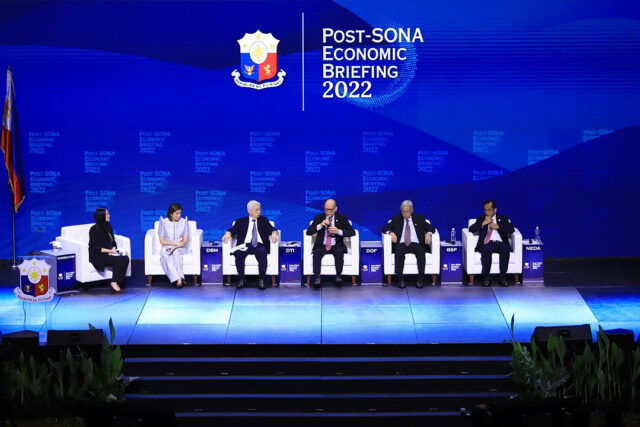
“The indication is clear. We do not have to borrow as much as we did in the last years, and at the same time, we will continue to boost domestic economic activity with our massive infrastructure investment of 5-6% of gross domestic product (GDP),” Mr. Diokno said at the post-State of the Nation (SONA) economic briefing in Pasay City.
The Philippines’ debt pile reached P12.495 trillion as of end-May, reflecting the surge in government borrowings to finance its pandemic response.
As of end-March, the country’s debt-to-GDP ratio breached the 60% threshold recommended by multilateral lenders at 63.5%.
The Finance chief said the Philippines is fully prepared to address risks arising from elevated inflation, lingering effects of the pandemic and the unpredictable global economy.
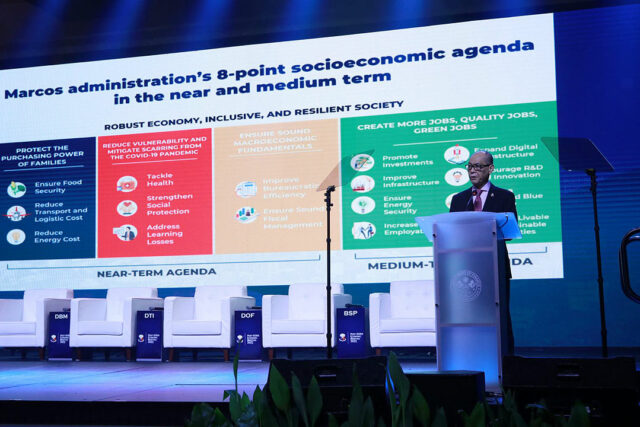
“The Marcos administration will implement a comprehensive 8-point socioeconomic agenda to decisively respond to these risks and steer the economy back to its high-growth trajectory,” he said, referring to the government’s 6.5-7.5% GDP target for this year and up to 8% GDP goal for 2023-2028.
The socioeconomic agenda includes ensuring food security, reducing transportation and logistics costs, and bringing down the high cost of power. The near-term agenda also includes mitigating the scarring impact from the pandemic by addressing learning losses and strengthening social protection, as well as ensuring sound macroeconomic fundamentals by improving bureaucratic efficiency.
Mr. Diokno said that the country still has enough fiscal space to meet these ends, citing a sound tax system and 200 ready-to-implement projects left by the preceding administration.
“We will enhance the improved tax system, so that will give us more revenues… we will rightsize the government so that the government will be in much better shape and do much more with less,” he said.
Over the medium term, the Marcos administration wants to create more jobs, improve infrastructure and ensure a level playing field in markets.
“We need to address the constraints to growth [and] constraints to quality employment creation that have been well identified by our development partners. These include issues affecting infrastructure,” Socioeconomic Planning Secretary Arsenio M. Balisacan said.
Mr. Balisacan said the government will focus on improving the educational system, as well as develop high-quality job-creating sectors, particularly manufacturing.
UPPER MIDDLE INCOME Economic managers are hoping to achieve President Ferdinand R. Marcos, Jr.’s target for the Philippines to achieve upper middle-income status by 2024.
“At the rate we are growing, and assuming that we’ll achieve the 6.5-7.5% growth this year and the 6.5-8% next year, we should be reaching that minimum of $4,250 in 2024,” Mr. Balisacan said.
The World Bank recently increased its income range for the upper middle-income bracket to a gross national income (GNI) per capita of $4,256-$13,205 from $4,096-$12,695.
The Philippines remained a lower middle-income economy despite the GNI per capita going up by 6.12% to $3,640 last year.
“That will mean that the size of the economic pie will be bigger, and that will mean that even without Mr. Diokno raising the rates of taxes, the size of the government revenues will be much bigger, and so we’ll have more resources for meeting public services and social protection,” Mr. Balisacan said.
Mr. Marcos is also aiming to reduce poverty incidence to 9% by 2028 or the end of his term.
“It’s so crucial that we are able to grow quickly, and sustain that growth because that is the most sustainable way of reducing poverty and achieving greater distribution of opportunities,” Mr. Balisacan said. — Diego Gabriel C. Robles
THE PROPOSED P5.268-trillion national budget for 2023 will focus on the Marcos administration’s top priorities such as education, health, infrastructure, social safety nets, and agriculture, Budget Secretary Amenah F. Pangandaman said on Tuesday.
During the post-State of the Nation Address (SONA) economic briefing, Ms. Pangandaman said the Department of Budget and Management (DBM) is still finalizing the proposed General Appropriations Act (GAA) which will be submitted to Congress on Aug. 22.
The proposed P5.268-trillion budget accounts for 22% of gross domestic product (GDP), and is 5% higher than this year’s P5.024-trillion budget.
Ms. Pangandaman expressed hope the budget bill will be approved by Congress before the Christmas break.
“Our budget will support our medium-term fiscal framework and the eight-point agenda… First, of course, is funding for education. It is the top priority, as mandated by the Constitution,” Ms. Pangandaman said.
“We will use and allocate our scarce resources to be able to finance our priority programs and projects. We will ensure that every peso in our GAA (General Appropriations Act) will be spent and implemented timely,” she added.
Since the Marcos administration promised to continue the “Build, Build, Build” program, she said the DBM will provide funding support for infrastructure projects.
“As directed by the President, we shall continue with the ‘Build Build Build,’ and expand it further,” Ms. Pangandaman said, adding that spending on infrastructure is seen to reach P2 trillion by 2028.
The Marcos administration is targeting an infrastructure spending-to-gross domestic product (GDP) ratio of 5-6% annually from 2023 to 2028.
The infrastructure program for this year is at P1.2 trillion, accounting for 5.5% of GDP.
In his first SONA on Monday, President Ferdinand R. Marcos, Jr. said the government should aspire to “build, better, more.”
“Necessarily, infrastructure development will remain a very high priority in our drive for growth and employment. Once again, I will not suspend any of the ongoing projects as those have already been shown to be of benefit to the public that they serve,” Mr. Marcos said.
The DBM will also roll out the Budget and Treasury Management System.
“It is an online ledger of all transactions of the government, from planning up to the release of the budget. We will see the levels of the budget in real time. You’ll see the releases; you’ll see the balances of our budget. So, it will ensure transparency in government transactions,” she said.
‘COMPLICATIONS’ Meanwhile, Finance Secretary Benjamin E. Diokno said they are now reviewing which spending items should be assigned to local government units (LGUs), as the Mandanas ruling is implemented this year.
“In an executive order issued by President Duterte before he left office, he specified some of the items that are now going to be assigned to LGUs. These are not really new items… except that there are some items that should not be there in the first place,” he said.
“Right now, we are reviewing what spending items should be assigned to LGUs, and we are in close coordination with the needs of cities, provinces, etc.,” he added.
Mr. Marcos also highlighted this issue during his SONA on Monday.
“We have been in discussion with local government leaders, governors and mayors, in the last few weeks to determine, with the LGUs, what is actually practicable, what functions belong to the LGUs and what belong to the National Government,” Mr. Marcos said.
The President noted some “complications” arose over who will repair school buildings in relation to the Mandanas ruling.
Starting this year, LGUs received a bigger share of the National Government’s tax collections, alongside the transfer of basic services.
President Rodrigo R. Duterte in June 2021 signed Executive Order (EO) No. 138 which transfers a number of basic services to LGUs by 2024. With this, the government is shifting programs and projects, worth an estimated P234.4 billion, to LGUs. — D.G.C.Robles
JAKARTA The other week, I was in Jakarta to watch Gilas Pilipinas play in the FIBA Asia Basketball Cup. On the way to our hotel, I was struck by how different the city looked since I last visited in 2018. Undeveloped spaces sprang forth new buildings, transport hubs, and vibrant centers of economic activity. It was amazing. When I asked what spurred this pace of growth, the reply was: “Well, people kept working through the pandemic.”
Later, when I visited Anthoni Salim in his office at Indofood, he shared with me his plans to develop 600 hectares of greenhouses. Their goal, he says, is to help feed their population of 270 million people. This is the kind of single-minded approach to Agriculture that our country sorely needs — and one which our Group is passionate about — feeding our people first. It is appalling how many billions of dollars we spend on imported food every year. President Marcos’s focus on the sector has resonated with us, and our people. It will be precisely this mindset — focus, boldness, and planning — that could turn this industry around.
OUTLOOK Outlooks are tricky. Several studies have revealed that economic growth forecasts — many of which rely on formulas more scientific and sophisticated than my own studied observations — tend to have upward biases. So instead of speculating about how our country might perform in the coming years, perhaps it would be more prudent to offer my own outlook in the form of a to-do list — starting with areas that our companies can materially affect.
Agriculture is foremost in our mind. We are in sugar and dairy production already. We will emulate the greenhouses of Anthoni here, and expand into other food areas.
Power is next. The Philippines needs adequate and affordable energy, and simply more power plants to augment supply. This was driven home by President Marcos Jr. in his SONA earlier this week. If there are no new plants built soon, we can expect rotating brownouts in the country. We must also achieve a fair degree of energy independence, failing which import dependencies will subject us to the vagaries of geopolitics. And if we do not reduce our reliance on fossil fuels, we can expect a grim future for our children.
Meralco, for its part, intends to build a substantial portfolio of power plants, especially renewable. We plan to raise the share of renewables in our distribution supply chain and our generation portfolio. We envisage an energy mix that is 35% renewable by 2030, and 60% in 2040. We are also applying with the government for an ambitious capex for advanced metering infrastructure which, with solar panels on rooftops, will help consumers better manage their electricity consumption.
The other currency with which modern economies are being reimagined is connectivity. Infrastructure has come to mean both information and brick and mortar highways — both of which our Group builds. Cities who deal with transport shortages and traffic congestion must work with business to sort out the ideal logistical arrangements — both physical and digital — which should ultimately connect via data the providers of goods and services directly with the consumer. The most efficient ecosystem is the direct connect digitally, between producers and consumers, linked by efficient logistics, and with fewer intermediaries. This is now possible with technology.
Back in the real world — earlier this year, we opened the 8.9 km Cebu-Cordova Link Expressway (CCLEX) in Cebu — the longest and tallest bridge in the country. We partnered directly with the local governments of Cebu City and Cordova, which we hope can become an archetype for Private Sector/LGU engagements in the future. We plan to build more roads here and abroad. On the connectivity side, PLDT has also been on an appropriate track. Last year, we laid out more domestic and international fiber than before, and added more than a million Home Broadband Fiber customers. Our goal to provide connectivity to anyone who needs it, wherever the location, remains inviolate. And we want to make the Marcos administration’s universal connectivity initiative a reality.
Finally, on the health side, our hospitals saw a lack of manpower — particularly nurses — which became one of the major bottlenecks to our Covid response. There were instances where available beds could not be filled because no one could man them. The President’s support for a Medical Reserve Corps Act, which will allow him to mobilize such a group during a public health emergency, is timely. And a development such as this will result in more healthcare professionals in the pipeline.
FINALLY President Marcos Jr.’s SONA gave us a spacious idea of the government’s position on various areas, and it was comforting to hear that his administration is taking a thorough, pragmatic approach to the challenges confronting the country. Indeed, there is much work ahead. But the most dangerous takeaway would be to think that that work should fall on the shoulders of government alone. If we want to level up with our neighbors like Indonesia, we must not simply match their dedication, but exceed it. That means all of us — including us from the private sector. When we are able to work together — like a basketball team — the passion, creativity, and inherent ingenuity of our people will carry us through. This should supply us with the optimism which had vacated us these many years. Perhaps it is also what encouraged the President to close his SONA with these hortatory words — that despite everything, “the State of the Nation is sound.” I couldn’t agree more.
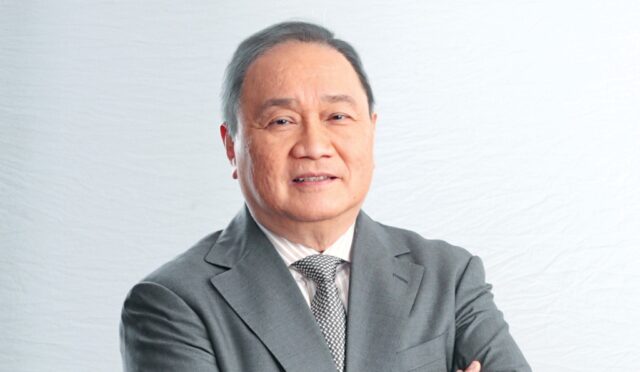
Manuel V. Pangilinan is the president, chairman, and chief executive officer (CEO) of Metro Pacific Investments Corporation. He is the managing director and CEO of Hong Kong-based investment management and holding company, First Pacific Company Limited, with operations in the Asia-Pacific Region. He is also the chairman of PLDT, Meralco, Maynilad, Philex, TV5, Media Quest, and PXP Energy.
The young sub-editor sat stone-faced and unblinking before BusinessWorld’s brass early one morning, even as he was disappointed by the publisher’s outwardly lukewarm reception of a 1996 Asia-Pacific Economic Cooperation summit report which he had just presented. He had toiled on the report for weeks on end — conceptualizing the cover design and completely rewriting some articles — on top of work on regular pages that began at about 9 a.m. and stretched towards 10 p.m. daily.
It was just another brush with the exacting culture of quality he had struggled with since joining the publication as a reporter after leaving government service.
Sensing the newly promoted sub-editor’s discouragement, the city editor at that time took him aside. “Uy, dapat matuwa ka na ’nun. Ganun lang talaga si Boss magpuri ng trabaho (Hey, you should be glad. That is really just how Boss praises work.),” the senior editor said, referring to the late Raul L. Locsin who had founded the publication in July 1987. “Don’t expect a medal.”
Of course, talent management has improved by leaps and bounds since then, even as the focus on quality endures — it is probably one of the few things that has kept steady since BusinessWorld’s founding in mid-1987.
VETERANS’ TALES For some BusinessWorld vets, the publication’s story from the start has been characterized in part by an awareness of available tools to kick the business up even just a notch through ever-present hurdles.
Ronaldo A. Romero, who started as news editor when BusinessWorld began operations and retired as publisher in 2006, recalled how computerization of the newsroom back then had cut the time it took to produce the newspaper. “Little by little, we were able to put the paper to bed earlier than 12 midnight, then 11 p.m., until we were able to close at 10 p.m.,” he recalled in a recent chat.
Besides that, focal to competitiveness even then was the quality of talent and well-oiled newsroom operations. “It is noteworthy that we had only so many reporters, but were still able to put one or two over the other dailies,” Mr. Romero added, saying that one “major advantage” was the ability of newsroom staff to promptly support reporters in the field who needed background information before interviews or for articles.
Marvin A. Tort — a BusinessWorld columnist who had served as managing editor through years that saw resurgent political and economic uncertainties, punctuated by the 2005 resignation of some Cabinet secretaries and senior officials amid a top-level election controversy — remembered the constant struggle “to look for new ways to distribute content” as print subscription plateaued.
“We were somewhat ahead in the online space, but revenues were still driven by print, and circulation was not growing,” he explained. In that setting, the online platform ended up “competing rather than complementing” print.
Among others, BusinessWorld ventured into a content partnership with the ABS-CBN News Channel at that time, and while that did not bring in ad revenue, it generated “greater awareness,” Mr. Tort recalled.
“We also started a breakfast forum, organizing events for subscribers to attend,” he added, generating revenue from sponsorship.
The 2007-2008 Global Financial Crisis made business even tougher, said Anthony L. Cuaycong, the publication’s former president who had been vice-president and chief operating officer at that time, noting that advertising slowed as “(t)he usual sources turned to papers with higher circulation, compelling management to think outside the box in order to enhance the paper’s value as an advertising medium.” At that time, he said, such efforts included coming up with special sections to lure specialized ads.
STANDARD FARE Challenges constantly knocking at BusinessWorld’s door notwithstanding, the publication has become standard fare for those monitoring the Philippine economy.
“To be effective in our work, my research team needs to know what’s in BusinessWorld each morning of each trading day, as we simply can’t afford to miss any major economic and financial market development,” Emilio S. Neri, Jr., lead economist at the Bank of the Philippine Islands, said in a recent interview.
“We find BusinessWorld articles a valuable source of information…,” he added, citing particularly the Quarterly Banking Report.
Peter Lee U, dean of the University of Asia and the Pacific’s School of Economics, who specializes in energy and industrial economics, said separately that BusinessWorld keeps him “posted on developments like the latest policy pronouncements of key government officials and business players, as well as releases of economic statistics.”
“When giving economic analyses and briefings to our public, one has to be aware of these developments,” he said.
“As an economics teacher, I use BusinessWorld reportage of developing and past issues to draw examples for my economics classes. This prevents economics lessons from remaining theoretical so that students can see it actually applies to real-life events, and thus understand how markets work,” he explained.
“In both cases, facts and figures need to be collected and monitored historically. To talk based on the latest numbers without knowledge of trends emerging from actual historical data is like shooting from the hip. Thus, I also go back to old news to give context, which is important as well in academic research.”
Still, newspapers have long since acknowledged the dire prognosis for print as a medium for content delivery. In fact, this had been a nagging planning topic after The Philippine Star took over BusinessWorld in mid-2015.
Major survey groups have provided an overall picture of the changed landscape of news consumption over the past two years, among others showing that close to half of Filipino adults (aged at least 18 years old) polled used the internet, with nearly all of that complement maintaining a Facebook account, almost half of those accessing the Web doing so to get news and just 1-3% relying on newspapers for such content. If anything, “internet use has been on a generally upward trend for all age and education groups since June 2006,” one of them — the Social Weather Stations — said in a September 2020 report. (1)
Jarring adjustments amid the disruption caused by the ongoing pandemic ironically provided the much-needed kick — making both editorial and business sense — towards digital space.
CHANGE HAS ONLY JUST BEGUN Miguel G. Belmonte, president and chief executive officer (CEO)of BusinessWorld and parent The Philippine Star, said earlier this month that fundamental principles will anchor the company as it dives further into the digital realm.
“BusinessWorld has always believed in and maintained the highest quality of journalism simply because this is what business readers deserve, whether they follow us on traditional platforms or on newer media channels. The important thing is that the quality of journalism will remain the same regardless,” Mr. Belmonte said.
“From a static medium, BusinessWorld was able to create new community of readers and followers in the digital space.BusinessWorld Insights and BusinessWorld Virtual Economic Forum became two of our most successful endeavors in the digital space. These were able to mitigate the impact of the pandemic in the last two years. Despite the challenges in 2020, we saw 2021 becoming profitable again and it looks like 2022 will be BusinessWorld’s most profitable year ever,” he added.
Miguel G. Belmonte, president & CEO of BusinessWorld Publishing Corp.
“On the other hand, we continue to embrace newer platforms to cater to the needs of our audience. The mission is quite simple: to remain the same by keeping our core values intact while evolving so that our brand is able to adapt to the changed media landscape.”
BusinessWorld’s current journey is mirrored in the wider business world.
In an effort to “build back better” as they claw their way out of the slump in the past two years, organizations are beating a path through an uncertain environment and fighting to survive through a pandemic, persistently fast-rising prices, successive interest rate increases, the fragile recovery of the overall economy and the growing risk of a global recession next year.
The internet is replete with prescriptions from consultancies and international organizations for those sailing further into such uncharted waters.
In its 2022 Global Risks Report, for example, the World Economic Forum isolated five emerging best practices in organizations’ quest for resilience:
• Identify specific types of failure or damage that could hit core business goals in order for organizations to gain a better appreciation of their capabilities and available tools that may have to be deployed, redesigned or improved.
• View vulnerabilities within a broader ecosystem that includes third parties on which organizations rely.
• Emphasize “just-in-case reliability” rather than “just-in-time efficiency” by putting backups and redundancies in place to ensure that the organization can adapt quickly for business continuity. In this effort, “(s)upportive employee behaviors are as vital as structural measures, especially when empowered by good leadership and effective communication,” the report said.
• Connect resilience efforts with environmental, social and governance (ESG) goals. “For example, shortening supply chains can advance net zero strategies as well as reduce exposure to adverse geoeconomic developments, while strong community relations may help recovery initiatives in the event of a disaster,” it said.
• Consider resilience as a journey and not as a target and constantly be alert to changing circumstances that could result in fresh blind spots and gaps that, in turn, would warrant urgent new adjustments.
For Bain & Company, “getting business resilience right” means staying on one’s toes to spot vulnerabilities as they emerge and improve scenario planning to prepare as best one can for the unforeseen.(2)
First off, “(t)here is no way you’re going to remove volatility,” Dunigan O’Keeffe, Bain’s head of Global Strategy practice, said in a January 2021 video discussion. And that, in a way, is a good thing. Amid all the talk these days about agility, his remarks bring to mind a principle behind new-generation fighter jets’ supermaneuverability (as seen in Top Gun: Maverick) — they are designed to be so inherently unstable they would drop like rocks were it not for onboard computers that keep them steady via microsecond adjustments.
Bain Director James Allen separately described the pandemic as “a dress rehearsal for a new, more turbulent world.” “…(W)ithout that pandemic, you’d still be heading for a new, more turbulent world. You just wouldn’t have had the dress rehearsal,” he said in another video. “… (H)ow adaptable are you to more turbulence?” (3)
“There’s this issue that you’re preparing for yesterday’s ‘(black) swan’ event. Right, you had a problem with commodity pricing and now you’re hedging. Turns out that the next one event is a technology problem. That’s a big issue,” Hernan Saenz, Bain’s global head for Performance Improvement practice, explained in the January 2021 video. “And the other one is to just cover certain areas, right: the ones you’ve covered in the past and the ones that you read about in the news. But now, you have to cover everywhere — your strategy, your operations, your organization, your technology. So you don’t want surprises in any big angle of your business.”
Lessons have been myriad: from having leadership positions in various parts of the company’s portfolio, to being aware of which business segments risk being very stressed in a crisis, to a culture and structure (i.e., empowering local teams more) “close enough to the frontline with the customer, such that you see those crises early and are able to respond,” to cite just a few.
Turning to the global challenge of worsening inflation, Bain said that companies that improve productivity by cutting costs and spending better, while adjusting prices and finding new sources of growth will “weather the storm best.” It noted that the current inflationary period differs from the last one in the early months of the 2008 global recession in that labor markets are tighter and supply chains are more constrained, though consumer demand has not dipped the way it did then. “As they prepare for higher inflation in this new environment, companies will need to make moves that not only cut costs but also build more scalable growth platforms, positioning them to strategically reinvest in programs that deliver greater resilience and stronger purchasing and pricing capabilities,” Bain said in an April 2022 article. “They need cost programs that allow them to grow top-line revenue and reduce their dependence on difficult labor markets while improving employee retention.” (4)
Boston Consulting Group (BCG) identified a number of priorities for corporate leaders this year. (5)
The list includes figuring out which features adopted amid the pandemic that enabled an organization to respond quickly to contingencies, like breaking down traditional barriers as well as forming and empowering small teams to address key challenges, to keep. The company can then deploy more resources to scale up and then integrate what works in these teams. “Competing on innovation velocity should be a pressing priority for 2022,” said Karalee Close, BCG’s managing director and senior partner, as well as global leader for Technology Advantage.
ESG may also be catching on, but “make sure your company’s good deeds are profitable and scalable,” said Richard Hutchinson, BCG managing director and senior partner, as well as global leader for Social Impact practice. “Investors, employees, governments, and other stakeholders increasingly expect companies to work for the public good. These expectations have risen dramatically in just the past few years,” he said. “My advice is that if you want to make a real social impact, find something you can do profitably. Because if it’s profitable, it’s scalable. And if a solution is scalable, it can be really powerful.” The trick, Mr. Hutchinson said, is to find ways to incorporate such initiatives into the core business.
Organizations also need to rethink and recalibrate their talent management framework, said BCG Managing Director and Senior Partner Deborah Lovich. That, she said, involves finding out what makes key workers tick or dissatisfied and then collaborating with them to craft better structures and arrangements that would be good for both them and the business.
Finally — for those considering adoption of artificial intelligence (AI) — there is a need to first understand AI’s full potential for one’s business before moving forward, said François Candelon, BCG managing director and senior partner, as well as global director of its Henderson Institute think tank. “CEOs know that it’s important and are ready to make serious investments,” Mr. Candelon said of AI. “But many don’t really understand what to do with it. To borrow a French saying, it’s like giving a knife to a chicken. Not surprisingly, only around 10% of companies say that they see significant financial returns on their AI investments, according to a recent study we at BCG conducted with MIT Sloan Management Review.”
Zeroing in on digital transformation, McKinsey & Co. said that while most organizations have dived into digitalization to varying degrees, “simply getting projects off the drawing board doesn’t guarantee that the organization is increasing revenue, profitability, market share, efficiency, or competitive moats as a result.” Besides having the top brass engaged in this effort, ensuring success would require prioritizing scalable initiatives that will substantially improve organization performance, focusing on minimally viable outcomes that can be improved over time, as well as measuring and tracking the impact and value creation of digital initiatives. (6)
“To maximize returns, we recommend transforming one business domain at a time and broadening from there for traction and coherence,” Laura LaBerge, director of Capabilities for Digital Strategy at McKinsey’s Stamford, Connecticut, office as well as senior partners Kate Smaje and Rodney Zemmel said in a June 2022 article. Focusing on one critical process or function at a time, they said, “allows organizations to leverage similar data sets, technology solutions, and team members for multiple use cases, which ultimately saves time and expense.” (7)
They also noted that, among others, use of digital technologies to achieve competitive differentiation in terms of customer engagement and innovation, rather than to merely achieve cost efficiencies, would have better chances of reaping these investments’ full value.
IN A STATE OF FLUX Our 35th anniversary report now seeks to provide an idea of how environments have changed for a selection of industries and sectors and what stakeholders there have been doing or can do, not only to cope but also to thrive.
If anything, BusinessWorld’s own migration to the digital realm amid continuing disruption remains a work in progress. A process that accelerated a quarter after the declaration of a pandemic in March 2020 has given this publication a slew of brands in its digital portfolio, including the BusinessWorld Virtual Economic Forum; BusinessWorld B-Side podcasts available on Spotify, Apple Podcasts and Anchor; BusinessWorld Insights online discussion with experts; BusinessWorld In-Depth Magazine that now includes the Quarterly Banking Report; BWorld Lounge Viber community; and BusinessWorld One-on-One virtual interviews with top government and private sector leaders, among others.
Coming up are even more initiatives as we maximize the digital potential of BusinessWorld’s content and services. So please stay tuned.
(1)For details of the Pulse Asia and Social Weather Stations surveys from late 2019 to late last year, go to https://www.pulseasia.ph/september-2021-nationwide-survey-on-news-sources-and-use-of-the-internet-social-media-and-instant-messaging-applications/ and https://www.sws.org.ph/swsmain/artcldisppage/?artcsyscode=ART-20200908150946.
(2)Dunigan O’Keeffe, Hernan Saenz, Andrew Schwedel, and Thomas Devlin, “Getting business resilience right,” https://www.bain.com/insights/getting-business-resilience-right/; “Dispelling Five Myths on Business Resilience, https://www.bain.com/insights/dispelling-five-myths-on-business-resilience-video, Jan. 7, 2021.
(3)James Allen, “Roadmap for a post-pandemic world,” https://www.bain.com/insights/roadmap-for-a-post-pandemic-world-video, 7 April 2021.
(4)Jaxon Heinrich, Simon Henderson and Megan Portanova, “Turning inflation disruption into value with six strategic steps,” https://www.bain.com/insights/turning-inflation-disruption-into-value-with-six-strategic-steps/?utm_medium=email&utm_source=mkto&utm_campaign=OPT-q2-best-of-bain-insights-2022-07-06&utm_term=turning-inflation-disruption-into-value-with-six-strategic-steps&mkt_tok=Mzc4LU5ZVS0yMjAAAAGFdIBJ7R-mYDLZjs60DgZdBqelF2W00RGF8Wot1M5fPkIDJgXjtZ0FsEqG09-hMayL7k_Lkc5virk91aS55GvfnLfB07s6UPnuaY5R2IZ0, April 18, 2022.
(5)Priorities for the C-Suite in 2022, https://www.bcg.com/publications/2022/c-suite-executive-priorities-2022, Jan. 10, 2022.
(6)Matt Fitzpatrick and Kurt Strovink, “How do you measure success in digital?” https://www.mckinsey.com/business-functions/mckinsey-digital/our-insights/how-do-you-measure-success-in-digital-five-metrics-for-ceos, Jan 21, 2021.
(7)Laura LaBerge, Kate Smaje and Rodney Zemmel, “Three new mandates for capturing a digital transformation’s full value,” https://www.mckinsey.com/business-functions/mckinsey-digital/our-insights/three-new-mandates-for-capturing-a-digital-transformations-full-value, June 15, 2022.
NEDA Secretary Arsenio M. Balisacan will have to strike an uneasy balance as he formulates economic policy for the Marcos administration.
On one hand, he must continue the infrastructure programs of the Duterte administration as these are necessary investments for our economic future. At the same time, a deluge of new investments must be made to elevate our education system, broaden healthcare services and provide social protection for the poorest among us through the conditional cash transfer program. All these necessitate massive spending on the part of the government.
On the other hand, he must tighten belts. The Marcos administration inherited an economy that operates on a deficit -— one only bridged by debt. From a public debt of roughly P5.9 trillion in 2016, debt ballooned to P12.68 trillion as of January this year, representing 63.5% of GDP. In other words, the Philippines owes P63.5 pesos for every P100 worth of goods and services she produces. Our debt-to-GDP ratio surpasses the government’s own self-imposed limit of 59.1% and the international standard for developing countries of 60%.
So Secretary Balisacan is under pressure to spend more on infrastructure and social services while slashing expenses and avoiding the take-up of new loans.
Putting a stop to ongoing infrastructure projects is out of the question as it is bad practice and will send an unfavorable signal to investors, Mr. Balisacan has said. As of April 2021, just 12 out of 119 flagship infrastructure projects have been completed. Another seven should have been completed by the time Mr. Duterte stepped down, if the former President’s spokesmen are to be believed. That leaves 100 projects still in the pipeline, all of which require funding.
The Marcos administration intends to sustain infrastructure spending at 5.5% of GDP in 2022, 5.4% in 2023 and 5.3% in 2024 and 2025.
Meanwhile, budget appropriations for education, healthcare and social protection must increase by at least 40%, 30% and 20%, respectively, to make an impact. Investing in health and human capital capacitation is an equally important investment in our economic future.
And then there is debt service. Mr. Duterte left Mr. Marcos with P834 billion in debt falling due this year; roughly 4.2 trillion will be falling due within the decade.
Difficult as it may seem, performing this balancing act is possible. However, it will require the adoption of radical policies.
The first is to crack down on budgetary leakage. Few are aware that as much as 15% of the national budget is lost to graft and corruption. This amount was validated by a senior official of the Department of Budget and Management. Graft and corruption come by way of procurement overpricing, ghost purchases, ghost payrolls, congressional pork barrel funds, frivolous budget insertions, etc. To better appreciate the scale of budgetary leaks at present, the volume of public funds thought to be lost to graft and corruption is nearly enough to pay our debt service bill this year.
There is no way out of it -— graft and corruption must be culled to get maximum value out of the national budget. This will entail sacrifices from those that benefit from it most — the legislature and grafters from the Executive branch.
Second is to spread the cost of infrastructure. The funding requirement of the 100 remaining flagship projects is well over P4 trillion. Mr. Duterte’s preference for loans (through official development assistance) is simply not sustainable. Fitch’s negative outlook on the Philippines, as affirmed in February, underscores the need to adjust the funding mix for infrastructure development.
Mr. Balisacan was correct when he said that private capital must be tapped to help foot the infrastructure bill. The Philippine playbook on public-private partnerships (PPP), developed during the Aquino administration, is so advanced that it has been used as a template by the governments of Thailand, Indonesia, India and Poland, among others. It will be foolish not to tap the wealth of private capital for projects where private participation is warranted, especially considering our vast experience in undertaking PPP projects. Besides, the private sector has consistently proven that it can build, operate and maintain projects more efficiently than government can. By leveraging PPP, infrastructure projects that would have required a cash outlay on the part of the government will instead become a source of income by way of royalties and taxes.
Although Mr. Balisacan has ruled out canceling infrastructure projects, I still think that certain projects need to be reviewed. Poorly managed projects must be rationalized or privatized. Those that garnered a negative report from the Commission on Audit must be subject to cancellation. One of them is the Kaliwa Dam Project. The CoA reported that there was a simulated bid among Chinese contractors in favor of the winner, China Energy Engineering Corp. Projects tainted with corruption from the get-go should have no place in the current administration. Similarly, projects that employ majority foreign workers should be canceled or reconfigured as they leave out Filipino laborers at the Philippine government’s expense.
Third, increase tax collection. Government’s tax collection efficiency is about 15.5% of GDP today. It is simply not enough to bridge the budget gap, which stood at 8.6% of GDP or P1.67 trillion last year. Mr. Balisacan and the rest of the economic team aspire to gradually reduce the budget deficit to 7.6% in 2022, 6.1% in 2023, 5.1% in 2024 and 4.1% in 2025.
Finance Secretary Benjamin E. Diokno said that he is not inclined to impose new taxes. Instead, he would rather increase collection efficiency by automation and by cracking down on tax delinquents, tax evaders and smugglers. One wonders if the family with the biggest tax delinquency, the Marcoses themselves, will be made to settle their P23-billion estate tax obligation. Not to do so will be unfair to the rest of the Filipino people who will surely be pressured by the BIR to pay up.
Fourth is to have the economy grow its way out of its debt. If the economy is able to grow by at least 7% per year until 2025 and 6% until 2028, we will be able to bring down our debt ratios to manageable levels and service debt with ease. Growing by this rate will make the Philippines a half-trillion-dollar economy by 2025.
Mr. Balisacan hit the nail on the head when he said that investment should be channeled to bring about the resurgence of agriculture and manufacturing. These sectors have been in steady decline, such that they now comprise less than 40% of economic output today. It is the reason why we have become import-dependent for the majority of our needs. The situation is so bad that we import basic food products, including rice, sugar and pork, and basic manufactured goods such as textiles and construction materials.
Increasing agriculture and manufacturing output will reduce our import bill, increase export and tax revenue, and reduce our trade deficit.It makes sense to focus time and resources on these sectors. It will also generate jobs to reduce our 5.7% unemployment rate.
We cannot do it alone. We need foreign direct investment not only for the agriculture and manufacturing space but also for infrastructure and technology-driven industries. FDIs are the silver bullet that can solve our budgetary gaps and accelerate our development.
There have been breakthroughs, facilitated by the Duterte administration, which made the Philippines more competitive in attracting FDI. The recent passage of amendments to the Public Service Act, the Foreign Investment Act and the Retail Trade Liberalization Act have opened up more sectors to foreign ownership. The amendments override the prohibitive provision in the 1987 constitution relating to foreign investment. The CREATE Law has made us regionally competitive in terms of taxation.
But these are not enough. The next administration must institute reforms to reduce red tape and unease in doing business. This is true on both the national and local levels. Automation and digitization are key to addressing these. Other areas needing resolution are power security and cost, water security and, most important, the credibility and speed of the justice system.
Striking a balance between aggressive spending and belt-tightening is a challenge. But it can be done. The good thing is that Mr. Balisacan and the rest of the economic team have a well-considered path forward.
Andrew J. Masigan writes the Numbers Don’t Lie column for BusinessWorld. His e-mail address is andrew_rs6@yahoo.com. Follow him on Twitter @aj_masigan
WE ARE PLEASED to share excerpts from our July 5 special report to GlobalSource Partners subscribers. GSP (globalsourcepartners.com) is a New York-based network of independent analysts in emerging market countries. Its subscribers are mostly global banks and fund managers.
Ferdinand R. Marcos, Jr., took his oath of office as the 17th President of the Philippines on June 30. He is starting his six-year term at a particularly inauspicious time. Two years of battling the pandemic has left the economy weakened, with output barely back to 2019 levels and government limited in macro policy headroom due to rising inflation, hefty budget deficits alongside higher public debt, and a ballooning of the current account deficit. The economy is also facing external headwinds due to a slowing global economy, a gloomy outlook for energy and food markets as well as continuing supply chain bottlenecks that are pushing up global inflation, and tighter financial market conditions as advanced economies try to rein in soaring inflation. Downside risks remain elevated due to increased food and energy insecurity, rising risk of recession in the US, debt overhang and possible defaults in emerging markets.
CONTINUITY AND CHANGE In two major respects, Marcos 2.0 represents a continuation of the Duterte administration: a seamless transition at the macroeconomic policy level, with economic managers drawn from the last two administrations; and a commitment to sustaining investments in infrastructure at 5% of GDP, with old hands manning infrastructure agencies and PPP experts brought in key departments.
Notwithstanding broad policy continuity in these two areas, we expect a major change in working relationships. Previously, Finance Secretary Carlos G. Dominguez III was the recognized team leader given his unique friendship with the former President dating back to primary school. In comparison, we expect collaboration within the Marcos team to be more collegial, reflecting the members’ decades-long personal relationships. Too, although Messrs. Benjamin Diokno and Felipe Medalla have the more high-profile jobs as far as financial markets are concerned, we expect Mr. Arsenio Balisacan to have greater influence in steering the economy in new directions, including possibly agricultural policy.
In two notable areas, Marcos 2.0 is gearing up for change: agriculture and education. The clearest signal is that the President and the Vice-President, Sara Duterte-Carpio, are taking over those portfolios. Both sectors suffer from decades of government underinvestment (and especially in agriculture, poor governance) and will take years to reform to improve their developmental impacts. Both sectors are now grappling with rising risks, the former a looming food crisis, the latter in relation to the two-year suspension of in-person schooling.
Based on the appointments, two other areas where more balanced policies, important for the economy, can be expected moving forward are in foreign affairs and labor and employment.
THE NEXT 365 DAYS The overriding goal of the economic managers is to sustain job creation to drive economic growth of 6-7% over the term of the administration. They need to do this without benefit of the expansive macro policy room that their predecessors enjoyed at the starting line. Thus, more than the previous administration, they need to gain investor confidence quickly to unlock private capital.
One may view the many challenges they now face as messaging opportunities, especially for foreign investors, to help dispel doubts about the new regime and assure them of a level playing field. It is also an opportunity for the President to show leadership, how he resolves policy trade-offs and handles conflicting interests. Five major areas where concrete action plans are needed to match the rhetoric are worth highlighting:
1.Macroeconomic stability. The goals are twofold. More immediate is to signal and demonstrate ability to bring headline inflation back to target (2-4%) as early in 2023 as possible to minimize the risk of de-anchoring inflation expectations. Aside from the conduct of monetary policy, non-monetary interventions to address supply shocks and bottlenecks are important. Second is to present markets with a credible fiscal consolidation plan to avoid a credit rating downgrade, especially as external balances deteriorate. We expect details of the plan to be unveiled when the President presents his legislative agenda in his State of the Nation Address.
2.Financing infrastructure and PPP. There are about 100 flagship infrastructure projects worth close to P5 trillion, both ongoing and under review, that the Duterte administration is leaving behind. There is no question that the new administration will continue to implement projects that have started. Rather, the question is how the government will finance the big-ticket projects going forward given budget constraints. Although development partners are a major funding source (about P2.7-trillion total), these projects require budget cover from the government that contractors tell us is not fully assured, based on the latest approved national budget.
The list also includes many PPP projects that could help to sustain infrastructure investments under much constrained fiscal conditions. Although this suggests that there is no lack of private sector interest, government initiatives to rebuild trust in these long-term contracts will be needed considering the previous administration’s antagonistic stance towards long-standing PPP contracts (e.g., Manila’s water concessions) as well as reticence in granting sovereign undertakings that have been common in awarded PPP contracts (e.g., certain material adverse government actions, international arbitration, automatic adjustments in user fees). A revisit of the midnight implementing rules and regulations (IRR) of the BOT law done by the last administration that was roundly criticized by business organizations, think tanks and potential investors is in the works.
3.A looming food “crisis” and agriculture sector reform. The President himself placed this on the people’s radar screens and, given the global food shortage and price spikes as well as his campaign promise of P20 rice, almost half of current market price of regular milled rice (P37), the question on many people’s minds is what his intentions are for rice. Although there have been worries that he will reverse reforms initiated by the Rice Tariffication Law, which allowed freer imports and helped keep the price of the grain stable, he has not talked directly about the issue since his election
In his inauguration speech, the President expressed a broad desire to achieve food sufficiency and reduce reliance on imports. But he also pointed to his father’s administration as the only one that delivered on food self-sufficiency, bringing to listeners’ minds the elder Mr. Marcos’ Masagana 99 program which, while contributing to rice self-sufficiency, proved unsustainable due to high fiscal costs, and as farmers defaulted massively on government’s directed credit programs.
4. The lingering health crisis and resuming face-to-face classes. Since the January Omicron surge, the country has avoided further surges in COVID-19 infections. Experts think that the disease has likely become endemic. However, removal of health protocols, including the basic masking policy, has been impeded by the low level of booster dose take-up, in large part due to local governments being preoccupied by the elections.
So far, the private sector is still not allowed on its own to procure the vaccines, which have only emergency use authorization, and the pharmaceutical companies themselves have no incentive to move away from the current system of wholesale public procurement. The failure to sustain vaccination momentum is hindering the education sector’s ability to return to in-person classes, with less than 15% of schools conducting face-to-face instruction.
5. Power supply. Here we wish to highlight investor concerns about the reliability and cost of power over the medium term. The most pressing issue is related to the Malampaya natural gas reserves. Five power plants that provide about a fourth of the main grid’s generation mix run on Malampaya gas. Not only will the take-or-pay contracts expire by 2024 but estimates of remaining gas reserves indicate that these will be depleted by 2027. The grid will require higher-cost replacement fuel to run these power plants.
Moreover, for the economy to grow at 6-7% over the medium term, some 600 MW of new power supply will be needed annually to meet demand. The new administration will need to balance the needs of energy security with calls for decarbonization.
The new administration’s ability to put out these fires will define its ability to pursue meaningful structural reforms over the medium term and gain investor and the public’s confidence. Considering rising external risks related to food and energy markets, tightening financial conditions and worsening global growth prospects, we think any policy misstep in any of the above could be costly for achieving the economic managers’ aim of sustaining economic growth at 6-7%, alongside job creation.
As it is, we think that just the pandemic has eroded the economy’s growth potential by at least a percentage point and that in the short term, its lingering effects will continue to sideline many service industries, while investors will continue to wait and see what the new administration can and will do.
Momentum in vaccination would have to be restored to help keep economic growth momentum going. In this regard, finding a permanent Health Secretary is quite pressing. In terms of maintaining economic growth, some of the areas we cited above require immediate solutions to avoid social unrest (e.g., securing food supplies and inputs to production at reasonable prices) and ensure continuing growth (e.g., reopening in-person schooling, infrastructure). Others are a matter of credibly committing to a realistic medium-term action plan with concrete targets (e.g., fiscal consolidation, power supply adequacy, agricultural reform) to help build investor confidence and allow the recently legislated foreign investment reforms to bear fruit.
In addressing urgent issues, government needs also to keep an eye not only on the fiscal costs but also the risks. Many applauded the President’s Day One veto of an enrolled bill to create a special economic zone and freeport around a PPP project on the ground that it posed substantial fiscal risks for government. The same people are now wondering whether they could expect such good sense to be applied consistently going forward.
Mr. Bernardo co-writes the Introspective column for BusinessWorld. He and Marie Christine G. Tang serve as GlobalSource Partners Philippine advisers.
AS WE ENTER a new phase in the country’s history, I am confident that with a clear vision and plan for the country; close collaboration between the private sector and government; and the perseverance to steadfastly continue along the path of economic reform, the country can certainly bounce back from the pandemic and create a solid platform for growth.
The headwinds arising from the pandemic’s persistent impact and the war in Ukraine will remain, but I believe that the critical elements needed for the country to withstand these and bounce back are readily available.
For instance, looking ahead, we join the business community in expressing strong confidence in the appointments President Marcos has made for his economic team. Sec. Ben Diokno, Sec. Arsi Balisacan, Sec. Fred Pascual, and Sec. Felipe Medalla are all highly respected as they have all served in exceptional ways both in the public and private sectors. Sec. Jaime Bautista is likewise highly respected in the transportation space, which will be crucial in our continuing effort to drastically improve our roads, trains, airports, and seaports. They join many others in the Cabinet, who are experienced public servants and experts in the private sector.
We are also delighted with the recent pronouncements by the economic team that the new administration will reaffirm its commitment to harness public-private partnerships (PPP) as a pathway to address several of the country’s pain points. The private sector is a strong believer in the power of collaboration in solving our country’s biggest local challenges. We saw an excellent example of that with the unprecedented level of cooperation between government and the private sector during the pandemic.
It was inspiring to see government and private institutions working hand-in-hand to expand testing and treatment capacity; procure and administer COVID-19 vaccines; and distribute essential assistance to our vulnerable countrymen. It is our hope that we can further add to these gains as we move forward.
The Ayala Group looks forward to tapping the strong power of partnerships to solve the many challenges we face. We likewise remain committed to continue investing in the country to help in our recovery and to build a solid platform for sustainable and inclusive growth. For 2022, the Ayala Group intends to deploy P285 billion in combined capital expenditure (capex) and investments, 25% higher than 2021. We hope that this will help catalyze our recovery and growth, especially in light of the encouraging signs that we see in the industries that we operate in.
In residential properties, the reopening of the economy is a positive signal of returning vitality in the economy. However, we are closely monitoring the impact of rising interest rates and inflation on demand and disposable income. There has been recent increased demand for horizontal projects, highlighting the benefits of living in open areas.
In the office sector, while there has been a slight increase in the industry’s vacancy levels, we continue to see stable BPO and HQ operations that anchor tenancy in office spaces. We have seen lease out rates as high as 87% in the office buildings that were completed in March. As more companies return to physical work, we expect tenancy and demand to further improve.
In the banking sector, we saw industry loan growth reached double-digit growth in back-to-back months in April and May at 10.1% and 10.7% due to overall economic recovery. We believe that banks’ engagements in the digital space will become much more critical as customers shift online for their financial services needs. BPI has seen this transformation, with digital transactions now comprising 91% of all transactions, and gross transaction value growing by 22% in Q1 2022.
In telecommunications, we see this sector playing a critical role in enabling the digital lifestyle that everyone has grown accustomed to today. The pandemic underscored the need for fast and reliable connectivity. Globe is spending P89 billion for its capex program this year to continue improving and expanding its data infrastructure, 5G, and fiber broadband.
Meanwhile, the energy sector requires significant investments as the push for a shift to renewable energy accelerates. Globally, the share of electricity from non-coal sources has risen to 38% with wind and solar accounting for much of the rise. In the Philippines, the current share of renewables is about 21% of total capacity. We see encouraging prospects for the industry as DoE’s Philippine Energy Plan for 2020-2024 aims to increase this to 35% by 2030 and 50% by 2040. ACEN is well prepared to support this push, given its pipeline of 6,500 MW of renewable energy in the Philippines.
We are also investing significant amounts in healthcare and logistics. We see that there is a sizable, underserved demand in these sectors.
AC Health remains on track to build an integrated healthcare ecosystem through clinics, pharma, hospital, and health technology assets to make healthcare accessible to more Filipinos. AC Logistics continues to make significant strides towards being an end-to-end logistics platform. We believe that our ongoing acquisition of Air21 will transform the company into a full-suite logistics provider, complementing our last mile presence in Entrego. We hope to finalize the acquisition in the coming months.
We believe that the strong economic team that was assembled and the encouraging prospects we have seen in the industries where Ayala has touchpoints will be crucial in the country’s ongoing economic reform agenda.
For one, we all understand the need to continue improving the country’s education system, while at the same time upskilling our broader population and workforce to be prepared for the jobs and industries of the future. We are delighted that there is renewed energy and commitment within the private sector and in the Marcos Administration to collaborate with peers, and with each other on this important sector. This will be crucial as the economy tries to recover the jobs that were lost — mostly in mobility-related industries, such as transportation, accommodations, and food services — while also building a solid platform for the new jobs and industries that will emerge in the near future.
At a fundamental level, there remains the ongoing task to diversify the country’s economic drivers. The Philippines remains highly dependent on consumer spending, services, OFW remittances, and the Greater Metro Manila region. Consumer spending accounts for around 70% of GDP, while the services sector cover almost 60% of total jobs. Almost half of the country’s total economic output is concentrated in Metro Manila. The business community and the Ayala Group stand ready to support more broad-based development in the country’s emerging growth areas outside of our traditional economic centers.
These are just some of the major economic headwinds that the Philippines will face in the coming years. Let us also keep in mind the rising costs of goods and services due to both supply chain and geopolitical issues. There also remain other serious issues regarding the quality of our healthcare and education systems, as well as our physical infrastructure, which continue to greatly lag behind our peers in Southeast Asia.
These are just parts of a much broader economic reform agenda that will take time, energy, and strong partnerships to fully realize. However, we enter this new period in our history with optimism that with a clear plan and close collaboration between the public and private sectors, we can bring back significant sustainable growth and increase the momentum of our progress as a nation.
Fernando Zóbel de Ayala is the president and chief executive officer of Ayala Corporation and is part of the seventh generation in the family overseeing the Company. He is also the board chairman of Ayala Land and AC Energy, vice chairman of Bank of the Philippine Islands, co-vice chairman of Globe Telecom, and a director of Manila Water and Pilipinas Shell Corporation.
THANK YOU for the honor and privilege of sharing an article on this special BusinessWorld 35th anniversary issue, focused on moving “Forward Faster.” This theme resonates deeply with all of us at the Aboitiz Group because it summarily describes what we’ve been doing for the past 100 years and what we intend to keep doing in the next hundred and beyond, which is to continuously accelerate our growth into the future through innovation.
We recently launched a large-and-deep-scale group-wide initiative based on a bold decision to literally move forward faster. We call it a Great Transformation in the way we think and act as a conglomerate in order to become a faster, better, and stronger version of it. This transition into a New Aboitiz is one of the most important moments in our storied history and urgent imperatives of our time. We call it the birth of the Philippine “techglomerate.”
Let’s first take a look at the world around us and appreciate its surreality, volatility, and unpredictability. We are at an inflection point in time that leaves us with no other recourse but to bite the bullet of the modern world and find strength and opportunity in it. As the world is transformed by a pandemic, a Fourth Industrial Revolution, a European war with profound repercussions, unprecedented inflation, and a rapidly eroding democratic ideal, I believe we have more than enough reasons to transform with it.
We came to the rational conclusion that the only way to do this was to redefine what it means to be a conglomerate by defining what it means to be a techglomerate. As we move forward faster into the future, all industries will become tech industries, all companies will become tech companies, and all conglomerates will become techglomerates. At Aboitiz, we have chosen to not just recognize and accept this inevitable truth, but to accelerate it — to move towards it faster.
We knew this had to start with our people. Because as powerful as technology has become, it cannot and should not ever surpass the power of the people behind it. Humanity drives technology, and no matter how fast we move forward, it can never be the other way around. Thus began a campaign to open the mind to new and better ways of thinking, and a transformation to a culture that would be much more progressive, empathetic, independent, and entrepreneurial. We were shifting from a corporate culture to a startup culture.
We knew that once the mind was set free, people would become curious, experimental, and hungry for knowledge, as there was plenty of it out there and now instantly accessible. They would become more interested in understanding how things worked so they could find ways to make them work better. They would become naturally creative, innovative, collaborative, and unafraid to learn new skills and technologies that would make their lives easier and more productive at the same time. They would develop the attitude and behavior needed to build a techglomerate.
So a techglomerate from our perspective is not just about being tooled up to the max with the latest technology, but also about the mindset that goes with it — the cognitive flexibility, the digital dexterity, the emotional and social intelligence. It also means being clearly aware of the possibility that any of our strong, foundational, 100-year-old legacy businesses could be disrupted and dismantled at any moment by four college dropouts with a great idea and a garage. We are therefore incubating new tech startups to add to our future-ready business portfolio.
As a techglomerate, we also need to recognize the value of data and data literacy. Data is now the world’s most valuable commodity and by 2025, our Great Transformation’s first goal post, most employees will use data to optimize almost every aspect of their work. Our very own Aboitiz Data Innovation (ADI) in Singapore was created to explore and implement the vast possibilities of data science and artificial intelligence (DSAI) across all our business units to transform their performance capabilities.
The banking and financial services industry continues to explode online with fintech, crypto, blockchain, and digital banking; and now with ADI supporting it, UnionBank continues to lead this revolution locally with the creation of the country’s first digital bank, first metaversal bank branch, leading open finance platform, and most functional and customer-friendly online banking experience. DSAI has also been able to offset some of the strains affecting our Power and Food Groups due to the current energy and food crises.
Regional real estate is playing an increasing role in the growth of the economy and there is a unique opportunity to create well planned and forward-thinking developments that can compete globally. Our Land, Infrastructure, and Construction Groups are seizing this opportunity with developments like their LIMA Estate, as well as other critical infrastructure projects needed to support robust economic progress.
This brings me to my concluding point about our ultimate responsibility as a techglomerate, which is to bolster our brand promise of advancing business and communities. We and the rest of the private sector hope to work closely with the new administration in transforming our economy the way we are transforming our own businesses in preparation for the future — through digitization and innovative technology; modern, progressive thinking; and the proper infrastructure required to build a strong nation and economy that can be competitive on a global scale.
Sabin M. Aboitiz is the president and chief executive officer of the Aboitiz Group of Companies, one of the largest conglomerates in the Philippines with interests in energy, banking, food, real estate, infrastructure, construction, technologies, data science and artificial intelligence. He has been with the group for over three decades and has held various management positions in the company’s food, infrastructure, and then-transport strategic business units.
AS BUSINESSWORLD marks its 35th year in an ever-changing and fast-paced industry, it must have recognized the need to move forward even faster, remaining agile and constantly overcoming the challenges of this pandemic.
We share this path.
SM Investments Corp. continues to evolve and invest in our country through the years, regardless of the prevailing economic conditions. This reflects our firm belief in the resiliency of the Philippines and its people that will continue to transcend these economic cycles.
GROWING TOGETHER While we remain watchful of headwinds from geopolitical risks and their effects on inflation, we are optimistic about consumer outlook as we have seen this gaining momentum in the last quarter.
With renewed prospects for a retail recovery, we expanded our footprint nationwide. As of the first quarter, our store network reached 3,278 stores. And with more than 30 brands across our retail footprint, we serve as a platform for these local and international brands to be more accessible to the Filipino market.
SM Prime Holdings, Inc. has also signaled its optimism, laying out an P80-billion capital expenditure program for the year for its expansion, led by its malls and residential businesses.
SM Prime through SM Hotels and Conventions Corp. recently opened SMX Convention Center Clark, a nod to the growth prospects in the Clark Freeport Zone, with the facility poised to become the area’s preferred MICE (meetings, incentives, conferences and exhibitions) and tourism destination.
Our banks, BDO Unibank, Inc. and China Banking Corp., both delivered strong net income from sustained growth from their core businesses, increasing their nonperforming loan coverage and ensured strong balance sheets. As of the first quarter, both banks have a combined network of 2,209 branches and 5,547 ATMs.
Across our portfolio investments, we continued to see improved operations and resilient performance. These provide us good growth opportunities as we look for further investments in high growth areas in the Philippines.
Our continued growth is a testament to both the fundamental relevance of our businesses to Filipino consumers and to our long-standing financial prudence that helps fuel our expansion and growth.
But more than this, our growth means more opportunities to uplift the lives of communities.
DIGITAL TRANSFORMATION Since the onset of COVID-19, SM has reinvented ways it can bring its products and services closer to customers. We are committed to deliver excellent customer experience by combining the online shopping experience with our very own brand of service in our brick and mortar spaces. Our enhanced digital platforms allow our customers to use a multitude of devices and platforms which further complement our continued physical expansion.
One example is The SM Store’s Call to Deliver launched in 2020, a hybrid shopping platform that allows customers to get all their daily essentials from their chosen SM Store branch with the help of a personal shopper.
In 2021, Call to Deliver accounted for 10% of total non-grocery sales last year. We expect this share to shift to foot traffic in our stores as alert levels are relaxed further.
For the younger set who are savvy and comfortable shopping online, there is SM Retail’s ShopSM where they can shop for fashion, beauty and personal care essentials from the SM Store on an online shopping portal.
For our food business, SM Markets Online provides a one-stop grocery shopping platform to customers in Metro Manila, Cebu, Davao and other key cities in Luzon and Visayas. The platform offers an assortment of wet and dry market goods as well as offerings from house brand SM Bonus. SM Markets Online is also available through the ShopSM App.
BDO for its part continues to invest in digital infrastructure to make services more accessible, easier to use and operationally efficient. It launched BDO Pay, the country’s first bank-backed mobile wallet.
Our logistics arm, 2GO Group, continued to modernize its fleet and systems to meet future customer demands and help with the revival of tourism. Our other logistics company Airspeed started its digital transformation even before the pandemic by launching several services to help micro, small and medium entrepreneurs and global Filipinos.
We will continue to invest in online technology as we see e-commerce growing even more long-term. As we keep adapting to our customers’ preferences, we will combine our strengths in both the physical and online spaces and innovate further into the future.
SUSTAINABLE TOGETHER As an advocate for sustainability, we made a strong commitment with our recent investment in Philippine Geothermal Production Co., Inc. (PGPC). The acquisition of PGPC, which operates the Tiwi and Mak-Ban steam fields, will boost our sustainable portfolio through an investment in renewable energy production.
BDO recently issued its maiden Blue Bond amounting to $100 million, through an investment from the International Finance Corp. (IFC), which will support financing for projects that help prevent marine pollution and preserve clean water resources, while supporting the country’s climate goals.
This is a milestone for BDO, being the first private sector issuance in Southeast Asia to issue a Blue Bond. The issuance reinforces the bank’s commitment to sustainable finance, particularly in critical areas such as water conservation, wastewater treatment, plastic recycling, sustainable tourism, fisheries and sustainable seafood processing, among others.
This year also marks our second year of reporting under more stringent International Integrated Reporting Council (IIRC) guidelines. We have disclosed additional information according to the Taskforce on Climate Related Financial Disclosures (TCFD) framework, which lays out our approach and high-level roadmap relating to Climate Change.
Going forward, we recognize that protecting our environment is one of the biggest challenges we will face.
We stepped up our climate action program and together with SM Prime and NEO, a part of portfolio investments, we signed on as supporters of TCFD in 2021. We join more than 3,000 supporters worldwide to make clear our unequivocal support for private sector action, transparency in our own programs and our partnership toward common needs and goals.
SM Prime continues to lead in disaster resilience planning across all of its developments particularly as a partner in UN ARISE and by dedicating 10% of our capital expenditures to disaster resilient designs and features.
SM Prime also made one of the boldest announcements related to energy usage in the country to date, committing that 50% of their energy will be provided by renewable sources by end-2022.
Through our various businesses, we have also introduced the SM Green Movement that aims to improve the quality of life of communities through priority sustainability solutions to promote a green planet, green living and a green culture.
We continue on firmly with our journey of expansion and growth based on a long-term, sustainable approach to our environment while integrating technology into our businesses. Our vision remains, despite the uncertainties ahead, to build an ecosystem of sustainable businesses that are catalysts for responsible development to serve our communities better.
Frederic C. Dybuncio is the president and chief executive officer of SM Investments Corp. He is leading the company’s expansion and growth via landmark deals to diversify its portfolio into high growth sectors. Prior to this post, he was a career banker, spending over 20 years with JPMorgan Chase and its predecessor institutions.
THE NEW Philippine leadership is inheriting a Bangsamoro Region that is at its most peaceful in recent years, and where economic prospects are most auspicious since the 1970s when the armed separatist movement was born.
The past two Presidents, the late Benigno S.C. Aquino III and Rodrigo R. Duterte, laid out the foundations for the Bangsamoro Autonomous Region in Muslim Mindanao (BARMM) with the signing of the peace agreement in March 2014 and the passage of the Bangsamoro Organic Law in July 2018.
These milestones made headway despite serious tangles: the 2015 Mamasapano mishap during Mr. Aquino’s term; and the 2017 Marawi siege under Mr. Duterte, the costliest single conflict in post-World War II Philippines in terms of loss of life and property.
BARMM is now a region in transition with an expanded territory, holding greater power for self-determination, and more fiscally independent.
“The gains in peace have facilitated private-sector confidence as evidenced by the increase in investment generation, and socioeconomic improvement as seen in the decrease in poverty incidence which is at its lowest in the BARMM,” Presidential Peace Adviser Carlito G. Galvez, Jr. said during the Duterte Legacy Summit on May 31.
In 2019, the first year of the transition period under a new regional government, violent incidents dropped by 9% to 2,655 from 2,910 in 2018, according to the Conflict Alert 2020: Enduring Wars report released in January 2021.
Previously, violent incidents stood at 4,363 and 4,140 in 2016 and 2017, respectively. The decline was sustained in the first half of 2020 as mobility restrictions were imposed to contain the coronavirus outbreak, based on the report.
The Philippines as a whole climbed four spots to 125th in the Global Peace Index (GPI) 2022.
“The improvement in peacefulness was driven by changes in the Safety and Security and Ongoing Conflict domains,” according to the annual report produced by the Institute for Economics and Peace (IEP) headquartered in Australia.
“The Philippines has actually improved every year in the last four years,” IEP Founder and Executive Chairman Steve Killelea said in an online interview with BusinessWorld.
He discounted the risk of terrorism intensifying in the Philippines, allowing the country emerging as a hub in Asia.
“The hotspot for terrorism today is the Sahel (region) in Africa, where 10 countries there accounted for 43% of all deaths from terrorism in 2021.”
Mr. Killelea said the biggest threat to peace in the medium term is the economic disruption being felt globally from the tail end of the pandemic and the war in Ukraine.
“There are storm clouds brewing globally that will impact the Philippines,” he said. “The backend of COVID, supply chain issues that push inflation, and now we’ve got the Ukraine war. And even in places as far away as the Philippines, this is having an impact, again on supply chains, but especially on food and the cost of energy.”
“And so economic management becomes exceptionally important,” he said.
RECOVERY Between 2018 and 2021, government data show the Bangsamoro area posted its biggest drop in poverty incidence within the first semester period, with the rate improving to 39.4% last year from 55.9% four years prior.
The latest poverty rate, however, remains the highest among 17 regions in the country.
BARMM’s economy, as measured through gross regional domestic product, posted the second-highest growth among all regions in 2021 at 7.5%, a significant recovery from the contraction of 1.9% in 2020. This is consistent with the national gross domestic product rebound from the first year of the coronavirus pandemic.
Keeping the recovery momentum in the BARMM should not be a problem in terms of financial resources. Spending available funds, however, is a major test for the Bangsamoro Transition Authority’s (BTA) governance capacity.
The region — with an annual block grant from the National Government guaranteed under the law plus a special development fund — has an approved budget this year of P79.86 billion.
Almost half of the total budget or 48% is allocated to education, health and social services. Economic services account for 26.6%, which cover infrastructure development and programs for key sectors such as agriculture, transport and communications, trade, and tourism.
General public services have a 23.5% share while 1.8% goes to public order and safety.
The regional government can also use its unspent 2020 and 2021 budgets until the end of 2022, based on a law passed by the Bangsamoro Parliament in December last year.
Datu Hilmie Khan C. Haron, chief budget and management specialist of the Ministry of Finance, Budget, and Management, underscored during a January forum on the budget monitoring system that the regional government has been able to institutionalize reforms and set up mechanisms for sound fiscal management.
“(The funds) are entrusted to us as guardians and financial managers of the public resources,” Mr. Haron told budget and planning officers and other representatives of the BARMM ministries.
“It is our sole responsibility to protect the integrity of the Bangsamoro Government, upholding the principles of moral governance in everything that we do in pursuit of genuine and meaningful autonomy,” he said.
Political analyst Ramon C. Casiple said while the Bangsamoro shifts towards greater autonomy, the Marcos administration must not think that the regional government should now be left to its own devices.
“Bangsamoro is a project in transition… this is a different level of governance, it’s not part of the normal system in the Philippines that we have regional governments,” said Mr. Casiple, executive director of the Institute for Political and Electoral Reform.
“Recognizing this transition requires that the National Government should pay attention to the ideas coming from that particular area since this is a new beginning for them.”
As a startup region, its leadership, composed of the members of the transition authority, is contending with a multitude of issues, both old and new, that are all linked to keeping the peace and ensuring inclusive development in the poorest part of the Philippines.
The independent Third Party Monitoring Team (TPMT) that is keeping watch on the normalization process has underscored the need to synchronize the rollout of socioeconomic programs alongside the decommissioning of former armed combatants of the Moro Islamic Liberation Front (MILF).
“Decommissioning is perhaps the most challenging part of the normalization process,” the TPMT said in its 7th Public Report covering the period November 2020 to January 2022.
Under the decommissioning process, the MILF, which signed a peace deal with the government in 2014, committed to turn over weapons in phases, to be complemented by development and social service programs for former rebel camps and communities.
“All these (socioeconomic support projects) have been rather slow in coming… this is something which really should be addressed,” TPMT Chair Heino Marius said at the report launch in March.
Director Wendell P. Orbeso of the Office of the Presidential Adviser on Peace, Reconciliation and Unity said programs for the normalization as well as political tracks of the peace process did gain momentum despite the additional challenges posed by the coronavirus crisis.
“We are currently in Phase 3 in the implementation of the normalization track wherein we are in the process of decommissioning an additional 35% or 14,000 MILF combatants which commenced on Nov. 8, 2021,” Mr. Orbeso said during the last meeting of the Duterte government’s Inter-Cabinet Cluster Mechanism on Normalization (ICCMN) in late June.
TRANSFORMATION The transformation of former MILF camps, meanwhile, is getting multi-sectoral support, with projects involving the security forces, civil society, foreign governments, and international agencies.
One of these projects, the Access to Legal Identity and Social Services for Decommissioned Combatants, deals with something fundamental: Documenting and establishing individual identities of not just decommissioned combatants but also those who are still non-decommissioned and civilians who live in and around the camp communities.
“We are assisting the national ID program in registering these individuals… as part of the camp transformation, their reintegration into civilian life,” said Marco Bayadog, program manager of IDEALS, Inc.
The nonprofit organization is implementing the program, funded by the European Union, United Nations Development Programme, and the Australian government.
“So they’ll be ready, they have legal documents for them to access socioeconomic benefits (from the government),” he said.
In the course of their ground work, Mr. Bayadog said the most striking encounter he had was with an 80-year-old man whom he noticed was looking intently at his document after registration.
It turned out that the man could not read and he was curious where his name was indicated and what everything else on the paper meant.
“I explained that this is your name, the family name of your mother, father, where you were born, your home address, your rank among your siblings,” Mr. Bayadog said in an online interview.
“And he said to me: This is a wonderful document because now my children and my grandchildren have a reference for where I came from.”
Mr. Bayadog, who also worked on initiatives for Marawi City’s displaced residents, said he was moved by the realization that for the old man, receiving social benefits such as a senior citizen allowance was not as valued as establishing a tangible piece of history — and being able to connect his roots to his family and the generations to come.
SUSTAINING THE GAINS Mr. Galvez, speaking at his last ICCMN meeting under the Duterte administration, said the “dividends of peace” are now being felt in the Bangsamoro.
He also rallied career officers and employees in the ICCMN member agencies “to provide the same level of support to the incoming administration” in order to sustain the gains in the BARMM.
Mr. Galvez, one of the key generals who led security forces in the Marawi battle against Islamic State-linked local terrorist groups, has been designated by President Ferdinand R. Marcos, Jr. as holdover peace adviser until the end of the year.
Another national-regional mechanism, the Intergovernmental Relations Body, which was set up to address concerns and speed up the transition process, also left a detailed report on its achievements as well as pending issues that need attention — including coordination in natural resource management, transfer of public assets, and the rights of indigenous communities within BARMM, among others.
“With this report, we hope to guide the next administration in building on the significant gains we have made and in driving the BARMM’s transition process towards completion,” former Finance Secretary Carlos G. Dominguez III said during a presentation ceremony in Malacañang in mid-June.
Mr. Dominguez co-chaired the body with BARMM Education Minister Mohagher Iqbal, who was also the MILF’s chief negotiator during the peace talks.
Mr. Casiple said the Bangsamoro is “certainly an important and pressing matter” that the Marcos administration could not simply put on the back burner.
“This (the BARMM establishment) is already progress in itself,” he said, but “the Duterte administration has not finished the job.”
Sustaining the peace efforts, Mr. Galvez said, ultimately benefits the whole country in terms of reputation and economic gains.
“The region has now become a show window for peace and development. It has certainly come a long way since the days when investors shied away,” he said in a statement in early June.
Brian Harding, Southeast Asia senior expert at the United States Institute of Peace (USIP), said what happens to the BARMM peace process matters not just for the region and the Philippines, but globally.
Speaking at a USIP-organized conference on June 14 in Cotabato City, BARMM’s regional center, Mr. Harding said the world needs to see “peace-building success stories” as in the unfolding tale of the Bangsamoro.