Home Blog Page 6081

Entertainment News (08/02/22)

BuKo channel celebrates first anniversary

THE COUNTRY’S first and only 24-hour comedy channel, BuKo, is now a year old. Launched on Aug. 2, 2021 by Cignal TV and APT Entertainment, Inc., BuKo has brought laughter to multi-platform audiences on Cignal and SatLite Pay TV, and on the video streaming service Cignal Play. BuKo has delivered over 220 episodes of original programming, as well as more than 1,000 episodes of Pinoy comedy classics. With the theme “Tawa’t Tuwa Fiesta: The First BUKO Anibersaya,” BuKo’s anniversary celebration offers new shows and back-to-back episodes of BuKo Originals. To start off the anniversary fiesta, BuKo will hold a daily three-hour long marathon, from 3 to 6 p.m., on Aug. 1 to 5. It will start with the second season of Kusina ni Mamang and #MaineGoals on Aug. 1 and 2. A Kusina Ni Mamang Season 1 marathon and #MaineGoals Season 1 marathon will be held on Aug. 4 and 5. The news parody show Balita One Nan with KaladKaren, Alex Calleja, and Wally Bayola, will air a special marathon and also includes episode replays on Aug. 3. Starting Aug. 6, the first episode of Pinoy Samurai premieres on the channel at 6 p.m., while the new schedule for Bubble Gang and Pepito Manaloto will be on Sundays from 8 to 10 p.m. On Aug. 8, Wow Meganon will air at 6 p.m., followed by Lokomoko U at 7 p.m. every Monday to Friday. Starting Aug. 13, the 1990s Filipino comedy Mongolian Barbecue will air at 7 p.m., and the sitcom Everybody Hapi will air at 9 p.m. every Saturday. BuKo channel is operated by Cignal TV, Inc., in partnership with APT Entertainment Inc., and is available on Cignal TV (Channel 2) and SatLite (Channel 2), and on the Cignal Play app, available via App Store and Google Play.

Beyoncé returns with new album   

THE 7th studio album from Beyoncé is now available on all major streaming platforms. From her own label Parkwood Entertainment and Columbia Records, Renaissance arrives six years after the globally lauded album Lemonade was released in 2016 as a complete surprise. Packed with 16 rousing anthems, Renaissance encourages jubilation, agency, and movement with abandon. “Creating this album allowed me a place to dream and to find escape during a scary time for the world,” singer Beyoncé Knowles said in a statement. “It allowed me to feel free and adventurous in a time when little else was moving. My intention was to create a safe place, a place without judgment. A place to be free of perfectionism and overthinking. A place to scream, release, feel freedom. It was a beautiful journey of exploration.”  While the visuals that will accompany the album are scheduled to be released at a later date, the album comes with a menu of formats. The music store on Beyoncé’s website offers album merch and multiple configurations of Renaissance, listing a CD, digital album, a limited-edition vinyl, and four box sets which include a T-shirt and CD in a special box (sold out). The breakout single, “Break My Soul,” comes as a digital single and is also available in acapella and instrumental versions. With the album release also comes a deluxe vinyl. It includes two black vinyl LPs, a 36-page booklet, and a folded collectable (24”x 36”) poster.

Netflix’s Seoul Vibe

THE NEW Korean action film Seoul Vibe is about the baby-drivers of Sanggye-dong who dreamed of the American dream during the 1988 Seoul Olympics. Directed by Moon Hyun-sung, it stars Yoo Ah-in, Koh Kyung-Pyo, Lee Kyoo-hyung, Park Ju-hyun, Ong Seong-wu, Oh Jung-se, Jung Woong-in, and Moon So-ri. Seoul Vibe (https://www.youtube.com/watch?v=lTMz8eC5Wos) premieres on Aug. 26.

GMA Affordabox announces price drop at P799

GMA Affordabox celebrates its second anniversary by dropping the price of GMA Network’s digital TV receiver from P888 to P799. GMA Affordabox is also introducing its mascot, Affordy. Over 2 million units of the GMA Affordabox have been sold since its launch in 2020. The Affordabox is part of the network’s initiatives in the country’s shift from analog to digital broadcast, enabling Filipino households to watch the GMA and GTV channels at a higher definition along with the GMA digital channels Heart of Asia, Hallypop, and I Heart Movies. Other free-to-air channels on digital broadcast are also available depending on the Affordabox user’s area. The device has unique features such as a video recorder which lets users re-watch highlights of GMA shows with instant or scheduled recording. It can also become a multimedia player through its USB port. It also has a nationwide Emergency Warning Broadcast System that receives alerts about calamity warnings in the user’s area as well as a functional auto-on alert feature. The GMA Affordabox is available at supermarkets, appliance and gadget stores, and online via the official GMA Store on Shopee and Lazada.


GMR Megawide sees pre-pandemic flight traffic by Q4

GMR MEGAWIDE Cebu Airport Corp. (GMCAC), the private operator of Mactan-Cebu International Airport (MCIA), expects domestic flight traffic to return to pre-pandemic levels by the fourth quarter.

“While we expect to return to pre-pandemic numbers (for domestic) by the fourth quarter this year, it still also depends on how quickly international traffic also resumes in Cebu and other airports such as Manila, Clark and Davao,” GMCAC said in a statement to BusinessWorld on Monday.

According to the company, 25% of its domestic traffic is connecting feeder traffic to and from international flights.

“We are working closely with airlines and regulators to support the steady return of traffic to Cebu at the soonest possible time,” it noted.

The Mactan-Cebu International Airport Authority said aircraft traffic, both domestic and international, surged 174% to 20,551 in the first half of 2022 from 7,489 in the same period last year.

GMCAC said the percentage of domestic flights at MCIA has already returned to 70%.

“International traffic, which has ramped up since May, is expected to achieve its pre-pandemic levels by end of the second quarter of 2023,” the company said in a separate statement.

More Korean airlines have resumed their direct flights to Korea from MCIA after over two years of economic downturn due to the pandemic, the company noted.

“The return of direct flights to Korea, apart from other international destinations, is a positive signal for the recovery of the travel and aviation sector,” said GMCAC President Louie B. Ferrer.

“Korea comprised our main international traffic pre-pandemic, followed by other ASEAN countries. We are very glad to welcome them back to Cebu and assist the return of tourism in the region,” he added.

Daily flights to Incheon, according to GMCAC, are operated by Korean Air, Jin Air, T’way and Jeju Air, while flights to Busan are operated by Jin Air and Air Busan.

Local budget carrier Cebu Pacific Air also operates flights from Cebu to Incheon.

GMCAC, a joint venture of Megawide Construction Corp. and Indian infrastructure company GMR Group, took over the development of the airport’s landside facilities in 2014 under a 25-year public-private partnership concession agreement with the government. — Arjay L. Balinbin

Most expensive condominium in Los Angeles hits market at $75M

A PENTHOUSE condo connected to the Four Seasons Los Angeles hotel is being listed for $75 million, a record asking price in a city known more for megamansions than high-rise housing.

Dubbed “One L.A.,” the duplex has 12,700 square feet (1,200 square meters) of living space, a private elevator and private six-car garage. A wraparound rooftop terrace with a swimming pool and two reflecting pools offers panoramic views of the Hollywood Hills, downtown LA and the Pacific Ocean from atop the 13-storey tower.

“LA wasn’t ready for this before,” Billy Rose, the broker with The Agency who has the listing, said in an interview. “It’s finally arrived with a chair at the table of global cities. This is something for people with multiple homes who aren’t here year-round but want a place that somebody’s overseeing 24/7 and with the service of the Four Seasons.”

While sprawling oceanfront and hilltop mansions dominate the high-end Los Angeles housing market, developers have stepped up offerings of condo towers targeting well-heeled buyers who want to add a Southern California pied-a-terre to their collection of residences. Condos in the LA area sold for a median of $910,000 in the three months through May, a 12% increase over the same period in 2021, according to a report this month by Polaris Pacific.

Buying has continued even as the broader housing market slows amid soaring mortgage rates, the faltering stock market and fears of a recession. A penthouse at the Pendry Residences West Hollywood sold this month for $21.5 million, the highest price for a LA-area condo this year.

The market’s priciest condo deal was in 2010, when Candy Spelling, widow of TV producer Aaron Spelling, bought a Century City penthouse developed by Related Cos. for $35 million.

Two side-by-side penthouse condos in West Hollywood are being prepared for marketing at $50 million each. Potential buyers who have toured the condos have said they’re interested in combining the two units, said Fredrik Eklund of Eklund-Gomes, the listing agent.

One L.A. is not to be confused with The One, a Los Angeles megamansion once touted with a $500 million asking price. That property sold in March for $141 million in a bankruptcy court-ordered auction. — Bloomberg

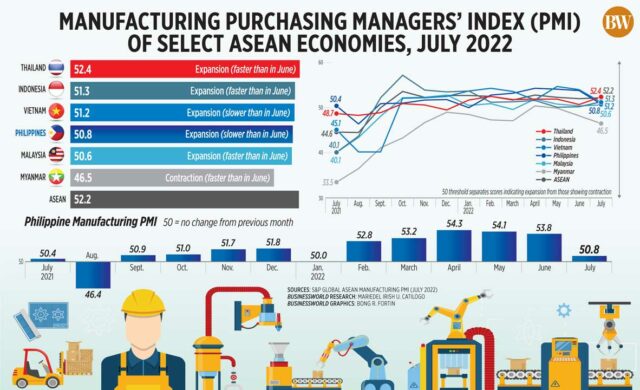
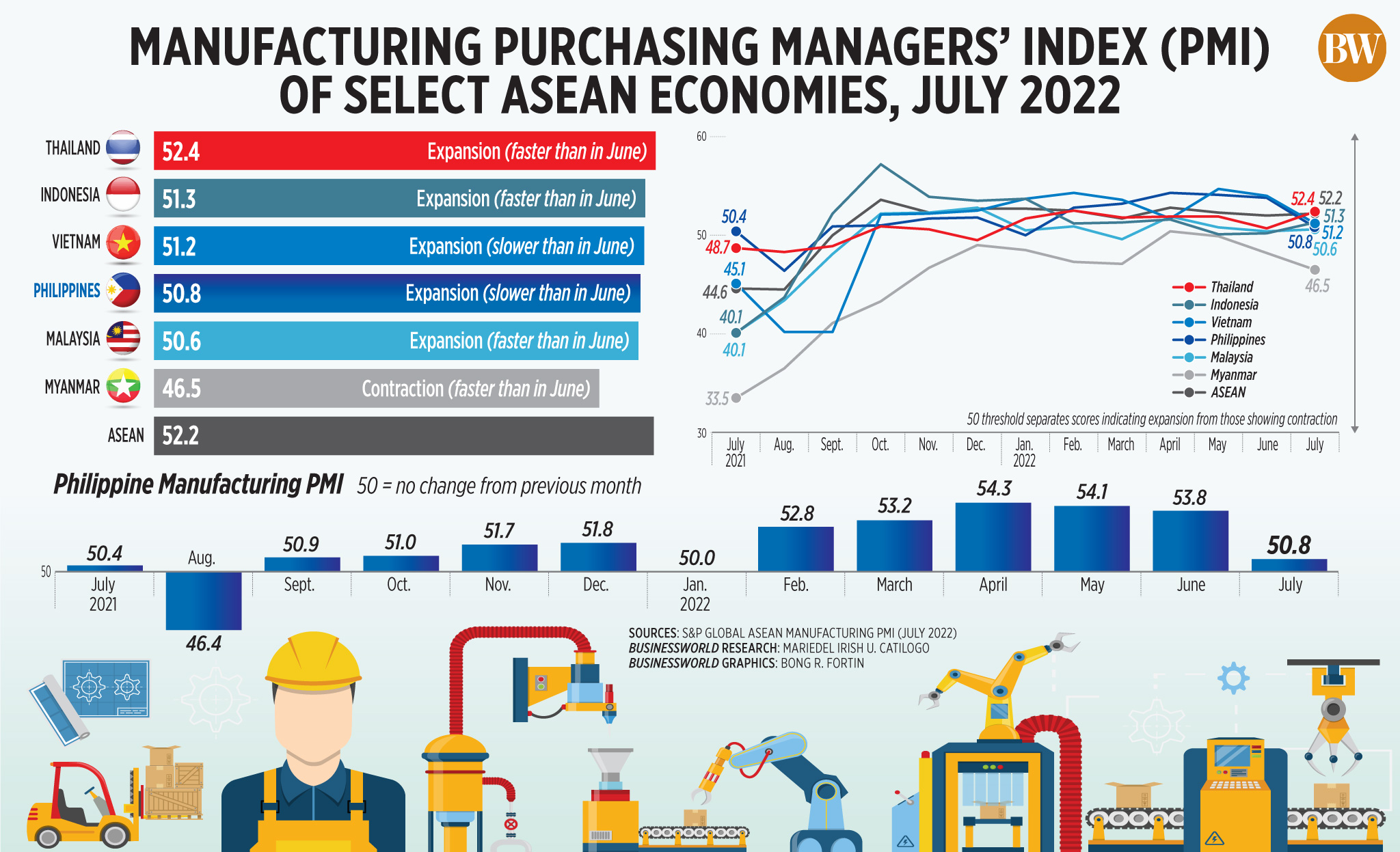
Manufacturing Purchasing Managers’ Index (PMI) of select ASEAN economies, July 2022

THE PHILIPPINES’ manufacturing sector slowed in July as production and new orders declined, signaling weaker global demand, S&P Global said on Monday. Read the full story.

Manufacturing Purchasing Managers’ Index (PMI) of select ASEAN economies, July 2022

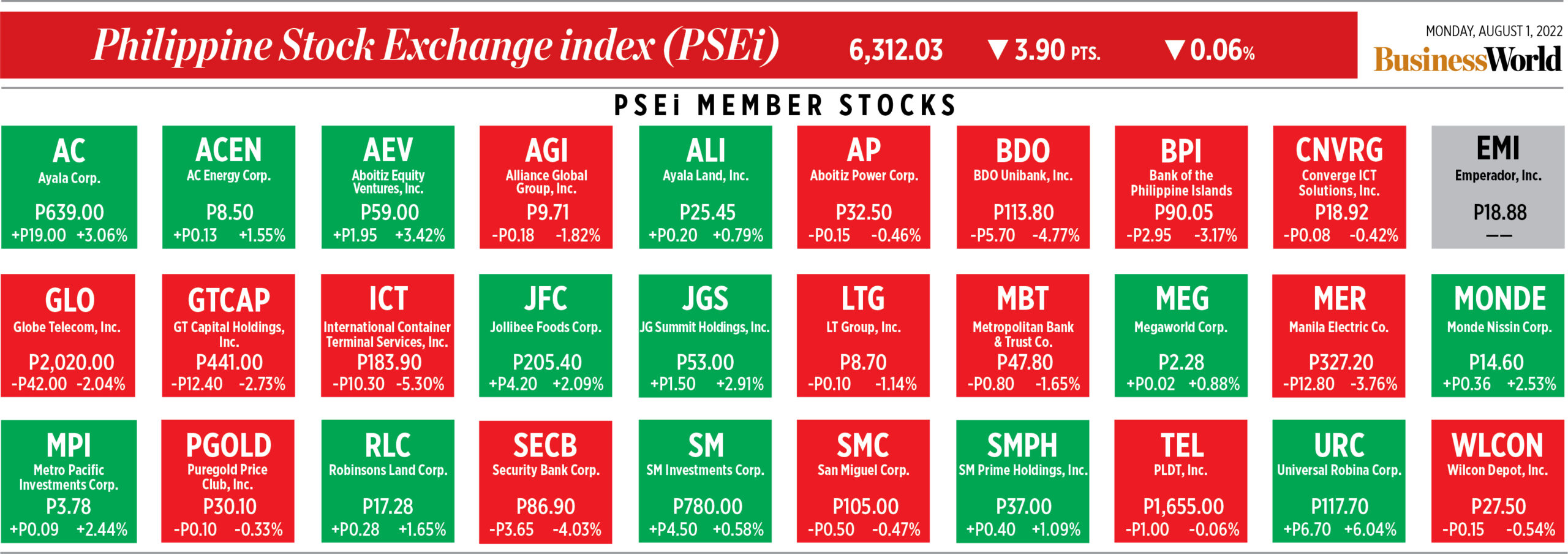
How PSEi member stocks performed — August 1, 2022

Here’s a quick glance at how PSEi stocks fared on Monday, August 1, 2022.


PHL stocks flat ahead of key economic data

REUTERS

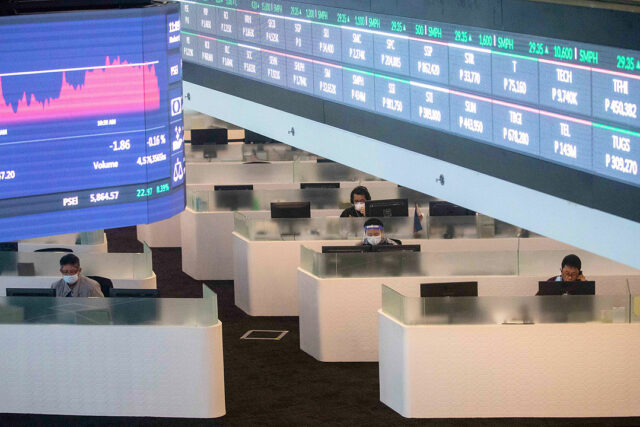
STOCKS opened the month flat ahead of the release of key economic data and more second quarter results of listed firms.

The Philippine Stock Exchange index (PSEi) fell by 3.90 points or 0.06% to close at 6,312.03 on Monday, while the broader all shares index dropped 5.90 points or 0.17% to 3,392.92.

“The market had a seesaw session today as investors await the next important catalyst: second quarter earnings,” AB Capital Securities, Inc. Vice President Jovis Vistan said in a Viber Message on Monday.

“Philippine investors welcomed the month of with a flat start as several economic data releases scheduled for this week,” Regina Capital Development Corp. Head of Sales Luis A. Limlingan said in a Viber message.

“The most awaited economic data this week back home is the Philippines’ CPI (consumer price index) data for July, as well as the PSEi rebalancing, both on Friday,” Mr. Limlingan said.

The market will also look at other reports to be released this week, including the June trade balance data and July unemployment numbers, he said.

“Aside from these, a handful of speaking engagements from the Fed (US Federal Reserve) are also expected to be monitored by investors this week,” Mr. Limlingan added.

A BusinessWorld poll of 14 analysts yielded a median estimate of 6.2% for July headline inflation, within the 5.6-6.4% forecast of the Bangko Sentral ng Pilipinas (BSP).

If realized, this would be faster than the 6.1% print seen in June and the 3.7% in July 2021 and would exceed the BSP’s 2-4% target band for the fourth straight month. It would also be the highest in 45 months or nearly four years since the 6.9% in October 2018.

Sectoral indices ended split on Monday. Financials went down by 49.99 points or 3.26% to 1,482.39; services declined by 33.92 points or 2.02% to 1,640.33; and mining and oil decreased by 34.63 points or 0.30% to 11,407.98.

Meanwhile, holding firms increased by 80.68 points or 1.35% to 6,015.41; property rose by 29.91 points or 1.05% to 2,862.12; and industrials added 88.09 points or 0.95% to end at 9,350.5.

Decliners beat advancers, 92 versus 85, while 55 names closed unchanged.

Value turnover climbed to P5.13 billion on Monday with 96.95 million shares changing hands from the P18.05 billion with 566.04 million issues seen on Friday.

Foreigners turned sellers anew, recording P288.4 million in net sales on Monday from the P1.97 billion in net purchases seen on Friday.

AB Capital Securities’ Mr. Vistan placed PSEi’s support at 6,200 and resistance at its 50-day average of 6,400, while Regina Capital’s Mr. Limlingan put the PSEi’s support at 6,200 and resistance at 6,380.

Peso declines on weaker PMI

BW FILE PHOTO

THE PESO weakened versus the greenback on Monday on weaker factory activity data and the rise in coronavirus disease 2019 (COVID-19) cases in the country.

The local unit closed at P55.31 per dollar on Monday, depreciating by 18 centavos from its P55.13 finish on Friday, based on data from the Bankers Association of the Philippines.

The peso opened Monday’s session at P55.35 per dollar. Its weakest showing was at P55.45, while its intraday best was at P55.31 versus the greenback.

Dollars exchanged decreased to $1.05 billion on Monday from $1.57 billion on Friday.

Rizal Commercial Banking Corp. Chief Economist Michael L. Ricafort said the peso declined on weak manufacturing data released on Monday.

“Peso also weaker partly due to new 5.5-month highs in new COVID local cases above 4,000 per day recently, as well as the first monkeypox case detected in the country late last week,” Mr. Ricafort added.

The S&P Global Philippines Manufacturing Purchasing Managers’ Index (PMI) fell to 50.8 in July from 53.8 in June, marginally above the 50 mark that separates growth from contraction, data released on Monday showed.

Meanwhile, the Philippines recorded 4,159 new COVID-19 cases on Sunday, bringing active infections to 33,722, data from the Department of Health (DoH) showed.

The country also reported its first case of the monkeypox virus, a 31-year-old Filipino who arrived from overseas on July 19, the DoH announced on Friday.

“The peso weakened amid market expectations of strong US unemployment and nonfarm payrolls reports for July 2022,” a trader said in an e-mail.

“However, the local currency might recover due to potentially weaker US manufacturing PMI data overnight,” the trader added.

For Tuesday, Mr. Ricafort gave a forecast range of P55.15 to P55.40 per dollar, while the trader expects the local unit to move within P55.20 to P55.40. — Keisha B. Ta-asan

Tourism recovery in Asia-Pacific seen lagging other regions in 2022

UNSPLASH

TOURIST arrivals in the Asia and the Pacific (APAC) are expected to lag the recovery posted by other regions, with travelers still deterred by the frictions associated with international travel, according to the United Nations World Tourism Organization (UNWTO).

In a statement on Monday, the UNWTO said the 2022 projection is contained in its World Tourism Barometer report.

“In Africa and the Middle East, arrivals could reach about 50% to 70% of pre-pandemic levels, while in APAC they would remain at 30% of 2019 levels in the best-case scenario,” the UNWTO said.

“Scenarios by region show Europe and Americas recording the best tourism results in 2022, while APAC is expected to lag due to more restrictive travel policies,” it added.

The UNWTO sees international arrivals hitting between 55% and 70% of pre-pandemic levels in 2022. The actual outcome will depend on further travel restrictions, the extent of inflation, and fallout from the Russia-Ukraine war.  

“More recent challenges such as staff shortages, severe airport congestion and flight delays and cancellations could also impact international tourism numbers,” the UNWTO said.

Asked to comment, John Paolo R. Rivera, associate director at the Asian Institute of Management’s Dr. Andrew L. Tan Center for Tourism, said that the Philippines will be banking on domestic tourism to pick up the slack. 

“Recent Philippine Tourism Satellite Accounts (PTSA) indicated that Philippine tourism is 80% driven by domestic tourism and 20% foreign tourism. The Philippines can rely on its domestic tourism to thrive unlike other countries reliant on foreign tourism,” Mr. Rivera said.

“Philippine tourism should strengthen domestic tourism through better infrastructure, product offerings, and safety measures,” he added.

Mr. Rivera noted that the recent detection of monkeypox in the Philippines could be a downside risk.

“Monkeypox is a threat if it proves to be contagious and require physical distancing and movement restrictions to contain it. It will affect tourism again negatively as tourism is a high touch, high movement industry,” Mr. Rivera said.

The Health department on July 29 announced the detection of the first monkeypox case in the country, involving a 31-year-old Filipino.

Tourism Congress of the Philippines President Jose C. Clemente III said in a Viber message that the Philippines has to balance managing outbreaks and opening up the economy.

“We are pleased with the current arrival rate of the Philippines as it continues to ramp up with each month. We are still getting back in the swing of things and having a slower but steady pace is fine for now,” he added.  

The UNWTO said that international tourism posted a sustained recovery in the first five months of 2022 despite economic and geopolitical challenges.

“International tourism saw a strong rebound in the first five months of 2022, with almost 250 million international arrivals recorded. This compares to 77 million arrivals from January to May 2021 and means that the sector has recovered almost half (46%) of pre-pandemic 2019 levels,” the UNWTO said.

The UNWTO said that Europe posted a 350% increase in international arrivals in the first five months of 2022, while the Middle East and Africa remained 54% and 50% below 2019 levels, respectively.

It added that APAC posted 94% increase in arrivals during the first five months. However, the number was 90% below 2019 levels as some borders remained closed to non-essential travel.  

The UNWTO noted that more destinations are easing or lifting travel restrictions at this stage of the coronavirus disease 2019 (COVID-19) pandemic.

It said that as of July 22, 62 destinations (including 39 in Europe) had no COVID-19 related restrictions in place and more destinations in Asia have started to ease their rules.

“The recovery of tourism has gathered pace in many parts of the world, weathering the challenges standing in its way. At the same time, (we should be cautious) in view of the economic headwinds and geopolitical challenges which could impact the sector in the remainder of 2022 and beyond,” UNWTO Secretary-General Zurab Pololikashvili said.

Since Feb. 10, the Philippines has allowed the entry of fully vaccinated tourists by nationals permitted visa-free entry, while fully vaccinated Filipinos have been permitted entry since Feb. 1.

Foreigners and returning Filipinos are no longer required to undergo mandatory quarantine upon arrival.

The Department of Tourism estimates tourist arrivals, including Filipino balikbayans, at 814,144 as of the end of June.

According to preliminary data from the Philippine Statistics Authority, the tourism industry’s direct gross value added accounted for 5.2% of gross domestic product (GDP) in 2021, up from 5.1% of GDP in 2020. — Revin Mikhael D. Ochave

Business chambers call for COVID-19 lessons to be applied to managing monkeypox

A SECTION of skin tissue, harvested from a lesion on the skin of a monkey, that had been infected with monkeypox virus. — CENTERS FOR DISEASE CONTROL AND PREVENTION

BUSINESS LEADERS expressed the hope that a possible monkeypox outbreak will be managed by a government now well-versed in what measures proved effective in containing the coronavirus.

“We are hopeful that monkeypox remains non-epidemic and that this administration, the healthcare sector, and the private sector use the lessons of COVID-19 to minimize its impact on Filipino lives,” Francisco Alcuaz, Jr., Makati Business Club executive director, said in a Viber message.

On July 29, the Department of Health (DoH) announced that it had detected the first monkeypox case in the Philippines, a 31-year-old Filipino national who arrived from overseas on July 19.

Monkeypox causes flu-like symptoms and pus-filled skin lesions. It can spread via close contact.

The World Health Organization (WHO) has classified the monkeypox outbreak as a global health emergency following its rapid spread.

Eric Teng, Restaurant Owners of the Philippines president, said that he does not expect COVID-style lockdowns following the detection of monkeypox.

“However, we should heed what safety precautions or warnings that the WHO will be recommending to our DoH,” Mr. Teng said in a mobile phone message.

“As with the COVID-19 pandemic, we have to act and work together with the right information, and be careful of fake news or false cures,” he added.

Steven T. Cua, Philippine Amalgamated Supermarkets Association president, said his industry remains focused on operating as normal, though it has a plan should restrictions be reimposed.

“It’s still business as usual. Hoping that there’s no need for any future alarm,” Mr. Cua said in a mobile phone message.

“We urged our members to continue their practice of checking if employees or customers are nursing a fever before allowing entry. Cleaning of surfaces helps against infection from any form of virus,” he added.

Tourism Congress of the Philippines President Jose C. Clemente III said in a Viber message that the government should know at this point which measures are effective.

“Monkeypox is definitely a concern but we are hoping that with the information we have, the government can mount a defense against wide spread. Of course, we cannot understate the possible effects and continue to ask that people continue health and safety protocols,” Mr. Clemente said. — Revin Mikhael D. Ochave

DBM releases rice farmer subsidy of over P8 billion

BW FILE PHOTO

THE Department of Budget and Management (DBM) said it released P8.05 billion worth of subsidies for rice farmers for distribution in the third and fourth quarters.

In a statement on Monday, Budget Secretary Amenah F. Pangandaman said the DBM released the Notice of Cash Allocation (NCA) to the Department of Agriculture (DA), which will distribute a P5,000 subsidy to 1.56 million farmers.  

“Our farmers deserve our help and care. The immediate release of cash assistance could provide relief to our rice farmers given the recent natural calamities they experienced,” Ms. Pangandaman said.

The release of the NCA supports the Rice Farmer Financial Assistance (RFFA) program, targeted at farmers affected by the Rice Tariffication Law, she said.

The RFFA is a P3-billion unconditional cash transfer program targeting rice farmers tilling 0.5 to 2 hectares of land.

Passed in 2019, the Rice Tariffication Law allowed rice to be imported more freely but charged tariffs of 35% on grain imported from Southeast Asia. The tariffs provide P10 billion a year to the Rice Competitiveness Enhancement Fund (RCEF) to help the industry modernize.

“This unconditional cash assistance could also provide aid to the rice farmers in securing farm inputs such as fertilizer and oil farm machinery,” Ms. Pangandaman added.

The NCA likewise covers the service fee, including the cost of card generation, for the RCEF-RFFA of the Development Bank of the Philippines.

On March 24, DBM released a Special Allotment Release Order amounting to P8.9 billion to the DA as an unprogrammed appropriation.

Additionally, on May 6, an initial NCA worth P894.8 million was released by the DBM to the DA to support 173,753 qualified rice farmer-beneficiaries. — Keisha B. Ta-asan

SEC revokes registration of poultry firm for selling securities without approval

ARTEM BELIAIKIN-UNSPLASH

THE Securities and Exchange Commission (SEC) said it revoked the business registration of  Katuwang Poultry Chicken Egg Producing Co. for selling unauthorized securities.

The SEC found that the company offered shares in the company to the public without registering the offer with the commission, in violation of Sections 8.1 and 28.1 of the Securities Regulation Code.

Section 8.1 prohibits the sale, offer, or distribution of securities without registering them and obtaining approval from the commission.

Section 28.1 regulates which persons may engage in buying or selling securities as a broker or dealer, or as a salesman.

Katuwang Poultry, organized as a producer of eggs, was found to have invited the public to invest in the company without the necessary licenses to sell or offer shares of stocks and other investment-taking schemes. It also promised high returns in as little as six months, and offered subscribers a 10% referral commission for bringing in other investors.

“Based on the evidence gathered, Katuwang Poultry is engaged in the offering, solicitation and sale of securities to the public without the required registration statement duly filed and approved by the SEC,” the SEC said.

“The investment scheme of  Katuwang Poultry also operates to defraud investors as it deceives the investing public by making it appear that it has the authority to deal in securities,” the commission added. — Justine Irish D. Tabile

To infinite energy and beyond

According to the National Mapping and Resource Information Authority (NAMRIA), the Philippines is made up of 7,641 islands, which contain significant natural resources. Despite the abundance of such resources, the country is still in the early stages of exploiting these natural assets to produce renewable and sustainable energy. The main constraint appears to be the lack of investment due to the high cost of developing, producing, and sustaining renewable energy.

In his first State of the Nation Address, President Ferdinand R. Marcos, Jr. said renewable energy is at the top of his climate agenda. The President called for increased use of hydropower, geothermal, solar, and wind. The increased use of renewables will help expand the power supply to meet growing demand.

To help attract investment to renewable energy (RE), the Bureau of Internal Revenue (BIR) issued Revenue Regulations (RR) No. 7-2022, setting guidelines for the availment of fiscal incentives under Republic Act (RA) No. 9513, otherwise known as the Renewable Energy Act of 2008.

The salient provisions of the RR are discussed below.

CERTIFICATIONS/ACCREDITATIONS TO AVAIL OF THE TAX INCENTIVE
RE Developers and manufacturers, fabricators, and suppliers of locally produced RE equipment must register with the Department of Energy’s (DoE) Renewable Energy Management Bureau (REMB). They must secure and submit to the BIR the DoE Certificate of Registration or the DoE Certificate of Accreditation. Other certifications required are the DoE Certificate of Endorsement (CoE), Registration with the Board of Investments (BoI), and Certificate of Income Tax Holiday (ITH) Entitlement (CE).

INCENTIVES FOR RE PROJECTS AND ACTIVITIES
a. Income Tax Holiday. ITH of seven years from the start of commercial operations (SCO) is provided to existing RE Projects and New investment in RE Resources. RE Developers undertaking discovery and development of new RE resources distinct from their registered operations may qualify as new projects and must set up a separate book of accounts to be registered with the BIR. In such a case, a fresh ITH from start of commercial operations applies. For additional investment in RE projects, the ITH only applies to the income attributable to the additional investment.

b. Corporate income tax of 10%. Following the expiration of the ITH, all registered RE Developers pay a corporate income tax of 10% on their net taxable income: Provided, that the RE Developers pass on the savings to the end-users in the form of lower power rates.

To avail of this incentive, the RE Developer must submit the following to the BIR:

1. Copy of the Certificate of Endorsement issued by the DoE prior to the first year of its availment of the 10% corporate income tax rate;

2. Valid and subsisting renewable energy service/operating contract and the corresponding Certificate of Registration; and

3. Sworn Undertaking attached to the ITR stating that for the year of availment of the 10% corporate income tax rate incentive, it has not been found to have breached its obligations under the renewable energy service/operating contact and that it intends to pass on the savings derived from this incentive in the form of lower power rates.

The RE Developer must also attach to its ITR and submit to the BIR proof of submission to the DoE and ERC of the report, supported by technical and financial documents, in the years succeeding its initial availment of the 10% incentive. To prove that savings derived from incentives during the previous year were passed on to end-users, the RE Developer must submit to the BIR the rates approved by the ERC. 

c. Net operating loss carry over. In addition to the above incentives, the net operating loss carry over (NOLCO) of RE Developers during the first three years from the SCO may be carried over as a deduction from gross income for the next seven consecutive taxable years immediately following the year of such loss. Provided, that the NOLCO has not been previously offset as a deduction from gross income, and that the loss should be from the operation and not from the availment of incentives.

d. Accelerated Depreciation. If an RE project fails to receive an ITH before full operation, an RE Developer may apply for accelerated depreciation on its plant, machinery and equipment that are reasonably needed and used for the exploration, development and utilization of RE resources. Once applied, the project or its expansions shall no longer be eligible to avail of the ITH. The RE Developer is to inform the BIR of availment of accelerated depreciation instead of ITH.

e. Zero Percent VAT Rate. Sale of power or fuel generated through RE sources is subject to 0% VAT. The local purchase by RE Developers of goods, property, and services needed for the development, construction, and installation of power plant facilities, and the whole process of exploration and development of RE sources up to its conversion of power, is subject to 0% VAT. Accordingly, local suppliers of goods, properties, and services of duly registered RE developers should not pass on the 12% VAT, provided, that the RE Developer provides a copy of its BoI and DoE registration to avail of the VAT incentive.

f. Tax exemption of carbon credits. All proceeds from the sale of carbon emission credits are exempt from any and all taxes.

INCENTIVES FOR RE COMMERCIALIZATION
Sale of locally produced RE equipment and components by accredited and registered DoE and BoI manufacturers, fabricators, and suppliers to RE Developers are subject to the following incentives:

1. VAT-free imports of components, parts, and materials subject to conditions;

2. ITH and exemption for seven years starting from date of registration and accreditation with DoE and BoI; and

3. VAT zero-rating on their transactions with local suppliers of goods, properties, and services needed in the manufacture/fabrication of RE equipment.

By creating policies and guidelines for availing of incentives, the RE industry is encouraged to invest more in the renewable energy market. Considering the uncertainty hanging over the price of oil, the adverse impact of climate change, and the increasing demand for electricity, it is high time to shift the focus to maximizing the use of natural resources to achieve self-reliance in energy. Relying on renewable energy will not only save billions of pesos; it can also save the country from the catastrophic effects of climate change.

Let’s Talk Tax is a weekly newspaper column of P&A Grant Thornton that aims to keep the public informed of various developments in taxation. This article is not intended to be a substitute for competent professional advice.


Lorenzo Miguel A. Soriano is a senior in charge of Tax Advisory & Compliance division of P&A Grant Thornton, the Philippine member firm of Grant Thornton International Ltd.

pagrantthornton@ph.gt.com

ADVERTISEMENT
ADVERTISEMENT