Home Blog Page 608

Refounding: returning to our beginnings

The Philippines is grappling with a deepening sense of uncertainty. Disclosures of massive corruption in government infrastructure projects, combined with cracks in national leadership, have triggered public frustration and shaken investor confidence. Global turbulence — geopolitical tensions, rising protectionism, and economic slowdown — adds to a bleak horizon. Companies face a dual challenge: surviving the external storm while preventing internal drift.

This is where the concept of refounding, developed by John Iwata of the Yale School of Management, becomes not just relevant but urgent. Refounding is the disciplined act of reconnecting an institution to the values, purpose, and strategic clarity of its early — and often most vibrant — years. It is a way of anchoring organizations so they do not lose their identity in the midst of chaos.

But refounding is more than introspection. It is a strategic response to turbulence.

Historically, periods of crisis have triggered great refoundings:

• IBM refounded itself in the 1990s, confronting existential collapse after years of drift.

• Starbucks refounded during the 2008 financial crisis, returning to coffee quality and founder-led culture before expanding globally.

• Ford refounded in 2006, sharpening its mission and avoiding the government bailouts that hit other automakers during the recession.

In each case, geopolitical and economic shocks did not push these companies to retreat. Instead, leaders returned to their founding essence to chart a forward-looking path.

When institutions around you fail in integrity, the strongest counter-strategy is to strengthen your own. When governance collapses in politics, the best defense is governance excellence within your firm.

Refounding answers these challenges by clarifying:

• what you stand for;

• why you exist;

• what values you refuse to compromise; and

• what capabilities uniquely define you.

In a weak-governance environment, companies that operate with clarity and purpose gain trust — especially when public institutions lose it.

Many executives respond to turbulent times with the familiar call to “go back to basics.” While useful, this is largely operational — tightening execution, cutting costs, improving service.

Refounding is far deeper. It asks: what truth must we remember so that we can move forward with confidence — even when the world around us is unstable?

When corruption scandals shake the foundations of national governance, when unpredictability becomes the norm, companies must find stability elsewhere. That stability will not come from the outside. It must come from an internal re-anchoring — a renewed sense of identity and mission.

THE SAN MIGUEL EXAMPLE
San Miguel Corp. (SMC) illustrates how refounding can help companies rise above national dysfunction. While SMC started as a brewery in 1890, its remarkable transformation into a conglomerate spanning food, power, energy, tollways, and airports seems almost incongruent with “returning to origins.”

But SMC’s true origin was never beer alone. Its foundational strengths were: a) scale, b) nationwide logistics mastery, c) brand trust, and d) a philosophy of community engagement.

These principles allowed SMC to move into essential systems such as power grids, tollways, and infrastructure — areas ironically plagued by government inefficiency and corruption. SMC’s expansions filled gaps in national development, partly because the company refounded itself on the belief that private institutions can play a decisive role in public progress when state capacity weakens.

Thus, SMC’s diversification is itself an act of refounding. Its ventures remain consistent with its original impulse: to build systems that move the country forward, especially in times when public institutions falter.

REFOUNDING AS AN ANTIDOTE TO DISTRUST
A bleak economic scenario marked by corruption and leadership vacuums creates major risks for companies. These include erosion of public trust, unpredictable policy environments, and moral decay within organizations.

All three can be mitigated by refounding.

Refounding forces companies to reassert their ethical core — not as PR, but as a survival strategy. When trust in the public sector declines, society looks for integrity somewhere else. Institutions that embody transparency, governance rigor, and authentic purpose become magnets for talent, investors, and customers.

In a country struggling with government accountability, a company with a strong identity and clear values becomes a rare source of credibility.

When national leadership becomes erratic or compromised, organizational leadership must become steadier. Refounding strengthens leadership in two ways. It clarifies decision-making, because leaders operate from core principles rather than reacting to politics. It grounds leaders morally, reminding them that integrity is not situational — even if the nation’s leaders appear to waver.

The challenge for Philippine institutions is not merely to keep operating — it is to keep believing in their purpose amid a climate of cynicism.

This is the paradox that refounding solves. It restores optimism without ignoring reality. It rekindles ambition without abandoning prudence. It empowers companies to evolve without losing themselves.

In a period when corruption scandals undermine public trust, and when governance questions cast long shadows on the economy, the companies that will endure are those that look inward not to retreat but to regenerate.

Ultimately, a company’s founding idea is not a relic of the past — it is the anchor that steadies it when the nation around it is shaking.

And in these turbulent times, institutions that are deeply rooted can grow even stronger — not despite the chaos, but because they know exactly who they are.

The views expressed herein are his own and do not necessarily reflect the opinion of his office as well as FINEX.


Benel Dela Paz Lagua was previously EVP and chief development officer at the Development Bank of the Philippines.  He is an active FINEX member and an advocate of risk-based lending for SMEs. Today, he is independent director in progressive banks and in some NGOs.


Fallout expands ‘everything’ for show’s second season

Ella Purnell in a scene from Fallout.

LONDON — Hit television series Fallout ups the stakes as it returns to screens for a sophomore season, its stars and makers say.

“You can play it two ways,” actor Walton Goggins said as he premiered the new season in London on Tuesday. “You can play it safe, rely on what happened in season one, or you can go for broke. And we went for broke.”

Based on the popular video game franchise of the same name, the live-action series centers on three main characters; former vault dweller Lucy (Ella Purnell), Maximus, a member of the Brotherhood of Steel (Aaron Moten), and Cooper Howard/The Ghoul (Goggins), a former movie star and mutated bounty hunter.

The new season picks up where season one left off, with Lucy looking for her father Hank (Kyle MacLachlan), and pairing up with The Ghoul on a post-apocalyptic adventure through the Mojave Desert to New Vegas.

The show’s executive producer, Jonathan Nolan, said audiences could expect “more of everything.” “More madness, more humor, more violence. We just try to outdo ourselves,” he said.

The second season also shows a new side to Lucy as her optimistic attitude clashes with The Ghoul’s nihilistic worldview on their way to Sin City, said Ms. Purnell.

“She’s in the wasteland now and she has to survive. You can’t always do that by being nice,” Ms. Purnell said. “I don’t want to spoil it, but we’ll see what happens to that moral compass.”

The new season introduces Justin Theroux in the role of Robert House, the ruler of the New Vegas strip, and a major character in the franchise.

“It’s a bit intimidating,” said Mr. Theroux. “The players of this game and the fans of the show are really sort of the shareholders, so you don’t want to disappoint them. But I worked very hard to hopefully not do that.”

Also joining the cast are actors Macaulay Culkin and Kumail Nanjiani, as well as a host of new creatures, brought to life by puppeteers.

The eight-episode second season of Fallout starts streaming on Prime Video on Dec. 17, with a new episode released weekly. — Reuters

PAL to start Manila-Palau service by March

PHILIPPINE STAR/EDD GUMBAN

PHILIPPINE AIRLINES (PAL) is set to mount direct flights between Manila and Palau (Koror) by March next year, the flag carrier said on Thursday.

“Creating flights to this Pacific island will stimulate tourism travel among beach lovers and the diving community,” PAL President Richard Nuttall said in a media release.

Starting March 29, 2026, PAL will offer the Manila-Palau service twice weekly, it said, adding that the new route will further boost the flag carrier’s presence in the Pacific region.

PAL will use its modern 199-seater dual-class Airbus A321ceo with flights departing Manila every Wednesday and Sunday while return flights will leave Palau on Mondays and Thursdays.

Koror serves as Palau’s gateway and is one of the largest cities and the commercial center in Palau.

“The destination boasts vibrant dive sites, crystal-clear lagoons, and thriving coral reefs. Its proximity and ease of access position Palau as an attractive addition to PAL’s network, reinforcing its commitment to expanding routes that deliver unique experiences and drive tourism growth,” it said.

PAL also said its new service complements its existing daily service to Guam which further enhances its network.

PAL Holdings, Inc., the operator of PAL, said its attributable net income climbed 33.58% to P9.03 billion from P6.76 billion a year ago, supported by higher passenger revenues of P116.56 billion, up from P115.66 billion.

Cargo and ancillary revenues contributed P6.71 billion and P12.67 billion, respectively. Total revenues for the nine-month period increased 2.68% to P136.01 billion from P132.45 billion, while gross expenses rose 3.96% to P124.85 billion from P120.09 billion.

At the local bourse, shares in PAL closed five centavos, or 1.32% lower at P3.75 each. — Ashley Erika O. Jose

How the first Bible to include a map helped spread the idea of countries with borders

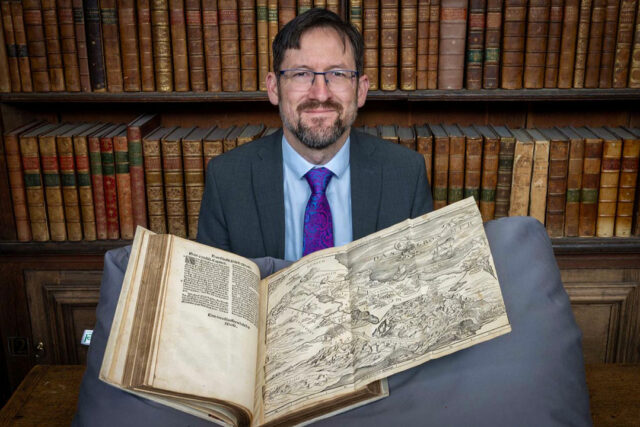
NATHAN MACDONALD with the Bible map in Trinity College’s Wren Library. — CAM.AC.UK

Five hundred years ago the first Bible featuring a map was published. The anniversary has passed uncelebrated, but it transformed the way that Bibles were produced. The map appeared in Christopher Froschauer’s 1525 Old Testament, which was published in Zürich and widely distributed in 16th century central Europe.

Yet despite being a groundbreaking moment in the Bible’s history, the initial attempt was hardly a triumph.

It is flipped along the north-south axis (meaning it’s back to front). As a result, the Mediterranean appears to the east of Palestine, rather than to the west. It illustrates how little many in Europe knew about the Middle East that such a map could have been published without anyone in the printer’s workshop questioning it.

The map had originally been drawn about a decade earlier by the celebrated Renaissance painter and printmaker Lukas Cranach the Elder, based in Wittenberg in latter-day Germany. Written in Latin, it shows Palestine with various important holy sites such as Jerusalem and Bethlehem. At the bottom, you can see the mountains of Sinai and the path taken by the Israelites as they escaped slavery in Egypt.

Look closely and you can see the Israelites and their tents, plus various vignettes of the events on their journey. The landscape is more European than Middle Eastern, though, reflecting the printmakers’ ignorance of this region. There are walled towns with numerous trees and, in contrast with reality, the Jordan meanders rather more dramatically towards the Dead Sea, and the coastline has more bays and coves.

In the previous century, Europeans had rediscovered the second-century Greco-Roman geographer Ptolemy, and with him the art of making accurate maps that used latitude and longitude (insofar as longitude could be estimated at that time — it greatly improved in later centuries). With the advent of printing, Ptolemy’s Cosmographia had taken Europe by storm. His scientific treatise on geography was published and his maps of the ancient world reproduced.

Printers soon discovered, however, that purchasers desired contemporary maps. Soon new maps of France, Spain, and Scandinavia were published. To our eyes these are truly modern. North is at the top of the page and the locations of cities, rivers, and coastlines are presented highly accurately.

These maps rapidly replaced medieval mapping with its symbolic approach to the world, such as the famous Hereford mappa mundi of the known world circa 1300, where it was more about conveying cultural or religious meaning than geographical accuracy. Except, that is, in one case: Palestine.

The early modern printers of Ptolemy also gave their readers a “modern map of the Holy Land” that was nothing of the sort. It was a medieval map produced not by using latitude and longitude, but using a grid to measure distances between different locations. It was orientated with the east at the top of the page and the west at the bottom. It portrayed the holy sites of Christianity and divided the land of Palestine into tribal territories.

Cranach’s map blends these two types of maps. At its top and bottom edges it has lines of meridian, but the coastline is slanted so that the entire map is orientated with the north-east at the top of the page.

It is as though Cranach couldn’t quite decide what type of map to create. Its portrayal is realistic and modern, but the map is full of symbolic geography: as your eye passes over, you journey with the Israelites from Egyptian bondage to the promised land, with all its resonant locations, such as Mount Carmel, Nazareth, the River Jordan, and Jericho.

PERCEPTIONS OF PALESTINE
The map was characteristic of Europe’s lack of interest in Palestine, then part of the Ottoman empire. What European book buyers cared for was the strange hybrid space that is the “Holy Land”: somewhere that was in our world, but also not part of it.

The towns the map portrayed were those that had flourished two millennia earlier, which for Christians were in some sense more real. They were part of the imaginative space described in their churches and scriptures.

That curious juxtaposition of ancient and modern was particularly consequential when it came to the mapping of Palestine into 12 tribal territories. The 12 tribes that descended from Jacob symbolized Christianity’s claim as true heir of Israel and its holy sites, and also what the holy sites represented: the inheritance of the heavenly Jerusalem. Lines on the map communicated the eternal promises of God.

But in the early modern period, lines began to be used to mark the borders between sovereign states. The maps of the Holy Land, neatly divided amongst the Israelite tribes, set the agenda for cartographers. As the 16th century went on, more and more maps in atlases divided the world among distinct nations with clearly defined borders.

The fact that a map divided into territories appeared in the Bible gave apparently religious authorization for a world full of borders. Lines that had once symbolized the boundless divine promises now communicated the limits of political sovereignties.

Within Bibles themselves, maps had arrived for good. The following years saw printers experiment with various configurations, but eventually they were to settle on four maps: one of the wilderness wanderings of the Israelites, one of the territories of the 12 tribes, one of Palestine at the time of Jesus, and one of the apostle Paul’s missionary journeys.

There is a pleasing symmetry: two maps for the Old Testament, two for the New Testament. But also, two maps of journeys and two maps of the Holy Land. Such symmetries communicated the connections between events: the Old Testament was fulfilled in the New Testament, and Judaism in Christianity.

The first map in a Bible is therefore a fascinating moment in history, but a troubling one. It transformed the Bible into something like a Renaissance atlas, but deeply embedded in assumptions about Christian superiority: the Holy Land of Christian imagination displacing contemporary Palestine, and Christianity superseding Judaism.

It was also one of the agents in creating the modern world of distinct nation states. In many ways, we’ve been living with the consequences ever since.

THE CONVERSATION VIA REUTERS CONNECT

Nathan MacDonald is professor of the Interpretation of the Old Testament at the University of Cambridge.

When not to revise the workers’ Code of Conduct

Our chief executive officer (CEO) wants to toughen the penalties in the Code of Conduct. This is due to the increasing number of employee absences without official leave, tardiness, insubordination, and in some cases theft. He instructed me to hire a consultant to revise the code. Is this the right approach? — Velvet Vicky.

A company’s Code of Conduct is the corporate equivalent of traffic rules. It must be clear, simple, and updated as it is designed to prevent collisions, confusion, and chaos. In practice, however, some Codes look like they were last updated when people still used dial-up internet and Nokia ringtones.

Worse, some employees only read it once — on their first day — before signing the acknowledgment form like they’re accepting terms and conditions for a new app.

But wait. If your Code is less than five years old, your first priority is to upgrade the leadership capabilities of your line executives because people problems rarely come from written policies alone.

The real issues stem from ineffective leadership, inconsistent enforcement, poor communication, or a weak workplace culture. Updating the Code may look like action, but it doesn’t guarantee meaningful change.

Moreover, revising it is time-consuming. It requires interviews of key line leaders and some employees, back-and-forth management consultation, multiple drafting, reviews, and approvals.

On top of that, hiring a management consultant can be expensive, and some consultants merely recycle templates or copy other companies’ standards without tailoring them to your organization’s unique context. Or else they would simply use AI to make their work easy and faster, but not necessarily better.

If that happens, you end up with a “cut-and-paste” policy that doesn’t reflect your culture, risks, or priorities. Instead of solving problems, it may create confusion, compliance gaps, and employee resistance. In short, blindly revising the Code — especially with generic external input can put the organization in a worse situation than before.

If you’re unsure whether your organization’s Code deserves a refresh, then think again. One logical approach is to train or retrain your line executives to make them effective leaders.

10 PRINCIPLES
Revising the Code may look elegant in a binder, but it rarely fixes real workplace problems. The smarter move is to strengthen your line executives’ leadership capabilities. Most organizational issues stem from weak judgment, poor communication, and inconsistent enforcement — all behavioral gaps that no rewritten policy will magically cure.

Strong leaders prevent violations before they happen, interpret gray areas wisely, and resolve conflicts long before they turn into disciplinary issues. Employees follow good leaders, not paragraphs, which means culture rises or falls based on the day-to-day actions of line executives, not the thickness of your manual.

Better leadership also saves money with the following principles:

One, leaders implement the Code — the Code doesn’t implement itself. Policies look good on paper, but their real power depends on leaders with the help of Human Resources (HR) which can interpret and enforce them with objectivity and wisdom.

Two, leadership issues are behavioral — not procedural. Most workplace problems come from poor judgment, weak communication, or inconsistency, not from outdated rules. Training leaders fixes the root cause.

Three, better leaders prevent violations before they happen. A competent team leader, supervisor or manager can spot issues early, clarify expectations, and coach employees — reducing the need for disciplinary action.

Four, a revised Code doesn’t change culture — better leaders do. Culture is shaped by daily behavior. If leaders don’t model integrity, no amount of rewriting will motivate employees to follow the rules.

Five, employees follow people, not paragraphs. Workers observe their leaders’ actions more than they read manuals. Strong leadership encourages natural compliance in a compelling, positive way.

Six, training is more cost-effective and sustainable. There’s no assurance that external consultants, even if they’re the most expensive, can deliver the best result. Instead, building leadership capability yields long-term RoI.

Seven, good leaders interpret gray areas better than any policy. That’s because of their experience. Besides, not every situation can be covered in a handbook. Skilled leaders make sound decisions even in ambiguous scenarios.

Eight, strong leadership reduces conflict and complaints. Most grievances come from poor handling, not poor documentation. Imagine toxic managers who alienate people. Leaders with empathy and skill prevent issues early.

Nine, leadership development builds accountability. Well-trained line executives take responsibility instead of hiding behind policy wording or point to HR as the one primarily responsible.

Ten, employees feel valued when leadership skills improve. And not when rules multiply. Rule-heavy environments feel controlling. Skilled leaders create trust and engagement even in the most difficult circumstances.

In conclusion, when leadership behavior drifts from what’s written in the Code, employees naturally follow what they observe. Therefore, a Code of Conduct should reflect — and reinforce — real-world behavior. Don’t rush to rewrite the Code. Fix the leaders first. A well-crafted policy guides behavior, but a well-trained leader transforms it.


Consult Rey Elbo for free. Send your workplace issues to elbonomics@gmail.com or DM Facebook, LinkedIn, X or via https://reyelbo.com/contact-us. Anonymity is guaranteed.

Online lenders target to bring more Filipinos into formal financial sector

ANASTASIA NELEN–UNSPLASH

ONLINE LENDING companies target to onboard 300,000 additional borrowers monthly next year as the sector wants to help in bringing more Filipinos into the formal financial sector, an industry group said.

Consumer Lending Association of the Philippines, Inc. (CLAP) President and Tala Financing Philippines Inc. External Affairs Director Arianne Ferrer said their member companies want to help reach those individuals that do not have access to financial products and services.

“If there is regulatory stability, consistency, and in general, the amount of support we’re currently getting from the government, we are hoping to reach as much as 300,000 new borrowers every month,” Ms. Ferrer said during a media roundtable on Thursday.

“We would always really give the opportunity to people who do not have financial credit history, who may not have lots of documentation, to have their first financial account.”

CLAP members include some of the biggest online lending platforms in the country that are registered with the Securities and Exchange Commission (SEC).

Ms. Ferrer said CLAP members’ apps have a combined 33 million downloads on Google Play Store and 10 million in Apple Store and Huawei AppGallery.

“CLAP and its members work to break barriers and create new economic opportunities for Filipinos, such as sari-sari store owners and first-time borrowers, by using alternative data and technology to assess credit risk for those with limited or no formal credit history,” the group said in a separate statement on Thursday. “They aim to ensure continued access to credit for the underserved and the unbanked safely and securely.”

The group said it will roll out a nationwide campaign against unethical debt collection practices and predatory lending next year, urging consumers to report these incidents directly to the association.

The SEC earlier said that they received 5,415 complaints of unjust collection practices from online lenders.

“Filipinos deserve protection from abusive practices and affordable access to fair, formal credit,” CLAP said. “With the media as an active partner in consumer education, borrowers can be guided toward safe, sustainable financial choices, and industry efforts to curb fraud can reach the communities that need them most.”

The Bangko Sentral ng Pilipinas (BSP) is targeting to onboard at least 70% of adult Filipinos into the formal financial system. The share of Filipinos with bank accounts reached 65% of the adult population in 2022, BSP data showed. — Katherine K. Chan

H&M announces designer collaboration with Stella McCartney

STOCKHOLM — British fashion designer Stella McCartney will produce a collection in collaboration with H&M, the Swedish budget fashion giant said on Tuesday.

The collection will launch in H&M stores and online in the first half of 2026, it said in a statement.

Stella McCartney and H&M have had one design collaboration previously, launched in 2005.

H&M has had collaborations with several external designers over the past two decades, while Stella McCartney has collaborated with several other high-street brands, including Adidas. — Reuters

Aprio eyeing expansion of Philippine workforce to 750 by 2030

APRIO, a US-based advisory and accounting firm, is targeting an increase in its Philippine workforce to 750 employees by 2030, part of its strategy to support its growing global client base.

“We anticipate that the Philippines as a country will be north of 750 people by 2030, that is our goal,” Dave Kothari, global solutions delivery leader and partner at Aprio, told reporters on the sidelines of the opening of its Makati office on Thursday.

Aprio’s second Philippine branch is located on the fourth floor of KMC One Ayala Mall.

“By investing in our local office, we are not just extending capacity, but we are strengthening collaboration and positioning Aprio to lead the next era of global transformation for our clients,” Mr. Kothari said.

Aprio first established operations in the Philippines in 2022, opening its inaugural office in Clark Global City, Pampanga.

The company currently employs 400 professionals in the country.

Its Philippine teams deliver support across tax, advisory, assurance, wealth management, and business operations, while also focusing on analytics, technology adoption, compliance modernization, and workflow optimization. — Beatriz Marie D. Cruz

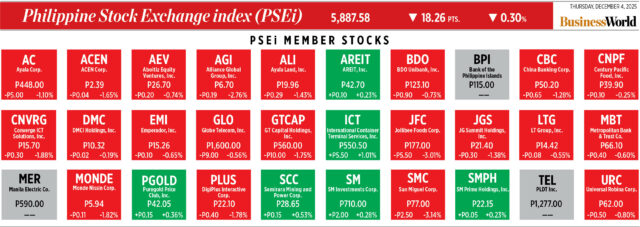
How PSEi member stocks performed — December 4, 2025

Here’s a quick glance at how PSEi stocks fared on Thursday, December 4, 2025.


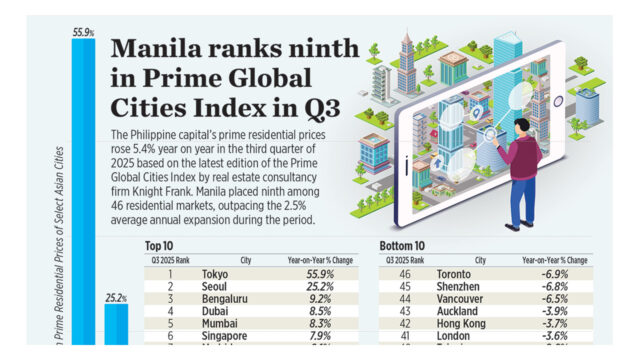
Manila ranks ninth in Prime Global Cities Index in Q3

The Philippine capital’s prime residential prices rose 5.4% year on year in the third quarter of 2025 based on the latest edition of the Prime Global Cities Index by real estate consultancy firm Knight Frank. Manila placed ninth among 46 residential markets, outpacing the 2.5% average annual expansion during the period.

Manila ranks ninth in Prime Global Cities Index in Q3

Foreign rice suppliers warned against raising prices in PHL

REUTERS

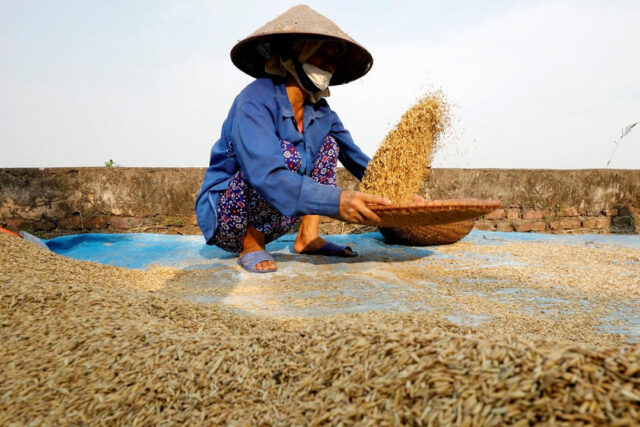
THE Department of Agriculture (DA) warned foreign rice suppliers that a strong domestic harvest could upset any plans they may have of raising prices when shipments to the Philippines resume early next year.

The DA said in a statement that it expects scaled-down demand for imported rice early next year after new production assessments pointed to a harvest that will still approach 2023 records, even after the impact of late-year calamities.

In the statement, Agriculture Secretary Francisco P. Tiu Laurel, Jr. said foreign suppliers should not take advantage of the Philippines’ return to the global rice market, noting that some suppliers appear to be expecting renewed large-volume purchases after a temporary import ban expires.

Mr. Laurel was quoted as saying that the government will not allow foreign suppliers to exploit the country’s food-security mechanisms. He urged importers to diversify their sourcing to ensure more stable and predictable supply arrangements.

“While we value our partnerships with traditional suppliers, food security is paramount, and diversifying our sources is vital,” Mr. Laurel said.

The DA is projecting import volumes for the first quarter of 2026 to be “substantially lower” than previous estimates, following positive assessments of the 2025 crop.

It now expects 2025 output of palay (unmilled rice) at 19.61 to 19.89 million metric tons (MMT), near the 2023 record of 20.06 MMT. This is also higher than the 19.09 MMT reported by the Philippine Statistics Authority in 2024.

The DA said the revised range is slightly lower than the previous target of 20.46 MMT after downgrades to fourth-quarter estimates. However, according to the DA, updated field validation shows that domestic production suffered smaller-than-expected setbacks even after several typhoons traversed key rice-growing areas.

Mr. Laurel cited improved farm preparedness, better disaster-response coordination, and the timing of storms that did not hit during critical phases of the growing period.

The DA said it is preparing an adjusted import matrix to guide private traders once the country lifts its moratorium on rice imports in January.

The DA said the framework will be calibrated to safeguard farmgate prices and prevent predatory import practices as the country reenters the international market. — Vonn Andrei E. Villamiel

Economic impact of typhoons seen as ‘small, temporary’

DOST-PAGASA

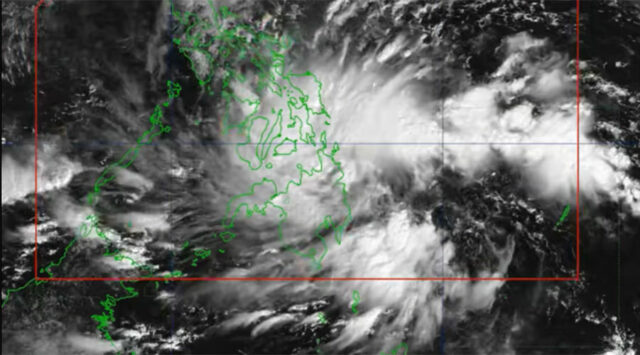
NATURAL DISASTERS such as typhoons that bring flooding and landslides pose minimal and temporary risks to the Philippines’ economic growth, Capital Economics said.

Senior Asia economist Gareth Leather cited the example of 2013’s Typhoon Haiyan, known in the Philippines as Yolanda, which killed 10,000 people but had a limited impact on economic growth.

“The floods that struck (this year) amid a corruption scandal centered on flood control projects, which could amplify public frustration and prompt a stronger government response,” Mr. Leather said in a note dated Dec. 3.

“Overall, however, while supply chains and manufacturing may face some disruption, the hit to activity is likely to be small and temporary,” he added.

Economy Secretary Arsenio M. Balisacan has said that the recent slowdown in household spending may be attributed to widespread cancellations of school, work, and travel activities due to the typhoons.

In the third quarter, growth in household final consumption expenditure, which accounts for over 70% of the economy, slowed to 4.1% from 5.3% a quarter earlier and 5.2% a year earlier.

This was the weakest reading since the 4.8% contraction in the first quarter of 2021.

Mr. Leather said typhoons mostly impact the agriculture sector, often causing food prices to spike.

In November, Typhoons Kalmaegi (Tino), Fung-Wong (Uwan), and Koto (Verbena) brought heavy rains and flooding across the country.

Agricultural damage from Kalmaegi and Fung-Wong topped P4.13 billion, while Verbena left P57.53 million worth of farm damage, the Department of Agriculture (DA) reported.

“This creates an upside risk to our inflation forecasts. The good news is that inflation is starting from a very low base — it is at or below target across most of the region,” Mr. Leather said.

In October, headline inflation settled at 1.7%, the eighth straight month that inflation came in below the Bangko Sentral ng Pilipinas’ (BSP) 2-4% target band. Ten-month inflation averaged 1.7%.  

A BusinessWorld poll of 15 analysts yielded a median estimate of 1.6% for November inflation, slowing from 1.7% in October and 2.5% a year earlier.

Mr. Leather said the central bank thus has room to ease policy rates further.

BSP Governor Eli M. Remolona, Jr. said on Wednesday that the likelihood for another interest rate cut this month has increased, partly due to expectations that the economy will grow 4-5% this year, missing the 5.5-6.5% government target band.

The central bank has so far lowered borrowing costs by a total of 175 bps since it began its easing cycle in August 2024, bringing the benchmark interest rate to 4.75%.

The Monetary Board will convene for its last policy meeting of the year on Dec. 11. — Katherine K. Chan

ADVERTISEMENT
ADVERTISEMENT