Home Blog Page 603

Microsoft scales back Chinese access to cyber early warning system

REUTERS

 – Microsoft said on Wednesday it has scaled back some Chinese companies’ access to its early warning system for cybersecurity vulnerabilities following speculation that Beijing was involved in a hacking campaign against the company’s widely used SharePoint servers.

The new restrictions come in the wake of last month’s sweeping hacking attempts against Microsoft SharePoint servers, at least some of which Microsoft and others have blamed on Beijing. That raised suspicions among several cybersecurity experts that there was a leak in the Microsoft Active Protections Program (MAPP), which Microsoft uses to help security vendors worldwide, including in China, to learn about cyber threats before the general public so they can better defend against hackers.

Beijing has denied involvement in any SharePoint hacking.

Microsoft notified members of the MAPP program of the SharePoint vulnerabilities on June 24, July 3 and July 7, Reuters has previously reported. Because Microsoft said it first observed exploitation attempts on July 7, the timing led some experts to allege that the likeliest scenario for the sudden explosion in hacking attempts was because a rogue member of the MAPP program misused the information.

In a statement, Microsoft said several Chinese firms would no longer receive “proof of concept code,” which mimics the operation of genuine malicious software. Proof of concept code can help cybersecurity professionals seeking to harden their systems in a hurry, but it can also be repurposed by hackers to get a jump start on the defenders.

Microsoft said it was aware that the information it provided its partners could be exploited, “which is why we take steps – both known and confidential – to prevent misuse. We continuously review participants and suspend or remove them if we find they violated their contract with us which includes a prohibition on participating in offensive attacks.”

Microsoft declined to disclose the status of its investigation of the hacking or go into specifics about which companies had been restricted. – Reuters

Pangandaman sees 6% GDP growth in second half

THE Department of Public Works and Highways (DPWH) conducts clearing operations in Manila. — PHILIPPINE STAR/ RYAN BALDEMOR

Philippine economic growth seen to pick in the second semester, amid an expected rebound in government spending following the election-tied ban, Budget Secretary Amenah F. Pangandaman said.

“Hopefully. I think it’s 6% [in the second semester],” Ms. Pangandaman told reporters on the sidelines of a Department of Budget and Management (DBM) event on Wednesday.

This forecast depends on the pace of public expenditures after the election ban on public works, she said. The 45-day ban started on March 28 and ended with the May 12 elections.

“Our first semester performance is just hitting the low-end of this program, so we must be growing 6% or higher in the second half,” Budget Assistant Secretary Romeo Matthew T. Balanquit told BusinessWorld.

The gross domestic product (GDP) grew by 5.5% in the second quarter, slightly faster than the 5.4% print in the first quarter but slower than the 6.5% a year ago.

For the first half, GDP growth averaged 5.4%, slower than the 6.2% a year ago.

Economy Secretary Arsenio M. Balisacan earlier said GDP must grow by 5.6% for the rest of the year to achieve the low end of the full-year target.

“Better than the 5.5% in the third quarter. Better because we started again. We released the NCA (Notice of Cash Allocation). You can see agencies began procuring again,” Ms. Pangandaman said.

Latest disbursement report from DBM showed government spending increased by 21.2% to P578.2 billion in May. This was a turnaround from the 27.8% annual contraction in April due to the election ban on public works spending.

The budget department has ordered government agencies to submit their “catch-up plans” to bolster spending for the rest of year.

“They are already submitting submissions to direct the programs and the agency projects. But yes, we’ll get their catch-up plans soon and then we’ll release it to the public,” she said.

Asked if she expects revisions to the 5.5% to 6.5% growth outlook this year, Ms. Pangandaman, who chairs the Development Budget Coordination Committee (DBCC), said: “Not yet.”

The second meeting of the economic managers for this year will likely be scheduled in the end of September, she said.

The DBCC revised macroeconomic assumptions in July to reflect a “more measured and resilient outlook amid global headwinds.”

However, Ateneo Center for Economic Research and Development Director Ser Percival K. Peña-Reyes said faster spending alone may not be enough to lift growth beyond 6% for the second half.

“Our forecast is below 6%,” he said in a Viber message, noting external risks such as uncertainty in the US tariffs.

Mr. Trump last month imposed a 19% duty on the Philippines, which took effect on Aug. 7.
The new rate is slightly lower than the 20% the US had threatened to impose, but higher than the 17% tariff announced during the “Liberation Day” in April.

Mr. Peña-Reyes also noted the lower approvals in foreign investment commitments, which plunged by 64.4% to P67.38 billion in the second quarter, down from the revised P189.5 billion in same period last year. – Aubrey Rose A. Inosante

BoP position swings to deficit in July

A picture illustration shows a $100 banknote laying on $1 banknotes. — REUTERS

THE PHILIPPINES’ balance of payments (BoP) position swung to a $167-million deficit in July as the government paid off external debt, the central bank said on Tuesday.

Preliminary data from the Bangko Sentral ng Pilipinas (BSP) showed the BoP position stood at a $167-million deficit in July, a reversal from the $226-million surplus recorded in June and the $62-million surplus in July 2024.

Philippines: Balance of Payments (BoP) Position“The BoP deficit reflected National Government’s (NG) drawdowns on its foreign currency deposits with the BSP to service external debt obligations,” the BSP said in a statement.

For the first seven months, the BoP deficit widened to $5.756 billion, marking a reversal from the $1.504-billion surplus in the January-July period last year.

BoP refers to the country’s economic transactions with other nations. A surplus indicates more funds entered the country, while a deficit shows that the country spent more than it received.

“Preliminary data indicate that the year-to-date BoP deficit was largely due to the continued trade in goods deficit,” the central bank said.

The Philippines’ balance of trade in goods, or the difference between the values of exports and imports, posted a $3.95-billion deficit in June, based on data from the Philippine Statistics Authority.

For the first semester, the trade deficit narrowed to $23.97 billion from the $25.06-billion deficit a year ago.

“This (BoP deficit) was partly offset by the sustained net inflows from personal remittances from overseas Filipinos, foreign borrowings by the NG, and foreign portfolio investments,” the BSP added.

This comes amid prevailing “global trade uncertainty, heightened geopolitical risks, and weakened investor confidence,” the BSP said.

Earlier this year, the central bank revised its BoP forecasts for 2025 to a $6.3-billion deficit and for 2026 to a $2.8-billion gap.

“The latest BoP deficit (is) partly due to some payment of foreign currency debts and other foreign obligations (as well as the) continued trade deficit and net imports of the country in recent months,” Rizal Commercial Banking Corp. Chief Economist Michael L. Ricafort said in an e-mail. “Though (this was) offset by some frontloading of Philippine export sales before Trump’s higher tariffs take effect.”

He also noted that the deficit came “amid the continued Trump risk factor or premium that led to some market volatility worldwide in view of the Aug. 7 deadline for the United States’ trade deals and tariffs.”

John Paolo R. Rivera, a senior research fellow at the Philippine Institute for Development Studies, said the BoP deficit “reflects the growing pressure from trade imbalances and external payments, particularly rising imports, weaker exports, and possibly some debt-related outflows.”

“It is a reminder that global uncertainties and tariff risks continue to weigh on our external sector,” he said via Viber.

“While the National Government and BSP still have tools to stabilize the BoP such as boosting tourism, remittances, and managing capital flows, the outlook remains cautious. Without stronger exports or a more stable Philippine peso, deficits may persist in the near term,” he added.

The BSP expects the overall BoP position to end at a $6.3-billion deficit or -1.3% of gross domestic product this year.

GIR DECLINE
Meanwhile, the country’s gross international reserves (GIR) slipped to $105.4 billion as of end-July from $106 billion at end-June.

“The level of GIR remains an adequate external liquidity buffer, equivalent to 7.2 months’ worth of imports of goods and payments of services and primary income,” the BSP said. “Moreover, it covers about 3.4 times the country’s short-term external debt based on residual maturity.”

GIR comprises foreign-denominated securities, foreign exchange, and other assets such as gold. It enables a country to finance imports and foreign debts, maintain the stability of its currency, and safeguard itself against global economic disruptions.

The central bank expects GIR to settle at $104 billion by end-2025. — Katherine K. Chan

Trump’s 300% chip tariffs would be ‘prohibitive,’ says Balisacan

Semiconductor chips are pictured at chip packaging firm in Ipoh, Malaysia, Oct. 15, 2021. — REUTERS/LIM HUEY TENG

By Aubrey Rose A. Inosante and Justine Irish D. Tabile, Reporters

US PRESIDENT Donald J. Trump’s proposal to impose up to 300% tariffs on semiconductor chip imports to the US would kill global trade, according to Philippine Economy Secretary Arsenio M. Balisacan.

“It’s practically saying no trade. It’s prohibitive,” Mr. Balisacan told BusinessWorld on the sidelines of the House of Representatives Committee on Appropriations hearing late on Monday.

Mr. Trump had earlier floated a 100% tariff on imports of semiconductors, but companies that plan to build manufacturing facilities in the US would be exempted.

However, he has now suggested raising the tariffs on chips to as much as 300%, with the announcement expected to come later this month.

“I’m going to have a rate that is going to be 200%, 300%?” Mr. Trump was quoted as saying in a Bloomberg story last week.

Analysts warned that Mr. Trump’s latest proposal may put the local industry in peril.

“If a 100% tariff is already considered prohibitive — effectively eliminating imports — then any figure beyond that becomes superfluous,” Associate Professor of the University of Asia and the Pacific George N. Manzano said in a Viber message.

“That said, I believe the US still needs to import semiconductors, so this 300% tariff may be more rhetorical than real,” Mr. Manzano added.

Foundation for Economic Freedom President Calixto V. Chikiamco said the possibility of losing the US market would be a “devastating blow” to the industry and the economy.

“A 300% tariff on semiconductors would be devastating to the semiconductor industry and could result in the loss of high-paying jobs,” Mr. Chikiamco said in a Viber message.

Semiconductors and electronics are the Philippines’ top exports to the US. The Philippines exported $12.14 billion to the US in 2024, of which electronic products accounted for $6.43 billion or 53% of the total.

“With such a huge impact on the costs, of course, the demand is going to be affected,” Philippine Institute for Development Studies Emeritus Research Fellow and Former Trade Undersecretary Rafaelita M. Aldaba said, referring to the potential impact of the semiconductor tariff.

Since the Philippines does assembly, testing, and packaging (ATP), she noted the decline in exports will also be reflected in imports.

“We import a lot of the components. These are really high-tech products. And so, on balance, I would say, there’s going to be a reduction on both sides of the equation, the import side as well as the export side,” she said.

“This is given that the stage or the type of manufacturing that we do here in the country is really more of ATP, which really requires a lot of imported high-tech semiconductor components,” she added.

To address this, she said that it is important for the Philippines to diversify its trading partners and find new markets for the products that the country will not be able to sell to the US.

“Of course, we need to find new markets, and hence the emphasis as well on supply-chain resilience. We need to be able to shift and pivot to other markets where to send all these new products that we’re currently manufacturing,” Ms. Aldaba said.

Ms. Aldaba said the implementation of the Regional Comprehensive Economic Partnership is also important for the Philippines, as it would open up markets in 14 countries and help divert trade from the US to other countries.

WIDER TRADE GAP
Meanwhile, the Philippines’ trade gap will likely widen due to the US’ imposition of a 19% tariff on Philippine goods, as well as a possible increase on tariffs on semiconductors.

“We think that the 19% imposed for the Philippines will most likely affect some of the exports in the Philippines,” said Peter Louise D. Garnace, equity research analyst at Unicapital Securities, Inc.

In particular, he said that the 19% tariff for Philippine goods entering the US market which took effect on Aug. 7, is expected to affect sectors such as coconut, seafood, and garments.

“We think that if the tariffs kick in, the trade balance would definitely contract given that exports will slow down, which will lead to the widening of the trade deficit of the Philippines,” he added.

He said that the widening trade gap is underpinned by the slow growth in terms of exports and even slower growth of imports.

“There’s going to be a contraction in terms of the overall trade balance of the Philippines. So, from what we’ve also gathered, it’s going to be around a high single-digit decline in terms of both the export growth as well as the import growth,” he added.

For the first semester of 2025, the country’s trade-in-goods deficit narrowed to $23.97 billion from the $25.06-billion deficit a year ago. Exports increased by 13.2% to $41.24 billion, while imports rose by 6% to $65.22 billion.

The country’s balance of trade in goods has been in the red for over a decade or since the $64.95-million surplus in May 2015.

“We believe that uncertainty is here to stay all throughout President Trump’s term,” Mr. Garnace  said.

However, he said that the export industry in the Philippines constitutes only a minimal or small amount of the gross domestic product (GDP).

For this year, Unicapital downgraded its GDP growth forecast to 5.5% from 6.3% previously.

“We factored here our assumptions of global trade uncertainties, as well as domestic headwinds in the Philippines,” he said.

“But despite this, we still continue to see the Philippines to be among the fastest-growing economies in Southeast Asia, next only to Vietnam,” he added.


Manila slumps to near bottom of smart cities list

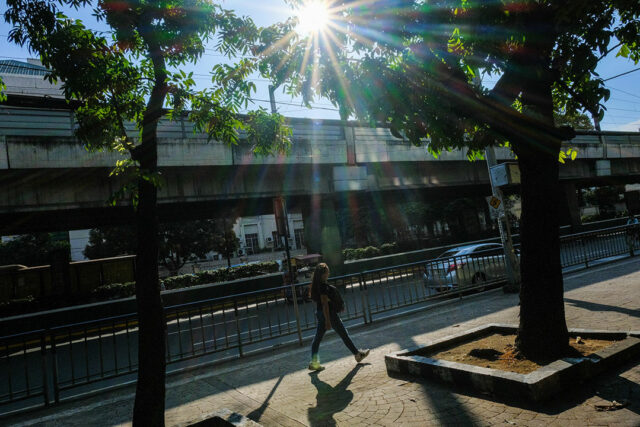
A person walks along the sidewalk along Taft Avenue in Manila. — PHILIPPINE STAR/JOHN RYAN BALDEMOR

By Beatriz Marie D. Cruz, Reporter

MANILA continued its downward slide in the latest global index of “smart cities” by International Society for Urban Informatics (ISUI), even ranking last among select Asia-Pacific cities.

In the 2025 edition of the Smart City Index, the Philippine capital ranked 63rd out of 73 cities. Manila dropped 19 spots from its 44th ranking out of 50 cities in the previous edition.

ISUI’s index is based on several factors such as citizen well-being and economic development.

Manila last among neighbors in ISUI Smart City Index

Among key Asia-Pacific cities, Tokyo ranked the highest at fifth place, followed by Hong Kong (eighth).

Also on the list were Seoul (13th), Beijing (15th), Singapore (21st), Shenzhen (25th), Yokohama (28th), Guangzhou (36th), Shanghai (39th), and Busan (41st).

Other “smart” cities in the region that were ahead of Manila include Kuala Lumpur (46th), Hangzhou (47th), Incheon (50th), Osaka (53rd), Bangkok (55th), and Jakarta (60th).

A higher ranking in the Smart City Index “reflects stronger performance in terms of inclusive, efficient, and sustainable urban living,” ISUI said.

According to the index, a smart city is defined by six dimensions: citizen, environment, social landscape, economy, infrastructure, and governance.

This year’s ranking was also expanded to 73 cities from 50 cities previously, “enabling a richer comparative analysis across regions and city types,” ISUI said.

“A smart city is assessed in terms of its contribution to improving urban efficiency and sustainability, and more importantly, its capacity to support the well-being, inclusiveness, and quality of life of city dwellers,” according to the report.

John Paolo R. Rivera, a senior research fellow at the Philippine Institute for Development Studies, said the government and private sector must invest more in inclusive digital infrastructure, such as smart mobility, interoperable public data systems, and affordable connectivity in Philippine cities.

“Manila’s low ranking reflects longstanding issues in digital infrastructure, mobility, safety, and access to urban services especially for the poor and vulnerable,” he said in a Viber message.

Nigel Paul C. Villarete, a senior advisor at technical advisory group Libra Konsult, Inc., said the country’s low ranking in the Smart City Index reflects the growing digital divide among citizens.

“While we do have an advanced and competitive interaction with smart technology, there remains a chunk of our population and society who have not fully embraced it than other countries may have,” Mr. Villarete said in a Viber message.

“It may be a natural fear of the new, or the prevalent preference for what we are used to, but we need to free ourselves more to accept future technologies and maximize their benefits for our country and people,” he added.

For Party-list Representative and House Transportation Committee Member Terry L. Ridon, Manila’s low ranking is linked to its poor and limited transport infrastructure.

The Philippine government must also focus on policies and programs centered on improving citizen well-being and raising their quality of life, according to the Philippine Resource Center for Inclusive Development (Inklusibo), a local organization.

“At the heart of cities are the people themselves, and for us to achieve inclusive smart cities, the National Government must have the political will to ensure that its policies and programs are rooted in participatory processes,” Inklusibo Executive Director Hans G. Bautista said in an e-mail.

“The government must not prioritize profit. Rather, it must prioritize the improvement of quality services that ensure that living is dignified,” he added.

PSE sets guidelines on stock market trading during disasters

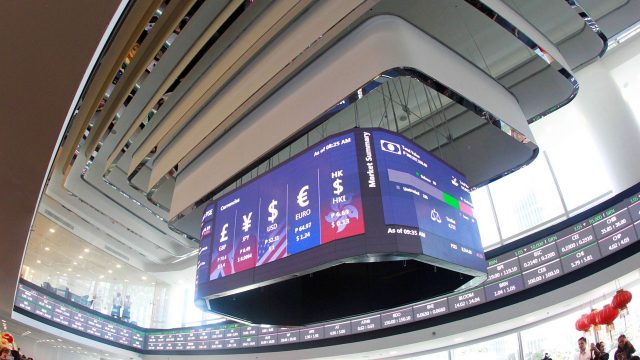
PHILIPPINE STAR/KJ ROSALES

TRADING at the stock market is automatically canceled if Metro Manila is placed under Tropical Cyclone Wind Signal (TCWS) No. 3 or higher, according to new rules issued by the Philippine Stock Exchange, Inc. (PSE).

There will be no stock market trading if the Philippine Atmospheric, Geophysical, and Astronomical Services Administration (PAGASA) raises TCWS Nos. 3, 4, or 5 in the National Capital Region (NCR), the PSE said in its new guidelines on natural disasters or extraordinary circumstances released on Wednesday.

Meanwhile, the regular trading schedule will be followed if PAGASA issues TCWS Nos. 1 or 2 in NCR.

Trading will proceed if PAGASA downgrades the TCWS in NCR to Nos. 1 or 2 from a higher level by 6 a.m. of the following trading day.

On the other hand, trading will be canceled if PAGASA maintains the TCWS in NCR at Signal No. 3 or higher by 6 a.m. of the next day.

Meanwhile, under amendments to existing rules, the PSE now also has the discretion to halt, suspend or cancel a scheduled trading day in the case of an emergency situation, including fire, earthquake, eruption, flood, heavy rainfall, civil commotion, terrorist attack, and other circumstances that would require evacuation from or prevents employees from re-entering the PSE premises.

A trading halt can also be triggered if participants accounting for over 50% of average daily trading value for the past six months are unable to access the trading system. This is a change from the previous threshold of one-third of trading participants.

“The exchange shall immediately notify the Securities and Exchange Commission (SEC) of its decision to halt, suspend or cancel a scheduled trading day,” it said.

It added that all trading participants are given two months to select a correspondent trading participant as part of their business continuity requirement.

The PSE will also implement a market halt if the trading participants are unable to trade through their correspondent trading participant. 

The new and updated guidelines have been approved by the SEC, the PSE said.

Rizal Commercial Banking Corp. Chief Economist Michael L. Ricafort said in a Viber message that the PSE guidelines ensure that there are contingency plans for the local bourse.

“The guidelines allow for greater predictability of trading activities for the investing public, both local and foreign,” Mr. Ricafort said.

“It also helps us align with global best practices.”

On Wednesday, the benchmark PSE index inched up 0.20 point to close at 6,277.87, while the broader all shares index fell by 0.07% or 2.76 points to 3,735.14. — Revin Mikhael D. Ochave

Hotel101 to open 2 hotels in Cambodia by 2028

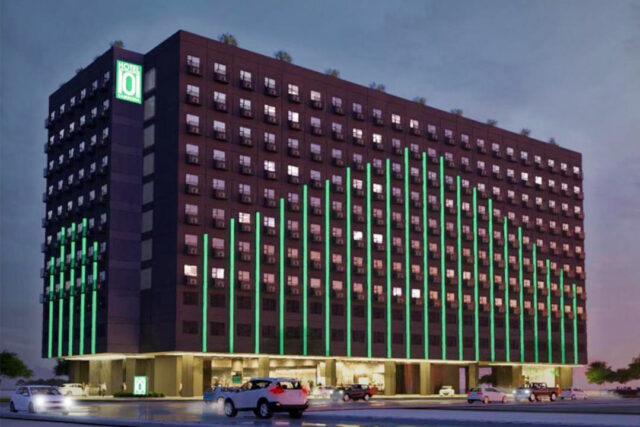
HOTEL101-SIHANOUKVILLE — HOTEL101 GLOBAL PTE. LTD.

HOTEL101 GLOBAL Pte. Ltd., the Singapore-based unit of DoubleDragon Corp. (DD), is building two hotel projects in Cambodia that are slated for completion by 2028.

Hotel101 entered into definitive agreements with Cambodian real estate developer Canopy Sands Development Co. Ltd. to develop the 700-room Hotel101-Phnom Penh and the 680-room Hotel101-Sihanoukville, the company said in an e-mailed statement on Wednesday.

The two projects are expected to generate P6.3 billion ($109.55 million) in total sales revenue once fully sold and will be among the largest hotels in Cambodia in terms of room count upon completion, it noted.

“These landmark developments, the first to be located in Phnom Penh, the capital and commercial hub of Cambodia, and the second to be located at Bay of Lights in Sihanoukville, a burgeoning financial and tourism beacon, mark a pivotal step in Hotel101’s long-term vision to operate 1 million hotel rooms across 100 countries,” Hotel101 said.

The 30-floor Hotel101-Phnom Penh will rise on a 2,033-square-meter (sq.m.) parcel of land in the Tonlé Bassac district. It is near landmarks such as the Boeung Keng Kang upscale district, Aeon Mall 1, and the Independence Monument.

The project will include kitchenettes, a swimming pool, a fitness gym, all-day dining, a business center, function rooms, and commercial spaces.

The Hotel101-Sihanoukville will rise on a 4,623-sq.m. parcel of land within the $16-billion, 934-hectare Bay of Lights master-planned coastal development led by Canopy Sands Development. It will be located near Sihanoukville airport.

Both projects will feature Hotel101’s standardized 21-sq.m. “HappyRoom” units.

Hotel101 said the expansion seeks to take advantage of Cambodia’s 6.7 million international visitors last year, a figure expected to rise further with the opening of the new Techo International Airport in Phnom Penh on Sept. 9.

Cambodia is the sixth country with a Hotel101 presence after the Philippines, Japan, Spain, the United States, and Saudi Arabia. Other Hotel101 projects under development are in Niseko, Japan (482 rooms), Madrid, Spain (680 rooms), and Los Angeles, USA (about 622 rooms).

DD shares fell by 1.72% or 17 centavos to P9.71 apiece on Wednesday. — Revin Mikhael D. Ochave

Deeds signed for ABS-CBN’s P6.24-B property deal with ALI

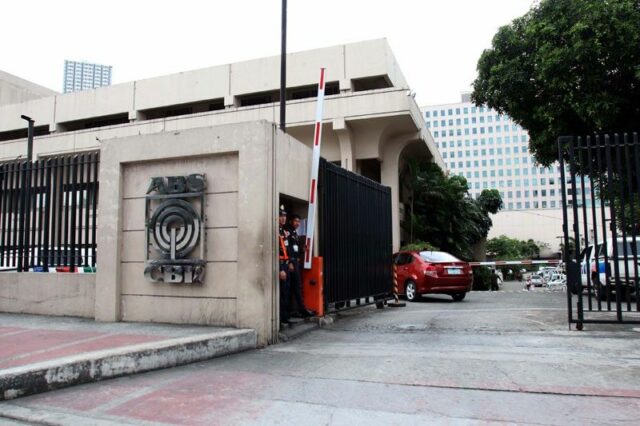
PHILIPPINE STAR/BOY SANTOS

MEDIA company ABS-CBN Corp. said it has signed the deeds of absolute sale (DoAS) covering part of its Quezon City property with property developer Ayala Land, Inc. (ALI), formalizing a P6.24-billion deal announced earlier.

“On Aug. 20, 2025, ALI and ABS-CBN signed the deeds of absolute sale upon the compliance with the conditions precedent,” ABS-CBN told the stock exchange.

The transaction follows the signing of a memorandum of agreement by ALI to acquire ABS-CBN Corp.’s property in Quezon City for P6.24 billion.

The sale covers up to 30,000 square meters, or 68.14% of ABS-CBN’s 44,027.30-square-meter property.

The agreement is subject to certain conditions, including clearance from the Philippine Competition Commission (PCC).

“It will help ABS-CBN pay down its debts as it shifts its business focus. For ALI, it’s another new site for their developments,” BDO Capital & Investment Corp. President Eduardo V. Francisco said in a Viber message.

ABS-CBN trimmed its attributable net loss for the second quarter (Q2) to P289.74 million, driven by higher advertising revenues and lower expenses for the period.

For the April-to-June period, ABS-CBN’s gross revenue rose by 8.89% to P4.04 billion from P3.71 billion in the same period last year, while combined expenses fell by 12.37% to P4.32 billion from P4.93 billion, the company said in a regulatory filing on Wednesday.

For the first half, ABS-CBN reduced its attributable net loss to P715.39 million from P2.02 billion a year earlier.

“This is the formalization of the sale, of course it will be good for ABS-CBN since it will allow them to raise much needed funds,” said April Lynn C. Lee-Tan, first vice-president and corporate strategy and chief investor relations officer of COL Financial Group, Inc.

ABS-CBN President and Chief Executive Officer Carlo L. Katigbak said in June that the company expects profitability within 18 months, citing higher advertising revenue and contributions from its digital, film, and music operations.

At the local bourse on Wednesday, ABS-CBN shares gained three centavos to close at P4.06 apiece, while shares in ALI climbed 45 centavos, or 1.73%, to finish at P26.50 each. — Ashley Erika O. Jose

Unicapital cuts PSEi year-end forecast to 7,100

PHILIPPINE STAR/KRIZ JOHN ROSALES

LOCAL BROKERAGE Unicapital Securities, Inc. has lowered its year-end forecast for the Philippine Stock Exchange index (PSEi) to 7,100 from 7,800, citing slower corporate earnings growth.

“We forecast the PSEi to reach 7,100 by yearend as we expect corporate earnings to increase by 8% in 2025, with an implied price-to-earnings ratio of 12x,” Unicapital Securities Equity Research Analyst Peter Louise D.C. Garnace said in a briefing on Wednesday.

“We reduced our earnings per share assumption from 10% to 8% given the uncertainties related to global trade tensions,” he added.

Mr. Garnace said the PSEi would be supported by easing inflation, prospects of further interest rate cuts, resilient economic growth, and “undemanding” valuations.

“Moving into the second half, we continue to see policy easing as a key tailwind for the market, underpinned by continued easing of inflation rate, and the government’s target to spur the local economy,” he said.

“We continue to see the disinflationary trend for price levels, and this is driven by the decline in rice and oil prices,” he added.

Philippine inflation slowed to a near six-year low of 0.9% in July as utilities and food costs continued to ease.

However, Mr. Garnace noted risks to the projection, including inflationary pressure from United States tariffs, global oil price volatility, trade disruptions, and geopolitical tensions.

Unicapital Securities Equity Research Analyst Jeri R. Alfonso said the PSEi projection relies on the resilience of sectors such as consumer, real estate investment trusts (REITs), and utilities.

“We see the Filipino household seeing a bit more cash in their pockets this year because of the inflation stabilizing. Aside from that, we want to note that the recent minimum wage increase will help the consumer sector narrative,” she said.

“Our role is to translate these numbers into actionable strategies for investors, so they can position ahead of the curve and benefit from the industries shaping the Philippines’ growth story. We believe the Philippines is not just turning the corner but is positioning to lead Southeast Asia’s growth race in 2025,” Unicapital Securities President Maria Concepcion Y. Fernandez said.

The main PSE index inched up by 0.003% or 0.20 point to 6,277.87, while the broader all shares index slipped by 0.07% or 2.76 points to 3,735.14 on Wednesday. — Revin Mikhael D. Ochave

ERC OKs Alternergy’s P2.8-B grid link project for Tanay wind farm

BW FILE PHOTO/ALDRINE BALLESTEROS

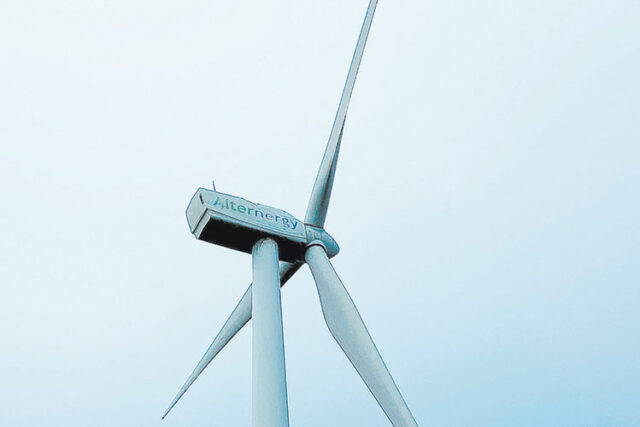
ALTERNERGY Holdings Corp. has secured approval from the Energy Regulatory Commission (ERC) to build a P2.8-billion transmission facility to connect its 128-megawatt (MW) wind power project in Tanay, Rizal.

The ERC approved the application of Alternergy Tanay Wind Corp. (ATWC), a subsidiary of Alternergy, to develop and own a dedicated point-to-point transmission facility, the company said in a media release on Wednesday.

The facility will involve the construction of two double-circuit 500-kilovolt (kV) transmission lines and a 500-kV switchyard with a transformer.

Alternergy also secured approval for its unique two-stage interconnection scheme comprising an interim and a final connection.

As an interim connection scheme, the ERC approved a bus-in connection to the existing 500-kV San Jose-Tayabas transmission backbone of the Luzon grid, pending completion of the proposed Baras 500-kV substation of the National Grid Corporation of the Philippines (NGCP), which will serve as the final connection scheme.

“This is an innovative interconnection scheme that enables our Tanay Wind Power Project to meet its commitment under the Administration’s Green Energy Auction 2,” ATWC President Gerry P. Magbanua said.

The Tanay Wind Power Project is part of Alternergy’s portfolio of renewable energy projects, supporting the company’s goal of achieving a 500-MW capacity by 2026.

The P11.8-billion wind energy project is slated to begin commercial operations by the end of the year.

Earlier this month, Alternergy also secured approval from the ERC to build a P1.8-billion transmission facility to link its 64-MW Alabat wind power project in Quezon province to the Luzon grid.

Alternergy has a portfolio of renewable energy projects, including wind, hydro, solar farms and commercial rooftops, battery storage, and offshore wind projects. — Sheldeen Joy Talavera

Something hot

A collaboration with A Spark of Madness is sizzling up at Shake Shack.

SHAKE SHACK fans can now have a taste of its latest collaboration with A Spark of Madness, a Hong Kong-based brand of sauces and condiments. The new products hit the US-based burger restaurants in Manila on Aug. 19.

The collaboration is based on A Spark of Madness’ Crispy Chili Oil, a condiment made by its founder Simran Savlani during the pandemic (more on that later). It will be used on four items: Crispy Chili Chicken (100% all-natural crispy chicken breast glazed in Crispy Chili Oil, then layered with pickled cucumber, shredded lettuce, and a creamy scallion mayo), Crispy Chili Chicken Bites (crispy bite-sized chicken pieces soaked in the oil, served with that same scallion mayo on the side), Crispy Chili Cheese Fries (topped with Shack cheese sauce and A Spark of Madness crispy chili oil), and the Crispy Chili Cheesedog (all-natural beef hotdog drizzled with Shack cheese sauce and Crispy Chili Oil).

BusinessWorld got to try the new offerings during a tasting on Aug. 14 at the Shake Shack branch in Central Square, BGC. The Chicken Sandwich was pleasantly spicy, crispy, and filling; one of the best chicken sandwiches we’ve had in the city, due to the seamless blend between the chicken breast and the chili oil (we just have one complaint: it’s much too messy to eat, but unless you’re wearing all-white, you can be forgiven for scarfing it down). The chicken bites were a lot less forgiving than the chicken sandwich, its heat levels unhampered by the sandwich’s accoutrements. The hotdog, meanwhile, just tasted like a hotdog with spicy toppings. Finally, we judge the chili cheese fries to have the most mainstream appeal, what with the cheese sauce and the chili oil giving each other balance. What’s more, the cheese sauce tempered the spice, so even our heat-averse seatmates at the launch managed to finish this one.

Kate Villasenor, marketing director at Good Eats Specialists, Inc. (the franchiser of Shake Shack in the Philippines; under the SSI Group), said that the collaboration is exclusive to the Philippines, though Shake Shack in the UK has had a similar brush with crispy chili oil (albeit from another brand, and a few years ago).

She also said that they plan to open two more Shake Shacks this year, with the first one already showing a board-up in the Greenhills shopping complex.

A SPARK OF MADNESS
Ms. Savlani’s sauces can be found in Hong Kong, the Middle East, Singapore, and this month, in Manila (through Joel’s Place, the high-end grocery venture by the same Tantoco family of SSI).

The sauces have four variants: Crack Sauce (a version of Chinese peanut-based Dandan Noodles sauce), the Crispy Chili Oil used by Shake Shack and a hotter version with Black Truffle, and Caramelized Spring Onion.

Ms. Savlani named the business after something the late actor Robin Williams said during a standup comedy set: “You’re only given a little spark of madness, and you mustn’t lose it.”

“I grew up watching Robin Williams. I loved him,” she told BusinessWorld. As a child, she had longed to open a restaurant but was directed towards getting a business degree by her family. She worked in media and lifestyle for a few years, then decided to move to Paris to study at the Cordon Bleu: not to be a chef, as she had hoped, but to learn how to build restaurants. She went into this career, traveling all corners of the globe to do just that.

Like many of us, she took a pause because of the COVID-19 pandemic — Hong Kong was under restrictive quarantines and lockdowns. In her home, she decided to write a cookbook (named A Spark of Madness). The sauces were initially meant to be giveaways during her book events, but they took a life of their own. “With the sauces, people kept coming back,” she said.

“I’ve always wanted to feed people. With a restaurant, I would be able to feed people only in one neighborhood,” she said. “With the sauces… someone in Dubai is sitting and having the sauces.”

While they’re Asian in inspiration, Ms. Savlani’s tweaks to her vegetarian, preservative-free, handmade sauces make them suitable to use in any cuisine. “There’s no limit to what you can do.” It’s reflective of the multiculturalism of Hong Kong: “We’re a small city, where people bring flavors in.”

It’s also a reflection of her own: of Indian descent, residing in Hong Kong, born in Taiwan, and with periods spent in Bombay and Paris. Asked what that lifestyle did to her palate, she said, “Curiosity. When you’re pushed to be in a place that’s not home, you’re curious.”

While staying in Manila, she had gone to several different markets, ranging from middle-range to high-end. She does this in every city she visits. “It’s just exciting to know how a country consumes food,” she said. “I soak in a city by seeing its food.”

The collaboration between A Spark of Madness and Shake Shack will be available from Aug. 19 until Oct. 18 at all Shake Shack locations nationwide.

Meanwhile, Shake Shack will be offering free form pottery classes in partnership with local ceramic studio Bumi and Ashe. Happening on Sept. 6 and 7 at Shake Shack Alabang Town Center, guests can create a ceramic piece to take home, while also enjoying a free Crispy Chili meal set plus swag from Bumi and Ashe. Visit bumiandashe.com to reserve a slot or check @bumi.and.ashe on Instagram. — Joseph L. Garcia

Megawide Q2 income falls on lower revenues

MEGAWIDE.COM.PH

MEGAWIDE Construction Corp. saw its second-quarter (Q2) attributable net income decline by 14.6% to P220.79 million on lower revenues for the period.

For April to June, the company’s total revenues decreased by 28.34% to P4.45 billion from P6.21 billion in the same period last year.

For the six months ended June, the company’s attributable net income fell by 2.73% to P434.79 million from P447.03 million a year ago.

Consolidated revenues for January to June dropped by 23.59% to P8.78 billion from P11.49 billion in the comparable period last year.

Broken down, construction operations accounted for the majority of the company’s revenues for January to June at P7.31 billion, followed by landport operations at P216.97 million and real estate operations at P1.07 billion.

“Based on our performance in the first six months of the year, we are on track to outpace our net income from the previous year. This is also partly driven by the increasing contribution from our real estate business, which is steadily emerging as a new growth driver,” Megawide Chairman and Chief Executive Officer Edgar B. Saavedra said.

The company’s gross expenses went down to P8.13 billion, marking a 24.9% decline from P10.84 billion.

“Other business segments are expected to complement our consolidated overall performance as we replenish our order book for EPC and Precast and Construction Solutions (PCS) from both external and internal clients,” Mr. Saavedra said.

As of end-June, the company’s construction order book stood at P37.7 billion, with new contracts amounting to P2 billion.

These new contracts include Towers 2 and 3 of PH1 World Developers, Inc.’s PH1 project; Modan Lofts Ortigas Hills; Citicore’s Lucanin Solar Power Plant; and battery energy storage systems for the Bolbok and Lumbangan solar plants.

At the stock exchange on Wednesday, shares in the company gained four centavos or 1.96% to close at P2.09 apiece. — Ashley Erika O. Jose