Home Blog Page 6008

Diay de Vega: Skillful athlete with character

Asia’s fastest woman in the 1980s, Lydia (Diay) de Vega was scheduled, as we were doing this column, to be laid to rest at Pandayan Memorial Cemetery at Meycauayan City, Bulacan on Wednesday, Aug. 17. Diay’s interment was to be followed by a two-day wake at the St. Francis of Assisi Parish Church, one of the oldest parishes in Bulacan. As expected, thousands of mourners have visited the wake to say goodbye to one of the town’s favorite daughters and hometown heroes.

Diay was born in and grew up in Meycauayan where she was elected councilor in 2001. Diay was 57 when she succumbed to breast cancer on Aug. 10, after waging a quiet but brave battle against the killer disease that, according to the University of the Philippines-National Institutes of Health’s Institute of Human Genetics, claims the lives of four Filipinos every hour or 96 patients every day. Reports indicate that the Philippines has the highest prevalence of breast cancer in Asia and ninth in the world.

Diay was diagnosed with the disease in 2018 in Singapore. True to her character however, she kept her illness a secret except from her immediate family. Eldest child Stephanie, a former De La Salle Lady Spiker, said that, “Mama did not want to bother people and wanted to solve her problem herself.” Diay kept her condition so well-guarded a secret that everything seemed so normal when she appeared with other sports greats — like three-time world bowling champion and Guinness World Records holder Paeng Nepomuceno, basketball star Alvin Patrimonio — to carry a giant Philippine flag during the opening ceremonies of the 30th Southeast Asian Games.

Diay made sure that she did not appear unwell, to the point that she even took an active part in the wedding preparations of Stephanie, who married longtime sweetheart, David Abesamis Koenigswarter, a professional pilot. Diay extended her Manila trip to attend the wedding of Stephanie (or Paneng) in December 2019.

Sometime in July-August 2021, as the country geared for the presidential elections on May 9, 2022, we asked Diay if she would do a short video urging Filipinos, especially the youth, to “go out and register in order to vote” in the forthcoming elections. Diay asked for a few days to think about it. I had told her that other sports personalities like taekwondo Olympian and taekwondo world championship gold medalist Monsour del Rosario, Nepomuceno, volleyball players Mika Reyes and Jaja Santiago had agreed to do the commercial. Diay later told me that she would not be able to do the commercial because “I would rather remain in the background here in Singapore.” Hidilyn Diaz, the country’s first Olympic gold medalist graciously agreed to do the commercial a few days after winning the country’s first ever Olympic gold medal in Tokyo. The Hidilyn commercial was an instant hit, going viral a few minutes after it was posted.

Years earlier, in 2003, as I narrated in an earlier column, Diay agreed to appear on a weekly TV sports show with me called Double Team, aired on IBC 13. By the time she appeared in the weekly sports show, she had a movie to her credit, aptly called, Medalyang Ginto. Lydia and Tatang, her father-coach, played out how they achieved success in athletics. It was therefore not difficult to act out what they did in real life. It was not surprising then that Diay appeared comfortable in front of the camera and easily memorized her lines and embraced the show’s concept: two sports personalities dealing with both the technical and philosophical aspects of sport and sport as a force for good.

During breaks in the taping, Diay would express her feelings about how athletes, especially those with continuing victories, should behave and the responsibility on their shoulders. Moral character was to her just as important as skill. Daughter Stepanie’s reluctance to talk about the disconnect between skill and moral character in an athlete was consistent with her mother’s desire to refrain from commenting on those inconsistencies and anomalies. Stephanie would say, “Like Mama, huwag natin pag-usapan na (let’s not talk about that anymore).” That comment, however, revealed the moral compass by which mother and daughter were guided.

At her wake at the Heritage Chapels, I was able to spend a few moments with Diay’s husband, Paolo Mercado, who recalled those nights when he would accompany her to our taping sessions at a studio in Broadway Centrum in Quezon City. Paolo also reminisced about the night I dropped by the couple’s place in Project 4, Quezon City during the wake of their four-year-old son, Jonathan. Diay’s first son was run over by a passenger jeep while playing in front of the Mercados house on Feb. 14, 2001.

I vividly recall that precise moment when I condoled with Diay who was at a loss in understanding why her son had such a short life. I sensed that she regretted that she was not able to do enough to “prevent” the accident from happening.

Diay’s mother, Mary, after whom Maria Lydia de Vega was named, was quietly grieving as I observed her from a distance during the wake. I approached mother Mary and she said, “Napakabait ng batang ’yan.” (She was so kind). Mary narrated that Diay would often call her up from Singapore to advise her “not to work too much since there are people who can help you there.”

Twelve years the junior of her late husband, ex-policeman Tatang, Mary, now 83, rued that “instead of my child burying me, I’m the one burying Diay.” Mary added that after three sons, she gave birth to Diay, who was followed by two daughters, one of whom was adopted.

One among Diay’s ex-Gintong Alay comrades who took her passing hard was Elma Muros-Posadas. Just two years younger than Diay, Elma was considered Diay’s heir apparent although some quarters unsuccessfully tried to create a rivalry between the two. The two would not, however, oblige. To begin with, Elma was competing in different and more events. Elma was competing in the heptathlon, a grueling eight-event discipline. It was the female version of the decathlon, a 10-event discipline. Of the eight events in heptathlon, Elma excelled in long jump and was promptly accorded the title of “long jump queen.”

Diay and Elma shared the values of integrity, truthfulness, and loyalty. Even while Diay was overseas, the two would often talk for hours on Viber or WhatsApp about goings-on in the Philippines, especially in the athletics community. Both knew the real substantive issues and were not fooled by elaborately prepared and presented and glossy but untruthful narratives.

Elma wept unabashedly during the wake, saying that she had leaned on Diay for proper advice and guidance on her life as an active elite, and now a senior and master athlete. One can therefore be sure that what Elma says and does is a product of long reflection and discussion between her, Diay, and husband, coach Jojo Posadas, and fellow ex-Gintong Alay athletes like Nonoy Unso.

Those were the days.


Philip Ella Juico’s areas of interest include the protection and promotion of democracy, free markets, sustainable development, social responsibility and sports as a tool for social development. He obtained his doctorate in business at De La Salle University. Dr. Juico served as secretary of Agrarian Reform during the Corazon C. Aquino administration.


A new normal is dividing the global chip industry

YOGESH PHUYAL-UNSPLASH

SEMICONDUCTOR stockpiles are at a record high, and a global economic downturn is unlikely to change that picture. But an increasingly tense geopolitical environment and continued supply chain friction is dividing the largest from other semiconductor manufacturers, which could impact how well they survive.

The technology Cold War between the US and China that gained steam under the Trump administration and was exacerbated by the pandemic has reset expectations for how much product should be kept on the shelves. The global shortage of some chips peaked in 2021 after clients that included carmakers cut orders only to desperately need them a few months later. At the same time, the popularity of streaming video services such as Netflix, Inc., which were forced to expand their server capacity, and greater use of gadgets from companies like Sony Group Corp. created competition for limited manufacturing capacity.

Inventory days, a measure of how long it takes to sell and replace stockpiles, have never been higher at dedicated chip foundries Taiwan Semiconductor Manufacturing Co. (TSMC), United Microelectronics Corp. (UMC), and Semiconductor Manufacturing International Corp. Those three companies are ranked number one, three, and five in global made-to-order market share — accounting for 67% of the total. Data from Samsung Electronics Co., the second-largest foundry, isn’t analyzed here because the company doesn’t provide data for its contract chip business. Data for fourth-ranked GlobalFoundries, Inc. only dates back two years.

Digging deeper, we can see that manufacturers outside TSMC and possibly Samsung are still holding on to higher stockpiles as sales slow. At the end of June, inventory at TSMC, which accounts for around 55% of the foundry market, was equal to 40% of that quarter’s revenue. Its rivals collectively had a figure of 57%.

Even though semiconductor demand has not declined, it is weakening as consumers tighten their belts and companies, including Apple, Inc., freeze hiring or cut staff. Those chipmakers that focus mainly on older technology for mainstream use — such as components used in smartphones, computers, and televisions — are seeing a more dramatic slowdown. TSMC and Samsung, the industry leaders, are enjoying more robust outlooks for their foundry services because they can offer clients superior manufacturing processes for higher-end applications like artificial intelligence and 5G mobile communications. This competitive advantage offers a greater financial buffer, reducing the risk of holding higher inventory.

Easing the danger for the other players are long-term supply deals including those made public in recent years by both UMC and GlobalFoundries. The latter last week announced a new deal with Qualcomm, Inc. that guarantees a total of $7 billion in revenue from the Californian designer of chips used in smartphones through 2028, slightly more than GlobalFoundries’ entire sales last year. While TSMC hasn’t disclosed similar agreements, assurances that its capacity will find buyers are somewhat implicit in the company’s business model and aggressive spending plans, with management repeatedly stating that the $100 billion it’s investing over three years is based on consultation with clients in anticipation of their needs.

A raft of new policies, including a $52-billion spending package from the US Congress, is aimed at making it easier and cheaper to expand capacity in America and Europe. TSMC, Samsung, GlobalFoundries, and foundry newcomer Intel Corp. are all set to benefit.

Yet investors remain unconvinced that all this spending will support earnings. Most foundry stocks have declined over the past year, even with continued double-digit revenue growth, in large part because the high rate of spending on new facilities heightens concerns that capacity will outstrip demand if a global recession hits. That’s a reasonable concern, since semiconductor sales tend to closely track macroeconomic indicators such as growth in gross domestic product. But the new normal — a sustained higher rate of stockpiles — is also likely to worsen the divide between the biggest companies with better technology, and other chipmakers who are highly dependent on demand for mainstream products.

This changing landscape will likely mean that the strong get stronger, and the weaker struggle to hold on.

BLOOMBERG OPINION

Hands off and hands on

PAPAIOANNOU KOSTAS-UNSPLASH

THE HANDS-ON LEADER is supposed to inspire confidence and serve as the model for the rest of the organization. This workaholic chief may state in a media interview on his lifestyle and bucket lists that his favorite place on earth is not Paris or Bora. It’s his corporate office with its Bloomberg screens for trading activities around the world and access to his direct (and indirect) reports, wherever they are.

Is it necessary for the chief to work long hours to prove his fitness to serve? Don’t long hours imply the need to get into the nitty gritty and figure out where the fire exit is? Does the plunge into details make the CEO lose perspective?

Micromanagement, or the undue obsession with connecting all the dots, needs to be examined in terms of its effects on subordinates. Maybe they feel mistrusted, that they will not get things done without the boss breathing down their necks. Delegation of authority is part of effective management practice.

What’s wrong with being hands off?

There are hidden advantages for a chief executive who is not caught in a flurry of activities and trying to be everywhere, present in every event he is invited to. Shorter working hours force the setting of priorities and the proper allocation of the scarce attention span. Besides he needs to free up schedules for those who want to see him too.

When available hours for ceremonial appearances are cut back, demand needs to be more thoroughly screened. Lessening speaking engagements reduces the opportunities for not just ambush interviews but the equally hard to fend off petitions from assigned seat mates.

These soliciting encounters must be avoided. They provide the occasion of sin for blatant appeals for favors resulting in the erosion of line authority. (Sir, I have this catering service that can handle office parties, but your watchdogs are refusing me entry to see you.) Gatekeepers are at risk for obstruction of favor-seekers — is that villain still at his desk?

Micromanagers do not find any detail unworthy of attention and follow-up. The only solution for the line manager is to “slow walk” impromptu instructions from the top. This dangerous form of disobedience works only with chiefs who are forgetful or have the early onset of dementia. They forget to follow up.

Even more impressive for those who see micromanagers as heroes is the flurry of long meetings, and always being late for them. It’s a little bit like speed dating or simultaneous chess matches — move a pawn and then bang on the stop clock and hurry to the next board.

The principle of need-to-know or its corollary of need-to-consult makes fewer meetings with fewer people possible. Does the chief call town hall meetings when smaller and shorter meetings will do? While somebody is presenting his litany of woes or trumpeting his little triumphs (we have installed a fogging machine in the lobby) the others are getting set for their turn and reviewing their own charts.

Long hours of attending meetings, showing up at events, reviewing reports to put one’s marginal notes (more study needed) can earn the leader the accolade of being a hardworking and hands-on manager. One must properly allocate the value only the chief executive can add when scheduling his attendance.

For the nation’s leader, it is the symbolic might of his office which defines what is critical to the country, maybe pushing through an unpopular but needed policy or going against entrenched political interests, like removing tax incentives, or simply paying his taxes.

Does a visit to a disaster area really fluster the local executives and distract them from their rehabilitation work by attending to visiting dignitaries? Or is it a way of showing the concern of a leader?

The optics of the chief’s presence are critical. Showing up at events like disasters from natural calamities or the declaration of a corporate default shows who’s in charge. And this must be done at the time of the crisis, not long afterwards.

Still the best use of hands (off or on) is the middle way, where the chief understands enough details without losing his sense of priorities. By wisely allocating his time, the chief does not devalue his presence or absence in big or small meetings, including one-on-ones with no media present.

The chief should dive into both the forest and the trees and understand that sometimes… some twigs need pruning.


Tony Samson is chairman and CEO of TOUCH xda

ar.samson@yahoo.com

TaskUs PHL doubles in size over pandemic

TASKUS.COM

Business service providers like TaskUs, Inc., benefitted from the pandemic, said Jaspar Weir, co-founder and president the Texas-headquartered outsourcing and offshoring consulting company. Its Philippine workforce, spread over 10 sites, has doubled since coronavirus disease 2019 (COVID-19) struck.  

“When people get comfortable working at home, it no longer matters if somebody works in the office next to you or … anywhere in the world. Outsourcing in general wins,” he said, adding that clients have expanded their outsourcing requirements in low-cost destinations like the Philippines. 

The Philippines is “the premier place” for services like English support, content moderation, and data operations, he added. 

At a roundtable discussion on Aug. 15, Kris G. Mandap, vice president of operations of TaskUs Ortigas-Phoenix, said that there are over 27,000 employees in the country at the end of 2021, more than double the workforce prior to the pandemic.

“We are able to provide livelihood for a lot of people,” he said. 

Fueling that growth are the company’s learning experience services, as well as its risk and response solutions that focus on fraud, risk, and compliance.  

Providing e-Learning systems and development programs was born out of a client request that TaskUs take over its in-house training after they observed that the outsourcing company was “doing a good job training its people.”  

“We commercialized that offering. We’re always looking at new services that clients ask for,” Mr. Weir said, adding that this also provides advancement opportunities for TaskUs employees. 

Dean Van Ormer, TaskUs’ senior vice president and head of the Southeast Asia region, said that employees stay with the organization because they have multiple ways to move up. 

“We have a whole academy designed so — if they want to move up through first-, second-, third-level management — this is all at their disposal,” he said. “If they want to invest the time to do it, we invest the resources to educate them.”  

The key differentiator for TaskUs, Mr. Weir added, has been realizing that “creating jobs that people love going to … is a good business model.”  

TaskUs’ first office was located above a vulcanizing shop alongside Aguinaldo Highway, Cavite. Conceived in 2008 as a virtual personal assistant company, Mr. Weir and co-founder and Chief Executive Officer Bryce Maddock eventually decided to develop TaskUs into a business servicing high-growth startups.  

“We realized that if we can attract the best people, then those people can deliver the best work for our clients,” Mr. Weir said. “As long as we keep investing in that employee lifecycle, it pays back.”  

TaskUs (Nasdaq: TASK) reported on Aug. 8 second quarter total revenues of $246.5 million, representing 36.9% of year-on-year growth. In the same period, the company generated 51% of its revenues in the Philippines. — Patricia B. Mirasol

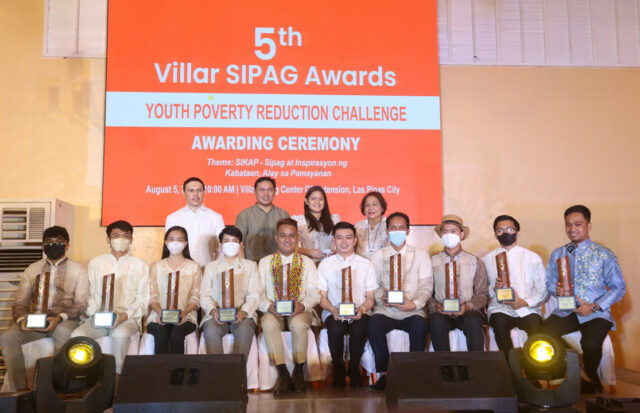
5th Villar SIPAG awards most outstanding youth enterprise

THE VILLAR SIPAG AWARDS – YOUTH POVERTY REDUCTION CHALLENGE is an annual search for empowered youth organizations trying to make a significant impact in society through their advocacies, and is now on its 5th year. It is a friendly competition among the Filipino youth whose social enterprises contribute in alleviating the poverty situation in their respective communities.

This is the Villar SIPAG founders’, spouses Manny and Cynthia Villar way of supporting youth empowerment in the hope to further encourage more young people to significantly contribute to nation building. The award is a recognition of the youth’s efforts, passion and self-less dedication in creating positive change in society.

For this year, seventy-five (75) participating groups were nominated and submitted their documents for screening. Twenty (20)  went  through  rigorous final validation by a panel of judges using the following criteria:  originality or uniqueness, adaptability, sustainability and community upliftment. Ultimately, ten (10) groups are named Most Outstanding Youth Social Enterprises and one (1) has been chosen for a special award.

This year’s winning groups champion the promotion  and  preservation  of  the  Filipino arts and culture, entrepreneurship in agriculture, environment preservation, leadership development, together with social media and sports training.

The awarding ceremony was held on August 5, 2022, where the winners each received One Hundred and Fifty thousand Pesos and a trophy at the Villar SIPAG Center, in Las Piñas City. The special awardee also gets a trophy and fifty thousand cash. The awardees are:

GLORIA COMPOUND YOUTH ORGANIZATION (PILAR, LAS PIÑAS) It was established on January 1, 2011 and currently have 570 members. Their community programs includes: GCYO Online Hub; Youth Data Management System,Gloria Youth Center; Project A.R.A.L. (Access to Resource for Alternative Learning); Project H.O.P.E. (Help Other People Eat); Miss Gloria; Kabataang Gloria Bastketball League; Halloween Parade and Linggo ng Kabataan Annual Celebration.

TONDO YOUTH PATAAS COMMUNITY CARE, INC. (TONDO, MANILA) Established in August 2017, Tondo Youth Pataas has an initial 6 members and grew to 423 members as of to date. TYPCI educate and train aspiring youth in performing arts, administrative services, social media, job preparedness, and event production. They initiated various job-generating projects such as on-site job hiring, job and project referral programs, and the “Ambagan Sa Bike” livelihood project and conducts feeding, relief operations, and gift-giving to people who are greatly in need in Tondo. They provide manpower to be utilized as service crew from some fast-food store such as Jollibee and McDonalds. Social media awareness is their platform in promoting the dance group.

SIMEONA  F.  CHANYUNGCO  LAHINGKAYUMANGGI MANANAYAW NG MARIKINAINC. (MARIKINA CITY) Established in July 2011, they grew to 31 members from the initial 6 pioneers. SFCLKM is aliving legacy of Marikina’s local artist in dance,Mrs. Simeona F. Chanyungco who dedicated her life as a cultural advocate.

Their group aims to enrich Mrs. Simeona F. Chanyungco dedication in folk dancing and propagate her loyalty for the community. The organization conducts free dance workshops for the community, boosting engagements and empowering the underprivileged youth by fostering their talents and skills to dance. Their Pagmulat and Indayog workshops enables great young dance artists to become a full scholar in college. SFCLKM is consists mostly of young and talented artists from early teenage years who value folk dancing more than modern dance. Dancing has become their structure to sustain their education and they are being hired to perform.

SAN CARLOS CITY FEDERATION OF 4-H CLUB (SAN CARLOS CITY, PANGASINAN) Established on 2019, the group is composed of 470 members from 22 barangays out of 31 barangays or 70 percent penetration of all barangays with initial members of 69 members from 4 barangays only.

San Carlos City 4H Club is an active youth organization that participates in agriculture activities and community services. Members are actively participating in building a vegetable garden and engaging in Free-Range Chicken production. They provide trainings on agriculture related activities and livelihood to enable the young individual to gain knowledge and generate income.

JCI DAGUPAN BANGUS (DAGUPAN, PANGASINAN) Established in 1951 and has since recruited 2,347 with currently 91 active members. JCI Dagupan Bangus provides job opportunities through partnerships in businesses owned by the members of JCI Dagupan Bangus.  The organization makes partnerships with government and private entities quarterly, to conduct coastal and community clean-up drives, tree and mangrove planting as well as participating in the policy development of the government and planning in formulating a  sustainable program with regards to green projects. They conduct health services, provides seminars and symposium with regards to anti-violence against women and children, safe spaces act, partnership and membership in peace and order council of Dagupan City Local Government and participation in planning for peace and order. Since establishment, they focused on bangusdevelopment,give trainings on bangus growing, distributed bangus fingerlings and other needed equipment as starting kits to sustain the City’s production. They consistently joined the yearly Bangus Festival.

MGA TALA AT TULA COMMUNITY (CANDABA, PAMPANGA) Established on April 15, 2018, the organization has now 136,200 members from 15 initial. The programs and services they offer includes Poetry Collaboration in social media, spoken  poetry  competition,  virtual  poetryreading, nationwide distribution of basic needs and online donation drive.

The organization started the “We Write To Help Campaign,” a social media campaign in 2020 to help communities especially the marginalized and affected by calamities. They were able to collect fund for relief operations in Cagayan Valley during the aftermath of Typhoon Rolly and Ulysses. They were able to aid indigenous communities such as Aetas in Nueva Ecija and Dumagat in Bulacan. Through “We Write To Help Program” they were able to set-up ten Community Pantries in the different parts of the country, serving basic needs during the start of the pandemic and mobilizing hundreds of youth volunteers from Luzon, Visayas and Mindanao.

KATOTO PROJECT  (PAETE, LAGUNA)

Established in June 2019, the organization currently have forty two members from the original ten. One of their initiatives is Aklaya or “Ang Classroom na Malaya” use mobile kariton classroom to teach children and provide school supply through Balik Sigla, BalikEskwela Project. Others project includes ; Almusal-Ang Saya ng Almusal – feeding program,AniniKatoto- Community Pantry for farmers, KatotoHanan – Ang tahananniKatoto: Housing project. A housing project using nipa hut materials.

Katoto Project was recognized by the National Youth Commission receiving Platinum Award or the Seal of Good Youth Governance in 2021 and by the Province of Laguna as one of top ten best organization also in 2021.

YOUTH PROYEKTO PHILIPPINES INC. (ILOILO CITY)Established on June 29, 201, they currently have 60 volunteer members  nationwide.  It is a non-profit organization  duly recognized by the Province of Iloilo and has partnered with of some LGUs. The organization gathers youth people for the welfare of our environment.

Their advocacies includes: “Youth Environment Support, Yes You Can!”, Eco Run where they collectpet bottles and sacks of soft plastic annually which  they made into eco bricks. They also have an annual coastal clean – up. They have adopted IP Community or the Calinog ATI Tribe Indigenous Crafts Maker through their “PagkalingasaKatutubo; Sila ay atingKapwa”project.

Youth Proyekto partners with of various  groups in promoting Panay through Ecotourism activities.

MUSHROOM CITY (MALAYBALAY CITY, BUKIDNON) Established on November 12, 2019, Mushroom City is a private enterprise started by two siblings who  learned about mushroom while they were students in Central Mindanao State University. Today, they already have six employees under the enterprise.

Mushroom City is accredited by Agricultural Training Institute (ATI)  and TESDA as a farm school/learning site. They provide free training on mushroom production, lakbay-aral and farm tour to interested groups, and promote farm tourism in Malaybalay.

They also venture to chicharon making, mushroom drying and powdering, and currently constructing a café for their guests. Their buyers came from all over Mindanao regions.

During pandemic, they gave mushroom to 15 barangays in Bukidnon as food aid and they also gave mushroom tempura to the community dubbed as “Mushroom for Frontliners.”

BUTWA’AN ARTS CENTRE/BUTWA’AN DANCE ENSEMBLE (BUTUAN CITY, AGUSAN DEL NORTE) Established on May 8, 2018, the organization promotes local culture and arts. They are composed of young people ranges from 17 to 25 years old, and teach traditional dance, yoga and zumba on line, where their income is shared to both the organization and performers/talents to support their education.

The National Commission for Culture and Arts discovered them through their online fund raising to save their art studio that was put at risk due to the pandemic.


Spotlight is BusinessWorld’s sponsored section that allows advertisers to amplify their brand and connect with BusinessWorld’s audience by enabling them to publish their stories directly on the BusinessWorld Web site. For more information, send an email to online@bworldonline.com.

Join us on Viber to get more updates from BusinessWorld: https://bit.ly/3hv6bLA.

IABC Philippines to celebrate communications excellence at 19th Philippine Quill Awards

The International Association of Business Communicators Philippines (IABC PH) will once again honor and celebrate the best of the campaigns, programs and tools promoted in the Philippine communications industry from January 2020 up to July 2021 at the 19th Philippine Quill and 9th Student Quill Awards, the country’s most prestigious awards program in the field of business communication.

The Quills is a communication Olympiad highlighting the gold standard in communication for professionals as well as students.  The IABC Philippines has been running the Quills for almost two decades, promoting a spirit of friendly competition as well as unity amongst Philippine communications practitioners in pursuit of a common goal — communications excellence.

Each entry is evaluated using IABC’s highest global standards.  The industry sees the Quill as a seal of approval, recognizing the use of excellent communication to achieve business goals and to make a difference in society.

The 19th edition of Philippine Quill Awards and the 9th Philippine Student Quill Awards will carry the theme “Move: Stronger Together”, highlighting the power of communications in shaping the future. With recent challenges, IABC encourages communicators to use their voice and platforms to navigate and move through the next normal bigger and better — setting the direction and inspiring people towards action and positive change.

The awards night for both Philippine Quill Awards and Philippine Student Quill Awards will be happening virtually this August 18 via KTX.PH platform.

“I feel very honored to witness our communications professionals and students thrive during a very difficult period. In this second year of the virtual Quills, we shall once again come together to inspire and encourage each other to look towards a future made better by evolving communications, “said IABC Philippines President and Football for Humanity Co-Founder Belle Tiongco.

“Our peers from the communication industry have shown how resiliency through impactful campaigns can foster a positive influence and change to each one of us. Excited to finally celebrate their work at this year’s Quills,” said Abigail Ho-Torres, IABC PH’s Chair of the Philippine Quill Awards and Assistant Vice-President — Head of Advocacy and Marketing Department of Maynilad Water Services.

The 19th Philippine Quill Awards and 9th Philippine Student Quill Awards is supported by KTX.PH as the event’s virtual platform partner. Adobo Magazine, BusinessWorld and Manila Standard served as media partners.

E-tickets for this year’s Philippine Quill Awards and Philippine Student Quill Awards are now available and can be booked in the following link: https://forms.gle/grKnGfqtj5HLVcXt6.

To know more about IABC Philippines and the 19th Quill Awards, please visit https://www.facebook.com/iabcph or e-mail iabcphilippinesat30@gmail.com.

About IABC Philippines

IABC Philippines is the first IABC country chapter in Asia. It is an association of top business, industrial and organizational communicators and professionals that supports the highest professional standards and practice of exceptional quality and innovation in organization and business communication. It advocates for continued professional growth, learning, and communication excellence, linking Filipino practitioners with colleagues and best practices worldwide. Its two major communication excellence industry awards are the Philippine Quill and the Philippine CEO EXCEL Awards. IABC is a member of the Global Alliance of Public Relations and Communication Management.


Spotlight is BusinessWorld’s sponsored section that allows advertisers to amplify their brand and connect with BusinessWorld’s audience by enabling them to publish their stories directly on the BusinessWorld Web site. For more information, send an email to online@bworldonline.com.

Join us on Viber to get more updates from BusinessWorld: https://bit.ly/3hv6bLA.

S. Korea calls for talks as N. Korea test fires missiles

South Korean President Yoon Suk-yeol. — REUTERS

SEOUL — Talks with North Korea should not be for political show but contribute to establishing peace, South Korean President Yoon Suk-yeol said on Wednesday, just hours after the North test fired two cruise missiles into the sea.

Speaking at a wide-ranging news conference to mark his first 100 days in office, Mr. Yoon made no mention of the launches, which were only publicly reported later by the South Korean military.

Mr. Yoon repeated his willingness to provide phased economic aid to North Korea if it ended nuclear weapons development and began denuclearization, noting that he had called for a dialogue with Pyongyang since his campaign.

“Any dialogue between the leaders of the South and North, or negotiations between working-level officials, should not be a political show, but should contribute to establishing substantive peace on the Korean peninsula and in Northeast Asia,” he said.

The comments were an apparent criticism of summits involving his predecessor Moon Jae-in, North Korean leader Kim Jong Un, and then-US President Donald Trump.

Despite those meetings, denuclearization talks stalled in 2019 and North Korea has said it will not trade away its self-defense, though it has called for an end to sanctions. It has been observed preparing for a possible nuclear test, which would be its first since 2017.

North Korea’s launches on Wednesday were the first reported in months, and come a day after South Korea and the United States began preliminary joint drills ahead of a restart of live field training halted under Moon.

Mr. Yoon said South Korea was not in a position to guarantee the North’s security if it gave up its nuclear weapons, but Seoul did not want a forced change in the status quo in the North.

The North’s recent missile tests and nuclear development has revived debate over whether the South should pursue its own nuclear weapons. Mr. Yoon said that he was committed to the Treaty on the Non-Proliferation of Nuclear Weapons (NPT) and working with the United States to boost its “extended deterrence” for South Korea.

“The NPT should not be abandoned and I will adhere to that until the end,” he said.

LABOR STRIFE
Facing falling poll numbers and controversies over his picks for top ministers, Mr. Yoon was pressed by media on a range of issues including labor reform, housing shortages, and recovery from recent floods.

Since Mr. Yoon came to office in May, two strikes have cost industry more than $1.6 billion, according to labor ministry and shipbuilder estimates, although neither involved a government suppression before ending. The president said he would always allow time for dialogue and compromise before suppressing an illegal strike.

Yoon called for ending discrepancies between “workers who do the same job”, such as between direct hires and contract workers, without elaborating on how.

UKRAINE AID
He also touted major weapons sales including a deal last month with NATO-member Poland involving more than 1,600 tanks and howitzers, and nearly 50 fighter jets.

He declined, however, to say whether his government would change its policy of not directly providing lethal aid to Ukraine.

“While it’s difficult to elaborate here on the issue of supplying military support, we will help the Ukrainian people recover freedom and rebuild the destroyed national assets swiftly,” Mr. Yoon said.

He said he believed that historical disputes with Japan dating back to its colonial occupation of the Korean peninsula from 1910-1945 could be overcome and that the two countries needed to cooperate more closely on supply chain and economic security. — Reuters

P&G faces reckoning over Charmin, Bounty supply chain

UNSPLASH

NEW YORK — Procter & Gamble Co. will take steps aimed at reducing potential harm to forests from its purchases of wood pulp for toilet paper and other consumer goods, after being pressured by environmentalists and investors for more sweeping changes. 

P&G will aim to end buying pulp, a key ingredient in its top-selling Charmin toilet paper, from certain forests in Canada and develop a plan to reduce purchases of the raw material from other swaths of woodland, according to an agreement the consumer products company made with an investor last month. 

P&G faces scrutiny from environmental non-profits and some investors in part because it lags its publicly-traded peers in using recycled paper and fibers in household staples like toilet paper. P&G has not made pledges to cut its purchases of pulp, which is harvested from logged trees. Environmental groups say pulp harvesting takes a heavy toll on the environment. 

Wood pulp helps P&G’s Charmin and Bounty paper towels feel soft and more absorbent, and the company says consumers prefer them. P&G says its competitors making premium toilet paper all exclusively use virgin wood pulp as well. 

But rival Kimberly Clark Corp., which makes Cottonelle toilet paper, has vowed to reduce its reliance on natural forest fibers, which include pulp. It also makes a Scott toilet paper with 100% recycled material. 

Unilever Plc sells a Seventh Generation brand of 100% recycled toilet paper, paper towels and tissue. 

P&G’s agreement with investor Green Century Capital Management Inc was filed July 18 with the US Securities and Exchange Commission. 

P&G also updated its forestry practices section of its website in late July to include most of the agreement. In that update, P&G said it has created and is testing two new Charmin products, one made with plant-based fiber and another with bamboo. 

‘HEAD IN THE SAND’
P&G and some of its investors and non-profits are deeply divided on the environmental impact of the company’s sole reliance on virgin pulp. 

P&G, which had its own pulp and timber business until the early 1990s, says all of its pulp comes from sustainably managed forests and tree plantations, limiting negative effects on the environment. 

It cites climate experts saying that those forests take more climate-warming greenhouse gasses out of the atmosphere than they emit, from the time they are grown to when they are harvested. 

The pulp supply chain starts generating greenhouse gasses once the trees are loaded onto trucks and processed, said Tonia Elrod, a spokeswoman for P&G’s family care brands, which includes its paper products, and responsible sourcing initiatives. 

Environmental non-profits, however, argue that some forests P&G sources its pulp from are ultimately degraded, and that the company is likely underestimating its impact on the environment. They say the argument by companies that planting a tree or two to make up for the harm of another cut down ignores the larger impact of cutting down old forests. 

“P&G has buried its head in the sand for a long time,” said Jennifer Skene, a policy manager at the Natural Resources Defense Council. “They are treating the forest as replaceable.” 

Nicole Rycroft, executive director of Canopy, a Vancouver supply chain consultant, said it can take 60 to 150 years or more to get back to carbon neutral after a longstanding forest is logged. 

New guidance on land use is being developed to close those loopholes and offer improved carbon accounting. There are also efforts underway to help companies set targets to reduce emissions from land use. P&G is participating in both. 

The company says the pulp it buys is all certified to ensure no deforestation. 

‘SMALL PORTION’
P&G’s new efforts are a “step in the right direction” and over time, will help reduce its environmental impact, said Thomas Peterson, a shareholder advocate with Green Century. 

Before striking the agreement, P&G faced the prospect of a shareholder vote at its annual meeting in October on Green Century’s call to strengthen its policy on deforestation on a tighter deadline. 

P&G lawyers argued the measure would “micromanage” the company and it ultimately struck the new deal instead. The company cautions that some of its efforts depend on the actions of the Canadian government and new mapping of forests. 

Green Century two years ago won majority support from shareholders on another resolution calling on P&G to issue a report on how it could beef up its efforts to eliminate deforestation and degradation in its supply chain. 

P&G’s third-largest shareholder, State Street Global Advisors, has also been pressing companies on how they manage risks related to deforestation and says it may withhold votes from board directors and back shareholder proposals on it. 

Ultimately, P&G’s wood pulp purchases represent a “small portion” of the 16.8 million metric tons of emissions from its total supply chain, said P&G spokesman Scott Heid. He declined to provide a figure. 

A widely-used tool called the Paper Calculator, managed by the Environmental Paper Network, however, shows P&G’s emissions from wood pulp purchases alone tally 17.8 million metric tons, eclipsing the company’s total supply chain emissions. It is a figure the company disputes. 

P&G pegs consumer use of its products — such as long showers with Olay body wash — as accounting for the bulk of its greenhouse gas emissions. — Reuters

PLDT, Smart win gold, silver Stevies on consumer safety, digital inclusion

The initiatives of PLDT Inc. and its wireless unit Smart Communications, Inc. on consumer safety and digital inclusion recently received recognition from the International Business Awards.

The International Business Awards are the world’s premier business awards program, receiving entries from organizations in 67 nations and territories.

Bagging a Gold Stevie® for Security/Safety is Project Tower, an information dissemination campaign on the safety of cell sites and the regulation of radio frequency of the telecommunication industry. In particular, the judges cited PLDT and Smart’s well-planned, well-executed and sufficiently explanatory video produced in the time of COVID-19 for the benefit of consumers.

Receiving back-to-back Silver Stevie® awards is PLDT and Smart’s #FarmSmart initiative, recognized under the Communications or PR Campaign of the Year – Corporate Responsibility category, for livelihood programs that help farmers and fisherfolk increase productivity, reach sure markets, and achieve food security through digital technologies. The International Business Awards cited #FarmSmart’s success in leveling up capacity-building initiatives to empower farming communities. Early this year, #FarmSmart also received a Silver Stevie® from the Asia Pacific Stevies.

“We are truly honored for these citations from the International Business Awards.We are inspired and committed to pursue more initiatives that provide security, value and lasting impact to the consumers and communities that we serve,” said PLDT and Smart FVP and Corporate Communications Head, Cathy Yap-Yang.

Winners will be celebrated during a gala banquet at the InterContinental London Park Lane Hotel, in London, England, on Saturday, 15 October – the first live IBA awards ceremony since 2019. This year’s competition also featured a number of new categories to recognize organizations’ and individuals’ achievements in thought leadership.

“We’re thrilled that we’re able to return to celebrating Stevie winners in person this year,” said Stevie Awards president Maggie Miller. “This year’s class of honorees are as innovative, adventuresome, persistent, and successful as we’ve ever had. We look forward to celebrating their achievements with them during our 15 October awards banquet in London.”

Details about The International Business Awards and the lists of Stevie Award winners are available at www.StevieAwards.com/IBA.


Spotlight is BusinessWorld’s sponsored section that allows advertisers to amplify their brand and connect with BusinessWorld’s audience by enabling them to publish their stories directly on the BusinessWorld Web site. For more information, send an email to online@bworldonline.com.

Join us on Viber to get more updates from BusinessWorld: https://bit.ly/3hv6bLA.

WHO vows nothing ‘ridiculous’ as public submits ideas to rename monkeypox

WIKIMEDIA COMMONS

GENEVA/LONDON — Poxy McPoxface, TRUMP-22, or Mpox: these are some of the ideas sent in by the public to the World Health Organization (WHO) as it seeks a new name for monkeypox. 

Often disease names are chosen behind closed doors by a technical committee, but the WHO has this time decided to open up the process to the public. After a slow start, dozens of submissions have now been made from a range of contributors including academics, doctors, and a gay community activist. 

They range from the technical (OPOXID-22, submitted by Harvard Medical School emergency physician Jeremy Faust) to the farcical (Poxy McPoxface, submitted by Andrew Yi in an allusion to Boaty McBoatface — almost the name of a British polar research vessel after a public vote on the choice). 

Pressure is growing for a new name for the disease, in part because critics say it is misleading, since monkeys are not the original animal host. A group of leading scientists wrote a position paper in June calling for a name that was “neutral, non-discriminatory and non-stigmatizing” amid fears the name can be used in a racist way. 

Until this year, monkeypox has mainly spread only in a group of countries in west and central Africa. 

“It’s very important we find a new name for monkeypox because this is best practice not to create any offense to an ethical group, a region, a country, an animal etc.,” WHO spokesperson Fadela Chaib said on Tuesday. 

“The WHO is very concerned by this issue and we want to find a name that is not stigmatizing,” she added without giving a timeline. 

One of the more popular submissions so far is Mpox, submitted by Samuel Miriello, director of a men’s health organization RÉZO which is already using the name in its outreach campaigns in Montreal, Canada. 

“When you remove the monkey imagery, people seem to understand more quickly that there’s an emergency that needs to be taken seriously,” he told Reuters. 

Another proposal, TRUMP-22, appeared to refer to former US President Donald J. Trump who used the controversial term “Chinese virus” for the new coronavirus, although its author said it stood for “Toxic Rash of Unrecognized Mysterious Provenance of 2022.” 

Submissions mocking the gay community had earlier been posted but were later removed from the WHO site. 

The WHO has a mandate to assign new names to existing diseases under the International Classification of Diseases. It has already renamed monkeypox virus variants, or clades, changing them from African regions to Roman numerals

The WHO said it would decide among the proposals “according to their scientific validity, their acceptability, their pronounceability (and) whether they can be used in different languages.” 

“I am sure we will not come up with a ridiculous name,” said Ms. Chaib. 

Monkeypox was first discovered in 1958 and named after the first animal to show symptoms. The WHO declared the current outbreak a public health emergency last month having reported more than 32,000 cases from over 80 countries. — Reuters

US carries out missile test delayed over Chinese drills

An Air Force Global Strike Command unarmed Minuteman III intercontinental ballistic missile launches during an operation test in February 2021, at Vandenberg Air Force Base, California. — Defense Visual Information Distribution Service

WASHINGTON — The United States military on Tuesday said it carried out a test of a Minuteman III intercontinental ballistic missile that had been delayed to avoid escalating tensions with Beijing during China’s show of force near Taiwan earlier this month. 

China deployed scores of planes and fired live missiles in the Taiwan Strait after US House of Representatives Speaker Nancy Pelosi made a trip to the self-ruled island. China considers Taiwan part of its territory and has never renounced using force to bring it under its control. 

The test showed “the readiness of US nuclear forces and provides confidence in the lethality and effectiveness of the nation’s nuclear deterrent,” a US military statement said. 

The re-entry vehicle traveled about 6,760 kilometers and was launched from Vandenberg Space Force Base in California. 

The military said about 300 such tests have been carried out previously and that it was not the result of any specific global event. 

The test suggests that Washington is less worried about the situation escalating around Taiwan in the short-term at least. 

President Joseph R. Biden, Jr.’s administration has said that it would continue to carry out routine air and naval operations in the Taiwan Strait in the coming weeks. 

China’s military said it carried out more exercises near Taiwan on Monday as a group of US lawmakers visited the Chinese-claimed island and met President Tsai Ing-wen, who said her government was committed to maintaining stability. 

The US military also canceled a test of its Minuteman III intercontinental ballistic missile in April. That delay had aimed to lower nuclear tensions with Russia during the ongoing war in Ukraine. 

The nuclear-capable Minuteman III, made by Boeing Co., is key to the US military’s strategic arsenal. The missile has a range of 9,660-plus kilometers and can travel at a speed of approximately 24,000 kph. 

Missiles are dispersed in hardened underground silos operated by launch crews. 

Russian President Vladimir Putin said in February that his nation’s nuclear forces should be put on high alert, raising fears that Russia’s invasion of Ukraine could lead to nuclear war. But US officials have said they have seen no reason so far to change Washington’s nuclear alert levels. 

Russia and the United States have by far the biggest arsenals of nuclear warheads after the Cold War that divided the world for much of the 20th century, pitting the West against the Soviet Union and its allies. — Reuters

UK sees biggest rise in foreign workers since COVID-19 pandemic

People walk past the Houses of Parliament and the Big Ben clock tower in London, Britain, August 23, 2016. — REUTERS/HANNAH MCKAY

LONDON — Britain recorded its biggest rise in foreign workers since the start of the coronavirus disease 2019 (COVID-19) pandemic in the year to June, driven overwhelmingly by workers from outside the European Union (EU), official figures showed on Tuesday. 

Since January 2021, most EU citizens not already working in Britain must be sponsored by an employer and be paid a salary that does not significantly undercut existing wages, after losing their previous almost-unrestricted right to work. 

The post-Brexit change puts EU migrants on the same footing as those from the rest of the world, but has drawn complaints from employers who find the process bureaucratic, and a non-starter for most jobs that pay less than 25,600 pounds ($30,760) a year. 

Tuesday’s Office for National Statistics data showed the number of foreign-born workers in Britain rose by 223,000 in the year to the end of June, up from an increase of 184,000 in the year to March and the biggest rise since early 2020. 

“Migration — a key source of worker shortages through the pandemic — is showing some signs of bouncing back,” said James Smith, an economist at ING. 

The data may be welcomed by the Bank of England which is worried that a shortage of candidates to fill jobs could push up wages too quickly and aggravate the recent jump in inflation. 

Samuel Tombs, at Pantheon Macroeconomics, said migration was likely to rise further as the salary thresholds for sponsoring work visas had not been raised in line with average wages, which are 5.1% higher than a year ago. 

The latest figures confirm a big shift in migration patterns compared with before Brexit. 

Non-EU workers increased by 189,000 while the number of EU workers rose by 34,000 over the past year. 

Previous government data showed India, Nigeria, and the Philippines were the countries whose nationals received the most skilled work visas in the year to March. 

By contrast, more than a million EU workers moved to Britain between the 2008–09 financial crisis and June 2016’s Brexit referendum, since when the number of EU-born workers in employment has broadly stabilized at slightly under 2.4 million. 

The number of non-EU workers employed in Britain has risen to 3.9 million from 3.1 million in the six years since June 2016. ($1 = 0.8323 pounds) — Reuters

ADVERTISEMENT
ADVERTISEMENT