Home Blog Page 5960

DA seeks to stimulate demand for alternatives to bangus, tilapia

PHILSTAR FILE PHOTO

THE Department of Agriculture (DA) said it will seek to promote to consumers fish alternatives that are readily available domestically to address supply concerns.

“Aside from improving the yield of agricultural inputs to help farmers (achieve) a better yield, we are also looking at alternative commodities like fish (beyond consumer favorites like) galunggong (round scad), bangus (milkfish) and tilapia,” Agriculture Undersecretary Kristine Y. Evangelista told a hearing on Tuesday at the House committee on agriculture and food.

The goal is to “strengthen our other produce and influence consumer preferences to shift to certain commodities that we have in abundance.”

“For us to be able to increase the yield of farmers, we need to engage them in our programs…it’s a whole ecosystem. Increase in production is one, shift of consumer preference is also a direction we are taking, and the last resort is augmentation with imports,” she added.

Last week, the DA said it is pursuing initiatives to improve domestic salt production with the aim of making the Philippines more self-sufficient. The department estimates that the Philippines is 93% dependent on imported salt.

“We have not produced enough… as far as the DA is concerned, we are focused on (expanding) local production… to meet demand requirements. Aside from identifying areas of production, there is a need as far as technology is concerned, not only for our marginal fisherfolk, but also (at) industry level to meet demand,” Ms. Evangelista said.

“This will help our fisherfolk (as) this is (will become another) revenue stream for them,” she added.

In onion production, Ms. Evangelista said that the DA has not yet prepared an import plan to address the white onion shortage.

“We have not issued import permits. One of the reasons (is) we want to make sure no imports happen during the harvest season. We have to make sure we are not flooded with imported onions while harvesting,” she said.

“As far as smuggling is concerned, our field inspector team is working with the Bureau of Customs and there have been smuggled onions seized,” she added. — Luisa Maria Jacinta C. Jocson

ACEN’s Arayat-Mexico solar farm enters full operations

ACEN Corp. said on Tuesday that its joint venture project with Citicore Power, Inc., a 72-megawatt (MW) solar farm in Arayat and Mexico, Pampanga has entered full operations.

“We are extremely pleased to showcase another successful venture that moves us closer to our shared goals of sustainable development for our country,” Jose Maria Eduardo P. Zabaleta, chief development officer of ACEN, said in a statement.

ACEN, the Ayala group’s listed energy platform, said the solar farm produces sufficient energy to supplying electricity to about 45,000 households, which the company described as a “critical addition” to the grid.

ACEN said the project will do away with 72,000 metric tons of carbon dioxide emissions annually had conventional methods been used to generate the power. It also created more than 1,500 job opportunities in the host communities.

Oliver Y. Tan, president and chief executive officer of Citicore Renewable Energy Corp., said that the company will pursue more collaboration with ACEN.

“Citicore’s engineering excellence and end-to-end project development capabilities, from construction to commissioning, enabled a fast turnaround time for the completion of this maiden joint venture project with ACEN,” he added.

The P2.9-billion joint venture was completed less than a year after ground breaking in June 2021. In a disclosure in March 2022, ACEN said that the solar farm started to export power to the grid on March 23.

ACEN and Citicore are now developing the project’s 44 MW second phase, which is expected to be commissioned by the second quarter of 2023. Once fully operational, the project’s full capacity will be 116 MW. — Ashley Erika O. Jose

Addressing the challenge of agricultural development: Recognizing the causes

BW FILE PHOTO

(Part 2)

It might not have been a direct intention of President Ferdinand Marcos, Jr. when he decided to appoint Vice-President Sara Duterte to be the Secretary of Education and himself as the Secretary of Agriculture. It is serendipity, however, that the two highest officials of the land are responsible for the two most important sectors of society that contribute most to sustainable and inclusive growth, i.e., food security and education. Not only that. The two are so intertwined and interconnected — as the members of the Philippine Business for Education (PBEd) highlighted in a recent seminar about the interconnectedness between the poor quality of Philippine basic education and the state of malnutrition of children, as was pointed out in the first article of this series. The Philippines has the worst state of malnutrition in the ASEAN. It having the worst learning poverty rate is not a coincidence.

Here, I can only cite the most perceptive discussion of this interconnectedness between food security and the state of basic education by Dr. Cielito Habito in a column in the Inquirer (Aug. 9, 2022). No one else can better discuss this issue than Dr. Habito, who has undergraduate training in agricultural sciences from UP Los Baños and a Ph.D. in economics from Harvard University. He was the NEDA (National Economic and Development Authority) Director General during the Administration of the late Fidel V. Ramos.

He cites the scientific fact that 90% of a human’s brain development happens by age five. A chronically malnourished child who is stunted at age five will no longer be able to achieve his/her full physical and mental potential, and is irreversibly damaged for life. The very high rate of malnutrition among our children explains to a great extent why our country ranked lowest among all 10 ASEAN countries in average IQ in a cross-country assessment in the early 2000s. In the 2018 Program for International Student Assessment, the Philippines ranked at the bottom in reading comprehension and second to the bottom in science and mathematics among 79 participating countries. More recently, the World Bank announced the latest country assessments on learning poverty, which measures the percentage of children who cannot read and understand simple text by age 10. The Philippines got a high 90.9%, far above Indonesia’s 52.8%, Malaysia’s 42%, Thailand’s 23.4% and Vietnam’s 18.1%, and Singapore’s 2.8%.

This interconnectedness between food security and the quality of basic education should be a frequent matter of consultation between the two departments headed by the President and the Vice-President. As Dr. Habito recommends, school feeding programs are important, but making sure pregnant and lactating mothers are able to eat well is even more critical and urgent. All LGUs should study closely the very successful 1,000 days program for feeding mothers and newborn babies that was implemented in the province of Quezon during the term of Governor Jay Suarez, assisted by his wife who was a member of the House of Representatives.

Now that we have assessed the nature of the problem of the low productivity of our agriculture sector and the consequent lack of food security, what does the Transition Report of former Secretary William Dar and his team give as the causes of the poor performance of the Philippine Agriculture, Fisheries and Forestry (AFF) sector? The first reason given, with which I fully concur, is the very limited vision of successive previous leaderships of the Department of Agriculture (DA) who were fixated on farming and forgot that agribusiness consists not only of farm production but also includes the whole value chain of post-harvest, infrastructures, logistics, warehousing, cold storage, processing, and all the way to the so-called last mile to the consumers. The DA had a spending bias in the provision of input subsidies and support services which accounted for 93.2% of the total budget from 1999 to 2020. Except for some of the connectivity infrastructure (e.g., farm to market roads), public support for the economic segments of the agro-based value chains (such as the midstream, downstream, and the upstream segments) that could have significantly contributed to the modernization of the agribusiness value chains, were given scant attention. For instance, in 2015, the share of agricultural research and development (R&D) expenditure to agricultural gross value added (GVA) was only a measly 0.25% in the Philippines in contrast with Malaysia (1.14%) and Thailand (1.45%).

The second major reason for the underdevelopment of our agricultural sector is summarized in the pithy remark of Dr. Habito in his column on the interconnectedness of the food and education crises:

“Our overly protective (rather than nurturing and enabling) agricultural policies, which pushed food prices higher than they need to be, ultimately led to the poor’s food insecurity, malnutrition, and poor education outcomes, hence perpetuating their poverty.”

As a consequence of the misguided “self-sufficiency” policy of past DA Administrations, domestic agriculture producers remained relatively inefficient (especially compared to our ASEAN neighbors) by virtue of protectionist policies, such as tariff and non-tariff barriers that were not timebound. As can be inferred from the objections by some leaders of farmers to the Regional Comprehensive Economic Partnership (RCEP), there is a continuing clamor to shield the majority of agricultural commodities from global or international competition through Minimum Access Volume (MAV) mechanisms, high most favored nation (MFN) tariff rates, and other non-tariff barriers. With the absence of foreign competition, local agricultural producers (not only the small farmers) have little incentive to innovate and become more productive. This reminds me of the so-called “infant industries” in the last century that were pampered with so much protection that they never grew up and caused our industrialization efforts to fail.

The third cause of our lagging agricultural sector was the obsession of the DA with the impossible dream of rice self-sufficiency. This rice-centric policy impeded the growth and development of other agro-food value chains, in which we have greater comparative advantage in relation to our neighboring countries. Even if we exert our best efforts to improve the productivity of our rice farms, we will never be able to bring our costs of production lower than those of Thailand and Vietnam which have unlimited water sources because their rivers are like oceans. As an archipelago, water — which is the most crucial ingredient for rice production — will always be a scarce commodity in the Philippines.

Diversification of our agricultural produce — a must for expanding income sources in the rural areas and an impetus for robust agro-based value chain development — happened at turtle pace, rising minimally in the last two decades from 19.6% in 2000 to 20.6% in 2018 and 22.9% in 2019. This happened despite the promulgation of the High Value Crop Law way back in 1995. The slow growth of the production of high-value crops was in stark contrast with the robust improvement of similar crops, especially in Southeast Asia, where governments adopted a more outward-oriented policy of targeting the export markets, aligning local practices with global standards. As mentioned earlier, the classical example is the way the Vietnamese government helped their coffee producers catapult the country into becoming the second largest exporter of coffee in the world in a record time of just a decade.

The failure to diversify into high-value crops can be partly attributed to the obsession with rice self-sufficiency of past leaders. The heavy attention of the budget of the DA on rice had significant negative effects on the over-all performance of the AFF sector. Specifically, the lopsided focus on rice led to a neglect of potentially competitive agro-based value chains. A combination of trade and distortive domestic support policies were enforced in the rice value chains. Aside from trade restrictions, there were domestic support policies such as market price support and payments based on input subsidies. These distorted the inputs and outputs markets of other agro-based goods.

Approximately 50% of the banner program budget of the DA, on average, went to rice from 2009 to 2020. In fact, the imbalance of the DA budget in favor of rice is even higher when we take into account that the operational budgets of the National Irrigation Administration (NIA) and the Rice Competitiveness Enhance Fund are excluded from the Department’s rice banner program. The lack of competitiveness of the rice subsector slowed down significantly the agricultural transformation as it prevented labor from moving to more profitable agricultural commodities (including livestock) or to non-farm employment in the countryside or to urban employment.

Finally, another explanation for the underdevelopment of Philippine agriculture is the small average farm size in the country. This hinders the achievement of economies of scale and the attainment of efficient transfer and/or coordination of technology as well as of government intervention programs. Averaging about one hectare per farm, the fragmented structure of Philippine farming results in the absence of economies of scale and the limited vertical integration in the agro-food value chains (such as the contract growing arrangement) and the inadequate use of technology for farm production and primary post-harvest. Government interventions and/or regulations, such as capacity development, regulatory compliance such as on food safety, technology transfer, and delivery of other production and support extensions services are more efficiently coordinated and disseminated through organized groups such as farmers’ organizations, associations, or cooperatives. Unfortunately, successful farmers’ cooperatives and associations in the Philippines are the exceptions rather the rule.

(To be continued.)


Bernardo M. Villegas has a Ph.D. in Economics from Harvard, is professor emeritus at the University of Asia and the Pacific, and a visiting professor at the IESE Business School in Barcelona, Spain. He was a member of the 1986 Constitutional Commission.

bernardo.villegas@uap.asia

The failure of the Duterte Administration’s pivot to the non-traditional partners

PHILIPPINE STAR/EDD GUMBAN

On Feb. 24, Russia launched a full-scale armed invasion of Ukraine. The member-states of the Association of Southeast Asian Nations (ASEAN) found themselves confronted with the terrible implications of Russia’s unprovoked aggression in the Ukraine invasion.

The invasion was a blatant violation of an independent state’s sovereignty as enshrined in the United Nations (UN) Charter. Russia’s close partner in East Asia, China, might replicate Russia’s approach in pursuing its irredentist agenda. This could be achieved through its expansion into the South China Sea at the expense of other coastal states and the invasion of Taiwan, which China considers a renegade province.

The Philippines’ reaction was confusion and bewilderment. Initially, the Philippines directed all its attention and efforts to evacuate a few hundred Overseas Filipino Workers (OFWs) in Ukraine. Then, former Defense Secretary Delfin Lorenzana, declared that the Philippines would be neutral in the conflict because it was none of our business. He emphatically stated: “We are going to be neutral for now. We have nothing to do with Europe or what they are doing; we are not near the borders of Ukraine.”

However, on Feb. 28, the Permanent Philippine Delegation to the United Nations supported the US-Albanian-sponsored resolution passed during the Emergency Special Session of the UN General Assembly on Ukraine. The Philippine statement expressed its explicit condemnation of the invasion of Ukraine and urged the cessation of hostilities in the conflict. It also cited the UN Charter, which requires sovereign states to refrain from using force against other states’ political independence and territorial integrity.

The Philippines, nevertheless, refused to join the other US Indo-Pacific allies that imposed sanctions against Russia. This reflected Manila’s dilemma in supporting Washington’s efforts to isolate Moscow versus its interest in keeping its ties to Russia open, especially in defense. This was because Manila had just announced the purchase of Brahmos cruise missiles, jointly developed by Indian and Russian arms manufacturers, and a signed arms deal with Moscow to acquire Russian-made Mil Mi-17 heavy-lift helicopters.

In the next few days, the Department of National Defense (DND) found itself defending the Mi-17 helicopter deal in the face of several countries imposing sanctions and companies holding their business in Russia in protest over its unprovoked invasion of Ukraine. In his March 11 statement, Secretary Lorenzana said that the contract and initial payment for the Mi-17 heavy-lift helicopter acquisition project had been completed before the invasion.

The Philippines is upholding its contractual obligation as it takes note of the circumstances that may affect the project. Lorenzana said that the P12.7-billion ($254 million) contract had been signed in November, and a down payment had been made in January. Then, he added that the contract was unlikely to be scrapped for now.

THE FAILED PIVOT TO RUSSIA
During the early months of the Duterte administration, public and foreign observers focused on President Rodrigo Duterte’s controversial pivot to China while ignoring his efforts to strategically gravitate to Russia. Former President Duterte did his best to improve Philippine-Russia relations as one of his foreign policy initiatives based on his independent foreign policy. He planned to keep the alliance with the US intact, with the Philippines seeking cooperation with new or non-traditional partners like China and Russia.

In May 2017, President Duterte went to Moscow for an official visit and met with President Vladimir Putin. Against the backdrop of the battle for Marawi City, Russia took the opportunity to offer the Philippines direct military assistance such as assault rifles and armored personnel carriers and intelligence on the foreign ISIS fighters operating in Southeast Asia.

In October 2019, President Duterte visited Russia for the second time to affirm the Philippines’ commitment to building a robust and comprehensive partnership with Russia. The Philippines signed a deal to purchase 16 Russian-made Mi-17 medium-lift helicopters for $14.7 million. It was considered a symbolic acquisition from Russia that was expected to pave the way for more advanced and large-scale arms acquisition for the Armed Forces of the Philippines (AFP).

The Philippine military, however, was unprepared for the Duterte administration’s sudden shift toward China and, to a certain degree, Russia. This is because the AFP viewed both countries as traditional threats to national security.

The AFP also finds little need to expand security relations with Russia and acquire Russian-made weapons since they follow Eastern-bloc standards that could not be integrated with its NATO-certified weapons systems. There are also doctrine, training, and integration issues, which must be considered before the Philippine military purchases and acquires Russian-made armaments. Closer Philippine-Russia defense relations are also hampered by the lack of mutual awareness about each other’s interests. Also, the AFP and DND are concerned that closer ties between the countries could adversely affect the Philippine-US alliance.

SCRAPPING THE DEAL
The significant step to jump-start the Philippine-Russian defense relationship faltered when the Philippines opted not to consider Russia’s offer of two Kilo-class submarines for the Philippine Navy (PN). Instead, the PN narrowed its choice to two other countries — France and South Korea. The deal of the 17 heavy-lift helicopters became controversial because of logistic, financial, and political repercussions triggered by the Ukraine-Russia War.

The Duterte administration declared that it would honor its commitment to purchase these heavy-lift 17 Russian helicopters. Eventually, it backtracked and announced that it would review it, but ultimately canceled the arms deal. This means the Philippines had forfeited the P2-billion down payment to Russia. More significantly, it signified the failure of the Duterte administration’s strategic pivot to China and Russia.


Dr. Renato De Castro is a trustee and program convenor of the Stratbase ADR Institute.

Peculiar prior art sources in patent cases

Patents involve inventions where the law grants exclusive rights to the registrant, such as the right to commercialize and use the invention. However, before such exclusive rights are granted, the invention must not have been made part of prior art. This means that the invention should not have been made known to the public prior to the filing of the patent application. Otherwise, a prior art rejection will be issued.

Normally, prior arts are seen in scientific papers and patent databases. However, is prior art limited to these sources of information? If your answer is in the affirmative, then it is time to revisit some peculiar prior art sources you may consider looking into when doing a prior art search.

Section 24 of Republic Art No. 8293, otherwise known as the Intellectual Property Code (IP Code), defines prior art as “Everything which has been made available to the public anywhere in the world, before the filing date or the priority date of the application claiming the invention.”

The IP Code uses the word “everything.” As in everything — from patents, pending patent applications, comic books, science fiction films, keynote speeches, newspaper images, or even the Bible. Here are a few interesting examples.

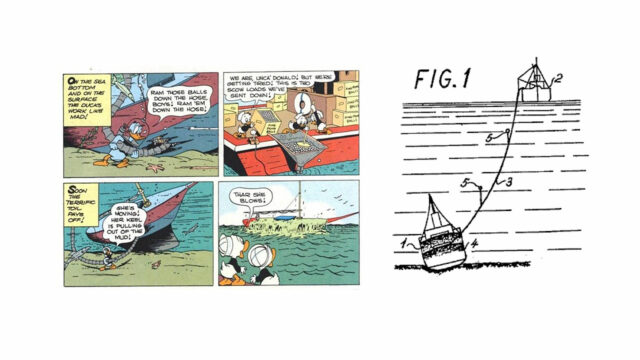
The Donald Duck comics case1 — Karl Kroyer invented a method to raise a sunken ship by filling it with buoyant bodies fed through a tube. In 1964, Mr. Kroyer successfully lifted a sunken ship in Kuwait’s harbor by filling the ship with 27 million plastic balls. Did Mr. Kroyer obtain a patent for this invention? The answer is a yes and a no. The patent was granted in the UK. However, it was rejected in the Netherlands because the said method had already been described in the 1949 comic strip “The Sunken Yacht” showing Donald Duck, with the help of Huey, Dewey, and Louie, using the same principle and method to raise a ship with ping pong balls shoved through a tube. Below are side-by-side images of The Sunken Yacht comic strip from Walt Disney and Figure 1 of Mr. Kroyer’s Patent2.

Since ping pong balls are buoyant bodies, and they were fed to the yacht through a tube, the Donald Duck episode was deemed as having disclosed the same technique as that which was claimed in Mr. Kroyer’s patent application.3 Consequently, the Donald Duck story sunk Mr. Kroyer’s patent application as it was considered as novelty-destroying prior art.

2001: A Space Odyssey4 — Part of the patent war between Apple and Samsung is Samsung’s argument that the film 2001: A Space Odyssey proves that Apple did not invent the tablet. A screenshot from the said film was submitted as part of Samsung’s defense, claiming that “Long before Apple claims to have invented a design for a thin, rectangular flat tablet computer, dominated by a display screen, similar designs were part of popular culture and commercial practice.” In addition, Samsung’s defense states: “In a clip from that film lasting about one minute, two astronauts are eating and, at the same time, using personal tablet computers.”

The Bible5 — While not specifically cited in the search report, Matthew 3:12 formed part of the written opinion — not as a relevant document but merely as a reference to show that winnowing or separating the grain from the chaff has been known since the dawn of time. The said Bible verse reads, “His winnowing fork is in his hand, and he will clear his threshing floor, gathering his wheat into the barn and burning up the chaff with unquenchable fire.” The patent application involved here was EP3886614A1 which relates to a method for binding dust and particles generated in the cigarette manufacturing process.

The few examples above show that prior art can be found anywhere, not just in scientific journals, or granted and pending patents. Images, pictures, and reels may form part of prior art of the emerging technologies in the market. The technology now may have just been part of creative imagination of the past in written or image form; and such may hinder the allowance of a patent application. As the saying goes, “a picture paints a thousand words,” which can also mean that a picture can be an equivalent of written prior art.

Conducting prior art searches is not a simple task as it requires extensive research, as the law defines “prior” as “[e]verything which has been made available to the public anywhere in the world.”

An incomplete prior art search can cause one to lose the chance of getting a patent registration, making the effort and cost in making the invention fruitless. It is thus best to consult a lawyer specializing in intellectual property law for prior art matters.

1Joseph, R. 2019. Topic 2: Legal Requirements for Patentability and Typical Part of a Patent Application. World Intellectual Property Office website, accessed on Aug. 26, 2022, <https://www.wipo.int/edocs/mdocs/africa/en/wipo_aripo_ip_hre_19/wipo_aripo_ip_hre_19_t_2.pdf>.

2Ius Mentis. 2006. The “Donald Duck as prior art case,” accessed on Aug. 26, 2022, <https://www.iusmentis.com/patents/priorart/donaldduck/>.

3Id.

4Westaway, L. 2011. Samsung says 2011: A Space Odyssey invented the tablet, not Apple, accessed on Aug. 26, 2022, <https://www.cnet.com/culture/samsung-says-2001-a-space-odyssey-invented-the-tablet-not-apple/>.

5Soriano, Leopoldo Belda, 2022. When the cited prior art is not run of the mill, accessed on Aug. 26, 2022, https://belda.blog/2022/02/27/when-the-cited-prior-art-is-not-run-of-the-mill%EF%BF%BC/>.

This article is for general informational and educational purposes only and not offered as, and does not constitute, legal advice or legal opinion.


Mary Cherwyn L. Castro is an associate in the Intellectual Property department of the Angara Abello Concepcion Regala & Cruz Law Offices (ACCRALAW).

clcastro@accralaw.com

8830-8000

What the hawks didn’t get at Jackson Hole

CHRISTINE ROY-UNSPLASH

JACKSON HOLE is an unlikely place to look for rebels. Titans of global monetary policy sent out a largely unchallenged message from the Federal Reserve’s summer retreat in Wyoming: Inflation is way too high and must be crushed, almost regardless of the cost to growth. Amid this festival of hawkishness, there were some nuanced and important voices from Asia that risk getting lost in all the hard talk.

Fed Chair Jerome Powell dominated the show, warning that interest rates are heading higher for longer. European Central Bank (ECB) officials sounded similarly resolute. Where there was shading, it tended to come from places like Japan, New Zealand, and South Korea. Not refutation, but mostly refinements. Still, they stood out and are significant given all the chest-thumping and aversion to any intimation of weakness.

Bank of Japan (BOJ) Governor Haruhiko Kuroda certainly expressed resolve, but of a very different nature to his Group of Seven counterparts. Inflation has exceeded the Bank of Japan’s 2% target for a few months, but Kuroda isn’t particularly impressed and ultra-loose policy still rules. “We have no choice other than continued easing until wages and prices rise in a stable and sustainable manner,” Kuroda said at one panel.

That’s in line with Kuroda’s comments after recent BOJ rate decisions — in itself noteworthy. When visiting the US in April, he struck a different stance. In a speech at Columbia University, Kuroda appeared to abandon the bank’s forward guidance that policy will be further eased if necessary. He said that the economy wasn’t vulnerable enough to warrant such a step. Whatever his intent then, there’s little ambiguity about his position now. Any tightening may have to wait until after his second term concludes next year.

One of the earliest rate hikers went so far as to suggest that the bulk of his heavy lifting may be done. Adrian Orr, governor of the Reserve Bank of New Zealand, said that after four consecutive increases in the benchmark rate of half a percentage point, “We’re in a much more comfortable position.” Orr told Bloomberg Television’s Kathleen Hays that the slowdown under way is “a good signal that monetary policy is biting and we are doing our work.” But Kiwi policy makers were moving against inflation before Powell, ECB President Christine Lagarde or Bank of England Governor Andrew Bailey. The ability to soon slow down — even to pause rate hikes — is the reward; private sector economists see cuts as soon as next year.

Bank of Korea Governor Rhee Chang-yong was careful not to rule out a big hike. But this fell short of backing a return to jumbo adjustments. Rhee made a splash soon after his appointment when the Bank of Korea (BOK) broke a pattern of quarter-point nudges with a 50-basis-points move in July. Hours before he got on the plane, BOK policy makers returned to small steps in their August meeting. Altering course again wouldn’t look like resolve, but like there’s no plan or strategy. The bank has already reached what it considers to be a neutral range of levels of rates. Get to the upper end, and Seoul will weigh whether further work is required. Rhee also told the Jackson Hole audience that Asia can return to the days of low inflation that prevailed before COVID and its aftermath.

Not that Asian economies can strike out entirely on their own. What happens in the US can buoy or buffet them. The Fed’s path has an enormous influence on exchange rates; the dollar is on one side of almost 90% of currency transactions. As key exporters, Asian countries are susceptible to the ebbs and flows of economic cycles, something American monetary policy greatly shapes. If places like Korea and New Zealand had been late to interest rate liftoff, as the Fed and ECB were, Orr and company might well have made Powell blush with their hawkishness.

None of this suggests a wishing away of inflation. Kuroda, who has strived to push inflation up for his nine years in the job, would prefer that it not be driven by soaring global energy and commodity costs. Rhee and Orr may soon see the dividends of starting early, if they can take a break by the end of the year. Don’t expect them to countenance that notion too loudly, however. In this era of inflation busting, there are limits to what can be uttered in polite company.

Powell went out of his way to discourage the idea the Fed will retreat next year, as some traders have wagered. He might gaze across the Pacific with some envy.

BLOOMBERG OPINION

FIBA, SBP mark ‘one year to go’ Basketball World Cup milestone

THE SAMAHANG Basketbol ng Pilipinas (SBP) and the International Basketball Federation (FIBA) have formally started counting down the one year to go ahead of the FIBA Basketball World Cup with the unveiling of the Tissot Clock Countdown on Saturday, August 27 at the Mall of Asia Music Hall.

THE STAGE is set, the clock is winding down, and the road to the FIBA Basketball World Cup 2023 begins here.

The Samahang Basketbol ng Pilipinas (SBP) and the International Basketball Federation (FIBA) have formally started counting down the one year to go ahead of the FIBA Basketball World Cup with the unveiling of the Tissot Clock Countdown on Saturday, August 27 at the Mall of Asia Music Hall.

SBP Chairman Emeritus Manny Pangilinan, SBP President Al Panlilio, FIBA Basketball World Cup 2023 Chairman Richard Carrion, FIBA Basketball World Cup 2023 ambassador Catriona Gray, and Tissot representative Denise Dy signaled the start of the countdown with a multi-visual and audio spectacle that revealed the Tissot Countdown Clock. It will be counting down the days, hours, minutes and even up to the last second before the prestigious tournament begins.

This was also the first official appearance of the FIBA Basketball World Cup 2023 local ambassadors after being introduced to members of the media last Thursday, August 25. Ms. Gray, who was crowned the Miss Universe in 2018 as well as the members of the Gilas team that secured the historic return of the Philippines to the FIBA Basketball World Cup in 2014 were present in the event.

Additionally, the event was also attended by FIBA President Hamane Niang as well as FIBA Basketball World Cup 2023 Executive Director Richard Carrion.

Before the unveiling of the Tissot Clock Countdown, FIBA and SBP put on a show with the Buganda drumbeaters to hype up the crowd and pay tribute to host countries Japan, Indonesia, and the Philippines. During the clock reveal, the audience was treated to a special synchronized drone and fireworks show. Multiple drones formed the face of JIP, the FIBA Basketball World Cup 2023 Mascot, the flags of the three host countries and the FIBA Basketball World Cup 2023 logo. The momentous event capped off with a three-minute fireworks spectacle and a special performance from Filipino band 6cyclemind.

Manny Pangilinan, SBP chairman emeritus, said: “Together with our co-hosts Japan and Indonesia, we are so happy to have you join us as we officially begin the countdown to the FIBA World Cup 2023.  We have put our hearts and minds into all the final preparations. Let’s continue working together to make FIBA World Cup 2023 happen.”

Al Panlilio, SBP president, added: “We are so excited to welcome everyone to today’s event.  Co-hosting an international event of this magnitude is truly an honor and at the same time a huge challenge. But it is also an opportunity for us to showcase our country, our culture and our people. We are working hard to achieve a successful FIBA World Cup 2023 and we appreciate all the support that we have been receiving.”

Richard Carrion, chairman of the FIBA Basketball World Cup 2023, said: “Across the Philippines, we know fans are counting down the days to the FIBA Basketball World Cup 2023 tip-off and thanks to the Qualifiers, fans have already got a taste of the action. Fans in Manila will be able to see 20 games of the Group Phase being played out at the Smart Araneta Coliseum and at Mall of Asia Arena. And then 12 action-packed Finals games at the biggest arena in the world — the Philippine Arena.”

Support the Philippines and watch the games live next year in the FIBA Basketball World Cup 2023. Like and follow SBP on Facebook (Samahang Basketbol ng Pilipinas – SBP) and Twitter (@officialSBPinc) for the latest updates on the FIBA Basketball World Cup 2023.

Skippers, Green Archers lock horn one last time for PBA D-League Aspirants’ Cup crown

MOMENTUM is on EcoOil-La Salle after forcing a rubber match with a big 70-63 win in Game 2 of best of three PBA D-League Finals. — PBA MEDIA

Game Today
(Smart Araneta Coliseum)
Game 3 of Best-of-3 Finals
12 p.m. — Marinerong Pilipino vs EcoOil-La Salle

MARINERONG Pilipino and EcoOil-La Salle cross paths once more to clash for all the marbles in the winner-take-all Game 3 of the 2022 PBA D-League Aspirants’ Cup finals today at the Smart Araneta Coliseum.

After exchanging blows in the first two games of the quick best-of-three series, the Skippers and the Green Archers lock horn one last time at 12 p.m. with D-League’s first title amid the pandemic up for grabs.

Momentum is on EcoOil-La Salle after forcing a rubber match with a big 70-63 win in Game 2, which coach Derrick Pumaren is hoping to carry over in the season’s last battle.

“We know what’s at stake. We can’t play tentative again because that’s not who we are. We’ve got to be better,” said the seasoned tactician, who will lean on prized big man Michael Phillips anew.

Mr. Phillips hauled down 18 points, 14 rebounds and four blocks in that match but is expected to come out even stronger after a runner-up finish to Marinero’s Juan Gomez de Liaño in the MVP race.

Backstopping him in towing La Salle to a sweet D-League championship for a good build-up to the UAAP in October are ace guards Schonny Winston and Evan Nelle as well as Gilas Pilipinas campaigner Kevin Quiambao.

Led by MVP Mr. De Liaño, Marinero is ready for the challenge in a bid to finally realize its D-League title dream that is already three years in the making after a failed attempt in Game 2.

Marinerong coach Yong Garcia, who will also bank on veteran Jollo Go and big man Kemark Cariño to get the job done.

The Skippers in 2019 swept the D-League eliminations only to lose in the finals. This year, it came closer to finally achieving the feat with a 72-67 Game 1 win before falling short in Game 2. — John Bryan Ulanday

Risa Sato joining Creamline in ASEAN Grand Prix in Thailand

RISA SATO (right) joining Creamline in Thainland — PVL

GOOD and bad news for the Philippine women’s volleyball team seeing action in the second edition of the ASEAN Grand Prix slated Sept. 9 to 11 in Nakhon Ratchasima, Thailand.

The good — team captain Alyssa Valdez and middle blocker Risa Sato are joining the trip — and the bad — only Ms. Sato is seeing action.

“Only Ms. Sato (is playing), but Alyssa is joining the trip,” national team manager Tonyboy Liao yesterday told The STAR.

Ms. Sato will reclaim her spot from rookie Lorie Bernardo after missing the team’s historic finish in the Asian Volleyball Confederation Cup at the PhilSports Arena while Ms. Valdez has not yet completed the two-week rest prescribed by her doctors from the dengue she was diagnosed more than a week back. Rizza Mandapat will keep her slot in lieu of Ms. Valdez.

The Filipinas, composed by Premier Volleyball League Invitational champion Creamline, was given by coach Sherwin Meneses yesterday and today to rest before resuming practice tomorrow.

“Alyssa (Valdez) will be in Thailand as a spectator but we all know that she provides inspiration and support to the team by just being there,” said Mr. Liao.

Setter Julia de Guzman will remain the skipper while Ms. Valdez is out while the other members of the team are Tots Carlos, Jema Galanza, Michele Gumabao, Pangs Panaga, Ced Domingo, Rose Vargas, Kyla Atienza, Kyle Negrito, Ella de Jesus, Fille Cayetano and Pau Soriano.

The Filipinas are eyeing to improve their third place finish in two legs in the event’s inaugural staging three years ago in Santa Rosa, Laguna and Korat.

Other nations seeing action in the three-day competition are host Thailand, Vietnam and Indonesia. — Joey Villar

Serena Williams puts off retirement with first round win

NEW YORK — Serena Williams signaled she is not quite ready for retirement advancing to the second round of the US Open on Monday with a scrappy 6-3 6-3 win over Danka Kovinic.

The victory over the 80th ranked Kovinic, just her second this year, will be a confidence boost for Ms. Williams but the path to a record equalling 24th Grand Slam now gets treacherous.

Waiting in the wings is Estonian second seed Anett Kontaveit, who breezed past Jaqueline Cristian 6-3 6-0.

Ms. Williams indicated her intention to retire in a Vogue article in early August, saying she was “evolving away from tennis” but never confirming the US Open as her final event.

For tennis fans, however, the message was clear, the US Open would be where she would take her final bow.

Could there be an encore?

The former-world number one has played coy even refusing to rule out next year’s Australia Open.

But in a strange post-match ceremony celebrating her career, which was not yet finished, Ms. Williams gave the clearest sign yet that the US Open will indeed be her last tournament and expanded on that later in her press conference.

“It’s extremely difficult still because I absolutely love being out there,” said Ms. Williams. “The more tournaments I play, I feel like the more I can belong out there.

Pressed if the US Open was definitely her last event Ms. Williams again stepped back from the brink.

“I’ve been pretty vague about it, right,” smiled Ms. Williams. “I’m going to stay vague because you never know.”

A montage of Ms. Williams career played before she appeared on court that left the door open a crack for a return some day, “if you ever decide to return Queen your throne will be waiting” ended the video.

A defiant Ms. Williams, however, made it clear she was not giving up that throne just yet.

SPECIAL ENERGY
There is always excitement on opening night at Flushing Meadows but on Monday the teeming stadium crackled with a special energy from the moment Ms. Williams appeared on court decked out in a shimmering black robe and specially designed diamond encrusted shoes.

The outfit may have sparkled more than the 40-year-old American’s play but it did not matter to a jam-packed Arthur Ashe Stadium as Ms. Williams’ fighting edge remained razor sharp even if her serve and ground strokes were not. “It’s so important to give your all,” Ms. Williams told the adoring crowd. “I’ve been down and out so many times, in the public eye.”

Certainly there was no more fitting place to bring the curtain down on one of tennis’s most phenomenal careers than in a city that has been in her corner from the very beginning, fuelling runs to six US Open crowns.

The magnitude of the moment was not lost on the 23,000 fans, including, former US president Bill Clinton, designer Vera Wang, director Spike Lee and others who packed into Arthur Ashe not expecting to see greatness but to celebrate it.

Having been world number one for 319 weeks, Williams arrived in New York ranked below 600 and unseeded.

Playing in her 21st US Open, Ms. Williams has never lost in the first round and her victory over Ms. Kovinic was her 106th at Flushing Meadows.

While Ms. Kovinic has been enjoying the best Grand Slam season of her career reaching the third round of both the Australian and French Open, she had not won a single match since Roland Garros.

As play got underway it was Ms. Williams showing signs of nerves, piling up the double faults as Ms. Kovinic got in front 3-2.

But Ms. Williams, as she has done so many times, lifted her game when she needed to, sweeping the next four games to snatch the first set.

Now in charge, Ms. Williams would not let it slip away in the second set, breaking to go up 3-2, and with match point and the crowd on its feet, she danced in delight as Ms. Kovinic’s return hit the net. — Reuters

Lebanon qualifies for World Cup

BEIRUT — Crisis-hit Lebanon qualified for the Basketball World Cup on Monday for the fourth time in their history after beating India 95-63 in Bengaluru.

A rare moment of hope and unity in a country mired in fractious sectarian politics and a three-year economic meltdown was achieved despite little government support for the national team, known as The Cedars.

The team had been lifted by a win over the Philippines last week and a second-place finish at the Asia Cup in July behind Australia, who are ranked third in the world.

Lebanon, ranked 54th, last made it to the Basketball World Cup in 2010.

“This is great for the country’s image because we’re in a miserable situation here in Lebanon. It’s a small light at the end of the tunnel,” former Lebanese national team coach Joe Mouajes told Reuters. — Reuters

No one like her

Tickets for first-round matches at Arthur Ashe Stadium the other night were being peddled for much, much more than their face value for one reason alone: aging superstar Serena Williams was slated to burn rubber, and perhaps for the last time in her storied career. Nearly 30,000 warm bodies were on the Flushing Meadows grounds, with five-sixths of the number inside the grandest of stages in pro tennis, simply because she could well be wielding her racket one last time. The prospect of bidding goodbye to arguably the best female to grace the sport was simply too much for fans to ignore, the considerable expense notwithstanding.

Not that the veritable Who’s Who on hand at the National Tennis Center wanted Williams to lose. In fact, they were cheering her on to victory. Forget the pomp that accompanied the set-to, or the significant coin they shelled out to put their backsides in seats. If they needed to do so anew just to gain admission to her farewell tour, then so be it. They were ready to keep riding the wave for as long as they could. And even if she was scheduled to face unheralded Danka Kovinic, her recent outings did not lend optimism that she would not suffer the same one-and-done fate.

To be sure, Williams did not have to subject herself to the uncertainty that awaited her as a 40-year-old hopeful with hardly any competition in the last year. The United States Open was hard enough for her at her prime, and now even more so. She’s ready to hang up her sneakers for good, but on her terms. Which means playing in the ladies singles and doubles draws, never mind the Sisyphean bent in her endeavors. It’s win or bust every time she’s under the klieg lights, and whereas the former proved the far better bet for two decades, the latter has become more commonplace of late.

No matter what happens, though, Williams has already cemented her place among the sport’s all-time greats. Her body of work isn’t all roses; she has courted controversy at one time or another, and not always on the right side. That said, there can be no doubting how much she has distanced herself from her so-called peers. Heck, even Kovinic reveled in her triumph, and in the manner it was celebrated by the crowd. And if she exuded a rock star vibe, it was in large measure because of the spectacle around her.

There is no small irony in seeing Williams’ last matches attract the kind of attention not even previous finals could. The unlikelihood of a Cinderella finish has not dampened the mood — not for her, not for everyone else, and not for the United States Tennis Association. In view of the inevitable, all and sundry are compelled to reflect on her singular contributions. There is no one like her, and there never will be.


Anthony L. Cuaycong has been writing Courtside since BusinessWorld introduced a Sports section in 1994. He is a consultant on strategic planning, operations and Human Resources management, corporate communications, and business development.

ADVERTISEMENT
ADVERTISEMENT