Home Blog Page 5958

Sine Halaga calls for entries for its 2nd edition

A STILL from the film Dandansoy

THERE is a call for entries to the two categories of the Sine Halaga Film Festival and Educational Resources, a project of the National Commission for Culture and the Arts (NCCA) and the Negros Cultural Foundation, Inc. (NCF).

Launched in August last year, the first Sine Halaga Film Festival showcased 12 Filipino films that highlight cultural values. It reached more than 5 million viewers in community, regional, national, and international face-to-face and online screenings. Sine Halaga collaborated with more than 50 writers, teachers, artists, and cultural workers in its various educational programs.

For its second year, the film festival will be accepting finished films from Filipino filmmakers and students produced between Jan. 1, 2021 and Sept. 30, 2022.

“The purpose of Sine Halaga is to strengthen film literacy programs in our country,” Sine Halaga National Festival Director Elvert Bañares said during an online press conference on Aug. 23.

Entries are to include one or more of the following 20 values in the film: valuing culture, arts, and sciences; love for the family and community; attaining education; faith and spirituality; health and wellness; addressing basic needs; self-development or self-improvement; ensuring work and livelihood; peace and development; honesty and integrity; resilience; life and purpose, happiness; respecting and upholding human rights; care for the environment; love for country; shared responsibility for the common good; good governance; upholding the rule of law; creative excellence; and lifelong learning and adaptability.

The values highlighted in the film competition are from the results of the NCCA National Survey for Filipino Values, conducted by Prof. Arvin Manuel Villalon and Jose Soliman, Jr. over two years. It is based on the Chapter 7 of the Philippine Development Plan on “Promoting Philippine Culture and Values through Bayanihan” which is aimed at valuing diverse cultures, and strengthening culture-sensitive governance.

“The films are made in a way to evoke a response,” Mr. Villalon said. “We would like to reflect or have that mirror of who we are as a Filipino.”

Sine Halaga is looking for cinematic stories/works in any genre (see first set of Sine Halaga films at http://www.sinehalaga.com) with a high regard for the narrative, the characters, and the film’s technical aspects and how these elements are creatively weaved together into one coherent whole using elements of cinema. The competition is not keen on accepting works with “in your face” messages, propaganda, infomercial, or values campaign.

Films with stories, characters and cultures of Indigenous Peoples are welcome, however, they must be sanctioned by the National Commission on Indigenous Peoples (NCIP) and approved by the Indigenous Community being portrayed. Filmmakers should provide proof of consent and clearance with the communities and with the NCIP. Films without consent from the community with the intervention of NCIP will not be accepted.

Sine Halaga is open to all Filipino filmmakers (Filipino citizens currently residing in the Philippines) of good standing in their communities and with no criminal record.

Sine Halaga has two competitive categories for its second edition: Adult Filmmakers and Student Filmmakers.

The top three winning films in the Adult Filmmakers category will each win P100,000 and a Halagahan trophy. Five finalists will each win P20,000 and a Sine Halaga Certificates. For the Student Filmmakers category, the top three winning films will each win P50,000 and a Sine Halaga Certificate. Five finalists will each win P10,000 and a Sine Halaga Certificate.

Eight finalists will be chosen per category. Deadline of submission is on Sept. 30.

For the competition requirements and mechanics visit https://www.nccalearninghub.com/sinehalaga-rulesandjury. For updates, visit www.facebook.com/sinehalaga/.

Senator refiles bill requiring state-run lenders to open bank accounts for Filipinos

BW FILE PHOTO
A BILL requiring state-run lenders to open and maintain bank accounts for every Filipino citizen has been filed at the Senate. — BW FILE PHOTO

A BILL requiring state-run lenders to open a bank account for every Filipino to fast-track the delivery of public and social services, such as aid for qualified beneficiaries, has been refiled at the Senate.

Senate Bill 808 or the proposed One Filipino One Bank Account Act authored by Senator Sherwin T. Gatchalian and filed on July 25 mandates government financial institutions Land Bank of the Philippines (LANDBANK) and Development Bank of the Philippines (DBP) to open and maintain a bank account for every Filipino free of related fees and charges beginning Jan. 1, 2023.

The same bill was filed in the 18th Congress but remained pending with the Senate Committee on Banks, Financial Institutions and Currencies until the session adjourned sine die.

“The bank accounts so created will be used for the delivery of the government’s public and social services, and will be linked with the Philippine Identification System (PhilSys),” Mr. Gatchalian said in the bill’s explanatory note.

“Under this proposal, the distribution of aid will be made easier because financial aid will be directly deposited into the bank account of the beneficiaries and there will be no need to stand in line,” he said in a Tuesday statement. “Through this, our countrymen will learn to use bank and online facilities for various transactions, such as paying bills and orders, as well as savings.”

The proposed measure will apply to all Filipino citizens who are covered by the PhilSys.

Under the bill, the LANDBANK and DBP will automatically open and maintain bank accounts for Filipinos registered with the PhilSys upon presentation of their national ID.

For those not registered with PhilSys by Jan. 1, 2023, they may proceed to any branch of the two banks and submit other identification documents to open their accounts.

These bank accounts will also be automatically linked with the PhilSys.

Accounts for underage Filipinos and those unable to give consent will be linked to those of their parents, legal guardians or persons exercising substitute parental authority.

LANDBANK and DBP are mandated to coordinate with the Bangko Sentral ng Pilipinas (BSP), the Philippine Statistics Authority (PSA) and other relevant government agencies and local government units to formulate a mechanism to implement provisions of the bill for a seamless transition in the delivery of public and social services.

The amount needed for the initial implementation of the proposed law will be taken from the current appropriations of LANDBANK, DBP and the PSA. Funds necessary for its continued implementation will be included in the annual General Appropriations Act.

“As faster coordination is expected from the barangays of each local government, the movement will become synchronized,” Mr. Gatchalian said. “This will prevent chaos and maintain order in the distribution of financial assistance to our countrymen in need.”

The lawmaker said the bill is also expected to boost financial inclusion in the country.

The country’s banked population was at about 56% of all adults in 2021, up from just 29% in 2019, results of the BSP’s 2021 Financial Inclusion Survey released last week showed. The central bank said this was the best two-year increase since it began to conduct the survey in 2015 and was driven by the accelerated growth in digital payments amid the coronavirus pandemic.

This translated to a 22-million increase in Filipinos with formal financial accounts between 2019 and 2021. However, 34.3 million adults remained unbanked.

The BSP wants 70% of Filipino adults to have a formal financial account by 2023. — Alyssa Nicole O. Tan

Promoting ethical behavior in the pharma industry

FREEPIK

Unethical behavior negatively impacts business performance, reputation, and access to funding and financing. It is a liability for businesses, said the Asia-Pacific Economic Cooperation (APEC).  

According to an APEC study titled “The Benefits of Embracing Ethical Business Conduct,” businesses that deploy dishonest approaches often do so to fulfill their short-term financial objectives. In the long term, however, the said conduct will adversely impact the business to a greater extent than the initial advantages obtained. It said that dishonest business practices can later on lead to increased costs. 

On the other hand, ethical behavior results in desirable business outcomes. The same APEC reference cited a study which found that an increase in the corporate value index is associated with the firm’s performance. Moreover, the benefits of an ethical reputation can also have a competitive advantage as a company distinguishes itself from its competitors. It added that companies that have strong, values-based corporate culture showed improved employee engagement, and increased overall positive reputation. 

In the healthcare community, unethical behavior hurts not just businesses. It also brings harm to patients and deprives them of quality and appropriate healthcare they deserve. Ethical interactions, meanwhile, help ensure that medical decisions are made in the best interests of patients. They also level the playing field and encourage robust competition in the industry. 

With this, the Pharmaceutical and Healthcare Association of the Philippines (PHAP) ratified its own Code of Practice, an internationally aligned Code that is a requirement for PHAP membership. The Code is implemented through an independent Ethics Committee and cascaded to PHAP members through a pioneering module called the Integrity and Proficiency Program for the Pharmaceutical Sector (IPPS). The IPPS, registered under the Professional Regulation Commission, offers science-related information and provides modules on laws and codes that must guide all interactions with healthcare professionals, the government, and patients, among others. 

As a member of the International Federation of Pharmaceutical Manufacturers and Associations (IFPMA), PHAP fully subscribes to the IFPMA Ethos. The Ethos has overarching values namely trust, care, fairness, respect and honesty. This set of core values and principles helps ensure that their interactions with healthcare professionals and the broader health community are appropriate and in line with the expectations of the society. The Ethos underpins the rules and provides a framework to behave with integrity no matter how testing the circumstances are. 

The Philippine government has achieved milestones when it comes to the campaign for integrity in the healthcare community. In 2011, the Mexico City Principles for Voluntary Codes of Business Ethics for the Biopharmaceutical Sector was endorsed by heads of states of APEC member economies, including the Philippines. In interacting with healthcare professionals and other stakeholders, PHAP member companies are guided by the six Mexico City Principles. 

The first principle is healthcare and patient focus which means that everything we do is intended to benefit patients. The second principle is integrity which means dealing ethically, honestly and respectfully in everything we do. 

Third is independence which means to respect the need for autonomous decision-making of all parties, free from improper influence. Fourth is legitimate intent which means everything we do is for the right reasons, is lawful, and aligns with the spirit and the values of these Principles. Fifth is transparency which means a general willingness to be open about our actions while respecting legitimate commercial sensitivities and intellectual property rights. Finally, accountability means a willingness to be responsible for our actions and interactions. 

The Philippine Food and Drug Administration also adopted and implemented the Mexico City Principles in September 2013. The Department of Health which created a Committee for the Creation and Adoption of the Mexico City Principles and Kuala Lumpur Principles for Medical Device Sector Codes of Business Ethics, must also be commended for pushing the integrity campaign forward. 

In accordance with the Nanjing Declaration to Promote Ethical Environments in the Medical Device and Biopharmaceutical Sectors (2014–2020), PHAP is also working with the government, healthcare professionals, and non-government organizations (NGOs) — in particular, patient organizations — to promote ethical environments in the medical device and biopharmaceutical sectors. 

Ethical principles are universal and reinforce Filipino values. Because of the unique role of ethical behavior in positively affecting the health and lives of patients, the pharmaceutical industry must always be committed to ethical behavior at all times. 


Teodoro B. Padilla is the executive director of the Pharmaceutical and Healthcare Association of the Philippines (PHAP), which represents the biopharmaceutical medicines and vaccines industry in the country. Its members are at the forefront of research and development efforts for COVID-19 and other diseases that affect Filipinos. 

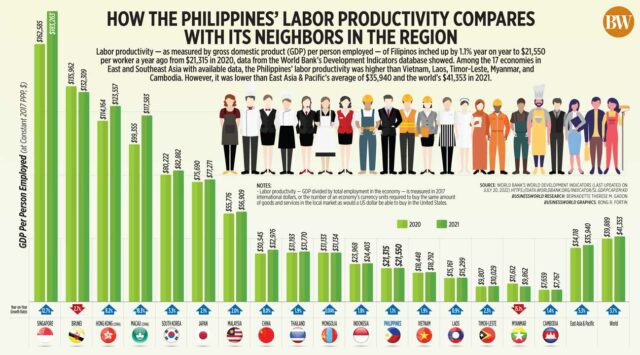
How the Philippines’ labor productivity compares with its neighbors in the region

Labor productivity — as measured by gross domestic product (GDP) per person employed — of Filipinos inched up by 1.1% year on year to $21,550 per worker a year ago from $21,315 in 2020, data from the World Bank’s Development Indicators database showed. Among the 17 economies in East and Southeast Asia with available data, the Philippines’ labor productivity was higher than Vietnam, Laos, Timor-Leste, Myanmar, and Cambodia. However, it was lower than East Asia & Pacific’s average of $35,940 and the world’s $41,353 in 2021.

How the Philippines’ labor productivity compares with its neighbors in the region

How PSEi member stocks performed — August 30, 2022

Here’s a quick glance at how PSEi stocks fared on Tuesday, August 30, 2022.


Stocks fall on rate hike worries, profit taking

BW FILE PHOTO

STOCKS fell on Tuesday as the local market reopened after a holiday, with investors pocketing gains amid Wall Street’s decline last week on continued worries over the US Federal Reserve’s policy path.

The benchmark Philippine Stock Exchange index (PSEi) went down by 62.23 points or 0.92% to close at 6,690.27 on Tuesday, while the broader all shares index went down by 28.95 points or 0.80% to 3,548.50.

Philippine financial markets were closed on Monday in commemoration of National Heroes’ Day.

“Philippine shares settled in the red amid mounting concerns over rising rates and tighter US monetary policy, which reflected the blunt remarks made by Fed Chair Powell in the recently held Jackson Hole,” Regina Capital Development Corp. Head of Sales Luis A. Limlingan said in a Viber message.

“Investors took profit or sold positions due to the sell-off that happened last Friday in the US market,” Mercantile Securities Corp. Head Trader Jeff Radley C. See said in a Viber message.

Wall Street ended Friday with all three benchmarks more than 3% lower following Fed Chairman Jerome H. Powell’s speech on the second day of Fed’s annual Jackson Hole symposium.

On Monday, the Dow Jones Industrial Average fell by 184.41 points or 0.57% to 32,098.99; the S&P 500 lost 27.05 points or 0.67% to 4,030.61; and the Nasdaq Composite dropped by 124.04 points or 1.02% to 12,017.67.

Mr. Powell said the US may see slower economic growth and an increase in unemployment as the central bank continues to raise rates to fight rising inflation.

He said the Fed will raise rates as high as needed and would keep them there “for some time” to bring down inflation, raising bets of another 75-basis-point (bp) hike at the US central bank’s meeting on Sept. 20-21.

The Fed has raised rates by 225 bps so far since March, including back-to-back 75-bp hikes in June and July.

Back home, all sectoral indices ended in the red. Services dropped by 18.81 points or 1.09% to 1,703.68; holdings firms declined by 65.58 points or 1.01% to 6,425.39; financials went down by 15.23 points or 0.93% to 1,621.55; property decreased by 25.63 points or 0.84% to 2,995.54; mining and oil lost 62.58 points or 0.53% to close at 11,752.30; and industrials fell by 51.85 points or 0.52% to 9,823.02.

Decliners outnumbered advancers, 124 versus 58, while 51 names were unchanged.

Value turnover declined to P5.98 billion on Tuesday with 1.26 billion shares changing hands from the P8.82 billion with 1.26 billion issues seen on Friday.

Net foreign selling decreased to P37.36 million on Tuesday from the P85.79 million seen on Friday.

Mercantile Securities’ Mr. See said the PSEi may retest the 6,750 resistance level after it managed to close at the 6,690 area from a low of 6,600. He placed the PSEi’s support at 6,400-6,600 and resistance at 6,700-6,900. — J.I.D. Tabile

Peso declines on hawkish Fed

BW FILE PHOTO

THE PESO weakened versus the greenback on Tuesday following hawkish signals from top central bankers at Jackson Hole over the weekend.

The local unit closed at P56.225 per dollar on Tuesday, down by 20.5 centavos from its P56.02 finish on Friday, Bankers Association of the Philippines data showed.

Philippine financial markets were closed on Monday for a holiday commemorating National Heroes’ Day.

The peso opened Tuesday’s session at P56.15 against the dollar. Its weakest showing was at P56.32, while its intraday best was at P56.10 versus the greenback.

Dollars exchanged rose to $1.08 billion on Tuesday from $804.5 million on Friday.

“The Philippine peso depreciated further today coming off from the hawkish statements of Fed Chair Powell last Friday. This also followed declines in Asian emerging market economies yesterday,” China Banking Corp. Chief Economist Domini S. Velasquez said in a Viber message on Tuesday.

“Powell’s speech prompted more market participants to price in another 75-bp (basis point) rate hike for the Fed in September, which led to dollar gains against other currencies,” Ms. Velasquez said.

US Federal Reserve Chairman Jerome H. Powell on Friday said the US may see slower economic growth and an increase in unemployment as the central bank continues to raise rates to fight rising inflation.

The Fed has raised rates by 225 bps so far since March, including back-to-back 75-bp hikes in June and July.

“Traditionally, the peso is weakest in Q3 as businesses import more for the holiday season. We expect that the recent depreciation will take a turn once remittances come in and as BSP (Bangko Sentral ng Pilipinas) continues its monetary tightening cycle,” Ms. Velazquez added.

The peso weakened following hawkish signals from the Fed and other central bankers recently, Rizal Commercial Banking Corp. Chief Economist Michael L. Ricafort said in a Viber message.

The local unit also declined following petitions for another transport fare hike that could lead to higher inflation, Mr. Ricafort added.

The BSP has increased borrowing costs by 175 bps since May as it seeks to bring inflation back within target.

Headline inflation accelerated to 6.4% year on year in July, exceeding the BSP’s 2-4% target for a fourth straight month.

For Wednesday, Mr. Ricafort said the peso may move from P56.10 to P56.30 versus the dollar. — KBT

SC stops use of cameras to catch traffic violators

A CLOSED-CIRCUIT TELEVISION (CCTV) at Main Avenue in Cubao, Quezon City. — PHILIPPINE STAR/ MICHAEL VARCAS

THE SUPREME COURT (SC) has stopped law enforcers from using video surveillance and digital cameras to catch traffic violators in five Metro Manila cities.

In a statement on Tuesday, the High Court said it had also stopped the Land Transportation Office (LTO) from giving out motorists’ information to local government units.

“The court also said that any apprehensions through the no-contact apprehension policy and ordinances related thereto shall be prohibited until further orders from the court,” it added.

The tribunal, which had yet to upload a copy of the order on its website, set a hearing on the lawsuit for Jan. 24.

Several transport groups earlier asked the tribunal to void down the government’s so-called no-contact apprehension policy, which they said is prone to abuse by law enforcers.

The cities of Manila, Muntinlupa, Parañaque, Quezon and Valenzuela as well as the Metro Manila Development Authority are enforcing the traffic policy.

The tribunal said it had issued the temporary restraining order “without necessarily giving due course to the petitions.”

A separate website will be created to give the public access to pleadings related to the case, it added.

Transportation Assistant Secretary and LTO Chief Teofilo E. Guadiz III has asked local governments to suspend the no-contact apprehension policy.

In a statement on Aug. 9, he said local governments should sit down with the LTO to iron out guidelines and hear out complaints from public utility vehicle operators.

Quezon City Rep. Marvin C. Rillo earlier filed a resolution seeking to investigate the policy because law enforcers might abuse it.

He noted that traffic enforcers might subject motorists to excessive and unreasonable fines and penalties.

“We are also worried that motorists may be wrongfully burdened — not by the cost of violating traffic laws, rules and regulations — but by the cost of the technologies used in the no-contact apprehension policy,” Mr. Rillo said.

The first lawsuit was filed by transport groups Kapit, Pasang Masda, ALTODAP and ACTO against the five cities and the Land Transportation Office on Aug. 3.

They questioned local ordinances on the no-contact apprehension program.

The High Court on Aug. 16 ordered the respondents to comment on the petition and the plea to stop the policy within 10 days.

A lawyer who was fined more than P20,000 for alleged traffic violations filed a separate lawsuit on Aug. 18.

The Land Transportation Franchising and Regulatory Board had asked the cities to suspend the policy until the guidelines are clarified, but their mayors, backed by the Metropolitan Manila Development Authority, bucked the call.

Valenzuela City Mayor Wes Gatchalian, Parañaque City Mayor Eric L. Olivarez, Quezon City Mayor Maria Josefina “Joy” G. Belmonte, Manila City Mayor Maria Sheilah Honrado Lacuna–Pangan and San Juan City Mayor Francisco Javier M. Zamora said the policy had minimized human intervention in traffic enforcement.

This supposedly cut corruption, created a culture of discipline among motorists and ensured road safety by reducing traffic violations.

“The implementation of the no-contact apprehension policy never disregarded motorists’ due process since each local government unit has its respective traffic adjudication boards where motorists can contest and file protests or appeals,” they said. — John Victor D. Ordoñez

Daily coronavirus cases fell by 19%, says OCTA group

PHILIPPINE STAR/EDD GUMBAN

THE DAILY average of coronavirus infections in Manila, the capital and nearby cities has declined by 19%, according to the OCTA Research Group.

The daily average had fallen to 862 cases in the week ending Aug. 29 from 1,062 a week earlier, OCTA Fellow Fredegusto P. David tweeted on Tuesday. 

The virus reproduction number fell to 0.95 on Aug. 26 from 0.99 on Aug. 19. “A reproduction number of less than one indicates decreasing infections.”

The current average daily attack rate in the region was 5.98 per 100,000, which is considered low, Mr. David said.

The positivity rate in the capital region had also fallen to 12.7% as of Aug. 25 from 14.6% a week earlier.

The healthcare use rate for COVID-19 in the region remained low at 33.3%, while intensive care unit occupancy was 25.8%, the OCTA fellow said. 

Mr. David said at the weekend daily coronavirus infections in the Philippines could fall to fewer than 1,000 by mid-September.

But Rontgene M. Solante, a member of the Health department’s technical advisory group, said on Monday infections in the country would likely increase as more students attend face-to-face classes.

Filipinos are expected to hold more gatherings such as parties during the Christmas holidays. The Philippines had experienced infection surges in the past holidays, with the highly infectious Omicron variant spreading locally as early as January this year.

Mr. Solante said the highly infectious Omicron subvariant BA.5 has been in the Philippines for four to six weeks.

“It’s the dominant variant globally. This is the most evasive subvariant. Those who have been vaccinated could still catch the virus. Those who have been infected before could be infected again.”

He said the BA.5 has descendants that are also infectious, such as the BA.5.1 and BA.5.2.

“Variants of concern will be here for a longer period of time because we are vulnerable.”

Meanwhile, the Commission on Higher Education (CHED) said that it would no longer require university students and staff to get vaccinated against the coronavirus as face-to-face classes resume.

“I think CHED’s announcement is the success of anti-vaxxers,” Iloilo Rep. Janette L. Garin told a news briefing. The anti-vaccine group is a very strong lobby group that is also well-organized, she said.

Ms. Garin, a former Health secretary, called on the presidential palace to step in and decide what is best for the people. “It’s now the president’s call because only the president can make sure that when people in government do their job, they will be protected.” — Kyle Aristophere T. Atienza and Kyanna Angela Bulan

PCSO eyes online lotto to boost yearly revenue 

PHILSTAR FILE PHOTO

By Kyanna Angela Bulan 

THE PHILIPPINE Charity Sweepstakes Office (PCSO) on Tuesday said it is seeking to boost its revenue through online lotto operations. 

“We are embarking on digital operations,” PCSO Chairman Junie E. Cua told congressmen at a hearing. “We are installing additional terminals. We would like to go online, so that it would become more convenient to bet. We hope that going digital can increase our revenues.” 

PCSO ticket sales rose by 32.15% to P25.92 billion in the first half from a year earlier.  

Mr. Cua cited a shift from face-to-face to electronic transactions by clients. The agency is also looking at making lotto bets available to mobile and smartphones, he said. 

Cagayan de Oro City Rep. Rufus B. Rodriguez bucked the plan for online lotto, which he said would also become accessible to minors. 

“We cannot afford to make online gambling being available easily to the youth of our country,” he told the hearing. 

Manila City Rep. Bienvenido M. Abante, Jr. raised the same concern.  

“If there is a digital kind of game wherein children can bet, I think the PCSO should look out for it because we do not want our own children, as young as they would be, to bet on this digital game”, he said.   

“Online betting has serious economic and moral impacts on Filipino families and especially young people and the poor,” Antonio Gabriel M. La Viña, a human rights lawyer and former dean of the Ateneo de Manila University’s School of Government, said in a text message. “The government should not be encouraging this.” 

Also on Tuesday, the Philippine Amusement and Gaming Corp. (Pagcor) said it was monitoring illegal Philippine Offshore Gaming Operators (POGO).  

“Out of the 30 legal licensees, 27 continue to operate,” Pagcor Chairman Alejandro H. Tengco told the same congressional hearing.  

Pagcor wants the police and National Bureau of Investigation to look at the illegal operations of some operators and gaming sites, he said. The agency is also studying potential conflicts of interest that may arise given Pagcor’s dual role as a regulator and gambling operator. 

“It is best to regulate because you cannot be two agents acting as one,” Quezon City Rep. David C. Suarez said.  

Mr. La Viña said Pagcor has a schizophrenic identity. “It cannot be a regulator and operator at the same time, but it does that effectively,” he said. 

US donates P27M in books to Bicol

THE UNITED STATES has donated P27 million worth of reading materials for young students in the Bicol region, the US Embassy said in a statement on Tuesday.  

It said it handed over 540,000 early grade books to the Department of Education (DepEd) from the United States Agency for International Development (USAID) on Aug. 22.   

“We are working with DepEd so that children who are returning to school have access to age- and context-appropriate learning resources,” USAID Education Director Thomas LeBlanc said in the statement.  

The reading materials included picture books, storybooks and leveled books in English and Filipino to help students from Kindergarten to Grade 3 develop their reading skills. 

The donation is the first batch of materials that USAID is giving DepEd this school year.  — Alyssa Nicole O. Tan 

Facebook, Google told to release info on YouTube channel 

STOCK PHOTO | Image by terimakasih0 from Pixabay

A MANILA trial court on Tuesday ordered Google and Meta Platforms, Inc., Facebook’s parent company, to disclose information on a YouTube channel that allegedly promotes child sexual abuse. 

The court allowed the Philippine National Police’s anti-cybercrime group to compel YouTube and Facebook to submit data on the said channel within 72 hours, according to a copy of the warrant posted by state-run news agency People’s Television Network on Twitter. 

In July, screenshots of the channel’s videos went viral on social media that supposedly promoted sexual relationships with minors. 

The channel has since been taken down from both platforms. 

“Hoping that the news about the warrant against Meta and Google will encourage the victim-survivors to come forward,” Senator Ana Theresia “Risa” N. Hontiveros-Baraquel tweeted. 

The senator met with representatives from Meta, police and the National Bureau of Investigation to discuss measures to prevent the spread of child sexual abuse materials online. 

The senator authored the Anti-Online Sexual Abuse or Exploitation of Children bill, which was sent to the Office of the President on June 28. 

Last week, Justice Secretary Jesus Crispin C. Remulla said an inter-agency task force would use the country’s anti-money laundering mechanisms to restrict transactions related to the online exploitation of children. 

“Law enforcement agencies around the world know that the Philippines is one of the favorite places for these perverts who exploit children,” he told a press briefing. 

The Justice chief said the government would work with the US Department of Homeland Security to track down foreigners involved in child exploitation in the country. — John Victor D. Ordoñez  

ADVERTISEMENT
ADVERTISEMENT