Home Blog Page 5869

Wanted: Women Directors

BROOKE LARK-UNSPLASH

Women directorship — is this a career path for women in the C Suite?

Did you know that only 17% of board seats in publicly listed corporations or PLCs are held by women directors?

The new group we formed would like to see that grow to 30% in the next few years. Diversity means more profits as proven by global statistics, and being mindful of these numbers may be the secret sauce to making your company sustainable.

Diversity means including women, and also younger directors who may be more familiar with current concerns, such as Fintech and Sustainability. In a recent guesting at the NextGen Organization of Women Corporate Directors (NOWCD) General membership meeting, former Bursa Malaysia Chair Datuk Shireen Ann Zaharah Muhiudeen talked about women’s roles in committees like Risk and Sustainability. These are subjects that women directors can specialize in as these topics are the most in demand these days.

The NOWCD is now affiliated with Women Corporate Directors International or WCD (www.womencorporatedirectors.org), making its local members qualified for international board seats. More and more international lenders, like International Finance Corp. (IFC), may also open opportunities for independent directorships in projects around Asia, given the same time zone it would be convenient for Filipina directors. Other board opportunities in companies across the globe abound, and one only needs to be a subject matter expert and a member of NOWCD (which makes one a member of WCD) to apply for such well-compensated and much-desired foreign assignments. These posts give us more knowledge and experience in the international arena of business.

In the Philippines, we hope to advocate and also encourage companies with public interest to recruit women directors even though they are not listed at the Philippine Stock Exchange (PSE). The Securities and Exchange Commission (SEC) also requires companies, such as Mercury Drug, National Book Store — though they are not public — to have independent directors. This was revealed by former SEC chair Teresita Herbosa, at the same general membership meeting of NOWCD.

Another tip given by Datuk Shireen is for women to come to the fore and promote each other so companies that keep saying there is a lack of women directors will have access to a list or a directory of qualified women. There is really a pressing need to recruit more women into our pipeline given the rule that one director can only hold a maximum of five directorships. If you do the math, we will never get to our goal of 30% as stated above if we do not train more young women to join our ranks.

The first step would be to enroll in a Professional Director Program (PDP), such as the one offered by the Institute of Corporate Directors (www.icd.ph).

Next would be to practice and earn your stripes in private corporate boards or even NGOs. As Datuk Shireen shared, it need not be a PLC right away. Sit in or accept invitations to join private company boards and NGOs.

Third would be to master a subject like Risk, Sustainability, or Audit. Just like a college degree moving on to a doctorate one, there are steps and specializations. One cannot be a master of all.

Fourth would be to network and be involved in business organizations or federations like the Philippine Women’s Economic Network (PhilWEN, www.philwen.org) which has six member organizations, exposing one to a myriad of opportunities in the women empowerment sector, especially through business. In PhilWEN we also have the Filipina CEO Circle, a robust group of over 100 Women CEOs and COOs, whose next career move would be to be a Board director. And that network experience makes one useful to PLCs, NGOs, and other companies with public interest as mentioned.

Many women CEOs think that the next step after one has reached the pinnacle of power and authority in a corporation, big or small, is retirement. What will one do with all that experience and knowledge gained over the years in corporate life? The next step is being in the B-suite or the Board.

So, whether you want to stay in the country or travel the world attending board meetings, like what Ambassador Delia Albert does, and other powerful women desire to do, you can start now. Start focusing on your specialty and let the world know you are ready to take it on, someday soon.

Remember today’s mantra for companies: “Diversity and Inclusion. Sustainability. Risk Management.” Only the fearful will set this opportunity slide. And women, regardless of age, can take a stab at it. Be fearless. This is the time for lifelong learning.

As for the men? Our message is for you to include women in your boards and you may be surprised at the different ideas they can contribute to your company’s bottom line, among other benefits they may bring to the proverbial table. Be a Champion of Change — diversity and inclusion are today’s buzzwords if one is to be perceived as an enlightened leader.

Yes, we want more women to be in boards. And we want them now. 

This article reflects the personal opinion of the author and does not reflect the official stand of the Management Association of the Philippines or MAP.


Chit U. Juan is a member of the MAP Diversity & Inclusion Committee, and the MAP Agribusiness Committee. She is chair of the Philippine Coffee Board, and councilor of Slow Food for Southeast Asia.
map@map.org.ph

pujuan29@gmail.com

Power demonopolization, privatization, and smuggling

Last week, on Sept. 12, the National Grid Corp. of the Philippines (NGCP) made a big announcement of red and yellow alerts in the Luzon grid. It was a bad situation for three reasons.

One, it came just five days after a successful business roadshow by the Marcos Jr. administration in Jakarta and Singapore where some $14.4 billion of pledged investments to the Philippines were announced. When those big foreign investments come, they will need a huge power supply and yet the Philippines still experiences yellow-red alerts of thin power reserves and potential blackouts until now.

Two, the main reason was not power generation deficiency but the tripping of transmission lines of the NGCP — two 500 kilovolt (kv) lines connecting Kaampat (Bolo) to San Manuel (Nagsaag) tripped on the morning of Sept. 11, but the NGCP and some sectors blamed the affected power plants. Two big coal plants, Sual (1,294 megawatts or MW) and Masinloc units 2 and 3 (679 MW) tripped because there was no transmission line or “highway” to deliver the power they generated. In addition, three plants — Masinloc 1, GMEC 2, SLTEC 2 — experienced derating or below-capacity generation of 226 MW.

There were three other plants that were already out prior to the grid tripping incident — Calaca 2, Dinginin, and Quezon Power — with a combined 1,428 MW.

And, three, it highlighted once again NGCP’s non-compliance with Department of Energy (DoE) Circulars on contracting ancillary services (AS) to help ensure grid stability when there are unforeseen generation or transmission problems.

See these reports in BusinessWorld: “DoE to investigate forced outages that raised red alert over Luzon” (Sept. 12), and “NGCP ‘in discussions’ with DoE to ensure adequate power supply” (Sept. 14).

The NGCP is the only remaining national private monopoly in the country. It is a very privileged and pampered company. From 2017-2021, its average net income was P21 billion/year from gross revenues of P48 billion/year (see this column’s piece, “Electrifying profit and penalties, the case of NGCP, DUs, and ERC,” Feb. 7, 2022). The other national monopolies are government-owned corporations like SSS, PhilHealth, and Pag-IBIG.

Transmission should be demonopolized but this will require legislation. Meantime the monopoly should be strictly monitored by the Energy Regulatory Commission (ERC), penalized for acts or inaction that lead to frequent yellow-red alerts due to transmission line defects, and/or expensive transmission charges. The previous ERC leadership failed to do this job.

Also last week, the Independent Electricity Market Operator of the Philippines (IEMOP) held a media briefing on power supply demand and pricing in the Wholesale Electricity Spot Market (WESM). There are three things I want to highlight from the IEMOP data.

One, there were many instances or periods from Aug. 25 to Sept. 10 when the secondary price cap of P6.25/kwh was imposed. Price control is said to protect the consumers but the opposite really happens. At forced low prices, someday the power supply will not be there when people need it most — blackout. Damaged appliances, darkness and heat, use of candles or gensets are more expensive than temporary price hikes if there is no price control.

Two, there was huge uptick in peak demand — the average increase in July-September 2022 over July-September 2021 was 6.6%. This shows consumer demand is high, investment optimism is high — this is good news. And since growth in power demand is a good proxy for GDP growth, my estimate of third quarter 2022 GDP growth would be about 8%, +/- 0.5%. In the second quarter of 2022, peak demand growth was 5.7% while GDP growth in Q2 was 7.4%.

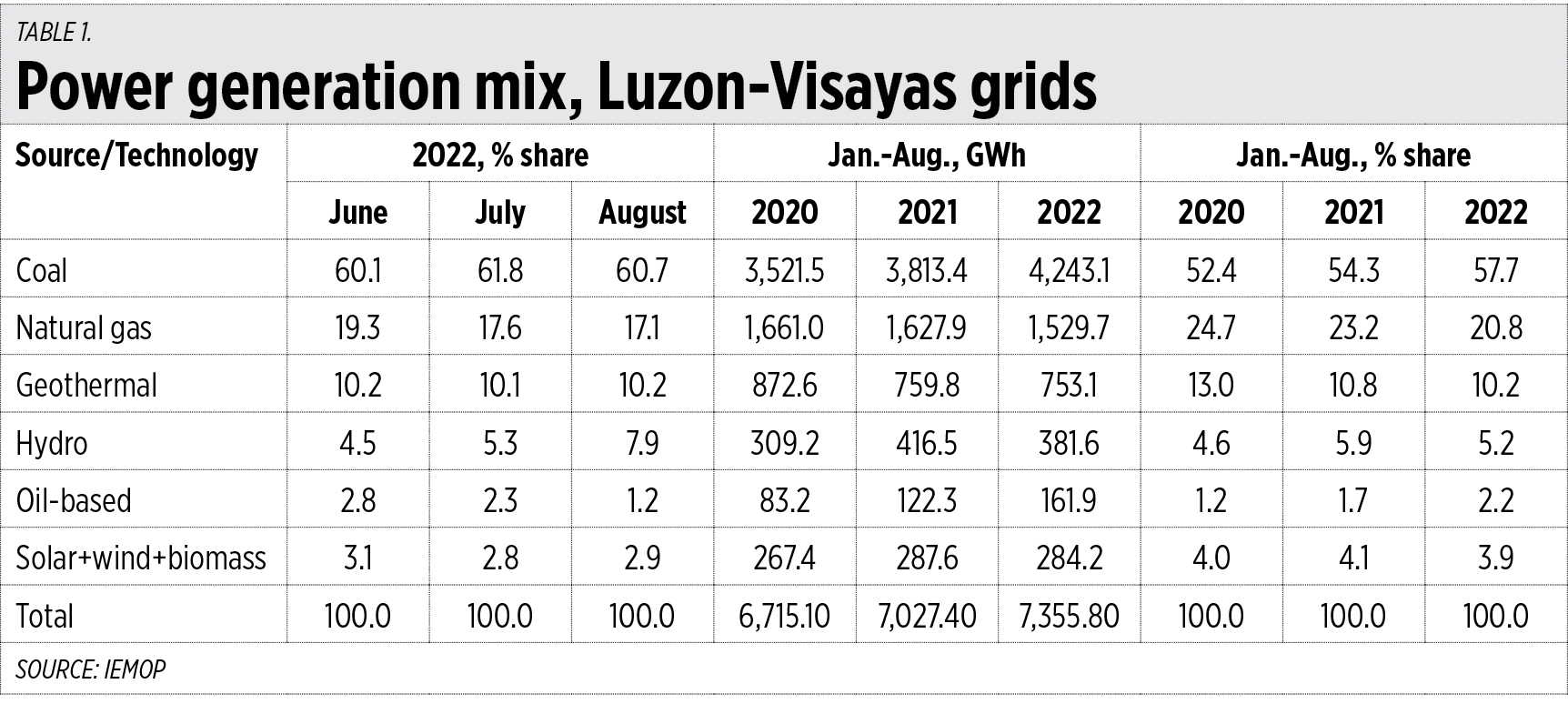
And, three, intermittent, unstable and unreliable wind, solar, and biomass continue to generate very low power until today, only about 3% of total power generation in June-August 2022, 13 years after the Renewable Energy (RE) law of 2008 (RA 9513) was enacted. (see Table 1)

But we frequently hear and read about the strong lobby by intermittent RE. See these recent reports in BusinessWorld:

• “IFC mobilizes financing for PHL firms’ green projects” (Sept. 8),

• “PHL urged to decentralize power generation with more solar plants” (Sept. 11),

• “RE firms want reform of competitive selection” (Sept. 11).

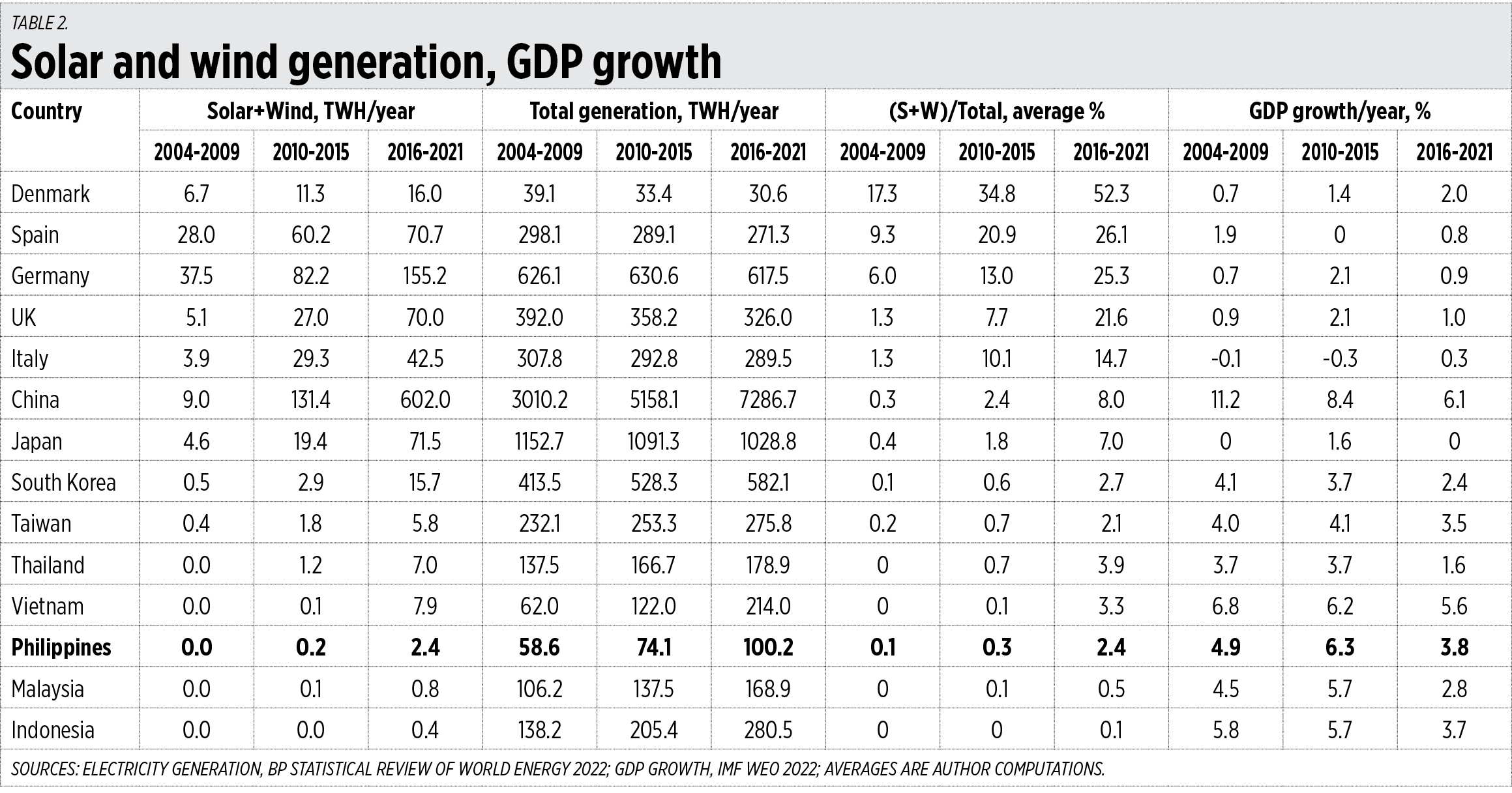
In many countries in Europe, the inconvenient fact is that as more wind and solar are added to the grid, overall power generation declines, and GDP growth is low and anemic. This is because many non-intermittent and reliable fossil fuel and nuclear plants exit the market as they are not a priority in the grid and are being demonized regularly.

The opposite occurs in East Asia. In the ASEAN-5 especially, wind-solar share remains low in the total generation mix and countries grow fast (see Table 2). We should keep business as usual, have more fossil fuel plants and limit the share of intermittent sources in the grid.

And then there are these two related reports in BusinessWorld: “DoE’s Lotilla says gov’t involvement in power will not bring rates down” (Sept. 8), and “Consistent application sought for key ERC ruling” (Sept. 15). I express my support for the positions taken by Energy Secretary Raphael Lotilla, and by ACEN Corp. that any ERC ruling on the SMC power companies’ petition for a rate hike must apply to all other players that will seek similar petitions.

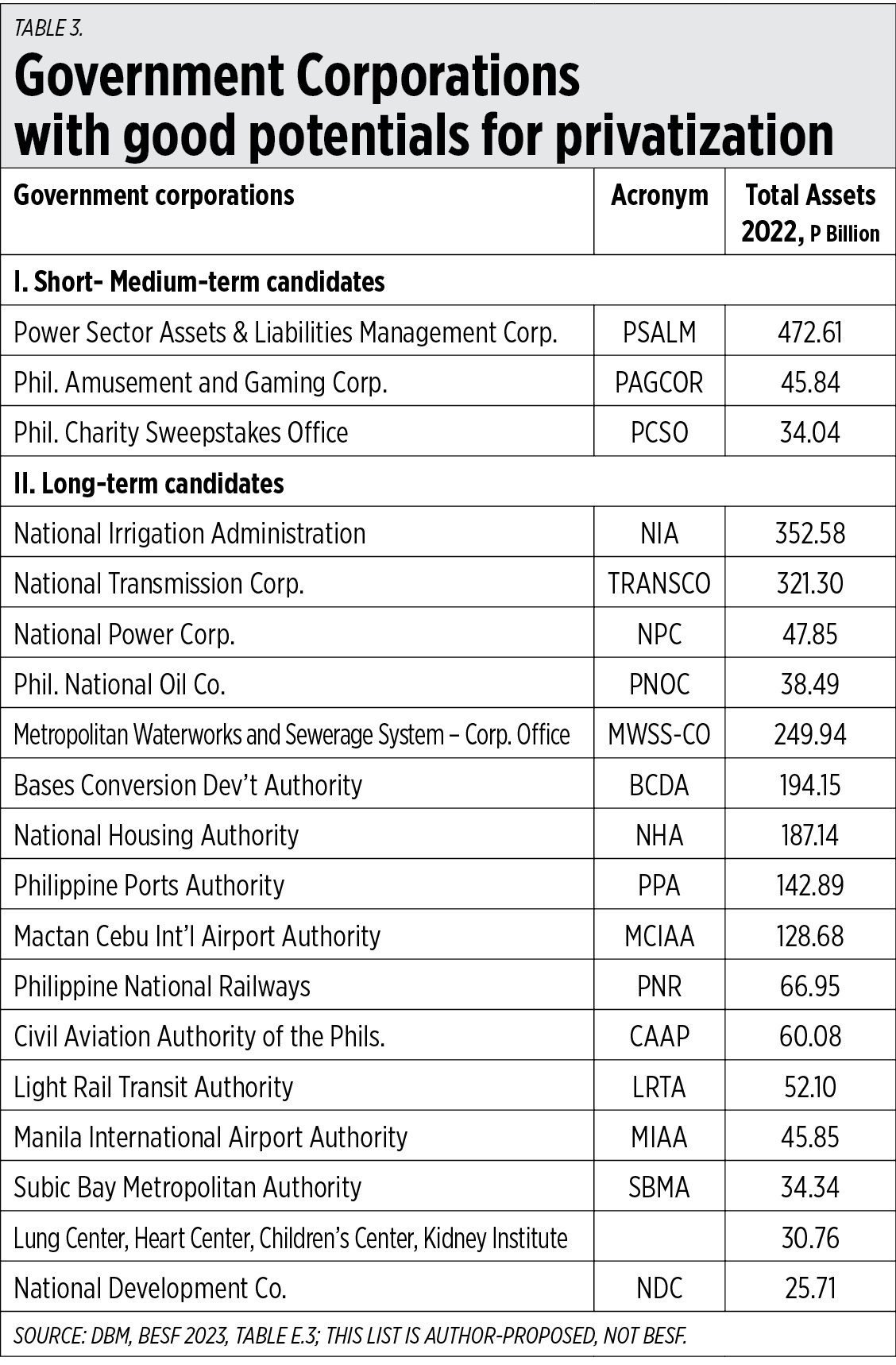
On the budget, taxes, and borrowings for 2023, there is one important revenue source to pay the P2+ trillion/year of net borrowings from 2020 to around 2024: privatize many government corporations and other assets. I propose three state enterprises that must be prioritized for privatization, and nearly 20 others over the long-term (see Table 3). Government-owned power plants and gambling companies should be at the top of the list. There is zero market failure being addressed by these state enterprises, they remain simply due to politics.

Finally, related to a recent piece in this column, “Motorcycle taxis, illicit tobacco, and electric cooperatives” (Aug. 8) where I noted that the estimated value of foregone tobacco taxes due to smuggling is P24-49 billion/year, House Bill (HB) 3917 was filed amending the Anti-Agricultural Smuggling Act of 2016 to classify cigarette smuggling as “economic sabotage” and imposing higher fines and penalties, and imprisonment.

This is a good bill authored by Ilocos Norte Representative Ferdinand “Sandro” Marcos and Party-list Representative Margarita “Migs” Nograles. The anti-smoking NGOs and activists should support moves to fight illicit tobacco because smuggled cigarettes are so cheap — the retail prices are lower than the tax alone of P55/pack this year — that they encourage more smoking, not less.

When tax avoidance and smuggling are controlled, there will be less need to raise taxes elsewhere.


Bienvenido S. Oplas, Jr. is the president of Minimal Government Thinkers.

minimalgovernment@gmail.com

Inclusion of Taiwan for the global good

THE 77th session of the United Nations General Assembly takes place from 13 to 27 September 2022 in New York City under the theme “A watershed moment: transformative solutions to interlocking challenges.” As the world’s most important forum of global cooperation began, the global community is confronting a number of unprecedented crises: from the ongoing COVID-19 variants and stalled efforts on climate change, to supply chain disruptions and China’s increasing rhetorical and military intimidation of Taiwan. At this juncture, it is worth reminding these leaders that all people — including the people of Taiwan — deserve to have their voices heard and efforts included for the global good.

A beacon of democracy in Asia and a force for good in the world, Taiwan is a reliable and valuable partner and Taiwan is committed to implementing the UN Sustainable Development Goals, and combating climate change with a blueprint for net-zero carbon emissions by 2050. As the world’s 22nd largest economy in terms of GDP and a major semiconductor manufacturer, Taiwan plays a key role in global supply chains. And as a defender of democracy, Taiwan is working to safeguard the status quo and support the rules-based international order.

By deliberately conflating its “One China” principle with the UNGA Resolution 2758 — the resolution that determined who represents “China” in the organization some 50 years ago — Beijing is misleading the world by spreading the fallacy that Taiwan is part of the PRC. Contrary to these false claims, the resolution does not take a position on Taiwan, nor does it include the word “Taiwan.” The long-term status quo is, the ROC (Taiwan) and the PRC are separate jurisdictions, with neither subordinate to the other. The people of Taiwan can only be represented in the international community by their free and democratically elected government.

Taiwan will resolutely defend its sovereignty and security. As a responsible member of the international community, Taiwan will also continue to exercise restraint in response to China’s provocations, and work together with like-minded countries, including the Philippines, to uphold peace and stability in the region.

As close neighbors and maritime nations, Taiwan and the Philippines uphold the values of freedom, democracy and the rules-based international order. Taiwan and the Philippines enjoy longtime cordial people to people relations. We sincerely hope that our Filipino brothers and sisters could continue to voice their support for Taiwan’s meaningful participation in the UN system.

In promoting post-pandemic recovery and reconnecting the world, now is the best time for UN to reconnect with Taiwan. Taiwan aspires to contribute. The 23.5 million resilient Taiwanese people surely should be included for the global good.


Peiyung Hsu
Representative Taipei Economic
and Cultural Office in the Philippines

The Monarchy is Britain’s most successful (re)invention

ANNIE SPRATT-UNSPLASH

ALL WEEK, a river of mourners has queued for hours alongside the banks of the Thames in London to pay their respects to their longest-reigning monarch as she lies in state in Westminster Hall. Tens of thousands also lined the narrow streets of Edinburgh to gaze on the hearse bearing the queen’s body last week.

Pilgrimage to bid farewell to a loved monarch is not limited to Britons: World leaders, including Presidents Joe Biden and Emmanuel Macron, Prime Minister Justin Trudeau and Chinese Vice-President Wang Qishan, are gathering to attend her funeral service at Westminster Abbey on Monday.

These are not the modest obsequies of a Scandinavian monarchy. Nor is this the hysteria of an oppressed people who take to the streets when a long-lived dictator — a Stalin or a Mao — finally dies. Of course, there is media hype, but the heightened emotions are not all manufactured. Walking in Westminster last week as the royal coffin arrived, the stillness of the crowds and reflective silence among usually noisy Londoners was striking.

For many secular Britons, the pomp and pageantry of royal ceremonies are a substitute for religion, but even agnostics and non-believers in monarchy are slightly awed by the scale and solemnity of the occasion. Few of those who watched were not moved when the queen’s coffin was drawn in a gun carriage from Buckingham Palace to Westminster, while her eldest son, King Charles III, and his sons followed her to the accompaniment of somber strains from military bands.

Courtesy of the television cameras, millions outside the UK get to be spectators and even participants too. The country’s gift to the world represents a theatrical display of soft power. Royalty is the biggest British brand, bigger than James Bond, bigger than the Bard, bigger even than the Beatles. How did it happen?

Among all modern nations, the British have been more successful at inventing traditions that appear linked to an immemorial past, but are in fact late 19th and early 20th century innovations. The Scottish kilt was the invention of an Englishman, and the idea of a tartan for every Scottish clan was dreamt up as a marketing ploy by canny textile manufacturers. (The Welsh managed to invent their own national dress without English help.)

The modern monarchy, however, has been the most successful British invention — or reinvention — of them all.

For the royals didn’t always put on such a good show. After watching Queen Victoria open Parliament in 1860, Lord Robert Cecil observed:

Some nations have a gift for ceremonial. This aptitude is generally confined to the people of a southern climate and of a non-Teutonic parentage. In England the case is exactly the reverse. We can afford to be more splendid than most nations; but some malignant spell broods over all our most solemn ceremonials, and inserts into them some feature which makes them all ridiculous.

William IV’s drab coronation was derided as the “Half Crown-nation” (a skit on the half crown coin, worth only a fourth of a pound sterling), while at Victoria’s unrehearsed coronation, the clergy lost their place in the order of service and the choir was pronounced “inadequate.” Those who carried her long train gossiped throughout.

But as the Crown’s power waned in the dawn of the democratic era, the ceremonial grew more elaborate and its execution became flawless — the beginning of what historian David Cannadine calls a “cavalcade of impotence.” By the time Victoria died, the once reclusive and unpopular Queen Empress had celebrated two highly successful jubilees and become the unofficial grandmother of Europe. Hundreds of thousands also lined the streets on the death of her son Edward VII in 1910 and for Queen Elizabeth II’s father, George VI, in 1952.

The same inventiveness was shown in the final hours of the British empire.

There was no great ceremony after the redcoats lost the Battle of Yorktown and with it the original 13 American colonies. When London was forced to abandon Ireland — its oldest overseas colony — soon after World War I, its last chief official quietly drove away from Dublin Castle. And it was a member of the royal family, Lord Mountbatten, the last imperial viceroy of India, who in 1947 decided it was better to foster feelings of goodwill to the former imperial power and to go with dignity. Speeches were given by the elites on both sides, the Union Jack was lowered at midnight and the flags of India and Pakistan were raised. The process was designed to give the appearance of an orderly transition, although afterward partition led to appalling violence.

Soon the British had got decolonization down to a tee. Independence ceremonies held in purpose-built stadiums sometimes occurred at the rate of four a year in the 1960s, with a royal usually in attendance. The folks back home could see from TV that the British had left the place in reasonable order while the new rulers enjoyed being treated as equals and gladly signed up to the new democratic Commonwealth of Nations.

Dissenting opinion has always held that both the vanished empire and today’s ceremonial monarchy are “a Tory racket,” opium for the masses. Cynicism, however, needs to be tempered. Labor leaders have often been more royalist than Conservatives. Constitutional monarchies preside over some of the most stable and successful democratic countries on the planet. The queen and her family grasped the implications of decolonization more quickly than much of the political class. Flinty-hearted Tories would have let the Commonwealth wither but for the queen. Some English Conservatives even harbor the wish that Scotland should go its own way to save the expense, but the Crown keeps the Union alive.

After the queen’s funeral, “the Firm,” as the royal family is known, will continue to modernize, doubtless becoming less formal in manner. Yet the pageantry that still moves millions — the golden carriages, military salutes and strange ceremonials — has turned out to be one of Britain’s most durable creations.

BLOOMBERG OPINION

Acosta appointed as Pag-IBIG Fund CEO

Pag-IBIG Fund acting Chief Executive Officer Marilene C. Acosta

In a letter released by Malacañang on Sept. 19, Marilene C. Acosta has been appointed as acting Chief Executive Officer of Pag-IBIG Fund, succeeding Acmad Rizaldy P. Moti as head of the country’s leading home financing agency.

Acosta, who hails from Narvacan, Ilocos Sur, has been with Pag-IBIG Fund since 1981. A Certified Public Accountant (CPA) and Career Executive Service Officer (CESO) V, she rose from the ranks since starting her career as an accounting clerk in Pag-IBIG Fund’s Baguio Regional Office. During her tenure as Pag-IBIG Fund Deputy CEO for Home Lending from March 2017 to September 2022, the agency released consistent record-highs in housing loans, which then enabled a record-high number of members to acquire their own homes.

“I am grateful for the trust that the President Ferdinand Marcos, Jr. and our Chairperson, DHSUD Secretary Jose Rizalino Acuzar have given me on being appointed to this post. I also thank outgoing CEO Moti and my fellow Lingkod Pag-IBIG for their support, as well as the Organization of Socialized and Economic Housing Developers in the Philippines (OSHDP), Inc. and the Subdivision and Housing Developers Association (SHDA), Inc. for their endorsements. I assure all of them, as well as our members, partner-developers, partner-employers and stakeholders, that we at Pag-IBIG Fund shall remain committed in providing them responsive and excellent service. My more than 40 years of public service in Pag-IBIG Fund has prepared me well for this post, and I will put to best use all that I have learned during the past four decades in ensuring that we continue the fulfillment of our mandates and in providing Tapat na Serbisyo, Mula sa Puso,” Acosta said.

Outgoing Pag-IBIG Fund Chief Executive Officer Acmad Rizaldy Moti, meanwhile, hailed Acosta’s appointment. He said that this would ensure continuity in the agency’s directions towards sustaining and building on the many gains it has accomplished over the recent years.

“CEO Acosta’s leadership, excellence, integrity, and grit are among the key factors that have enabled Pag-IBIG Fund to accomplish numerous record-highs and milestones, particularly in the home financing front. Her appointment shall allow the continuity and sustainability of Pag-IBIG Fund’s efforts to uplift the lives of all Filipino workers. I truly wish her and Pag-IBIG all the best,” Moti said.

Moti leaves Pag-IBIG Fund in its strongest-ever state, posting significant increases in key metrics from 2016 – the year prior to assuming his post as CEO. As of August 2022, the agency has P795.93 billion in total assets, an 81% increase from P439.30 billion as of yearend 2016; a P100.8 billion single-year home loan release in 2021, a 76% increase from the annual home loan takeout of P57.3 billion six years ago; P25.95 billion voluntarily saved by members in MP2 Savings in 2021, a 3,065% increase from the P0.82 billion saved in 2016; investible funds amounting to P92.56 billion, a 49% increase from P62.15 billion in 2016; and, an annual net income of more than P30 billion for five consecutive years since 2017.


Spotlight is BusinessWorld’s sponsored section that allows advertisers to amplify their brand and connect with BusinessWorld’s audience by enabling them to publish their stories directly on the BusinessWorld Web site. For more information, send an email to online@bworldonline.com.

Join us on Viber to get more updates from BusinessWorld: https://bit.ly/3hv6bLA.

Biden says US forces would defend Taiwan in the event of a Chinese invasion

US PRESIDENT JOE BIDEN/FACEBOOK

WASHINGTON — US President Joseph R. Biden said US forces would defend Taiwan in the event of a Chinese invasion, his most explicit statement so far on the issue and comments sure to anger Beijing.

Asked in a CBS 60 Minutes interview broadcast on Sunday whether US forces would defend the democratically governed island claimed by China, he replied: “Yes, if in fact, there was an unprecedented attack.”

Asked to clarify if he meant that unlike in Ukraine, US forces — American men and women — would defend Taiwan in the event of a Chinese invasion, Mr. Biden replied: “Yes.”

The interview was just the latest time that Mr. Biden has appeared to go beyond long-standing stated US policy on Taiwan, but his statement was clearer than previous ones about committing US troops to the defend the island.

The United States has long stuck to a policy of “strategic ambiguity” and not making clear whether it would respond militarily to an attack on Taiwan.

Asked to comment, a White House spokesperson said US policy towards Taiwan had not changed.

“The President has said this before, including in Tokyo earlier this year. He also made clear then that our Taiwan policy hasn’t changed. That remains true,” the spokesperson said.

Taiwan’s Foreign Ministry expressed its thanks to Mr. Biden for his reaffirming of the “US government’s rock-solid security commitment to Taiwan”.

Taiwan will continue to strengthen its self-defense capabilities and deepen the close security partnership between Taiwan and the United States, it said in a statement.

The CBS interview with Mr. Biden was conducted last week. The president is in Britain for Queen Elizabeth’s funeral on Monday.

In May, Mr. Biden was asked if he was willing to get involved militarily to defend Taiwan and replied: “Yes … That’s the commitment we made.”

In the 60 Minutes interview, Mr. Biden reiterated the United States did not support Taiwanese independence and remained committed to a “One-China” policy in which Washington officially recognizes Beijing not Taipei.

Mr. Biden’s remarks are sure to enrage Beijing, which was greatly angered by a visit to Taiwan by US House speaker Nancy Pelosi in August.

That visit promoted China to conducted its largest-ever military exercises around Taiwan and China has protested moves by US lawmakers to advanced legislation that would enhance US military support for Taiwan.

Chinese President Xi Jinping has vowed to bring Taiwan under Beijing’s control and has not ruled out the use of force. Taiwan strongly objects to China’s sovereignty claims.

There was no immediate response to a request for comment from China’s embassy in Washington.

In a phone call with Mr. Biden in July, Mr. Xi warned against playing with fire over Taiwan, saying “those who play with fire will perish by it.”

Asked last October if the United States would come to the defense of Taiwan, which the United States is required by law to provide with the means to defend itself, Mr. Biden said: “Yes, we have a commitment to do that.”

At that time, a White House spokesperson said Mr. Biden was not announcing any change in US policy and some experts referred to the comment as a “gaffe”.

Bonnie Glaser, an Asia expert at the German Marshall Fund of the United States, said if Mr. Biden made such pledges he needed to ensure he could back them up.

“If President Biden plans to defend Taiwan, then he should make sure the US military has the capability to do so,” she said. “Rhetorical support that isn’t backed up by real capabilities is unlikely to strengthen deterrence.”

Mr. Biden’s Asia policy czar, Kurt Campbell, has in the past rejected any move to “strategic clarity” over Taiwan, saying there were “significant downsides” to such an approach. — Reuters

Zelensky vows no letup as troops cross Oskil River

President of Ukraine Volodymyr Zelenskyy/Flickr

KIEV — Ukrainian President Volodymyr Zelensky vowed there would be no letup in fighting to regain territory lost to Russia as Kyiv reported its troops had advanced to the eastern bank of the Oskil River, threatening Russian occupation forces in the Donbas.

Crossing the Oskil is another important milestone in Ukraine’s counter-offensive in the northeastern Kharkiv region as it flows south to the Siversky Donets River, which goes right through Luhansk, one of two provinces in the Donbas region.

Ukrainian troops “have pushed across the Oskil. From yesterday, Ukraine controls the east bank,” the Ukrainian Armed Forces wrote on Telegram late Sunday.

Serhiy Gaidai, governor of Luhansk region, wrote on Telegram: “Luhansk region is right next door. Decoccupation is not far away.”

Mr. Zelensky vowed to keep up the pressure on Moscow after Ukraine’s rapid gains in Kharkiv this month.

“Perhaps it seems to some of you that after a series of victories we now have a lull of sorts,” he said in his regular nightly address on Sunday. “But there will be no lull. There is preparation for the next series … For Ukraine must be free. All of it.”

US President Joseph R. Biden also said victory for Ukraine meant removing Russian forces from the entire country, and pledged US support for as long as it takes.

“Winning the war in Ukraine is to get Russia out of Ukraine completely and to recognize the sovereignty. They’re defeating Russia,” he said in an interview with CBS’s 60 Minutes broadcast on Sunday.

“Russia’s turning out not to be as competent and capable as many people thought they were going to be.”

Russian artillery pounded towns and villages across the frontlines in the east and south on Sunday, including civilian infrastructure in Zaporizhzhia city, Ukrainian officials said.

Britain said Russian forces had widened strikes on civilian infrastructure following battlefield setbacks and were likely to expand their targets further.

“As it faces setbacks on the front lines, Russia has likely extended the locations it is prepared to strike in an attempt to directly undermine the morale of the Ukrainian people and government,” Britain’s defense ministry said.

Ukraine’s southern command on Monday said strikes were also launched on a radar station near Kherson and on a pontoon crossing near Nova Kakhovka east of Kherson, where a Ukrainian counter-offensive has focused on taking out bridges across the Dnipro and Inhulets Rivers.

Reuters was unable to independently verify the battlefield reports.

PUTIN, BIDEN WARNINGS
On Friday, Russian President Vladimir Putin brushed off Ukraine’s swift counteroffensive and said Moscow would respond more forcefully if its troops were put under further pressure.

Such repeated threats have raised concerns Mr. Putin could at some point turn to small nuclear weapons or chemical warfare.

US President Joseph R. Biden, asked what he would tell Mr. Putin if he was considering using such weapons, replied in the CBS’s 60 Minutes interview: “Don’t. Don’t. Don’t. It would change the face of war unlike anything since World War II.”

Some military analysts have said Russia might also stage a nuclear incident at the Zaporizhzhia nuclear power plant held by Russia but run by Ukrainian staff.

Moscow and Kyiv have accused each other for shelling around the plant that has damaged buildings and disrupted power lines needed to keep it cooled and safe.

US Army General Mark Milley, chairman of the Joint Chiefs of Staff, called for vigilance on Sunday after visiting a base in Poland aiding Ukraine’s war effort.

“The war is not going too well for Russia right now so it’s incumbent upon all of us to maintain high states of readiness, alert,” he said after his trip to the base, which reporters traveling with him were asked not to identify.

With its battlefield losses mounting, the Russian army is seeking contract soldiers for what it calls the “special military operation” in Ukraine, and is offering nearly $3,000 a month as an incentive.

A special unit stationed a recruitment truck in the southern city of Rostov on the weekend and masked soldiers handed out brochures titled “Military service on a contract — the choice of a real man.”

MASS GRAVES
On Saturday, Mr. Zelensky said authorities had found a mass grave containing the bodies of 17 soldiers in Izium, some of which he said bore signs of torture.

Izium residents have been searching for dead relatives at a forest grave site where workers began exhuming bodies last week. Ukrainian officials said last week they had found 440 bodies in woods near Izium. They said most of the dead were civilians and the causes of death had not been established.

The Kremlin has not commented on the discovery of the graves, but in the past Moscow has repeatedly denied deliberately attacking civilians or committing atrocities.

In Kozacha Lopan, a village some 45 km (30 miles) north of Kharkiv and close to the Russian border, a Reuters reporter was taken to a squalid cellar with rooms fitted with iron bars which officials said had served as a makeshift prison during the occupation.

District Mayor Vyacheslav Zadorenko said the rooms had been used as a “torture cellar” to detain civilians.

Reuters was unable to verify those accounts. — Reuters

Activists fear rising surveillance from Asia’s Digital Silk Road

CODY LOGAN/WIKIMEDIA COMMONS

PHNOM PENH — The drones were hard to avoid: they buzzed low over the crowd of protesters holding banners and shouting slogans outside the NagaWorld casino in the Cambodian city of Phnom Penh, then hovered above each of the speakers as they called for justice. 

As hundreds of workers went on strike outside the glass and chrome towers of the firm’s hotel and casino complex, demanding the reinstatement of nearly 400 employees who were laid off last year, armed riot police and surveillance cameras kept watch. 

“We knew we were being recorded, but we couldn’t do anything, so we would wave at the drones,” said Chhim Sithar, 34, a union leader who was arrested at the January protest along with more than a dozen others, and held in jail for nine weeks. 

Hong Kong-listed NagaCorp said the strike that began in December was illegal, and that the layoffs were a “mutual separation plan” to cut costs during the coronavirus disease 2019 (COVID-19) pandemic. 

Municipal police have said the workers’ strike was illegal and a threat to public order and safety. Police charged some protesters with “incitement to cause serious chaos to social security.” 

Chhim Sithar and other Cambodian rights activists say they are under constant surveillance, their every move online and offline tracked by software, cameras, and drones. 

Much of the technology is supplied by China, which sells extensive digital surveillance packages to governments under its Belt and Road Initiative (BRI) infrastructure project. 

Chinese Premier Xi Jinping launched BRI in 2013, aiming to harness China’s strengths in financing and infrastructure construction to “build a broad community of shared interests” across Asia, Africa and Latin America. 

China has installed more than 1,000 CCTV cameras in Phnom Penh as part of a new nationwide surveillance system, according to local media reports. 

Cambodian government spokesman Phay Siphan denied that the technologies are used to target activists and union leaders. 

“The CCTVs and other surveillance infrastructure are for security purposes, to fight crime, and traffic violations and other illegal actions,” he told the Thomson Reuters Foundation. 

CHINA INFLUENCE
While authorities justify surveillance on security grounds, human rights groups have raised concerns about privacy violations and the potential for profiling and discrimination, with the technologies often deployed without public consultation, and in the absence of strong data protection laws. 

Countries taking part in BRI are using technologies including artificial intelligence-based facial recognition systems linked to abuse of minority Uyghurs in China for smart policing or smart cities programs, and digital tools for monitoring social media sites. 

“These tools offer new possibilities for tracking and intimidating dissenters, monitoring political opponents, and preempting challenges to the government,” said Steven Feldstein, a senior fellow at the Carnegie Endowment for International Peace (CEIP), a think-tank based in Washington, DC. 

“In authoritarian settings, these capabilities have obvious potential to deepen repression,” said Mr. Feldstein, who estimates that Chinese artificial intelligence (AI) surveillance technologies are being rolled out in more than 50 BRI countries. 

A key part of China’s BRI program is the so-called Digital Silk Road — an initiative that aims to build modern telecom and data infrastructure among nations lying on the ancient Silk Road trade route. 

Chinese involvement ranges from its tech firms building submarine internet cables, data centers and mobile towers, to nations copying its cyber laws and internet gateways to control the flow of data and information, said a recent report by the Alliance to Secure Democracy (ASD), a US-based think-tank. 

“There is a risk that the Chinese state may be able to amass data — whether it’s genetic surveillance information or more traditional information about political opinions or activity through these systems,” said Lindsay Gorman, senior fellow for emerging technologies at ASD. 

“There is a real question about where the data that fuels these surveillance systems is stored, who owns it and who benefits from it,” she said. 

The Chinese embassy in Cambodia could not be reached for comment. Chinese authorities have said tech monitoring is vital to combat crime and prevent the spread of COVID-19, and has denied reports that it is using tech to enable abuse of Uyghurs. 

‘WE ARE ALL AFRAID’
In Myanmar, where the military overthrew an elected government last year and launched a bloody crackdown on protests and dissent, Chinese firms are deploying 4G and 5G networks, as well as facial recognition systems in several cities. 

The junta has adopted cyber laws that echo China’s — including limiting internet access to certain websites, and banning social media platforms such as Facebook and Twitter. 

A spokesperson for the junta did not respond to a request for comment. Officials have earlier said that facial recognition systems are needed to maintain security and “civil peace.” 

But reports of the use of CCTV and facial recognition to target protesters have made Hsu, a lawyer who provides legal aid to political prisoners in the city of Mandalay, “more afraid.” 

“The police submit CCTV records as evidence in the court, so we know it is dangerous for the activists,” said Hsu, 26, using a pseudonym for fear of reprisal. 

“When I went to prison to meet with jailed activists, I would wear a mask — not because I was scared of COVID-19, but because I wanted to hide my face. 

“We are all afraid of the CCTV.” 

BEING WATCHED
Worldwide, the rise of AI (artificial intelligence) technologies has led to the proliferation of mass surveillance systems, including face recognition and voice identification for a range of uses, from tracking criminals to marking student attendance. 

“Technology has changed the nature of how governments carry out surveillance and what they choose to monitor,” said Mr. Feldstein. 

In Cambodia, where authorities are building a national internet gateway — similar to China’s internet firewall that blocks websites and social media platforms — there is little transparency around these systems, said Chak Sopheap at the Cambodian Center for Human Rights, a nonprofit. 

“The government has disclosed no information as to the data gathered, and how they are used by the authorities. This lack of transparency is highly problematic,” she said. 

“The use of such technologies affects the right to privacy of people, especially those who do not support the government, and provides Cambodian authorities with an additional tool to crack down on critical voices and dissidents.” 

In Phnom Penh, labor leader Chhim Sithar and her fellow protesters are adapting: they do more in-person meetings, where they turn off their phones, they use virtual private networks (VPNs) and encrypted chat groups and refrain from posting on social media. 

“This feeling of being watched and tracked all the time is exhausting,” she said. 

“We cannot do anything without the police knowing — it’s scary.” — Thomson Reuters Foundation

Strong earthquake hits southeastern Taiwan, 146 injured

Taiwan Central Weather Bureau

TAIPEI — A 6.8 magnitude earthquake hit the sparsely populated southeastern part of Taiwan on Sunday, the island’s weather bureau said, derailing train carriages, causing a convenience store to collapse and trapping hundreds on mountain roads. 

The weather bureau said the epicenter was in Taitung county, and followed a 6.4 magnitude temblor on Saturday evening in the same area, which caused no casualties. 

The US Geological Survey measured Sunday’s quake at a magnitude 7.2 and at a depth of 10 km (six miles). 

Taiwan’s fire department said one person had died and 146 were injured by the quake. 

All four people were rescued from a building that collapsed in Yuli, while three people whose vehicles fell off a damaged bridge were rescued and taken to hospital. 

The Taiwan Railways Administration said six carriages came off the rails at Dongli station in eastern Taiwan after part of the platform canopy collapsed, but the fire department said there were no injuries. 

More than 600 people are trapped on the scenic Chike and Liushishi mountain areas by blocked roads, though there were no injuries and rescuers were working to reopen the roads, the department said. 

The US Pacific Tsunami Warning Center issued a warning for Taiwan after the tremor but later lifted the alert. Japan’s weather agency lifted a tsunami warning for part of Okinawa prefecture. 

The quake could be felt across Taiwan, the weather bureau said. Buildings shook briefly in the capital Taipei, and aftershocks have continued to jolt the island. 

Science parks in the southern cities of Tainan and Kaohsiung, home to major semiconductor factories, said there was no impact on operations. 

Taiwan Semiconductor Manufacturing Co. (TSMC) , the world’s largest contract chipmaker, said there was “no known significant impact for now.” 

Taiwan lies near the junction of two tectonic plates and is prone to earthquakes. 

More than 100 people were killed in a quake in southern Taiwan in 2016, while a 7.3 magnitude quake killed more than 2,000 people in 1999. — Reuters

Fossil fuel registry launched to help spot ‘stranded assets’

REUTERS

LONDON — Carbon Tracker and Global Energy Monitor said on Monday they had launched the first global registry of oil and gas reserves, production and emissions with data for more than 50,000 fields. 

The database makes previously disparate or hard-to-access data publicly available, including to investors attempting to better understand which assets could be at risk of being uneconomic, or “stranded,” in the low-energy transition. 

It could also help activists in their efforts to pressure producers or governments to cut fossil fuel output. 

“It is an enormous help to now have all this information, cross-referenced and searchable at our fingertips. Not least to help us in targeting and refining our thematic engagement and stewardship,” said Eric Christian Pedersen, head of responsible investments at Nordea Asset Management. 

The Global Registry of Fossil Fuels contains data for fields in 89 countries, covering 75% of global production, the non-governmental organizations (NGOs) which developed it said. 

Global Energy Monitor (GEM) said the registry collated data from sources including governments, state-owned and private companies, news and media reports, NGOs and on-the-ground contacts providing first-hand information about a project. 

“With the Registry, it will be much easier to include expected future emissions into the analysis — and thus to identify and prioritize the companies with the greatest risk of harboring assets likely to become stranded,” Mr. Pedersen said. 

While there is little doubt that much of the world’s oil and gas reserves will have to stay underground to avoid a dramatic worsening of the climate, the registry has put a number on this. 

“Producing and combusting the world’s reserves would yield over 3.5 trillion tons of greenhouse gas emissions, over seven times the remaining carbon budget for 1.5°C and more than all emissions produced since the industrial revolution,” they said. 

It is not straightforward to calculate the life-cycle emissions of a unit of oil, gas or coal, often relying on calculations rather than measurements which can differ widely. 

One factor, for example, whether the potent but short-lived greenhouse gas methane gets converted into CO2 equivalent data on a 20-year rather than a 100-year timeframe. 

“It may sound dry and technical but it adds about another five gigatons of CO2e (carbon dioxide equivalent) emissions a year,” lead modeler Johnny West of Koinon Consulting, which advised Carbon Tracker, said. 

Deborah Gordon at the Rocky Mountain Institute’s climate intelligence group, said such data was crucial so that industry and governments can tackle the dirtiest fields first. 

“There is far too little transparency … Reservoir and activity data are difficult, if not impossible, to ascertain,” Ms. Gordon added. — Reuters

Asian farmers plant to boost palm oil output, seedling shortage slows pace

Photo by Craig Morey/Flickr/CC BY-SA 2.0

MUMBAI/KUALA LUMPUR/JAKARTA — Farmers across Asia are busy planting trees to boost palm oil production but nurseries are struggling to keep up with demand for sprouts and seedlings, risking a delay in the industry’s recovery from the coronavirus disease 2019 (COVID-19) pandemic.

The seedlings shortfall could slow plantation, capping production growth and keeping palm oil prices elevated, industry officials said, as the world already grapples with lofty inflation. Asia produces more than 90% of the world’s cheapest edible oil used in cooking, baking and cosmetics.

The production growth of palm oil stalled in recent years, partly due to labour shortages during the COVID-19 pandemic, but farmers are now looking to replant or expand plantations amid rising prices.

The demand surge comes as supply for germinated sprouts, used to make seedlings, has fallen as oil palm nurseries scaled down production during the pandemic to adjust to weaker demand.

Traditional growers Indonesia and Malaysia, which account for more than 80% of the global palm oil output, are focusing on replacing old oil palm trees that are cumbersome to harvest and less productive, while India and Thailand are trying to expand acreage, industry officials said.

“A number of big Malaysian estates (have decided) they want to replant, causing a shortage of availability of seedlings in the market,” said Tan Kim Tun, a Malaysian nursery operator based in the state of Johor.

Global annual palm oil production growth slowed to 0.5% between 2018 and 2022 from a 4.8% pace in the previous four years, according to data compiled by the U.S. Department of Agriculture.

Against this backdrop, palm oil prices hit a record high of 7,268 Malaysian ringgit ($1,606.19) per tonne this year and remain above the average seen in 2010-2020 despite a big downward correction recently.

New plants take four years to grow before harvest, meaning production will stay tepid and prices high for a while yet, said a New-Delhi based dealer with a global trading firm.

“As the productive trees are chopped, production growth will remain negligible for a few years,” said the dealer. “Replanting will support palm oil prices for the next few years.”

SEED SHORTAGE

Oil palm nurseries will struggle to ramp up output overnight to meet strong demand as it takes more than a year to make a seedling.

“We can increase our capacity but it will take time … it will at least take one year before you can get (a) germinated seed. The shortage cannot be resolved fast,” said Ahmad Parveez Ghulam Kadir, director-general of Malaysian Palm Oil Board (MPOB).

Industry officials estimate Malaysia has the capacity to produce up to 80 million germinated sprouts a year and Indonesia 200 million sprouts.

Indonesia, however, can currently only produce half of that amount, or 110 million per year, said Hasril Hasan Siregar, head of research and productivity improvement at Indonesian Palm Oil Association (GAPKI).

Meanwhile, Indonesia uses around 95% of the seedlings it produces to meet domestic demand and exports only around 5%, Siregar said, forcing importers such as India and Myanmar to rely on Malaysia and Thailand.

Indeed, demand for Malaysia’s germinated seeds surged 30% in Jan.–Aug. 2022 period from a year ago to nearly 38 million seeds, according to data compiled by the MPOB. For Indonesia’s sprouts, demand jumped nearly 24% over the same period.

Demand for Malaysia’s germinated seeds is so high, that some nurseries are having to reject orders, said Mr. Tan, adding that his nursery has a waiting list of around six months.

All of this is causing problems for India, which is aiming to rapidly expand its oil palm area.

“The world needs more and more palm oil. For many poor consumers, it’s the only option,” said a Mumbai-based dealer with a global trading firm. The dealers declined to be named because of company policy.

India needs 20 million sprouts in 2022 but only 75% of that demand has been met by imports from Indonesia, Malaysia, Thailand and Costa Rica so far this year, said an official with TS Oilfed, India’s biggest importer of oil palm sprouts, who declined to be named because of company policy. — Reuters

Frugal is the new cool for young Chinese as economy falters

REUTERS

BEIJING — Before the pandemic, Doris Fu imagined a different future for herself and her family: new car, bigger apartment, fine dining on weekends and holidays on tropical islands.

Instead, the 39-year-old Shanghai marketing consultant is one of many Chinese in their 20s and 30s cutting spending and saving cash where they can, rattled by China’s coronavirus lockdowns, high youth unemployment and a faltering property market. 

“I no longer have manicures, I don’t get my hair done anymore. I have gone to China-made for all my cosmetics,” Ms. Fu told Reuters. 

This new frugality, amplified by social media influencers touting low-cost lifestyles and sharing money-saving tips, is a threat to the world’s second-largest economy, which narrowly avoided contraction in the second quarter. Consumer spending accounts for more than half of China’s gross domestic product. 

“We’ve been mapping consumer behavior here for 16 years and in all of that time this is the most concerned that I’ve seen young consumers,” said Benjamin Cavender, managing director of China Market Research Group (CMR). 

China’s “zero-COVID” policy — including stringent lockdowns, travel restrictions and mass testing — has taken a heavy toll on the country’s economy. The government’s crackdown on big technology companies has also had an outsized effect on the young workforce. 

Unemployment among people aged 16 to 24 stands at almost 19%, after hitting a record 20% in July, according to government data. Some young people have been forced to take pay cuts, for example in the retail and e-commerce sectors, according to two industry surveys. The average salary in 38 major Chinese cities fell 1% in the first three months of this year, data collated by online recruitment firm Zhilian Zhaopin show. 

As a result, some young people prefer to save than splurge. 

“I used to go see two movies every month, but I haven’t stepped inside a cinema since the pandemic,” said Ms. Fu, an avid movie fan. 

Retail sales in China rose just 2.7% year-on-year in July, recovering to 5.4% in August but still well below the mostly 7%-plus levels during 2019, before the pandemic. 

Almost 60% of people are now inclined to save more, rather than consume or invest more, according to the most recent quarterly survey by the People’s Bank of China (PBOC), China’s central bank. That figure was 45% three years ago. 

Chinese households overall added 10.8 trillion yuan ($1.54 trillion) in new bank savings in the first eight months of the year, up from 6.4 trillion yuan in the same period last year. 

That is a problem for China’s economic policymakers, who have long relied on increased consumption to bolster growth. 

China is the only leading economy that cut interest rates this year, in an effort to spur growth. China’s big state-owned banks cut personal deposit rates on Sept. 15, a move designed to discourage saving and boost consumption. 

Addressing the rise in people’s inclination to save, a PBOC official said in July that when the pandemic eases, the willingness to invest and consume will “stabilize and rise.” 

The PBOC did not respond to Reuters requests for comment; neither did China’s Ministry of Commerce. 

‘10 YUAN DINNER’ 

After years of increasingly ardent consumerism fueled by rising wages, easy credit and online shopping, a move toward frugality brings young people in China closer to their more cautious parents, whose memories of lean years before the economy took off have made them more inclined to save. 

“Amid the tough job market and strong downward economic pressure, young people’s feelings of insecurity and uncertainty are something they never experienced,” said Zhiwu Chen, chair professor of finance at Hong Kong University Business School. 

Unlike their parents, some are making a show of their thriftiness online. 

A woman in her 20s in the eastern city of Hangzhou, who uses the handle Lajiang, has gained hundreds of thousands of followers posting more than 100 videos on how to make 10 yuan ($1.45) dinners on lifestyle app Xiaohongshu and streaming site Bilibili. 

In one minute-long video with nearly 400,000 views, she stir-fries a dish made from a 4-yuan basa fillet, 5 yuan of frozen shrimp, and 2 yuan of vegetables, using a pink chopping board and pink rice cooker. 

Social media discussions have sprung up to share money-saving tips, such as the “Live off 1,600 yuan a month challenge,” in Shanghai, one of China’s most expensive cities. 

Yang Jun, who said she was deep in credit card debt before the pandemic, started a group called the Low Consumption Research Institute on networking site Douban in 2019. The group has attracted more than 150,000 members. Ms. Yang said she is cutting spending and is selling some of her belongings on second-hand sites to raise cash. 

“COVID-19 makes people pessimistic,” the 28-year-old said. “You can’t just be like before, spend all the money you make, and make it back again next month.” She said she is now out of debt. 

Ms. Yang said she has cut out her daily Starbucks coffee. Ms. Fu said she switched her makeup powder brand from Givenchy to a Chinese brand called Florasis, which is about 60% cheaper. 

French luxury brands leader LVMH, which owns Givenchy, and coffee giant Starbucks Corp both said sales fell sharply in China in the latest quarter. 

China has given no signal on when or how it will exit from its zero-COVID policy. And while policymakers have taken various measures in hopes of boosting consumption, from subsidies for car buyers to shopping vouchers, far more money and attention has been directed towards infrastructure as a way of stimulating the economy. 

Stability has been the key theme for China’s policymakers this year, experts say, as President Xi Jinping gears up for a third leadership term at next month’s congress of the ruling Communist Party. 

“In the past, when you had economic slowdown, consumers were more likely to feel that government policy is going to fix this problem very quickly,” said Mr. Cavender at CMR. “I think right now the challenge is when you interview younger consumers, they really don’t know what the future holds.” 

Ms. Fu, the marketing professional, said she has deferred plans to sell her two small apartments to buy a bigger one in a better school district for her son, and has given up for now on upgrading from her Volkswagen Golf. 

“Why do I dare not upgrade my house and my car, even if I have the money?” she said. “Everything is unknown.” — Reuters 


ADVERTISEMENT
ADVERTISEMENT