Home Blog Page 5822

AEV, UBP executives trade roles

EXECUTIVES of Aboitiz Equity Ventures, Inc. (AEV) and Union Bank of the Philippines (UBP) will be trading roles as part of the Aboitiz group’s transformation into becoming the country’s first “techglomerate.”

In a press release on Thursday, the firm said that AEV Senior Vice-President and Chief Financial Officer Manuel R. Lozano and UBP Senior Executive Vice President, Treasurer and Head of Global Markets Jose Emmanuel U. Hilado will be trading roles effective next year.

Recently, UBP hired a new treasurer and global markets head to replace incumbent Mr. Hilado beginning Oct. 1, 2022.

Mr. Hilado will then assume the role of UBP’s chief financial officer until Dec. 31, 2022, after which he will transfer to AEV, the firm said.

As he assumes Mr. Lozano’s position, Mr. Hilado will oversee AEV’s treasury, tax advisory and compliance services, finance, accounting and business support, investor relations, and legal and compliance.

Meanwhile, Mr. Lozano will oversee UBP units such as controllership, corporate accounting, tax and insurance, management information system, finance, corporate planning and investor relations, remedial management and asset recovery, business services, and wholesale credit review.

AEV said that as UBP’s chief financial officer, Mr. Lozano will supervise the bank’s finance unit and serve as the chief financial spokesperson for the organization.

“He will be a key player in crafting and implementing the bank’s business strategies as well as working hand in hand with the business units to ensure consistent and superior operating performance,” the firm said.

AEV said that Mr. Lozano will directly report to UBP President and Chief Executive Officer Edwin R. Bautista “with regard to all strategic and tactical matters as they relate to corporate portfolio strategy and capital allocation, budget management, balance sheet management, and tax optimization.”

AEV is the public holding company of the Aboitiz group with major investments in power, banking and financial services, food, infrastructure, and land.

On Thursday, shares in AEV climbed by P1.70 or 3.08% to P56.90 each, while shares in UBP lost P1 or 1.22% to P80.95 apiece. — Justine Irish D. Tabile

Alec Baldwin, others may be charged in October over Rust shooting

ALEC BALDWIN/IMDB.COM

ACTOR Alec Baldwin is among up to four people who may face charges in October for the fatal shooting of cinematographer Halyna Hutchins during filming of the Western Rust in 2021, a New Mexico prosecutor said.

The final police report on the shooting near Santa Fe, New Mexico is expected next month, at which time prosecutors will file criminal charges if warranted, district attorney Mary Carmack-Altwies told the state’s finance board.

Investigators are focusing on the “many individuals” who handled the pistol Mr. Baldwin fired during a rehearsal, killing Ms. Hutchins and injuring director Joel Souza, Ms. Carmack-Altwies said in a letter to the board.

“One of the possible defendants is well-known movie actor Alec Baldwin,” she said in an Aug. 30 letter requesting additional funding to prosecute the high-profile case.

Four jury trials with each defendant charged under some variation of state homicide statutes are possible, Ms. Carmack-Altwies told the board during a Sept. 20 meeting.

The former public defender said her team faced “well-paid and experienced defense lawyers” from Los Angeles and New York and would need to retain a near full-time prosecutor, special investigator, media spokesperson and expert witnesses.

The finance board granted the district attorney’s office $317,750 in funding during the Sept. 20 meeting after it requested $635,500.

Mr. Baldwin has denied responsibility for Ms. Hutchins’ death and said live rounds should never have been allowed onto the set.

His attorney Luke Nikas warned against assumptions Mr. Baldwin would be charged.

“The DA has made clear that she has not received the sheriff’s report or made any decisions about who, if anyone, might be charged in this case,” he said in a statement on Monday. — Reuters

When intuitive decision-making matters

A CLASSIC Harvard Business Review article by Eric Bonabeau entitled “Don’t Trust Your Gut” discusses how intuition plays an important role in decision-making but warns that it can be dangerously unreliable. He noted how research revealed that 45% of corporate executives rely more on instincts than on facts and figures in running their businesses. Detached from rigorous analysis, intuition is a fickle and undependable guide.

Intuition is the ability to have a grasp on a situation or information without the need for conscious reasoning. As Bonabeau describes it, “people have always sought to put their faith in mystical force when confronted with earthly confusion.” Intuition or gut instinct is also known as sixth sense and involves being able to gather information that other individuals may miss.

The allure of intuition lies in its transformative power and the stories of business legends guided by vision and their subconscious mind. It is romantic, even magical. It simplifies complex situations and raises to high stations those who claim to have the capacity for good hunches that pay off. Bruce Henderson, founder of the Boston Consulting Group, calls intuition “the subconscious integration of all the experiences, conditioning, and knowledge of the lifetime, including the culture and emotional biases of the lifetime.”

Finance today has a new school of thought dubbed behavioral finance where understanding the implications of psychological factors reveals some of the potential problems of intuitive decision-making. Errors in information processing can lead to misestimating the true probabilities of possible events and associated returns. The individual’s limited analytical processing capacity can lead to overreaction.

In the analysis of Bonabeau, the problems in information processing make reliance on intuition dangerous. We give disproportionate weight to (a) information confirming not challenging our assumptions; (b) conclusions justifying, not upending, the status quo; and (c) information we receive first, which distorts our interpretation of subsequent data.

Research has revealed our unconscious desire to identify patterns to understand and anticipate the future. The problem here is when a new phenomenon exists, brains try to categorize it based on our previous experience, to fit even when it doesn’t. You’ll likely miss what makes it different and lead to wrong action.

Pattern seeking can cut off or narrow an individual’s thinking too quickly. An intelligent decision-making process requires the explanation of options and alternatives. Intuition seeks immediate closure. Additionally, it masks me-too thinking. In today’s interconnected world, we live in a vast echo chamber where the voice of intuition could simply be the voice that communicates to everyone else. The tendency is to follow the crowd. Intuition could be misleading.

Given all the negatives, should we set aside intuition? Empirically, insights provide important illumination that cannot be ignored. Combine this with the context and circumstances of the situation and it can lead to better outcomes.

Bartleby of The Economist recently wrote that some decisions are more connected to emotional responses and inherently less tractable to analysis.

There are situations in the workplace where instinctive decision-making is the only way to get through the day.

There is danger in over-analysis and planning. Fast thinking, which relies on intuition, can help when overthinking things could lead to what Bartleby calls analytical overshadowing, mulling a simple problem until it turns into a complex one. Intuition becomes more unerring with experience.

Dr. Melanie Greenberg in Psychology Today suggests that the mind should integrate logical thinking with emotional awareness. The wise mind integrates our intuitive reactions with the wisdom of experience and knowledge about the world. Insight brings the courage to see what others don’t. It is key to the eureka moment.

There is no one best approach. Henry Mintzberg and Frances Westley acknowledge that the rationale or think-first model of decision-making needs supplementation. Think-best models assume rationality with one’s capacity to define, gather data, analyze, diagnose, design, and decide. To be effective, we should also embrace intuitive or action-oriented forms of decision-making. There are times when insights from deep knowledge where the subconscious mind prevails can lead to correct action. As Louis Pasteur puts it, “choice favors the prepared mind.”

When to use intuition and how to combine it with deliberative thinking is a skill worth exploring and developing. By being aware of its pitfalls, the different ways of knowing and deciding can be adopted, when needed.

The views expressed herein are his own and does not necessarily reflect the opinion of his office as well as FINEX.


Benel Dela Paz Lagua was previously EVP and chief development officer at the Development Bank of the Philippines. He is an active FINEX member and an advocate of risk-based lending for SMEs.  Today, he is independent director in progressive banks and in some NGOs.

An unpopular manager gets hate mail

I’m the human resource (HR) manager of a factory. Yesterday, a janitor gave me an unsigned open letter he found in a toilet cubicle. It was a poison-pen letter aimed at a department manager notorious for his dictatorial management style. The letter complained about his unreasonable manner of dealing with subordinates. What should I do with it? — Rainbow Connection.

What’s your company policy on these matters? Obviously, you don’t have any because you took the time to seek my advice. Double check the wording of your code of conduct or similar regulations if it can be classed as “disrespecting management authority” or some similar violation.

The problem is, who may be charged in the case of anonymous letters? How far are you willing to go to uncover the author? Have there been similar incidents in the past? What did management do then? This situation calls for serious thought.

First, thank the janitor for his discovery and instruct him to keep it secret. You don’t want the manager to be the subject of rumors spread by a few disgruntled workers even if they have good reason. If there are valid issues between these workers and their manager, then bringing the case out into the open is not advisable.

It may be too late to keep a lid on things, but just the same, do everything you can to prevent any greater damage, not only to the manager but to the whole organization as well.

COURSE OF ACTION
You can’t stop a disgruntled worker or workers from issuing complaints covertly. But a poison-pen letter is always out of line. It’s a level worse than talking about a colleague behind his back.

The letter could be a symptom of bad management, though it is difficult to speculate. Therefore, as an HR manager, you must probe deeper for any underlying issues raised by the letter. The complaint could be exaggerated or baseless. Manage the situation by doing the following:

One, inform the chief executive officer (CEO) or any senior official. Preferably someone who is both in charge of your work and of the manager involved. This is cause for concern and should not be handled at your level, even if you think it’s a minor matter. Tell the CEO or your boss about your initial findings and recommendations.

Clearance from a higher-up will give you the confidence to do your job and ignore some people’s attempts to dismiss an unsigned letter as a non-issue.

Two, review the manager’s work circumstances. If the CEO agrees to proceed with your proposal, round out your information with verifiable records on employee absenteeism, tardiness and turnover rate, including requests for transfers to other departments or branches, among other things.

It’s better to dig down to the past three years to detect any trends and understand context. You might also find revealing information in exit interviews. If the department’s metrics are out of line compared to other departments, consider it a strike against the manager.

Last, confer with the manager. The idea is not to indict, but to share information and allow the manager to give his side. Nothing more than that. However, do note that depending on the manager’s personality, such information-sharing may be misinterpreted, and could even backfire on you if you are perceived as giving importance to a trivial issue.

How might this happen? If your company has a formal whistleblower program where complaints may be filed with no danger of retaliation, you might be seen as giving too much importance to anonymous letters.

PROACTIVE PROGRAMS
Prevention is better than cure. These situations often crop up in the absence or incomplete application of communication programs that are supposed to be managed by the HR department. These programs include the following:

One, corporate-wide employee morale survey. The result may take some time and may not be ready by the time you have to act on the manager’s case. Just the same, consider the survey a regular annual opportunity to be alerted to the need to proactively deal with any issues that may arise.

Two, engagement dialogue between manager and workers. Why wait for exit interviews when managers can talk to people casually. The questions can be as simple as how are you doing? What are the challenges in your job that we can mutually resolve? How can I help you achieve your career goals in this organization?

Three, a quality circle (QC) or any team problem-solving activity. A group activity like this is often branded as ineffective by managers with dictatorial tendencies. But a QC often serves as an alternate grapevine. It is where workers can vent against certain policies or management personalities. If you don’t know this yet, then you could be losing out.


Chat to air out your workplace questions with Rey Elbo on Facebook, LinkedIn or Twitter, e-mail elbonomics@gmail.com or go to https://reyelbo.com

Ayala Land relaunches Parklinks South Tower 

A UNIT of Ayala Land, Inc. recently relaunched its second tower in Parklinks, achieving 17% reservation sales in its first weekend.

Parklinks South Tower, which was originally launched in 2019, is a residential, high-rise tower in Ayala Land’s Parklinks development.

“We just launched Parklinks South Tower just last weekend. And we are already 17% taken up for that second tower. So, we had a very successful launch weekend,” AyalaLand Premiere, Inc. Project Development Manager Cherryl Nera-Uy said during the Parklinks media tour on Wednesday.

The first tower — Parklinks North Tower — was reported to be 80% taken up.

“We have very good sales here in this estate, which really speaks about the confidence our market has in this estate,” Ms. Uy said.

The 4,145-square meter (sq.m.) Parklinks North Tower has 280 units in total, with 55 floors, while the 4,002 sq.m. Parklinks South Tower has 313 units.

Units in the towers can be a one-bedroom unit, which has 70 sq.m., to a four-bedroom unit, which has 306 sq.m. with only four to nine units per floor.

Parklinks North Tower will be turned over in 2025 while Parklinks South Tower is set to be turned over in 2029.

Total potential sales for the first tower are P13 billion, while Ayala Land expects P15 billion in sales for the South Tower.

AyalaLand Premiere said that it has seen an appreciation by 23.2% in capital values for its Parklinks North Tower from P280,000 per sq.m. in late 2018 to P345,000 per sq.m. at present.

The 35-hectare Parklinks is a 50-50 venture between Ayala Land and LT Group, Inc. It is being developed by ALI Eton Property Development Corp. in Brgy. Ugong Norte, Quezon City.

AyalaLand Premiere is a real estate subsidiary of Ayala Land that engages in first-class residential developments offering luxury living. It is also the developer of Parklinks North and South Towers. — Justine Irish D. Tabile

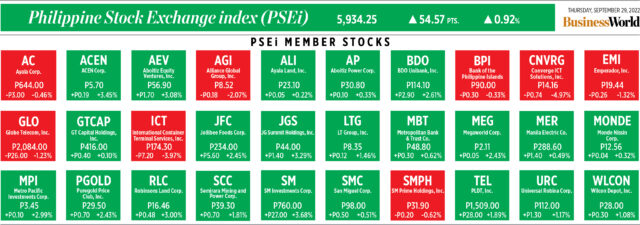
How PSEi member stocks performed — September 29, 2022

Here’s a quick glance at how PSEi stocks fared on Thursday, September 29, 2022.


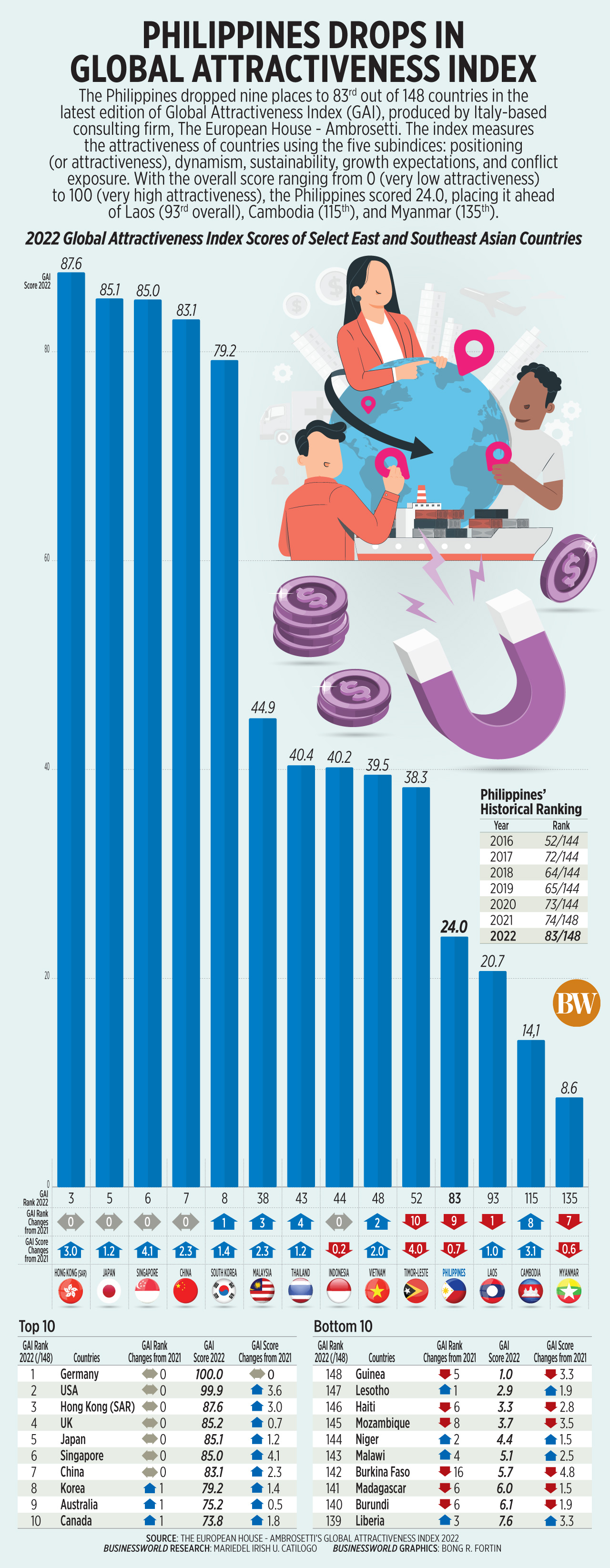
Philippines drops in global attractiveness index

The Philippines dropped nine places to 83rd out of 148 countries in the latest edition of Global Attractiveness Index (GAI), produced by Italy-based consulting firm, The European House – Ambrosetti. The index measures the attractiveness of countries using the five subindices: positioning(or attractiveness), dynamism, sustainability, growth expectations, and conflict exposure. With the overall score ranging from 0 (very low attractiveness) to 100 (very high attractiveness), the Philippines scored 24.0, placing it ahead of Laos (93rd overall), Cambodia (115th), and Myanmar (135th).

Philippines drops in global attractiveness index

Peso closes stronger as dollar demand eases

BW FILE PHOTO

THE PESO appreciated on Thursday as demand for dollars declined due to the Bank of England’s (BoE) emergency action to launch a bond program to avoid a meltdown in the gilts market.

The local unit closed at P58.97 against the greenback on Thursday, gaining one centavo from its P58.98 finish on Wednesday, Bankers Association of the Philippines data showed.

The peso started trading at P58.87 per dollar on Thursday. Its weakest showing was at P59, while its intraday best was at P58.75 versus the greenback.

Dollars exchanged fell to $902 million on Thursday from $1.19 billion on Wednesday.

The peso slightly strengthened due to the effect of the BoE’s intervention through purchases of long-dated bonds, Rizal Commercial Banking Corp. Chief Economist Michael L. Ricafort said in a Viber message.

The BoE said on Wednesday it would start a temporary program of bond purchases to stabilize the market and postpone the planned start of its gilt sale program.

“As the Governor said in his statement on Monday, the Bank is monitoring developments in financial markets very closely in light of the significant repricing of UK and global financial assets,” the BoE said in a statement.

“In line with its financial stability objective, the Bank of England stands ready to restore market functioning and reduce any risks from contagion to credit conditions for UK households and businesses,” it added.

“To achieve this, the Bank will carry out temporary purchases of long-dated UK government bonds from 28 September. The purpose of these purchases will be to restore orderly market conditions.”

MUFG Bank Currency Analyst Sophia Ng in a report said even though this move tamed the volatility in the market, it is seen to be inflationary in nature and may have an impact on the pace and magnitude of subsequent rate hikes.

Ms. Ng said the improvements in risk appetite overnight following the launch of the BoE’s emergency bond-buying program “should bring a reprieve for Asian currencies today.”

The peso also strengthened as the local stock market gained on Thursday, Mr. Ricafort said.

The bellwether Philippine Stock Exchange index climbed by 54.57 points or 0.92% to close at 5,934.25 on Thursday, while the broader all shares index inched up by 25.24 points or 0.79% to 3,190.88.

“The peso [was] slightly stronger after crude oil prices [were] still among 8-month lows,” Mr. Ricafort added.

Brent crude futures fell $1.18 or 1.3% to $88.14 a barrel by 0823 GMT and US crude futures dropped by $1.11 or 1.4% to $81.04.

Both benchmarks rebounded in the previous two sessions from nine-month lows earlier in the week, buoyed by a temporary dive in the dollar index and a larger than expected US fuel inventory drawdown.

For Friday, Mr. Ricafort gave a forecast range of P58.80 to P59 per dollar. — Keisha B. Ta-asan

Philippine stocks recover as foreign markets climb

REUTERS

THE LOCAL INDEX snapped out of its four-day decline on Thursday following Wall Street’s positive movement overnight as the Bank of England’s intervention in the UK bond market doused investors’ fears.

The bellwether Philippine Stock Exchange index (PSEi) climbed by 54.57 points or 0.92% to close at 5,934.25 on Thursday, while the broader all shares index inched up by 25.24 points or 0.79% to 3,190.88.

“The index staged an oversold rally today as it tracked similar moves in offshore markets. Today’s temporary reprieve comes on the heels of an overnight decline in the US treasury yields and a surprise intervention of the Bank of England in the UK bond market,” China Bank Securities Corp. Research Director Rastine Mackie D. Mercado said in an e-mail.

Philstocks Financial, Inc. Senior Research Analyst Japhet Louis O. Tantiangco said what the local bourse saw was a “technical bounce” supported by possible spillovers from Wall Street.

“However, over the medium term, we’re still seeing bearish bias due to [the] confluence of headwinds. Of course, we still have peso depreciation, which may likely continue due to the hawkish outlook of the Federal Reserve,” Mr. Tantiangco added during an interview with BusinessWorld Live.

Global equities staged a partial comeback on Wednesday as the Bank of England said it would temporarily buy long-dated bonds to dampen investors’ fears of contagion across the financial system, Reuters reported.

On Wednesday, Wall Street rebounded, with the Dow Jones Industrial Average adding 1.88% to close at 29,683.74, the S&P 500 Index gaining 1.97% to 3,719.04, and the Nasdaq Composite going up by 2.05% to 11,051.64.

Back home, the peso closed at P58.97 against the greenback on Thursday, gaining a centavo from its P58.98 finish on Wednesday, data from the Bankers Association of the Philippines show.

Most of the sectoral indices closed higher on Thursday. Holding firms gained 126.90 points or 2.26% to close at 5,729.84; mining and oil went up by 191.63 points or 1.84% to 10,575.30; industrials climbed by 108.87 points or 1.25% to 8,771.10; financials added 11.67 points or 0.79% to 1,484.20; and property inched up by 7.69 points or 0.30% to end at 2,545.67.

Meanwhile, services retreated by 13.94 points or 0.88% to end Thursday’s session at 1,555.75.

Value turnover went down to P5.19 billion with 658.93 million shares on Thursday changing hands from the P6.79 billion with 815.83 million issues traded on Wednesday.

Advancers outnumbered decliners, 121 to 76, while 42 names closed unchanged.

Net foreign selling went down to P491.71 million on Thursday from P588.99 million the previous trading day.

“Based on our outlook, we’re seeing bearish bias moving forward,” Philstocks Financials’ Mr. Tantiangco said, pointing to the index going below the 6,041-bear- market line

“At the same time, it has breached below the support range of 6,000-6,100,” he added.

China Bank Securities’ Mr. Mercado said: “We expect overnight developments in offshore markets to once again factor into investor sentiment and the market move for tomorrow (Friday).”

He placed the PSEi’s immediate support at 5,830 and its resistance moving within the 6,000-6,050 range. — Justine Irish D. Tabile

Philippines 4th deadliest country for eco-activists

KALIKASAN-PNE

THE PHILIPPINES was the fourth deadliest country in the world for land and environmental defenders last year, according to an international report, which noted that killings of indigenous peoples were rampant in the Southeast Asian nation.

The report by non-profit organization Global Witness said the country’s key institutions were weak, allowing perpetrators to commit crimes with “little accountability.”

Global Witness cited 19 environmentalists and land defenders killed in the Philippines in 2021, making the country the most dangerous country for green advocates in Asia.

“Steaming ahead with development projects without any consideration for human rights raises serious concerns about the future of land and environmental defenders in a country with one of the highest levels of killings of defenders in the world,” the report said, referring to the Philippines.

Latin American countries were at the top of the global list with Mexico ranking first with 54 killings, followed by Colombia with 33, and Brazil with 26 killings, the report said. Nicaragua was placed after the Philippines, with 15 killings.

Philippine Solicitor General Menardo I. Gueverra, the justice chief during the last years of former President Rodrigo R. Duterte’s six-year term, did not immediately reply to a Viber message seeking comments. The new administration has yet to issue a statement on the report.

While the Philippines saw a drop in killings of defenders in 2021 from 30 in 2020, the country recorded at least 270 killings between 2012 and 2021, the report said.

The report said that globally, 40% of all “fatal” attacks targeted indigenous peoples (IPs) “despite them only making up 5% of the world’s population.”

These were documented predominantly in Mexico, Colombia, Nicaragua, Peru, and the Philippines.

It said 40% or 114 of the defenders murdered in the Philippines in the last 10 years were IPs “campaigning to protect their land and the environment.” Nearly 80% of these took place in the southern region of Mindanao.

Most of the killings were linked to the mining sector, with 27 related deaths, the group said. Most of these occurred in Mexico (15), the Philippines (6), Venezuela (4), Nicaragua (1) and Ecuador (1).

The report also cited Mr. Duterte’s lifting of a nine-year-old moratorium on new mining projects on April 14, 2021, just over a year before he stepped down in end-June 2022. The moratorium was issued by his predecessor in 2012.

Global Witness said green advocates criticized the move, “warning that the new order could further endanger defenders as well as negatively impact key biodiversity areas, local water and food supplies, and Indigenous communities.”

“There is very little transparency in the Philippines’ mining sector, with mining contracts and data seldom made public,” according to the report, noting that rules mandating mining firms to get the consent of affected communities are “not consistently implemented.”

It said Mr. Duterte’s successor, President Ferdinand R. Marcos, Jr., “raised a red flag” during his first address to Congress in July, where he emphasized  “investment incentives including within the energy sector” and did not talk about the country’s human rights condition.

“Impunity is rife: it is suspected that state forces are behind the majority of killings in the few cases where the identity of the perpetrators is documented,” the report said. “Key state institutions, including the judiciary and law enforcement agencies, are weak, and the military and police commit human rights violations with little accountability.”

The Philippines is among the top five countries rich in mineral resources, the report noted, adding that nearly 30% of the country’s land is known to hold high mineral deposits, of which over 8% is covered by mining concessions as of July.

“It’s clear that the government has not taken this crisis seriously,” Philippine-based Kalikasan People’s Network said in a Facebook Messenger chat.

“While the slight drop in killings should be noted, unless specific measures are in place to protect environmental defenders — least of all even just recognizing the problem on a national level — these killings will undoubtedly continue at a systematic level,” the green network’s national coordinator, Jon Bonifacio, was quoted as saying.

The network said it will push for the refiling of an environmental defense bill, which seeks to establish appropriate mechanisms to hold perpetrators into account. “We only hope it gains traction under an administration that supposedly cares for the climate and the environment.” Kyle Aristophere T. Atienza
DoTr to push budget for jeepney revamp

BW FILE PHOTO

THE TRANSPORTATION department said it will continue to push for funding for its public utility vehicle modernization program (PUVMP) in 2023.

The department had proposed a P788-million budget for the program for next year, but it was not included in the national expenditure program.

“We continue to advocate funding for the PUVMP to our lawmakers… so that the program could be given funding during the deliberations,” Transportation Undersecretary Mark Steven C. Pastor said in Filipino at a briefing on Wednesday.

The PUVMP was a flagship program of the previous administration. It envisions a “restructured, modern, well-managed and environmentally sustainable transport sector where drivers and operators have stable, sufficient and dignified livelihoods while commuters get to their destinations quickly, safely and comfortably,” the Land Transportation Franchising and Regulatory Board said on its website.

Even without the PUVMP allocation, Secretary Jaime J. Bautista welcomed the final approval of the 2023 budget of the Department of Transportation (DoTr) and its attached agencies, amounting to P167.12 billion.

He said the House’s approval of the DoTr’s 2023 budget “highlights the need to provide Filipinos with safe, accessible, comfortable, and affordable transportation, as well as transform the country’s transportation system into global standards and fulfill the ‘full speed ahead’ order of President Ferdinand R. Marcos Jr.”

CASHLESS PAYMENT
Meanwhile, state-owned Land Bank of the Philippines (LANDBANK) has launched its mobile transit application for cashless and contactless payment in public utility vehicles, it said in a press release on Thursday.

The application can be used in transport units with an Automated Fare Collection System (AFCS) and the EMV standard which uses smart chips for transactions.

“The LANDBANK mCommuter app supports the government’s transport modernization agenda, geared towards enhancing the daily travel experience of commuters,” LANDBANK President and CEO Cecilia C. Borromeo was quoted as saying.

“This is part of our continued efforts to leverage digital technology to serve commuter needs.”

The LANDBANK and the DoTr launched the first six units of modern public utiltiy vehicles with AFCS capabilities this month. These were owned by the PM Jeepney Drivers Operators and Services, Inc.

Another 144 units will soon be deployed in selected pilot sites in the National Capital Region, Central Luzon, Calabarzon, and Metro Cebu.

The application has been available for download in Google Play Store since Sept. 13, while it is yet to be released in the Apple App Store. — Arjay L. Balinbin and Diego Gabriel C. Robles

Philippines eyeing ‘green investments’ despite tight fiscal space, Diokno says

PHILIPPINE STAR/KRIZ JOHN ROSALES

THE government can pursue green investments despite the limited fiscal space, Finance Secretary Benjamin E. Diokno told an Asian Development Bank (ADB) conference, adding that such investments were factored in when the Philippines started drafting its medium-term goals.

“All these programs are embedded in our medium-term development plan that we are designing at the moment,” Mr. Diokno said during the ADB Governor’s Seminar on Thursday.

“We’re not so much concerned about the fiscal space because, to me, given what we have done, the fiscal space is still there, (and) we have embedded the important greening programs moving forward.”

ADB President Masatsugu Asakawa told the gathering, however, that fiscal consolidation in many countries is only a matter of time.

“I think (the time will come for) every country to shift the gears (from) fiscal expansion to fiscal consolidation. Of course, countries should pick the right time to do so. It cannot be too early; it cannot be too late,” he said.

The Philippines’ debt-to-gross domestic product (GDP) ratio was 62.1% in the second quarter, above the 60% threshold deemed sustainable for developing countries, and reflecting the debt taken on to finance the response to the coronavirus disease 2019 (COVID-19) pandemic.

Still, “the Philippines has maintained its financial footing,” Mr. Diokno said, crediting recent structural reforms and the reopening of the economy.

The government intends to bring debt-to-GDP to 52.5% by 2028, as well as reduce its budget deficit from 7.6% to 3% over the same period via higher tax collections, rightsizing, and projected growth of 6.5%-8%.

Pasi Hellman, a Finnish foreign ministry official sitting on the ADB board, said official development assistance may be harder to come by with even donor countries having limited fiscal space.

“That’s why we need to work even harder to ensure different development financing institutions and entities have shared goals and better coordination,” he said. “For climate mitigation, there is clearly more private and commercial financing available.” He proposed that public money be focused on “facilitating (and) catalyzing by preparing and making projects bankable.”

“The world really needs renewable energy, and energy efficiency solutions that are scalable also in developing countries and make good business sense,” he added. “This, again, is where public funding can help to mitigate risks to pave way for private sector to enter the markets.”

The Philippine government recently revised the implementing rules and regulations (IRR) of its Build-Operate-Transfer Law, in response to concerns from economists and business groups that the government remains too insulated from risk even if project delays are the result of delayed government deliverables.

“It has cured a number of perceived defects of the old IRR. (I) think the new IRR is more responsive and clearer to potential investors,” Mr. Diokno told reporters on Tuesday.

At the same event, Mr. Diokno also expressed the Philippines’ interest in participating in the ADB’s $14-billion food security and climate change facility, which was announced on Tuesday.

“The short answer is definitely,” Mr. Diokno said. “Definitely we will avail of this facility.”

“I have looked at the performance of the Philippine economy for the last two decades. Industry and services are growing, but agriculture has been in and out of recession. It’s what I call a laggard, and this is because of many structural defects in the sector,” he added, mentioning the “mild” failure of the government’s agrarian reform program. 

Funding for the $14-billion program will be sourced from the ADB’s sovereign and private sector operations, with assistance starting this year until 2025.

Meanwhile, Mr. Diokno said that the government is also looking to focus on developing Mindanao.

“I love to say that Mindanao is so rich that it can feed the whole country… Now that we have achieved peace in Mindanao, we will focus on Mindanao,” he said.

“We have a new government setup there, and there is a lot of interest from our development partners,” he added. — Diego Gabriel C. Robles

ADVERTISEMENT
ADVERTISEMENT