Home Blog Page 576

ALI eyes Gatewalk as key commercial district in Cebu

LISTED property developer Ayala Land, Inc. (ALI) said its upcoming Gatewalk development in Mandaue City is set to become a key commercial district in Metro Cebu as it rolls out new access infrastructure and retail components.

“Gatewalk is envisioned to grow into Mandaue’s central commercial and lifestyle district, rising on a foundation of connected streets, active public spaces, and integrated urban experiences,” the company said in a statement on Wednesday.

ALI recently opened Gatewalk Drive, a new access road linking Lopez Jaena Street to M. Logarta Avenue in Mandaue, which is expected to improve accessibility to future developments within the estate.

The road is designed to support the rollout of office, retail, leisure, civic and green open spaces at Gatewalk, including the planned Ayala Malls Gatewalk, which the company aims to open by the end of 2026.

The mall will feature dining and entertainment concepts as well as community-focused spaces.

The estate will also include a one-hectare Greenway with landscaped parks and pedestrian corridors.

“The opening of Gatewalk Drive is a strong start to the district’s long-term vision,” Jennylle Tupaz, head of Central Luzon and VisMin Estates at Ayala Land, said. “Gatewalk is designed to become a central hub in Mandaue, where accessibility, commerce and community come together.”

ALI said Mandaue City, a key industrial and commercial center within the Metro Cebu corridor, offers strategic location advantages for the development.

By connecting Lopez Jaena Street with surrounding commercial and residential zones, the company said the new road would enhance access, ease travel and unlock opportunities for future developments within the estate.

Gatewalk forms part of ALI’s estate network in Metro Cebu, which also includes South Coast City in SRP, Cebu City; and Seagrove in Punta Engaño, Lapu-Lapu City.

The company’s other major developments in the province include Cebu Business Park and Cebu IT Park.

ALI reported a 0.9% year-on-year increase in nine-month attributable net income to P21.4 billion.

At the local bourse on Thursday, ALI shares closed down 0.47% or 10 centavos at P21 apiece. — Beatriz Marie D. Cruz

Microsoft unveils $23 billion in new AI investments with big focus on India

REUTERS

BENGALURU — Microsoft on Tuesday unveiled $23 billion in new artificial intelligence (AI) investments, with the bulk earmarked for India as the US tech giant deepens its bet on one of the world’s fastest-growing digital markets.

Chief Executive Officer Satya Nadella said Microsoft would spend $17.5 billion in India in its largest investment in Asia, building on a $3 billion commitment announced earlier this year. The four-year spending plan starts in 2026 and would give Microsoft the largest cloud-computing presence in India.

With around a billion internet users and deep tech talent, India has become a key destination for US tech giants, which are investing billions of dollars to build AI infrastructure.

Data centers are seen as the South Asian country’s best shot at breaking into the boom, given that it has limited chip-manufacturing capabilities.

Google said in October it would invest $15 billion over five years to build an AI data center in the southern state of Andhra Pradesh, its biggest commitment in the world’s most populous nation.

The Microsoft spending will “help build the infrastructure, skills, and sovereign capabilities needed for India’s AI first future,” Mr. Nadella said in a post on X, sharing a photo of himself with Indian Prime Minister Narendra Modi.

Mr. Nadella is in the country for a three-day trip for the company’s AI conferences, with events in the capital New Delhi, IT hub Bengaluru and financial center Mumbai starting Wednesday.

The investments — the latest big-ticket outlay by technology companies in the high-stakes AI race — come amid a diplomatic standoff between New Delhi and Washington over tariffs and a stalled trade deal.

CANADA INVESTMENT PLANS

Microsoft said earlier in the day it would invest more than C$7.5 billion ($5.42 billion) in Canada over the next two years, with new cloud capacity under the investment slated to come online in the second half of 2026. The move was part of its total planned Canada spending of C$19 billion between 2023 and 2027.

That would help the company expand its Azure Local cloud offering in the country, and Microsoft is also partnering with Canadian AI startup Cohere to offer the firm’s advanced AI models on its Azure platform.

The Windows maker and other big US cloud providers are expected to spend more than $400 billion on AI this year to build out data centers needed to support services such as ChatGPT, Copilot and Gemini.

But that growing spending, limited evidence of real-world AI productivity gains, soaring valuations and a web of circular investments have stoked fears of an AI bubble.

DATA CENTER EXPANSION, MORE SKILLING INITIATIVES

Microsoft said a new data center in Hyderabad would be its largest hyperscale region in India and is expected to go live in mid-2026. It will also expand its three existing regions in Chennai, Hyderabad and Pune, and has doubled a January pledge to equip 20 million Indians with essential AI skills by 2030.

Total data center capacity in India is expected to more than triple to about 4.5 gigawatts by 2030, according to real estate consultancy Colliers. One gigawatt of computing power is roughly enough to power about 750,000 US homes.

Microsoft employs more than 22,000 people in India and about 5,300 in Canada.

It announced plans to invest $10 billion in AI infrastructure in Portugal as well as $15 billion in the United Arab Emirates last month. — Reuters

Artist Nnena Kalu wins UK’s 2025 Turner Prize

https://www.tate.org.uk/press/press-releases/nnena-kalu-wins-turner-prize-202

LONDON — Glasgow-born artist Nnena Kalu won the 2025 Turner Prize for contemporary art on Tuesday, with the jury praising the hanging sculptures she creates from wrappings of varied materials, forming cocoon-like shapes, as well as her large-scale drawings.

Established in 1984 and named after British painter J.M.W. Turner, the prestigious art prize is awarded to an artist born or based in the United Kingdom for an outstanding exhibition or presentation of their work in the past 12 months.

Ms. Kalu, 59, receives a £25,000 ($33,240) prize.

The jury commended Ms. Kalu’s “bold and compelling work” and highlighted her “distinct practice and finesse of scale, composition and color,” describing the pieces as having a powerful presence.

The 2025 prize was announced at a ceremony at a school in the northern English city of Bradford, this year’s UK City of Culture, and was presented by magician Steven Frayne, formerly known as Dynamo.

Last year’s prize was won by artist Jasleen Kaur, who was also born in the Scottish city of Glasgow. — Reuters

Recycling as trade defense

STOCK PHOTO | Image by FREEPIK

The Philippines has a garbage problem that the world can see. Tons of our plastic waste continue to end up in the ocean. What lies ahead, however, is not only an environmental problem but also a trade problem. Philippine companies that sell into Europe are at risk.

Diplomats failed to agree on a global plastics treaty in Busan, South Korea late last year. The European Union did not wait. It moved ahead and finalized rules that require recyclable packaging for all products sold in the EU. The clock is now ticking for Philippine exports to Europe.

The EU’s Packaging and Packaging Waste Regulation, or PPWR, is now law. Starting August 2026, Philippine brands that export food, cosmetics, electronics, and other goods to Europe must meet new standards on recyclability, labeling, and empty space. Failure to comply can create new barriers to entry.

The plastic problem is no longer a matter of cleaning rivers and protecting oceans. It is also a matter of defending market access, particularly in Europe. Between August 2026 and 2030, we need to overhaul export policies, regulations, and business practices so our export goods can keep their access.

The EU’s PPWR requires all packaging to be recyclable by design by 2030, with binding measures arriving in phases as early as next year. It mandates harmonized labels to remove consumer confusion, strict limits on void space or air in boxes, and high separate-collection targets for beverage containers. These rules touch every pack that crosses the EU border.

This matters because the Philippines is an exporting economy. Our bananas, dried mangoes, coconut oil, semiconductors, and many other goods do not travel unwrapped. They travel in packaging. As our trading partners pivot to circularity, our domestic packaging ecosystem must adapt.

If we do not align, our producers may be forced to keep dual inventories, one pack format for export and another for local sale. That creates higher costs and production inefficiencies that can kill competitiveness, especially abroad. It also sets a poor example at home. Why should we accept weaker standards locally than those we are forced to meet in Europe? The standards should be the same.

In this sense, the biggest threat to Philippine exports may not be tariffs. It may be the physical design of our packaging. Under the new regulation, a shipment can be rejected at the border not because of what is inside the box, but because of the box itself. Food and electronics could take the biggest hit.

Consider dried mangoes. The product is world-class. The foil pouch that carries it is not. Most pouches today are multi-layer laminates, a sandwich of plastic and aluminum bonded together. Recycling plants cannot separate these layers at scale.

Under PPWR timelines, that kind of packaging will lose market access unless producers shift to materials that real facilities can process. The EU is not against plastic by default. It is against packaging that cannot be recycled in practice.

Semiconductor exports face a different risk. The PPWR limits the empty air inside a package to a maximum of 50%. Many electronics are small and often ship in large cartons padded with foam and bubble wrap. Exporters will need to reduce air, right-size boxes, and avoid restricted protective foams.

The first wave of restrictions starts in August next year. These include tighter rules for food-contact packaging and chemicals, which affect exporters that rely on grease-proof papers for baked goods or wrappers for fast food. Philippine products risk losing shelf space to competitors that already invested in circular design and compliant materials.

We are not starting from zero. We already have an Extended Producer Responsibility law, Republic Act 11898, that compels large companies to recover plastic waste. The law, however, focuses on waste tonnage recovered rather than the design choices that prevent waste in the first place. It does not hard-wire design for recycling, uniform labeling, or a national deposit-return system.

What we need now is a clear legal mandate for design. Companies should be required to use packaging that can be recycled in practice and at scale. Many will resist on the basis of cost. But if we intend to keep market share in the EU, exporters may no longer have a choice. Retooling is cheaper than losing a market.

Stronger rules will also shift the domestic market toward better packaging. Yes, there will be costs. But the benefits to consumers and the environment make the effort worthwhile. We cannot continue to rely on un-recyclable formats that fill dumps and leak into waterways.

We should align domestic rules with international standards via a Philippine version of the Packaging and Packaging Waste Regulation. Congress is now considering a tax on single-use plastic bags. However, a comprehensive PPWR-style law is the larger system change. The bag tax can play a supporting role.

Voluntary pledges will not get us there. Recyclability by design should be mandated. That mandate requires clear technical specifications and objective criteria for recyclability across plastic, glass, paper, metals, etc. We can match ISO and EU benchmarks, provided we also incentivize investments in domestic recycling capacity and offer smart tax breaks for re-processors and clean-material logistics.

The EU’s 2030 deadline may be ambitious for some domestic formats. We can phase it. Maybe 10 years from now, any package that cannot be recycled in practice and at scale should no longer be allowed on store shelves. We should apply a similar discipline to imports that enter the Philippine market, since those packs end up in our waste stream as well.

The immediate priority is exports. Encourage local manufacturers to upgrade now for the EU deadline in 2030, then complete the shift for the domestic market by 2035. That window gives producers more time to retool and gives investors time to build the wash lines, pulping capacity, cullet logistics, and sorting facilities that a circular system needs.

A new mandate can also standardize and harmonize waste-sorting labels nationwide. Consumers deserve simple, consistent instructions on how to dispose of each pack. We can revive deposit-return systems for bottles and cans, set reasonable limits on single-use formats like condiment sachets and dine-in disposables, and scale refill and bulk dispensing where density supports it. The goal is to create clean, predictable material streams that finan-ciers and recyclers can bank on.

Policy design should reward good choices and penalize poor ones. Producers that use mono-material, clear, label-friendly, and truly recyclable packaging should be rewarded. And those that persist with complex laminates and hard-to-recycle formats should be penalized.

Design for recycling is both a sustainability move and a cost-management strategy because it prevents waste and reduces contamination. Recyclable packaging is also a trade defense strategy as well as an environmental re-form. We protect export access by meeting the rules of destination markets and we protect our coastlines by keeping valuable materials in circulation.

Government can help finance the transition. Part of the revenue from a single-use plastic bag tax can fund capital expenditures for modern materials recovery facilities, deposit-return clearinghouses, standardized bins and labels, and enforcement. The tax should not be viewed as a burden on consumers. It should be seen as a bridge that carries us from today’s leakage to tomorrow’s circular system.

Science already supports alternatives. Research validates cellulose, starch, chitin, lignin, and other agricultural residues as viable inputs for packaging. These bio-based materials can become films, trays, and coatings. Many are compatible with existing recycling streams, and some work in controlled composting where bio-waste collection exists.

We should scale R&D, set performance standards, and pilot commercial applications with farmers, universities, and manufacturers. Recyclable and biodegradable are not marketing lines. They are performance requirements that must be proven in real facilities.

We must change how packaging is designed, labeled, collected, and funded if we want to keep export markets and clean up our streets and seas. A Philippine PPWR, working alongside the existing EPR law and a well-designed plastic bag tax, can deliver that change.

A local PPWR sets the system rules for design, labeling, and collection. The EPR law provides a financing backbone and accountability. The plastic bag tax nudges behavior in the short term and helps fund the infrastructure that will make itself unnecessary over time. The change will also protect our exports. Saving the environment is saving the economy.


Marvin Tort is a former managing editor of BusinessWorld, and a former chairman of the Philippine Press Council
matort@yahoo.com


Peso edges up before Fed, BSP decisions

THE PESO inched up against the dollar on Wednesday as investors await the policy decisions of the US Federal Reserve and the Bangko Sentral ng Pilipinas (BSP).

The local unit gained a centavo to close at P59.21 versus the greenback from its record-low finish of P59.22 on Tuesday, data from the Bankers Association of the Philippines data showed.

The peso opened Wednesday’s trading session weaker at P59.25 versus the dollar, which was also its intraday low. Meanwhile, it climbed to its strongest at P59.16 against the greenback.

Dollars traded rose to $1.29 billion from $1.097 billion on Tuesday.

“The peso moved almost flat amid market uncertainty ahead of the Fed and BSP policy decisions tomorrow,” a trader said in a Viber message.

The Fed was set to announce its policy decision overnight. A second straight 25-basis-point (bp) cut is largely priced in, but markets will monitor the statement of Fed Chair Jerome H. Powell for clues on the central bank’s future policy path.

Meanwhile, a BusinessWorld poll showed that 17 of 18 analysts expect the Monetary Board to deliver a fifth straight 25-bp reduction at its meeting on Thursday to bring the policy rate to 4.5%, the lowest since September 2022. One analyst sees an outsized 50-bp cut.

The BSP has lowered benchmark rates by a total of 175 bps since it began its easing cycle in August 2024.

The peso was also supported by lower global crude oil prices as well as the seasonal increase in remittances amid the holiday season, Rizal Commercial Banking Corp. Chief Economist Michael L. Ricafort said in a Viber message.

For Thursday, the trader said the peso could appreciate in the morning session in reaction to the Fed’s statement, but weaken again once the BSP announces its own decision.

The trader sees the peso moving between P59.10 and P59.30 per dollar, while Mr. Ricafort expects it to range from P59.05 to P59.25.

Oikonomia Advisory and Research, Inc. economist Reinielle Matt M. Erece said in a Viber message that the central bank could step in to prevent the peso from sinking to the P60 level to support consumer and business senti-ment.

“The central bank may employ measures such as the outflow of reserves to prop up the peso. Moreover, the holiday season may continue to support the domestic currency, preventing it from slipping too much,” he added.

BSP Governor Eli M. Remolona, Jr. has said that the central bank would only intervene in the foreign exchange market if the peso’s prolonged depreciation becomes inflationary. — A.M.C. Sy

Maynilad concludes stabilization activity for equity offering

MAYNILAD

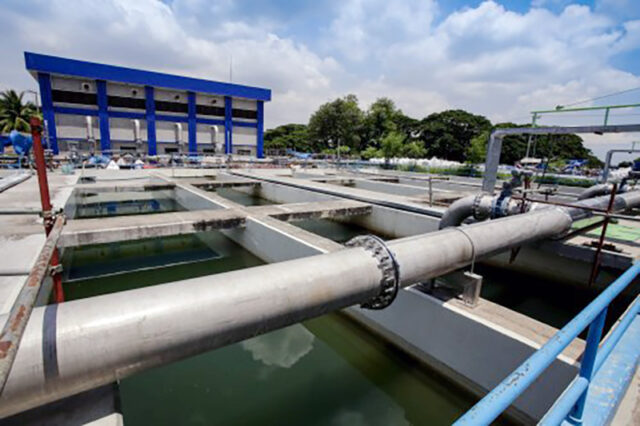
WEST ZONE water concessionaire Maynilad Water Services, Inc. has concluded its stabilization activities for its P34.3-billion equity offering, nearly a month after its debut on the Philippine Stock Exchange.

In a disclosure to the exchange on Wednesday, the company said UBS AG Singapore Branch, acting as stabilization agent, purchased a total of 144.29 million shares during the stabilization period covering Nov. 7 to Dec. 5.

The stabilization activity, undertaken in connection with Maynilad’s overallotment option, allows the agent to buy shares in the open market to limit excess volatility following a new share sale.

The shares purchased represent about 2% of Maynilad’s outstanding shares of 7.55 billion. The company said these purchases form part of temporary price-support operations and do not reflect a change in long-term owner-ship.

Since listing on Nov. 7, Maynilad shares have eased 0.61% to close at P16.20 on Wednesday.

Maynilad is the second and last company to list on the local bourse this year and the largest initial public offering since Monde Nissin Corp.’s P48.6-billion offering in 2021.

The company is an integrated provider of water and wastewater services for the West Zone, covering 11 cities in Metro Manila and parts of Cavite province.

Metro Pacific Investments Corp., which holds a majority stake in Maynilad, is one of three Philippine subsidiaries of First Pacific Co. Ltd., alongside Philex Mining Corp. and PLDT Inc.

Hastings Holdings, Inc., a unit of PLDT Beneficial Trust Fund subsidiary MediaQuest Holdings, Inc., holds an interest in BusinessWorld through the Philippine Star Group, which it controls. — Sheldeen Joy Talavera

Scientists discover secrets of ancient Roman concrete at Pompeii

A TOURIST visits the archaeological site of the ancient city of Pompeii, Italy, April 27, 2021. — REUTERS

SCIENTISTS excavating the ruins of Pompeii have discovered a construction site left frozen in time by the eruption of Italy’s Mount Vesuvius volcano in 79 AD, clarifying the ingredients and methods behind the durable self-healing concrete the ancient Romans used to revolutionize architecture.

The site represents a building project that was underway when the eruption buried Pompeii under volcanic ash and rock. The researchers came across rooms where the walls were unfinished and piles of premixed dry material and tools for weighing and measuring were in place for preparing concrete.

“Studying it truly felt as if I had traveled back in time and was standing beside the workers as they mixed and placed their concrete,” said Admir Masic, a Massachusetts Institute of Technology professor of civil and environmen-tal engineering and leader of the study published on Tuesday in the journal Nature Communications.

An indispensable building material, concrete helped the Romans erect structures including stadiums like the Colosseum, domed temples like the Pantheon, public baths and other big buildings, aqueducts and bridges unlike any fashioned to that point in history. Because the concrete could harden underwater, it also was vital for constructing harbors and breakwaters.

The precise method they used to make their concrete has been a matter of debate, with recent archaeological discoveries appearing to contradict accounts given in a 1st century BC treatise by Roman architect and engineer Vi-truvius.

The Pompeii discovery showed the Romans used a technique called “hot mixing” in which a material called quicklime — dry limestone that was previously heated — is combined directly with water and a blend of volcanic rock and ash, producing a chemical reaction that naturally heats the mixture. That differs from the method described by Vitruvius, who wrote about a century earlier.

“Pompeii preserves buildings, materials and even work in progress in the precise state they were in when the eruption occurred. Unlike finished structures that have undergone centuries of repair or weathering, this site cap-tures construction processes as they happened,” Mr. Masic said.

“For studying ancient technologies, there is simply no parallel,” Mr. Masic said. “Its exceptional preservation offers a true ‘snapshot’ of Roman building practice in action.”

The building under construction combined domestic rooms with a working bakery with ovens, grain-washing basins, and storage. The evidence there indicated that the technique outlined by Vitruvius, known as slaked lime, was not used for building walls.

That method may have been outdated by the time of the project in Pompeii.

“Imagine what 100 years of difference could mean for the building technology. A good analogy could be the early telephones. In the 1920s-30s: rotary dialing, long-distance copper lines. In the 2020s: smartphones using pack-et-switched digital signals and wireless networks,” Mr. Masic said.

The hot-mixing technique contributed to the self-healing properties of the concrete, chemically repairing cracks. The concrete contains white remnants of the lime used to make it, called “lime clasts,” which can dissolve and re-crystallize, healing cracks that may form with the infiltration of water.

The Romans industrialized concrete, beginning in the 1st centuries BC and AD.

“This allowed builders to construct massive monolithic structures, complex vaults and domes, and harbors with concrete that cured underwater. Concrete fundamentally expanded what could be built and how cities and infra-structures were conceived,” Mr. Masic said.

The new understanding of Roman concrete may have relevance for modern architects.

“Modern concretes generally lack intrinsic self-healing capability, which is increasingly important as we seek longer-lasting, lower-maintenance infrastructure,” Mr. Masic said. “So while the ancient process itself is not a direct replacement for modern standards, the principles revealed can inform the design of next-generation durable, low-carbon concretes.” — Reuters

The rise of AI reasoning models comes with a big energy trade-off

FREEPIK

NEARLY ALL leading artificial intelligence (AI) developers are focused on building AI models that mimic the way humans reason, but new research shows these cutting-edge systems can be far more energy intensive, adding to concerns about AI’s strain on power grids.

AI reasoning models used 30 times more power on average to respond to 1,000 written prompts than alternatives without this reasoning capability or which had it disabled, according to a study released on Thursday last week. The work was carried out by the AI Energy Score project, led by Hugging Face research scientist Sasha Luccioni and Salesforce, Inc. head of AI sustainability Boris Gamazaychikov.

The researchers evaluated 40 open, freely available AI models, including software from OpenAI, Alphabet, Inc.’s Google and Microsoft Corp. Some models were found to have a much wider disparity in energy consumption, including one from Chinese upstart DeepSeek. A slimmed-down version of DeepSeek’s R1 model used just 50 watt hours to respond to the prompts when reasoning was turned off, or about as much power as is needed to run a 50 watt lightbulb for an hour. With the reasoning feature enabled, the same model required 7,626 watt hours to complete the tasks.

The soaring energy needs of AI have increasingly come under scrutiny. As tech companies race to build more and bigger data centers to support AI, industry watchers have raised concerns about straining power grids and raising energy costs for consumers. A Bloomberg investigation in September found that wholesale electricity prices rose as much as 267% over the past five years in areas near data centers. There are also environmental drawbacks, as Microsoft, Google and Amazon.com, Inc. have previously acknowledged the data center buildout could complicate their long-term climate objectives.

More than a year ago, OpenAI released its first reasoning model, called o1. Where its prior software replied almost instantly to queries, o1 spent more time computing an answer before responding. Many other AI companies have since released similar systems, with the goal of solving more complex multistep problems for fields like science, math and coding.

Though reasoning systems have quickly become the industry norm for carrying out more complicated tasks, there has been little research into their energy demands. Much of the increase in power consumption is due to reasoning models generating much more text when responding, the researchers said.

The new report aims to better understand how AI energy needs are evolving, Ms. Luccioni said. She also hopes it helps people better understand that there are different types of AI models suited to different actions. Not every query requires tapping the most computationally intensive AI reasoning systems.

“We should be smarter about the way that we use AI,” Ms. Luccioni said. “Choosing the right model for the right task is important.”

To test the difference in power use, the researchers ran all the models on the same computer hardware. They used the same prompts for each, ranging from simple questions — such as asking which team won the Super Bowl in a particular year — to more complex math problems. They also used a software tool called CodeCarbon to track how much energy was being consumed in real time.

The results varied considerably. The researchers found one of Microsoft’s Phi 4 reasoning models used 9,462 watt hours with reasoning turned on, compared with about 18 watt hours with it off. OpenAI’s largest gpt-oss model, meanwhile, had a less stark difference. It used 8,504 watt hours with reasoning on the most computationally intensive “high” setting and 5,313 watt hours with the setting turned down to “low.”

OpenAI, Microsoft, Google and DeepSeek did not immediately respond to a request for comment.

Google released internal research in August that estimated the median text prompt for its Gemini AI service used 0.24 watt-hours of energy, roughly equal to watching TV for less than nine seconds. Google said that figure was “substantially lower than many public estimates.”

Much of the discussion about AI power consumption has focused on large-scale facilities set up to train artificial intelligence systems. Increasingly, however, tech firms are shifting more resources to inference, or the process of running AI systems after they’ve been trained. The push toward reasoning models is a big piece of that as these systems are more reliant on inference.

Recently, some tech leaders have acknowledged that AI’s power draw needs to be reckoned with. Microsoft CEO Satya Nadella said the industry must earn the “social permission to consume energy” for AI data centers in a November interview. To do that, he argued tech must use AI to do good and foster broad economic growth. — Bloomberg

Observations from my five foreign trips in 2025

I was lucky to have taken five foreign trips this year — to Hong Kong and China last April, Spain in September, and Vietnam and Japan in November. All were work-related except the Vietnam trip, which was a vacation with my ex-UP Narra dormmates with our spouses and friends.

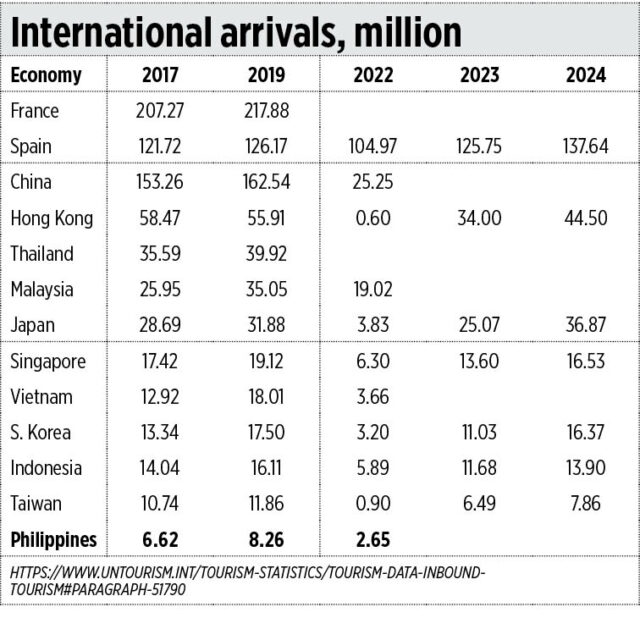
To help provide context to the observations I made about tourism during my travels, I constructed this table based on information from the UN Tourism website. I added a few other countries I have been to — like France as I had gone to Nice in 2023. I also added other East Asian neighbors to this table.

The Philippines has the smallest number of tourist arrivals in the table, mainly because of its geography. It is far away from the Asian mainland where visitors can go from, say, Vietnam to Cambodia to Thailand by car or bus aside from airplane. Add to this our generally poor infrastructure.

Here are some observations, some of which we can possibly adapt in the Philippines.

1. Hong Kong’s huge airport is directly connected to the city by high-speed train, then one can go by taxi or subway to stations near hotels. There are also buses from the airport to major hotel corridors. The city’s long and modern subway trains and the huge skyscrapers continue to amaze me. It’s main attraction for international visitors is its unilateral free trade policy, with zero tariffs for exports and imports so visitors can find many items from China and many other countries at competi-tive prices. This is a combination of tourism and trade policy that the Philippines should consider.

2. While Beijing international airport is also huge and is connected to the city by a fast airport express train, our host picked us up by van as we stopped by a nice restaurant before going to our hotel. We took the toll road, but it was congested even on a Sunday night. China has become a car culture country unlike many decades ago where it was a bicycle and motorcycle riding country.

3. Madrid’s international airport is also huge, but our landing terminal was far away from the baggage claim. It took about an hour from landing to get the luggage, a very long time! Going from the airport express train to the high-speed train station going to Valencia (where I was attending my annual international free market network conference) and other cities is very confusing as there were no clear signs. I missed my train to Valencia and had to buy another train ticket. SMC’s Bulacan airport should avoid this kind of lousy airport design.

4. Ho Chi Minh international airport is also big, but the country is getting a lot more visitors now as many Chinese tourists are avoiding Japan and the US, going instead to Vietnam and other East Asian nations. Flying back to Manila, it took us more than one hour just queuing at immigration, then the security check for passengers and their hand-carry. I think Ho Chi Minh airport should move elsewhere, like a wide reclaimed area near the sea where further expansion is possible.

5. The Narita-Tokyo international airport is really huge and modern. But I noticed it was not as busy as before, probably due to millions of China tourists avoiding Japan due to the ongoing diplomatic spat over Taiwan. Nagoya airport is also huge, but we landed at the domestic terminal. Flying back to Manila we took the Haneda-Tokyo airport, also huge but not as big as Narita.

6. China is careful to preserve its historic structures that are up to 1,500 years old. The Great Wall of China attracts 15-17 million tourists a year, with the Badaling section near Beijing attracting some 10 million. Our host brought me there in the afternoon after our morning meeting and lunch, and I was amazed by the huge number of visitors coming in even in late afternoon — many white people, then locals from other provinces, then other Asians.

The Forbidden City or Palace Museum in the center of Beijing attracted up to 19 million visitors in 2019. When I was there, my host said it gets an average of 40,000 visitors a day, peaking at 80,000 a day in the summer months. One must reserve tickets several days ahead. Again, I was amazed at the hugeness of the area, the wood carvings, and architecture.

7. I was impressed by the high-speed trains I took during my trips. There was China’s train, which runs up to 350 kph from Chengde to Beijing; then Spain’s train which runs up to 300 kph from Madrid to Valencia and back; then Japan’s shinkansen or bullet train which runs up to 280 kph from Nagoya to Tokyo. There are trains going at up to 320 kph in other destinations. All arrive and depart on schedule, but in terms of a smooth ride, I think Chi-na’s more modern trains are better. The Philippines should aspire to have these high-speed trains someday, say from Manila to Laoag City in the north and to Legaspi City in the south.

8. They use tunnels instead of zigzag roads to traverse hills and mountains. Going from Beijing to a pumped-hydro storage power plant in the mountains, we passed by a long elevated toll road, then through so many tunnels — ranging in length from 200 meters to two to five kms long — that I lost count. Smooth, well-paved, and well-lit, there was even an internet signal inside the long tunnels. The Philippines should have these tunnels too someday: these would re-duce road accidents and road closures from landslides. They would also do for horizontal mining.

9. There were no tricycles, no jeepneys, and no stray dogs in sight. The five places I went to have none of these while the Philippines has a lot. Even Vietnam has none of these, only motorcycles, cars, and aircon buses. And even in rural areas of Ho Chi Minh, all the houses have fences and gates except those with shops and restaurants. The gates are about two to three meters from the road, with no vehicles — even motorcycles — parked on road shoulders. The motorists are disciplined and considerate.

10. The rule of law protects peace and order, and private property. I saw few or no security guards at shops, malls, and hotels. Plus, there were lots of bright lights at night (no issues with the electricity supply) and wide pe-destrian walkways.

There are more observations, but I limit myself this time to those 10 points.


Bienvenido S. Oplas, Jr. is the president of Bienvenido S. Oplas, Jr. Research Consultancy Services, and Minimal Government Thinkers. He is an international fellow of the Tholos Foundation.
minimalgovernment@gmail.com

BSP, SEC ink deal on PERA data sharing

Photo credit | THE PHILIPPINE STAR

THE BANGKO SENTRAL ng Pilipinas (BSP) has signed a memorandum of agreement (MoA) with the Securities and Exchange Commission (SEC) to exchange and manage information on Personal Equity and Retirement Account (PERA) contributors.

The partnership signed on Dec. 3 will help safeguard the retirement savings of Filipinos, the central bank said in a statement on Wednesday.

The agreement covers data sharing and the access to and use of information from the Personal Equity and Retirement Account System or PERASys.

PERASys is managed by the BSP and is the central database of all PERA contributors.

“It helps ensure that every contributor’s hard-earned savings and corresponding tax incentives are accurately recorded and well-protected,” it said.

Under the MoA, the two regulators will ensure that data on PERA contributors are shared and used securely and responsibly.

The agreement ensures full compliance with data privacy laws and sets “high” standards for confidentiality, recordkeeping, and data security, the BSP said, as it outlines the procedures for reporting, handling of operational issues, and safeguarding information.

“When you put aside part of your income for your future, you trust us to protect that investment,” BSP Governor Eli M. Remolona, Jr. said,

“With this partnership, we are building a system that keeps your information safe and your future more certain. It is one more step toward helping every Filipino retire with dignity and peace of mind.”

PERA, created under Republic Act No. 9505 in 2016, is a voluntary retirement saving program that aims to supplement benefits from the Social Security System, Government Service Insurance System, and employer-provided plans.

BSP data showed that accumulated PERA contributions rose by 24% year on year to P491.4 million at end-2024 from P396.3 million the previous year.

The total number of PERA contributors likewise grew by 6.4% to 5,912 by the end of last year from 5,555 in 2023. — Katherine K. Chan

Ray-Ban Meta glasses take off but face privacy and competition test

https://www.ray-ban.com/usa/ray-ban-meta-ai-glasses

MILAN — EssilorLuxottica is betting big on smart eyewear and the gamble is about to be tested. Its Ray-Ban Meta glasses, powered by artificial intelligence (AI), have delivered their first meaningful revenue boost this year, but analysts warn that privacy concerns and a wave of new rivals could limit their growth.

The frames, launched in 2021, promise to upend the smartphone era by letting wearers take photos and videos through tiny cameras in the lenses, stream content to Meta apps and talk to an AI assistant.

Yet the same features that promise to make the AI-powered frames — born from the collaboration between Mark Zuckerberg’s Meta and French-Italian eyewear giant EssilorLuxottica — into a must-have device are sparking concerns, as bystanders have little control over being recorded or how their data is handled.

“AI smart glasses raise significant privacy concerns,” said Kleanthi Sardeli, a lawyer at European digital rights advocacy group NOYB. “The main issues are linked to the use of people’s personal data to train AI models and transparency for bystanders.”

Meta Platforms, which owns Facebook, Instagram and WhatsApp and generates the bulk of its revenue from advertising, is leveraging user data to power artificial intelligence tools, a move that brought the company to face scrutiny over data practices.

REGULATORY SCRUTINY IN EUROPE

European regulators have flagged risks since 2021, when Italy and Ireland asked Meta to clarify how it complied with local privacy laws.

Ireland’s Data Protection Commission questioned whether a tiny LED indicator was enough to alert people they were being filmed, prompting Meta and EssilorLuxottica to enlarge the light and add a blinking pattern.

Privacy concerns are particularly strong in the European Union (EU), where stricter regulations have slowed adoption of some AI features.

AI-enabled wearables are regulated by the EU’s AI Act and the General Data Protection Regulation, or GDPR.

“Any recording of individuals must be clearly communicated and must have a legal basis to record individuals,” unless the data was processed for purely personal or household reasons, a European Commission spokesperson said.

But enforcing those rights is difficult when the device owner is unknown, says NOYB.

A 2024 Monash University survey of more than 1,000 Australians found owners see smart glasses as boosting their self-image and social ties, while non-users fear privacy breaches and social disruption.

EssilorLuxottica said it partners “with competent authorities to drive innovation, safeguard privacy and set new industry standards.”

A Meta spokesperson declined to comment beyond referring to EssilorLuxottica’s statement.

COMPETITION HEATS UP

Ray‑Ban Meta glasses lead the AI eyewear market thanks to a partnership that bridges tech and fashion, analysts and experts say, a gap that doomed Google Glass a decade ago.

According to Barclays, EssilorLuxottica currently holds a 60% share of the smart glasses market.

“Instead of trying to make something cool, Meta partnered with people who know what’s cool,” said Ross Gerber, Chief Executive Officer (CEO) of California-based wealth management firm Gerber Kawasaki, which holds Meta shares.

But its first-mover advantage may fade as rivals launch better products, said Bernstein analyst Luca Solca. Smart glasses could also cannibalize traditional eyewear, which accounts for about a quarter of EssilorLuxottica’s revenue.

Several tech giants aim to catch up.

In November Alibaba released its new Quark AI-powered glasses in China, where Ray-Ban Meta are not sold.

Apple is expected to unveil its own model next year and release it in 2027, Bloomberg News reported.

Google is working with Warby Parker and luxury fashion house Kering to develop its own version, announcing on Monday it expected to launch a first product in 2026, sending EssilorLuxottica shares lower. Amazon is also reportedly exploring the market and Xiaomi launched a similar product in June.

LEVERAGING ITS BRAND PORTFOLIO

EssilorLuxottica, the world’s biggest eyewear maker, can lean on its 18,000-store network and brands such as Prada, Armani and Chanel.

“One of the key differentiating elements for them is not just their ability to produce, but also their ability to distribute, and their ability to leverage a portfolio of brands,” said Bassel Choughari, Paris-based portfolio manager at Comgest, which holds EssilorLuxottica shares.

“That is an element that shouldn’t be underestimated.”

EssilorLuxottica CEO Francesco Milleri, who took over as head of the company in 2020, is steering the group towards medical technology.

Smart glasses, central to this strategy, contributed more than four percentage points to EssilorLuxottica’s nine-month sales growth, sparking a 14% market rally for the €140-billion company, even though they account for just 2% of global sales, investor CCLA estimates.

EssilorLuxottica is looking to build on this momentum. It has widened its portfolio to sports brand Oakley and held exploratory talks with Prada, heir to the luxury brand, Lorenzo Bertelli told Reuters. In September it introduced a model with an in-lens display, operated through a bracelet that converts hand gestures into commands.

Competition is welcome, the company says: “A vibrant ecosystem will help us drive market growth, fuel innovation and expand consumer choice.” — Reuters

Hendrix classic albums under spotlight in UK rights battle with Sony

https://en.wikipedia.org/wiki/File:Are_You_Experienced_-_US_cover-edit.jpg

LONDON — Jimi Hendrix’s classic 1960s albums are the focus of a London lawsuit over performers’ rights asserted on behalf of his British bassist and drummer against Sony Music Entertainment, which warns that a win for the claimants could “throw the music industry into chaos.”

Guitarist Noel Redding, who had recently auditioned for the 1960s blues-rock band The Animals, and pioneering drummer Mitch Mitchell joined The Jimi Hendrix Experience in 1966 and created some of the most renowned mu-sic of the decade.

Mr. Redding and Mr. Mitchell played on the group’s three studio albums Are You Experienced, Axis: Bold As Love, and Electric Ladyland, released in 1967 and 1968 and featuring “Hey Joe,” “Purple Haze,” “Foxy Lady” and other hits.

The recordings helped usher in the psychedelic music age and made Mr. Hendrix a rock superstar before his untimely death in London in September 1970, aged 27. Five decades on, The Jimi Hendrix Experience’s music remains both popular and profitable.

Their albums are at the center of a trial that began on Tuesday and seeks a share of potentially lucrative streaming royalties — a claim Sony says should be rejected.

LAWSUIT CITES UNFORESEEN RISE OF STREAMING
Mr. Redding and Mr. Mitchell died in 2003 and 2008 respectively and their descendants later assigned any rights they might have had to two companies, Noel Redding Estate Limited and Mitch Mitchell Estate Limited.

The companies sued Sony at London’s High Court in 2022 and are seeking a declaration that they own a share of the sound recording copyrights of, and performers’ property rights in, the three Jimi Hendrix Experience albums.

Sony’s lawyers argue that in 1966 the band signed away the rights to exploit the recordings “by any method now known or hereafter to be known.” They also cite releases agreed by Mr. Redding and Mr. Mitchell to drop lawsuits in the early 1970s.

But the companies’ lawyer Simon Malynicz said Sony’s case relied on deals signed “long before the internet revolutionized music” and the rise of streaming platforms like Spotify.

“The agreements from the 1960s and 1970s simply do not extend to the radically different modes of digital exploitation which underpin (Sony’s) current business model,” he said in court filings.

Sony, however, raised concerns about the wider impact of the companies’ case if they succeed, which it said could prompt a slew of lawsuits from session musicians and backing vocalists.

Sony’s lawyer Robert Howe said in court filings that “deals done with virtually every 1960s and 1970s artist, from The Beatles to the Berlin Philharmonic… would be vulnerable to retrospective attack.” — Reuters

ADVERTISEMENT
ADVERTISEMENT