Home Blog Page 5728

PHL posts over 15K COVID cases for Oct. 10-16

PHILIPPINE STAR/ MICHAEL VARCAS

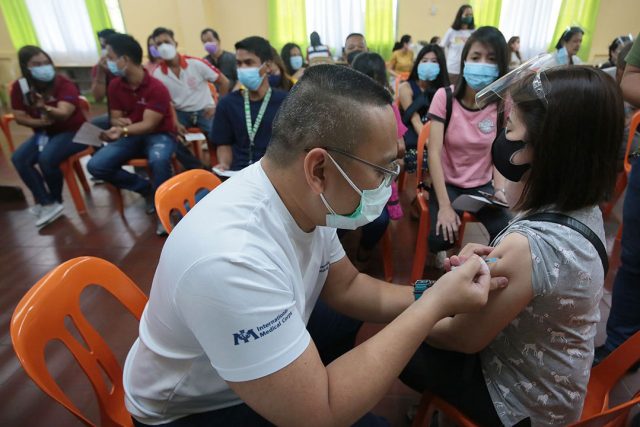
THE PHILIPPINES posted 15,314 new coronavirus infections in the previous week with a daily average of 2,188 cases, according to health authorities. 

The daily average from Oct. 10 to 16 was 7% higher than the average cases per day from a week earlier, the Department of Health (DoH) said in a bulletin. 

Of the new cases, four were severe and critical cases, it added.

DoH said 251 new deaths were verifiedin the past week, 33 of which occurred from Oct. 3 to 16. 

The agency said 625 of 2,504 intensive care unit (ICU) beds were in use as of Oct. 16, while 5,697 of 21,281 non-ICU beds were occupied. There were 690 severe and critical admissions, it added. Kyle Aristophere T. Atienza

Party-list rep files ‘agripreneur’ scholarship bill

BW FILE PHOTO

A PARTY-LIST representative for the agriculture sector filed a bill that aims to encourage students to pursue a degree in agriculture, forestry and fisheries through a scholarship program. 

House Bill (HB) 2419 or the proposed Agripreneurs Scholarship Program Act aims to establish an ‘Integrated Agripreneurs Scholarship Program in state-owned universities and colleges (SUCs). 

Aside from investments to agriculture infrastructure and equipment, we must give equal importance to integrated efforts in investing in education and training among the youth so they acquire the latest agricultural principles and techniques,AGRI Party-list Wilber T. Lee said in a statement on Monday.

We want to encourage more students to take up agricultural interests and possibly earn degrees,he said. 

Under the bill, the scholarship program would cover tuition; allowances for books, uniform, and dormitory; internship fees; licensure exam fees; and living allowance.

To qualify, a student must be a natural-born citizen, have an insufficient family income to fund a college education, be a senior high school graduating student and already passed an entrance examination in an SUC.

The bill also includes a mandatory return service programwherein fresh scholar graduates will serve in public agricultural institutions accredited by the Department of Agriculture.  

(The) mandatory return service program (seeks) to help improve the agricultural system of the country,Mr. Lee said.

In July, Mr. Lee also filed HB 1295 or the proposed Free Tertiary Agricultural Education Act, which seeks to provide scholarship programs specifically for children of indigent farmers. 

On my proposed HB 1295, we seek to provide scholarships for children of farmers and fisherfolk. We want them to be incentivized to continue farming,Mr. Lee told BusinessWorld. Even with the free tuition law, farmers and fisherfolk still find it hard to send their children to college because of other school-related expenses,he said. 

While HB 2419 is open to all students whose family income is not sufficient to support tertiary education,he said. This measure also seeks to provide cash grant programs to agripreneur scholars who wish to venture and establish their agribusinesses.Kyanna Angela Bulan 

Philippine Science High School campus, resource center in New Clark City ready by 2026

PSHS

THE BASES Conversion and Development Authority (BCDA) and the Philippine Science High School (PSHS) has recently broken ground for a campus and learning resource center at the New Clark City in Tarlac.  

The 4.6-hectare complex to be called Infinitum is expected to be operational by 2026, BCDA said in a statement on Monday. 

It will serve as a campus for PSHSsenior high school students and a resource center for teachers and professionals.   

Under the approved master development plan, 80 percent of the total campus area will be open space, while only 20 percent will be occupied. This is in line with the sustainability guidelines of New Clark City,BCDA said.   

The center will feature a multi-purpose academic building with 24 classrooms, case rooms, library, faculty room, and a dining hall; a research center for chemistry, physics, environmental science and biology; a technology hub for computer science, mathematics and humanities; an innovation center; a training center; dormitories; administration building; and a summer camp area.  

At a time when Central and Northern Luzon are primed for growth, the rise of the state-of-the-art Infinitum in New Clark City will enable us to provide more opportunities for quality education to the next generation of leaders here,BCDA President and Chief Executive Officer Aileen R. Zosa said. Revin Mikhael D. Ochave  

Bill seeks to give financial aid to workers who suffer from mental health problems

A LAWMAKER on Monday pushed for the swift passage of a bill that will provide financial assistance to public and private sector workers who suffer from job-related mental disability.   

House Bill 2789 seeks to introduce a new provision to Section 5 of Republic Act 11036 or the Mental Health Act, which mandates the release of special financial assistance should mental health service users sustain temporary or permanent mental disability during their duty. 

Filipino workers are hardworking and resilient. Every blood, sweat, and tear they pour into a days work must be compensated with sufficient safeguards to protect their mental health and well-being,Quezon City Rep. Michael D. Vargas, author of the bill, said in a statement. 

Under the Mental Health Act, a service user is a person who has a mental health condition including those who require psychiatric, neurologic and psychosocial care. 

The distribution of the special financial assistance under the proposed measure will still be subject to deliberation when the internal rules and regulations are created. 

In 2021, the Department of Health (DoH) estimated that at least 3.6 million Filipinos were facing mental health issues during the pandemic.   

The Health department’s Disease Prevention and Control Bureau said around 1.14 million had depression, while 847,000 were had alcohol-related issues. It also said 520,000 were diagnosed with bipolar disorder.   

Access to mental health services for the greater population remains limited due to economic constraints,Mr. Vargas, also vice chairperson of the House committee on social services, said in the bills explanatory note. Thus, the government must increase its efforts to enable service users to equitably access appropriate care when needed.”   

Currently, Philippine Health Insurance Corp. offers up to P7,800 hospitalization coverage for patients with diagnosed mental and behavioral disorders.   

Last year, it announced that it will work with the DoH to include mental health coverage in of one its primary care packages. Matthew Carl L. Montecillo

Creamline battles Petro Gazz in PVL Reinforced Conference

COOL SMASHERS keep its grand slam bid going as they battle Petro Gazz. — PVL

Games Today
(PhilSports Arena)
2:30 p.m. — UAI-Army vs F2
5:30 p.m. — Creamline vs Petro Gazz

CREAMLINE focuses on keeping its bold Grand Slam bid going as it clashes with a dangerous Petro Gazz today in the Premier Volleyball League (PVL) Reinforced Conference at the PhilSports Arena.

The Cool Smashers turned back the PLDT High Speed Hitters, 25-22, 25-18, 26-28, 25-22, behind the much-awaited return of their team captain Alyssa Valdez, who unleashed 17 points while getting the job done in defense with 13 digs, the same number of receptions and two blocks in that emphatic win.

And the Open and Invitational Conferences champion will try to ride the crest of that impressive triumph when it faces off with Petro Gazz in a game — set at 5:30 p.m. — where the winner snatches a share of the early lead with Chery Tiggo (2-0).

“It’s going to be a tough match,” said Creamline coach Sherwin Meneses.

For Petro Gazz, it will try to close the gap between it and Creamline, which had been sharpened by its recent international stints in the AVC Cup in Pasig and Southeast Asian Grand Prix in Thailand a month ago.

“There is now a big gap especially with their international experience and they also have a strong import,” said Petro Gazz mentor Rald Ricafort. “But we’re lucky also because Lindsay (Vander Weide) fill in what we lacked in the outside spiker position.”

Truly, Ms. Vander Weide impressed on her debut and unleashed 25 points in a 27-25, 25-22, 28-26 win over Choco Mucho last week.

And the power-hitting American vowed to bring it again as she faces Turk Yeliz Basa in an intriguing marquee match up between the league’s top reinforcements.

“I’m really pumped up for the first game, I’m a gamer so I’m definitely bringing it,” she said.

Meanwhile, United Auctioneers-Army and F2 Logistics eye their first win after two defeats as they collide at 2:30 p.m. — Joey Villar

Letran faces Perpetual, San Beda collides with Arellano in today’s games

LETRAN Knights’ Fran Yu (3) — NCAA/SYNERGY-GMA

Games Today
(Filoil EcoOil Centre)
12 p.m. — San Beda vs AU
3 p.m. — Letran vs UPHSD

LETRAN and San Beda aspire to inch closer to the top and fortify its place inside the magic four as they battle University of Perpetual Help (UPHSD) and Arellano University (AU), respectively, today in NCAA Season 98 at the Filoil EcoOil Centre.

The Knights and the Lions are currently tied at No. 4 with 6-3 records after hurdling the Emilio Aguinaldo College Generals, 72-68, and the Altas, 71-52, respectively, a week ago.

Another triumph would send the league’s traditional powerhouses in a share of No. 3 with Lyceum of the Philippines U (7-3) and closer to pace-setting College of St. Benilde (7-2) and No. 2 Jose Rizal U (5-2).

In contrast, both AU and UPHSD are out to improve on their 4-5 slates.

King Caralipio and Brent Paraiso came through big the last time out by combining for 31 points but the latter believes that defense and endgame execution would spell the biggest difference.

“We have to play defense and execute well,” said Mr. Paraiso.

San Beda, for its part, is hoping to come out with guns ablaze from the get-go just like what it did in its one-sided win over UPHSD to have a strong chance at a win.

Like a predator to a prey, the Lions devoured the Altas and raced out of the gates with a 25-11 lead that they sustained until the finish in a game the former led by as much as 22 points.

Another one of those roaring start should give San Beda that needed edge.

“We have to play aggressive from start to finish for us to have a chance at a win,” said JB Bahio, who starred in their most recent victory by dropping 16 points, eight rebounds and a block. — J. Villar

Gerrit Cole shines, Yankees top Guardians to force Game 5

NEW YORK YANKEES starting pitcher Gerrit Cole (45) throws a pitch against the Cleveland Guardians in the first inning during game four of the ALDS for the 2022 MLB Playoffs at Progressive Field. — KEN BLAZE-USA TODAY SPORTS

AS CLAY Holmes warmed up, Gerrit Cole emptied the tank and blew a 98 mph fastball past pinch hitter Will Brennan for the final out of the seventh inning.

Mr. Cole’s 110th and final pitch of a clutch postseason start also prompted the right-hander to shout “Let’s Go” and pump his fist as he walked off the mound.

Mr. Cole delivered seven stellar innings and the visiting New York Yankees evened the American League Division Series at two games apiece with a 4-2 victory over the host Cleveland Guardians on Sunday night.

“Just kept making pitches all night long,” New York manager Aaron Boone said. “And I thought (he) was just really in command of the moment, and it was obviously a huge start for us and for him. And to get us that deep in the game set us up real nice.”

Game 5 is Monday night in New York, with Jameson Taillon expected to start for the Yankees against the Guardians’ Aaron Civale in what likely will be a bullpen game for both teams. The winner heads to Houston to open the AL Championship Series on Wednesday.

Harrison Bader hit his third homer of the series and his second off Cal Quantrill (0-2) as the Yankees raced out to a 3-0 lead in the second.

Anthony Rizzo hit an RBI single in the first and Giancarlo Stanton lifted a sacrifice fly in the sixth for the Yankees, who have scored 15 runs in the series. The Yankees evened the series after moving Oswaldo Cabrera to shortstop in place of Isiah Kiner-Falefa and starting Aaron Hicks in left field.

Jose Ramirez hit an RBI single for Cleveland’s first run and Josh Naylor homered for the Guardians, whose two wins in the series have come in their last at-bats on go-ahead hits by rookie Oscar Gonzalez.

Mr. Cole allowed two runs on six hits to improve to 10-5 in 16 career postseason starts, and he got his second win in six starts in an elimination playoff game. The $324 million ace struck out eight and walked one, and was and seemed to get stronger as the game continued, hitting 97 mph.

“Our guys had that look in their eyes tonight, and it starts with Gerrit,” Mr. Rizzo said.

In the seventh, Mr. Cole had a runner at second when Andres Gimenez singled and advanced when Mr. Bader bobbled the ball in center field.

Mr. Cole then struck out Gabriel Arias for the second out. After a second mound visit to give Mr.  Holmes more time, Mr. Cole threw three straight fastballs past Mr. Brennan, including the final one when the rookie attempted to call time from plate umpire Will Little.

“I think he was probably out of gas the last two, three hitters,” Mr. Boone said. “Just a huge, big-time performance in this environment and to get us back home.”

“I do that (empty the tank) every time I pitch,” Mr. Cole said. “Whether he lets me or not, that’s another deal.”

After not being used in the ninth inning Saturday when Wandy Peralta and Clarke Schmidt combined to allow three runs in a 6-5 Game 3 loss, Mr. Holmes issued a one-out walk to Steven Kwan but fanned Mr. Ramirez on a slider to end the eighth. Mr. Peralta needed just seven pitches in a 1-2-3 ninth for the save.

“I thought he threw the ball really well and was very much under control too,” Mr. Boone said of Holmes, who has dealt with a sore shoulder recently.

Cleveland was held to six hits and went 1-for-5 with runners in scoring position, one day after ripping 15 hits and going 9-for-17 with runners in scoring position in Saturday’s 6-5 win.

“If you would have told me back in March we just signed up to play Game 5 in New York, to go to the ALCS, I would have jogged to New York,” Cleveland manager Terry Francona said.

The Yankees’ Gleyber Torres led off the game with a single, stole second when Aaron Judge struck out and just beat the relay throw on Rizzo’s single to give the Yankees a 1-0 lead.

After Josh Donaldson opened the second with a single, Bader hit a first-pitch cutter into the left field seats.

Ramirez’s bloop single to left on an 0-2 pitch against the shift got Cleveland within one run in the third, but the third baseman overran first base and was easily thrown out to end the inning.

Naylor opened the fourth by hitting a 2-2 fastball to right-center. Naylor rounded the bases swinging his arms back and forth in excitement in a reaction that hardly bothered Cole.

“Whatever,” Cole said. “It’s cute.” Cole then retired the final 10 hitters before the pivotal sequence in the seventh.

Quantrill allowed three runs on four hits in five innings. He struck out three and walked one.

“He competed like crazy,” Mr. Francona said. — Reuters

Qatar to stage 2023 Asian Cup after 2022 World Cup

AHMED bin Ali Stadium, Al Rayyan, Qatar, general view inside the stadium ahead of the World Cup. — REUTERS

KUALA LUMPUR — Qatar will stage next year’s Asian Cup in place of original hosts China after seeing off rival bids from South Korea and Indonesia, the Asian Football Confederation (AFC) announced on Monday.

The continental championships were awarded to China in 2019 but the world’s most populous country relinquished the rights earlier this year as it pursued a zero-COVID policy.

The AFC reopened the bidding process and Qatar, which will host the World Cup finals from next month, was preferred to bids from South Korea and Indonesia at an executive committee meeting on Monday.

“Qatar’s capabilities and track record in hosting major international sporting events and their meticulous attention to detail are well admired throughout the globe,” AFC President Shaikh Salman bin Ebrahim Al Khalifa said in a statement.

“With their existing world-class infrastructure and unrivaled hosting capabilities, we are confident that Qatar will stage a worthy spectacle befitting the prestige and stature of Asia’s crown jewel.”

The Gulf state has staged the Asian Cup twice before in 1988 and 2011 and won the last edition in the United Arab Emirates in 2019.

The gas and oil-rich country has built seven stadiums and upgraded another around the capital Doha to host the 32-team World Cup finals in November and December.

The 24-team Asian Cup is now likely to be shifted from its original dates in June and July to later in 2023, or even into early 2024, to ensure matches are not played during the worst of the summer heat.

The Qatar Football Association and Qatar’s government media office did not immediately respond to Reuters request for comment or to questions about when the tournament would be held.

South Korea had been favorites to be awarded the hosting rights as the country had not staged the finals since 1960, when they won the second of their two Asian titles.

Indonesia had been considered outsiders because of the lack of stadium infrastructure in the country, even more so after more than 130 people died in a stampede at a match at Kanjuruhan stadium in East Java on Oct. 1.

The AFC said the executive meeting had opened with the offer of “heartfelt condolences” to the Indonesian FA “as well as the families and loved ones of the precious lives lost”.

Qatar was also one of three nations bidding to stage the 2027 edition of the Asian Cup after Iran and Uzbekistan withdrew expressions of interest.

The AFC executive committee on Monday shortlisted the bids from India and Saudi Arabia for that tournament with a final decision to be made at their next meeting in February. — Reuters

Eagles snuff Cowboys’ comeback, improve to 6-0

THE UNBEATEN Eagles capped an electric sports weekend in Philadelphia with a 26-17 home victory against the rival Dallas Cowboys on Sunday night.

The Eagles (6-0) soared to a 20-0 lead late in the first half and held on to snap the Cowboys’ four-game winning streak. Dallas (4-2) slipped to third place in the NFC East behind the New York Giants (5-1).

Across the street, the Philadelphia Phillies defeated the defending World Series champion Atlanta Braves on Friday and Saturday to advance to the National League Championship Series.

Jalen Hurts passed for 155 yards and two touchdowns as the Eagles matched the 1981 team for the second-best start in franchise history. Philadelphia started 7-0 in 2004 and went to the Super Bowl.

Mr. Hurts’ 7-yard touchdown pass to DeVonta Smith with 7:02 remaining capped the scoring and helped to thwart a Cowboys comeback bid. The clutch drive covered 75 yards in 13 plays and chewed 7:37 off the clock.

Cooper Rush, likely making his last start for Dallas before Dak Prescott returns from a broken thumb, threw three interceptions — two by C.J. Gardner-Johnson — and lost for the first time in six career starts. Mr. Rush finished with 181 yards and a touchdown on 18-of-38 passing.

After a scoreless first quarter, Philadelphia took control. Miles Sanders scored on a 5-yard run on the first play of the second quarter.

Mr. Rush turned it over on the next offensive play, with Mr. Gardner-Johnson picking off a deflected pass. Philadelphia capitalized with Mr. Hurts’ 15-yard scoring pass to A.J. Brown for a 14-0 lead.

The Cowboys failed on fourth-and-inches on their own 34 on their next possession. The Eagles capitalized on Jake Elliott’s 51-yard field goal to make it 17-0.

Mr. Elliott’s 34-yarder pushed it to 20-0 following Rush’s second interception, this one by Darius Slay.

Brett Maher’s 30-yard field goal finally put Dallas on the board with 29 seconds left in the first half.

Momentum shifted as the Cowboys got within 20-10 on Ezekiel Elliott’s 14-yard run, the only points of the third quarter.

Mr. Rush’s 7-yard touchdown pass to Jake Ferguson trimmed the Dallas deficit to 20-17 with 14:39 left in the game. — Reuters

Nip cybercrime in the bud through policy reforms

TOWFIQU BARBHUIYA-UNSPLASH

Banking has greatly evolved over the years. Changes in the way that we live, such as mobility restrictions due to COVID-19 and the rise of more advanced technologies, have allowed banks to offer services that no longer require customers to physically go to branches to transact. Through digital platforms, bank clients can now do their transactions on the go and even in the comfort of their own homes.

However, banks are not the only ones that have adapted to the increasing shift toward digital technology. Cybercriminals have also taken advantage of digital banking through social engineering schemes and other types of scams. Now it is in the face of these new challenges that banks are stepping up their efforts to empower customers to guard against scammers and, ultimately, contribute to nation-building.

INDUSTRY-WIDE RESPONSE TO FINANCIAL-RELATED CYBERCRIMES
Considering the ingenuity of scammers and other malicious actors, banks continue to strengthen their defenses by setting up cybersecurity measures and by constantly informing clients about ways that they can protect themselves from scams and other similar crimes. To complement these efforts, it has become essential for the banking industry and the government to work together for the enactment of much-needed policies that will help reduce the number of scam incidents in the country. Below are some policy reforms that will ultimately protect the general banking public and prevent the proliferation of financial-related cybercrimes, if implemented.

FINANCIAL CONSUMER PROTECTION ACT
Towards the end of his administration, former President Rodrigo R. Duterte signed RA No. 11765 or the Financial Products and Services Consumer Protection Act (FCPA) into law. The said law aims to strengthen consumer protection mechanisms and authorizes regulators, i.e., the Bangko Sentral ng Pilipinas (BSP) and the Securities Exchange Commission (SEC), to enforce the law on banks and financial institutions. For banks, one of the key provisions that shall help customers victimized by cybercrimes is the creation of a Financial Consumer Protection Assistance Mechanism (FCPAM) for each BSP-supervised financial institution (BSFI).

The mechanism provides more efficient and faster avenues to redress issues, especially for matters that involve financial loss from scams. Customers go through a long and difficult process when they decide to pursue a case against cybercriminals. Thus, having a mechanism that will allow banks to offer accessible, affordable, and fair means of resolving complaints can help strengthen bank customers’ trust in the industry’s systems. The BSP has one year from the effectivity of the law to work with BSFIs and other stakeholders in the crafting of the implementing rules and regulations (IRR) to ensure that there are clear guidelines for its implementation and that its objectives will be met accordingly.

FINANCIAL ACCOUNTS REGULATION ACT
Apart from protecting customers and preventing them from losing their confidence in financial systems, the banking industry is also advocating for policies that nip cybercrimes in the bud. During the 18th Congress, the Bankers Association of the Philippines (BAP) pushed for a policy that aims to criminalize money mules and social engineering schemes, as well as to regulate the use of financial accounts and e-wallets (electronic wallets).

Money mules are individuals who help facilitate illegal funds transfer for someone else’s behalf. Their emergence is a perfect example of how criminals have used digitalization to find new ways to operate. The proposed policy aims to deter this new form of crime from further proliferating by imposing the appropriate punishment on individuals who are proven to be money mules.

Moreover, the policy addresses the ever-changing nature of social engineering schemes. Most of us are familiar with phishing (via e-mail), smishing (via SMS), and vishing (via voice calls), but, recently, cybercriminals have also resorted to quishing (via QR code). The latter occurs when victims are tricked into scanning QR codes that direct them to fake websites where they will be asked to provide their personal data. Cybercriminals can then acquire information that can be used to access bank accounts or e-wallets.

The House version of the bill (HB 10689) was approved at the committee level in January 2022, while its Senate counterpart (SB 2380) passed the first reading in September 2021. This 19th Congress, several members of the House of Representatives have already refiled the bill, acknowledging that with the increased use of e-commerce and digital banking, there is a need to update our cybersecurity policies and strengthen law enforcement against the rapidly evolving financial-related cybercrimes. Once passed into law, this legislative measure will protect the public from the unauthorized or illegal use of bank accounts and e-wallets.

SIM REGISTRATION ACT
One major policy that has the potential to address scams at the root of their operations is the SIM Registration Act. After getting vetoed last Congress over a contentious social media provision, the bill finally saw the light of day when it was signed into law on Oct. 10, now known as RA No. 11934 or the Subscriber Identity Module (SIM) Registration Act. This law can help eradicate mobile phone or electronic communication-aided criminal activities by making it possible for law enforcement agencies to identify cybercriminals who use prepaid SIM cards for phishing, vishing, and other text scams.

The impact of this landmark legislation is yet to be seen as concerned government agencies craft the law’s IRR in the next 60 days. Of course, just like in all other policy initiatives, this new law requires a balancing of interests between preventing SIM-aided crimes and protecting the privacy of the public. The IRR must be clear in terms of the registration process and the proper storage of data to safeguard these interests.

CUSTOMERS AT THE CORE OF BANKING
One of the core values we have at BPI is customer obsession. We define it as the ability of the bank and all of our employees to anticipate our customers’ needs, to innovate and provide them with the best financial advice, and to make it easy for our customers to save and grow their finances. While the primary role of the banking industry is to maintain an efficient and stable financial system that contributes to the country’s economic growth, it is equally important for us to protect the core of our operations: the customers.

This is the reason why banks are committed to assisting the government in crafting and implementing policies that will strengthen consumer protection and will contribute to the fight against cybercrimes — not just in responding to specific incidents, but also in preventing future crimes from occurring. The government and the private sector, particularly the banking industry, have a shared goal of protecting banking customers, and providing the best and safest services for them to achieve financial freedom.

We have been in the business for 171 years now. Together with the nation and the Filipino people, we have experienced milestones and have overcome many challenges. It is true that the banking landscape is evolving and will continue to evolve in the coming years, but as we face numerous changes, we remain committed to support necessary measures that aim to protect our customers, by collaborating with the government and the rest of the banking industry to ensure that these policies are implemented.

This article reflects the personal opinion of the author and does not reflect the official stand of the Management Association of the Philippines or MAP.


Ramon “Mon” L. Jocson is EVP and COO of BPI. This article is written as part of the bank’s initiative to celebrate the 2022 Cybersecurity Awareness Month with the theme “See Yourself in Cyber.”

map@map.org.ph

rljocson@bpi.com.ph

Education recovery beyond face-to-face resumption

PHILIPPINE STAR/ MIGUEL DE GUZMAN

“Literacy is a bridge from misery to hope.”
— Kofi Annan, former Secretary-General of the United Nations

This article comes out a bit later than the global celebration of International Literacy Day which is celebrated worldwide in September. The theme for this year was “Transforming Literacy Learning Spaces,” a timely reminder of what needs to be done as the world continues to navigate a safe return to schools for learners of varying age after more than two years of disrupted learning.

Students lost basic numeracy and literacy skills due to the prolonged period of learning outside the classroom where such skills could have been acquired and this loss is too significant to be dismissed. According to UNICEF, learning losses due to school closures in low- and middle-income countries were up by 17% from its pre-pandemic status. From 53% before the onset of COVID-19, the percentage of 10-year-olds who are unable to read and write is now at 70%. This defines the very concept of learning poverty, an indicator introduced by the UNESCO Institute for Statistics to refer to the lack of proficiency in reading and understanding simple texts at age 10. Resolving it involves a retooling of academic policies fit for post-pandemic normalcy and a serious rethinking of the role of literacy in today’s society.

In the Philippines, the outlook towards this crisis is met with concern, a bit of defiance, but overall treated as a matter of national urgency. This is not without reason. Based on a recently released and updated version of the World Bank’s State of Global Learning Poverty (2022), the country’s learning poverty ranks among the highest in the Asian region. With learning poverty at 90.9%, the Philippines outranked all its ASEAN neighbors with the exception of Lao PDR (97.7%) and Brunei (no assessment included). Outranking does not mean the country fares well. On the contrary, the scoring is such that, the higher the number is, the poorer the performance is. Singapore, a small country with population that is just a fraction of the Philippines’, performed better at 2.8%. Indonesia, though more than double the Philippines’ population, likewise scored better at 52.8%.

THE NEED FOR AN EDUCATION PRESIDENT
The dismal report on the country’s state of education was not lost on key stakeholders. Thus, it was not surprising that this became an integral part of critical conversations leading to the May 2022 national elections. The Philippine Business for Education, an advocacy group led by leaders in the business sector, expressed the need for the Filipino people to choose government leaders who are focused on education, emphasizing that literacy is an elections concern.

This sentiment was echoed by other organizations, such as Education Nation, particularly on the need to elect leaders who will prioritize reforms in the education sector. Experts from Education Nation and Philippine Business for Education, in search of an education president, released a scorecard giving former Vice-President and presidential candidate Leni Robredo a perfect score of 10/10 vis-à-vis her strategies and evidence-based solutions to address the learning crisis. Then presidential candidate Ferdinand “Bongbong” Marcos, Jr. received a 5/10.

MARCOS’ FIRST 100 DAYS
Three months into the presidency, Mr. Marcos Jr.’s focus was on putting “together a government which is functional” (Cupin, 2022). A lot of premium was and continues to be directed towards livelihood and economic recovery as seen with the administration’s efforts to secure investment pledges, among other agreements, through bilateral deals such as the ones closed during the president’s recent trips to Singapore and Indonesia (CNN, 2022).

Aside from livelihood and economic recovery, a quick rundown of Marcos’ top policy measures during his first 100 days includes public health and peace initiatives. Partnerships with the private sector have also been actively sought out in order to advance the country’s agriculture, infrastructure, water, health, and tourism sectors (PNA, 2022). After 100 days it seems all is set in motion to “get things done” for what the administration sees as the country’s most pressing concerns, controversies and issues aside.

While assessment of an executive leader’s first months into the job rests on a lot tentative variables, it does provide a picture of how the next few years will unfold. To this end, it begs to be asked: Where does post-pandemic education recovery lie in President Marcos Jr.’s priority measures?

THE ROAD TO POST-PANDEMIC RECOVERY MUST INCLUDE EDUCATION RECOVERY
It goes without saying that it will take more than 100 days to recover the learning losses incurred in the past two years of the COVID-19 pandemic. But 100 days is a good start to establish where the government stands with regard to addressing the said loss. The call for an education president who will also prioritize addressing the Philippines’ state of learning poverty is valid and must be heeded.

Students, especially in the basic level and those who are marginalized, need intensive and active support from the government to recover education lost due to school closures, aggravated by economic, personal, and social circumstances. There is a need, too, “to rebuild their mental and physical health, social development and nutrition” (UNICEF, 2022), which requires more than a return to face-to-face modality of learning. In President Marcos Jr.’s SONA (state of the nation address), references to the education sector included the students’ return to face-to-face classes, the appointment of Vice-President Sara Duterte as Education Secretary, putting an end to the poor quality of educational materials given to schools, the importance of connectivity and appropriate tools for digital education, and the reinstitution of ROTC (Reserve Officers Training Corps). Would these pronouncements suffice?

The window is narrow in terms of recovering basic literacy skills impacted by learning disruptions borne out of the COVID-19 pandemic. A more explicit expression of political will prioritizing literacy and education recovery, alongside other pressing concerns, is needed to accelerate said recovery and address the country’s high learning poverty rate in a sustained manner. Senate Minority Floor Leader Franklin Drilon’s recent statement echoed the importance of political will in focusing on urgent issues such as “inadequate healthcare and poor education” (Yang, 2022).

But then again, political will is just one thing, having a catch-up plan beyond returning to school is another. The current leadership must undertake a needs assessment in order to identify learning gaps and develop appropriate short- and long-term interventions. Merely returning to face-to-face modality in the delivery of classes might not be sufficient enough as there could be other factors at play including poor nutrition of the students or the state of school facilities. Finding out what these other factors are is critical.

Ultimately, the challenge at hand is to close the learning gap and lower the country’s learning poverty rate. Political will is needed to ensure that the role of literacy today and in the future is kept alive.


Pilar Preciousa Pajayon-Berse, PhD is an assistant professor at the Department of Political Science, Ateneo de Manila University.

Today’s topics: Economic briefing in Washington DC, PPP Center, Tariff Commission, and agencies with no secretaries

On Oct. 7, I was interviewed on the BusinessWorld Live program of One News, Cignal TV which is hosted by very articulate broadcasters Danie Laurel and Jes delos Santos. The topic was about the impact of the OPEC+ decision to cut their combined oil production by 2 million barrels per day (mbpd), from 43.8 mbpd until this October to 41.8 mbpd by November. Projected global oil demand is 100 mbpd.

Towards the end, they asked me for my assessment of President Ferdinand Marcos, Jr.’s first 100 days, I said that on a scale of one to 10, 10 being the highest, I would give him a seven overall. I would add now that if we focus on economic policies, I would give him an 8.5. For three reasons.

One, the quick formation of the administration’s economic team — Bangko Sentral ng Pilipinas (BSP) Governor Felipe Medalla, Finance Secretary Benjamin Diokno, Economic Planning Secretary Arsenio Balisacan, Budget Secretary Amenah Pangandaman — high caliber economic minds and public officials, as early as May 30 or just three weeks after the May 9 elections. The President wanted to send a clear signal to investors and the public that his economic team are mainly technocrats and the choice was not based on political patronage.

Two, the prudent management of inflation, the main concern of many people. The 6.9% inflation rate in September was indeed high but it was only a four-year high, at the same level as 6.9% in October 2018. Compare that with Germany’s 10% which is a 70-year high (the highest since 1952), the Netherlands’ 51-year high, the US, UK, and Canada’s 40-year high, and so on. The discontinuation of geographical lockdowns by the previous administration was a big factor for more production and transportation of goods and services leading to controlled inflation.

Three, the three Philippine Economic Briefing (PEB) events abroad, a series of investment promotion campaigns telling global investors that the country is ready and prepared to welcome them. The President, the economic team, and infrastructure team, about nine Cabinet Secretaries plus the BSP Governor, telling investors face to face to come to the country. The PEB in Jakarta and Singapore on Sept. 6-7 resulted in about $14.4 billion in investment pledges, and the PEB in New York on Sept. 22 saw about $4 billion investment plans.

I cannot say the economic policies are near-perfect (a score of nine to 10) because of one big burden — the continued huge borrowings and high interest payments yearly are a big pulldown. The government’s outstanding public debt rose from P8.22 trillion (actual + guaranteed) in 2019 to P12.15 trillion in 2021 and P13.41 trillion as of August 2022. It is projected to reach P14.0 trillion by the end of this year. The net financing (gross borrowings minus principal amortization) rose from P0.88 trillion in 2019 to P2.37 trillion a year average for 2020-2021.

These numbers I explained today during an interview by veteran host Cito Beltran on his program Agenda on One News, Cignal TV. Thanks for the opportunity to discuss these economic numbers and their implications, Cito.

PEB IN WASHINGTON DC
Last Saturday, Oct. 15, another PEB was held in Washington DC. BSP Governor Medalla, Secretaries Diokno and Pangandaman, and National Economic and Development Authority (NEDA) Assistant Secretary Sarah Lynn Daway-Ducanes spoke to the assembled investors and some US federal officials, and reiterated the optimistic condition in the country — that we have institutionalized and legislated a conducive regulatory and investment environment.

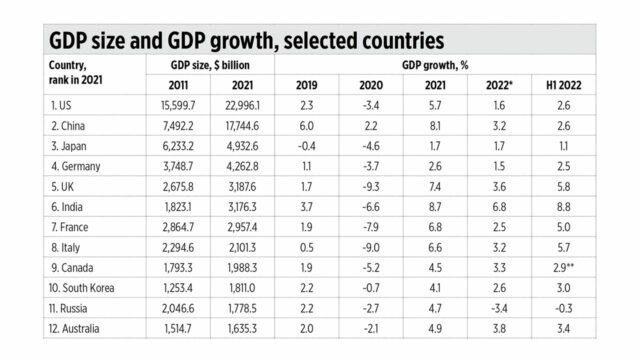
Also last week, the International Monetary Fund (IMF) released the October update of the World Economic Outlook (WEO). The Philippines is the 39th largest economy in the world, tailing No. 38 Singapore by just $3 billion.

The latest projections of the three multilaterals — the Asian Development Bank or ADB, the World Bank or WB, and the IMF — put the Philippines’ 2022 GDP growth at 6.5%. If true, that should be the 4th fastest growth in the world’s top 50 largest economies, trailing Bangladesh’s 7.2%, Vietnam’s 7%, and India’s 6.8% (see table).
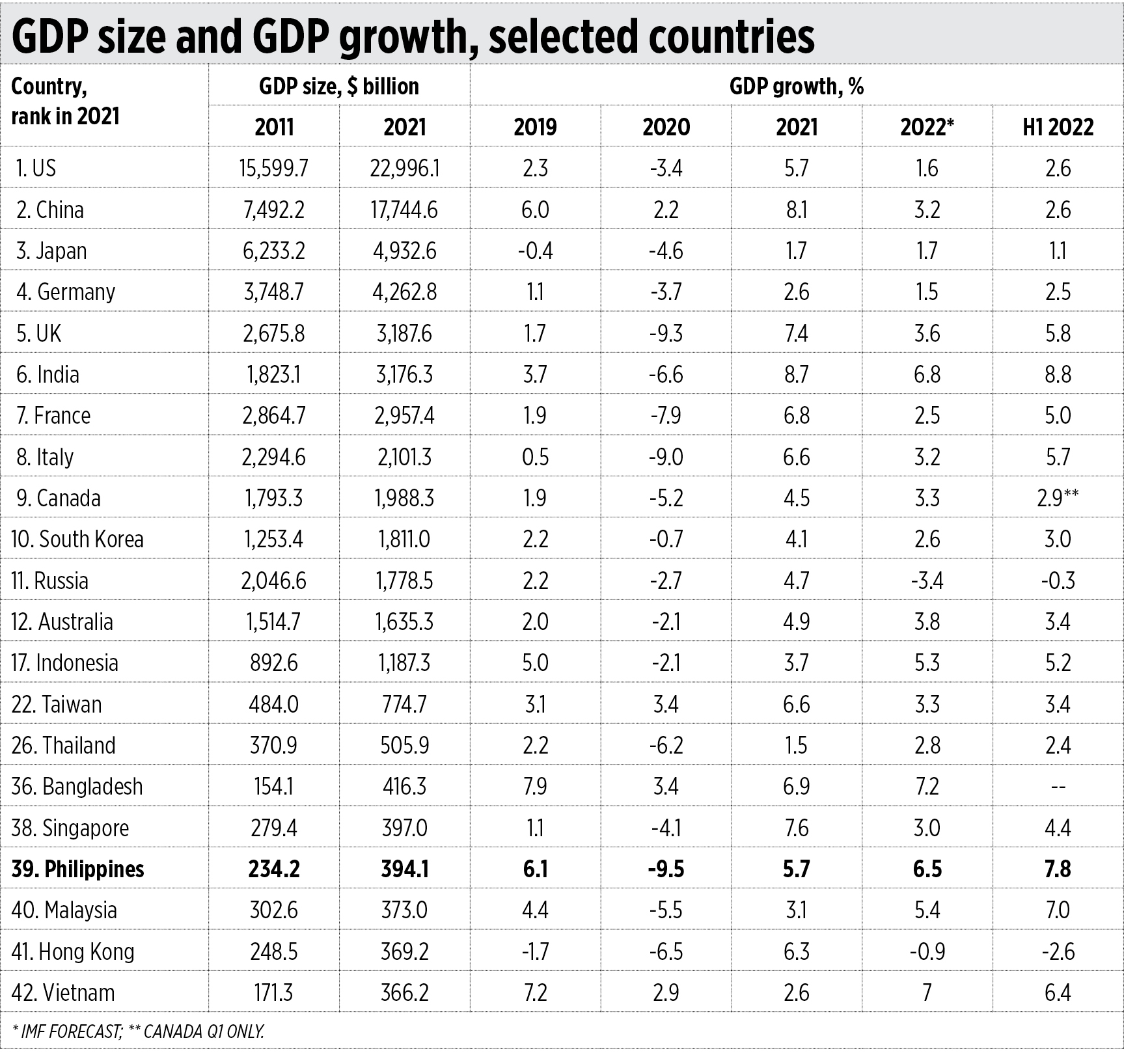
I think the multilaterals’ assessment of the Philippines is not realistic enough. In the first half (H1), or quarters 1 and 2, our growth was already 7.8%. This implies that they project H2 growth only at 5.2% to have a full year growth of 6.5%.

Using the power and electricity demand for July-September of about 6-7% (the Luzon-Visayas grids) as a proxy for GDP growth, I see growth of 7-7.5% in Q3 and this will likely be sustained in Q4. So, the full year 2022 growth would be around 7.5%, not the 6.5% projection of the multilaterals.

And from anecdotal data that I see both in Metro Manila and some provinces, there is high and fast recovery this year given the muted and slow growth in 2021.

Investors who attended the four PEB in four big cities abroad should be assured that they are entering a dynamic economy with a big consumer base.

PPP CENTER AND TARIFF COMMISSION
Last week at the Economic Journalists Association of the Philippines (EJAP) forum, the new Public-Private Partnership (PPP) Center Executive Secretary Cynthia Hernandez identified the emerging PPP sectors — health, water and sanitation, transportation, solid waste management, and ecozones, among others — as priorities for development on top of traditional PPP sectors like toll roads, seaports, airports, and power.

Given the huge annual budget deficit and net borrowings that started in 2020, many projects should be taken out of an “all taxpayers pay” scheme and be put under “only users pay” scheme. The PPP projects embody this principle and Ms. Hernandez — an engineer, economist, and financial advisor, a three-in-one brain — has the will and expertise to make this pivot of unburdening taxpayers while having big infrastructure projects.

Also last week, the Tariff Commission (TC) ruled on two different cases on cement tariffs. First, that the safeguard measure against cement imports cannot be extended beyond October 2022 because the requirements of the law (RA 8800) were not met. And second, the imposition of anti-dumping (AD) duties against imports of cement from Vietnam — that there will be no AD duties for exporters with de minimis or negative dumping margins (DMs), and have AD duties on exporters which have non-de minimis positive DMs.

A legal technicality for me, but as I understand it that the TC overall has ruled in favor of free trade in cement. Congratulations to the commission, headed by Chairperson Marilou Mendoza. My free trade mind actually supports dumping. If Vietnam will burden its taxpayers to subsidize cheap cement exports to the Philippines, so be it. The biggest protection against strong storms, floods, and earthquakes is not more politics. It is strong houses and buildings. People should use more cement and steel to live and work in strong structures.

DEPARTMENTS WITH NO SECRETARIES YET
The Office of Press Secretary (OPS) and Department of Health (DoH) are among the departments and agencies with Acting or Officer in Charge (OIC) leaders only.

I think a Press Secretary/Presidential Spokesperson is someone with at least four characteristics. One, they are savvy in the law because many Presidential pronouncements have legal implications. Two, they have past or current media and public relations experience, preferably both in broadcast/TV and print media. Three, they have a deep corporate background to augment and better appreciate the economic team’s big push to attract more investments into the country. And four, they must have good looks, and a mature and charismatic personality.

I can think of one person who fits this shoe — Michael “Mike” Toledo.

For Health Secretary, I think that the previous and current leadership of the DoH and their consultants were responsible for the very strict lockdown policies in 2020 — leading to the Philippines having the worst economic contraction in Asia, also the worst contraction in Philippine history since post-World War 2. They seem to plan for an endless health emergency situation, and they do not seem to mind if public borrowings remain at P2+ trillion yearly for many years so long as their yearly budget and vaccine procurement remain high.

Two doctors would be good as the next DoH Secretary. One is Dr. Godofreda “Jody” Vergeire-Dalmacion, an epidemiologist and retired professor from the Department of Pharmacology, University of the Philippines (UP) College of Medicine. The other is Dr. Benigno “Iggy” Agbayani, Jr., also a product of the UP College of Medicine and former President of Concerned Doctors and Citizens of the Philippines (CDC PH). Both physicians have high credibility and independence, they opposed the lockdown, and advocated focused protection via cheap, proven, and off-patent medicines.

I hope President Ferdinand “Bongbong” Marcos, Jr. will consider Mike Toledo, Dr. Jody Vergeire-Dalmacion or Dr. Iggy Agbayani for those positions.


Bienvenido S. Oplas, Jr. is the president of Minimal Government Thinkers.

minimalgovernment@gmail.com