Home Blog Page 5716

Microsoft Teams back up for some users after service disruption

Microsoft Corp’s Teams was back up for some users, the company said on Thursday, after an hours-long outage that disrupted the chat application for thousands of customers.

The Redmond, Washington-based company pinpointed a disruption “on a recent deployment that contained a broken connection to an internal storage service”, but did not disclose the number of users affected by the outage.

“We’re receiving many reports that users are able to access Microsoft Teams, and many functions are beginning to recover,” the company said.

MS Teams forms an integral part of daily operations for businesses as workers use the service to communicate internally, message each other, make calls, and organize their workflow.

There were more than 4,800 incidents of people who reported issues with MS Teams on Wednesday, said Downdetector.com, which tracks outages by collating status reports from sources including user-submitted errors on its platform.

Some 530 users are currently affected as of 12:15 AM ET, Downdetector said.

The web monitoring firm also showed earlier that there were more than 150 incidents of people reporting issues with Microsoft Office 365.

Microsoft tweeted it has identified downstream impact to multiple Microsoft 365 services with Teams integration, such as Microsoft Word, Office Online and SharePoint Online.

“We’ve taken action to reroute a portion of traffic to provide some relief within the environment,” it said.

Microsoft in its earnings call in January had said that MS Teams surpassed 270 million monthly active users, as demand for remote business-oriented teleconferencing and messaging tools soared and became a key fixture for organizations during the COVID-19 pandemic as people worked from homes.

Other big technology companies have also been hit by outages in the past year, with a near six-hour disruption at Meta Platforms META.O keeping WhatsApp, Instagram and Messenger out of reach for billions of users last October. — Reuters

Protests and street blockades against soaring prices persist in Panama

PANAMA CITY — Hundreds of people took to the streets of Panama on Wednesday to protest the government’s failed efforts to stem the rising cost of living, among other demands. 

Across the Central American nation protesters blocked roads and stopped trucks from delivering food, a pressure tactic that has been increasingly used since protests broke out two weeks ago as inflation accelerated to 5.2% in the year through June. 

“The situation is critical,” said Humberto Montero, a member of the Veraguenses Educators Association, which has sought, along with other organizations, to reach an agreement with the government. 

Protesters are also demanding the government curb public spending, apart from new investments in health and education, and bring a halt to corruption. 

The blockades are now leading to shortages, particularly of agricultural products, in the capital Panama City. 

Since the beginning of the protests, President Laurentino Cortizo’s government, which implemented austerity measures and froze gasoline and diesel prices, has unsuccessfully tried to reach an agreement with protesters. 

On Tuesday, Panamanian police fired tear gas on protesters blocking road access in the country’s west on Tuesday. 

“If the police continue with repression, the dialogue will be affected,” Mr. Montero said. 

Producers have asked protesters to establish “humanitarian corridors” to allow food to be distributed. 

The Ministry of Agricultural Development did not immediately respond to a Reuters request for comment. — Reuters

Biden stops short of declaring climate emergency, takes steps on wind power

President Joe Biden/Facebook

SOMERSET, Mass./WASHINGTON — US President Joseph R. Biden, Jr., said on Wednesday that climate change is an emergency but stopped short of a formal declaration, announcing a modest package of executive actions and promising more aggressive efforts. 

Mr. Biden made the comments during a visit to Massachusetts and as a historic heat wave batters Europe and the United States. Some 100 million Americans from New York City to Las Vegas will be under heat warnings this week. 

“Climate change is literally an existential threat to our nation and to the world,” Mr. Biden said. “This is an emergency, an emergency, and I will look at it that way.” 

The announcements included new funding for cooling centers and pushing for new off-shore wind projects in the oil-rich Gulf of Mexico. 

Still, those actions fall short of demands by Democratic lawmakers and environmental activists who want Mr. Biden to formally declare a climate emergency, which would enable the use of the Defense Production Act to ramp up production of a wide range of renewable energy products and systems. 

Mr. Biden told reporters that he would decide shortly on whether to make such a declaration. 

“I’m running the traps on the … authority I have,” he told reporters as he traveled home from Massachusetts. “I’ll make that decision soon.” 

Mr. Biden is under increasing pressure after conservative Democratic Senator Joe Manchin said last week he was not ready to support key climate provisions in Congress, a critical loss in the evenly divided Senate. 

Mr. Biden has not spoken with Mr. Manchin since, he told reporters on Wednesday. 

The Federal Emergency Management Agency will provide $2.3 billion in funding to help states build cooling centers to deal with excessive heat and to tackle other impacts of climate change, the White House said as it announced the largest ever investment to the Building Resilient Infrastructure and Communities Program. 

New funding could expand flood control, shore up utilities, retrofit buildings, and help low-income families pay for heating and cooling costs. 

Mr. Biden also announced new support for the domestic offshore wind industry. The administration has identified 700,000 acres for possible offshore wind energy development in the Gulf of Mexico, the White House said. 

Mr. Biden spoke from a former coal-fired plant that is playing a role in supporting the state’s offshore wind industry as a manufacturing hub for undersea cables. 

Mr. Biden said more is to come. 

“In the coming days, my administration will announce the executive actions we have developed to combat this emergency,” Mr. Biden said. 

Senator Jeff Merkley and eight other Democrats sent a letter to Mr. Biden on Wednesday urging him to declare a climate emergency and use aggressive executive actions to limit emissions from fossil fuels produced on public lands and waters and maximize use of electric vehicles. 

Mr. Biden promised tough action on climate change in his presidential campaign, and it remains a key priority for some voters ahead of Nov. 8 midterms for control of Congress. The US president also pledged in international climate negotiations to cut climate pollution by 50% by 2030 and reach 100% clean electricity by 2035. 

But that climate agenda has been derailed by several major setbacks, including Congress failing to pass crucial climate and clean energy measures in a federal budget bill, record-setting gasoline prices, and Russia’s invasion of Ukraine disrupting global energy markets. 

A Supreme Court ruling last month limiting the federal government’s authority to issue sweeping regulations to reduce carbon emissions from power plants also is undermining Mr. Biden’s climate plans. 

When asked whether Mr. Biden has concluded there is no longer any option for a climate bill, a senior White House official told reporters that other people could answer that question, evidently suggesting a lot depends on Mr. Manchin. 

“Our focus is on what we can do,” the official said. — Jeff Mason and Timothy Gardner/Reuters

ECB to finally join rate hike club with big move on agenda

Euro banknotes are displayed in this picture illustration taken Nov. 14, 2017. — REUTERS/BENOIT TESSIER/ILLUSTRATION

FRANKFURT — The European Central Bank (ECB) will raise interest rates for the first time in 11 years on Thursday with a bigger-than-flagged move seen as increasingly likely as policymakers fear losing control of runaway consumer price growth. 

With inflation already approaching double digit territory, it is now at risk of getting entrenched above the ECB’s 2% target, requiring rate hikes even if that slows — or crashes — an economy already suffering from the impact of Russia’s war in Ukraine. 

But policymakers appear far from united on just how fast the ECB should move with some arguing that it is already a long way behind the curve, especially compared to global peers like the US Federal Reserve, while others point to a looming recession the ECB risks exacerbating. 

The bank until recently was signaling just a 25-basis-point increase to be followed by a bigger move in September but sources close to the discussion said a 50-basis-point increase would also be on the table on Thursday as the inflation outlook is deteriorating quickly. 

Economists polled by Reuters predicted only a 25-basis-point increase but most said the bank should actually hike by 50 basis points, lifting its record low minus 0.5% deposit rate to zero. 

Complicating the decision, the euro’s recent drop to a two-decade low against the dollar also boosts inflation pressures, adding to the case for a bigger rate hike even if that ultimately hurts growth. 

A larger increase would, however, require the ECB to shield more indebted nations like Italy or Spain from soaring borrowing costs, so a deal on a new bond purchase scheme, already close to being reached according to sources, would also be needed. 

When rates rise, borrowing costs on the bloc’s periphery often increase disproportionately and the ECB has promised to fight this sort of fragmentation with a new instrument. 

While not all the details of this tool are expected to be announced, ECB chief Christine Lagarde is likely to make a firm commitment and must offer financial markets at least some specifics including on the requirements for triggering ECB aid. 

In June, when she made only a vague commitment, investors immediately challenged the ECB, pushing up Italian yields to their highest in a decade, forcing the ECB into an emergency policy meeting and a stronger pledge. 

The ECB announces its policy decision at 1215 GMT, 30 minutes later than previously, while Ms. Lagarde’s news conference is scheduled for 1245 GMT, 15 minutes later than in the past. 

INFLATION VS RECESSION 

Along with the rate hike, the ECB is also set to signal a string of subsequent increases. It already flagged a 50-basis-point hike for September and that is likely to remain on the cards. 

It is also expected to pledge further moves, though it is less likely to make firm commitments. 

“Our central case is for a 50-basis-point hike in September, but we think … the Governing Council will leave the door open for a larger move,” BNP Paribas said in a note. “We still expect a … 50 basis point hike in October.” 

Markets now see almost 100 basis points worth of moves by September and a combined 170 basis points of hikes by the end of the year, or increases at all four meetings, with several 50-basis-point moves along the way. 

The dilemma for policymakers will be to balance growth and inflation considerations. 

Confidence has already taken a hit from the war and high raw materials prices are depleting purchasing power, pushing the block towards a possible recession, especially with looming gas shortages over the winter. 

Raising rates in a downturn is controversial, however, and could magnify the pain as businesses and households face higher financing costs. 

“One problem is that, for example, a gas shutdown would not only hit growth, but would also boost inflation and therefore the ECB may not immediately become more growth sensitive,” JP Morgan economist Greg Fuzesi said. 

The ECB’s ultimate mandate is controlling inflation, however, and rapid price growth for too long could perpetuate the problem as firms automatically adjust prices. 

Europe’s labor market is also increasingly tight suggesting that pressure from wages is also likely to keep price growth high. 

Some central banks, most particularly the Fed, have made clear they are willing to crash growth to control inflation because the risk of a new “inflation regime” setting in is too high. 

But if a recession is coming, the ECB needs to front load rate hikes so it gets done quicker. — Balazs Koranyi and Francesco Canepa/Reuters

EU tells members to cut gas usage amid new Putin warning

NORD STREAM AG

BRUSSELS/LONDON — The European Union (EU) told member states on Wednesday to cut gas usage by 15% until March as an emergency step after President Vladimir Putin warned that Russian supplies sent via the biggest pipeline to Europe could be reduced further and might even stop. 

Deliveries via Nord Stream 1, which accounts for more than a third of Russian gas exports to the EU, are due to resume on Thursday after a 10-day halt for annual maintenance. 

German gas network operator Gascade said on Wednesday it expects flows to resume at pre-maintenance levels based on current requests for gas. 

On July 10, the last full day before maintenance on the pipeline started, flows stood at around 698 GWh. 

Supplies via the route had been reduced even before the maintenance outage in a dispute over sanctions, and may now be cut further, while flows via other routes, such as Ukraine, have also fallen since Russia invaded its neighbor in February. 

The disruptions have hampered Europe’s efforts to refill gas storage before winter, raising the risk of rationing and another hit to fragile economic growth if Moscow further restricts flows in retaliation for Western sanctions over the war in Ukraine. 

The European Commission proposed a voluntary target for all EU states to cut gas use by 15% from August to March, compared with their average consumption in the same period in 2016–2021. 

“Russia is blackmailing us. Russia is using energy as a weapon. And therefore, in any event, whether it’s a partial, major cut-off of Russian gas or a total cut-off of Russian gas, Europe needs to be ready,” EU Commission President Ursula von der Leyen said. 

The Commission proposal would enable Brussels to make the target mandatory in a supply emergency, if the EU declared a substantial risk of severe gas shortages. 

The move, which needs the backing of EU states, will be discussed on Friday so ministers can approve it on July 26. 

“We believe that a full disruption is likely,” one EU official said. “If we wait, it will be more expensive and it will mean us dancing to Russia’s tune.” 

EU states are trying to ensure storage facilities are 80% full by Nov. 1, from about 65% now. 

WILL FLOWS RESUME? 

European politicians say Russia is using technical issues as a pretext to cut deliveries. The Kremlin says Russia is a reliable energy supplier and blames sanctions for reduced flows. 

Two Russian sources familiar with export plans said flows via Nord Stream 1 were expected to restart on Thursday but below capacity of 160 million cubic meters (mcm) per day. 

Kremlin-controlled Gazprom cut gas exports via the route to 40% capacity in June, blaming delays to the return of a turbine that Siemens Energy was servicing in Canada. 

That turbine, which was caught up in sanctions, was reported this week to be on its way back, although Gazprom said on Wednesday it had not received documentation to reinstall it and said the turbine’s return and maintenance of other equipment was needed to keep the pipeline running safely. 

Mr. Putin said there might be a further reduction in supplies or even a complete halt to flows via the pipeline that runs under the Baltic Sea to Germany, which relies heavily on Russian fuel. 

He said equipment was being returned from Canada but said the quality of the returned gear and other parameters meant the pipeline might still be shut down in the future. 

“Maybe… they will turn it off at some point, and that’s it, and Nord Stream 1 will stop, because they came from there, from Canada,” he said in televised comments, without elaborating. 

Gas prices have rocketed in volatile trade since the Ukraine crisis erupted. The front-month gas contract climbed above 160 euros per megawatt hour (MWh) on Wednesday, 360% up on a year ago but below its March peak of 335 euros. 

‘CRUMBLING’ EQUIPMENT 

The surge in price has squeezed utility companies, triggering bankruptcies. In Germany, the government plans to inject billions of euros into the country’s biggest buyer of Russian gas, Uniper. 

Siemens Energy said maintaining turbines for Nord Stream 1 would normally be a routine matter. It said it would continue maintaining equipment under sanctions if possible and where required, and it would work as fast as it could. 

In earlier remarks, Mr. Putin said one of the five gas pumping units, operated by Siemens Energy at Nord Stream 1, was out of order due to a “crumbling of inside lining” and another was due to be sent for maintenance on July 26. 

Mr. Putin said Gazprom, which has a monopoly on Russian gas exports by pipeline, was not to blame for the reduction of gas transit capacity via a network of pipelines to Europe. 

He blamed Kyiv for closing one route via Ukraine, although Ukraine’s authorities blame the shutdown on Russia’s invasion. 

In its pivot east, Gazprom said on Wednesday Russian gas supplies heading to China hit a new daily record. Moscow has been expanding capacity to supply China as deliveries to Europe dwindle, although Russia’s far east network is not connected to the European supply system. 

European nations, meanwhile, have been chasing alternative supplies, although the global gas market was stretched even before the Ukraine crisis, with demand for the fuel recovering from the pandemic-induced downturn. 

Those efforts have included seeking more gas from suppliers linked to Europe by pipeline, such as Algeria, and by building or expanding more liquefied natural gas (LNG) terminals to receive shipments from much further afield, such as the United States. — Kate Abnett and Nina Chestney/Reuters

Ukraine war, higher rates to limit growth in developing Asia – ADB

REUTERS

MANILA – The Asian Development Bank (ADB) on Thursday slashed its growth forecasts for developing Asia for this year and next, reflecting the economic fallout from Russia’s war in Ukraine and aggressive tightening by global central banks to tame inflation.

Also contributing to its weaker growth forecasts was a sharper-than-expected deceleration in China prompted by its lingering COVID-19 lockdowns, the ADB said in a supplement to its Asian Development Outlook report.

Downgrading its 2022 forecast for a third time, the ADB said it now expects the bloc’s combined economy, which includes China and India, to expand 4.6%, slower than its 5.2% projection in April.

“Risks to developing Asia’s economic outlook remain elevated and mainly associated with external factors,” the ADB said, citing a substantial slowdown in global growth, the U.S. Federal Reserve’s aggressive tightening, and surge in commodity prices.

For 2023, the region is forecast to grow 5.2%, down slightly from its earlier forecast of 5.3%, the ADB said.

“From within the region, downside risks could arise from the potentially lingering effects on supply chains from (China’s) latest round of lockdowns and the country’s growth slowdown, which could hinder developing Asia’s growth momentum,” the multilateral lending organization said.

China’s economy will likely expand 4.0% this year, the ADB said, a drop of 1 percentage point from its April forecast, but will recover lost ground in 2023 with growth seen at 4.8%.

The growth outlook for the sub-regions was mixed, with Southeast Asia, Central Asia and the Pacific expected to grow faster than initially projected, while South Asia was forecast to expand more slowly due to the economic crisis in Sri Lanka and high inflation in India.

The ADB chopped its growth forecast for South Asia to 6.5% from 7.0% this year and to 7.1% from 7.4% in 2023.

With soaring inflation gripping much of the world, the ADB upgraded its inflation forecasts for this year and next to 4.2% and 3.5 % from 3.7% and 3.1%, respectively.

“Inflation pressures in the region, are however, less than elsewhere in the world,” the ADB said. — Reuters

BoP deficit hits $1.57 billion in June

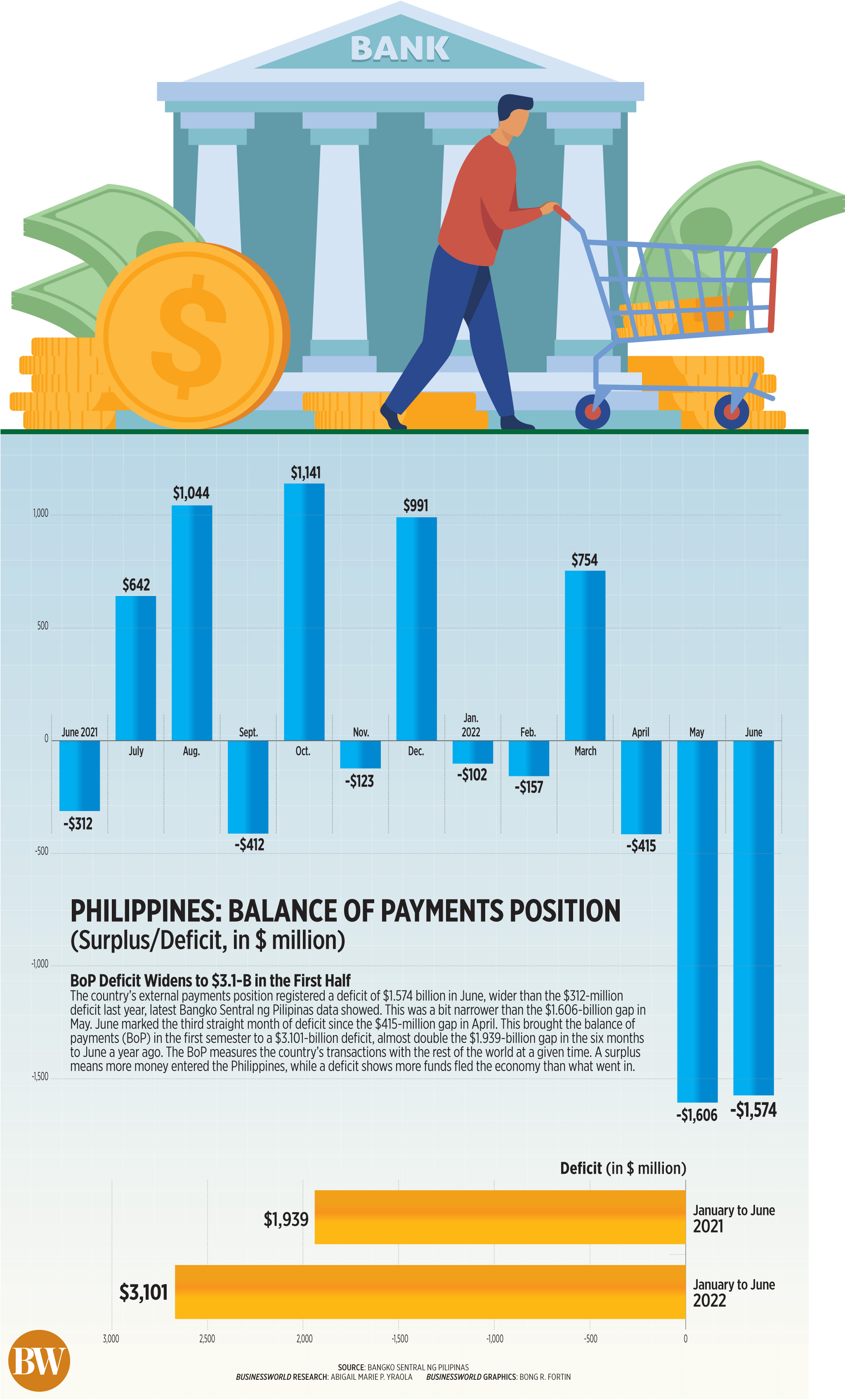
THE PHILIPPINES’ balance of payments (BoP) position remained in a deficit for a third straight month in June, as more dollars flowed out of the country to pay for the government’s foreign debt.    

Data released by the Bangko Sentral ng Pilipinas (BSP) late on Tuesday showed the BoP deficit widened to $1.57 billion in June, from the $312-million deficit in the same month last year.

However, the June deficit slightly narrowed from the $1.61-billion gap in May, which was the widest since $2.019 billion in February 2021.

Philippines: Balance of payments position“The BoP deficit in June 2022 reflected outflows arising mainly from the National Government’s payments of its foreign currency debt obligations,” the BSP said in a statement.

The BoP measures the country’s transactions with the rest of the world at a given time. A deficit means more funds fled the economy than what went in, while a surplus shows that more money entered the Philippines.

In the first half of the year, the BoP deficit widened to $3.1 billion, from the $1.9-billion deficit in the same period in 2021.   

“Based on preliminary data, this cumulative BoP deficit reflected the widening trade in goods deficit,” the central bank said.   

The trade deficit for January-May 2022 rose by 70.5% to $24.9 billion from the $14.6-billion deficit in the same period a year prior, preliminary data from the Philippine Statistics Authority’s (PSA) showed.

The BoP deficit reflected the near-record trade gap as net imports have been bloated by elevated prices of imported oil and other commodities, Rizal Commercial Banking Corp. Chief Economist Michael L. Ricafort said in a note.

Global prices of oil and other commodities have spiked since Russia invaded Ukraine in late February.

The central bank noted that this BoP position reflects the final gross international reserves (GIR) level of $100.9 billion, 2.6% lower than the $103.6 billion as of end-May.

“Nonetheless, the latest GIR level represents a more than adequate external liquidity buffer equivalent to 8.4 months’ worth of imports of goods and payments of services and primary income,” the BSP said.

“Specifically, it ensures availability of foreign exchange to meet balance of payments financing needs, such as for payment of imports and debt service, in extreme conditions when there are no export earnings or foreign loans.”

The GIR can also cover up to 7.1 times the country’s short-term external debt based on original maturity and 4.5 times based on residual maturity.

“Short-term debt based on residual maturity refers to outstanding external debt with original maturity of one year or less, plus principal payments on medium- and long-term loans of the public and private sectors falling due within the next 12 months,” the BSP said.

China Banking Corp. Chief Economist Domini S. Velasquez said the country will likely continue to post BoP deficits in the next few months, as the current account is expected to remain in deficit.

“However, we expect more contained deficits in the next few months as import prices of major commodities such as oil and food are coming off from its highs after Russia invaded Ukraine,” Ms. Velasquez said in a Viber message.

Mr. Ricafort said a prolonged Russia-Ukraine war could continue driving up the prices of oil and other commodities, which “may lead to near record-high trade deficits/net imports, thereby partly leading to weaker peso exchange rate vs. the US dollar as seen in recent weeks/months.”

At the same time, Mr. Ricafort said the country’s BoP could still improve as remittances from overseas Filipino workers remain high and the economy further reopens.

Ms. Velasquez also said that expectations of lower commodity prices will bring the BoP deficit “to more sustainable levels” next year.

Last month, the BSP said it expects the country to post a wider BoP deficit this year due to a weaker global growth outlook that could affect trade and capital flows.

Earlier, the Monetary Board revised its BoP deficit forecast to $6.3 billion, or equivalent to -1.5% of gross domestic product (GDP), higher than the previous projection of a $4.3-billion gap (-1% of GDP).

The BSP also projected a wider current account deficit at $19.1 billion (-4.6% of GDP) this year, from $16.3 billion (-3.8% of GDP) previously.

The country’s GIR is expected to hit $105 billion by end-2022 and $106 billion by end-2023, lower than the March projections of $108 billion and $109 billion, respectively. — Keisha B. Ta-asan

Robust growth needed to mitigate pandemic scarring

Shoppers pose in front of lanterns at a mall in Binondo, Manila, July 17. — PHILIPPINE STAR/EDD GUMBAN

THE SCARRING IMPACT of the coronavirus pandemic on the Philippines can be significantly reduced if the economic growth remains strong this year and in 2023, the ASEAN+3 Macroeconomic Research Office (AMRO) said.

“The scarring effects caused by the pandemic have raised the urgency to take action to build resilient, sustainable, and inclusive long-term growth… Otherwise, it would take longer time to mitigate scarring effects,” Heung Chun “Andrew” Tsang, an economist at AMRO, said during the think tank’s briefing on its 2021 Annual Consultation Report on the Philippines, on Wednesday.

AMRO expects Philippine gross domestic product (GDP) to expand by 6.9% this year, within the government’s recently revised 6.5-7.5% target. For 2023, GDP growth is forecast at 6.5%, at the lower end of the government’s 6.5-8% goal.

According to the AMRO report, some lasting scarring effects of the pandemic have become “increasingly visible” and may be difficult to reverse.

The most serious impact is on human capital, as seen with the sharp rise in unemployment and poverty rates during the pandemic. The quality of learning also suffered as schools shifted to online classes amid the strict lockdowns.

“One of the sectors that was hit badly is the education sector. A lot of schools were closed and, in the case of the Philippines, it was closed for quite a long time. [Students] had to go online and it depends very much on the digital infrastructure to some extent. But not withstanding that, I think there was a lot of scarring in the education sector. Kids fell behind in terms of education,” Hoe Ee Khor, chief economist of AMRO, said during the same briefing.

Mr. Tsang said the government’s policy should focus on upgrading and upskilling the workforce amid the shift to a more technology-driven economy.

The services sector, particularly tourism, is also seen to bounce back as travel restrictions continue to ease.

Aside from scarring effects, the Philippine economy’s recovery is also clouded by a potential outbreak of more virulent and vaccine-resistant coronavirus disease 2019 (COVID-19) variants and impairment of private firms’ balance sheets in the near term.

“The significance of these two risks may have somewhat abated. However, capital flow volatility is expected to rise in 2022 as global financial conditions are set to tighten significantly,” AMRO said in the report.

AMRO also cited the prolonged Russia-Ukraine conflict, China’s economic slowdown and capital flow volatility as other risks to the Philippines’ recovery.

“The Philippine economy is well positioned to weather the adverse impacts, but tighter global financial conditions and heightened financial volatilities could add depreciation pressure on the peso,” it added.

DEBT LEVEL
While there are concerns over the Philippines’ debt level, AMRO said “the likelihood of the Philippine government falling into debt distress is still low.”

“A lot of fiscal space has been used up during the pandemic. But we’ve done a debt sustainability assessment and the Philippines is still quite comfortable, notwithstanding the increase in the debt level,” Mr. Khor said.

As of end-March, the country’s debt-to-GDP ratio stood at 63.5%, beyond the 60% threshold prescribed by multilateral lenders to developing economies.

The government’s outstanding debt stood at P12.5 trillion in May, slightly inching down by 2.1% from end-April’s record high of P12.76 trillion.

AMRO noted that the interest rate on government debt is at a “moderate level,” and the borrowings were mainly from domestic financial savings.

“The share of nonresident holdings of government securities is less than 2%, which makes the domestic bond market less vulnerable to a sell-off by foreign investors. Lastly, the government is mindful of potential fiscal risks from rising debt levels and continues to exercise prudence in debt management and fiscal policies,” it said.

FISCAL CONSOLIDATION
As the Philippines undertakes fiscal consolidation to generate fresh revenues to pay for its debt, AMRO said the government needs to improve the efficiency of its spending programs and enhance revenue collection.

“The fiscal consolidation plan should enhance fiscal sustainability without jeopardizing economic recovery,” Mr. Tsang said.

AMRO said nonessential and ineffective fiscal programs should be revamped, and resources redirected to national priorities.

“To improve the tax administration is one way, a good way. But at the same time, the tax base needs to be broadened,” Mr. Yiu said.

AMRO said a hike in excise tax rates and new taxes on digital services may also be considered by the government.

However, AMRO said the proposed tax on single-use plastics may not generate enough revenue. — Diego Gabriel C. Robles

Coronavirus deepens Philippine learning crisis

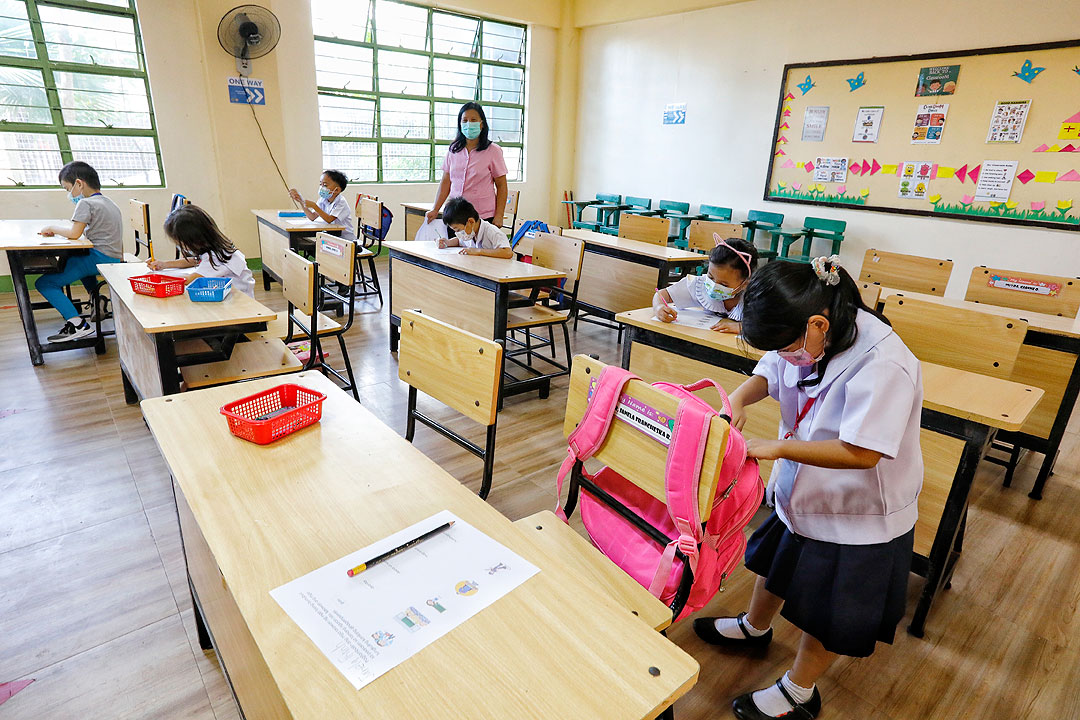
PHILIPPINE STAR/ WALTER BOLLOZOS

By Kyle Aristophere T. Atienza, Reporter

NATIVIDAD ARAGO, 74, worries about the future of her seven-year-old grandson, who has barely learned anything in his two years of online classes amid a coronavirus pandemic.

“He still doesn’t know how to read,” she said by telephone. “I’ve been helping him with his learning modules, but I can only do so much.”

Her grandson, who is now in second grade, was one of hundreds of thousands of Filipino students who were forced to study at home after schools were shuttered in 2020 amid lockdowns.

This generation of students worldwide now risks losing $17 trillion in lifetime earnings in present value, or about 14% of today’s global gross domestic product, because of coronavirus-related school closures and economic shocks, according to the World Bank.

“This new projection far exceeds the $10-trillion estimate released in 2020 and reveals that the impact of the pandemic is more severe than previously thought,” it said in a January blog posted on its website.

The pandemic and school closures not only jeopardized children’s health and safety with domestic violence and child labor increasing, but also affected student learning substantially, the multilateral lender said.

In low- and middle-income countries, the share of children living in learning poverty — already above 50% before the pandemic — could reach 70% largely as a result of the long school closures and the relative ineffectiveness of remote learning, the World Bank added, citing an earlier report.

“Unless action is taken, learning losses may continue to accumulate once children are back in school, endangering future learning.”

This could erode the quality of Philippine manpower, which experts said is now struggling to compete with foreign labor in the global market.

“There is a lot of anecdotal feedback that employers, despite high unemployment, have a hard time hiring because people don’t have the right skills or skill level,” Francisco Alcuaz, Jr., executive director of the Makati Business Club, said in an e-mail. “There are many reasons behind this.”

Policy makers are backing calls to review the country’s 10-year-old curriculum called the K-12 program, which extended the basic education cycle to include two more years in high school.

Almost a decade after the program, which complies with global standards, Filipino students hardly excel as shown in major assessments.

“The Philippines has certain competitive advantages when it comes to its working population being skilled,” Chris Nelson, executive director of the British Chamber of Commerce Philippines (BCCP), said in an e-mail. “However, challenges to retaining this advantage may arise if the government will not pursue immediate actions to strengthen the education system.”

In an assessment of 15-year-old learners across 79 economies conducted by the Organization for Economic Co-operation and Development (OECD) in 2018, the Philippines ranked last in reading comprehension and placed second to the last in science and mathematics. 

Majority of Filipino learners in Grade 5 also did not meet the proficiency level expected in reading, writing, and math, according to the 2019 Southeast Asia Primary Learning Metrics.

Meanwhile, 24% of 3.6 million Grade 4 to 6 students were frustrated readers while 1% were nonreaders, according to the Philippine Education department’s post-tests for school year 2018 to 2019.

Mr. Alcuaz said there’s a link between malnutrition and poor cognitive ability among children that he said should be treated as an emergency.

“As many as a third of five-year-olds aren’t getting proper nutrition,” he said. “It may affect brain development and learning ability.”

Childhood undernutrition cost the Philippines $4.4 billion or 1.5% of its growth output in 2015, according to the World Bank.

“We need the president to be an education and nutrition president,” Mr. Alcuaz said. “We need to declare and treat these as emergencies. Without proper nutrition, it’s hard to get an educated workforce.”

Even before the pandemic, the Philippine education sector faced challenges including overcrowded classrooms and a teacher shortage triggered by low wages.

Vice-President Sara Duterte-Carpio, who as Education chief has ordered full face-to-face classes by November, should address these problems.

Antonio L. Sayo, vice-president of the Employers Confederation of the Philippines (ECoP), said the government should ensure that the education sector meets the demands of emerging industries.

“The current economic structure is now dominated by the service sector at 40%, with manufacturing and agriculture making up about 30% each,” he said in an e-mail.

More high schools should offer science and mathematics-oriented curricula, Mr. Sayo said. “We have dwindling students in science, technology, engineering, and mathematics and that should be addressed so we could attract investments in manufacturing where we have more value added.”

‘DRILL’
Mr. Sayo said the Philippine government should also push its national policy on educational qualifications, which now include the Recognition of Prior Learning, a process that assesses one’s knowledge and skills — honed through formal and informal learning.

“Under the Recognition of Prior Learning, many of our overseas Filipino workers who returned can pursue their degrees by giving credit to their experience, particularly in manufacturing and construction,” he said.

The government should likewise have a clear policy on the medium of instruction to be used in elementary and secondary schools, he added.

Rene E. Ofreneo, former dean of the University of the Philippines’ School of Labor and Industrial Relations, said the best way to master reading, arithmetic, and science is to use the language understood by students.

“You learn English as a secondary language, not as the primary one,” he said in an e-mail. “If you try to drill English immediately, the processes of understanding the basics are weakened and you produce low-quality graduates with poor understanding of science and technology.”

English proficiency and a high literacy rate have made the Philippines one of the most attractive destinations for outsourcing, which accounts for a tenth of its economic output.

But Mr. Ofreneo said the Philippines can do more for multinational clients than just providing a pool of English-speaking talents with an American accent.

The government should have long recognized that the business process outsourcing sector is being subjected to automation, “making call center operators vulnerable to job displacements.”

“The BPO business or offshored information and communications technology businesses are bound to have a global workforce involving different nationalities across the globe,” Mr. Ofreneo said.

“The Philippines should adopt India’s approach amid the changing landscape by reducing reliance on call center or customer service operations and focusing on higher value-adding programming services, which require more science and technical know-how.”

Experts have been urging the government to help third-party service providers prepare their workforce for a shift to high-value demand or non-voice services.

In 2021, the information technology and business process management sector contributed $29.5 billion to the Philippine economy, higher than $26.7 billion a year earlier.

The country needs more workers who are digitally literate to boost the industry’s economic contribution, Mr. Nelson said.

“Upskilling the Filipino workforce particularly to adapt to digitalization is key to addressing the threats to the Philippines’ manpower.”

“I hope my grandson will learn more now that he’ll be going to school again,” said Ms. Arago, the grandmother. “That’s for his own good. I want him to have a good future.”


Faustino and Ramos dominate their division with three golds each

GOLD winners Rosalinda Faustino (left) and Rosegie Ramos (right) with coach Allen Drayfus Diaz during the awarding ceremony of the Asian Youth and Junior Weightlifting Championships in Tashkent, Uzbekistan on Tuesday (July 19, 2022). The Philippines now has 12 gold medals. — PHILIPPINE NEWS AGENCY

Hike the country’s gold collection to 12

THE PHILIPPINES sustained its juggernaut in the Asian Youth and Junior Championships as Rosalinda Faustino and Rosegie Ramos added three gold medals apiece Tuesday to the country’s mighty haul in Tashkent, Uzbekistan.

Ms. Faustino swept all the mints in the women’s 49-kilogram youth division with lifts of 71 kg in snatch, 90 kg in clean and jerk and 161 kg in total, while Ms. Ramos pulled off the same feat in the 49 kg junior class with 80 kg in snatch, 96 kg in clean and jerk and 176 kg in total.

The pair of spectacular efforts hiked the country’s impressive golden collection of 12 whopping golds.

Four of those mints came from Rosegie’s younger sister, Rose Jean, while the two were delivered by Angeline Colonia days before.

Interestingly, all four hails from Zamboanga, a place that produced Tokyo Olympic gold medalist Hidilyn Diaz.

And the country is expected to harvest more as Asian seniors and Southeast Asian Games queen Vanessa Sarno, who will see action today.

Samahang Weightlifting ng Pilipinas president Monico Puentevella said this performance is a glimpse of the country’s promising future in the weightlifting.

“We’re looking at Olympians now for Paris 2024 and Los Angeles 2028,” an awed Mr. Puentevella told The STAR. “This country will get more Olympic medals from weightlifting in the future.” — Joey Villar

NCAA Volleyball Finals: CSB Lady Blazers too good for Arellano U Lady Chiefs

COLLEGE of St. Benilde Lady Blazers. — SYNERGY/GMA NETWORK, INC.

25-21, 25-11, 25-10

COLLEGE of St. Benilde (CSB) coach Jerry Yee knew his team would come in a little rusty going into the opener of their NCAA Season 97 Volleyball title showdown with Arellano University (AU) after an 11-day hiatus.

But the soft-spoken coach was also aware that when the Lady Blazers get going, nothing, not even the reigning three-peat champions like the Lady Chiefs, could stop them.

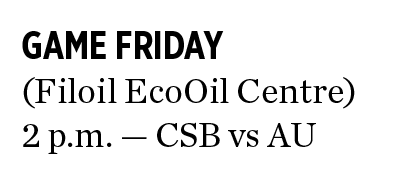
Overcoming opening-set sluggishness, CSB showed little mercy in its 25-21, 25-11, 25-10 decimation of a listless AU side yesterday to move on the cusp of sweeping its way to its second league crown at the Filoil EcoOil Arena.

“In the first set we have problems with our game speed, my players had a hard time catching up,” said Mr. Yee, whose charges swept the elimination round in nine games to barge straight into the best-of-three finale.

“But I reminded them of what we should do and I’m glad they responded,” he added.

It was a devastatingly impressive victory for CSB, which could complete a historic sweep if it could repeat over AU, which survived Jose Rizal in the final game of the stepladder semis Sunday, in Game Two tomorrow.

Or the Lady Chiefs could miraculously summon supernatural grit and force a decider on Sunday for a chance at a potential four-peat feat.

But that would be highly unlikely considering CSB has been too good to be true especially on this one for the one-sided triumph that may have broken the will of AU.

Mr. Yee didn’t even call a single time out while counterpart, Obet Javier, stood up for most part of opener, barked instructions and pleaded for his wards to plod on.

The Lady Chiefs never did.

Jhasmin Gayle Pascual presided over the carnage with a match-high 17 points while Michelle Gamit, skipper Francis Mycah Go and Jade Gentapa joined the execution with 11, eight and seven hits, respectively.

Mr. Yee also had the luxury of playing two setters in Cloanne Sophia Mondonedo and Chenae Basarte, who split time and were equally efficient and effective in dishing out excellent set after excellent set that fuelled its relentlessly powerful attacking game.

“It’s the coach’s job to make the games boring and one-sided because if we allow it to be exciting, that’s my fault if we lose,” said Mr. Yee. — Joey Villar

Dollar debts of Globe and SMC ‘sufficiently’ hedged: CreditSights

JCOMP-FREEPIK

By Arjay L. Balinbin, Senior Reporter

GLOBE Telecom, Inc. and San Miguel Corp. (SMC) — on a standalone basis — have sufficiently hedged their US dollar (USD) debts, according to financial research firm CreditSights, Inc.

PLDT, Inc. has substantially hedged its 2031 USD bond, although all of its hedges are currently “out of the money.”

CreditSights noted that many companies fell into distress during the Asian financial crisis in 1997 “due to severe currency risks, which were largely unhedged.”

“The currencies of India, Indonesia and the Philippines have depreciated sharply against the USD in the last 1-1.5 months,” the research firm said in its latest currency risk exposure report on the corporations it covers in the region. Local currencies’ weakness was attributed primarily to the faster pace of US Fed rate hikes as compared to the Asian benchmark rates.

“The Philippine companies… have not fallen into distress due to foreign exchange problems, since these companies are owned and supported by large, long-standing conglomerates.”

According to CreditSights, Globe, whose revenues and costs are mostly in Philippine peso (PHP), has hedged 96% of its $1.1-billion debt with “cross currency swaps and call spread options.”

“A 0.9% depreciation in USD/PHP would reduce profit before tax by P1.3 billion,” it noted.

This means that the company has derivatives in place that “mitigate the risk of their dollar-denominated debts bloating in peso terms due to the latter’s depreciation,” Philstocks Financial, Inc. Senior Research Analyst Japhet Louis O. Tantiangco said in a Viber message.

“The derivatives have pre-arranged conditions which allow their holders to have access of the foreign currency at rates more favorable than what’s going on in the market right now,” he added.

Meanwhile, diversified conglomerate SMC, whose 74% of revenues are in PHP and a substantial portion of costs are in USD, has hedged 88% of its $500-millon bond with cross currency swaps and call spread options.

“A 1% depreciation in USD/PHP would reduce profit before tax by P5 billion,” CreditSights said.

“However, SMC’s USD debt issuing subsidiaries Petron and SMC Global Power have significantly inadequate USD debt hedging measures in place,”  the financial research firm also said.

Oil and gas company Petron, whose 13% of revenues and 53% of costs are in USD, has hedged 4% of its $2.2-billion debt with cross currency swaps and call spread options in the range of P47 to P57.

“A 1% depreciation in USD/PHP would reduce profit before tax by P790 million.”

SMC Global Power Holdings Corp., a power generation company whose revenues are mostly in PHP and costs are mostly in USD, has hedged 3% of its $5.7-billion debt with call spread options in the range of P52.95 to P56.15.

CreditSights said a 1% depreciation in USD/PHP would reduce profit before tax by P2.1 billion.

Meanwhile, PLDT, whose revenues and costs are mostly in PHP, has hedged 50% of its $820-million debt with cross currency swaps and call spread options in the range of P48.64 to P55.28.

“Of which, it hedged 97% of its $300-million 2031 bond in the range of P49.61 to P55.28, but its $300-million 2050 bond is fully unhedged,” the research firm noted.

“We have market perform recommendations on… PLDT… (and) outperform recommendations on SMC and Globe Telecom,” it added.

Finance website Investopedia defines market perform as a “neutral assessment of a stock and is neither strongly positive nor negative.”

“If, however, the stock has gone through a period of market underperformance, it is an indication that the stock is expected to improve its performance relative to market averages.”

Meanwhile, outperform means “the company will produce a better rate of return than similar companies, but the stock may not be the best performer in the index.”

CreditSights said its report is for informational purposes only. “Neither the information contained in this report, nor any opinion expressed therein is intended as an offer or solicitation with respect to the purchase or sale of any security or as personalized investment advice.”

Hastings Holdings, Inc., a unit of PLDT Beneficial Trust Fund subsidiary MediaQuest Holdings, Inc., has a majority stake in BusinessWorld through the Philippine Star Group, which it controls.