Home Blog Page 5683

Taylor Swift announces first US stadium tour in five years

GLOBAL pop sensation Taylor Swift on Tuesday announced that she was launching a tour for the first time in five years, with several US stadium concert dates confirmed for 2023 and international stops to be revealed later.

The 32-year-old American singer-songwriter released her 10th studio album Midnights on Oct. 21, and by Tuesday its soaring popularity had made her the first artist to claim all 10 spots on the Billboard 100 in the song chart’s 64-year history.

Her 2023 tour will feature the new album as well as being a retrospective of her prolific and storied career. In an Instagram post, Ms. Swift said the tour — dubbed The Eras Tour — would be “a journey through the musical eras of my career (past and present!).”

The US concert dates span from March to August 2023, and the shows will take place in stadiums in or near major cities like Boston, New York, Los Angeles, and Chicago.

“I can’t WAIT to see your gorgeous faces out there. It’s been a long time coming,” Ms. Swift wrote.

Ms. Swift’s last stadium tour was in 2018, to promote her album Reputation. She has since released new studio albums Lover, Folklore and Evermore, and re-recorded her Red and Fearless albums, but has not performed shows during the COVID-19 pandemic. Folklore was named album of the year at the Grammys in 2021.

The opening acts for The Eras Tour will include artists Paramore, Beabadoobee, Phoebe Bridgers, Girl in Red, MUNA, Haim, Gracie Abrams, Gayle and Owenn. — Reuters

Century Properties launches P3.1-B mid-tier project

CENTURY Properties, Group, Inc. (CPG) launched its first middle-income residential development in Batangas called PHirst Editions Batulao from which it expects P3.1 billion in sales.

The development will be under the company’s PHirst brand which has a project portfolio that now covers socialized housing as low as P800,000 to middle-income housing worth P3.2 million to P6 million.

“We created the PHirst brand to introduce new house packages at different price points to give buyers more options in owning their PHirst home,” PHirst President Ricky M. Celis said in a press release

The development will be located in a 14-hectare lot in Nasugbu, Batangas. It will have 629 horizontal units.

PHirst Editions Batulao will have four models: 54 units of Cartland at P3.5 million each; 70 Charles units at P4.3 million; 90 Christie units at P5.8 million; and 105 units of Corin at P7 million apiece.

The development will offer single attached and detached units with lot sizes ranging from 88 square meters (sq.m.) to 132 sq.m. and floor sizes ranging from 54 sq.m. to 105 sq.m.

“PHirst Editions Batulao is our answer to the strong demand for varied home suburban options and will bear the PHirst stamp of quality that many of our homebuyers have already put their trust in,” Mr. Celis said.

Among the amenities to be enjoyed by residents are a clubhouse, hammocks, a bike trail, an outdoor cinema, a rope bridge, and a pet park with WiFi coverage.

“As other brands will soon be introduced, PHirst Park Homes, which has launched 12 projects to date, shall remain an affordable housing brand,” the company said.

CPG is a real estate company involved in developing residential, retail, and office properties, marketing, and property management services.

On the stock exchange on Wednesday, shares in the company closed lower by one centavo or 2.86% to 34 centavos each. — Justine Irish D. Tabile

AUB Group’s net profit surges by 70% in Q3

BW FILE PHOTO

ASIA United Bank Corp. (AUB) and its subsidiaries saw their consolidated net income climb by 70% in the third quarter amid higher earnings from its core businesses.

AUB Group booked a net income of P1.7 billion last quarter, 70% higher than the P998.3 million booked in the same period in 2021, based on its quarterly report disclosed to the local bourse.

This brought its net profit for the first nine months to P4.6 billion, up 57% from the P2.9 billion a year prior, which it noted already surpassed its pre-pandemic performance.

The bank’s nine-month performance translated to a return on assets of 1.9%, up from 1.3% the year prior, and a return on equity of 16.4%, rising from 10.8%. Its cost-to-income ratio in the period was at 38.6%, better than 44% a year ago.

“Since AUB started at the height of the 1997 financial crisis, it has consistently been among the top five publicly listed local banks in the country that have posted healthy profitability ratios. We are extremely pleased to have beaten our pre-pandemic performance as we celebrate our 25th anniversary,” AUB President Manuel A. Gomez said in the statement.

“We will remain prudent, vigilant, and agile, even as we continue to be confident of ending 2022 with a stronger financial position,” Mr. Gomez said, noting the bank remains watchful of risks, including inflationary pressures, higher interest rates, the peso’s depreciation against the dollar, and geopolitical tensions.

AUB’s net interest income rose by 24% to P3.5 billion in the third quarter from P2.8 billion a year prior, backed by better earnings from loans and trading and investment securities.

Interest income from loans and receivables went up by 9% to P2.8 billion as it booked higher loans, while earnings from trading and investment securities more than doubled (up 110%) to P1.1 billion on reinvestment into higher yielding securities.

Meanwhile, interest expense increased by 12% to P492.7 million.

For the first nine months, net interest income increased by 14% to P93 billion.

Net interest margin rose to 4.1% from 3.8%.

On the other hand, AUB Group’s other operating income climbed by 38% to P588.7 million in the quarter amid higher gains from trading and securities, service charges, fees and commissions, and foreign exchange.

Trading and securities gains surged 101% to P75.5 million amid favorable market conditions.

“The bank took profit on a handful of securities to secure gains during this volatile year,” it said.

Foreign exchange gains increased by 61% to P138.7 million, while earnings from service charges, fees and commissions rose 17% to P267.8 million. Miscellaneous income also grew by 62% to P76.8 million.

For the nine months ended Sept. 30, the group’s non-interest income grew by 40% to P1.6 billion.

AUB Group’s total operating expenses increased by 6% to P2 billion last quarter, bringing the nine-month total to P5.3 billion, down 5% year on year.

Provisions for losses inched up to P508.7 million from P507.3 million in the third quarter, with the nine-month total at P4.2 billion, also up by 3% from the year prior.

The bank’s loans and receivables increased by 7% to P176.6 billion as of Sept. 30 “as corporate clients with expansion projects held in abeyance during pandemic resumed implementation.”

“Corporate clients also started to avail loan in anticipation of rising interest rates. Consumer loans also increased from stable housing demand, resumption of motor vehicle purchases and increased utilization of salary loans,” the bank said.

AUB Group’s nonperforming loan (NPL) ratio went down to 1.54% at end-September from 1.98% a year ago. NPL coverage ratio rose to 89.1% from 82.6%.

Meanwhile, deposits were flat at P262.3 billion as an increase in demand and savings deposits was offset by a decrease in time deposits.

The group’s total assets inched up to P317.8 billion as of Sept. 30 from P317.8 billion. Equity also increased by 3% to P38 billion.

The bank’s common equity Tier 1 ratio stood at 14.04% as of September, down from 15.95% a year prior, while capital adequacy ratio was at 14.64%, lower than 16.59% a year ago. Still, both remained above regulatory requirements.

AUB Group had 258 branches and its parent bank had 201 automated teller machines as of Sept. 30.

The bank’s shares declined by 3.74% or P1.55 to close at P39.90 apiece on Wednesday. — BVR

Cyber criminals hold Asian technology workers captive in scam factories

TRUSTPAIR.COM

CHENNAI/BANGKOK — Indian engineer Stephen Wesley was puzzled when he was asked to take a typing test during an interview for a graphic design job in Thailand — but put it out of his mind when he got the role.

Hours after landing in Bangkok to start work in July, Mr. Wesley and seven other new recruits were instead ferried over the border into Myanmar where their phones and passports were taken, and they were put to work on online cryptocurrency scams.

“I spent up to 18 hours a day researching, typing messages, chatting with people on social media platforms, gaining their trust and encouraging them to invest in cryptocurrency,” said Mr. Wesley, 29, in a telephone interview.

Thousands of people, many with tech skills, have been lured by social media advertisements promising well-paid jobs in Cambodia, Laos and Myanmar, only to find themselves forced to defraud strangers worldwide via the internet.

Wesley spent 45 days held captive at a compound in Myanmar’s southeastern border town of Myawaddy, and given a list of about 3,500 names that he had to contact via Facebook, Instagram or dating apps.

“We were trained on how to flirt, chat about hobbies, everyday routine, likes and dislikes. In roughly 15 days, the trust would be built and the client would be willing to take our advice on investing in crypto,” he said.

The cybercrime rings first emerged in Cambodia, but have since moved into other countries in the region and are targeting more tech-savvy workers, including from India and Malaysia.

Authorities in these countries and United Nations officials have said they are run by Chinese gangsters who control gambling across southeast Asia and are making up for losses during the pandemic lockdowns.

The experts say the trafficked captives are held in large compounds in converted casinos in Cambodia, and in special economic zones in Myanmar and Laos.

“The gangs targeted skilled, tech-savvy workers who had lost jobs during the pandemic and were desperate, and fell for these bogus recruitment ads,” said Phil Robertson, deputy director for Asia at Human Rights Watch.

“Authorities have been slow to respond, and in many cases these people are not being treated as victims of trafficking, but as criminals because they were caught up in these scams.”

DUBIOUS TECH FIRMS
Cybercrime has surged with the rise of digital platforms that brought easy access to personal data online as well as improved translation software and artificial intelligence (AI)-generated photos that help scammers to create fake personas.

The scam that Mr. Wesley and others were forced into is known as pig butchering, where a scammer builds trust with their victims over social media, messaging and dating apps, then pressures them to invest in bogus crypto or online trading schemes.

The term refers to the process by which scammers “feed their victims with promises of romance and riches” before cutting them off and taking their money, according to the US Federal Bureau of Investigation, which traced its origins to China in 2019.

“People don’t realize it, but they do share a lot of information on social media platforms,” said Dhanya Menon, director of Avanzo Cyber Security Solutions in India, which advises firms on cybersecurity.

“If you follow someone’s social media for just 15 days, you will glean a lot of information about them,” she said, adding that cryptocurrency scams are on the rise because there is little awareness of how the virtual currency works.

India’s foreign ministry in September issued an advisory warning youth with technology skills of fake job offers in Thailand from “dubious IT firms involved in call-center scam and cryptocurrency fraud.”

Authorities last month said they had rescued about 130 Indians from such schemes in Laos, Cambodia and Myanmar – including Mr. Wesley and others.

Myanmar’s military government — which took control of the country in a coup in February 2021 — did not respond to a request for comment.

Cambodian officials, who for months denied reports of abuses and trafficking, have taken a harder stance in recent months, and ordered a crackdown on cyber scam operators across the country.

FAKE DATING PROFILES
Bell, a 23-year-old Thai woman, said she was lured by the offer of an administration job with a monthly salary of about $1,000 and free food and housing at a casino in Cambodia.

But when Bell — who used a pseudonym to protect her identity — arrived at the casino in the coastal city of Sihanoukville in December, her Chinese employers took away her passport, ID and mobile phone, and locked the doors.

She was made to create a fake profile on social media and build relationships with men on dating app Tinder, then persuade them to invest in stocks.

“I wanted to go home because it wasn’t what I wanted to do, but they said I would have to pay 120,000 to 130,000 baht ($3,175-$3,440),” she said.

“I had to (work) for fear of being beaten.”

Bell and 20 other Thai detainees were rescued in June by Thai police, who have freed more than 1,200 of their citizens from compounds in Cambodia since late last year, said Surawchet Hakphan, assistant commissioner general of the Thai police.

More than 3,000 Thais are still trapped in Sihanoukville and the Cambodian capital Phnom Penh, Surachet estimated.

Mr. Wesley, who was also told to pay a large ransom if he wished to leave the compound in Myanmar, had to create a fake persona of a young female Brunei-born graphic designer who was working in Monaco and was fond of posting selfies.

He targeted 50 people daily in Europe, Australia, Britain and India, asking each to invest $20,000 to begin with.

Now back in India, Mr. Wesley is struggling to find work.

“When I look back … I keep wondering if there were any signs that I missed or anything I could have done differently,” he said from Chennai, where he was interviewing for a job.

“But I didn’t suspect anything.” — Thomson Reuters Foundation

Tokyo Tokyo targets 3 more stores before yearend

JAPANESE dine-in restaurant Tokyo Tokyo is set to launch around three more stores this year after it reached its 2022 revenue target in the second quarter.

“We’re opening several more [stores] until December … about two to three more stores,” Tokyo Tokyo Marketing Head Genaline G. Austero said on the sidelines of the restaurant’s product launch.

According to Ms. Austero, the group just opened a dine-in store in SM Tanza in Cavite which is its first opening this year. The planned store openings will be located within and outside Metro Manila.

“I think we will be ending the year with 175 to 180 stores,” she said about the number of food trucks and dine-in stories in its portfolio.

Meanwhile, Ms. Austero said that Tokyo Tokyo will open two food trailers in Banilad and Lapu-Lapu in Cebu City.

“We will continue to expand the brand nationwide. Actually, we’re opening our Cebu trailer[s] next week,” she said.

According to Ms. Austero, the food trailers came to life when the pandemic hit as most Tokyo Tokyo stores are located inside the malls.

“Tokyo Tokyo is mostly in the malls so when the pandemic hit, we were badly affected because most of the malls closed for several months. So, we pivoted, we put up trailers,” Ms. Austero said.

Ms. Austero said that Tokyo Tokyo has already reached its target topline for 2022 in the second quarter. She did not disclose specific figures. 

“We have actually reached our target already,” Ms. Austero said. “[It was due to the] expansion of the stores primarily driven by the trailers, the opening of the food stores or the dine-in stores, and the new products to keep our customers excited.”

On Wednesday, Tokyo Tokyo officially launched its Umami Fried Chicken, which had a soft launch on Thursday last week. The new offering will be available for solo plates, bento meals, and platters.

“We’re already in the ‘ber’-season so we’re already preparing for the Christmas peak,” Ms. Austero said. “This will be our last major launch for the year.”

Tokyo Tokyo is a restaurant brand underww Hansbury, Inc. that has more than 100 food trailers and around 70 dine-in stores. — Justine Irish D. Tabile

Director Tim Burton on Wednesday: ‘I felt it was written for me’

JENNA ORTEGA is the lead in Wednesday.

LUCCA, Italy — Filmmaker Tim Burton steps into the macabre and supernatural world of the Addams Family with new series Wednesday.

The Netflix show, released on Nov. 23, is based on Wednesday Addams, usually seen as a child in previous Addams Family shows or movies, but now at a high school for outcasts, trying to harness her psychic powers and being a teenager.

Mr. Burton, known for mixing the weird and charming in films which include Edward Scissorhands and Big Fish, directs the first four of eight episodes of the new series.

“I feel like it was written for me because… I felt like I was her as a boy in school,” Mr. Burton told Reuters at the Lucca Comics and Games pop culture festival in Italy.

“That feeling about family, school, technology, therapy, it just spoke to me… so it was very easy to identify with all of that. The Addams Family has been done very well in different ways. I just like the idea of focusing on Wednesday and seeing her as a teenager.”

The series addresses trauma and mental health with Wednesday, played by Jenna Ortega, visiting a therapist — scenes Mr. Burton said were important to him personally.

“I still have issues… I feel very lucky… I had an outlet, whether it’s drawing or making films, to sort of exercise some of those demons and deal with some of those issues,” Mr. Burton said.

“And so seeing her… and how she deals with it was important to me.”

Wednesday stars Catherine Zeta-Jones and Luis Guzman as Wednesday’s parents, Morticia and Gomez Addams, while Christina Ricci, who portrayed Wednesday in two 1990s films, plays teacher Miss Thornhill.

Ms. Ricci previously worked with Mr. Burton on Sleepy Hollow, alongside Johnny Depp, a frequent Burton collaborator.

Asked if he would work again with Mr. Depp, who is trying to rebuild his career after an ugly defamation fight with his ex-wife Amber Heard, Mr. Burton said: “If the right thing was around then sure.

“I don’t really have any I’m going to work with my ex-wife or my friends or this or that because… I just do things because I want to do them.” — Reuters

BSP defaces 520 MT of coins unfit for circulation

BW FILE PHOTO

THE BANGKO SENTRAL ng Pilipinas (BSP) has retired a total of 519.93 metric tons (MT) of unfit, demonetized, mutilated, and counterfeit coins through defacement, it said on Wednesday.

“This will ensure that only fit and legal tender banknotes and coins are circulated and used to purchase goods and services,” the central bank said.

Coin defacement is a process that alters the surfaces of coins to prevent them from being recirculated. The defaced coins may then be recycled into different items based on their metallic content.

Of the total coins defaced, 70% or 364 MT were unfit coins, 25% or 128 MT were mutilated, 4% or 21 MT were counterfeit, and the remaining were demonetized.

The defacement process ran from October 2021 until September this year.

The BSP is mandated by law to retire or destroy all Philippine banknotes and coins found to be unfit, mutilated, or demonetized, including seized counterfeits.

“To reinforce its continuing efforts to maintain and protect the integrity of Philippine currency, the BSP is also seeking the enactment of a law defining and penalizing the excessive and unnecessary hoarding of coins,” it added. — Luisa Maria Jacinta C. Jocson

Manufacturing Purchasing Managers’ Index (PMI) of select ASEAN economies, October 2022

FACTORY OUTPUT in the Philippines expanded at a slower pace in October, reflecting a modest uptick in new orders despite elevated inflation and supply chain disruptions, S&P Global said on Wednesday. Read the full story.

Manufacturing Purchasing Managers’ Index (PMI) of select ASEAN economies, October (2022)

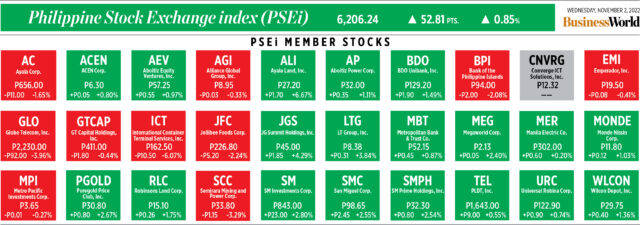
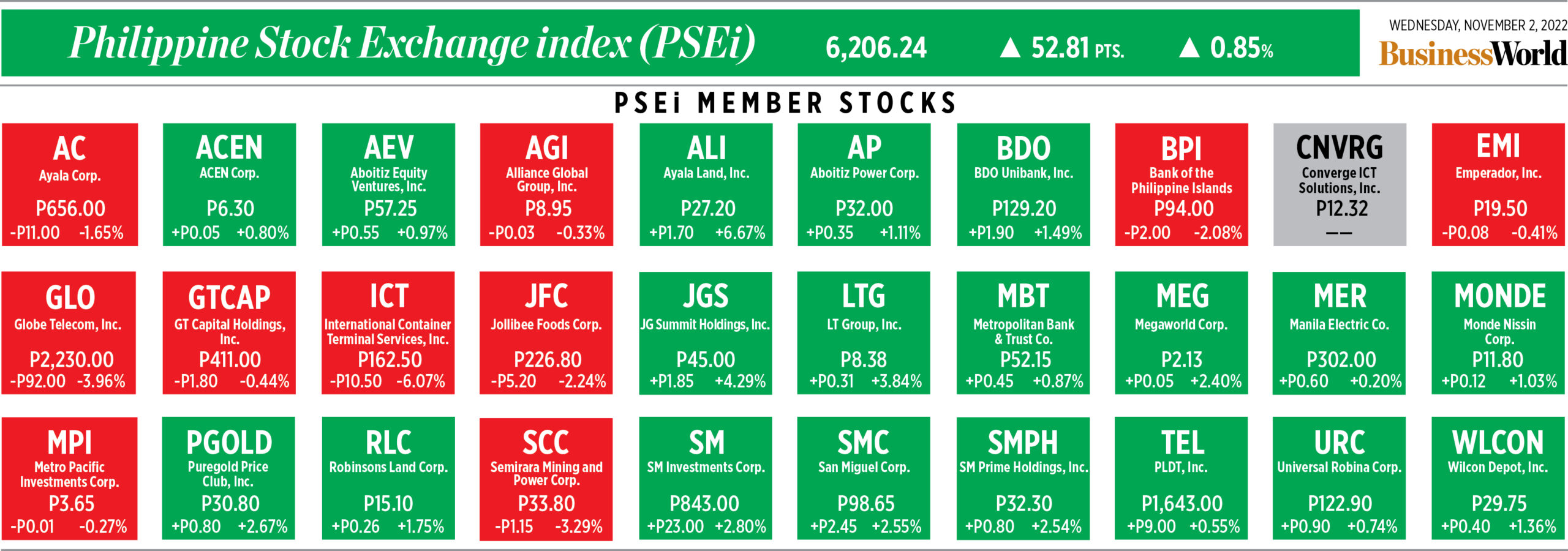
How PSEi member stocks performed — November 2, 2022

Here’s a quick glance at how PSEi stocks fared on Wednesday, November 2, 2022.


Peso sinks ahead of Fed decision

JULIAN PAOLO DAYAG-UNSPLASH

THE PESO weakened versus the dollar on Wednesday on expectations of another aggressive rate hike from the US Federal Reserve.

The local unit closed at P58.47 against the dollar on Wednesday, down by 50 centavos from P57.97 on Friday, data from the Bankers Association of the Philippines’ website showed.

Philippine financial markets were closed for public holidays from Oct. 31 to Nov. 1.

The peso opened Monday’s session at P58.05 against the dollar. Its weakest showing was at P58.49, while its intraday best was at P58.02 versus the greenback.

Dollars exchanged went down to $844.15 million on Wednesday from $912.35 million on Friday.

“The peso depreciated due to market caution ahead of the US Federal Reserve policy decision this week,” a trader said in an e-mail.

“The US dollar also corrected higher recently vs. major global currencies to one-week highs … ahead of the widely expected jumbo rate hike of +0.75 on Nov. 2,” Rizal Commercial Banking Corp. Chief Economist Michael L. Ricafort said.

“Mostly stronger-than-expected US economic data since late last week… could still support further aggressive Fed rate hikes in the quest to significantly bring down elevated US inflation from 40-year highs recently,” Mr. Ricafort said.

The Fed is widely expected to raise benchmark rates by at least 75 basis points at its Nov. 1-2 meeting to temper soaring inflation. The decision was expected to be announced overnight.

“The peso backtracked ahead of the much-anticipated Fed meeting. With expectations for a hefty rate hike from [Fed Chair Jerome] Powell, risk assets took a backseat and slid. The market is now hopeful for some guidance for the so-called Fed pivot,” ING Bank N.V. Manila Senior Economist Nicholas Antonio T. Mapa said on Wednesday.

For Thursday, the trader said the peso may strengthen ahead of a potentially weak US initial jobless claims report.

The trader sees the peso moving within P58.40 to P58.60 against the dollar on Thursday, while Mr. Ricafort gave a forecast range of P58.35 to P58.55. — Keisha B. Ta-asan

Stocks rise on improved manufacturing activity

BW FILE PHOTO

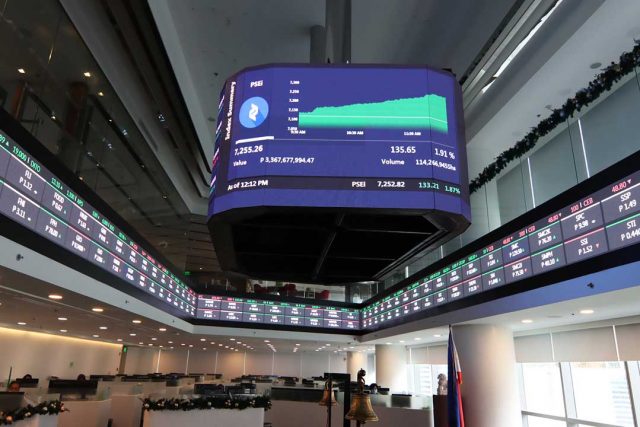
PHILIPPINE SHARES rose on Wednesday on improved manufacturing activity last month and as strong earnings of listed companies continued to boost market sentiment.

The bellwether Philippine Stock Exchange index (PSEi) rose by 52.81 points or 0.85% to end at 6,206.24 on Wednesday, while the broader all shares index went up by 19.72 points or 0.6% to finish at 3,277.01. 

China Bank Securities Corp. Research Analyst Lance U. Soledad said the PSEi’s rise was driven by the continued expansion of the country’s manufacturing sector in October.

“Surge in market-on-close buying led to the index closing above the 6,200 resistance level. Buying appetite for today may have been buoyed by the continued expansion of the country’s manufacturing sector in October,” Mr. Soledad said in an e-mail on Wednesday.

S&P Global said in a report that manufacturing activity posted a modest expansion in October.

The S&P Global Philippines Manufacturing purchasing managers’ index (PMI) stood at 52.6 in October, slowing from 52.9 in September but remaining above the 50 mark that separates growth from contraction.

Regina Capital Development Corp. Head of Sales Luis A. Limlingan said that the third-quarter results of some listed firms also boosted market sentiment.

“Investors made bets ahead of the main highlight this week, which is the Fed’s (US Federal Reserve) latest policy decision at the conclusion of its meeting on Wednesday,” Mr. Limlingan said in a Viber message. 

“Back home, the key economic data for this shortened week are the S&P Global Manufacturing PMI, which came out with a slight contraction today, as well as the October inflation rate,” Mr. Limlingan added.

AP Securities, Inc. Equity Research Analyst Carlos Angelo O. Temporal said in a Viber message that local shares closed higher on Wednesday on earnings optimism. However, the PSEi “erased most of its early gains as investors took profit ahead of Fed’s policy rate decision due out tonight.”

Sectoral indices ended mixed on Wednesday. Property went up by 91.10 points or 3.54% to 2,663.85; holding firms gained 90.04 points or 1.51% to end at 6,023.41; and financials rose by 6.90 points or 0.43% to 1,595.04.

Meanwhile, services went down by 27.79 points or 1.74% to 1,564.54; mining and oil declined by 39.38 points or 0.40% to 9,763.57; and industrials dropped by 10.86 points to 0.12% to 8,977.04.

Value turnover rose to P6.29 billion on Wednesday with 496.31 shares changing hands from the P4.21 billion with 421.67 million issues traded on Oct. 28.

Advancers beat decliners, 105 versus 74, while 47 names closed unchanged.

Net foreign buying stood at P580.99 million on Wednesday, a reversal of the P41.54 million in net selling on Oct. 28.

China Bank Securities’ Mr. Soledad placed the PSEi’s support at 6,000-6,050 and resistance at 6,380, while AP Securities Mr. Temporal put support at 5,900 and resistance at 6,300. — AEOJ

Hotels hit 60-80% occupancy; full recovery expected in 2024

HOTEL OCCUPANCY levels are currently between 60 and 80%, and are expected to return to pre-pandemic levels starting 2024, an industry executive said.

Benito C. Bengzon, Jr., Executive Director of the Philippine Hotel Owners Association, Inc. (PHOA), added that the industry had been hoping for a boost from tourists making a long weekend of the last days of October, though many travelers had to cancel because of Tropical Storm Paeng.

“Our member hotels have been reporting occupancy rates of about 60% to 80%. But we are still a long way off from pre-pandemic levels. We feel that the return to 2019 levels will only happen in 2024 at the earliest,” Mr. Bengzon said.  

On the long weekend leading up to the Nov. 1 holiday, Mr. Bengzon said,“The reports that we’ve been getting from our member hotels have been varied. There were some that were reporting 90% occupancy and there were some that reporting 50% occupancy. All in all, it could’ve been better. But unfortunately, we were affected by the typhoon…We in the PHOA remain confident that the situation will get better. For sure, 2022 is a better year for us compared to 2021 and 2020.”

“People were really looking forward to the long weekend. This is the first time in a very long time that we’ve had a four-day weekend. Unfortunately, we were affected by the storm and this disrupted travel plans,” he added.

On Wednesday, Calabarzon (Cavite, Laguna, Batangas, Rizal, Quezon), Bicol, the Western Visayas, and the Bangsamoro Autonomous Region in Muslim Mindanao were placed under a state of calamity with the issuance of Proclamation No. 84 by President Ferdinand R. Marcos, Jr.

The state of calamity will be effective for six months unless lifted earlier by Mr. Marcos.

“When I talk about return to 2019 levels, I’m looking at both international traffic, meaning we have to go back to roughly 8.2 million foreign travelers and for domestic traffic, we have to go back to 110 million domestic trips,” Mr. Bengzon said.

Mr. Bengzon said the industry’s performance will be influenced by affordable air fares, flight availability, and the global situation.

“For inbound traffic, we have to make sure that the main tourist markets of the Philippines, particularly South Korea, China, and Japan will go back to normal levels. We have to make sure also that the flights are restored to their operating capacity in 2019,” Mr. Bengzon said.

“For next year… the situation in Ukraine will be a major factor for long-haul travel. Air fares have to be kept to a very manageable level to encourage inbound and domestic travel. While we are optimistic about 2023, we also have to consider that there are many challenges facing us, like the high cost of fuel and inflation,” he added.

Recently, the Tourism department announced that tourist arrivals hit 1.83 million as of Oct. 25, exceeding the previous projection of 1.7 million arrivals. The Philippines opened its borders in February. — Revin Mikhael D. Ochave

ADVERTISEMENT
ADVERTISEMENT