Home Blog Page 5673

Lakers at a crossroad

All eyes remain on the Lakers, and not simply because they seem to be dragging their heels on a deal involving Russell Westbrook. It’s clear that the latter no longer wants to stay in the fold, not after a disastrous 2021-22 season that saw his numbers decline across the board, and certainly not after he found himself being dangled in just about every potential deal so far in the offseason. Heck, he even fired longtime agent Thad Foucher, and then signed with influential Excel Sports ostensibly to get better leverage on is way out.

If the grapevine is to be believed, the Lakers are balking at the inclusion of their future draft picks. Due to a rule named after former Cavaliers owner Ted Stepien, they’re not able to trade consecutive first-round picks; the provision likewise prevents them from dangling their 2026 option until the Pelicans decide on the third of consecutive choices generated by the deal for then-six-time-All-Star Anthony Davis in 2019. This means that acquiescing to demands for them to sweeten any Westbrook trade would be tantamount to giving up any freedom at the draft until 2030.

True, it’s a problem in and of itself. That said, surefire talent in the present is more valuable than the promise of What Ifs. And, needless to say, the Lakers should understand that housing a marquee player who’s pushing 38 effectively places them in Win Now mode; continuing to give the keys to LeBron James — admittedly on the backside of an all-time-great career — necessitates the capacity to go all in. It’s what they did when they acquired Davis, and what they did when they spread the welcome mat for Westbrook.

Recency bias does play a role in the Lakers’ reluctance to open the bank for the possibility of taking in mercurial guard Kyrie Irving from the Nets. No doubt, the latter’s flaky character also gives them pause. What if the solution is worse than the problem? Then again, they have few paths to success, and none as currently constructed. Later this month, James will be eligible for a contract extension, and whether he ensures his status as the principal protagonist in purple and gold may well be predicated on how close he believes he is to a fifth ring.

So, yes, the Lakers are at a crossroads. And, yes, they’re playing high-stakes poker. The question is this: Does the hand they have give them the conviction to bluff? They have a tell, and, right now, conventional wisdom has them folding one way or the other.

Postscript: Coca-Cola Beverages Philippines, Inc. (CCBPI) and Coca-Cola Foundation Philippines, Inc. (CCFPI) recently held the Coca-Cola Charity Golf Classic 2022 and raised P3.5 million in pledges as a result. The Sta. Elena Golf Club played host to 123 captains of industry, partners, and customers — a significantly higher number than when the event was last held in 2019.

CCBPI CEO and President Gareth McGeown envisions the tournament as “a tradition wherein the Coca-Cola community and our partners in the business gather for a greater goal.” Proceeds from the 2019 endeavor were used by CCFPI for pandemic-related initiatives.

And then there is the golf itself, which proved climactic as the winning team of JP Reyes, Ace Stehmeier, Frank Garcia, and Vic Gregorio turned in a nine-under gross score off birdies in the last three holes to win by a single stroke. It was a fitting result for the charity event, which had been staged regularly since 2003, but which needed to be postponed due to the pandemic.


Anthony L. Cuaycong has been writing Courtside since BusinessWorld introduced a Sports section in 1994. He is a consultant on strategic planning, operations and Human Resources management, corporate communications, and business development.

FVR’s continuing legacy and learning curve

BW FILE PHOTO

Five years ago in 2017, the Philippine Star published an interesting piece entitled “Debt, Deprivation and the Spoils of the Dictatorship,” written by Camille Diola, reporting that there were attempts to institutionalize the idea that the Marcos’ years were the Philippines’ golden years. In what came to be called the “prosperity myth,” the story could not have been true because the Philippines was pushed into deeper debt and more severe deprivation, as it was not exclusively driven by external shocks in the 1970s and 1980s, or the political crisis following the assassination of the late Senator Ninoy Aquino.

University economists alike shared the view that “while the Philippines experienced more or less the same external shocks as other developing countries, there is a residual variation in its performance and response which makes it fall below the average for countries in its class.”

This residual variation, to Diola’s piecing together the various accounts of the times, consisted of institutions bowing to corruption, red tape, inefficiency, and political cronyism. External factors and the Aquino assassination simply exposed the economy’s peaking vulnerabilities.

If ever there is anything most historic that former President Fidel V. Ramos (FVR) left behind, it must be his participation in the 1986 EDSA revolt. For the next six years, he would be defending the Republic against seven coup attempts both by various groups within the Armed Forces and those loyalists who were deposed in the February 1986 uprising. And for the period 1992-98, FVR was to nurture the economy into a generally resilient one as its 12th head of state.

It was a beautiful journey for FVR, having fought for democracy and freedom in Korea by enlisting as a member of the 20th Battalion Combat Team of the Armed Forces of the Philippines, and in the hills of Pampanga against the Huks. But during the military regime, he was its face being the head of the Philippine Constabulary, and later vice-chief of staff. He never attempted to recant his story, or collaborated to perpetuate the urban legend that deceived a whole generation of youngsters and oldies alike. He shed all the military in him and embraced his role as a father to the nation during his presidency and even long after that until his departure. His story is one of tenacity and constancy to the cause of the nation that was very taken with his thumb up and his Filipino slogan “kaya natin ito!” (“We can do it!”)

It was a beautiful journey for FVR, having transitioned from an easily irritable man in uniform to Cory Aquino’s armed forces chief of staff and later defense secretary. As Philippine Star’s Ana Marie Pamintuan wrote: “…when he secured President Cory’s endorsement, he changed overnight. Perhaps he recognized the role of the press in the attainment of his vision for the nation.” The media would be receiving his faxed annotation of their pieces on him, or on his policy pronouncements. Perhaps, it was more his cabinet members who dreaded receiving those faxes at four in the morning when they had hardly read the news. By that time, almost every morning, FVR had already formed a good sense of what was in the papers and what to say to the media in ambush interviews. That advantage must have eased his nerves and lengthened his understanding of the press.

It was a beautiful journey for FVR, the quintessential salesman of the Philippines. But unlike a salesman, FVR sold products of his own making. We recall joining those fund-raising exercises in Asia, Northern America, and Europe for both the National Government and some government corporations. With a hollow economy, volatile consumer prices, and weak public finance, selling bonds was a tall order. It was likely to be undersubscribed. Ours were junk bonds with stiff risk premia, which means it was very expensive to borrow from abroad. But we found a good messaging, all ostensibly because of a single unifying element: FVR. He was instrumental in EDSA, he fought for democracy, he defended it against seven coup attempts, he was serious in ensuring democracy and pursuing economic growth in a “big” nation of 65 million, then our population in 1992.

We talked of the past, and there was very little to talk about, and there was work in progress, and there were so many in the pipeline. As the International Monetary Fund (IMF) itself described it, the Ramos administration embraced a “comprehensive reform strategy” that ranged from opening up the economy to international trade and investment, addressing the so-called macroeconomic imbalances, and managing structural rigidities especially on the supply side and the labor market.

We would return to Manila with the good news of oversubscription of the country’s global bonds. FVR was an excellent selling point.

Of our economic prospects, we would always argue that we did not repudiate the old system to exchange it for another. The folded sleeves of the President and his unlit tobacco should convince our investors that we meant business. FVR’s open arms policy towards the secessionist movement in Mindanao and the communist movement demonstrated his broad-minded approach to long-lasting peace that should be music to the ears of foreign investors. Based on his many initiatives in the oil, telecommunications, power, and banking industries, FVR’s focus on political governance and institutions should be able to count for something in terms of the durability of reforms and the promise of good macroeconomic performance.

As rightly pointed out by former NEDA Secretary Dante Canlas, in his lecture before the National Graduate Institute for Policy Studies in Tokyo in 2007: “Political institutions and good governance have now joined economic factors like savings, investments in human and physical capital, and technological progress as key determinants of growth.”

In the six years of Ramos, we experienced a dramatic turnaround in our economic performance. There were only two IMF programs that were initiated under his watch. The first was the Extended Fund Facility of June 24, 1994 to March 31, 1998 amounting to $791 million, while the second was the Standby Arrangement of April 1, 1998 to Dec. 31, 2000 worth $783 million. With good performance after the Asian Financial Crisis, the Philippines decided not to draw the entire amount.

This could only result from implementing sound macroeconomic policy. The FVR government pursued a good fiscal consolidation program without compromising economic growth. Prudent spending and new revenue measures supported an active pro-growth demand management policy. Congress enacted the new BSP Act giving the central bank more fiscal autonomy and independence with a focused mandate of price stability. The BSP started to pursue an independent float of the peso, benefiting from its automatic stabilizing features. Industrial restructuring was also pursued by the FVR government. Import liberalization and tariff reduction began to re-orient industrial direction. The Philippines also acceded to the World Trade Organization during this time. To help provide more credit and liquidity support to the growing economy, FVR also asked Congress to liberalize the banking industry.

FVR will therefore be remembered by his singular contribution in putting the Philippines on the radar of foreign investors and the global markets. The country became more integrated with the global economy through more open trade in goods and services as well as investments. Over time, this has allowed us to reap the benefits of global competition and greater economic productivity and efficiency.

In Ramos, because he decided based only on complete staff work within a reasonably short period of time, there was no need to look for the off-switch. He did not overthink, or overanalyze. Armed with the guidance of his cabinet backstop, like a combatant, he would decisively act. His trust in his people never wavered nor changed. His life ethics should make future leaders’ learning curve much shorter.


Diwa C. Guinigundo is the former deputy governor for the Monetary and Economics Sector, the Bangko Sentral ng Pilipinas (BSP). He served the BSP for 41 years. In 2001-2003, he was alternate executive director at the International Monetary Fund in Washington, DC. He is the senior pastor of the Fullness of Christ International Ministries in Mandaluyong.

Back to the past: The return of ROTC

RESERVE OFFICERS’ TRAINING CORPS ROTC FB PAGE

Vice-President and Education Secretary Sara Duterte wants the Reserve Officers’ Training Corps (ROTC), which is currently elective, made mandatory again. President Ferdinand Marcos, Jr. apparently agrees. As part of the legislative agenda he presented to Congress in his July 25th State of the Nation Address (SONA), he urged approval of a bill that would make ROTC a requirement for students in the 11th and 12th grades.

ROTC was required until 2002 of every male student in both private and public colleges and universities, but has since then been one of three options in the National Service Training Program (NSTP).

Before anyone says that Duterte-Carpio’s and Marcos Jr.’s seeming obsession with a program that, to put it mildly, was riddled with anomalies when it was required of college students is indicative of a martial mindset, the stated reasons for its return have mostly been on its supposed value in inculcating love of country among the youth and in improving the country’s disaster preparedness.

Instilling love of country and discipline were among former President Rodrigo Duterte’s reasons for supporting in 2018 a bill that would have similarly made ROTC compulsory again. But Mr. Duterte once regaled his audience during a speaking engagement on how he himself avoided ROTC  during his college days by bribing a tuberculosis patient into having himself X-rayed under the Rodrigo Duterte name because he did not want anyone to yell at him. Most students indeed looked at ROTC as a waste of time, and only an opportunity for officers to yell at them.

Vice-President Duterte did say that the program is needed to instill discipline among the youth. But she seems to have shelved that argument, probably because she and its advocates in the military bureaucracy do not want to provoke speculations that they see it as a way of preventing students from being political and social activists even before they go to college.

If that is indeed the real reason, however, they need to be reminded that the program was still mandatory in the late 1960s and the early 1970s when student and youth activism was at its peak and spreading its reformist message among professionals, farmers, and workers. Only more than 30 years later, in 2002, were college students given the choice, through Republic Act 9163, of going into ROTC or taking the Literacy Training Service or Civil Welfare Training Service programs as part of their NTSP obligations.

The first trained students in improving literacy and numeracy among out-of-school youth, while the second prepared them for the task of aiding affected communities in disaster-prone Philippines. Both emphasized the patriotic duty of serving the nation through engagement with the local and national community.

These alternatives to ROTC became available through RA 9163 a year after a student of the University of Santo Tomas was found dead in the Pasig River with his arms bound and his mouth taped. Mark Chua had earlier exposed in The Varsitarian, the UST student paper, corruption in his school’s ROTC program and had named those whom he said were responsible.

The killing of Chua was enough to provoke much of the media into exposing or recalling the many anomalies in the program, such as the corruption that among other indications included some students’ buying their way out of it through various means such as bribery as Mr. Duterte did, and ROTC cadets’ being made to purchase uniforms, shoes, and other paraphernalia only from sources specified by their military handlers.

There were also reports of rampant abuses by cadet officers, complaints over the use of substandard equipment, and, most of all, its failure to inculcate the love of country and people in the students’ being required to take it which was supposed to be its core purpose.

The experience of this columnist and the rest of his generation validates most of those complaints. They too had to finish four semesters of ROTC before they could get their college degrees. At the University of the Philippines that meant marching every Saturday both on and outside the UP Diliman campus under sun or rain; sitting down to hear the lectures of hardly coherent cadet officers whose vocabularies were limited to curses learned from US war movies; firing, disassembling, and re-assembling firearms (at that time the .45 caliber Colt pistol and the M-1 Garand rifle); and, because the UP ROTC regiment was then an artillery unit, greeting with blank cannon rounds on-campus guests like the President of the Philippines.

Never was there any lecture or orientation on the program’s role in imbuing citizens with patriotism or civic consciousness. There was instead only the constant repetition of the obvious fact that it was contributing more manpower to the country’s military establishment. It would have helped the program if the students in it had been told what it was for other than a venue for power-trippers to feel important, but that did not happen.

What passed for instilling discipline mostly consisted of cadet officers’ screaming profanities at their schoolmates, giving them demerits for crumpled uniforms, unpolished brass buckles, or long hair, making them do pushups, and, in some cases, physically abusing them by dropping eight-pound rifles butt-end first on cadet toes. Their point was crystal-clear: obey, or else be yelled at — or worse.

Like any other hierarchical system, ROTC in this feudal land provided those with low self-esteem the opportunity to exercise power over those who in the real world were their superiors. And in replication of the military culture of violence, the use of force was integral to ROTC ideology.

Some UP alumni and faculty who were detained during the martial law period also ran into some graduates of the ROTC advanced course for officers who were in units of the Philippine military in behalf of which they had apparently been spying on their professors and fellow students.

One of the consequences of the above practices was ROTC officers’ being jeered at and made fun of in the classroom, among other reasons because it seemed more than obvious that going into the military should hardly be anyone’s goal in enrolling in the University of the Philippines. Rather was it so obviously to earn a degree in the arts, the natural and social sciences, business, education, or in professions such as law and medicine.

If indeed the Marcos II administration intends to bring back the past by, among other means, making ROTC mandatory again, 21 years after it was made an NTSP elective, it could start by first instituting the needed reforms in the program to prevent or at least reduce the corruption, abuses and violence that many associate with it.

But even more crucial is the imperative of instilling among its participants a lifetime commitment to the Constitutional mandate that the military is the protector of the people and of the country’s sovereign rights, rather than their oppressor and the defender of the oligarchy that it has been for decades — and as it was brazenly so during the Marcos Sr. dictatorship.

That would make the return of ROTC a way forward rather than back. It may not exactly be the intent of its advocates, but that of encouraging the country’s young citizens into internalizing the Philippine military’s simple-minded definition of patriotism as no more than unquestioning obedience and loyalty to authority. That was what ROTC did in the past. But that is not what this rumored democracy needs in this troubled present.


Luis V. Teodoro is on Facebook and Twitter (@luisteodoro).

www.luisteodoro.com

The Philippines is now a theocracy

WAYHOMESTUDIO-FREEPIK

There was a time when critical thinking meant the ability to question prevailing dogma and subjecting it to logic, reason, and experience, and perhaps consequently, this led to religion being recently rebuffed, specially when its high priests haughtily rejected thinking’s demands by blithely escaping behind the notions of faith and obedience. Accordingly, many matters of faith that should have had a rightful place in public discourse are now roundly ignored.

But then along comes “wokeism.”

Supposedly, wokeism denotes a conscious “awakeness” to the plights of minorities and other forms of social inequalities. In reality, it is merely an ungrammatical descriptive of an insufferable self-righteous attitude held by people with incoherent set of mental synapses (which liberal progressives like to pose as “ideas”).

THE NEW RELIGION
But wokeism has morphed into something else. “There is a new religion. It is moving like a tidal wave through every facet of western culture, shaping and redefining society as it goes. This religion masquerades under the guise of compassion and justice, but underneath is an evil ideology that is incompatible with western values and incongruent with the Christian worldview.” That new religion is wokeism. “Although it has not been organized into any formal religious structure, it has all the functions of religious doctrine. It has a unique epistemology (theory of knowledge), an evaluation of the human condition, and a redemption narrative” with the goal of “complete dismantling and rebuilding of western culture from the ground up” (“Wokeism: The New Religion of The West,” Max Funk, October 2020).

Princeton professor Robert George once conducted an informal Twitter survey with the question, “If an established religion is one whose dogmas cannot be publicly denied or questioned without risk of becoming an outcast, being fired or disciplined at work, or losing opportunities for educational or professional advancement, what is the established religion of the US today?” 89.5% of respondents answered: wokeism.

And one sees that today in the Philippines: the awe and reverence with which sexual identity is held, sacrificing womanhood in the name of “sexual orientation and gender identity” particularly that of transgender ideology and same sex marriage, the infallibility of climate change based on total worship of the environment at the cost of humanity and human innovation, and of “social justice” and Marxism while immolating human rights and self-responsibility.

MERE ORTHODOXY
The influence of wokeism is such that it has rammed its way through and infiltrated government, academia, media, and even the Catholic Church (the latter seeing a number of its clergy preferring to call boycotts on a movie rather than teach about the doctrines on marriage, the family, and sexuality).

Thus, local governments and businesses are forced to contend with mob mentality and mob-inspired legislation, holding “Pride parades” or applying hugely expensive CSR measures that no way could reasonably benefit the planet (particularly so when one considers that Philippine activity is miniscule when compared to the utter environmental damage done by a country such as China), actresses forced to mouth liberal progressive dictation for fear of being “canceled”, and universities terrified of upholding the truth and even cancelling lectures on homosexuality or alternative views on 1970s Martial Law for fear of offending students.

THE CHURCH OF COVID
Then, there is, of course, wokeism’s brightest sect, “COVID”: “It has converted us all, yet no one noticed. Without any conscious effort, or formal instruction, we have all become members of this newest and most widespread faith of all.

“The very orthodox ‘covidians’ entail being “strict adherents to the letter of the law. They follow the guidelines religiously, can quote UKGov [in the Philippines its IATF] rules without hesitation, are experts on what can be done when, by whom, to whom, inside or outside, with a mask, without a mask, before 10 p.m., after 10 p.m., with or without five others (preferably also Orthodox). They may get hot and bothered, even febrile, if others disagree with their approach. But don’t argue with them, they are the righteous, with the hotline to the Truth.” (“COVID is the new religion, and that is the Gospel Truth,” Pulse, December 2020)

The World Health Organization is the new Vatican, Anthony Fauci is the new pope. And covidism’s central sacrament, its modern day eucharist, is the vaccine. Vaccine has become so sacred that parents faithful to this religion would not even question the vaccine for the death of their vaccinated child, would not even permit the vaccine to be suspected as the cause of death, and instead blame everything else: COVID-19, the unvaccinated, or even God (“God’s will”). Blame everything else except the vaccine that did not even exist a year and a half ago and is still under emergency authorization.

Thus, “there is something seriously wrong with this viewpoint: the idea that woke ideology is secular. On the contrary, while many commentators have noted the quasi-religious fervor of social justice warriors, complete with foundational ‘sacred’ texts, go-to advocates (or rather, high priests), taboos and heresy trials, we propose that the time has come to treat woke ideology as being a belief system that places paramount ethical value on identity markers — race, sexual orientation and ‘gender identity.’” It operates as a religion, not least in the legal sense. (“Is Gender Wokeism the New Religion of the West?,” Heritage, July 2021)

Yet, “if their belief system is successfully enshrined at the societal level — and the winds certainly appear to favor them — it will mean the woke would have to compete on an equal basis with all other faiths, rather than claiming that their beliefs are incontrovertible facts which everyone must honor.”

SEPARATION OF CHURCH AND STATE
Indeed. Since wokeism is now a religion, acting on faith rather than science or reason, then it should be treated as such. Yes, wokeism perhaps has indeed forced its way alongside the ranks of Christianity, Islam, Buddhism, and Hinduism. But it should also mean that, in matters of government policy and public discourse, it must now be subject to the very same rule that liberal progressives always shriek out when women and men of faith chose to rightfully exercise their religion in public: “Keep religion out of government!”


Jemy Gatdula is a senior fellow of the Philippine Council for Foreign Relations and a Philippine Judicial Academy law lecturer for constitutional philosophy and jurisprudence.

www.facebook.com/jigatdula/

Twitter @jemygatdula

Taiwan decries China’s live-fire military drills as ‘irresponsible’

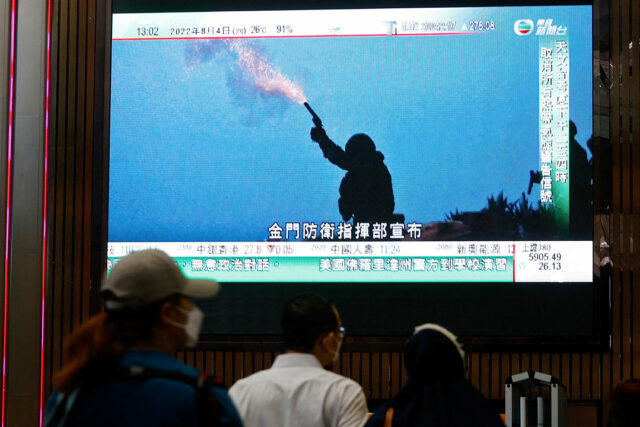
A TV SCREEN shows that China’s People’s Liberation Army has begun military exercises including live firing on the waters and in the airspace surrounding the island of Taiwan, as reported by Chinese state television, in Hong Kong, China, Aug. 4. — REUTERS

TAIPEI — China launched unprecedented live-fire military drills in six areas that ring Taiwan on Thursday, a day after a visit by US House of Representatives Speaker Nancy Pelosi to the self-ruled island that Beijing regards as its sovereign territory.

Soon after the scheduled start at 0400 GMT, China’s state broadcaster CCTV said the drills had begun and would end at 0400 GMT on Sunday. They would include live firing on the waters and in the airspace surrounding Taiwan, it said.

Taiwan officials have said the drills violate United Nations rules, invade Taiwan’s territorial space and are a direct challenge to free air and sea navigation.

China is conducting drills on the busiest international waterways and aviation routes and that is “irresponsible, illegitimate behavior,” Taiwan’s ruling Democratic Progressive Party said.

Taiwan’s cabinet spokesman, expressing serious condemnation of the drills, said also that websites of the defense ministry, the foreign ministry and the presidential office were attacked by hackers.

Chinese navy ships and military aircraft briefly crossed the Taiwan Strait median line several times on Thursday morning, a Taiwanese source briefed on the matter told Reuters.

By midday on Thursday, military vessels from both sides remained in the area and in close proximity.

Taiwan scrambled jets and deployed missile systems to track multiple Chinese aircraft crossing the line.

“They flew in and then flew out, again and again. They continue to harass us,” the Taiwanese source said.

On Wednesday night, just hours after Ms. Pelosi left for South Korea, unidentified aircraft, probably drones, flew above the area of Taiwan’s outlying Kinmen islands near the mainland coast, Taiwan’s defense ministry said.

China, which claims Taiwan as its own territory and reserves the right to take it by force, said on Thursday its differences with the self-ruled island were an internal affair.

“Our punishment of pro-Taiwan independence diehards, external forces is reasonable, lawful,” China’s Beijing-based Taiwan Affairs Office said.

China’s Foreign Minister Wang Yi called Ms. Pelosi’s visit to Taiwan a “manic, irresponsible and highly irrational” act by the United States, state broadcaster CCTV reported.

Mr. Wang, speaking at a meeting of Southeast Asian foreign ministers in Phnom Penh, Cambodia, said China had made the utmost diplomatic effort to avert crisis, but would never allow its core interests to be hurt.

The foreign ministers in a statement had earlier warned that volatility caused by tensions in the Taiwan Strait could lead to “miscalculation, serious confrontation, open conflicts and unpredictable consequences among major powers”.

‘COMRADE PELOSI’
Unusually, the drills in six areas around Taiwan were announced with a locator map circulated by China’s official Xinhua news agency earlier this week — a factor that for some analysts and scholars shows the need to play to both domestic and foreign audiences.

On Thursday, the top eight trending items on China’s Twitter-like Weibo service were related to Taiwan, with most expressing support for the drills or fury at Ms. Pelosi.

“Let’s reunite the motherland,” several users wrote.

In Beijing, security in the area around the US Embassy remained unusually tight on Thursday as it has been throughout this week. There were no signs of significant protests or calls to boycott US products.

“I think this (Pelosi’s visit) is a good thing,” said a man surnamed Zhao in the capital’s central business district. “It gives us an opportunity to surround Taiwan, then to use this opportunity to take Taiwan by force. I think we should thank Comrade Pelosi.”

Ms. Pelosi, the highest-level US visitor to Taiwan in 25 years, praised its democracy and pledged American solidarity during her brief stopover, adding that Chinese anger could not stop world leaders from traveling there.

China summoned the US ambassador in Beijing in protest against her visit and halted several agricultural imports from Taiwan.

“Our delegation came to Taiwan to make unequivocally clear that we will not abandon Taiwan,” Ms. Pelosi told Taiwan’s President Tsai Ing-wen, who Beijing suspects of pushing for formal independence — a red line for China.

“Now, more than ever, America’s solidarity with Taiwan is crucial, and that’s the message we are bringing here today.”

The United States and the foreign ministers of the Group of Seven (G7) nations warned China against using Ms. Pelosi’s visit as a pretext for military action against Taiwan.

White House national security spokesman John Kirby said earlier in the week that Ms. Pelosi was within her rights to visit Taiwan, while stressing that the trip did not constitute a violation of Chinese sovereignty or America’s longstanding “one-China” policy.

The United States has no official diplomatic relations with Taiwan but is bound by American law to provide it with the means to defend itself.

China views visits by US officials to Taiwan as sending an encouraging signal to the pro-independence camp on the island. Taiwan rejects China’s sovereignty claims, saying only the Taiwanese people can decide the island’s future. — Reuters

How Malaysia ended up owing $15 billion to a sultan’s heirs

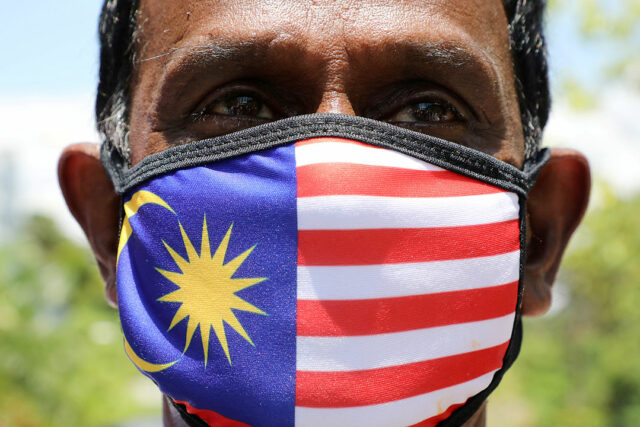
A MAN wears a mask with Malaysia’s flag outside the National Palace, Kuala Lumpur, Malaysia, Feb. 26, 2020. — REUTERS

KUALA LUMPUR — Malaysia is scrambling to protect its assets as the descendants of the last sultan of the remote Philippine region of Sulu look to enforce a $15-billion arbitration award in a dispute over a colonial-era land deal.

In 1878, two European colonists signed a deal with the sultan for the use of his territory in present-day Malaysia — an agreement that independent Malaysia honored until 2013, paying the monarch’s descendants about $1,000 a year.

Now, 144 years later after the original deal, Malaysia is on the hook for the second largest arbitration award on record for stopping the payments after a bloody incursion by supporters of Sultan Mohammed Jamalul Alam’s heirs in which more than 50 people were killed.

“It is a fascinating and unusual case,” said lawyer Paul Cohen, a lead co-counsel for the sultan’s heirs from British law firm 4-5 Gray’s Inn Square.

For years, Malaysia largely dismissed the claims but in July, two Luxembourg-based subsidiaries of state energy firm Petronas were served with a seizure notice to enforce the award that the heirs won in February.

The arbitration ruling in France followed an eight-year legal effort by the heirs and $20 million in funds raised for them from unidentified third-party investors, according to interviews with main figures in the case and legal documents seen by Reuters.

Malaysia did not participate in nor recognize the arbitration — allowing the heirs to present their case without rebuttal — despite warnings that it would be dangerous to ignore the process.

The claimants, including some retirees, are Filipino citizens leading middle-class lives, a far cry from their royal ancestors of the Sulu sultanate that once spanned rainforest-covered islands in the southern Philippines and parts of Borneo island.

The heirs argue that the 19th century deal was a commercial lease, which is why they chose arbitration. They also claimed compensation for the vast energy reserves that have since been discovered in the territory they gave up in Malaysia’s Sabah state on Borneo.

Malaysia disputes that, saying the sultanate ceded sovereignty and the arbitration was illegitimate.

“The arbitration is a sophisticated fiction, veiled as a legal process,” Uria Menendez, a Spanish law firm representing Malaysia, told Reuters.

Malaysia has obtained a stay in France pending an appeal – a process that could take years – but the award remains enforceable globally under a U.N. convention on arbitration.

‘POOREST SULTAN’
Malaysia honored the colonial-era deal until 2013, when supporters of the late Jamalul Kiram III, who claimed to be the rightful sultan of Sulu, attempted to reclaim Sabah.

Clashes erupted when about 200 supporters arrived in boats from the Philippines and lasted nearly a month.

Kiram, who claimed to be the “poorest sultan in the world,” was not one of the court-recognized heirs who received payments from Malaysia.

The eight claimants in the arbitration — including Kiram’s daughter and cousins — who received the annual payment have condemned the attack.

Up until the intrusion, the Malaysian embassy in Manila wrote a cheque to the claimants every year for “cession money,” according to cheques and correspondence from the embassy to the heirs and shared with Reuters by the heirs’ lawyers.

Malaysia’s then-prime minister, Najib Razak, told Reuters he had stopped the payments due to public anger over the incursion, acknowledging the reason publicly for the first time.

“I felt it was incumbent upon my duty and responsibility to protect the sovereignty of Sabah and the people of Sabah,” he said, adding he had not anticipated retaliatory legal action.

The claimants, through their lawyers, declined to be interviewed.

Mr. Cohen, the heirs’ lawyer, first heard of their claims from an oil and gas expert he cross examined in 2014 in an unrelated case.

Knowing they did not have the financial means, Mr. Cohen in 2016 brought on board Therium, a British firm that has bankrolled legal actions by raising money from institutional investors, including a sovereign wealth fund.

Therium conducted nine rounds of funding for the case, during which third-party investors repeatedly assessed its merits, said Elisabeth Mason, a lead co-counsel for the claimants with 4-5 Gray’s Inn Square.

The case has cost over $20 million, including lawyers and researchers in eight jurisdictions, she said.

“Investors don’t invest lightly in such matters,” she said.

Therium said it would continue to finance efforts to enforce the award. It declined to provide details.

LUDICROUS’
The heirs notified their intention to commence arbitration in 2017 in Spain and initially sought $32.2 billion in compensation, according to the award statement.

Malaysia’s first response came in 2019 when then-attorney general Tommy Thomas offered to resume the annual payments and pay 48,000 ringgit ($10,800) in arrears and interest if the arbitration was dropped.

Mr. Thomas believed the demands were “absurd and ludicrous” but made the offer after colleagues advised him that it was “perilous” to disregard the arbitration as Malaysia’s foreign assets could be at risk, he wrote in a 2021 memoir.

The heirs rejected Mr. Thomas’ offer and the arbitration went on without Malaysia’s participation.

Malaysia successfully challenged the appointment of Gonzalo Stampa as the sole arbitrator in a Spanish court last year.

But Mr. Stampa argued in his award statement that the courts did not have jurisdiction over arbitration, and moved the case to France to deliver the award — actions that Malaysia says were unlawful.

Mr. Stampa is now facing criminal proceedings in Spain following a complaint filed by Malaysia. He declined to comment to Reuters.

By snubbing the arbitration, Malaysia is confined to arguing the procedural validity rather than making a case against the heirs’ claims, said N. Jansen Calamita, head of Investment Law and Policy at the National University of Singapore. — Reuters

China warns that its temperatures are rising faster than global average

The downtown area of Haikou city is pictured in Hainan province, China May 6, 2018. — CHINA DAILY VIA REUTERS

SHANGHAI — China’s average ground temperatures have risen much more quickly than the global average over the past 70 years and will remain “significantly higher” in the future as the challenges of climate change mount, a government official said.

In its annual climate assessment published this week, China’s weather bureau described the country as “a sensitive region in global climate change,” with temperatures rising 0.26 degrees Celsius (0.47 degrees Fahrenheit) a decade since 1951, compared to the global average of 0.15 degrees.

“In the future, the increase in regional average temperatures in China will be significantly higher than the world,” said Yuan Jiashuang, vice-director of China’s National Climate Center (NCC), at a Wednesday briefing.

He warned that changing weather patterns in China will affect the balance of water resources, make ecosystems more vulnerable and reduce crop yields.

Extreme weather has wreaked havoc in recent weeks, with lengthy heatwaves causing droughts and forest fires across the world. Historically high rainfall in some countries has also caused deadly floods.

U.N. Secretary General Antonio Guterres warned last month that “no nation is immune” from climate change and said the world now had to choose between “collective action or collective suicide”.

China has already endured weeks of torrid weather, with temperatures reaching in excess of 44C in southwestern Yunnan and Hebei in the north.

As many as 131 Chinese weather stations have recorded temperatures that equalled or exceeded historical highs, up from 62 for the whole of last year, according to NCC data.

China’s 2021 climate assessment said coastal water levels last year were at their highest since 1980. Glacial retreat also accelerated, active permafrost along the Qinghai-Tibet Highway reached a record high and sea ice continued to decline.

China also recorded a 7.9% increase in vegetation cover in 2021 compared to the 2001-2020 average, and the assessment noted growth periods for many plants are starting earlier each year. — Reuters

ASEAN warns against ‘miscalculation,’ ‘serious confrontation’ over Taiwan

PHNOM PENH — Southeast Asia’s regional bloc ASEAN warned on Thursday of a risk that volatility caused by tensions in the Taiwan Strait could lead to “miscalculation, serious confrontation, open conflicts and unpredictable consequences among major powers”.

The Association of Southeast Asian Nations (ASEAN)  made the remarks in a statement from foreign ministers after its chair, Cambodia, had urged all sides to de-escalate tension over Taiwan.

The meeting in Phnom Penh of the 10-nation bloc, which is being attended by a string of other countries including China and the United States, has been overshadowed by developments in Taiwan following the visit by the U.S. house speaker Nancy Pelosi.

“ASEAN stands ready to play a constructive role in facilitating peaceful dialogue between all parties,” ASEAN said as it called for maximum restraint and for parties to refrain from provocative action.

The Pelosi trip, the highest-level US visit to self-ruled Taiwan in 25 years, has sparked outrage in China, which has responded with a burst of military exercises and other activity in the area.

Southeast Asian countries tend to tread a careful line in trying to balance their relations with China and the United States, wary of getting in between the super powers.

US Secretary of State Antony Blinken, in comments after talks with his Indian counterpart Subrahmanyam Jaishankar, said he had been able to compare notes with a close partner “as we head into these very important ASEAN meetings”.

“We have a shared vision together for a free and open Indo-Pacific,” said Mr. Blinken, who is not expected to hold a meeting with Chinese Foreign Minister Wang Yi in Cambodia.

Mr. Blinken, who is among 27 foreign ministers set to join an ASEAN Regional Forum security meeting on Friday, said his meeting with Mr. Jaishankar had covered “the situation in Sri Lanka, Burma, and a number of other hot spots”. — Reuters

5 Things you can do at SM this Cyber Month

Great tech and gaming deals are coming your way this August!

Hey there, tech geeks!

SM Supermalls is celebrating tech and innovation this August at the #SMCyberMonth2022. It’s going to be an #AweSM, action-packed month at SM with these activities and offerings that will keep you at the edge of your seat.

Experience the Great Gadget Sale

Truly, there is no place like SM Cyberzone when it comes to the hottest tech deals and the lowest price guaranteed gadgets. Get your hands on the best deals, special promos, and bundles on select items with up to 60% off in participating stores at the Great Gadget Sale. Delightful, tech-citing deals are up for grabs at SM Cyberzone, SM Appliance, and The SM Store Gadgets!

Hop on the Gadget Lab

From fun, entertaining displays and touch & try product exhibits, to interactive product guides and the latest gadgets available in the Philippines, go crazy over all things tech at the Gadget Lab. See for yourself all the best smart home devices, gaming, productivity devices, and smartphones on display in the activity areas.

See what the future of tech and gaming looks like

Aside from the epic battles, you can also see what the future of tech and gaming looks like at the PlayZone. Immerse yourself in the live demonstrations of the newest gaming technology there is! You can also check out the gaming pods, gaming set-ups, and PC rig displays in the activity area.

Witness some action at the PlayZone

SM Supermalls is bringing together e-sports players and mobile gamers for some intense and epic battles. Tag along with your gaming squad and watch the gamers outplay each other at the special exhibition matches.

Grab the special deals exclusive via the SM Online App

But if you can’t go to any SM Cyberzone branches in the Philippines, there’s still a way for you to score these offerings and discounts. All you have to do is download the SM Malls Online App, add to your cart all your tech must-haves, use the voucher deals in-app, and just pick up the items at the SM mall near you.

For first time shoppers, SM Malls Online is offering a P200 OFF when you use voucher code SMGOESONLINE upon checkout. Shop for your favorite tech brands and gadget needs! Download now the SM Malls Online app here – https://click.smmallsonline.com/DFqS/btxb3s1w

“The #SMCyberMonth2022 is a celebration of tech and gadgets that can definitely make our lives more fun, easier, and convenient. And no matter what your interest is– may it be gaming, virtual reality, smart home, music, or smartphone photography – there will be something for you at Cyberzone!” said SM Supermalls President, Steven Tan.

Experience all these and more this August at the #SMCyberMonth2022! Visit www.smsupermalls.com or follow SM Supermalls’ official social media accounts on Facebook, Twitter, and Instagram so you won’t miss out on all the cool happenings in your favorite SM mall.


Spotlight is BusinessWorld’s sponsored section that allows advertisers to amplify their brand and connect with BusinessWorld’s audience by enabling them to publish their stories directly on the BusinessWorld Web site. For more information, send an email to online@bworldonline.com.

Join us on Viber to get more updates from BusinessWorld: https://bit.ly/3hv6bLA.

Preserving cultural heritage in a modern world

CITY OF VIGAN/FACEBOOK

By Brontë H. Lacsamana, Reporter

CULTURAL AGENCIES in the Philippines renewed their commitment to preserving the rich cultural heritage of the country, using social media platforms to call on all Filipinos to support these efforts as part of National History Month this August. 

“A big challenge is carrying out the plans for taking care of our cultural heritage. It requires participation from the government, from communities, and from various sectors of society,” said Lawrence Charles E. Salazar, head of the cultural heritage section of the National Commission for Culture and the Arts (NCCA), at an Aug. 2 webinar. 

Coming to a consensus as to which cultural properties are relevant is an already difficult task — whether they’re structures, movable items, documents, or practices, he added. 

Heritage can also influence behavioral changes towards more sustainable consumption and production patterns.

“When we protect heritage, we’re also protecting the natural environment because most practices and institutions are made with what’s locally available. That’s why it’s important to communities that the sources of materials are protected,” said Mr. Salazar. 

The T’boli people of Cotabato use t’nalak, a cloth woven from the fibers of the abaca plant found around Lake Sebu; and Vigan’s heritage sites, which were damaged from the recent north Luzon earthquake, can be restored using clay found in the local environment. 

Restoration is easier said than done as it involves a long process, said  

Rene R. Escalante, concurrent chairman of both the NCCA and the National Historical Commission of the Philippines (NHCP) at a July 28 briefing.

A team of conservation and restoration experts are in Abra, Ilocos Sur, and Ilocos Norte to conduct damage assessment. Civil engineers from the University of the Philippines — Diliman evaluated the concrete structures of Vigan City Hall, Vigan Cathedral, and other structures in the city.

The Cultural Heritage Act of 2009 allows the government’s cultural agencies to categorize, document, and protect these properties. 

“More than the physical characteristics, we have to ensure that the values ascribed to a cultural property are also protected,” he said. 

“They help with identity building and nation building, which are very important.” 

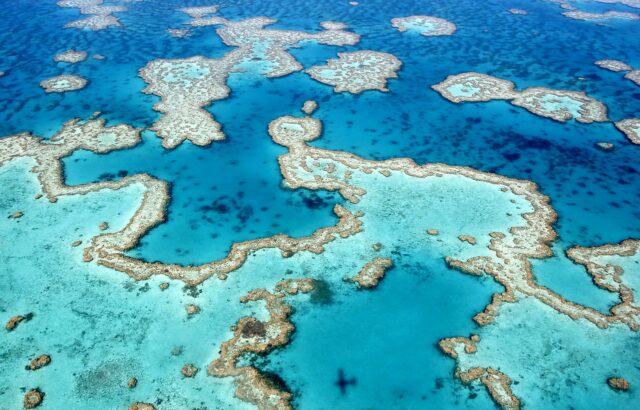
Parts of Australia’s Great Barrier Reef show highest coral cover in 36 years

Ayanadak123/CC BY-SA 4.0/Wikimedia Commons

MELBOURNE/SYDNEY — Two-thirds of Australia’s Great Barrier Reef showed the largest amount of coral cover in 36 years, but the reef remains vulnerable to increasingly frequent mass bleaching, an official long-term monitoring program reported on Thursday. 

The recovery in the central and northern stretches of the UNESCO world heritage-listed reef contrasted with the southern region, where there was a loss of coral cover due to crown-of-thorns starfish outbreaks, the Australian Institute of Marine Sciences (AIMS) said in its annual report. 

“What we’re seeing is that the Great Barrier Reef is still a resilient system. It still maintains that ability to recover from disturbances,” AIMS monitoring program leader Mike Emslie told Reuters. 

“But the worrying thing is that the frequency of these disturbance events are increasing, particularly the mass coral bleaching events,” he said. 

The report comes as UNESCO considers whether to list the Great Barrier Reef as “in danger,” following a visit by UNESCO experts in March. The World Heritage Committee meeting where the fate of the reef was on the agenda was due to be held in Russia in June but was postponed. 

In a key measure of reef health, AIMS defines hard coral cover of more than 30% as high value, based on its long-term surveys of the reef. 

On the northern region, average hard coral cover grew to 36% in 2022 from a low of 13% in 2017, while on the central region hard coral cover increased to 33% from a low of 12% in 2019 — the highest levels recorded for both regions since the institute began monitoring the reef in 1985. 

In the southern region, however, which generally has higher hard coral cover than the other two regions, cover fell to 34% in 2022 from 38% a year earlier. 

The recovery comes after the fourth mass bleaching in seven years and the first during a La Nina event, which typically brings cooler temperatures. While extensive, the institute said, the bleaching in 2020 and 2022 was not as damaging as in 2016 and 2017. 

On the downside, the growth in cover has been driven by Acropora corals, which AIMS said are particularly vulnerable to wave damage, heat stress and crown-of-thorns starfish. 

“We’re really in uncharted waters when it comes to the effects of the bleaching and what it means moving forward. But as of today, it’s still a fantastic place,” Mr. Emslie said. — Sonali Paul and James Redmayne/Reuters

Ukraine warns of new Russian offensive; Sweden, Finland move closer to joining NATO

North Atlantic Treaty Organization/Flickr

KYIV/WASHINGTON — Ukraine said Russia had started creating a military strike force aimed at President Volodymyr Zelenskyy’s hometown of Kryvyi Rih, while NATO moved closer to its most significant expansion in decades as the alliance responds to the invasion of Ukraine. 

The US Senate and the Italian parliament both approved on Wednesday Finland and Sweden’s accession to the 30-member North Atlantic Treaty Organization (NATO). Under NATO membership, which must be ratified by all 30 member states, an attack on one member is an attack against all. 

“This historic vote sends an important signal of the sustained, bipartisan US commitment to NATO, and to ensuring our Alliance is prepared to meet the challenges of today and tomorrow,” US President Joseph R. Biden, Jr. said in a statement. 

Russia, which invaded Ukraine on Feb. 24, has repeatedly warned Finland and Sweden against joining NATO. 

NATO’s 30 allies signed the accession protocol last month, allowing them to join the US-led nuclear-armed alliance once its members ratify the decision. 

Ratification could take up to a year. 

Ukraine on Wednesday dismissed suggestions by former German Chancellor Gerhard Schroeder that Russia wanted a “negotiated solution” to the war and said any dialogue would be contingent on a Russian ceasefire and withdrawal of its troops. 

The South China Morning Post (SCMP) reported on Thursday that Ukraine was seeking an opportunity to speak “directly” with Chinese leader Xi Jinping to help end the war. 

“It’s a very powerful state. It’s a powerful economy … So (it) can politically, economically influence Russia. And China is (also a) permanent member of the UN Security Council,” Mr. Zelenskyy told SCMP in an interview. 

China’s foreign ministry did not immediately reply to a Reuters request for comment. 

NEW OFFENSIVE
On the battleground, Russian forces were engaged in considerable military activity, firing from tanks, barrel and rocket artillery in several parts of Ukraine, the General Staff of the Ukrainian Armed Forces said on Thursday. 

Earlier, Ukraine said Russia had begun creating a strike group in the Kryvyi Rih direction and that it could be preparing new offensive operations in southern Ukraine. 

The steel-producing city of Kryvyi Rih where Mr. Zelenskyy grew up lies around 50 kilometers from the southern frontline. 

Pavlo Kyrylenko, governor of the Donetsk region, said on the Telegram app that three civilians had been killed in Bakhmut, Maryinka and Shevchenko and five wounded in the past 24 hours. 

Governors of the Mykolaiv, Kharkiv, Dnipropetrovsk regions reported that their regions had been shelled overnight, and civilian infrastructure, houses had been damaged. 

“The idea is to put military pressure on us in Kharkiv, Donetsk and Luhansk over the next few weeks … What is happening in the east is not what will determine the outcome of the war,” Ukrainian Presidential Adviser Oleksiy Arestovych said in an interview appearing on YouTube. 

The whole point of the Russian offensive in the east is to force Ukraine to divert troops from the area that is truly a danger — Zaporizhzhia, Mr. Arestovych added. 

Mayor Yevhen Yevtushenko of Nikopol, west of Zaporizhzhia in central Ukraine, said his city had been shelled overnight. 

Russia in March was accused of firing shells dangerously close to the Zaporizhzhia nuclear power plant, as its forces took it over in the first weeks of the invasion. 

US Secretary of State Antony Blinken has accused Moscow of using Ukraine’s largest nuclear power plant as a “nuclear shield” in attacks on Ukrainian forces. 

Reuters was not able to verify battlefield reports. 

Russia denies it targets civilians, but many towns and cities have been destroyed and thousands killed in the biggest conflict in Europe since World War Two. Ukraine and its Western allies accuse Russian forces of war crimes. 

FOOD CRISIS
Russian President Vladimir Putin sent troops into Ukraine in what he calls a “special military operation” to rid the country of fascists. Ukraine and the West said Putin launched an unprovoked “imperial” land grab. 

The war has sparked a global energy and food crisis. Russia and Ukraine produce about one third of global wheat and Russia is the main energy supplier to Europe. 

An agreement between Moscow and Kyiv, brokered by the United Nations and Turkey, to allow safe passage of grain ships from Ukraine has been hailed as a rare diplomatic success in the war. 

The first ship carrying Ukrainian grain since the war started passed through the Bosphorus Strait on Wednesday. The vessel, Razoni, was carrying 26,527 tonnes of corn to the Lebanese port of Tripoli. 

Mr. Zelenskyy said Ukraine needed to export a minimum 10 million tonnes of grain to urgently help bring down its budget deficit which was running at $5 billion a month. 

A senior Turkish official said three ships could leave Ukrainian ports daily following the Razoni’s departure, while Ukraine’s infrastructure minister said 17 more ships had been loaded with agricultural produce and were waiting to set sail. — Natalia Zinets and Patricia Zengerle/Reuters