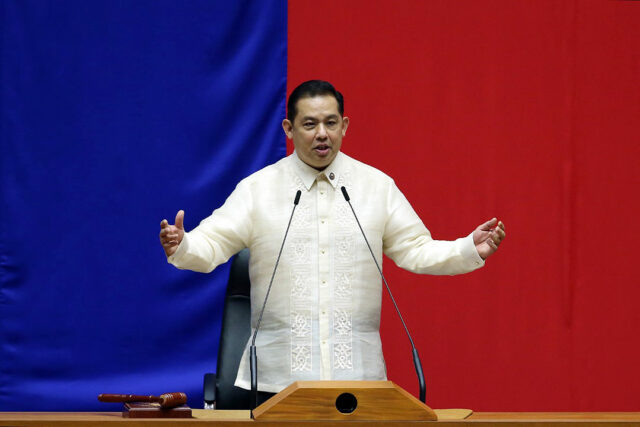
House Speaker Ferdinand Martin G. Romualdez — PHILIPPINE STAR/KRIZ JOHN ROSALES
THE HOUSE of Representatives is ready to work on the national budget, which is expected to be submitted by Malacañang within the month, and 2,877 bills have been filed, Speaker Martin G. Romualdez said on Sunday.
Mr. Romualdez, who represents Leyte’s 1st District, said the chamber is buckling down to legislative work as chairpersons and members of most committees have already been elected.
The Committee on Appropriations, headed by Ako Bicol Party-list Rep. Elizaldy S. Co, will be one of the busiest as it will be the main panel that will evaluate the proposed national budget.
The National Expenditure Program is expected to be submitted by Malacañang to the House of Representatives on the third week of August.
“Rest assured that the House will act immediately on the budget,” Mr. Romualdez said in a press release.
Press Secretary Trixie Cruz-Angeles announced on July 29 that the administration is planning to submit the 2023 budget to Congress on Aug. 22. The expenditure plan is expected to be not much higher than this year’s P5.02 trillion budget.
Mr. Romualdez also announced that 50 out of the 64 standing committees and 10 of 15 special committees have been designated their respective chairperson. All but one committee also have member-lawmakers designated to them.
Once constituted, House committees will hold hearings on filed bills and other measures. — Matthew Carl L. Montecillo
THE SUPREME Court (SC) has ordered a regional court judge to pay a fine of P17,500 for failing to act on a litigant’s motion to authenticate video evidence for forensic examination and enhancement.
In a resolution dated April 26 and made public on August 5, the court’s first division found Talisay City Regional Trial Court Branch 1 Presiding Judge Mario V. Manayon guilty of simple neglect of duty, which is a lesser offense than the Judicial Integrity Board’s (JIB) initial recommendation to fine him for undue delay in rendering an order.
The tribunal added the trial court judge failed to “give proper attention to a task expected of an employee resulting from either carelessness or indifference.”
Under SC rules, magistrates found guilty of simple neglect of duty are liable to a fine of more than P35,000 but not exceeding P100,0000 and suspension from office for up to six months.
The High Court noted that it decided to impose a lesser fine since this was the judge’s first offense, as the rules allow the court to impose a fine of not less than half of P35,000.
“Considering that this is respondent judge’s first infraction, the penalty of suspension from office for a period not less than one month nor more than six months; or the imposition of a fine of more than P35,000.00 but not exceeding P100,000 is a bit harsh,” it said.
The tribunal sternly warned Mr. Manayon of a more severe penalty should he repeat the offense or commit a similar violation.
The fine stemmed from a disbarment complaint from Cristhyn R. Abing, a private litigant who claimed the judge showed bias towards a witness during a criminal case as the judge repeatedly intervened during cross-examinations to answer questions for the witness.
Ms. Abing’s complaint accused the judge of obstruction of justice by failing to act on her request to authenticate video evidence and the supposed bias during the case hearings.
The National Bureau of Investigation’s (NBI) regional anti-cybercrime unit told her that they could only conduct a forensic examination on the video but not authenticate it.
Mr. Manayon argued that he only intervened during the witness’ cross-examination because he said the questions were vague or misleading.
“While judges should as much as possible refrain from showing partiality to one party and hostility to another, it does not mean that a trial judge should keep mum throughout the trial and allow parties to ask the question that they desire, on issues which they think are the important issue,” said the High Court.
The magistrate added that he had previously issued an order for the authentication of the video, but the prosecution opposed Ms. Abing’s additional motion to enhance the video, saying it would tamper with the evidence.
He added that the complainant agreed to return to the NBI to explain how the video was to be examined.
The High Court affirmed the JIB’s report that the judge’s inaction in resolving the complainant’s motion made him liable for neglect of duty.
“Judges shall perform all judicial duties, including the delivery of reserved decisions, efficiently, fairly, and with reasonable promptness,” it said, citing the New Code of Judicial Conduct. — John Victor D. Ordoñez
CHESS PIECES are seen in front of displayed China and Taiwan’s flags in this illustration taken Jan. 25, 2022. — REUTERS
TAIPEI — Chinese and Taiwanese warships played high-seas “cat and mouse” on Sunday ahead of the scheduled end of four days of unprecedented Chinese military exercises launched in reaction to a visit to Taiwan by the US house speaker.
Nancy Pelosi’s visit last week to the self-ruled island infuriated China, which responded with test launches of ballistic missiles over the island’s capital for the first time and the cutting of communication links with the United States.
Some 10 warships each from China and Taiwan sailed at close quarters in the Taiwan Strait, with some Chinese vessels crossing the median line, an unofficial buffer separating the two sides, according to a person with knowledge of the matter.
The island’s defense ministry said in a release multiple Chinese military ships, aircraft, and drones were simulating attacks on the island and its navy. It said it had sent aircraft and ships to react “appropriately.”
As Chinese forces “pressed” the line, as they did on Saturday, the Taiwan side stayed close to monitor and, where possible, deny the Chinese the ability to cross, the person said.
“The two sides are showing restraint,” the person said, describing the maneuvers as high seas “cat and mouse.”
“One side tries to cross, and the other stands in the way and forces them to a more disadvantaged position and eventually return to the other side.”
Taiwan said its shore-based anti-ship missiles and its Patriot surface-to-air-missiles were on stand-by.
The Chinese exercises, centered on six locations around the island that China claims as its own, began on Thursday and are scheduled to last until midday on Sunday, the official Xinhua News Agency reported last week.
China’s military said on Saturday the sea and air joint exercises, north, southwest and east of Taiwan, had a focus on land-strike and sea-assault capabilities.
The United States called the exercises an escalation.
“These activities are a significant escalation in China’s efforts to change the status quo. They are provocative, irresponsible and raise the risk of miscalculation,” a White House spokesperson said.
“They are also at odds with our long-standing goal of maintaining peace and stability across the Taiwan Strait, which is what the world expects.”
‘DAMAGING PEACE’ China says its relations with Taiwan are an internal matter and it reserves the right to bring the island under its control, by force if necessary. Taiwan rejects China’s claims saying only Taiwan’s people can decide their future.
China has also warned the United States not to “act rashly” and create a greater crisis.
Referring to the response to Ms. Pelosi’s visit, the Communist Party’s People’s Daily newspaper said China had adopted “effective measures that fully demonstrates that China is fully determined and capable of safeguarding national unity and safeguarding … sovereignty and territorial integrity.”
Taiwan’s Premier Su Tseng-chang told reporters that China had “arrogantly” used military action to disrupt peace and he called on Beijing not to not flex its military muscle.
Taiwan’s defense ministry said on Saturday its forces scrambled jets to warn away 20 Chinese aircraft, including 14 that crossed the median line. It also detected 14 Chinese ships conducting activity around the Taiwan Strait.
The ministry released a photograph showing Taiwanese sailors closely watching a nearby Chinese vessel.
Taiwan’s forces on Friday fired flares to warn away drones flying over its Kinmen islands and unidentified aircraft flying over its Matsu islands. Both island groups are close to China’s coast.
‘WORLD FACES A CHOICE’ As part of its response to Ms. Pelosi’s visit, China has halted communication through various channels with the United States including between military theater commands and on climate change.
US Secretary of State Antony Blinken accused China of taking “irresponsible” steps and moving away from prioritizing peaceful resolution towards the use of force.
Ms. Pelosi, a long-time China critic and a political ally of US President Joseph R. Biden, arrived in Taiwan late on Tuesday on the highest-level visit to the island by an American official in decades, despite Chinese warnings. She said her visit showed unwavering US commitment to supporting Taiwan’s democracy.
“The world faces a choice between autocracy and democracy,” she said. She also stressed that her trip was “not about changing the status quo in Taiwan or the region.”
Taiwan has been self-ruled since 1949, when Mao Zedong’s communists took power in Beijing after defeating Chiang Kai-shek’s Kuomintang nationalists in a civil war, prompting their retreat to the island.
Speaking during a visit to the Philippines, Mr. Blinken said the United States had been hearing concern from allies about what he called China’s dangerous and destabilizing actions but Washington sought to avoid escalating the situation.
He said China’s cessation of bilateral dialogue in eight key areas were moves that would punish the world. — Reuters
ZURICH — The head of the International Atomic Energy Agency (IAEA) raised grave concerns on Saturday about the shelling the previous day at the Zaporizhzhia nuclear power plant in Ukraine, saying the action showed the risk of a nuclear disaster.
Both sides accused each other on Saturday of engaging in “nuclear terrorism”. Ukraine’s state nuclear power company Energoatom blamed Russia for the damage while Russia’s defense ministry accused Ukrainian forces of shelling the plant.
“I’m extremely concerned by the shelling yesterday at Europe’s largest nuclear power plant, which underlines the very real risk of a nuclear disaster,” IAEA Director General Rafael Mariano Grossi said in a statement.
Mr. Grossi, who leads the United Nation’s nuclear watchdog, urged all sides in the Ukraine conflict to exercise the “utmost restraint” around the plant.
Shells hit a high-voltage power line on Friday at the facility, prompting its operators to disconnect a reactor despite no radioactive leak being detected. The plant was captured by Russian forces in early March in the opening stage of the war but it is still run by its Ukrainian technicians.
Energoatom said Russia wanted to disconnect the station from the Ukrainian electricity system and cause blackouts in the south of the country. Moscow’s forces, it said, had placed weapons and explosives in two of the power-generating units and mined the shoreline outside the plant.
“It is highly probable that all of this will cause a nuclear and radiation disaster,” it said in a statement on Saturday.
Russia’s defense ministry said damage to the plant had only been avoided thanks to the “skillful, competent and effective actions” of its units.
Mr. Grossi said that military action jeopardizing the safety and security of the Zaporizhzhia plant “is completely unacceptable and must be avoided at all costs”. — Reuters
A TOURIST visits the archaeological site of the ancient city of Pompeii, Italy, April 27, 2021. — REUTERS
MILAN — Archaeologists have discovered four new rooms in a house in Pompeii filled with plates, amphoras and other everyday objects, giving a snapshot of middle-class life at the moment Mount Vesuvius’ eruption buried the Roman city in AD 79.
The remains of bowls, a hastily emptied trunk, a bed and a crib-shaped terra-cotta perfume burner were found on two floors of a previously-excavated building, the Pompeii archaeological park authority said on Saturday.
Some were more valuable than others — vessels made of bronze or glass next to everyday tools.
“A large slice of the population in the Roman Empire were people who sweated for their daily bread but were also anxious to raise their social status,” the park’s director, Gabriel Zuchtriegel, said.
Archaeologists took plaster casts to reproduce some of the objects from the site in Pompeii, one of Italy’s main tourist attractions near the modern city of Naples.
The rest of the structure, excavated in 2018, includes a courtyard decorated in frescoes of plants, birds and hunting scenes. A niche hosting the household guardian gods, or Lares, gave the “Larario house” its popular name.
“The owners of the Larario house in Pompeii had been able to decorate the courtyard hosting the Lares site and a well with outstanding paintings, but evidently they didn’t have enough money for all of the rooms,” Zuchtriegel added.
“We don’t know who lived here but the pleasurable life depicted in the courtyard was probably more of an aspiration than their everyday reality.” — Reuters
FORMER President
Fidel Valdez Ramos
re-enacts the famous jump for joy he did on February 25, 1986 in the 2011 EDSA People Power Revolution Anniversary celebrations. — BW FILE PHOTO
FORMER President Fidel Valdez Ramos re-enacts the famous jump for joy he did on February 25, 1986 in the 2011 EDSA People Power Revolution Anniversary celebrations. — BW FILE PHOTO
(In view of the recent passing of former president Fidel V. Ramos, Introspective is reprinting a tribute column from Jan. 11, 2010.)
Our country is at a crossroad. Results of the May elections, an orderly transfer of power, and no less, the person who will occupy the country’s CEO position, will define the course of our collective future for at least the next six years.
There have been worrisome declines in objective indicators of global competitiveness, governance and transparency, economic freedom, and credit rating since 1998 (see World Economic Forum: Global Competitiveness Index, www.weforum.org;Transparency International: Corruption Perceptions Index, www.transparency.org; The Heritage Foundation: Index of Economic Freedom, www.heritage.org; and Standard & Poor’s, www.standardandpoors.com). While it may be argued that there are factors that contributed to this decline beyond the control of the national leadership, say, economic tsunamis like the Asian and global financial crises, such consistent RELATIVE declines over such an extended period compared to peers outside and within our neighborhood, cannot but be attributed to leadership failure — if not to malign, then benign, neglect.
It has not always been this way, and more importantly, needs not be. For example, can there be good reason for us to be ranked 144 out of 183 in a World Bank report released two weeks ago on ease of doing business, even below Pakistan, Bangladesh, the West Bank, and Gaza, and down there with troubled countries Zimbabwe and Afghanistan? Or worse, continue on a downward descent?
Assuredly none. I earlier wrote about a study that my LBT colleague and I did for the World Bank Growth Commission (chaired by Nobel Prize winner Michael Spence) on the political economy of reform during the Ramos years (https://openknowledge.worldbank.org/handle/10986/28020).
In it, we looked at what it took the Ramos administration to successfully push for reform (in telecom demonopolization, water privatization, and oil deregulation) working against strong special interests (e.g., from affected businessmen, labor constituencies, political ideologues) and using instruments, both formal and informal, at the disposal of the presidency in an environment of weak, lethargic, or sometimes obstructive/compromised institutions, including an underdeveloped and poorly motivated bureaucracy.
It finds, no surprise, that leadership matters crucially.
The personal qualities and experience of the leader for the most difficult job in the country matter much. His ability to think strategically; the clarity of this national vision and its articulation; his ability to attract, inspire, manage, and forge cohesion in a first-class team; his ability to build coalitions and political consensus and educate the public and get their support to overcome obstacles and persevere; and other leadership attributes and management skills come out as elements for success in pushing reforms in a difficult terrain.
Mr. Ramos has had preparation for leadership at an early age. A West Point graduate with degrees in Engineering and an MBA, he honed his executive skills over decades within the military and civilian bureaucracies and his political skills in dealing with politicians and the public in areas of peacekeeping and development. As former Finance Secretary Roberto de Ocampo quipped explaining his successes upon receiving the Finance Minister award from Euromoney in 1996, “A finance secretary has many key decisions to make; not least of them, which president to serve.”
The case studies as well showed the importance of timing. A new president has six years to make a difference. He and his team cannot solve everything in one go — indeed some problems may be so intractable, or be met with overwhelming political opposition, that if he started on them first, he would have sown the seeds, and demonstrably shown, abject failure early on, in what may become the signature of his administration.
He needs to hit the ground running, and score early, and impressive, victories that build confidence and get the public fully behind him for more difficult items down the road of his reform agenda. During the Ramos administration, the immediate problem, and opportunity, was getting the economy on track after debilitating outages that saw GDP contract by 0.6% — to put back the lights both literally and in terms of business confidence. This was achieved in a record time of 15 months, thanks to Ramos’ no-nonsense leadership and empowerment of known achievers: Energy Secretary Del Lazaro, recruited from a distinguished career in the private and briefly in the public sector, and NPC President Sonny Viray, a PhD in Electrical Engineering and dean of the UP College of Engineering.
Such a victory set the stage for reviving investments and rallying public support behind other reforms to improve global competitiveness, including bringing to the next stage, the trade and investment liberalization started earlier, deregulation, privatization/public-private partnerships, fiscal consolidation, that has contributed importantly to the resilience of the Philippine economy even during the Asian crisis and the more recent global financial tsunami. The improvements in objective indicators of competitiveness and governance/transparency, economic freedom, and credit rating since 1992 are a matter of record as have been their deterioration since 1998.
The take-away from all this is not that our country is doomed to take one step forward, and then two steps backward, but that it is possible to reverse the decline. For our next CEO, improving fiscal performance, side by side with a well thought-out and executed infrastructure and social spending program, including through transparent public-private partnerships, would be a good place to start. Our collective future depends on it.
Romeo L. Bernardo was finance undersecretary from 1990-96. He is a trustee/director of the Foundation for Economic Freedom, Management Association of the Philippines, and FINEX Foundation. He is Philippines principal adviser to Globalsource Partners
On Aug. 4, the Philippine Statistics Authority (PSA) announced that Philippine inflation hit 6.4% in July, the fastest year-on-year growth in four years.
Fast-rising inflation has exacerbated poverty and affected household spending all over the country. But at the same time, this inflation is not a result of a “hot economy.” In fact, we are still at the critical stage of recovering our economy and returning to pre-pandemic levels of income and output.
In short, the administration needs a solid, coherent plan. The goal is not just to arrest immediate inflation and mitigate its negative impact, but to bring about sustained economic growth in the Philippines following the pandemic-induced recession and a high fiscal deficit.
In this regard, a central question that Ferdinand Marcos, Jr.’s state of the nation address (SONA) should have answered is: What is the President’s diagnosis of the main problems plaguing our country? What are the binding constraints on the economy? And how did he arrive at the diagnosis?
In his SONA, the President said that we face “difficult times.” and “we will continue to find solutions.” With respect to the economy, he enumerated a number of proposed measures wherein he highlighted “sound fiscal management.” But clarity is lacking as to what underpins these proposals, and whether these proposals are most responsive to the binding constraints.
Instead of assessing the country’s current economic situation and the policy recommendations, this piece (Part 1) will focus on explaining how to do the growth diagnostics approach. This policy tool comes from a 2005 paper by Ricardo Hausmann, Dani Rodrik, and Andres Velasco, entitled “Growth Diagnostics.”
The paper informs readers, particularly policy makers and economists, on the relevance of doing diagnostics to identify an economy’s binding constraints. It is likewise a critique of the Washington Consensus (WC), a set of wholesale, if not second-best, policy recommendations supported by the International Monetary Fund and the World Bank. The WC failed to deliver sustained higher levels of investments in many emerging economies.
Hausmann et al. argue that a growth diagnostics approach is needed towards narrowing the policy interventions that are most appropriate to removing the major barriers to investments. Setting the ambitious goal to solve all problems or distortions all at once (like the WC) is unrealistic. The arguments of Hausmann et al. are summarized below.
There are four typical reform strategies, which Hausmann et al. argue are inferior to the growth diagnostics approach.
The first is “wholesale reform,” in which all issues are simultaneously eliminated. This is practically impossible. In the first place, policymakers lack the relevant information regarding all the distortions in order to do wholesale reform. In the second place, pursuing reforms everywhere stretches and exhausts institutional capacity.
The second is “do as much reform as you can, as best as you can,” which is the prevailing approach and is a laundry-list approach to reform. This simply goes for whichever reforms seem to be doable, relying on the idea that the more areas are reformed, the better, and that any reform is good. This is faulty because we cannot be sure that any given reform taken on its own can be guaranteed to be good, due to numerous other issues which it might interact with. For example, a doctor can prescribe medicine that is in itself good for the patient, but when taken in combination with other drugs, it could have contraindications and lead to increased harm.
The third is the second-best reform, which prioritizes reforms that lead to positive second-best effects. But it is often difficult to forecast second-best interactions before they happen. Despite being aware of possible negative effects of the interaction of doable reforms, we cannot at the outset predict what the costs are. The full transaction costs of a controversial reform, for example, only emerge after the fact.
The fourth criticized strategy is: If the second-best interactions cannot be ascertained, reformers may opt to target the biggest distortion. But this doesn’t guarantee that the reforms with the biggest impact on economic welfare and growth will be worked on first. Biggest distortions do not necessarily correspond to achieving the biggest net benefits for society. (Take for example, the higher corporate income tax, relative to similarly situated countries in the region. One can concede that this is a big distortion. But investors themselves do not consider the higher tax as the most binding constraint.)
We cannot thus afford to undertake what Hausmann et al. call a “spray-gun” approach, which has too many targets. As worldwide experience has shown, it is not only ineffective; it also leads to unintended adverse consequences, making the situation worse.
Besides political, capital, time, and resources are finite. Hence these limited resources are better used to work toward the most important reforms.
The solution is to focus on the most binding constraints, or the principal problems, which provide the most “bang for the reform buck.” This approach focuses on the bottlenecks directly. These are the obstacles that if not cleared, would make the economy grind to a halt. Overcoming these obstacles brings about a large magnitude of benefits for society, the economy, or the sector.
Determining binding constraints is not a simple task. The growth diagnostics approach uses a problem tree (Figure) to look at the proximate determinants of economic growth (e.g., savings, innovation, infrastructure, etc.) rather than the specific problems.
Using the problem tree requires answering the following questions: What keeps growth low? What hinders the flow of productive investments? Is the main problem the low return to economic activities or the high cost of finance?
If the main problem revolves around low return to economic activities, is it due to risks in the macroeconomy like inflation or narrow fiscal space? Or is it about low social returns like insufficient investment in complementary factors of production such as human capital or infrastructure? Or is it due to poor access to technology? Or poor property rights and contract enforcement, labor-capital conflicts, or learning and coordination externalities?
Or is low growth mainly explained by inadequate access to finance? Are there problems with the domestic financial markets or external markets? If it’s a problem of poor domestic markets, is this due to fiscal deficits or poor intermediation?
After doing a process of elimination, we can separate the non-binding from the binding constraints. Once we know where to focus, we find the associated economic distortions whose removal will make the biggest contribution to alleviating the constraints on growth. Then we can proceed to choosing the appropriate policy or intervention. However, this does not yet determine the exact sequencing of policy interventions. Once the primary binding constraint is adequately addressed, we return to the problem tree framework for the next challenge.
To illustrate the use of the growth diagnostics framework, let’s apply this to the case of the Philippines. In 2010, when President Noynoy Aquino’s term began, the binding constraint was the narrow fiscal space due to the previous administration’s politicized spending and reluctance to pass further tax reforms. To resolve this, the Aquino administration successfully pushed for the passage of the sin tax reforms, which increased, simplified, and improved the excise tax regime.
The sin tax reforms relaxed our fiscal space. However, it was still necessary to further increase taxes to finance high spending for infrastructure. During the Aquino term, infrastructure spending was low and became a binding constraint.
The Duterte administration addressed the issue of low infrastructure spending, inadequacy, and deterioration of infrastructure by legislating the comprehensive tax reform program. This resulted in the country’s highest tax effort since the Ramos administration. These reforms upgraded our creditworthiness and enabled the financing of infrastructure and other public goods.
Moving forward, we ask: What are the binding constraints hampering growth in the Philippines today? A wholesale reform strategy will only waste our resources. In the same vein, a misdiagnosis can possibly further constrain our growth. Is the binding constraint the “high cost of finance” or the country’s rising debt? Is it low social returns, arising from the COVID-19 pandemic? Is the health system or the education system impeding growth and investments? Does infrastructure remain a binding constraint? Or have the macro risks like the threat of narrowing fiscal space and high prices emerged as a binding constraint?
The challenge thus is to define a narrow target of policy interventions that are responsive to removing the most binding constraints.
The next piece will focus on Marcos Jr.’s economic policy priorities and the policies needed to address the binding constraints.
(To be continued.)
The authors belong to Action for Economic Reforms.
Last April, the Sri Lankan government announced that it was defaulting on its debts, making it the first sovereign nation to default since the pandemic started. The island republic has depleted its cash reserves. The Sri Lankan people face a shortage of food, fuel, medicines, and electric power. At least 500,000 Sri Lankans have fallen into severe poverty in the last year alone. All these have led to civil unrest and the resignation and subsequent retreat of President Gotabaya Rajapaksa to the Maldives.
Pakistan is showing all the signs of going Sri Lanka’s way. With debts amounting to well over $125 billion (71.3% of GDP), the south Asian nation has only $7 billion in cash reserves. Pakistan is facing a cash crunch. It tried to borrow from China and Saudi Arabia to pay for the importation of its basic essentials, but both turned cold, spooked by the risk.
Pakistan had no choice but to turn to the IMF for a $6 billion bailout. The lifeline will likely come, albeit with stiff conditions. Pakistan will have to remove all fuel subsidies to save cash. This will severely impact the Pakistani people who are already suffering under the weight of 21.3% inflation.
Making matters worse is the rapid devaluation of the Pakistani Rupee which fell by 34% in the last year. The devaluation has made imports more expensive — a difficult situation since Pakistan is dependent on imports for its food, medicines, and other essentials. As it stands, food prices have become unreachable for most Pakistanis. Medicines are becoming scarce. The country suffers from frequent power outages to save fuel. Public anger is rising and people are taking to the streets.
Calls for the resignation of Pakistan’s Prime Minister, Shehbaz Sharif, are getting stronger by the day. But Sharif blames his predecessor for his country’s woes.
How did Pakistan get to this point?
Pakistan’s downfall has been in the making for 70 years. It has undergone one economic crisis after another since separating from India in 1947. In the last 30 years alone, the IMF has had to bail it out 13 times.
At the heart of Pakistan’s problems is political instability and the lack of continuity. Ousting incumbent Prime Ministers is a standards affair such that none of Pakistan’s past 22 Prime Ministers have finished their term.
Typically, the sitting Prime Minister would spend the first years of his/her term undoing the policies of the predecessor, only to be ousted before real reforms can be instituted. Case in point, in 1978 Muhammad Zia-ul-Haq banned labor unions and censored media. When Benazir Bhutto came to power, she spent the better part of her term legalizing unions and restoring freedom of the press. Immediately after, she was ousted by Nawaz Sharif. This has been Pakistan’s pattern for decades.
This pattern led to a chain of consequences that have proven disastrous. Necessary reforms do not gain traction; Prime Ministers become more concerned with staving-off power grabs than instituting real reforms; reforms, whenever instituted, tend to be populist; political instability leads to policy instability; foreign investors stay away; lack of investments leads to a sluggish manufacturing sector and import dependence; low productivity leads to low national revenues which forces the country to depend on loans to sustain itself.
Exacerbating matters is Pakistan’s “war brokering” business. Pakistan has been a breeding ground for militant groups who can be hired for a price. For instance, the Mujahideen fighters were contracted by the United States to resist Russian forces in Afghanistan in 1979. The Pakistani government also accepted some $1.2 billion a year for the US to use its roads, ports, railways, and airspace as it battled the Russians in Kabul. War brokering and militant group outsourcing has been mainstay in Pakistan’s economy even today.
Involvement in wars (even if not their own) contributed to Pakistan’s image as an unsafe and turbulent economy. Investors and tourists stay away, depriving the country of precious dollar revenues.
While the country languishes in dire straits, in comes China offering generous loans for the development of infrastructure. It proposed the development of the Gwadar Port which is strategically located in the Arabian Sea.
China used its debt trap strategy to gain control of the Gwadar Port. How does it work? First, China lures weak nations into acquiring massive loans for the development of infrastructure. Second, China imposes stiff terms designed to cause the borrower to default. Interest rates could reach 4% per annum as compared to 1% from development lenders such as the ADB. Chinese debt duration usually spans 10 to 15 years whereas it is typically 30-years with others. All construction suppliers, labor, and engineers are sourced from China, causing the funds to flow back to the mainland, not the host country. Third, when the country defaults, China takes over the asset and treats it like its sovereign property, using it for sole purpose.
Pakistan owes China some $24.7 billion. And since it defaulted on its debt obligations, China now occupies and controls the strategic Gwadar Port.
So, what are the lessons for the Philippines?
1. We must never allow ourselves to be import dependent since it makes us vulnerable. Self-sufficiency in food and basic essentials is a must for national survival. This means we must work towards a manufacturing and agricultural resurgence as soon as possible.
2. We should maintain strong financial fundamentals which include manageable debt levels, strong forex reserve positions, and manageable current account balances. The government must avoid populist policies like giving out subsidies, especially in a time when belt tightening is needed.
3. No matter how strong political rivalries may be, our laws and policies should always serve the national interest, not political agendas.
4. Continuity in policies across administrations is critical.
5. Steer clear from Chinese debt traps.
Pakistan’s situation is lamentable and our hearts go out to the Pakistani people for their sufferings. May this crisis serve as an impetus for political and financial reforms which are vital for Pakistan’s recovery.
A SCREENGRAB of “Permission to Dance” video by the K-pop group BTS.
Omigod, we are so late for the queue-up for the free COVID booster shots!
Actually, the Glorietta Malls open at 10 a.m. on Saturdays (and Sundays), and it is only 10:30 a.m. — not so late, really, but why are there throngs wanting to get in? Up the escalator to the 2nd floor of Glorietta 4, we are shocked to see the snaking lines of maybe close to a thousand people hugging the security railings, backing up to Glorietta 3. You can proceed to the SM wing on this same floor, the security guard says (maybe because we were evidently Seniors), and we emerge upon the satellite Vaccination Center of the Department of Health (DoH) for Makati City.
At the Vaccination Center, there are about 150 people — DoH staff and patients — in a space of about 300 square meters. We are registered, vaccinated, and out in half an hour. The DoH nurse tells us they are expecting less than 700 vaccinees for the Pfizer shots available today. What are the thousands of people outside lined up for? They are not queueing for COVID Booster shots!
What are you in line for, we ask a young man garbed in a loose shirt and tight white pants, short hair combed forward in K-pop style bangs almost covering his eyes. We are queueing for the K-pop store, he says excitedly. Why, what’s there? There’s a sale today, 20% off on all items, but people are really wanting to buy limited edition CDs of K-Pop icons, with free exclusive photo-albums — P2,900 a pop, for these K-pop collectibles!
In a phone interview the day after, the K-pop store manager claimed they had 3,000 customers on the day of the sale, while since their soft opening a month earlier, they have had an average of 1,000 customers a day spending an average of P1,000 per head on the all-K-pop items that the store carries.
What is this K-pop craze that has young people queueing for hours to spend P2,900 on a BTS CD album? Meanwhile, K-pop idol Jason Wang of the Masterz boy band sang at the SM MOA Arena the evening before the CD sale, to a hysterical full-packed audience who bought tickets at swooning prices, ranging from P2,500 to P12,500 (depending on the seating) — it must be crowd hypnosis!
What is the face of this “fandom” (the die-hard fans, collectively, in all their ardor)? What has inextricably bound them to the image, perhaps, of what they can be, or what they want to be — especially in these fragile times of the unrelenting COVID pandemic and the political and economic turmoil all over the world?
At the Glorietta Mall, the queue moved so slowly (like maybe every 30 minutes only) because the K-pop store allowed only 10 customers in the small store due to the COVID requirement of social distancing. A special uniformed security guard at the small entrance strictly monitored this. And yet the waiting crowd was very patient, disciplined, and quiet. How old are you, we asked the young man with the K-pop bangs? Twenty-five, John said. A dozen places ahead of him, a young woman named Marsha said she was 27. But of course! K-Pop fans cannot be too young, else how can they afford those expensive shows and K-pop memorabilia?
K-Pop fans are not limited to young working adults of 20-30 years, our dachshund Sandy’s astute veterinarian said authoritatively. In fact, there is no age barrier to being a rabid fan (no offense meant on the use of the word “rabid”). Our 40+ and groovy vet says he has been a fan since 2012, when PSY’s “Gangnam Style” video was first released on YouTube. According to BBC News, “Gangnam Style” broke YouTube’s maximum view count limit of 2,147,483,647 views, causing YouTube to rewrite this limit, which now stands at 9.22 quintillion.
And so, this “oldie” (and someone who is not yet a K-pop fan) just had to watch the boy band BTS perform their first hit, “Dynamite” (YouTube Official MV: 1,535,120,651 views; it premiered on Aug. 21, 2020). The seven “boys” look like teens (although their bios on Google show that they range from 26 to 29 years old today — the same general age of those lined up at Glorietta for the K-pop store sale). Against this oldie’s preconception of “macho,” they all look effeminate, what with little hoop earrings on each earlobe, plucked eyebrows, and pink lipstick. And the de rigueur bangs of the K-pop hairdo made them somewhat androgynous. Their dance moves are slowed hip-hop, bodies undulating with the repetitive music reminiscent of rapping, but languid and stretched — yes, the slow arching and then the abrupt jerks of the K-pop dance might suggest the tension of passion building then bursting into climax.
Blackpink is the highest-charting female Korean act on the Billboard Hot 100, the first female Korean group on Forbes’ 30 Under 30 Asia (2020); the first Korean girl group to win an MTV Music Video Award (2020), and lauded by former South Korean President Moon Jae-in as a global K-pop phenomenon helping spread K-pop content worldwide (2021). The four Blackpink members are Jisoo, Jennie, and Rosé who are all 25 years old, and Lisa who is 29 years old today, but they all look like teens, just like the BTS boys. Their choreography is innocently playful, but urgingly sensual in the swiveling of hips and dipping low — much like the nubile flirtation of a child-lover Lolita. Cute, and teasingly “male-gaze-ready” one observed. The lyrics of their song “Forever Young” are in American English, unabashedly borrowing from Cyndi Lauper’s “Girls Just Wanna Have Fun” (YouTube Official MV: Blackpink — “Forever Young,” 214,897,665 views since June 21, 2018).
Perhaps the appeal of K-pop is that the “idols” seem to be frozen in time at that perfection of youth, while they cope with their angst and frustrations in detached surrender, as seen in their moves and their songs. Some foreign critics decry that K-pop music has lost its cultural integrity by its outright Westernization, forgetting the charm of mixed Korean and English lyrics, and going all-English (as the BTS band does in “Dynamo”), and dressing all-Western garb, as in distressed jeans and hang-loose get-ups. But that is precisely the secret of K-pop’s marketing success — that it has global reach and has captured universal demand.
“K-pop has played a large role in transforming the South Korean economy. Over the course of 30 years, K-pop has grown tremendously. Not only did the popularity of musical groups increase, but the economy of South Korea also improved. Professor Kim Seiwan from Ewha Women’s University says that based on official estimation, K-pop generates about $10 billion for the country each year. One group that is extremely successful and whose popularity continues to increase is BTS. In 2018, the Hyundai Research Institute (HRI) reported that BTS accounted for an estimated $3.54 billion of the South Korean GDP. This number has increased even higher in recent years,”says an article the International Socioeconomics Laboratory, socioeconlabs.org.
South Korean president Moon has brought BTS to speak before the UN General Assembly in New York three times in the last five years — an inspired break with tradition to draw emphasis on the role of the youth in sustainable development. At their latest “guesting” before the august UN General Assembly on September 2021, Kim Nam-joon, the BTS leader, said, “I’ve heard that people in their teens and 20s today are being referred to as COVID’s lost generation. But I think it’s a stretch to say they’re lost just because the path they tread can’t be seen by grown-up eyes” (YouTube: BTS Speech at the 75th UN General Assembly; 3,578,547 views as of Sept. 21, 2021). They expressed their faith in young people’s ability to imagine a better world despite the pandemic. “Life goes on. We must live on.”
And thus we “oldies” understand those throngs of young people, passionate for K-pop for knowing their angst and reinforcing their determination to survive and thrive despite life’s trials.
“Permission to Dance” was the song and dance message of K-pop/BTS on behalf of the youth, before the UN General Assembly.
Amelia H. C. Ylagan is a doctor of Business Administration from the University of the Philippines.
President Ferdinand Marcos Jr. welcomes US State of Secretary Antony Blinken during a courtesy call at the Malacañan Palace on Saturday, Aug. 6, 2022. Photo by KJ ROSALES/PPA POOL/ The Philippine Star
MANILA – Secretary of State Antony Blinken assured the Philippines on Saturday that the United States would come to its defense if attacked in the South China Sea, seeking to allay concerns about the extent of the US commitment to a mutual defense treaty.
In meetings in Manila dominated by discussion on simmering US-China tensions over the Taiwan visit of US House of Representatives Speaker Nancy Pelosi, Mr. Blinken said a 70-year-old defense pact with the Philippines was “ironclad”.
“An armed attack on Philippine armed forces, public vessels and aircraft will invoke US mutual defense commitments under that treaty,” Mr. Blinken told a news conference.
“The Philippines is an irreplaceable friend, partner, and ally to the United States.”
Mr. Blinken was the most senior US official to meet new President Ferdinand Marcos Jr, the son of the late strongman who Washington helped to flee into exile in Hawaii during a 1986 “people power” uprising that ended his two-decade rule.
In opening remarks to Mr. Blinken, Marcos sought to downplay the diplomatic flare-up over Taiwan and said he believed Ms. Pelosi’s trip “did not raise the intensity” of a situation that was already volatile.
“We have been at that level for a good while, but we have sort of got used to the idea,” Marcos said.
The Philippines is a fulcrum of the geopolitical rivalry between the United States and China and Marcos faces a tricky challenge in balancing ties between the two major powers.
He will also face domestic pressure to stand up to China in the South China Sea, without angering its leadership.
US-Philippines ties were shaken by predecessor Rodrigo Duterte’s overtures towards China, his famous anti-US rhetoric and threats to downgrade their military ties.
On Saturday, Philippines foreign secretary Enrique Manalo said President Joe Biden had invited Marcos to Washington, and both sides were working on a suitable date.
Mr. Marcos has not been to the United States in more than a decade, due largely to a contempt of court order for his refusal to cooperate with a Hawaii court, which in 1995 ordered the Marcos family to return $2 billion of missing state wealth to victims of abuses by the state under his father’s rule.
Marcos Jr and mother, Imelda, also face a $353 million fine.
The U.S. embassy in Manila has said heads of state have diplomatic immunity.
Mr. Manalo said Washington was an important ally, but concerning nearby Taiwan he told Mr. Blinken the Philippines “looks at the big powers to help calm the waters”.
“We can ill afford any further escalation of tensions,” he said. – Reuters
“Ladies and gentlemen, the one and only superstar: Miss Lavinia Arguelles!”
This was how Cherie Gil’s character was announced onstage in the film Bituing Walang Ningning(1985). Cherie Gil (née Evangeline Rose Gil Eigenmann), arguably one of the finest Filipino villainesses onscreen, died yesterday, Aug. 5.
The news was broken by talent manager Annabel Rama on Aug. 5 via social media. “Cherie Gil just passed away at 5PM today. Please pray for her (praying emoji),” a Facebook post blared in capital letters. This was later confirmed by two Instagram posts by her nephew, Sid Lucero (né Timothy Eigenmann). In one, with a picture of his aunt, he said, “I love you;) big hug 🙂 #bugluv”. People commented with their messages of condolences.
Ms. Gil had left the Philippines for New York in February this year. In posts on her Facebook page in July, she had shown a picture of her shaved head with surgical stitches, along with a few lines from 1 Corinthians 13:4 (“Love is patient, love is kind”). After her death, her sons, Jay Eigenmann and Raphael Rogoff, posted on Instagram that their mother had been diagnosed with a rare form of endometrial cancer in October last year. “It was her request that her diagnosis be kept private, and as a family we supported her in this decision,” their statement said.
“Cherie fought bravely against her illness, with grace and strength. Despite her struggles she always managed to exude courage and never lost her trademark sass, wit, and infectious humor, or her larger-than-life personality. She spent her last days surrounded by family and loved ones,” they said. “In the end, there are no words — only love. Cherie lived with all her heart.”
SHOWBIZ LINEAGE
Born to crooner Eddie Mesa and actress Rosemarie Gil on June 21, 1963, Cherie Gil’s fine patrician looks and her entertainment pedigree made her a shoo-in for show business. Her parents had already set a formidable trail in the industry, while her brothers, fellow actors Michael de Mesa (né Michael Edward Gil Eigenmann) and Mark Gil (né Raphael John Gil Eigenmann, deceased 2014) had already picked up acting. Together, and then with the children in the third generation — including celebrities Ryan, AJ, and Geoff Eigenmann (from her brother Michael); the aforementioned Sid Lucero, Gabby, Andi, and Max Eigenmann (from her brother Mark)* — the Eigenmann family, using different names and assuming multiple identities onscreen, would become one of the country’s more formidable showbiz dynasties, known for a dedication to their craft.
Ms. Gil is survived by her parents, a brother, numerous nephews and nieces, and three children: Jay Eigenmann (with actor and comedian Leo Martinez), and Bianca and Raphael Rogoff (with violinist Rony Rogoff).
CAREER
Prior to her big break in Elwood Perez’s Problem Child(1980), Ms. Gil recalled in an Instagram post: “I’ve been asked numerous times how many years I’ve been in the business. Frankly, I don’t know exactly as with the ‘which came first, the chicken or the egg’ anecdote, I’m not really sure when it all started.’” The post was accompanied by a picture of a young Cherie, according to her, singing Carole King’s “I Feel The Earth Move” on a show called Super Young Stars. “I did start as a singer and host after all!,” she said. “I was so sure that was the song because I vividly remember my dad standing behind the cameras conducting to the rhythm of my favorite tune. I practiced over and over again to only make a mistake and start over.”
“I don’t know if I got paid for it though as I was having so much fun anyway as I recall!” she wrote. “When you love your job, it don’t feel like a job at all.”
Her looks and bearing would have been enough for a lucrative modelling career (as seen in a 1970s advertisement for Citrobelle, a brand of facial cleanser), but drama was in her blood. In a short span of time, Ms. Gil proved her versatility, jumping from roles of aristocratic enfants terribles in the aforementioned Problem Child and Oro Plata Mata(1982), and in between playing an actual degenerate in Ishmael Bernal’s Manila By Night (1980; for which she was nominated Best Actress during the Gawad Urian Awards). She could do camp (playing the gorgon Valentina in Darna: Ang Pagbabalik in 1994), and comedy (spending years in the comedy sketch show Champoy in the 1980s).
Her skill would be recognized in multiple awards: for Sonata(2013), she won as Best Actress at the 2015 ASEAN International Film Festival and Awards (AIFFA), and for Mana(2014), she won Best Lead Actress in a Foreign Language Film at the Madrid International Film Festival, and the Ani ng Dangal Award from the National Commission of Culture and the Arts (NCCA) in 2016.
“What a role!” Ms. Gil said of her work in Manila By Night, during an interview with BusinessWorld High Life in 2015. “I felt, wow, I must be really Bernie’s favorite,” she laughed. “I think the sense of having the androgynousness made him feel that I was the one who could play Kano. I grew up with my brothers, so I could get into character easily. It was a dream role — a dream role.”
Outside her roles as cold and calculating women on the big and small screens (she was a favored telenovela villain), she brought nuanced performances onstage. She played Maria Callas in Master Class(2010), and in her capacity as founder of My Own Mann Productions, she played Vogue editor Diana Vreeland in Full Gallop(2014). “Theater is an actor’s medium — the best training ground,” she told High Life.
SETTING A STANDARD
She achieved mainstream fame in Bituing Walang Ningning, where she played an established diva about to be upstaged by a younger supplicant, played by frequent co-star, Sharon Cuneta (herself formidable enough with her own showbiz and political connections, as well as an adoring fanbase that dubbed her “Megastar”).
According to the same High Life story, titled “PriMadonna” (juxtaposing her with pop star Madonna, who was in Manila for the first time when the interview was conducted), Ms. Gil had bagged the role when she took a break from the cinema and sang in clubs. This movie cemented her place in Filipino pop culture: in it, she splashes her rival in the face with a glass of water after haughtily declaring: “You’re nothing but a second-rate, trying-hard copycat!” This line would either be copied word-for-word in drag shows, or referenced in several other movies. Ms. Gil set a standard for Philippine cinema’s contrabidas(villains).
Ms. Cuneta’s virginal ingenues were the perfect foils for Ms. Gil’s polished villains. They played rivals in Kailan Sasabihing Mahal Kita(1985), Bakit Ikaw Pa Rin?(1990), and NgayonAtKailanman(1992), among other films.
LOVE
In the film Sana’y Wala Nang Wakas (1986), they played friends, a testament to the real-life bond between the two stars. In an Instagram post, Ms. Cuneta told Ms. Gil in a comment, “I want to thank you for being my ‘better half’ in ALL of our movies together. You are my one and only Cherie. There is no one like you. You have been such a big part of my career and every bit of success God has blessed me with… I have always loved you and will always love you.”
While looking every bit a cold sophisticate, Ms. Gil was full of real-life warmth. During an event for the press rounds of Full Gallop, she had told this reporter, “You have got style.” In another press conference for the play, she told BusinessWorldabout her similarities with the similarly glamorous and misunderstood editor. “She loves the tango; I love the tango. She’s a wonderful mother, and I would like to think I’m a wonderful mother.”
She lowered her voice when she remembered parallels between herself and her character. “The times when I found myself in my deepest misery, in my lowest. And you’d have to get up again.”— Joseph L. Garcia
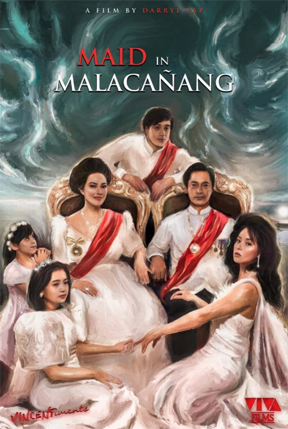
The Big Reveal in the controversial and much-talked-about Maidin Malacañang (MIM) comes in Chapter 8, also titled “Maid in Malacañang.” All the months of buzz had it that this account of the last 72 hours of Pamilya Marcos Sr. in the Palace, would be told from the POV of three faithful kasambahay(maids) who were there and saw it all. Turns out, it is Senator Imee Marcos, the creative and executive producer, who is the real “Maid in Malacañang.”
The movie has 10 chapters, so try to be awake for this one. Chapter 8 features Imee’s (played by Christine Reyes) big heart-to-heart with her dad (Cesar Montano) as they await the US contingent which will escort them to Ilocos Norte — or so they think. In another effortful attempt to humanize him, Marcos Sr. croaks his concern that all the “little people” working for them as domestics might become collateral damage as the People Power crowd outside the Palace walls grows increasingly restive. Then, he warmly praises Imee, his “genius girl,” for always serving him and the nation selflessly, and to the best of her ability, dubbing her the true “Maid in Malacañang.” In turn, she assures him that history will judge him rightly: not as a monster, but as a true soldier and loving leader of the Filipino people. So, that’s what this is really all about.
When Imee was quoted last June, as saying: “Ang importante, ’yungmaahonnamin ang pangalannamin, ang apelyidonamin, na ’yung legacy ng tatay ko babalikan at titingnan ng maigi. ’Yun ang importante. (What is most important is that we clear our family name, that my father’s legacy will be re-examined truthfully and fairly. That is foremost.)” And that’s exactly what she set out to do in this movie.
MIM opens and ends with mahjong. The tiles might symbolize the forces amassing against them. In the opening Singapore hotel lobby sequence, Imee, with a baby on her hip, looks on with consternation, as the players shuffle the red tiles. Note: walasiyang yaya o bodyguards (she has no nanny or security) — so much for the stories about PAL’s flight schedules gone haywire just to bring her expressed breast milk to her firstborn Borgy while she holidayed in London, and of hordes of her close-in security disrupting performances in London’s West End. Anyway, the red mahjong tiles might symbolize Defense Secretary Juan Ponce Enrile, General Fidel V. Ramos, and the Reform the Armed Forces (inexplicably renamed the Military Reform Movement in the film) who have mounted a military coup against them. She rushes back to their hotel room where Borgy, a budding psychic or just a little war freak, is drawing military helicopters and tanks. She’s just in time for a phone call from her father the President who tells her to return immediately to Manila. In any crisis, he needs his “genius girl” by his side.
Imee’s being indispensable to Marcos Sr. is repeatedly stressed. A larger Olympian origin story prevails: Imee sprang like Athena from Marcos/Zeus’ head. They are like-minded, kindred spirits. She is his confidante, consigliere and rightful heir-apparent. Upon her arrival from Singapore, she enters a large foyer crammed with unsealed balikbayan boxes, packed to the brim with wads of cash. With Imee away, her siblings failed to distribute these tokens of appreciation for all those poll-watchers and teachers who had ensured Marcos Sr.’s win in the Snap Elections. Imee frets over the delay: “Paano na tayo uulit? (How can we call on them to help us out again?)” That’s meant to counter reports like Los Angeles Times’ March 1986 story, that for their Great Escape, Pamilya Marcos brought “22 crates containing $1.2 million in Philippine pesos, apart from $7.7 million in cash and valuables into their suitcases when they fled to Hawaii last month, according to a US Customs Service inventory made public Monday.”
Marcos Sr. immediately summons Imee to a closed-door meeting, leaving Imelda (Ruffa Guttierez) and her siblings waiting in the hallway. Notwithstanding the Office of the President’s vast communications and intelligence resources, the maid Biday (Beverly Salviejo) is tasked with giving Imee the current situationer. Her turgid-tongued Bisayan accent guarantees easy laughs. For comic relief throughout the film, Salviejo fluctuates between Ilocano, Bisaya, and Batangueño accents. The absurdity of Manang Biday giving intelligence briefings might lull us into forgetting about the dreaded NICA (National Intelligence Coordinating Agency), which is now part of the even bigger and more powerful NTF-ELCAC (National Task Force to End Local Communist Armed Conflict).
Despite the millions of pesos literally lying around the Palace, and dozens of uniformed kasambahay protected by countless PSG (Presidential Security Group) to do their bidding, MIM would have us believe that those evil Cory supporters surrounding Malacañan for the last two days made it nearly impossible for them to go out and replenish their dangerously low food supplies. After just two days, Pamilya Marcos with their guards and retainers, were in danger of starving to death. Wala pa kasing Grab o Food Panda noon. (They couldn’t order online delivery back in 1986.) Youngest sister Irene’s (Ella Cruz) hubby Greggy Araneta, of the billionaire clan, returns from a grocery run with a tiny paper bag. His car was supposedly bombed. The kasambahay must resort to begging for food scraps from kind-hearted neighbors living around Malacañan. The director-scriptwriter Darryl Yap is unable to keep up this farce with a straight face. He can’t resist showing that the last breakfast of Pamilya Marcos and household is caviar on melba toast.
Yap’s forte is over-the top comedy, not historical retelling. His concession to straight drama is to insert a hysterical rant at the end of every sober narrative chapter or sequence. Christine Reyes plays Imee as perpetually on the edge, her face as tightly clenched as fingernails scraping across a blackboard. To show her concern over her father, Imee imagines another assassination attempt on him. She claims there had already been seven such, right in the Palace, as well as 12 previous coup attempts. There’s no record of these though in theOfficial Gazette.
Imee is overcome by paranoia, demanding to see the IDs of random PSG while shrieking in their faces: “Ilocoso Leyte?” (Ilocos province or Leyte province). Taking a page from the Faye Dunaway-Mommie Dearest school of acting wire hanger scene (a queer camp favorite), she vents her suspicions on the dialysis nurse, and hurls trays of medicine about, in search of poison. “You’re too nice!” she yells at her nonplussed father. Unlike the ruthlessly scheming and grasping halves of the Conjugal Dictatorship they have been portrayed to be, this ultimate power couple took off their shoes and tiptoed along the hallway to their bedroom, just to avoid disturbing the kasambahay Santa (Karla Estrada) who had fallen asleep there, believe it or not.
In the interest of equal time, Imee’s brother, here called Bonget, and younger sister are given their own moments of high (melo)drama too. For Bonget, whom Imee ridicules for playing toy soldier and never taking off his army fatigues (“You can’t wear that during the press con,” she warns him), it’s a teary exchange with dear old dad. He’s remorseful about his clubbing days and party boy ways. He just wants daddy to be proud of him, and is ready to lay down his life fighting for his family. Awww… The only bed scene in the movie is shared between Bonget and his mother. He assures her that even if they have to leave now, they will return, and the camera ominously closes up on the sole of a rhinestone-bedazzled sandal with the catalogue no. IRM 2022.
The bit in the trailer where Marcos the dictator thoughtfully asks if he was a bad person is in Irene’s (Ella Cruz) sequence. The actress has shown in interviews that she can really turn on the waterworks which she does so straight off in the film. It’s just one long tiresome whine from there, even as her dad explains that the powerful hate the Marcoses because they are poor provincial hicks — with a Congressman (Mariano Marcos) and a Supreme Court Justice (Norberto Romualdez) as their immediate ancestors. Inured to all the untrammeled hysteria and cringe-worthy drama, we are ready to doze off. If only Yap had the buxom Ms. Cruz take off her top, as the more nubile of his Vincentiments Facebook page YouTube starlets are wont to do when their emotions run high, that might wake us up enough to pay attention.
The director-writer’s and producers’ true sentiments about the Malacañankasambahay are made clear in the chapter titled “Palamunin” (Worthless Freeloaders). Here, the help are instructed to pack up their belongings and wear street clothes in preparation for the fall of Malacañang to an angry mob. Manang Lucy (Elizabeth Oropesa) praises Marcos for his refusal to respond with violence against the rallyists or the putschists, and exhorts the hired help to die for their masters. There is a chorus of weeping as the kasambahay cannot imagine an existence other than servitude. The stupid servant continues to be a staple in Philippine performing arts.
As the take-chargepanganay (eldest daughter), Imee orders her husband Tommy to phone the US Embassy to come and get them (“para sunduinna tayo.”) as though despite the yellow T-shirted, torch-bearing mob from a pre-WWII Frankenstein movie who had wandered inside the Palace, Pamilya Marcos had decided to leave Malacañang of their own volition. Robin Padilla has a cameo as a loyal officer who sees them to safety. That surreal scenario is like the popular Vincentiments “Kung Puede Lang” shorts, where the protagonist acts out his fantasies in his head — mostly anti-social cursing, threatening mayhem, and disrobing. In MIM, the fantasy is that on Feb. 25, 1986, it was Pamilya Marcos’ choice to leave the Palace with a US military escort, while his successor Corazon C. Aquino, her hair mockingly done up with curlers, played mahjong (this time with yellow tiles) with the Carmelites.
Despite MIM’s attempts to portray Marcos Sr. as a kindly, ailing, misunderstood dotard, history shows it was he, not his “genius girl,” negotiating with the US during the Pamilya Marcos’ final days in Malacañang, and shortly before they were hustled out by the US Air Force:
“At 15:00 PST (GMT+8) on Feb. 25, 1986, Marcos talked to United States Senator Paul Laxalt, a close associate of the United States President Ronald Reagan, asking for advice from the White House. Laxalt advised him to “cut and cut cleanly,” to which Marcos expressed his disappointment after a short pause. In the afternoon, Marcos talked to Enrile, asking for safe passage for him and his family, and included his close allies like General Ver. Finally, at 9 p.m., the Marcos family was transported by four Sikorsky HH-3E helicopters to Clark Air Base in Angeles City, about 83 kilometers north of Manila, before boarding US Air Force C-130 planes bound for Andersen Air Force Base in Guam, and finally to Hickam Air Force Base in Hawaii where Marcos arrived on Feb. 26. When he fled to Hawaii by way of Guam, he also brought with him 22 crates of cash valued at $717 million, 300 crates of assorted jewelry with undetermined value, $4 million worth of unset precious gems contained in Pampers diaper boxes, 65 Seiko and Cartier watches, a 12 by 4 feet box crammed full of real pearls, a three-foot solid gold statue covered in diamonds and other precious stones, $200,000 in gold bullion and nearly $1 million in Philippine pesos, and deposit slips to banks in the US, Switzerland, and the Cayman Islands worth $124 million, which he all amassed during his dictatorship.
“Initially, there was confusion in Washington as to what to do with Marcos and the 90 members of his entourage. Given the special relations Marcos nurtured with Reagan, the former had expectations of favorable treatment. However, Reagan was to distance himself from the Marcoses. The State Department in turn assigned former Deputy Chief of Mission to Manila, Robert G. Rich Jr. to be the point of contact. The entourage were first billeted inside the housing facilities of Hickam Air Force Base. Later on the State Department announced the Marcoses were not immune from legal charges, and within weeks hundreds of cases had been filed against them.”
At maniwala po kayo saWikipedia,iyan po ang tunaynapangyayari. Bow. (And you can believe Wikipedia: that’s what really happened. Word.)