Home Blog Page 565

The Victor wins Best Landmark Design in The PropertyGuru Asia Property Awards

Robinsons Land President and CEO Mybelle V. Aragon-GoBio (center) celebrates with company executives after the team clinched 7 major awards and nominated as finalist in 16 categories at the PropertyGuru Asia Property Awards in Bangkok, Thailand — a proud moment for Filipino excellence on the regional stage.

The Victor is a victor. The 55-meter public landmark by Robinsons Land (RLC) has just received the award for Best Landmark Design at The PropertyGuru Asia Property Awards, besting other landmarks in the region.

“The Victor embodies the Filipino spirit — resilient, ambitious, and unwavering in its pursuit of greatness. Getting the Best Landmark Design award is a triumph we share with every Filipino. We are grateful to The PropertyGuru Asia Property Awards for this recognition, which celebrates our vision and the excellence of our people,” said Mybelle Aragon-GoBio, President and CEO of RLC.

It’s just one of multiple accolades RLC received at the awarding ceremony held in Bangkok, Thailand on Dec. 12. RLC was declared Best Luxury Developer. Robinsons Hotels & Resorts was awarded Best Hospitality Developer. The Mall | NUSTAR was given the award for Best Lifestyle Retail Development. work.able GBF Center 1 won Best Co-Working Space. The Residences at The Westin Manila was declared Best Completed Luxury Condo Development. SYNC was awarded Best Mid-End Condo Development. The recognition comes at a particularly meaningful time, as RLC celebrates its 45th anniversary, highlighting decades of excellence and the company’s standing as one of the most trusted and most diversified real estate property developers in the Philippines.

“The breadth of recognitions we received at this year’s Asia Property Awards reflects RLC’s deep commitment to elevating Filipino excellence across every segment we serve,” said Aragon-GoBio. “From hospitality and retail to workspaces and residences, each award is a testament to our team’s dedication to creating developments that build better lives. And at the heart of these achievements stands The Victor, which is testament to our passion and our belief in what the Filipino can accomplish.”

Since it was unveiled in 2023, The Victor has become a symbol of the hardworking Filipino: strong, steadfast, always rising, and thriving wherever they are — in the Philippines and out in the world.

Robinsons Land President and CEO Mybelle V. Aragon-GoBio (left) and Robinsons Destination Estates General Manager Trina Cipriano accept the Best Landmark Design (Asia) Award from PropertyGuru for The Victor, a towering urban landmark in Bridgetowne designed by renowned Filipino-American artist Jefrë.

Designed by Jefrë, a globally celebrated Filipino-American artist known for his monumental works and commitment to cultural storytelling, The Victor stands proudly, pumping his fist in triumph, at Bridgetowne Destination Estate, RLC’s 32-hectare master-planned development that straddles Quezon City and Pasig. It’s an urban landmark and a cultural touchstone in the middle of a thriving community — a modern Filipino icon that draws visitors of all ages. It’s more than just something to look at. The Victor is something to experience, share, and take pride in, it’s a landmark that truly belongs to the people.

Transforming urban landscapes and elevating communities

Over the years, RLC has consistently demonstrated a vision that goes beyond constructing buildings — it strives to transform urban landscapes, elevate communities, and create developments that endure as cultural and economic landmarks. The Victor stands as a concrete example of this philosophy, merging architectural innovation with the company’s commitment to nation-building.

Aragon-GoBio said, “We at RLC are also inspired by The Victor. From world-class landmarks to integrated lifestyle estates, RLC remains committed to building developments that elevate communities, enhance urban landscapes, and contribute to long-term economic growth.”
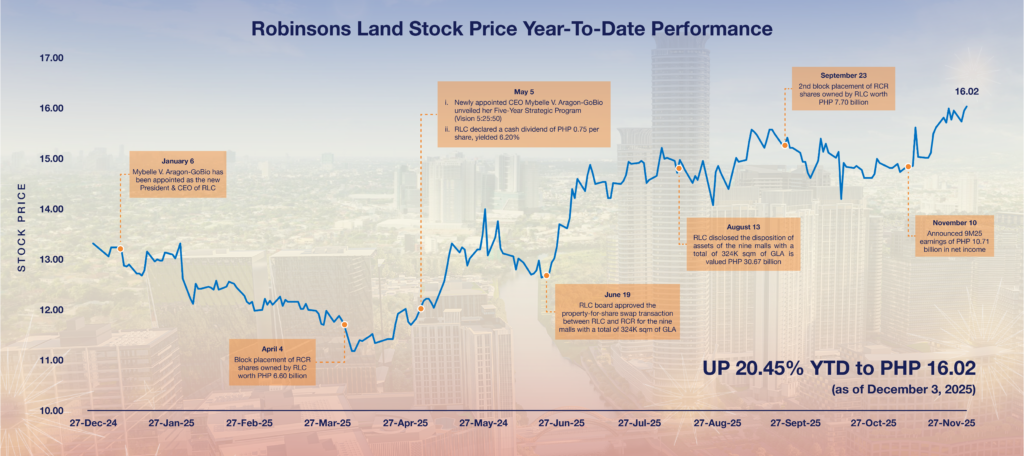
RLC’s stock rose 20.45% YTD to P16.02 as of Nov. 30, 2025, supported by continued strategic execution under President and CEO, Mybelle V. Aragon-GoBio. Investors are responding positively to Vision 5-25-50, the company’s roadmap anchored on five levers designed to deliver P25 billion in net income by 2030. The strategy accelerates investment expansion, asset monetization, premiumization, partnerships, and new customer experience-driven business ventures. The improving share price reflects market confidence in the company’s long-term and value-creating direction.

The company’s strong performance extends to the financial markets. RLC’s stock has outperformed peers, rising 20% year-to-date, while offering a 5.7% dividend yield, the highest among listed real estate companies on the Philippine Stock Exchange (PSE). This reflects investor confidence in RLC’s sustainable growth, diversified portfolio, and strategic positioning in both mature and emerging urban areas.

Aragon-GoBio said, “The Victor represents more than an architectural achievement — it embodies RLC’s commitment to shaping the future of Philippine cities. As we continue to expand our portfolio and redefine urban landscapes, we remain driven by the belief that quality, innovation, and purpose go hand in hand.”


Spotlight is BusinessWorld’s sponsored section that allows advertisers to amplify their brand and connect with BusinessWorld’s audience by publishing their stories on the BusinessWorld Web site. For more information, send an email to online@bworldonline.com.

Join us on Viber at https://bit.ly/3hv6bLA to get more updates and subscribe to BusinessWorld’s titles and get exclusive content through www.bworld-x.com.

Generational Money Mindsets: Spending, Saving, and Investing

How Filipinos across generations are redefining what “money” means to them

From Gen Z’s side hustles to Boomers’ legacy plans, money means different things to every generation. For some, it’s freedom, while for others, it’s security, comfort, or survival. And over the last decade, with the pandemic period having a major impact, the Filipino relationship with money has transformed in different ways.

Since 2015, Acumen has tracked how Filipino generations think, spend, save, and invest. What we’re now seeing in 2025 through Project Alphabet is not just a change in financial behavior, it’s a complete shift in meaning. Filipinos today think about money with far more intentionality, discipline, and long-term focus than ever before.

  1. From Survival to Intentionality: The Pandemic Effect

If finances in 2015 was a source of aspiration and stress for Filipinos, finances in 2025 has come to be defined by something new: Intentionality toward financial stability. Before the pandemic, many Filipinos, especially the younger generations, viewed money through a day-to-day lens. Budgets were flexible, purchases were spontaneous, and “future planning” felt like something only older generations worried about.

But the pandemic created a collective awakening. It reminded every Filipino, regardless of age, that life can change overnight. Uncertainty became real. Stability can disappear overnight, emergencies can happen anytime, and financial preparedness is not optional.  Financial security now represents independence and peace of mind.

  1. Money Has Shifted in Meaning Across Generations

For Gen Z and Millennials, money represents freedom with responsibility and independence. Gen Zs seek independence, spending on experiences and things that they deem meaningful for them and worth their hard-earned money. Millennials desire the ability to spend without guilt, balancing indulgence with discipline while keeping family obligations in mind. Both generations want as much money as possible not for status, but for the ability to live comfortably without anxiety, guilt, or reliance on others.

For Gen X and Boomers, money continues to symbolize provision and duty. They take pride in giving their families a comfortable life, settling obligations first, and finding fulfillment in providing. For them, financial security is not just a personal goal, it is a legacy to sustain their loved ones.

This cross-generational shift is the backdrop of everything else. It reshapes how each generation spends, saves, spends, invests, and aspires.

  1. Savings at the Forefront

Saving has now become a great equalizer across generations — a behavior once associated only with older generations. Today, every generation treats savings as a non-negotiable, with Gen Zs building emergency funds earlier, older generations reinforcing their buffers, and families openly discussing financial planning in ways that used to be somewhat taboo.

Saving is no longer just a mathematical exercise, it is emotional. Though motivations differ, the mindset is shared: Savings give security, and in today’s world, that security is what gives Filipinos confidence, calm, and control over their future.

Across all age groups, saving has become more intentional and disciplined.

  • Gen Zs save to gain independence, using digital banks, e-wallet pockets, and micro-investing apps to build small but consistent buffers.
  • Gen Ys save to achieve financial freedom without guilt, the ability to enjoy life without compromising responsibilities.
  • Gen Xers save to secure a comfortable life for their family, prioritizing education funds, insurance, and future-proofing the household.
  • Boomers save to continue supporting not just themselves but also their children and even their grandchildren. They are focusing on health, legacy, and stability.
  1. Spending Mindset: Practical, Intentional, Family-First

Across all generations, a clear shift is visible: practicality is the new priority, and Filipinos now spend only on what truly matters. Each generation has quietly redefined value — favoring intentionality, quality, and family-first consumption. In this new era, every peso must serve a purpose, reflect responsibility, and support the people who matter most.

Gen Zs, raised in a world of constant trends and temptations, are learning to minimize impulsive  purchases made on a whim. They’ll still spend for the things that spark joy, but only if the purchase feels sulit and genuinely “mapapa-happy talaga ako.” For them, value is emotional and practical at the same time: enjoy life, but never irresponsibly.

Gen Ys echo this mindset but from a more mature, life-stage perspective—rewarding themselves occasionally, but only after family needs are secured. They’ve embraced delayed gratification, choosing to spend for themselves only when the essentials and obligations of the household are covered.

Meanwhile, Gen X and Boomers remain anchored in a family-first spending mindset — prioritizing needs over wants, choosing durability over trendiness, and finding joy in providing for children and especially grandchildren. When extra funds allow, they reward themselves as a well-earned payoff after years of hard work, but practicality continues to guide their everyday decisions.

  1. Investing Mindset: Growing Wealth While Safeguarding What Matters

Across generations, Filipinos now see investing as a pathway to freedom, protection, and long-term possibility — a shift driven by both experience and aspiration.

  • Gen Z and Gen Ys prefer passive, low-effort investment routes such as real estate, condos for rent, or gold, largely because their focus is still on building careers or businesses. But once they understand something deeply, they become surprisingly aggressive (e.g. automating crypto or forex trading, or venturing into new business categories after researching financial returns.) As one Gen Y said, “Wala namang nagturo sa akin mag-invest — nag-search lang ako online. Trial and error talaga.”
  • Gen X and Boomers, meanwhile, gravitate toward stable, appreciating assets they can pass on to their families (e.g. house and lot, farms, MP2, gold jewelry, or rental properties) always guided by the belief that wealth built slowly and safely protects the next generation. For them, investing is never impulsive; it is deliberate, sustainable, and rooted in stewardship.

Within this broader investment mindset, insurance has emerged as one of the most valued and universal forms of protection. What used to be seen as a product you “only benefit from when you’re gone” is now understood as a smart financial shield — something that secures health, safeguards income, and ensures family stability no matter what happens.

  • A Gen Z captures it simply: “Insurance is peace of mind.”
  • Gen Ys now appreciate its living benefits — “Ngayon, may value na habang buhay ka.”
  • Gen X and Boomers consider insurance as something that is intertwined with responsibility and legacy: “Meron akong life insurance. Para sa pamilya ko ‘pag wala na ako,” “Importante talaga insurance… may maiiwan ka sa pamilya.”

Across all generations, insurance has become both an investment and a safety net — offering stability, emotional assurance, and the confidence that families will be protected in the present and in the future.

What this multi-generational story shows us is simple but powerful: Filipinos are no longer managing money just for survival, they’re managing it with intention. At the end of the day, money has become more than currency, it’s a reflection of the Filipino’s hopes, fears, values, and dreams.

And as these generational money mindsets continue to evolve, business leaders who stay fluent, empathetic, and forward-looking will be the ones who build brands and organizations that truly connect, serve, and endure. — Kristine Joyce Erni Santos, Program Director and Strategist for Commercial Strategy, Acumen (www.acumen.com.ph)


Spotlight is BusinessWorld’s sponsored section that allows advertisers to amplify their brand and connect with BusinessWorld’s audience by publishing their stories on the BusinessWorld Web site. For more information, send an email to online@bworldonline.com.

Join us on Viber at https://bit.ly/3hv6bLA to get more updates and subscribe to BusinessWorld’s titles and get exclusive content through www.bworld-x.com.

‘Unspeakable tragedy’: Bondi residents react to mass shooting

BONDI BEACH — BW FILE PHOTO

SYDNEY — Stories of horror and heroism emerged as Australians mourned the 15 people killed by two gunmen at Sydney’s Bondi Beach during a Hanukkah event.

Police said two shooters, a father-son duo, opened fire on the crowd gathered for the Jewish festival beside the landmark Sydney beach late on Sunday, in the worst shooting in Australia in three decades.

The 50-year-old father was killed at the scene while his 24-year-old son was in a critical condition in hospital, police said.

A man identified by Australian media as 43-year-old Sydney fruit shop owner Ahmed al Ahmed has been hailed as a hero for tackling and disarming one of the gunmen during the attack.

Video captured by a bystander shows the man identified as Mr. Ahmed creeping through a carpark before tackling the gunman from behind. He was shot by the second gunman and remains in hospital, police said.

“There are many, many people alive tonight as a result of his bravery,” said Chris Minns, the premier of New South Wales state.

More tales of heroism came to light on Monday as mourners returned to the area to leave flowers at a makeshift memorial near the beach’s headlands. Private security guards gathered near the site as Jewish leaders visited.

Kellie Sloane, the state opposition leader whose electorate covers Bondi, was at the beach when the shooting happened and said she saw many people risking their lives to help others.

“I saw the acts of heroism firsthand, what they did, supporting people, trying to save people, was extraordinary,” she said.

“I went in and tried to do my best like so many other locals. It was an incredibly confronting scene, there were bodies everywhere, people working trying to revive people.

“Everyone did their best trying to support those who were in shock, no one knew what to do and everyone pulled together. When I arrived I could hear a couple of shots but everyone was working on the wounded, we held the hands of people who were passing away, we looked after the people who were in shock.”

‘WE CAN MOVE FORWARD’
Bondi resident Morgan Gabriel, 27, said she sheltered a few people who ran from the gunshots.

“It’s just, it’s a very sad time this morning… I’m here every day and normally, like on a Monday or any morning, it’s packed. People are swimming, surfing, running. So this is very, very quiet. And there’s definitely a solemn sort of vibe,” she said.

Trent Tur, 18, was in the water when the shooting started.

“Unfortunately I saw a couple of dead bodies, it was the worst feeling, words couldn’t describe it,” he said.

“Honestly it’s terrible. As a community we can move forward from this, it will be hard but the spirits, the Australian spirit in Bondi is very high and we can move forward.”

Waverley Mayor William Nemesh, a Jewish man whose council covers Bondi, said the community was in shock and mourning.

“It is an unspeakable tragedy that has occurred, a deliberate terrorist attack, cowardly attack targeting innocents enjoying Hannukah. We are tight-knit, we are close, everyone knows someone who has been affected. It truly is devastating,” he said.

Mr. Nemesh said many in Sydney’s Jewish community did not feel safe, particularly after the October 7, 2023 attacks on Israel by Hamas and other Palestinian Islamist factions that triggered the Gaza war.

“But this is just beyond what anyone thought was possible and could happen on Bondi Beach,” he said.

“It’s no coincidence this occurred the first night of Hanukkah, a joyous festival that is about bringing light into the world and the light triumphs the darkness.”— Reuters

China, Saudi Arabia agree to strengthen coordination on regional, global matters

REUTERS

BEIJING — China and Saudi Arabia agreed to have closer communication and coordination on regional and international issues, with Beijing lauding Riyadh’s role in Middle East diplomacy, statements following a meeting between the nations’ foreign ministers on Sunday showed.

Chinese Foreign Minister Wang Yi is on a three-nation tour in the Middle East that began in the United Arab Emirates and is expected to end in Jordan. He met with Saudi Arabia’s Foreign Minister Prince Faisal bin Farhan Al-Saud in Riyadh on Sunday.

A joint statement published by China’s official news agency Xinhua did not elaborate on what issues the countries will strengthen coordination on, but mentioned China’s support for Saudi Arabia and Iran developing and enhancing their relations.

“(China) appreciates Saudi Arabia’s leading role and efforts to achieve regional and international security and stability,” the statement released on Monday said.

The statement also reiterated both countries’ support for a “comprehensive and just settlement” of the Palestinian issue and the formation of an independent state for Palestinians.

At a high-level meeting, Mr. Wang told his Saudi counterpart that China has always regarded Saudi Arabia as a “priority for Middle East diplomacy” and an important partner in global diplomacy, a Chinese foreign ministry statement on Monday said.

He also encouraged more cooperation in energy and investments, as well as in the fields of new energy and green transformation.

The countries have agreed to mutually exempt visas for diplomatic and special passport holders from both sides, according to the joint statement.— Reuters

Person of interest detained in fatal mass shooting at Brown University

STOCK PHOTO | Shooting gun photo created by senivpetro - www.freepik.com

PROVIDENCE, Rhode Island — A man was taken into custody on Sunday at a Rhode Island hotel and held as a “person of interest” in the Brown University shooting that left two students dead and nine wounded amid year-end final exams at the Ivy League school, authorities said.

Providence Police Chief Oscar Perez said at a midday news conference that the person detained in connection with Saturday’s gun violence was in his 20s but declined to share further details. Mr. Perez said earlier on Sunday that authorities were not seeking other suspects at this time.

Detectives anticipated that the person in custody would be formally charged Sunday night, city public safety spokesperson Kristy DosReis said.

Other news media outlets, including the Washington Post and NBC News, cited unnamed sources identifying the man as military veteran Benjamin Erickson, 24, who previously resided in Wisconsin.

A person by the name of Benjamin W. Erickson served as a US Army infantryman from May 2021 to November 2024, leaving the service with the rank of specialist without ever being deployed, military officials told Reuters. But they could not confirm whether he was the man detained over the Brown University shooting.

FBI Director Kash Patel earlier Sunday said in a post on X that the person of interest had been detained in a hotel room in the Rhode Island town of Coventry, a 30-minute drive from the Brown campus. An FBI team specializing in cellular data analysis used geolocation information to track the suspect, Mr. Patel said.

The mass shooting — the latest of nearly 400 in the US this year, according to the Gun Violence Archive — shook the community at the university, one of the oldest in the United States. The school canceled exams, and classes, for the rest of the year and the campus was quiet on Sunday as a light snowfall blanketed the city.

Providence Mayor Brett Smiley said that authorities, as of midday on Sunday, had not yet contacted all of the victims’ family members because some were traveling. He invited residents to a previously planned event on Sunday to light a Christmas tree and a menorah to mark the first night of Hanukkah.

“It is quite clear that if we can come together as a community and shine a little bit of light tonight, I think there’s nothing better that we could be doing,” Mr. Smiley said.

AUTHORITIES RELEASE VIDEO OF SUSPECT
Seven people injured at Brown University were in stable condition, Mr. Smiley said. One remained in critical but stable condition, while another had been discharged, he added.

Shelter-in-place orders at the university and nearby areas were lifted on Sunday. Mr. Smiley said earlier in the day that residents should expect a visible police presence across the city.

The gunman fled after shooting students in a classroom in Brown’s Barus & Holley engineering and physics building, where outer doors had been left unlocked while exams were taking place, officials said on Saturday.

Authorities on Saturday released a short video clip of a person of interest dressed in black walking near the engineering building. Providence Deputy Police Chief Timothy O’Hara said on Saturday the individual may have worn a mask, but officials were not certain.

Brown President Christina Paxson told reporters that all or nearly all of the victims were students, adding: “This is the day one hopes never happens, and it has.”

STUDENTS CAUGHT BY SURPRISE
Ref Bari, 22, a graduate student at Brown, said he was inside the Barus & Holley building when he heard a series of loud popping sounds that appeared to be gunfire.

Mr. Bari ran out of the building and asked another student running in the street if he could hide with her and her friends and she agreed. They returned to her basement apartment and hid in the bathroom.

“She trusted me,” he said. “The only connection between us is we’re both students at Brown but beyond that, we don’t know each other.”

Teaching assistant Joseph Oduro, 21, told CNN he was in a classroom that was attacked.

“The first couple of gunshots went straight to the chalkboard right where I was standing,” Mr. Oduro said. “Who knows, if I didn’t duck, maybe I’m not here today.”

A student next to him took two bullets to the leg and was due to undergo surgery on Sunday, he said.

Jack DiPrimio, another graduate student at Brown, said he was initially not concerned when the university went on lockdown because he had experienced many active-shooter drills. The drills have become more common in the US as attacks targeting students have increased.

“I had faced so many lockdowns in high school and even a few at my undergrad, so I wasn’t that worried at first,” Mr. DiPrimio said in a TikTok video after coming out of a five-hour lockdown. “Maybe I was desensitized.”— Reuters

DPWH wants P45-B back to keep projects moving

DPWH

The Public Works department asked lawmakers on Sunday to restore about P45 billion cut from its 2026 budget, warning that the shortfall could slow construction activity and weigh further on an already cooling Philippine economy.

Public Works Secretary Vivencio B. Dizon was allowed to join a select group of senators and congressmen finalizing the proposed P6.793-trillion national budget — a rare move that underscored growing concerns that deep cuts to infrastructure funds could stall projects that have long propped up economic growth.

“We all know that in the past quarter, the economy only grew by 4%,” Mr. Dizon told members of the bicameral conference committee. “This is largely because of the cut in public expenditure, especially in infrastructure.”

He said President Ferdinand R. Marcos, Jr. had ordered him both to crack down on overpriced construction materials and ensure infrastructure spending accelerates given its central role in job creation and economic activity.

Mr. Dizon’s appeal comes as the agency enforces stricter procurement rules to prevent inflated costing of materials — an issue at the center of a widening corruption scandal tied to anomalous flood-control contracts.

The controversy has implicated several politicians, officials and contractors in a multibillion-peso kickback scheme that has dented confidence in the administration and contributed to a pullback in public works spending since July.

Congress has since pared down the Department of Public Works and Highways’ (DPWH) budget by hundreds of billions. The Senate’s version of the 2026 budget sets aside P570.8 billion for the agency, about 8.6% less than the P624.48 billion approved by the House of Representatives in October.

Earlier, congressmen cut P255 billion in flood-control allocations from the Executive’s proposed P880-billion infrastructure program, citing the investigations.

Mr. Dizon said the P45-billion restoration he is seeking would not revive any flood-control projects flagged in the kickback scheme. The money, he added, would instead support road, bridge and other infrastructure works risked by the Senate’s cuts.

“We request that we go back to the levels of the House General Appropriations bill, and let the DPWH implement the price adjustment to make sure that the deductions are correct and based per project,” he said. “It’s to make sure that the… integrity of the project is not compromised, and to make sure that they will still be implemented.”

The agency issued a department-wide order tightening procurement to prevent overpricing, Mr. Dizon said. Savings from lower materials costs, he added, would either be remitted to government coffers or redirected to other state programs at the President’s discretion. “Upon the President’s approval, it may be used to augment projects,” he said.

He also warned that several projects planned for 2026 would likely be delayed because the agency could not finalize allocations while potential adjustments to material pricing are still under review.

“Because early procurement was delayed, there are many projects for 2026 that will be delayed,” Mr. Dizon said. “We are not sure what projects will be passed by Congress.”

Scrutiny of next year’s national budget has intensified amid the scale of the alleged corruption in flood-control spending, fueling public protests and prompting lawmakers to adopt added transparency measures. These include livestreaming bicameral hearings that were traditionally held behind closed doors.

The bicameral conference committee must reconcile the Senate and House versions of the spending plan before transmitting the final budget to Malacañang for Mr. Marcos’ signature. Lawmakers will adjourn on Dec. 23 — later than originally planned — to ensure ratification of the appropriations bill.

Officials have until year-end to avoid a reenacted 2025 budget, which economists warn would further drag growth. — Kenneth Christiane L. Basilio

Inflation risks may limit BSP easing

PHILIPPINE STAR/EDD GUMBAN

By Katherine K. Chan

EMERGING RISKS to inflation may limit the Philippine central bank’s ability to ease further in 2026 despite an expected economic slowdown, analysts said.

John Paolo R. Rivera, a senior research fellow at the Philippine Institute for Development Studies, said another 25-basis-point (bp) cut signaled by the central bank for 2026 would not suffice to spur the economy.

“A final 25-bp rate cut would help at the margin, but it may not be enough on its own to materially lift growth if fourth-quarter (growth) comes in around 3.8%,” he told BusinessWorld in a Viber message.

Last week, Bangko Sentral ng Pilipinas (BSP) Governor Eli M. Remolona, Jr. said gross domestic product (GDP) growth in the fourth quarter might settle at 3.8%, easing from 4% in the third quarter.

If realized, it would be the slowest growth rate since 3% in the third quarter of 2011 and bring full-year expansion to 4.7%, under the government’s 5.5-6.5% target.   

However, Mr. Rivera said the central bank’s current easing cycle will likely end soon as food prices and peso’s weakness pose inflationary risks.

“As for easing space, the BSP likely has limited room left,” he said. “With growth projected to stay below target but inflation risks still present (from food prices and the (peso’s) depreciation), BSP must balance support for growth with price and financial stability.”

ANZ Research Chief Economist for Southeast Asia and India Sanjay Mathur and economist Arindam Chakraborty noted that the peso’s recent performance against the dollar has not affected inflation, amplifying calls for another 25-bp cut in February. 

“In our view, the subdued growth and inflation prospects suggest there is room for further rate cuts,” they said in a note released late on Thursday. “We anticipate another 25-bp rate cut in Q1 2026, bringing the terminal policy rate to 4.25%.”

The peso has hit the P59-per-dollar several times since November, even slumping to a fresh low of P59.22 against the greenback on Dec. 9.

The Monetary Board last week lowered key borrowing costs for a fifth straight meeting by 25 bps to an over three-year low of 4.5%, citing subdued inflation and slowing growth. It has so far delivered a total of 200 bps in cuts since it began its easing cycle in August 2024.

Mr. Remolona earlier said they might cap off their easing cycle with a final 25-bp rate cut in 2026 if economic figures turn out worse than they anticipated.

ING Chief Economist and Regional Head of Research for Asia‑Pacific Deepali Bhargava said benign inflation could allow the BSP to ease further but warned that real interest rates may climb if inflation rates fall below expectations.

“Inflation should remain within central bank targets in 2026, allowing rate-cutting cycles to continue in… the Philippines… and supporting a generally easier monetary stance across the region,” he said in a statement.

“However, ING cautions that if inflation were to undershoot expectations, real interest rates could rise again, creating a more challenging environment for both business investment and consumer demand.”

Headline inflation slowed to 1.5% in November from 1.7% in the previous month and 2.5% in the same month last year, bringing inflation to an average of 1.6% in the 11-month period.    

ING expects inflation to return within the central bank’s 2-4% target next year at 3%, a tad slower than the 3.2% revised forecast of the BSP.

Citi Research said the central bank might ease more in 2026 as the rise of jobless Filipinos could pull down consumption and inflation.

“With a cooling job market possibly dragging down consumption and inflation, we still expect a final 25-bp cut in (February 2026) to 4.25%, with still some (albeit reduced) risk of a further 25-bp cut,” it said in an e-mailed note on Friday.

The country’s unemployment rate climbed to a three-month high of 5% in October from 3.8% in September and 3.9% in the same month last year.

GOVERNANCE
Meanwhile, analysts said the economy would need fiscal action and governance reforms on top of monetary policy easing to fully recover.

“Gradual cuts could still surprise, but don’t rely on rates alone,” Jonathan L. Ravelas, a senior adviser at Reyes Tacandong & Co., told BusinessWorld via Viber. “Real boost will come if (the) government speeds up action on governance, fiscal discipline, and sector reforms. Without that, impact stays limited amid political noise and corruption concerns.”

Reinielle Matt M. Erece, an economist at Oikonomia Advisory and Research, Inc., also noted that the stock market’s recent recovery is also not enough to offset slower government spending and waning investor confidence.

“Despite recovery in the equities market and the recent short rallies observed, these factors won’t be enough to offset the decline in government spending and investor sentiment,” he said in a Viber message. “A large part of GDP is government spending, hence declines in this sector will have a large impact on growth indicators.”

On Friday, the Philippine Stock Exchange index climbed by 0.78% or 46.72 points to end at 6,036.72. Week on week, it rose by 87.5 points from its 5,949.22 close on Dec. 5.

“The BSP can release money to the financial system, cut interest rates, but if the fiscal sector is tight, economic growth can only go so far,” he added.

President Ferdinand R. Marcos, Jr. earlier vowed to boost government spending in the fourth quarter in a bid to support economic growth.

Car sales to grow 5% next year, says CAMPI

Vehicles are seen along EDSA-Taft in Pasay City, May 20. — PHILIPPINE STAR/RYAN BALDEMOR

By Justine Irish D. Tabile, Reporter

THE CHAMBER of Automotive Manufacturers of the Philippines, Inc. (CAMPI) is eyeing a 5% growth in vehicle sales next year amid improving supply chains, introduction of new models, and public acceptance of electrified vehicles (EVs).

CAMPI President Rommel R. Gutierrez told reporters on Friday that the industry is on track to meet the 500,000 sales target for this year.

“Next year, it has to be higher… On average [we are growing] 5%… I think 5% will be a conservative figure. We will maintain (this),” he said.

If CAMPI and the Truck Manufacturers Association (TMA) achieve its 500,000 sales target this year, a 5% growth would mean vehicle sales of 525,000 in 2026.

The latest industry report showed new passenger car sales stood at 383,424 units as of the end of October, making up 76.68% of the target set for the year.

Mr. Gutierrez said sales growth will be driven by the improvement in supply, introduction of new vehicle models, and the wider adoption of EVs.

For next year, Mr. Gutierrez said he expects more sales of EVs, which is on track to account for 12% of the industry’s total sales this year.

“I think that was the target, and I think it is possible even next year, or even higher. Even the Vios model now has a hybrid, so we are moving towards that,” he said. “And I feel we see that consumers are already embracing and accepting EVs more than ever.”

In CAMPI’s report, total EV sales hit 24,265 units in the first 10 months, accounting for 6.33% of the total industry sales. However, it is important to note that some car manufacturers are not members of CAMPI and TMA, whose sales will not be reflected in the industry groups’ report.

Meanwhile, Mr. Gutierrez said car sales may also be driven by rising demand for ride-hailing services.

“Those drivers buy vehicles to use for ride-hailing services… There’s really a lot more potential… The more the players, the merrier,” he added.

Toby Allan C. Arce, head of sales trading at Globalinks Securities and Stocks, Inc., said that the 5% growth in sales is plausible and “reflects a rebound narrative that has been building over the past couple of years.”

“After several years of elevated vehicle prices, supply-chain constraints, and tighter consumer credit, the industry saw improved affordability and inventory normalization in 2025, contributing to stronger sales,” he said in a Viber message.

“If those conditions persist into 2026, a 5% uptick is reasonable — especially if consumer confidence remains stable, financing costs ease slightly alongside broader monetary easing, and manufacturers continue to introduce refreshed models that attract buyers,” he added.

Other growth drivers include urbanization, rising middle-class incomes, and infrastructure improvements, Mr. Arce said.

“I find CAMPI’s 5% growth outlook for 2026 credible if economic conditions remain broadly supportive — stable consumption, manageable interest rates, and steady employment will help sustain auto demand,” he said.

“However, structural hurdles such as cost of ownership, regulatory shifts, and potential macro headwinds (exchange rates, fuel prices, and credit costs) could limit upside. The industry’s performance will hinge on whether these drivers align to keep new vehicle purchases both desirable and affordable to a broad segment of Filipino consumers,” he added.

John Paolo R. Rivera, a senior research fellow at the Philippine Institute for Development Studies, said that CAMPI’s 5% sales forecast assumes easing interest rates and a recovery in consumer confidence.

“If rates fall and incomes stabilize, sales can grow modestly but without that, upside may be limited,” he said in a Viber message.

“Demand will likely be driven by replacement purchases, the continued expansion of ride-hailing and logistics fleets, improved availability of models, and growing interest in hybrid and entry-level vehicles,” he added.

However, Mr. Rivera said that the industry will continue to be challenged by high borrowing costs, the peso weakness which raises vehicle prices, and cautious household spending.

For next year, Rizal Commercial Banking Corp. Chief Economist Michael L. Ricafort said that reduction in borrowing costs as a result of recent rate cuts would help increase demand for vehicles.

He said that the Bangko Sentral ng Pilipinas’  recent cuts, which brought the key policy rate to a three-year low of 4.5%, coupled with the reduction in banks’ reserve requirement ratio, have increased the loanable funds of banks.

“These are passed also in terms of lower vehicle loan rates, which would help increase demand for vehicles, especially those financed by loans,” Mr. Ricafort said in a Viber message.

“Better weather conditions towards the end of 2025 and into 2026, especially into the Christmas holiday spending season, would help fundamentally support increased demand for vehicles, alongside increased demand for EVs amid increased competition that helped reduce prices and increased options for Filipino buyers,” he added.

 Meanwhile, CAMPI signed a memorandum of understanding with the Intellectual Property Office of the Philippines (IPOPHL) to go after counterfeit auto products sold online.

“We hope this will be a deterrent for those wanting to sell fake parts online. It is really for the protection of our consumers,” said Mr. Gutierrez.

The partnership will allow CAMPI members to flag counterfeit products and have the listings taken down from the online platforms.

IPOPHL data showed that two out of the 44 counterfeit-related reports it received this year involved vehicle products, including fake oils and motorcycle parts.

Last year, the agency received four vehicle-related reports involving oil, coolants, and components for the Japanese car brand Honda.

Growth in big banks’ assets, loans slowed sharply in Q3

BW FILE PHOTO

By Matthew Miguel L. Castillo, Researcher

THE PHILIPPINES’ largest banks saw the weakest asset growth in over three years in the third quarter as the flood control mess weighed on economic activity.

At the same time, loan growth also logged its slowest expansion in over a year.

According to the latest release of BusinessWorld’s quarterly banking report, the aggregate assets of 44 universal and commercial banks grew annually by 7.42% in the third quarter to P27.91 trillion from P25.98 trillion in the same period a year earlier.

Asset growth slowed from the 9.05% seen in the previous quarter and the 11.17% in the same period last year.

This was the weakest growth in assets in 14 quarters or since the 7.37% expansion in the first quarter of 2022.

Total loans grew by 10.91% to P14.6 trillion at end-September, slowing from the 12.38% in the second quarter and from 15.07% a year ago.

This was the weakest loan expansion in seven quarters or since the 10.22% growth logged in the last three months of 2023.

The third-quarter slowdown in asset and loan growth came amid the investigation into anomalous flood control projects, which has dampened consumer and investor confidence.

Some government officials, lawmakers and contractors were accused of getting kickbacks from substandard or nonexistent infrastructure projects.

The economy grew by 4.5% in the third quarter — the slowest in four years, mainly due to sluggish government spending and household expenditure.

At the same time, big banks’ nonperforming loans saw a higher share of the total loan portfolio in the July-to-September period.

Data showed that the ratio of bad loans, or those with unpaid principal and/or interest beyond 90 days, to total loans reached 3.49%, the highest share in six quarters or since 3.6% in the first quarter of 2024.

Meanwhile, the median return on equity, which measures how much shareholders earn for every peso invested, fell to 7.09% in the third quarter.

This was lower than the 8.05% median return in the same period last year and the 7.67% in the second quarter. It also marked an 11-quarter low in profitability since 6.36% in the fourth quarter of 2022.

The median capital adequacy ratio (CAR), on the other hand, rose to the highest in two quarters at 20.32%. However, it was still lower than 20.52% logged in the third quarter last year.

The CAR shows how much a bank’s capital weighs against its risk-weighted assets, indicating its capacity to absorb losses.

As of end-September, Philippine big banks’ CAR remained clearly above standard, surpassing the 10% regulatory minimum of the BSP and the international 8% lower bar under the Basel III framework.

Meanwhile, the leverage ratio, which gauges the institution’s ability to absorb shocks by measuring the bank’s capital relative to total exposure, dropped to a median of 11.05% from 11.39% in the previous quarter and 11.53% a year ago.

This continued to surpass the minimum 5% guideline of the central bank and the 3% international standard.

The net interest margin (NIM) went up to 3.82% in the third quarter from 3.54% in the second quarter but was lower than 3.91% as of end-September last year.

The NIM measures a bank’s investment profitability by dividing its net income by average earning assets.

Return on assets in the July-September period slipped to 1.59% from 1.62% in the second quarter and 1.69% a year ago.

BDO Unibank, Inc. (BDO) retained its top spot among all banks in terms of assets in the third quarter with P5.22 trillion.

It was followed by Metropolitan Bank & Trust Co. (Metrobank) with P3.69 trillion, and Bank of the Philippine Islands (BPI) with P3.55 trillion.

The same three banks topped the list in terms of total loans in the quarter.

BDO led all banks as it lent a total of P3.47 trillion, followed by BPI with P2.4 trillion, and Metrobank with P1.86 trillion.

In terms of total deposits, BDO remained the leader with P4.1 trillion in deposits, followed by Land Bank of the Philippines with P3.08 trillion, and BPI with P2.68 trillion.

Among banks in the P100 billion-and-above-tier, Asia United Bank Corp. (AUB) had the fastest asset growth in the third quarter with 19.53%, followed by Bank of Commerce with 17.35% and Security Bank with 15.18%.

AUB also led the industry in annual loan growth at 36.19% in the third quarter, followed by Bank of Commerce and Philippine Trust Co. with 18.49% and 14.54%, respectively.

BusinessWorld Research has been tracking the financial performance of the country’s large banks quarterly since the late 1980s using banks’ published statements.

Bicam’s budget rush raises transparency risks

PCOO

By Adrian H. Halili, Reporter and Vonn Andrei E. Villamiel

BUDGET WATCHDOGS warned that Congress’ rushed timetable to finalize the P6.793-trillion national budget for 2026 increases the risk of unchecked amendments and last-minute insertions, potentially undermining transparency.

Adolfo Jose A. Montesa, an adviser for the People’s Budget Coalition, said Congress’ tight schedule for bicameral conference committee meetings leaves little room for substantive debate, amid a backdrop of heightened concern over corruption in the budget process.

“The temptation there is to just prioritize political accommodations once again, rather than truly development and people-oriented budget amendments,” he said in a Viber message.

The House of Representatives and the Senate on Saturday convened the bicameral conference committee deliberations on the proposed 2026 national budget.

For the first time, lawmakers agreed to livestream the proceedings amid calls for transparency following the corruption scandal involving flood control projects.

“It is important that they will not sacrifice integrity and accountability as they pass the budget,” Joy G. Aceron, convenor-director of governance watchdog G-Watch, said in a Viber message.

“The schedule is tight, but we can’t have a reenacted budget,” she added.

Malacañang earlier called on Congress to hasten the passage of the proposed 2026 national budget, noting that President Ferdinand R. Marcos, Jr. does not want a reenacted budget.

Mr. Marcos earlier threatened to veto the proposed 2026 national budget and operate on a reenacted budget if Congress includes unauthorized insertions or deviates from his administration’s National Expenditure Program (NEP).

Ederson DT. Tapia, a political science professor at the University of Makati said the tight timeline may raise the risk of more questionable budget insertions.

“A compressed timeline increases the danger of errors, unvetted amendments, and last-minute insertions that even lawmakers themselves may not fully catch,” he said in a Facebook Messenger chat.

Mr. Tapia said lawmakers should also enforce transparency initiatives.

“If Congress wants to demonstrate that transparency is real, not performative, the bicam must resist the temptation to rush and instead show that scrutiny and discipline guided the process,” Mr. Tapia said.

Anthony Lawrence A. Borja, an associate political science professor at De La Salle University, said that the public must continue to watch out for problematic projects that could be included in the 2026 budget. 

“We must keep an eye on the controversial projects that can serve as both sources of welfare and patronage,” he said in a Messenger chat.

Congress seeks to finalize the 2026 national budget by this week and ratify the bicameral report by Dec. 22.

Senator Sherwin T. Gatchalian, who heads the Senate Committee on Finance, said earlier that lawmakers expect to have the budget signed by the President on Dec. 29.

AGRI BUDGET
Meanwhile, the bicameral committee approved late on Saturday a combined P214.39-billion budget for the Department of Agriculture (DA) and attached government corporations, 1.9% higher than the P210.25 billion proposed under House Bill (HB)  No. 4058 or the 2026 General Appropriations Bill.

The DA and its attached agencies will receive P185.77 billion, up 3% from the P180.29 billion allocated under HB 4058. From this budget, the Office of the Secretary will receive P165.54 billion, 2% more than the P162.03 billion allocated under HB 4058.

The Committee approved a P33-billion budget for the repair, rehabilitation and construction of farm-to-market road (FMR) projects in designated key production areas, slightly higher than the P32.6 billion in the House version. The DA is set to take over the implementation of FMR projects from the Department of Public Works and Highways starting next year.

The agriculture sector earlier received a P53.8-billion budget hike under HB 4058 from the P255.5 billion slashed from the proposed budget of the DPWH. The additional budget will be used to fund agricultural infrastructure, such as FMRs and postharvest facilities.

While the committee approved the DA’s budget for FMRs, some members said the department still needs to boost its capacity to implement infrastructure projects.

“DA has to beef up its manpower, especially for the (Bureau of Agricultural and Fisheries Engineering). They’re very short-staffed to be able to implement all of this,” House Appropriations Committee Chairperson Rep. Mikaela Angela B. Suansing said.

The committee also approved a proposed P10-billion budget for the Presidential Assistance to Farmers and Fisherfolk, expected to benefit 1.43 million farmers and fishers.

“They are susceptible to weather disturbances. They live a very volatile life. That’s why I can see a specialized program for them. I see the benefit, especially for farmers and fisherfolk,” Finance Committee Chairperson Sherwin T. Gatchalian said in mixed English and Filipino.

Among the attached agencies of the DA, the biggest budget increase went to the Philippine Carabao Center, after receiving an additional P1.21 billion to P2.08 billion.

Meanwhile, the budget for government corporations under the DA was reduced by 4.47% to P28.62 billion from the proposed P29.96 billion under HB 4058.

This was due to the removal of the P4.19-billion budget intended for the establishment, repair and rehabilitation of postharvest facilities under the National Food Authority. The committee recommended the removal of the budget as the proposed Rice Industry and Consumer Empowerment (RICE) Act, which seeks to expand the NFA’s powers, has yet to pass Congress.

On the other hand, the committee increased the budget of the National Dairy Authority to P2.38 billion from P531.02 million under HB 4058, to support the implementation of the milk component of the Department of Education’s school-based feeding program.

The Philippine Crop Insurance Corp. also received a P6.5-billion budget allocation, up from the P5.5 billion in the House version, to provide insurance coverage to more farmers and fisherfolk.

Mixing pearls and crystals

Rustan’s brings in HK jewelry brand

ARAO, a Hong Kong (HK)-based jewelry brand, has found a home in the Philippines in Rustan’s Silver Vault at the Shangri-La Plaza.

It makes sense: the brand’s founder, Mirabel Rosar, has roots in the Philippines. A marketing executive who moved abroad in 2012, she said in an interview after its opening on Dec. 9 at Rustan’s, “The journey of putting up Arao was strongly influenced by my heritage; my origins.”

“I would always get compliments from foreigners about what I wear, what I have. People would always say good things about stuff that I buy from the Philippines,” she said. Since 2012, she has lived in Switzerland, then Australia, and now, in Hong Kong.

While using an array of precious and semiprecious stones, Arao’s jewelry places Golden South Sea pearls (and pearls in general) from the Philippines as its centerpiece. For the Soul collection premiering in Rustan’s, each piece uses a solitaire baroque pearl which is then strung with crystals like aquamarine, amethyst, citrine, smoky quartz, clear quartz, larimar, moonstone, prehnite or rose quartz.

“I wanted to create a collection that would really speak to the souls of our women and men of pearls. When I developed the design with our team, we returned to our ethos of everyday luxury. What is everyday luxury and how does this look like today?” Ms. Rosar said in a statement.

Each crystal is imbued with meaning (for example, aquamarine for calming senses while ringing in emotional clarity and balance, or prehnite for unconditional love). During the interview, Ms. Rosar was herself wearing a collar made of fillets of agate, each as large as a baby’s palm, connected by a baroque pearl at the center. Baroque pearls, irregularly shaped unlike the customary round, perfect, pearl, are never the same, ensuring that each piece is unique.

“Having grown up in the Philippines, surrounded by pearls, you think it’s common,” she said. Then she told a story about her German mother-in-law, who visited the Philippines and immediately asked her where to get good pearls. “In that part of the world, it’s so expensive,” Ms. Rosar pointed out.

“Every time she has pearls, she’s always showing off to her friends,” she said. “It’s really something that we should be proud of.”

DOING BUSINESS IN HONG KONG
Despite her own Philippine roots, she mainly does her business in Hong Kong — they do pop-ups in some of the city’s most prestigious hotels, but they also have a home at Chaless Wellness and Beauty down Hong Kong’s Aberdeen Street.

“The Hong Kong market is actually part of the top five per capita consumption of jewelry,” she noted, and as part of her research, she found out that most of the countries she’s lived in were in the top five as well. “Maybe really that’s the best way to go,” she said about setting up in Hong Kong. “You have four jewelry fairs every year. It’s represented by global brands. It’s a good way to really look at what’s happening in the market. Not just with trends but also technology, advancements. That I learned from there.”

As an example, their creative director, Luis Espiritu (also a known society columnist) pointed out that they combined semiprecious stones and pearls before they became fashionable. They also like stones that aren’t so common: for example, every color of sapphire except blue.

The brand was established in 2020, during the peak of the COVID-19 pandemic. Hong Kong then had one of the strictest lockdowns in the world, with quarantines in place that were only lifted in the early months of 2023. Oddly enough, she said “I think that was a good time to start a business,” because “people couldn’t travel.”

A report from Kearney states that while the pandemic caused sales in the luxury sector to fall, an upshot was seen easing into the period (https://tinyurl.com/yne9npxp). In fact, luxury brand Hermès managed to beat its Q4 2019 results in Q3 2020.

“People were spending a lot more. The luxury industry surged during COVID because travel was down,” Ms. Rosar recalled. “In fact, when COVID ended, luxury was affected. I was (on) a huge surge, and then all of a sudden, things normalized. People started with travel, spending less on luxury.

“Small brands that were more agile, able to deliver products… with designs that are relevant to the market: that’s how small brands are coping compared to the bigger brands,” she said.

SUSTAINABLE PEARLS?
Arao’s website says, “Mirabel also has a great love for the ocean, and enjoys surfing with her husband, Till. This love inspired her to promote sustainability through ethical pearl farming.”

It turns out that natural pearl farming is sustainable by default: “The business of pearls is really a sustainable business, because pearls cannot grow in an unhealthy environment,” she said. “Promoting healthy pearl farming is actually pushing for sustainable oceans.”

She’s looking into other ways to be more sustainable: they sometimes use the shell itself for jewelry (while dining on the oyster itself), and they’re thinking of using recycled gold (the expense of melting it down and removing impurities, however, is a challenge).

“We only live in one earth, and we know that resources are scarce,” she said. “We’re lucky that we have enough resources, but we also have to be mindful that these are limited.” — Joseph L. Garcia

Evangelion collection taps into Filipino nostalgia for animé

EVANGELION COLLECTION — BRONTË H. LACSAMANA

Japanese retailer gearing up for expansion

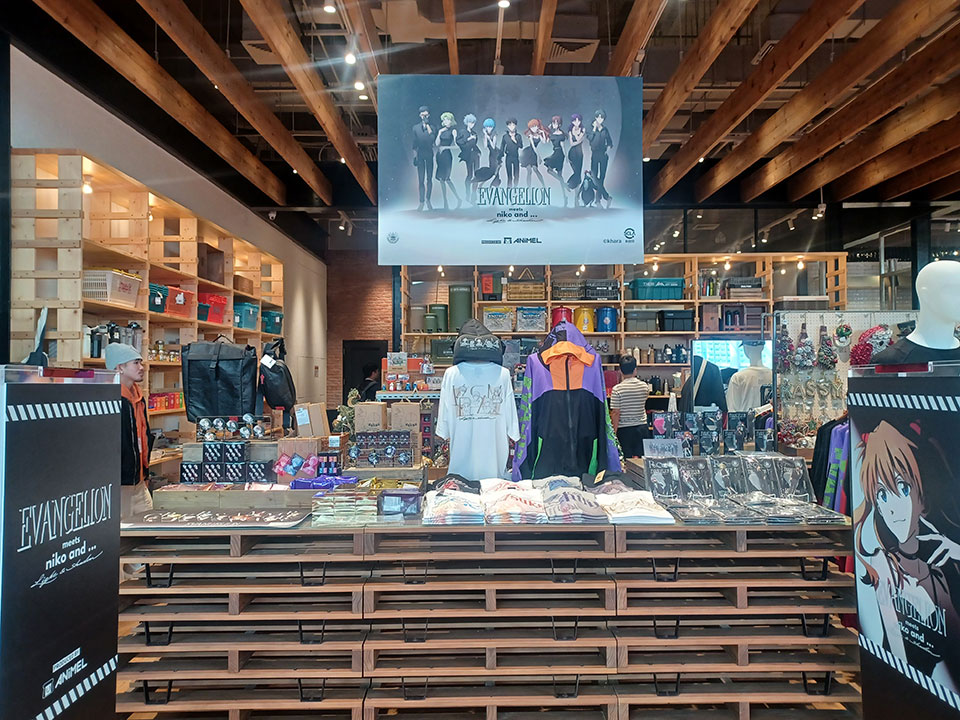
CLOTHES, merchandise, and other functional items by Japanese lifestyle brand niko and … are tapping into Filipinos’ nostalgia for classic animé with a new collaboration featuring the characters of Neon Genesis Evangelion, also known as Evangelion or just EVA.

At the launch on Dec. 12 at the niko and … store in SM Mall of Asia, a cosplayer posed as EVA’s Rei Ayanami, amidst a display of merchandise. The collaboration is timely for both niko and … since it is its first year in the Philippines, and EVA which is celebrating its 30th anniversary.

Animé lovers will find T-shirts, bags, hoodies, and other items featuring the main characters, all exclusively created for the limited edition Evangelion collection. They reinterpret key elements from the series through the silhouettes, graphics, and styles meant for daily wear.

As a style editorial brand, niko and … aims to “encapsulate culture, design, and everyday living into a one creative playground, fostering a creative ecosystem that enables collaborations with a wide range of IPs, artists, and labels.”

The store welcomes those who admire Japanese craftsmanship and attention to detail. Its goal is to give customers access to the latest trends from Japan through apparel, accessories, room items, and collaborative lines such as the Evangelion collection.

JAPANESE CULTURE, PHILIPPINE MARKET
Considering that consumers have responded “strongly to design, quality, and cultural expression” during niko and …’s first year in the Philippines, the brand has expressed interest in opening more stores, guided by Japanese apparel retailer Adastria.

“We found that Japanese culture is familiar in the Philippine market,” Adastria Chief Executive Officer Daisuke Fujii told BusinessWorld at the EVA launch. “Our lifestyle goods are successful. We also opened online. For now we are looking for another store, for more locations.”

On how they think their “one-year testing period” went, Mr. Fujii explained that introducing new content through collaborations with franchises like Stranger Things and PlayStation helped them see what Filipino consumers like.

“We’re not targeting a specific age group or gender. We just try to emphasize our brand,” he said. “In Japan, it’s a different market, an aging population. Here, it is totally different, very young. It’s a great opportunity and that’s why we’re here.”

The name niko and … references the Japanese onomatopoeia for smile, “niko niko.” Its executives also shared that it could be an acronym for their mindset about fashion: “nobody I know owns their own style.” With their assorted collections of lifestyle items, they invite their customers to encounter whatever is suitable for them and develop their own style at the store.

Adastria, with a diverse portfolio of 45 brands, is exploring the introduction of more brands to the country in addition to niko and ….

“We are thinking of bringing one or two more brands… here,” Mr. Fujii said. “Filipinos can expect to hear more from us.” — Brontë H. Lacsamana

ADVERTISEMENT
ADVERTISEMENT