Home Blog Page 5605

BSP tightening seen to continue until next year
BW FILE PHOTO
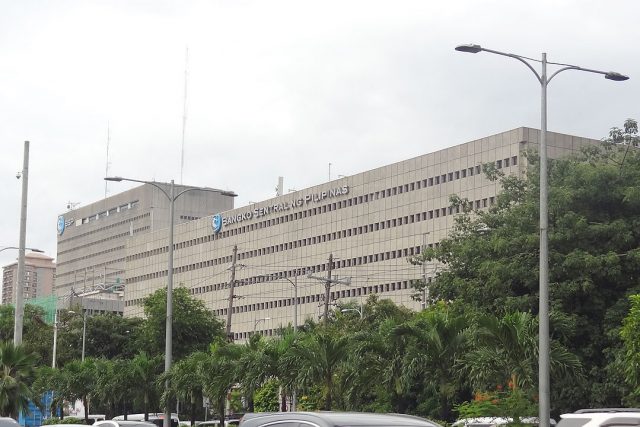
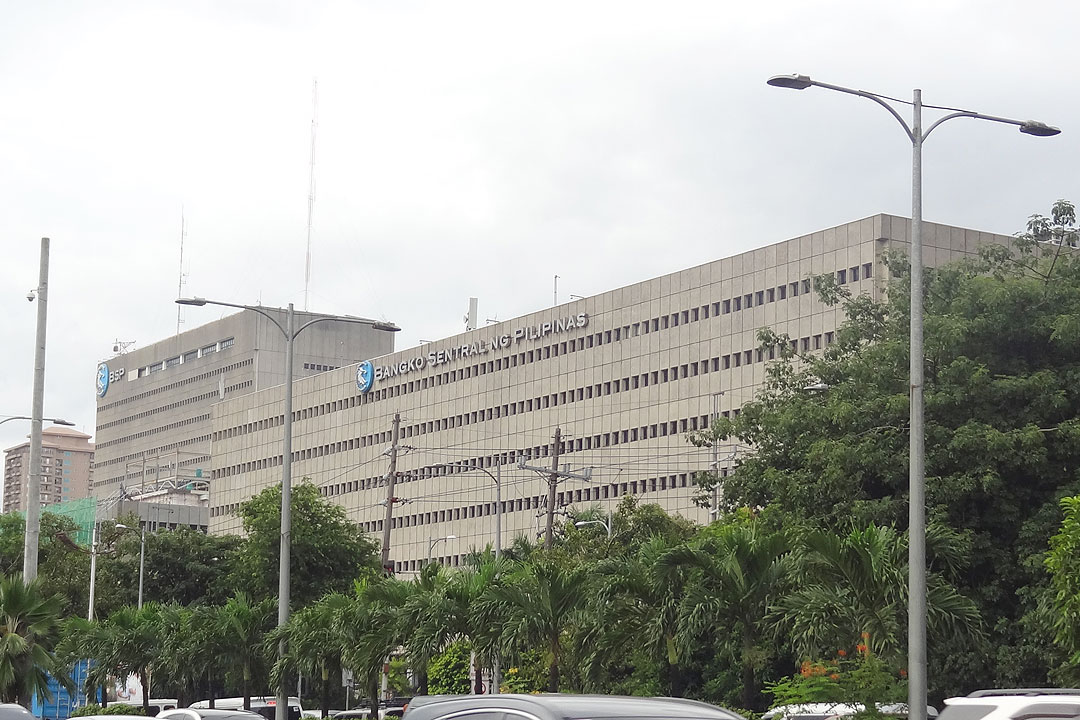
THE CENTRAL BANK is expected to continue raising benchmark interest rates until next year as inflation remains elevated. — BW FILE PHOTO

THE CENTRAL BANK is likely to continue its tightening cycle to tame inflation in the coming months, but it may deliver less aggressive rate hikes as the peso stabilizes against the dollar, Fitch Solutions Country Risk & Industry Research said.

Fitch Solutions said in a commentary dated Nov. 18 that they expect the benchmark policy rate to end at 5.5% this year and go up to a peak of 5.75% next year as the Bangko Sentral ng Pilipinas (BSP) continues its fight against inflation.

“The central bank will remain resolute in reining in high domestic inflation, which we expect to average 5.8% in 2022 before moderating slightly to 4.8% in 2023,” Fitch Solutions said, adding that inflation will likely remain above the BSP’s 2-4% target throughout the first half of 2023.

“Food inflation — which accelerated further to a four-year high of 9.4% y-o-y in October — will likely remain a significant source of upside risk. Adverse weather conditions have led to disruptions in food supply this year and remains a threat to prices,” it added.

Headline inflation quickened to 7.7% in October from 6.9%, marking the seventh straight month that inflation breached the BSP’s 2-4% target range. For the first 10 months, inflation averaged 5.4%, lower than the BSP’s revised 5.8% full-year forecast.

The BSP last week raised its key interest rate by 75 basis points (bps) to 5%, the highest in nearly 14 years. It has so far hiked rates by 300 bps since May to tame inflation.

“That said, a deteriorating economic outlook and an eventual stabilization in global monetary conditions mean the pace of hikes will slow over the coming months,” Fitch Solutions said.

It said it expects the central bank to deliver a smaller 50-bp rate hike on Dec. 15 and increase borrowing costs further to a peak of 5.75% in the first half of 2023.

“Since October, the peso has started to stabilize against the US dollar and is less overvalued on a real effective exchange rate basis. Moreover, we think that the US Federal Reserve will only raise interest rates by an additional 50 bps by end-2022 before keeping them steady throughout 2023,” it added.

“If we are right, then there will be less of a need for the BSP to lean towards aggressive rate hikes to defend the peso going forward. That said, we do see upside risks to our US interest rate forecasts,” it said. “Moreover, headwinds to economic growth are mounting. While the third-quarter growth outturn showed the economy expanding by a strong 7.4% year on year, underlying signs of weakness are apparent in the breakdown.”

The economy expanded by 7.6% in the third quarter, faster than the revised 7.5% in second quarter. Growth in the first three quarters of the year averaged 7.7%.

“Further ahead, we think that the lagged impact of persistent inflation, weaker external demand, and high interest rates will lead to a slowdown in growth, which we expect to slow from 7.4% in 2022 to 5.9% in 2023,” Fitch Solutions said.

The research firm noted there are risks to their policy rate forecast, skewed slightly to the upside.

“Indeed, larger-than-expected rate hikes by the US Fed could exacerbate downside volatility for the peso, prompting steeper interest rate hikes by the BSP to ensure currency stability,” Fitch Solutions said.

The US Federal Reserve has raised policy rates by 375 bps since March to curb inflation.

US inflation eased to 7.7% in October from the 8.2% print in September. While inflation is still elevated, this may prompt the Fed to consider slower monetary tightening. — K.B. Ta-asan


Regus franchise center to open in Las Piñas

INTERNATIONAL Workspace Group (IWG) recently inked a 10-year management agreement with Kyleson, Inc. to open a Regus franchise center in Las Piñas City.

The flexible workspace center, located within the Colours Town Center, will have 195 workstations and 1,200 square meters (sq.m.) of co-working desks, meeting rooms, and private offices. This will be the 26th Regus center in the Philippines.

“Our partnership with Colours Town Center combines our more than 30 years track record in equipping workspaces with the infrastructure and support services with ideal, modern locations to ensure employees experience the benefits of working wherever is most convenient for them without sacrificing productivity, or the benefits of collaboration,” Lars Wittig, IWG country manager, said in a statement.

Mr. Wittig noted worker preferences across Asia Pacific are shifting in favor of hybrid working, and companies that fail to adopt may lose their best workers.

“Adopting flexible working arrangements is crucial to business sustainability and long-term resilience,” he added.

IWG is aiming to expand its locations in the Philippines to 43.

Colours Town Center is located along the corner of Alabang-Zapote Road and Marcos Alvarez Avenue in Las Piñas City.

New Mexico sheriff releases Rust movie shooting investigation

A NEW Mexico sheriff’s office on Friday released documents from his investigation into the fatal shooting of cinematographer Halyna Hutchins last year on the set of Western movie Rust, as a state prosecutor decided whether to press criminal charges. Among 551 pages published by the Santa Fe County Sheriff’s Office were interviews with witnesses, including star Alec Baldwin, and text messages and e-mails from crew and cast members sometimes detailing chaotic and acrimonious conditions on set prior to Ms. Hutchins’ death on Oct. 21, 2021.

But the documents offered no conclusive answers as to how live ammunition got onto the movie set at a ranch outside Santa Fe and into a replica Colt .45-caliber revolver that was fired by Mr. Baldwin and killed Ms. Hutchins.

Mr. Baldwin was handed the gun during a rehearsal. A live round hit Ms. Hutchins and movie director Joel Souza, who survived. Mr. Baldwin is among up to four people who may face criminal charges for the death of the cinematographer, New Mexico District Attorney Mary Carmack-Altwies said in September. Her office had no comment on Friday.

The 30 Rock and Saturday Night Live actor has denied responsibility for Ms. Hutchins’ death and said live rounds should never have been allowed onto the set.

In police interviews and lawsuit filings, the film’s armorer, first assistant director, prop supplier, and prop master all denied culpability for the shooting.

Among the documents was an FBI report that said five live bullets were found on a props trolley and in a bandolier and holster near the movie-set church where Ms. Hutchins died.

The sheriff’s office said it would release more files on the case by Dec. 20. Under a lawsuit settlement between Mr. Baldwin, the film’s producers, and the Hutchins family, Rust will resume filming outside New Mexico in January with the same principal actors and director and the late cinematographer’s husband Matthew Hutchins serving as executive producer. — Reuters

LBC Express net loss widens to P144M

LBC Express Holdings, Inc. saw its attributable net loss for the third quarter of the year widen to P144.11 million from a loss of P64.22 million in the same period a year ago, mainly due to higher non-operating expenses.

The company’s service revenue for the period went up 1% to P3.94 billion from P3.90 billion previously.

There was a “growth in the overseas logistics and money transfer services by 12% and 14%, respectively,” LBC Express said in its third-quarter financial performance report.

Meanwhile, the company’s cost of services increased by 2% to P3.19 billion from P3.13 billion in the same period a year ago.

LBC Express attributed the increase to the higher cost of delivery and remittance by 1%.

“There are rate increases for domestic and international shipping lines and fuel rates,” the company also said.

Other charges rose to P289.69 million for the third quarter from P109.46 million previously.

This was mainly driven by “losses related to foreign exchange amounting to P89.55 million … compared to gains amounting to P22.50 million” in the same period last year, the company noted.

For the January-to-September period, the company incurred an attributable net loss of P227.10 million from a loss of P246.34 million in the same period last year.

Total service revenue for the period stood at P11.67 billion from P12.32 billion previously. Cost of services went down by 2% to P9.22 billion from P9.43 billion in 2021.

This was due to “lower cost of delivery and remittance by 7%,” the company said. “Reduction in truck rentals were aligned to current sales production.”

“However, these reductions were offset by the increasing fuel prices and surge in cost of freight-sea as general price increase was implemented by shipping lines, both domestic and overseas setting,” the company added.

LBC Express shares closed 4.81% higher at P17 apiece on Monday. — Arjay L. Balinbin

Reluctant buyers pose main threat to Beijing’s property revival efforts

RESIDENTIAL houses are seen in a valley in Tengchong, Yunnan province, in this Aug. 7, 2015 file photo. — REUTERS/STRINGER/FILES

BEIJING/HONG KONG — A slew of recent supportive measures will bring China’s cash-strapped property developers much needed relief, but a full recovery of the sector will be hobbled by increasingly elusive buyers, say bankers, developers and analysts.

From a sweeping purge a couple of years ago to a series of financing measures now, China’s changed approach towards the property sector, a key pillar of the economy, reflects how dire the situation has become.

Weighed down by protracted coronavirus disease 2019 (COVID-19) curbs, falling home prices and rising unemployment in the world’s second-largest economy, many prospective buyers are putting off their plans, creating challenges for developers and policymakers.

“These policies will have little lasting effect and the property prices will not go up significantly,” said Jack Yang, an engineer in Beijing, noting “future income” had become a key concern for homebuyers.

Mr. Yang said he had put plans to sell his home and buy a new one on hold due to COVID restrictions, cuts in his salary and concerns he may lose his job.

Chinese regulators outlined 16 supportive measures last week, mainly aimed at boosting liquidity for developers, in the most comprehensive rescue package for the sector since it was hit by a debt crisis last year.

Markets cheered the measures, which included loan repayment extensions and easier access to fresh funding, but bankers and analysts say they only address the property market’s supply problems, with the demand recovery still a key concern.

Demand for property, a sector that accounts for roughly a quarter of China’s economy, took a big hit this past year as many developers lurched from crisis to crisis and halted the construction of apartments as they ran out of money.

The economic fallout of COVID lockdowns in many cities also contributed to buyers like Mr. Yang putting off plans to take on debt to buy new homes — a trend, bankers and analysts say, is unlikely to change anytime soon.

Property sales measured by floor area fell for a 15th straight month in October, while new home prices fell at their fastest pace in over seven years, official data showed this week.

John Lam, head of China and Hong Kong property research at UBS said the government’s move to support liquidity “kind of breaks the negative cycle,” adding this “should be a positive in terms of the demand recovery.”

But rating agency Fitch said on Tuesday it was sticking to its forecast for a “largely flat trend” in new home sales in 2023 even after the latest support measures.

Housing demand “hinges on a recovery in homebuyers’ sentiment and employment prospects, which we think depends on sustained easing of China’s pandemic-related controls,” it said.

China last week eased some COVID rules, but analysts say the zero-COVID strategy will continue to weigh on economic activity.

While Beijing has cut mortgage costs and relaxed some curbs this year to boost new home purchases, analysts say authorities’ focus mostly on affordable housing and President Xi Jinping’s “common prosperity” push are likely to keep a lid on demand.

CREDIT RISK
The fall in home prices is a major concern for homebuyers in China given a large share of them buy new homes as an investment option, with returns historically reaching as high as 30%-50% over a period of time in some cities.

Despite the recent liquidity-boosting measures, some bankers say developers continue to face credit risks given the uncertain outlook.

“The measures will improve the real estate financing environment, which means that for banks, the vicious cycle and death spiral between real estate risks and financial risks have been alleviated,” said an official at a mid-sized commercial bank.

“But it is too early to say that the credit risk alert of real estate has been lifted,” said the banker, who declined to be named as he was not authorized to speak to the media.

According to UBS, Chinese banks have roughly 88 trillion-yuan ($12.43 trillion) worth of exposure to the property sector.

It estimates the property sector downturn will cost the banking system up to 1.4-1.5 trillion yuan in the next few years, mainly from potential losses in banks’ unsecured property development loans, bonds, and non-standard assets.

For now, however, the main concern for some homebuyers is whether the latest measures will enable developers to come out of the crisis and resume the construction of apartments.

Sam Wang, a 22-year-old freelancer in the catering industry, said a relative had bought “a property for presale in full payment” in Wuhan about three years ago, but it was still unfinished.

“For me, I am about to buy a house for residential purposes, and in the short term, I’ll take a wait-and-see attitude,” said Wang. — Reuters

Robert Clary, Holocaust survivor who starred in TV’s Hogan’s Heroes, 96

ROBERT CLARY (front) and Larry Hovis in a scene from the TV series Hogan’s Heroes.

ROBERT Clary, the diminutive Paris-born actor and singer who survived 31 months in Nazi concentration camps but later had no qualms about co-starring in Hogan’s Heroes, the American situation comedy set in a German World War II POW camp, has died at the age of 96.

Mr. Clary, who played strudel-baking French Corporal Louis Lebeau on Hogan’s Heroes during its six seasons from 1965 to 1971, died on Wednesday at his home in Los Angeles, his granddaughter told The Hollywood Reporter.

“Robert was an amazing gentleman and incredibly talented not just as an actor but also a performer and a gifted painter,” said David Martin, his former manager.

Mr. Clary was 16 in September 1942 when he was deported from Paris to Nazi concentration camps with 12 other members of his Jewish family. He was the only one who survived. Mr. Clary spent 2-1/2 years in the Ottmuth, Blachhammer, Gross-Rosen and Buchenwald concentration camps, enduring hunger, disease, and forced labor.

He was freed when American troops liberated Buchenwald in April 1945, but then learned that his family members, including his parents, had died in the Holocaust.

It was with some irony that Mr. Clary achieved his greatest fame playing for jokes in a TV show set in a German POW camp. He said he had no concerns about being in a show that mocked the Nazis.

His character was one of the prisoners-of-war who outwitted their dimwitted German jailers and conducted espionage and sabotage to aid the Allied cause.

“The show was a satire set in a stalag for prisoners of war, where conditions were not pleasant but in no way comparable to a concentration camp, and it had nothing to do with Jews,” Mr. Clary told the Jerusalem Post in 2002.

“Showbiz is like a roller coaster and you take what roles are offered to you,” Mr. Clary added.

Hogan’s Heroes starred Bob Crane as American Colonel Robert Hogan, with Richard Dawson, Larry Hovis, and Ivan Dixon playing other POWs. The main German characters were bumbling camp commandant Colonel Klink, played by Werner Klemperer, and pliant guard Sergeant Schultz, played by John Banner. Both actors were Jews and had fled Europe because of the Nazis.

Mr. Clary’s character was known for his burgundy beret and his cooking skills, which were used to distract German officers with delicious cuisine while his fellow POWs were up to mischief.

Hogan’s Heroes was popular with TV viewers during its run on the CBS network and for decades afterward in syndication even though some critics considered it in bad taste.

‘ONE OF THE LUCKY ONES’
Mr. Clary was born as Robert Max Widerman on March 1, 1926, the youngest of his Polish tailor father’s 14 children from two marriages. He became a professional singer as a teenager.

In the camps set up by the Nazis to eradicate Europe’s Jews, he was tattooed with the number A-5714 and forced to dig trenches, work in a shoe factory, and sing for his captors. The singing earned him a few extra morsels of food, Mr. Clary said.

“I was one of the lucky ones,” he told the Asbury Park, New Jersey, Press in 2002. “First of all, because I survived. Secondly, because I was in camps that were not as atrocious as others. I did not suffer. I did not work as hard as people were working in salt mines on quarries. I was never tortured. I was never really beaten. I was never hanged. But I saw all these things.”

After the war, Mr. Clary’s singing career took off in France. He moved to the United States in 1949 and comedian Eddie Cantor gave him national TV exposure. Mr. Clary later married Cantor’s daughter Natalie.

Mr. Clary performed on stage, in small film roles and in guest spots on TV before being cast in Hogan’s Heroes. His biggest film role was in director Robert Wise’s The Hindenburg (1975) starring George C. Scott.

Alarm over people trying to deny the Holocaust prompted Mr. Clary in 1980 to end his self-imposed silence about his experiences. He spent years traveling to schools in the United States and Canada speaking about the Holocaust. He also wrote an autobiography, From the Holocaust to Hogan’s Heroes.

“We must learn from history,” Mr. Clary told the Reno Gazette-Journal in 2002, “which we don’t.” — Reuters

Lenders sustain momentum in Q3 — CreditSights

PHILIPPINE BANKS sustained their positive momentum in the third quarter as asset quality and loan growth stayed resilient despite macroeconomic challenges, CreditSights said on Monday.

CreditSights said in a report dated Nov. 18 that banks in the country have mostly built on the momentum they had during the first half in the third quarter.

“Net interest and fee incomes continued to provide good cushion for poor trading income, which continues to be down across the board due to rising rates, and sharply reduced credit costs kept profitability back at or near pre-pandemic levels,” it said.

The research firm said the central bank’s rate hikes in the third quarter have started feeding through first-tier banks’ net interest margins (NIMs) which supported their net interest income (NII).

However, second-tier banks did not experience the same uptick in NIM due to weaker deposit franchises. This prompted banks to pre-fund time deposits more aggressively amid current and savings account outflows as rates rise.

Philippine banks’ NII rose by 4% to 26% annually, driven by higher NIMs and high-single to mid-teen digits loan portfolio expansion, CreditSights said.

The exceptions were Rizal Commercial Banking Corp. (RCBC), which relied more on the growth of its securities portfolio, and Philippine National Bank (PNB), which recorded a flat NIM and modest loan growth, it said.

Meanwhile, the NII growth of UnionBank of the Philippines, Inc. (UBP) reflects the boost from the bank’s acquisition of Citigroup, Inc.’s Philippine consumer business, it added.   

“That said, NIMs are still likely to move higher in the coming quarters as the lag effect of the BSP’s (Bangko Sentral ng Pilipinas) hikes on loan yields come through. The banks have also been more active in growing their investment securities portfolios to take advantage of presently higher yields,” CreditSights said.

The BSP has hiked borrowing costs by 300 basis points (bps) since May as it seeks to get inflation under control.

Meanwhile, banks’ fee income remained steady, driven by the continued reopening of the economy, CreditSights said. Double-digit growth was recorded by all banks except for the Bank of the Philippine Islands (BPI) and PNB.   

Asset quality was also stable quarter on quarter, but CreditSights noted the higher nonperforming loan (NPL) ratio of Metropolitan Bank & Trust Co. (Metrobank) and that UnionBank did not disclose its own NPL ratio this quarter.

“Provisions were aided by write-backs in the first half particularly at the second-tier banks and thus came in much lower year-on-year at all the banks…”

Loan growth also decelerated from the previous quarter for first-tier banks, but was higher for second-tier lenders. Loan growth ranged between 3% and 6.5%, with the year-to-date expansion for banks that CreditSights covers at 5.5-8%.

“Policy tightening by the BSP has been aggressive and this is likely to damper growth momentum going forward,” the financial research firm said.

CreditSights said first-tier banks, namely BPI, BDO Unibank Inc. (BDO), and Metrobank, have stronger capital buffers and loss absorption, more benign asset quality, and larger business franchises compared to other banks.

“They benefit from a high exposure to large corporates which should be more resilient in a downturn, as well as their strong deposit franchises which temper the rise in deposit costs, allowing more uplift from the BSP’s rate hikes to their NIM,” it said.

“We acknowledge the headwinds facing the Philippines but see the risks as fairly captured in their current spreads, and thus retain our Market perform recommendation on BDO, BPI and MBT,” it added.

Meanwhile, the financial research firm said Security Bank Corp. and UnionBank lack size compared with the first-tier banks.

CreditSights also noted that UnionBank’s common equity tier 1 (CET1) ratio dropped to 11.9% in the third quarter as its acquisition of Citi’s consumer banking business officially closed in August.

Meanwhile, the research firm is considering to changed their “market perform” recommendation for RCBC after announcing that Sumitomo Mitsui Banking Corp. (SMBC) will hike its stake to 20% through a capital infusion.

“For RCBC, we view SMBC increasing its stake to 20% as a material credit positive as it provides an ~400 bp uplift to the CET1 ratio, and strengthens SMBC’s commitment to RCBC as the vehicle for its expansion into the Philippine market,” it said.   

“We see this level as somewhat wide but would look for signs of stabilization in its asset quality and credit costs before considering a change to our current Market perform recommendation on RCBC,” it added. — K.B. Ta-asan

ALI to open UV Express terminal in One Ayala

AYALA LAND, Inc. is set to open the next phase of its public terminal in One Ayala after opening its new bus terminal in partnership with the Department of Transportation.

“In the succeeding months we will be opening the UV Express terminal at the basement level of this facility,” Ayala Land’s Project Development Head for Makati Shiella G. Aguilar said in an interview.

Last Friday, the company opened the bus terminal of its transit-oriented development at the intersection of Ayala Ave. and EDSA.

The terminal will serve as the new bus stop for Ayala commuters and will cater to EDSA Bus Carousel, point-to-point buses, and southbound city buses. The UV Express terminal will be on the basement level of One Ayala and will have an air-conditioned passenger concourse open to the public.

The second level of the development will also have a big passenger concourse that will be directly connected to the Ayala station of the Manila Metro Rail Transit System (MRT).

“It’s like an atrium where people can actually go down to the different escalators in the different bus bays and there’s also a connection also at the second level to the MRT, it’s directly connected,” Ms. Aguilar said.

One Ayala is a mixed-use development that will have a terminal, two office towers, a hotel, and a commercial tower.

According to Ms. Aguilar, its first office tower is already operational and is home to a number of tenants. One Ayala’s six-storey retail component is expected to open by the third quarter of 2023, while the second tower is expected to top off by 2024. 

One Ayala will have a Seda hotel within the complex that is already under construction. It will be a flagship project for Seda as it will have 430 rooms and is set to open after the second office tower.

When asked how much was invested in the project, Ms. Aguilar said “the entire One Ayala project is P25 billion.” — Justine Irish D. Tabile

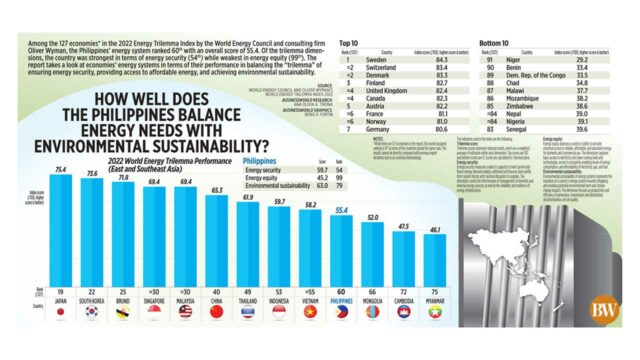
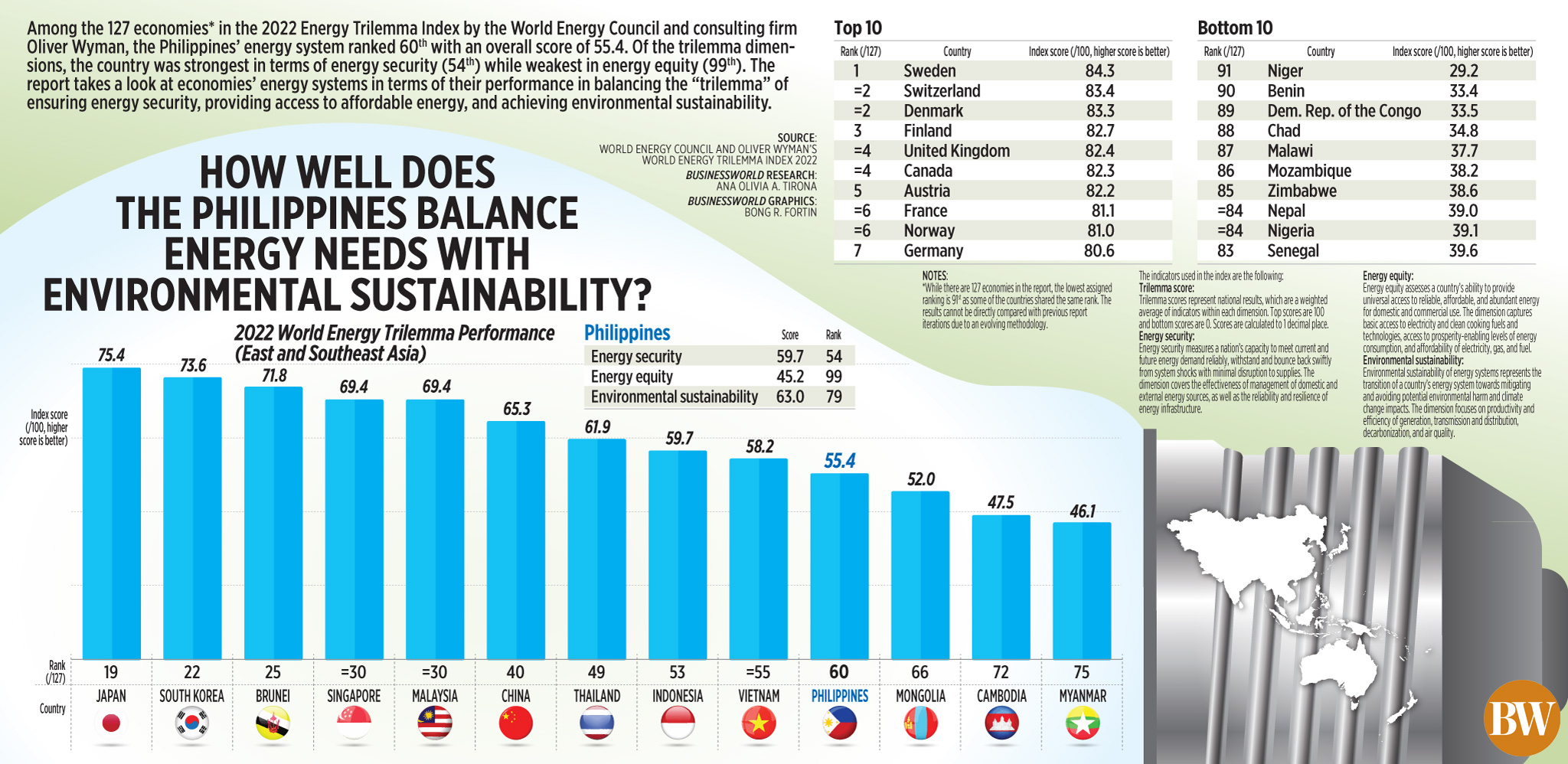
How well does the Philippines balance energy needs with environmental sustainability?

Among the 127 economies* in the 2022 Energy Trilemma Index by the World Energy Council and consulting firm Oliver Wyman, the Philippines’ energy system ranked 60th with an overall score of 55.4. Of the trilemma dimensions, the country was strongest in terms of energy security (54th) while weakest in energy equity (99th). The report takes a look at economies’ energy systems in terms of their performance in balancing the “trilemma” of ensuring energy security, providing access to affordable energy, and achieving environmental sustainability.

How well does the Philippines balance energy needs with environmental sustainability?

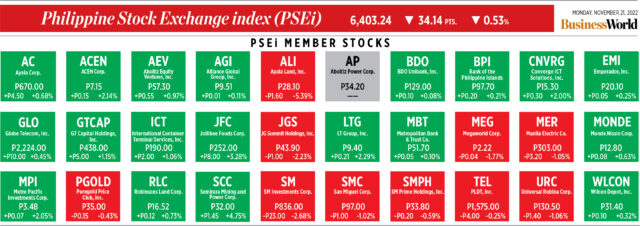
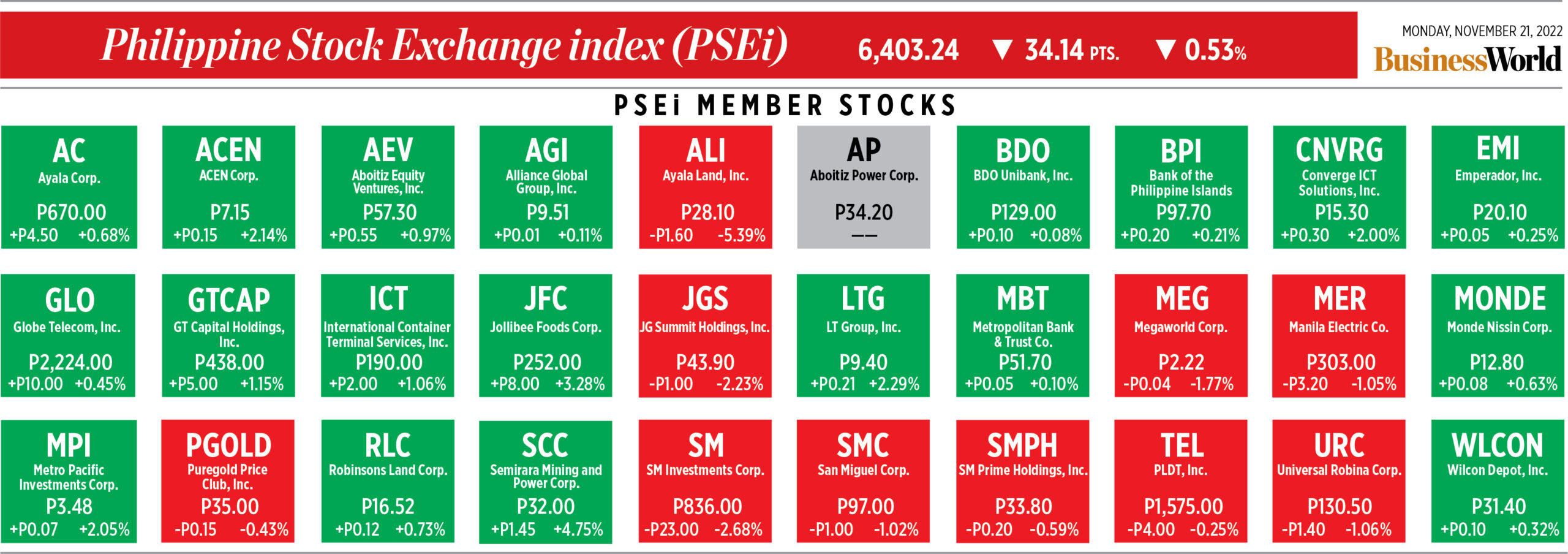
How PSEi member stocks performed — November 21, 2022

Here’s a quick glance at how PSEi stocks fared on Monday, November 21, 2022.


Peso declines on Fed worries

BW FILE PHOTO

THE PESO ended weaker against the dollar on Monday following hawkish signals from the US central bank, and as renewed coronavirus worries spurred safe-haven demand.

The local unit closed at P57.36 versus the dollar on Monday, down by 10 centavos from its P57.26 finish on Friday, data from the Bankers Association of the Philippines’ website showed.

The peso opened Monday’s session stronger than its Friday close at P57.20, which was also its intraday best. Its weakest point was at P57.37 versus the greenback.

Dollars exchanged went down to $527.82 million on Monday from $650.18 million on Friday.

The peso weakened on Monday as officials of the US Federal Reserve said they will likely continue hiking rates, Rizal Commercial Banking Corp. Chief Economist Michael L. Ricafort said in a Viber message.

Last week, Federal Reserve Bank of Boston President Susan M. Collins said the Fed may need to hike by another 75 basis points (bps) as it seeks to control inflation.

St. Louis Fed President James B. Bullard also said the Fed needs to keep on raising borrowing costs as its monetary tightening so far “had only limited effects on observed inflation.”

The US central bank has raised borrowing costs by 375 bps since March, with the latest move being a fourth straight 75-bp rate hike earlier this month, bringing the fed funds rate a 3.75-4% range.

Meanwhile, a trader attributed the peso’s depreciation to rising coronavirus disease 2019 (COVID-19) cases in China.

“The peso weakened from global growth concerns after China recorded new COVID-related deaths and surge in COVID cases over the weekend,” the trader said in an e-mail.

Reuters reported that students in schools across several Beijing districts buckled down for online classes on Monday after officials called for residents to stay home, as COVID-19 cases were higher in China.

China recorded 26,824 new local cases for Sunday, nearing the country’s daily pandemic peak in April. Two deaths were also reported in Beijing, up from one on Saturday, which was China’s first since late May.

For Tuesday, the trader said the peso may continue to weaken after China’s central bank flagged growth worries.

The trader said the peso could move from P57.25 to P57.50 on Tuesday, while Mr. Ricafort gave a forecast range of P57.20 to P57.40 per dollar. — KBT with Reuters

PHL shares decline as investors pocket profits

BW FILE PHOTO

PHILIPPINE SHARES declined on Monday after investors booked profits from the market’s recent rally.

The Philippine Stock Exchange index (PSEi) went down by 34.14 points or 0.53% to end at 6,403.24, while the broader all shares index lost 10.67 points or 0.31% to 3,385.96.

AB Capital Securities, Inc. Vice-President Jovis L. Vistan said the PSEi went down on profit taking.

“After gaining by almost 13% for the past month and a half, the local equities market was ripe for profit taking. The earnings reporting season is over and attention now shifts to macroeconomic fundamentals,” Mr. Vistan said in a Viber message.

He said while US consumer inflation eased in October, which could lead to slower tightening by the US Federal Reserve, higher prices elsewhere weighed on sentiment. 

“Japan’s October inflation was the highest in four decades while Philippine inflation may not have peaked yet,” Mr. Vistan said.

Consumer prices in Japan excluding fresh food climbed by 3.6% in October, the fastest since 1982.

Meanwhile, Philippine consumer inflation accelerated to a near 14-year high of 7.7% in October from 6.9% in September and 4% in the same month in 2021. This is well above the Bangko Sentral ng Pilipinas’ (BSP) 2-4% target.

“The local bourse dropped … as investors took some profits, on the upside, the index still managed to stay above the 6,400 old resistance line,” Philstocks Financial, Inc. Research Analyst Claire T. Alviar in a Viber message. 

“Moreover, the BSP’s expectation that the Philippine economic growth may slow down in the next two years amid internal and external headwinds, and monetary tightening, weighed on the sentiment,” Mr. Alviar added.

The BSP last week delivered a 75-basis-point (bp) hike to match the Fed as it seeks to rein in rising inflation and support the currency. It has now raised borrowing costs by 300 bps since May.

The majority of sectoral indices ended higher on Monday except for property, which declined by 60.80 points or 2.13% to close at 2,785.09; and holding firms, which went down by 54.49 points or 0.89% to 6,047.32. 

Meanwhile, industrials gained 59.05 points or 0.62% to end at 9,543.82; services went up by 9.20 points or 0.55% to 1,667.56; financials rose by 2.74 points or 0.16% to 1,619.87; and mining and oil climbed by 10.85 points or 0.11% to 9,856.08.

Value turnover rose to P6.24 billion on Monday with 776.16 million shares changing hands from the P5.33 billion with 570.39 million shares issued on Friday.

Decliners outnumbered advancers, 97 versus 87, while 40 names closed unchanged.

Net foreign buying declined to P170.07 million on Monday from the P652.19 million seen on Friday.

AB Capital Securities’ Mr. Vistan placed the PSEi’s support at 6,150 and resistance at 6,450. — A.E.O. Jose