
Tarlac’s Belenismo Festival

RESIDENTS and local tourists view and take photos of different renditions of the nativity scene at Tarlac’s annual Belenismo Festival on Nov. 20.
RESIDENTS and local tourists view and take photos of different renditions of the nativity scene at Tarlac’s annual Belenismo Festival on Nov. 20.

FOLLOWING is a list of players who have been ruled out or are doubtful through injury for the soccer World Cup, which runs from Sunday through Dec. 18.
PAUL POGBA (FRANCE): Pogba injured his knee in pre-season and underwent surgery in September to repair a damaged meniscus.
The 29-year-old resumed training, but on Oct. 31 his agent said the midfielder would not return to action for Juventus or world champions France before the World Cup.
N’GOLO KANTE (FRANCE): The Chelsea midfielder suffered a setback in his rehabilitation from a hamstring injury that has restricted him to two league appearances this season. He will be sidelined for four months after undergoing surgery.
TIMO WERNER (GERMANY): The RB Leipzig forward, 26, sustained an ankle injury during their 4-0 Champions League victory over Shakhtar Donetsk at the start of November and will be sidelined for the rest of 2022.
REECE JAMES (ENGLAND): The 22-year-old right back injured his knee in Chelsea’s Champions League clash against AC Milan in October and said he will not be a part of the England team.
DIOGO JOTA (PORTUGAL): The Liverpool forward will miss the tournament due to a calf injury sustained in their victory over Manchester City, but the Premier League club’s manager Juergen Klopp said that he would not require surgery.
PEDRO NETO (PORTUGAL): The 22-year-old Wolverhampton Wanderers winger will undergo surgery on an ankle injury sustained against West Ham United in October.
BOUBACAR KAMARA (FRANCE): The Aston Villa midfielder suffered a knee ligament injury in September that will keep him out until after the World Cup.
ARTHUR MELO (BRAZIL): Liverpool’s on-loan midfielder picked up a muscle injury in the build-up to a Champions League clash with Rangers in October.
SCOTT KENNEDY (CANADA): The 25-year-old defender sustained a freak shoulder injury at the end of October while playing for SSV Jahn Regensburg in the German second division.
JESUS ‘TECATITO’ CORONA (MEXICO): The Sevilla winger suffered a fracture on his left ankle while he was training with the LaLiga club in August and underwent surgery.
GIOVANI LO CELSO (ARGENTINA): The midfielder picked up a hamstring injury while playing for Villarreal. Argentina coach Lionel Scaloni described him as being “irreplaceable” when naming his squad.
MARCO REUS (GERMANY): The Borussia Dortmund captain sustained an ankle injury and failed to recover fully in time. Reus also missed the 2014 World Cup after getting injured on the eve of Germany’s departure for Brazil, where they won the title.
BEN CHILWELL (ENGLAND): Left back Ben Chilwell pulled up with a hamstring injury during added time in Chelsea’s Champions League win over Dinamo Zagreb and said days later he had suffered “significant damage” that would rule him out of the World Cup.
PRESNEL KIMPEMBE (FRANCE): The Paris St Germain center back ruled himself out because of a hamstring injury.
YUTA NAKAYAMA (JAPAN): The defender will miss the World Cup after being ruled out for the rest of the season due to an Achilles injury.
AMINE HARIT (MOROCCO): Morocco’s Olympique de Marseille forward Amine Harit sustained a knee injury during a Ligue 1 match against AS Monaco, ruling him out of the tournament.
SADIO MANE (SENEGAL): Sadio Mane was named in Senegal’s squad for the World Cup despite suffering an injury playing for Bayern Munich, but has been ruled out of the tournament after officials confirmed he would need surgery on the injury.
CHRISTOPHER NKUNKU (FRANCE): The RB Leipzig forward was included in France’s squad for the World Cup, but was ruled out of the tournament after picking up a left knee injury following a tackle from team mate Eduardo Camavinga in training.
JOSE GAYA (SPAIN): Valencia left back Jose Gaya was withdrawn from Spain’s squad for the World Cup in Qatar after suffering an ankle injury in training.
KARIM BENZEMA (FRANCE): Real Madrid striker and Ballon d’Or winner Karim Benzema was ruled out of the World Cup for France after suffering an injury in training the day before the start of the tournament. — Reuters
(Compiled by Hritika Sharma, Aadi Nair, Rohith Nair and Shrivathsa Sridhar in Bengaluru, Tommy Lund in Gdansk)

FILIPINO Grandmaster (GM)Joey Antonio crushed French GM Eric Prie to seize a share of the lead almost halfway through the Open 50+ division of the 30th FIDE World Senior Chess Championship in Umbria, Italy Saturday.
The 60-year-old Olympiad veteran defended well against Mr. Prie’s coffeehouse tactics and ended up snatching a pawn and going an exchange up to essay a 47-move triumph in their center-counter game.
It was a win that propelled Mr. Antonio straight to the top alongside GMs Darcy Lima of Brazil, Maxim Novik of Lithuania and Frank Holzke of Germany with 4.5 points apiece after five rounds of this 11-round tournament.
Messrs. Lima and Novik split the point on top board while Holzke downed International Master David Cummings of Canada.
Mr. Antonio will try to hang on to a piece of the top spot as he was battling Mr. Lima in the sixth round at press time.
The Filipino online chess iron man is hoping to finally win here after coming close to accomplishing it five years ago also in Acqui Terme, Italy where he eventually wound up second behind winner GM Julio Granda Zuniga of Peru.
“Still a long way to go but I hope to sustain my momentum,” said Mr. Antonio who also bested Igor Tsyn of Israel, FIDE Master Milan Kolesar of Slovakia and IM Ali Hussein Al-Ali Hussein of Iraq in the first three rounds before halving the point with second seed GM Ivan Morovic Fernandez of Chile in the fourth round. — Joey Villar

Games On Wednesday
(Mall of Asia Arena)
11 a.m. — UST vs UP
1 p.m. — NU vs DLSU
3 p.m. — ADMU VS UE
6:30 p.m. — FEU vs AdU
NATIONAL University (NU) finally broke out from its leash, ending a seven-year Final Four drought with a 67-57 come-from-behind win over University of Santo Tomas (UST) in the UAAP Season 85 men’s basketball tournament yesterday at the Mall of Asia Arena.
Skipper John Lloyd Clemente unleashed 19 points and five rebounds including the dagger triple in the last minute as the Bulldogs listed their fourth straight win and ninth overall in 12 matches to join reigning champion and pacesetting University of the Philippines to the semis.
Omar John (12) and Kean Baclaan (10) backstopped Mr. Clemente in NU’s big triumph that in the process created a little breathing room from first-game winner Ateneo (8-3) in a wild race for a Top-Two finish that comes with a twice-to-beat advantage.
“We survived a gritty UST team. They played their hearts out. Good thing was, we came back in the second half. We regrouped and earned this tough win,” said coach Jeff Napa, who rushed straight to the Smart Araneta Coliseum for the PBA game of Northport, where he’s an assistant coach.
NU, the UAAP’s revelation team this season with a stellar campaign including handing UP’s lone loss so far, trailed early at 25-36 but regained its groove after the break by limiting Santo Tomas to eight points in the third.
The Bulldogs figured in a dogfight with the Tigers since then before uncorking a 12-0 run to transform a 52-54 deficit to a 64-54 lead for the win.
Earlier, Ange Kouame hauled down a 20-14 double-double as Ateneo clawed back from 19 points to earn at least a playoff in the Final Four and stay in hunt for a twice-to-beat advantage with an 8-3 card.
With the meltdown, FEU took a toll on its own semis bid as it fell to 4-8 while Santo Tomas crashed out of contention with its 10th straight loss at 1-10. — John Bryan Ulanday
The Scores:
First Game
ATENEO 71 — Kouame 20, Padrigao 13, Andrade 9, Ildefonso 8, Garcia 8, Ballungay 5, Koon 4, Lazaro 2, Daves 2, Chiu 0, Quitevis 0.
FEU 65 — Torres 19, Gonzales 15, Sleat 10, Tchuente 8, Anonuevo 8, Bagunu 3, Bautista 2, Alforque 0, Sajonia 0, Sandagon 0, Tempra 0.
Quarterscores: 14-21, 27-41, 49-54, 71-65.
Second Game
NU 67 — Clemente 19, John 12, Baclaan 10, Malonzo 6, Manansala 6, Figueroa 4, Palacielo 4, Enriquez 3, Galinato 3, Yu 0, Mahinay 0, Tibayan 0, Padrones 0, Minerva 0.
UST 57 — Cabanero 20, Faye 11, Pangilinan 8, Garing 6, Calimag 5, Manaytay 4, Duremdes 3, Manalang 0.
Quarterscores: 11-20, 29-36, 46-44, 67-57.

Games Wednesday
(Filoil EcoOil Centre)
12 p.m. — EAC vs AU
3 p.m. — CSB vs San Beda
COLLEGE of St. Benilde (CSB) drew strength from other sources when MVP leader Will Gozum sputtered as it turned back Arellano University (AU), 83-73, yesterday to reclaim a share of the lead with San Juan de Letran in NCAA Season 98 at the Filoil EcoOil Centre.
Migz Corteza and Mark Sangco came off the bench and filled the void left by a struggling Mr. Gozum as the Blazers not only jumped to joint first with a 13-4 slate but also ensured them of at least a playoff for one of the two twice-to-beat incentives in the Final Four.
CSB could claim that important edge outright with a win against San Beda (12-5) on Wednesday.
A loss, however, would mean it would have to play another game for that advantage.
And CSB head coach Charles Tiu had the duo of Mr. Corteza, who had 15 points, and Mr. Sangco, who finished with 11 points and 13 rebounds, to thank for as Mr. Gozum was out of sync the whole game and wound up with nine points and 10 boards.
“They stepped up big for us. Will Gozum wasn’t that good today (yesterday),” said Mr. Tiu of the Corteza-Sangco frontcourt tandem.
The Arellano University Chiefs dropped to 7-10.
Earlier, San Sebastian edged Emilio Aguinaldo College (EAC), 62-59, to improve to 8-9.
The Generals skidded to 2-15. — Joey Villar
The Scores:
First Game
San Sebastian 62 — Altamirano 18, Calahat 12, Aguilar 11, Sumoda 6, Cosari 4, Villapando 3, Una 3, Escobido 2, Are 0, Concha 0
EAC 59 — Cosejo 15, Dominguez 12, Tolentino 7, Maguliano 6, Cosa 6, Quinal 5, Balowa 4, Luciano 2, Angeles 2, Bajon 0, Umpad 0, An. Doria 0
Quarterscores: 20-15, 39-32, 53-44, 62-59
Second Game
CSB 83 — Nayve 17, Corteza 15, Sangco 11, Pasturan 10, Gozum 9, Oczon 6, Cullar 5, Lepalam 4, Carlos 3, Lim 3, Marcos 0, Mara 0, Davis 0
AU 73 — Flores 17, Doromal 14, Mantua 11, Tolentino 10, Talampas 10, Mallari 8, Ongotan 3, Oliva 0, Abastillas 0, Oftana 0, Sunga 0
Quarterscores: 24-24, 45-46, 64-59, 83-73

ALMOND Vosotros caught fire as TNT secured a redeeming triumph in Leg 3 of the PBA Season 2 Second Conference via a gritty 21-17 clincher over Cavitex yesterday at Robinsons Novaliches.
In a searing shooting display, Mr. Vosotros knocked down six consecutive two-pointers in the stretch to fuel the Tropang Giga’s turnaround from 9-13 and complete their return-to-the-top mission after last week’s runner-up heartbreaker to J&T Express in Leg 2.
Mr. Vosotros finished with 15 points highlighted by seven long bombs while Gryann Mendoza, Lervin Flores and Ray Mark Acuno accounted for a combined six markers plus other intangibles in delivering TNT’s latest feat worth P100,000.
It was one of the most dominant individual performances the league has seen but Mr. Vosotros quickly deflected credit. “Effort ng whole team ito — from the coaches to the utilities to the players,” he said.
TNT now owns two victories in the mid-season conference, counting its Leg 1 conquest. Overall, the Tropang Giga have won 10 leg titles and two conference championships since the inaugural season.
Cavitex’ Bong Galanza, Sherwin Concepcion, Dominick Fajardo and Jorey Napoles banked P50,000 for their runner-up finish.
The Braves were left to rue their failure to close TNT out after even holding a 16-15 upperhand in the middle of the Vosotros bombardment.
Meralco joined the podium and netted P30,000 after beating Ginebra in the battle for third, 17-15. — Olmin Leyba
Don’t look now, but the Bucks are struggling. After hitting the ground running and torching the National Basketball Association with nine straight victories to start their 2022-23 campaign, they’ve suffered setbacks in four of their last six matches, including one to the otherwise-lowly Spurs. The other day, they even managed to snatch defeat from the throes of victory in the road against the supposedly struggling Sixers. It was a game they should have won, and not just because the hosts were undermanned; more importantly, they faced a predictable offense that, after having been down 13, found cause to rally and triumph pulling away.
The season’s early, of course, and it’s hard to pillory the Bucks when their record is still good for second in the league, a single game out of first place. And insofar as disappointments go, they’re back in line behind such notables as the Warriors, Suns, Mavericks, Nuggets — and, yes, even the Sixers and Nets. Just about all the contenders have concerns to tend and attend to, and with four-fifths of the schedule remaining, focusing on issues as if the end of the world is nigh borders on overreaction.
On the other hand, the Bucks do have significant items to address, and it’s best for them to do so early on so that no bad habits — or, just as crucially, no bad thoughts — develop. It’s why Antetokounmpo saw fit to linger at the Wells Fargo Center long after the loss to the Sixers to work on his free throw shooting. He canned only four of 15 attempts from the line, a cause for concern in light of his immediate past four-of-11 output. His lack of efficiency has made him and, by extension, the Bucks predictable, hence their uncharacteristic negative offensive rating.
Indeed, Antetokounmpo was visibly affected in the aftermath, leading to recorded kerfuffles with the Sixers’ Montrezl Harrell and with arena workers, and to a ladder forcibly pushed out of the way. He then felt that it was much ado over nothing. “I don’t know if I should apologize because I don’t feel like I did anything wrong, except the ladder just fell. I feel like it’s my right for me to work on my skills after a horrible night at the free throw line. I think anybody in my position that had a night like me would go out and work on his free throws. And if they didn’t they don’t really care about their game.”
Antetokounmpo’s on the mark, to be sure. So much of the Bucks’ fate hangs on his performances, and there’s a reason his shooting numbers have dropped to levels not seen in seven years. And unless and until he determines why, he’ll continue to search for answers, on the court and off.
Anthony L. Cuaycong has been writing Courtside since BusinessWorld introduced a Sports section in 1994. He is a consultant on strategic planning, operations and human resources management, corporate communications, and business development.
(Part 1)
The Atlas Network (https://www.atlasnetwork.org/) partnered with the Foundation for Economic Freedom or FEF (https://www.fef.org.ph/) to organize and host the “Asia Liberty Forum” in Manila on Sept. 29-30. We brought together friends of the freedom movement across Asia to discuss challenges facing the region and to learn from one another how to most effectively advance free-market reforms. One hundred forty-seven Atlas Network partners, academics, economists, journalists, students, and many other proponents of the freedom movement from 22 countries gathered in Manila. Through panel discussions, break-out sessions, the Asia Liberty Awards Dinner, and other events, attendees heard from leaders from across the continent about the challenges and opportunities ahead for liberal democracy.
One of culminating events was an interview with economic freedom champion, our only living National Scientist in Economics, former Dean and UP Economics Professor Emeritus, Raul Fabella. I am proudly his fellow “Introspective” columnist in this space, co-author of Momentum (Momentum: Economic Reform for Sustaining Growth, 2019) and Momen2m (Momen2m: More reforms for Economic Growth, 2021), and, together with Calixto Chikiamco, Philip Medalla, the late Dondon Paderanga, Mahar Mangahas, and others, co-founded the FEF.
It was my honor to interview my friend of long standing — since 1977 when we first met, both economics graduate students, at a bus stop in Washington DC. The interview follows below:
Romeo Bernardo (RB): I will act as a provocateur to help bring out Raul’s thoughts. Apologies if questions seem Philippine centric, though they could just as easily apply to other developing countries, where majority of our participants here come from.
We hope to cover relationship between economic freedom, growth and inequality, rule of law and inclusion/inequality (including where human rights fit in), the retreat from liberal economic regimes towards authoritarian/statist regimes (coming from the right and the left) we are observing globally, the role of civil society organizations like the FEF and how we may strengthen.
In a column you wrote in 2014, “On poverty, inequality, growth,” you expounded on how a developing country like the Philippines should view the then-just-released book (both celebrated and scorned) of Thomas Piketty.
At the risk of oversimplifying, these were my own take-aways from your column:
• sustained growth is paramount, especially for a developing country with substantial poverty like the Philippines.
• right market based policies and institutions essential to sustain growth. Excessive inequality can also be corrosive of sustained growth.
• poverty reduction should be higher priority than reduction of inequality. As illustrated in the case of China started by Premier Deng, inequality may well be a corollary of pursuing market policies and thus the price of graduating hundreds of millions out of poverty.
Have I captured your views correctly? Can growth be sustained with inequality increasing?
Raul Fabella (RF): A. Poverty reduction should be a higher priority than income inequality in low-income countries and in weak governance environments, the state should retreat to its Smithian competitive competence and cede to the market activities where the market has superior competence. The state and the market can cooperate in PPP (public-private partnership) projects. Excessive inequality can shorten the duration of growth (Berg and Oster, 2011): social unrest can be a corollary to excessive inequality.
B. Growth is sine qua non for poverty reduction but some [kinds of] growth are more equal than others. Growth led by Manufacturing and Tradables are more poverty reducing than growth led by the Services sector (Fabella, Daway-Ducanes, Ducanes, shortly to appear).
C. Growth can be sustained with increasing inequality: witness the MDG [Millennium Development Goals] (1990-2015) experience of PRC [the People’s Republic of China]: rapid growth reduced poverty incidence to 5% — 600 million people [were raised] out of poverty — but raised income inequality from 31% to 43%.
This was the message of front end of the Kuznets inverted U hypothesis: inequality as Gini ratio first rises with rising wages, second, reaches a ceiling, and finally, begins to fall with further increases in wages. The rise in equality in the front end is understood to be in aid of economic growth. Sustained increases in wages cannot be realized without sustained economic growth. The US Constitution itself says as much when it asserts that inequality should be foreborn as long as it advances the common good. There is such thing as welfare advancing inequality. What is that point where inequality is most productive of the collective weal is anybody’s guess.
Piketty (2011) however showed that in normal times, the second and third part of the Kuznets curve does not exist for well-governed advanced economies in the West; he gave evidence that income and wealth inequality rises progressively in these economies and it is not due to some garden variety market failure. It is rather a meta-market failure that Marxists and Socialists in the 1930s riled up against as the fatal soft underbelly of market economies. A case in point is the PRC economy over the MDG period from 1990 to 2015: the economy grew at a record pace while income inequality rose from GINI 31 in 1990 to GINI 43. The rise in the rank of Chinese dollar billionaires was in exchange for the 600 million Chinese being graduated from abject poverty. Few would say “no” to such a tradeoff.
RB: How about the effect of income inequality on freedom and what it implies on human welfare broadly defined apart from possible drag on sustained economic growth? Also, should we not worry about concentration of wealth and political power?
RF: A. Economic freedom — That rising income inequality can impair economic freedom is an arguable point: where the concentration of wealth readily translates into political power, economic freedom may be curtailed by wealth-sponsored-legal mandates that favor monopolies and cartels. Contrarily, economic freedom can unleash the power of the market which results, as Piketty showed, in rising income inequality. The causation can work in either direction. There is no evidence that rising income inequality curtails economic freedom. Piketty feared that wealth inequality would rather curtail or blindside political freedom.
In the Robber Baron era (1870-1900), political power was suborned to economic power and but major economic freedom legislations were enacted: e.g., the Sherman Anti-Trust [Act], etc. Enforcement of anti-trust was however spotty at the start but eventually improved with the Fair Trade Commission law.
B. That inequality impairs political freedom is Piketty’s fear but is arguable: it is clear that political power beholden to economic power can legislate anti-union and tariff protection laws. But the decline of unionism in the USA had little to do with anti-union laws and more to do with economic liberalization laws allowing imports to gut the US steel and textile industries. On the other hand, there is a school of thought that says that a rising middle class could provide the agency for greater political liberalization, say, more inclusivity in voting rights and the allocation of fiscal resources.
RB: In the case of the Philippines, the most egregious evidence of concentration of economic and political power is the pervasiveness of political dynasties, which are either themselves directly engaged in business, mostly of the rent seeking monopolistic types in their areas, if not illegal activities like gambling, or are partnered with such commercial operators both local and national. Our 1987 constitution recognized its pernicious impact on genuine democracy and economic welfare, but was never operationalized in law. Instead, there seems to have been an expansion and deepening since then, as studied by Prof. Ron Mendoza. Your thoughts on this?
RF: Political dynasties: here the evidence is also mixed. The relation between political dynasties (granting that we have a fool-proof definition we can all agree on) and income inequality is difficult to establish as causation rather than just association. The rise of political dynasties in democracies is affected by and large by economics, i.e., economies of scale: an election victory gives winner broad name recall, brand and franchise asset and an election network which reduces the cost of campaign for the rest of his/her kin. Contestability of entrenched family machineries can, if infrequently, come from black swan events (Isabela’s polio-stricken Grace Padaca) and more readily by another entrenched family — incumbent newcomer Governor Art Yap’s machinery in Bohol, considered formidable, was swept away by the machinery of the older Aumentado family.
(To be continued.)
Romeo L. Bernardo was finance undersecretary from 1990-1996. He is a trustee/director of the Foundation for Economic Freedom, the Management Association of the Philippines, and the FINEX Foundation. He is the principal Philippine Adviser of Globalsource Partners (globalsourcepartners.com). He also serves as a board director in leading companies in banking and financial services, telecommunication, energy, food and beverage, education, real estate, and others.
Dani Rodrik a world-renowned professor of economics known for his trenchant criticism of globalization (his preferred term: “hyper-globalization”), was the keynote speaker at the annual conference of the Philippine Economics Society (PES). Prof. Rodrik’s titled his speech: “What next after hyper-globalization and export-oriented industrialization?”
The November conference was a special one, for it celebrated the 60th year of PES. If the PES were a Filipino human, she would have become a senior citizen, enabling her to enjoy entitlements like an exemption from some value-added tax transactions. Economists generally would have disapproved of this. The economic arguments that they would have deployed would include the inequity, the forgone revenues, and the opportunity costs resulting from the law granting special privileges to senior citizens.
The commemoration of PES’ 60th year is nonetheless a relevant occasion to take stock of how the Philippine economy has matured. In the early 1960s, the Philippine economy was considered a stellar performer. Industry was growing during the 1970s and early 1980s. But the share of industry to total output plunged, which coincided with the sharp recession during the twilight years of the Marcos dictatorship. The industrial sector has not recovered its status of being the biggest contributor to output, which happened ironically during the Marcos era. The crash that ensued in 1984 and the inability to bounce back nevertheless demonstrate that the rise of industry was unsustainable, and that the quality of industrialization was hollow during the Marcos period.
In the same vein, Trade and Industry Undersecretary Fita Aldaba, in her numerous presentations, sadly observes that manufacturing growth has slowed, and the “desired structural changes” have not happened. She particularly notes that manufacturing growth during the import substitution era averaged 9.4% between 1951 and 1960 and 5.7% between 1971 and 1970. During the period of globalization (or hyper-globalization), of which trade liberalization was expected to boost growth, the performance of manufacturing was dismal. Between 1981 and 1990, average manufacturing growth rate was 0.9%. Between 1991-2000, it was 2.5%. Note that this was at the height of trade liberalization (and the mantra of the Washington Consensus). Between 2000 and 2010, after the East Asian financial crisis that imparted painful lessons about globalization, manufacturing growth averaged 3.5%.
To be sure, a few countries — China, being the outstanding example — have benefited from globalization features. For instance, China developed its comparative advantage in international trade, attracted foreign direct investments (as opposed to short-term portfolio flows), and pursued an aggressive export strategy. But China has reaped spectacular gains because of its deviation from the policy prescriptions of the hyper-globalization advocates. It protected vital industries, poured massive subsidies to potential winners, restricted foreign ownership, manipulated the exchange rate, instituted capital control, etc. And it has vigorously conducted industrial policy (IP).
IP is taboo from the perspective of hyper-globalization. It is seen as inefficient and wasteful. It breeds corruption and cronyism. It distorts markets. The neoliberal would point out the disastrous IP during the Marcos dictatorship. But this is a biased, one-sided, myopic view of IP.
Like any other economic instrument (say, fiscal stimulus, taxation, or interest rate), IP can be mishandled or mismanaged. Thus, Marcos was the failure for misappropriating the policy instruments. But like any other policy instrument, IP is relevant, effective, and powerful. Rather than being a market destroyer, IP — if used wisely — addresses market failures and, more importantly, enables and creates markets. Thus, even as the dictator Ferdinand Marcos, Sr. crashed the Philippine economy, the leaders of other East Asian countries (Japan, South Korea, Taiwan, Singapore, and later Malaysia, Thailand, and Vietnam) enabled their economies to become highly industrialized through interventionist strategies and tools.
Sadly, the economists and policymakers got the wrong lessons from the fall of the Marcos economy. They belittled or diminished the role of the state and institutions, including how the state can wield IP, in growing the economy and creating markets. We threw out Marcos, but we also threw away policy tools that reformist or progressive leaders — leaders who are the opposite of Marcos — can use. The neoliberals violated the old saying: “Don’t throw the baby out with the bathwater.”
It is against this background that Mr. Rodrik’s presentation (it was online) at the PES conference is very appreciated. He has always been a champion of IP. His being a champion of IP does not make him an ideologue of the “statist” variety. In fact, Rodrik is one of the leading global influencers who has a deep understanding of economics as a discipline. The PES invited him to be the keynote speaker of its conference in recognition of his being president of the International Economic Association and his prolific scholarly writings on globalization and development. Being a follower of the legendary Albert Hirschman, and a recipient of the Hirschman Prize awarded by the Social Science Research Council, he supports the flowering of competing economic thoughts. To him belongs the phrase: “One economics, many recipes,” the title of his book published in 2007.
Rodrik’s views on IP likewise evolve. As conditions change, so do his analysis and policy advice. In that case, IP, too, has different recipes.
At the PES conference, Rodrik offered new insights into IP thinking. His key proposition is that hyper-globalization, which he defines as “the pursuit of deep economic integration,” and export-oriented industrialization seem neither feasible nor sustainable under current conditions. He delves into the specific issues to make his argument.
First, he points out “the gains from productive diversification” as exemplified by China. This goes against the grain of “gains from specialization” associated with conventional economic theory.
Second, he raises the conflicts related to the distribution of gains. Although liberalization conceptually leads to overall welfare, the distribution of the gains is highly uneven.
Third, the conflicts arising from distribution of gains lead to issues of domestic politics and accountability. Rodrik has introduced what is called the “political trilemma.” That is, it is impossible to have hyper-globalization, national sovereignty, and democratic politics go hand in hand. One must be sacrificed. For instance, national sovereignty can adhere to deep economic integration, but it will have to sacrifice its commitment to democratic politics. On the other hand, national government (sovereignty) can embrace democratic politics, but it must slow down the process of globalizing policies.
Fourth, geopolitical rivalry has become even more intense, resulting in destructive competition — that is, resorting to zero-sum games, instead of pursuing positive-sum outcomes.
Hyper-globalization has created or has made pronounced an economic dualism that exists not only in developing countries but also in rich countries. This dualism is seen in the presence of a narrow but modern and highly sophisticated segment of the economy that side by side operates with the huge mass of businesses, mainly informal, that thrive on cheap unskilled labor and low productivity.
Rodrik argues that conventional measures to create better jobs are insufficient. Successive Philippine administrations, for example, have policies increasing spending for education, providing basic income (such as conditional cash transfers), upgrading skills training and the like, but the gains from these reforms have not transformed the economy. Nor have they led to creating good jobs.
What is needed is to have an industrial policy for good jobs or productive jobs. Towards this end, Rodrik says that growth policy and social policy will “increasingly become one.”
Given the dual economy, good jobs should also be created for the low-skilled workers. This in turn means paying attention to the small- and medium-scale enterprises (SMEs) that abound in the service sector.
Thus, Rodrik’s development policy wishes to rethink the present way of doing IP like giving subsidies and incentives to corporations, increasing budget for research and development, and introducing innovation systems. This IP caters to “high-productivity firms and industries. Rodrik’s IP for good jobs focuses on “middle-productivity” through “promotion of higher-quality jobs in SMEs.” This is done in a variety of ways like “employer-linked training policies” and customized business incentives and services.”
To be sure, Rodrik’s new IP is provocative even for those who support IP. Is Rodrik now de-emphasizing high-productivity manufacturing? Having read Rodrik’s other works and having become familiar with his thinking, I say that his new IP does not preclude a manufacturing-based strategy. His argument is that all-around development needs to address the problems arising from the dual economy that globalization intensified. So, strengthening SMEs does serve manufacturing. At the same time, the new geo-political realities and the rise of populism and ultra-nationalism are not favorable to an export-oriented strategy.
Randy Tuaño, an economics professor from Ateneo de Manila, shares a similar view: “The focus on middle-productivity services of SMEs can eventually benefit the broader economy and serve as an engine for reigniting manufacturing.”
The point is, IP is alive. And IP has many recipes, and the right recipe is contingent on the specific time and conditions.
Filomeno S. Sta. Ana III coordinates the Action for Economic Reforms.

Steel manufacturing is fundamental in the industrialization of any economy. The Philippines was the second Asian nation to build a steel manufacturing plant, in Iligan City, Mindanao. It was envisaged to be the basis for the rapid industrialization of the country.
During its heyday, the National Steel Corp. (NSC) was the pride of Philippine industry. It was the 11th largest Philippine enterprise and a shining example of a well-run government-controlled corporation. Not only did the NSC generate billions in export earnings, it also provided the foundation for light industries to thrive. Using steel from the NSC, the Philippines was the first country in the ASEAN to produce automobiles (remember the VW Sakbayan, Toyota Tamaraw, Isuzu Harabas, and Mitsubishi Cimarron?); the first to produce household appliances (remember Radiowealth and Zenith?); we also produced our own roofing and construction materials, light ocean vessels, etc. During the 1960s and early ’70s the Philippines was counted as a challenger to South Korea and Taiwan as a manufacturer and exporter of industrial goods.
The NSC could have been a global giant and leading light for Philippine industry — but all that came to a screeching halt in 1999 when NSC shut its doors. As is the recurring theme of most things good in our economy, we lost the NSC due to multiple reasons, among which was smuggling, lack of government support, and bad decisions in relation to its privatization. Along with the NSC’s closure came a great setback in Philippine industrialization.
Rewind to 1950 when President Carlos Garcia realized that the Philippines was at a disadvantage. Unlike Indonesia and Malaysia who were endowed with petroleum resources, the Philippines had to import 100% of its oil and gas requirements. Importing petroleum was a drain to our foreign reserves.
But what we lacked in oil and gas was compensated for by a rich cache of iron, copper, gold, and nickel. With that, President Garcia set out to build on our mineral resources to foster rapid industrialization. He figured that as the country grew in wealth on the back of industry, importing oil would have less financial consequences.
That year, President Garcia set-up the National Shipyard and Steel Corp. (NASCO) in Iligan City. He purposely integrated a steel mill and ship building factory under one roof knowing that the lion’s share of the company’s steel output would be used to build ships. Back then, the demand for ocean vessels was enormous given the needs of the logistics, transport, military, and fishing sectors. President Garcia envisioned the Philippines as a global maritime force and ocean vessel supplier to the world.
The steel mill was capable of producing steel ingots, bars, rods and sheets which it used to manufacture ocean vessels and to support local industries. In 1955, government granted NASCO a P15-million loan to add a pig iron plant. This would bring NASCO closer to being an integrated steel mill.
But the peso depreciated and P15 million was no longer enough to purchase the pig iron equipment. So, in 1958, President Garcia applied for a $62.5-million loan from the Export Import Bank of America to finance the equipment and modernization needs of NASCO. The Eximbank granted the loan on two conditions. First, that all equipment be purchased from American suppliers, and, second, that at least 49% of NASCO be sold to the private sector. Eximbank was of the belief that private sector participation augers well towards operations efficiency.
President Garcia agreed and shares of NASCO went through a long, protracted bidding process that lasted four years. In the end, industrialist Don Fernando Jacinto won the bid. NASCO was renamed Iligan Integrated Steel Mills, Inc. (IISMI). It was 1962 by this time and the loan proceeds were no longer enough to purchase the equipment needed for IISMI to become a fully integrated steel mill. IISMI availed of the loan which government guaranteed through the Development Bank of the Philippines (DBP). An additional P30 million loan was granted by government to add a hot and cold rolling mill.
The modernization program was completed in 1967 but business conditions were difficult. Smuggling of steel from Taiwan and South Korea was rife and the government of Marcos Sr. refused to give our steel manufacturing industry the support it needed.
Unlike the governments of Taiwan and South Korea who protected their steel industry from smuggling and granted generous fiscal incentives to their steel manufacturers, the Marcos administration did not accord the same support to IISMI. It was said that Marcos Sr. and Don Fernando Jacinto were not on good terms as they stood on the opposite sides of the political fence.
In 1972, the effects of the global oil crisis took its toll and IISMI struggled to survive amid high power costs. It asked government for a $70-million loan (or a state guarantee) to help it ride out the crisis and to purchase a new blast furnace. Marcos Sr. did not support the loan application.
In succeeding years, the peso depreciated further and IISMI was struggling to pay its dollar denominated debts. It turned to government for help. But instead of extending assistance, the DBP foreclosed on IISMI and went after its assets.
Martial law allowed the Marcos government to take over IISMI’s assets. In 1974, the company was nationalized and given a new name, the National Steel Corp. NSC merged with smaller steel processers.
NSC specialized in billets, tin plates, and flat rolled steel. NSC’s products were renowned for their quality and were exported all over the world.
In 1980, trade reforms brought steel tariffs down to 3%. Imports began to flood the market. It was a tough time for NSC but it still managed to compete and churn out a profit. Although still viable, profits steadily declined through the 1980s.
By 1992, NSC’s billets, tin plates, and flat rolled steel were outpriced by cheaper Taiwanese alternatives. NSC need to upgrade its plant and infuse newer technologies to compete. Resources were scarce as the country grappled with its own debt service payments.
President Fidel Ramos decided to privatize the NSC. The winning bidder had to modernize NSC’s facilities and expand into iron processing.
The winner was a Malaysian company called Wing Tiek Holdings (WTH). Awarding NSC to WTH was a big mistake. You see, WTC were steel traders with no experience in manufacturing. They fumbled their way through the next four years, booking monumental losses, topping P2 billion in 1996. WTH then sold NSC to another Malaysian trader which made the same mistakes as WTH. Losses mounted even further. NSC finally succumbed to financial hemorrhage and closed in 1999.
There was an attempt to revive the steel plant in 2003 as the Ispat Group of India took over the steel plant but it failed too.
President Garcia’s vision of rapid industrialization leveraging on steel and ship building never came to fruition. To blame was smuggling, a lack of government support, and the ill-advised decision to sell NSC to a trader, not a seasoned manufacturer. NSC was our ticket to industrialization which could have made us a high-income society. But, alas, it was not to be. NSC’s story is another example how our economic woes are self inflicted.
Andrew J. Masigan is an economist
Facebook@AndrewJ. Masigan
Twitter @aj_masigan
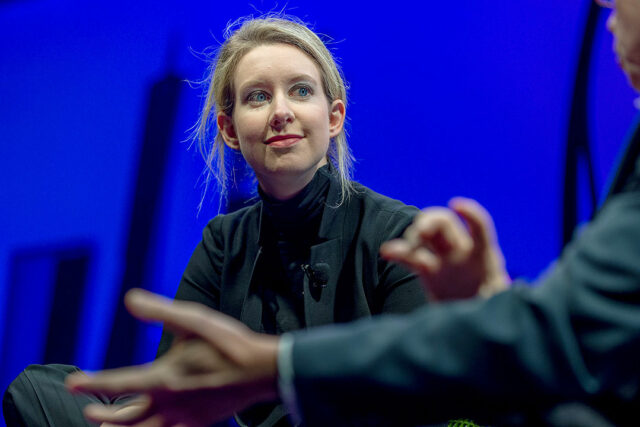
UPON HEARING that Elizabeth Holmes has been sentenced to more than 11 years in prison, social media erupted with vituperative glee. A lot of people seem to think that the 38-year-old Theranos founder, convicted of fraud earlier this year, is getting what she deserves.
Fair enough. Holmes’s deceptions about her company’s technology cost investors hundreds of millions of dollars and, according to the judge, her contrition was at best minimal. She could hardly have expected to walk away with the 18-month sentence her lawyers requested. And although this is hardly the end of the litigation — an appeal is forthcoming, according to her lawyers — the public fascination with the case is itself a source of fascination.
I’ve written many columns about the Holmes trial. As a teacher of both contracts and evidence, I find many of the issues it raised both intriguing and important. Yet somehow I suspect that the abiding and emotional public response has nothing to do with either the scope of attorney-client privilege or the distinction between “puffery” and misrepresentation.
Some have attributed the continuing fascination to the fact that, unlike other spectacular Silicon Valley collapses, the Theranos fraud involved people’s health. True — but insufficient. The trial of former Theranos President Sunny Balwani, who was convicted in July of fraud and is scheduled to be sentenced next month, has not attracted nearly as much attention.
Part of the reason of course is Holmes’ gender — specifically, what one observer labeled the “complex interplay of feminine charm, ego, power, and ethics.” John Carreyrou of the Wall Street Journal, who broke the Theranos story, described in his book how people fell under her spell: “The way she trained her big blue eyes on you without blinking made you feel like the center of the world.” Small wonder that some scholars have found in the celebration of her downfall a reflection of “longstanding apprehensions about formidable women.”
Yet gender cannot be the entire story, because taking glee in the travails of the famous is hardly uncommon. People who know nothing about crypto and never heard of Sam Bankman-Fried before last week seem to be taking pleasure in his swift and sudden fall. The astonishing slide in Meta’s shares — and thus in Mark Zuckerberg’s personal wealth — has some critics all but dancing in the streets.
None of this is new. The 1907 “high society” trial of Harry Thaw for the murder of Stanford White brought so many of the curious to New York City that every hotel was packed. More than 150 million people in the US alone tuned in to watch the verdict in the 1995 murder trial of O.J. Simpson.
What links these disparate cases is a shared public schadenfreude, a term the Oxford English Dictionary defines as the “malicious enjoyment of the misfortunes of others” but which can more accurately be described as a shiver of enjoyment at the downfall of the great and powerful.
In her fine 2018 book on the subject, the cultural historian Tiffany Watt Smith argues that schadenfreude provides people an emotional “respite” — a momentary surge of superiority in a world that judges constantly. Smith points out that even though it is considered wrong to look down on the less fortunate, we’re generally happy to look down on those we usually find looking down on us: “Just as satire is only funny when it punches up,” she writes, “we are most comfortable sniggering at the failures of those more wealthy, attractive and talented than us.”
To be sure, Smith is being ironic. Wealth has an absolute as well as a relative measure; talent can be measured in some areas; attractiveness is almost wholly subjective. So perhaps the larger point is that we’re fighting back, if only for a delightful and tantalizing moment, against what the novelist E.L. Doctorow called “a process of magnification by which news events established certain individuals in the public consciousness as larger than life.”
Celebrities, for instance. Rich ones especially.
A part of schadenfreude is the desire to see justice done in cases that involve the prominent. Smith notes that in 2009, after the late Bernard Madoff was sentenced to 150 years in prison, “the public gallery erupted in cheers and applause.” Though she concedes that “justice is also hugely emotional,” she expresses concern: “Are we entitled to add an extra dose of humiliation to the carefully measured punishment?”
The answer, I think, is yes, we are. Not for the fleeting sense of superiority, but because for those who have been great and are now brought low, the humiliation constitutes a pertinent part of the punishment.
This point was missed by those who wrote the hundred-odd letters asking the court for leniency on Holmes’ behalf — as if by dint of losing both fortune and reputation, she has suffered enough. No doubt the ritualized humiliation is difficult to bear, but it’s baked into the celebrity pie. Those who crave the cheers must risk the boos.
It’s not that I lack sympathy for Holmes, who continues to strike me as somewhat befuddled by her fate. But I have much more sympathy for the investors who lost money and the patients who lost hope. And if, as alleged, Holmes once said, “They don’t put pretty people like me in jail,” she did not just underestimate the legal system; she misunderstood what schadenfreude is all about.
BLOOMBERG OPINION
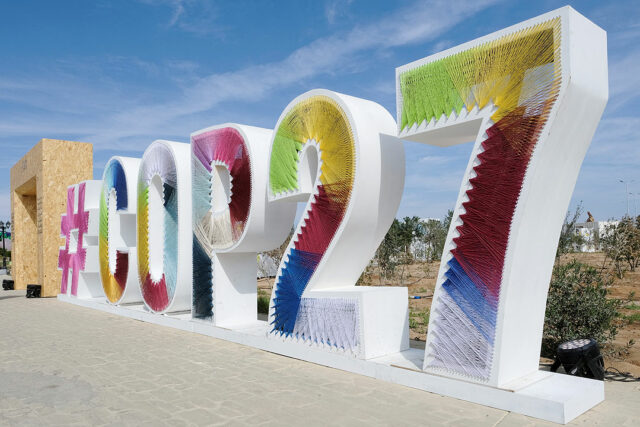
SHARM EL-SHEIKH, Egypt — Countries adopted a hard-fought final agreement at the United Nations (UN) Conference of the Parties (COP27) climate summit early on Sunday that sets up a fund to help poor countries being battered by climate disasters — but does not boost efforts to tackle the emissions causing them.
After tense negotiations that ran through the night, the Egyptian COP27 presidency released the final text for a deal and simultaneously called a plenary session to quickly gavel it through.
The session first swiftly approved the text’s provision to set up a “loss and damage” fund to help developing countries bear the immediate costs of climate-fueled events such as storms and floods.
But it kicked many of the most controversial decisions on the fund into next year, when a “transitional committee” would make recommendations for countries to then adopt at the COP28 climate summit in November 2023.
Those recommendations would cover “identifying and expanding sources of funding” — referring to the vexed question of which countries should pay into the new fund.
Calls by developing countries for such a fund have dominated the two-week summit, pushing the talks past their scheduled Friday finish.
And after a pause requested by Switzerland to review the final text, negotiators gave no objections as COP27 President Sameh Shoukry rattled through the final agenda items.
By the time dawn broke over the summit venue in the Egyptian resort of Sharm el-Sheikh, the deal was done.
FOSSIL FUEL FIZZLE
The two-week summit has been seen as a test of global resolve to fight climate change -— even as a war in Europe, energy market turmoil and rampant consumer inflation distract international attention.
Billed as the “African COP,” the summit in Egypt had promised to highlight the plight of poor countries facing the most severe consequences from global warming caused mainly by wealthy, industrialized nations.
Negotiators from the European Union and other countries had said earlier that they were worried about efforts to block measures to strengthen last year’s Glasgow Climate Pact.
“While progress on loss and damage was encouraging, it is disappointing that the decision mostly copy and pasted language from Glasgow about curbing emissions, rather than taking any significant new steps,” said Ani Desgupta, president of the non-profit World Resources Institute.
In line with earlier iterations, the approved deal did not contain a reference requested by India and some other delegations to phasing down use of “all fossil fuels.”
It instead called on countries to take steps toward “the phasedown of unabated coal power and phaseout of inefficient fossil fuel subsidies,” as agreed at the COP26 Glasgow summit.
The draft also includes a reference to “low-emissions energy,” raising concern among some that it opened the door to the growing use of natural gas — a fossil fuel that leads to both carbon dioxide and methane emissions.
Norway’s Climate Minister Espen Barth Eide told reporters his team had hoped for a stronger agreement. “It does not break with Glasgow completely, but it doesn’t raise ambition at all,” he said. — Reuters
