Home Blog Page 5604

Farm mechanization agency under pressure over disbursement performance

PHILSTAR FILE PHOTO

THE Philippine Center for Postharvest Development and Mechanization (PhilMech) faced questioning from the Senate after disbursing only a fraction of its budget for mechanizing the rice farming industry.

At a hearing of the Senate Agriculture, Food and Agrarian Reform committee Senator Maria Imelda Josefa Remedios R. Marcos said the agency disbursed only P159 million of the funding available to provide tractors and other equipment to rice farmers, for a disbursement rate of 2.1% in the first half.

PhilMech supplies farm machinery to support industry modernization efforts of the Rice Competitiveness Enhancement Fund (RCEF), a component of the Rice Tariffication Law.

“Even looking at the obligation rate, your rate is a mere 5.8% performance, that is so small compared to before where you could deliver 82.75%. What happened?” Ms. Marcos said at the hearing, which was reviewing the agency’s statement of appropriations, obligations, and distributions and balances in the first half.

PhilMech Director Dionisio G. Alvindia, however, contended that “this year, from January to July 2022, we have already disbursed P3.2 billion and by the end of December, we would like to tell this honorable committee that we can obligate all the P5 billion that is allotted for 2022.”

The discrepancy in the estimates of disbursement performance as reported by the agency and by Ms. Marcos was not explained. Mr. Alvindia said, however, that he has dropped other assignments to focus wholly on PhilMech.

“Yesterday, I asked the Department of Agriculture to relieve me from the Philippine Integrated Program just to concentrate on the PhilMech activities, because when I took my leadership position at PhilMech on March 3, we inherited a lot of problems,” Mr. Alvindia said.

Senator Cynthia A. Villar, who chairs the committee, cited two memoranda which called for the creation of an advisory council to implement the mechanization program of the RCEF. She called the advisory council counter to the intent of the Rice Tariffication Law.

She threatened legal action “if you don’t stop this advisory committee because when we passed the Rice Tariffication Law, in creating the Rice Competitiveness Enhancement Fund, I remember we gave the authority to PhilMech.”

The tasks associated with modernizing the rice industry were parceled out to various government agencies to ease implementation, Ms. Villar said. “Because if you give it to the (Department of Agriculture), it will not be implemented because they will point fingers at each other when mistakes are made, which is happening today.”

“If (the task was assigned to) PhilMech, then it should answer for it. If it was not implemented, PhilMech should be held accountable, that is the spirit of the law,” she added.

Ms. Villar said only PhilMech is authorized to implement the RCEF’s mechanization program, and not an advisory council.

The Rice Tariffication Law, or Republic Act 11203, liberalized rice imports, allowing private parties to bring in shipments of the grain. These importers, however, had to pay tariffs of 35% on Southeast Asian rice, thereby helping raise funds for RCEF and other modernization initiatives.

Tariffs provide RCEF P10 billion worth of funding a year for six years to support farm mechanization (50%), seed development (30%), training (10%), and credit assistance (10%).

“Based on studies, the reason our rice farmers are not competitive is that they are not mechanized and they are not using good, productive seed,” Ms. Villar said, “which is why a large budget of the Rice Competitiveness Enhancement Fund was given to PhilMech and 30% to PhilRice (Philippine Rice Research Institute) so that they will provide the farmers the inbred seed that they need.”

She said the cost of producing rice in the Philippines is P12 per kilogram, double the cost of production in Vietnam.

“I only agreed to pass that Rice Tariffication Law because all proceeds will be given to farmers,” Ms. Villar said.

The Senate panel asked the agency to commit to implementing the mandate of the law and send the necessary documents for its implementation to the committee, and Mr. Alvindia offered to resign if disbursements do not pick up. — Alyssa Nicole O. Tan

DoTr to foster competition in automated fare system

PHILSTAR FILE PHOTO

THE Transportation department said on Thursday that the automated fare collection system (AFCS) will be opened up to competition, barring monopolies from seizing control of a key component of the transport modernization program.

“We want an open automated fare collection system to avoid a monopoly and what that achieves is choice — choice for our public transport operators on which equipment to use, AFCS provider, and overall maintenance they have to adopt (to lower) the overall cost of our transportation service,” Transportation Undersecretary for Planning and Project Development Timothy John R. Batan said during the interim launch of the AFCS at the Parañaque Integrated Terminal Exchange.

The department also signed an agreement with Land Bank of the Philippines (LANDBANK) on Thursday for the rollout of the Europay, MasterCard and Visa (EMV)-compliant AFCS.

According to LANDBANK, a total of 150 public utility vehicles (PUVs) in the National Capital Region, Central Luzon, Calabarzon, and Metro Cebu will participate in the AFCS pilot test.

“The AFCS, which allows the convenient use of EMV-compliant contactless credit, debit and prepaid bank cards as cashless payment instruments in public transport modes, will be tested under a real-time operational conditions in preparation for its full and commercial implementation,” the bank said.

It said that only LANDBANK prepaid and credit contactless cards will be accepted and processed in the 150 participating PUVs during the first month of the AFCS pilot period.

“Once the necessary regulations or policies have been issued, the LANDBANK AFCS solution can also accept and process the EMV contactless cards issued by other banks,” it said.

The bank said that it has distributed more than 4.5 million EMV cards that can be used in the AFCS system, with another 1.9 million cards available for account holders to claim.

Transportation Secretary Jaime J. Bautista said: “The institutionalization of the AFCS will bring us closer to the goal of achieving global standards in cashless payments when commuting, following the norm in many other countries that have long been using this system.”

“I would like to believe that the majority of our commuters, not just here in Metro Manila, have overcome the reluctance to embrace technology in our mass transport system because they have seen the significance of technological advancements to ease their commute,” he added.

LANDBANK President and Chief Executive Officer Cecilia C. Borromeo said the bank “fully supports the AFCS project for convenient and safe cashless payments in our PUVs.”

“Through LANDBANK Contactless Cards, we look forward to making the daily journey and payment experience of commuters as seamless as possible.” — Arjay L. Balinbin

Electric vehicle law IRR due on Sept. 8

Image via Ivan Radic/CC BY 2.0

THE Departments of Energy (DoE) and Transportation (DoTR) said they plan to issue the implementing rules and regulations (IRR) of the Electric Vehicle Industry Development Act (EVIDA) on Sept. 8.

EVIDA, also known as Republic Act No. 11697, offers incentives for the adoption of electric vehicles and the building of charging stations. EVIDA also sets a 5% EV minimum share in corporate and government vehicle fleets, the provision of dedicated parking slots, the installation of charging stations in parking lots and gasoline stations, green routes, and support for domestic EV manufacturing.

Section 30 of the EVIDA tasks the DoE, DoTR, and other agencies with developing the IRR. The two departments carried out public consultations on Aug. 19, 23, 25 and 31.

“We are very pleased with the outcome of this public consultation,” Mark Steven C. Pastor, Transport undersecretary, said in a statement. — Ashley Erika O. Jose

Williams retirement on hold after win over world number two

SERENA WILLIAMS — REUTERS

NEW YORK — Playing more like a world number one than a player ranked outside the top 600, Serena Williams turned back the clock on Wednesday to stun world number two Anett Kontaveit 7-6(4) 2-6 6-2 and move into the third round of the US Open, putting her retirement plans on pause.

Defeat has always been hard to swallow for the fiercely competitive Ms. Williams and the 40-year-old American’s relentless will to win was on full display during an absorbing two-hour 27 minute contest of unexpected high quality, breathless intensity and drama. Ms. Williams had signaled her intention to retire earlier this month, saying she was “evolving away from tennis” but never confirming the US Open as her final event.

Any farewell has now been put on hold with Ms. Williams back on center court on Thursday for a doubles match with older sister Venus, followed by a third round clash with Australian Ajla Tomljanovic who was a 1-6 6-2 7-5 winner over Russia’s Evgeniya Rodina.

“I’m a pretty good player,” said Ms. Williams with a sly grin when asked how she downed the world number two. “This is what I do best — I love a challenge, I love rising to a challenge.”

“The last couple matches here in New York it’s really come together.

“I’m super competitive — honestly I’m just looking at it as a bonus.

“I have absolutely nothing to prove.”

With 23 Grand Slam titles and widely regarded as the greatest women’s player of all time, Ms. Williams indeed has done it all on the tennis court.

But after two wins and now safely through to the third round the once-unthinkable dream of a Hollywood ending to Ms. Williams’ career just might be in the cards, walking off into retirement with an elusive 24th major that would put her level with Margaret Court at the top of the all-time list.

Having been world number one for 319 weeks, Ms. Williams arrived in New York ranked below 600, unseeded and with just a single match win from three events coming into the season’s final Grand Slam.

It had been over a year — at the 2021 French Open — since Ms. Williams last posted back-to-back wins. She faced a daunting challenge in 26-year-old Ms. Kontaveit, a player whose game was built for the hardcourt and who won five of her six career titles on the surface.

With none of the pre-match festivities that took place ahead of her first round match to distract her, Ms. Williams stepped onto the court with her game face on and delivered a performance that had a packed Arthur Ash Stadium on its feet.

Ms. Williams claimed the first break to go 5-4 up but faltered serving for the set and Ms. Kontaveit broke back to ensure a tie-break.

The tie-break was of no less quality, Ms. Williams clinching it 7-4 in classic fashion with a thundering ace.

But the Estonian would not be intimidated by either Ms. Williams or a frothing crowd, grabbing two early breaks in the second set to jump 3-0 in front and easily take the set.

The third got off to a scrappy start with three breaks in the opening four games but two of those would go to Ms. Williams. She got in front 4-1 and never let go. — Reuters

Obiena keeps gold medal run in Duplantis-less German tournament

WORLD Championships bronze medalist EJ Obiena sustained his gold medal juggernaut as he topped the St. Wendel City Jump in Sankt Wendel, Germany Wednesday.

The World No. 3 from the Philippines completed a clearance of 5.86 meters to not only capture the mint against Menno Vloon of the Netherlands and Anthony Ammirati of France but also set a new meet record.

Messrs. Vloon and Ammirati had 5.81m apiece but the former took the silver via count back while the latter wound up with the bronze.

The Asian record-holder and Southeast Asian Games gold winner tried to breach the six-meter plateau for the very first time and eclipse his personal best of 5.94m but fell short thrice.

But despite his failure to set a new mark, Mr. Obiena kept his big-winning ways as he claimed his third gold and fourth straight podium finish in an impressive span of a little over a week.

His other golden triumphs came in the Stabhochspringmeeting in Jockgrim last Aug. 23 and the True Athletes Classic in Leverkusen also in Germany several days later.

Mr. Obiena had a bronze in the Athletissima in Lausanne, Switzerland in between his gold conquests.

Reigning Olympic and world champion and world record-holder Armand Duplantis of Sweden and World No. 2 Chris Nilsen of the United States both skipped the Sankt Wendel tilt.

Mr. Obiena will have a chance to extend his excellent run as he is scheduled to see action in the Memorial van Damme tonight in Brussels, Belgium, the ISTAF 2022 on Sunday in Berlin, Germany and the Golden Fly on Sept. 11 in Schaan, Liechtenstein. — Joey Villar

New PSC Chairman Noli Eala seeks to continue successful program for the long term

NEWLY appointed Philippine Sports Commission (PSC) Chairman Noli Eala drove himself straight to his new office at the agency’s Malate, Manila office yesterday morning and quickly got down to business.

And on his first day of office, he outlined three major targets — sustain the success of the glorious achievements of the past leadership, develop grassroots sports and tap the private sectors similar to the old Gintong Alay days.

“We have made great strides in the last few years in sports,” said Mr. Eala, who got his appointment papers as the PSC’s 11th chair from Malacañang last Tuesday, in a statement.

“My new administration will seek to ensure sustainability of the success of our programs for the long term,” he added.

Meanwhile, Philippine Olympic Committee President Abraham Tolentino said he’s looking forward to a harmonious relationship with Mr. Eala.

“A wonderful choice by our President BBM [Ferdinand ‘Bongbong’ Marcos Jr.] because he [Mr. Eala] is a sportsman himself and has been involved in sports for many decades,” said Mr. Tolentino. “He surely knows the needs of athletes and coaches in all sports federations.”

Mr. Eala will have in his hands the responsibility of sustaining, if not eclipsing, the accomplishments the country has achieved the past few years like weightlifter’s breakthrough Olympic gold medal in the Tokyo Games a year ago, world titles of gymnast Caloy Yulo and a historic World Championship bronze by pole-vaulter EJ Obiena among others.

Mr. Eala also mentioned seeking support from the private sector to further enhance these recent successes.

“We will continue with programs that will further strengthen our sports initiatives,” said Mr. Eala. “We will create pathways for all to get involved in sports while ensuring that elite athletes are provided with all they need to be successful.”

“We will reach out to the private sector, similar to the golden years of the Gintong Alay program, to harness their support for all stakeholders of sports,” he added.

Interestingly, the Gintong Alay was then headed by now Laoag City Mayor Michael Keon, who was reportedly one of the people responsible for Mr. Eala’s appointment.

The former PBA commissioner and Samahang Basketbol ng Pilipinas executive director, who first sat with PSC commissioner and officer-in-charge Bong Coo and executive director Atty. Guillermo Iroy, Jr., also mentioned using grassroots sports in uplifting and uniting the nation.

“I will carry out the mandates of the PSC to develop and promote sports in the grassroots as a tool towards nation building and unity, and ensure full and enhanced support for our national athletes in their continued quest to bring honor and glory to our country,” he said.

And Mr. Eala vowed he would not relent in his quest to make these visions a reality.

“The PSC will have a new face and new energy. The PSC, under my watch, will care for sports like no other,” he said. — Joey Villar

Tropang Giga eye clincher of PBA Philippine Cup finals

Game Today
(Smart Araneta Coliseum)
5:45 p.m. — TNT vs San Miguel Beer
*TNT leads series, 3-2

Defending champion TNT has hurdled a lot of adversities to get to a 3-2 lead in the PBA Philippine Cup finals against San Miguel Beer.

Now comes the hardest part: Nailing the clincher against a rival as tough and hell-bent to capture the league’s crown jewel.

“I’ve always said it — the hardest game to win is the fourth game. We have no illusions about it. We know it’s going to be a huge, difficult war so we have to be prepared,” TNT coach Chot Reyes.

“All we can do is prepare ourselves, control the things we can control and just be ready for Friday,” he added.

If done right, TNT can make today’s 5:45 p.m. Game 6 at the Smart Araneta Coliseum a victory lap to cap a ride made bumpier by manpower problems here and there and killer game schedules due to Gilas Pilipinas slates. And yes, with the closeout, the Tropang Giga can give Mr. Reyes a merry celebration amid relentless social media scoring from his critics and haters.

Best Player of the Conference June Mar Fajardo and his hungry SMB teammates are defiant.

Mr. Fajardo, whose squad is intent on dragging TNT to a deciding seventh game and continue its own hunt for a first championship since the 2019 Commissioner’s Cup.

The Tropang Giga put themselves in position to win it all after pulling off back-to-back victories, 100-87 and 102-93, in Games 3 and 4, respectively, after trailing at 2-1.

“(In Game 4) we wanted to double up because we haven’t beaten San Miguel two-in-a-row yet, not last year, not this year. So we knew we had to find a way to win two-in-a-row. So that first part is now over. We’ll see if we can follow it up,” said Mr. Reyes.

TNT carries this mission out with Jayson Castro not 100 percent, if he gets to suit up, or worse, sitting it out altogether after spraining his ankle last Wednesday.

Kelly Williams, who was the first player in his 40s to score at least 20 in the finals since the legendary Robert Jaworski back in the 1991 First Conference, has to do another heavy lifting in the closing bid.

Last Wednesday, “Machine Kelly” knocked down four triples in a 21-point performance in a major step up effort with Castro sidelined. Fil-Am sniper Mikey Williams (23), Poy Erram (17) and RR Pogoy (14) did their thing on offense while backup guard Kib Montalbo and lengthy big Matt Ganuelas Rosser also chipped in.

“We always say that when one man goes down, there’s no one person who can fill his shoes. But every other person, little by little, in their own little way can,” said Mr. Reyes. — Olmin Leyba

PBA D-League champion La Salle will fly to Japan for 2-week training

NEWLY-minted PBA D-League Aspirants’ Cup champion La Salle will not rest on its laurels just yet as it is out to hit the final gear in preparation for a bigger battle in the UAAP Season 85 next month.

For the Green Archers, capturing the D-League Aspirants’ Cup with a 2-1 series win over Marinerong Pilipino was just part of their long course to the UAAP, where they seek redemption after a narrow finale miss in Season 84.

“That’s why we’re here and that’s why we joined the D-League. We have to be a better team and not just better team but a championship-caliber team,” said coach Derrick Pumaren as La Salle ruled the eight-team tourney to mark D-League’s return from a two-year hiatus due to the pandemic.

“This is not really a gauge for us. It’s just part of the process. It’s gonna be a different arena when we get to the UAAP so we have to be ready,” he added.

In the UAAP do-or-die Final Four last season, La Salle were minutes away from advancing and setting a classic finals date with rival Ateneo after leading by 70-56 in the waning minutes only to crumble to a 78-74 loss against eventual champion University of the Philippines.

“We fell short against UP. We did not close out. That’s one thing we’re gonna work on, closing games we need to win. This is part of the program so I’m pretty sure this (D-League championship) will toughen the team,” added Mr. Pumaren.

Aside from the D-League and the 17-team Filoil Preseason Cup where La Salle made it to the semis, Mr. Pumaren’s wards will also troop to Japan for its final build-up before the UAAP wars in the first week of October.

The Green Archers will fly to Japan on Sept. 10 for a two-week training camp including at least six tune-up games with different varsity squads. — John Bryan Ulanday

Williams sisters get prime time spot in US Open doubles return

NEW YORK — Venus and Serena Williams will kick off Thursday’s evening schedule in Arthur Ashe Stadium as they join forces in the US Open doubles draw for the first time since 2014.

It marks the first time a first-round doubles match has featured at the marquee venue of the year’s final major and the pair will play Czech duo Lucie Hradecka and Linda Noskova in prime time.

Older sister Venus should arrive well-rested after making a quiet exit from the singles draw on Tuesday but Serena may be more weary after a second-round match on Wednesday in what could be her final tournament.

Another intriguing doubles showdown will close out the day at Louis Armstrong Stadium as Australian close friends Thanasi Kokkinakis and Nick Kyrgios play France’s Hugo Gaston and Italian Lorenzo Musetti.

Mr. Kyrgios, who beat his “Special K” counterpart in the singles opening round, will be hoping he and Mr. Kokkinakis can collect another Grand Slam crown after winning the Australian Open title this year. — Reuters

Aces even series

As expected, Game Two of the semifinal round series between the Aces and the Storm went down the wire. It was no surprise, since contests between the top two teams in the Western Conference throughout the season typically proved close. And, in this measure, it was, perhaps, fitting that the final score of yesterday’s set-to very nearly mimicked the 76-73 outcome in their first playoff encounter. The difference was in who prevailed. This time around, the hosts managed to protect home court on the strength of a much better performance from Most Valuable Player candidate A’ja Wilson.

Certainly, the Aces needed all and sundry to step up. The 9,755 warm bodies who filled the Michelob ULTRA Arena understood the importance of a win for them. Another setback would have compelled them to sweep the remaining outings — as Sisyphean an endeavor as any given the championship pedigree of the Storm. And, creditably, Wilson stepped up and met expectations this time around. That she was actually able to outperform counterpart Breanna Stewart is no mean feat, especially in the face of their must-prevail situation.

Make no mistake. The Storm tried to keep pace, with Stewart again leading the way. However, they were arguably outclassed in the crunch, if for no other reason than because the Aces had more stars showing up with the encounter on the line. Game One heroine Jewell Loyd could not weave the same magic on offense even as the absence of defensive ace Gabby Williams showed at the other end of the court. The hope is that the latter will be available in Game Three, thereby allowing the green and white to revert to familiar substitution patterns.

As with any other best-of-five affair, the capacity of the protagonists to make adjustments will be key moving forward. For the Aces, this means coming up with twists to a supposedly free-flowing attack that has so far been stunted. For the Storm, this entails trying to counteract the measures in order to get ahead anew. In other words, fans should look forward to yet another humdinger on Sunday.


Anthony L. Cuaycong has been writing Courtside since BusinessWorld introduced a Sports section in 1994. He is a consultant on strategic planning, operations and Human Resources management, corporate communications, and business development.

Budget politics

(Part 1)

The Philippine Government, through the Department of Budget and Management (DBM), last Monday submitted to Congress the proposed P5.268-trillion national budget for 2023. This document goes through a technical process that begins with vision setting by the President and ends with specific programs and projects budgeted at different levels of the bureaucracy.

Based on our 25-year involvement in the cabinet-level Development Budget Coordination Committee (DBCC) and its sub-cabinet level Executive Technical Board (ETB), the other more substantive aspect of the budget process is political. The budget captures the hierarchy of government choices that should be pursued, like utilities, infrastructure, and mass housing. It should reflect the implementation of laws like universal healthcare and tertiary education, or even counter-insurgency measures.

Without doubt, the national budget also reflects the influence of vested interests or specific constituencies like rice, sugar, real estate, and other business activities. One can see this in the kind of tax policy that would support public spending plans. Or the location of a new airport or government center, or even perhaps the areas that would be traversed by a new highway or train routes. These choices are critical because public money will be spent on them and away from the others.

Thus, the national budget also establishes a framework of accountability for concerned citizens who wish to determine whether public money is properly disbursed according to the overall vision of government and the specific goals by sector objectives. A linkage is necessary between society’s pressing needs and the resources made available through the budget process.

The budget process is therefore a powerful tool for implementing democracy.

The International Monetary Fund (IMF) has always been a strong advocate of budget transparency, that appropriate information on both the budget preparation and execution should be accessible through periodic reports and audit results. Democracy is upheld when the people have access to information on the extent of government operations, how the government addresses key issues on reducing poverty and income inequality. After all, when disasters strike, everyone sees the revealed preference of their national and local governments, like pursuing beautification projects and barangay centers that are submerged in flood waters instead of executing drainage and water impounding projects which are less obvious, less glamorous, and less profitable.

How did the Philippine Congress receive the executive submission?

Speaker Ferdinand Martin Romualdez, assuring the DBM of speedy deliberations and passage before the end of the year, declared that Congress will respond to the needs of the people in addressing health crisis, creating more jobs, and ensuring food security.

This is a good concordance with the DBM’s representation of the eight-point socioeconomic agenda of the Marcos Jr. government during the DBCC presentation of the macroeconomic assumptions of the budget before Congress on Aug. 26:

1. Ensuring food security, improved transportation and affordable and clean energy to strengthen the purchasing power of Filipinos;

2. Providing social services, healthcare and education to reduce vulnerability and mitigate scarring from the COVID-19 pandemic; and,

3. Achieving bureaucratic efficiency and sound fiscal management to ensure sound macroeconomic fundamentals.

Does the 2023 budget comply with the Speaker’s expectation that “every centavo of the national budget would be spent wisely to implement the programs that would save lives, protect communities, and make our economy strong and more agile”?

Will the politics of the budget promote the Government’s agenda for prosperity?

Budget Secretary Amenah Pangandaman compressed the eight-point program into five priorities of the “proactive and resilient” 2023 national budget: education, infrastructure development, health, agriculture, and social safety nets.

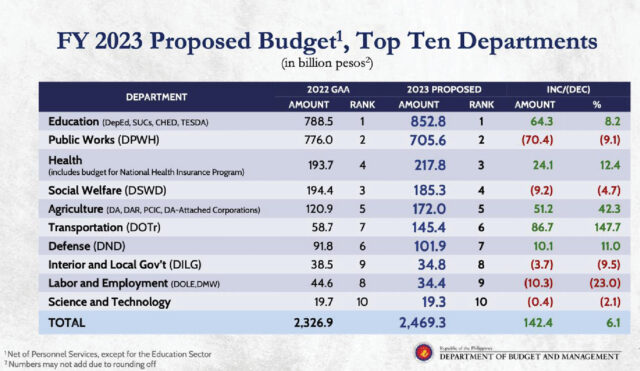
Education ranks high in terms of the absolute size of its budget at P852.8 billion. But in terms of actual increase, the education budget shall rise by only 8.2%, and that includes personnel services. Time and again, educators and economists have reiterated the challenges in Philippine education: lack of good facilities of learning like classrooms, desks, and educational equipment; lack of academic personnel; inferior learning resources. With serious disproportion between the number of students and classrooms, books, teachers, and other learning kits, an 8.2% adjustment could cover only inflation and the usual friction costs. No big deal here.

What about the new challenge of digitalization? And the cost of mitigating economic scarring in the academe by way of retraining the teachers and upgrading their skill sets? We can only hope that these new hurdles were considered in the technical phase and, if not, could be taken up in the congressional deliberations. While Congress cannot increase the proposed budget, some realignment should be possible.

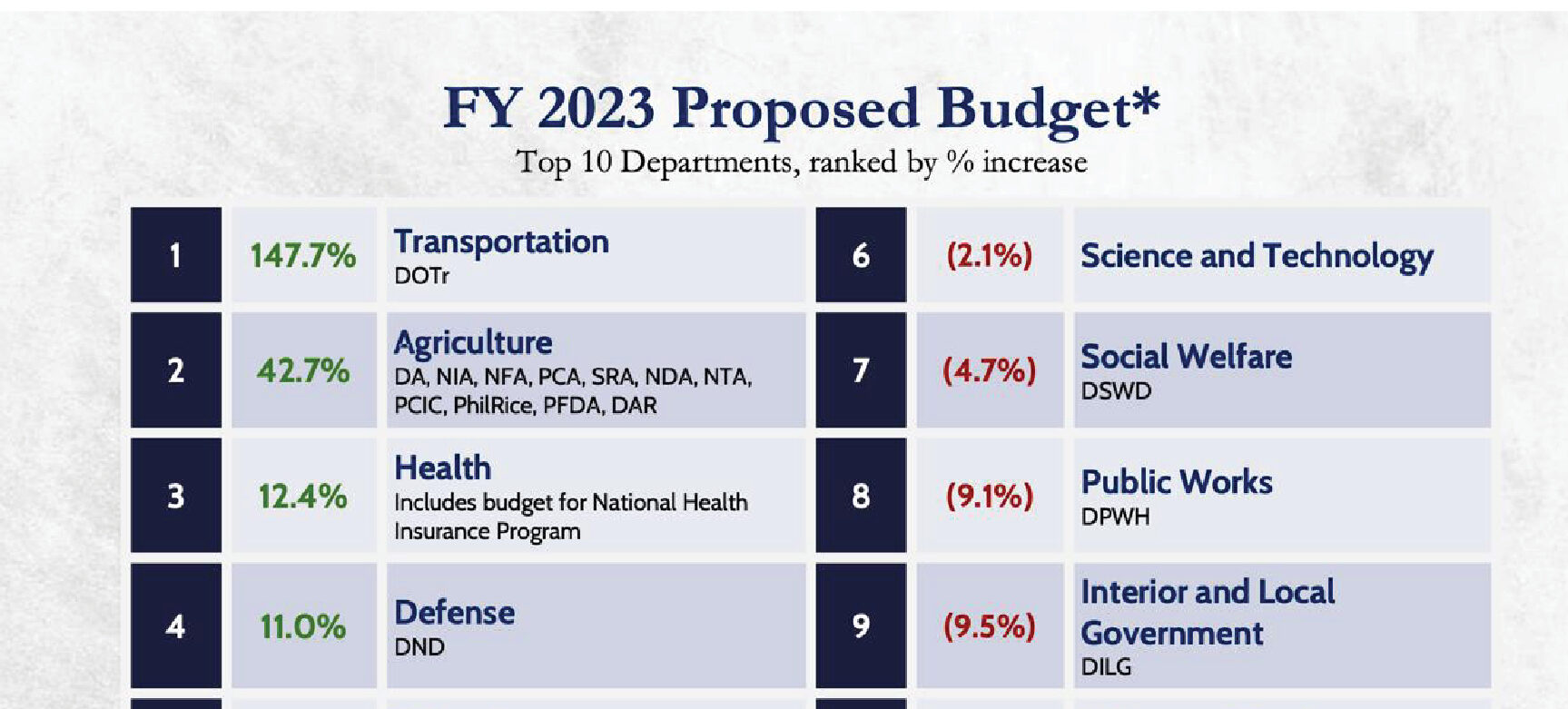
In terms of the annual adjustment of 8.2%, education actually ranks only 5th even if the other sectors are exclusive of personnel services. We do recognize that education was also allocated P11.85 billion for infra projects but that is only less than 1% of the infra budget.

Finally, as Cagayan de Oro Rep. Rufus Rodriguez pointed out, the UP-budget reduction from this year’s P25.6 billion to P23.1 billion, or P2.5 billion less, should be restored, if not increased. As a general principle, he was correct in saying state universities should be properly funded.

Infrastructure development will receive P1.196 trillion for both the Department of Transportation budget increase of 147.7% and the Department of Public Works and Highways budget drop of 9.1%. Percentage increase-wise, transport sector is 1st while public works is 8th. Very clearly, this is the budget translation of building better and more subways, regional airports, railways, and farm-to-market roads. We notice in the sub-object breakdown for infra, flood control systems are getting P209.15 billion or 17.49% of the total while irrigation systems will be funded by only P29.49 billion, representing a 2.47% share.

But there is very little to show in terms of solving our annual flooding problem. We build roads and bridges as well as impressive town centers but flooding remains a big headache. Instead of doing what other countries have done, and that is to start with a systematic drainage system, we simply clear the roads and pour concrete on them. That wins votes every three years. We end up digging the sides of the street to lay down concrete pipes for drainage purposes.

Yet, our irrigation system, something that is indispensable to agriculture and food security, will only be getting less than P30 billion or 3% of infra budget. Unless we have a more strategic approach to these two issues, we shall continue to experience floods during the rainy season and drought during summer. Some engineers refer to this broadly as water resource management. This involves development, conservation, and management of water through irrigation, drainage, flood control, water logging, surface-water storages, integrated water reservoirs, and basin planning.

On health, a few words. The gross allocation looks respectable, showing an increase from this year’s P193.7 billion to P217.8 billion, representing an increase of P24.1 billion, or 12.4%. The breakdown of the budget, however, indicates many of the components are to be slashed. The budget for the prevention and control of communicable diseases will be halved, while pandemic management expenses are subsumed under unprogrammed funds. We don’t see why COVID-19 pandemic management had to be classified as unprogrammed. The Philippine General Hospital will have a budget nearly P400 million lower this year, allegedly due to its limited absorptive capacity. Yet the problematic National Health Insurance Program will be given an additional P30 billion.

Agriculture — that includes the Department proper and other attached agencies — is to receive P172 billion or an additional P51 billion or 42.3% more. Food security will be promoted by beefing up the budget for rice, corn, livestock, fisheries, high-value crops, and the agrarian reform beneficiaries’ program. These additional allocations are well and good, but we wonder why an additional P5-billion budget was allocated for National Food Authority’s buffer stocking program when rice importation has been liberalized with tariffication.

Provision of social safety nets would normally be undertaken by the Department of Social Welfare and Development (DSWD). Yet next year, DSWD will be budgeted with P185.3 billion, or by less than P9.2 billion or 4.2% lower. True, cash assistance will continue to be extended through various agencies with the bulk going to DSWD and the least to DA. Cash transfers or 4Ps to the very poor, indigent senior citizens, individuals and families in difficult circumstances, livelihood and feeding program, as well as early childhood care will be continued.

It is the task of Congress to scrutinize each line item and see not only that which has been funded, but, more important, that which did not even merit an allocation like low-cost housing. Commission on Audit findings on each department should be consulted on whether the projects funded were completed. Checklists can always deceive us because, as behavioral economists would argue, absence is much harder to detect than presence. That’s when good governance and good budget politics are critical.

(Next week: Funding the 2023 budget)


Diwa C. Guinigundo is the former deputy governor for the Monetary and Economics Sector, the Bangko Sentral ng Pilipinas (BSP). He served the BSP for 41 years. In 2001-2003, he was alternate executive director at the International Monetary Fund in Washington, DC. He is the senior pastor of the Fullness of Christ International Ministries in Mandaluyong.


COAxing government

ALEXANDER GREY-UNSPLASH

The Duterte regime ended last July, but is still in the news because of Commission on Audit (COA) reports on some of its agencies’ alleged non-compliance with COA standards in 2021.

Two years after his election, in 2018, then President Rodrigo Duterte was already spewing a stream of profanities against the Commission, which turned out to be a major target of his ire. He even “jokingly” suggested on one occasion that its auditors be pushed down the stairs.

Mr. Duterte was reacting to the complaint of his close ally, then Ilocos Norte Governor, now Senator “Imee” Marcos, that the Commission had limited the cash advances of the province’s municipalities affected by Typhoon Ompong only for food for the victims, and only up to P15,000.

He went on to belittle the COA’s issuance of circulars, which he said it expected everyone in government to obey— but with which every government agency is in fact compelled to comply. He then claimed that the COA’s requiring government agencies to award contracts for goods and services only to the lowest bidder, which is precisely intended to see to it that government funds are wisely spent, leads to corruption.

He kept up his attacks on the COA in 2019, when he even suggested — “jokingly,” again said his spokesperson — kidnapping and torturing its auditors.

In 2021 he assailed the Commission for releasing to the media the results of its audit of government agencies, particularly those on the Department of Health (DoH). The COA said the department had failed to “maximize” the use of anti-COVID-19 pandemic funds amounting to P68.28 billion. There were alleged irregularities as well in the procurement of certain materials and equipment, lack of documentation, plus lapses in the implementation of projects worth nearly P4 billion.

But rather than calmly and reasonably urging the DoH to correct its “lapses” and to do better, Mr. Duterte instead harangued the Commission for supposedly making it appear that there was corruption in some of the agencies under the Executive Department. He then threatened to audit COA should he be elected Vice-President in 2022, although there is nothing in the Constitution that would have allowed him to do that. (In 2021 he was thinking of running for VP, but eventually decided against it.)

The COA was created as an independent body by the 1987 Constitution with the mandate to examine and oversee government accounts, among other functions. Its website declares that its mission is “to ensure accountability for public resources… for the benefit of the Filipino people.”

The obvious intent, although the Constitution does not say so, is to see to it that procedures are followed and public funds and other resources are not misspent, squandered, or diverted. The Commission also looks into the extent to which programs and projects are implemented with the use of the funds that have been allocated for them.

That is what auditing is supposed to do, and in the government context, it is meant to prevent and call out possible cases of ineptitude, wrongdoing, and corruption. One example is the COA’s taking the Department of Education (DepEd) to task for its purchase, through the Procurement Services of the Department of Budget and Management (PS-DBM) of over-priced and outdated laptop computers. Among other consequences, that blunder prevented many teachers from accessing and using one of those devices, forced some to purchase them with their meager salaries, and, more seriously, made distance education even less beneficial to the country’s learners at the basic education level.

During and after his campaign for the Presidency, Mr. Duterte had repeatedly pledged to eradicate corruption in government to the extent of promising that he would summarily remove officials with “even a whiff” of it. The COA reports could have helped him fulfill that promise, while at the same time warning every agency and their officials to observe the established auditing standards in government contracts, procurements, cash advances, etc. But his tirades against the COA — and at one point his urging his officials to ignore COA reports — could arguably have encouraged those agencies to do the opposite.

The Duterte era thus led the COA to call out and, in effect, reprimand 11 government national agencies in its 2022 reports for their failure to observe established procedures in 2021. For example, said COA, the Philippine National Police (PNP), Mr. Duterte’s most favored agency, failed to construct P27.7 million worth of police stations in Davao del Sur, North Cotabato, and Sultan Kudarat supposedly because of technical and other difficulties. The recipient of some P270 million worth of donations that included 200 vehicles and other equipment, the same agency also failed to properly record them, according to COA auditors.

The Commission also flagged another Duterte favorite, the Armed Forces of the Philippines (AFP), for its procurement of COVID-19 resources worth P3.8 million without the needed contracts with the suppliers as well as the required purchase orders. The National Task Force to End Local Communist Armed Conflict (NTF-ELCAC), said COA, also failed to liquidate P34 million out of its P52.9-million budget.

Eight other national agencies of the Duterte regime have also been cited by the COA for various alleged violations such as the failure to implement projects, misspending public funds, and/or other shortcomings. They are the Department of Public Works and Highways, the National Irrigation Administration, the Department of Transportation, the Land Transportation Office, the Department of Information and Communications Technology, the Commission on Higher Education, the Department of Social Welfare and Development, and the Bureau of Customs. The total amounts either misspent or unspent came to trillions of pesos.

The mandates of the COA-flagged agencies involve education from the basic to the tertiary level; law and order; public health; national defense and security; infrastructure; communication; social amelioration; and government finances. Their alleged failure to either properly spend or implement the projects the vast amounts at their disposal were supposed to fund suggests that if they had otherwise been more focused on providing the country what it needs, after the six years of the Duterte regime, things could have somewhat changed for the better, pandemic or no pandemic as Mr. Duterte himself promised in 2016. It was another opportunity missed among many others, with the country emerging so much the worse from his troubling watch.

A new administration has taken power, and has six years to make good on its own promises. Hopefully, under the new President’s appointees, its agencies will be more observant of auditing and other government procedures.

Next year’s COA reports on the performance of government agencies this year should indicate whether that has begun to happen. If it has not, and the COA still finds alleged anomalies to disclose, the President of the Philippines should take it in the spirit of doing better, in recognition of the indispensable role the Commission plays in improving governance and preventing malfeasance, rather than as an occasion to rant against it and to justify the actions of his own appointed officials.

Instead of attacking the COA should it find and report an anomaly in this or that agency, President Ferdinand Marcos, Jr. could urge the offending party to do better. In doing so he would be defending the Commission as a Constitutional body crucial to the drive for good government and national development to which every administration, including his and his predecessor’s, claim to be committed.


Luis V. Teodoro is on Facebook and Twitter (@luisteodoro).

www.luisteodoro.com