Home Blog Page 5603

Bank of Korea’s Rhee says policy tightening unlikely to end before Fed

REUTERS

JACKSON HOLE, Wyo./SEOUL — The Bank of Korea (BOK) must keep raising interest rates until the rate of inflation is in decline, but the central bank likely could not halt its tightening before the US Federal Reserve, Governor Rhee Chang-yong said on Saturday.

In an interview with Reuters, Mr. Rhee also said South Korea’s central bank is ready to take steps, including intervention to stabilize the won against the dollar, if needed, should the bank determine speculative forces are causing the currency’s fall.

Mr. Rhee’s comments, on the sidelines of the Jackson Hole conference of central bankers in the US state of Wyoming, dampened speculation that the BOK might be one of the first big central banks to ease off in the global battle against the steepest inflation in decades.

Asia’s fourth-largest economy has been in the vanguard of global tightening. The BOK was among the first central banks to abandon pandemic-era monetary stimulus, raising its key policy rate by 2 percentage points since August last year to 2.5%.

Dollar appreciation driven by Fed rate increases has added to inflation in many open economies around the world, including South Korea, as local currencies fall in value.

“We are now independent from government, but we are not independent from the Fed,” Mr. Rhee said. “So if the Fed continues to increase the interest rate, it will have a depreciation pressure for our currency.”

Although the BOK began raising interest rates before the Fed, with its first hike a year ago, “whether we can end earlier — I don’t think so.”

South Korea’s inflation is largely the result of external issues such as energy prices, Mr. Rhee said.

“If you ask me, whether I’m going to stop … what happens if the oil price increases again?” he said. “It’s very hard for us to know the exact timing, given the importance of the external shock.”

Even though he expects domestic inflation to slow in August compared with the 6.3% rate seen in July, it is “too premature” to say it has peaked, especially since, as winter approaches, gas prices could again rise.

The BOK raised rates by a quarter point at its last meeting and said further quarter-point increases “will be appropriate for some time as long as inflation paths remain as currently presumed.”

At this point, “I cannot say we are ahead of the curve,” Mr. Rhee said. “As long as inflation remains high, meaning 4%–5% … then we will definitely continue to emphasize the normalization” of interest rates.

EYE ON THE WON 

Inflation in South Korea is forecast around 5% by the end of 2022, and to fall through 2023. Its central bank, like many others, targets 2% inflation.

At Jackson Hole, central bankers used largely the same language to describe their battle against rising prices. Though the headline problem is the same — inflation far above their established targets — the sources of price pressure and therefore the policy responses differ among countries.

For smaller, open economies like South Korea’s, the situation is particularly complex because of the spillover effects from policies set elsewhere.

Federal Reserve Chairman Jerome Powell on Friday kicked off the Jackson Hole conference by saying the Fed will raise rates as high as needed to restrict growth, and would keep them there “for some time” to bring down inflation.

His speech sparked a sell-off in US equity markets, and Mr. Rhee said on Monday attention would turn to the won.

The won, one of Asia’s worst-performing currencies, has dropped about 11% against the dollar this year, and local officials have stepped up surveillance of the currency’s movements.

Mr. Rhee said so far he did not see the depreciation as driven by speculation or South Korea’s economic fundamentals, but as part of the dollar’s rising global strength.

“There are a few days we see movement that’s too excessive — but so far I think our exchange rate movement is very much in line with major currencies,” Mr. Rhee said.

But should the BOK detect speculative moves in dollar-won trading, he stands ready to intervene in currency markets. The won has been falling faster than currencies in neighboring China and Japan, partly because they maintain loose monetary policies, he said.

Policymakers from President Yoon Suk-yeol to Finance Minister Choo Kyung-ho have stepped up their rhetoric to try to slow the won’s decline repeatedly over the last week.

Prime Minister Han Duck-soo said on Sunday the won’s weakness should help South Korea’s economy, in aspects of exports and the current account, adding that he hopes monetary policy may not have to be tightened by as much or as quickly as in the United States.

“This depreciation pressure due to the dollar strength actually is a bad factor for our inflation, because our imported prices increase a lot,” Mr. Rhee said. But “the current depreciation pressure does not mean any liquidity problems or solvency problems, or credit problem for Korea.” — Reuters

[B-SIDE Podcast] The birth of the Filipino nation

Follow us on Spotify BusinessWorld B-Side

In this B-Side episode, playwright, historian, and educator Dr. Paul A. Dumol talks about the birth of the Filipino nation, a relatively new concept that emerged at the beginning of the 20th century.

In a conversation with BusinessWorld reporter Diego Gabriel C. Robles, Dr. Dumol touches on the writing of National Hero Jose P. Rizal, author Nicomedes “Nick” M. Joaquin, and historian Teodoro A. Agoncillo to answer the questions: Who was the Filipino then? Who is the Filipino now? Where are we, the Filipinos of today, headed as a nation?

“What does ‘being Filipino’ mean,” Dr. Dumol said in the vernacular. “I think it means, at the very least, love for everybody else.”

TAKEAWAYS
Nationalism is new and not everybody understands it.

Dr. Dumol theorized that nationalism spread widely and quickly among Filipinos through the public system installed by the Americans.

“This notion … really emerges only in the beginning of the 20th century. And I’m sure not very many people felt it,” he said. “This idea is relatively new, and not everybody understands it.” 

“I think our problem is understanding the duties and responsibilities that come with citizenship,” he continued.

In the Philippines, family often trumps nation. 

“Many times, when we complain about people who are corrupt. … We see that their motivation is frequently their family. They’re thinking of their family. But we may complain, ‘wait, can’t you also think of the nation?’ and there’s so many anecdotes about that tension,” he said. 

“It’s very hard for us to transcend the universe of the family — I’m not saying that we should abandon our families or that we should be indifferent to them. [Rather], we should not be exclusively focused on our own families, and consider that we belong to a society. We should think not only of ourselves but also about everybody else.” 

True integration means that no one gets left behind. 

According to Dr. Dumol, true integration goes beyond political sloganeering and takes into account all social groups — whether national, regional, or familial — and loving each without neglecting one for the sole benefit of another. 

Recorded remotely August 2022. Produced by Joseph Emmanuel L. Garcia, Earl R. Lagundino, and Sam L. Marcelo.

Follow us on Spotify BusinessWorld B-Side

An opportunity to sustain a good start

By Adrian Paul B. Conoza, Special Features Assistant Editor

The Philippine office segment has seen indications of an initial rebound so far this year, and this has been largely marked by the growing preference for flexibility at work.

As shared by Joey Roi Bondoc, associate director and head of research at Colliers Philippines, in a special report in BusinessWorld earlier this month, data from their firm recorded that 306,100 square meters (sq.m.) of new supply completed in the first quarter (Q1) of 2022, exceeding the 114,300 sq.m. (1.2 million sq. ft.) completed in the fourth quarter (Q4) of 2021.

“Among the buildings completed in the first quarter were One Ayala Towers 1 & 2 in Makati CBD (Central Business District), DoubleDragon Tower, Four E-com Tower 3 and Iland Bay Plaza in the Bay Area, NEX 54 in Ortigas Fringe and Savya Financial Center North in Arca South,” Mr. Bondoc added.

Net take-up, meanwhile, escalated from minus 130,100 sq.m. in the Q4 of 2021 to 26,400 sq.m. in Q1 2022 — the first recorded positive net take-up after seven consecutive quarters of negative net absorption.

Colliers also noted that office transactions in the capital region totaled 146,100 sq.m., an increase of 30% year-on-year.

Robinsons Land Corp. (RLC) finds themselves in a similar path with these positive observations, as Jericho P. Go, the developer’s senior vice-president and business unit general manager for Offices, said.

“We have seen a positive uptick in office leasing transactions with the way we have configured our developments,” Mr. Go told BusinessWorld in an e-mail.

Hub-and-spoke

In addition, Colliers observed that traditional and outsourcing firms took up space during Q1, both inside and outside the metro. Most of the firms leased space in Fort Bonifacio, the Bay Area, and Makati CBD. Outside of Metro Manila, absorption of new office space was spotted in Pampanga, Cebu, Iloilo, Davao, and Cagayan de Oro.

This expanded presence of offices is reflected by the implementation of a hub-and-spoke strategy, where offices retain operations in urban centers or CBDs while expanding them in “second-and third-tier cities and locations.”

On RLC’s end, this strategy has been applied even before the pandemic hit the property sector.

“In Metro Manila, we have the largest population base and a wealth of labor resource in terms of complexity, availability, and diversity,” Mr. Go said.

While maintaining presence in Metro Manila, RLC is aggressively expanding in key cities in the provinces.

“Going into these provinces, we provide options to those who want to work near their families. We are experiencing an increase in inquiries and signups in key cities,” the developer said.

Alexis Ortiga, vice-president of the SM Commercial Properties Group, under SM Prime Holdings, Inc. (SMPH), also observed an increase of offices in the fringe areas going into the provinces.

“Iloilo is a very popular market right now. The Cavite, Laguna, and Batangas areas are also popular for both warehouses and offices,” Mr. Ortiga said.

Emphasis on flexibility

Also being realized in the past six months, and beyond, is stronger flexibility in work, where on-site and remote modes converge.

The latest Asia Pacific Workforce Preferences Barometer of Jones Lang LaSalle (JLL) highlighted that an ‘optimal point’ has been reached among office workers, with hybrid work preferred by 60% of employees surveyed and being implemented already by 55% of respondents. The research also found that three in four employees agree that hybrid is a non-negotiable factor in talent retention, and 78% of respondents who advocate remote working are actually managers.

JLL’s research further noted that the office is set to become a hub for human connection and innovation, as 56% of organizations plan to refit or redesign their office space in the next 12 months.

In addition, based on its workplace strategy tool called Experience per Square Foot TM, Cushman & Wakefield expects greater workplace flexibility to take further shape in the post-pandemic period.

“We can expect a significant flight to quality among corporate occupiers, with state-of-the-art buildings featuring smart technology considered attractive by employees. Moreover, office spaces with flexible floor plans are preferred, to accommodate increased allocation for collaboration areas and well-being facilities,” Claro Cordero, Jr., director and head of research, Consulting & Advisory Services at Cushman & Wakefield, explained in another outlook previously published in BusinessWorld.

Mr. Ortiga of SMPH agrees that flexible office spaces are now preferred by a lot of tenants.

“They want more open layouts, higher floor-to-ceiling clearance, and of course a lot of them have heavily invested in safety protocols,” he said.

RLC, for its part, observed similar needs for flexibility amid the pandemic, and so has resolved to reconfigure their workspaces to meet employees’ needs in the new normal, as shown in their headquarters at the 25th floor of Robinsons Cyberscape Alpha in Ortigas Center, Pasig City.

“Professionals have grown accustomed to working from home during the pandemic, but the disadvantages in that include interruptions in power supply, internet connection, and mental health because of the relative isolation as one works alone and is not in personal contact with peers,” Mr. Go observed.

Considering these factors, RLC developed an environment designed for employees to “enjoy the best of both worlds.” The developer incorporated elements of a home, such as the living room area, the pantry, and the bar; while also adding ‘fun’ elements such as a billiards table, a Ping-Pong table, a foosball table.

“All of these facilitate collaboration, interaction, coordination, camaraderie, and synergy within the workplace, ultimately creating a winning culture so that when employees go back to the office, they are inspired to create innovations and new ways of doing business,” Mr. Go explained.

Relevant technologies have also been rolled out, alongside health and safety protocols.

“For instance, we installed generous provisions for treated outdoor air to deliver airflow rates that exceed the [Department of Labor and Employment] standard. Through this, we ensure a healthy work environment with air exchange that expel virus. More and more people would want to have that,” Mr. Go said.

Safety features have been a long-standing practice for SMPH’s offices.

“For example, hourly cleaning and sanitation of high touch point areas — we’ve been doing that for a long time now. Having MERV 13 filters in our ventilation systems so that the air we breathe inside SM Offices is cleaner,” Mr. Ortiga shared.

Looking ahead

Backed by a good start, the office segment is expected to sustain its progress towards recovery.

Lobien Realty Group (LRG) notes that this recovery, particularly in the Metro Manila market, is set to start in Q4 2022. LRG reported that the office vacancy rate in the said market is expected to improve from first half’s 19% as office demand picks up with increased economic activity.

LRG also found that the Makati CBD has a pipeline of 307,000 sq.m. in office spaces that is expected to be completed by 2028. Taguig’s business district is found to have 250,000 sq.m. of office space in the pipeline, while Pasig has 139,000 sq.m.

“Opportunity is seen for office space tenants and locators due to the 19% vacancy rates, ample supply of office space pipeline in all office space grades, and the possible weakening of rental rates for landlords to shed the available office supply in the market,” LRG was quoted as saying in a recent BusinessWorld report.

Colliers, for its part, projects new supply to reach 821,900 sq.m. this year, a 30% increase from 2021 completions.

Further on demand, Mr. Cordero of Cushman & Wakefield spoke of a favorable long-term outlook for the major demand drivers of office space.

Citing a recent study of the firm on the Asia-Pacific office market, Mr. Cordero said total employment in office-using jobs in the Philippines is expected to grow by more than 2.4 million, which translates to more than 8.3 million sq.m. in office space demand. This is equivalent to a more than 70% increase in the current stock of office space in the country.

“The near-term outlook on net office space absorption in the Philippines will still be lower than the estimated average in the last 15 years,” Mr. Cordero continued. “The expansionary demand in the medium term, however, will come from the continued growth of the outsourcing and information technology and business processing management (IT-BPM) companies.”

RLC’s Mr. Go also shared other potential drivers in the office segment.

“In the office sector where there is an oversupply, the return of POGO (Philippine offshore gaming operators) may reduce vacancies. When the supply and demand imbalance is corrected, there is an expectation that rental rates will improve. We also see an opportunity with the requirements on data centers. Sectors such as data analytics, robotics, and artificial intelligence, will benefit from the infrastructure technology provided by data centers to help them grow. These industries are expected to take up office spaces,” he said.

Challenges

However, caution is indicated on JLL’s most recent outlook. In its “Global Real Estate Perspective” for the office segment this month, JLL found that current economic headwinds are impacting the construction sector and will flow through to the development pipeline over the coming 12 to 24 months.

“Rising construction costs, a shortage of labor (especially in Eastern Europe due to the war in Ukraine), and supply chain disruption are creating uncertainty and will help to shape the development pipeline. The future supply pipeline is consequently anticipated to tighten and there is potential for deliveries to be delayed,” JLL explained on its website.

Likewise, RLC, as an importer of raw materials and equipment for office developments such as building elevators, generation sets, air-conditioning units and escalators, sees certain global events as a cause for concern.

“Such events may affect the flow of goods and services and the deliveries on raw materials and equipment. When deliveries are disrupted, it will affect the completion and handover of projects,” Mr. Go said.

Amid these challenges, for Mr. Go, the segment’s recovery is sure to happen.

“Slowly but surely, we are nearing pre-pandemic levels. We are optimistic because of the hub-and-spoke strategy that we have adopted even before the pandemic hit, with Metro Manila as the base of operations. This strategy effectively brings in new inquiries and signups for the business,” Mr. Go said.

Mr. Go also believes that RLC’s large investment in flexible spaces will start its growth for a ‘better normal.’

“As we go back to the office, performance is expected to improve for our company and like-minded companies, who would want to start again and enjoy the same benefits of collaborative workspaces, gaming areas, airflow rates, etc. That concept is resonating well to office locators as evidenced by the increase in inquiries and signups year-on-year since 2020,” Mr. Go said.

SMPH, meanwhile, believes it has figured out a design formula that works well for employers, tenant-partners, and their employees and guests.

“Given our amenities and conveniences, I’m proud to say we give real meaning to the phrase ‘work-life balance’, and how we’re able to treat each tenant-partners and their employees as human beings, not just tenants that fill up our spaces,” Mr. Ortiga said.


Latest office developments catering to the evolving workspace dynamics

By Chelsey Keith P. Ignacio, Special Features Writer

The concept of a workspace has been redesigned among office-based employees as companies shifted to a work-from-home setup due to the pandemic.

From having one’s own workstation at the office, people have designated an area at home as their workspaces. Meetings at the boardroom have been replaced by a video-conferencing platform. And collaborating with colleagues has been mostly powered by technology. This is the ‘new normal’ workspace that most office-based employees had to move into.

Having functioned in a different work arrangement for over two years, the interests or expectations in one’s office might have changed now resulting to the current conversations about the future of offices.

Envisioning work beyond the pandemic is prominently about hybridity. Among the findings of real estate services and investment firm CBRE’s 2022 Asia Pacific Occupier Survey released last May, which focused on crafting the post-pandemic office, involved balancing the ‘me’ and ‘we’ spaces. The surveyed office occupiers saw areas for more enclosed soundproofed space for individuals as well as collaborative space for unscheduled catch-ups and communal space for socializing as priorities.

Technology would also be crucial in empowering hybrid work. The survey recorded ‘little interest’ from occupiers in making their own employee experience applications or installing smart building features. But this is because landlords assumed most of the responsibility in this part.

Yet, the research also noted that hybrid work adoption would stipulate for “more sophisticated real estate and will drive demand for ‘futureproof’ buildings” that encompass physical, human, and digital elements. And among the surveyed occupiers’ most sought-after building attributes in these areas are flexible open space, indoor air quality, and touchless technologies, respectively.

Furthermore, CBRE’s survey saw that ESG (Environmental, Social, and Governance) compliant office buildings are “widely considered by occupiers as an essential criterion for a new office.”

As the perception and preference towards the office went some changes, how did property developers build their new office developments in a way that could accommodate the changed future of work?
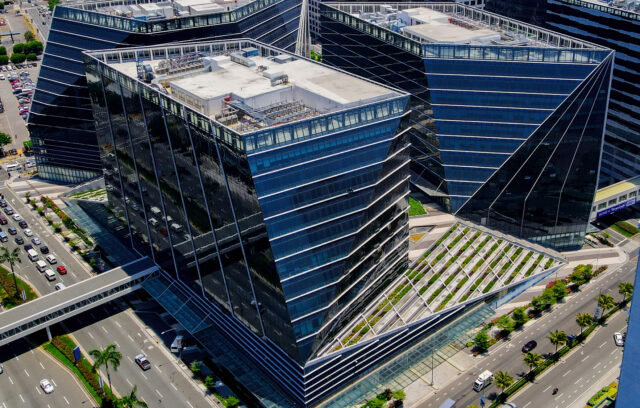

Robinsons Land Corp. (RLC) recently announced the completion of the top floor of its new office building GBF Center 1, which the property developer said is designed to cater to the evolving workplace dynamics beyond the pandemic.

Keeping in mind the evolving trends and changing needs of office locators, PEZA-registered GBF Center 1 is designed to suit new workplace dynamics in the post-pandemic era and to support aggressive business expansion plans.

The 30-storey GBF Center 1 offers wide and flexible office spaces with floor plates of about 2,500 square meters (sq. m.).

RLC also took note of the demands of the modern workforce in building GBF Center 1, reinforcing its commitment to go contactless through modern features such as QR-activated turnstiles and elevators in the building.

In addition, the new office development would be equipped with generous provisions for treated outdoor air to deliver an ideal airflow rate that surpasses the prescribed DOLE standards.

Located at the entrance of Bridgetowne Destination Estate, RLC’s first mixed-use development that straddles the border of Quezon City and Pasig City, GBF Center 1 is a sustainable building. It is equipped with a rainwater collection facility, LED lights, as well as electric charging stations, and bicycle racks. The office building is aiming to secure LEED (Leadership in Energy and Environmental Design) Gold Certification.

“The GBF towers are envisioned to be a landmark structure along the C5 IT corridor. The building design, technology, and green building features are meant to stand out,” said Jericho P. Go, RLC’s senior vice-president and business unit general manager for Offices, said.

Upon completion of GBF Centers 1 and 2, RLC plans to add more office buildings to its portfolio to accommodate tenants’ needs in the next five to 10 years.

“Bridgetown has been carefully master planned to offer the best in class for your live, work, play, and inspire experience. In our well-designed workspaces, we can truly say that work can be fun,” Mr. Go said.

As the economy further opens, more companies started to implement return-to-office, while outsourcing companies are pursuing expansion plans. Thus, a pickup in demand for office space is beginning to be seen by Colliers Philippines in its office market report for the second quarter of 2022.

The property consultancy firm recorded the completion of about 146,700 sq. m. of new office supply in Metro Manila during the said period, lower than the 306,100 sq. m. of the quarter prior. It expects the delivery of 356,200 sq. m. of new office space for the remainder of the year, with Makati Fringe and Ortigas CBD likely to cover 65% of the remaining supply.

Colliers projects the annual completion of about 543,300 sq. m. from 2023 to 2026.

Creating spaces for human connection

SM Prime Commercial Properties Group continues to establish office culture amidst the pandemic. The soon-to-launch FourE-com Center is a 15-storey, pre-certified LEED Gold building that will deliver a more conducive place for tenant-partners and their employees.

The world has inarguably changed in the two years of the pandemic. Digital technology in particular — how to implement it in the company strategy, cybersecurity, the Metaverse, and virtual reality, among others —has completely taken over conversations within the global business community.

It stands to reason. Digital technology has been instrumental in keeping companies afloat during the worldwide lockdowns, so it is inevitable for many to believe that the future of business will take place in the digital world.

SM Prime Holdings, Inc. (SMPH), one of Southeast Asia’s largest integrated property developers, has witnessed this change firsthand. Alexis Ortiga, vice-president of the SM Commercial Properties Group — SM Prime’s office development and leasing arm — told BusinessWorld in an interview that the harsh realities of the pandemic have led many businesses to reevaluate and reconsider their space requirements, especially considering how they can continue operations virtually any way.

The FourE-com Center Prism Plaza is poised to become one of Mall of Asia Complex’s premier after-work destinations. It is set to carry a variety of mid to high-end establishments that will cater to diverse food cravings.

“Tenant-partners have readjusted their space requirements, whether it’s expanding or decreasing them,” he said. “During the pandemic, many businesses had to recalibrate their expense items, including manpower and rent.”

However, Mr. Ortiga does not believe that these sudden adjustments will have long-lasting impact on how office spaces are viewed culturally, but rather it only changes the market’s preferences.

“Most kept their office spaces. There is still something to be said about the office. It is here to stay, it’s been ingrained in our culture, not just Filipino culture but the world in general, the need and practicality of having an office and going to the office,” he said.

“We see that culture staying and progressing. Slowly but surely, people are coming back to the office. Companies want to reestablish that office culture, redeveloping camaraderie and teamwork by working side by side with one’s colleagues. These are things that are part of our human nature for decades already. Two years of the pandemic is not going to erase that.”

The shift was not so much in the tenants’ belief in the role of offices in the future of business, but rather a change in the values that drive their choices in the market. For instance, many companies naturally are more conscious nowadays about health and safety considerations and are demanding more flexible, open-air layouts, or amenities like air filtration systems and reliable sanitation.

Mr. Ortiga noted that even before the pandemic, SM Prime, in general, has always kept the convenience and welfare of their tenant-partners and customers in mind when developing their properties. For instance, SM Offices’ buildings are strategically located nearby transportation hubs, so employees will have an easier time commuting. Its buildings are also one-stop shops which offer areas for dining, entertainment, shopping, and relaxation.

What’s more, some of the SM Offices’ buildings are also LEED Gold-certified, which represents SM’s commitment towards reducing carbon emissions, reducing power and water consumption, and waste generation.

“The office is that one venue that contends with the home as the place where a person spends most of his or her waking hours. So that office better be a super conducive place to stay in,” he said.

This emphasis on human connection is what has always driven SM Prime’s business strategy in the past, and it is what Mr. Ortiga believes will drive it in the future.

“SM’s strategy has always been consumer-centric, wherein we put the needs and welfare of our customers first. We start with our malls, and from there the residences come in, the offices come in. We know the market and community are there. SM has always been about community and nation-building,” he said.

“We want to go beyond what is expected, whether in terms of the developments we build or government and ESG requirements. In SM Prime, our business strategies cover a wide responsibility to include the well-being of our stakeholders and the environment.”

Mr. Ortiga concludes, “At SM Offices, we believe that our design formula works well for employers, tenant-partners, and their employees and guests. Given our amenities and conveniences on any given day, I’m proud to say that SM gives real meaning to the phrase ‘work-life balance’, and how we’re able to treat each tenant and their employees as human beings, not just tenants that fill up our spaces.”


Spotlight is BusinessWorld’s sponsored section that allows advertisers to amplify their brand and connect with BusinessWorld’s audience by enabling them to publish their stories directly on the BusinessWorld Web site. For more information, send an email to online@bworldonline.com.

Join us on Viber to get more updates from BusinessWorld: https://bit.ly/3hv6bLA.

Dollar reserves still ‘adequate’ — BSP

REUTERS

THE COUNTRY’S dollar reserves remain at an “adequate” level despite slipping below the $100-billion level as of end-July,  Bangko Sentral ng Pilipinas (BSP) Governor Felipe M. Medalla said.

At the same time, S&P Global Ratings noted the Philippines’ foreign exchange reserves remain “very high” but will likely drop as global commodity prices and interest rates continue to rise.

Many central banks have deployed the tandem of rate hikes and foreign exchange spot intervention as the US Federal Reserve continued its aggressive monetary policy tightening.

“We were responding just like other central banks to this global situation. The monetary policy in the United States is causing currencies to depreciate, so in response to that, we raised interest rates, not as much as the US did, and we also sold reserves… Nonetheless, our reserves remain comfortable and adequate,” Mr. Medalla said at the Development Budget Coordination Committee’s (DBCC) briefing for the House Committee on Appropriations on Friday.

The peso touched its all-time low of P56.45 per dollar in July.

Year to date, the peso has weakened by P6.02 or 9.84% from its P51-per-dollar close on Dec. 31, 2021.

The country’s gross international reserves (GIR) stood at $98.83 billion as of end-July, 2% lower than the $100.85-billion level as of end-June. The dollar reserves fell below the $100-billion level for the first time since August 2020 when GIR stood at $98.95 billion.   

The GIR level has been on a decline since February this year.

“Despite the recent declines in gross international reserves, the overall level remains very high, especially when put into the context of the fairly consistent trend of around $80 billion in the five years prior to the pandemic,” S&P Global Ratings Senior Economist Vincent Conti said in an e-mail.

Having an ample level of dollar reserves safeguards an economy from market volatility and is an assurance of the country’s capability for debt repayment in the event of an economic downturn.

The country’s foreign exchange buffer hit a record high of $110.12 billion in December 2020.

“In a way, the weak domestic economy during the COVID (coronavirus disease 2019) period had the positive and related side effects of a stronger currency and a strong buildup of reserves, by dampening imports and thus boosting the trade balance,” Mr. Conti said.   

“This is of course being reversed as the Philippines and the region faces capital outflow pressure amid high commodity prices and prospects of still higher global interest rates, as we note in our most recent report. That has resulted in peso depreciation as well as a slightly lower buffer from reserves,” he added.

In a research note dated Aug. 22, S&P Asia-Pacific Chief Economist Louis Kujis said foreign reserves in emerging markets in the region have declined amid heightened exchange rate volatility.

“Asian currencies have depreciated appreciably against the US dollar this year; and this has allayed much of the burden on the balance of payments,” he said.

The BSP is expecting a GIR of $108 billion for this year and $109 billion for next year. — Keisha B. Ta-asan

Elevated inflation, rising rates to drag growth, says Medalla

Department of Trade and Industry officials inspect the price of sugar at a supermarket, Aug. 26. — PHILIPPINE STAR/EDD GUMBAN

ELEVATED INFLATION and rising interest rates will drag Philippine economic growth this year, the central bank chief said.

Bangko Sentral ng Pilipinas (BSP) Governor Felipe M. Medalla on Friday said inflation is “very high” this year, but the Philippines will likely be “less affected” than other countries.

“Nonetheless, it will affect the growth because if people are spending more money on transport, fuel, food, they will have less money for other things,” he said during the Development Budget Coordination Committee’s (DBCC) briefing for the House Committee on Appropriations on Friday.

The consumer price index quickened to 6.4% year on year in July, the fastest in nearly four years, amid the continued climb in global prices of fuel and other commodities. It exceeded the central bank’s 2-4% target band for a fourth straight month.

Inflation averaged 4.7% in the first seven months, still below the central bank’s 5.4% inflation forecast for this year.

“But there’s very little we can do about it since those prices are totally beyond our control. The question whether inflation will hurt us, the answer is yes,” Mr. Medalla said.

For the first half of 2022, the economy expanded by 7.8%, exceeding the government’s 6.5-7.5% full-year target.

Mr. Medalla noted the peso’s depreciation against the US dollar is also adding inflationary pressure. As of Aug. 26, the peso has weakened by P6.02 or 9.84% from its P51-per-dollar close on Dec. 31, 2021.

“There’s too much depreciation, that is bad on the inflation for the economy. And the central bank raises interest rates, of course that will also affect the economy,” Mr. Medalla said. “But as I already stated, not enough to prevent us from achieving what was stated in the budget.”

The Marcos administration last week submitted to Congress its proposed P5.268-trillion national budget for 2023.

Most of next year’s proposed budget will go to social services at P2.071 trillion (39.31%) and economic services at P1.528 trillion (29.01%). The rest of the proposed budget is allocated to general public services at P807.2 billion (15.32%); debt burden, including net lending, at P611 billion (11.59%); and defense at P250.7 billion (4.76%).

Economic managers are targeting 6.5-8% gross domestic product (GDP) growth in 2023.

IMPACT
“Inflation or higher prices would erode the purchasing power of the government’s national budget or curtail the power of government spending as an economic growth driver/pillar,” Rizal Commercial Banking Corp. Chief Economist Michael L. Ricafort said.

Higher interest rates would also require a bigger budget for interest payments on borrowings incurred to finance the budget deficit, he added.

“Same goes with the private sector: Higher prices/inflation reduce the funds that would otherwise go for spending and investments by consumers (about 78% of the economy), by businesses and other institutions,” Mr. Ricafort said.

China Banking Corp. Chief Economist Domini S. Velasquez said in a Viber message that rising prices have impacted the purchasing power of ordinary Filipinos.

“BSP’s recent aggressive actions seem to have re-anchored inflationary expectations and have brought some stability to the peso. However, both higher inflation and higher interest rates affect economic growth prospects,” she said.

The Monetary Board has raised its benchmark policy rate by a total of 175 bps so far this year, bringing it to 3.75%.

“We think that inflation is still on its way to peak in the fourth quarter. Hence, we expect BSP to keep raising rates at a moderate pace of 25 bps in its meetings before ending with a terminal rate of 4.5%,” Ms. Velasquez added.

If inflation starts easing in the coming months, Mr. Ricafort said there would be a lesser need for the BSP’s aggressive tightening.

The next Monetary Board policy meeting is scheduled on Sept. 22. — Keisha B. Ta-asan

‘Revenge’ partygoers spur Manila’s nightlife revival

People enjoy al fresco dining at restaurants in Quezon City, June 11. — PHILIPPINE STAR/ MIGUEL DE GUZMAN

By Joseph L. Garcia, Reporter

TIM NG reopened Mow’s, an “underground” bar near Manila, the Philippine capital in July after two years of being shuttered amid a coronavirus pandemic.

The bar, located in the basement of a family-owned building — the Kowloon House in Quezon City — resumed business months after the industry was allowed to operate again as infections eased.

Manila’s nightlife appears to have come to life again, thanks to “revenge” partygoers eager to spend more on food and booze.

In 2020, the combined sales of cafés and bars in the Philippines reached $1.1 billion, significantly lower than before the coronavirus pandemic hit, according to Statista.


“A number of bars started reopening months before, but we wanted to wait until cases really went down,” Mr. Ng said in an e-mail. “We reopened a couple of weeks after the government allowed 100% occupancy rates for establishments.”

Booze joints in the National Capital Region (NCR) were closed to contain the coronavirus disease 2019 (COVID-19), which in many parts of the world including the United States spurred a rapid spread in infections in 2020.

Lockdowns covered both old and young people, including those aged 21 and younger, who enjoy partying.

In Quezon City where Mow’s is located, liquor bans and curfews were enforced at the start of a Luzon-wide lockdown in March 2020 and sporadically months later during infection surges.

The glamorous Palace Manila club complex in Bonifacio Global City in Taguig — one of the top party destinations in the Philippines with five nightclubs — was also forced to shut during the pandemic.

“The Palace complex was forced to close for almost two years to minimize our overhead expenses and tide us through,” Palace Manila co-owners JM Rodriguez and Alexandra Habaluyas said in an e-mail.

The bohemians in Mow’s and the fashionistas at Palace Manila face the same problems in the post-pandemic world, including spiraling prices.

“All industries were heavily affected by the pandemic but as the world was slowly getting used to living with the virus, the nightlife industry was in the back of the line due to important aspects such as government guidelines,” its owners said.

“Many businesses had to close because they didn’t have savings to keep them afloat,” they said. “We pivoted to doing online shows to preserve the clubbing culture and remain relevant in people’s minds but nothing beats experiencing it live.”

In January 2021, they tried opening The Island — one of the nightclubs under their umbrella — that had a swimming pool. “It didn’t really work because the government had very strict guidelines and people were still fearful of the virus. Everyone was still treading carefully because no one knew how it was going to pan out,” they said.

They reopened The Island later that year, when the government had eased the lockdown level in the NCR to Alert Level 3.

“Our patrons were more receptive,” they noted. Xylo, their flagship club, was only allowed to open when Metro Manila had transitioned to Alert Level 2.

“We reopened Xylo’s doors in February and it just blew up from there. We eventually decided to open Revel last April when we saw that more and more people were comfortable going out.”

The two nightclubs only accept vaccinated patrons, who must wear masks as mandated by the government.

At Xylo, security officers check the temperature of each guest before entry, while Mow’s regularly sanitize the bar and test its staff for the coronavirus.

“We’ve also had to put caps on attendance to avoid overcrowding,” said Mr. Ng. At Palace Manila, reservations are kept at half its occupancy rate.

MORE PROFITABLE
Both nightclubs cited a return to pre-pandemic sales numbers.

“We’ve definitely surpassed our older numbers,” Mr. Ng said. “It may be because we just reopened but they’re higher than what we expected given the pandemic and higher prices.”

Meanwhile, Mr. Rodriguez and Ms. Habaluyas said they have become more profitable amid restrictions and despite operating at 50% capacity.

“Gigs start and end earlier,” Mr. Ng said. “We have more customers coming in earlier to have dinner before the gig. The crowd always had their masks on and the smokers comply with the one-meter social distancing at the designated smoking area.”

Some vocalists also bring their own mics to gigs. Surprisingly, people order more food and drinks these days, according to the owners of both night clubs.

“Now that it’s less packed, people tend to order more and service isn’t sacrificed,” Mr. Rodriguez and Ms. Habaluyas said. “People are on a mission to make up for lost time and ‘revenge’ party.”

The Palace Manila ensures that each patron’s visit becomes an enjoyable but safe experience.

People’s behavior seems to have changed. Those who used to go out before the pandemic have graduated from partying.

“You see a lot of new faces — teens who have grown up and introverts who are tired of staying at home. People now also go out earlier and drink more, so nights are extended.”

“One of the most important lessons we learned is to strike while the iron is hot,” the Palace Manila owners said. “Being at the forefront of the local nightlife scene, we always strive to outperform ourselves by being updated with relevant trends and making sure guests have a great time.”

Bar owners have learned a lot during the pandemic and are still learning as they go along. “Nothing is certain given that our industry heavily depends on the government’s guidelines.”

Meanwhile, supply chain and labor issues overseas have also entered the party scene. But suppliers have prioritized the Palace Manila given its sheer size and big volume requirements.

It has raised prices, though its clients didn’t seem to mind, its owners said.

Mow’s, which gets its food from Kowloon House, also had to raise its prices.

Mr. Ng remains cautiously optimistic. “With how careful the gig scene has been, we’re feeling a bit optimistic,” he said. “There have also been a couple of big concerts and festivals lately so the industry doesn’t seem like it’ll slow down any time soon. Because of how bad the economy is too; businesses will want to remain open.”

“We are definitely on our toes because of how volatile it is nowadays, so we’re prepared to make the necessary adjustments.”

PEZA defers approval of WFH extension for BPOs

BW FILE PHOTO

THE PHILIPPINE Economic Zone Authority (PEZA) board has deferred the approval of the extension of the work-from-home (WFH) arrangement for information technology and business process outsourcing (IT-BPO) firms to March 2023.

Tereso O. Panga, PEZA officer-in-charge and deputy director-general for policy and planning, said in a Viber message that the WFH extension for IT-BPOs until March 2023 has been “approved in principle,” but the final approval was deferred by the PEZA board at its Aug. 26 meeting.

“The WFH 30% limit extension is approved in principle. We just need to revise our memo to include the inputs of the PEZA board — that the 30% WFH is a long-standing policy of PEZA and not just as a business continuity plan measure. We will pursue that in the ad referendum and there is no need for the PEZA board to convene,” he said.

Mr. Panga in a Facebook post on Sunday said the PEZA board wants to get “further clarification” from the Department of Finance (DoF) and the Board of Investments (BoI) regarding the extension.

However, he said they will push to approve the extension before the earlier resolution expires on Sept. 12.

On June 21, the interagency Fiscal Incentives Review Board (FIRB) issued Resolution No. 017-22, which temporarily allowed registered IT-BPO firms to have a 70% on-site and 30% WFH arrangement until Sept. 12, while still enjoying fiscal incentives under Republic Act No. 11534 or the Corporate Recovery and Tax Incentives for Enterprises (CREATE) law.   

Registered firms are usually required to conduct their business inside economic zones (ecozones) in order to avail of tax incentives. However, IT-BPO companies were allowed to implement WFH schemes during the strict lockdowns implemented amid the pandemic.

The FIRB released Resolution No. 19-21 in August 2021 that allowed registered IT-BPO firms to implement a 90% WFH and 10% on-site work arrangement and still avail of tax incentives. The resolution ended on April 1 this year.

The FIRB is in charge of granting tax incentives to registered business enterprises including IT-BPO firms.   

IT-BPO industry stakeholders such as the IT and Business Process Association of the Philippines have been pushing for the WFH arrangement while keeping their tax incentives, citing benefits to employees and productivity.   

According to Mr. Panga, the PEZA board agreed that the DoF should coordinate with the Bureau of Internal Revenue (BIR) regarding the issues affecting the ecozone industry on the application of WFH policy.

At the same time, Mr. Panga said that the PEZA board deferred and subjected to ad referendum the inclusion of ecozone logistics services activity in the Strategic Investment Priority Plan (SIPP).  

“The DoF just wanted to make sure that ecozone logistics is included in the SIPP. The BoI initially confirmed its inclusion under Tier 1 of SIPP as support to export activities. This will encourage the registration of more ecozone logistics service enterprises (ELSEs) as a critical ecozone supply chain as they cater exclusively to the requirements of export-oriented locators,” Mr. Panga said.   

“Under the old regime, PEZA has been approving ELSEs but subject only to tax- and duty-free importation and zero value-added tax rating on local purchases as their incentives. We recommended the same incentives for new ELSEs to be registered by PEZA under the CREATE law,” he added.   

He added that the DoF and BIR will also address inconsistencies in the issuances of FIRB, BIR, and Bureau of Customs regarding the grant of incentives to registered business enterprises (RBEs) under the CREATE law.

Meanwhile, Mr. Panga said that the PEZA board also approved 30 ecozone developer and locator application projects worth P8.685 billion in capital investments.   

“We will release more details on these approved applications,” Mr. Panga said.   

In first half of 2022, the PEZA’s approved investments dropped by 29.85% to P22.488 billion. The agency is eyeing to achieve a 6% to 7% investment growth for 2022. — Revin Mikhael D. Ochave

PAGCOR needs to settle conflicting roles, says DoF

THE PHILIPPINE Amusement and Gaming Corp. (PAGCOR) should present its plans as the Marcos administration decides whether its gaming operations are up for privatization, the Department of Finance (DoF) said.

“PAGCOR’s new leadership will have to make known their plans moving forward. They should resolve the seemingly conflicting roles as an operator and regulator,” Finance Secretary Benjamin E. Diokno told reporters on Friday.

Mr. Diokno’s statement came after he told the House Committee on Appropriations on Friday that the administration is open to supporting a supplemental budget, possibly funded by the privatization of government-owned and controlled corporations (GOCCs) such as PAGCOR.

“We would like the economy to grow [and] to recover. So, if there [are] additional resources available to us — either through maybe new loans or maybe additional revenues coming from, say, privatization of some corporations — we would be willing to support a supplemental budget… Because if there are ready to implement projects, and we had the money, then better spend it now rather than, say, a year from now,” Mr. Diokno said.

“PAGCOR, as it is right now, is a GOCC, so when the government regulates it, it’s like regulating themselves,” said Antonio A. Ligon, a law and business professor at De La Salle University.

“If it is privatized, then the audit or internal control of the entity may be privatized also. So, you may see stricter and more efficient internal controls, with the hiring of employees having different criteria. But definitely, it will avoid, if not minimize, political factors,” he added in a Viber message.

Public investment analyst and convenor of think tank InfraWatch PH Terry L. Ridon rejected the idea that PAGCOR’s role as both regulator and operator makes up a conflict of interest, noting that it is an excuse for those who have an agenda in privatizing PAGCOR-operated casinos.

“Casino operators merely derive their power to operate from PAGCOR itself, as PAGCOR by law has the monopoly of casino operations in the Philippines,” Mr. Ridon said in an email.

“If government revenue will be less under a privatized regime, there is no point privatizing PAGCOR-operated casinos, particularly at this time of limited fiscal space, in which every peso going into public services counts,” he added.

Economist Bernardo M. Villegas of the University of Asia and the Pacific said that the state-run gaming firm should focus on the public good as opposed to maximizing profits.

“PAGCOR should limit its role to regulating and allow a private enterprise to operate it. Government revenues need not be reduced if the regulation is enlightened,” he said in an email.

The previous administration sought to privatize the gaming operations of PAGCOR to raise an estimated P300 billion in revenues, in lieu of imposing additional taxes amid the coronavirus disease 2019 (COVID-19) pandemic.

The plan did not push through as it was thought that the move might eventually result in foregone revenues for the government after PAGCOR foregoes its gaming operations.

But, “in the short and medium term there will be no revenue loss because of privatization proceeds,” Mr. Diokno said.

When asked if taxes and license fees collected from its potential new owners in the future would be enough in the long term, Mr. Diokno reiterated that “the new leadership should consider the worthiness of their move appropriate to their role.”

“I’m not sure if the government can put conditions on privatization. But let’s say if PAGCOR does not make a higher yield within three or five years as compared to the present, then it should go back to being government-run,” Mr. Ligon said.

“As to profitability, I think the private entity, which is profit-driven, can make it more profitable than the government operation.”

In the first half of the year, PAGCOR posted a 68.11% expansion in its revenue collection, obtaining P26.7 billion against P15.88 billion in the same period last year.

Its net income after tax also surged to P2.15 billion compared with the P79.07-million income in the first semester of last year.

PAGCOR also said that its contributions to nation-building from January to June increased by 62.69% to P21.23 billion. This includes P11.71 billion that went to the Bureau of the Treasury, P6 billion to the national coffers as cash dividends for the dividend year 2021, and P1.23 billion to the Bureau of Internal Revenue as franchise tax.

Last week, new PAGCOR officials were sworn into office. Alejandro H. Tengco was appointed chairman and chief executive officer, while Juanito L. Sañosa, Jr. was appointed president and chief operating officer. — Diego Gabriel C. Robles

You can’t spell GR86 without ‘GR8’

PHOTO BY KAP MACEDA AGUILA

Toyota’s popular 2+2 pocket rocket is back for more

IF YOUR EXPECTATIONS are spot on, the Toyota 86 will deliver in spades – for much less.

And therein lies the secret to its unqualified success. The 86 (and its soul sibling, the Subaru BRZ) have been hits in their segment – as reachable aspirations for performance-seeking drivers who don’t want to fork over the deed to the condo in exchange for the price of admission to an adrenaline-pumping experience.

That’s exactly what these pocket rockets are, to be honest – affordable sports cars. Now that is not to demean what the 86 is all about. In fact, you can say that the model democratizes exciting mobility.

When it first came out in 2012, the 2+2 fastback coupe captured the imagination for ticking all the right boxes: rear-wheel drive, 50:50 weight distribution, peppy old-school (read: naturally aspirated) engine, and great styling. It absolutely looked the part of the sports car you would have flaunted the first time you learned to drive – the pogi car that would have negated the awkward teenager in you. But I’m blabbing.

The 86/BRZ group project for Toyota and Subaru designers and engineers has entered its second chapter with an all-new iteration, and Toyota is so proud of the result that it bestowed its hallowed “GR” prefix to the 86. GR, of course, stands for Gazoo Racing, which essentially encapsulates the motorsports spirit and efforts of the brand – spearheaded by no less than its “Master Driver” Morizo (aka Akio Toyoda, the boss man himself) .

Last weekend, Toyota Motor Philippines Corporation (TMP) afforded a small group of media practitioners not just a glimpse of, but actual seat time on, this all-new iteration of the GR86.

Priced at P2.328 million for the six-speed manual, and P2.499 million for the six-speed automatic, there’s quite a bit of a price bump from the outgoing version (the manual used to be priced at P2.086 million, while the automatic went for P2.186 million). Bear in mind though: This the GR86 does not merely get new toys or aesthetic upgrades here and there. It’s a totally different beast altogether. At first blush, that much is obvious: The GR86 is a reimagination of the 86.

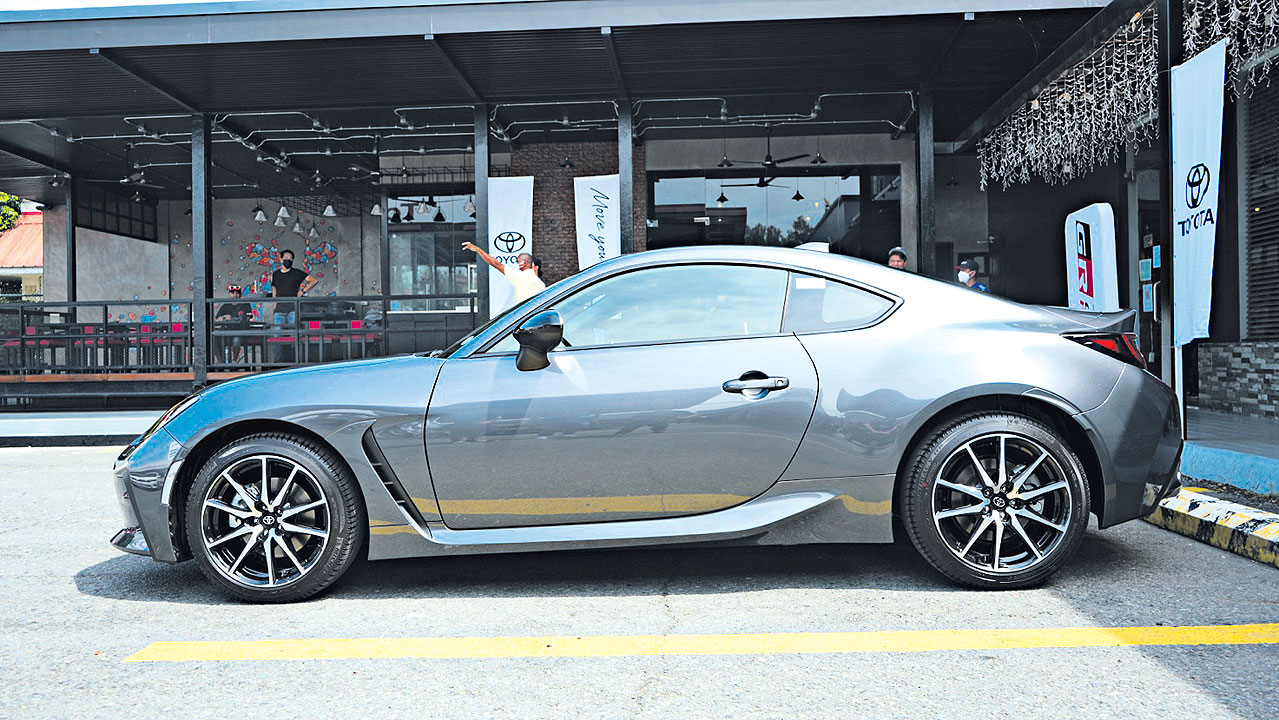
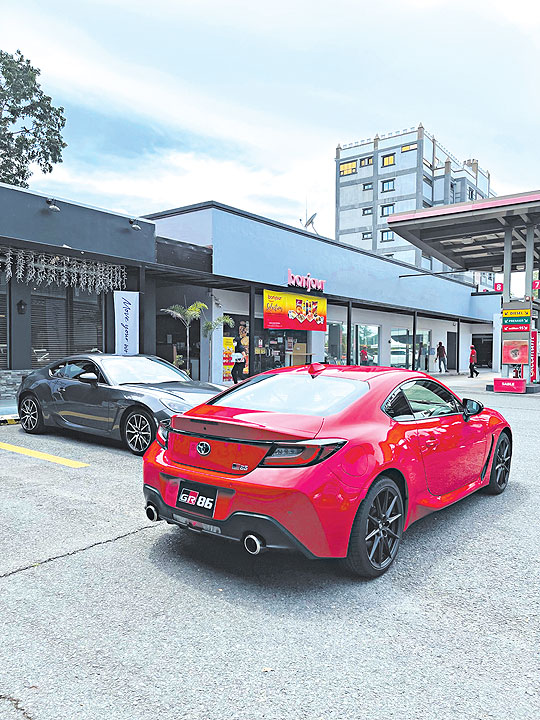
Though I must admit I kind of miss the keyhole-like shape of the headlamp and taillamp assemblies which make the 86 immediately recognizable, the more sedate-looking front and rear of the GR86 aren’t bad at all. The headlights, daytime running lamps and foglamps all feature LEDs – same with the illumination at the rear.

TMP Vice-President for Product Planning Nico Bravante, who most graciously sat in the front passenger seat while allowing me the pressure, I mean pleasure, of driving the GR86 on the speed-limited internal roads of Clark in Angeles, Pampanga, talked about what’s new in the all-new.

“First, it rides on a much-bigger platform,” he said. “The engine now has 2.4 liters of displacement, compared to the 2.0 liters of the previous model.” While we’re at it, the previous 86 had 200ps and 205Nm; the GR86 now gives you 237ps and 250Nm – a great gain in both power and torque. The wheelbase has also increased marginally from 2,570 millimeters to 2,575mm, and overall length from 4,240mm to 4,265mm. While the width stays the same at 1,775mm, the GR86 stands 10mm shorter at 1,310mm versus the 1,320mm versus its older sibling.

Mr. Bravante added that the goal for Toyota in the new GR86 is a much sportier stance, something that is definitely apparent owing to how low slung and longer the car is. It also has a longer bonnet now, under which resides the aforementioned 2.4-liter boxer engine, which still does its breathing the normal way sans turbo. The new model reportedly gets to 100kph from a standstill much more quickly (6.3 seconds, if you’re wondering), 1.1 seconds better than its forerunner.

On the both sides of the vehicle are pronounced vents for the front wheel arches which, explained the TMP executive, aids in aerodynamics and managing the temperature of the brakes during dynamic driving. The higher-spec automatic transmission variant gets 18-inch alloys shod in 215/40 Michelin Pilot Sport as standard.

The ducktail spoiler is integrated to the body, and a high-mount third brake lamp completes the picture of the GR86’s hindquarters as substantial and dynamic — particularly with a good-looking diffuser in black that’s accentuated by a large tail pipe on both sides.

Inside, the GR86 is pretty much the same 2+2 coupe. If you’re looking to seat more than “small fry” in the rear, perish that thought. I still like to think of this car as having two trunks rather than seating four. To be fair though, we did manage to squeeze in two adults back there, who had to Indian-sit the entire time I was driving and talking to Mr. Bravante. I didn’t hear a peep of complaint, so I guess that was a good sign.

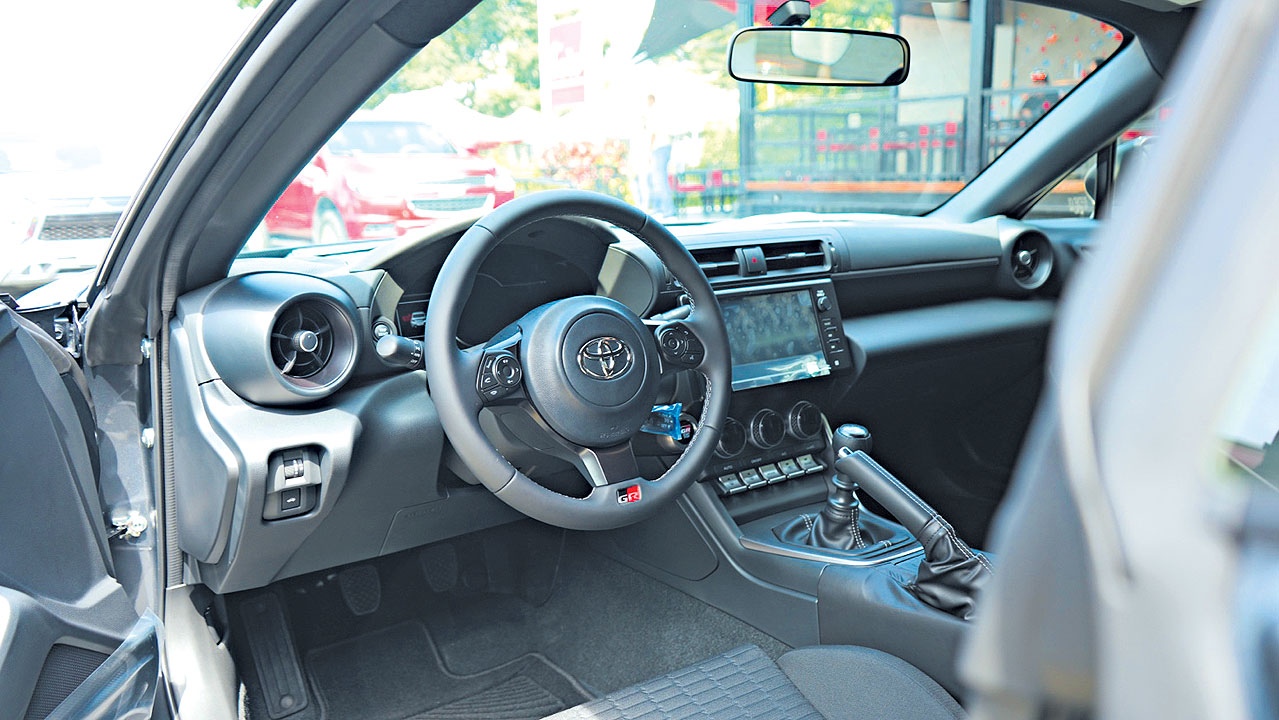
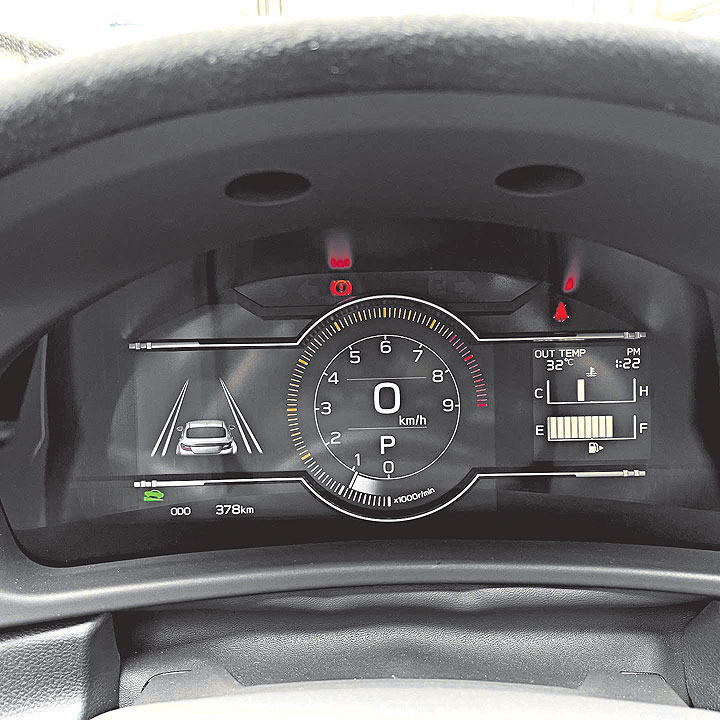
The front two seats are where the action is, of course, and I’m happy to report that they are adequately bolstered for dynamic driving. The instrument cluster has been thoroughly modernized through a seven-inch thin-film-transistor multi-information display plus other digital meters that aren’t crass or gimmicky. On the center console is an eight-inch touchscreen display upon which the infotainment system is predicated. Rejoice some more because it now supports Apple CarPlay and Android Auto, and the car will play your content through six speakers. There are also two USB ports for your convenience, as well as a 12-volt socket.

For safety, Toyota’s entry-level sports car gets the GR86 Active Safety Suite, which includes a pre-collision system, automatic high beam, lane departure alert, and dynamic radar cruise control. On top of these are an adaptive front lighting system, blind spot monitoring, SRS airbags, anti-lock brakes, vehicle stability control, hill-start assist control, and limited slip differential, among other niceties. There’s a reversing camera as well and back sonar, just so you can park more easily.

“When engineers and designers were conceptualizing this new generation, they wanted to keep the sportiness and performance, but they also considered the daily-driving aspect of the vehicle such as in the comfort and amenities it provides to passengers,” reported Mr. Bravante.

Surely, I can see the results of this effort showing up in the GR86. While NVH levels have improved, at least based on our short drive time, you need to manage your expectations because, again, this is a sports car.

And obviously, you should have the most fun with the GR86 on the track, or at least in the open road. For now I’ll reserve a full-on review hoping that we can get another, longer date with the GR86 and its wellspring of performance promises.

SPNEC’s SRO favors long-term investors — analysts 

ANALYSTS see the stock rights offering (SRO) of Solar Philippines Nueva Ecija Corp. (SPNEC) to be more appealing to long-term investors as they expect its business to grow in the long run amid favorable government support for green energy projects.

“Long-term investors who wish to subscribe to the SRO can look forward to a bright future as the government favors green energy projects and the expansion of SPNEC will be supported by the government,” Timson Securities, Inc. Head of Online Trading Marc Kebinson L. Lood said in a Viber message.

Separately, Globalinks Securities and Stocks, Inc. Head of Sales Trading Toby Allan C. Arce said that the continuous rise of the country’s power demand presents growth opportunities for SPNEC as it looks to further expand its renewable energy portfolio.

“SPNEC is on track to complete its major deals this year, including its [SRO] within the next few weeks and its asset-for-share swap with parent Solar Philippines [Power Project Holdings, Inc. or SPPPHI] by the end of 2022,” Mr. Arce said in a Viber message.

In June, SPNEC filed its preliminary SRO prospectus with the Securities and Exchange Commission and Philippine Stock Exchange for nearly 1.88 billion shares.

After the SRO’s price adjustment in July to now range from P1.50 to P1.75 per share, it placed the aggregate offer amount at P2.81 billion to about P3.3 billion.

The offer period will start on Aug. 30 and end on Sept. 5. It has an entitlement ratio of one share for every 1.28 shares held.

“While this SRO may not be appealing for short-term players as they stay on the sidelines, those players who’ll participate are probably banking on the bright prospects that this project may yield for SPNEC’s bottom-line figures in the future,” Mr. Lood noted.

In a media briefing on Friday, SPNEC President and Chief Executive Officer Leandro Antonio L. Leviste said the SRO’s P2.8-billion proceeds “will help complete the P10 billion that we plan to invest to complete the development of 10 gigawatts (GW) of projects.”

“As a project developer, our job is to consolidate land and permits so the projects can secure off-take and become construction-ready, to enable the projects to raise financing to complete the capital expenditure with the help of partners,” he added.

Mr. Leviste said brokers had begun taking orders for Aug. 22, with the deadline for orders with most brokers on Aug. 30 or 31.

SPNEC placed the industry standard cost of putting up a megawatt (MW) of solar power at $700,000, which can translate into revenues of P6 billion per MW per year. It added that its 10 GW of projects would have a total non-land capital expenditure budget of $7 billion, or revenues of P60 billion per year.

Meanwhile, SPNEC is also planning to conduct an asset-for-share swap with its parent Solar Philippines after the first round of SRO.

“Following the exercise, SPNEC will obtain basically all the operating assets of SPPPHI, and the latter’s pipeline projects under development. After the asset-for-share swap exercise, SPNEC is expected to have an operating capacity of a total of 904 MW, making it the biggest solar power generation company in the country,” Mr. Arce said.

SPPPHI and SPNEC have signed the share-swap agreement for the issuance of around 24.37 billion shares at P2.50 apiece, in exchange for the shares of SPPPHI in a portfolio of projects.

“SPNEC’s future earnings growth outlook and value depend largely on its ability to execute more than 10 GW of pipeline developments. These developments require high level of capital, the bulk of which will likely be funded through debt,” Mr. Arce said.

Mr. Arce said that SPNEC would utilize the strategy of forming joint ventures and partnerships going forward to develop its pipeline projects of over 10 GW.

“SPNEC’s earnings growth will depend largely on the successful development of its solar power generation pipeline projects. Any delay in the development and construction of these projects will likely affect SPNEC’s earnings growth outlook,” he added.

Mr. Lood expects the stock to perform better in the second half of the year “as the company begins to roll out its operations to meet its ambitious goals and as we anticipate positive earnings figures.”

On the stock exchange on Friday, shares in SPNEC climbed by 2.42% or P0.04 to P1.69 apiece. — Justine Irish D. Tabile