Home Blog Page 5564

BSP sees Nov. inflation at 7.4-8.2%
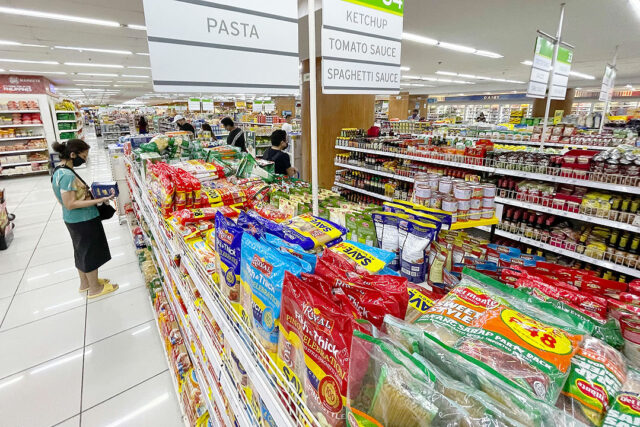
Shoppers look for items at a supermarket in Quezon City, Oct. 16. — PHILIPPINE STAR/ MIGUEL DE GUZMAN

By Keisha B. Ta-asan, Reporter

HEADLINE INFLATION may have settled within the 7.4% to 8.2% range in November due to higher electricity rates and soaring prices of agricultural commodities, the Bangko Sentral ng Pilipinas (BSP) said on Tuesday evening.   

If realized, inflation would exceed the BSP’s 2-4% target for the eighth consecutive month. Headline inflation stood at 7.7% in October.   

The upper end of the forecast or 8.2% would be the fastest pace recorded in 14 years or since the 9.1% recorded in November 2008.   

BSP Governor Felipe M. Medalla said inflation may have peaked in November or will peak in December.

“We cannot guarantee for sure that despite the falling oil prices, and despite the appreciating peso, it’s over. But what we are sure of… is that we will be on a target consistent path and the moment you see it going down, it will continue to go down,” he said on the sidelines of the BSP Stakeholders Appreciation ceremony on Tuesday evening.

Mr. Medalla said the recent appreciation of the peso and the cut in diesel prices makes him optimistic that “the worst may be over.”

“The highest year-on-year headline inflation is either this coming report or the next one,” Mr. Medalla said.   

The Philippine Statistics Authority will release the November inflation data on Dec. 6.   

“Upward price pressures for (November) are expected to emanate from higher electricity rates, uptick in the prices of agricultural commodities due to severe tropical storm Paeng, and higher LPG (liquefied petroleum gas) prices,” the BSP said in a statement.    

Manila Electric Co. (Meralco) earlier said the overall rate for a typical household went up P0.0844 to P9.8628 per kilowatt-hour (kWh) in November.

The agriculture sector suffered significant damage from several storms this year. Severe Tropical Storm Paeng (international name: Nalgae) was the 16th typhoon to hit the country, and caused more than P6.4 billion in agricultural damage.

Cooking gas prices rose by P3.50 per kilogram in November, ending six straight months of price cuts.

“Meanwhile, the reduction in petroleum and pork prices as well as the peso appreciation could contribute to easing price pressures for the month,” the BSP said.   

In November alone, pump price adjustments stood at a net decrease of P7.5 a liter for diesel and P4 a liter for kerosene. Meanwhile, gasoline prices increased by P0.8 per liter for the month.    

The peso also rebounded to the P56-a-dollar mark in November, closing the month at P56.56 on Tuesday, up by P1.41 or 2.5% from its P57.97 finish on Oct. 28. 

The BSP expects inflation to ease in the next few months.

“More importantly, inflation is projected to gradually decelerate in the succeeding months as the cost-push shocks to inflation due to weather disturbances and transport fare adjustments dissipate,” it said.

The BSP said timely implementation of government measures will help ease price pressures.

The BSP sees inflation averaging 5.8% for this year and 4.3% for 2023, before easing to 3.1% in 2024.

“We are confident that the path of inflation will be target consistent and that by 2024 inflation will be closer to 3% than to 4%,” Mr. Medalla said.   

NO NEED TO MIRROR FED
Meanwhile, Mr. Medalla said the BSP may no longer need to mirror the US Federal Reserve’s policy tightening if the strong dollar begins to wane in the coming months.   

“(The highest) year-to-date peso depreciation was about 15%. Now it’s below 10% and it’s not just the Philippines. It’s a global trend now that people are saying that maybe the Fed is already close to eventually pausing and will no longer do jumbos of 75 (bps),” Mr. Medalla said.    

The BSP has increased borrowing costs by 300 basis points (bps) since May to tame inflation and stabilize the peso, bringing the key policy rate to 5%.   

As of the peso’s close on Tuesday, the peso has weakened by P5.56 or 9.8% from its P51 close on Dec. 31, 2021. There was no trading on Wednesday.

Asked if the BSP will continue to increase interest rates in its coming meetings, Mr. Medalla said that it would be very data dependent.   

“What they’re saying is that US rates will rise but the rate of increase will decrease. So, in that particular case, then maybe we have room to either respond fully or partially. Depending on the data,” he said.   

The US Federal Reserve has so far raised its policy rates by 375 bps since March, bringing the Fed funds rate to the 3.75-4% range. It is widely expected to deliver a smaller 50-bp rate hike on Dec. 14, a day before the BSP’s last policy setting meeting on Dec. 15. 

Asked if the BSP will pause next year, Reuters quoted Mr. Medalla as saying: “Maybe the first quarter, depending on developments.”

Meanwhile, Mr. Medalla believes that the country will still be able to achieve the 6.5-8% growth targets of the Development Budget Coordination Committee (DBCC) in 2023 despite higher interest rates.    

“I will say that DBCC growth targets are still feasible for next year. What do we bank on? International tourism picks up. And there’s also still quite a bit of pent-up demand,” Mr. Medalla said.   

He also added that the growth forecast for the country next year by the International Monetary Fund (IMF) is “too pessimistic.”   

The IMF forecasts Philippine economic growth at 6.5% this year, slowing to 5% in 2023.

PHL plans retail dollar bond issue in 1st quarter

REUTERS

THE GOVERNMENT is planning to launch a US dollar retail Treasury bond issue in the first quarter of 2023, Finance Secretary Benjamin E. Diokno said on Wednesday.

“We’re launching first quarter of next year… We’re still finalizing the terms,” Mr. Diokno said during the Kapihan sa Manila Bay Forum, adding that the tenor would be at least five years.

He said the issue is expected to raise around $3 billion, depending on demand.

The planned transaction will be the second of its kind, following a $1.6-billion five and 10-year offering in 2021.

The onshore offer of an alternative investment product aimed at Filipinos overseas should boost funding for government programs to support the economy’s recovery.

The government traditionally offers retail Treasury bonds denominated in the local currency, with the most recent in September when it raised P420.45 billion ($7.43 billion).

The Philippines, one of Asia’s most active sovereign bond issuers, is planning to raise around $5 billion from offshore bonds next year, roughly the same as this year’s total, National Treasurer Rosalia V. de Leon told IFR, Refinitiv’s capital markets news service, this month.

Next year, the country will continue to favor US dollar bond sales, while also looking to return to the yen and euro markets, depending on market conditions. The Philippines is also looking at the possibility of issuing its maiden US dollar sukuk, said Ms. De Leon.

RISING REVENUES
Meanwhile, Mr. Diokno said the Development Budget Coordination Committee (DBCC) will be meeting on Dec. 5 to review the macroeconomic assumptions and fiscal targets.

“Our recovery has strong traction and our economic indicators suggest that despite the gloomy outlook globally, it’s looking very bright domestically,” he said.

The Finance chief also said the government will likely surpass its revenue collection target for the year. “Revenues are on the rise… We are very optimistic we’ll exceed our target. We expect revenue collection to surpass pre-pandemic levels,” he added.

Total revenue collections reached P2.9 trillion in the first 10 months of the year, up 18.3% year on year. This already accounted for 89% of the P3.3-trillion goal for the year.

“The BoC (Bureau of Customs) has met its annual target, the BIR (Bureau of Internal Revenue) is slightly behind, because the BIR was 6% below target, now its 3% below target,” he added.

MAHARLIKA FUND
Meanwhile, Mr. Diokno said lawmakers should make sure the proposed sovereign wealth fund will be independent and not influenced by politicians.

The House Committee on Banks on Tuesday approved “in principle” a bill creating the Maharlika Investments Fund (MIF).

“Just make sure it is not identified with the President. Whoever is the president, he cannot meddle with the use of the fund. You need a governing council that is totally out of the government, but still one member, the Finance secretary. The fund will be there forever and ever, it’s a legacy,” Mr. Diokno said.

“It’s not a fund that will be influenced by politicians. There should be a sense that it’s independent,” he added.

Sovereign wealth funds are typically supported by proceeds from commodity exports such as oil.

Under House Bill 6398, the P250-billion MIF will be funded by contributions from the Government Service Insurance System, the Social Security System, the Land Bank of the Philippines, and the Development Bank of the Philippines. — Reuters with Keisha B. Ta-asan and Luisa Maria Jacinta C. Jocson

Lending growth in October fastest in nearly 4 years

BW FILE PHOTO

DESPITE RISING interest rates, bank lending expanded in October at the fastest pace in nearly four years, the Bangko Sentral ng Pilipinas (BSP) said.

Outstanding loans by big banks, net of reverse repurchase (RRP) placements with the central bank, jumped by 13.9% year on year in October to P10.56 trillion. This was slightly faster than the 13.4% loan growth in September.

October credit growth was the fastest in nearly four years or since the 15.3% expansion posted in January 2019.

On a month-on-month seasonally adjusted basis, lending net of RRP placements with the BSP inched up by 1.1%.

Inclusive of reverse repurchase agreements, outstanding loans rose by 12.9% year on year in October, a tad faster than the previous month’s 12.6%. 

Outstanding loans to residents net of RRPs grew by 13.4% to P10.22 trillion in October, from 13.1% in September.

Loans for production activities jumped by 12.5% to P9.23 trillion in October, as more loans were extended for real estate activities (14%); manufacturing (17.7%); wholesale and retail trade, repair of motor vehicles and motorcycles (11.5%); financial and insurance activities (12.8%); information and communication (25%); and electricity, gas, steam, and air-conditioning supply (10.9%).

Consumer loans to residents also went up by 22.6% to P987.11 billion, faster than the 20.6% growth seen in September. This was attributed to double-digit growth in credit card loans (26.8%) and salary-based general purpose consumption loans (62.8%). Motor vehicle loans grew by 6.6% during the month.

Meanwhile, outstanding loans to non-residents net of RRPs expanded by 33% to P338.68 billion in October, faster than the 26.6% growth seen the previous month.

“The sustained growth in credit activity and ample liquidity will continue to support the recovery of economic activity and domestic demand,” BSP Governor Felipe M. Medalla said in a statement on Tuesday evening.

Mr. Medalla said the BSP will continue to take necessary action “to ensure that liquidity and bank lending conditions remain consistent with promoting price and financial stability.”

“Loan growth again posted a positive year-on-year growth for the 15th consecutive month and grew consistently month on month since May 2021, as the economy reopened further towards greater normalcy,” Rizal Commercial Banking Corp. Chief Economist Michael L. Ricafort said in an e-mail note.

ING Bank N.V. Manila Senior Economist Nicholas Antonio T. Mapa said the lending data reflected “revenge spending” “with firms and households looking past elevated borrowing costs to partake in the reopening story.”

“Pent-up demand for expansion activity after two years of delay are compelling borrowers to take on loans despite high rates,” Mr. Mapa said.

At its Sept. 22 meeting, the Monetary Board hiked interest rates by 50 basis points (bps), bringing the benchmark rate to 4.25%.

“Ironically, higher inflation and interest rates would also lead to higher borrowings by some sectors to make up for higher prices on investments, operating costs, and other inputs, as well as to deal with higher debt servicing costs/interest expense for some borrowers,” Mr. Ricafort said.

M3 GROWTH PICKS UP
Meanwhile, domestic liquidity grew at a quicker pace in October, supported by the expansion in bank lending.

M3 — which is considered as the broadest measure of cash in an economy — expanded 5.4% year on year in October to P15.4 trillion, from the revised 5.2% in September, BSP data showed.

On a seasonally adjusted basis, it inched up by 0.7% month on month.

“Domestic claims rose by 11% year on year in October from 11.2% (revised) in the previous month, due to the continued improvement in bank lending to the private sector,” Mr. Medalla said in a separate statement.   

Net claims on the central government went up by 14.7% in October from a 16.5% expansion in September on the back of sustained borrowings by the National Government.

Driven by lending to nonfinancial private firms, claims on the private sector rose by 10.4% in October from 10.3% in September.

Meanwhile, net foreign assets (NFA) in peso terms declined by 1.4% in October from 11.6% in September.

“The NFA of banks fell mainly on account of higher bills payable. Similarly, the BSP’s NFA position contracted by 0.5% in October,” Mr. Medalla said. — Keisha B. Ta-asan

Tech to drive home-sharing business after Airbnb survives COVID

The Airbnb logo is seen on a little mini pyramid under the glass Pyramid of the Louvre Museum in Paris, France, March 12, 2019. — REUTERS

By Luisa Maria Jacinta C. Jocson, Reporter

REGINA G. DE DIOS, a 58-year-old Filipina entrepreneur who rents out condominium units to tourists as an Airbnb host, finds the business “financially and socially rewarding.”

“I have flexibility in renting out my condo units,” she said in a Viber message. “I choose how long I want the units rented out, at what price, and pause if I need to take a break.”

Property owners use Airbnb to make income on the side. Property consultants see it as a magnet for investments in the property market, while driving tourism growth, especially now that coronavirus lockdowns have been lifted in most parts of the world.

In 2019, California-based Airbnb, Inc. posted a net loss of $674.35 million amid a global coronavirus pandemic, according to the Nasdaq website. Its net loss widened to $4.58 billion in 2020 before easing to $352.03 million in 2021.

“Airbnb and maybe future variants are highly beneficial to the real estate and tourism industries because development and technology move forward to a more mobile-based transaction society,” Roy A. Golez, director for Research at Leechiu Property Consultants, said in an e-mail. “The ease of use of the app encourages people to travel and go on vacations more.”

Launched in 2008, Airbnb began as an online marketplace focused on short-term homestays and lodging. The platform allows hosts to put up property for rent on the website that tourists can use while traveling.


In 2007, Brian Chesky and Joe Gebbia rented out air mattresses in their San Francisco apartment to attendees of a conference because all the hotels were booked. They called their service “Air Bed and Breakfast.”

In a few years, this small experiment would create the hotel industry disruptor Airbnb, according to Leigh Gallagher, who chronicled the growth of the company in her book The Airbnb Story.

The company, with third co-founder Nathan Blecharczyk on board, listed more than three million lodgings in almost 200 countries and was worth $31 billion before the pandemic, more than Hilton and Wyndham combined, according to the Wharton School of the University of Pennsylvania.

After going public in December 2020 — amid the  global pandemic — it now has a market capitalization of $61.84 billion, according to Nasdaq.

Mr. Golez said the internet made the lodging market more accessible. “It has allowed owners of residential units to go direct to the market, and for the guests to also directly talk to the owners.”

This has brought down rent costs, while travelers have more choices in terms of lodging size, location, quality, and amenities. “This is all good for the real estate and tourism market,” he added.

“Airbnb has become an affordable option for budget travelers and backpackers,” Joey Roi H. Bondoc, associate director at Colliers Philippines, said in a separate e-mail. “A lot of condominium units have been converted into Airbnb units.”

The growth of the local Airbnb landscape has been notable and particularly felt in the various tourism destinations in the Philippines, Karisse N. Garcia, research manager at JLL Philippines, said in an e-mail. “Travelers’ quest for cheaper accommodation alternatives drove up the demand for this product.”

She said the popularity of Airbnbs in tourist spots boosted the sales of residential units in these areas because units rented out promise higher returns than long-term lease.

They are not likely to affect housing prices.

“On a macro level, I don’t think Airbnb has affected housing affordability because these are not new lodging facilities catering to tourists and thus compete with existing rooms in the tourist market,” Mr. Golez said.

“The rise of Airbnb doesn’t seem to have much bearing on the residential market because it caters to different demand profiles,” Ms. Garcia said.

Bettina G. Lozano, a 54-year-old IT manager who is also an Airbnb host, prefers long-term tenants.

“It makes sense to have it leased out on a monthly basis or longer, she said by telephone. “That way, I don’t have to worry about cleaning and maintaining it.”

Long-term stays are a popular choice among Filipino guests, according to an Airbnb article posted on its website. While Airbnb hosts prefer the security of income in long-term rentals, property consultants think it will take a while before the platform veers away from short-term bookings.

“Although there are some Airbnb units that can be rented out for the long term, majority of customers book units or rooms for the short term so it typically doesn’t eat into the residential rental market where leases typically go for a minimum of one year,” Ms. Garcia said.

Mr. Golez expects the local Airbnb landscape to keep growing “as we move transactions to the internet and through mobile.”

While Airbnb directly competes with hotels and resorts, it is still expected to help promote and boost the tourism market.

“Second home units in tourist locations are given new life as renovated, well-maintained and income-earning assets,” Mr. Golez said. “Not only will one’s house be in a better condition because of the income generated and maintenance costs are covered, there will also likely be additional net cash inflows.”

‘ENTHUSIASM’
In the first quarter, searches by international guests for Airbnb stays in the Philippines more than doubled from a year earlier, according to an article posted on the Airbnb website.

“Since the country eased all travel restrictions in April, there has been an incredible amount of enthusiasm among international travelers looking to travel to the Philippines.”

Eco Hotels, a Philippine green-service hotel chain business, said Airbnb benefits the industry by creating awareness about new travel destinations.

“The government has a lot of catching up to do in order to benefit from Airbnb’s free advertising of the country’s great destinations and the income and taxes it may bring,” the company said in an e-mail.

The hotel and resort industry is also not worried about the rise of Airbnb.

“Airbnb facilities do not have a direct and major impact on 5-star hotels even for ‘staycation’ because guests of five-star hotels still prefer professional and personalized services,” Benito C. Bengzon, Jr., executive director at the Philippine Hotel Owners Association, Inc. said in a Viber message.

“The market for Airbnb is limited because business travelers and convention groups will not use its facilities,” he said. “Hotels now offer very attractive long-stay rates to address the needs of the business market. Expatriates still prefer a hotel for safety and security reasons.”

“There are still many travelers who prefer certain standards of service and would not take risks in vacationing in a lousy property with a lousy experience. They still prefer the hotel service and experience,” Eco Hotels said.

It said the hotel and resort industry should work with the Airbnb platform to maximize customer bookings.

“The platform does not limit listings and types of properties and any hotel and resort may offer their properties in this platform,” it added.

Mr. Bondoc said the demand for Airbnb units could also extend to the office property market.

“Airbnbs extending to office will be popular moving forward especially with the popularity of work from home or work from anywhere,” he said.

“For the office sector, there is the co-working model, which allows shared time use of office amenities, facilities and addresses,” Mr. Golez added.

More than a third of local guests stayed at an Airbnb unit to travel and work remotely, according to a recent Airbnb survey among Filipino guests.

In the first half of 2021, more than two-thirds of new Airbnb hosts were millennials and Gen Zs, ages 18 to 40.

The youth is accelerating the growth of Airbnb hosts even in the local market, Ms. Garcia said. The barkada culture led this consumer group to look for lodging spaces that can accommodate more people at the cheapest price, she added.

The Airbnb business is expected to continue growing amid the pandemic.

“We see the Airbnb business continuing its positive trajectory in the coming years with the tourism market bouncing back, though it may not spill over to the other asset classes due to its main demand profile which is heavily geared toward leisure and tourism,” Ms. Garcia said.

Airbnb units became available earlier than the managed hotel or resort lodging facilities during the pandemic, Mr. Golez said. “In a way, Airbnb has given confidence to individual unit investors that they can rent out their units at potentially higher yields.”

Ms. De Dios said half of the Airbnb market has yet to return to pre-pandemic levels. “It’s still a cut-throat business.”

Why airline food is bland and what it takes to counter this

PAN-FRIED Snapper

FOR decades airline food has been the easy butt of jokes for its blandness. Its status can be explained by science: in a 2011 article from the Fraunhofer Institute for Building Physics IBP in Holzkirchen, the research institute tested in-flight menus from Germany’s Lufthansa AG. Aroma chemist Dr. Andrea Burdack-Freitag explained that up in the air, “Food and drink tastes as it does when we have a cold.”

According to the study, “salt is perceived to be between 20% and 30% less intense and sugar 15% to 20% less intense.” The reasons given for this reduction in taste include reduced pressure in the aircraft affecting a person’s body: “oxygen saturation in the blood is reduced, thus also reducing the effectiveness of the olfactory and taste receptors,” it said. Psychological effects from being up in the air in an unfamiliar environment can also affect taste: “In the unfamiliar environment of the aircraft cabin, people are more exposed to basic stimuli and less likely to notice details. This pushes up stimulus thresholds, with the result that a stronger stimulus is required to trigger a response,” the study said.

Thankfully, media guests to a tasting by Philippine Airlines (PAL) had their feet on the ground during Nov. 16 in Parañaque’s Bamba Bistro, helmed by chef Tina Legarda. Ms. Legarda had been chosen by PAL to create the in-flight menu for its nonstop flights to the US and Canada.

The menu has been available to Business Class passengers since November, and will appear on Business Class tables until the end of the year.

BusinessWorld tucked in to the amuses bouches of The Filly and Maria’s Toast (slow-cooked duck adobo, scallion cream, and torched lychee flambéed in Tanduay Rhum; then homemade longanisa [sausage], guava jam, salted egg cream, arugula, and shallots — both on toasted baguettes). Most everybody loved the comforting Kalabasa Soup (pumpkin soup), made with lemon gremolata and candied pili nuts. There was a Luzviminda Salad with Romaine lettuce, red onions, ricotta, and lychee vinaigrette, while exotic tastes were sated with a Crab Mie Goreng on an egg roll with green onions. The Breakfast Burrito was chicken inasal (barbeque) served mile-high, with scrambled eggs, java rice, lettuce, salsa, and hash browns.

Our favorites included the pan-fried snapper with whipped potatoes, a roasted garlic butter sauce, lemon chimichurri, and steamed asparagus — this course made us truly feel like a jetsetter from the golden age of flying. There was a Nasi ng Bayan, again recalling the inasal with a coffee and annatto sauce, served with coconut rice, peanut paste, and a tangy pineapple salsa.

The savories ended with Boeuf Short Ribs, a creamy offering with Dijon demiglace cream, mushrooms, asparagus, and whipped potatoes.

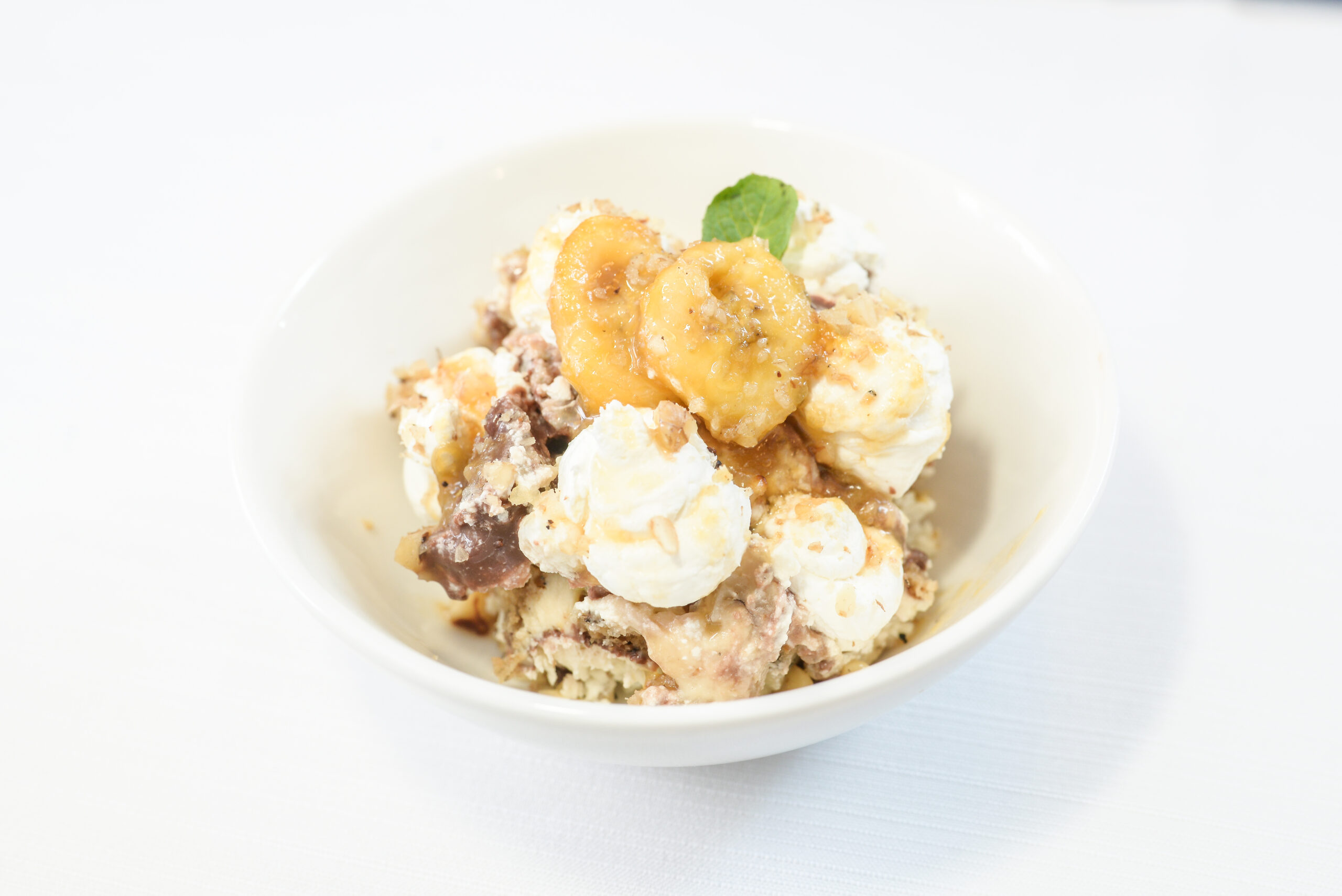
One could round out the meal on a plane with a Banana Budino Trifle, with banana cake, natillas (custard), caramelized bananas, chocolate ganache, whipped cream, and walnuts.

Not included during our tasting, but still on the menu, were a Gyu-silog (beef in sesame butter and fried rice), and Bangus Inasal (milk fish with banana fried rice).

Ethel Francisco, PAL’s AVP for Products and Services Management, spoke about the reasons for choosing Ms. Legarda as a partner. “The balance is so good. Her flavor profile is vibrant.” Needed when one considers how flying affects the experience of taste.

“It’s very different serving food down here. Salt levels lessen when you’re up there,” Ms. Legarda said of some of the difficulties she encountered while making the menu.

Ms. Francisco talked about how food gets on the plane: “With PAL, and I guess, all full-service carriers, we do work with caterers, who do this for us. We’re talking about multiple stations: The Philippines, LA, etc.” Ms. Legarda doesn’t prepare the food herself, but instead teaches these caterers how to replicate the recipes for mass-production.

“Our kitchen would prepare hot food 48 hours before the flight. Cold food, 24 hours,” said Maria Criselda Rayos, PAL’s AVP for Catering Operations, as she took BusinessWorld on a step-by-step explanation on how food gets from the kitchen to a flight.  “After preparation, it has to go through a cold soaking, as we call it. It stays in a holding room, where the temperature is kept at 5°C. Two hours before the flight, all of this food is gathered, assembled, and brought to the aircraft.”

A lot of the work developing recipes for in-flight food is devoted to stress-testing. Will the food still taste good after being held in the cold? Will it still be palatable after reheating in the plane’s galley oven? “Did the sauce collapse, or harden?” said Ms. Rayos. After these tests, the recipe is tweaked again and again until it gets to a quality fit to serve up in the air.

As cited in the study above, psychology plays a role in how food tastes aboard a plane. They say that the journey matters more than the destination — when it comes to airline food, it might ring true. “In an aircraft, you’re left with nothing to do,” said Ms. Rayos. “Food is a diversion.”

“It separates you from that feeling of fear and nervousness,” she said. “Once a passenger is inside the aircraft, and you give him food — food is everything to him.” — Joseph L. Garcia

Clear rules and transparency seen to improve PPPs

ART TUGADE FACEBOOK PAGE

CLARITY of rules, transparency of the process, and clear role designations are seen to help in improving public-private partnerships (PPPs) and entice more private companies to collaborate in various infrastructure projects.

“We have already established the basic foundation of policies on having an effective PPP program and I think this administration can build on that and improve on it,” said Aboitiz InfraCapital, Inc. President and Chief Executive Officer Cosette V. Canilao said during the BusinessWorld Economic Forum on Tuesday.

When asked about what she wished would be improved in the program, she said: “clear rules, feasibility and transparency on the PPP process, and clarity on the institutional roles of government agencies that are involved in PPPs.”

Ms. Canilao led the country’s PPP program in a past administration.

According to Ms. Canilao, existing rules that cover contracts such as the Build-Operate-Transfer Law and the various PPP codes of the local government units are just tools to get the private sector’s involvement in various government-initiated projects.

Through PPP contracts, the private sector can provide capital, innovation, and talent that can help in addressing the infrastructure requirements of the country, she said.

Ms. Canilao said she wishes that the private sector and the government will hold the promise of following through on the commitment and obligations written under the contracts.

“PPPs are given a bad name when the private sector is not mindful of their commitment under the contract,” Ms. Canilao said.

“We need to be able to really assure that the services are met and that you’re able to address the issues of the communities during pre-construction, during construction, and during operations,” she added.

Ms. Canilao also said that there should be constant and frequent consultations between the government and the various private sector participants such as lenders, investors, insurance providers, and construction companies.

“The government acts as a regulator more than a facilitator in delivering the service. Challenges when they come, will not be solved if there is no open and frank discussions,” Ms. Canilao said.

“Infrastructure now has a broader meaning. It’s not only the traditional infrastructure like we know, like roads and bridges, but also social infrastructure such as health, education, even agriculture and the new emerging infrastructure such as IT, digital and even tech-based services,” she said.

According to Ms. Canilao, the enumerated types of infrastructure can be rolled out through PPPs wherein the private sector can be involved. — Justine Irish D. Tabile

Wine-loving France gets a taste for the alcohol-free

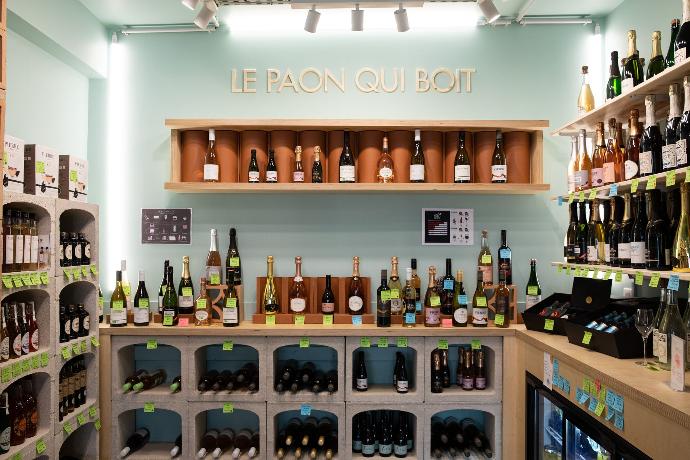
PHOTO FROM LE-PAON-QUI-BOIT.ODOO.COM

PARIS — When a pandemic lockdown kept the French indoors in 2020, Augustin Laborde decided to give up wine but struggled in Paris to find a non-alcoholic alternative.

Two years later, Mr. Laborde has opened what he says is the first alcohol-free wine store in a country renowned the world over for its Bordeaux red wines and white Burgundies.

“We’re responding to very strong demand,” he said. “We’re already receiving proposals to open similar shops elsewhere in France.”

France, where vineyards cover the landscape from the Jura mountains in the east to the foothills of the Pyrenees in the southwest, is the second largest consumer of wine, behind only the United States, 2021 figures from the International Organization of Vine and Wine show.

While non-alcoholic drinks have gained popularity elsewhere, they have lagged in France.

The country’s consumption of non-alcoholic wine grew by 4% in 2021, compared with growth of 24% worldwide, consultancy group IWSR Drinks Market Analysis found.

But even in France attitudes are changing as alcohol awareness campaigns highlight its health risks and well-being trends gain traction.

“We see a strong interest for low-alcohol and no-alcohol beverages” alcohol addiction researcher Mickael Naassila told Reuters. “People are more concerned about their health.”

Customers in Augustin Laborde’s shop, Le Paon qui boit (The Drinking Peacock), echoed that view.

As she tasted a glass of alcohol-free red wine, Helene Bourgy said the drink was a compromise that allowed for an alcohol-free but still “festive atmosphere.”

Even if the French have been slow to take up non-alcoholic drinks, their wine consumption has fallen from 20th-century peaks.

It dropped from over 20 liters of alcoholic drinks sold per inhabitant in 1961, to 5.6 liters in 2020, according the French Observatory of drugs and addictive tendencies (OFDT).

While the French are drinking less in quantity, they are favoring quality, Mr. Naassila said, as the country’s love of wine is deeply rooted.

“(French people) realize that they have to decrease their level of consumption,” he says. “They still love gastronomy and I am sure they will continue to drink.” — Reuters

ICTSI plans to revive Iloilo port development proposal

LISTED port operator International Container Terminal Services, Inc. (ICTSI) said it plans to revive its proposal to develop and operate the Iloilo Commercial Port Complex as part of its goal to help the government in improving the country’s port network.

“We want to push that again, for sure,” ICTSI Executive Vice-President and Chief Risk Officer Christian Razon Gonzales told BusinessWorld in a recent interview.

“We’re waiting for guidance from the government whether it will be a public tender done by the Philippine Ports Authority or they will welcome an unsolicited proposal,” he added.

The company is also interested in developing ports in other regions, including in Mindanao.

“I think doing something in General Santos City would be interesting and, of course, all regions in the Philippines depending on what the government is going to push in terms of economic agenda for these regions,” Mr. Gonzales said.

“If we saw that as an opportunity to put a port there or to help develop a port there whether with national or local government, then why not” he added.

ICTSI, which is in the business of developing, operating and acquiring container terminals, was granted the unsolicited proposal for the development of the Iloilo commercial port complex in the previous administration.

The company had initially estimated an investment of over P5 billion to fully develop the Iloilo port complex. It had also proposed to develop the Port of Dumangas in the same province.

“Overall, the company hopes to be able to assist the port authority in its goals to upgrade the Philippine port network in the hope of facilitating inter-island and international cargo movement,” ICTSI said in a statement posted on its website.

“An integral part of this investment will include the dredging and deepening of the port itself and the channel to allow the direct entry of new generation, international vessels,” it added.

The United Nations Conference on Trade and Development said in its latest report that there is a need for increased investment in maritime supply chains, including ports, shipping fleets, and hinterland connections, to boost sustainability and prepare the country for future global crises.

The Philippines was one of many countries that experienced serious vessel delays and container shortages during the pandemic. — Arjay L. Balinbin

What makes American meat great

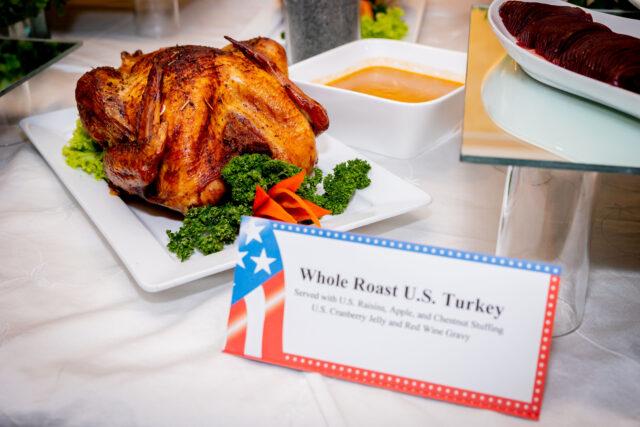
Whole Roast US Turkey

It’s all in the grain

IT’S NOT every day that the United States Ambassador to the Philippines opens up their house for a barbeque, so it was quite easy for us to say “yes” to their invitation for a Holiday Hoedown-themed Great American Barbeque trade reception on Nov. 17.

Ambassador MaryKay Carlson, a native of Arkansas, told media guests about her fond memories of her father barbequing brisket in the summer.

More than that though, she gave three reasons for the celebration in a speech. “The Philippines is the 7th-largest market in the world for US food and agricultural products,” she said. According to her, the US is also the number one supplier of agricultural products to the Philippines. Finally, “We are also your number one customer. Last year, we had record two-way trade in these goods, worth $4.6 billion.”

“When you see what these high-quality US products can become in the hands of skilled chefs — of which I am not one, but we’re glad that we have some tonight — you will recognize the power and the benefits of trade,” said Ms. Carlson.

The Great American Barbeque trade reception was sponsored by the US Department of Agriculture (USDA) Foreign Agricultural Service, in partnership with US trade associations and suppliers and Philippine companies.

One of the guest chefs that night was Jay McCarthy, a consultant chef for the Texas Beef Council, the Nebraska Beef Council, and the US Meat Export Federation. Included in the spread were turkey, pulled pork sliders, baby back ribs, slow-cooked US Beef Ribs (with Mr. McCarthy’s mushroom sauce and prime rib rub), and US Angus Hot Pastrami (from local caterers The Plaza). There was also a selection of American cheeses and wines.

Mr. McCarthy, speaking with BusinessWorld in the ambassador’s living room, discussed how US meat becomes that way: tender and flavorful (based on our experience, at least). “We have an abundance of corn and grain, which isn’t available around the rest of the world. That’s what really influences raising all the pigs and the cows. Ultimately, it’s the fat, where the flavor is. All that energy, those high-energy diets go into finishing the product so that it has that richness.”

Other countries might boast that their livestock is fed on grass, but Mr. McCarthy makes a case for seasonal changes that might affect how the meat will taste like. Cattle may be fed first on fresh spring grass, for example, but, “As the seasons change, and that grass dries out towards the end of the season, there’s less energy, less protein available for the animal to eat. That’s going to change the flavor of the fat. That creates an inconsistency.”

For his part, Mr. McCarthy likes using tougher cuts like briskets and flank steaks and sees them as a challenge. “Anyone can cook a steak on a grill. But if you want to cook a brisket, or something else, you have got to pay a little attention.”

Mr. McCarthy’s work that night wouldn’t have been complete without the various hands that made the meat itself: the animal, of course, but also the various farmers and other players in the US meat industry. Asked what meat says about the American people, Mr. McCarthy said, “I think US agriculture, US meat… or whatever (product) it is, speaks a lot to what America can do to feed the world.” — JL Garcia

AboitizPower turns on battery energy storage system in Davao de Oro

ABOITIZ Power Corp. (AboitizPower) announced on Wednesday that its unit’s 49-megawatts (MW) battery energy storage system (BESS) in Maco, Davao de Oro is now operational.

“AboitizPower sees battery technology as a great opportunity to address concerns about the reliability, affordability, and sustainability of energy supply,” Emmanuel V. Rubio, president and chief executive officer of AboitizPower, said in a media release.

AboitizPower, through its subsidiary Therma Marine, Inc., said that its BESS will support the Mindanao grid as it will “complement Therma’s existing diesel engine.”

It is intended for ancillary services or power reserves. Power grids tap reserve power, engaged via ancillary services contracts, when baseload power declines.

“We respond to the needs of our customers and communities while supporting economic growth by ensuring the stability of the grid,” Mr. Rubio said.

James A. Villaroman, chief renewable energy officer of AboitizPower, said during the BusinessWorld Economic Forum on Tuesday that energy storage systems will play a part in the country’s energy security.

“We’re looking at a couple of innovations to prioritize. It’s not yet really part of our goal but this storage will be critical to the energy transition. With a lot of variable renewable energy coming in, we need to address intermittency, storage needs to be part of that,” Mr. Villaroman said.

Meanwhile, renewable energy firm SN Aboitiz Power (SNAP), a joint venture between AboitizPower and SN Power of Norway, said that its 24-MW Magat BESS project at the hydroelectric power plant in Ramon, Isabela is seen operational by the first quarter of 2024, after it began construction in August.

AboitizPower is targeting to develop a total capacity of 248 MW for regulating and contingency reserves.

The power company also noted that while it has started to enter the battery market, its portfolio will be driven by renewable energy in the 10 years with an additional 3,700 MW of renewable energy.

AboitizPower is targeting to expand its Cleanergy, the company’s renewable brand in the Philippines and abroad to “help build the country’s renewable energy market and contribute to the global renewable energy goals.” — Ashley Erika O. Jose

Dining In/Out (12/01/22)


Mama Sita’s offers Christmas hampers

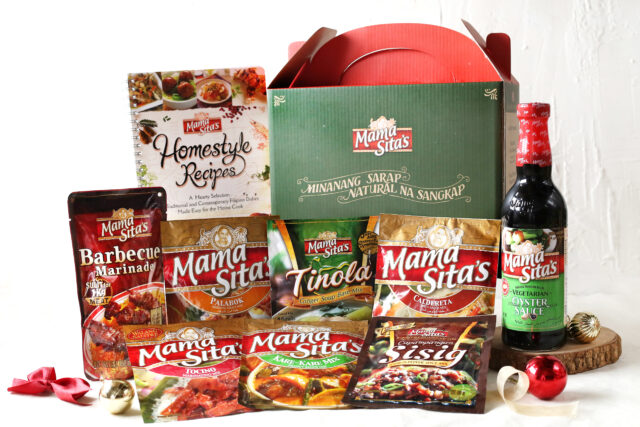
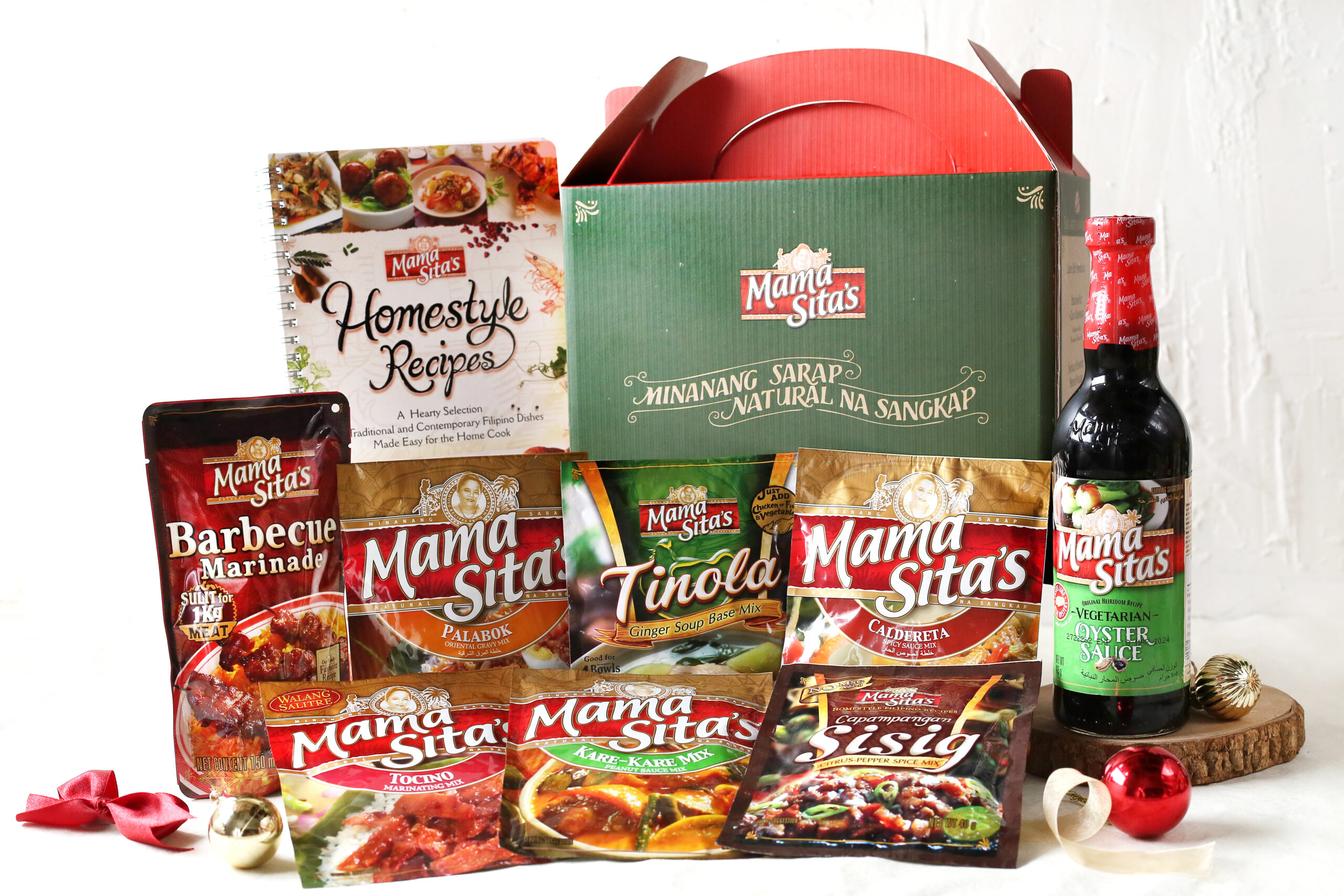
THIS year, Mama Sita’s has six Christmas hampers to choose from. The Budget Pack Bundle contains classic picks that offer great value (P300); the Everyday Cooking Basket is meant to help inspire home cooks with every day culinary items (P400); the Fiesta Collection is a gift of celebration dishes to make parties and gatherings merry and memorable (P500); the All-time Paborito Box puts together all-time favorite dishes (P500); the Lutong Bahay Package offers everyday cooking flavors (P650); and the Homestyle Bundle has a selection of favorite seasonings and spices (P1,000). The Christmas hampers are packaged in baskets styled to suit the season. The All-time Paborito Box comes in a specially printed Mama Sita’s Christmas box. There is a five-day lead time for orders to be prepared. The Christmas hampers shall be available up to Dec. 20. Orders made beyond this date will be delivered in January 2023. Special discounts include 7.5% off for orders of five hampers or more, and 10% off for orders at 10 or more sets. Each gift pack also comes with special cook booklets from Mama Sita’s — Homestyle Recipes, Everyday Recipes, and Easy Vegetarian Recipes. Interested gifters may contact R-J Quito at 0956-759-1507 or Joanna Tacdol at 0917-815-4565 or e-mail info@msita.com.


KFC’s Secret Menu is real and available

AFTER posts about the existence of a KFC Secret Menu made the rounds on social media groups, KFC has announced that the Secret Menu is real. The KFC Secret Menu is exclusively available when a customer orders via the KFC website or app and GLife, or calls their hotline at 887-8888. There are currently four main offerings in the Secret Menu: KFC Double Zinger, KFC Sloppy Shots, KFC Naked Twister, and KFC Colonel’s Belgian Bites. The Double Zinger features two Zinger patties in one spicy sandwich. The KFC Sloppy Shots features KFC’s signature fries drenched in Original Recipe gravy, and topped with corn and cheese. The Naked Twister is a deconstructed version that dispenses with the classic tortilla wrap to become a bowl of shots with veggies and special dressing. KFC’s Colonel’s Belgian Bites is a bucket of 12 bite-sized donuts filled with Belgian chocolate filling, and coated with chocolate.


Muji launches holiday drinks

JAPANESE lifestyle brand Muji has launched its first holiday drinks in the country. The new drinks are Ginger Cinnamon Latte, Peppermint Cafe Latte, Peppermint Mocha Latte, and Ichigo Lychee Earl Grey Iced Tea. All coffee-based drinks can be enjoyed as hot and cold drinks. Ginger Cinnamon Latte is an espresso-based drink with flavor hints of ginger and cinnamon, finished off with a dash of cinnamon powder on top. The Peppermint Cafe Latte is an espresso-based drink with milk and Muji’s signature mint flavored syrup. It also comes in another variant — Peppermint Mocha Latte, a refreshing blend of espresso, mint, and chocolate syrup. The last on the holiday line-up is the Ichigo Lychee Earl Grey Iced Tea, an Earl Grey tea based iced tea infused with strawberry and lychee sauces. These holiday drinks are available only until Jan. 15, 2023. To try these new drinks, customers may visit Muji’s Coffee Counter located inside Muji Central Square, BGC, Taguig.


Baked treats at Richmonde Hotel Ortigas

RICHMONDE Hotel Ortigas. Executive Chef Tristan Galang and his kitchen team have prepared baked treats and savory pies for holiday celebrations and gift-giving this season. There are Special Hotbox Platters packed in self-heating containers that are meant for sharing at home celebrations and potluck parties: Salmon en Croute (P2,800), Cottage Pie (P2,400), Shepherd’s Pie (P2,555), Chicken Pot Pie (P1,650), and Potatoes au Gratin (P1,620). For sweeter options, there are Richmonde’s Signature Moist Chocolate Cake (from P250), Flourless Chocolate Cake (from P515), and Red Velvet Cheesecake (from P395), all decked out with Christmas designs. Also available are fresh-from-the-oven breads — Banana Walnut Bread (P335), Creamy Spinach Baguette (P360), Cranberry Babka (P320), and Coffee Bun (P364/box of four). Or elevate toast with Richmonde’s Herbed Butter (P200) and Bacon Jam (P265) spreads. Richmonde’s signature year-round hits are still available for gifting: the Plain Ensaymada (P195) and Ube Ensaymada (P225). Two new variants, the Pork Floss Ensaymada (P250) and Alcapone Ensaymada (P275) are making their debut this season. There are also Mini-Ensaymadas in boxes of four pieces (Plain, P275; Ube, P315) and nine pieces (Plain, P600; Ube, P685). Christmas Hampers — filled with an assortment of Richmonde’s breads and homemade spreads and packed in an elegant see-through box — come in two sizes. The Box of Freshly Baked Bliss (P1,750) is good for three to five persons and contains one creamy spinach baguette, one braided rosemary loaf, two coffee buns, one mini pork floss ensaymada, one mini alcapone ensaymada, one jar of herbed butter, and one jar of bacon jam. The Hamper of Holiday Happiness (P2,250), on the other hand, is good for six to eight persons with bigger versions of the breads in the Box of Freshly Baked Bliss, plus a loaf of cranberry babka. The holiday goodies are on display at Richmonde Ortigas’ Lobby Café and the hotel’s official Facebook page which has the complete catalogue. Items are available for pickup and delivery until Jan. 8, 2023, with advance orders and prepayment. Lead time of at least 48 hours is required and bulk orders may be arranged. For inquiries and orders, call (632) 8638-7777, SMS or Viber 0917-534-4352, e-mail fbsup@richmondeortigas.com, or message @Richmonde Hotel Ortigas on Facebook and Instagram.


Mang Inasal has Christmas dine-in deals, party specials

FOR this month, grill restaurant Mang Inasal offers Ihaw-Sarap ChristmaSAYA Dine-In Deals plus more ChristmaSARAP meals that work for at-home, in-office, or outdoor parties. Dine at Mang Inasal stores nationwide from Dec. 1 to 31 and save P20 by ordering the Ihaw-Sarap ChristmaSAYA Dine-in Deals. Choose from either a Chicken Inasal Paa or Pecho combo, with both options served with unlimited rice, extra creamy halo-halo or crema de leche halo-halo, and a medium-sized drink. Meanwhile, the ChristmaSARAP meals are takeout and delivery options for group dining. There is the Mang Inasal Family Fiesta, a special bundled group meal composed of char-grilled favorites Chicken Inasal, Pork BBQ, or Grilled Liempo. Starting at P709 for takeout, you can choose from four different combos. Each bundle comes with a platter of Java rice, toyomansi, chili, chicken oil, plus peanut sauce for the Pork BBQ. Perfect for big group parties are Mang Inasal’s Siksik sa Sahog, Siksik sa Sarap Palabok, extra creamy halo-halo, and crema de leche halo-halo that is made special with leche flan, macapuno, and caramelized banana. Delivery orders can be made via the Mang Inasal Delivery App, http://manginasaldelivery.com.ph/, GrabFood, or foodpanda.

AUB, Alipay+ plan e-wallet for cross-border payments

FREEPIK

ASIA United Bank Corp. (AUB) has partnered with Alipay+ to enable the bank’s e-wallet, HelloMoney, for cross-border transactions and to provide an efficient payment experience for users whenever they go out of the country.

In a statement on Wednesday, AUB said the move makes it the first Philippine lender with an e-wallet that can be used overseas. HelloMoney will be made acceptable first in South Korea and Japan through the partnership. It will allow users to pay merchants that accept Alipay+.

AUB Executive Vice-President and IT & Operations Group Head Wilfredo Rodriguez, Jr. said that through the years, the bank has been building a “digital arsenal” of “pioneering initiatives and innovations.”

He said the bank’s end-to-end digital account opening enables clients to make banking easy through their mobile phones while allowing merchants to sustain their businesses as seen during the pandemic’s restricted mobility.

“With Alipay+’s global presence through its integration with local merchants worldwide, our HelloMoney users will have a wider reach in payment acceptance while ensuring a safe and secure digital transaction,” Mr. Rodriguez said.

About a million HelloMoney users would also be able to take advantage of more competitive exchange rates compared with prevailing market rates, the lender said.

As of October 2022, HelloMoney booked double-digit growth in transactions, rising by 45% to 19 million from last year. The value of transactions reached P63 billion or 49% higher than in 2021.

“AUB has been a long-term partner to Ant Group, and we are excited to extend the partnership further to enable its e-wallet’s cross-border operations through Alipay+,” Alipay+ Global Partnerships, Ant Group General Manager Jia Hang said.

Introduced by Ant Group, Alipay+ was designed to enable businesses to process a wide range of payment transactions and better serve regional and global clients.

“Despite it being a relatively young e-wallet, HelloMoney has garnered strong growth and adoption momentum among users. Through this partnership, users of HelloMoney can rely on the e-wallet when they travel overseas, too, without the hassle of carrying cash or change currencies,” Mr. Hang said.

AUB launched HelloMoney to let users digitally perform bank-to-bank fund transfers, buy prepaid load, remit money through PeraPadala, and transact using HelloMoney’s own virtual Mastercard.

The launch was followed by the release of Hello Pag-IBIG, the companion mobile app to the Pag-IBIG Loyalty Card Plus. In 2021, AUB introduced the HelloMoney Mastercard for online shopping.

AUB and its subsidiaries booked a net income of P1.7 billion in the third quarter, 70% higher than the P998.3 million booked in the same period in 2021, amid higher earnings from its core businesses.

This brought the group’s nine-month net profit to P4.6 billion, up 57% from the P2.9 billion a year prior, which it noted already surpassed its pre-pandemic performance.

The bank’s shares declined by 1.23% or 55 centavos to close at P40 apiece on Tuesday. — Keisha B. Ta-asan

ADVERTISEMENT
ADVERTISEMENT