Home Blog Page 5551

12 reasons why the Chery Tiggo 8 PRO 1.6T delivers the safest and most stress-free drive

In this age of pandemic, one of the most crucial aspects in the car-buying decision is safety—especially at a time when people are revenge-traveling and going back to face-to-face work and school.

And we’re not talking about your basic seatbelts, airbags, ABS, and crumple zones. We’re talking about features that will actively protect you and your loved ones by helping avoid or eliminate the risks that can lead to accidents. These are state-of-the-art smart features that will not only help prevent accidents before they happen, they actually help direct you away from situations that can lead to an accident. 

Which is why CHERY Auto Philippines has loaded its new 7-seater midsized SUV, the Tiggo 8 PRO 1.6 Turbo, with no less than 12 Advanced Driver Assist Systems (ADAS).

  1. Rear Cross-Traffic Assist – RCTA alerts you when another vehicle is approaching you just as you reverse out of a parking space
  2. Blind Spot Detection – BSD notifies you if a vehicle is approaching your blind spots on either side of your car
  3. Autonomous Emergency Braking – AEB automatically activates the brakes once it detects an obstacle and doesn’t receive any braking inputs from the driver
  4. Door Opening Warning – When DOW detects an oncoming car from behind as you or your passengers are about to go down from the car, the DOW automatically issues an alert 
  5. Forward Collision Warning – FCW detects objects ahead and alerts the driver for potential collisions
  6. Adaptive Cruise Control – ACC automatically adjusts your vehicle’s speed depending on the speed and distance of the vehicle in front
  7. Lane Keeping Assist – LKA helps the driver remain inside the marked lanes, which comes in handy during drives with low visibility or when temporarily blinded by other cars’ high beams
  8. Traffic Jam Assist – TJA serves as an extension of cruise control, but works in slow-moving traffic for enhanced comfort in gridlock situations. It will autonomously accelerate and brake the vehicle in traffic. 
  9. Integrated Cruise Assist – ICA constantly measures the distance to the vehicle in front of you in real time and automatically maintains a safe distance
  10. Intelligent High-Beam Control – IHBC automatically adjusts the headlights to maximize vision even in poorly lit roads
  11. Lane Departure Warning – LDW alerts you via audible alert and force-feedback when your vehicle inadvertently drifts to another lane—very helpful when the driver’s alertness is impaired due to fatigue or other factors 
  12. Traffic Sign Recognition – TSR alerts you when your speed exceeds that of posted speed limits

Over and above these 12 Advanced Driver Assist Systems, the Tiggo 8 PRO 1.6 Turbo offers an Anti-lock Braking System (ABS), Electronic Brakeforce Distribution (EBD), Electronic Stability Program (ESP), Traction Control System (TCS), Hill Assist Control (HAC), Hill Descent Control (HDC), Tire Pressure Monitoring System (TPMS), and ISOFIX child-seat tethers, among others.  

With all these smart safety features and Advanced Driver Assist Systems (ADAS), the new CHERY Tiggo 8 PRO 1.6 Turbo is convincingly one of the safest automobiles on the market.   

The Tiggo 8 PRO 1.6T is made even more irresistible with the brand’s industry-leading CHERY Premium Preserv consisting of a 7-year engine warranty, 7-year bumper-to-bumper general vehicle warranty, FREE 3-year preventive maintenance service (PMS), and FREE 3-year roadside assistance.

The CHERY Tiggo 8 PRO 1.6T has been a recipient of numerous awards and accolades globally, and was recently lauded as the Best Midsize Crossover by the respected C! Magazine.   

The all-new CHERY Tiggo 8 PRO 1.6 Turbo has a retail price of PHP 1,698,000. 

For more info, follow CHERY Auto Philippines (Facebook) and @cheryautophilippines (Instagram). You may also call the 24/7 CHERY Auto Philippines hotline at (0917) 552 4379 or email chery@uaagi.com for more inquiries.


Spotlight is BusinessWorld’s sponsored section that allows advertisers to amplify their brand and connect with BusinessWorld’s audience by enabling them to publish their stories directly on the BusinessWorld Web site. For more information, send an email to online@bworldonline.com.

Join us on Viber to get more updates from BusinessWorld: https://bit.ly/3hv6bLA.
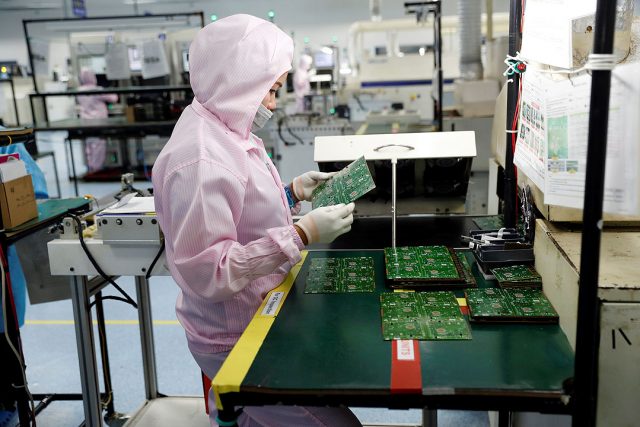
Factory activity inches higher in Nov.

REUTERS

By Luisa Maria Jacinta C. Jocson, Reporter

FACTORY ACTIVITY in the Philippines expanded for a tenth month in a row in November, although jobs fell for the first time since March, a survey by S&P Global showed on Thursday.

The S&P Global Philippines Manufacturing Purchasing Managers’ Index (PMI) inched up to 52.7 in November, from 52.6 in October, reflecting a “modest” pace of expansion.

“Growth across the Philippines manufacturing sector entered its tenth successive month, with modest expansions in operating conditions seen since September. The improvement across the sector primarily stemmed from greater demand conditions which drove higher sales and output,” Maryam Baluch, economist at S&P Global Market Intelligence, said in a report.

Manufacturing Purchasing Managers’ Index (PMI) of select ASEAN Economies, November 2022A PMI reading above 50 denotes improvement in operating conditions compared with the preceding month, while a reading below 50 signals deterioration.

The Philippines had the highest PMI reading among six Association of Southeast Asian Nations (ASEAN) economies in November, and exceeded the regional PMI average of 50.7.

Thailand had the second-highest PMI reading with 51.1, followed by Indonesia with 50.3. On the other hand, Malaysia (47.9), Vietnam (47.4) and Myanmar (44.6) all saw a contraction in November.

“Growth across the ASEAN manufacturing sector slowed again during November, with the latest PMI data signaling only a mild improvement in operating conditions. The slowdown reflected softer growth in output, while factory orders declined for the first time in 14 months,” S&P Global said.

JOBS DROP
S&P Global said the latest data signaled a sustained improvement in operating conditions in the Philippine manufacturing sector.

“Growth stemmed from greater demand which resulted in quicker expansions in production levels and factory orders. Buying activity also increased at a faster pace during November,” it added, noting that manufacturing output and factory orders grew for the third consecutive month.

However, the seasonally adjusted employment index fell below the 50 neutral mark, indicating a drop in employment numbers for the first time since March.

“Firms also recorded a reduction in staffing numbers during the latest survey period, thereby ending the run of job creation that began in May. Resignations among employees was commonly cited as a reason for the fall in workforce numbers,” S&P Global said.

Sales were also affected by sluggish export conditions.

“Weak foreign client demand weighed on total new order growth across the sector which was primarily driven by domestic demand. Nonetheless, the downturn in export sales softened from October’s recent low,” S&P said.

Firms ramped up their purchases of inputs for a third month in a row, as they anticipated more orders in the next few months.

“The rate of expansion quickened from October to the fastest in six months, and signaled a solid increase overall. Growth in output and buying activity resulted in stocks of inputs increasing during November. Businesses increased their holdings in anticipation of greater demand,” S&P said. 

Meanwhile, supply-chain disruptions were persistent during the month due to port congestion and material shortages, but the incidence of delays was at a three-month low.

Rising inflation pushed firms’ expenses higher.

“The rate of input price inflation gathered pace for the second month running, as higher energy costs were primarily blamed for the latest uptick in expenses. Similarly, output prices increased at a quicker rate during November as firms chose to pass costs on to clients,” S&P said.

The Bangko Sentral ng Pilipinas (BSP) expects inflation to range from 7.4% to 8.2% in November.

“While the manufacturing sector has shown strong gains during 2022, elevated price pressures pose an ongoing threat. Coupled with supply-chain issues, the peso weakening against the dollar adds further fragility,” Ms. Baluch said.

Ms. Baluch said rising interest rates and further monetary tightening may affect customer spending.

The BSP has raised rates by 300 basis points (bps) since May, bringing the benchmark rate to a 14-year high of 5%. It is widely expected to deliver another 50-bp rate increase at its December policy meeting.

Factory activity was impacted by “less upbeat” labor trends, as the decline in the seasonally adjusted labor index curbed potential growth, ING Bank N.V. Manila Senior Economist Nicholas Antonio T. Mapa said in a Viber message.

“This shows that the labor market recovery is still ways before we get back to pre-COVID levels,” he said.

Mr. Mapa also said that domestic demand fueled growth as the bulk of manufacturing is related to food items consumed locally. However, flat foreign demand reflected the slowdown in global trade, he added.

S&P Global said manufacturing firms are “strongly optimistic” of output growth in the next 12 months.

“Moreover, the degree of confidence strengthened in the month. This was often linked to greater client activity, the economy opening up and more firms undertaking new projects,” it added.

Rizal Commercial Banking Corp. Chief Economist Michael L. Ricafort said in an e-mail that increased production activities ahead of the holiday season would also boost manufacturing activity.

“Nevertheless, we are also sensing seasonal demand creeping into the main demand scene. I do expect the PMI to continue to be in expansion territory as we end the year,” UnionBank of the Philippines, Inc. Chief Economist Ruben Carlo O. Asuncion said in a Viber message.

The headline PMI measures manufacturing conditions through the weighted average of five indices: new orders (30%), output (25%), employment (20%), suppliers’ delivery times (15%) and stocks of purchases (10%).

WB sees slower growth in PHL remittances in 2023

Passengers wait inside the Ninoy Aquino International Airport Terminal 3 in Pasay City, Oct. 29, 2022. — PHILIPPINE STAR/ MIGUEL DE GUZMAN
Passengers wait inside the Ninoy Aquino International Airport Terminal 3 in Pasay City, Oct. 29. The growth in remittances is expected to slow next year amid a looming global economic slowdown. — PHILIPPINE STAR/ MIGUEL DE GUZMAN

By Keisha B. Ta-asan, Reporter

REMITTANCE INFLOWS to the Philippines are expected to rise by 3.6% this year, the World Bank (WB) said, but it sees growth slowing in 2023 as a looming global economic slowdown is likely to weigh on overseas Filipino workers’ (OFWs) ability to send more money home.

On the other hand, Bangko Sentral ng Pilipinas Governor Felipe M. Medalla said he expects OFW remittances “to be 4% to 5% higher (in 2022) than last year.”

In the latest World Bank Migration and Development Brief, the multilateral lender said remittance inflows to the Philippines are estimated to go up 3.6% to $38 billion this year.

The World Bank and BSP’s remittance growth forecasts are slower than the 5.1% annual expansion seen in 2021.

“(Remittance growth) reflected benefits of bilateral arrangements that the Filipino government forged recently with destination governments (including Saudi Arabia) to improve the treatment of Filipino workers,” the World Bank said.

The Philippines lifted the ban on the deployment of OFWs to Saudi Arabia in November. The ban was imposed in 2021 due to reports of alleged maltreatment of OFWs by Saudi employers.

The World Bank also said demand for skilled Filipino workers in the health and hospitality sectors also drove remittances higher.

“With nearly 40-60% of their emigrants employed in the United States and the United Kingdom, the Philippines and Vietnam benefited from the wage hikes and labor shortages in these countries, even as the pandemic-related stimulus subsidies were phased out and record-high inflation eroded their remitting ability,” it said.

According to the World Bank, remittances to low- and middle-income countries jumped by an estimated 5% to $626 billion this year, slower than the 10.2% increase in 2021.

This year, the Philippines is expected to be the fourth-biggest recipient of remittances, after India ($100 billion), Mexico ($60 billion) and China ($51 billion).

India is the first country on track to receive more than $100 billion in annual remittances, the World Bank said.

Remittances to East Asia are projected to have inched up 0.7% to $134 billion in 2022, reversing the decline in the last two years. Excluding China, remittances to the region likely went up 3.7%.

“Migrants help to ease tight labor markets in host countries while supporting their families through remittances. Inclusive social protection policies have helped workers weather the income and employment uncertainties created by the COVID-19 (coronavirus disease 2019) pandemic. Such policies have global impacts through remittances and must be continued,” Michal Rutkowski, World Bank Global Director for Social Protection and Jobs, said in a statement.

SLOWER GROWTH
The World Bank said remittances may grow at a slower pace of 2% to $639 billion in 2023, as a global slowdown may slash migrants’ wage gains in host countries.

“Downside risks, including a further deterioration in the war in Ukraine, volatile oil prices and currency exchange rates, and a deeper-than-expected downturn in major high-income countries, are substantial,” it added.

The World Bank expects the growth of remittance inflows to the Philippines to ease to 2% to $39 billion in 2023.

An economic slowdown and a cost-of-living crisis in migrants’ destination countries will likely affect remittance inflows to East Asia, including the Philippines.

“Real GDP growth in high-income countries is projected to halve from 2.4% to 1.1%, with inflation remaining high at 4.4%. This will curtail East Asian migrants’ ability to remit, especially if job losses occur,” it said.

The World Bank noted lower oil prices may dampen remittance growth from Middle East countries to East Asian nations. Slower demand for East Asia’s manufactured exports “is expected to depress remittance flows to the lower-income East Asian countries,” it added.

Higher-income East Asian countries like China, Malaysia and Thailand, which export manufactured goods, usually employ migrants from lower-income countries like the Philippines.

“When global demand for manufactured products slumps and migrants loses their jobs, remittance flows to the lower-income countries are adversely affected. The combined impact of these factors suggests that remittance growth in East Asia will be marginally negative (-1%) in 2023 with inflows totaling $133 billion,” the World Bank said.

Excluding China, remittances to East Asia are expected to grow “sluggishly” or 0.8% to $84 billion from $82.9 billion in 2022, the World Bank said.

Foreign chambers targeting $128-billion investments by 2030

Philippine flags are displayed along the streets, June 3, 2022. — PHILIPPINE STAR/EDD GUMBAN

By Revin Mikhael D. Ochave, Reporter

THE JOINT Foreign Chambers of the Philippines (JFC) is now targeting to generate $128 billion in foreign direct investments (FDIs) in the Philippines by 2030.

“We set the target to $50 billion (in 2020) and now it’s at $78 billion. So we have raised it. Make it a total of $128 billion (target) by the end of 2030,” Ebb Hinchliffe, American Chamber of Commerce of the Philippines (AmCham) executive director, said during a press conference in Makati City on Thursday

According to Mr. Hinchliffe, the JFC is banking on more investments in renewable energy, agriculture, and manufacturing to reach its 2030 target.   

He said the target will be achievable especially with the passage of laws amending the Public Service Act (PSA), Retail Trade Liberalization Act (RTLA), and Foreign Investment Act (FIA).

The law amending the PSA effectively allows foreigners to fully own public services such as railways, telecommunications, shipping, air carriers and subways.

“Energy will be a big part. I know there is a lot of interest on the energy side especially as we shift away from coal to renewable energy. I think the recently issued implementing rules and regulations (IRR) on renewable energy (RE) is bigger than the PSA,” Mr. Hinchliffe said.   

The Department of Energy (DoE) last month issued a circular amending the IRR of the Renewable Energy Act of 2008 to allow 100% foreign capital in RE projects. Section 19 of the IRR had previously limited foreign ownership of RE projects to 40%.

The DoE earlier said the circular now paves the way for foreign nationals and foreign-owned entities to explore, develop and use RE resources in the country such as solar, wind, biomass, ocean or tidal energy.

“Manufacturing is coming. I think there will be more investments in the semiconductor and electronics field. We’ve learned our lesson on chips. Agriculture is a tremendous opportunity especially on technology and software to help farmers increase productivity. Infrastructure also. We have a lot of infrastructure projects being done,” Mr. Hinchliffe said.

In terms of projected job generation from these new investments, Mr. Hincliffe said that it may vary depending on the sector.   

“I think it’s just about the same ratio. It depends on the sectors. We saw a lot of foreign investment into the business process outsourcing (BPO) industry. And what we need now is an investment into the manufacturing sectors,” Mr. Hinchliffe said.   

Lars Wittig, European Chamber of Commerce of the Philippines (ECCP) president, said recent economic reforms would also attract more investments into the Philippines.   

“It should also be mentioned that the game-changing reforms that we have seen within the last 18 months affecting big investment industries, and the most recent taking effect also this month, the IRR regarding sustainable energy, these will result in billion-dollar investments from Europe alone,” Mr. Wittig said.

“We believe that a highly experienced and competent economic team is in place and we trust they will manage appropriate interventions to influence inflation, supply chain blockages, and similar major challenges and headwinds to economic growth,” he added.   

Bradley Norman, Australian-New Zealand Chamber of Commerce Philippines, Inc. (ANZCHAM) vice-president, said the JFC is optimistic of the economy’s recovery.

“We are optimistic with respect to the performance of the Philippines and that optimism hasn’t changed…We still see that the Philippine economy is going to grow very strongly,” Mr. Norman said.   

The Philippines’ gross domestic product (GDP) rose to 7.6% year on year in the third quarter, bringing the nine-month GDP growth to 7.7%. Economic managers are confident GDP growth will exceed the 6.5-7.5% target for this year.

“It will encourage FDIs and of course they will as well for employment. Just how much employment and how that employment relates to the FDI figure is really something that you can’t calculate. We’re very positive that the Philippines is heading in the right direction,” he added.   

MAHARLIKA FUND
Meanwhile, several JFC members said that they are neutral about the lawmakers’ proposal to create a sovereign wealth fund called the Maharlika Investments Fund (MIF).

Mr. Wittig said that the JFC is monitoring the developments on the fund, adding that they are waiting on further details regarding the proposal.   

“(We are) neutral for now. We are monitoring it. We are learning more. We don’t have many details yet. It’s a big issue with a few details on the table,” Mr. Wittig said.   

Mr. Norman added that the ANZCHAM supports the proposed creation of the MIF if it would spur more opportunities for the mining industry.   

“From our point of view, we are very supportive of mining and if a sovereign wealth fund being set up would create further mining opportunities, then it’s something that we would look at,” Mr. Norman said.   

Mr. Hinchliffe added that he is still uncertain on the importance of the proposed sovereign wealth fund.   

“I don’t know how necessary it is in the Philippines or how it is going to work,” Mr. Hinchliffe said.   

On Tuesday, the House Committee on Banks approved “in principle” House Bill No. 6398 seeking to create the sovereign wealth fund.

Sovereign wealth funds are usually funded by proceeds sourced from commodity exports such as oil.   

JFC members include the AmCham, ANZCHAM, ECCP, Canadian Chamber of Commerce of the Philippines, Japanese Chamber of Commerce of the Philippines, Korean Chamber of Commerce Philippines, and the Philippine Association of Multinational Companies Regional Headquarters, Inc.

Gov’t urged to extend devolution transition for LGUs

Workers prepare relief packs in Pasig City, Aug. 13, 2021. — PHILIPPINE STAR/ MICHAEL VARCAS

LOCAL GOVERNMENT units (LGUs) should be given more time for the smooth transition of devolved functions from the National Government (NG) agencies, according to a report.

A Mandanas-Garcia Ruling Transition Report by the Department of the Interior and Local Government (DILG) and the United Nations Development Programme (UNDP) in the Philippines called the implementation of the transition program from 2022-2024 “highly ambitious.”

“The implementation of this transition in the midst of the COVID-19 (coronavirus disease 2019) pandemic greatly amplifies the risks of failure and unintended consequences of the move,” the report said. 

“In the given context, a more incremental approach towards full decentralization, such as by expanding the three-year transition to a six-year span to coincide with a full presidential term,” it said, noting that the current period is aligned with the term of local officials elected in 2022.   

Extending the timeline for the transition would also mean a more gradual transfer of programs from NG agencies to LGUs within that period.

“A longer and more phased transition will also allow the both national and local government agencies to build/transfer the necessary capacity to ensure the continuity of performance in service-delivery responsibilities, as well as to course-correct for unintended consequences,” the report said.

The Supreme Court’s Mandanas-Garcia ruling granted LGUs a larger share of the national taxes by expanding their 40% cut to also include revenues from Customs duties, and not just those collected by the Bureau of Internal Revenue.

Last year, President Rodrigo R. Duterte signed Executive Order (EO) 138 which transfers a number of basic services to LGUs by 2024.   

With this, the government has shifted programs and projects, worth an estimated P234.4 billion, to LGUs.

During the report’s event launch on Wednesday, Jerik Cruz, co-author of a study called “From Dependency to Autonomy,” said there is a need to further boost LGUs’ capacity amid the transition to full devolution.

“They’re not able to adapt as well as we would like them to new and challenging circumstances. And partly related to this is what we found to be the surprising level of the lack of digitization of local governments,” Mr. Cruz said.

“Their ability to harness new digital technologies has not yet been maximized. We find that there tends to be a very big inequality among local governments where already capable local governments are able to tap into them whereas those which are poorer and left behind, generally are unable to make the most of them,” he added.   

Mr. Cruz said in their surveys of LGU budget officers, the biggest constraint in relation to spending is the lack of investment funds and resources, followed by a lack of staff.    

“So, we may see as a result of Mandanas ruling based on certain parts of the survey, that we may find greater inequality among local governments, where high performing local governments especially the highly urbanized cities, tend to pull away from the rest. Whereas those who are poorer and lower performing to begin with, especially municipalities, tend to fall behind further,” Mr. Cruz said.   

He emphasized that strengthening the LGUs’ local fiscal autonomy is possibly “one of the most neglected pillars of strong good local governance.”

“It’s not a silver bullet. But for most of the concerns that have been raised about the Mandanas ruling such as possibly challenges with budget execution, challenges with capacity, accountability, strengthening their own fiscal autonomy will help address every single one of those objectives,” he said.   

“We do recommend that we consider a lengthening of the transition from three years to six years so as to coincide with the full presidential term. A gradual transition in this way will give local governments more time to augment their capacity,” he added.   

Meanwhile, Cielo D. Magno, author of the study titled “Breaking Down the LGU Fiscal Performance,” said underspending among local governments is a main concern that needs to be addressed.   

“The Mandanas-Garcia ruling is expected to increase the budget of local government units and if we’re not able to address the constraints, we will expect LGUs to continue with the lower budget execution rates and lower budget execution rates mean underperformance or delay in service delivery,” Ms. Magno said.   

According to their study, LGUs have not been able to fully utilize their resources to combat the threat of COVID-19, climate related disasters, and other conflicts.

Between 2015 to 2018, LGUs utilized about 80% of their budgets on average, with cities having the lowest utilization rate at 72.7% and municipalities at the highest at 79.2%.   

“If we are not able to address this, LGUs will not be able to keep up with the increase in their current budget and they will tend to keep pushing balances to the following year. And this will also affect the quality-of-service delivery at the local level,” she added.   

The study recommends the government to review fiscal transfers and assignment of functions to LGUs. It should also review procurement policies particularly around capital outlay and boost oversight as enabler of good governance and delivery. — Keisha B. Ta-asan

SEC warns public about three unlicensed investment-takers

IN separate advisories, the Securities and Exchange Commission (SEC) has warned the public not to invest in CashBaka, Hero Mining International Group, and BitBankUps.com as the three entities have not secured the license to solicit investments.

According to the regulator, the three are neither registered as a corporation nor a partnership with the SEC. It also found them to have been soliciting investments without securing the necessary license as prescribed under the Securities and Regulation Code.

CashBaka has been promising the public a 150% to 200% interest within 30 days and a return of capital within 15 days. Investors who put in P500 are promised to get a P25 income per day, while those who put in P10,500 are told to expect a P2,170 income per day.

Meanwhile, Hero Mining offers seven investment options to its investors, starting from $10 up to $789, depending on the chosen scheme. Investors are promised to earn from P1,000 up to P144,905 with a 60% bonus from the profit of every successful recruit.

BitBank has been enticing the public to invest in its virtual currency called BBT.

According to the SEC, the entity has been promising a guaranteed profit through commissions with an initial capital of $100 to $5,000 in the form of a US dollar-pegged cryptocurrency like Tether.

Investors of BitBank were also promised referral bonuses each time they successfully recruited an individual to invest.

In a separate advisory, the commission also warned the public to not engage in advance-fee loan scams wherein victims are asked to pay a certain amount in exchange for the release of a loan.

“An advance-fee scam is a form of fraud and one of the most common types of confidence trick,” the SEC.

According to the regulator, the scam promises the victim a large sum of money, in return for a required small up-front payment.

“If a victim makes the payment, the fraudster either invents a series of further fees for the victim or simply disappears,” the SEC explained.

The commission said that people who are engaged in these scams are liable for the violation of Article 315 on swindling under the Revised Penal Code of the Philippines. — Justine Irish D. Tabile

D.M. Consunji’s order book down 8% as projects ease

SHIVENDU SHUKLA-UNSPLASH

D.M. CONSUNJI, Inc.’s (DMCI) order book declined by 8.1% to P45.3 billion for the past three quarters from P49.3 billion in the same period last year amid a slowdown in project bidding and contract awarding.

In a press release on Thursday, its parent firm DMCI Holdings, Inc. said the “moderate” decrease was recorded for both the private and public sectors. It said the unit recorded P8.4 billion worth of contracts and P1 billion in change orders for the nine-month period.

“[The order book] was a bit lower than last year, but next year there’s a lot in the pipeline,” D.M. Consunji President and Chief Executive Officer Jorge A. Consunji told reporters in a recent gathering.

The company recorded P13.3 billion in construction accomplishments as of September this year.

According to Mr. Consunji, the contractor expects headwinds over the medium term amid high inflation, rising interest rates, and higher office and commercial vacancies.

“Public infrastructure projects could provide some upside but it would still depend on the rollout strategy and spending priorities of the national government,” he said in the press release.

In the nine-month period, D.M. Consunji posted P796 million net income, higher by 1.4% than the P785 million income it recorded last year.

“As far as profit is concerned, it is not ideal because [we were hit by] price volatility. It could’ve been better, but we are positively better than last year,” Mr. Consunji said.

Meanwhile, the company’s nine-month revenue declined by 7% to P15.33 billion from the P16.48 billion revenue it booked last year.

“If you talk about revenue, it will be slightly lower than last year because na-delay kami sa mga right-of-way (we were delayed by right-of-way issues),” he said.

According to Mr. Consunji, although the contractor did not reach its 2022 targets due to fuel price increases and foreign exchange losses, he remains optimistic about the company’s performance in 2023.

“We expect [next year to be] a little better than this year,” he said. “Remember we are doing some jobs with joint ventures — Department of Transportation, [and] Japan International Cooperation Agency — [as long as the projects acquire the] right of way as they promised, we’re okay.”

Mr. Consunji said that the company held back on some of its projects this year as the promised right-of-way acquisitions were not all awarded.

On Thursday, shares in DMCI Holdings rose 1.56% or P0.15 to close at P9.75 apiece. — Justine Irish D. Tabile

Century Properties to open mid-scale hotel in Manila

CENTURY-PROPERTIES.COM

PROPERTY developer Century Properties Group, Inc. (CPGI) is set to open a mid-scale hotel in Mandaluyong City on Dec.15, targeting to cater to tourist influx during the holidays.

“December is an opportune time for Novotel Suites Manila to open as Century Properties can actively participate and address the demand surge for tourism and leisure travel,” CPGI President and Chief Executive Officer Jose Marco R. Antonio said in a press release.

According to Mr. Antonio, the opening of the new hotel is in line with the government’s thrust of promoting the tourism industry.

He also noted that the hotel is expected to meet the growing demand for intimate gatherings in the area coming from the increasing number of multinational companies in Taguig and Makati.

The hotel will sit at a master-planned development called Acqua in Brgy. Hulo, Mandaluyong City, which will make it accessible through various points in the cities of Makati and Mandaluyong.

It will house 152 rooms and will be jointly owned by Century Properties and Century Acqua Lifestyle Corp. The hotel’s upper floors will be allocated for residential condominium units, which are all pre-sold.

The hotel, which was conceptualized with an augmented hospitality group called Accor, will be the sixth and final tower of Acqua Private Residences.

The rooms it will offer will range from 32 square meters (sq.m.) to 87 sq.m. The hotel will also have a pool, restaurant and bar, lounge café, pastry shop, fitness center, and meeting rooms suitable for small-scale events.

Novotel Suites Manila is the pilot hospitality development for Century Properties as it has been originally known for its high-rise condominiums.

“We are proud to carry the Novotel name, along with other 500 establishments globally. It’s a trusted brand, known for excellent rooms and service. It’s our pleasure to work with Accor,” Mr. Antonio said. — Justine Irish D. Tabile

What’s in store for Disney in 2023? A lot.

WISH

SINGAPORE — with titles ranging from Hollywood films to Hallyu and Japanese animé, The Walt Disney Company Asia Pacific unveiled its slate of upcoming movies, series, and new Asia Pacific region titles for Disney+ and Disney+ Hotstar for 2023.

The global titles that are set for release next year from Marvel Studios are Ant-Man and the Wasp: Quantumania (Feb. 17), The Marvels (July), Secret Invasion (streaming on Disney+), Guardians of the Galaxy Vol. 3 (May 5), and Loki Season 2.

Meanwhile, Walt Disney Animation Studios will stream Wish, and Iwaju on Disney+. Pixar will release Elemental on June 6. Walt Disney Pictures will come out with the live action The Little Mermaid in May and Haunted Mansion in August. And Lucasfilm has a slew on its slate: The Mandalorian Season 3, Ahsoka, Star Wars: The Bad Batch Season 2, The Acolyte, and Star Wars Visions Volume Two, all of which will be streaming on Disney+. It will be releasing Indiana Jones 5 in movie theaters on June 30.

The showcase of titles closed with James Cameron’s sequel to Avatar, his 2009 blockbuster. Avatar: The Way of Water stars Zoe Saldana, Sam Worthington, Sigourney Weaver, Stephen Lang, Cliff Curtis, Joel David Moore, CCH Pounder, Edie Falco, Jemaine Clement, and Kate Winslet. The film will open in Philippine theaters on Dec. 14, and go into wide release globally ono Dec. 16.

“The Walt Disney Company has brought iconic stories and characters to consumers all over the world, becoming a part of global culture,” The Walt Disney Company President Asia Pacific Luke Kang said at the Disney Content Showcase 2022 at Marina Bay Sands in Singapore on Nov. 30.

APAC ORIGINALS
The company also announced its upcoming content from Japan, Korea, Indonesia, Australia, and New Zealand.

“Over the last year, the total streaming hours of Asian content on Disney+ has grown over eight times,” Mr. Kang pointed out, adding that the local production is done “with the ambitious long-term plan to uncover the best stories from this region and to showcase creative excellence to shine on the world stage.”

Titles from Korea range from crime dramas, a family opera, and a tale of superheroes, to K-pop documentary series.

Call It Love, directed by Lee Kwangyoung, is about a mistreated daughter who seeks revenge on her father’s mistress after his sudden death. Meanwhile, Moving — which is based on a popular webtoon by Kang Full — tells the story of three teenagers who discover they’ve inherited unusual powers from their secret agent parents. Set in the 1990s is Worst of Evil, which follows an investigative task force as their undercover officer infiltrates a new criminal organization responsible for fueling a trafficking triangle. RACE is about a mediocre employee who suddenly works harder after discovering she was hired at her top-tier publicity company for diversity reasons.

Super Junior: The Last Man Standing takes viewers behind-the-scenes with the members of the K-pop supergroup, offering new insights into the modern K-pop industry. BTS Monuments: Beyond the Stars is an exclusive Disney+ original music docu-series featuring the group’s library of music and footage over the past nine years. It will also feature the daily lives, thoughts, and future plans of BTS members. Finally, j-hope Solo Documentary (its working title) follows pop star j-hope in the preparation process of his recently released solo album.

The upcoming titles from Indonesia are Hubungi Agen Gue! (The Talent Agency), an adaptation of the hit French series Dix Pour Cent  (Call My Agent!). The comedy follows four agents in an Indonesian talent agency as they struggle to save the business following the unexpected death of the company’s founder. Meanwhile, Wedding Agreement The Series Season 2 returns with Refal Hady and Indah Permatasari.

There are two titles from Australia and New Zealand. The Artful Dodger is a drama set in the frontier colonies of Australia in the 1850s. Across eight episodes the scripted series explores the adult double life of Charles Dickens’ famous prince of thieves from Oliver Twist — The Artful Dodger — who is now a surgeon who can’t shake his predilection for crime. Meanwhile, the psycho-thriller The Clearing is based on J.P. Pomare’s acclaimed novel In the Clearing, which was inspired by cults throughout history.

ANIMÉ COLLABORATION
The Walt Disney Company Asia Pacific also announced the expansion of its strategic collaboration with Japanese publishing house Kodansha to include Japanese animé. The collaboration will include licensing exclusive SVOD animé titles based on manga produced by Kodansha that will be available exclusively on Disney+ and Disney+ Hotstar.

The first title to be released as part of the collaboration is Tokyo Revengers: Christmas Showdown Arc. It follows a former bad boy who uses his accidentally acquired powers of time travel to go back and save his high school girlfriend from being murdered.

Another title from Japan is the live-action adaptation Gannibal, the manga about dark and mysterious disappearances in a remote Japanese village. Co-produced by Teruhisa Yamamoto (producer of Academy Award winner Drive My Car) and Tatsuya Iwakura, and adapted for the screen by Academy Award nominee Takamasa Oe (Drive My Car), the series will launch on Dec. 28.

Finally, there is the original live action and fantasy series Dragons of Wonderhatch and House of the Owl. Dragons tells the story of a high school girl who struggles to fit in before being swept up on an adventure with a boy from another world. House of the Owl follows Japan’s number one fixer who faces his most daunting challenge in dealing with a chain of events that could forever change Japan’s politics, all while unable to control his family.

“Our aspiration is for these stories in the Asia Pacific region to be a key pillar to the Walt Disney Company’s next 100 years and to continue to move the hearts and minds of audiences worldwide,” Mr. Kang said. — Michelle Anne P. Soliman

NLEX Corp. keen on 1.2-km interconnection link 

NLEX Corp. is willing to build the 1.2-kilometer (km) link that is under the concession agreement between the government and San Miguel Corp. for the Metro Manila Skyway System.

NLEX Corp. is the toll road operator and builder of the North Luzon Expressway (NLEX) and Subic–Clark–Tarlac Expressway (SCTEX). It is a subsidiary of Metro Pacific Tollways Corp. (MPTC).

In a briefing on the NLEX Connector’s update, MPTC Chief Financial Officer Christopher Daniel C. Lizo expressed the group’s interest to build the interconnection structure.

“The Toll Regulatory Board can always amend their concession. The government can award to us the 1.2-km interconnection link,” he said.

According to NLEX Corp., the link is a vital part of the 8-km NLEX Connector project for it to be connected to the Skyway.

If awarded, MPTC expects the additional 1.2-km road to cost P2 billion, which will increase the total cost of the entire 9.2-km road to around P19 billion.

Edward F. Castro, NLEX Corp. head engineer for the NLEX Connector project, said that the interconnection link and the connector road should have already been finished.

Lahat naman kami sumobra sa timeframe because of the pandemic, kasi lahat ng usapan prior to pandemic, (All of us exceeded the timeframe because of the pandemic because all of the talks happened prior to the pandemic),” Mr. Castro said.

Sana kapag natapos itong connector road, matapos din sila to interconnect the two projects, (We hope that when we complete the connector road, they will also finish so that we can interconnect the two projects),” he added.

NLEX Corp. is targeting to open the first section of the connector road by December. The section will span from Caloocan to España. The company has already acquired 97% of the right-of-way needed for the first section and 86% for the second section.

The second section — Magsaysay Blvd. to Sta. Mesa — is expected to be fully opened by mid-February of 2023. The entire project is seen to be completed by mid-April of 2023.

The connector project aims to decongest the major thoroughfares in Manila such as España Blvd., Abad Santos Ave., Rizal Ave., and Lacson Ave. It is also expected to reduce travel time from NLEX to South Luzon Expressway from two hours to 20 minutes. — Justine Irish D. Tabile

Disney CEO Iger makes profitable streaming a priority

MIKA BAUMEISTER-UNSPLASH

WALT DISNEY Co. Chief Executive Bob Iger said on Monday that one of his top priorities is to make the company’s streaming business profitable.

Mr. Iger is responsible for Disney’s all-in embrace of streaming, and the launch of its marquee service, Disney+, but he acknowledged the measurement of success has changed. Wall Street investors now focus on profitability, not merely subscriber gains.

“Instead of chasing (subscribers) with aggressive marketing and aggressive spend on content, we have to start chasing profitability,” Mr. Iger told a town-hall meeting on the company’s Burbank, California, lot, according to a transcript of remarks seen by Reuters.

“In order to achieve that, we have to take a very, very hard look at our cost structure across our businesses.”

Disney joins a number of media companies seeking to grow their streaming services without sacrificing its film or television businesses.

The board announced it had installed Iger as chief executive on Nov. 20 after removing his handpicked successor, Bob Chapek, who had lost the support of senior staff.

“Filled with gratitude and excitement to be back @WaltDisneyCo!,” Mr. Iger tweeted on Monday with a picture of the company’s headquarters.

From a sound stage on Disney’s lot, Mr. Iger said he returns to the company he led for 15 years with a sense of urgency. He said he had recently been listening to Lin-Manuel Miranda’s musical Hamilton, and was struck by the song “What’d I Miss?,” as Thomas Jefferson, the US minister to France, is called home.

“The status quo is gone. A lot has changed. But the sun is still shining,” Mr. Iger said.

Mr. Iger, in a question-and-answer session, said it was a “surprise” to have been asked to return to Disney for a two-year period. His top focus, he said, is creativity.

His predecessor, Mr. Chapek, had a rocky tenure at Disney’s helm, even as he was credited with navigating the company through the worst of the pandemic.

Mr. Chapek clashed with Black Widow star Scarlett Johansson over the decision to simultaneously release the film in theaters and online, and with Florida Governor Ron DeSantis over legislation limiting classroom discussion of sexual orientation or gender identity.

Disney also has been under pressure from activist investors, who have been pushing for change.

Mr. Iger said he planned to keep a hiring freeze, which Mr. Chapek instituted, in place, while he assesses Disney’s cost structure. He offered no timing on the restructuring of the company’s film and television distribution group, Disney Media and Entertainment Distribution. CNBC was the first to report details, which Reuters independently confirmed.

Asked about Disney’s initial attempts to remain neutral on a Florida law that critics refer to as the “Don’t Say Gay” bill, Mr. Iger reiterated his commitment to the company’s LGBTQ+ employees — “we care deeply about them. That is a given.”

The returning chief executive declined to respond to speculation that Disney might explore a sale to Apple Inc., noting, “We never comment on acquisitions or divestitures or whatever. You can quickly get into a lot of trouble there — and I don’t want to leave this job and end up in jail.”

Mr. Iger left the stage to a standing ovation, according to one person who attended the session. — Reuters

Meet the Fabels

GABRIEL LABELLE in a scene from The Fabelmans.

Movie Review
The Fabelmans
Directed by

Steven Spielberg

ARGUABLY Steven Spielberg doesn’t need to do an autobiographical film, he’s been doing them all his life — Sugarland Express features a mother as a driven force of nature, Jaws includes the subplot of ship’s captain bullying a nerdy scientist, Close Encounters of the Third Kind follows a man so obsessed with his quest that he abandons his family, ET described a lonely child with his head crammed full of dreams, and, as it turns out, Duel and 1941 (knew it!) allude to one of his most formative traumas — the massive car-and-train collision in The Greatest Show on Earth, which he saw as a child. That said, Spielberg at this point in his career insists on an autobiographical feature — a direct one this time — hence The Fabelmans.

Spielberg’s memoirs turn out to be a straightforward affair: Sammy Fableman (Mateo Zoryan as a child, Gabrielle LaBelle as adolescent and young man) tags along with his chaotic family as they move from Haddon Township, New Jersey to Phoenix, Arizona to Saratoga, California. Sammy (it’s suggested) was terrified by the first film he ever saw (the aforementioned Greatest Show) and by way of therapy records his own staged Lionel Train collision on 8 mm and projects it onto his bedroom closet; with this scene Spielberg points out one power of movies — capturing moments to replay again and again, in total safety and under our complete control.

Filmmaking becomes a ruling passion in the boy’s childhood: Sammy’s three sisters are lassoed into acting in a stagecoach holdup; the household’s entire supply of toilet paper is requisitioned to make mummy wrappings. The results (both the filming and screening of it) are delightful in that toy train-set manner, children using their inventiveness to improvise a story — holes punched into film strips suggest gunshots (an audience of classmates and neighbors gasping in appreciation), buried sticks kicking up sand in imitation of ricochets, youths slap blood-filled condoms on their chests to simulate bullet wounds — all captured by cinematographer Janusz Kaminski in the slightly burnished glow of fond recollection. Which is Spielberg’s way of showing us another power of movies — their making is a most elaborate form of play, capable of inspiring the players to give their all.

Spielberg has been directing movies for upwards of 50 years (officially; unofficially he’s been directing since he was six), so it makes sense that his grasp of dramatic storytelling has improved. His scenes of family meals and domestic squabbles here have the off-the-cuff quality of improvisation, with generous helpings of overlapping dialogue (his movies have had had plenty from Sugarland Express to ET, but for some reason the practice has tapered off; glad to see it back).

Easily the film’s finest scene is when Sammy tries to tell his mother Mitzi (Michelle Williams) a secret so big and corrosive and difficult he can’t tell her in words, so he sits her down in his preferred screening venue (bedroom closet), and sets up his projector. Spielberg has the camera at chin level pointed to Mitzi’s upturned face when the projector clatters into life behind her.

The shot is classic Spielberg, one he’s repeated a bit too often in his career, with the actor (police chief, scientist, lonely boy) gazing in slack-jawed wonder at an often-fantastic creature (giant shark, mother ship, creature with luminescent chest); here mother watches her son’s assembled footage and the moment has the force of revelation, the subtly monumentalized feel of the image for once completely and overwhelmingly earned. Here Spielberg shows yet a third power of movies: to observe and expose and, on occasion, cause tectonic fractures in our lives.

Can’t resist comparing this to the other autobiographical film from a director of Ukranian-Jewish ethnicity: James Gray’s Armageddon Time is set not in the 1950s and ’60s but in the ’80s. Both feature a stylized palette representing their respective filmmaker’s attitudes to their respective periods: Spielberg the washed-out colors of Arizona (and later, California) sunlight, Gray the lightly honeyed glow of Queens, New York in the ’80s. Spielberg cuts to the frenetic pace of off-the-cuff filmmaking and evokes the intensity of self-confession; Gray assumes a steadier tread, gazing at his family and himself with a cooler contemplative eye.

Gray’s onscreen equivalent Paul Graff (Michael Banks Repeta) has an angelic face framed with a halo of red curls and right off we see a difference: where Sammy is consistently sweet if needy in his youth, Paul can be a loud rebellious brat, his sense of entitlement more than a little overwhelming, his adventures a half-step short of being a juvenile delinquent’s (where Sammy pours all his time and effort into fashioning amateur movies, Paul has enough leftover energy to raise hell in school and the outside world). Sammy’s family has issues — what family doesn’t? — but the hostility comes mostly from the outside, in the form of anti-Semitic classmates who oppress and even hit the youth; Gray’s Paul is beaten not by some school bully but by his father.

The outside world intrudes on Sammy in the form of abusive anti-Semitism; Paul encounters this too but subtler, in the form of the condescension shown him by white upper-class students in the private school he eventually enters. The public school he just left had issues but to its credit Jews were not singled out — too many ethnicities jostled each other for room — and it’s in public school where Paul meets Johnny (Jaylin Webb), an older student held back a year. They would bond over astronaut badges and the space program, and through Johnny Paul would be taught a variety of lessons, not necessarily the positive kind — the inequities of race and social class, the Faustian bargain middle-class Jewish families had to make with the larger society, the frustration and sense of impotence a high school student can feel in the face of it all.

The voice of an older generation speaks to Sammy in the form of his Uncle Boris, with Judd Hirsch (as he did decades ago in Ordinary People) representing Jewish warmth and wisdom; Gray has Anthony Hopkins dispensing advice to Paul as Grandpa Aaron, encouraging the boy to speak up when encountering racism. Uncle Boris speaks with the force of prophecy (he foresees the birth and agony of Steven Spielberg) but Grandpa Aaron’s advice comes across with more ambivalence: Paul is already in trouble for speaking out, will get into his worst trouble yet out of friendship with Johnny. Is speaking up really the best thing for him at this point in time? Grandpa Aaron pays for Paul’s tuition at his elite school — should the old man really be talking about the marginalized and social inequality? Gray raises more questions than answers, more unease than comfort — compare Sammy’s cheerfully Chaplinesque saunter into the sunset (yes, tomorrow is another day) — with Paul’s sombre walk out of the school gym into the dark.

How do the two autobiographies compare in a fairly crowded field? Folks seem to forget that Richard Linklater came out with his own childhood story (Apollo 10 1/2: A Space Age Childhood) — aside from the obvious stylization of the rotoscope-style animation (actually veering from rotoscoped into outright abstraction) Linklater doesn’t appear to have much of an overt agenda beyond capturing the look and feel of his time and rewriting a largely uneventful childhood to include a little adventure, but in some ways that makes his film more evocative (you’re free to read whatever you like into its stylized surface), not to mention more creative (an autobiographical fantasy?). A few years ago, there was Alfonso Cuaron’s Roma, which was beautiful in its persistently austere way but felt too passive for my tastes.

Not an especially big fan of Ingmar Bergman’s Fanny and Alexander but its scope and at times frosty, at times candlelit-warm look marks it as a major example; much prefer Federico Fellini’s earthier Amarcord, and (leaving out childhood) I Vitelloni and the narcissistic, impossibly beautiful 8 1/2 (like Spielberg, you might say much of Fellini’s work is autobiographical). Francois Truffaut’s The 400 Blows is hugely influential, and you see Gray paying homage at one point in his picture.

If I had to pick favorites, I’d pick two: Jean Vigo’s Zero for Conduct and Orson Welles’ The Magnificent Ambersons. Vigo’s draws directly from his childhood at a boarding school but can hardly be called a docu-drama: radical and surreal and dreamlike, it assumes a heedlessly, even heroically defiant, attitude and raises the banner of anarchism whatever the consequences. The Magnificent Ambersons may have been an adaptation of the Booth Tarkington novel but Welles identified with it so intensely he adapted it twice — once on radio and once, magnificently, on film — and claims the character of Eugene Morgan was based on his own father Richard Welles, who was a friend of Tarkington’s.

In terms of witheringly confessional self-exposure, few onscreen portraits match that of George Minafer, the monster brat in Ambersons who becomes an equally monstrous young man, of which everyone has at one point or the other wished his “comeuppance” — that quaint term for karmic justice feeling inadequate (hence beautifully appropriate) to describe the scene of unblinking heartbreak awaiting him in his future. Spielberg approximates some of the delights of Amberson’s early passages (that snow sled!), Gray channels a bit of Welles’ dispassionate tone — the two do their best and are quite good in their own ways, but Welles in my book sets the standard for the autobiographical film.