Home Blog Page 5532

What to See This Week (12/09/22)


Plan 75 

SET in Japan in the near future, the film tells of a government program, Plan 75, which encourages senior citizens to agree to voluntary euthanasia to remedy the problems of a super-aged society. An elderly woman whose means of survival are vanishing, a pragmatic Plan 75 salesman, and a young Filipino laborer find themselves facing choices of life and death. The winner of a Camera D’Or Special Mention at the 2022 Cannes Film Festival’s Un Certain Regard section, the film is co-written and directed by Chie Hayakawa, and features Filipina actress Stefanie Arianne, Chieko Baisho, and Hayato Isomura. Variety’s Peter Debruge writes, “Plan 75 might have been a risible exercise in emotional manipulation if not for the sensitive tone with which Hayakawa approaches all of her characters. The film’s underlying agenda is hardly subtle, and yet, Hayakawa leaves more than enough room for audiences to disagree — that is, to consider the actual merits of deciding the hour and means of one’s own exit.” Film review aggregate site Rotten Tomatoes’ Tomatometer gives the film a score of 92%, and an audience score of 100%.   

MTRCB Rating: PG


A Mermaid for Christmas 

THIS 2019 TV movie hits the big screen in the Philippines in time for the holidays, and combines classic Christmas themes with an escapist fantasy element that only a mermaid can provide. Directed by Michael Caruso, it stars Kyle Lowder, Kathleen Gati, Arriane Zucker, Sheree J. Wilson, and Chadwick Armstrong.   

MTRCB Rating: PG


Call Me Papi

AFTER the COVID-19 pandemic stretched out its shooting schedule over three years, Call Me Papi is finally finished and out for theatrical release. The film follows five men living under one roof who each face various challenges. Produced by Feast Foundation in cooperation with Viva Films, and directed by Alvin Yapan, it stars Enzo Pineda, Albie Casiño, Lharby Policarpio, Royce Cabrera, and Aaron Concepcion, with Irma Adlawan, Anja Aguilar, and Katya Santos. It features the song “Inuman Na” by Parokya ni Edgar.

MTRCB Rating: R-16

Too early for minimum wage increase — PCCI

BW FILE PHOTO

By John Victor D. Ordoñez, Reporter

THE Philippine Chamber of Commerce and Industry (PCCI) on Wednesday said it was too early for trade unions to ask for a daily minimum wage increase in Metro Manila, adding that inflation and oil prices would probably taper off starting next year.

“What is important right now is to sustain their workers’ jobs and create more opportunities to boost jobs,” PCCI President George T. Barcelon said by telephone. Regional tripartite wage boards would likely address worker pay next year, he added.

In June, the Metro Manila Wage Board issued a P33 minimum wage hike. Wage boards can only act on wage petitions a year after a region’s last wage order.

The Kapatiran ng mga Unyon at Samahang Manggagawa trade union filed a petition on Monday seeking a P100 increase in the daily minimum wage in the National Capital Region.

Minimum wage earners who work five days a week earn P11,400 monthly, which is lower than average monthly expenses of P15,666, it said, citing 2018 government data.

“The average inflation rate in the Philippines during that time was 5.2% for the entire 12 months, which was surpassed [in the first 10 months of] 2022, averaging 5.4%,” it said in a statement. Rising prices make it difficult to live on a daily minimum wage of P570, it added.

On Tuesday, the Philippine Statistics Authority (PSA) said inflation quickened to a 14-year high of 8% in November. This was faster than 7.7% in October and the median estimate of 7.8% in a BusinessWorld poll of economists last week.

Mr. Barcelon said the government should focus on strengthening ties with micro, small and medium enterprises to help increase jobs in the country.

Labor Secretary Bienvenido E. Laguesma earlier said his department would focus on helping the sector to improve the quality of jobs.

Job quality improved in October as the underemployment rate, or Filipinos looking for more work, eased to 14.2% from 15.4% in September, PSA said on Wednesday.

The Philippine jobless rate dropped to 4.5% in October, the lowest since October 2019 before the pandemic hit the country and the world. Last week, the International Labour Organization (ILO) said inflation continues to cut the purchasing power of low-paid workers.

In the first half, global wages fell in real terms for the first time in the 21st century, it said.

Mr. Barcelon welcomed the President Ferdinand R. Marcos, Jr.’s vow to bolster the manufacturing sector to boost job creation.

Mr. Marcos told a forum on Tuesday developing the manufacturing sector and local markets would help expand economic output.

The ILO has said the Philippines has the potential to boost jobs in manufacturing while it recovers from the pandemic.

The manufacturing sector posted lower employment numbers in October, with 3.667 million workers from 4.45 million a month earlier.

“Developing the manufacturing sector could be crucial in a big way if we are able to attract foreign investors since marginalized operators have not fully recovered from the pandemic,” Mr. Barcelon said.

Manulife Philippines launches online platform

THE MANUFACTURERS LIFE Insurance Co. (Phils.), Inc. (Manulife Philippines) launched its online shop on Wednesday as more customers go digital.

The digital platform called Manulife Shop was developed in partnership with Democrance, an international insurtech startup, the company said in a statement.

“Manulife Shop is our latest initiative to provide intuitive, convenient, and frictionless customer experience for today’s hyper-digital Filipinos, in line with our ambition to be the most digital, customer-centric global company in our industry,” Manulife Philippines President and Chief Executive Officer Rahul Hora was quoted as saying.

“Through Manulife Shop, we respond to the needs of Filipinos who want access to easy and affordable insurance protection options, with the comfort of digitally driven customer experiences where they can transact seamlessly,” he said.

Manulife Philippines said its own study showed more Filipinos are looking to buy insurance products online.

“Manulife’s recent study, “The Modern Filipino Family: Exploring family dynamics and digitalization in the new normal,” found that 90% of the Filipinos surveyed use e-commerce apps, and 82% use finance apps for cashless payments or to buy insurance,” it said.

“In addition, among those surveyed, 25% of Filipino Gen X and 33% of Filipino millennials revealed that they have bought insurance products online in the past 12 months, while 41% of Gen Zs are considering purchasing insurance products online in the next 12 months. Participants in the survey cited convenience (45%), sense of security (22%), and protection (17%) as their reasons for buying insurance products online,” Manulife Philippines added.

The online shop currently offers three products for purchase, namely 365 Ready Accident, an accident life insurance product that covers accidental death, dismemberment, total permanent disability, double indemnity, and family assistance for as low as P199 yearly; 365 Ready Life, a term life insurance plan that provides coverage for just P249 a year; and 365 Ready Duo, a term life and personal accident insurance plan offered for as low as P448 annually.

“Manulife Shop serves the growing number of Filipinos seeking digitally enabled insurance to secure their protection,” Manulife Philippines said.

The shop can be accessed via www.manulife.com.ph/online-shop. Interested customers may also tap a Manulife financial advisor for consultation. — A.M.C. Sy

Yamaha Motor remains keen on bringing in e-bikes, e-scooters

MOTORCYCLE brand Yamaha Motor Philippines, Inc. is still considering a plan to introduce its electric bikes and electronic scooters to the country as a proposal for zero tariffs on select imported electric vehicles or EVs remains pending.

Hiroshi Koike, Yamaha Motor Philippines president, said in an interview on the sidelines of the company’s recent solar roof launch in Batangas that the company was still studying whether to bring in its e-bikes and e-scooters.

Mr. Koike said that the proposed zero-tariff policy on EVs, including e-bikes and e-scooters, would help in the decision, but said that it is not enough.

“It (zero-tariff) is better than nothing. But I don’t think it is enough. Simply speaking, if we were to come up with e-bike that has a similar performance as the current internal combustion engine, the price would be double. A few percent would not offset those,” Mr. Koike said.

“We need to think about it (e-bike) but we already mass produce e-bikes in Vietnam. These are exported to Europe. We already have the products, [but] it is sold elsewhere. We need to think a lot before bringing these in because we need to think how to have battery stations,” he added.

On Nov. 24, the National Economic and Development Authority (NEDA) Board endorsed an executive order (EO) lowering the most favored nation tariff rates on completely built-up units of EVs to zero percent for five years. The current tariff rates for EVs range from 5% to 30%.

The proposed EO covers electric passenger cars, buses, mini-buses, vans, trucks, motorcycles, tricycles, scooters, and bicycles. However, the proposed EO excludes hybrid EVs.

Mr. Koike said that there are still a lot of improvements needed in terms of price, infrastructure, and sustainability before coming up with a decision.

“As a manufacturer, we need to think about how to collect the battery because when we talk about saving the environment, which is supposed to be the objective of EVs, there is no point if people start throwing out the batteries everywhere. It is not good for the environment,” Mr. Koike said.

“EV is only one of the options when we talk about reducing carbon dioxide. We are also looking at hydrogen engine and biofuel. There are different options and I think we should be open-minded and think what is best for the society and customer as well,” he added.

Meanwhile, Mr. Koike said that the country still faces a lot of challenges in accelerating the adoption of EVs.

“We need to invest in infrastructure. There are so many obstacles that need to be done in order to realize (EV adoption),” Mr. Koike said.

“It cannot happen overnight. There’s a region like Europe that is already doing it (EVs). If we can learn from what they’ve done and try to not make the same mistakes, I think we can do it in less work and shorter amount of time,” he added. — Revin Mikhael D. Ochave

Kim Kardashian, other celebrities beat EMax crypto investors’ lawsuit

KIM KARDASHIAN attends the Baby2Baby gala at Pacific Design Center in West Hollywood, California, US, Nov. 12. — REUTERS

A FEDERAL judge in California on Wednesday dismissed a lawsuit against reality TV star Kim Kardashian, boxing legend Floyd Mayweather, Jr. and others over their role in promoting a cryptocurrency, saying it was not clear that the investors who sued actually saw the promotions.

The lawsuit filed in January claims EthereumMax executives schemed with celebrity promoters to induce investors to buy the EMax token, driving up its price and allowing them to sell their own tokens at a profit.

US District Judge Michael Fitzgerald in Los Angeles said that the investors may amend and refile their proposed class action. The decision comes as other celebrity promoters face lawsuits from users of the failed cryptocurrency exchange FTX, whose collapse has deepened an ongoing “crypto winter.”

Sean Masson, an attorney who represents the investors in the EthereumMax case, said they plan to revise their claims to add “a host of additional facts demonstrating defendants’ wrongdoing and liability.”

Michael Rhodes, the lead attorney for Kardashian, said the defense is “pleased with the court’s well-reasoned ruling.”

Attorneys for Mr. Mayweather did not immediately respond to a request for comment. Also named in the lawsuit was former National Basketball Association star Paul Pierce.

Ms. Kardashian promoted EthereumMax in a June 2021 post on Instagram, and Mr. Mayweather wore the company’s logo on his boxing trunks during a widely viewed fight, the investors said.

In Wednesday’s ruling, Mr. Fitzgerald said that investors had failed to show that the executives and promoters schemed to mislead investors, rather than acting in their own self-interest.

The investors’ fraud claims failed because they had not stated whether or when they saw the promotions, the judge wrote.

While the investors may revise those claims, Mr. Fitzgerald permanently dismissed their claim under California’s consumer protection law, which he said applies to tangible goods and services, not “intangible goods” such as cryptocurrency.

Ms. Kardashian agreed in October to pay the SEC $1.26 million to settle claims that she failed to disclose she was paid to promote EthereumMax tokens. She did not admit wrongdoing. — Reuters

Indonesia to allow former politicians to head central bank, financial regulator

INDONESIA’S parliament and government have agreed on a clause in a new financial bill to allow former politicians to stand as central bank governor, three sources familiar with the discussions told Reuters.

Plans by parliament in the last few years to overhaul how the central bank operates have raised market concerns that Bank Indonesia (BI) could lose independence and its policy making could be at risk from political interference.

Parliament and the government were due to approve a final draft of the bill later on Thursday and a member of the parliament commission overseeing the bill said parliament will hold a plenary session for a final vote on Monday.

The bill will also expand the mandate of BI to support economic growth, on top of managing the value of the rupiah, and allow BI to purchase bonds directly from the government “under certain conditions” set by the president, said one of the sources, who declined to be named as the bill is not public yet.

BI and the parliamentary commissions in charge of the bill did not immediately respond when asked for comment.

BI conducted such bond buying during the COVID-19 pandemic, and the quantitative easing program is set to end this year.

Alongside running BI, politicians who resign from their party will also be eligible to head the Financial Services Authority and the Deposit Insurance Corp.

“Politicians have the same rights like others to run for these positions and in terms of competence, they can do it,” the source said.

President Joko Widodo has previously pledged BI would remain independent.

Tauhid Ahmad, an economist at the Institute for Development of Economics and Finance (INDEF), a local think tank, said while currently no specific rule prohibited a politician from standing for a BI post, a “code of ethics” has stopped them from doing so.

Mr. Tauhid said even though a BI candidate would now have to stand down from a political party, ties with the party would remain strong.

“There is a threat BI’s independence’s will be weakened.” he said.

Currently, BI has a six-member board of governors, who are recommended by the president and elected by parliament. They can come from any background, but five existing members are career central bankers and one has a long career as an economist.

A panel of experts to parliament’s legislation committee had previously recommended that cabinet ministers be given voting rights at BI’s monthly monetary policy reviews and to form a Monetary Council to supervise BI, with seats for the finance minister and a minister in the economics sector.

These recommendations, however, were not included in the latest draft, a source said. — Reuters

Manila must scrap labor contracting, says envoy

BW FILE PHOTO

By Alyssa Nicole O. Tan, Reporter

THE PHILIPPINES should overcome its labor contracting policy to improve worker conditions, the Swedish ambassador in the Philippines said on Wednesday.

The unavailability of permanent jobs has negatively affected the livelihood of many Filipinos, Swedish Ambassador Annika Thunborg told BusinessWorld on the sidelines of a labor forum.

“Contractualization is an issue,” she said, referring to the corporate practice of giving workers temporary work that is fewer than six months and then ending their employment just before they get regularized to avoid paying benefits.

“In certain sectors, you can have more temporary contracts. It comes with the nature of the business. There are very big sectors, professional groups or just groups of workers in the Philippines that completely have no organization at all,” she added.

She said this concern has led to uncertainty, citing construction workers who have to queue outside the building site to be paid hand-to-mouth, while some people go to mom-and-pop stores in the evening to buy the little they could afford.

“That is not sustainable, that is not good for them,” Ms. Thunborg said. “It is not good for their families, it is not good for the companies and it is not good for society.”

“If the workers are regularized and given permanent contracts, opportunity and responsibility to learn, it will lead to stability and dignity, which in turn will lead to a more efficient and effective work culture and help a business combat corruption,” she added.

At the labor forum, IKEA Philippines head Georg Platzer recounted his experience shopping in the Philippines, saying he felt pity for workers who failed to answer his basic questions.

“There is a lack of competence and then I realized maybe because they don’t get training,” he said. “Maybe they do not get right on boarding, maybe they get changed every six months and then they just change uniforms,” he said.

Mr. Platzer said permanent jobs would let workers reach a certain competence and confidence level. “They feel well when they meet the customer because they have the right answers in place.”

Ms. Thunborg cited the need for dialogue among the private sector, the government and civil society, including trade unions.

“Effective social dialogue can play an important role in reducing inequalities, improving labor market inclusion and creating a stable labor market,” she said.

“Strong labor movements, as well as collective agreements at a central level between the employers and workers have been crucial in achieving successful socioeconomic development in many countries,” she added.

“Agreements of this kind have created decent working conditions and stable labor markets without strikes and unrest, which have been beneficial to employers, employees, companies and society.”

Misinterpreting employee empowerment

The supervisors’ union is testing the limits of our employee empowerment program when it encouraged those affected to “do what they want to do within their job description.” A case in point is when a supervisor allowed his unit to work almost without close supervision on the condition that they meet their daily production quota. The trouble is that several team members are complaining they’re required to take up the slack for two to three workers who come in late and leave early as soon as they’re nearing the team’s daily quota. What’s the cure? — Banana Boat.

Clearly, the concerned supervisor has no clear understanding of the limits of empowerment. Even if one is empowered, that person can’t do what he wants to do even if their group is meeting the production quota as exemplified by the subject complaint raised by some team members.

There’s no question that employee empowerment is important. “When employees feel empowered at work, it is associated with stronger job performance, job satisfaction and commitment to the organization,” according to the 2018 Harvard Business Review article by Allan Lee, Sara Willis and Amy Wei Tian.

“Many leaders today often try to empower their employees by delegating authority and decision-making, sharing information and asking for their input. But our recent research found that this style of leadership works best in motivating certain types of performance and certain types of employees.”

In other words, not all employees can benefit from empowerment, especially those who lack the discipline to fully support and cooperate with their team members who are forced to work hard for them.

SOLUTIONS
It’s not too late to fix the situation, especially if you have a pending complaint from other team members who feel aggrieved. With or without a supervisors’ union, you can always correct this problem by issuing a memorandum clarifying the specific limits of their authority to be empowered:

First, recognize how empowerment has improved work operations. Cite specific accomplishments of the program and reward people for their milestones. It’s important to give factual and verifiable records of “before and after” situations to justify the many advantages of empowerment. It’s important to emphasize this because you don’t want to suspend or cancel an empowerment program due to this isolated incident.

Second, review the empowerment policy, if there’s any. Discover the missing link of the policy in the actual situation and other foreseeable situations that could happen. Focus on what the supervisors and their teams can handle. This means making a distinction between what’s routine and what’s extraordinary.

For complicated, unusual and sensitive matters, the supervisor’s authority is limited to giving top three recommended solutions, arranged according to the order of priority for management approval.

Third, define the terms and conditions of empowerment. In general, empowerment is several steps higher than what we know about simple delegation. No matter how you define empowerment and the amount of authority you’re willing to extend to all supervisors, ensure that top management or its representative is not blindsided by issues like what you have now.

In other words, management should have the veto power to override a supervisor’s decision if it would result in a bigger issue, like the case of our imperfect attendance record that resulted in the inequality of contributions from team members.

Lastly, meet with all supervisors and their team members. Explain in detail what level of independence that they can enjoy and their limitations. Allow a question-and-answer hour to discuss specific issues, even hypothetical ones that may not be covered by the memorandum. As much as possible, give a clear answer and avoid telling them vague answers like “Let’s cross the bridge when we get there.”

TESTING THE LIMITS
There’s no point in making a conclusion that the supervisors’ union is “testing the limits” of your employee empowerment program in the absence of a clear proof. It’s not a politically correct strategy. Otherwise, if you’ll continue putting malice on anyone, including the supervisor’s union, and you’ll make it difficult to resolve the issue.

The best approach is to treat everyone with respect and go direct to the point in resolving the issue right away, up to the extent of ignoring other peripheral issues that may not help at all. Ask yourself this important question: Do you trust the supervisors and their union that they are ready to be empowered and capable of handling sensitive issues?

If your answer is yes, then you’re on the right path. Empowerment is all about trusting the supervisor’s judgment call and that all supervisors similarly situated can make a sound decision. Therefore, accept the fact that not all supervisors will embrace the idea of empowering their workers with open arms.

Some may not even like it for its increased responsibility. If that happens, be alert to any eventuality without losing focus of the fact that empowerment is one best approach that could be misinterpreted from time to time.


Ask your workplace questions to Rey Elbo on Facebook, LinkedIn or Twitter or e-mail elbonomics@gmail.com or via https://reyelbo.com


SM’s NEO seeks resiliency certification for its buildings

SM INVESTMENTS Corp.’s NEO group is planning to get all of its buildings resiliency-certified by global development institution International Finance Corp. (IFC) early next year.

“There’s a rating now called the Building Resilience Index by the IFC. We’re doing that for all of our buildings. So, by next year, we’ll have a resiliency rating for every single NEO building,” NEO Chief Executive Officer Raymond D. Rufino told BusinessWorld.

The rating aims to provide the building sector with a web-hazard mapping and resilience assessment framework. It measures how buildings can withstand earthquakes, typhoons, and other risks present in their location, Mr. Rufino said.

“It’s under process now so baka malamang first quarter next year ’yun lalabas, ’yung rating namin (I think the result of the ratings will come out by first quarter next year),“ he said.

Meanwhile, Mr. Rufino said that the company is planning to release its first sustainability report in the coming weeks.

“It was very challenging but we’re very excited. We’re gonna release that in the coming weeks,” he said.

“I’m very proud of that report. I think it’s a very good quality report for a private company. I think it’s gonna be a great first effort and I look forward to doing that every year,” he added.

Mr. Rufino said doing the report was not that hard for the group as it has pushed early on for sustainability initiatives.

“Since talagang nandoon na kami (Since we’re already there), we’ve always been pushing for energy reduction [and the like], it was not hard for us kasi madami na kaming nagawa (we already did so many) from before,” he said.

“I guess if you’re starting from zero [it would be more] challenging,” Mr. Rufino said about getting a sustainability report done.

At present, all seven buildings of NEO have certifications from Building for Ecologically Responsive Design Excellence, Excellence in Design for Greater Efficiencies, WELL Building Standard, and Advancing Net Zero Philippines.

The seven buildings — One/NEO, Two/NEO, Three/NEO, Four/NEO, Five/NEO, Six/Neo, and Seven/NEO — are all at Bonifacio Global City in Taguig City. — Justine Irish D. Tabile

Netflix hit Emily in Paris draws cast to French capital for global premiere

PARIS — The cast of Emily in Paris hit the red carpet Tuesday in the city of lights for the global premiere of season three of the popular Netflix series, taking over a theater on Avenue Montaigne.

Upcoming shows delve further into the characters, explained creator Darren Star.

“Everybody has some strong stories — it’s not just about Emily any more,” Star said.

Slated for release on Dec. 21, the new season of the television comedy stars Lily Collins as Emily Cooper, an American who relocated from Chicago to the French capital for a marketing job.

“Emily this season is a little more grounded in herself, she’s quietly confident, she is a little bit more French,” Ms. Collins said.

Watched by 58 million households in its first month, the series debuted at the height of pandemic lockdowns in 2020 and became the most popular comedy on Netflix that year.

There were more crowds on the streets during filming this season, noted Kate Walsh, who plays Madeline Wheeler.

It has drawn ire in France for caricatures of Parisians while inspiring droves of visitors from abroad to the capital for selfies in front of the Eiffel Tower and meals at Emily’s favorite haunts.

“Tourism in Paris is doing well, everyone’s wearing berets,” said William Abadie, who plays the role of a perfumer.

Philippine Leroy-Beaulieu, who plays Emily’s French boss, said that while the series pokes fun at the French, it also takes on Americans — but hinted at newfound cooperation between her character and Emily.

“I think she’s influencing Emily a lot more than Emily thinks and Emily’s influencing her also a lot,” said Leroy-Beaulieu.

Two new cast members, Paul Forman and Melia Kreiling, join the upcoming series.

One of the characters, Nicolas, seeks to “prove himself as an individual,” said Mr. Forman, who plays a wealthy son. — Reuters

Sovereign wealth fund: a governance issue

THE talk of the town these days is the proposed sovereign wealth fund (SWF). Briefly, the SWF will be capitalized at P250 billion and is supposed to promote economic development, strengthen the national budget and boost citizen savings. It will be allowed to invest in cash, foreign currencies, tradeable commodities, fixed-income investments, listed and unlisted equities such as stocks, financial derivatives, joint ventures, mutual funds and commercial real estate and infrastructure.

SWFs are typically created when governments have budgetary surpluses or have little or no international debt. Kuwait, for example, created its SWF in 1953 to invest substantial revenues from its oil industry. Other commodity rich funds followed. Non-commodity-based countries with vast current account surpluses got into the fray, like China, Korea, Taiwan, Hong Kong and Singapore. Initially, it was to manage their exchange rate systems, and later to reap higher returns.

According to Lee and Wang, SWFs aim to convert physical wealth (often mineral wealth) into financial wealth and preserve such wealth in a trust format for the benefit of multiple generations. They aim to manage pools of excess reserves used to support domestic currencies to ensure financial stability, as well as provide for some level of fiscal contingency.

The first two premises of SWF creation as observed worldwide need to be asked about the Philippine case. First, is our country rich with accumulated substantial foreign exchange reserves from commodity exports?  Second, are we following the model of SWFs in Asian countries which are mostly based on conventional current account surpluses derived from non-resource exports and persistent balance of payment surpluses associated with capital inflows and increasing foreign exchange reserves?

The short answer to these two salient questions is a resounding no. This column does not have enough space to elucidate on this, but it is well known how government budget deficit was a full-year P1.7 trillion in 2021 or 8.61% of GDP.  This year, it will slightly decrease but should still be way above the peso trillion mark. We have also breached the borderline 60% debt-to-GDP ratio being monitored by international and multilateral agencies, reaching 62.10% in 2Q 2022.

Granted, for the sake of argument, that we can justify a Philippine SWF, Kin-Yip Ho and Zhaoyong Zhang have raised important unresolved issues hounding the operations of existing Asian SWFs. “First, would these SWFs use their financial power and clout to advance their political ambitions. As these SWFs have operated in a rather secretive and non-transparent manner with limited disclosure on their strategies, do they have a hidden political agenda? Second, would their investments destabilize international financial markets? Third, would a conflict of interest arise between SWFs and the recipient countries where these funds are invested, since SWF investments could have macroeconomic implications for the local government? Fourth, would the aggressiveness of SWFs create backlash and encourage the rise of protectionism in recipients’ countries? Finally, would SWFs lead to state capitalism and undermine the free market system?”

Ho and Zhang highlighted the biggest issue that will pester the proposed SWF when they cited the common practice of “secretive and non-transparent” management of SWFs. I admire the forthrightness of BSP Governor Felipe Medalla who said in a Bloomberg TV interview that “Even if the current guys are okay, will the guys five years from now still be okay?  It’s a governance issue.” Medalla expressed his lukewarm attitude towards the fund and his concern that the monetary authority’s independence could be compromised. He clearly expressed doubts about its reason for creation and as a respected economist and practitioner/leader combined, Medalla’s views should be heard.

The four core principles of good governance are accountability, transparency, fairness and responsibility. Will the SWF be able to account for and explain every and all actions it takes, take ownership of risks and build trust with its stakeholders?  Will the SWF affairs be open and fully disclosed accurately and on time? Will it strive for good business ethics? Will its board and management wield their power responsibly?

The sovereign wealth fund proposal deserves closer scrutiny and evaluation.  There are so many unanswered questions.  We have not even touched on the proposal to tap SSS and GSIS pension funds, which is receiving a lot of negative reviews.  Why should these funds, already threatened in their actuarial lives, be risked for the SWF? And what types of projects will the SWF sponsor? There is no mention of sustainability objectives or the cause of environment, social and governance goals.

We can only hope the powers that decide on this proposal will cover all angles before rushing into action.  It is amazing that it passed Congressional approval in record time despite its complications. We need to subject this proposal to more intensive deliberation. The academe and serious policy wonks should be consulted. Decisions should be based on verifiable data and a review of past practices, even if elsewhere.  We should learn from lessons learned by the international community and not reinvent the wheel. Any program that is supposed to preserve our wealth as a nation deserves no less.

***

The views expressed herein are his own and does not necessarily reflect the opinion of his office as well as FINEX.


Benel Dela Paz Lagua was previously EVP and chief development officer at the Development Bank of the Philippines.  He is an active FINEX member and an advocate of risk-based lending for SMEs. Today, he is independent director in progressive banks and in some NGOs.

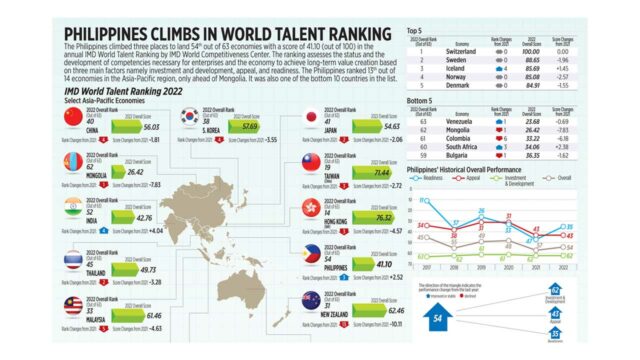
Philippines climbs in world talent ranking

THE PHILIPPINES jumped three spots in an annual global ranking of economies that measures their ability to attract and retain a skilled workforce, a report by the Institute for Management Development (IMD) World Competitiveness Center showed. Read the full story.

Philippines climbs in world talent ranking

ADVERTISEMENT
ADVERTISEMENT