Home Blog Page 5492

Alternergy expects Palau project to operate in 2023

ALTERNERGY Holdings Corp.’s solar photovoltaic (PV) and battery storage project in Palau is set to begin commercial operations in April 2023, the renewable energy company announced on Monday.

“Alternergy and Solar Pacific saw the opportunity to explore the electricity market outside the Philippines and we are honored to be the first independent power producer (IPP) in the Republic of Palau,” Alternergy Chairman Vicente S. Perez said in a media release on Monday.

The project, which is already 65% completed, is under Solar Pacific Pristine Power, Inc., which is a unit of an Alternergy subsidiary.

The Palau solar PV and battery storage project has a capacity of 15.3 megawatt-peak (MWp) solar PV and 12.9-megawatt-hour (MWh) battery energy storage system (BESS).

Mike Lichtenfeld, Chief Executive Officer of Solar Pacific, said in the media release that the Palau project builds a strong partnership with the governments of Palau, through a long-term power supply agreement (PSA) with the Palau Public Utilities Corp., and Australia, through project financing under the Australian Infrastructure Financing Facility for the Pacific.

The Palau hybrid project is expected to provide up to 23,000 MWh of clean and renewable energy to Palau, which translates to 20% of the country’s annual demand.

Mr. Lichtenfeld added that the project is one of the biggest direct foreign investments in Palau with a cost of $29 million, “and is generating local employment and tax revenues to the country.” — Ashley Erika O. Jose

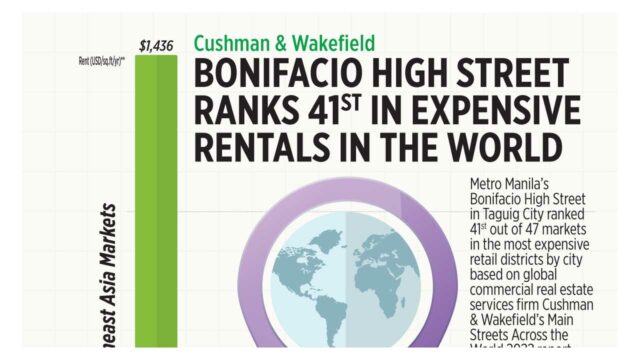
Bonifacio High Street ranks 41st in expensive rentals in the world

FIFTH AVENUE in New York City is the world’s most expensive shopping street once again, according to a new global ranking from real estate services firm Cushman & Wakefield. Read the full story.

Bonifacio High Street ranks 41<sup>st</sup> in expensive rentals in the world

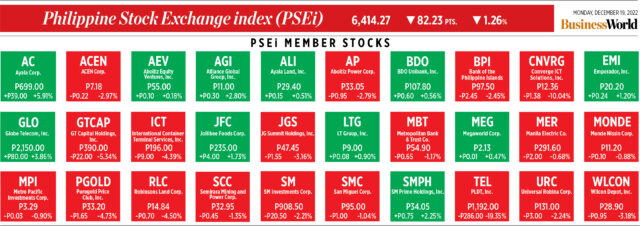
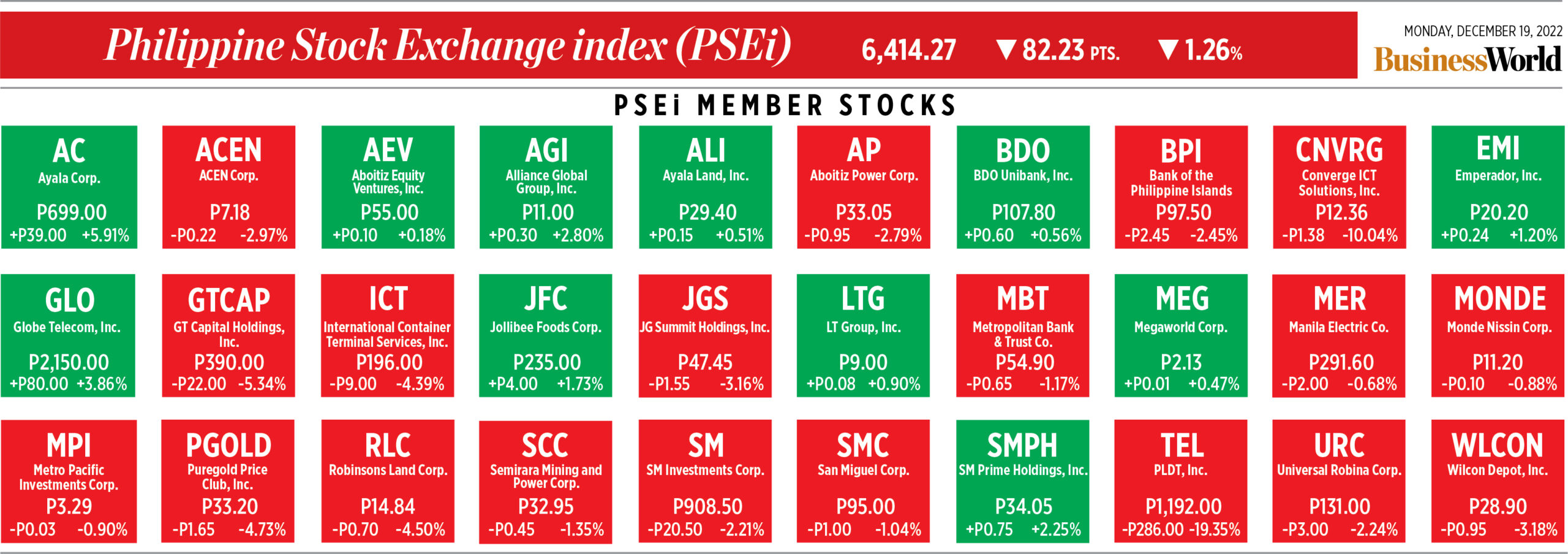
How PSEi member stocks performed — December 19, 2022

Here’s a quick glance at how PSEi stocks fared on Monday, December 19, 2022.


Shares down on PLDT’s budget overrun, Wall Street

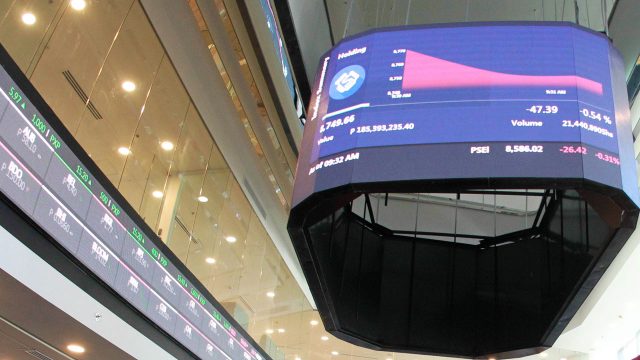
LOCAL stocks closed lower on Monday, mirroring Wall Street’s decline amid recession fears and as investors priced in the news of a budget overrun in PLDT, Inc.

The benchmark Philippine Stock Exchange index (PSEi) declined by 82.23 points or 1.26% to close at 6,414.27 on Monday, while the broader all-shares index lost 32.82 points or 0.96% to 3,367.31.

“The local market declined this Monday … due to negative spillovers from Wall Street fueled by recession fears in the US,” Philstocks Financial, Inc. Research and Engagement Officer Mikhail Philippe Plopenio said in a Viber message.

Wall Street declined for a third straight session on Friday as fears that the central bank’s campaign to fight inflation would tilt the economy into a recession, Reuters reported.

The Dow Jones Industrial Average fell by 281.76 points or 0.85% to 32,920.46; the S&P 500 lost 43.39 points or 1.11% to 3,852.36; and the Nasdaq Composite dropped 105.11 points or 0.97% to 10,705.41.

Last week, the US Federal Reserve raised its benchmark overnight interest rate by 50 basis points (bps) to the 4.25%-4.5% range and projected it could rise to 5%-5.25% next year.

The Fed has now hiked borrowing costs by 425 bps since March.

“Aside from the recession fears next year, investors were surprised by the recent news of PLDT where there was a budget overrun of P48 billion. The stock now is down 19.35% and might go down further,” Mercantile Securities Corp. Head Trader Jeff Radley C. See said in a Viber message.

In a disclosure on Friday, PLDT announced that it found an estimated budget overrun of no more than P48 billion, which represents 12.7% of the total capital expenditure spent in four years.

According to the company, the budget overrun is going through internal forensics and discussions with principal vendors. It added that the investigation has not uncovered any “fraudulent transactions, procurement anomalies or loss of assets.”

On Monday, shares in PLDT closed 286 points or 19.35% lower to 1,192 each. Shares in the company were sold at an intraday low of 1,187 apiece, which is also its new 52-week low.

Most of the sectoral indices closed lower on Monday except property, which increased by 32.7 points or 1.17% to end Monday’s session at 2,823.60.

Meanwhile, services slumped by 99.14 points or 5.98% to close at 1,557.89; financials declined by 116.03 points or 0.97% to 1,628.44; industrials lost 85.21 points or 0.91% to 9,187.34; holding firms went down by 30.13 points or 0.47% to 6,316.78; and mining and oil inched down by 5.34 points or 0.05 to close at 10,160.49.

Value turnover surged to P18.72 billion on Monday with 1.31 billion shares changing hands from P7.31 billion with 558.77 million issues traded on Friday. Decliners overwhelmed advancers, 123 to 55, while 45 names closed unchanged.

Net foreign selling climbed to P1.01 billion on Monday from P148.81 million seen the previous trading day.

Mercantile Securities’ Mr. See placed the PSEi’s support at the 6,150, 6,250 and 6,400 levels and resistance at 6,660 and 6,800 levels. — Justine Irish D. Tabile

Peso strengthens further on continued inflows

BW FILE PHOTO

THE PESO strengthened further on Monday because of the weakening of the US dollar and a continued increase in foreign exchange inflows.

The local currency ended at P55.41 against the greenback, up by 15 centavos from Friday’s P55.56 close, data from the Bankers Association of the Philippines’ website showed.

The peso opened Monday’s session at P55.50 per dollar, which is also its weakest showing for the day. Its intraday best was at P55.40 versus the greenback. Dollars traded dipped further to $627.25 million from $902.27 million on Friday.

A trader said in a Viber message that the strengthening of the peso is largely due to a weaker dollar against most Asian currencies as well as remittances from overseas Filipinos.

The US dollar index slipped 0.19% to 104.61, according to a report by Reuters.

Meanwhile, the Japanese yen was 0.4% stronger at ¥136.19 per dollar, after jumping more than 0.5% to a high of ¥135.78 earlier in the session.

The yen climbed on Monday on news that the Japanese government could soon revise a joint statement with the Bank of Japan over the latter’s inflation target, potentially paving the way for a tweak in its ultra-loose monetary policy, Reuters said.

The peso also strengthened on Friday on the back of seasonal dollar inflows as the holidays draw near, the trader said.

Rizal Commercial Banking Corp. Chief Economist Michael L. Ricafort said in a Viber message that aside from the continuing effect of remittances and the weaker dollar, the peso was also affected by global crude oil prices.

Oil prices rose on Monday as China, the world’s top crude oil importer and No. 2 oil consumer, abruptly ended its “dynamic zero-COVID” policy.

The US also bought back oil for its state reserves, which supported the rise in oil prices, as the US Energy department said on Friday that it would begin repurchasing crude oil for the strategic petroleum reserve for delivery in February next year.

A report by Reuters showed that Brent crude futures gained 42 cents, or 0.5%, to $79.46 a barrel while US West Texas Intermediate crude was at $74.67, up 38 cents, or 0.5%.

For the next day’s movement, the trader expects the peso to move sideways with a downward bias at P55.25 to P55.50 per dollar, again due to the seasonal inflows but may be tempered by the weak performance of the Philippine Stock Exchange following news on PLDT, Inc.

Telecommunications provider PLDT led by Manuel V. Pangilinan is reorganizing its management after discovering a P48-billion budget overrun, representing 12.7% of its P379-billion capital expenditure over the past four years, the company announced on Friday.

PLDT’s stock plunged more than 19% to P1,192, with almost P62 billion in market value wiped out. This was the company’s steepest loss ever based on prices going back to January 1990 as investors dumped the shares.

Meanwhile, Mr. Ricafort expects the peso to move between P55.30-P55.50 per dollar. — Aaron Michael C. Sy

DBP dividend cut not connected to Maharlika, DoF’s Diokno says

PHILIPPINE STAR/KRIZ JOHN ROSALES

FINANCE Secretary Benjamin E. Diokno rejected on Monday speculation that the reduction in the Development Bank of the Philippines’ (DBP) dividend was intended to retain capital for use by the proposed Maharlika Investment Fund (MIF).

The Department of Finance (DoF) said in a statement that government banks like the DBP and Land Bank of the Philippines are routinely allowed to reduce their dividends.

“Long before the MIF was conceived (dividend reductions were resorted to) in order to improve the ability of both government banks to deliver on their mandates and, at the same time, maintain their financial standing.”

He was responding to a statement by Representative France L. Castro, the House deputy minority leader from the ACT-Teachers Party-list, that Executive Order (EO) No. 8, which reduced the rate of DBP’s dividends to the National Government to 0%, “was issued to increase DBP’s capital for the Maharlika fund.”

Mr. Diokno said President Ferdinand R. Marcos, Jr. issued EO No. 8 last week to support the capital position of the DBP, allow it to comply with central bank regulations, and “sustain its role in the economic recovery of industries adversely affected by the pandemic.”

“The grant of dividend relief aims to provide DBP with a stronger capital base in support of its mandated developmental programs,” he said.

Part of the proposed MIF’s initial funding was to come from the DBP, which will pitch in P25 billion.

“Consequently, because DBP would not remit anything to the National Government, this would be a huge loss from the people’s coffers and the source of funds for the next General Appropriations Act (GAA),” Ms. Castro said in her statement.

Republic Act No. 7656 requires all government-owned or -controlled corporations to declare and remit at least 50% of their annual net earnings as cash, stock or property dividends to the National Government.

 “The President of the Philippines, however, may adjust the percentage of annual net earnings to be declared by a government-owned and -controlled corporation, in the interest of the national economy and general welfare, according to RA 7656,” the Palace said in a statement. — Kyle Aristophere T. Atienza

PHL taps IMF for technical assistance on exiting from accommodative policy

REUTERS

THE PHILIPPINES is tapping the International Monetary Fund (IMF) for technical assistance, with the aim of improving the central bank’s ability to transition away from the accommodative policy it adopted during the pandemic, the fund said.

In a country report, the IMF called the Philippines one of the largest recipients of capacity development (CD) assistance among emerging economies, with the fund providing “considerable” support in order to help the government pursue its reform agenda.

“The authorities have identified additional CD priorities where support from the IMF would further contribute to the reform agenda. Some of the assistance is already ongoing while other requests remain to be addressed,” the IMF said.

The IMF was also asked to assist with improving the monetary authorities’ inflation forecasting and enhancing the Bangko Sentral ng Pilipinas’ (BSP) data analysis capabilities.

“Support for the implementation of monetary policy will center on: (i) inflation forecasting and refinements to the BSP’s Policy Analysis Model for the Philippines to facilitate structured and data-coherent forecasting and integrated analysis of monetary and other policies,” the IMF said. 

The IMF was also asked to help the BSP reform its liquidity operations and to improve the central bank’s communication strategy, particularly on giving forward guidance when it comes to policy rates, making the Monetary Policy Report a flagship publication, communicating its exit strategy from crisis support measures, and how to best inform the public about digital money, cybercrime, and climate-related financial risk.

“The authorities have also requested the Fund to advise and provide training for a sandbox project on the development of a wholesale CBDC (central bank digital currency).”

Earlier this year, the BSP announced it was working on a pilot project that will test the use of wholesale CBDCs for large-value financial transactions by selected financial institutions.

In the financial sector, the IMF was requested to provide technical assistance on bank supervision and the establishment of a supervisory college.

The IMF was also asked to assess the expected credit loss model of banks and the operational resilience of the Philippine banking system.

“Requests have also been made by the Securities and Exchange Commission for TA (technical assistance) to develop risk management instruments and by the Bureau of the Treasury for TA to enhance its cash management, further develop the government’s debt management strategy, deepen the domestic debt market through innovative financial instruments, and develop a strategy to access the international capital markets,” the IMF said.

The fund was asked to review an ongoing program helping government-owned and -controlled corporations (GOCCs) enhance their financial reporting, the fund said.

According to the IMF, the Philippines has requested a follow-up mission to review the progress made on GOCC financial reporting since the assistance was first put forward in 2019.

The IMF was requested to provide guidance and help develop an implementation plan to bring the reporting frameworks of GOCCs and public-private partnerships in line with international standards. — Keisha B. Ta-asan

Insurance Commission says catastrophe risk premiums overdue for adjustment

PHILIPPINE STAR/ MICHAEL VARCAS

THE Insurance Commission (IC) said premiums for catastrophe risk were last adjusted in 2006 and need adjustment because the old premium structure was “unsustainable.”

IC Commissioner Dennis B. Funa said on Monday in an e-mail that “For the longest time, the other non-life insurance business lines have been subsidizing catastrophe insurance products and claims — a situation that is unsustainable given the constant, if not growing, exposure to catastrophe risks,” Mr. Funa said in an e-mail.

Mr. Funa was responding to a legislator’s query about the state of the catastrophe insurance market.

AGRI Party-list Representative Wilbert T. Lee had queried via a Dec. 12 resolution whether there was a gap in coverage for earthquakes, typhoons, and floods.

“Our country has a huge catastrophe insurance gap that leaves millions of Filipinos in poverty after every catastrophe,” Mr. Funa said.

The commissioner added that higher premiums would be warranted given the Philippines’ vulnerability to natural disasters.

“Since insurance is an important risk transfer tool for the recovery of communities after large loss events, it has been the view of the World Bank, the Department of Finance (DoF), the IC, and non-life insurers that catastrophe resilience of the Philippine insurance industry and its capacity to retain catastrophe risks should be increased,” Mr. Funa added. 

The IC is in charge of Philippine Catastrophe Insurance Facility (PCIF), a World Bank initiative under the supervision of the DoF.

Mr. Funa said the IC is reassessing the PCIF program. — Beatriz Marie D. Cruz

JobStreet offers hiring companies 30 days’ worth of free job postings

EMPLOYMENT listings site JobStreet said it is offering employers 30 days’ worth of free job postings.

In a statement on Monday, JobStreet said hiring companies that register with its platform will have access to a database of more than 14 million jobseekers in the Philippines.

JobStreet said participants will also be able to use platform features like AI matching, job market insights, and various solutions available to hirers.

“Making hiring decisions and recruiting the right people have been a struggle for enterprises as they transition to the new normal,” it said. “Things have changed since the pandemic and fresh talent has also entered the job market.”

“We are looking to empower hirers to… end the year with great hires and start the year with quality candidates in their companies,” it added.

JobStreet said that its new job posting package scheme “follows a consumable budget-based model.”

The model provides “flexibility,” allowing employers to adjust job postings to their needs, it said.

Workers are expected to turn to job posting platforms at a time of high inflation and underemployment, economists said, with the gig economy and part-time work as one of the options.

“Many Filipinos are taking extra jobs since inflation decreases a person’s purchasing power” Jefferson A. Arapoc, an assistant professor of Economics at the University of the Philippines Los Baños, told BusinessWorld via chat. 

“If the government cannot manage surging inflation, we can only expect the number of underemployed people to surge as well,” he added.

“The gig economy has emerged because of the inadequacy of salaries and wages. This is a response of people to make ends meet and maintain purchasing power,” according to John Paolo R. Rivera, an economist at the Asian Institute of Management.

“Companies should understand this especially if they cannot and are not willing to adjust salaries (in line with) inflation,” he said via chat. — Kyle Aristophere T. Atienza

LGU cut from 2020 tobacco excise P19B 

BW FILE PHOTO

THE Department of Budget and Management (DBM) said local government units (LGUs) have been allocated P19.01 billion as their share of excise taxes collected from tobacco in 2020.

In a memorandum circular released on Monday, the DBM said LGUs will get P15.01 billion from excise taxes on locally manufactured Virginia-type cigarettes and P4 billion from the burley and native tobacco variety.

Excise tax allocations from Virginia-type cigarettes must be used to support tobacco farmers, including cooperative projects to enhance quality of products, increase farmer productivity, livelihood projects like alternative farming systems, and infrastructure projects like farm-to-market roads.

The burley and native tobacco allocations will go towards programs to provide inputs, training, and other support for tobacco farmers. It will also financially support displaced tobacco farmers, and allow for cooperative programs for farmers planting other crops, and infrastructure projects, among others.

LGU receipts from 2019 indicate an excise tax share of P24.8 billion, including P19.87 billion from Virginia-type cigarettes and P4.94 billion from taxes on burley and native tobacco.

Shares are distributed among provinces according to their volume of tobacco production.

Republic Act No. 7171 directs the DBM to allot a percentage of taxes from domestically manufactured Virginia-type cigarettes to local governments.

Republic Act No. 10351 or the Sin Tax Law of 2012 assigns a percentage of the tobacco excise tax to fund programs supporting tobacco farmers. — Keisha B. Ta-asan

A closer look at the BIR’s clarifications on REEs’ VAT incentives

Since Republic Act 11534, otherwise known as the Corporate Recovery and Tax Incentives for Enterprises (CREATE) Act, took effect, the Bureau of Internal Revenue (BIR) has released issuances and clarifications to implement the amendments introduced therein. On Dec. 10, 2021, Revenue Regulations (RR) No. 21-2021 took effect, implementing the amended value-added tax (VAT) incentives of Registered Export Enterprises (REEs) on their imports and local purchases, as provided under the Tax Code, as amended, and the Implementing Rules and Regulations of the CREATE Act.

Months after, Revenue Memorandum Circular (RMC) Nos. 24-2022 and 49-2022 were issued to provide clarifications on RR No. 21-2022. RMC No. 24-2022 clarifies that VAT-registered REEs whose registration with an IPA has expired is subject to VAT, whereas RMC No. 49-2022 clarifies that REEs enjoying 5% GIT/SCIT are to shift registration from VAT to Non-VAT taxpayers. In this regard, concerns may have surfaced from taxpayers on the proper application and consequences of the above clarifications.

To address these concerns, the BIR recently issued RMC No. 152-2022 to further clarify the transitory provisions of RR No. 21-2021 and as explained in RMC Nos. 24-2022 and 49-2022. These issuances implement and clarify the VAT zero-rate incentives under the Tax Code, as amended, and as implemented by Rule 18 of the CREATE Act Implementing Rules and Regulations.

The BIR grants relief to suppliers/sellers who might have treated and declared their sales to REEs as VAT zero-rated in their respective quarterly returns during the transitory period between the effectivity of RR No. 21-2021 on Dec. 10, 2021, and the issuance of Q&A No. 26 of RMC NO. 24-2022 on March 9, 2022. It is to be noted that RMC No. 24-2022 clarified that an REE whose incentives have expired is no longer qualified for VAT zero-rating on local purchases during the transitory period. In such cases, the BIR, in RMC No. 152-2022, ruled that the above transactions which transpired during the transitory period remain VAT zero-rated to avoid prejudice to affected taxpayers.

On the other hand, in cases where the REE is qualified for VAT zero-rate on its purchases, but was charged 12% VAT by the seller during the transitory period, the buyer and the seller may either:

1. Retain the transaction as subject to 12% VAT

VAT-registered purchasers, in such case, can utilize the input VAT from their output tax or if the purchaser is engaged in zero-rated activities, the same can be recovered through the VAT refund pursuant to Section 112(A) of the Tax Code, as amended. If the purchaser is not VAT-registered, the VAT paid may be claimed as part of the cost of sales or expenses.

2. Revert the transaction from VAT at 12% to VAT zero-rated where the seller may amend the same after reimbursing/returning the VAT paid by a buyer that is an REE.

The related VAT Sales Invoices/Official Receipts (SI/OR) to such transactions are to be retrieved by the seller for cancellation and replacement with VAT SI/OR. The seller is to prepare a list of canceled VAT SI/OR together with the replacement subject to validation of the BIR.

Consequently, the purchaser must likewise file an amendment return to reflect the reduced input VAT it previously declared in the VAT return/s.

The BIR has yet to clarify the time and manner of submission of the required list under the 2nd option above, whether it will be submitted to the BIR or only to be presented in case of a tax audit. Nonetheless, taxpayers need to identify the transactions engaged in during the transitory period and prepare the list required by the BIR to be ready once the BIR requires its submission.

RMC No. 152-2022 also discussed the mandatory registration from VAT to Non-VAT of REEs that are under the 5% Gross Income Tax (GIT)/Special Corporate Income Tax (SCIT) within two months from the expiration of the ITH or the effectivity of RMC No. 49-2022, whichever is applicable, as provided under RMC No. 24-2022.

It was clarified further that the mandatory shift from VAT to Non-VAT would not subject REEs’ sales to percentage tax as they are entitled and subject only to GIT/SCIT in lieu of all other internal revenue taxes. Despite the shift from VAT to Non-VAT, the BIR clarified that REEs are still entitled to VAT zero-rate incentives on their local purchases until the expiration of the incentive period of the Company.

While this issuance is somehow a respite to some taxpayers, the question on the validity of provisions under the CREATE IRR that limit the duration of entitlement of non-income-related tax incentives remains, such as VAT zero-rate on local purchases and VAT exemption on imports. This limitation under the IRR may have unduly expanded the provisions of the CREATE Act since it seems that such duration was not provided under Section 296 and 311 of the Tax Code, as amended.

It is clear under Paragraph 3 Section 6 of the Civil Code that “[a]dministrative or executive acts, orders and regulations shall be valid only when they are not contrary to the laws or the Constitution.” Additionally, the Supreme Court has always been consistent on the limitation of the delegated legislative powers to administrative agencies through enacted laws. Mere administrative issuances cannot modify, expand, or restrict the law delegating the power to prescribe rules to implement statute’s provisions. This is consistent with the long-standing legal principle that the spring cannot rise higher than the source.

In this case, it seems the prohibition under the CREATE Act was specifically included by the Congress to limit the duration of income-related tax incentives only. Thus, a distinction should be made, and such duration may not extend to other incentives granted under the law. This would cause undue restriction of the rights of REEs clearly granted by the CREATE Act. Accordingly, taxpayers are hoping that the limit on the period of availment of VAT zero-rating be further evaluated by our regulatory bodies.

Nevertheless, the BIR continues to revisit and address all the relevant concerns of taxpayers to implement effectively and efficiently the CREATE Act, and frequently releases clarificatory issuances primarily aimed at helping taxpayers navigate the changes introduced to our tax system.

Let’s Talk Tax is a weekly newspaper column of P&A Grant Thornton that aims to keep the public informed of various developments in taxation. This article is not intended to be a substitute for competent professional advice.


Aaron Paul A. Santos is a senior-in charge from the Tax Advisory & Compliance division of P&A Grant Thornton, the Philippine member firm of Grant Thornton International Ltd.

pagrantthornton@ph.gt.com

More benefits, eased requisites continue to pull nurses abroad

PHILIPPINE STAR/EDD GUMBAN

THE PHILIPPINES continues to see a migration of nurses as more foreign countries are now offering even more attractive economic packages, according to the Filipino Nurses United (FNU).

“According to government data, no less than 19,000 nurses migrate per year,” FNU Secretary-General Jocelyn S. Andamo told One News Balita in Filipino on Monday.

“We can only say the reasons as to why we can’t hire or attract nurses to apply  (locally) is because the salary is low, but the responsibility is high,” she said.

Ms. Andamo also said there is inadequate social support for nurses in the Philippines as well as lack in medical supplies and equipment, “so it is very difficult to work.”

“Third is the security of tenure,” she added.

“Many of the (locally-employed) nurses are contractual until today. There are different kinds of systems — nurses under job orders, nurses under a deployment program, and nurses hired by the DoH (Department of Health) and are at risk of losing their jobs.”

On the other hand, the wage and benefits being offered by foreign countries to Filipino health workers are substantial, Ms. Andamo said.

“There are many offers, and the requirements are easy to fulfill,” she said.

“Besides that, the economic package they offer is very good. Great salary, benefits, sometimes they offer for the entire family to migrate.”

There are also countries that offer free accommodation, apart from housing options.

“That’s why we encourage nurses to go to other countries and look for opportunities there,” she said.

ENTRY RATE
Ms. Andamo reiterated their call for a P50,000 entry rate for all nurses, which she said is one step in keeping nurses in the country and address the shortage of healthcare workers.

“It is already beyond 100 days since the beginning of the Marcos administration. We are still looking forward to his promise to take better care of healthcare workers, as well as nurses,” she said.

“What we’re hoping for is that it be legislated that all nurses upon entry receive P50,000, or if not, at least P35,000,” Ms. Andamo said. “Small hospitals should also be subsidized to provide an adequate salary.”

Starting nurses in private hospitals receive a minimum wage of P537 daily in the capital region Metro Manila, or about P12,000 monthly, while those in other regions receive less, she said.

Nurses working in public hospitals receive around P35,097 monthly, but this may also vary, she added.

FNU National President Maristela P. Abenojar earlier said the total number of nurses in both the public and the private sector as of December was 172,589.

“Out of 10 registered nurses, two are working either in the public or private sector, so that’s equivalent to 19% of the total 915,291 registered nurses,” she said.

She said 35% or four out of 10 registered nurses in the Philippines choose to work abroad.

The rest are mostly employed in other industries, including medical outsourcing operations, while some simply choose not to practice given local wage rates and work conditions.

“Our need for nurses is great,” Ms. Andamo said. “One nurse handles up to 20 patients, sometimes up to 50,” much higher than the DoH standard of 12 patients for every nurse.

The FNU is recommending the hiring of an additional 52,000 nurses in public hospitals and in community health centers.

“There are no less than 100,000 untapped nurses,” she said. — Alyssa Nicole O. Tan

ADVERTISEMENT
ADVERTISEMENT