Home Blog Page 547

DoE seeking P3.8-B budget for 2026

PRESIDENT Ferdinand R. Marcos, Jr. and newly appointed Energy Secretary Sharon S. Garin talk following her oath-taking in Malacañan Palace on Monday. — PCO

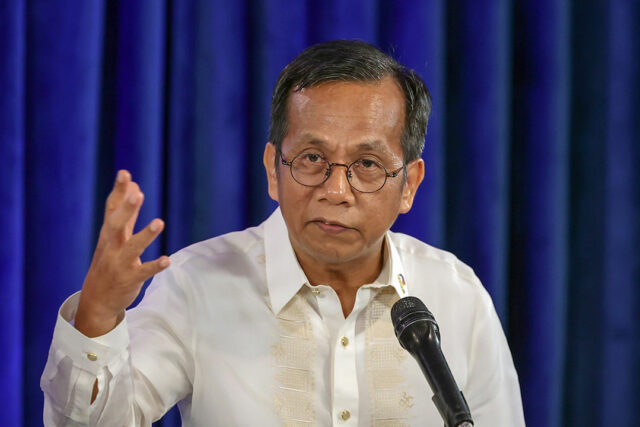
THE Department of Energy (DoE) is asking for a P3.8-billion budget in 2026, which if granted would be 24.4% higher than this year’s funding, citing the need to support the entry of nuclear power and achieve full electrification.

At a budget hearing on Tuesday, DoE Financial Services Director Agustus Cesar A. Navarro said P2.4 billion or 64% of the proposed budget will go to major programs like the information systemic strategic plan (ISSP) and capital outlays, staffing, and operational requirements of the newly created Nuclear Energy Division.

Around P1.4 billion or 36% will be set aside for the Nuclear Energy Development Program, the promotion of energy efficiency and conservation, alternative fuels for transport and other purposes, and the total electrification project.

Mr. Navarro said the special account of its general fund reflects “the collection of shares from national wealth in the production of petroleum, coal, geothermal, wind, solar, and hydropower energy resources.”

Other sources of revenue are fees and charges collected for permits, certifications, accreditations, processing, fines and penalties, and other services.

“We wanted to show the body that the Energy family actually earns substantial amounts for the National Treasury, and our budget is only P3 billion,” Energy Secretary Sharon S. Garin said.

“We are actually positive. We earn more than we spend as a department,” she said.

Ms. Garin said that the DoE’s legislative priorities include amending the 24-year-old Electric Power Industry Reform Act (EPIRA), particularly giving the Energy Regulatory Commission more authority.

She added that proposed amendments to Republic Act No. 8479, also known as the Downstream Oil Industry Deregulation Act of 1998, will ensure fair trade practices and safeguards.

“One of the most important is to give authority to the President to suspend or reduce excise taxes on fuels in case of emergencies,” she added.

The DoE is also pushing to amend RA No. 9367, or the Biofuels Act of 2006, to allow imported blends if domestic supply is too expensive.

The Philippine Energy Plan 2023-2050 outlines the government’s clean energy transition strategy, she said, citing the need “to be flexible (in the face of) a changing energy landscape and advances in technology.”

The Philippines hopes to increase the share of renewable energy in the power generation mix to 35% by 2030 and 50% by 2040.

Ms. Garin said the DoE is also seeking to develop more indigenous resources like gas or renewables.

“The objective is to have cleaner but more diversified energy,” she said. — Sheldeen Joy Talavera

PSEi dips as inflation worries weigh on sentiment

BW FILE PHOTO

By Alexandria Grace C. Magno

PHILIPPINE SHARES extended their decline on Tuesday, as concerns over stubborn inflation and the timing of monetary easing continued to weigh on investor appetite.

The Philippine Stock Exchange index (PSEi) slipped 0.18% or 11.46 points to close at 6,128.89, while the broader all-share index edged down 0.06% or 2.52 points to 3,681.03.

“Investor confidence appears to be waning as no clear positive catalyst is in sight,” Luis A. Limlingan, head of sales at Regina Capital Development Corp., said in a Viber message. “Sentiment remains uncertain with inflation expectations staying elevated, alongside forecasts that the BSP (Bangko Sentral ng Pilipinas) may delay rate cuts until next year instead of within this year.”

A BusinessWorld poll of 16 analysts yielded a median estimate of 1.3% for August inflation, from 0.9% in July and 3.3% a year earlier. This could mark the sixth straight month inflation remained below the BSP’s 2-4% target. The Philippine Statistics Authority will release the official data on Sept. 5.

Global cues also weighed on local trading. “Wall Street was closed [on Sept. 1] due to Labor Day. Last Friday, major indexes gave back a portion of their recent gains, with the market’s focus now squarely on the anticipated August job report,” Mr. Limlingan said, adding that uncertainty over the US Federal Reserve’s next policy steps is fueling caution.

Alfred Benjamin R. Garcia, research head at AP Securities, Inc., noted that banking stocks bore much of Tuesday’s decline as they extended their downtrend.

Expectations of narrowing margins from recent rate cuts dragged the sector, he said. “Sentiment also remained weak against the backdrop of global economic uncertainty and geopolitical instability in Southeast Asia,” Alfred Benjamin R. Garcia, research head at AP Securities, Inc., said in a Viber message.

Foreign investors turned net sellers, unloading P368.84 million in local shares compared with P148.55 million the previous day.

Sectoral performance was mixed, with three indices rising and three declining. Mining and oil climbed 2.49% or 260.05 points to 10,674.61, property rose 0.26% or 6.52 points to 2,452.26, and industrials added 0.04% or 3.88 points to 9,056.93.

On the other hand, financials dropped 0.78% or 16.39 points to 2,062.93, services slipped 0.16% or 3.66 points to 2,180.83 and holding firms dropped 0.08% or 4.22 points to 5,044.74.

Value turnover increased to P5.58 billion with 1.16 billion shares traded, up from P4.21 billion with 1.15 billion shares on Monday. Losers beat winners, 111 to 84, while 59 stocks were unchanged.

Balisacan rules out growth target adjustments

ARSENIO M. BALISACAN — PHILIPPINE STAR/KRIZ JOHN ROSALES

ECONOMY Secretary Arsenio M. Balisacan said Tuesday that he sees no need to adjust the government’s growth targets, despite the setbacks from recent storms coupled with the Southwest Monsoon.

Asked if the government needs to revise its targets, Mr. Balisacan said “No, I don’t think so. So far.”

He added that the business sector can adapt to flooding.

“I think people in the business sector can adjust. They can do some overtime,” he told reporters on the sidelines of a Senate budget hearing.

The government set a growth target of between 5.5% and 6.5% in 2025. In the second quarter the economy grew by 5.5%, oustripping the 5.4% expansion in the first quarter. A year earlier, growth had been 6.5%.

The Philippines was hit by five consecutive tropical depressions in recent weeks, alongside the southwest monsoon.

“We hope that there will be less and less of this because whenever you have floods, economic activity stops (or) reduced,” he added.

“If it happens frequently, then you have to start worrying about the impact,” he added.

Last year, Gross Domestic Product came in at 5.6%, falling short of the revised 6-6.5% target. This was party caused by setbacks like extreme weather events, geopolitical tensions, and subdued global demand.

“Every time you have floods and typhoons assets are destroyed, that reduces the potential of the economy. When assets and physical capital are destroyed, there’s less productive capacity,” Mr. Balisacan said.

The Philippines experiences about 20 storms each year. It also lies iwithin Pacific Ring of Fire, a belt of volcanoes around the Pacific Ocean where most of the world’s earthquakes strike. — Adrian H. Halili

PHL taking ‘strategic’ approach to UN General Assembly suit vs China

Foreign Affairs Secretary Ma. Theresa P. Lazaro — DFA.GOV.PH/UNESCO PHOTO

By Kenneth Christiane L. Basilio, Reporter

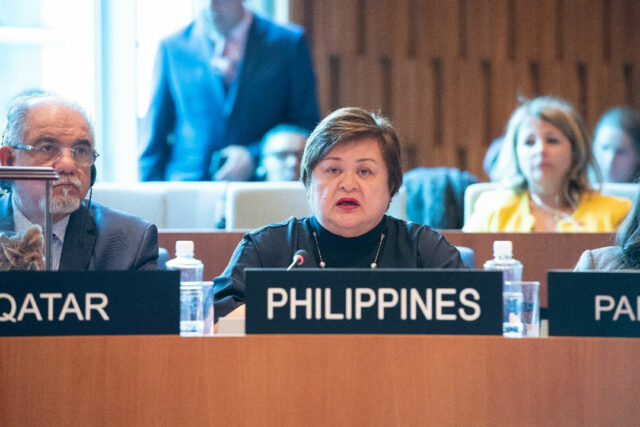
THE Department of Foreign Affairs (DFA) is taking a “strategic, deliberate and calibrated approach” amid calls for the Philippines to file a United Nations General Assembly (UNGA) resolution on the South China Sea, Manila’s top envoy said on Tuesday.

Foreign Affairs Secretary Ma. Theresa P. Lazaro said the DFA is studying the possibility of a UNGA resolution on Chinese activities in the contested waters but emphasized the agency’s priority is securing a seat at the UN Security Council.

“The Department of Foreign Affairs is looking at a strategic, deliberate and calibrated approach, and this is what we need to promote the resolution that you have mentioned,” she told lawmakers at a congressional hearing. “We are consulting the mission in New York on the possibilities and the probabilities of having this resolution passed.”

“We’re looking at it and we’re studying it very carefully,” she added.

Congressmen in late-August urged the DFA to raise concerns on Chinese activities in the South China Sea before the UN General Assembly, as they pressed China to cease what was described as its “hostile and aggressive” actions in the waterbody.

The Chinese Embassy in Manila did not immediately reply to a Viber message seeking comment.

China claims almost the entire South China Sea under its controversial nine-dash line, overlapping with the claims of the Philippines, Vietnam, Malaysia and Brunei.

In 2016, the Permanent Court of Arbitration in The Hague ruled in favor of the Philippines, voiding China’s sweeping claims over the contested waters. Beijing has refused to recognize the ruling and maintains a heavy presence in disputed areas, including the Spratly Islands and Scarborough Shoal.

Filing a UNGA resolution on the South China Sea could help ease tensions in the disputed waters, said Ms. Lazaro. “There is the possibility it may.”

But she said the Philippines remains keen on using its bilateral consultation mechanism with China as a channel to raise concerns and help ease tensions in the South China Sea.

“[It] is so far being effective,” she said.

The bilateral consultation mechanism was established in 2017 amid disputes in the waters, where trillions worth of shipborne trade passes through annually.

“Raising and putting an emphasis on our ongoing quest to promote our sovereignty and territorial integrity over the disputed waters in the UN General Assembly will undoubtedly be a strategic move,” Josue Raphael J. Cortez, a diplomacy instructor at De La Salle-College of St. Benilde’s School of Diplomacy and Governance, said in a Facebook Messenger chat.

“Opening such discussion, although it would not bode well with China, may allow us to rally more support from like-minded nations,” he added.

He said such a resolution could highlight the Philippines role as a “norm-setter” in the disputed waters and could help generate support for the approval of the stalled Code of Conduct in the South China Sea.

The Association of Southeast Asian Nations (ASEAN) and China pledged in 2002 to come up with a code of conduct in the waterway, a framework that seeks to prevent conflict through diplomatic means but it has remained elusive due to slow progress.

“[It] may also serve as an impetus for global backing on the Code of Conduct that we wish to promote during our Association of Southeast Asian Nations chairship,” he said.

Raising the South China Sea dispute at the UN General Assembly may also help bolster support for the Philippines’ campaign for a seat on the UN Security Council, he added.

“It would be very unlikely that raising the issue would negatively affect our campaign,” he said.

The Philippines is seeking a nonpermanent seat on the UN Security Council, with elections set for June next year, said Ms. Lazaro. “The focus… now is to gather more support because of our UN Security Council candidature.”

Securing a seat on the UN Security Council could strengthen the country’s ability to raise immediate security concerns, including the South China Sea, Hansley A. Juliano, a political science lecturer at the Ateneo de Manila University, said in a Facebook chat.

China is among the five permanent members of the Council, alongside, France, Russian Federation, the United Kingdom, and the United States.

Senators mull budget overhaul for DPWH

PHILIPPINE STAR/RUSSELL PALMA

PHILIPPINE Senators on Tuesday are pushing to amend or delete the proposed 2026 budget of the Department of Public Works and Highways (DPWH) over “red flagged” projects.

“We can delete the whole DPWH budget and allow the new secretary to do a new budget, so he will submit a supplemental budget. That is allowed by the process,” Senator Loren Regina B. Legarda said during the Senate budget hearing.

The department is now being headed by former Transportation Secretary Vivencio “Vince” B. Dizon after President Ferdinand R. Marcos, Jr. accepted the resignation of Manuel M. Bonoan as Public Works Secretary.

“If the body is not agreeable to that, the House can propose errata to the respective districts. So that the red flagged projects, like flood control, can be converted elsewhere either the DPWH or even another department,” she added.

Senator Panfilo M. Lacson also proposed to schedule an executive session with the Budget department after he flagged more than 500 flood control projects in the National Capital Region, Ilocos Region, Cagayan Valley, and central Luzon with similar costs.

Mr. Lacson, in his presentation, noted that there were 88 projects with P150-million funding each, totaling P13.2 billion, 373 projects with P100-million funding each, totaling P37.3 billion, and 11 items with P120-million funding each, that totaled P1.32 billion.

“With your guidance we are willing to amend and delete all these similarly costing projects,” he told the Department of Budget and Management.

He added that the executive session would allow the Senate to redirect the slashed budget to programs in line with the Philippine Medium Term Development Plan.

Budget Secretary Amenah F. Pangandaman said that she will coordinate with newly appointed Public Works Secretary Dizon on the matter.

The agency has among the largest allocation under the proposed 2026 national budget at P881 billion, according to the National Expenditure Plan.

‘NEGATIVE LIST’
Also on Tuesday, Senate President Francis “Chiz” G. Escudero called on the Presidential Palace to create a “negative list” of potential non-essential or questionable infrastructure projects that should be defunded in the 2026 National Expenditure Plan.

“Instead of waiting for questionable projects to slip into the budget and then expose them after the fact, we should be proactive. The Palace should make it clear from the start that these kinds of projects will not be entertained,” Mr. Escudero said in a statement.

The Senate chief is also pushing for a potential moratorium on new flood control projects under the DPWH’s proposed budget, noting unfinished projects within the agency’s pipeline.

“Let’s finish the pending projects and fix the plan before we continue with them. We should give Secretary Dizon the opportunity to fix the system first,” he said.

“Let’s redirect those funds to waste-to-energy plants, refuse-derived fuel facilities, and other measures that address garbage, clogged drainage systems, and reduced water-holding capacity in rivers and waterways. These are among the real drivers of flooding in Metro Manila and other urban centers,” he said.

The DPWH has been under scrutiny over the alleged misuse of government funding allocated for flood control projects.

The Senate is currently conducting a probe on anomalous projects flagged by President Ferdinand R. Marcos, Jr.

Since 2022, about P544 billion in public funds have been allocated for flood control nationwide, with about P100 billion cornered by the top 15 contractors named by Mr. Marcos.

Investigations are also underway at the House of Representatives, where a joint committee on Tuesday moved to require its members to disclose any links to infrastructure contractors.

Members of the House joint committee on Public Accounts, Public Works and Good Government must submit a “full disclosure” of any business and financial links with contractors to clear a possible conflict of interest in their investigation, according to the motion of Deputy Minority Leader and Party-list Rep. Jose Manuel Tadeo “Chel” I. Diokno.

“There were at least 67 members of the House of Representatives during the 19th Congress who were operating construction businesses that had projects that they themselves had allocated funding for,” he told congressmen.

Authorities have come under fire amid widespread flooding and mounting criticism over the failure of flood control infrastructure nationwide, with lawmakers and contractors suspected of collusion and corruption.

“You can always assure fairness, transparency… and that the body will be partial. But will the people believe these assurances?” Deputy Minority Leader and Party-list Rep. Leila M. de Lima said in the same hearing. “People have heard about the involvement of elected public officials, including members of Congress… [on the] issue of anomalous flood control projects.”

The House joint committee also issued a subpoena to five contractors that did not attend the hearing, compelling their attendance for the next.

INDEPENDENT BODY
Meanwhile, Mr. Dizon on Tuesday said he will dissolve DPWH’s internal anti-corruption task force, following the President’s decision to establish an independent commission to investigate corruption allegations.

“With all due respect to the officials who created the task force, I do not believe that an organization should investigate itself. That is not right,” Mr. Dizon told reporters, according to a transcript shared by his office.

“The President has spoken—he will set up an independent commission. We should respect his wisdom. That is why I will abolish the task force today.”

The task force was created under former DPWH Secretary Bonoan to look into alleged irregularities within the department.

Mr. Dizon clarified that all initial findings of the task force will be turned over to the independent body. “We will gather the information from within the department and pass it on to the commission.”

Mr. Dizon said that he has not received any official details on the composition of the commission amid reports that Baguio City Mayor Benjamin B. Magalong and retired General Gregorio Pio P. Catapang, Jr. will be among its members.

“If it is true, it would be a very welcome development. Mayor Magalong has long been at the forefront of anti-corruption efforts,” he added.

The Secretary also declined to recommend who should head the commission.

“It is not in my position to recommend. That is the sole prerogative of the President, and we must trust and respect his decision,” he said.

Mr. Dizon also confirmed plans to inspect the DPWH’s flood control projects in the coming days. — Adrian H. Halili, Kenneth Christiane L. Basilio, and Erika Mae P. Sinaking


55% of online gamblers unaware of risks from illegal sites — study

PHILIPPINE STAR/EDD GUMBAN

MORE THAN half of Filipino online gamblers are unaware of the financial, legal, and privacy risks associated with unregulated gambling platforms, a research firm said on Tuesday.

In a survey, which polled 400 online gamblers from Mega Manila, Metro Cebu, and Metro Davao, The Fourth Wall found that 55% of respondents admitted they were unaware of the legal risks tied to illegal gambling sites. Around 33% said they know “a little,” while only 12% of them find the rules clear.

“Our study reveals confidence, fairness, and profitability matter more than platform features such as betting limits or affiliate programs,” Fourth Wall Research Director John Brylle L. Bae said.

“This explains why players, despite the uncertainty and uneasiness, continue to engage with these platforms as long as they perceive a chance to win.”

Finance Secretary Ralph G. Recto said the government is still ironing out details on its online gambling tax and other preventive measures to curb negative social impact such as financial loss and addiction.

The study identified JiliBet as the most preferred illegal platform, accounting for 28% of surveyed users, followed by Ph365 (13%), Phfun (9%), PHDream (9%), and Milyon88 (8%).

The firm said players cited game variety, frequent promotions, faster transactions, and convenient payment options as key reasons for choosing unregulated platforms.

However, trust and customer service ranked lower in their decision-making.

The research company also noted that players on unregulated platforms spend more gaming time with 40.7% playing 2-3 times a week, while 16.6 play 4 or more times a week.

“By comparison, players who also engage in regulated platforms tend to play less often, suggesting that heavier use is more common in the unregulated space,” it said.

Most bets placed on unregulated sites ranged from P100 to P499, while high-stakes wagers exceeding P1,000 were rare but occurred almost exclusively on illegal platforms.

These habits often led to financial losses, with 41% of respondents saying they stopped gambling due to monetary setbacks.

Losses were more concentrated in unregulated platforms, the Fourth Wall said.

“Mid- to high-value losses of P100–P999 dominate, while large losses of P5,000 or more occur almost entirely in unregulated platforms. In contrast, regulated play is more often associated with smaller losses of P100–P499,” it said.

The study categorized players into four risk-based profiles.

The largest group, comprising 44 % of respondents, were labeled “high-stakes losers,” or those who exclusively play on unregulated platforms and frequently place high bets. This high-risk and unprofitable behavior was followed by identified as “perceived winners” (28%), who play on unregulated sites with frequent medium bets and believe their wins outweigh losses.

About 17% of them are so-called “casual break-even players,” who prioritize low-risk entertainment over high-stakes wins, and 11% are “regulated converts,” individuals who play on both regulated and unregulated sites but tend to play regulated more frequently.

Breaking down by age, the players were usually around 36-45 years old (32%) and 26-35 years old (31%).

“The majority of players on unregulated platforms are between 26 and 45 years old, come from lower-income brackets, and see gambling as a form of casual leisure,” it said. — Aubrey Rose A. Inosante

Justice chief to file motion seeking to resolve pending Ombudsman case

JESUS CRISPIN C. REMULLA — PHILIPPINE STAR/JOHN RYAN BALDEMOR

JUSTICE SECRETARY Jesus Crispin C. Remulla on Tuesday said that he would file a motion to resolve his pending case before the Office of the Ombudsman amid his bid for its top post.

“I will be filing a motion to resolve as soon as possible,” Mr. Remulla said following his public interview with the Judicial and Bar Council (JBC), according to a transcript sent to reporters.

He said that the matter is still pending before the Supreme Court through a petition for certiorari.

Mr. Remulla is facing a complaint before the Ombudsman over the arrest of Mr. Duterte and his subsequent transfer to The Netherlands, where he is facing charges of crimes against humanity in connection with his deadly war on drugs.

Mr. Remulla argues that his actions in the Duterte case were guided by legal opinion and statutory authority, citing Republic Act No. 9851 as the legal basis for his clearance at the time.

“That is our duty, to keep the country stable, to prevent violence, to prevent the happening of any untoward acts, and I think we were able to peacefully bring him out abroad to face the charges against him without hurting anybody physically,” Mr. Remulla said.

Pressed on whether the acting Ombudsman was facing political pressure to dismiss the complaint, Mr. Remulla declined to respond.

On broader reforms, the Secretary underscored the importance of maintaining the Ombudsman as an impartial institution. “The Ombudsman has to be fair. It should never be weaponized,” he said.

He said lifestyle checks for officials and relatives should be enforced and also called on communities to act as partners in anti-corruption efforts, noting they could be reliable allies in enforcing accountability.

“I think that we can rely on the people of the Philippines to help the government in advocating, in enforcing a lifestyle check. It is the citizens who can say what is happening in their surroundings.”

Mr. Remulla, one of 17 candidates seeking to head the Office of the Ombudsman, acknowledged that the pending case could affect his eligibility under the 2020 Revised Rules of the Judicial and Bar Council (JBC No. 2020-01).

The rules disqualify applicants with pending criminal or administrative cases from being nominated to judicial posts or key positions, including Ombudsman, Deputy Ombudsman, Special Prosecutor, or Legal Education Board member.

This includes those facing pending complaints before the Office of the Ombudsman that are under fact-finding or adjudication, unless cleared.

Meanwhile, Supreme Court spokesperson Atty. Camille Sue Mae L. Ting clarified that Mr. Remulla was allowed to proceed with his JBC interview despite lacking Ombudsman clearance.

She said applicants may submit the required clearance until the day of the JBC’s final deliberations, expected in the coming weeks.

“On the day of deliberations for the shortlist, applicants must already have their Ombudsman clearance. If they do not, they cannot be considered and will not be included in the shortlist,” Ms. Ting explained.

She added that Mr. Remulla is not the only candidate in this situation. Another applicant, Philippine Charity Sweepstakes Office Chairman Felix P. Reyes, also has yet to secure clearance from the Ombudsman.

The Ombudsman post was vacated on July 27, after Ombudsman Samuel R. Martires completed his seven-year term. — Erika Mae P. Sinaking

E-game licensing generates P69B

PHILSTAR FILE PHOTO

THE Philippine Amusement and Gaming Corp. (PAGCOR) has earned P69 billion from the licensing fees of legal online gambling platforms in the first seven months, its chairman said on Tuesday.

The state gaming regulator generated P41 billion from electronics games and P28 billion from other online betting platforms between January and July, proving the growing role of digital gaming as a revenue source for the government, PAGCOR Chairman Alejandro H. Tengco said.

“Because of its huge potential, online gaming has become an important source of funds for our nation-building commitments,” he told lawmakers at a congressional hearing, according to a statement from his office.

Online gaming is currently the target of a campaign for stricter regulation, increased taxation, or even an outright ban amid concerns about social impacts like gambling addiction.

“These illegal sites not only deprive the government of much-needed revenues but also expose Filipino players to numerous risks,” said Mr. Tengco, citing heightened addiction concerns and the possibility of users losing their deposits to unregulated platforms.

Most illegal gambling platforms are operating in other countries, making enforcement difficult and rendering a total digital betting ban futile, he added.

“Ninety-nine percent of illegal platforms are not within the jurisdiction of the Philippines,” he said in Filipino. “They are mostly based overseas, like Cambodia and Timor-Leste.

“That’s what I want to highlight. That even if we impose a total ban, the problem will only become more difficult for us,” he added.

Mr. Tengco said PAGCOR is drafting a joint memorandum with the Department and Information Communications Technology’s Cybercrime Investigation and Coordinating Center to bolster the government’s crackdown on illegal betting platforms.

“It is being spearheaded by the Cybercrime Commission,” he said, citing that PAGCOR cannot take the lead in the campaign against illicit platforms due to lack of authority.

“We do not have the police power to enforce, that’s why… even though we have the mandate to issue licenses, we lack police authority,” said Mr. Tengco.

The state gaming regulator expects legal online gambling platforms to account for 43% of the online betting market by yearend, he said, as state efforts to curb illegal firms ramp up.

“What I expect, by the end of the year, is to increase the share of legal gambling sites to 42-43%,” he said.

About 60% of the Philippines’ online gambling market is occupied by illegal platforms, with only 40% operating under proper licenses, according to a copy of PAGCOR’s presentation to congressmen, of which a copy was obtained by BusinessWorld.

Mr. Tengco said the government has closed down about 8,000 illegal platforms so far. — Kenneth Christiane L. Basilio

Health emergency allowance OKd

PHILIPPINE STAR/ MICHAEL VARCAS

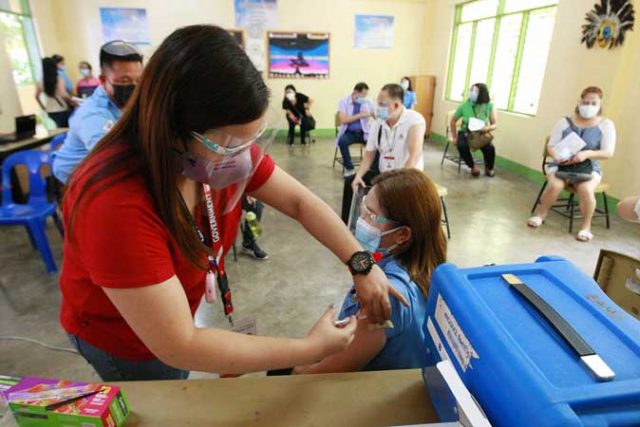
THE Department of Budget and Management (DBM) has approved the release of P6.77 billion to fully settle the remaining Public Health Emergency Benefits and Allowances (PHEBA) owed to healthcare and non-healthcare workers.

In a statement on Tuesday, the DBM said this will cover the 1.41 million claims made by local government units, private health facilities, state universities, and other institutions nationwide from 2021 to 2023.

“This latest release, amounting to P6.767 billion, is in line with the updated request from the Department of Health (DoH). It also follows the directive of our President not to neglect our health workers,” Budget Secretary Amenah F. Pangandaman said.

The amount was released through a Special Allotment Release Order to the DoH, enabling the agency to pay the final balance of the government’s commitment to health emergency allowances.

In February, the DoH presented an updated request for additional funds amounting to P6.727 billion during the Monthly Economic Managers’ Meeting.

In total, the DBM released more than P121.33 billion last year to pay the PHEBA of healthcare and non-healthcare workers.

This covers the health emergency allowance (P27.383 billion) and COVID-19 compensation package (P70.7 million) pursuant to the DoH report of validated claims as of April 2024.

“Once again, we appeal to the DoH to distribute this latest release for the Public Health Emergency Benefits and Allowances to our health sector workers as soon as possible. They’ve been waiting for this for a long time,” she said.

The fund was charged against the Strengthening Assistance for Government Infrastructure and Social Programs (SAGIP) under the Unprogrammed Appropriations of the 2025 General Appropriations Act. — Aubrey Rose A. Inosante

Bataan launches zero-balance policy

President Ferdinand R. Marcos, Jr. visited patients at the Bataan General Hospital and Medical Center in Balanga, Bataan on Sept. 22. — PPA POOL/REVOLI CORTEZ

THE Bataan General Hospital and Medical Center (BataanGHMC) on Tuesday said it has fully implemented the zero-balance billing program, covering indigent, sponsored, senior citizen, and persons with disability who are beneficiaries of the Philippine Health Insurance Corp. (PhilHealth) members.

“This program embodies President (Ferdinand R. Marcos, Jr.’s) vision of a health system that is inclusive, compassionate, and truly for the people,” said Glory V. Baltazar, BataanGHMC Medical Center Chief II.

The government’s zero-balance billing (ZBB) policy under the Universal Health Care Law ensures patients in Department of Health (DoH) hospitals are discharged without paying out-of-pocket costs for PhilHealth-covered services.

During a visit to the facility, Mr. Marcos highlighted a new feature of the program that eliminates the need for patients to queue at the cashier before discharge. Instead, their zero-balance statement is delivered directly to them, which he described as “another added convenience” that could be adopted nationwide.

“I’m very happy that we are able to do this, and it’s a big thing to see people coming in for treatment without hesitation,” Mr. Marcos said.

The President said the ZBB program is now in place in 78 hospitals nationwide, with nearly 3,000 patients already benefiting from the scheme in Bataan alone.

He added that the launch of a Bagong Urgent Care and Ambulatory Service (BUCAS) Center in the province would further decongest major hospitals by handling screenings, laboratory tests, maternal and child health services, and ambulatory surgeries. — Erika Mae P. Sinaking

BSP fires two over forged attendance

BW FILE PHOTO

TWO central bank supervisors have been formally dismissed from service over their alleged involvement in the falsified attendance records of four employees, the Bangko Sentral ng Pilipinas (BSP) said.

The BSP said the Monetary Board arrived at the decision on Aug. 20 following a recent deliberation and its legal department’s investigation since November 2023.

“The penalties include formal dismissal from service,” the BSP said in a statement on Tuesday. “While they have been previously separated from service, the formal dismissal includes forfeiture of retirement benefits, cancellation of civil service eligibility, perpetual disqualification from holding public office and a bar from taking civil service exams.”

The two supervisors filed their resignations at the Office of the President (OP) in June 2024. The OP, who appointed them, addressed their exit on July 15 this year.

In July 2024, the central bank fired and banned the four concerned BSP employees from holding any public office. Their retirement benefits were likewise forfeited.

The BSP said it implemented reforms to prevent any similar cases of misconduct.

Among the reforms were improved supervisor training and briefing of new employees, stricter enforcement of its code of ethics, administrative action and incident escalation, and better “whistleblower mechanism.”

The previous head of the BSP Committee on Ethics and Decorum, who was a director, was replaced by a deputy governor.

The central bank now also requires its employees to submit timesheets and supervisors’ approvals online as part of its revamped human resource system.

It added that it is conducting a review of the Monetary Board’s organizational structure and management, where it is eyeing stricter supervision by the Office of the Secretary of the Monetary Board. — Katherine K. Chan

UA&P did not make ‘genuine’ counteroffer, unions say

UAP.ASIA

FACULTY and staff unions of the University of Asia & Pacific (UA&P) on Tuesday said that the university’s management has failed to provide a genuine counteroffer during a collective bargaining agreement (CBA) negotiation.

In a joint statement, the UA&P Union of Faculty Members (UA&PUFM) and the UA&P Union of Allied Employees (UA&PUAE) said that the university’s management has not provided any counteroffer to their demands.

“We want to go back to plant-level CBA negotiations. But it would be futile to return if management’s position will still be to reiterate the same non-offer they echoed during our past CBA negotiations,” Ferdinand D. Delos Reyes, president of the UA&PUFM said.

“To be clear, retaining the status quo is a non-offer. I don’t think majority of rank-and-file employees will vote to accredit our unions as bargaining agents if they are happy with the status quo,” he added.

UA&P was contacted by e-mail for comment but has not replied at the deadline.

In early-August, the two unions had filed a notice to strike, following a bargaining deadlock with the UA&P management.

The deadlock had centered on priority economic provisions and the suspension of a policy requiring faculty to work onsite for 5.5 days each week.

The groups had sought salary increases, the revision of salary and promotions structure, inclusion of employee dependents in health management organization (HMO) coverage, provision of food allowance, medical cash allowance, educational benefit for employee dependents, and union signing bonus.

Both unions are set to have their next mediation conference with UA&P Management on Sept. 5. — Adrian H. Halili