Home Blog Page 5441

Australia’s natural disasters bill hits $3.5 billion in 2022, billions more to come

STOCK PHOTO | Image by Andi Graf from Pixabay

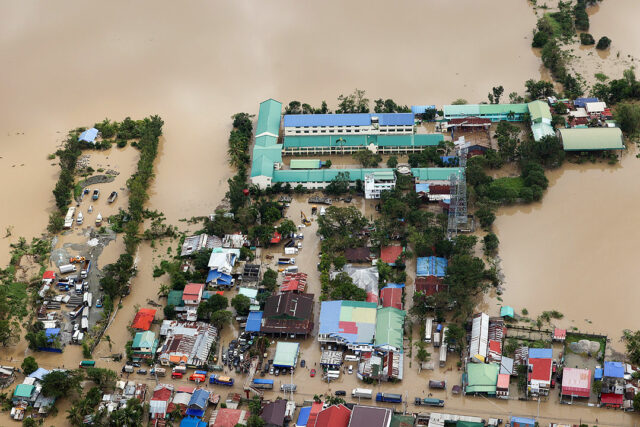
SYDNEY — Floods and natural disasters that hit all but one Australian state and territory in 2022 cost the economy A$5 billion ($3.48 billion) and stoked inflation according to Treasury estimates which forecast billions more spending in 2023.

Australia suffered four major bouts of flooding last year, with global reinsurer Munich Re estimating that February and March flooding across northern New South Wales state that killed more than 20 was the fourth most costly global disaster in 2022.

Natural disasters cost the economy A$5 billion or 0.25% of real GDP for last financial year, according to Treasury estimates, particularly delays to mining and construction plus the destruction of crops. The figures did not include damage or destruction of infrastructure and other assets.

“We’ve put that number out there really just as a reminder that even though we are rightly focused on the human cost of these natural disasters, which are becoming more and more frequent, there is a cost to the economy as well and a cost to the budget,” Treasurer Jim Chalmers told ABC radio on Friday ahead of a tour of Lismore, a town 700 kilometers (435 miles) north of Sydney devastated by floods last year.

Flooding worsened last year’s record inflation, according to the Treasury, with washed out crops and disrupted logistics contributing to a 16.2% rise in fruit and vegetables prices compared to the pre-COVID decade average of 2.5%.

Days after inflation surprised forecasters to the upside, the Treasury believes fresh food prices will continue to rise.

Mr. Chalmers also flagged more demands on the budget he will deliver in May, with billions of additional disaster-related spending expected this year on top of A$3.5 billion spent in 2022.

The government will focus on mitigating future disasters, he said, instead of policies like subsidizing expensive insurance for those who live in disaster-prone areas.

“We need to be careful about how we expose the government’s balance sheet to some of these big risks,” he said. — Reuters

Why the US needs Japan’s help on China chips restrictions

REUTERS

WASHINGTON — When the Biden administration unveiled aggressive export controls in October aimed at blocking China from becoming a global leader in advanced semiconductors it was missing a key ingredient: agreement from US allies to impose their own matching restrictions.

Persuading Japan to join the US effort, which limits Chinese access to US chipmaking technology and cuts China off from certain semiconductor chips made anywhere in the world, will be high on US President Joseph R. Biden, Jr.’s to-do list when he meets with Japanese Prime Minister Fumio Kishida in Washington on Friday.

American officials, touting an ever-closer strategic alignment with Japan, are praising Tokyo’s plan for the biggest Japanese military buildup since World War Two as rivalry with China in the region grows.

But while Japan is broadly in-line with the goals of the Mr. Biden administration’s expanded US export controls, Mr. Kishida’s government has been vague about the extent to which it will join in.

Speaking in Washington last week, Japan’s minister of Economy, Trade and Industry, Yasutoshi Nishimura, promised to work more closely with Washington on export controls, although he did not say whether Tokyo would match sweeping US restrictions.

The hesitation is understandable — Japan is a top producer of the specialized tooling equipment needed to manufacture advanced chips and its companies hold 27% of global market share, according to the Semiconductor Industry Association. Tokyo Electron, Japan’s leading chip manufacturing equipment maker, relies on China for about a quarter of its revenue.

The other top producers of chip-making gear are the United States and the Netherlands, home to ASML, another of the world’s biggest makers of chip-making tools.

SEEKING A DEAL

US officials are quick to play down the differences between the United States, Japan and other allies.

“I think there’s a very, very similar vision of the challenges,” a senior US administration official told Reuters on Wednesday, adding that Japanese export restrictions may not be exactly the same as the U.S. controls.

“But I don’t think the Japanese question the basic premise that we need to be working closely together on this.”

A US Commerce Department official said in October he expected a deal with allies in the near term.

Netherlands Prime Minister Mark Rutte will travel to Washington to meet Biden on Tuesday and discuss “cooperation on critical technologies and shared vision for a free and open Indo-Pacific,” the White House said on Thursday.

Still, said Daniel Russel, a former top US diplomat for Asia, a gap remains between the US and Japanese positions.

“Kishida wants the US to take a Goldilocks approach that is tough enough to deter Chinese assertiveness, but cautious enough to allow Japan’s business interests to thrive,” he said.

Behind the US drive for high-tech export controls is rising alarm about China’s military buildup and its effort to outpace the United States in technologies such as artificial intelligence and quantum computing.

Fearing that this will yield a military edge for an increasingly assertive China, US officials hope that keeping the most sophisticated chips – and the tools needed to make them — out of China’s hands will slow the country’s progress on advanced technologies.

But unless Japan and the Netherlands impose their own export controls, China will soon perfect other ways of getting the equipment it needs, even as American companies stand to lose market share.

A US deal with the Netherlands could also be within reach. One toolmaking industry executive familiar with that country’s sector said that if the Dutch government imposed similar export controls on its industry, ASML would probably not suffer a severe impact due to its extensive network of customers beyond China.

If US diplomacy succeeds, its policies could have the intended impact, argues Chris Miller, author of “Chip War” and an associate professor at Tufts University.

With Japan on board, particularly in terms of chip manufacturing tools, the United States could put up “a really large number of road blocks to China’s ability to advance its own domestic chipmaking,” Mr. Miller said.

That would have knock-on effects for Beijing’s other tech ambitions, including in artificial intelligence.

Japanese companies can make up for lost China business by expanding elsewhere, such as Southeast Asia, a chip industry source familiar with internal discussions about export restrictions said.

“For better or worse, Japan’s semiconductor strategy is moving in accordance with what the United States wants.” — Reuters

Four out of five Filipinos are interested in entrepreneurship – OCTA Research

STOCK IMAGE | Image by pikisuperstar on Freepik

Eighty-one percent (81%) of adult Filipinos would prefer to go into business – granting they had enough know-how to do so, according to the results of a survey conducted in October 2022 by OCTA Research, a private polling, research, and consultation firm,  

Results of the national survey was released January, 2023 by the office of Jose Ma. “Joey” A. Concepcion III, founder of GoNegosyo, a non-profit that supports Filipino entrepreneurs, and which commissioned the said survey. 

Across socioeconomic classes, the desire for entrepreneurship was at 80% among classes ABC and D, and 74% from class E. The national survey, commissioned by Go Negosyo, a non-profit that supports Filipino entrepreneurs, also found that capital provision is the kind of government support that small entrepreneurs need the most (69%), and that mentorship is a very important component for a small business to be more successful (66%). 

Filipinos have high interest for entrepreneurship, according to Ranjit Singh Rye, an OCTA Research fellow and a professor at the University of the Philippines, in a January 11 phone call.  

“It’s also clear they want government to support MSMEs [micro, small, and medium enterprises] by funding two things: loans and mentoring,” Mr. Rye said. 

“My opinion is that the government needs to expand investment in programs that broaden and deepen the development of MSMEs in the country.…Filipinos are hankering for support,” he added. “This is the viable way forward for us not just to recover, but prosper as a nation.”  

Among those Filipinos who prefer to get into business, the top reasons are: 

  • no boss to report to/get along with (24%) 
  • management of one’s own time/schedule (21%) 
  • working and earning at home or from anywhere (14%) 
  • daily income/money (13%) 
  • and no limit in profit/bigger salary (12%).  

Those who prefer work, in contrast, cite having a fixed/monthly income (34%), financial security (29%), and not having to need money/capital to start (17%) as their top reasons.  

Either way, three-fifths of adult Filipinos (62%) think the positive impact on the community is the main reason for supporting and favoring small businesses. 


Information sources 

Relatives and family are the main source of information about entrepreneurship for adult Filipinos (59%), with the local government unit (LGU) following at 43%. Only about 23% of the same segment consider the Department of Trade and Industry as the source of information about entrepreneurship. 

The October 2022 survey further found that more than half – or 53% – were also aware of Go Negosyo and its founder, Jose Ma. “Joey” A. Concepcion III. Go Negosyo is seen by adult Filipinos as either as a partner or supporter of small businesses (52%), or as one that teaches how to run a business (47%). 

“With the pandemic now behind us, and even with the current headwinds facing the global economy, I am confident that 2023 will be a much better year for our entrepreneurs,” Mr. Concepcion said in a January 8 press statement.  

“I think our growth will continue, and I believe that, perhaps by the second quarter, we will reach a tipping point where commodity prices will go down. Interest rates definitely will taper off, and hopefully, by the second quarter and maybe towards the third, interest rates will go down, and it will be the same with power rates,” said Mr. Concepcion. 

“Barring any further escalation between Russia and the Ukraine, we might have already seen the worst,” he added in the same press statement. 

Micro, small, and medium enterprises account for 62.66% of job generation in the Philippines, which amounts to 5,380,815 jobs, per the Department of Trade and Industry’s 2020 figures. 

The Philippines Statistics Authority classifies an enterprise as a micro enterprise if it has less than 10 employees, small if it has 10-99 employees, medium with 100-199 employees, and large if it has 200 or more employees. The Small and Medium Enterprise Development Council, on the other hand, uses asset size (up to P3,000,000 for microenterprises, and up to P100,000,000 for medium ones) as its basis for classification.Patricia B. Mirasol

The survey involved 1,200 respondents aged 18 years and older, covering socioeconomic classes AB, C, D, and E.  

Animal and pet-related Reels get most engagement on Facebook and Instagram in 2022

Reels of animals and pets received the most engagement on Facebook and Instagram in the first three quarters of 2022, according to Meta, the company that owns the two social media platforms. 

The Reels feature is a feed of short-form videos that were launched in the Philippines early 2022 (for Facebook) and late 2021 (for Instagram). 

For Facebook Reels, the top 5 most engaged topics from Filipino creators in 2022 are: 

  • Animals and pets 
  • Comedy/skit 
  • Sports 
  • Fashion 
  • Family and parenting 

For verified Philippine-based Instagram accounts, former Pinoy Big Brother housemate, Andrei King (@king.dreii), created the Reel with the highest number of views with his “Instagram vs. Reality” experience about taking Instagram-worthy travel photos, garnering 1,228,238 likes.  

Actress Maricar Reyes-Poon (@maricareyespoon) takes second place for most played Instagram Reels with her transformation from sweet and charming girl next door to chic and sophisticated lady with the Cruella filter. 

Philippine-based Korean creator Dasuri Choi’s quick glam change, fashion blogger Kryz Uy’s moment with husband Slater, and When In Manila’s sushi pun round up the top 5. 

Meta also noted that Jeeca Uy, the home cook behind The Foodie Takes Flight, gained more than 117,000 new Instagram followers after they viewed one of her Reels.  

“Reels enables everyone to create entertaining short-form videos and get discovered on a global stage. Since we launched Reels on Instagram in 2021, we have seen just how much Reels content reflect authentic Pinoy culture as a whole—from our soft spot for animals, to our penchant for finding humor in everyday life, how we value family, and how we express our shared love for food,” said John Rubio, Philippine country director at Meta, in a January 5 press statement. 

 “We look forward to seeing Filipino Creators expand their repertoire, grow their following, and explore fun new ways to engage people through short-form content in 2023,” he added.Patricia B. Mirasol

BSP chief hopes to cut rates in 2024

Buildings are seen along EDSA in Quezon City, July 3, 2022. — PHILIPPINE STAR/ MIGUEL DE GUZMAN

By Keisha B. Ta-asan, Reporter

THE BANGKO SENTRAL ng Pilipinas (BSP) may cut key benchmark rates in 2024, as well as lower the reserve requirements for banks in the first half of 2023, its chief said on Thursday.

“Now hopefully by 2024, when pent-up demand is gone, then monetary policy hopefully at that time will be much looser than what we have now. How much looser? I don’t know. Of course, so many things can happen,” BSP Governor Felipe M. Medalla said in a speech at the Rotary Club Manila meeting.

However, Mr. Medalla told reporters that monetary policy would still depend on what the US Federal Reserve does, saying the policy tightening in the United States “is far from over.”     

The US Federal Reserve increased rates by 425 bps last year, bringing its policy rate to 4.25-4.5%.  The Fed has signaled it will continue tightening this year to tame inflation.

“Even though we’re quite confident that inflation will normalize, I cannot say that we will have rate cuts before the end of this year. But hopefully 2024,” Mr. Medalla said.   

The BSP governor earlier this week flagged a 25-basis-point (bp) or 50-bp rate increase at its first policy meeting this year on Feb. 16.

The Monetary Board raised borrowing costs by 350 bps in 2022, to curb inflation and support the peso. This brought the policy rate to a 14-year high of 5.5%.   

Mr. Medalla also hopes that the series of rate hikes would be enough to tame inflation and prevent any second-round effects this year.   

Inflation rose to a 14-year high of 8.1% in December, bringing the full-year average to 5.8%. The BSP sees inflation easing to 4.5% this year and 2.8% in 2024.   

RRR CUT
Mr. Medalla said there is a high probability of cutting the banks’ reserve requirement ratio (RRR) in the first semester of 2023.

“Cutting the RRR is very important to us. The only reason we postponed this is because (when) we did this in the past, it confused the markets,” Mr. Medalla said.

A cut in RRR is a move intended to be an operational adjustment to facilitate the BSP’s shift to market-based instruments for managing liquidity in the financial system, particularly the term deposit facility and the BSP securities. 

The RRR for big banks is currently at 12%, one of the highest in the region. Reserve requirements for thrift and rural lenders are at 3% and 2%, respectively.

In March 2020, the BSP cut big banks’ RRR, or the percentage of deposits and deposit substitutes they must keep with the central bank, by 200 bps to 12%.

The BSP earlier committed to bringing down the RRR of big banks to single digits by 2023.   

Bank of the Philippine Islands (BPI) Lead Economist Emilio S. Neri, Jr. said the central bank is taking the right direction regarding the reserve requirements.

“Cutting RRR improves the competitiveness of local banks and should benefit bank customers as it lowers the cost of intermediation. It’s crucial that the sequence is done right,” Mr. Neri said in a Viber message.   

“It’s better for a policy rate cut to give way to an RRR cut as doing the opposite could lead to another postponement of a long-standing commitment to sharpen, so to speak, BSP’s policy tools. The RRR is a blunt policy tool being replaced by more precise and preventive ones like macro prudential measures,” he added.   

For ING Bank N.V. Manila Senior Economist Nicholas Antonio T. Mapa, the move to reduce the RRR is a welcome development and it should be well-timed to avoid confusion on the BSP’s policy stance.   

“In 2023, with less pressure on the peso and with the current governor indicating that the rate hike cycle is winding down, the RR (reserve requirement) reduction can take place in an orderly fashion,” Mr. Mapa said in an e-mail. 

“Furthermore, [Mr.] Medalla expressed the intention to reduce RR to offset the expiration of pandemic-era accommodation for lending to (small and medium enterprises). This should further ensure an orderly transition away from RR to market-based tools such as the BSP deposit facilities and bills,” he added.

During the pandemic, the BSP allowed lenders to count their lending to micro, small, and medium enterprises and pandemic-hit large enterprises as part of banks’ alternative compliance with the RR against deposit liabilities and deposit substitutes until the end of 2022.

NPL ratio continues to decline in November

STOCK PHOTO | Image by iiijaoyingiii from Pixabay

BAD DEBTS held by Philippine banks continued to drop in November, bringing the industry’s nonperforming loan (NPL) ratio to 3.35%, with the Bangko Sentral ng Pilipinas (BSP) governor saying he does not expect a further rise this year.

Based on data from the central bank, soured loans slipped by 0.9% to P408.097 billion in November from P411.632 billion in October. It also declined by 15.3% from P481.879 billion in November 2021.

This brought the November NPL ratio to 3.35%, which fell from 3.41% in October and 4.35% in the same month of 2021. This was also the lowest in 27 months or since the 2.84% print in August 2020.

Loans are considered nonperforming once they remain unpaid for at least 90 days after the due date. They are deemed as risk assets as borrowers are unlikely to settle these loans.

“It’s hard to predict (the trend in NPLs) but I do not expect it to rise (this year). Loans are going up, so the denominator is going up,” BSP Governor Felipe M. Medalla told reporters on the sidelines of a Rotary event on Thursday. 

Data earlier released by the BSP showed outstanding loans extended by universal and commercial banks climbed by 13.7% year on year to P10.64 trillion in November. However, this is slightly slower than the 13.9% expansion in October.

Asian Institute of Management economist John Paulo R. Rivera attributed the decline in NPLs to more income-generating activities and stable employment as the economy recovered from the pandemic.

“This is expected to continue as the economy recovers and approach pre-pandemic level,” Mr. Rivera said in a Viber message.

The unemployment rate eased to 4.2% in November, the lowest in over 17 years, as firms hired more workers ahead of the holiday season. 

Since March last year, Metro Manila and most provinces in the country have been under the most lenient alert level, allowing businesses to operate at full capacity.

Consumers and businesses were also able to pay their loans amid the economic recovery, Rizal Commercial Banking Corp. Chief Economist Michael L. Ricafort likewise said.

In November, banks’ total loan portfolio rose by 10.1% to P12.20 trillion from P11.08 trillion a year ago.

Past due loans fell by 13.2% to P492.528 billion from P567.512 billion a year earlier. These borrowings are equivalent to 4.04% of the industry’s total loan portfolio, down from 5.12% a year earlier.

Restructured loans fell by 4.9% year on year to P327.760 billion in November, from P344.897 billion in the same month of 2021. This brought the ratio to 2.69% in November, from 3.11% in the year prior.

Meanwhile, banks increased loan loss reserves by 2.7% to P431.501 billion in November, from P419.863 billion in the year prior. With this, the ratio went down to 3.54% from 3.79% in November a year ago.

Lenders’ NPL coverage ratio — which shows the allowance for potential losses due to bad loans — increased to 105.73% from 87.13% a year earlier.

“Further improvement in lending/credit standards also contributed to the improved loan/asset quality of banks, on top of the further reopening of the economy,” Mr. Ricafort said. 

However, he noted that elevated inflation and higher borrowing costs remain “overshadowing challenges” that may affect banks.

The BSP has raised benchmark interest rates by 350 basis points (bps) last year, bringing the overnight reverse repurchase rate to 5.5% to tame inflation.

Inflation rose to a 14-year high of 8.1% in December, bringing the full-year average to 5.8%. This is above the central bank’s 2-4% target for 2022.

BSP officials earlier said Philippine banks’ NPL ratio may peak at 8.2% in 2022.

As of end-December 2021, the ratio stood at 3.97%. — Keisha B. Ta-asan

GDP grew by at least 7.5% in 2022, says Diokno

Families celebrate Christmas at Luneta Park, Dec. 25, 2022. — PHILIPPINE STAR/WALTER BOLLOZOS

THE PHILIPPINE ECONOMY likely expanded by at least 7.5% in 2022, Finance Secretary Benjamin E. Diokno said on Thursday.

“We expect the economy to have grown by at least 7.5% last year. Because of the expected slowdown of the global economy, the Philippine economy is forecasted to grow by around 6.5% this year — still one of the highest, if not the highest, growth rate in the Asia-Pacific region,” Mr. Diokno said in a transcribed speech at the 16th Asian Financial Forum (AFF) on Wednesday.

The government had set a gross domestic product (GDP) growth target of 6.5-7.5% for 2022.

Economic managers previously said the Philippines will likely exceed the GDP target after the better-than-expected 7.6% growth in the third quarter, which brought the nine-month average to 7.7%.

The Philippine Statistics Authority (PSA) is set to release fourth-quarter GDP data on Jan. 26.

“Entering 2023, the world economy faces multiple challenges — from the COVID-19 pandemic to the global supply chain crisis; from persistently high prices owing to higher energy and other commodity prices to the rapid monetary tightening in the US, Europe, and practically all economies; and from worsening poverty to threatening climate disaster,” Mr. Diokno said.

Economic managers in December revised its 2023 GDP target to 6-7%, a narrower band than the previous goal of 6.5-8%.

The World Bank on Wednesday lowered its forecast for the Philippines’ GDP to 5.4% this year, from its previous projection of 5.6% amid the looming global recession.

The 5.4% Philippine GDP forecast was the second-fastest forecast in Southeast Asia this year, behind Vietnam’s 6.3%.

“While the challenges we face today are grand and complex, these are not insurmountable. There is much we can accomplish with the right policy tools, decisive action, and commitment to global cooperation,” Mr. Diokno said.

The Finance chief said that the government’s growth and price stability objectives can be achieved “if the leaders and policy makers are able and willing to adopt the appropriate monetary and fiscal policies.” — Luisa Maria Jacinta C. Jocson

Disasters, debt crisis are seen as top risks for PHL

Areas in Bulacan, Nueva Ecija and Tarlac experienced heavy flooding after super typhoon Karding hit the country in September. — PHILIPPINE STAR/KRIZ JOHN ROSALES/PPA POOL

NATURAL DISASTERS are considered the top risk faced by the Philippines over the next two years, alongside a possible debt crisis, rising inflation and misinformation, according to a survey conducted by the World Economic Forum (WEF).

In its Global Risks Report 2023, the WEF said Philippine respondents for its executive opinion survey (EOS) identified natural disasters and extreme weather events as the top risk facing the country.

The Philippines is one of the countries considered most vulnerable to natural disasters such as earthquakes, floods, heatwaves, and typhoons. It had the highest disaster risk among 193 countries in the World Risk Index last year.

“Natural disasters and calamities cause a lot of damage, disruption, and productivity losses in a year and is a consideration for investments,” Rizal Commercial Banking Corp. Chief Economist Michael L. Ricafort said in a Viber message when sought for comment.

Philippine respondents also considered a debt crisis as the second-biggest risk, as the government borrowed heavily to fund its coronavirus pandemic response.

The National Government’s outstanding debt stood at a record P13.644 trillion as of end-November. As of end-September, the government’s debt-to-gross domestic product (GDP) stood at 63.7%, still above the 60% threshold prescribed by multilateral lenders.

However, Mr. Ricafort said that the country’s debt-to-GDP ratio is still manageable.

“However, there is a need to bring the debt-to-GDP ratio to below the international threshold of 60% of GDP… to prevent any risk of credit rating downgrade,” Mr. Ricafort said.

MISINFORMATION
The WEF report showed Philippine respondents also identified rapid or sustained inflation, misinformation, and geopolitical contestation of resources as other top risks for the country.

Inflation rose to a 14-year high of 8.1% in December, bringing the full-year average to 5.8%. However, the Philippine central bank sees inflation easing to 4.5% this year and 2.8% in 2024.   

Based on the WEF report, the Philippines was the only country where respondents considered misinformation as one of the top five risks in the next two years.

“Misinformation and disinformation are, together, a potential accelerant to the erosion of social cohesion as well as a consequence. With the potential to destabilize trust in information and political processes, it has become a prominent tool for geopolitical agents to propagate extremist beliefs and sway elections through social media echo chambers,” WEF said.

Filipino voters had faced a barrage of fake news on social media, particularly during the national elections in 2016 and 2022.

“Information is key to any good working economy. Information asymmetry is not good especially for financial markets,” UnionBank of the Philippines, Inc. Chief Economist Ruben Carlo O. Asuncion said in a Viber message.

Mr. Ricafort said that misinformation is a high risk for the Philippines since it could affect both the economic and political landscape.

“It could potentially alter election results/voters’ behavior and choices. It is also important in view of the information age… Increased education and transparency can help address risk of misinformation,” he added.

Mr. Asuncion said the Philippine government has a “tough task” of sustaining economic recovery amid various headwinds.

“Nevertheless, we do have a leg up moving forward but still I would approach 2023 with much caution… Global economic growth is fragile and any unexpected event (like geopolitical noise, resurgence of COVID-19) can push the global economy into a deeper economic slowdown,” Mr. Asuncion said.

“Careful and deliberate policy coordination and support would be welcome amidst the challenges of uncertainties that we all face as citizens of this world,” he added.

The survey was conducted by WEF between April and September 2022. It involved over 12,000 respondents from WEF’s partner institutes, who were asked which five risks are most likely to pose the biggest threat to their country in the next two years. 

GLOBAL RISKS
Meanwhile, the “cost-of-living crisis” was ranked as the most severe global risk in the next two years, the annual WEF Global Risks Perception Survey (GRPS) showed.

“The persistence of a global cost-of-living crisis could result in a growing proportion of the most vulnerable parts of society being priced out of access to basic needs, fueling unrest and political instability,” WEF said.

Other top global risks identified by global respondents were natural disasters and extreme weather events; geoeconomic confrontation, failure to mitigate climate change; and erosion of social cohesion and societal polarization.

Global risk is defined by the possibility of the occurrence of an event that may negatively impact a significant proportion of global economy, population or natural resources.

In the next 10 years, the failure to mitigate climate change is seen as the biggest risk facing the global economy, followed by failure of climate change adaption, and natural disasters and extreme weather events.

“The short-term risk landscape is dominated by energy, food, debt and disasters. Those that are already the most vulnerable are suffering — and in the face of multiple crises, those who qualify as vulnerable are rapidly expanding, in rich and poor countries alike,” WEF Managing Director Saadia Zahidi said in a separate statement.

“Climate and human development must be at the core of concerns of global leaders, even as they battle current crises. Cooperation is the only way forward,” she added.

The GRPS collected responses from over 1,200 experts between Sept. 7 and Oct. 5, 2022. — Revin Mikhael D. Ochave

REITs seen saddled by hybrid work, POGO exit

KATE SADE-UNSPLASH

By Justine Irish D. Tabile, Reporter

REAL estate investment trusts (REITs) are expected to benefit from the further reopening of the economy, but their growth could be tempered by flexible work arrangements and the departure of Philippine offshore gaming operators (POGO), analysts said.

“The economic reopening narrative would still be the important consideration for the business and sales and overall valuations of REITs,” Rizal Commercial Banking Corp. Chief Economist Michael L. Ricafort said in a Viber message.

“This would be counterbalanced though by the continued work-from-home or hybrid arrangements for some BPOs (business process outsourcing) and some reduction in POGO business since the pandemic started and also amid tighter regulations on POGOs in recent months,” Mr. Ricafort added.

The continuing hybrid work comes as the Fiscal Incentives Registration Board (FIRB), an interagency government body that grants tax incentives to registered business enterprises (RBEs), extended the validity of Resolution No. 026-22 until Jan. 31.

Before the extension, the FIRB noted that only about 40% of the affected RBEs in the information technology and business process management (IT-BPM) industry have submitted their transfer requirements on time or on the previous deadline of Dec. 31, 2022, with 640 RBEs not being able to submit.

With its extension, Resolution No. 026-22 will allow existing RBEs to transfer their registration from the investment promotion agency administering economic zones to the Board of Investments until Jan. 31, which will allow them to adopt up to 100% work-from-home arrangement without the loss of incentives.

Meanwhile, China Bank Securities Corp. Research Director Rastine Mackie D. Mercado said that continued growth in economic activity could help buoy occupancy and rental rates of office and retail REITs.

“Apart from this, revenue growth could also be supported by annual rental escalation, and incremental revenues from asset infusions,” Mr. Mercado added.

Many REITs have posted three-year investment strategies in which they have expressed a positive outlook for the coming years. Philippine Stock Exchange, Inc. said it expects more REITs to list in 2023.

According to the bourse operator, it expects 14 maiden listings this year, 11 of which will be composed of companies and REITs that will list on the main board.

In its three-year investment strategy, DDMP REIT, Inc. (DDMPR) said it is looking to diversify its tenant mix to include financial services, government agencies, and service sectors, banking on its properties’ prime location and government property locators.

Meanwhile, MREIT, Inc. said it is on track to increase its gross leasable area (GLA) to 500,000 square meters (sq.m.) by the end of 2024, while Ayala Land, Inc.-sponsored AREIT, Inc. is planning to grow its assets at an average of 100,000 sq.m. of GLA annually from 2023 to 2025.

Premiere Island Power REIT Corp. (PREIT) said it is working to grow and diversify its portfolio on power generation as it expects to maximize annual total investor return through new acquisitions.

However, most shares of REITs closed lower by end-2022 versus their offer prices with some continually declining as of Jan. 6.

In the REIT prices summary compiled by Philstocks Financial, Inc., AREIT and PREIT were the sole gainers over their offer prices.

AREIT shares closed five centavos or 0.14% higher on Friday to P35.20 apiece, while PREIT shares added a centavo or 0.63% to P1.50 each.

Meanwhile, Citicore Energy REIT Corp. lost one centavo or 0.44% on Friday to P2.28 apiece; MREIT shares went down by 30 centavos or 2.14% to P13.70 each.

RL Commercial REIT, Inc. also declined by 19 centavos or 3.2% on Friday to P5.75 apiece, which was what also happened with VistaREIT, Inc., which lost one centavo or 0.6% to P1.65 each.

Although DDMPR added a centavo on Friday, its closing price of P1.30 is still lower than its offer price of P2.25, while Filinvest REIT Corp. closed unchanged at P5.50 each, also lower than its offer price of P7.

Despite the decline, Mr. Ricafort said that REITs remain to be an integral part of the capital market as they help in diversifying fund sources and investment prospects related to real estate.

“More REITs that are looking to be a part of capital market development allow real estate or property companies to have more options in raising funds while giving more alternatives to the investing public to participate in the various REITs as alternatives to actual real estate or properties with rental income being managed outright,” Mr. Ricafort said.

Meanwhile, Mr. Mercado expects less downward pressure on REIT prices this year as policy rate hikes level off.

“Note that REIT prices typically have an inverse relationship with interest rates and benchmark yields. Prospective infusions could also serve as catalysts for positive price action,” Mr. Mercado said.

Banshees, Fabelmans follow Globes honors with SAG nods

SAG-AFTRA
SAG-AFTRA

LOS ANGELES — Steven Spielberg’s drama The Fabelmans and dark comedy The Banshees of Inisherin, two big winners at Hollywood’s Golden Globes ceremony, were nominated on Wednesday for the top movie honor at the Screen Actors Guild Awards.

The films will compete for best movie cast with Women Talking, Babylon, and Everything Everywhere All at Once.

Banshees and Everything Everywhere led all movie contenders with five SAG nominations each.

Winners will be chosen by members of the SAG-AFTRA acting union. The awards are closely watched because actors form the largest group that will vote for the Academy Awards in March.

Banshees, the story of feuding friends on a remote island off the coast of Ireland, received SAG nominations for lead actor Colin Farrell and supporting cast Brendan Gleeson, Barry Keoghan, and Kerry Condon. The film was named best movie musical or comedy on Tuesday at the Golden Globe awards.

SAG also nominated Michelle Yeoh for her lead role in dimension-hopping action movie Everything Everywhere. Her co-stars Ke Huy Quan, Jamie Lee Curtis, and Stephanie Hsu also landed nominations.

The Fabelmans, the Golden Globe winner for best movie drama, earned a SAG nomination for lead actor Paul Dano. The coming-of-age story was inspired by Spielberg’s real life as a teenager facing family strife and anti-Semitism.

Other movie actors nominated included Austin Butler for Elvis, Cate Blanchett for Tar, and Adam Sandler for Hustle.

In television categories, Better Call Saul, The Crown, Ozark, Severance, and The White Lotus were nominated for best drama cast.

The TV comedy cast contenders are Abbott Elementary, Barry, The Bear, Hacks, and Only Murders in the Building.

Awards are scheduled to be handed out at a ceremony in Los Angeles on Feb. 26, two weeks ahead of the Oscars. The show will be streamed live on Netflix, Inc.’s YouTube channel. — Reuters

Megaworld to bring Savoy hotel to San Vicente, Palawan

MEGAWORLD Corp. is bringing its Savoy hotel brand to Palawan in a move that will raise the listed property developer’s total hotel room keys to around 4,806 when the project is completed.

The 10-storey Savoy Palawan will offer 306 guest rooms and suites in varied layouts and will open its doors in a 462-hectare lot in Paragua Coastown in San Vicente, Palawan by 2028.

“As we continue to tap on the rising opportunities in Philippine tourism, we also hope to meet the demand for accommodations in San Vicente, which is known to have the longest beach line in the entire country,” Megaworld Hotels and Resorts Managing Director Cleofe C. Albiso.

Savoy Palawan will be a five-minute walk to the beach and will be beside the township’s Mangrove Reserve Park.

The hotel will have a swimming pool for adults and a separate kiddie pool, a pool deck at the third level, a fitness center, a spa with a wet and dry sauna, and a kid’s club.

Meanwhile, Savoy Palawan will house four food and beverage outlets: an all-day dining restaurant with an alfresco area, Zabana Bar & Lounge, Grill Bar with outdoor dining, and a specialty restaurant. It will also house a ballroom, smaller function rooms with pre-function areas, a business center and a meeting room.

Ms. Albiso said that the hotel will feature sustainability features as the company aims to make it a luxury green hotel.

“The hotel’s equipment and machines will be certified ‘energy-efficient’ and we will also be using recycled water for washing from our rain harvesting facility,” said Ms. Albiso.

Savoy Hotel will also have facilities for bikes as a part of the bike-friendly community of Paragua Coastown.

The hotel is the 17th hotel property launched by Megaworld Hotels and Resorts, the homegrown hotel operator of Megaworld.

To date, 12 of these 17 launched hotels are operational with the remaining five currently in the pipeline including Savoy Palawan and Grand Westside Hotel in Parañaque City which the company said is poised to be the biggest hotel in the country.

The total operational hotel rooms of the company are around 4,500 in Richmonde Hotel Ortigas, Eastwood Richmonde Hotel, Richmonde Hotel Iloilo, Savoy Hotel Newport, Savoy Hotel Boracay, Savoy Hotel Mactan Newtown, Belmont Hotel Manila, Belmont Hotel Boracay, Belmont Hotel Mactan, Kingsford Hotel Manila, Twin Lakes Hotel in Tagaytay and Hotel Lucky Chinatown in Binondo. — Justine Irish D. Tabile

The Good, the Middling, and the Ugly of 2022

A SCENE from the film The Fabelmans.

OKAY, as Tuco once put it “when you have to shoot, shoot; don’t talk.”

THE GOOD
17. Barbarian — Zach Cregger puts it best: he didn’t like the way the film was going — predictably — so he threw in a sudden left turn. It works; the pic is worth a look mainly for the suspense set pieces and for Justin Long’s hilariously toxic take on the entitled man-child, who talks a good game and acts like an aspiring Survivor contestant.

16. Three Thousand Years of Longing — George Miller’s latest delivers on the sumptuous cornucopia of visual delights in the manner of A Thousand and One Nights, beguiling us the way Scheherazade did her king — and then what? What’s left for a woman who’s heard it all and a Djinn who’s seen even more? The answer may either intrigue or disappoint you, but has some kind of crazed integrity.

15. Halloween Ends — easily the most perverse of David Gordon Green’s Halloween trilogy, and a capstone to the overextended life of Michael Myers. Ends addresses not just the mortal chill in Laurie’s bones but everyone’s in Haddonfield, and ours too. Myers is just a man, after all; Green’s thesis is that his evil isn’t so much supernatural as it is social, mutating and going viral in an all-too-familiar way in this hate-filled hair-trigger world.

14. Inu-Oh — Maasaki Yuasa’s latest is a musical thin on plotline but thick on beyond-gorgeous animated art, not to mention an ingenious working-out of the question “what if modern rock stagecraft was developed in 12th century Japan?” Call it a laser glamrock concert with a quietly piercing ending.

13. Pearl — Ti West’s prequel to X feels less like a slasher flick than a character study, his visual style — Douglas Sirk on steroids — underlining the story’s melodramatic roots. Mia Goth, who stars and co-writes, gives the film her all, including a final few minutes of agonizing intensity.

12. Everything, Everywhere, All at Once — For the record, the Daniels’ debut feature is a tad too earnest, serving up all that fun and ingenuity to hand us some moral and spiritual uplift, like a limp fortune cookie delivered at the end of a sumptuous Chinese feast. That said, this is a feast, some of the funniest, most eyepopping action sequences this side of the younger Jackie Chan or Michelle Yeoh, and by gum that is Michelle Yeoh at the eye of this particular storm. Done for a mere fraction of Dr. Strange’s catering budget (see below).

11. Leonor Will Never Die — Martika Ramirez Escobar’s debut feature took eight years to write and three years to release and is worth the long wait: the eponymous Leonor is a former famed filmmaker hoping to make a comeback with her long-cherished script; the result bounces between fantasy and reality and meta-reality with the freewheeling spirit of Everything Everywhere only without the heavy-handed “uplift” and at a fraction of Everything’s already minuscule budget (which in turn makes Dr. Strange’s hundred million dollar production look even more embarrassing).

10. The Fabelmans — Spielberg’s most overtly personal work (he’s been covertly personal for most of his career), with some of his best filmmaking poured into sequences of — surprise surprise — a young man filmmaking. That and David Lynch as John Ford; what’s not to like?

9. Mad God — What if Blade Runner had been animated by Ray Harryhausen channeling David Cronenberg? Phil Tippet takes some 30 years to respond to the challenge, and the results are by turns confusing, fascinating, disgusting, awe-inspiring.

8. Blonde — if you ignore the fact that Andrew Dominik’s “fictionalized history” is loosely based on the life of Marilyn Monroe, and inflicts on her more suffering than the real star likely experienced in her lifetime (with maybe half the spirit) — you might like the film. As is, I consider it the best horror of the year, with the caveat that it’s a little too relentless — when interrogating a client, you want to allow her some breathing room to recover, so you can continue the session.

7. Crimes of the Future — maybe not major David Cronenberg but sexy Cronenberg, perhaps his funniest in years. Sketches the outlines to a future that seems ominously plausible even inevitable, and poses this knotty question: when pain is no longer felt, are emotional stakes or drama still possible? Is even humanity possible?

6. 12 Weeks — Anna Isabelle Matutina’s debut feature tells of a woman whose life is turned upside-down when she suddenly learns she’s pregnant — at the age of 40, in a country where abortions are still illegal. Matutina doesn’t judge, presents her story as plainly as possible, but the fact that the woman doesn’t have a choice in the matter says something.

5. When the Waves are Gone — And then there’s Lav Diaz who among Filipino filmmakers seems like the only one that gives a damn about our six years under a near-dictator, the six more promised under the son of a former dictator. Waves is his stripped-down noir, about the Philippines’ greatest police investigator, Lieutenant Hermes Papauran, being stalked by his former mentor, Primo Macabantay. As the former, John Lloyd Cruz shuffles forth in the world like a classic Diaz protagonist, with his conscience and the troubles of the world dragging him down; as the latter, Ronnie Lazaro is imp and jester, judge and executioner, offsetting Cruz’s gravid presence with his own explosive lunacy.

4. Pinocchio — Guillermo del Toro treats the eponymous character not like a cute boy with token wooden joints but like one of his own creatures — frightening, fearless, not entirely without soul. In many ways darker and more subversive than the 1940s Disney classic or even the Collodi original.

3. Armageddon Time — the third filmmaker’s autobiography to come out this year is the smallest-scaled and most understated, and, in my book, the most powerful. James Gray takes a plainspoken approach to recognizing everyone’s special qualities, sparing none of their flaws; he touches on the uneasy truce Jewish immigrants have struck with the upper class, the fragile yet persistent nature of adolescent friendship, and the utter powerlessness of a youth.

2. Decision to Leave — I’ve seen serial killer scenarios wielded as thrillers, as comedies, as ravishingly embroidered menus, as pseudo-profound philosophical stances — but as a seduction tactic? Park Chan-wook’s latest does exactly that, weaving a web of mystery and sensuality around its detective that leaves him off-balanced and confused till the cord tightens round his neck. One thinks of Deliverance, Dressed to Kill, Out of the Past, and even Vertigo watching this film, not without cause; to Park’s credit, he invites such outlandish comparisons and still manages to be his own perversely persistent creature.

1. A Tale of Filipino Violence — Again Lav Diaz, who just can’t leave a good thing alone. His adaptation of Ricky Lee’s classic story “Servando Magdamag” is a three-pronged attack on the Marcos regime — its roots in the colonialist past, its chokehold on the immediate present (actually 1970s Philippines), its dark reach into the near future.

THE MIDDLING
15. Don’t Worry Darling — Olivia Wilde’s stylish mashup of The Prisoner with The Stepford Wives ultimately feels unsatisfying, but getting there’s more than half (actually all) the fun.

14. RRR — SS Rajamouli’s action epic is watchably inventive for maybe the first half-hour; the variety is sustained in the remaining two and a half hours — somewhat — but the intensity does wear you down, not to mention the relentless flag-waving. Prefer his far more inventive Eeaga, where the rivalry (man vs. fly) is more lopsided, the comedy more pointed.

13. Babylon — Damien Chazelle’s unauthorized and unacknowledged adaptation of Kenneth Anger’s Hollywood Babylon is enjoyable, just don’t take it seriously as history. No, seriously — don’t.

12. Thor: Love and Thunder — Don’t see this so much as a Marvel sequel as it is Taika Waititi doubling down on his obsessions and just for that if not much else, I concede respect.

11. Kimi — Steven Soderbergh’s chamber thriller has Zoe Kravitz evoking everything from Repulsion to Rear Window. Not substantial but cleverly done.

10. X The Texas Chainsaw Massacre meets Debbie Does Dallas. Ti West succeeds where the Saw remake fails: taking the tired formula of city slickers invading the countryside and breathing sneaky comic life into the landscape. Mia Goth makes for an engaging porn star, an even more engaging creepy grandma (their scene in bed together is for the ages). Recommend pairing with its superior prequel, Pearl.

9. Apollo 10 1/2: A Space Age Childhood — the forgotten filmmaker’s autobiography. Richard Linklater, unlike Spielberg or Gray, doesn’t seem to have anything more serious in mind than evoking a childhood growing up in space-crazed Houston; paradoxically this frees him up to be more freewheeling and imaginative — and funnier — than either of his more highly regarded colleagues.

8. The Bob’s Burgers Movie — Loren Bouchard and Bernard Derriman’s blown-up, stretched-out version of the cult food porn animated series puts out a few songs, but don’t let that fool you; this is a nicely wayward nicely eccentric trip down some kind of lane — exactly what I can’t tell you, but it’s something.

7. Amsterdam — is terrific for maybe the first hour and 50 minutes, a funny, witty, scary evocation of the Nazi conspiracy that almost took over America. Scariest of all: it almost happened again last Jan. 6, 2020. The final 20 minutes is David O. Russell trying his level best to convince you the quality of the previous 110 minutes never existed — but no. It’s really good. The rest — well, that previous 110 minutes was really good.

6. All Quiet on the Western Front — more explicitly realistic than the 1930 adaptation — naturally — it commits two mistakes: 1.) substituting Paul’s furlough with a subplot tracing the various political maneuverings that end the war, and, 2.) giving Paul an extended, considerably more heroic fate. I understand introducing 1.) because it adds an element of suspense (can the war end before Paul does?) but the point of the book as I understood it was that the war was Sisyphean, wearing Paul’s spirit down to nothing. And I appreciate the elaborate staging and intensity of 2.) but that finale can’t even touch the brief poetry of Lewis Milestone’s butterfly version.

5. Dr. Strange in the Multiverse of Madness — Not sure how Raimi managed to hoodwink Disney and Marvel into financing his biggest-budgeted, most visually ambitious installment of the Evil Dead franchise but he did, and included Elizabeth Olsen’s most scarily authoritative performance yet in the bargain. A major accomplishment, if it wasn’t for — (see above).

4. Nope — Jordan Peele’s least evocative feature to date, and, yes, I do hear what it has to say about showbiz and the public’s insatiable appetite for scandal and spectacle. That said, nice use of the valley’s arena-like space (you know where you are at any point throughout the film) and the “Gordy’s Home” birthday episode feels like a nightmare excerpt from another far more disturbing film.

3. Tar — Subtly elegantly crafted. Amazing Cate Blanchett, especially how half her performance is in her hands, which keep fluttering and flitting through the air like a pair of wings, the way you imagine a conductor’s does. The rest of Todd Field’s film feels like both an argument for artists to continue being artists — flawed human beings with irreplaceable talent — and an indictment of people who defend such celebrities. You like or loathe it depending on how you fall on the issue; personally, I empathize with the former, feel oddly cool towards the film overall.

2. Triangle of Sadness — the first act could have been cut entirely, the second act is something Monty Python did funnier faster, the third act features Dolly de Leon — easily the best thing in the picture, though Woody Harrelson as a socialist ship’s captain and Harris Dickinson as a by turns oversensitive by turns opportunistic male model have their moments. Much prefer this when it was Joey Gosiengfiao’s Temptation Island.

1. The Banshees of Inisherin — Martin McDonagh’s claustrophobically insular work feels like Soderbergh’s Kimi turned inside out, with the inmates screaming at bleak landscapes instead of apartment walls, but the emotional terrain is basically the same: they have little else to face but themselves, and will do anything but that. One particularly twisted bit of subplot involving fingers feels less than persuasive — okay, I think it’s a dealbreaker, didn’t buy it when I first heard it, and by film’s end McDonagh fails to sell it to me. Better than his previous widely hailed masterwork, but still not to my taste.

THE UGLY
4. Texas Chainsaw Massacre — Watched David Blue Garcia’s sophomore feature because it came highly recommended on Twitter (catch me doing that again!). Starts off promisingly enough — Alice Krige plays an ambiguously senile matriarch, and Olwen Fouere replaces the late Marilyn Burns as Sally from the original 1974 Saw — then devolves into A Series of Unlikely Coincidences. Not recommended.

3. The Batman — Matt Reeves’ three-hour ultra-dark ultra-gritty take on the Cape Crusader borders on the autistic; there’s not much to see here (literally; did someone forget to pay the light bill?) and not much to chew on if you did (the best ideas were recycled from Se7ven, The French Connection, All The President’s Men, and Chinatown). As Catwoman, Zoe Kravitz — so engaging in Kimi — feels anemic when compared to Michelle Pfeiffer’s incomparable take on the character in the Tim Burton film.

2. Elvis — Baz Luhrmann doing Vegas for three straight hours. Oh the migraine.

1. Avatar: Way of Water — Sky people seek living space, burn thousands of square miles of good forest land, shoot thousands more blue folks. Jake’s kids are captured and escape, captured and escape; rinse and repeat till you have three hours’ worth of monotonous monochrome blue.