Home Blog Page 5378

Indonesia mangrove restoration engages coastal villagers

REUTERS

SEMARANG, Indonesia — In a coastal community on Indonesia’s Java island, villagers must constantly take soil and stones to local graveyards to secure the resting places of their dead friends and relatives — fearful that frequent flooding will sweep away the deceased.

Like other flood-prone villages in the northern Demak regency, Timbulsloko’s problems are threefold — with over-extraction of groundwater causing sinking, aquaculture contributing to some of the worst coastal erosion across the archipelago, and sea levels rising due to climate change.

The more than 3,000 people in Timbulsloko, who refuse to abandon their homes, often pay for trucks to transport dirt and rocks from nearby mountainous areas in order to protect graves, and to elevate their houses above the rising waters.

“Since 2008, there is more flooding because of coastal erosion,” said fisherman Suratno, who like many Indonesians goes by one name, sitting on the floor of his one-storey house, where the front door was blocked by ankle-deep flood waters.

“Every day there is flooding — the morning, afternoon or at night,” the 51-year-old told the Thomson Reuters Foundation last month.

Located along the Pacific Rim of Fire, Indonesia is made up of more than 17,000 islands, and faces many natural threats — ranging from earthquakes and tsunamis to volcanic eruptions. And the effects of climate change, such as worsening floods, present ever-greater risks to the Southeast Asian nation.

In a bid to protect Timbulsloko, Suratno and other locals took part in a pilot project that sought to reintroduce previously removed mangroves in several villages to rejuvenate and protect at-risk fishing communities and their livelihoods.

Unlike many mangrove restoration initiatives, the seven-year scheme by Netherlands-based environmental group Wetlands International did not replant the trees — which are considered a key defense against flooding and coastal erosion.

Instead, the project — which ended in October 2021 — tapped into expert and local knowledge and manpower to convert degraded aquaculture ponds into green-belts and sedimentation basins to help mangroves regrow naturally and boost fish stocks.

Indonesia is home to the world’s largest area of mangroves — which have an outsize role in absorbing carbon emissions — and the nation is on an ambitious restoration drive. It is a priority for President Joko Widodo, who is due to showcase these efforts to leaders during a G20 summit in Bali later this year.

About 30 million people suffer from the impacts of coastal flooding in northern Java, with communities being displaced and livelihoods destroyed, according to Wetlands International.

In Demak, where villagers build bamboo bridges to access their flood-hit homes, sea levels are expected to cause flooding up to 6 km (3.7 miles) inland by 2100. Flooding in Timbulsloko is largely due to the clearing of mangroves over many decades to make way for aquaculture ponds.

Government-built concrete flood barriers are crumbling and have had limited impact as over-extraction of groundwater by industry and households on Java also causes widespread sinking. So in 2015, Wetlands International teamed up with nine villages along a 20 km stretch of coastline in Demak.

Instead of replanting — which can focus on the wrong species or wrong areas and has a success rate of 10-15%, mangrove experts say — the scheme enlisted Dutch and Indonesian experts to map the best places where the trees would regrow naturally.

Then, with the involvement and knowledge of local communities, the €5-million project built permeable bamboo structures in the sea to trap sediment and create the best conditions for mangroves to regenerate.

Wetlands International’s advocacy officer Susanna Tol said the project had a success rate of up to 75%, based on increased sediment and mangrove regrowth, although areas with heavy subsidence hindered progress.

From a cost perspective, it is hard to compare this nature-based approach with efforts that purely replant mangroves or if the villages did nothing but boost flood defenses, as Wetlands International’s project also involved funding to boost livelihoods, she added.

The methods have been replicated in 13 other districts, led by Indonesia’s fisheries ministry, and the group is helping the national mangrove restoration agency draft a best-practice document.

“We integrate mangroves and the economy as much as possible because this is the only way you get local support,” said Ms. Tol.

The project also formed community groups which are still active and have established green-belt areas, taught mangrove conservation, promoted sustainable fishing and aquaculture practices, and had access to small loans linked to restoration.

Suratno said he installed “bamboo sea walls” to protect the village against future flooding, and used a loan to purchase nets and an additional boat that he rents to other fishermen.

“Mangroves have many, many benefits,” he said, adding that the number of birds and fish had increased locally. “The (flooded) coastal areas will come back and we will still be able to live here.”

There are about 80 different species of mangroves, which are largely found in the equatorial region. They support a range of wildlife and provide nutrients to the wider ecosystem, which are vital for fisheries.

Although mangroves make up less than 1% of tropical forests globally, they store a significant amount of carbon underground, prevent coastal erosion, and reduce the power of strong waves.

However, they are in decline, with the world’s mangrove area decreasing by about 1 million hectares between 1990 and 2020, although the rate of loss has slowed in recent years, according to the United Nations Food and Agriculture Organization.

Drivers of this loss include harvesting timber and charcoal, clearing for fish farms and urbanization in coastal areas, said Chris Mcowen, lead marine scientist at the UN Environment Programme’s World Conservation Monitoring Centre.

Recognizing their value, Indonesia launched a program last year to restore 600,000 hectares of degraded mangroves by 2024, although this drive has been hindered by the pandemic.

Such targets provide a sense of urgency and are good for publicity and engaging with donors, said Mr. Mcowen.

However, local people are too often not consulted in restoration efforts, said Mr. Mcowen, adding that without buy-in from communities, such projects can be doomed to failure.

And in the face of rising seas and storm surges, mangroves should be grown where the survival rate will be highest rather than simply where they were lost previously, the scientist said.

“We’re only going to see the benefits in 20 to 30 years and restoration should be forward-looking, not just backward,” he added.

In the village of Tambakbulusan in Demak, where the sinking is not as severe as in nearby Timbulsloko, many mangroves have returned — having benefited from the reclamation of old aquaculture ponds and creation of green-belts. Flooding in the village is less common, while local fishermen sell their organic fish at a premium.

Abdul Ghofur, who catches shrimp and milk fish using sustainable fishing methods, joined the Wetlands International project at its launch and is the head of a community group. The father-of-three said that people in his village believed mangroves provided cleaner air and kept them healthier.

“I see in my village that people now care about mangroves — they no longer cut them down,” the 53-year-old added. In Tambakbulusan, Mr. Ghofur remembers walking with his son around the family fish farms during school holidays many years ago — teaching the boy about the importance of mangroves.

The project’s resulting increase in fish quantities and quality helped pay for his son’s education and more recently, for him to study aquaculture at university.

“I want my son to become a teacher (of aquaculture),” Mr. Ghofur said. “Mangroves have changed my life.” — Thomson Reuters Foundation


Pedigree offers new treats for dogs

PET owners will agree that just the sound of a treat package opening excites dogs. While it is fun to bond while giving your pet treats, part of being a responsible pet owner is to also be aware of their oral hygiene. This is where Pedigrees new products come in.

Pedigree has new treats for dogs Pedigree DentaStix Chewy Chunx, and Pedigree Good Chew that were developed with veterinarians and nutritionists from Waltham Petcare Science Institute, the science and research center for Mars Petcare.

“Not all treats are the same. You can’t just give any treats to your dogs because dogs have different needs, and treats have different purposes,” General Manager of MARS Philippines Johnny Racoma said in a statement. “When it comes to treats, we want our treats to satisfy our dogs and we want them also to address specific aspects of their health.”

Pedigree DentaStix Chewy Chunx is a daily oral care treat that comes in a bite-sized format to help clean dog’s teeth and improve their oral hygiene.

“With DentaStix Chewy Chunks, pets can maintain their teeth and gum health while enjoying the treats,” Mr. Racoma said during an online launch on Sept. 6. “This is extremely important because dental diseases in dogs happen five times more often than in humans,” he added.

Veterinarian and Scientific Communication Manager for MARS Philippines Saza Curaming that the ingredients zinc sulphate and sodium tripolyphosphate (STPP) can “help reduce the tartar build up” and also “clean your dog’s teeth and protects their gums.”

Ms. Curaming reminded owners that neglecting a dog’s oral health can lead to more serious diseases.

“Four out of five dogs have periodontal disease when they reach the age of three and sadly, 90% of owners think their dog’s oral health is good or perfect,” she said.

Dr. Curaming explained that periodontal disease carries bacteria, then travels to the dog’s bloodstream, and can affect the heart, liver and lungs. “Small dogs are more susceptible because of the structure of their mouth.” She advised pet owners to also establish a dental routine and make regular dental appointments for their dogs.

Another new product is the Pedigree Good Chew which is a long-lasting treat with a unique texture that is soft enough to chew. It has no rawhide and instead contains beef collagen. It is also easily digestible for dogs.

The hardness of rawhide can harm the dogs’ teeth and tongue, Ms. Curaming said. “The worst thing that can happen is [that] they can cause intestinal blockage” and emergency cases “will require surgical removal.”

Ms. Curaming added that pet owners must make it a habit of reviewing product ingredients.

“We should remember, that as much as we treat our pets like babies, pets have different needs from humans. All ingredients found in treats must be tested safe for pets,” Ms. Curaming said.

Pedigree DentaStix Chewy Chunx and Pedigree Good Chew are available at pet shops, supermarkets, convenient stores, hardware chains, and online at Shopee or Lazada. — Michelle Anne P. Soliman

Hino 300 Series trucks unveiled

PHOTO FROM HINO MOTORS PHILIPPINES

HINO MOTORS PHILIPPINES (HMP) recently rolled out its latest 300 Series lineup. Comprised of the new 414i, 414i Long, 414i 6W, 814i and 814i Extra Long, the trucks are said to be loaded with features to address a wide range of business needs. The new Hino 300 Series trucks are positioned as “perfect logistics partners” for any entrepreneur.

All models in the new 300 Series come with a refreshed fascia featuring a new Hino grille design, reshaped headlights, bumper, and foglamps. A spacious cabin gets luxurious brown interiors, ergonomic seats, and convenient storage spaces.

Powering the trucks is the Hino N04C-WW Euro-4 Engine delivering 142ps and 400Nm, “making them the superior product at the 4,000-to-4,490 GVW (gross vehicle weight) range.” The drivetrain is powered by the new Aisin RE50 transmission. With an alternator generating 12 volts and 130A, the vehicles are also ideal for refrigerated transport.

The new Hino 300 series come in a wide range GVW options from 4,490 kg up to 7,500 kg — the largest and the longest being the new 814i Extra Long. The 18-foot loader has an impressive space to carry large hauls, translating to less operating costs as it can accommodate more cargo in one go.

“Hino is determined to serve the Filipino entrepreneur as we are the only commercial vehicle brand in the nation to provide a full one-stop shop advantage. From the delivery of truck chassis through manufacturing of the rear body and all phases of aftersales, we strive to provide increased uptime while reducing operational cost. That is the pledge of total support from Hino,” said Hino Motors Philippines President Mitsuharu Tabata.

For more information, visit hino.com.ph. Announcements are also available at Hino Motors Philippines’ official Facebook and Instagram pages.

Globe’s pricing of SRO shares and PSE tie-up pique investors

INVESTORS were piqued with Globe Telecom, Inc. last week after the company announced the pricing of its stock rights offering (SRO) and the tie-up with the local bourse for easier trading using its e-wallet app.

Data from the Philippine Stock Exchange showed Globe trading P848.41 million worth of 394,550 shares from Sept. 12 to 16.

Shares in the Ayala-led telecommunications company went up by 1.3% to close at P2,118 a piece last Friday. Since the start of the year, however, Globe has declined by 35.4%.

“The news of the SRO has piqued the interest of the investors, given that the offer price per entitlement ratio offers above 22% discount to its 30-day VWAP (volume-weighted average price),” Regina Capital Development Corp. Head of Sales Luis A. Limlingan said.

In an e-mail, he added that the collaboration of GCash with the stock exchange was also good news for investors as the tie-up could result in higher transactions on both ends.

Last Sept. 12, the telecommunications company announced its SRO price at P1,680 per share for one entitlement right for every 13.2366 shares owned by investors.

With a total of 10.12 million shares up for sale, Globe plans to raise P17 billion, which according to the press release will be used on the following: pre-payment or repayment, repurchase of all or a portion of certain borrowing, including interest, and other liabilities availed of by the company for capital expenditures; and capital expenditure plans.

The rights offering will begin on Oct. 3 until Oct. 7.

Meanwhile, the Philippine Stock Exchange said on Sept. 14 that it had tied up with the e-wallet company GCash to offer stock trading via the app.

In an interview on BusinessWorld Live, PSE President and Chief Executive Officer Ramon S. Monzon said that GCash users will be able to start investing via the app in November.

Mr. Limlingan said the partnership will be good for Globe’s stock in the future, more so if this provides ease and accessibility in trading for investors.

AAA Southeast Equities, Inc. Research Head Christopher John Mangun said in a Viber message that the partnership will be good for Globe and its subscribers as this will allow app users to have more features to take advantage of.

Globe earlier reported that its second-quarter attributable income reached P6.01 billion, up nearly 6% from P5.68 billion a year earlier.

This put Globe’s first-half attributable income at P19.65 billion, up by 51% from P12.99 billion in the same period in 2021. Analysts are looking forward to Globe’s upward trajectory for the rest of the year.

Mr. Mangun gave his third- and fourth-quarter income expectation for Globe to reach around P6 billion to 6.2 billion. 

“The tower sale and leaseback transaction [are] expected to boost GLO’s 3Q22 performance. For the whole year, we think a double-digit bottom-line growth is achievable,” Mr. Limlingan said, referring to the ticker symbol of Globe.

He sees the stock’s immediate support at 2,050, while its resistance at P2,220.

“Hard to say where the stock is headed in the coming months, but in the near term looks like its current support will hold and it could possibly go above the 2,200 mark,” Mr. Limlingan added.

Mr. Mangun placed Globe’s support and resistance levels at P2,000 and P2,300, respectively, adding that he sees the company to continue trading within this range until the end of the rights offering. — Bernadette Therese M. Gadon

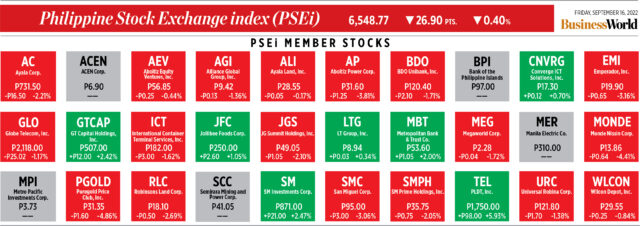
How PSEi member stocks performed — September 16, 2022

Here’s a quick glance at how PSEi stocks fared on Friday, September 16, 2022.


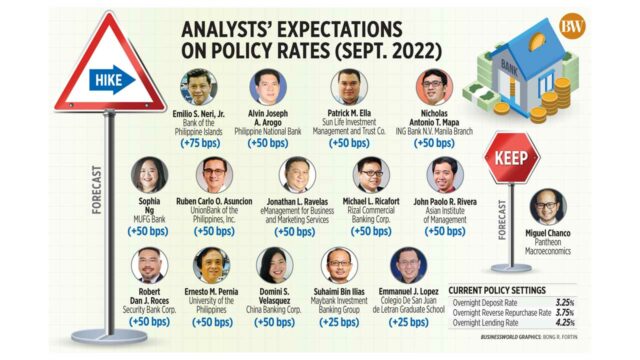
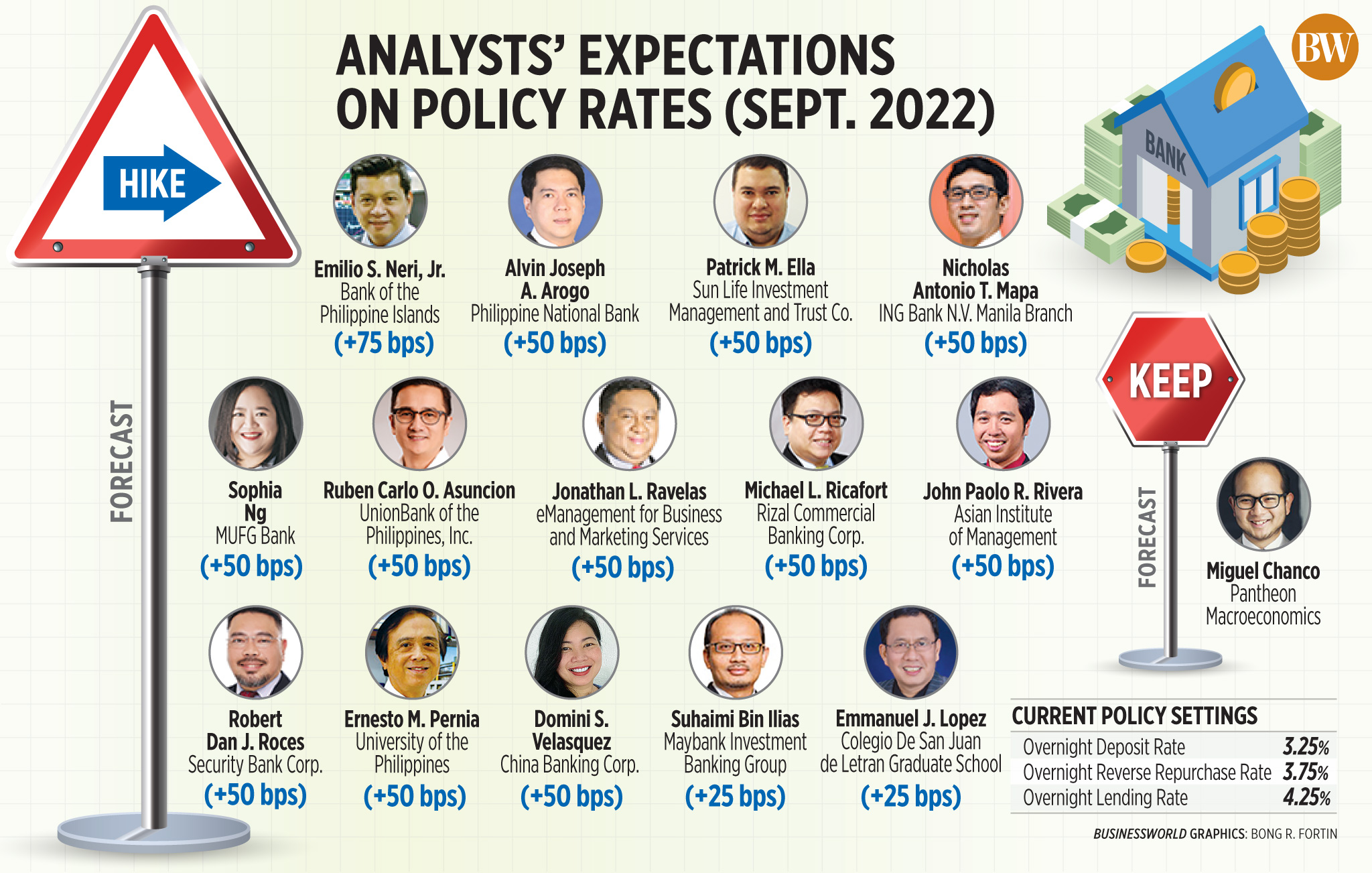
Analysts’ expectations on policy rates (Sept. 2022)

THE BANGKO SENTRAL ng Pilipinas (BSP) is likely to continue its rate hike cycle on Thursday, with several analysts forecasting a 50-basis-point (bp) increase as the US Federal Reserve is also expected to further tighten policy this week. Read the full story.

Analysts’ expectations on policy rates (Sept. 2022)

Peso may recover vs the dollar on expectations of BSP rate increase

BW FILE PHOTO

THE PESO may rebound against the dollar this week as the Bangko Sentral ng Pilipinas (BSP) is widely expected to continue increasing its benchmark interest rates.

The local unit closed at a new all-time low of P57.43 on Friday, dropping 27 centavos from its P57.16 finish on Thursday, data from the Bankers Association of the Philippines showed. For the year so far, the peso has weakened by P6.43 or 12.61% from its Dec. 31, 2021 close of P51.

Week on week, the local unit also sank by 61 centavos from its P56.82 close on Sept. 9.

The peso opened Friday’s session at P57.35 per dollar. Its intraday best was at P57.32, while its weakest showing was at P57.44 against the greenback.

Dollars exchanged inched down to $900.66 million on Friday from $909.8 million on Thursday.

The local unit weakened versus the dollar on Friday on expectations that the US Federal Reserve would deliver another 75-basis-point (bp) or a bigger full percentage point rate increase this week, Rizal Commercial Banking Corp. Chief Economist Michael L. Ricafort said in a Viber message.

The US consumer price index (CPI) rose in August amid rising rent and healthcare costs, bolstering expectations of another jumbo Fed hike at their Sept. 20-21 review.

Consumer inflation edged up by 0.1% to 8.3% last month after being unchanged in July. In the 12 months through August, the CPI increased to 8.3%.

The Fed has raised rates by 225 basis points (bps) since March, including two 75-bp hikes in June and July.

“The peso was also weaker after the World Bank warned that the global economy may face a recession in 2022 due to aggressive monetary policy tightening that could still be not enough to bring down elevated inflation,” Mr. Ricafort said.

The World Bank on Thursday said the global economy may be edging toward a recession as central banks simultaneously hike interest rates to combat inflation.

For this week, UnionBank of the Philippines, Inc. Chief Economist Ruben Carlo O. Asuncion said the peso may rebound against the dollar on expectations of a rate hike from the BSP Monetary Board at their Sept. 22 meeting.

However, the peso is likely to remain at the P57-a-dollar level this week, with the Fed seen to increase borrowing costs aggressively at its own review, Mr. Asuncion said.

A BusinessWorld poll last week showed 14 out of 15 analysts expect the BSP to fire off another rate hike on Thursday.

The Monetary Board raised rates by 50 bps at their Aug. 18 meeting that brought cumulative increases for the year so far to 175 bps.

For this week, Mr. Ricafort expects the local unit to move from P57 to P57.50 per dollar, while Mr. Asuncion gave a forecast range of P56.85 to P57.35. — Keisha B. Ta-asan

PHL stocks may decline before Fed, BSP meetings

REUTERS

PHILIPPINE SHARES may continue to decline this week ahead of the policy meetings of the US Federal Reserve and the Bangko Sentral ng Pilipinas (BSP).

The Philippine Stock Exchange index (PSEi) slipped by 26.90 points or 0.4% to close at 6,548.77 on Friday, while the broader all shares index went down by 22.49 points or 0.64% to 3,474.41.

Week on week, the PSEi declined by 57.23 points or 0.87% from its close of 6,606 on Sept. 9.

“The local bourse lost steam midweek onwards, mimicking Wall Street’s weakness after US inflation missed consensus,” online brokerage 2TradeAsia.com said in a report.

The US consumer price index (CPI) rose in August amid rising rent and healthcare costs, strengthening the case for another aggressive Fed rate hike this week.

Consumer inflation edged up by 0.1% to 8.3% last month after being unchanged in July. In the 12 months through August, the CPI increased to 8.3%.

Fed Chair Jerome H. Powell earlier said the central bank was “strongly committed” to fighting inflation. The Fed is meeting to review policy on Sept. 20-21 and has raised rates by 225 basis points (bps) since March, including two 75-bp hikes in June and July.

“Philippine stocks slid [on Friday] following the latest FTSE (Financial Times Stock Exchange) rebalancing and after investors digested a couple of economic reports that showed a muddy picture of the US economy,” Regina Capital Development Corp. Head of Sales Luis A. Limlingan said in a Viber message.

“Initial jobless claims came in better than expected, but import prices dropped less than estimated. Retail sales beat expectations but were negative when excluding autos. Manufacturing data also showed a slowing economy,” Mr. Limlingan added.

For this week, Philstocks Financial, Inc. Senior Research Analyst Japhet Louis O. Tantiangco said in a Viber message that the PSEi may drop ahead of expected rate hikes from the Fed and the BSP.

“We may see episodes of bargain hunting as the market lies at attractive levels. However, the general mood is still expected to be bearish as investors price in another possible 75-basis-point rate hike by the Fed to combat their still elevated inflation,” Mr. Tantiangco said.

“Investors are also expected to watch out for the BSP who may also act aggressively amid the demand-side risks to our country’s inflation, and the weakening of our local currency which also poses upside risks to the rise of our general price level. A 75-basis-point rate hike by the Fed, which puts more depreciation pressure on the peso, may lead to a 50-basis-point rate increase by the BSP,” he added.

The BSP will hold its policy meeting on Sept. 22, right after the Fed’s review. It has hiked borrowing costs by 175 bps since May to rein in rising prices.

2TradeAsia.com placed the PSEi’s immediate support at 6,500, secondary support at 6,400 and resistance at 6,700, while Philstocks Financial’s Mr. Tantiangco put support at 6,400 and resistance at 6,600. — Justine Irish D. Tabile

Analysts: Marcos reassignment order reeks of bad governance

PHILIPPINE STAR/KRIZ JOHN ROSALES

By Kyle Aristophere T. Atienza, Reporter

PRESIDENT Ferdinand R. Marcos’ appointment of his resigned executive secretary to a new post reeks of bad governance and is contrary to his rightsizing push, political analysts said at the weekend.

Victor D. Rodriguez on Saturday said he had resigned as executive secretary but added he would stay on as presidential chief of staff.

“This does not look like a resignation but a reassignment,” Maria Ela. L. Atienza, who teaches political science at the University of the Philippines, said in a Viber message. “If he really is resigning, he should have been out of Malacañang by now.” Press Secretary Trixie Cruz-Angeles did not immediately reply to a Viber message seeking comment.

The move is an act of self-preservation for Mr. Rodriguez, who is now under pressure after being hounded by controversies, said Arjan P. Aguirre, a political science professor at the Ateneo De Manila University.

“It’s meant to protect Rodriguez and also not to antagonize him,” he said in a Facebook Messenger chat. “Other people are going against Rodriguez because he tends to have control over other government portfolios and appointive positions.”

Mr. Rodriguez appears to be a valued actor in the larger Marcos bloc, he added.

“When some Marcos allies saw an opening to attack him through the botched sugar importation plan, they all wanted him to fall from grace,” Mr. Aguirre said. “Marcos Jr. opted to protect Rodriguez.”

The Senate majority recently cleared Mr. Rodriguez in its investigation of a sugar import order that Mr. Marcos later vetoed, but the Senate minority bloc said he failed to communicate the palace import policy.

“This reassignment only reveals to us how Marcos values the presence of Rodriguez in his government,” Mr. Aguirre said.

The executive secretary, who is also called the “little president,” directly helps the president in managing the affairs of the government.

The late President Corazon C. Aquino restored the pre-martial law executive secretary position, according to the Official Gazette. Her predecessor, the late dictator Ferdinand E. Marcos — Marcos Jr.’s father — abolished the position and replaced it with the presidential assistant in 1975.

Mr. Rodriguez, 48, was executive secretary for only 79 days. Peter D. Garrucho, the late President Fidel V. Ramos’ executive secretary, lasted 74 days, while Edgardo J. Angara, who served under ex-President Joseph E. Estrada, had 20 days, Cleve V. Arguelles, who teaches political science at De La Salle University, tweeted.

“The lesson is that winning the election is the easiest part,” he said. “Surviving faction politics once they are in Malacañang is a totally different, more high-stakes game.”

“This is a cause for concern because we have not even crossed the first 100 days,” policy analyst Michael Henry Ll. Yusingco said in a Messenger chat.  “The resignation of the executive secretary, and to a certain extent, the role he played in the sugar fiasco, reflect negatively on the president himself.” 

“It makes us question whether he can indeed control the competing interests within his team.”

Mr. Angeles earlier said the president issued an administrative order at the weekend reviving the chief of staff post.

In a Sept. 15 memo for Mr. Marcos, presidential legal counsel Juan Ponce Enrile opposed Mr. Rodriguez’s draft administrative order reviving the Office of the Presidential Chief of Staff and draft special order giving him more powers.

“There is no need to create the position of the presidential chief of staff, much less grant it so much power,” he said in the five-page memo, noting that other government agencies were already doing the job.

“The proposed administrative order/special order will certainly cause confusion and conflicts among the said offices, in terms of functions and accountabilities,” the 98-year-old lawyer said.

Ms. Atienza said previous administrations had also reassigned officials who figured in controversies. 

“Like the Duterte administration, the Marcos administration reshuffles and recycles allies and cronies to protect them from initial scrutiny and criticisms,” she said. “This current administration has been reeking of patronage and politics of spoils from the very beginning. Good governance is not something that can be associated with it.”

Mr. Rodriguez, Mr. Marcos’ chief of staff and lawyer before he became president, was a key figure in his campaign.

Ms. Atienza said Mr. Marcos’ decision to create a new position goes against his rightsizing push, which was done amid record government debt.

She said there are too many positions in the Executive branch with overlapping functions. “You have the office of the executive secretary, presidential management staff and now, the chief of staff position.”

Mr. Yusingco said the reassignment of Mr. Rodriguez should serve as a “harsh lesson” for voters, noting that it was “patently obvious” that the Marcos campaign was supported by a “loose alliance” of traditional and influential politicians with competing interests.

“We already knew at that time that an administration born out of such an alliance would definitely be riddled with varying political agendas,” he said. “And now these competing political interests within the Cabinet are on full display for us to see, directly showing us how it undermines governance of the country, and with us voters left to endure the many problems the president promised to address during the campaign.”

Gov’t told to work with United Nations on human rights

PHILIPPINE STAR/ MIGUEL DE GUZMAN

By John Victor D. Ordoñez,  Reporter

THE PHILIPPINE government should cooperate with the United Nations (UN) on human rights to show its commitment to the rule of law, political analysts said at the weekend.

“The joint cooperation between the Philippines and the UN is a display of the government’s commitment to the Constitution to protect human rights,”  Maria Ela L. Atienza, a political science professor at the University of the Philippines, said in a Viber message.

“The UN or any of its agencies only point out problems when there are massive complaints from citizens and groups themselves about poor performance or lack of commitment of their own government to protect human rights,” she added.

Last week, the Office of the UN High Commissioner for Human Rights issued a report saying the Philippine probe into human rights violations in connection with its deadly drug war lacked transparency.

“Transparency and public scrutiny in investigative processes and outcomes remain a challenge,” it said.

Still, the UN office recognized the government’s inter-agency task force that formed 15 teams last year to probe extralegal killings.

“It is part and parcel of a UN member to enforce international human rights standards, and fair implementation is only possible if both are on the same page,” Hansley A. Juliano, a political economy researcher studying at Nagoya University’s Graduate School of International Development in Japan, said in a Facebook Messenger chat.

He said cooperation with the UN is crucial since the Philippines is among the signatories of the 1946 UN Universal Declaration of Human Rights.

Press Secretary Trixie Cruz-Angeles did not immediately respond to a Viber message seeking comment.

The UN Human Rights Council is holding its 51st regular session on Sept. 12 to Oct. 7 in Geneva, Switzerland.

Human Rights Watch (HRW) earlier called on member states of the UN council to pass a resolution that will expand human rights monitoring in the Philippines.

The global watchdog said human rights violations from the previous administration’s deadly drug war continue under President Ferdinand R. Marcos, Jr.

Human Rights Watch Deputy Asia Director Phil Robertson also said Mr. Marcos’ promise to tackle the Philippines’ illegal drug problem in a “different way” glosses over the urgent need to first issue a clear public order ending the drug war in toto.

“Using a drug rehabilitation approach means little when police and mystery gunmen are still executing suspected drug users and dealers,” he said in a statement on Sept. 14. “Law enforcers should receive clear orders to stop the drug war enforcement once and for all.”

Philippine Solicitor General Menardo I. Guevarra earlier asked the International Criminal Court to dismiss the ICC, saying it does not have the authority to do so.

He said the alleged killings of drug suspects in police raids were not crimes against humanity because these were not “attacks against the civilian population.”

Analyst have said the Justice department should encourage more cops to come forward as witnesses.

“Police officers who want witness protection only prove that in the ongoing investigations, there are higher-ups who erred in supervising the war on drugs.” Marlon M. Villarin, who teaches political science at the University of Santo Tomas, said in a Viber message last month.

Justice Secretary Jesus Crispin C. Remulla has said he wanted to extend the Witness Protection Program to police officers who are willing to testify on extralegal killings under the previous administration’s anti-illegal drug campaign.

Under the Witness Protection Security and Benefit Act, law enforcers are barred from acting as state witnesses.

“If done properly and in the interest of solving drug war cases involving police, this can really help police give more accurate testimonies against fellow police,” Ms. Atienza said last month.

President leaves for New York City visit, United Nations General Assembly

PHILIPPINE STAR/KRIZ JOHN ROSALES

PHILIPPINE President Ferdinand R. Marcos, Jr. on Sunday left Manila for his visit to New York, where he will meet with other world leaders at the United Nations (UN) General Assembly.

In a pre-departure speech, he said he would highlight his government’s “thrust for economic recovery, food security and agricultural productivity” during the 77th UN assembly. He said the country would affirm its commitment to the ideals of the UN, which has been instrumental in the “peaceful settlement” of international disputes and in “fostering international dialogue and cooperation,” when he speaks there on Sept. 20.

It was not clear whether Mr. Marcos would raise the country’s sea dispute with China, which has ignored a UN-backed tribunal’s 2016 ruling that voided its claim to more than 80% of the South China Sea. 

“The UN is where the countries of the world congregate to discuss the most pressing challenges facing our people” Mr. Marcos said. “Thus, it is important for us to participate in the General Assembly and to make certain that our voice is heard.” He said he would meet with UN Secretary-General António Guterres and other leaders of “long-standing and important partners” of the Philippines and discuss with them stronger cooperation in food security, agriculture, renewable energy and climate change.

Mr. Marcos is also set to attend several bilateral meetings and business engagements during the trip.

Foreign Affairs Assistant Secretary Jose Victor Gonzaga earlier said Mr. Marcos would attend roundtables with US companies, the US Chamber of Commerce, US-ASEAN Business Council, and US-Philippines Society.

“The President intends to meet with US companies that would be able to contribute to our efforts to achieve food security, energy security, and sustainable economic development, among others,” he said. 

A high-ranking US diplomat in June said Mr. Marcos’ election as Philippine president allows him to go to the US without being arrested for a $353-million contempt order against his family in connection with a human rights lawsuit.

The diplomatic immunity, which is given to heads of states, would only cover Mr. Marcos, not his entire family. The US Court of Appeals has ordered Mr. Marcos and his mother Imelda to pay $353.6 million for violating a US court order not to dissipate their assets, which have been earmarked as compensation for the victims of his father’s martial rule. — Kyle Aristophere T. Atienza

Maguindanao split into two provinces 

FELIPE AIRA, MARWAN KHAN, HUEMAN01, PHOTO07

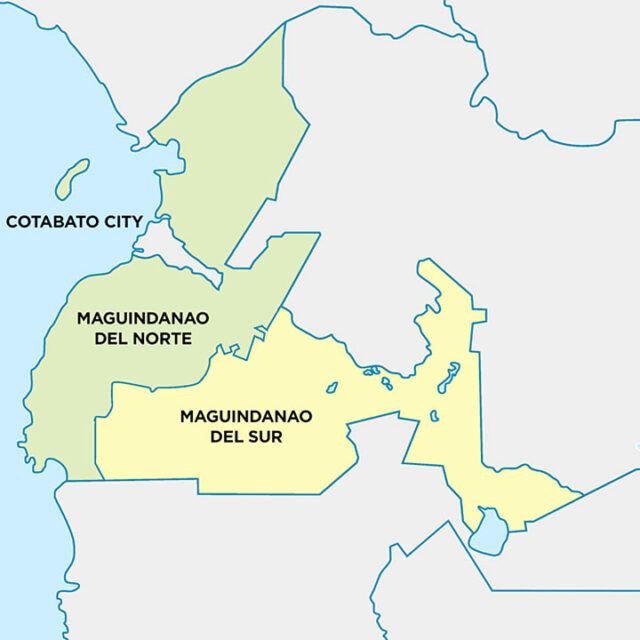
MAGUINDANAO has been split into two provinces after residents voted in favor of a law dividing the southern Philippine province, the Commission on Elections  (Comelec) said on Sunday. 

In a statement, Comelec said 706,558 or 99.27% of the voters agreed with Maguindanao’s division, based on partial results. 

Last year, former President Rodrigo R. Duterte signed into law a measure dividing Maguindanao, a province under the Bangsamoro region, into Maguindanao del Norte and Maguindanao del Sur.   

The plebiscite had an 86.83% voter turnout. 

“People are not afraid to cast their votes,” Comelec Chairman George Erwin M. Garcia said in a Viber message. “They trust the process so much.”
In a separate statement, election watchdog National Citizen’s Movement for Free Elections (Namfrel) said the plebiscite was generally peaceful and transparent. 

The election body had postponed several plebiscites that were supposed to be conducted before the May 9 national and local elections, citing time constraints for the preparations. 

Last year, Senator Francis N. Tolentino sponsored a bill to split Maguindanao into two, which he said would improve the delivery of government services to residents. — John Victor D. Ordonez