Home Blog Page 5373

Corn production upgrades planned to boost supply of animal feed

REUTERS

THE Department of Agriculture (DA) said it will seek to enhance domestic corn production in order to meet the needs of the feed and livestock industries.

In a memorandum signed by Senior Undersecretary Domingo F. Panganiban dated Jan. 16, the DA will implement a Corn Production Enhancement Project to increase the yield per hectare of yellow and white corn by 3% a year to increase the supply of yellow and white corn for animal and human use.

According to the memorandum, corn production is increasing but not sufficiently to address the needs of corn processors.

“The local yellow corn-feed sufficiency is only 59% in 2021, other feed millers are also using cassava in their feed formulation (to account for) about 6-7% of the requirement,” according to the memorandum.

In the white corn segment, demand has increased for food and industrial applications.

The program applies to both yellow and white corn for the first cropping year of 2023.

“Priority areas include new/idle lands and crop/varietal shifting,” it said, adding that the average grain yield is less than 4.20 metric tons and 2.50 metric tons per hectare for yellow and white, respectively.

Targeted farmers are those tilling at least 0.50 hectares who are on the registry system for basic sectors in agriculture database.

Farmers will be given 18 kilos of hybrid seed corn, 20 kilos of improved seed corn and two bags of inorganic fertilizer per hectare planted to corn.

The cap on the benefits is one hectare, the DA said. — Ashley Erika O. Jose

Sugar planters call 450,000 MT import plan ‘acceptable’

BOC - PUBLIC INFORMATION AND ASSISTANCE DIVISION (BOC-PIAD)

THE United Sugar Producers Federation (UNIFED) said on Thursday that it supports a government plan to import sugar, with volumes initially estimated at 450,000 metric tons (MT), in light of the imminent establishment of a two-month buffer stock for the commodity.

In a statement on Thursday, UNIFED President Manuel R. Lamata said the import plan is “an acceptable volume for a buffer stock amid speculation that there may be a shortage by the end of the milling season.”

Mr. Lamata said the federation “fully supports” the plan to import about 450,000 MT of sugar, saying that it hopes the presence of a buffer stock will help keep retail prices contained.

On Wednesday, Rex C. Estoperez, deputy spokesman of the Department of Agriculture, said the DA is considering importing sugar in response to President Ferdinand R. Marcos, Jr.’s order to establish a two-month buffer stock of sugar.

Mr. Lamata said that the Sugar Regulatory Administration (SRA) should schedule the releases of the imported sugar to ensure that millgate prices are not be affected.

“UNIFED will leave the discretion of formulating the guidelines and mechanics for importation to the President and the SRA,” UNIFED added.

Enrique D. Roxas, president of National Federation of Sugarcane Planters, said he recognizes the need for imports and a sugar buffer stock.

“However, without knowing the actual and projected production and consumption figures for this crop year, we are groping in the dark as to the actual volume of imported sugar which we need for domestic consumption,” Mr. Roxas said in a statement on Thursday.

He said that imports should be calibrated in volume and timed to arrive after the close of milling, “so that it does not depress milling prices to the disadvantage of sugarcane farmers.”

“The 450,000 MT might be enough or it might not be enough, we do not know. Unless SRA provides us with the figures,” Mr. Roxas said.

Mr. Roxas asked the SRA to provide projections for production and consumption for this crop year.

Jayson H. Cainglet, executive director of the Samahang Industriya ng Agrikultura, said the DA needs to consult with planters and millers before proceeding with imports.

“As far as we know, we are still in the peak of harvest and milling activities and there is abundant local stocks at this point. The DA, it seems, is now the biggest enemy of local producers,” Mr. Cainglet said.

He said the DA should determine if there is a real shortage and import in a manner that “does not affect the local harvest or milling.”

The SRA estimates that for crop year (CY) 2022 to 2023, which covers the period of Sept. 1, 2022 to Jan. 1, 2023, the raw sugar inventory was 282,524 MT, up 0.77% from the 280,352 MT output recorded in CY 2021-2022.

For the refined sugar, the inventory estimate is 214,713 MT, up 64.9% from the crop year earlier. — Ashley Erika O. Jose

Zamboanga port passenger terminal expected completion revised to 2024

BUREAU OF IMMIGRATION PHILIPPINES FACEBOOK PAGE

THE Philippine Ports Authority (PPA) said the completion of the Zamboanga port passenger terminal building, which is set to become the country’s largest, will be delayed until next year.

“Originally, completion was to be within this year; but it’s not going to happen,” PPA General Manager Jay Daniel R. Santiago told reporters on Wednesday.

“It’s encountering delays for so many reasons, including material supply issues and weather disturbances, so we are trying to think of a catch-up plan,” he added.

When completed, the project will be the biggest passenger terminal in the country, with capacity of 4,500 passengers at any given time against the current capacity of 750.

The soon-to-be-opened Calapan Port’s new passenger terminal in Mindoro will have a capacity of 3,500 passengers at any one time, up from 800 currently.

“I’m excited really for that (Zamboanga) passenger terminal building) because it’s reflective of the Muslim culture down south… even the amenities are different,” Mr. Santiago said.

The agency expects to complete the Calapan port passenger terminal building on Feb. 18.

“The assessment of the Port Management Office of Mindoro revealed that the completion rate of our (project) is 17% ahead of its target schedule, and we are set to inaugurate it in March,” Mr. Santiago has said.

The current biggest passenger terminal building is the one in Cagayan de Oro, which has a capacity of 3,000 passengers at any one time. — Arjay L. Balinbin

JICA hopes to sign financing deal soon for next tranche of Metro Manila subway  

PHILIPPINE STAR/ MICHAEL VARCAS

THE Japan International Cooperation Agency (JICA) said it hopes to sign a financing agreement soon for the next financing tranche of the Metro Manila Subway project.

In a media briefing on Thursday, JICA President Akihiko Tanaka said the Japanese development agency has been working with the government on the infrastructure development programs, especially on the financing of the subway. 

“I think it’s up to the agreements between the two governments. I cannot let you know the exact date but I’m quite hopeful the signing should be coming soon,” Mr. Tanaka said.

“This year is going to be a very fruitful year in launching many productive projects,” he added.

According to JICA Chief Representative to the Philippines Takema Sakamoto, the next tranche will depend on the pace of construction progress and the timing of critical expenditures.

“If they send some list to exhaust the money, we are very happy to (implement a) further phasing of lending,” Mr. Sakamoto said.

The loan agreement for the second tranche of funding for the subway was worth P112.87 billion, payable in 27 years. 

The initial tranche signed in March 2018 was valued at P47.58 billion, payable over 40 year.

Meanwhile, JICA Senior Representative Kenji Kuronuma told reporters that the number of tranches is not fixed and will be determined in discussions between the two governments.

“Tranche 1 and 2 will not cover the entire costs. So of course, definitely there should be additional funds,” Mr. Kuronuma said.

He added that the JICA continues to support the Philippine government in implementing the rehabilitation and maintenance of MRT3, as well as the extension of LRT line 1 and 2.

“Apart from those lines, there hasn’t been any concrete, specific railway that would be prospectively financed by JICA at this moment. But of course, we are open to discuss further,” he added.

JICA LAUNCHES NEW TECH
Meanwhile, JICA has launched a pilot project in Las Piñas City that introduced a Japanese technology which could clean up debris in land and water efficiently, the firm said in a statement released on Thursday.

The technology was developed by Japanese company Kochi Marutaka Corp., and can be disassembled and carried to rivers or construction sites.

According to the lending arm, the equipment is useful in times of disasters, specifically against flooding, since it can also clear up garbage that accumulates in waterways.

“Aside from Official Development Assistance (ODA) major schemes, such as provisions of soft conditioned Yen loans, JICA has been partnering with the private sector under our Sustainable Development Goals Business Supporting Survey,” JICA Philippines Project Formulation Advisor Hashizume Takuya.

“This program shares with our partner countries unique products or technology from Japanese companies to boost industrial and economic growth, improve the living environment of communities, expand business and stimulate future investments of Japanese companies,” Mr. Takuya said.  

The Japanese company has partnered with JICA, Department of Public Works and Highways (DPWH), and Las Piñas City Government to launch the technology in the Philippines and test it at the local government level.

“We recognize the support of LGUs like Las Piñas City to this project since LGUs are always on the frontlines during disasters. When scaled up, use of this floating amphibious excavator can empower more LGUs to clean up river systems and mitigate disasters in the long-term,” Mr. Takuya added. — Keisha B. Ta-asan

PHL invited to participate in WEF tech center

REUTERS

THE PHILIPPINES has been invited by the World Economic Forum (WEF) to join a soon-to-be established technology-sharing center, the Palace said in a statement.

The Presidential Communications Office (PCO) said in a statement that the invitation was extended by World Economic Forum founder Klaus Schwab to President Ferdinand R. Marcos, Jr. at a meeting on Wednesday.

The PCO quoted Mr. Schwab as telling Mr. Marcos, “When we inaugurate it, we will invite the Philippines to be amongst the first countries to (take) residence (and) showcase your investment opportunities in a much more effective manner compared to video conferencing because you bring people into the next (stages) of what’s happening.”

“The technology of the future… will be applied to education, healthcare,” as well as energy transformation and clean fuels,” Mr. Schwab said.

Growing interest in three-dimensional virtual communities supported by artificial intelligence is enabling the global collaboration platform, Mr. Schwab told Mr. Marcos.

“We have all the representations of some countries, of companies and you can interact every time.”

Mr. Schwab cited the example of India, which is being assisted in the “application of the newest technologies to increase agricultural activity.”  Kyle Aristophere T. Atienza

Opposition cites revenue potential of wealth tax vs luxury tax

PHILIPPINE STAR/ MIGUEL DE GUZMAN

THE Makabayan bloc of legislators said a wealth tax will generate more revenue than a proposed tax on luxury goods.

The proposed revenue from taxing luxury goods “is very small compared to the billions in income generated by the wealthy,” Deputy Minority Leader France L. Castro said during a news conference on Thursday.

Representative Jose Ma. Clemente S. Salceda, who chairs the House ways and means committee, said on Wednesday that a proposed tax on luxury items will generate about P12.4 billion in revenue each year.

Ms. Castro said that the take from a wealth tax could exceed P400 billion.

In July, Ms. Castro, alongside Assistant Minority Leader Arlene D. Brosas and Kabataan Party-list Rep. Raoul Danniel A. Manuel filed House Bill No. 258, seeking to tax the “super-rich,” defined as those controlling assets of more than P1 billion. The proposed tax rate was 1%, escalating to 2% for wealth above P2 billion, and 3% for wealth exceeding P3 billion. The bill is currently pending with the ways and means committee.

Think tank IBON Foundation called the wealth tax “a social justice measure that redistributes wealth.”

In a statement on Thursday, IBON said that “a billionaire wealth tax can raise at least P468.8 billion annually from the country’s estimated 2,945 billionaires, who collectively have P8.2 trillion in wealth. This is a tax on not even one-third of one-thousandth of a percent (0.0026%) of the country’s population and will still leave them with P7.7 trillion.”

Ms. Castro also said that wealthy individuals have the option to purchase luxury items overseas and evade the luxury tax.

Terry L. Ridon, a former legislator and convener of think tank Infrawatch, said that taxing luxury goods would hurt tourism, which he considers “a pillar of Philippine economic growth.”

“Shopping for luxury, mass affluent and even high street goods and services is part of the overall strategy to attract foreigners to visit the country,” Mr. Ridon said in a statement.

Mr. Ridon, a former member of the ways and means committee, added that tourists may avoid the Philippines in favor of other destinations if luxury goods there are cheaper.

He added that workers who depend on the tourism and luxury industries will also be negatively affected.

Mr. Salceda has yet to fill a luxury tax bill in Congress, which will resume session next week. — Beatriz Marie D. Cruz

Foreign chambers press for Senate action on Open Access in Data Transmission measure 

REUTERS

THE members of the Joint Foreign Chambers (JFC) have called on the Senate to act on an open-access bill for data transmission, saying it would improve internet service quality.

In a joint statement on Thursday, the JFC said the Senate should begin deliberations on the proposed Open Access in Data Transmission Act when it resumes session on Jan. 23.

House Bill No. 6, the other chamber’s counterpart bill on the Open Data Transmission Act, was passed on third reading by the House of Representatives before it headed to recess in December.

“The bill aims to create the space that will allow and empower as many different service providers as possible to build and operate data networks and give more choices to broadband users anywhere in the country, especially in the countryside,” the JFC said.

“The proposed Open Access in Data Transmission Act is critical to establishing a forward-looking and future-ready digital policy framework for the Philippines,” it added.

Citing a position paper sent to the Senate Committee on Science and Technology, the JFC said that the bill will open the internet and data market and provide a competitive environment, which will benefit consumers.

The bill will also meet the need for fast, reliable, and affordable internet or data service.

“It lowers regulatory barriers and cost of entry for market players offering internet service, and promotes fair and open competition at different segments of the data transmission network. This will significantly improve data transmission services (faster internet speed and lower internet costs) throughout the country,” the JFC said.

According to the JFC, other bills related on Open Access are also pending with the Senate Science and Technology Committee chaired by Senator Alan Peter S. Cayetano.

It added that the House approved an Open Access in Data Transmission bill on third reading in both the 17th and 18th Congresses, which both failed to obtain Senate approval.

“The members of the JFC expressed optimism that since the bill was approved early in the 19th Congress, the Senate will have enough time to deliberate and approve the measure, especially considering no less than the Senate President filed a counterpart to the Open Access bill filed by House Speaker Ferdinand Martin G. Romualdez, Jr.,” the JFC said.

Signatories to the joint statement were the American Chamber of Commerce of the Philippines, Australian-New Zealand Commerce of the Philippines, Canadian Chamber of Commerce of the Philippines, European Chamber of Commerce of the Philippines, Japanese Chamber of Commerce and Industry of the Philippines, Korean Chamber of Commerce of the Philippines, and Philippine Association of Multinational Companies Regional Headquarters, Inc. — Revin Mikhael D. Ochave

Number of tourism companies grows 5.5% in 2014-2020 period

THE number of companies registered as tourism establishments grew 5.5% in the six years to 2020, driven by optimism about the industry’s growth before the pandemic set in, the Philippine Statistics Authority (PSA) said.

Citing preliminary data on Wednesday, the PSA said the 2020 Survey of Tourism of Establishments in the Philippines (STEP) tallied 40,815 tourism establishments in 2020, up from 38,699 in 2014.

Some 60.2% were food and beverage businesses, followed by education, health and personal service activities (18.6%) and accommodation for visitors (10%).

Other sub-industries with tourism components were include sports and recreational businesses (4.1%); retail businesses carrying goods for purchase by tourists (3.4%); and others (3.7%).

“The increase in tourism establishments was due to the optimism in the growth of tourism from record-breaking 2019 levels,” Asian Institute of Management economist John Paolo R. Rivera said in a Viber message.

“While most, if not all, these establishments were not able to serve theirs intended purpose during the pandemic, they can always be repurposed,” he added.

“Because tourism is reliant on movement and close social interaction, the pandemic has hit it badly prompting tourism activities to hit rock bottom resulting in a lower economic contribution,” Mr. Rivera said.

Total revenue generated from tourists in 2020 amounted to P360.96 billion, down 26.2% compared with 2014.

Food and beverage serving activities generated revenue of P188.45 billion; air passenger transport P58.87 billion; and accommodation for visitors P40.45 billion.

In a separate PSA report, tourism’s direct gross value added was equivalent to 5.1% of gross domestic product in 2020, significantly lower than the 12.9% reported in 2019.

Tourism-related value created by industries dropped 63.4% to P917.20 billion at current prices in 2020.

Total employment in the tourism industry was 672,947 in 2020, led by food and beverages with 275,715, equivalent to 41% of the industry total.

Education, health and personal service activities accounted for 31.9% or 214,675, and accommodation for visitors 12.4% or 83,457.

The 2020 STEP is the third survey conducted on tourism establishments in the Philippines, in connection with the 2020 Annual Survey of Philippine Business and Industry to provide information on the availability of tourism goods, products, and services, the PSA said. — Bernadette Therese M. Gadon

Marcos says PHL foreign policy not a choice between China, US

SCREENGRAB FROM OFFICE OF THE PRESIDENT

By Kyle Aristophere T. Atienza, Reporter

PHILIPPINE PRESIDENT Ferdinand Marcos, Jr. on Thursday maintained that his administration would not choose sides between China and the United States amid their strategic competition in the Asia-Pacific region, reiterating that he is prioritizing his country’s national interest. 

At the same time, Mr. Marcos cited a need to continuously “evolve” Manila’s relationship with Washington.

“I think most leaders and most strategists have a consensus that we should not fall back into that situation where countries should choose which side they would be on,” Mr. Marcos told World Economic Forum (WEF) President Børge Brende during a dialogue in Davos, Switzerland.

“When asked which side are you on, I said I don’t work for Beijing, I don’t work for Washington D.C. I work for the Philippines,” he said. “So I’m on the side of the Philippines and that really translates into a very simple statement of foreign policy which is that I promote the national interest.”

Earlier, the Philippine leader said at a Davos event that Asia-Pacific countries are under pressure to take sides amid a geopolitical rivalry in the region.

In the dialogue with WEF’s Mr. Brende, Mr. Marcos acknowledged that China and the US are among the Philippines’ largest trading partners.

He also noted the US remains as Manila’s main security ally, calling for an upgrade of the two countries’ relationship.

“The only way for it to remain strong and to remain relevant is to evolve that relationships so we can no longer be simply as what it was before,” he said.

“The Philippines has changed. The US has changed. The world has changed. And now, we are living within the context of all of these other forces that are coming out, especially around the region, around South China Sea,” he added. “so again, to be able to respond properly we have to evolve these relationships.”

Mr. Marcos said geopolitical tensions have made it necessary for the Philippines to become closer with the US in terms of security relations.

“We were bit on the back burner for a little while, that has again come to the forefront because of the increased tensions in our part of the world.”

Meanwhile, Mr. Marcos said the Philippines’ maritime dispute with China is something that keeps him up at night.

The Philippines is “at the very frontline” and “so whenever these tensions increase, when the ships come out, the Chinese and their Coast Guard vessels, the Americans answer,” he said.

“[It] keeps you up at night, keeps you up in the day, keeps you up most of the time…It’s very dynamic. It’s constantly in flux,” he said. “So you have to pay attention to it and to make sure that you are at least aware of the present situation so that you’re able to respond properly.”

“We are watching as bystanders. If something goes wrong here, we are going to suffer,” he added. “And that’s why when asked what is your foreign policy and how would you describe it, I say, it’s a commitment to peace and… guided very, very closely by our national interest as I mentioned before.”

China claims more than 80% of the sea, which is believed to contain massive oil and gas deposits. It is also a major route with billions of dollars in trade passing each year.

Beijing has ignored a 2016 ruling by a United Nations-backed arbitration court that voided its claim based on a 1940s map.

The Philippines has been unable to enforce the ruling and has since filed hundreds of protests over what it calls encroachment and harassment by China’s Coast Guard and its vast fishing fleet.

Japan, an ally of the US, has rejected China’s attempts to limit freedom of navigation in the waterway, which is subject to overlapping claims from the Philippines, Taiwan, Brunei, Indonesia, Malaysia and Vietnam.

Recently, the Japanese government committed to double its defense budget to 2% from 1% of its gross domestic product, citing China’s aggression and North Korea’s unpredictability.

Mr. Marcos, answering a question by the WEF official, said his government would not follow suit as “there is no point in the Philippines building up its armory.”

“First, we are not in an economic situation that we are able to build up to the levels that the Americans had, to the levels that the Chinese have and more importantly perhaps is our abiding belief that the solutions are not going to be military,” he said.

“And if they are going to be military, then they are not solutions because… it will end badly if it goes that way,” he added. “It will end badly for everyone involved. And even those who are not involved.”


Senate panel recommends charges vs procurement, DepEd execs over laptops

A TEACHER holds an online class in this August 2021 photo. — THE PHILIPPINE STAR/MICHAEL VARCAS

THE SENATE Blue Ribbon Committee has recommended the filing of criminal and administrative cases against current and former high officials of the procurement service of the Department of Budget and Management (PS-DBM) and the Department of Education (DepEd) for the purchase of allegedly overpriced laptops for teachers.

“There is sufficient basis to believe that there was a conspiracy to facilitate and or generate an overprice which indicates manifest partiality, evident bad faith, or gross inexcusable neglect on the part of senior officials and staff of the DepEd and the PS-DBM,” states the 197-page committee report released Thursday.

Results of the investigation, signed by 12 senators, showed a total overprice of at least P979 million after the procurement of more than 39,000 laptops at the height of the coronavirus pandemic.

The panel wants to recover the overpaid amount as “proceeds of corruption,” Senator Francis N. Tolentino, who chairs the committee, said in a press briefing on Thursday.

This can be done, he said, through a Commission on Audit (CoA) issuance of notices of disallowance against DepEd officials involved in the approval of the purchase contracts.

These Education officials, along with former PS-DBM executive directors and others involved, will be tasked to collect and recover the value of the overprice, including accrued interest and damages.

Mr. Tolentino said they will be held jointly liable on the basis of the Government Auditing Code of the Philippines.

After recovery, the amount will be placed in a special National Teachers Trust Fund to support the health and medical needs of public-school teachers as well as the educational needs of their children through a special scholarship program.

The committee also recommended the abolition of PS-DBM.

The report also called for an amendment of Republic Act 9184 or the Government Procurement Reform Act to include more transparency and accountability safeguards.

The committee also asked the CoA to conduct a special fraud audit, and the Bureau of Internal Revenue to perform a special tax compliance audit or a tax fraud audit inquiry to determine relevant accountability.

It also requested the Anti-Money Laundering Council (AMLC) to conduct an inquiry into bank deposits of the public officials identified in the investigation.

The report will be sent to the Office of the Ombudsman, CoA, Department of Justice, Bureau of Immigration, and AMLC Secretariat, among other government agencies with proper jurisdiction, for appropriate action on the panel recommendations. — Alyssa Nicole O. Tan

Senator lashes at Customs reps over ‘big-time’ fuel smuggling

PHILIPPINE STAR/WALTER BOLLOZOS

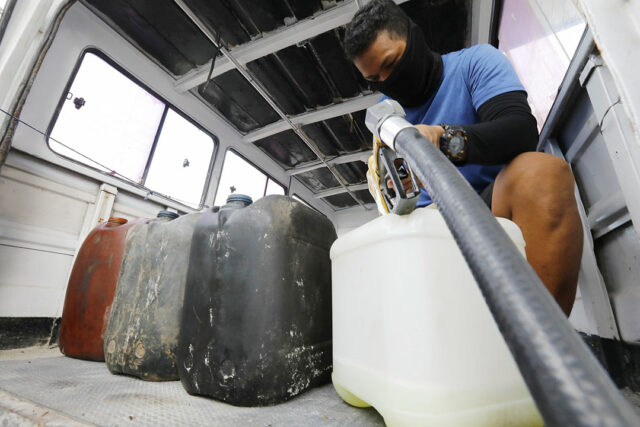
THE SENATE Energy Committee chair called out customs officials in a hearing on Thursday for claiming to have no information on “big-time oil smugglers” and failing to prosecute those caught evading the fuel marking program.

“This is the list of big-time oil smugglers,” Senator Rafael “Raffy” T. Tulfo, who chaired the hearing, said in a mix of English and Filipino as he presented a list with nine names.

“But it seems you do not know them” even when ordinary citizens do, he added. “This is supposed to be your job, to go after oil smugglers, to identify who these people are.”

Bureau of Customs special agent Anthony Escandor, speaking at the hearing, reported that the agency has so far seized 2.1 million liters of smuggled fuel.

“I will report the ones under disposition because the others are under seizure proceedings,” he said in a mix of English and Filipino. “We have already disposed of 36,750 liters of the diesel by donating them to the Philippine Coast Guard.”

“We also have 10,669 liters of diesel that was for official use,” he added.

Mr. Tulfo questioned why proceedings for bulk of the confiscated fuel seemed to be “taking so long” and alleged that these have most likely already been released to the market and sold at cheaper rates.

“What happened to the others? You are unable to answer me directly. You said they are still under seizure proceedings, but it’s taking so long,” he said.

Mr. Escandor vowed to send more information to the committee after the hearing.

The senator said the government’s fuel marking program appears to be ineffective in improving tax collection and addressing smuggling.

Under the marking program that started on Sept. 4, 2019, fuel is marked with a special dye to signify tax compliance. An absence of the dye is considered an indication that the fuel may be smuggled. The program is authorized by Republic Act 10963, or the Tax Reform for Acceleration and Inclusion (TRAIN) law. — Alyssa Nicole O. Tan

8 airports have funding in 2023 budget — DBM

FMROMUALDEZ FACEBOOK PAGE

THIS YEARs budget has guaranteed funds for eight airports in the country, including a new one in Zamboanga City that will replace the existing facility, the Department of Budget and Management (DBM) announced on Thursday.   

This budgetary allocation seeks to support the construction, rehabilitation, and improvement of the countrys transportation infrastructure, particularly in the aviation sector,Budget Secretary Amenah F. Pangandaman said in a statement.  

The 2023 General Appropriations Act includes the following allocations: P1.420 billion for the Tacloban Airport; P785 million for the Laoag International Airport; P500 million for the Antique Airport; and P80 million for the Bukidnon Airport.    

The new Zamboanga International Airport, which will be located in a new site, was provided P200 million.   

The airports in Vigan and Mlang will get P50 million and P15 million, respectively.  

The countrys main gateway, the Ninoy Aquino International Airport (NAIA), has a P43 million budget for upgrade works.  

Transportation Secretary Jaime J. Bautista recently said that the government is working with the Asian Development Bank on the possible privatization of the NAIA, following the system malfunction of the countrys air traffic management on Jan. 1. 

Ms. Pangandaman said they intended to diversify the airports that were given funding as their development will propel growth in different sectors, such as trade, employment, and tourism.  

In a separate statement on Thursday, Makati Rep. Luis Jose Angel N. Campos, Jr. who is vice chair of the House appropriations committee said, Being an archipelagic nation, highly efficient airports are essential for us to move people and goods faster.Beatriz Marie D. Cruz

ADVERTISEMENT
ADVERTISEMENT