Home Blog Page 5323

PSE approves Upson’s nearly P5-B initial public offering

BW FILE PHOTO

INFORMATION technology retailer Upson International Corp. has secured approval from the Philippine Stock Exchange (PSE) on its P4.88-billion maiden offering.

“We are both thrilled and grateful to have received the PSE’s approval for our planned initial public offering (IPO). This is a significant milestone as we look forward to sharing our growth prospects with everyone,” Upson President and Chief Executive Officer Arlene Louisa T. Sy said in a press release on Monday.

Subject to post-approval requirements, the local bourse issued the notice of approval to the company on Friday.

The maiden offering will allow Upson to sell up to 789.47 million primary common shares and up to 98.68 million secondary common shares, with an over-allotment option of up to 98.68 million secondary common shares, at P5.50 each.

The IPO’s price-setting date is set on Feb. 28, while the offer period will run from March 6 to 10. The tentative listing date is on March 16.

“Upson aims to raise gross primary proceeds of around P4.34 billion at its offer price, which will be used to fund the expansion of its store network and for other general corporate purposes,” the company said.

Among its plans is to open 250 new stores or an additional 25,000 square meters of retail space from 2023 to 2027. Its expansion plans also include adding warehouses and distribution facilities in nine other areas nationwide.

“The nationwide logistics infrastructure that supplements its retail network is to ensure uniform pricing of its products across all its branches,” the company said.

Upson’s nine-month 2022 net income grew by 68.6% to P400.23 million from P237.38 million in the same period a year earlier.

The company’s net sales as of September of last year also rose by 10.2% to P7.03 billion from P6.38 billion in 2021.

“Our long-valued suppliers and clients have helped us grow to where we are today. Going public is Upson’s way of sharing our growth and our success with them through partnership,” said Ms. Sy.

Upson operates a nationwide retail network of 200 stores as of Sep. 30, 2022, through its several wholly-owned retail brand outlets which are: Octagon Computer Superstore, Micro Valley, Gadget King, and Octagon Mobile.

It also has concept and specialty stores like Acer, HP, Brother, and Silvertec in select locations. — Justine Irish D. Tabile

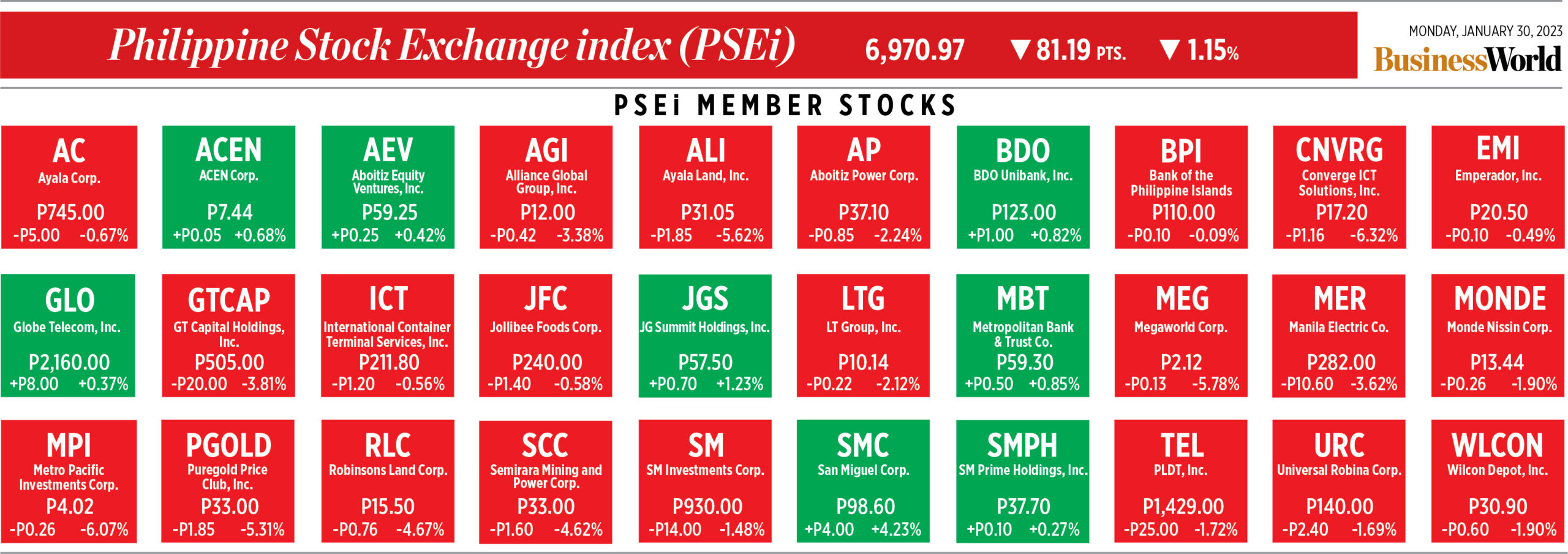
How PSEi member stocks performed — January 30, 2023

Here’s a quick glance at how PSEi stocks fared on Monday, January 30, 2023.


Shares decline as market awaits Fed, US data

REUTERS

STOCKS dropped on Monday amid a lack of catalysts as investors await the US Federal Reserve’s policy decision and economic data releases.

The benchmark Philippine Stock Exchange index (PSEi) went down by 81.19 points or 1.15% to close at 6,970.97 on Monday, while the broader all shares index lost 37.67 points or 1.01% to end at 3,659.96.

“The market was jittery ahead of Fed key rate hiking and forward guidance, which is expected to remain hawkish,” First Metro Investment Corp. (FMIC) Head of Research Cristina S. Ulang said in a Viber message.

“Philippine shares started the week in the red, with attention specifically on the Fed interest rate decision out this week,” Regina Capital Development Corp. Head of Sales Luis A. Limlingan said in a Viber message.

Mr. Limlingan said investors are waiting for more signals from the Fed on its policy direction amid the current inflation environment in the world’s largest economy.

The US central bank is holding its first policy meeting for the year on Jan. 31 to Feb. 1, where markets widely expect a smaller 25-basis-point (bp) hike.

Data on Friday showed that US consumer spending fell in December, while inflation continued to subside, which could give the Fed room to further slow the pace of its rate hikes, Reuters reported.

The US central bank raised its fed funds rate by 50 bps in December to a 4.25%-4.5% range following four straight 75-bp increases, bringing total hikes for 2022 to 425 bps.

Mr. Limlingan added that investors are also waiting for the release of the US Dallas Fed manufacturing index, Institute of Supply Management manufacturing purchasing managers index, JOLTS job openings and US employment data.

“Locally, it will be a relatively quiet week, with the December producer price index set to be released on Tuesday and the January S&P Global manufacturing purchasing managers index on Wednesday,” he said.

Most sectoral indices closed lower on Monday except for financials, which went up by 9.23 points or 0.5% to close at 1,825.92.

Meanwhile, mining and oil dropped by 377.53 points or 3.25% to 11,223.83; property went down by 68.93 points or 2.21% to 3,047.04; industrials declined by 150.98 points or 1.52% to 9,737.85; services lost 23.71 points or 1.34% to close at 1,734.97; and holding firms retreated by 74.74 points or 1.08% to 6,817.61.

Value turnover went up to P8.3 billion on Monday with 1.21 billion shares changing hands from the P5.65 billion with 1.12 billion issues traded on Friday.

Decliners outnumbered advancers, 147 versus 57, while 38 names closed unchanged.

Net foreign buying declined to P135.02 million on Monday from P967.18 million the previous trading day.

FMIC’s Ms. Ulang placed the PSEi’s support at 6,850 and resistance at 7,100. — J.I.D. Tabile

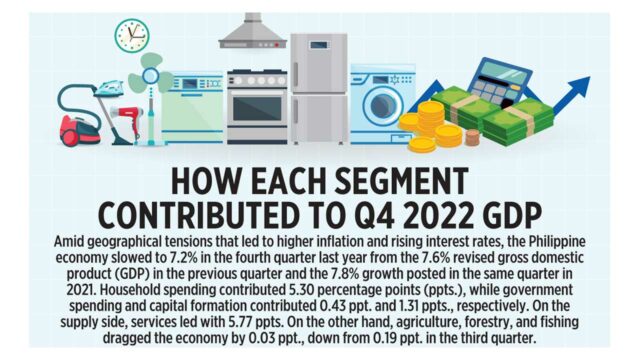
How each segment contributed to Q4 2022 GDP

THE PHILIPPINES weathered record inflation and interest rate increases last year by posting the fastest economic growth since 1976 — one of the strongest in Asia amid a dreary global outlook. Read the full story.

How each segment contributed to Q4 2022 GDP

Peso weakens vs dollar

BW FILE PHOTO

THE PESO weakened against the dollar on Monday after China’s cabinet pledged support for the economy’s recovery.

The local currency closed at P54.545 versus the greenback on Monday, declining by 7.5 centavos from Friday’s P54.47 finish, data from the Bankers Association of the Philippines showed.

The peso opened Monday’s trading session at P54.55 per dollar. Its weakest showing was at P54.60, while its intraday best was at P54.45 against the greenback.

Dollars traded dropped to $687.86 million from $946.65 billion on Friday.

“The peso weakened amid prospects of increased global activity from reports of further economic support by the Chinese government,” a trader said in an e-mail.

China’s cabinet said on Saturday it would promote a consumption recovery as the major driver of the economy and boost imports, state broadcaster CCTV reported, at a time of cooling global demand as major economies teeter on the brink of recession, Reuters reported.

At a meeting chaired by Premier Li Keqiang, China’s state council — which functions as the cabinet — also vowed to speed up the rollout of foreign investment projects, maintain a stable yuan, ease cross-border travel and help companies to participate in domestic and overseas trade shows.

“The US dollar/peso exchange rate also corrected higher after the local stock market gauge, the Philippine Stock Exchange Composite index (PSEi), corrected lower for the second day in three days,” Rizal Commercial Banking Corp. Chief Economist Michael L. Ricafort said in a Viber message.

The benchmark PSEi went down by 81.19 points or 1.15% to close at 6,970.97 on Monday.

For Tuesday, the trader said the peso might weaken further against the dollar on expectations of caution in the market ahead of the US Federal Reserve’s policy meeting.

The trader sees the peso moving from P54.45 to P54.70 a dollar, while Mr. Ricafort expects it to trade at P54.45 to P54.65. — AMCS

Universal charge hike proposed to sustain off-grid power services

PHILSTAR FILE PHOTO

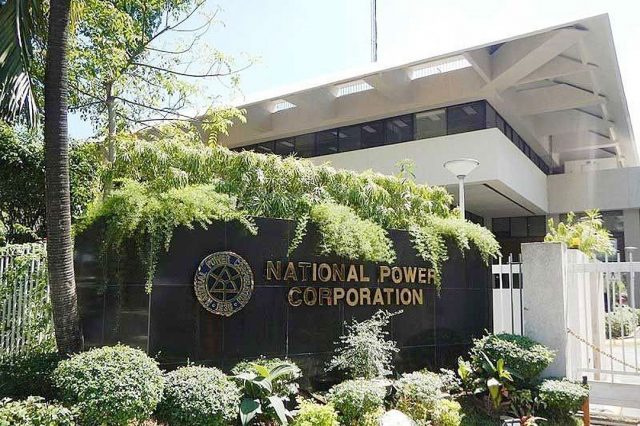
THE Department of Energy (DoE) will propose raising the universal charge to sustain off-grid services provided by the National Power Corp. (Napocor) as diesel prices rise.

In a virtual briefing on Monday, the DoE and Napocor are considering a higher universal charge for missionary electrification (UCME), which funds Napocor’s operations in off-grid areas, many of which are reliant on generator power.

“As you know the price of diesel in the international market has been on the uptick in the last week or so, and for the rest of the year there are indications that unless there are economic developments in the global area that the price will remain high,” Energy Secretary Raphael P.M. Lotilla said.

Republic Act No. 9136 or the Electric Power Industry Reform Act authorizes the collection of UCME to fund Napocor’s operations, including those of its Small Power Utilities Group (SPUG), which serves remote areas not connected to the grid.

“Electricity prices in missionary areas are subsidized but the subsidy comes from on-grid customers. When increases are needed in order to support the off-grid areas, the on-grid areas customers will have to bear the burden, subject to the approval of the ERC (Energy Regulatory Commission),” Mr. Lotilla said.

The DoE and Napocor are proposing a UCME increase of about 15 centavos per kilowatt-hour (kWh), adding that they hope the ERC would “act swiftly on the petition.”

ERC Chairperson and Chief Executive Officer Monalisa C. Dimalanta said in a Viber message that the ERC is currently completing its review of UCME applications.

“The ERC is committed to support the rest of the government in addressing the financing issues of NPC-SPUG in the short term and, in the long term, to come up with a viable program for sustainable development of our off-grid areas,” Ms. Dimalanta said.

Assuming that the ERC approves the petition, Bernadette T. Rivero, Napocor spokesperson, said the increase could take effect as early as May.

Mr. Lotilla said regulators are also taking steps to fund a sustainable solution that addresses the “financial woes that are crippling the operations of Napocor.”

As of Jan. 26, Napocor’s outstanding fuel payables to operate SPUG power plants and barges amount to P1.03 billion for the November-December billing period. Its payables to new power providers and qualified third parties amount to P5.51 billion, representing three to four months of arrears.

The DoE and Napocor’s board are planning to borrow P5 billion from government financial institutions, which will require special authority from the President.

“The big issue here is there is a funding deficit, there is fuel to be bought but the problem is the funding. If we can work together to manage a rationing system, it will be better for everybody; of course, we will do our best to garner additional funding but we have to be prepared to bear some of the cost,” Fernando Martin Y. Roxas, Napocor president, said.

If Napocor fails to secure funding, it will need to cut back on SPUG operating hours.

The proposed reduction in SPUG operating hours of SPUG power plants will start on March 1 and run until Dec. 31. Power plants that operate for 24 hours a day will be reduced to 15 hours, while power plants that operate for 16 hours will run for 12 hours. Those that operate for less than 16 hours will run for five hours.

Separately Mr. Lotilla said that the DoE is working on policy reforms to increase investment in the energy industry.

“It is the government that sets the policies but it is the private sector that drives investment and operations in the upstream, midstream and downstream sectors. All our efforts in this administration have been directed at reforming policies that blocked entry of new investment,” Mr. Lotilla said on Monday during the panel discussion of Philippine Development Plan 2023-2028 Forum.

Mr. Lotilla added that the DoE will take a market-driven approach to attracting more energy investment.

“One is the secondary price cap that was imposed way back in 2013… this has been difficult to lift at this time because of the impact on prices but we will have to deal with this if we want to attract more investment down the line,” he said.

The secondary price cap mechanism was designed to avert excessive rises in market prices. The ERC sets the secondary price cap at P6.245 per kWh in the event of a P9 per kWh breach in the rolling average of the generator-weighted average price over a three-day period.

“We’ve got to also to address the general attitude of government at all levels towards investment in energy,” Mr. Lotilla said, noting that local government units must not refuse the development of power projects.

“When we had typhoons last time in Luzon, a number of efforts to rehabilitate transmission lines could not be implemented immediately because some local government units refused. We’ve got to make all sectors realize that they cannot be blocking power projects that are going to benefit the entire country if we are to see the sustainable development of our economy,” Mr. Lotilla added.

He also called for the need to diversify the country’s indigenous sources to achieve energy security, adding that new technologies such as nuclear power are also an option.

“The tragedy of the past is that we tend to ban technologies but our effort is to be open to all technologies,” he added. — Ashley Erika O. Jose

Sole bidder for Southern Leyte port upgrade project disqualified

BFAR

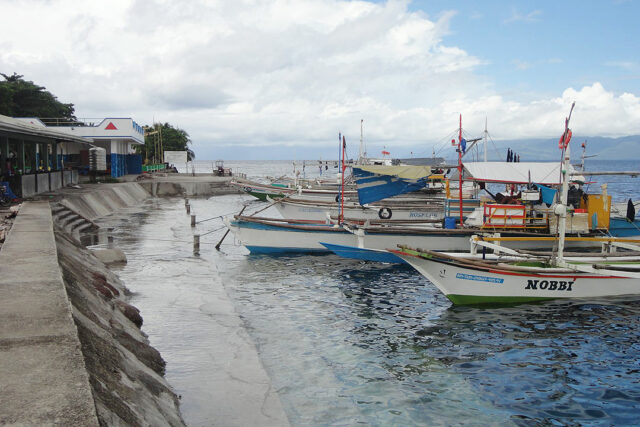
THE Philippine Ports Authority (PPA) has declared a bid failure for the upgrade works at the Port of San Juan in Southern Leyte after the sole bidder failed to meet the formatting requirements of the bid submission.

“The lone bidder for the project, R.A. Bensig Construction & General Services, was declared disqualified for its failure to comply with the bid submission required,” according to a Jan. 23 memorandum approved by PPA General Manager Jay Daniel R. Santiago.

The project involves the improvement and expansion of the port operational area and construction of other facilities. The contractor will also be tasked with the construction of a passenger shed, pumphouse, powerhouse, and guardhouse. The contract package has an approved budget of P51.26 million, according to the PPA.

The lone bidder was declared “ineligible” because of deficiencies in its bid, according to the Bids and Awards Committee.

“Each bidder shall submit one original and six copies of the technical and financial proposals, properly labeled, book-bound, with hard cover and corresponding index tab, (but the) R.A. Bensig Construction & Services submitted its technical proposals with plastic cover, not book-bound, and without index tabs,” the committee said in its resolution.

Mr. Santiago has approved the recommendation to re-bid the contract.

The PPA is committed to modernizing port infrastructure to improve the user experience for shippers, the sea-going public, and tourists.

The United Nations Conference on Trade and Development said in a report that more investment is needed in maritime supply chains, including ports, shipping fleets, and hinterland connections, to boost sustainability and prepare for future global crises.

The Philippines was one of many countries that experienced serious vessel delays and container shortages during the pandemic.

In his first State of the Nation Address, President Ferdinand R. Marcos, Jr. said that his administration will work on improving the transportation system and modernize seaports to maximize the Philippines’ strategic location in the Pacific. — Arjay L. Balinbin

ADB warns of risks as cross-border banking takes hold in region

BW FILE PHOTO

CENTRAL BANKS in Southeast Asia need to prepare liquidity support and safety nets to mitigate any risks stemming from financial digitalization and cross-border banking, the Asian Development Bank (ADB) said on Monday. 

In a report, the ADB said digitalized transactions have been beneficial to the banking industry in the Association of Southeast Asian Nations plus China, Japan, and South Korea (ASEAN+3), remains important for central banks to consider changes to their regulatory framework in anticipation of such risks.

“In the age of digitization, financial transactions will become more globalized as such transactions cross borders more easily. However, cyberspace makes conflicts of geographical as well as functional jurisdictions more complex,” the ADB said.

“Though financial services may go beyond borders, financial regulations continue to be based on territoriality; thus, cross-border regulatory problems must be solved through an appropriate home and host supervisory arrangement. Building trust and confidence in peer regulators is the basis of any effective cross-border regulatory cooperation,” it said.  

The bank added that the ASEAN+3 is unique compared with other regions, noting that even though intraregional economic linkages are extensive, member economies are in different stages of economic development and trade in their own currencies.

According to the ADB, supervisory entities must be organized for effective coordination. Central banks should also work more on data standardization and efficient data collection, which would allow regulators to use advanced technology in supervising the financial industry.

“The expansion of cross-border banking activities will create more difficulty for supervision and crisis management. Mismanagement of liquidity can trigger a failure of a banking group regionally. The home supervisor can provide liquidity to support the settlement of its own currency, but it is not possible to stop the chain reaction of failures in other markets,” the report read.

“Therefore, additional liquidity measures in different local currencies may need to be considered along with the expansion of cross-border financial services, depending on their size, impact on payment and settlement systems, and impact on regional financial stability,” it said.

The Bangko Sentral ng Pilipinas (BSP) has signed a memorandum of understanding with other ASEAN central banks to strengthen collaboration in payment connectivity.

The Memorandum of Understanding on Cooperation in Regional Payment Connectivity (RPC) was signed on the sidelines of the G20 Leaders’ Summit with Bank Indonesia, Bank Negara Malaysia, Monetary Authority of Singapore, and Bank of Thailand on Nov. 14 in Bali.

The RPC agreement aims to foster a more inclusive financial ecosystem by enabling fast, seamless, and cheaper cross-border payments across the region.

“Home and host central banks in ASEAN+3 must prepare their own cross-border, short-term liquidity measures, such as cross-border collateral arrangements and bilateral swap agreements, as another layer of regional financial safety nets. It is important to consider regional risk mitigation measures along with the rapid expansion of new financial services before any crisis happens,” the ADB said.  

The ADB projects digital transformation in the region to continue gathering pace in the medium term.

The ADB said the digital-banking penetration rate approached 90% in 2021 in some regional economies. Digital wallets have also taken hold as the dominant e-commerce payment platform, accounting for 68% of regional e-commerce transactions by value in 2021, which is projected to expand to over 72% by 2025 with the declining use of cash.

“The progress of financial innovation and digitalization is a great opportunity for the financial industry. Banks have been utilizing financial technologies to improve services (FinTech) and nonfinancial firms have emerged to utilize their technological advantages and offer a part of traditional banking services (TechFin) at a reduced cost, illustrating that the banking industry has increasingly become competitive in recent years,” the bank said.

The ADB recommended that central banks in the region ensure a level playing field between incumbent banks and new emerging companies, with no special treatment in bank licensing standards.

Regulators must also effectively utilize regulatory and supervisory technologies (regtech and suptech) to improve information-sharing.

The BSP has deployed the Advanced SupTech Engine for Risk-Based Compliance (ASTERisC*) among selected BSP-supervised financial institutions (BSFIs) in a bid to digitalize its processes.

ASTERisC* is a unified regtech and suptech solution that streamlines and automates reporting and compliance assessment for BSFIs’ cybersecurity risk management. It supports the BSP’s end-to-end process on cybersecurity supervision. — Keisha B. Ta-asan

Well-milled rice prices rise in mid-December  

PHILIPPINE STAR/MICHAEL VARCAS

THE average retail price of well-milled rice rose in mid-December at four major trading centers tracked by the Philippine Statistics Authority (PSA).

Prices rose on Dec. 15-17, which the PSA terms the second phase of December, compared with the prices from Dec. 1-5, or the first phase of the month.

Higher prices were reported in Tacloban City, where they rose by P1 to P47, in Digos City by 50 centavos to P41.50, in Legazpi City by 25 centavos to P42.39, and in Pagadian City by 20 centavos to P39.30.

Prices in the National Capital Region (NCR) and Iloilo City declined by P0.09 and P0.75, respectively.

The average retail price of dressed chicken per kilogram rose in five trading centers during the period.

Prices in San Fernando City and Tuguegarao City rose P20 to P200.

In Cabanatuan City, prices rose by P10 to P180, in Pagadian City by P10 to P212.50, and in the NCR by P4.69 to P197.58.

Prices fell by P15 to P180 in Cebu City, by P12.50 to P177.50 in Tacloban City, and by P1.50 to P196 in Digos City.

The PSA also reported increases in the average retail prices of bangus (milkfish) in seven trading centers during the second phase of December.

They rose by P20 to P190 in Butuan City; by P10 to P160 in Digos City, by P10 to P215 in Legazpi City, by P10 to P200 in Tuguegarao City, Cabanatuan City, and Tacloban City; and by P3.29 to P206.42 in the NCR.

Milkfish prices declined by P5 to P145 in San Fernando City and by P10 to P200 in Pagadian City. — Sheldeen Joy Talavera

Chinese construction firm proposes 270-km highway linking Laoag to La Union

LAOAGCITY.GOV.PH

A CHINESE state-run construction company has proposed to build a 270-kilometer (km) highway from Laoag City to Rosario, La Union, the Palace said in a statement.

It said the proposal was put forward by China Communications Construction Co. Ltd. (CCCC), whose representatives met with President Ferdinand R. Marcos, Jr. on Monday.

Mr. Marcos was quoted as saying that CCCC is welcome to participate in public-private partnerships (PPP) in the Philippines.

“The President said the central part of his government’s economic policy is the establishment, endorsement, and promotion of PPPs, in which the CCCC could participate,” Malacañang said.

It was unclear whether the Laoag-Rosario Highway would be structured as a PPP, or whether the CCCC pitch amounted to an unsolicited proposal, for which the government has the right to seek competing proposals.

Laoag is the capital of the President’s home province of Ilocos Norte. Rosario is a major road junction on the west coast of Northern Luzon which is a key turning-off point for vehicles headed to Baguio and the Cordilleras. Rosario is also the northernmost point of the Tarlac-Pangasinan-La Union Expressway (TPLEX) toll road.

A Laoag-to-Rosario highway would connect the Ilocos Norte capital to Metro Manila via a series of toll roads like TPLEX, the Central Luzon Link Expressway (CLLEX), the Subic-Clark-Tarlac Expressway (SCTEX), and the North Luzon Expressway (NLEX).

CCCC also pitched projects like the Juncao Technology Demonstration Center and Juncao Industrial Park, which would cultivate and process various types of grass.

These projects would be funded through aid from the Chinese government.

Last year, the Philippines lifted foreign ownership restrictions on renewable energy generation projects.

CCCC, via some of its 60 wholly-owned units, has also engaged in reclamation projects in Metro Manila, including the Pasig Harbor City Reclamation Project and Manila Waterfront City Development Project, the Palace said.

The CCCC officials also updated Mr. Marcos on the group’s ongoing infrastructure projects in the Philippines, which include the Samal Island to Davao City Connector Project and the North & South Harbor Bridge.

The President told the officials that the Philippines will not limit its partnerships with foreign corporations to PPPs.

“It can be of any nature — commercial venture or joint venture with a local partner,” Mr. Marcos was quoted as telling CCCC in his meeting with the company’s officials.

“Of course, the PPP, where you have a partnership with government, even a government-to-government arrangement — is also something that we have been doing for a long time and again that we wish to further.”

Malacañang has said Chinese investors had pledged $22.8 billion in investments after meeting with Mr. Marcos during his visit to Beijing on Jan. 4.

Chinese President Xi Jinping has committed to “address the trade deficit gap as China readies to accept high-value Philippine agriculture products, the Palace said.

The Philippines and China signed 14 bilateral agreements covering infrastructure, agriculture, trade and tourism during the visit. — John Victor D. Ordoñez

Refresher on minimum Philippine TP requirements

After all the merriment and celebrations from Christmas and early-year holidays such as the feast of the Black Nazarene, the Sinulog Festival, and Chinese New Year, it is finally the last day of January. Accountants and auditors alike are surely thankful that January, which seemed like an eternity, is over. Finally, a fraction of the tax season is over, and we survived. But it doesn’t stop there. Before we get tied up with finalizing audited financial statements and income tax returns for the year just ended, it is equally important to focus on the reporting requirements for transfer pricing (TP).

We ended 2022 with a series of TP articles dedicated to aiding taxpayers and businesses in assessing, preparing, benchmarking and reporting TP results. Though TP was introduced fairly recently in the Philippines, several guidelines have since been released by the Bureau of Internal Revenue (BIR) for minimum compliance. In time for the tax season, let us revisit the minimum TP requirements in the Philippines.

WHO ARE REQUIRED TO FILE BIR FORM 1709?
A taxpayer is required to file BIR Form 1709 (Related Party Transactions Form) or RPT Form when the following conditions are present:

• The taxpayer is required to file an annual income tax return; and

• The taxpayer has transactions with domestic and foreign related parties in the covered taxable year; and,

The taxpayer is either (1) a large taxpayer, (2) enjoying tax incentives, (3) reporting net operating losses for the current and two immediately preceding taxable years, or (4) a related party that has transactions with a taxpayer classified in the aforementioned three sub-criteria.

Taxpayers are advised to monitor the above conditions on a regular basis because they may not be required to file the RPT Form during the previous year but may be required to file one during the current year or the next. For example, a taxpayer who is not required to file the RPT Form in the previous year is now required to file because it is transferred to the Large Taxpayers Service during the current taxable year. Likewise, a taxpayer who recently registered with Philippine Economic Zone Authority is now required to file the RPT Form.

On the other hand, tax-exempt persons under the Tax Code or under special laws are not required to file due to their tax-exempt status.

The RPT Form may be submitted in accordance with the submission and as an attachment to the annual income tax returns, either manually through the Revenue District Offices or through the BIR’s eAFS system.

WHO ARE REQUIRED TO PREPARE TP DOCUMENTATION?
In mid-2020, when the first TP compliance regulations were issued, taxpayers rushed to prepare TP documentation (TPD) to comply with the old requirement of attaching TPD to the RPT Form. Since then, the regulation has been amended such that the submission of the TPD is mandatory within 30 days upon the request of the BIR under a valid Letter of Authority.

Certain thresholds have also been observed in TPD preparation. TPD is required if the taxpayer is required to file the RPT Form, as discussed above, and meets any of the following thresholds:

• Annual gross sales/revenue for the taxable period exceeds P150 million, with total related party transactions exceeding P90 million but excluding key management personnel compensation, dividends, and branch profit remittances; or,

• Sales of goods to related parties exceed P60 million or sales of services, interest payments or utilization of intangible goods exceed P15 million; or,

• TPD was required within the immediately preceding taxable period.

Take note, however, that the RPT Form requires disclosure of whether or not the taxpayer has already prepared TPD. While some taxpayers prefer to prepare the TPD once they breach the above thresholds, other taxpayers, though not exceeding the statutory thresholds, prefer to prepare ahead.

Tax authorities may be keen to adjust transfer prices to arm’s length pricing. As such, TPD should demonstrate that transfer prices are consistent with the arm’s length principle. The benchmarking of transfer prices should be properly presented and defended in the TPD to prevent, if not avoid, possible tax deficiency arising from audit adjustments.

As yet, BIR TP audits greatly depend on the initial TP risk assessment based on submitted RPT Forms, analysis of financial statements and tax returns, among others. However, we have recently noticed that BIR examiners started requesting a copy of the taxpayers’ TPD during tax audit. Without their TPD, taxpayers may be exposed to the BIR’s adjustments to transfer prices and assess possible deficiency taxes. Ultimately, while taxpayers may not be required to file the RPT Form or to prepare a TPD, they may still be required to present sufficient proof that their related party transactions are at arm’s length, especially during a BIR audit.

Beyond being a compliance item, TPD is helpful in planning the reasonable transfer price. It also provides an opportunity to explore the industry in which the taxpayer operates and the economic factors affecting the taxpayer’s operations. In the words of the BIR, nothing prevents any taxpayer from preparing TPD.

Better to have one than none.

HOW OFTEN SHOULD TPD BE UPDATED?
There is a tendency to misconstrue that the TPD, once drafted and prepared, is a static document.

The BIR does not require annual TPD updates. However, contemporaneous circumstances must be considered by the taxpayer to update the TPD, such as, but not limited to, significant changes in the business model, the factors or conditions considered in drafting the TPD, the nature of the related party transactions, or when the taxpayer’s transactions exceed the thresholds required to prepare TPD as enumerated above.

On the other hand, the Organisation for Economic Co-operation and Development (OECD) recommends that the TPD be reviewed and updated on an annual basis in order to determine whether an organization’s functional and economic analyses are still accurate and to confirm the validity of the TP methodology previously applied.

The OECD also recommends that the search for comparable companies be updated every three years rather than annually, as long as the operating conditions of the organization remain unchanged. Financial data for the comparable companies, however, should be updated annually.

For instance, TPD that was prepared as of year-end 2020, at the height of the COVID-19 pandemic with unique economic conditions, may not apply to the company at the end of 2022 following shifts made to prepare for the post-pandemic years; hence, the need to revisit and update TPD. In the same manner, if nothing significant has changed in the business model, factors or conditions considered in drafting the TPD, it may just update the financial data of the comparable companies in its TPD and verify whether the result or conclusion remains the same.

The OECD further acknowledges that there may not be significant changes in the economic and functional factors affecting an organization’s business, or that a comparable company in TPD has not changed since the last update, and as such, an annual updating may not be applicable to all organizations. In fact, the OECD defers to tax authorities the frequency of updating the TPD.

TAKEAWAY
While we collectively move forward from the woes and successes of 2022, taxpayers and business organizations can also move forward by looking back. With January 2023 over and as the remaining months of the tax season loom, it is best to be TP-prepared. What better way to defend the transfer price than by having robust TPD?

Let’s Talk TP is an offshoot of Let’s Talk Tax, a weekly newspaper column of P&A Grant Thornton that aims to keep the public informed of various developments in taxation. This article is not intended to be a substitute for competent professional advice.


Joen Jacob G. Ramas is a senior in charge of Tax Advisory & Compliance division at the Cebu office of P&A Grant Thornton, the Philippine member firm of Grant Thornton International Ltd.

pagrantthornton@ph.gt.com

Police: ICC probe violates Philippine sovereignty

PHILIPPINE STAR/ MIGUEL DE GUZMAN

PHILIPPINE police on Monday accused the International Criminal Court (ICC) of violating the country’s sovereignty by reopening its investigation into the government’s deadly war on drugs.

The Hague-based tribunal should “give due respect to the judicial processes that we have in our country because we are a sovereign country,” national police chief General Rodolfo S. Azurin, Jr. told a news briefing streamed live on Facebook. “We have our own judicial proceedings.”

Last week, the ICC pre-trial chamber granted its prosecutor’s request to reopen the probe of killings and human rights abuses during ex-President Rodrigo R. Duterte’s anti-illegal drug campaign. It said it was unsatisfied with government efforts to probe extralegal killings in connection with the drug war.

Mr. Azurin said the PNP has been working with the Department of Justice (DoJ) in probing erring cops accused of killing drug suspects who allegedly resisted arrest during drug raids.

“The PNP is committed to upholding the rule of law in all our actions, and we call on ICC and all international bodies to respect the jurisdiction and sovereignty of our country to address these cases under Philippine laws,” he said. 

The government should prove to the international community that it can handle its own legal issues, said Michael Henry Ll. Yusingco, a lawyer and policy analyst.

“This administration needs to show that we are capable of upholding the rule ourselves without a foreign entity doing it for us,” he said in a Facebook Messenger chat. “Sad to say, leaving the investigation and prosecution to the DoJ may not be enough and the president needs to consider other options within our own constitutional framework.”

Mr. Yusingco proposed an independent commission that will explore human rights abuses.

Experts at the weekend said the government of President Ferdinand R. Marcos, Jr. should uphold human rights by cooperating with the ICC probe.

The ICC had seen through the “charade,” Ephraim B. Cortez, president of the National Union of Peoples’ Lawyers, said, noting that the UN-based court’s dissatisfaction with Philippine efforts to investigate these killings.

He said the ICC decision to continue the investigation showed there is evidence of human rights abuses. “With this action, the government should reconsider its position not to cooperate with the ICC.”

Justice Secretary Jesus Crispin C. Remulla on Friday called the ICC’s probe an “irritant,” noting that the country has a functioning justice system.

Philippine Solicitor General Menardo I. Guevarra, Mr. Duterte’s Justice secretary, had said the government would pursue all legal means to block the ICC investigation.

The United Nations Rights Committee has said the Philippines should comply with international human rights mechanisms and cooperate with the ICC’s drug war probe.

The UN Commissioner for Human Rights last year said the government’s probe of human rights violations in connection with the drug war lacked transparency.

QUIT CALL
Arjan P. Aguirre, who teaches political science at the Ateneo de Manila University, earlier said Mr. Marcos would probably be uncooperative with the ICC to protect his predecessor.

“I’m sensing that the Marcos government will eventually decide not to participate in the investigation given that it has an important alliance to protect within the Marcos bloc that is crucial to its survival as a political regime,” he said in a Facebook Messenger chat.

“Failing to protect former President Duterte would definitely antagonize Vice-President Sara Duterte-Carpio.”

Meanwhile, Mr. Azurin said only 10 top-level cops have yet to heed the call to quit their jobs to cleanse their ranks of officers linked to the illegal drug trade.

He said three police generals and seven colonels had yet to submit their courtesy resignations.

Interior and Local Government Secretary Benjamin C. Abalos, Jr. this month urged all police colonels and generals to resign after a probe found many of them were involved in illegal drugs. A five-man committee is evaluating the record of each top cop who resigns.

The review could take as long as three months, according to the Interior secretary. The committee will then submit its recommendations to the National Police Commission, which Mr. Abalos heads.

Mr. Azurin said last week senior cops who refuse to quit would still undergo review to determine if they are linked to the illegal drug trade. 

The president told police in August to temper their use of force while enforcing the law. Mr. Abalos said the drug war would be “as intensive as before.”

Human rights abuses continued in the first six months of Philippine President Ferdinand R. Marcos, Jr.’s rule, Human Rights Watch (HRW) said on Jan. 12.

In a global report, the global watchdog said drug war killings, communist tagging and attacks against journalists continued to damage the country’s democratic institutions.

The Hague-based tribunal, which tries people charged with crimes against humanity, genocide, war crimes and aggression, suspended its probe of Mr. Duterte’s deadly war on drugs in 2021 upon the Philippine government’s request.

The ICC was also set to probe vigilante-style killings in Davao City when Mr. Duterte was still its vice mayor and mayor.

At least 6,117 suspected drug dealers had been killed in police operations, according to data released by the Philippine government in June 2021. Human rights groups estimate that as many as 30,000 suspects died.

The Philippine Human Rights Commission has said the Duterte government had encouraged a culture of impunity by hindering independent inquiries and failing to prosecute erring cops. — John Victor D. Ordoñez

ADVERTISEMENT
ADVERTISEMENT