Home Blog Page 5322

Philadelphia Eagles plot to end storybook run of San Francisco 49ers’ rookie quarterback Brock Purdy

BROCK Purdy emerged out of nowhere to become just the third rookie quarterback to win his first two postseason starts.

However, a bigger prize looms on the horizon when the San Francisco 49ers play in the NFC Championship Game for the third time in four seasons, visiting the Philadelphia Eagles on Sunday.

Purdy will be striving to lead the second-seeded 49ers to their second Super Bowl in the past four seasons. His rise from the 262nd and last pick in the NFL draft to unbeaten in seven career starts is becoming legendary stuff. But his coolness and poise are what resonates with teammates.

“He doesn’t care if he messes up,” San Francisco receiver Deebo Samuel said. “If he does, he’s going to go full speed and we’ll talk about it at the end of the day. “I have seen him grow throughout the whole year from zero snaps to being the starter of this team.”

Injuries to Trey Lance (ankle) and Jimmy Garoppolo (foot) created an opportunity, and Mr. Purdy has cashed in with playoff wins over the Seattle Seahawks and Dallas Cowboys. Joe Flacco of the Baltimore Ravens in 2008-09 and Mark Sanchez of the New York Jets in 2009-10 are the other rookies to win their first two playoff starts.

Coach Nick Sirianni of the top-seeded Eagles is impressed with Mr. Purdy’s rise and said his club studied the former Iowa State star during his college career.

“You do your homework on everybody,” Mr. Sirianni said. “Then a guy that has won as many games and has as many records as he does, of course you’re going to do your homework on him. He had a really good college tape for sure and he has a good pro tape. He’s done a nice job since he’s gotten in this league.”

Philadelphia’s defense, which ranked second in total defense (301.5 yards per game) in the regular season, will be the best Mr. Purdy has faced. Counting the postseason, the Eagles have racked up 75 sacks, third most in NFL history. The only two higher outputs came from the mid-1980s Chicago Bears, who had a record 82 in 1984 and 80 in 1985.

Eagles linebacker Haason Reddick (16 sacks), defensive ends Brandon Graham (11) and Josh Sweat (11) and defensive tackle Javon Hargrave (11) all established career highs for sacks. The defense also includes tackle Fletcher Cox (seven sacks) and safety C.J. Johnson-Gardner, who tied for the league lead with six interceptions.

Also part of the equation is the raucous Philadelphia crowd, which will provide noise.

The Eagles feature NFL MVP finalist Jalen Hurts at quarterback, an elite runner who has turned into a strong thrower. Mr. Hurts passed for 22 touchdowns and rushed for 13 during the regular season.

Mr. Hurts expects a strong test from the 49ers, who led the NFL in total defense (300.6 yards per game) and scoring defense (16.3 points per game). San Francisco defensive end Nick Bosa (NFL-high 18.5 sacks) is a finalist for Defensive Player of the Year honors.

The Eagles are in the NFC title game for the first time since the 2017-18 season when they went on to win the Super Bowl.

Philadelphia listed just two players as limited after Wednesday’s walkthrough: offensive tackle Lane Johnson (groin) and cornerback Avonte Maddox (toe).

San Francisco’s top two running backs — Christian McCaffrey (calf) and Elijah Mitchell (groin) — both missed Wednesday’s practice. So did Mr. Garoppolo, who isn’t expected to play.

Mr. Samuel and cornerback Ambry Thomas were both limited due to ankle injuries. Defensive end Charles Omenihu (oblique) also was limited two days after he was arrested on suspicion of misdemeanor domestic violence.

San Francisco coach Kyle Shanahan said Mr. Omenihu would play Sunday if healthy. — Reuters

Smooth sailing

It would be an understatement to contend that Novak Djokovic will be the overwhelming favorite against Tommy Paul in the semifinals of the Australian Open. It isn’t simply that the latter has already been around a lot and yet will be making the Round of Four for the first time in 14 major tournament appearances. It’s that the 2021 champion of the first event in the Grand Slam rota appears close to invincible once more.

Not that Djokovic is in unfamiliar territory. In fact, it can be reasonably argued that the World Number Five is most at home Down Under. It’s where he has claimed a whopping nine of his 21 major titles, and where his uncanny capacity for constructing points — unparalleled in any case — is even more evident. The GreenSet acrylic surface of the courts at Melbourne Park are a perfect complement to his predilection for aggressive counterpunching.

In other words, the title is Djokovic’s to lose. Never mind that he was deported last year for his refusal to be vaccinated in compliance with then-prevailing COVID-19 border protocols. Forget that he’s nursing a left hamstring injury that appeared to hamper him in the first two rounds. Since then, he has played near-flawless tennis; Alex de Minaur and Andrey Rublev, his last two opponents seeded 22nd and fifth, respectively, could muster only token opposition.

Interestingly, resistance to Djokovic’s smooth sailing seems to be more pronounced off the court. Precisely because he has been dominant, not a few quarters have questioned if he’s really less than 100% physically as he claims. The criticism is misplaced, to be sure; after all, his performance with a racket in hand is all that matters. And when he goes up against unseeded Paul today, he’ll be at nothing less than his best.


Anthony L. Cuaycong has been writing Courtside since BusinessWorld introduced a Sports section in 1994. He is a consultant on strategic planning, operations and human resources management, corporate communications, and business development.

Germany, US to send battle tanks to Ukraine; Russia slams decision

WASHINGTON/BERLIN/KYIV — The United States and Germany have announced plans to arm Ukraine with dozens of battle tanks in its fight against Russia, which denounced the decisions as an “extremely dangerous” step.

President Volodymyr Zelensky praised the commitments and urged allies to provide large quantities of tanks quickly.

“The key now is speed and volumes. Speed in training our forces, speed in supplying tanks to Ukraine. The numbers in tank support,” he said in a nightly video address on Wednesday. “We have to form such a ‘tank fist,’ such a ‘fist of freedom.’”

Ukraine has been seeking hundreds of modern tanks to give its troops the firepower to break Russian defensive lines and reclaim occupied territory in the south and east. Ukraine and Russia have been relying primarily on Soviet-era T-72 tanks.

The promise of tanks comes as both Ukraine and Russia are expected to launch new offensives in the war and as fighting has intensified in Bakhmut in Ukraine’s east, officials said.

US President Joseph R. Biden announced his decision to supply 31 M1 Abrams tanks hours after Berlin said it would provide Leopard 2 tanks — the workhorse of NATO armies across Europe.

Maintaining Kyiv’s drumbeat of requests for more aid, Mr. Zelensky said he spoke to NATO Secretary General Jens Stoltenberg and called for long-range missiles and aircraft.

Ukraine’s allies have already provided billions in military support including sophisticated US missile systems.

The United States has been wary of deploying the difficult-to-maintain Abrams but had to change tack to persuade Germany to send to Ukraine its more easily operated Leopards.

Mr. Biden said the tanks pose “no offensive threat” to Russia and that they were needed to help the Ukrainians “improve their ability to maneuver in open terrain”.

Germany will send an initial company of 14 tanks from its stocks and approve shipments by allied European states.

The Abrams can be tricky, but the Leopard was designed as a system that any NATO member could service and crews and repair specialists could be trained together on a single model, Ukrainian military expert Viktor Kevlyuk told Espreso TV.

“If we have been brought into this club by providing us with these vehicles, I would say our prospects look good.”

‘DANGEROUS DECISION’
Russia reacted with fury to Germany’s decision to approve the delivery of the Leopards.

“This extremely dangerous decision takes the conflict to a new level of confrontation,” said Sergei Nechayev, Russia’s ambassador to Germany.

Since invading Ukraine on Feb. 24 last year, Russia has shifted its rhetoric on the war from an operation to “denazify” and “demilitarize” its neighbor to casting it as a face-off between it and the US-led NATO alliance.

Senior US officials said it would take months for the Abrams to be delivered and described the decision to supply them as providing for Ukraine’s long-term defense.

Germany’s tanks would probably be ready in three or four months, Defense Minister Boris Pistorius said.

Pledges to Ukraine from other countries that field Leopards have multiplied with announcements from Poland, Finland and Norway. Spain and the Netherlands said they were considering it.

Britain has offered 14 of its comparable Challenger tanks and France is considering sending its Leclercs.

BAKHMUT FIGHTING
The Kyiv government acknowledged on Wednesday its forces had withdrawn from Soledar, a small salt-mining town in the east that Russia said it captured more than a week ago, its biggest gain for more than six months.

Soledar is close to Bakhmut, where the “intensity of the fighting is increasing,” Ukraine’s deputy defense minister, Hanna Maliar, said on Telegram.

The area around Bakhmut, with a pre-war population of 70,000, has seen some of the most brutal fighting of the war.

The Russian-installed governor of Ukraine’s Donetsk region said units of Russia’s Wagner contract militia were moving forward inside Bakhmut, with fighting on the outskirts and in neighborhoods recently held by Ukraine.

Analyst Mr. Kevlyuk said losing Bakhmut would not change much in terms of the tactical scheme of things but that he was more concerned by Russian efforts to regroup and concentrate resources in the Luhansk region.

Donetsk and Luhansk make up the Donbas region. Russian forces control nearly all of Luhansk, while Russians and their proxies say they control about half of Donetsk.

Reuters could not verify battlefield reports.

The 11-month war has killed thousands of people, driven millions from their homes and reduced cities to rubble.

Mr. Zelensky said he has urged a top U.N. official to help find a way to resolve the issue of deportations to Russia of thousands of adults and children.

“A mechanism is needed to protect and bring back people and to bring to account all those who are guilty of deportations,” he said on his nightly video address.

Russia denies any suggestion of mistreatment or criminal intent, describing the mass movements as “evacuations.” — Reuters

Myanmar opium cultivation surging under military rule, says UN

OPIUM CULTIVATION in military-ruled Myanmar jumped by 33% last year, reversing a six-year downward trend in the strife-torn country, the United Nations (UN) said in a report on Thursday.

The growth was directly connected to the political and economic turmoil in Myanmar since the military took power in a coup nearly two years ago, an official at the United Nations Office on Drugs and Crime (UNODC) said.

“Economic, security and governance disruptions that followed the military takeover of February 2021 have converged, and farmers in remote, often conflict-prone areas… have had little option but to move back to opium,” said Jeremy Douglas, the UNODC’s regional representative.

A junta spokesperson did not respond to requests for comment.

Myanmar’s economy has declined since the coup, with the kyat currency plummeting against the dollar and food and fuel prices spiraling upwards.

“Without alternatives and economic stability it is likely that opium cultivation and production will continue to expand,” warned UNODC Myanmar country manager Benedikt Hofmann.

The cultivated area in 2022 expanded by a third to 40,100 hectares (99,000 acres), while the average estimated yield rose 41% to nearly 20 kg (44 lb) per hectare, the highest value since the UNODC started keeping records in 2002, the report said.

The eastern Shan State, which borders China, Thailand and Laos, saw the biggest increase in cultivation, at 39%.

The 2021 report primarily used satellite data to determine cultivated area.

The value of opium produced annually in Myanmar can reach up to $2 billion, with much of the drug smuggled out to neighboring countries and on to the global market, the report added. — Reuters

Peruvian lawmakers file motion seeking to impeach new president

LIMA — A group of Peruvian lawmakers on Wednesday submitted a motion seeking to impeach President Dina Boluarte after a little over a month in power citing “permanent moral incapacity”.

The bid to remove Ms. Boluarte comes in the midst of violent protests following the impeachment and arrest last month of her predecessor, Pedro Castillo, in which dozens of people have been killed.

The motion, a copy of which was reviewed by Reuters, was signed by 28 leftist members of congress who support Mr. Castillo. A minimum of 20%, or 26 signatures, was required to file the motion.

The motion must now be approved by 52 votes before it can be debated in Congress where it must win two-thirds of the chamber’s support.

“Never in the history of Peru has a government in so little time — a month in governance — killed more than 40 people in protests,” the motion said, accusing Ms. Boluarte of allowing the abuse and disproportionate use of force, among other accusations.

Ms. Boluarte’s office did not immediately respond to a request for comment.

She has blamed Mr. Castillo, who is in pretrial detention, for promoting political polarization during his nearly 17 months in power.

On Tuesday, Ms. Boluarte called for a “political truce.” She has also accused drug traffickers and others of stirring up the violence on the streets.

Peru’s ombudsman office said there were more than 90 blockades across the country on Wednesday and one person was killed in Cusco city.

At least 47 people have died in clashes since the protests began in December, according to the office, including one police officer, while hundreds have been injured.

Human rights groups accuse police and soldiers of using excessive force, including live ammunition and dropping tear gas from helicopters.

Security forces say protesters, mostly in Peru’s southern Andes, used homemade weapons and explosives. — Reuters

Questions only the Maharlika Investment Fund has the answer to

BW FILE PHOTO

It is well and good for some members of the Lower House to talk about the role of the Maharlika Investment Fund (MIF) in mobilizing savings to finance “big-ticket infrastructure works and other priority development programs of the government” if — and this is a big if — indeed the idea could produce new money to mitigate what some of them described as limited fiscal space.

Perhaps it would be useful to know that there are no public savings to speak of in the first place. The Philippines is not a recipient of windfall profits from asset sales or privatization. No royalties are remitted to the national treasury from oil or gold or diamonds the way regular sovereign wealth funds derive support from their governments. What we have is chronic fiscal deficit and burgeoning public debt. Our external payments position due to unfavorable merchandise trade and financial accounts remains in big, big deficit.

The original proponents in the Lower House must have realized this because they attempted at first to source the funding from the pension funds of both the GSIS and the SSS (Government Service Insurance System and Social Security System), something that the Supreme Court in previous rulings considered to be unconstitutional because private property is to be deployed for public use without just compensation. There was also an attempt to include as source the gross international reserves of the Bangko Sentral ng Pilipinas (BSP), an action which runs counter to the Constitution and the central bank’s own charter which both grant it autonomy and independence, and mandate it to promote the stability of consumer prices, the financial system, and the exchange rate. Both features of the original House version of the bill were subsequently dropped.

Why the Lower House opted to continue with this idea is perplexing.

As approved by 279 representatives with only six objecting, House Bill 6608 sustained the view that there are savings to invest. For the Lower House, requiring both the Land Bank and the Development Bank of the Philippines (DBP), both government financial institutions (GFIs), to contribute some P75 billion and mandating the dividends of the BSP, PAGCOR (Philippine Amusement and Gaming Corp.) and other government-owned gambling enterprises will allegedly result in additionality of public savings. But under the one-fund concept pursuant to Presidential Decree 1177, all these dividends are already part of government revenues that must accrue to the General Fund for financing the budget.

Assigning by law their future dividends to the Maharlika Investment Fund will not only violate the Dividend Law of 1993 and undermine their ability to deliver on their mandates, but it will also force the government to borrow to compensate for the loss of dividend income.

What is it in the Maharlika fund that has suddenly made it a “complementary vehicle,” following the endorsement of National Economic and Development Authority (NEDA) chief Arsi Balisacan, to support the Philippines’ economic growth trajectory. He hopes more foreign investments will be encouraged to invest locally, augment domestic resources, and finance various social problems including poverty. “Solving poverty… requires a lot of investment, and that’s what we are trying to do.”

We are not sure which version would produce such a “complementary vehicle” to rally foreign investments.

The Senate version is the mirror image of House Bill 6608 — to be introduced reportedly by Senator Mark Villar — which provides for public funding, future special tax assessments on natural resources, and possible borrowings by the MIF. Public funding from the GFIs, BSP, and gambling institutions are not new money. Special tax assessments on natural resources are dependent on the actual mining output which may take time. Borrowings will simply make the whole concept untenable because MIF is supposed to generate and invest surplus funds.

Yes, more sounds better but in infrastructure alone, the government is already looking at spending P1.248 trillion for 2023. It is important for the executing agencies for infrastructure and social services to have the absorptive capacity to undertake all these ambitious spending program. What the MIF effectively does is to increase the budget deficit and motivates higher borrowings. How then can the government achieve its fiscal sustainability targets in terms of lower fiscal deficit to GDP ratio and public debt to GDP ratio?

This could be a drag to economic growth.

What is it in the Maharlika fund that made it timely for the NEDA chief who also recognized the challenges of “global recession and high interest rates?”

True, any period, whether tumultuous or calm, is a time to invest as long as there is something to place in fixed-income securities, equities, or even in speculative plays in commodities and metals. Unfortunately, we have none of such surplus funds. And since running the Maharlika will force the government to borrow in a high-interest rate environment, it is best to avoid exposure to highly volatile and uncertain capital markets.

What is it in the Maharlika fund that all of a sudden, some parties in government saw in it the possibility of doing something “beyond business as usual, that we need to be ambitious compared to what we have been doing for the past four decades?”

We should recall that the Philippine Development Plan 2023-2028 laid down our roadmap for sustainable and inclusive economic growth at between 6-7% in 2023 and 6.5-8% for 2024 through 2028 and reduce unemployment to a low 4-5% in the last few years of the Marcos administration. Yes, there are new elements most obvious in the country’s latest Development Plan including learning from the lessons of the past few years of the pandemic, addressing the economic scars, building on, yes, “tried and tested” strategies, and pursuing “unfinished business” while being mindful of the emerging global and regional trends. The whole plan aims at economic and social transformation for a prosperous, inclusive, and resilient society.

The new plan targets these lofty goals, and we all share them, with great confidence — but without a Maharlika fund.

Clearly, MIF does not seem to be necessary as it hardly meets any social demand as enunciated in the plan and its narrative is quite flawed in several respects. GFIs and the BSP have been investing all these years using their own treasuries and traders. Foreign investors can very well leverage on existing PPP (public-private partnerships) or BOT (build operate transfer) schemes to engage in infrastructure development in the Philippines. Serving as a big brother who knows the Philippines as an investment ground is the job of both the Board of Investments and Philippine Export Processing Zone. The Department of Trade and Industry should also be helpful here.

What new things the Maharlika fund will contribute escape us.

There is a term to explain our common failing to discern what we are seeing today: strategic misrepresentation. What is not being said is more important than what we hear being trumpeted around town.


Diwa C. Guinigundo is the former deputy governor for the Monetary and Economics Sector, the Bangko Sentral ng Pilipinas (BSP). He served the BSP for 41 years. In 2001-2003, he was alternate executive director at the International Monetary Fund in Washington, DC. He is the senior pastor of the Fullness of Christ International Ministries in Mandaluyong.

Global Warming: Frontline Philippines

RENZO D SOUZA—UNSPLASH

As this piece was being written, the number of dead, missing, and injured and the toll on agriculture and infrastructure were still rising in Oriental Mindoro, Camarines Norte, Samar, Romblon, and other provinces where almost every barangay had been devastated by days of torrential rain.

No super typhoon was responsible, and neither is it the rainy season. Low pressure areas (LPAs) and the clash between hot and cold air have nevertheless been bringing floods to parts of southern Luzon, the Visayas, and Mindanao.

No country can long endure the human and material costs of the unpredictability and intensifying violence of the weather disturbances that climate change is generating across the planet — and in the Philippines they have made even more problematic the poverty and destruction that bureaucratic bungling and corruption has inflicted on millions of Filipinos.

The increasing number of the super typhoons that have been smashing into the Philippines, the unseasonal weather, the tornados, cyclones, droughts, floods, and exceptionally cold winters in other countries are among the many indications that time is running out and the hour of what could be the end of the human race approaching.

Among the most vulnerable countries to global warming is the Philippines: it is a frontliner in the seemingly global rush to extinction. Not only is it in the path of typhoons; it also sits on the Pacific “ring of fire” that powers earthquakes and volcanic eruptions. The deaths, the injuries, and the billions in property losses and livelihood from these disasters contribute to the poverty and want that already define the lives of millions of Filipinos.

Even without global warming, crafting and implementing a national disaster mitigation program has always been among the responsibilities of any Philippine administration. To the need for such a program has been added the necessity of incorporating in it provisions that will give the Philippines a fighting chance in surviving the onslaught of the weather anomalies climate change is generating.

But the National Government has been remiss in the making of such a program. Local government units (LGUs) complain not only of the lack of funds for the dredging of creeks and rivers and for resident relocation, but also of the erratic and even non-existent reach of the food and other aid communities need during the current weather crisis.

No sense of urgency drove the previous administration to remedy the situation. Then President Rodrigo Duterte even had an excuse for his limited response to the victims of the super typhoons that ravaged the country, despite the billions of pesos budgeted for that purpose. Instead, he promised in 2021 to look for the funds needed to rehabilitate devastated communities. Hence it was mostly from foreign sources — the UN, Japan, the US and other countries — that those affected obtained some relief.

Unfortunately, neither has there been any sign that the Marcos II regime is seriously thinking of addressing the problems that climate change is aggravating, such as the decline in agricultural productivity and the losses in lives and property in the affected communities. Mr. Marcos is instead focused on regaling the rest of the world with his administration’s supposedly great economic achievements, the vast investment opportunities in the Philippines, and his sudden mastery of the complex realities of the country’s foreign relations.

Not all the 20 or so weather disturbances that enter the Philippine Area of Responsibility (PAR) annually make landfall. But even those that do not can still bring rains, flash floods, and landslides. Depending on the power of their winds, the rain they bring, and the number of places they ravage, those that do make landfall can be even more devastating. And as recent events are demonstrating, the rains from LPAs alone can bring unprecedented disasters to the most vulnerable communities.

These phenomena are likely to intensify, and they affect the entire country and the lives of everyone in it. Social and natural scientists have described the climate crisis as a threat worse than nuclear war to the future of organized human life. But little is being done in the Philippines by either local governments or their national counterpart to protect the most vulnerable communities from flooding and storm surges. Rather than pro-active risk-reduction, which global warming has made more urgent, government response to disasters has been mostly reactive and limited to moving those affected to improvised evacuation centers, distributing instant noodles and sardines, and urging them to relocate.

But neither the incentives, the means, nor the opportunity to relocate have been provided the residents of coastal communities, who are in perennial danger from storm surges, and those who live in places below average flood levels. Some do manage to evacuate when typhoons batter their communities. But they return to the same sites to repair or rebuild damaged or destroyed homes, and hence are in constant danger of losing their lives and property when the next typhoon comes.

Relocating can prevent the repetition of the same woes. But without access to livelihood sources, water supplies, and electric power in places they are unfamiliar with, few families are willing to risk it. And yet the millions still being spent on maintaining such frivolities as the Department of Environment and Natural Resources’ (DENR) Dolomite Folly could be better spent on, among others, providing endangered communities the incentives that could help reduce the annual human and material costs of weather disturbances.

Together with such a program, a national plan could include the construction of a system of levees along the country’s most vulnerable coastal areas. A network of permanent evacuation centers could also be constructed, and stricter engineering standards implemented in the construction of roads, bridges, buildings, homes, and other infrastructure.

Global warming has been attributed to, among others, the carbon dioxide and methane gasses that are released into the atmosphere by industries and the burning of fossil fuels of such countries as the United States, the European countries, Japan, and China. Reducing such emissions to stop the rise in global temperatures is therefore mostly those countries’ responsibility. They have to forge and implement working protocols to regulate their environmentally destructive industries and reduce the amount of pollutants from other sources discharged into the atmosphere. Among the existing conventions for that purpose are the Paris Climate Agreement and the Kyoto Protocol, but their implementation is hampered by the industrialized countries’ resistance to regulating the industries responsible.

Although not among those countries, the Philippines could make the use of alternative sources of power generation mandatory, together with the strict implementation of the Clean Air Act (RA 8749). It can also contribute to the global imperative of halting the threat by adopting a national plan devised by scientists, environmentalists, and other experts to ease the impact of disasters on the most endangered sectors of the population.

Ecologists and environmental activists have long been alerting the planet on the perils of climate change, but the governments of most countries, among them that of the Philippines, have not paid much attention to them. The “inconvenient truth,” as former US Vice-President Al Gore noted over two decades ago, is that not only national plans are needed but also a truly global program to address climate change.

Mr. Marcos could use his new-found skills in international relations to convince the rest of the world of that need. But rather than just globe-trotting, he could also craft and implement the policies that can combat the ravages of global warming here, in frontline Philippines.


Luis V. Teodoro is on Facebook and Twitter (@luisteodoro).

www.luisteodoro.com

Gen Z, it’s not good to have your boss hate you

NSEY BENAJAH —UNSPLASH

EVERY GENERATION faces a skeptical reception in the labor force. Baby boomers were called self-centered, Gen X was lazy, and millennials were considered entitled. For Gen Z, it’s the same — but different. When I was at the World Economic Forum in Davos, Switzerland, last week, there was the normal buzz about economic conditions and climate change. But everyone I spoke with mainly wanted to talk about something else: How the pandemic has changed the labor market, and especially how it has affected Gen Z.

Young people have never entered the labor force with more power — unemployment is low and the demand for labor is high — and they are exercising that power by changing workplace norms. The good times may not last, though, and Gen Z could wind up being the ones who pay the bigger price.

The Davos crowd focused on how hard it is to get people back into the office, and how even some of those who do come to work are “quiet quitting,” or doing the absolute minimum on the job. Citigroup Chief Executive Officer Jane Fraser said some people need retraining or coaching to return to their pre-pandemic productivity. There was also a lot of talk of rudeness, such as people getting far along in the interview process and then ghosting the company. It’s being seen at all ages and skill levels, but it seems to be most pronounced among people under 30 in high-skill service jobs, like banking, tech, or consulting.

What’s more, all the bosses felt like they had to put up with all the rudeness and low productivity because if there was one complaint heard more often than how awful workers are today, it was how scarce they have become. The labor market sounds a lot like the Woody Allen joke: The food is terrible and there is so little of it.

What struck me as extraordinary is that this change in the workforce is happening globally. Business leaders from the US to Germany to Japan all had the same complaints. In the past there were huge cultural differences in how people approached their jobs; for example, Japanese workers tended to favor large companies and stayed their entire career. No more. According to Japanese executives, their young staffers have one foot out the door, too, if they can find them to hire.

Does this mean the world is getting smaller, with young workers everywhere taking inspiration from TikTok videos about lying flat or quiet quitting? Are we seeing a cultural change in workplace norms brought on by Gen Z, many of whom started their careers working remotely?

There is a long history of technological change causing sudden changes in how we approach work. The industrial revolution resulted in people leaving their farms and home-based shops to commute to a factory for a set number of hours each day. This change caused lots of unease and complaints from employers, too. Economic historian Joel Mokyr says that factories initially hired women and children because they were more compliant and adaptable. Technology may be changing work culture again, making people less attached and invested in their employers. In the last period of technological upheaval, employers eventually got their way. We learned to show up on time, conform to workplace rules, and take orders from a supervisor. Perhaps employees are hoping this time will be different.

That may depend on how the economy goes. Every developed market just experienced the same economic shock from the pandemic and its aftermath. It may have created the current labor shortages that are giving workers more power, though it’s not clear why this is happening in every country. In the US, labor force participation fell and there is less legal immigration, so there are fewer workers. But that’s not true everywhere. In some countries more people are working than before the pandemic.

Another explanation is that there is more demand for labor. Many countries already had historically low unemployment. People came out of the pandemic with lots of savings and a desire to consume lots of goods and services. Businesses suddenly needed to increase their hiring; tech firms bulked up their hiring during and right after the pandemic. But odds are this won’t last as central banks increase interest rates to fight inflation. Some of the firms that over hired are starting to lay off workers.

If the labor market turns, workers’ market power will evaporate and people of all ages will need to get their act together, come to the office, be respectful during the hiring process, and do more than the bare minimum when at work. Younger workers should be mindful that they are often the first to be let go since they have fewer skills and less experience — all the more so if they are rarely in the office and their bosses don’t know them that well.

Longer term, the odds are not in workers’ favor. Even white-collar jobs will have to compete with technology. That means high-touch, uniquely human skills will be worth a premium — being personable and amiable, contributing to office culture and building a reputation as a valued colleague will be more important than ever.

So heed me, Gen Z: Now is not the time to ghost that job interview. Careers are long and so are institutional memories.

Phoning it in at work not only means you miss the opportunity to develop skills that make you more employable and harder to fire, you also miss out on building the relationships that technology can’t disrupt. The pandemic aftermath may have given workers more power for now, but young staffers with decades of employment ahead should be thinking about what happens when that inevitably changes.

BLOOMBERG OPINION

Stop encouraging mediocrity by calling it inclusivity

MD DURAN —UNSPLASH

“Reality is known in judgment, not in emotion. In reality, whatever the generous hopes and dreams and thoughts [will always have to give way to what is actually there].” So says legal philosopher John Finnis.

Unfortunately, many in today’s academe, media, policymakers defiantly continue to double down against reality, demanding that emotion rule over reason, logic, and facts.

ADAPT OR DIE
Take the appropriately named DIE, a conceptual framework that emphasizes diversity, inclusivity, and equity; supposedly to promote the full participation of those sectors of society normally considered marginalized. Make no mistake: the equalization of opportunity is a societal objective worth striving for. The equalization of outcome, however, is a fool’s errand.

See, for example, legal education and law schools, which today’s social media culture transformed into some weird psychosocial daily soap opera where the law students are the lead characters. Every day statements of affirmation and manifestation bombard the internet, incessantly feeding into the need for students to feel special and inspired, and bolstering the belief that their dream of becoming a lawyer is a right to be respected.

But the fact is, legal education is not there to fulfill a law student’s dreams. It is there to produce competent and ethical lawyers for the benefit of society. And reality tells us that to achieve that purpose, not everyone, actually most everyone, cannot be lawyers.

Thus, I wrote: “there are probably between 16,000-20,000 students that annually want to enter law school. That’s before the PhilSat. The PhilSat in 2018 cut that down to roughly 10,000-12,000.

“Without PhilSat and staying at 20,000, historically a rough average of 5,000 law graduates will take the Bar. Setting the Bar passing average at 20%, around 1,000 will become lawyers. That means theoretically around 19,000 people would probably have been better off being encouraged to explore other careers. From the beginning. Without wasting time and money.

“And that is with a legal education many criticize (a bit unfairly, albeit with modicum of truth) as built on rote.” (“A legal education at cross purposes,” Being Right, BusinessWorld, August 2019, https://bit.ly/Education081519).

This means that if we actually make legal training more rigorous than the supposedly rote training of today, we’d be producing fewer lawyers rather than more.

‘BUD/S IS HELL’
This reminds them of what retired Navy Seal Robert O’Neill once observed about the Basic Underwater Demolition/Seal (BUD/S) training: “Nobody can predict who’ll make it through BUD/S. The brass tries to figure it out; they bring in psychologists and boost the number of guys beginning the process, hoping more SEALs will be left standing at the end. They tweak the design to create more equal opportunity for minorities, but all that happens is that the instructors do to the students exactly what was done to them, and always 80% don’t make it. We have more white SEALs simply because more white guys try out. Eighty percent of white guys fail, 80% of Filipinos fail, 80% of black guys fail. And the irony is, the Navy doesn’t want an 80% failure rate. There can’t be too many SEALs. We’re always undermanned.

“From the beginning of boot camp, the instructors try separating guys who want to be SEALs. They put them together, feed them better, give them workouts designed to prepare them for BUD/S. These promising rookies get in better shape, are better nourished, and are psychologically primed to go. Then they’re sent to SEAL training and 80% fail. No matter what the Navy process tweakers do, they can’t crack it. You’d think the Olympic swimmer would make it. You’d think the pro-football player would make it. But they don’t — well, 80% don’t.” (The Operator: Firing the Shots that Killed Osama bin Laden and My Years as a SEAL Team Warrior by Robert O’Neill)

THE 80-20 RULE
O’Neill essentially gave a textbook description of the Pareto Principle — that 80% of results come from 20% of causes. Meaning, 20% of people create 80% of a specific thing, own 80% of what can be owned, or even have intimate relationships with 80% of the opposite sex in a particular community or crowd.

Famous psychologist Jordan Peterson found that the Pareto Principle actually works on an even harsher formula: “square root of the number of people operating in a specific discipline produce half the output.”

Hence, if “there’s a thousand scientists working on a particular discipline, 30 of them publish half the papers, and you can look across it’s the same with basketball hoops successfully managed, hockey goals scored, soccer goals scored, records produced, books written, books sold, records sold. It’s like everywhere this law, this weird square root law.

“Sometimes people sum that up as the 80-20 Principle but it’s way worse than that. Way worse than 80-20. It implies for example if you have an organization with 10,000 people, 100 of them will be doing half the work. If you have 10, it’s three and that’s not so bad. But at 10,000, it’s a hundred and you think no way it’s like, well if you meet some of those people who might be in that 100 you might think differently. So, this looks like some fundamental rule and if you’re interested in income distribution, what do you make of this sort of thing?” (The Jordan B. Peterson Podcast with Dr. Glenn Loury, October 2021).

ALWAYS A TOP TEN
In fact, this reality was famously demonstrated in what has been commonly (albeit somewhat banally) described as “The Best Bar Ever.” Hoping to address “inequities” and recognizing that some “are more privileged than the rest,” the 2021 Bar Exams sought to recognize that “all are not coming from the same starting point,” with many facing more challenges due to the “inherent discrimination that comes with their ethnicity, sexual orientation, gender identity, or expression.” Thus, a more “inclusive” Bar Exam was crafted for 2021. And to emphasize that the Bar Exams are not a competition, the categories of “fail” were discarded for “did not finish” or “did not pass.” As for that Top Ten list, which probably reeks of toxic masculinity, it was replaced with an “excellent” category for those that attained grades of 90% or higher.

In the end, despite all that inclusivity, 3,137 examinees still failed. Or rather, “did not pass.” And 14 examinees — 14 out of 11,378 — qualified as “excellent.” In the end, may Top Ten (or, in this case, 14) pa rin.

Does this mean we should pay no consideration to inequality? No. Anything, taken to an extreme, can be a problem. And inequality is no exception. Reaching dire levels, economic inequality clearly breeds crime and social instability.

REALITY AND THE MATTHEW EFFECT
But inequality, by itself, is not necessarily a problem: “Think about it: what actually is wrong with inequality? That some have more than others? But that will always be the way of the world: some are more talented, smarter, more hard working, and — most importantly — luckier.” (See Trade Tripper by Jemy Gatdula, “Inequality is not the problem. Poverty is,” June 2017, https://pidswebs.pids.gov.ph/CDN/NEWS/bw_june2.pdf)

Ultimately, “the problem is not inequality but poverty and the lack of social mobility. In both cases, the answer lies with free market economics and globalization.” And — more importantly — the strengthening of the family and marriage, the upholding of stringent standards, and the inculcation of virtue within the population. All that would be far more beneficial than the mere heuristic of “diversity, inclusivity, equity.”

Otherwise, we’ll have to face the effects of the Pareto Principle’s obverse and that is the Matthew Effect, a coin termed by sociologists to describe the phenomenon of how wealth, rewards, or even ability to create are distributed among individuals in accordance to how much they already have: “For whoever has will be given more, and they will have an abundance. Whoever does not have, even what they have will be taken from them” (Matthew 25:29).

In the end, there is no escaping reality and its consequences. Or as a wise man once said: “Facts don’t care about your feelings.”


Jemy Gatdula is a senior fellow of the Philippine Council for Foreign Relations and a Philippine Judicial Academy law lecturer for constitutional philosophy and jurisprudence

https://www.facebook.com/jigatdula/

Twitter  @jemygatdula

10 trends in GDP and trade in 2022 and 2023

The Philippine Statistics Authority (PSA) released today two important reports, the 4th quarter — and hence, full year 2022 — GDP, and December — and hence, full year 2022 — trade data. These are the trends that we see.

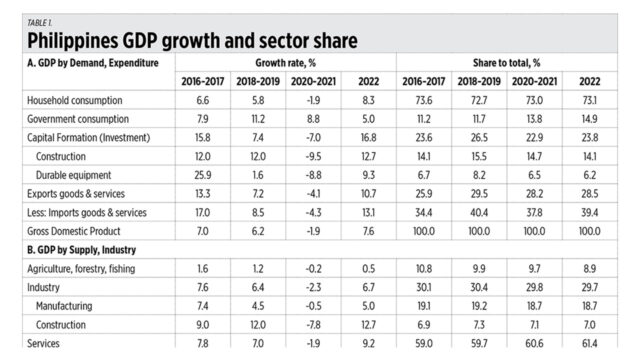
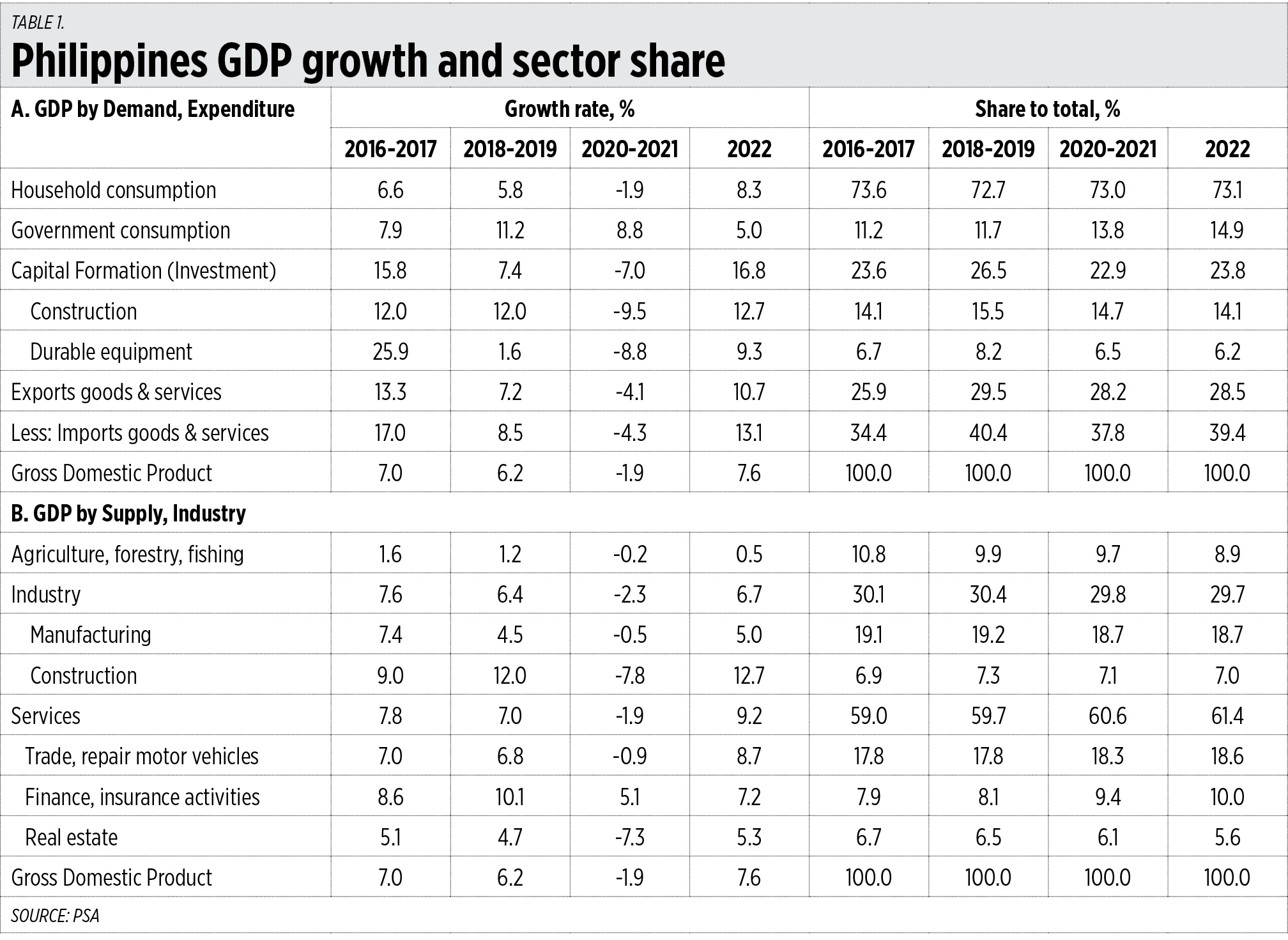
1. GDP growth in 2022 is 7.6% led by investments and household consumption. On the demand side, household consumption has the biggest share, 73%, of GDP or gross domestic product (a monetary measure of the market value of all the final goods and services produced and sold in a specific time period), and it grew 8.3% last year. Investment has a 24% share of GDP and it grew 17%.

2. Government’s share in GDP is rising. In 2016-2017, the share of government consumption was only 11% of GDP — it went up to 15% in 2022. Since government spending is financed by taxes and borrowings, this means that current and future taxes and debt payment will increase, not flatline or decline.

3. The Services sector, led by trade and finance, is growing fast. On the supply side of GDP, the services sector is now 61% of GDP and it grew 9% last year — good! The industry sector and manufacturing have modest growth (see Table 1).

4. Agriculture’s share continued its decline. Its share is now below 9% of GDP and growth remains anemic at 0.5%. As discussed in this column last Monday, “Ten themes in development economics (and the Ruperto Alonzo lectures),” the growth of corporate farming is much faster than overall agriculture. What the sector needs is more corporate agribusiness, and more land consolidation to have economies of scale.

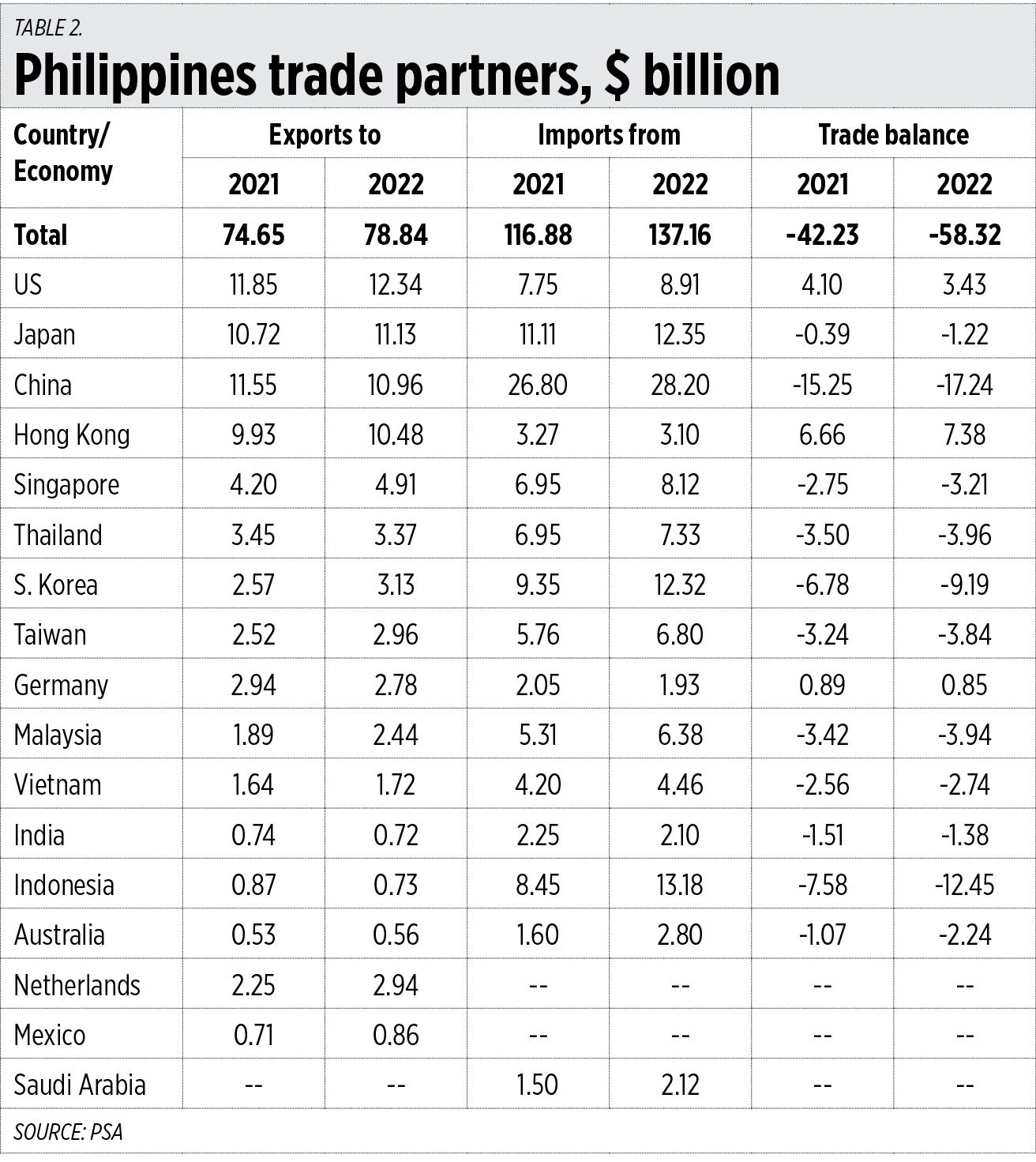
5. High expansion of imports despite the peso’s depreciation. Total merchandise or goods imports increased a great deal, from $117 billion in 2021 to $137 billion in 2022. The peso/US dollar average exchange rate last year was P54.48/$1 vs only P49.25/$1 in 2021. The Philippine economy was humming with both domestic and imported goods despite the higher exchange rate.

6. Exports have increased marginally, with the US and Japan as the top destinations. Merchandise exports in 2022 reached nearly $79 billion, with $23.4 billion going to the US and Japan alone. Germany remains the number one trade partner but its share to total exports and imports is declining.

7. Indonesia became a huge imports partner. Merchandise imports from Indonesia in 2021 were worth $8.45 billion, and jumped to $13.2 billion in 2022. Must be the higher value of coal imports, even if the quantity did not increase much.

8. Illicit trade in consumer items needs to be watched. For instance, the excise tax for legal cigarettes has increased from P55/pack in 2022 to P60/pack in 2023, and will further rise to P63/pack in 2024. Smuggled and illegal cigarettes, alcohol, other consumer goods will become cheaper options. Government revenues will suffer while certain government officials will amass wealth for themselves by allowing and facilitating the entry of illicit smuggled products.

9. The decelerated growth of 3% in China implies some migration of investments to ASEAN. Among the fastest-growing economies in the world in 2022, three were from the ASEAN — the Philippines, Malaysia, and Vietnam. The Philippines economic team — the departments of Finance and Budget and Management, the National Economic and Development Authority, and Bangko Sentral ng Pilipinas — will be busy entertaining more domestic and foreign investments expanding here.

10. Europeans suffer decelerated exports while East Asians kept their momentum. Expensive energy for Germany, the United Kingdom, France, etc. means less competitive merchandise exports for them. The Philippines needs to join the pack of export powerhouses of the ASEAN (see Table 3).

This column projects a 7-7.5% GDP growth in the first quarter of 2023. I will explain the basis for this projection in the coming weeks.


Bienvenido S. Oplas, Jr. is the president of Bienvenido Oplas, Jr. Research Consultancy Services, and Minimal Government Thinkers.

minimalgovernment@gmail.com

Meta to reinstate Donald Trump’s Facebook and Instagram accounts

REUTERS

Meta Platforms Inc. said Wednesday it will reinstate former US President Donald J. Trump’s Facebook and Instagram accounts in the coming weeks, following a two-year suspension after the deadly Capitol Hill riot on Jan. 6, 2021. 

The restoration of his accounts could provide a boost to Mr. Trump, who announced in November he will make another run for the White House in 2024. He has 34 million followers on Facebook and 23 million on Instagram, platforms that are key vehicles for political outreach and fundraising. 

His Twitter account was restored in November by new owner Elon Musk, though Mr. Trump has yet to post there. 

Free speech advocates say it is appropriate for the public to have access to messaging from political candidates, but critics of Meta have accused the company of lax moderating policies. 

Meta said in a blog post Wednesday it has “put new guardrails in place to deter repeat offenses.” 

“In the event that Mr. Trump posts further violating content, the content will be removed and he will be suspended for between one month and two years, depending on the severity of the violation,” wrote Nick Clegg, Meta’s president of global affairs, in the blog post. 

The decision, while widely expected, drew sharp rebukes from civil rights advocates. “Facebook has policies but they under-enforce them,” said Laura Murphy, an attorney who led a two-year long audit of Facebook concluding in 2020. “I worry about Facebook’s capacity to understand the real world harm that Trump poses: Facebook has been too slow to act.” 

The Anti-Defamation League, the NAACP, Free Press and other groups also expressed concern Wednesday over Facebook’s ability to prevent any future attacks on the democratic process, with Mr. Trump still repeating his false claim that he won the 2020 presidential election. 

Others said it was the right decision. 

Jameel Jaffer, executive director at the Knight First Amendment Institute at Columbia University and a former ACLU official, defended the reinstatement. He had previously endorsed the company’s decision to suspend Mr. Trump’s account. 

“The public has an interest in hearing directly from candidates for political office,” said Mr. Jaffer. “It’s better if the major social media platforms err on the side of leaving speech up, even if the speech is offensive or false, so that it can be addressed by other users and other institutions.” 

OTHER REACTIVATIONS?
The decision to ban Mr. Trump was a polarizing one for Meta, the world’s biggest social media company, which prior to the Mr. Trump suspension had never blocked the account of a sitting head of state for violating its content rules. 

The company indefinitely revoked Mr. Trump’s access to his Facebook and Instagram accounts after removing two of his posts during the Capitol Hill violence, including a video in which he reiterated his false claim of widespread voter fraud during the 2020 presidential election. 

It then referred the case to its independent oversight board, which ruled that the suspension was justified but its indeterminate nature was not. In response, Meta said it would revisit the suspension two years after it began. 

Meta’s blog post Wednesday suggested it may reactivate other suspended accounts, including those penalized for their involvement in civil unrest. The company said those reinstated accounts would be subject to more stringent review and penalties for violations. 

Whether, and how, Mr. Trump will seize upon the opportunity to return to Facebook and Instagram is unclear. 

Mr. Trump has not sent any new tweets since regaining his account on Twitter, saying he would prefer to stick with his own app Truth Social. But his campaign spokesman told Fox News Digital last week that being back on Facebook “will be an important tool for the 2024 campaign to reach voters.” 

In a post on Truth Social, Mr. Trump responded to his reinstatement on Meta apps, saying: “Such a thing should never again happen to a sitting President, or anybody else who is not deserving of retribution!” He did not indicate if or when he would begin posting on Meta platforms again. 

Representative Adam Schiff, a Democrat who previously chaired the House Intelligence Committee, criticized the decision to reinstate him. 

“Trump incited an insurrection,” Mr. Schiff wrote on Twitter. “Giving him back access to a social media platform to spread his lies and demagoguery is dangerous.” — Reuters

British banking damaged by slow supervisors warns industry report

THE SUN reflects off a skyscraper in the City of London, near the Royal Exchange and Bank of England, London in this Dec. 2, 2019, photo. — REUTERS

LONDON — Britain’s regulators can be slow, inefficient and unpredictable, raising costs and slowly damaging the financial sector’s global competitiveness, industry body TheCityUK said in a report. 

Complex, opaque and slow authorizations, such as for a new chief executive or a new product, can discourage growth and investment, the report published on Thursday said. 

It said The Financial Conduct Authority (FCA) and the Bank of England’s Prudential Regulation Authority (PRA) were taking steps to speed up authorizations, but further action was needed. 

The report was based on interviews with 20 industry leaders and a survey of 40 firms, with 83% of respondents saying Britain’s international competitiveness was slowly being damaged by regulatory inefficiencies. 

It recommends that regulators are “commercially aware” of the challenges the firms they regulate are facing, publish better performance data on authorizations, enhance communication with firms, adopt a “digital-first” approach and train authorization staff better. 

“The UK is one of the world’s leading international financial centers, but our competitors are biting at our heels. Complacency is not an option,” TheCityUK Chief Executive Miles Celic said. 

Britain is pushing through many reforms to financial rules to help the City of London remain globally competitive after being largely cut off from the European Union by Brexit, ushering in new competition from centers like Amsterdam and Paris. 

TheCityUK said it welcomes the so-called Edinburgh reforms to boost London as a global financial center. 

“Successfully updating the rules also depends on the referee implementing them in the same spirit and with the same energy,” Mr. Celic said. 

The Bank of England said it recognized the need to improve the timeliness of approving senior managers in particular and was taking steps in line with many of the recommendations. 

“This report supports our decision to invest heavily last year heavily in staff and technology, resulting in our pending caseload falling by 50 per cent, even as our workload and level of scrutiny of firms increases,” the FCA said. 

“We have already announced that we will publish more metrics about our performance soon and will shortly be testing automated application forms to make applications quicker to assess.” 

Britain’s finance ministry is due to launch in coming weeks a public consultation on rules for vetting senior managers at banks and insurers, with a focus on streamlining the process. — Reuters