Home Blog Page 5313

Sustainability at DMCI Holdings

In 2022, Semirara Mining and Power Corporation (SMPC) was recognized in the ASEAN Energy Awards, Southeast Asia’s highest recognition for excellence, creativity, practicality, and dedication to a cause in the field of energy. SMPC won in the Special Submission category for its accelerated rehabilitation of its South Panian pit in Semirara Island, Antique.

DMCI Holdings (PSE: DMC) is the only publicly listed holding company in the Philippines that has construction as its core competency.

Known for its strong financial performance and resilient business portfolio, the Company has been steadily improving its Environmental, Social and Governance (ESG) initiatives to promote purposeful and sustainable growth for its stakeholders.

Advancing Environmental Stewardship

DMCI Holdings has businesses that depend primarily on natural resources. Subsidiary Semirara Mining and Power Corporation (PSE: SCC) is the largest coal producer in the Philippines, and the only domestic power producer that generates its own fuel.

In 2022, SCC completed backfilling operations in its Panian mine, once regarded as the largest open pit mine in the Philippines.

After spending P2.9 billion and 11.5 million man-hours on its Panian rehabilitation efforts, SCC was able to fill the pit with over 452 million bank cubic meters of earth material, which is enough to fill 217,000 Olympic-size swimming pools. SCC is now implementing a science-based plan to reforest the land and restore biodiversity in the area.

SCC also supports the conservation and protection of avian, marine and aquatic resources in its host communities through wildlife rescue and rehabilitation, river and coastal cleanups, mangrove reforestation, giant clam propagation, seagrass protection and coral reef rehabilitation, to name a few.

Wholly-owned DMCI Mining Corporation is engaged in the exploration, extraction and export of nickel resources, an essential raw material for the energy transition. Nickel is used to produce batteries for energy storage systems and electric vehicles.

In 2021, DMCI Mining earmarked P110 million for its six-year final rehabilitation program for its Berong mine, which was fully depleted in the fourth quarter of the same year. The program covers 109 hectares of surface mine, 209 hectares of silt control structures and 25 hectares of stockpile area. Around 14 hectares of mine access road will also be rehabilitated and turned over to the host community for their use.

Aside from mine rehabilitation, DMCI Mining is involved in environmental research, genetic resource conservation of indigenous plants, and seedlings production for reforestation activities.

Most of its subsidiaries—namely, D.M. Consunji, Inc., SCC, DMCI Power, and DMCI Mining—also have environmental management systems that are certified to the ISO 14001:2015 standard, allowing them to manage their environmental responsibilities in a systematic and consistent manner.

Zambales Diversified Metals Corporation, a subsidiary of DMCI Mining Corporation, has a College Scholarship Program for qualified residents in its host communities. Some of its scholar-graduates were eventually hired by the company.

Towards Gender Equality 

The DMCI group mostly operates in male-dominated industries: engineering and construction, mining, power generation and utilities. Despite this, DMC and SCC have been constituents of the Bloomberg Gender-Equality Index (GEI) since 2021.

Bloomberg GEI tracks the performance of public companies across the world, based on their commitment to disclosing their efforts to support gender equality through policy development, representation, and transparency.

DMC and SCC have been included in the 2023 Bloomberg GEI which measures gender equality across five pillars: female leadership & talent pipeline, equal pay & gender pay parity, inclusive culture, anti-sexual harassment policies, and pro-women brand.

Only four listed companies in the Philippines joined this year’s roster. This is the third straight year that DMC and SCC have been included in the prestigious index. 

Semirara Mining and Power Corporation has propagated over 170,000 giant clams in Semirara Island through its Semirara Marine Hatchery. Giant clams are ecologically significant because they promote marine biodiversity and serve as bioindicators of the overall health of the marine ecosystem.

Strengthening Corporate Governance

In 2022, DMCI Holdings adopted a governance framework that outlines how the group manages risks and opportunities related to ESG factors. It also formed a Strategy and Sustainability Committee to assist and advise the Board of Directors in developing, assessing, and overseeing major plans and material issues that may affect the sustainability of the Company.

To strengthen Board independence and diversity, DMCI Holdings now has three independent directors whose expertise range from investment banking, finance, economics, law, and education. Its lead independent director (ID) is also the first female ID ever elected by the Company.

With these changes, independent directors now constitute one-third of the DMC Board while female directors account for nearly half (four out of nine) of the governing body.

DMCI Holdings likewise adopted a Diversity, Equality and Inclusion policy to foster an environment where employees are offered equal opportunities, and where employees feel safe, supported, and respected no matter their gender identity, religion, position in the company, or anything else that makes each different.


Spotlight is BusinessWorld’s sponsored section that allows advertisers to amplify their brand and connect with BusinessWorld’s audience by enabling them to publish their stories directly on the BusinessWorld Web site. For more information, send an email to online@bworldonline.com.

Join us on Viber to get more updates from BusinessWorld: https://bit.ly/3hv6bLA.
Factory activity highest in 7 months

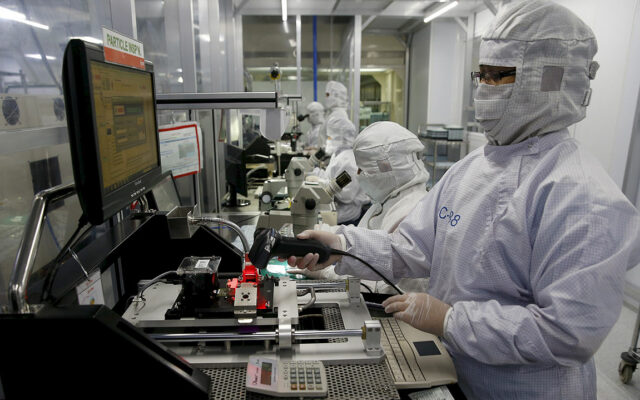
A worker uses a microscope at an electronics manufacturing assembly plant in Biñan, Laguna, April 20, 2016. — REUTERS

By Luisa Maria Jacinta C. Jocson, Reporter

FACTORY ACTIVITY in the Philippines continued to expand, hitting a seven-month high in January, as firms ramped up production levels due to an uptick in foreign demand.

The S&P Global Philippines Manufacturing Purchasing Managers’ Index (PMI) rose for a third straight month to 53.5 in January from 53.1 in December. This was the Philippines’ highest PMI reading since 53.8 in June 2022.

A PMI reading above 50 denotes improvement in operating conditions compared with the preceding month, while a reading below 50 signals deterioration.

Manufacturing Purchasing Managers’ Index (PMI) of select ASEAN economies, January 2023“Operating conditions across the Filipino manufacturing sector improved solidly during January, according to the latest PMI data. Sharp upturns were noted in both output and new orders, as panelists cited increased demand for Filipino manufactured goods,” Maryam Baluch, economist at S&P Global Market Intelligence, said in a report released on Wednesday.

The headline PMI measures manufacturing conditions through the weighted average of five indices: new orders (30%), output (25%), employment (20%), suppliers’ delivery times (15%), and stocks of purchases (10%).

The Philippines had the second-highest PMI reading among six Association of Southeast Asian (ASEAN) member countries, just behind Thailand (54.5) and ahead of Indonesia (51.3).

On the other hand, factory activity in Myanmar (49.6), Vietnam (47.4) and Malaysia (46.5) contracted during the month.

Overall, the ASEAN manufacturing sector jumped to a three-month high of 51 in January, from 50.3 in December.

STRONGER DEMAND
S&P Global noted a sharp rise in production levels, which expanded for a fifth month in a row.

“Anecdotal evidence pointed to increasing demand for Filipino manufacturing goods. Similarly, new orders also rose at a faster pace in January,” it said.

Foreign demand for Philippine-manufactured goods also rose in January.

“Growing international client numbers and stronger demand from China helped revive exports for the first time in 11 months,” S&P Global said.

Firms increased purchasing activity in January, with the pace of expansion one of the quickest on record.

Manufacturing companies also posted an increase in the level of unfinished work in January, which S&P Global said was only the fifth month of improved work backlog since January 2016.

“For the first time in a year, holdings of post-production inventories fell as firms utilized stocks to meet higher new orders,” it said, adding the drop was “slight.”

Despite stronger demand, S&P Global noted price pressures eased further in January.

“The pace of input price inflation was the slowest in two years and below the survey average, with charges levied also rising at a softer rate than that seen in over a year,” it added.

Ms. Baluch noted that the Bangko Sentral ng Pilipinas’ (BSP) aggressive tightening was effective as prices continued to ease in January.

“Encouragingly, demand has yet to be impacted negatively by policy changes,” she said.

The BSP raised rates by a total of 350 basis points (bps) last year. BSP Governor Felipe M. Medalla earlier signaled a 25- to 50-bp hike at the central bank’s first policy meeting of the year on Feb. 16.

“Additionally supply chain pressures also eased further, with panelists citing that improved infrastructure, more vendors and lifting of port restrictions helped with delivery times,” Ms. Baluch said.

However, hiring activity remained slow in January.

The S&P Global report showed the seasonally adjusted employment index edged closer to the 50 neutral mark, indicating only a fractional rise in employment numbers in January.

ING Bank N.V. Manila Senior Economist Nicholas Antonio T. Mapa said improved supply chain conditions and demand helped boost factory output in the first month of 2023.

“Supply chain conditions also (eased), which helped keep production costs down, a sign that the economy continues to reopen. Demand (was) also evident, notably also from abroad, which bodes well for export orders,” he said in a Viber message.

“The one disappointment would be the lack of pickup in labor market improvement as hiring was largely flat,” he added.

Rizal Commercial Banking Corp. Chief Economist Michael L. Ricafort said that the reopening of the economy drove manufacturing activity higher.

“The latest local manufacturing PMI gauge generally improved in recent months amid measures to further reopen the economy towards greater normalcy,” he said in an e-mail.

Mr. Ricafort added that the boost in foreign and local tourism also supported the recovery of businesses, including some manufacturers.

PEZA approves P6.4-B investments in January

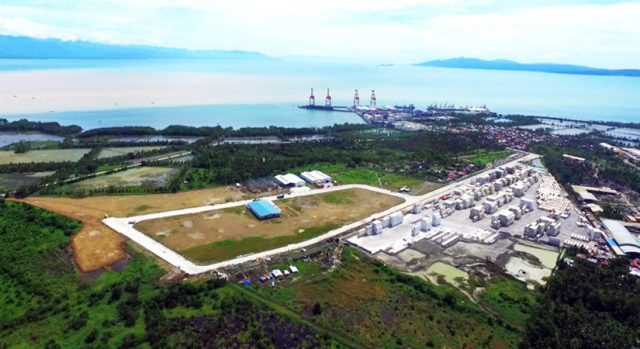
ANFLOINDUSTRIALESTATE.COM

THE PHILIPPINE Economic Zone Authority (PEZA) greenlit P6.39 billion worth of investments in January, which includes the development of an information technology (IT) center in Makati City.

In a statement on Wednesday, PEZA Officer-in-Charge Tereso O. Panga said the board approved last week 19 new and expansion projects of economic zone locators and developer/operators worth P6.39 billion.

He noted this is 83.69% higher than the P3.48-billion investments approved in January 2022.

“With the positive start of the year, we are bullish with our outlook this year, targeting a 10% investment growth based on the initial locator sector targets,” Mr. Panga said.

The biggest project approved by the PEZA board was an economic zone development envisioned as an IT center in Makati City that is expected to generate P4.116 billion worth of investments.

PEZA said the remaining P2.277 billion worth of approved investments will come from 18 new and expansion projects of registered locator companies. Broken down, the companies are comprised of 11 export manufacturing enterprises, four facilities enterprises, two IT enterprises, and one domestic market enterprise.  

According to the PEZA, the projects will be located in Makati City, Pasay City, Calabarzon, Cebu City, and South Cotabato.   

PEZA approved P140.7 billion worth of investments in 2022.   

Meanwhile, Mr. Panga said the inclusion of the ecozone development program in the Philippine Development Plan (PDP) 2023-2028 will help attract more investors.

“We are positive that more ecozones will be approved and created especially in the countryside,” he said.

Under the PDP 2023-2028, the PEZA is mandated to accelerate the implementation of the ecozone transformation roadmap that expands the various types of special ecozones that can be registered under the agency.

“Ecozones can be shields to soften the landing of the headwinds, the external constraints, and all these global disruptions happening especially during this time. The other side to this is that ecozones can be economic drivers to accelerate economic recovery and growth,” Mr. Panga said. — Revin Mikhael D. Ochave 

Marcos to sign 7 bilateral deals during Japan trip

A Japan Yen note is seen in this illustration photo taken June 1, 2017. — REUTERS

PRESIDENT Ferdinand R. Marcos, Jr. is expected to sign seven key bilateral deals covering infrastructure, defense, and tourism, among others, during his trip to Japan next week.

Mr. Marcos’ working visit from Feb. 8 to 12 also gives the Philippines a chance to further boost exports to Japan, Foreign Affairs Assistant Secretary for Asia and Pacific Affairs Nathaniel Imperial told a news briefing.

“During the visit, we anticipate the signing of seven key bilateral documents or agreements covering cooperation in infra development, defense, agriculture and information and communications technology — areas that are in the President’s priority agenda,” he said.

In terms of infrastructure cooperation, the Philippine government is set to sign the exchange of notes on loan agreements for the North-South Commuter Railway project from Malolos, Bulacan province to Clark International Airport, and from Manila’s Tutuban to Calamba, Laguna province.

“This will involve around $3 billion worth of loans that will be later signed also by the Department of Finance (DoF),” Mr. Imperial said.

Also on the list are agreements on humanitarian assistance and disaster relief cooperation between the Philippine Defense department and its Japanese counterpart.

“We are expecting the Japan trip to be more productive than the President’s speaking tour in Davos,” Terry L. Ridon, a public investment analyst, said in a Facebook Messenger chat.

“We are looking forward to continuing Japanese commitments towards completing ongoing infrastructure projects, particularly the Metro Manila subway and the North-South Commuter Railway.”

Mr. Imperial said the government hopes that the working visit would give Philippine agricultural exports, especially bananas and Hass avocados, better market access in Japan.

Japan has been the country’s biggest bilateral source of active official development assistance, providing concessional loans to finance important infrastructure and capacity building projects as well as programs on social safety, education, agriculture and science and technology, among “other high impact programs,” Mr. Imperial said.

Mr. Marcos will be joined by his wife First Lady Liza Araneta-Marcos and key administration allies including Senate President Juan Miguel F. Zubiri, House Speaker Ferdinand Martin G. Romualdez, and former President Gloria Macapagal-Arroyo.

His delegation also includes at least six Cabinet secretaries including Benjamin E. Diokno of the Finance department, Alfredo E. Pascual of the Trade department, Rafael P.M. Lotilla of the Energy department, Esperanza Christina Codilla-Frasco of the Tourism department, and Enrique A. Manalo of the Foreign Affairs department.

“Other Cabinet officials and undersecretaries” including Special Assistant to the President Antonio Ernesto F. Lagdameo, Jr. will also be part of the Philippine delegation, Mr. Imperial said, adding that there are around 150 “who signed up to join” the Philippine business delegation.

“As for the number of meetings and business activities lined up for the President, we foresee a lot of business deals to be signed in various areas,” he said, without giving details.

DFA’s Mr. Imperial said Mr. Marcos will also have roundtable and business meetings. A business seminar will also be held on Feb. 9 and 10.

“The President will also be meeting with CEOs of Japanese shipping companies and associations to advance partnerships with Philippine stakeholders in maritime education and welfare programs for our seafarers,” he said.

Mr. Marcos is also expected to meet with over a thousand Filipino migrant workers in Tokyo on Feb. 12, before returning to Manila in the evening.

Michael Henry Ll. Yusingco, a policy analyst, criticized the large retinue of government officials accompanying Mr. Marcos, saying this is “unnecessary and really just a waste of taxpayers’ money.”

“The least the government can do is to limit the politicizing of these trips. It will boost the credibility of the government and will demonstrate a firm resolve to protect our national interest,” Mr. Yusingco said in a Facebook Messenger chat. — Kyle Aristophere T. Atienza

Greenhills, Shopee on USTR list of notorious markets for counterfeits

BW FILE PHOTO

THE GREENHILLS Shopping Center in San Juan City and popular e-commerce platform Shopee are included in the United States Trade Representative’s (USTR) list of notorious markets for counterfeit and pirated goods.

In a report released on Jan. 31, the USTR identified 33 physical markets including Greenhills Shopping Center, Bangkok’s MBK Center, Beijing’s Silk Market and Kuala Lumpur’s Petaling Street Market, that continue to enable “substantial trade” in counterfeit goods.

It also identified 39 online markets including Shopee, Taobao, and Aliexpress, that facilitate the sale of products that are known as counterfeit.

“During the pandemic, many sellers of counterfeit goods adapted by transitioning from physical stores to e-commerce platforms and using the physical storefronts to facilitate the fulfillment of online sales,” the USTR said, noting that online sellers now use social media ads, hidden links, and drop shipping schemes to evade authorities.

In the Philippines, the USTR said many stalls in Greenhills Shopping Center sell fake goods such as electronics, perfumes, watches, shoes, accessories, and fashion items. A new seven-story building will be opened in Greenhills early this year.

“Greenhills Shopping Center has expressed willingness to cooperate with authorities and a belief that the opening of this (new) building will provide leverage to transition sellers of counterfeit goods into ‘legitimate’ sellers,” it said.

The USTR noted that Philippine law enforcers have taken action to seize counterfeit luxury goods, which are sold openly in the shopping center. For instance, authorities seized $1.4 million worth of counterfeit luxury goods from sellers in Greenhills.

“Right holders report enforcement activity in the form of warning letters and subsequent suspension of business, but the targets of enforcement often evade such efforts by moving the location of their stalls,” it said.

The Intellectual Property Office of the Philippines (IPOPHL) said that it has proposed a work plan to address piracy and counterfeiting activities in Greenhills.

In a separate statement, the IPOPHL said the draft plan is being reviewed by the members of the interagency National Committee on Intellectual Property Rights (NCIPR).

The NCIPR is set to meet later this month to discuss the draft plan, which includes strategies to address the proliferation of counterfeit items in Greenhills. It wants the shopping center operator to implement stricter monitoring of stalls and to slap bigger penalties against sellers of counterfeit items.

Under the plan, NCIPR will work with brand owners to submit affidavits of complaints directly to the mall operator, which would “indicate their expression of filing a legal complaint and as notice to the mall’s management of potential violators.”

“Truly, clearing Greenhills of IP infringement activities will not be an easy feat. Its long-standing reputation as a market for Class As and Bs and pirated DVDs has cut across generations. The problem demands the close and consistent collaboration among NCIPR members, local governments, brand owners and Greenhills — both its managers and vendors,” IPOPHL Director-General Rowel S. Barba said.   

ONLINE PLATFORMS
Meanwhile, the USTR said there has been growing concern from right holders about the proliferation of counterfeit sales on social commerce platforms amid the e-commerce boom during the pandemic.

“Right holders state that while certain social commerce platforms have taken positive steps to implement anti-counterfeiting policies, many others still lack adequate anti-counterfeiting policies, processes, and tools such as identity verification, effective notice and takedown procedures, proactive anti- counterfeiting filters and tools, and strong policies against repeat infringers,” it said.

The USTR identified Shopee as one of the online markets where right holders have reported “high volumes of counterfeits” and have complained about “cumbersome and duplicative processes among the individual country-focused platforms, differing requirements for takedown requests, and slow response times.”

Shopee launched a pilot program for its new brand protection portal in 2022, but the USTR said right holders said the platform should improve procedures for vetting sellers and increase penalties against sellers of counterfeit goods.

The USTR also identified AliExpress, which is owned by China’s Alibaba, as a “dominant upstream distributor of counterfeit goods in wholesale quantities for online markets in the United States and other countries.” Another Alibaba-owned platform Taobao was also included in the USTR’s list.

“Another key concern of right holders is that penalties for repeat infringers do not stop known counterfeit sellers on AliExpress from remaining on the market, such as by operating multiple accounts,” it said. — RMDO

Globe, Japan firm to complete subsea cable laying by April

DENNY MÜLLER-UNSPLASH

GLOBE Telecom, Inc. and its partners have commissioned a Japanese company to finish by April the last leg of a submarine cable network that will bring fiber connectivity to remote areas of the country.

In a press release on Wednesday, Globe said Japan-based NTT World Engineering Marine Corp. or NTT WE Marine is set to land and lay cables in the nine remaining segments of the $150-million Philippine Domestic Submarine Cable Network (PDSCN).

“With the final phase of the PDSCN in motion, we are excited to take a major step towards our goal of nation-building through digitalization,” Globe President and Chief Executive Officer Ernest L. Cu said.

“This is a crucial step towards bridging the digital divide and providing equitable and reliable connectivity, which is essential for the economic and social development of our country,” he added.

The project, which covers a total cable distance of 2,500 kilometers, started in July 2022. The last leg will be done through cable ship Subaru, one of NTT WE Marine’s cable-laying vessels.

The PDSCN, through its continuous cable landings, will cover Calatrava, Romblon; Pasacao, Camarines Sur; Bulan, Sorsogon; Calbayog City, Samar; Palanas, Masbate; Mactan, Cebu; Maasin City, Southern Leyte; Claver, Surigao del Norte; Kinoguitan, Misamis Oriental; Camiguin; Dipolog, Zamboanga del Norte; Liloy, Zamboanga del Norte; and Zamboanga City, Zamboanga del Sur.

Globe said that it has been “aggressive in expanding its network to meet the growing demand for connectivity amid increased digitalization.”

NTT WE Marine has a local branch and offices in Nagasaki and Yokohama, Japan.

In a separate press release, Globe said that it will be rolling out 30 booths to assist in the registration of subscriber identity module (SIM) cards from Feb. 1 to 3.

The company aims to open registration assistance booths in far-flung towns from northern to southern provinces to reach as many customers as possible before the April 26 deadline.

The SIM registration booths will be open to all and are put in place to help senior citizens, persons with disability, and those using basic phones without internet access.

The rollout is part of the National Telecommunications Commission’s initiative, which followed the first round in January, where the company deployed booths in 15 areas from Jan. 25 to 27.

By the end of January, Globe said it logged over 11 million registered prepaid SIMs.

“Globe is again urging its customers to plan and schedule their registration, as failure to do so within deadline will lead to SIM deactivation,” the company added. — Justine Irish D. Tabile

Concepcion Industrial doubles its Q4 net earnings

LISTED supplier of home appliances Concepcion Industrial Corp. announced on Wednesday that it closed the fourth quarter of 2022 with P60 million in earnings, twice higher than the earlier year, due to higher sales and the recovery of the local currency.

“We felt the enduring effect of the pandemic and the economic impact to supply and demand in 2022,” Concepcion Industrial Chairman and Chief Executive Officer Raul Joseph A. Concepcion said in a press release on Wednesday.

“However, we have continuously made refinements in our processes throughout the course of these challenges, with the utmost goal of protecting the long-term prospects of the business,” he added.

The firm said it was able to raise its income despite inflationary pressures.

Concepcion Industrial attributed its profit growth to the 8% rise in sales to P3.5 billion, along with a stronger peso, for the three months ending in December.

“The sales growth is attributed to a stronger demand in the commercial and aftermarket businesses, which was partly offset by a 1% decline in the consumer business due to weaker demand resulting from rising inflation,” the company said.

In the last month of 2022, the peso continued to appreciate from its record low of P59 against the greenback on Oct. 17, 2022.

In December alone, the peso strengthened by 0.8% or P0.465 when it closed at P55.755 on Dec. 29 from P56.22 on Dec. 1.

For its 12-months net sales, Concepcion Industrial said it also registered an 8% sales growth to P13.2 billion. The company’s full-year net income of P358 million was 5% lower than what it booked in 2021.

Concepcion Industrial said the strong fourth-quarter results “were not enough to recover the weak sell-out in [the first quarter] due to Omicron-related restrictions.”

These were coupled with higher commodity and logistics costs and unfavorable foreign exchange due to weak peso performance for most of the year, the company added.

“We remain optimistic into the future and we are constantly preparing the organization to be well-positioned to seize the opportunities as they present themselves,” Mr. Concepcion said.

Concepcion Industrial is a diversified manufacturing company that aims to provide leading products and services to the Filipino market.

It has seven subsidiaries which are: Concepcion-Carrier Air Conditioning Co.; Concepcion Durables, Inc.; Concepcion Otis Philippines, Inc.; Concepcion Business Services, Inc.; Cortex Technologies Corp.; Alstra, Inc.; and Teko Solutions Asia, Inc.

On the stock market on Wednesday, shares in the company closed unchanged at P16.76 apiece. — Justine Irish D. Tabile

MWSS expects Kaliwa Dam to be completed by 2026

A MAN arrives at a shallow part of Agos River, where the Metropolitan Waterworks and Sewerage System is planning to build a dam. — PHILSTAR FILE PHOTO / EFIGENIO TOLEDO IV

THE Metropolitan Waterworks and Sewerage System (MWSS) expects a crucial dam project that will augment water supply in the nation’s capital to be completed by the end of 2026 after it secured the necessary permits for its development.

“The Kaliwa dam has two big components — one is the tunneling and the other one is the dam. The tunnel boring machine stretches from Teresa to Morong,” said Leonor C. Cleofas, administrator of MWSS, referring to the two towns in Rizal province. “At the same time, if we can fulfill the validation of resettlement for the 46 families, then we can start with the dam.”

“The MWSS is endeavoring to complete the dam by the end of 2026,” Ms. Cleofas said in a virtual briefing on Wednesday.

Last year, the MWSS said the development of the Kaliwa Dam is pushing through after the signing of a memorandum of agreement with the indigenous peoples of Rizal and Quezon provinces.

“Our contact with China is ‘design and build.’ This includes the detailed engineering design, which is 100% complete. The tunnel boring machine started in December last year,” she said.

Ms. Cleofas added that both Maynilad Water Services, Inc. and Manila Water Co., Inc. would develop a water treatment plant in Teresa, Rizal once the dam and tunnel are finished.

“Coinciding with the operation of the treatment plant, we can expect the supply of 600 million liters per day (MLD) that will be added to other water sources,” she said.

Since the MWSS is expecting the Kaliwa Dam to be completed by the end of 2026, additional water supply is expected by 2027, Ms. Cleofas said.

Last month, the MWSS warned of a possible supply shortage by 2024 due to population growth while new water sources are non-existent.

The government’s Kaliwa Dam project, also known as the New Centennial Water Source project, aims to address the expected water crisis in Metro Manila and adjacent provinces. — Ashley Erika O. Jose

Alaska Milk, D&G Pacific launch upcycling facility

ALASKA Milk Corp. and D&G Pacific Corp. on Wednesday launched a multi-layered plastic upcycling facility that aims to collect and upcycle over three metric tons of single-use plastics per day, the companies’ officials said.

“As a responsible producer of plastics used in the packaging of our products, Alaska Milk is devoted to recovering not just the same amount but even more volume of plastics we release in the market,” said Tarang Gupta, the company’ managing director.

The facility, which sits on five hectares of land in Antipolo City, required an investment of P45 million, according to Jose Ildebrando B. Ambrosio, legal counsel of waste-management company D&G Pacific.

“As Alaska, we have created an ecosystem so we are already 100% plastic neutral, which means we are collecting plastics more than what we generate. Now, what we are doing is investing in upcycling facilities so that the plastic we collect can go into these and turn into something,” Mr. Gupta said.

Through the upcycling facility, single-use plastics are collected and turned into boards that can be used and reused in furniture production or as construction material.

“We target zero-waste management by developing sustainable materials recovery facilities (MRF) like this multi-layered plastic upcycling facility. With the efforts of Alaska Milk and with the help and support of our potential partners, we strongly believe that we will create a huge impact towards sustaining a greener environment,” said Edmund Gregory Dimalanta, president of D&G Pacific and RePurpose, Inc.

RePurpose was established to assume the rights and obligation to operate the multi-layered plastic upcycling facility.

“If this became successful, we would probably expand this facility but we are always open for partnerships. My invitation to other companies would be to explore. I am confident that this model would work,” Mr. Gupta said.

Meanwhile, Mr. Dimalanta said that his group is looking at replicating the facility in other parts of the country, namely: Cauayan City, Isabela; Baguio City; Quezon City; and Antipolo City.

“Antipolo wants us to manage the MRF and bring more, build more of these facilities,” Mr. Dimalanta said, adding that the target is for the projects to be in place by the fourth quarter. “But we want the signing to happen next quarter.” — Ashley Erika O. Jose

Infrastructure seen needed to boost sustainable packaging investments

INFRASTRUCTURE for collecting and recycling used materials is needed to draw more investments in sustainable packaging, the top official of the World Packaging Organization (WPO) said on Wednesday.

“The infrastructure [should be] put in place to be able to recycle. It’s now reusing recyclable material, but if you don’t have the infrastructure to collect this, then that’s of no value. It’s important that governments play their part,” WPO President Pierre Pienaar told reporters on the sidelines of ProPak Philippines 2023 conference in Pasay City.

The packaging industry needs to increase its recycling efforts to avoid consuming more natural resources in the production process, he added.

“We’ve got to recycle more. We want to use material that is recyclable. We’ve got to use material that has recycled content in it and we’ve got to make sure that the material is collected and put back into the process and used over and over so that we don’t use more of our natural resources,” Mr. Pienaar said.

Asked if providing incentives to the packaging industry is viable, Mr. Pienaar said that the concept of extended producer responsibility (EPR) is the only effective method of ensuring that recycling is sustained.

“The only method at this stage anywhere in the world that has worked in terms of ensuring the continuation of recycling and a circular economy is what we call EPR and this is where the manufacturers of the packaging are responsible to make sure the packaging is collected and recycled,” Mr. Pienaar said.

Meanwhile, Informa Markets held on Wednesday the first day of ProPak Philippines 2023, which attracted 250 local and international exhibitors from 25 countries and regions across the world.

The event showcased the latest technologies in manufacturing, packaging, and processing. It will run until Feb. 3 at the World Trade Center in Pasay City.

Some of the participating companies are engaged in processing and packaging machinery, technology, and materials in sectors such as filing, bottling, quality assurance, testing and measurement, and maintenance.

Other participants include those in automation, instrumentation, refrigeration, storage, labeling, printing, plastics processing, and wrapping machinery.

“We expect ProPak Philippines to be the international trade exhibition platform to offer solutions on cutting-edge technology in processing and packaging. We emphasize on the development that would need to get technology adoption in both big scale and micro, small, and medium enterprise (MSME),” Informa Markets Regional Group Director-ASEAN Rungphech Chitanuwat.

“With our international network and our brand ProPak in Asia, we have also brought experts to share in the conference and seminars during the three-day event,” she added. — Revin Mikhael D. Ochave

Playing wine games

Make a bet at the Grand Casino du Vin, learn something new, and maybe win big

THE GRAND Hyatt Manila’s bar, The Cellar, is combining game playing with wine in its Grand Casino du Vin wine game night, held every first and third Wednesday of every month, starting on Feb. 1.

The next Grand Casino du Vin is in two weeks.

BusinessWorld attended a preview of the games on Jan. 18. One is handed a bag of gaming chips at entry with which one can bet on three themed games. The first one we played was The Aromas of Wine. A host takes a bottle of scent, ranging from pine to vanilla (there are 50 to choose from), and guests are prompted to match the scent with a picture on a board. It is a lot harder than it sounds (we mistook lychee for rose; and vanilla with strawberry), and many people cheerfully lost at this game.

The next game, The Wine Regions, has wine (supplied by AWC Philippines) poured from concealed bottles, which players should taste and smell. Judging from one’s senses, one needs to pinpoint which country it comes from. We had a hard time, but we leaned towards placing our chips on the map of France every time something smelled a little bit too strong.

The easiest game for us was The Type of Wine, where wine was poured into special black glasses. Judging from taste and scent alone, one should guess whether one is drinking a white, a rosé, or a red. The host then pours the wine into a clear glass, which is held up to the light. Many players frequented this game table, and this reporter doubled his winnings there by the end of the night.

The prizes for winning are determined by the number of chips one has on hand: because prizes are auctioned off at the end, with the chips serving as payment. That night, we watched a bottle of champagne, a massage at the Grand Hyatt Manila Spa, a dinner at The Cellar, and a stay at a Grand Hyatt Manila suite go to other people (we only had 66 chips, and the bottle of champagne went for more than that). What we did see people doing was pooling their winnings together: the stay at the suite went to a group who had 450 chips between them.

Grand Hyatt Manila’s GM Gottfried Bogensperger was going around that evening, sneaking chips into people’s hands (but only if you promised to go all or nothing). The Cellar was always meant to host games night he said: “The Cellar was conceptualized like a cellar — a basement. You invite your friends, and it’s almost like a man-cave. You play games, you eat great food, and you have good wine.”

The setting prompted them thinking up of a game night, and they tried out the games during a staff member’s farewell party. “People still have fun and enjoy each other, even when they don’t know each other,” he said. That, and the wine education gives the evening an edge. “They learn something along the way,” he explained.

“It’s the excitement of learning and competing. It’s not the gaming component. You compete with your friends: that you know something more than they do.”

Mr. Bogensperger talked about all the fun one could have at the gaming tables, but also discussed why they do it: “We, the hospitality industry people, we are not here to serve you. We are here to create memories and experiences. When we say that, we have to do something. We have to mean it.

“We like to do business in terms of having fun with each other. Let’s enjoy it. It’s more fun to make fun memories and experiences you can take home.”

Entrance to the Grand Casino du Vin costs P3,000 net per person, which includes a four-course set menu with a glass of red and white wine, and 12 gaming chips. The event will be held every first and third Wednesday of the month from 5 to 11 p.m. — Joseph L. Garcia

CTA cancels pharmaceutical firm’s P7.48-M tax liabilities

CTA.JUDICIARY.GOV.PH

THE Court of Tax Appeals (CTA) has granted the appeal of Ajarma Pharma Philippines, Inc. to set aside its deficiency input value-added tax worth P7.48 million for the period covering Jan. 1 to June 30, 2017.

In a 20-page decision made public on Jan. 25, the CTA Special Third Division said the commissioner of internal revenue (CIR) did not afford the firm due process when it assessed its tax liabilities.

The tax tribunal said the CIR did not inform the firm why it rejected its protest in its tax demand and assessment letters.

“Due process requires the Bureau of Internal Revenue (BIR) to consider the defenses and evidence submitted by the taxpayer and to render a decision based on these submissions,” according to the ruling penned by Associate Justice Erlinda P. Uy.

The CIR was also ordered not to enforce the collection of the subject value-added assessment. The court said tax assessments that fail to comply with regulations on a taxpayer’s due process must be voided.

The CIR argued that it complied with all due process requirements and said its findings were based on pertinent evidence, which the tribunal disagreed with.

Citing the country’s tax code, it said taxpayers must be informed in writing of all facts surrounding an assessment, including why a protest was rejected.

Ajarma Pharma is a domestic corporation engaged in the wholesale distribution of drugs medicines and other pharmaceutical products.

The CIR, the respondent, has the authority to collect all national internal revenue taxes.

“As a corollary, the concerned taxpayer must not be left unaware on how the respondent or her duly authorized representatives appreciated the explanations or defenses raised in connection with the assessment,” it said.

“Relative thereto, a void assessment bears no valid fruit.” — John Victor D. Ordoñez

ADVERTISEMENT
ADVERTISEMENT