Home Blog Page 53

Stolen Renoir, Cézanne, and Matisse were probably uninsured, market sources say

CEZANNE’S Tasse et Plat de Cerises (Cup and plate of cherries) — MAGNANIROCCA.IT

THREE PAINTINGS by French masters Pierre-Auguste Renoir, Paul Cézanne, and Henri Matisse stolen from a museum in northern Italy in March were probably not insured, according to market sources.

One fine art underwriter told the Reuters publication The Insurer that the paintings, estimated to be worth around $10 million, had previously failed to secure insurance cover due to the cost.

The heist reportedly took only three minutes from the moment the thieves forced their way in through the main entrance of the Fondazione Magnani Rocca, near Parma, on the night of March 22.

They stole Cézanne’s Tasse et Plat de Cerises (Cup and Plate of Cherries), Renoir’s Les Poissons (The Fish), and Matisse’s Odalisque sur la Terrasse (Odalisque on the Terrace), police said.

One source said they had been surprised at the thieves’ choice of works of relatively low value from the museum’s permanent collections, which also contain artworks by the likes of Monet, Durer, and Rubens.

The lack of commercial insurance for paintings like the stolen ones is not uncommon, market sources say.

In a high-profile heist last October, thieves took €88 million ($101 million) worth of crown jewels from the Louvre Museum in Paris.

As in Italy, the government was expected to indemnify the museum as no commercial policy was in place for the jewels, a part of the permanent collection.

Most losses occur when works are being transported for storage or temporary exhibitions, and this tends to be the focus of commercial art insurance.

For permanent collections, the cost to individual museums or galleries of insuring against the substantial risk of theft or damage is prohibitive. For museums or heritage sites of national standing, the state often acts as a de facto insurer. — Reuters

Megacities can Chinamaxx their way out of an oil shock

STOCK PHOTO | Image by 4045 from Freepik

By David Fickling

FOR THE EMERGING megacities of Asia, the oil crisis spreading from the Strait of Hormuz is like the acute phase of a chronic condition.

The largest migration in human history is filling their streets and alleyways to bursting point. Urbanization and births will add a billion more people between now and 2050. Jakarta and Dhaka, with 42 million and 37 million people respectively, have overtaken Tokyo at 33 million as the world’s biggest metropolises. Delhi, Shanghai, Guangzhou, Manila, Kolkata, Seoul, Karachi, and Bangkok aren’t far behind.

Keeping that many people on the move is a challenge at the best of times. When the price of road fuel doubles, it becomes a nightmare.

The good news is that one country in Asia has been through this cycle already: China. It offers a guide for how to cut oil import bills and transport costs for citizens, reduce pollution from noise and exhaust smoke, and make the urban experience a more pleasant one for the average resident. Asia’s megacities can follow the Chinamaxxing trend that’s taken over social media lately: On quality-of-life issues, there’s plenty to learn from the country that’s home to one in five of the world’s urbanites.

From the perspective of a rich country, it’s easy to think that the electrification of transport is all about passenger cars. In emerging Asia, however, the real gains are to be made in scooters, motorbikes, trucks, and buses.

Two-wheelers are most ripe for EV disruption. As we’ve written, parts of Asia are already moving toward hard restrictions on gasoline-powered bikes and scooters. Most Chinese cities have been operating with such restrictions for a decade or more, making them motorbike-free zones. Nearly 60% of sales are already fully electric.

Falling battery costs are now changing the game across the region. In India, a base model Ola Electric Mobility Ltd. S1 electric scooter costs about 90,000 rupees ($964), compared to 78,000 rupees ($836) for the entry-level gasoline-powered Honda Motor Co. Activa. That’s close enough to make the electric bike a serious proposition, especially when you consider savings on maintenance and fuel. With small batteries that can typically be swapped and charged at home, such bikes don’t require costly infrastructure, either.

They also offer a quick route to making the urban environment more pleasant. Conventional motorbikes and scooters contribute a disproportionate amount of particulate pollution. Just one can make as much noise as 30 electric bikes. When visiting EV-dominated major Chinese cities these days it’s striking how weirdly quiet they can be.

Unfortunately, the sector elsewhere has been held back by baffling policy reversals. Indonesia, the third-largest two-wheeler market, announced the cancellation of its EV subsidies last year, leaving manufacturers and buyers uncertain of what was going on. India, the biggest, recently cut sales taxes on conventional motorbikes from 28% to 18%. That’s still higher than the 5% levied on EV bikes, but the narrowing of the discount made electric models less competitive. Policies encouraging a wholesale switch should be expanded, and held in place.

Trucks will be a harder fix, but there are opportunities there, too. Asian megacities, including those in China, already restrict deliveries to nighttime to prevent vehicles cramming up the road — but that creates its own problems, because noisy diesel engines ruin everybody’s sleep. Smaller trucks are already cost-competitive once you factor in fuel expenses, but operators still lack the incentive to switch. Cities should complement their night-delivery rules with charges for non-electric deliveries, similar to those employed in Europe’s low-emission zones. The revenue can be used to provide low-cost loans for drivers to switch to new, cleaner vehicles.

Buses form the last part of the picture. In China, two-thirds of the fleet and 97% of city bus sales are now electric. Typically, these services are state-run, so governments are well placed to act. Though they are a small share of traffic and fuel consumption, using fleet renewals to stimulate local supply chains will help build capability in manufacturing other heavy-duty vehicles, such as trucks.

We can’t ignore the EV car fleet, but that’s going to be the toughest nut to crack for emerging megacities. It will require comprehensive charging networks and costlier subsidies, given the sheer scale of the potential market. It will also funnel money to affluent citizens least in need of it. Metro systems, being built across Asia at a furious pace, are likewise a relatively big-ticket way to tackle the fuel, pollution, and traffic problems faced by 21st century metropolises.

Governments should certainly remove any subsidies that still incentivize gasoline and diesel usage. But making the transition to EV cars and commuter rail is a challenge that will take billions of dollars, and years, to solve. For governments struggling with the fiscal headaches spawned by the Iran war, Chinamaxxing the two-wheeler, truck and bus fleets will be far quicker, and cheaper. Fix that problem, and you’ll also make the cities of the future more pleasant places to live.

BLOOMBERG OPINION

ECB must be prepared to act as inflation scars risk quickly raising expectations, policymaker says

REUTERS

SOFIA — Euro zone inflation expectations are at risk of rising more quickly than in the past and the European Central Bank (ECB) must be ready to raise interest rates swiftly if signs of persistent price pressures emerge, ECB policymaker Dimitar Radev said.

Surging energy costs prompted by the Iran war have already pushed inflation well above the ECB’s 2% target and policymakers are now debating whether to tighten policy to prevent this increase from becoming embedded in the price of other goods and services, setting off a ​self-reinforcing price spiral.

“The balance of risks has shifted in an unfavorable direction,” Mr. Radev, head of Bulgaria’s central bank and one of the newest members of the ECB’s Governing Council, told Reuters in an interview.

“While the baseline remains our reference, the likelihood of a more adverse scenario has increased, particularly in light of the energy shock and the elevated level of uncertainty,” he said, referring to the three economic scenarios — adverse, baseline and severe — outlined by the ECB last month.

A key risk is that consumers and businesses, who experienced runaway prices only four years ago following Russia’s invasion of Ukraine, may quickly adjust their own expectations, demanding higher prices and wages, and setting off an inflation spiral, which then proves costly to extinguish.

BEHAVIORS HAVE CHANGED
“Recent inflation developments appear to have increased the responsiveness of expectations, meaning that pass-through from new shocks can occur more quickly than under normal conditions,” Mr. Radev said.

His comments echo warnings from a host of other policymakers who have stopped short of explicitly calling for rate hikes but have said the ECB needs to stand ready to pull the trigger.

For now inflation expectations are holding at the ECB’s target and second-round inflation effects are not visible in data such as the March inflation reading, which showed a jump on energy but signaled slowing price pressures for services.

But the ECB cannot take such a benign outcome for granted because the environment is fragile and prone to quick changes, Radev said.

“If the shock persists and begins to affect wages, margins and expectations, the cost of inaction would increase,” he said. “In such a situation, acting in a timely manner would be the more prudent course.”

This risk is a key reason why financial markets have priced in more than two interest rate hikes from the ECB this year, with the first expected in June.

Mr. Radev said it was too early to say whether the ECB would have enough data by the time ​of its April 30 meeting to make a call but it would have sufficient data to allow for a more concrete and structured policy discussion.

The bank will be especially attentive to various measures on inflation expectations, underlying price figures, sentiment indicators, energy price developments and, most importantly, signals regarding the length of the Iran war and its effects.

While the 2022 experience could make consumers more edgy, Radev also acknowledged that the euro zone entered this crisis from a better position since interest rates are already higher, and inflation expectations are anchored.

The big risk now is that governments start implementing subsidies that could potentially add fuel to the fire, he added. — Reuters

Startup Orderly pitches AI ordering tool to restaurants to cut labor costs

ORDERLY AI WEBSITE

By Almira Louise S. Martinez, Reporter

ORDERLY, an artificial intelligence (AI) voice-ordering system, is helping restaurants streamline order-taking by replacing traditional counter transactions with automated voice agents, a shift the startup says can cut labor costs and lift sales.

The system lets customers place orders by speaking to an AI agent, reducing the need for staff to manually take orders.

Orderly AI co-founder and Chief Executive Officer Math Z. Heramia said the idea grew from his family’s experience running restaurants in the Philippines and the difficulties of managing workers.

“We wanted to use AI to build a solution within restaurants and to solve ordering, which was like the biggest pain point,” Mr. Heramia told BusinessWorld in a Zoom interview.

Mr. Heramia, 21, is a Filipino-American based in the US and comes from a family of restaurateurs who, he said, faced recurring staffing issues.

“What we saw in the Philippine market is they’re facing the same thing as the US and the rest of the world, having to deal with labor,” he said.

Waiters in the Philippines earn an average base salary of P15,956 a month, according to job platform Indeed. Orderly estimates that mid-sized restaurants using its system can save more than P380,000 a year in labor costs while increasing average order value by as much as 38%.

“Instead of having five wait staff, you could maybe half that or replace two,” Mr. Heramia said. He added that the AI could also suggest add-ons and upgrades during ordering.

“We’re able to understand what the consumer wants at a very high level and down to the details,” he said.

Customers access the system by scanning a quick response code and choosing between a digital menu, chat interface or AI voice agent. Orders are sent directly into a restaurant’s point-of-sale system (POS), reducing error rates and preparation time.

“If you already have a POS system, we can integrate and run as a layer on top of what you have,” Mr. Heramia said, adding that setup requires little effort from restaurant owners.

The voice agent supports Filipino and English, with plans to expand coverage as the company gathers linguistic data.

“We would have to capture more speech data and train models to interact with customers across dialects,” Mr. Heramia said.

While automation reduces demand for frontline staff, Mr. Heramia said the lower operating cost could help displaced workers start businesses of their own. “Those people who may have lost that job could open their own restaurant now because it becomes much cheaper,” he said.

About 12.7 million jobs in the Philippines are exposed to generative AI, though only 3.6% face a high risk of displacement, according to data from the International Labour Organization.

Orderly aims to work with 500 local businesses and expand to 2,500 restaurants worldwide by year-end.

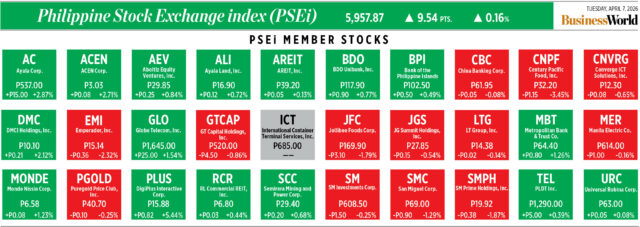
How PSEi member stocks performed — April 7, 2026

Here’s a quick glance at how PSEi stocks fared on Tuesday, April 7, 2026.


House summons audit, tax agencies in VP Duterte’s impeachment probe

VICE-PRESIDENT Sara Duterte-Carpio — OFFICE OF THE VICE PRESIDENT

By Erika Mae P. Sinaking, Reporter

THE HOUSE of Representatives Justice Committee has issued separate subpoenas to the Commission on Audit (CoA) and Bureau of Internal Revenue, ordering senior officials from both agencies to testify and submit government records tied to the impeachment proceedings against Vice-President (VP) Sara Duterte‑Carpio.

In orders dated March 31, the panel directed the agencies to produce documents and appear before lawmakers, signaling a deeper evidentiary phase in the impeachment inquiry as the committee evaluates whether grounds exist to advance the case.

The subpoena to the audit body was directed at State Auditor V Gloria A. Camora of the Commission on Audit-Intelligence and Confidential Funds Audit Office, the specialized unit that has custody of records covering the use of confidential and intelligence funds by the Office of the Vice-President and the Department of Education for 2022 and 2023.

Ms. Camora oversees audit files related to confidential fund disbursements during Ms. Duterte’s concurrent tenure as Vice-President and Education secretary, expenditures that sit at the center of the impeachment complaints.

Lawmakers ordered the audit body to submit original copies of all liquidation documents filed by the Office of the Vice-President for confidential funds covering the fourth quarter of 2022 and the first three quarters of 2023. The committee also sought related bank records, internal audit reports, communications involving education officials and any final findings issued by the audit body.

Ms. Camora’s testimony is necessary to “identify and authenticate the requested documents,” underscoring the committee’s aim to build an official paper trail based on primary government records, according to the summons.

The impeachment complaints allege, among other grounds, the improper liquidation and use of confidential funds by Ms. Duterte’s office.

The CoA unit responsible for reviewing intelligence and confidential expenditures is viewed by lawmakers as a key source of evidence to establish the factual basis of those claims.

The complaints were filed separately by Joel T. Saballa and others, endorsed by Party‑list Rep. Leila M. de Lima, and by Nathaniel G. Cabrera, endorsed by Reps. Bienvenido M. Abante, Jr. and Paolo P. Ortega V.

The committee earlier found both sufficient in form and substance and is now conducting hearings to determine probable cause.

TAX RECORDS
Separately, the panel summoned Bureau of Internal Revenue Commissioner Charlito Martin R. Mendoza, seeking almost two decades of tax records linked to Ms. Duterte and her husband, Manases R. Carpio.

The committee is demanding certified copies of the couple’s annual income tax returns from 2007 to 2025, as well as tax compliance and income records tied to business entities in which they are alleged to hold interests.

The subpoena directed Mr. Mendoza to identify and authenticate income tax returns and annual financial statements filed with the tax bureau, and to testify on the documents submitted to his office.

Lawmakers have said the tax records are crucial to assessing claims of unexplained wealth and potential violations of public trust raised in the impeachment filings.

Both subpoenas were signed by Justice committee Chairperson Gerville R. Luistro and Speaker Faustino “Bojie” G. Dy III, and attested by Secretary‑General Cheloy E. Velicaria‑Garafil.

The committee’s actions mark a broadening of its inquiry as it moves to compel testimony and records from key oversight agencies central to the allegations under review.

The House body has also summoned Ombudsman Jesus Crispin C. Remulla to testify and turn over the Vice-President’s wealth declarations.

Mr. Remulla on Monday said he would comply with the order and appear at an April 14 hearing. He has been ordered to submit certified copies of Ms. Duterte’s statements of assets, liabilities and net worth covering 2022 to 2025, as well as earlier periods from 2007 to 2013 and 2016 to 2022.

The records are needed “for the committee to be apprised of the assets, liabilities and net worth” declared by the Vice-President from the time she started public service until the present, according to the subpoena.

Political analysts earlier said the impeachment proceedings risk undercutting Ms. Duterte’s position as a leading contender for the 2028 presidential election, with corruption allegations threatening to erode the political capital she has built since sweeping into office in 2022.

The move to unseat Ms. Duterte intensifies a high-stakes political standoff between her and President Ferdinand R. Marcos, Jr., once allies who ran together on a unity ticket but have since fallen out and emerged as rivals.

Survey shows Sara ahead despite impeachment case

VICE-PRESIDENT SARA DUTERTE-CARPIO FACEBOOK PAGE

By Chloe Mari A. Hufana, Reporter

VICE-PRESIDENT Sara Duterte-Carpio remains the early front-runner for the 2028 presidential election, retaining a wide lead in a March 2026 survey by WR Numero despite facing an impeachment process in the House of Representatives.

The survey, released on Tuesday, showed Ms. Duterte securing 36% of voter preference, up three percentage points from November 2025. The result kept her well ahead of her closest challengers more than two years before the presidential election.

Undecided voters accounted for 19% of the respondents, underscoring the potential for shifts as political alignments solidify and the impeachment case develops.

Ms. Duterte declared her presidential bid on Feb. 18, days before the House began preliminary hearings on impeachment complaints against her. She has been accused of misusing confidential funds and other alleged irregularities related to her office.

The House proceedings aim to determine whether the complaints have sufficient basis to advance to trial in the Senate, which would convene as an impeachment court. The case is expected to test political alliances in Congress and could influence the dynamics of the 2028 race.

Senator Rafael “Raffy” T. Tulfo ranked second in the presidential preference survey with 19%, marking a five‑percentage‑point increase from November. Former Vice-President Ma. Leonor “Leni” G. Robredo followed with 16%, up three points over the same period.

Support for other potential contenders remained limited. Senator Christopher Lawrence “Bong” T. Go received 4%, Senator Paolo Benigno “Bam” A. Aquino IV captured 3% and former Senator Francis Pancratius “Kiko” N. Pangilinan drew 1% of voter preference.

The vice-presidential race showed greater dispersion, with no candidate emerging as a clear leader and more than a quarter of voters still undecided.

Mr. Go, former Senator Grace Poe-Llamanzares and Senator Robinhood C. Padilla each posted 12% support, placing them in a statistical tie. Mr. Go’s support declined by seven percentage points from November, while Ms. Poe gained four points and Mr. Padilla added three.

Senator Rodante D. Marcoleta, an ally of the Duterte family, polled at 8% in his first appearance in the vice-presidential preference survey. Opposition Senator Ana Theresia “Risa” N. Hontiveros-Baraquel secured 6%, up three points from November.

Support for Mr. Aquino dropped by five points to 2%. Senators Francis Joseph “Chiz” G. Escudero and Mr. Pangilinan each registered 5%, while Senator Maria Imelda Josefa Remedios “Imee” R. Marcos got 2%.

President Ferdinand R. Marcos, Jr. and Manila Mayor Francisco “Isko” Moreno Domagoso each received 4% support. Other figures, including Senator Sherwin T. Gatchalian, Metropolitan Manila Development Authority General Manager Nicolas D. Torre III, Baguio City Mayor Benjamin B. Magalong and Public Works Secretary Vivencio B. Dizon got below 1%.

WR Numero conducted the survey from March 10 to 17 through face‑to‑face interviews with 1,455 respondents nationwide. The poll carries a margin of error of ±3 percentage points at a 95% confidence level, with higher margins for subnational samples.

Philippine companies seek tax, work-from-home relief as costs rise

MOTORISTS queue at a gasoline station along Norzagaray Road in San Jose del Monte on March 8, 2026. — PHILIPPINE STAR/RYAN BALDEMOR

By Beatriz Marie D. Cruz, Senior Reporter

THE Philippine private sector is urging the government to grant temporary tax relief measures and expand work-from-home arrangements to help businesses and workers cope with rising costs linked to the escalating war in the Middle East.

“The important thing is that supply is available; the problem is on the price,” Jose Rene D. Almendras, private sector representative to the Legislative-Executive Development Advisory Council, told the ABS-CBN News Channel on Tuesday.

“During this period, let’s be more lenient. Let’s allow businesses to do things that help employees save money,” he said, referring to proposals raised during a recent meeting of private sector representatives with Executive Secretary Ralph G. Recto at the Presidential Palace.

Mr. Almendras said the group had pushed to raise the ceiling on the number of employees allowed to work remotely, arguing that broader work-from-home arrangements would help workers cut transport and fuel expenses as prices climb.

The Philippine Economic Zone Authority last week sought to increase the allowable share of remote workers from 50% to as much as 100% for registered enterprises operating inside economic zones, giving firms greater flexibility to manage higher operating costs driven by fuel price increases.

Mr. Almendras said the private sector also appealed for tax relief for employees to protect purchasing power as inflation accelerates.

Government economic managers have begun studying the possibility of raising the minimum deductible level under the income tax system, a move that would raise workers’ take-home pay and provide more buffer against higher prices.

Headline inflation accelerated to 4.1% in March from 2.4% in February, reflecting the impact of higher oil prices and peso weakness associated with geopolitical tensions in the Middle East.

Business representatives also called for adjustments to the tax treatment of employee benefits. Mr. Almendras said the group proposed raising the threshold on “de minimis” benefits, which are noncash perks employers provide to workers. These benefits are subject to caps, beyond which they may be taxed.

The Bureau of Internal Revenue increased the ceiling on nontaxable de minimis benefits in October last year. The rules exempted rice subsidies of up to P2,500 and medical cash allowances for employees’ dependents of up to P333 a month from income tax, withholding tax on compensation and fringe benefit tax.

Other items covered by the regulation include actual medical assistance, laundry allowances, daily meal allowances and benefits granted under collective bargaining agreements and productivity incentive programs, subject to prescribed limits.

Beyond taxes, the private sector urged the government to ease nonfuel friction costs, which business groups said disproportionately affect micro, small and medium enterprises. These include various local government fees that raise the cost of doing business but are not directly related to production or energy use.

Energy costs remain a key concern as fuel prices continue to rise. The Department of Energy has warned that diesel prices could reach as high as P172 per liter, while gasoline could climb to P120 per liter, after major oil companies announced another round of increases starting April 7.

Private sector representatives also promoted the wider use of alternative energy sources, including solar power, especially in small power utility group areas, to soften the impact of fuel-driven electricity price increases.

Businesses also asked the government to designate a specific official or office to receive industry feedback and proposals, a move they said would help speed up policy responses as cost pressures persist.

SC told unprogrammed funds erode control

PHOTO BY MIKE GONZALEZ

PLAINTIFFS challenging unprogrammed appropriations told the Supreme Court (SC) that the budget mechanism allows billions of pesos to move outside constitutional guardrails, weakening fiscal discipline and diluting Congress’ control over public spending.

“If the unprogrammed appropriations are not blank checks, they are checks drawn against insufficient funds,” Vaupetroanji J. Peña, lawyer for the petitioners Reps. Edgar S. Erice and Leila M. de Lima, said during oral arguments on Tuesday.

Solicitor General Darlene Marie B. Berberabe defended the provisions, saying unprogrammed items represent priorities that the government could pursue only if specific fiscal conditions are met. She described them as aspirational programs whose funding depends on excess revenues or additional borrowing.

The petitions seek to nullify Section 43 of the 2024 General Appropriations Act and similar provisions in the 2025 and 2026 budgets. The plaintiffs argued the sections violate the Constitution by authorizing contingent spending without definite funding sources and by allowing Congress to approve amounts that exceed the President’s proposed budget.

They pointed to the scale of the increases as evidence of overreach. The Executive branch proposed P281.9 billion in unprogrammed funds in the 2024 National Expenditure Program, but the figure rose to P731.4 billion in the enacted budget, an increase of about P449.5 billion. The petitioners said the expansion sidestepped constitutional limits on legislative adjustments to the budget.

Counsel for former Senate President Aquilino L. Pimentel III and former Speaker Pantaleon D. Alvarez asked the court to halt releases under the challenged provisions, warning that once funds are disbursed, any constitutional violation would be difficult to undo. They argued Congress effectively ceded its power of the purse to the Executive by allowing releases to depend on future and uncertain certifications.

The Office of the Solicitor General countered that unprogrammed appropriations do not authorize automatic spending and have been part of the national budget framework for decades.

Ms. Berberabe said the mechanism allows the government to act quickly when revenue conditions permit, without reopening the budget process.

Economic experts invited as friends of the court focused on fiscal risks. Former Socioeconomic Planning Secretary Solita “Winnie” D. Monsod warned that unprogrammed appropriations have become a repository for lump‑sum insertions, likening the structure to a modern pork‑barrel system.

She said wide gaps between the Executive proposal and the enacted budget emerged in recent years and contribute to weaker fiscal outcomes.

Former Budget Secretary Benjamin E. Diokno highlighted execution costs, saying essential items such as right‑of‑way acquisitions for major rail projects were transferred to unprogrammed status, exposing them to long delays and higher expenses, including fees paid to foreign lenders.

Former Senate President Franklin M. Drilon said unprogrammed funds are not unconstitutional by design but criticized the low threshold used to trigger their release. He argued releases should hinge on overall revenue performance rather than excess from a single source.

During questioning, Senior Associate Justice Marvic Mario Victor F. Leonen pressed government lawyers on why priority items such as defense modernization, free tertiary education and government personnel benefits were placed in a standby fund.

The court ordered the government to submit a detailed list of special allotment release orders for unprogrammed items in 2024 and 2025 before oral arguments resume later this month. — Erika Mae P. Sinaking

Filipina killed in Israel strike

SMOKE AND DUST rise after an Israeli strike on Beirut’s southern suburbs, March 2, 2026. — REUTERS/MOHAMED AZAKIR

THE DEPARTMENT of Foreign Affairs (DFA) on Tuesday confirmed the death of a Filipina national in Israel following a missile attack on the evening of April 5.

In a statement, the DFA said the Filipina died along with her Israeli husband and parents-in-law.

“I convey my deepest sympathies to the bereaved family and pray for strength and comfort for them during this difficult time,” Foreign Affairs Secretary Ma. Theresa P. Lazaro wrote in a tweet.

According to the DFA, the Philippine Embassy in Tel Aviv has reached out to the family of the victim for the repatriation of her remains at the earliest time possible considering the travel restrictions brought about by airspace closures since the war began on Feb. 28.

The Embassy of Israel in the Philippines identified the victim as 29-year-old Lucille Jane Gershovich, married to Dmitry Gershovich, 42, whose parents were Vladimir Gershovich, 73, and Lena Ostrovsky, 68.

“Israel stands in profound solidarity with the bereaved family and the Filipino community, and shares in the grief over the loss of a Filipino life,” the Israel Embassy said in a statement.

President Ferdinand R. Marcos, Jr. also directed concerned agencies to assist the family of Ms. Gershovich, noting that the Philippine Embassy is on standby for any help needed.

On March 1, a 32-year-old Filipina caregiver named Mary Ann Velasquez de Vera was also killed during an airstrike in Israel. — Kaela Patricia B. Gabriel

Probe of crisis fake news pushed

PRESIDENTIAL Communications Office Secretary Dave M. Gomez talked to the press after asking the Department of Justice to investigate a Facebook page accused of posting fake news related to the country’s energy situation. — PHILIPPINE STAR/RYAN BALDEMOR

THE PRESIDENTIAL Communications Office (PCO) on Monday requested the Department of Justice to investigate and file criminal charges against the administrators of a social media page accused of disseminating fabricated reports regarding the country’s energy situation.

PCO Acting Secretary Dave M. Gomez said that it referred the findings of its internal review to Acting Justice Secretary Fredderick A. Vida, noting that the move initiates the filing of charges to hold accountable those who maliciously seek to sow public panic and confusion, particularly during a period of national energy emergency.

“We are initiating the filing of charges against the persons responsible for the Facebook page ‘Malasakit News Pilipinas’ for posting fake news in a malicious desire to sow public panic and confusion and undermine public welfare and safety,” Mr. Gomez told reporters in an interview.

“We are asking the Department of Justice to investigate at least three ‘fake news’ posts, determine the persons that fabricated them and bring them to court on behalf of the Filipino people to answer for the harm they have caused the public,” he added.

Mr. Gomez said one post alleged a fabricated “energy lockdown” which was allegedly designed as a scam to coerce the public into purchasing solar panels.

Another post claimed a manufactured “fuel shortage,” Mr. Gomez said, which induced panic and prompted citizens to unnecessarily stock up on gasoline, diesel, and liquefied petroleum gas. The third post flagged by the PCO was an invented “emergency lockdown” attributed to an imagined “cicada” variant of COVID-19.

Malasakit News Pilipinas did not immediately reply to a Facebook Messenger chat seeking comment.

Government agencies immediately debunked these claims, noting that the posts were timed to exploit existing public anxiety following the declaration of a state of national energy emergency.

Under Article 154 of the Revised Penal Code, the publication of false news is a crime punishable by up to six months of imprisonment.

Mr. Gomez added that because these offenses were committed using online platforms, the penalties are expected to be one degree higher under the Cybercrime Prevention Act.

These malicious posts were first identified by the PCO Anti-Fake News Desk, which was established last month as part of a broader initiative in partnership with the country’s major newspaper publishers to combat disinformation.

“We remind users of social media platforms that the government will exercise zero tolerance for those who maliciously and deliberately spread utter falsehoods and fabricated contents,” Mr. Gomez said.

“Any attempt to mislead the public about energy security, supply, or pricing to sow confusion will be treated as a serious offense,” he added.

He said the PCO is now intensifying its monitoring of social media and information ecosystems to detect and counter such disinformation campaigns. — Erika Mae P. Sinaking

PUV service contracting to roll out

PHILIPPINE STAR/RYAN BALDEMOR

THE Land Transportation Franchising and Regulatory Board (LTFRB) will launch service contracting for public utility vehicles (PUVs) on select routes starting April 15 to help commuters and drivers amid rising fuel costs.

“The areas of operations of the service contracting for land-based public transportation was based on the data analysis on commuter traffic volume and interconnectivity to the mass transport system,” LTFRB Chairman Vigor D. Mendoza II said in a media release on Tuesday.

The LTFRB, together with the Transportation department, also started reviewing the guidelines for implementation of service contracting programs.

For Metro Manila, service contracting includes EDSA Bus Carousel program, modern and traditional jeepneys with routes along the Light Rail Transit and Metro Rail Transit lines stations, including major transportation hubs.

“These routes were prioritized as they support connectivity to rail transport systems, serve high passenger demand corridors, improve overall commuter mobility, and help reduce traffic congestion in key areas,” he said.

For Davao City and Cagayan de Oro City, service contracting will only cover certain routes based on passenger traffic, LTFRB said.

“These routes were selected to maximize the impact of limited funding, support high-ridership corridors, and ensure service continuity in major urban areas outside Metro Manila,” Mr. Mendoza said.

Service contracting, funded under the 2026 General Appropriations Act, is one of the government’s initiatives to support commuters, drivers, and operators amid rising fuel costs. Through this program, the government compensates PUV drivers and operators to provide free transportation services to commuters. — Ashley Erika O. Jose

ADVERTISEMENT
ADVERTISEMENT