Home Blog Page 5265

New Russian offensive underway in Ukraine, says NATO

JERNEJ FURMAN-FLICKER

KYIV — The eastern Ukrainian city of Bakhmut was facing heavy artillery fire as the NATO chief backed reports from local officials that a major new Russian offensive had begun, days before the first anniversary of Moscow’s invasion.

Ukrainian defenders, who have already held out for months, were defending new ground attacks under heavy shelling, Ukrainian military officials said.

Over the past day, Ukrainian forces repelled Russian attacks in one settlement of the Kharkiv region, around five settlements in Luhansk region and six settlements in Donetsk region, including in the Bakhmut area, the general staff of Ukraine’s armed forces said on Tuesday.

Positions in Bakhmut have been fortified and only people with a military role were being allowed in, while any civilians who still wanted to leave the city would have to brave the incoming fire, a deputy battalion commander said on Monday.

“There is not a single square meter in Bakhmut that is safe or that is not in range of enemy fire or drones,” Pavlo Kyrylenko, governor of the Donetsk region, told the Ukrainian national broadcaster late on Monday.

Bakhmut is a prime objective for Russian President Vladimir Putin, and its capture would give Russia a new foothold in the Donetsk region and a rare victory after months of setbacks.

The Donetsk and Luhansk regions make up the Donbas, Ukraine’s industrial heartland, now partially occupied by Russia which wants full control.

“We see how they are sending more troops, more weapons, more capabilities,” NATO Secretary-General Jens Stoltenberg told reporters in Brussels, saying it was the start of a new offensive.

The Russian assault on Bakhmut has been spearheaded by mercenaries of the Wagner group, who have made small but steady gains. The renewed Russian bombardments made the situation there even more acute.

The Russian defense ministry said its troops had pushed forward a few kilometers along the frontlines, without specifying where.

“Thank you to every one of our soldiers who are preventing the occupiers from encircling Bakhmut… and who are holding our key positions at the front,” President Volodymyr Zelenskiy said in his evening address.

Reuters was not able to independently verify the battlefield reports.

NATO TO DISCUSS FURTHER AID
The United Nations’ human rights office said on Monday it had recorded 7,199 civilian deaths and 11,756 wounded since Russia’s Feb. 24 invasion, mostly from shelling and missile and air strikes. However, it believed the actual figure was far higher.

Russia invaded Ukraine on Feb. 24, 2022, in what it calls a “special military operation” to “denazify” the country and protect Russian speakers. Western leaders say it was nothing more than a land grab.

Moldova’s president accused Russia on Monday of planning to use foreign saboteurs to bring down her leadership and use it in the war against Ukraine.

Zelenskiy said last week his country had uncovered a Russian intelligence plan “for the destruction of Moldova.” Days later the government of the country, bordering Ukraine and Romania, resigned.

Russia denied last year wanting to intervene in Moldova after authorities in Transdniestria, a breakaway region that has survived for three decades with support from Moscow, said they had been targeted by a series of attacks.

White House national security spokesperson John Kirby on Monday said reports of the plot had not been independently confirmed but were “deeply concerning” and “certainly not outside the bounds of Russian behavior.”

With Ukraine desperate for more weapons, defense ministers from several NATO countries allied to Kyiv will meet in Germany on Tuesday to discuss possible further military aid.

On the eve of the meeting, Ukraine’s top general and the most senior US Army commander in Europe discussed military aid and training in a telephone conversation. Ukraine says it needs fighter jets and long-range missiles.

Stoltenberg said he expected the issue of aircraft to be discussed, but that Ukraine needed support on the ground now.

A NATO source said it would increase targets for the stockpiling of ammunition as Kyiv was burning through shells much faster than Western countries can produce.

Western capitals will lay out additional pledges of ammunition and air defense equipment for Ukraine on Tuesday, officials told the FT.

Training of Ukrainian forces on the Leopard 2 and other modern battle tanks that are to boost the country’s defense is underway in several European countries, including Poland, Britain and Germany. — Reuters

Japan’s weak Q4 GDP rebound poses challenge for BOJ’s exit path

REUTERS

TOKYO – Japan’s economy averted recession but rebounded much less than expected in the fourth quarter as business investment slumped, a sign of the challenge the central bank faces in phasing out its massive stimulus program.

While private consumption is holding up against headwinds from rising living costs, uncertainties over the global economic outlook will weigh on Japan’s delayed recovery from the scars of the COVID-19 pandemic, analysts say.

The world’s third-largest economy expanded an annualized 0.6% in the final quarter of last year after slumping a revised 1.0% in July-September, government data showed on Tuesday.

The increase in gross domestic product (GDP) was much smaller than a median market forecast for a 2.0% rise, due to a downswing in capital expenditure and inventory.

“From a negative growth in July-September, the rebound isn’t very impressive,” said Toru Suehiro, chief economist at Daiwa Securities.

“We can expect consumption to pick up as service spending stabilizes. But it’s difficult to project a strong recovery partly due to pressure from rising inflation,” he said.

BOJ POLICY CHALLENGE

The weak data highlights the delicate task at hand for Kazuo Ueda, the government’s nominee to become next Bank of Japan (BOJ) governor, as he plots a path to normalizing the bank’s ultra-easy policy without derailing a fragile economic recovery.

Policymakers hope a rebound in consumption, driven by savings accumulated during the pandemic, will last long enough for wages to pick up and cushion the blow on households from rising food and fuel costs.

With inflation exceeding the BOJ’s 2% target, the outlook for the economy and wages will be key to how soon the central bank could phase out its massive stimulus program.

“It might be hard for the BOJ to normalize ultra-easy policy this year as overseas economies are slowing,” said Takeshi Minami, chief economist at Norinchukin Research Institute.

“The BOJ may have to wait until fiscal 2024 at the earliest.”

While private consumption rose 0.5% and external demand added 0.3 percentage point to growth, capital expenditure was a drag on the economy, falling a bigger-than-expected 0.5%, the data showed.

Private inventories also shaved 0.5 point off growth as firms saw declining stock of automobile and raw materials.

RECESSION RISKS

For the full year, the economy expanded 1.1% compared with a 2.1% increase in 2021, the data showed.

Japan has seen an increase in the number of overseas visitors since ending in October some of the world’s strictest border controls to prevent the spread of the COVID-19 pandemic.

Economy minister Shigeyuki Goto told reporters the economy was on course for a recovery as the pandemic’s impact fades.

“Rising inflation and the global slowdown are risks,” he said after the data release. “But corporate spending appetite hasn’t cooled … we’re not too pessimistic about the outlook.”

Some analysts, however, warn that global headwinds could weigh on the export-reliant economy and derail a fragile recovery by discouraging manufacturers to hike pay.

“With other advanced economies heading into recessions, we still expect net trade to drag Japan into a recession as well in the first half, especially since business investment is weakening faster than we had expected,” said Darren Tay, Japan economist at Capital Economics. — Reuters

‘Day of pain’: Wirecard boss denies charges in massive fraud trial

An investigation will look into Wirecard’s local partners, including PayEasy Solutions, Centurion Online Payment International, and ConePay International. -- Image courtesy of Reuters.

MUNICH – Wirecard’s former boss on Monday denied all wrongdoing over the collapse of the payments company as he took to the stand for the first time in Germany’s biggest post-war fraud trial, accusing other managers of scheming behind his back.

Dressed in his trademark black turtleneck and rimless spectacles, Markus Braun, 53, expressed his “deepest regret” over Wirecard’s demise but said he had no knowledge of any forgery or embezzlement and believed he was running a healthy business.

The Austrian-born former chief executive and two other ex-Wirecard managers Oliver Bellenhaus and Stephan von Erffa are on trial on charges including market manipulation and fraud and face up to 15 years each in prison if convicted.

Former chief operating officer Jan Marsalek is an international fugitive on Europe’s most wanted list whose whereabouts are unknown.

Braun has been in custody since the 2020 collapse of Wirecard, which shook Germany’s business establishment, putting politicians who backed it and regulators who took years to investigate allegations against the firm under intense scrutiny.

“I had no knowledge of counterfeiting or embezzlement,” Braun told the court in Munich, describing the discovery of 1.9 billion euro ($2 billion) hole in Wirecard’s balance sheet as a “day of pain” for shareholders and employees.

Prosecutors accuse the defendants of being in a gang that invented vast sums of phantom revenues through bogus transactions with partner companies to mislead creditors and investors.

Braun’s lawyers have previously alleged that Bellenhaus was the main perpetrator of fraud at the company, which began processing payments for pornography and online gambling and rose to be a blue chip DAX company worth $28 billion.

‘NOTHING TO HIDE’

Bellenhaus, who became a key witness after turning himself in to the authorities, has painted Braun as an “absolutist CEO” calling the shots at the heart of a vast swindle.

In his most detailed statements about Wirecard’s collapse since his arrest, Braun pushed back against that characterisation, describing his leadership as collegiate.

Instead, Braun accused Marsalek of constructing a “myth” that Wirecard’s finances were healthy while he and Bellenhaus tried to obstruct Braun’s attempts to hire KPMG as an external auditor as allegations of wrongdoing at the firm mounted.

By bringing in KPMG, the aim was to clear up “once and for all” allegations about balance sheet manipulation, Braun said. “I told Marsalek we have nothing to hide.”

When 1.9 billion euros went missing from the balance sheet, “Marsalek was very clever and understood how to explain that it was a mistake,” Braun said, speaking in the same calm and concentrated voice with which he used to address investor meetings and press conferences.

Matters came to a head in February 2020, Braun said, when Marsalek came to his office and revealed he had shifted billions of euros from Singapore to accounts in the Philippines without the knowledge of Braun or the company’s chief financial officer.

“I didn’t scream. It’s not my style,” Braun said, adding “I can remember asking him if he had lost his mind.”

Braun said he had resolved to fire Bellenhaus and clip Marsalek’s powers, though the company collapsed before he did so.

Describing Marsalek as intelligent but somewhat withdrawn, Braun said he was only later made aware of allegations in the media that Marsalek had ties to the security services and ran a shadow business operation from a Munich villa.

Braun also batted away suggestions that he had asked private security contractors to harass journalists who were investigating his company.

He contrasted Wirecard’s demise with accounts of his early years at the company, describing a struggling startup where he and other managers pulled all-nighters and worked with a sense of mission. “There was in reality no life outside the company,” he said. — Reuters

January vehicle sales climb by 42%

Vehicles are seen in the northbound lane of EDSA in Pasay City, Aug. 14, 2022. — PHILIPPINE STAR/MIGUEL DE GUZMAN

VEHICLE SALES in the Philippines surged by 42% in January, driven by strong demand for passenger cars and commercial vehicles.

The joint report by the Chamber of Automotive Manufacturers of the Philippines, Inc. (CAMPI) and Truck Manufacturers Association (TMA) showed automotive sales rose to 29,499 units in January from 20,765 units a year earlier. 

Month on month, vehicle sales fell by 21% from 37,259 units in December.

Auto sales“The double-digit sales growth of 42.1% recorded in January, coming from a year-on-year robust growth performance in 2022 is a good development momentum for the auto industry as we start the year,” CAMPI President Rommel R. Gutierrez said in a statement.

In January, commercial vehicle sales climbed by 46.8% to 21,993 from 14,981 a year ago. Those accounted for 74.56% of the industry’s total sales.

Light commercial vehicle sales jumped by 40.9% year on year to 16,757, while Asian utility vehicle (AUV) sales rose by 87.1% to 4,587. Sales of light trucks went up 10.8% to 370.

January passenger car sales jumped by 29.8% to 7,506 from 5,784 a year earlier.

Among car manufacturers, Toyota Motor Philippines Corp. posted the highest sales in January at 13,428 units. These accounted for 45.52% of the industry’s total sales.

Other leading car manufacturers for January were Mitsubishi Motors Philippines Corp. with a 17.05% market share or 5,030 units sold; Ford Motor Co. Phils. Inc. with 7.14% or 2,107 units sold; Nissan Philippines, Inc. with 6.37% or 1,878 units sold; and Honda Cars Philippines, Inc. with 5.56% or 1,639 units sold.

After the strong January sales, Mr. Gutierrez said the industry is bullish that demand would continue to rise.

“The auto industry is optimistic of its continued expansion from the demand-side standpoint driven by the growing domestic consumer market,” he said. On the other hand, the supply-side challenges are also an important factor that the industry is mindful of as this may hamper the industry growth.”

CAMPI has yet to give its sales target for 2023.

In 2022, CAMPI and TMA members sold 352,596 units, up by 31.3% year on year, and exceeding the group’s sales target of 336,000.

“The auto sales sustaining growth or exceeding last year’s record is not always clear-cut as our overall economic health and activity depend on various economic key indicators,” Mr. Gutierrez said.

The government expects gross domestic product (GDP) growth to slow to 6-7% this year, from 7.6% a year earlier. — Revin Mikhael D. Ochave

Nomura raises PHL GDP forecast for 2023, 2024

PARKGOERS stroll through the Mehan Garden in Manila, Feb. 12. — PHILIPPINE STAR/MIGUEL DE GUZMAN

NOMURA HOLDINGS, Inc. has raised its Philippine gross domestic product (GDP) growth estimates for this year and 2024, though these were still below the government’s forecast.

In the report “Philippines: A shallower growth dip,” Nomura Chief ASEAN (Association of Southeast Asian Nations) economist Euben Paracuelles and analyst Rangga Cipta said the Philippine economy is now expected to grow by 5.5% this year, from 4.3% previously.

“We now forecast a more modest slowing of GDP growth to 5.5% in 2023 after a better-than-expected outturn (7.2%) in the fourth quarter last year, which brought full-year 2022 growth to 7.6%,” Nomura said.

Nomura also hiked its GDP growth projection to 6.3% for 2024 from 6%.   

Both estimates are still below the government’s 6-7% target for 2023 and the 6.5-8% goal for 2024.   

“In addition, the relatively large upward revisions to our US and China GDP growth forecasts have a material impact on our Philippine forecasts via the export channel (both goods and services),” Nomura said.   

It raised its GDP growth estimate for China to 5.3% this year from 4.8%, while it sees the US economy expanding by 0.7% from 0.1%.    

“Still, our 2023 GDP growth forecast is below the government’s target of 6-7%, on our view that domestic demand will likely be less resilient than in past global downturns because of persistently high inflation, which hurts consumption spending,” Nomura said.

Inflation as well as high food and energy prices pose downside risks to growth, while increased foreign direct investments and the quicker rollout of infrastructure projects are upside risks, Nomura said.

Inflation quickened to a 14-year high of 8.7% in January from 8.1% in December.

“We therefore raised our 2023 inflation forecast to 5.6% from 4.4%, further above the Bangko Sentral ng Pilipinas’ (BSP) 2-4% target,” Nomura said.

The central bank sees inflation averaging 4.5% this year before easing to 2.8% in 2024.

“We maintain our forecast for BSP to hike by an additional 50 basis points (bps) to 6%, penciling in two 25-bp hikes in each of the next two meetings in February and March,” Nomura said.   

The central bank will likely start cutting its policy rate from the fourth quarter of 2023, instead of the third quarter, it added.

The Monetary Board increased the benchmark rate by 350 bps to a 14-year high of 5.5% last year.

The BSP is widely expected to raise benchmark interest rates at its meeting on Thursday. A BusinessWorld poll showed nine analysts expect it to hike borrowing costs by 50 bps, while eight analysts anticipate a 25-bp increase.

Nomura also expects a slower narrowing of the fiscal deficit to  6.6% of GDP this year from 6.8% in 2022. This is lower than the government’s 6.9% forecast.   

“While total revenues are tracking above official projections in 2022, we think they will underperform in 2023, given our nominal GDP growth forecast is lower than in the (medium-term fiscal framework). Importantly, we think expenditures will hold up, led by capital outlays under the ‘Build Back More’ infrastructure program,” it said. — Keisha B. Ta-asan

DoTr to award remaining subway contracts by Q3

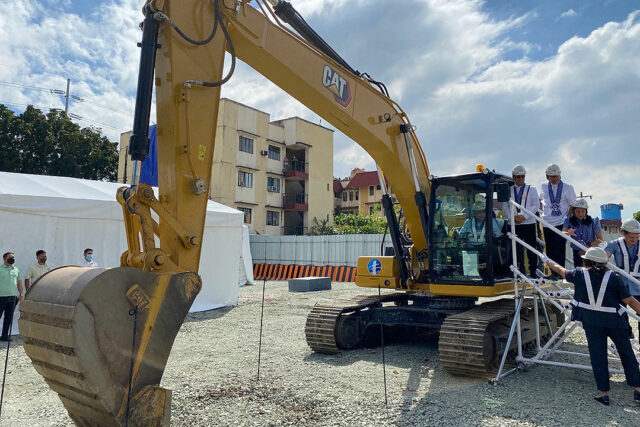
A GROUNDBREAKING CEREMONY for two subway stations of the Metro Manila Subway project was held at Camp Aguinaldo in Quezon City on Feb. 13. The subway project is supported by the government of Japan through the Japan International Cooperation Agency. — COURTESY OF JAPAN INTERNATIONAL COOPERATION AGENCY

THE DEPARTMENT of Transportation (DoTr) is planning to award the remaining three contract packages of the Metro Manila Subway Project by the third quarter.

Transportation Undersecretary Cesar B. Chavez told reporters on Monday the contract packages 105, 108 and 109, with an estimated cost of about P20 billion each, would be awarded by the “second or third quarter” this year.

The construction of two underground stations near Anonas and Camp Aguinaldo, as well as tunnels under contract package 103 began on Monday with a groundbreaking ceremony at the military headquarters in Quezon City.

Sumitomo Mitsui Construction Co. Ltd. is the contractor for this six-kilometer segment that connects Quezon City and Pasig City, with construction expected to take almost six years.

Pre-construction works for Camp Aguinaldo Station started in November 2021, and is targeted to be completed by the third quarter.

The DoTr said it would break the ground for the Quezon Avenue and East Avenue stations, which are under contract package 102, in March.

“We have talked with the Department of Human Settlements and Urban Development and National Housing Authority… It’s just that the contract for (package) 103 was earlier but we will start with (contract package) 102 next month),” Mr. Chavez said in a mixed of English and Filipino.

The P357-billion, 33-kilometer subway will run from Valenzuela City to FTI-Bicutan in Parañaque City, with a spur line to the Ninoy Aquino International Airport (NAIA) Terminal 3 in Pasay City. It will have 17 stations.

The government of Japan, through official development assistance, is providing the Philippine government with funds for the Metro Manila subway.

Transportation Secretary Jaime J. Bautista said the project is still on track to meet its 2028 target completion date despite the challenge of obtaining right-of-way for certain portions of the subway.   

“There could be partial operations for the first stations, from Valenzuela up to Ortigas. But we will try to finish the project by 2028,” Mr. Bautista said in a mixed of English and Filipino. “Right-of-way still remains a challenge but we don’t see it delaying the project.

With partial operations, the subway is expected to serve about 370,000 passengers a day. At full operations, it can serve about 519,000 passengers daily.

Asked about plans to develop three to four more subway systems, Mr. Bautista said feasibility studies were being undertaken.

“The planning department is still studying the possible subways so we can’t say for now when it will be launched, but it is being planned,” he added.

The new subways are expected to be built within Metro Manila, specifically in Parañaque City. However, Mr. Bautista said there are proposals to build a subway outside Metro Manila, such as Cavite. — Justine Irish D. Tabile

Congress to pass Maharlika bill, 9 others before June 2 — Palace

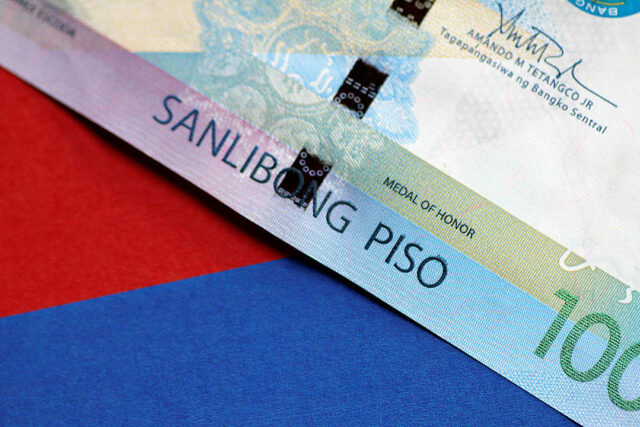
A Philippines peso note is seen in this picture illustration on June 2, 2017. — REUTERS

THE PROPOSED Maharlika Investment Fund (MIF) is one of the 10 priority legislative measures to be approved by Congress by June, according to the Palace.

At the same time, Senate leaders also committed to push for the ratification of the Regional Comprehensive Economic Partnership (RCEP).

At a meeting in Malacañang on Monday, the Legislative-Executive Development Advisory Council (LEDAC) identified the sovereign wealth fund and nine other priority bills to be approved by Congress before the end of its  first regular session on June 2.

The House of Representatives approved the proposed Maharlika Investment Fund in December, while a counterpart measure is pending in the Senate.

Other priority measures include the proposed Internet Transactions Act/E-Commerce Law; the Salt Industry Development bill; a bill condoning unpaid amortization and interest on loans of agrarian reform beneficiaries; and a bill amending the law granting a three-year fixed term for Armed Forces of the Philippines (AFP) top officials.

Other priority measures include changes to the Build-Operate-Transfer (BOT) Law/Public-Private Partnership (PPP); as well as the bills creating a Philippine Center for Disease Prevention and Control, Medical Reserve Corps and Virology Institute of the Philippines.

Another priority measure is a bill establishing a mandatory Reserve Officers Training Corps and National Service Training Program.

Senator Emmanuel Joel J. Villanueva said the Senate’s priority bills are similar to those identified by the LEDAC, with the inclusion of the RCEP ratification and a bill institutionalizing the National Educators’ Academy of the Philippines (NEAP).

President Ferdinand R. Marcos, Jr. on Sunday said that RCEP would provide more trade opportunities for the Philippines.

“If we are not part of the RCEP, we wouldn’t have access to their markets, (particularly) those supply chains available in the ASEAN (Association of Southeast Asian Nations),” he told reporters in Filipino while aboard a plane back to Manila from Tokyo.

Once part of RCEP, Mr. Marcos said the Philippines could access non-traditional suppliers of agricultural inputs and commodities.

The RCEP is a free trade agreement between member states of the Association of Southeast Asian Nations (ASEAN) and Japan, China, Australia, South Korea and New Zealand. The Philippines is the only ASEAN country that has not ratified the RCEP.

Senate President Juan Miguel F. Zubiri last month said the Senate is expected to ratify it this quarter.

Former President Rodrigo R. Duterte retified the RCEP in September 2021, but the previous Senate did not give its concurrence due to concerns over the free trade deal’s impact on the agriculture sector. — Beatriz Marie D. Cruz

Globe receives P8.6B for towers sold to Phil-Tower

GLOBE Telecom, Inc. has closed the sale of 578 towers to Phil-Tower Consortium, Inc. for P8.6 billion as part of its capital-raising strategy to improve its balance sheet.

In a disclosure to the Philippine Stock Exchange, the Ayala-led company said it received the amount on Feb. 11, which is the first closing of the 1,350 towers set to be transferred to Phil-Tower.

Rizza Maniego-Eala, Globe’s chief finance officer, said the transfer of nearly half of the towers provides the company “much-needed financial flexibility, especially in the current macroeconomic backdrop of high inflation and increasing interest rate environment.”

The deal goes back to Aug. 11, 2022 when the board of directors of the telco company approved the sale and leaseback agreement of its towers with Phil-Tower.

In total, Globe said it has completed 42% of the sale or a total of 2,988 of its 7,059 have been transferred to tower companies, raising around P39 billion so far.

“We are taking advantage of the arrangements we made with the [tower companies] to accelerate our tower builds and ensure fast and reliable connectivity as we roll out core products and services and diversify into new ventures,” said Ernest L. Cu, Globe president and chief executive officer.

The towers turned over to Phil-Tower are in the Visayas and Mindanao. Of these assets, 92% are ground-based towers and 8% are rooftop towers, Globe said.

Globe initially estimated a P5.2-billion gain from the transaction which it said is still subject to the carrying amount of the tower assets at the time of the actual sale.

“There will be multiple closing dates which will happen as and when closing conditions are met,” the company said.

In a separate press release, Globe said that its corporate venture builder, 917Ventures, received the initial batch of 100 Smartscooters, 400 smart batteries and seven GoStations from Taiwan-based Gogoro, to which it made an initial investment of $4 million.

The announcement is part of the partnership between 917Ventures, Ayala Corp. and Gogoro that aims to reduce the use of fossil fuels in the logistics industry.

The pilot run for Gogoro in Metro Manila will start in March 2023. The company said it will disclose details on the start of its commercial operations in due course.

Previously, Globe launched electric-powered shuttles from Global Electric Transport Philippines to service the company’s employees in Bonifacio Global City, Makati City and Mandaluyong City starting Jan. 23.

The use of electric vehicles is part of Globe’s plan of reducing its greenhouse gas emissions (GHG) in support of the Philippines’ commitment to reduce GHG emissions by 75% in 2030.

“This also aligns with Republic Act 11697, or the Electric Vehicle Industry Development Act, which mandates corporate fleets to ensure that 5% of their vehicles, whether owned or leased, are EVs within the government prescribed timeframe,” the company said.

On Monday, shares in Globe declined by 0.79% or P16 to close at P2,000 each at the stock exchange. — Justine Irish D. Tabile

SEC warns about Platinum Coin, plans SME fund-raising

THE Securities and Exchange Commission (SEC) has warned the public against Platinum Coin, which the regulator said is not authorized to solicit investments.

Platinum Coin is said to have been offering investments for a minimum amount of P1,000 up to P650,000. It also transacts as Platinum Coin Pawnshop.

Investors in the company are promised to earn 15% to 30%, plus a one-time 5% outright commission, apart from an option to earn a 2.5% monthly income if they applied as an official team leader.

The team leaders are said to be given a cash gift of P10,000 to P70,000, and P500 worth of load weekly. Platinum Coin investors are also promised a 20% yearly bonus.

The regulator found out that the company also engages in online lending business without securing a certificate of authority to operate as a lending company.

In its investigation, the SEC found out that the investment-taking company is not registered as a corporation nor as a partnership. The entity is operating without a license to take investments from the public.

In a separate press release, the SEC said it will be embarking on a nationwide roadshow that seeks to support the growth of micro, small and medium enterprises (MSMEs).

The roadshow, which will be piloted on Feb. 15 in Davao City, is seen to help MSMEs in tapping the capital market including crowdfunding platforms.

“Under the Crowdfunding Rules, SMEs no longer have to register securities with or secure approval directly from the SEC before they can solicit investments from the public. SMEs need only conduct their fundraising activity with a crowdfunding intermediary, funding portal, or crowdfunding platform registered with the SEC,” the commission said.

An MSME can raise as much as P10 million from any investor, and up to P50 million from qualified investors, within a 12-month period.

Three crowdfunding intermediaries have registered to date, namely: Investree Philippines, SeedIn Technology, Inc., and Eastern Securities Development Corp.

SEC Chairperson Emilio B. Aquino said the nationwide roadshow aims to help MSMEs that are greatly affected by the pandemic.

“We at the SEC hope to stem their financial woes by providing possible solutions to these enterprises, particularly through the capital market and crowdfunding,” said Mr. Aquino.

The roadshow will be under the SEC’s Office for the Advancement of Strategic Investments in SMEs, which aims to encourage small entities to explore the capital market to acquire external financing.

The initiative is also part of the SEC’s goal of having at least 888 companies tap the capital market by 2024, or the 88th year of the regulatory body.

The roadshow will next be held in Cebu, Cagayan de Oro, Zamboanga, Bacolod, Legazpi, Iloilo, Tarlac, Baguio, the Calabarzon (Cavite, Laguna, Batangas, Rizal, and Quezon) region, and Metro Manila. — Justine Irish D. Tabile

Manila Water unit inks 25-year deal with Davao industrial developer

A UNIT of Manila Water Co., Inc. has signed a 25-year partnership with Damosa Land, Inc. to develop and manage water facilities for an industrial estate, the east zone water concessionaire said on Monday.

In a statement, Manila Water said its subsidiary Manila Water Philippine Ventures, Inc. (MWPV) will spend about P125 million for the development, financing, construction, operation and management of the water system of Anflo Industrial Estate (AIE)

AIE is Damosa Land’s industrial development for trade and agriculture. It is a 63-hectare property in Panabo, Davao del Norte. The industrial estate has 19 existing locators from the Philippines, Japan, Austria, China, and the US.

Manila Water said the partnership is expected to meet the estimated demand of about 2.6 million liters per day (MLD) by bringing in additional facilities which will be integrated into AIE’s existing systems.

Roberto Jose R. Locsin, chief operating officer for international businesses and chief administrative officer of Manila Water, said the partnership will expand the company’s services beyond its franchise area in the east zone of Metro Manila.

“We look towards the growth in the Visayas and Mindanao regions where active developers like Damosa Land share a common vision of ensuring water security and availability to all Filipinos,” Mr. Locsin said.

Ricardo F. Lagdameo, president of Damosa Land, said the partnership with Manila Water will accelerate its sustainability goals by ensuring a reliable water supply.

“Damosa Land recognizes the importance of having a reliable water supply system for our locators to ensure efficient day-to-day business operations over a long period of time. Our partnership with the MWPV helps us further accelerate our sustainable operations at the Anflo Industrial Estate and upraise the industrial segment of Davao for our current and future locators,” he said.

MWPV is Manila Water’s designated vehicle for expansion initiatives in the country.

The water concessionaire serves Metro Manila’s east zone network, which comprises Marikina, Pasig, Makati, Taguig, Pateros, Mandaluyong, San Juan, portions of Quezon City and Manila, and several towns of nearby Rizal province. — Ashley Erika O. Jose

Clark Airport operator records 72% profit rise

Clark International Airport
STOCK PHOTO | Image by BCDA.GOV.PH

CLARK International Airport Corp. (CIAC) on Monday said its net income last year rose by 72.3% to P438.75 million from P254.72 million a year earlier as it booked higher revenues.

Revenues in 2022 reached P758.7 million, up by 36.7% from P555 million previously.

CIAC Officer-in-Charge Darwin L. Cunanan said the company also recorded a higher profit margin in 2022 at 58% from 46% in 2021, allowing it to pay bank loans and remit dividends to the government.

“CIAC ensures fiscal discipline and financial viability, and we also adhere to the highest standards of corporate governance so now we are a debt-free agency and at the same time able to remit dividends to the national treasury,” Mr. Cunanan said in a press release.

The loans, which include funds borrowed from the Land Bank of the Philippines and the Development Bank of the Philippines, were paid during the last quarter of 2022. These were used for airport expansion infrastructure projects.

The company was able to remit around P369 million in dividends to the Bureau of the Treasury in several tranches from May to October 2022 to cover the company’s 2019-2021 obligations.

“CIAC’s thrust now is to strengthen our commercial, engineering and corporate management teams in developing a globally-competitive service and logistics center at the aviation complex surrounding the airport and contribute to the national economy,” Mr. Cunanan said.

CIAC supervises and oversees the activities within the Clark Civil Aviation Complex including the Clark International Airport.

The airport, which was completed last year, has a capacity of 8 million passengers annually. Its capacity is estimated to increase to 80 million passengers a year upon the full implementation of the CIAC Master Development Plan. — Justine Irish D. Tabile

Century Peak unit starts selling cement in key Visayan markets

CENTURY Peak Holdings Corp. on Monday said its cement manufacturing unit has started distributing its cement products in key markets in the Visayas.

“We are looking at the markets where we can make an impact and the Visayas region, particularly in Cebu, Palawan, Mindoro, Bohol and Dumaguete, are included in our initial phase of distribution,” said Century Peak Vice President for Finance Katrina C. Cheng in a statement.

Century Peak Cement Manufacturing Corp. recently entered the cement market after the Department of Trade and Industry  granted quality standard certification for its Pro (blended hydraulic) and Prime (Portland) cement products.

The certificate means that the variants meet or exceed the requirements set by the Bureau of Philippine Standards.

With its pier located near the manufacturing plant in Pinamungajan, Cebu, the company said it is easier to transport cement products throughout the country, especially in the Visayas.

“As a locally developed brand, we put first the interest of the nation and our countrymen. It begins, naturally with our product that meets the standards set by the certifying bodies that ensure quality,” Ms. Cheng said.

“We are also targeting underserved localities that may not have much option in terms of cement brands and, by doing so, create for consumers a choice,” she added.

The cement producer is also engaged in the manufacturing, production, and merchandising of cement, cement products, and by-products, including their derivatives and all kinds of minerals and building materials. — Sheldeen Joy Talavera

ADVERTISEMENT
ADVERTISEMENT